One evening some years ago, Stephanie my wife prayed for guidance as to whether or not she should return to work part time. The very next morning, an absolutely perfect job practically fell into her lap. To us, this was an obvious sign from God. Yet that night, as we adjusted our family budget to reflect Stephanie’s new income, what did we start to do? We started to worry about money. God had just answered our prayer and shown us how much he cares for us. But still we didn’t “get it.” Finally, we looked at each other and said with exasperation, “What are we doing?” What we weren’t doing is trusting in Jesus, which is what he constantly invites us to do. That’s why he calls himself the good shepherd.
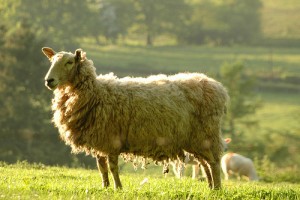
The image of Jesus as the “good shepherd” tells us quite a bit about what he wants our relationship with him to be like. I was once reminded of this very early in my ministry, while I served a small Texas church, smack in the middle of cattle country. There w ere real cowboys in my parish, and one day one of them said to me, “You know, Father there’s a reason Jesus never said: ‘I am the good cowboy.’” Cows, he explained, are very obstinate creatures. To get them going in the right direction, they need to be pushed and poked from behind- sometimes with an electric prodder! Sheep, however, are very different from cows. When they hear their shepherd’s call, they happily follow his lead. Just like Jesus said in today’s gospel: “My sheep hear my voice. I know them, and they follow me.” In other words, Jesus doesn’t want to have to push us like cows. Instead, he wants us to follow him like sheep.
The beautiful 23rd Psalm, which we just prayed together, speaks to us of how Jesus our shepherd cares for us when we trust and follow him. In an often reprinted Reader’s Digest article from over fifty years ago, one old shepherd explained that the psalm’s author obviously knew sheep and shepherds of the Holy Land very well.
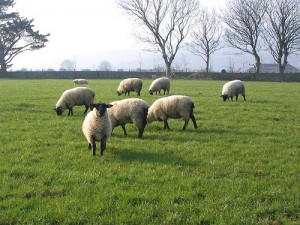 Good shepherds, he said, lead their flocks to green pastures where the grazing is best, and where the sheep find contentment. They root out and destroy poisonous plants so their sheep may safely graze. They guide them to still waters, as they know that sheep refuse to drink from noisy, babbling brooks. With their shepherd’s staff they protect them from predators, pull them out of pits should they fall in, and lead them safely through difficult terrain. With oil they anoint and heal the wounds inflicted by thorns and briers, and with jugs of water they cleanse eyes weeping from dust or fever. “Sheep do not worry,” this shepherd concludes, “(Their shepherd’s) guidance has been good in the past, and they have faith in the future because they know he has their well-being in view.”
This psalm refers to God’s care for his chosen people, the Israelites, as he liberated them from slavery in Egypt and led them to the Promised Land. It may very well have been written during the Babylonian exile, that difficult period some six centuries before Christ, after the Jews had been violently evicted from their homeland and forced to resettle in what is now Iraq. Far from their homeland and stripped of their freedoms, the exiled Jews wondered if God still cared for them. God inspired this psalm to be written to assure his people that he did. His message to them was: “I’m in charge, so there’s no need to worry.”
God still uses this psalm today to touch people’s hearts. It beautiful and powerful words continue to fill us with confidence and hope when facing change, difficulties, painful circumstances, or our fear of the unknown. It’s a psalm that calls us to place our trust in God- a call we need to hear time and time and time again.
A member of my parish, Peggy Rooney, has a wonderful story of how she learned to trust in God. In her book Uncommon Conversations with God, Peggy confesses that for years she was apprehensive about life. Peggy dreaded making decisions, was apprehensive of not living up to expectations on the job, and harbored what she describes as unreasonable fears about her children’s safety. She prayed and prayed about her these things, but seemingly to no avail. But then God brought a woman named Irene into her life.
Irene was partially blind and had lost both legs as a result of her diabetes. She had the use of only one hand, because an accident years earlier had left the other one crippled. Nevertheless, instead of being bitter and resentful, Irene was a cheerful, compassionate, genuinely loving, and courageous individual. Irene taught Peggy to let go of hear fears by trusting in God. Irene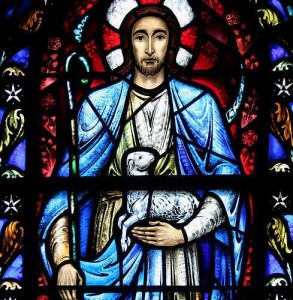 explained that letting go simply means letting God take control of one’s life. At first, Peggy was hesitant. She wondered who would protect her if she “let go.” Irene’s life, however, provided the answer. She had no choice about being absolutely dependent on others. But she did have a choice about how she related to those she depended upon. She trusted them, and she trusted God- absolutely.
One night Peggy asked Irene how she could be so brave in spite of her dependency. The answer changed Peggy’s life. Irene said, “I figure the worst thing that can happen to me is that I might die and get the chance to actually meet the One who’s been taking care of me for all these years.”
This is the kind of trust we all are called to. Jesus asks us not to worry, not to be filled with fears, and not to place our hopes on ourselves, on others, or on the things of this world. He invites us today to place our trust in him, and in him alone. Because when we trust the Lord who is our shepherd, surely we shall not want.
Readings for today’s Mass: http://www.usccb.org/nab/051511.shtml
Photo credits: ILRI, ralmonline, *clairity* via Creative Commons

 For whatever reason, my garage’s light switch is in the kitchen. One night, while I was in the garage, running on our treadmill, someone accidentally flipped off the lights. For a few scary moments, I found myself in complete darkness, running fast, but going absolutely nowhere.