There was more violence this past weekend. A man, whatever his grievance, killed three police officers and wounded four others. Pray for their souls.
And what has this gotten us? More anger. And no progress on justice at all.
History is replete with the failures of those who thought they could usher in justice with violence. The “war to end all wars” (World War I) demonstrated this foolish notion, as it ultimately brought about a far bloodier one: World War II.
There is a famous aphorism (often attributed to Gandhi) that “an eye for an eye leaves the whole world blind.”
Dr. Martin Luther King, Jr. said, “Darkness cannot drive out darkness; only light can do that. Hate cannot drive out hate; only love can do that.”
I would add that Jesus’ showdown with Satan demonstrated that pride cannot drive out pride; only humility can do that. Jesus defeated Satan’s pride with humility and obedience: He humbled Himself and became obedient to death—even death on a cross (Phil 2:8).
A violent response that is not an act of self-defense just throws fuel on the fire and causes Satan to win.
This post is brief for two reasons: (1) I am traveling, and (2) I think Bishop Robert Barron expresses things better than I could in this moment of fresh wounds. The video below is his commentary on the 2008 movie The Dark Knight. Bishop Barron ponders the problem of violence and critiques the world’s notion of how to fight it. His message is still relevant today.
Our intellect is our greatest strength and one of our greatest blessings, yet almost nothing gets us into as much trouble. Our strength is also our struggle. We think we know a few things, and indeed we do—a very few things.
The greatest intellects, if they have wisdom and humility, know this. St. Thomas Aquinas famously said,
In finem nostrae cognitionis Deum tamquam ignotum cognoscimus. (At the end of our knowledge we know God as unknown.) (In Boetium de Trinitate, q. 1, a. 2, ad 1um)
Henri De Lubac, a great intellect of the twentieth century, lamented,
There is probably no thinking person today who does not feel the shallowness and impoverishment of a certain kind of intellectualism and the barrenness of a certain abuse of the historic discipline … The dust and must of rational or positive criticism. … We have believed in the light, [but] we are rather bad at finding it, perhaps because we have, in the end, sought it only in knowledge and interest (The Drama of Atheist Humanism, p. 85).
I suppose by “interest” he means self-interest. That is, we have sought the light of truth not for its own sake, but for what it can do for us. De Lubac longed and hope for a
… return to the golden age of medieval thought, that of St. Thomas and St. Bonaventure … restoring the climate of mystery that was eminently the climate of patristic thought … relearning, if not the use, at least the understanding of symbols … going back to the deep springs … (Ibid).
And he advises,
[We must be] cured of our infatuation for a world wholly explainable … (Ibid, p. 86)
And he warns,
As soon as man ceases to be in contact with great mystical religious forces, does he not inevitably come under the yoke of a harsher and blender force, which leads him to perdition? (Ibid, p. 90)
Indeed, welcome to the world of post-Christian secularism and atheism; usher in the tyranny of relativism, unmoored and drifting rapidly toward the abyss. Detached from God and the humility of mystery, we fall inexorably to our ruin, all the while arrogantly calling it progress.
As a final witness to the need for mystical silence before God, enter St. Bonaventure, whose feast we celebrated on Friday (July 15th). Although he was a dogmatic theologian of the highest rank and would later be declared a doctor of the Church, St. Bonaventure held that our intellectual power, though always present, is inferior to that of the affections of our heart.
We see these insights on beautiful display in the following excerpt from his writings, featured in the Office of Readings for his feast day. As you read this, remember that St. Bonaventure was no anti-intellectual, just one who wisely and humbly recognized the limits of human thought.
Christ is both the way and the door …. A man … should gaze at him hanging on the cross, full of wonder and joy, marked by gratitude, and open to praise and jubilation.
Then such a man will make with Christ a “pasch,” that is, “a passing-over.” Through the branches of the cross he will pass over the Red Sea, leaving Egypt and entering the desert. There he will taste the hidden manna …
For this Passover to be perfect, we must suspend all the operations of the mind and we must transform the peak of our affections, directing them to God alone. This is a sacred mystical experience. It cannot be comprehended by anyone unless he surrenders himself to it. …
Seek the answer in God’s grace, not in doctrine; in the longing of the will, not in the understanding; in the sighs of prayer, not in research; seek the bridegroom not the teacher; God and not man; in darkness not daylight; and look not to the light but rather to the raging fire that carries the soul to God with intense fervor and glowing love. The fire is God. …
Let us … enter into the darkness, silencing our anxieties, our passions and all the fantasies of our imagination … saying: My flesh and my heart fail me, but God is the strength of my heart and my heritage forever. Blessed be the Lord forever, and let all the people say: Amen. Amen!
From The Journey of the Mind to God, by Saint Bonaventure, bishop (Cap. 7.1.2.6.6 Opera omnia 5, 312-313)
Once again, remember that St. Bonaventure was one of the great intellectuals of the Church and a great believer in doctrine. In this passage, his point is that doctrine without grace is just religious studies. Only by grace and humble silence can we pierce the clouds and see toward the purer light that is God.
Yet even our correction, that the intellect must be humble and balanced by mystical reverence, itself must come with a “warning label.”
Refuting the cynical agnosticism and atheism of the day, De Lubac says,
Contempt for truth can never be ours. … Our God is a hidden God indeed, but in himself he is light. “God is light, and in him there is no darkness” (1 John 1). So we refuse to make an idol of darkness (Op cit, p. 86).
We are not to be anti-intellectual. God reveals truths about Himself through creation and Scripture that can be known and must be insisted upon. But our acceptance of the darkness and the dark knowing of the mystical tradition is not an end in itself. For indeed the darkness will give way to the beatific vision, in which the glory of God will eternally unfold for us.
By the grace of faith, we know God, though for now it is in a mirror darkly (cf 1 Corinthians 13:12); we should admit this fact humbly. One day the darkness will fade and we will behold the Lord face to face. Now we know in part; then more fully, even as we have been fully known (Ibid).
Yes, our intellect is both our greatest gift and our biggest stumbling block. Only the humility and silence of the mystical tradition can unlock its greatest potential: moving toward God in deeper wisdom and understanding.
The LORD is in his holy temple: let all the earth keep silence before him (Habakkuk 2:20).
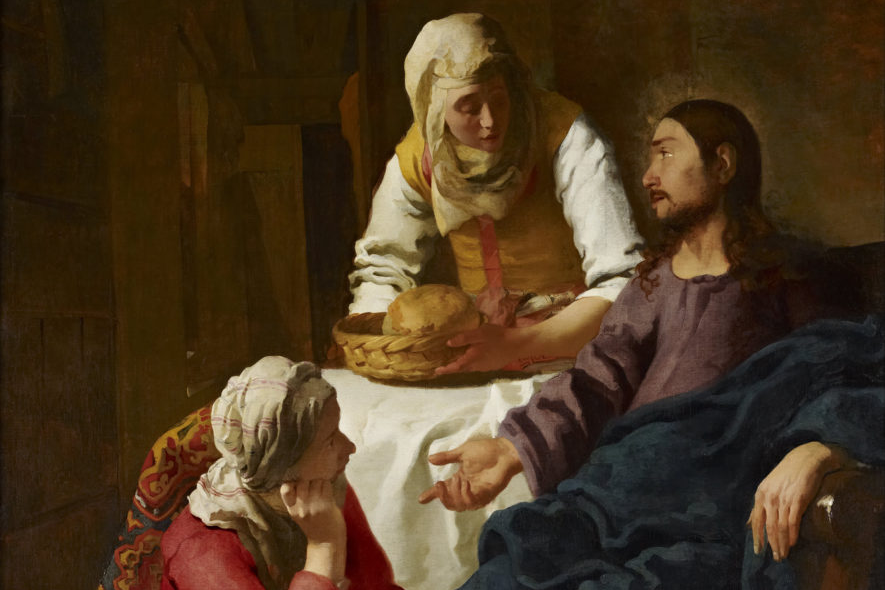
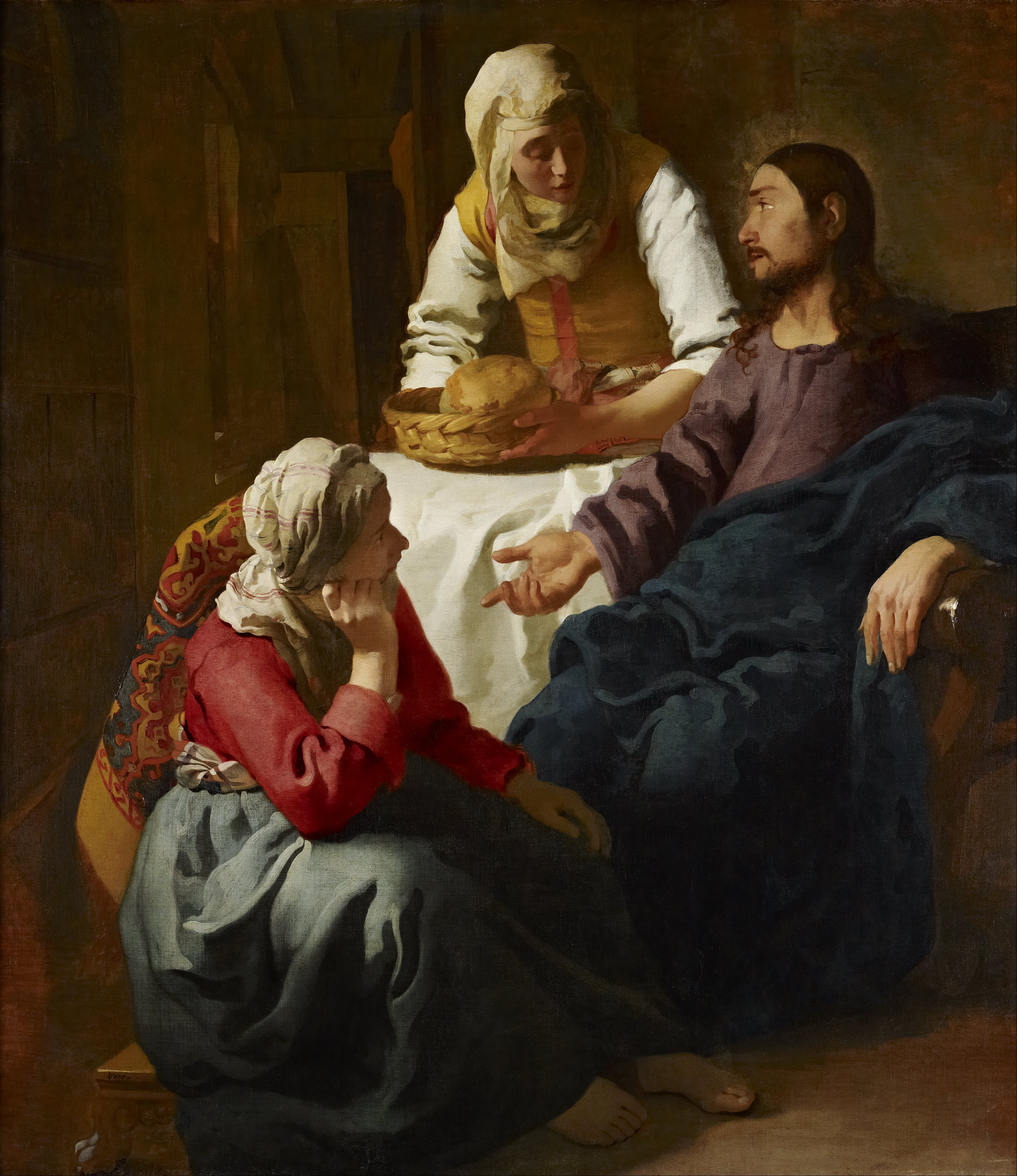
Today’s Gospel is the very familiar one of Martha and Mary. Martha is the anxious worker seeking to please the Lord with a good meal and hospitality; Mary sits quietly at His feet and listens. One has come to be the image of work, the other of prayer.
Misinterpreted? In my lifetime I have heard many a sermon that interpreted this Gospel passage as a call for a proper balance between work and prayer. Some have gone on to state that we all need a little of Martha and Mary in us, and that the Church needs both Marthas and Marys.
But in the end it seems that such a conclusion misses the central point of this passage. Jesus does not conclude by saying, “Martha, now go do your thing and let Mary do hers.” Rather, He describes Mary as not only choosing the better part but also as doing the “one thing necessary.” This does not amount to a call for “proper balance” but instead underscores the radical priority and primacy of prayer. This, it would seem, is the proper interpretation of what is being taught here. Many other passages of the Scripture do set forth the need to be rich in works of charity, but this is not one of them.
With that in mind let’s take a look at the details of the Lord’s teaching today on the priority of personal prayer.
I. PROMISING PRELUDE – Jesus entered a village where a woman whose name was Martha welcomed him. The story begins by showing Martha in a very favorable light. She opens her door (her life, if you will) and welcomes Jesus. This is at the heart of faith: a welcoming of Jesus into the home of our heart and life. Surely Revelation 3:20 comes to mind here: Behold I stand at the door and knock. If any one hears my voice and opens the door I will come in and eat with him and he with me.
While we acknowledge this promising prelude we ought also to underscore the fact that the initiative is that of Jesus. The text says that Jesus entered a village. In the call of faith, the initiative is always with God. It was not you who chose me, it was I who chose you (Jn 15:16). Hence, while we must welcome Him, God leads. Martha hears the Lord’s call and responds. So far, so good.
What happens next isn’t exactly clear, but the impression given is that Martha goes right to work. There is no evidence that Jesus asked for a meal from her. The text from Revelation quoted above does suggest that the Lord seeks to dine with us, but it implies that it is He who will provide the meal. Surely the Eucharistic context of our faith emphasizes that it is the Lord who feeds us with His Word and with His Body and Blood.
At any rate, Martha seems to have told the Lord to make Himself comfortable and has gone off to work in preparing a meal. That she later experiences it to be such a burden is evidence that her idea emerged more from her flesh than from the Spirit.
II. PORTRAIT OF PRAYER – She had a sister named Mary who sat beside the Lord at his feet listening to him speak. Now here is a beautiful portrait of prayer: sitting at the Lord’s feet, listening.
Many people think of prayer as something that is said. But prayer is better understood as a conversation, and conversations include both speaking and listening. Vocal prayer, intercessory prayer, and the like are all noble and important, but the prayer of listening is too often neglected.
Prayer is not just telling God what we want, it is discovering what He wills. We have to sit humbly and listen. We must learn to listen, and we must listen in order to learn. We listen by slowly and devoutly considering Scripture (lectio divina), and by pondering how God is speaking in the events and people in our life, how God is whispering in our conscience and soul.
As we shall see, Jesus calls this kind of prayer “the one thing necessary.” What Mary models and Martha forgets is that we must first come (to Jesus) and then go (and do what He says), that we must first receive before we can achieve, that we must first be blessed before we can do our best, that we must first listen before we leap into action.
III. PERTURBED and PRESUMPTUOUS – Martha, burdened with much serving, came to him and said, “Lord, do you not care that my sister has left me by myself to do the serving? Tell her to help me.” Martha, who is laboring in the flesh but not likely in the Spirit and in accord with the Lord’s wishes, is now experiencing the whole thing as a burden. She blames her sister for all this but the Lord’s response will make it clear that this is not Mary’s issue.
One sign that we are not in God’s will is experiencing what we are doing as a burden. We are all limited and human and will experience ordinary fatigue. It is one thing to be weary in the work but it is another to be weary of the work.
A lot of people run off to do something they think is a good idea. And maybe it is a fine thing in itself. But often, they never asked God about it. God might have said, “Fine.” But He might have said, “Not now, later.” Or He might have said, “Not you, but someone else.” Or he might have just said, “No.” But instead of asking they often just go off and do it, and then when things don’t work out will often blame God: “Why don’t you help me more?”
And so Martha is burdened. First she blames her sister. Then she presumes that the Lord does not care about what is (to her) an obvious injustice. Then she takes presumption one step further and presumes to tell the Lord what to do: “Tell her to help me.”
This is what happens when we try to serve the Lord in the flesh. Instead of being true servants who listen to the Lord’s wishes and carry them out by His grace, we end up angry and mildly (or more) dictatorial. She here is Martha, with her one hand on her hip and her index finger in the air . Jesus will be kind to her, but firm.
IV. PRESCRIBED PRIORITY – Martha, Martha, you are anxious and worried about many things. There is need of only one thing. Mary has chosen the better part and it will not be taken from her. Now don’t let the Lord have to call you by your name twice! It is clear that the Lord wants Martha’s attention and that she has made a fatal mistake (that we all can easily make): she leapt before she listened.
The Lord observes her and comments that she is anxious about many things. Anxiety about many things comes from neglect of the one thing most necessary: sitting at the feet of the Lord and listening to him.
The Lord will surely have things for us to do in our lives but they need to come from Him. This is why prayer is the “one thing” necessary and the better part: because work flows from it and is subordinate to it.
Discernment is not easy, but it is necessary. An awful lot of very noble ideas have floundered in the field of the flesh because they were never really brought before God and were not therefore a work of grace.
Jesus does not mean that all we are to do is to pray. There are too many other Gospels that summon us to labor in the vineyard to make that conclusion. But what Jesus is very clear to say is that prayer and discernment have absolute priority. Otherwise expect to be anxious about many things and have little to show for it.
Scripture makes it clear that God must be the author and initiator of our works:For by grace you have been saved through faith, and this is not from you; it is the gift of God; it is not from works, so no one may boast. For we are his handiwork, created in Christ Jesus for the good works that God has prepared in advance, that we should walk in them (Eph 2:8-10).
And old prayer from the Roman Ritual also makes this plain:
Actiones nostras, quaesumus Domine, aspirando praeveni et adiuvando prosequere: ut cuncta nostra oratio et operatio a te semper incipiat, et per te coepta finiatur. Per Christum Dominum nostrum
(Direct we beseech Thee, O Lord, our prayers and our actions by Thy holy inspirations and carry them on by Thy gracious assistance, so that every work of ours may always begin with Thee, and through Thee be ended.)
This song reminds us that when we really are working in the Lord’s will, as the fruit of prayer we love what we do and do so with joy. This song says, “I keep so busy working for the Kingdom I ain’t got time to die!”
The video below contains a surprise, reminding us that not all things are as they appear. We should be careful about sizing things up, and when we must do so, do it with great humility. There is an old saying that seems appropriate:
If your words are soft and sweet, they won’t be as hard to swallow if you have to eat them.
Before watching the video, consider these cautionary quotes from Scripture:
But the LORD said to Samuel [who seeking a king, was impressed with Jesse’s eldest son], “Do not consider his appearance or his height, for I have rejected him. The LORD does not look at the things people look at. Man looks at the outward appearance, but the LORD looks at the heart” (1 Sam 16:7).
So from now on we regard no one from a worldly point of view. Though we once regarded Christ in this way, we do so no longer (2 Cor 5:16).
Stop judging by mere appearances, but instead judge correctly (John 7:24).
You judge by human standards; I pass judgment on no one. But if I do judge, my decisions are true, because I am not alone. I stand with the Father, who sent me (John 8:15-16).
Jesus said to them, “You are the ones who justify yourselves in the eyes of others, but God knows your hearts” (Luke 16:15).
[O Lord] Forgive and act; deal with everyone according to all they do, since you know their hearts (for you alone know every human heart) (1 Kings 8:39).
Call no one happy before his death; by how he ends, a person becomes known (Sirach 11:28).
Today’s Gospel (Mat 12:1-8), in which Jesus is rebuked for violating the Sabbath, reminded me of the video below. It illustrates how we sometimes follow smaller rules while overlooking bigger ones in the process.
The Lord Jesus was often scorned by the people of His day, who claimed that He overlooked certain details of the law (often Sabbath observances). But those who rebuked him for this were guilty of far greater violations. For example,
[Jesus] went into the synagogue, and a man with a shriveled hand was there. Some of them were looking for a reason to accuse Jesus, so they watched him closely to see if he would heal him on the Sabbath. Jesus said to the man with the shriveled hand, “Stand up in front of everyone.” Then Jesus asked them, “Which is lawful on the Sabbath: to do good or to do evil, to save life or to kill?” But they remained silent. He looked around at them in anger and, deeply distressed at their stubborn hearts, said to the man, “Stretch out your hand.” He stretched it out, and his hand was completely restored. Then the Pharisees went out and began to plot with the Herodians how they might kill Jesus (Mk 3:1-6).
Woe to you Pharisees, because you give God a tenth of your mint, rue and all other kinds of garden herbs, but you neglect justice and the love of God. You should have practiced the latter without leaving the former undone (Luke 11:42).
Indignant because Jesus had healed on the Sabbath, the synagogue ruler said to the people, “There are six days for work. So come and be healed on those days, not on the Sabbath.” The Lord answered him, “You hypocrites! Doesn’t each of you on the Sabbath untie his ox or donkey from the stall and lead it out to give it water? Then should not this woman, a daughter of Abraham, whom Satan has kept bound for eighteen long years, be set free on the Sabbath day from what bound her?” (Lk 13:14-16)
You blind guides! You strain out a gnat but swallow a camel. Woe to you, teachers of the law and Pharisees, you hypocrites! You clean the outside of the cup and dish, but inside they are full of greed and self-indulgence. Blind Pharisee! First clean the inside of the cup and dish, and then the outside also will be clean (Matt 23:24-25).
Yes, they are straining out gnats but swallowing camels, maximizing the minimum but minimizing the maximum. Note that in the first passage above they are actually planning to kill Jesus for healing on the Sabbath!
Perhaps my all-time favorite illustration of this awful human tendency is in the Gospel of John:
Then the Jews led Jesus from Caiaphas to the palace of the Roman governor. By now it was early morning, and to avoid ceremonial uncleanness the Jews did not enter the palace; they wanted to be able to eat the Passover. So Pilate came out … (John 18:28-29).
They are plotting to kill a just and innocent man, indeed they are plotting to kill God. They are acting out of wickedness, envy, jealousy, hatred, and murderous anger, but their primary concern is avoiding ritual uncleanliness! Yes, they are straining out gnats but swallowing camels.
We who are pious and observant need to be wary of this tendency. Sometimes in congratulating ourselves over adherence in lesser matters, we can either offend or neglect in weightier ones. Perhaps I attend Mass each Sunday (a grave obligation); perhaps I pray the rosary (a highly commendable practice); perhaps I tithe (a commendable precept). These are all things that ought to be done (one is commanded, one is commended, and one is a precept). But what if at the same time I am hateful toward someone at the office, unforgiving to a family member, and/or insensitive to the poor?
The danger could be that I let my observance of certain things allow me to think that I can “check off the God box” and figure that because I went to Mass, prayed the rosary, and gave an offering, I’ve “got this righteousness thing down.” Too often, very significant and serious things like love, mercy, forgiveness, and charity are set aside or neglected as I am busy congratulating myself over my adherence to other, sometimes lesser, things.
This oversight can happen in the other direction as well. Someone may congratulate himself for spending the day working in a soup kitchen, and think that he therefore has no need to look at the fact that he is living unchastely (shacked up, for example) or not attending Mass.
We cannot “buy God off,” doing certain things (usually things that we like) while ignoring others we’d rather not. In the end, the whole counsel of God is important.
We must avoid the sinful tendency to try to substitute or swap, to observe a few things while overlooking others.
We see a lot of examples of this in our culture as well. We obsess over people smoking because it might be bad for their health while ignoring the health consequences of promiscuous behavior, which spreads AIDS and countless venereal diseases and leads to abortion. We campaign to save the baby seals while over a thousand baby humans are killed each day in the United States. We deplore (rightfully) the death of thousands each year in gun homicides while calling the murder of hundreds of thousands of babies each year a constitutional right. The school nurse is required to obtain parental permission to dispense aspirin to students but not to provide the dangerous abortifacient “morning after pill.” We talk about the dignity of women and yet pornography flourishes. We fret endlessly about our weight and the physical appearance of our bodies, which will die, and care little for our souls, which will live. We obsess over carbon footprints while flying on jets to global warming conferences at luxurious convention center complexes.
Yes, we are straining gnats but swallowing camels. As the Lord says, we ought not to neglect smaller things wholly, but simply observing lesser things doesn’t give us the right to ignore greater ones.
Salus animarum suprema lex. (The salvation of souls is the highest Law.) While little things mean a lot, we must always remember not to allow them to eclipse greater things.
The ideal for which to aim is an integrated state in which the lesser serves the greater and is subsumed into it. St. Augustine rightly observed,
Quod Minimum, minimum est, Sed in minimo fidelem esse, magnum est.
St. Augustine – De Doctrina Christiana, IV,35
(What is a little thing, is (just) a little thing. But to be faithful in a little thing is a great thing.)
Notice that the lesser things are in service of the greater thing—in this case fidelity. And thus we should rightly ask whether some of the lesser things we do are really in service of the greater things like justice, love, mercy, fidelity, kindness, and generosity. Otherwise we run the risk of straining out gnats but swallowing camels.
Enjoy this commercial, which illustrates how one rule (no loud voices in the library) is observed while violating nearly every other.
The Gospel from Wednesday’s Daily Mass contains memorable but often misunderstood lines:
Come to me, all you who labor and are burdened, and I will give you rest … Take my yoke upon you … For my yoke is easy, and my burden light.
The most important word in this sentence is the word “my.” Jesus says, my yoke is easy; my burden is light.
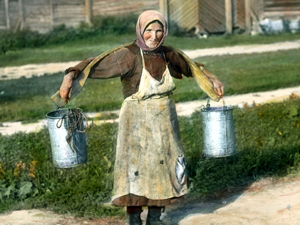
What is a yoke? It’s a wooden truss that makes it easier to carry a heavy load by distributing the weight across a wider part of the body or by allowing the weight to be shared by two or more people or animals. In the picture at left, the woman is able to carry the heavy water more easily with the weight distributed across her shoulders rather than in her hands. The load is eased by involving more parts of the body. Yokes are also used to join two animals and help them work together in pulling a load.
What is Jesus saying? First, He is saying that He has a yoke for us. That is, He has a cross for us. Notice that Jesus is not saying that there is no yoke or cross in following Him. There is a cross that He allows, and He allows it for a reason and for a season.
Easy? Jesus says that the cross he has for us is “easy.” The Greek word χρηστὸς (chrestos) is better translated as “well fitting,” “suitable,” or even “useful.” In effect, the Lord is saying that the yoke he has for us is suited to us; it fits us well and has been carefully chosen so as to be useful for us. God knows that we need some crosses in order to grow. He knows what those crosses are. He knows what we can bear and what we are ready for. Yes, His yoke for us fits us well.
But notice again that little word: “my.” The cross or yoke that Jesus has for us is well suited and useful for us. The problem comes when we start adding to that weight with things of our own doing. We put wood on our shoulders that God never put there and never intended for us. We make decisions without asking God. We undertake projects, launch careers, accept promotions, and even enter marriages without ever discerning if God wants this for us. And sure enough, before long our life is complicated and burdensome; we feel pulled in many different directions. But this is not the yoke of Jesus; this is largely the yoke of our own making. Of course it is not easy nor does it fit well, because Jesus didn’t make it.
Don’t blame God; simplify. Be very careful before accepting commitments and making big decisions. Ask God. It may be good, but not for you. It may help others, but destroy you. Seek the Lord’s will. If necessary, seek advice from a spiritually mature person. Consider your state in life; consider the tradeoffs. Balance the call to be generous with the call to proper stewardship of your time, talent, and treasure. Have proper priorities. It is amazing how many people put their career before their vocation. They accept promotions, take on special assignments, and think more about money and advancement than their spouse and children. The burdens increase and the load gets heavy when we don’t ask God or even consider how a proposed course of action might affect the most precious and important things in our lives.
Jesus’ final advice, then, is this: Take my yoke and only my yoke. Forsake all others. Simplify.
So stop “yoking around.” Take only His yoke. If you do, your burdens will be lighter. Jesus says, “Come and learn from me. I will not put heavy burdens on you. I will set your heart on fire with love. And then, whatever I do have for you, will be a pleasure for you to do. Because, what makes the difference is love.” Love lightens every load.
As we go through the Book of the Prophet Isaiah at Mass, we read of Israel’s painful purifications and also of a coming punishment of the surrounding nations. These ancient stories have something to say to us today.
As Isaiah sets forth, God permitted the nations to persecute Israel in order that she be purified. But the iniquity and sin of the nations and of this world cannot go on forever; wickedness must be ended. The Lord will judge the nations, not merely purify Israel.
In a complex passage, God says (through Isaiah) that although He had used Assyria as a tool to purify Israel, Assyria would not escape punishment for her iniquity. Here is an excerpt:
Woe to Assyria! My rod in anger, my staff in wrath. Against an impious nation [Israel] I send him, and against a people under my wrath I order him to seize plunder, carry off loot …. But this is not what he intends, nor does he have this in mind; Rather, it is in his heart to destroy …. [And] he says: “By my own power I have done it, and by my wisdom, for I am shrewd. I have moved the boundaries of peoples ….” Will the axe boast against him who hews with it? Will the saw exalt itself above him who wields it? As if a rod could sway him who lifts it …. Therefore, the Lord, the LORD of hosts, will send among his fat ones leanness, And instead of his glory there will be kindling like the kindling of fire (Isaiah 10:5-16).
Although God wielded Assyria like an axe to prune Israel, that did not make the axe good. And now it is time for the axe also to be refined as in fire.
What do stories like these have to say to us today? A lot, especially if we see Israel as an image for the Church, and the nations around us as akin to Assyria and Babylon.
For indeed, the Church has been going through a great pruning and purification. The once luxuriant vine of Catholicism and Christendom in the West is reduced. Only 25% of Catholics in the U.S. attend Mass; in Europe the numbers are far worse. Indifference to the faith and to God is widespread. Many are Catholic in name only. Yet for those who remain there is an increasingly fervent experience of the faith. On account of doubt and persecution, many of us are actually clearer about what we believe and why than we were in the past. There has been a great blossoming of Catholic apologetics and media. The smaller numbers of Catholics who remain are getting clearer, more devout, and more creative. And thus we see a pruning and purification that is so often necessary in the Church. Ecclesia semper reformanda (the Church is always in need of reform).
This purification is being effected by God, who is permitting an increasingly secular and hostile world to afflict the Church. These afflictions take many forms: simple scoffing at our beliefs, the promulgation of error and lies to lead us away from the faith, the excoriating and even criminalization of long-held beliefs of our faith, and even outright martyring of believers.
For the time being, God seems to be permitting the “Assyria” of modern, decadent culture to afflict us. But things do by opposition grow. Even if God is wielding the axe of modernity now, this does not make the axe holy; soon enough the axe will have to answer for its wickedness.
What are faithful Catholics to do under the current circumstances? The answer to this may vary based our state in life (parent, priest, married, single, young, old, etc.). Many younger families are choosing to “hunker down” and live as isolated from our toxic culture as possible: homeschooling, restricting television viewing, and/or limiting Internet access.
Others have chosen to engage the culture boldly in order to seek its conversion and/or to rescue as many as possible from its grip.
Both approaches are certainly valid. But as we journey further into the darkness, the banners of tolerance under which the revolutionaries marched are increasingly being exposed for what they really are: banners of tyranny. They never really meant what they said about tolerance; it was just a smoke screen. Under the new tyranny, our options for influencing the culture are decreasing; faithful Catholics proclaiming ancient truths are seeing their religious liberty erode. Merely quoting certain Scripture passages or reading from the Catechism of the Catholic Church is being labeled hate speech. There are increasing efforts to compel faithful Catholics and others to directly cooperate in evils such as contraception, abortion, and euthanasia.
With all this in mind, a text from another part of Isaiah seems appropriate for an increasing number of Catholics:
Come, my people, enter your chambers, and shut your doors behind you; hide yourselves for a little while until the wrath has passed by. For behold, the LORD is coming out from his place to punish the inhabitants of the earth for their iniquity, and the earth will disclose the blood shed on it, and will no more cover its slain (Is 26:21-22).
In effect, this text advises the faithful to hunker down and preserve the faith by seeking to live as far apart from the prevailing culture as possible. Now that Israel’s purification was bearing fruit, God was preparing to punish the nations that afflicted His faithful in Israel.
A possible modern application of this text is to view the wickedness in current Western culture as a sign of the wrath of God, who is allowing it to collapse under the weight of its own sin. A kind of delusion and lunacy has taken hold that reminds one of a rabid animal madly running around in circles. Rabid animals are not to be engaged; flee from them!
Much as in the days of Noah, our job may well be to hunker down and preserve the faith from the flood of rebellion. Scripture says,
The nations have drunk the wine of the passion of her immorality. The kings of the earth were immoral with her, and the merchants of the earth have grown wealthy through the extravagance of her luxury. Then I heard another voice from heaven say: “Come out of her, my people, so that you will not share in her sins, so that you will not receive any of her plagues; for her sins are piled up to heaven …” (Rev 18:3-5).
I will punish Bel in Babylon and make him spew out what he has swallowed. The nations will no longer stream to him. And the wall of Babylon will fall. Come out of her, my people! Run for your lives! Run from the fierce anger of the Lord. But do not lose heart or be afraid … (Jer 51:44-46).
In the months and years ahead, the priority for many in the Church may shift to a protective stance, a kind of hunkering down while God’s judgment brings an end to the evils in the cultures and nations around us.
This of course is not the usual stance of the Church, which ordinarily is to be zealously evangelical. But even the first evangelists were told by Jesus that in the face of fierce opposition to the Gospel they were to flee: When you are persecuted in one place, flee to another (Matt 10:24). There are times to hole up in the enclosure of the ark in order to preserve the life and light of the Gospel and then emerge again when the storms of destruction have passed by.
What does all of this mean to you? You must decide. Some may be called to isolate their families in order to preserve them from the caustic culture. Others may be called to engage with this world and seek to save as many as possible. But increasingly, the Church is simply not going to be able to make the compromises that the world will require.
Isaiah’s prophecies are not merely locked in the past; they are operative now as well.
In the video below, Bishop Robert Barron does a wonderful job of describing this stance (hunkering down) that the Church must occasionally take. It is a stance that is less one of hiding thank of preserving the faith so that it can be set loose later, with its purity still intact.
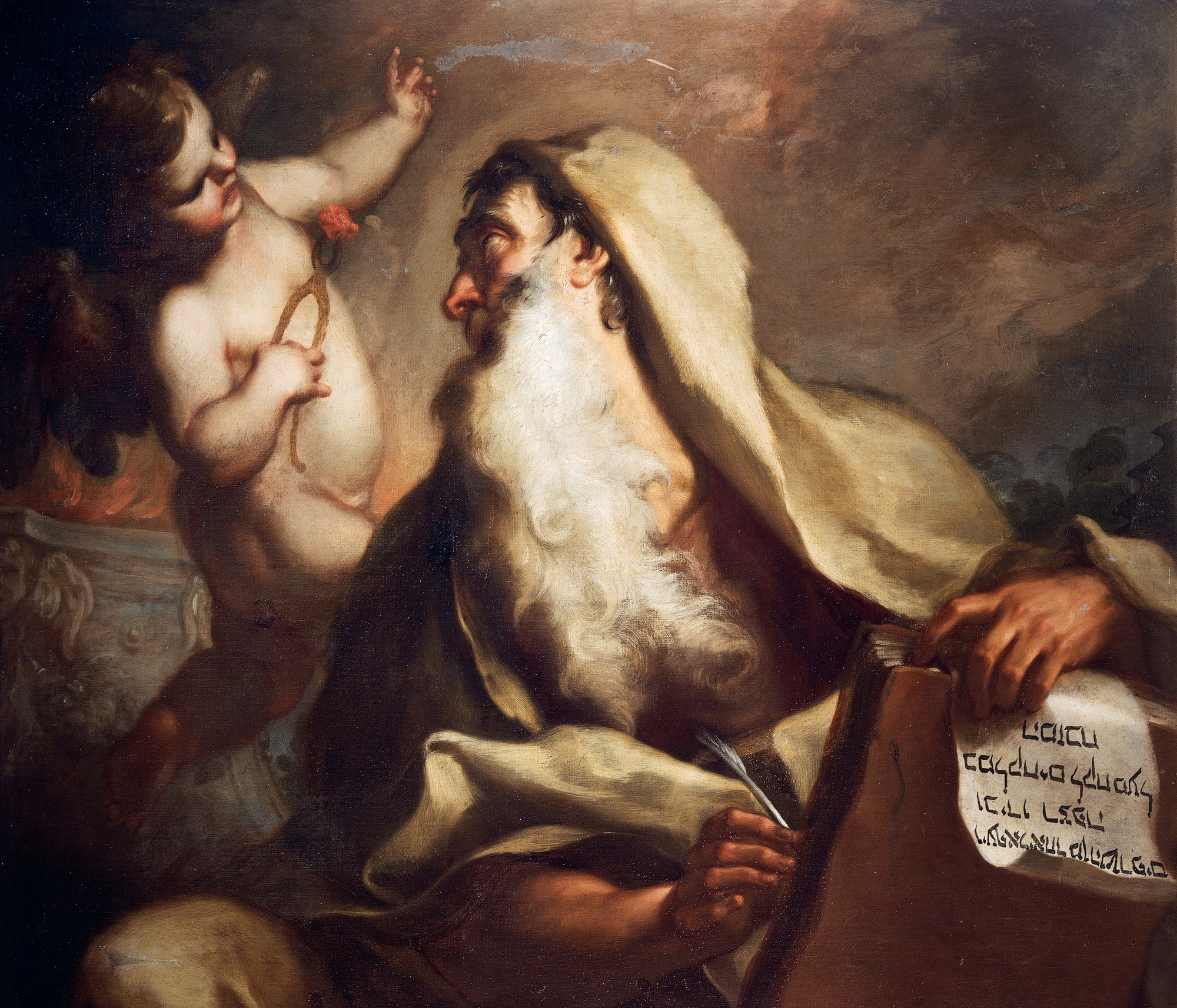
We are reading excerpts from the Prophet Isaiah this week in the Daily Liturgy, particularly from passages in which God’s judgment on unbelief and sin is proclaimed. I will write a bit more on this tomorrow, but perhaps for today there is some benefit in looking at Isaiah by way of overview. Let’s consider key elements of his life, struggle, and message. If you already have a firm grasp on Isaiah’s life and teachings and would like to read a shorter meditation, you can skip down to the section labeled in red: Lessons from Isaiah.
Isaiah was born in 760 B.C. He is further identified as the son of Amoz (Is 1:1). His name in Hebrew (Yeshayahu) means “Yah[weh] is salvation.” Isaiah lived this name well, insisting that Judah’s kings and people trust only in God, make no alliances with foreign nations, and refuse to fear anyone but God.
Isaiah lived in the terrible period following the great severing of the northern kingdom of Israel (with its ten tribes) from the southern kingdom of Judah. In the period prior to Isaiah’s birth, the northern kingdom had known almost nothing but godless kings. Idolatry had begun there from the start, when the first king, Jeroboam, erected golden calves (of all things!) in two northern cities and strove to dissuade northern Jews from going south to Jerusalem (in Judah) to worship. Other ugly moments in the north featured King Ahab and the wicked Queen Jezebel, who advanced the worship of the Canaanite fertility god, Baal, and who persecuted Elijah and the few others who sought to stay true to the faith of Abraham.
By the time Isaiah began his ministry (742 B.C.), the division was some 200 years old. Though living in Judah to the south, Isaiah both prophesied doom for the north and warned the kings of the south to rebuke wickedness and fears and to form no foreign alliances against the growing menaces to the north (Israel) and the east (Assyria). In this passage, he warned of northern destruction: In a single day the Lord will destroy both the head and the tail … The leaders of Israel are the head, and the lying prophets are the tail (Is 9:14-15). But his own Judah remained the focus of his concern and warnings.
Isaiah’s mission and ministry in Judah spanned four kings: Uzziah, Jotham, Ahaz, and Hezekiah. It is likely that he was a cousin of King Uzziah, which gave him both access and influence. Isaiah’s eloquence and influence also suggest that he received a royal education; little else is known of him personally.
Although the opening chapters of the Book of Isaiah describe the wickedness of the people of Judah and the need for their repentance and his ministry, Isaiah’s prophetic call seems to have begun in 742 B.C., “the year King Uzziah died,” and is described in Chapter 6:
1In the year that King Uzziah died I saw the Lord sitting upon a throne, high and lifted up; and his train filled the temple. 2Above him stood the seraphim; each had six wings: with two he covered his face, and with two he covered his feet, and with two he flew. 3And one called to another and said: “Holy, holy, holy is the Lord of hosts; the whole earth is full of his glory.” 4And the foundations of the thresholds shook at the voice of him who called, and the house was filled with smoke. 5And I said, “Woe is me! For I am lost; for I am a man of unclean lips, and I dwell in the midst of a people of unclean lips; for my eyes have seen the King, the Lord of hosts!” 6Then flew one of the seraphim to me, having in his hand a burning coal, which he had taken with tongs from the altar. 7And he touched my mouth, and said: “Behold, this has touched your lips; your guilt is taken away, and your sin forgiven.” 8And I heard the voice of the Lord saying, “Whom shall I send, and who will go for us?” Then I said, “Here am I! Send me” (Is 6:1–8).
While God accepts Isaiah’s offer, He warns that Isaiah’s message will be resisted. Isaiah asks, sadly,
11“How long, O Lord?” And he said, “Until cities lie waste without inhabitant, and houses without men, and the land is utterly desolate, 12and the Lord removes men far away, and the forsaken places are many in the midst of the land. 13And though a tenth remain in it, it will be burned” (Is 6:11–13).
Sure enough, the first 39 chapters of Isaiah describe a fiercely stubborn resistance to Isaiah’s calls. However, the prophesied destruction of the south would not occur until 587 B.C., long into the future, due in part to some limited success Isaiah had in working with King Hezekiah at a critical moment.
The winds of war were blowing. Assyria was expanding and the ominous clouds of its destructive conquest were moving westward. Israel to the north joined in a coalition to fight Assyria and tried to strong-arm Judah to join, threatening invasion and overthrow of King Ahaz if there was no agreement. Let’s just say that Ahaz was anxious, and all of Judah with him—threats to the north, threats to the east, and the Mediterranean to the west. There was no real escape.
God dispatches Isaiah to Ahaz with the following message:
4… Take heed, be quiet, do not fear, and do not let your heart be faint because of these two smoldering stumps of firebrands 5… [who have] devised evil against you, saying, 6“Let us go up against Judah and terrify it, and let us conquer it for ourselves, and set up the son of Tabe-el as king in the midst of it,” 7thus says the Lord GOD: It shall not stand, and it shall not come to pass (Is 7:4–7).
In other words, trust God. Make no alliances and do not give in to your fears. Stand your ground! God offers Ahaz a sign that a virgin shall conceive and bear a Son, Immanuel (God is with us). But Ahaz cops a falsely pious attitude, talking about not putting God to the test. Yet it is Ahaz who fails the test. Caving in, he sends tribute to Assyria and offers to become a vassal state.
In the end, this frees Assyria to concentrate on destroying Israel to the north. And while it can be argued that Israel’s wickedness brought her destruction, Ahaz helped seal the fate of fellow Jews in the north through his fearful and self-serving political calculations. The northern kingdom of Israel fell to the Assyrians in 721 B.C. and the survivors were carried off into exile. It was farewell to the Ten Lost Tribes. Only Judah and the Levites in the south remained intact.
Though Judah was spared, the relief from threatening Assyriawas to be temporary. Meanwhile, Ahaz’s son Hezekiah became king (ruling from 715-687 B.C.). Hezekiah was a better king: more faithful, more trusting, and thus less fearful. He rid Judah of any elements of Canaanite religious practice and by 705 B.C. had courageously broken free of the alliance with Assyria. He fortified Jerusalem (and his faith) against the backlash that was sure to come from Assyria.
Sure enough, in 701 B.C., Assyria came to collect past-due tribute and to assert who was boss. Jerusalem was surrounded with troops and her fate seemed sealed. But Isaiah summoned Hezekiah and Judah to courage:
33“Therefore thus says the Lord concerning the king of Assyria: He shall not come into this city, or shoot an arrow here, or come before it with a shield, or cast up a siege mound against it. 34By the way that he came, by the same he shall return, and he shall not come into this city, says the Lord. 35For I will defend this city to save it, for my own sake and for the sake of my servant David.” 36And the angel of the Lord went forth, and slew a hundred and eighty-five thousand in the camp of the Assyrians; and when men arose early in the morning, behold, these were all dead bodies (Is 37:33–36).
The Assyrian survivors left and returned by the way they had come. Their king, Sennacherib, returned home and was killed by his own sons.
A fear rebuked brought victory to Judah.Now maybe people would listen to Isaiah and trust God rather than foreign alliances! Well, not so fast. Hezekiah, who had been ill but miraculously recovered, started to get awfully friendly with the Babylonians, who were then emerging as a power to the east. Faith and trust are surely difficult things, especially for a king.
Because it looked like another alliance was being formed with a pagan state, Isaiah warned,
5“Hear the word of the Lord of hosts: 6Behold, the days are coming, when all that is in your house, and that which your fathers have stored up till this day, shall be carried to Babylon; nothing shall be left, says the Lord. 7 And some of your own sons, who are born to you, shall be taken away; and they shall be eunuchs in the palace of the king of Babylon.” 8Then said Hezekiah to Isaiah, “The word of the Lord which you have spoken is good.” For he thought, “There will be peace and security in my days” (Is 39:5–8).
Hezekiah’s selfish response reminds me of an old saying of my father’s: “People disappoint.” Alliances and dalliances with foreign lands and a corresponding lack of trust in God would continue to plague Judah despite miracles against Assyria.
We know little of Isaiah’s final demise. According to an extra-biblical tradition (and hinted at in Hebrews 11:37), he died by being sawed in half by Hezekiah’s unfaithful son, Manasseh. If the tradition is true, Manasseh answered to God for the murder of Isaiah.
Lessons from Isaiah:
Despite often disappointing results, Isaiah never gave up. God told him to prophesy and so he did. Isaiah lived what he preached. He feared God, not man. He never thought twice about going up to kings and declaring to their faces, “Thus saith the Lord!” Isaiah was willing to rebuke and encourage people regardless of their standing.
In the end, Isaiah’s message is remarkably clear: Do not fear! Clearly, fear leads all of us to a lot of foolish decisions. It is through fear that the devil holds us in bondage (Heb 2:15). The solution to fear is trust in God. And even if we were to be killed, we would still win, for the martyr’s crown would await us. Do not fear!
Why were foreign alliances so troubling to Isaiah? First of all, they manifested a lack of trust in the Lord with the following thinking: “Can God really save us? Maybe, but just in case He doesn’t come through, let’s make sure we have a plan B.” Hmm … not much faith there! But second (and related) the secular states of today were unknown at that time. People and nations were deeply religious. Alliances with foreign lands meant marriages to foreign queens as well as adopting the false religions of those nations and queens. Can someone say, “Jezebel”? Or how about Solomon and his 1000 wives and all their foreign gods? It was his folly that led to a divided Jewish nation and that introduced the wicked practices of the Baals and other Canaanite atrocities. These alliances manifested a lack of trust in God and introduced, inevitably, the adultery of “sleeping with” other gods.
An admonition is in order for us as well. As a Church, we ought to be wary of too many entanglements or partnerships with our increasingly hostile secular government. Many strings are attached to the federal and state monies we accept to serve the poor, give tuition assistance, etc. Compromises are increasingly demanded of us. Sadly, some sectors of the Church (especially certain universities) are caving in to the power and slavery of money and are compromising on same-sex unions and providing contraception (and even abortifacients) to their employees through health care plans. Large blocks of federal money are currently administered by some Catholic charitable organizations around the country. These government entanglements increasingly demand compromises of us and it is only going to get worse. Beware! We need to shift back to using our own monies to care for the poor. We need to be willing to say no to funding that comes with the demand to make compromises we cannot make. Serving the poor is important, but we cannot let even that become an idol. And frankly, if we are using mostly government money, can we really say that we are serving the poor? Are we not, rather, merely administering a government program? The Pope recently warned that the Church is not merely an NGO (any non-governmental, voluntary, not-for-profit organization).
Individual Catholics would also do well to be more hesitant to form political alliances. Too often, we allow political views to overrule our faith. Catholics need to be Catholics first, and be willing to denounce sin and evil no matter who perpetrates it or promotes it.
Alliances are often dangerous things. Too easily do we slip into adultery with the world. Beware! Compromise is ugly; adultery is a disgraceful betrayal of the Lord, whom we should fear and love.
Do not be afraid!
Tomorrow we will look at a passage that speaks of staying faithful and prayerful until the storms of destruction pass by.


 There was more violence this past weekend. A man, whatever his grievance, killed three police officers and wounded four others. Pray for their souls.