As we read the flood story in Tuesday’s daily Mass, I feel that a few clarifications are in order.
While we are not required as Catholics to interpret every detail of the flood story literally, there does seem to be some evidence (preserved in many ancient cultures) of a flood or “mega event” that drastically reduced the size of the human race. In addition, genetic, geological, and anthropological information point to a period some 70,000 years ago during which humans almost vanished from the planet [*].
How much of the flood narrative is a story and how much is history may be debatable, but something surely happened. In Genesis, God is recounting for us that He intervened at a critical moment to prune and purify the human family of the more egregious effects of sin in the aftermath of original sin.
The Lord saw that the wickedness of man was great in the earth, and that every imagination of the thoughts of his heart was only evil continually. And the Lord regretted that he had made man on the earth, and it grieved him to his heart. So the Lord said, “I will blot out man whom I have created from the face of the ground, man and beast and creeping things and birds of the air, for I am sorry that I have made them.” But Noah found favor in the eyes of the Lord (Gen 6:5-8).
This leads to another necessary clarification. God is said to regret that He made us and is described as being deeply grieved. Descriptions such as these are largely held to be anthropomorphisms, which ascribe human traits to God as a way of indicating the thoughts of God by analogy. In whatever manner God is “grieved” or “regretful,” it is not in the same way that we are. We are being told in this text that God has a resolve to set things right and to put an end to extreme wickedness. The artful use of anthropomorphic language to advance the story should not be considered as overriding other Scriptures that remind us that God is not subject to change and passions as we are. For example,
God is not man, that he should lie, or a son of man, that he should repent. Has he said, and will he not do it? Or has he spoken, and will he not fulfill it? (Numbers 23:19)
[The Children of men] will perish, but You endure; And all of them will wear out like a garment; Like clothing You will change them and they will be changed. But You are the same, And Your years will not come to an end (Psalm 102:26-27).
I the LORD do not change. So you, the descendants of Jacob, are not destroyed (Mal 3:6).
Every good and perfect gift is from above, coming down from the Father of lights, with whom there is no variation or shadow due to change (James 1:17).
A third clarification is needed in order to “rescue” God from charges of injustice in this “mass killing” of the human race. God, of course, is the giver of life. As the one who gives it, He also sets the length of our life and the manner of our death. This is His right. Indeed, one might even say that this is His “job.”
By way of analogy, I tend to many rose bushes in front of my rectory. At times, I feed them, water them, and foster their growth. At other times, I prune them. In certain cases, I remove diseased plants from the rose bed. Last year, I removed three diseased rose bushes. Who would dispute my right to do this? Who would accuse me of injustice? This is my work and my proper role.
While it is true that human beings are certainly more precious than roses, it is still God’s role to attend to the life and death of human beings, to the planting and harvesting of individuals, cultures, and civilizations. In His providence, God will at times prune away large segments in order to stave off disease or foster growth in individuals and in humanity as a whole.
Thus in the flood narrative, God sees the widespread evil and chooses to save what little good remains by cutting away the rest. In so doing, He creates a new beginning of goodness for the world. It is not free of sin, but is less beset by grave wickedness.
Yet even here, God does not necessarily forsake the wicked whose earthly lives He ends. They are confined in Sheol and await a day of visitation from the Lord. Scripture speaks to the fulfillment of this merciful outreach:
For Christ also suffered once for sins, the righteous for the unrighteous, that he might bring us to God, being put to death in the flesh but made alive in the spirit, in which he went and proclaimed to the spirits in prison, because they formerly did not obey, when God’s patience waited in the days of Noah, while the ark was being prepared, in which a few, that is, eight persons, were brought safely through water (1 Peter 3:18-20).
The Lord calls to them once more in His descent to the dead after Good Friday. He awakens them, preaches to them, and summons them. Did only some or all repent in the flood waters? We do not know, but the point remains that in ending their earthly lives, God did not completely forsake them in sending the waters. The worst thing is not dying (which we all will do); it is refusing God’s merciful love though an impenitent heart. God works for our eternal salvation, not merely our earthly comfort.
Here’s one scientific theory; take it or leave it as you wish.
In yesterday’s post, we explored the details of original sin and learned that there are subtleties and stages to it that can teach us something. Original sin was more than eating a piece of fruit; there were things that led up to it, both externally and internally.
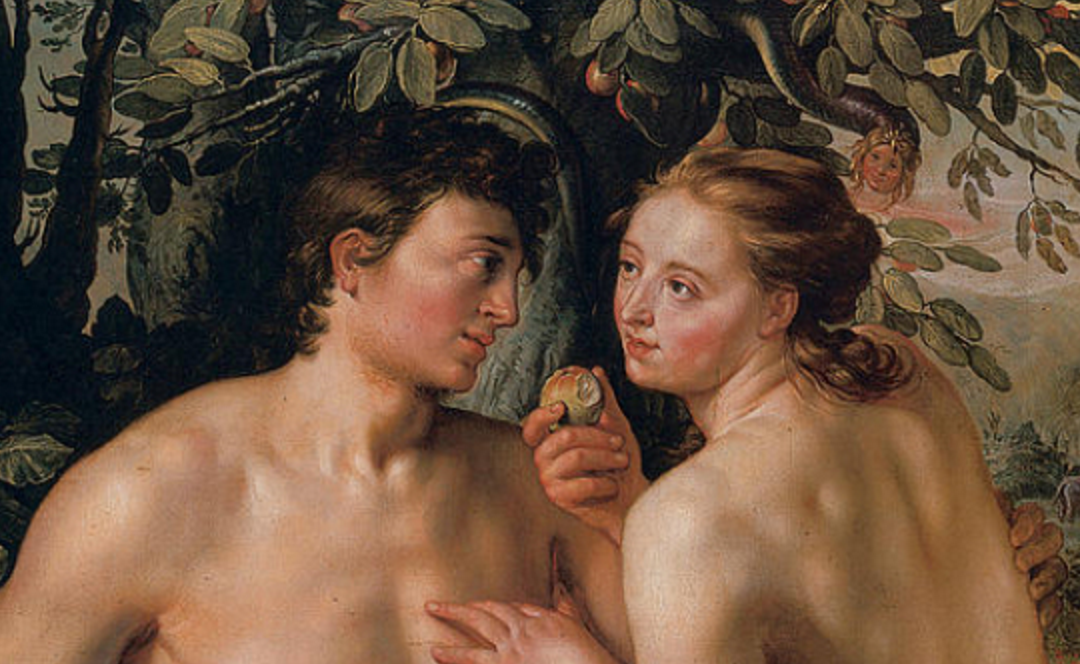
I also mentioned that it was worth exploring how the sacred text speaks of the “Sin of Adam” and differentiates it to some extent from the sin that Eve commits. Biblically, original sin is properly denoted as the “Sin of Adam.” It is Adam’s sin, not Eve’s that is called “original sin” (cf Rom 5:12 inter al).
It is not that Eve did not sin, or that her actions have no interest for us. Yesterday’s post focused on the stages she went through. Rather, as the head of his household and the human family, Adam had responsibility and thereby incurred the sin we call “original sin,” which comes down to all of us.
As you can see, this post isn’t very politically correct thus far—and it’s only going to get worse from here. In striving to differentiate Eve’s sin from Adam’s I would like to take up a very controversial text from St. Paul. While the specific text comports poorly with modern notions, two cautions are in order for those of us who read the text:
First, this is a sacred text, and even if St. Paul may have drawn some of his reflections from the cultural experiences of the time, he provides theological reasons for what he writes.
Second, remember that one verse from St. Paul is not all of St. Paul and certainly not all of Scripture. What Paul says rather absolutely in the verse that follows, he qualifies to some extent and other places as we shall see.
With this in mind, let’s examine the controversial text and strive to distinguish Adam’s sin from Eve’s. St. Paul writes:
A woman should learn in quietness and full submission. I do not permit a woman to teach or to assume authority over a man; she must be quiet. For Adam was formed first, then Eve. And Adam was not the one deceived; it was the woman who was deceived and became a sinner (1 Tim 2:11b-14).
Many, upon reading a text so astonishingly out of step with modern thinking, are prone simply to dismiss it as a relic of some past, dark age. It is debatable whether the edict that a woman should be silent and have no teaching authority over a man, is merely a disciplinary norm that we are not required to observe today. It is also debatable how absolute Paul’s words were meant to be. Paul wrote elsewhere of women in the early church communities as catechists (e.g., Phoebe in Romans 16:1), spiritual leaders, and benefactors (e.g., Lydia). He also made provisions for the proper attire of a woman who is to speak in the assembly (she is to cover her head). So what St. Paul says here, he distinguishes elsewhere in a way that allows for some provision that women both speak and teach the faith.
In the quote from first Timothy above, the context seems rather clearly to be that of the family and marriage. I this passage Paul affirms the headship of the husband, as he does elsewhere (Ephesians 5:22, Colossians 3:18); Peter does so as well (1 Peter 3:1-6).
Here is another text in which Paul speaks of women being silent in the Church. In this case, the context seems to be liturgical:
Women should remain silent in the churches. They are not allowed to speak, but must be in submission, as the law says. If they want to inquire about something, they should ask their own husbands at home; for it is disgraceful for a woman to speak in the church (1 Cor 14:34-35).
There are legitimate debates about how strictly this silence is to be interpreted. Generally, Church practice has understood this to mean that women are not to give the official teaching in the liturgy that we refer to as the sermon or homily. This stricture has been observed from antiquity down to the present day, by reserving the homily to the bishop, priest, or deacon. In more recent times, there have been allowances for women to serve as lectors, cantors, and singers. But the official teaching moment of the homily is still reserved to the male clergy, and the Magisterium consists of bishops and the Pope.
Prescinding from debate about how absolutely or strictly to interpret St. Paul’s restrictions, or whether or not some of these things are cultural artifacts that can be adjusted, what I really wish to focus on is the theological reasoning behind the differences between Adam’s sin and Eve’s sin. St. Paul writes,
For Adam was formed first, then Eve. And Adam was not the one deceived; it was the woman who was deceived and became a sinner (1 Tim 2:13-14).
St. Paul begins by saying that Adam was formed first, followed by Eve. And thus here he teaches that the husband has headship, authority. As Paul says elsewhere, The husband is head of his wife just as Christ is head of the Church (Eph 5:22).
In terms of original sin, which is our concern in today’s blog, Paul says that Adam was not the one deceived; it was Eve who was deceived. Thus, St. Paul speaks of Eve’s sin as being different from Adam’s. She was deceived and so sinned. Adam, however, was not deceived. His sin lay elsewhere.
Of the fact of her deception, Eve is a witness, for she says, “The serpent tricked me and so I ate it” (Gen 3:13). But of Adam’s sin, God says, “You listened to your wife and ate fruit from the tree about which I commanded you, ‘You must not eat from it’” (Gen 3:17). Adam’s sin lay in his willingness to allow his wife to tempt him.
Dear reader, you were warned that this was not going to be a politically correct post. Teachings such as these grate on modern ears, but of course that does not make them untrue.
Perhaps a little additional reflection may help to avoid knee-jerk reactions (such as gloating or anger). Adam’s and Eve’s sins are described differently; each’s sin can also be understood as a kind of weakness to which each was particularly susceptible: she to deception, he to being swayed by her feminine mystique and beauty.
St. Paul does not simply locate these two weaknesses in Adam and Eve as individuals, but also as male and female. Hence, St. Paul seems to teach here that a woman ought not to have a solemn teaching authority in the Church because of her tendency to be deceived.
Why might this be, that a woman could be more easily deceived? Perhaps it is rooted, paradoxically, in a woman’s strength. Among the strengths that women more generally manifest are natural spirituality and being sources of unity and peace in the heart of the family. And while these are wonderful strengths, in certain circumstances they can open one to deception. For if one seeks to make peace, one may compromise with error and sin. And though being open to spiritual things is of itself good, there are erroneous spiritual concepts to which one ought not to be open.
Not only is a woman possibly more susceptible to these, but should she cede to them, she can also have undue power over her husband and other men who might well be drawn by her beauty to set aside their better judgment.
To my mind, this is what St. Paul is getting at here in saying that Eve was deceived and Adam was not, therefore a woman cannot have teaching authority in the Church. There was also a warning in ancient Israel that men should not take foreign wives because they might confuse a man’s heart into the worship of their foreign gods. A man’s heart can easily be swayed by a beautiful and influential woman.
And thus, addressing a double threat, St. Paul forbids women to have teaching authority in the Church and ties it back to the archetypal incident of Adam and Eve: Eve was deceived and then was able to seduce her husband into sinning.
In modern times it may well be that St. Paul’s caution is affirmedby the modern problem of liberal Protestant denominations that have a large number of women leaders. These same denominations have departed significantly from the orthodox Christian faith, denying basic tenets of the Trinity, moral teaching, and biblical interpretation. This is not the only reason, but there seems to be a high correlation between denominations that embrace women leaders and a departure from orthodox Christian belief.
Have I been politically incorrect enough for you? Please feel free to leave your comments, but the chief focus I am interested in is the different descriptions of the “Sin of Adam” and Eve’s sin.
Last week we explored the creation accounts of Genesis, finishing with the account of original sin, that committed by Adam and Eve. Today and tomorrow I’d like to examine original sin more closely. Today, I’ll present the stages of sin that are manifested in Adam’s and Eve’s struggle.
Many tend to describe original sin merely as the eating of a forbidden fruit. While this accurate, it is incomplete and leads many to wonder why all this trouble came just from eating a piece of fruit. I believe it is helpful to consider the sin of Adam and Eve more richly. While the eating of the fruit is an external act, like any human act it proceeds from the heart and admits of some complexity.
I will use this passage from the Book of James to help frame our reflections. It describes the stages of sin:
Let no one say when he is tempted, “I am being tempted by God,” for God cannot be tempted with evil, and he himself tempts no one. But each person is tempted when he is lured and enticed by his own desire. Then desire when it has conceived gives birth to sin, and sin when it is fully grown brings forth death (James 1:13-15).
From this, we can distinguish the following stages of sin:
The lure of temptation
The engagement of desire
The conception of sin
The birth of sin
Spiritual death
When we examine the sin of Adam and Eve we can see these stages at work.
Preamble – God had put Adam in the garden even before Eve was created:
The LORD God took the man and placed him in the Garden of Eden in order to have him work it and guard it. And the Lord God commanded the man, “You are free to eat from any tree in the garden; but you must not eat from the tree of the knowledge of good and evil, for when you eat from it you will certainly die” (Gen 2:15-17).
Adam’s task was to work the garden and also to guard (keep watch over) the Garden. There was also a boundary that God told Adam not to cross related to the tree. God does not explain why, but simply notes the danger and asks Adam to trust Him.
Adam is to tend, till, and trust. As we shall see, Adam fell short in two of these, and they are aspects of what we have come to call original sin.
1. The Lure of Temptation – The story opens with the description of the serpent, the most cunning of all the wild creatures God had made (Genesis 3:1). While most of us imagine a snake of some sort, that description is given only after God curses Satan, who is allegorically represented by this creature. Exactly what this creature looked like before the fall is not stated, and hence we need not imagine a talking snake. Whatever creature Satan made use of (or whatever creature the author of Genesis allegorically made use of), it is representative of the way in which Satan interacts with Eve.
Cunning and subtle, Satan uses intellectual arguments to appeal to aspects of what would later come to be called pride and sensuality. He also seeks to undermine her trust in God’s goodness.
Satan begins by attempting to make God seem unreasonable, suggesting that He had forbidden them to eat from any of the trees in the Garden. Eve easily deals with this temptation and dismisses it, correctly stating that it is only one tree that has been proscribed. This is a common tactic of Satan’s even today: presenting God as unreasonable, demanding too many things and forbidding too much. This accusation wholly ignores the fact that God has given incredible liberty to the human person, who, unlike any other creature except the Angels, is permitted to say no to God.
Satan’s second attack is more successful. He declares that God is not telling them the truth. In effect, he says that God (who has given them everything) is holding something very important back from them. Satan argues that God is restraining them from being the gods they deserve to be. In effect, he says, “Why do you let anyone have power over you? Why do you let anyone tell you what to do? Why do you not instead say, ‘I will do what I want to do and I will decide whether it is right or wrong’?” Satan appeals to their incredible pride by saying, “You will be gods!”
And thus Eve is in the first stage of sin, the lure of temptation. One may well wonder where Adam is. Satan has been talking to Eve, but where is Adam? The text says that he is right there with her! (Gen 3:6)
Now here’s a problem integral to Adam’s sin. He was told, among other things, to guard the garden, to keep watch over it. It is arguable whether he could have prevented Satan from being there at all (he probably could not), but surely he could have tried to protect and guard his wife! Satan is there and Adam says and does nothing. He does not try to ward off the evil one, nor does he assist his wife in resisting the tempting thoughts. No, he stands quietly by. Adam is a passive husband here.
As the head of his family, Adam was obligated to come to his wife’s aid, to protect her, to assist her in this grave temptation and threat. But the text reports him doing nothing but standing quietly by. Indeed, Adam is so unobtrusive that when I point out the sixth verse, which says he was with Eve, people are surprised. Even many a passive husband would intervene if he were to see some strange individual speaking to his wife.
“But Father, but Father! Are you saying that Adam already sinned even before original sin was committed?” No, not necessarily. The point here is that original sin is more complicated than merely biting into a piece of fruit. Like many sins, it has layers. Adam may not yet have sinned, but his silence is surely puzzling; indeed, it is troubling. It is not a sin to be tempted (even Jesus was tempted), but to do nothing in the face of temptation is to at least open the door to the next stage of sin.
2. The Engagement of Desire – The text says, the woman saw the tree was good for food, and that it was a delight to the eyes, and that the tree was to be desired to make one wise (Genesis 3:6).
Temptation is a thought that either occurs to us or is presented to us by another. If I were to say to you, “Why don’t we go down to the corner store and rob it?” I have simply presented you with a thought or proposed course of action, which may or may not appeal to you. Temptation of itself is merely a thought.
In the second stage of sin, the tempting thoughts of Satan stir up Eve’s desires. The fruit engages her sensual desires; it looks tasty and delights the eyes. It also engages her intellectual desires, for it has been described to her as a source of empowering wisdom.
Thus, temptation moves from being a mere thought to becoming a kind of force or power. Eve’s desires have been engaged and ignited. Things are a bit more difficult. A purely intellectual response will not be enough, the will must be engaged in such a way that the desires can be curbed and subject to truth and right reason. Either she will obey God (who has given her everything) and thus decide reasonably, or she will yield to temptation and desire and decide to accept the proposal of Satan, who has given her nothing except an appeal to her sensuality and pride.
Again, note the silence of Adam. How tragic this is! Eve seems quite alone and without support. One would hope that in any marriage in which one spouse is struggling, the other will be strong. Adam remains silent. He is no leader. He seems to wait to see what his wife will do. Adam is a passive husband.
3. The Conception of Sin – The text simply says, she took of its fruit (Genesis 3:6). In reaching out to take hold and possess this fruit, Eve conceives sin in her heart. Her husband will do the same thing, taking hold of it before he eats it.
What are they taking hold of? Several things.
First, there is a colossal pride. Satan had said, “You will be gods.” Now, Adam and Eve are laying hold of and conceiving of this idea. They are laying hold of the prideful and rebellious notion that “I will do what I want to do and I will decide whether it is right or wrong. I will be under no one’s authority. I will do as I please. I answer to no one. I am god.”
They also sin against gratitude. God had given them everything, but even paradise was not enough for them; they wanted more. Ungratefully, they reject God, who has given them everything. They turn to Satan, who “promises” more, but has delivered nothing.
Finally, and most problematically, they sin against trust. Note that the tree is called “The Tree of the Knowledge of Good and Evil.” In the Bible, “knowing” refers to more than simple intellectual knowing; it means knowing something by experience. Thus, in naming this tree “The Tree of the Knowledge of Good and Evil” and commanding them to stay away from it, God is saying,
I am asking you to trust me to tell you what is good and what is evil, and not to demand to know this personally for yourselves. I want you to trust me, and that I tell you this for your own good. But if you take from that tree, you are insisting on knowing for yourself what is good and what is evil; and more importantly, you are insisting on knowing and experiencing evil.
In this way, Adam and Eve refuse to trust God, insisting on knowing (experiencing) for themselves the difference between good and evil. The Catechism describes original sin in this manner:
Man, tempted by the devil, let his trust in his Creator die in his heart and, abusing his freedom, disobeyed God’s command. This is what man’s first sin consisted of. All subsequent sin would be disobedience toward God and lack of trust in his goodness (CCC # 397).
So we see that at the heart of original sin (and all other sin) is a refusal to trust God, a refusal to trust in His goodness, and an abuse of our liberty.
All of this has been conceived in the heart of Adam and Eve as they lay hold of this fruit.
4. The Birth of Sin – Little needs to be said of this stage; the sin is engaged. Note that Eve eats first and then entices her husband to do so as well. I will discuss this topic further in tomorrow’s post, in which I will reflect on St. Paul’s commentary on the “Sin of Adam.” For today, suffice it to say that the sins of Adam and Eve are described somewhat differently. Eve is described as being deceived while Adam is described as being, in effect, seduced. Neither of them is without blame, but the nature of their temptation and the way in which their desires are engaged is different.
5. Spiritual Death – Adam and Eve do not immediately die a physical death; rather, they die spiritually. This is symbolized in many ways in the verses ahead.
As they become aware of their nakedness, they feel exposed, no longer innocent. They feel vulnerable and ashamed. Righteousness and integrity have died in their hearts. They are now “dis-integrated” and disoriented, turned away from God and turned in on themselves.
Most seriously, they are cut off from God, who is the source of their life. When God walks through the Garden at the usual time, they do not run to Him, but from Him; they are afraid. Having died spiritually and embraced the darkness, they now fear Him who is Life and Light. They cannot endure His presence.
Recriminations follow, and the prophecy of suffering, strife, and ultimately, death; the wages of sin is death. Had they been willing to trust Him, God would have spared them of this, but Adam and Eve wanted to know for themselves. Mysteriously, they sought a “better deal” than paradise, even knowing that its price would be death—so tragic, foolish, and horrifying!
Too often, original sin is reduced to the mere eating of a piece of fruit. In fact, far more was at stake and far more was going on beneath the surface in the subtleties of the story. There were many moving parts and numerous layers to the sad reality we call original sin.
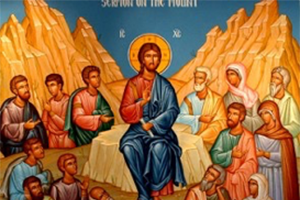
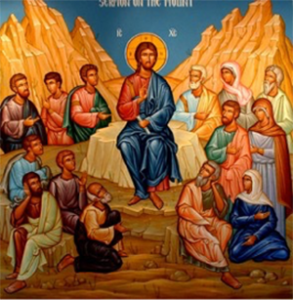
The Gospel for Sunday’s Mass is from the Sermon on the Mount (Matthew 5-7), specifically 5:17-37. In a way the Lord is drawing a picture for us of the transformed human person. He is presenting a kind of slide show of what sanctity really is. In understanding this rather lengthy text we do well to reflect on it in three parts.
I. The Power of New Life in Christ – We have discussed before that an important principle of the Christian moral vision is that it is received, not achieved. Holiness is a work of God. The human being acting out the power of his flesh alone cannot keep, and surely cannot fulfill, the Law. The experience of God’s people in the Old Testament bears this out. True holiness (not merely ethical rule-keeping) is possible only by and through God’s grace.
We must understand the moral vision given by Jesus as a description rather than a mere prescription. Notice what the text says here: I have come not to abolish but to fulfill [the Law]. It is Jesus who fulfills the Law. And we, who are more and more in Him and He in us, do what He does; it is His work.
Jesus describes these signs that we are transformed human beings:
Jesus Christ really begins to live His life in us (Gal 2:20).
The power of His cross goes to work in us and puts sin to death (Rom 6:2).
Jesus increases and we decrease (Jn 3:30).
Our old self is crucified with Him so that sin will no longer master us (Rom 6:6-7).
This is a work of God; the power is in the Blood and the cross. The power comes to us by grace. It is all a work of God.
Hence, in today’s Gospel, Jesus is not giving us a rigorous set of rules to follow (and they are rigorous), but is describing what the transformed human person is like. His description is not an impossible ideal, but is set forth as the normal Christian life. The normal Christian is a transformed human person. The normal Christian man has authority over his anger and sexuality, loves his wife and family, and is a man of his word. All this comes to him as the fruit of God’s grace.
It is very important to understand that this is a life offered to us by God. If we do not see it in that we, we are simply left with moral rules: Don’t be so angry or unchaste; don’t get divorced; and don’t lie. Rather, what is offered here is new life in Christ such that, on account of an inner transformation by the power of grace, our anger abates, our unchastity diminishes, our love of others increases, and we speak the truth in love. The power to do this comes not from our flesh but from the Lord, through the power of His cross to put sin to death and bring forth new life in us.
II. The Principle of New Life in Christ – Jesus’ moral vision is that, by His grace, we do not merely keep the Law, but fulfill it. The key word is “fulfill,” meaning to fill something until it is full, to exceed the minimum requirements. When we fulfill the Law, we enter into the full vision and meaning of the Law.
Thus, to use Jesus’ examples from today’s Gospel:
It is not enough to refrain from killing. True life in God means that I harbor no vengeful hatred. I love even my enemies and am reconciled with people I have wrongfully hurt or offended.
It is not enough to avoid adultery. True life in Christ means that I am chaste and pure even in my thoughts. By God’s grace, I have authority over what I am thinking and shun unchaste thoughts.
It is not enough to follow proper divorce law. True life in Christ means I have no desire to divorce my wife. I love her and my children. I am reconciled to her and accept that she is not perfect, just as I am not perfect.
It is not enough to refrain from swearing false oaths. True life in Christ means speaking the truth in love, being a man of my words. The grace of God keeps me from being duplicitous and deceitful.
In all these ways, the Law is not merely kept; it is fulfilled. It is filled full in that all these implications are abundantly and joyfully lived out as Jesus Christ transforms me. Christ came to fulfill the Law, and as our union with Christ grows more perfect we also fulfill the Law. For what Christ does, we do; we are in Him and He in us. I am the vine; you are the branches. If you remain in me and I in you, you will bear much fruit; apart from me you can do nothing (John 15:5).
III. The Picture of New Life in Christ. – The Lord then continues on to provide six descriptions of a transformed person. Today’s Gospel contains four of them. These pictures are often called “antitheses” because they are all formulated in this way: You have heard that it was said … but I say to you …. The key point is to see them as pictures of what happens to a person in whom Jesus Christ is really living. Let’s look at each.
A. On Anger– You have heard that it was said to your ancestors, You shall not kill; and whoever kills will be liable to judgment. But I say to you, whoever is angry with brother will be liable to judgment; and whoever says to brother, ‘Raqa,’ will be answerable to the Sanhedrin; and whoever says, ‘You fool,’ will be liable to fiery Gehenna. The Lord teaches us that the commandment not to kill has a deeper meaning. What leads to murder? Is it not the furnace of anger, retribution, and hatred within us? We may all experience a flash of anger and it passes. Further, there is such a thing as righteous anger, which is caused by the perception of injustice and sin. The Lord Himself exhibited this sort of anger on many occasions. This type of anger is not condemned. Rather the anger that is condemned is that which is born of hate and vengeance, anger that goes so far as to wish harm to another or to deny his human dignity; this is what leads to murder.
That the Lord has this sort of anger in mind is revealed in the examples He cites, which use the words Raqa and fool. These words express contempt and hatred. Raqa has no clear translation, but seems to have had the same impact as the “N word” does today. It was a very hurtful word expressing deep contempt. Such utterances cannot come from a person in whom the Lord authentically lives. And to the degree that we allow Christ to live in us, they will not. Increasingly, we cannot hate others, for the Lord is in us and He died for all of us out of love. How can I hate someone He loves?
The Lord makes it clear that if we don’t rid ourselves of this anger, we are going to jail: Therefore, if you bring your gift to the altar, and there recall that your brother has anything against you, leave your gift there at the altar, go first and be reconciled with your brother, and then come and offer your gift. Settle with your opponent quickly while on the way to court. Otherwise your opponent will hand you over to the judge, and the judge will hand you over to the guard, and you will be thrown into prison. Amen, I say to you, you will not be released until you have paid the last penny. Either we allow the Lord to effect this reconciliation in us or we’re off to jail! Whether the jail is Hell or purgatory (for it would seem that there is release from this jail after the last penny is paid), it is jail. We are not going to Heaven unless and until this matter is resolved. Why delay the issue? Let the Lord work it now. Don’t go to jail because of your grudges and your stubborn refusal to admit your own offenses.
B. On Lust – You have heard that it was said, You shall not commit adultery. But I say to you, everyone who looks at a woman with lust has already committed adultery with her in his heart. The Lord teaches us that the commandment against adultery has a deeper meaning. It is not merely about transgressing marital boundaries. To fill this Law full means to be chaste in all matters, in mind and in heart.
It is certainly wrong to engage in any illicit sexual union, but if one is looking at pornography or fanaticizing about others sexually, one is already in adultery. What the Lord is offering us here is a clean mind and pure heart. He is offering us authority over our sexuality and our thoughts. For those who are in Christ, self-mastery increases and purity of mind and heart become a greater reality. Our flesh alone cannot do this, but thanks be to God, who gives us the victory in Christ. It is His work in us to give us these gifts.
If your right eye causes you to sin, tear it out and throw it away. It is better for you to lose one of your members than to have your whole body thrown into Gehenna. And if your right hand causes you to sin, cut it off and throw it away. It is better for you to lose one of your members than to have your whole body go into Gehenna. We have to be serious about these matters. The Lord is using hyperbole to make a point: it is more serious to sin than to lose your eyesight or one of your limbs.
Most people don’t think this way; they make light of sin—sexual sin in particular. God does not make light of sin. Jesus teaches here that it is worse to lose our soul than to lose a part of our body. If we were to lose our eyesight or a limb to cancer, we would probably beg the Lord to deliver us. Why do we not think of sin in this way? Why are we not horrified to the same degree? We are clearly skewed in our thinking. Jesus is clear that these sorts of sins can land us in Hell (which is here called Gehenna). Lustful thinking, pornography, masturbation, fornication, adultery, contraception, and homosexual acts are not part of life in Christ, who wants to give us freedom and authority over our sexual passions.
Many people today are in some pretty serious bondage when it comes to sexuality. Jesus stands before us all and says, “Come let me live in you and give you the gift of sexual purity. It will be my gift to you. It will be my work in you to set you free from all disordered passions.”
C. On Divorce – It was also said, Whoever divorces his wife must give her a bill of divorce. But I say to you, whoever divorces his wife—unless the marriage is unlawful—causes her to commit adultery, and whoever marries a divorced woman commits adultery. At the time of the Lord Jesus, divorce was permitted in Israel, but a man had to follow certain rules. But the Lord says that to fulfill marriage law is to love your spouse. He teaches that when He begins to live His life in us, love for our spouse will grow; love for our children will deepen. Divorce won’t even occur to us! Who wants to divorce someone he loves?
If the Lord can help us to love our enemy, then He can surely cause us to love our spouse. Some of the deepest hurts can occur in marriage, but the Lord can heal all wounds and help us to forget the painful things of the past.
The Lord is blunt here. He simply refuses to recognize a piece of paper from a human judge approving a divorce. God is not impressed by a legal document and may well consider the couple married despite it.
The Lord says, “Come to me, bring me your broken marriage, your broken heart. Let me bring healing. Sometimes one of the spouses simply leaves or refuses to live in peace. In such a case, the Lord can heal by removing the loneliness and hurt that might drive one to a second “marriage” in which there is more trouble waiting. Let the Lord bring strength, healing, and a restoration of unity. He still works miracles and sometimes that is what it takes.
D. On Oaths – Again you have heard that it was said to your ancestors, Do not take a false oath, but make good to the Lord all that you vow. But I say to you, do not swear at all; not by heaven, for it is God’s throne; nor by the earth, for it is his footstool; nor by Jerusalem, for it is the city of the great King. Do not swear by your head, for you cannot make a single hair white or black. Let your ‘Yes’ mean ‘Yes,’ and your ‘No’ mean ‘No.’ Anything more is from the evil one. The people of Jesus’ time had lots of legalism associated with oaths and lots of tricky ways of watering down the truth. The Lord says, just be a man or woman of your word. When Jesus begins to live His life in us, we speak the truth in Love. When we make commitments, we are faithful to them; we do not lie; we don’t “play games” with the truth. God is truth. As He lives in us, we become the truth, speak the truth, and live the truth. This is the gift that Jesus offers us here.
So, then, here are four pictures of a transformed human being. Remember, the Sermon on the Mount is filled more with promises than with prescriptions, descriptions more so than prescriptions. The Lord is telling us what He can and will do for us.
I am a witness to the transformative power of Jesus’ grace and love. I promise you, brethren in the Lord Jesus Christ, that He will do everything He offers us here. It is already happening and is taking deep root in my life. How about you? Are you a witness?
This song, “Breathe in Me,” speaks of the power of Jesus to transform us and of our need for His grace.
You breathe in me, and I’m alive with the power of your holiness.
You breathe in me, and you revive feelings in my soul that I have laid to rest
Chorus: So breathe in me, I need you now.
I’ve never felt so dead within, so breathe in me.
Maybe somehow you can breathe new life in me again
I have met a good number of people who at one time said that they would never become Catholic yet now are; some are lay leaders in the Church and some are even priests! I have met other people who at one time said that they would never believe in God, yield to any religious instruction, or confess to “any man,” yet now they do (and teach others to do the same).
Growing up I never thought that I’d become a priest; the thought just never occurred to me. And if you told me in those days that Iwould one day be a priest, I would have laughed. But here I am, more than 25 years a priest and quite happy, thank you very much.
“Never say never.” It’s one of those wonderful phrases in which you break the rule in the very act of announcing it. God must laugh when we tell him our plans, and especially when we say, “Never.”
Pray God, though, that we never say that final “No” to Him, and that we never leave our sacred duties. May we seldom say never, but when we do, may it be when it matters.
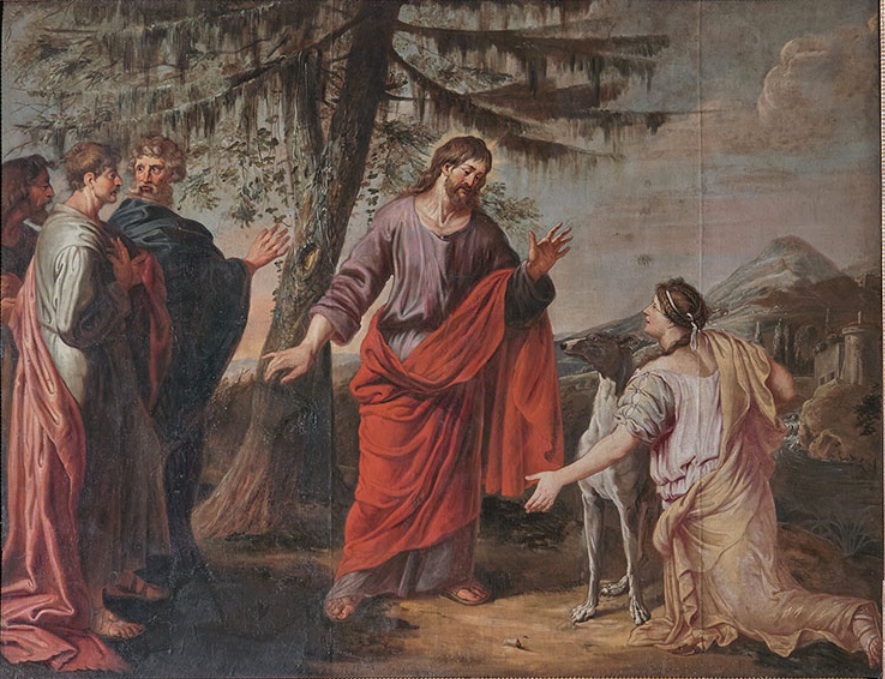
The Gospel for today’s Mass shocks most modern readers and perhaps a few ancient ones as well. It is the story of the Syrophoenician woman who begs Jesus to heal her daughter. But Jesus ignores and then rebuffs her. Our shock says perhaps more about our poor understanding of love than about Jesus’ terse response.
For review, here is the well known passage:
Jesus went to the district of Tyre. He entered a house and wanted no one to know about it, but he could not escape notice. Soon a woman whose daughter had an unclean spirit heard about him. She came and fell at his feet. The woman was a Greek, a Syrophoenician by birth, and she begged him to drive the demon out of her daughter. He said to her, “Let the children be fed first. For it is not right to take the food of the children and throw it to the dogs.” She replied and said to him, “Lord, even the dogs under the table eat the children’s scraps.” Then he said to her, “For saying this, you may go. The demon has gone out of your daughter.” When the woman went home, she found the child lying in bed and the demon gone (Mk 7:24-30).
While I have commented on other theories of this story elsewhere (Do Not Pass me By), in this post I want to briefly explore what our shock reveals about our own attitudes.
Briefly said, we tend to equate kindness with love; this is a mistake. Kindness is an aspect of love, but so is rebuke and so is punishment. Mercy and patience are aspects of love, but so are insisting on what is right and setting limits. Very often, true love requires us to be firm and insistent. Sometimes being kind is rather unloving, since that can assist or enable people in doing things that bring them great harm.
In today’s Gospel, Jesus, who is God and therefore is love, is for a moment “unkind” to the woman who seeks help for her daughter. He has His reasons for this. And while neither your nor I can read her heart, Jesus can. And it seems that Jesus sees a need to exact greater faith and trust from her. His rebuke challenges her, and challenges met have a way of increasing faith. She could have gone away angry or discouraged. With Jesus’ rebuke, her faith in His goodness is challenged. By staying in the conversation and refusing to give up her hope or faith, both these virtues grow. There is an old expression, “Things do by opposition grow,” and we see that here.
Why would her faith need to grow? I cannot speak for her, but I can speak for myself and from my experiences with others. Many people merely want relief, not healing. Healing is hard; it takes time and effort. Healing usually means that one must reexamine one’s life, thoughts, priorities, and so forth. Healing usually means making changes, some of them significant. It sometimes means giving up pleasures and ending unhealthy relationships.
Do we have the kind of faith that is willing to make the changes that healing often requires, or do we just want relief? I have found that people who have come to me over the years seeking deliverance and help often want a simple blessing or prayer to suffice. They are seeking relief and they want it fast. Some have made the longer journey toward healing, but others have gone away sad, angry, or discouraged.
In my own struggle during my mid-thirties, I think I started just wanting a quick solution to my anxieties; I wanted relief. But I came to discover that it was going to be a long journey to healing. It meant I was going to have to grow in trust by examining some of my controlling tendencies and changing the way I thought and lived.
Many years later, I can say that the healing has come. But it was a long and often difficult journey, during which I felt the way the Syrophoenician woman must have. In my own case, I was shocked by the Lord’s silence. And when I did hear His voice, it seemed only to challenge me. Was the Lord being unkind? Back then, I would have said, “yes.” But I have come to discover that the Lord was doing what was loving, even if at the time it seemed unkind and distant. The Lord was insisting that I come to trust Him more, for my own sake, and He wasn’t just going to keep sending me bromides for relief. His goal was to heal me. That was the loving thing to do.
Kindness has its place, but so does rebuke and so does the refusal to enable us in our sinful and wounded tendencies.
And so it was that a certain Syrophoenician woman experienced a moment of unkindness from Jesus. But she did not fail to receive His love. And while her story is told in a rather quick, focal way, our own stories may extend over a longer period. If we, like her, refuse to give up our hope and faith, if we stay with the Lord allowing Him to work and grow our faith in His work, we, too, will hear those marvelous words of the Lord: For saying this, you may go. The demon has gone out.
We have been reading the Genesis account of Creation in Mass, and so I’d like to ponder with you the awesome mystery of size and numbers as we look outward to all creatures great and inward to all creatures small.
Outer Space: As we look out on God’s universe, we cannot even fathom how huge and magnificent it is; we cannot comprehend its immensity. If one were to make a scale model of the Milky Way galaxy and reduce each star in it to the size of a grain of sugar, the model would have to be about 2000 miles wide and 1000 miles high—and that’s just one galaxy! There are billions of galaxies in the universe, which is ever expanding. Even the nearest star in our galaxy is about 25 trillion miles away from us.
And we are whirling around and outward! Earth rotates at a speed of about 1000 miles per hour (at the equator) while itself revolving at roughly 67,000 miles per hour around the sun. And our entire solar system is rotating around the center of the Milky Way galaxy at more than 500,000 miles per hour. And the Milky Way galaxy is flying outward and away (according to Doppler shift) at 1.3 million miles per hour! All creatures great … praise the Lord, for He has made them all!
Inner Space: What is equally amazing is the universe that exists, hidden from the naked eye, in what we might call “inner space”: that tiny, almost invisible world of microbiology. In just a drop of pond water there may be hundreds of thousands of bacteria and microorganisms, a veritable universe unto itself. Indeed, in every human body there are trillions of microorganisms in a kind of microbial fauna. About 80 different types of microorganisms live in the mouth alone. Every square centimeter of the human bowel contains as many as 10 billion organisms. Every square centimeter of our skin contains about 10 million individual bacteria. Even on our eyelashes are colonies of helpful bacteria and microorganisms that help keep the harmful ones away. These massively numbered civilizations—universes, really—of microorganisms are only recently known to us, thanks to the invention of powerful microscopes. To those in this “micro-world,” our bodies must seem as massive as outer space seems to us. If a microorganism could think, it would consider our bodies a universe too large to comprehend. Just as there are trillions of stars, there are trillions of microorganisms. To a microbe on our eyelash, a bacterium on our toe seems light-years away.
All creatures great and small – Outer space is magnificent (from the Latin magnus meaning large or great), but “inner space” is also a vast world—tiny to us, yet massive in its numbers. The abundance of life in these tiny worlds boggles the mind. To the microorganisms that accompany me, I am a universe too large to comprehend, yet I am only one of over seven billion humans on this planet. And I (even we, collectively) am not big at all. I am an infinitesimally small speck on a larger speck of dust called Earth, rotating around a fiery spark called the Sun, in a galaxy of over 200 billion other fiery sparks. And the Milky Way is just one galaxy (about 100 million light-years in diameter) of over 125 billion galaxies in the known universe!
It’s time for wonder and awe! We’ve moved between contemplating inner space and outer space in a matter of moments, but really, we cannot comprehend numbers like these. God does all this with a simple word—and it is so. He knows the depths of our souls and the details of the tiniest forms of life that cling to us. Every hair on our head is numbered and known to Him. He knows the farthest fringes of the universe. He made the stars and calls them by name. Ah, the Lord!
He who dismisses the light, and it departs, calls it, and it obeys him trembling; Before whom the stars at their posts shine and rejoice; When he calls them, they answer, “Here we are!” shining with joy for their Maker (Baruch 3:33-35).
As the old hymn says,
All things bright and beautiful,
All creatures great and small, All things wise and wonderful, The Lord God made them all.
Another of the great hymns says,O Lord my God! When I in awesome wonder, Consider all the works Thy hands have made. I see the stars, I hear the rolling thunder, Thy power throughout the universe displayed. Then sings my soul, my Savior God, to Thee. How great Thou art, how great Thou art!
Do not forget to meditate on God’s wonders. It is a great antidote to pride. God has done indescribable and marvelous things, some of which we can see and more which we cannot.
Beyond these, many things lie hid; only a few of his works have we seen (Sirach 43:34).
Many groups have a tendency to use words that make sense to their members but are unintelligible to outsiders. I have sometimes had to decode “Church-speak” for recent converts.
For example, one time I proudly announced, “RCIA classes will begin next week, so if you know anyone who is interested in attending please fill out an information card on the table just outside the sacristy door.” I thought I’d been perfectly clear, but then a new member approached me after Mass to inquire about the availability of classes to become Catholic and when they would begin. Wondering if she’d forgotten the announcement I reminded her what I had said about RCIA classes; she looked at me blankly. “Oh,” I said, “Let me explain what I mean by RCIA.” After I did so, I mentioned that she could pick up a flyer over by the sacristy door. Again I got a blank stare, followed by the question “What’s the sacristy?” Did I dare tell her that the classes would be held in the rectory?
I’ve had a similar reaction when announcing CCD classes. One angry parent called me to protest that she had been told by the DRE (more Church-speak) that her daughter could not make her First Holy Communion unless she started attending CCD. The mother, the non-Catholic wife of a less-than-practicing Catholic husband, had no idea what CCD meant and why it should be required in order for her daughter to receive Holy Communion. She had never connected the term CCD with Sunday school or any form of religious instruction.
Over my years as a priest I have become more and more aware that although I use what I would call ordinary terms of traditional Catholicism, given the poor catechesis (another Church word, meaning religious training, by the way) of so many, the meaning of what I am saying is lost. For example, I have discovered that some Catholics think that “mortal sin” refers only to killing someone. Even the expression “grave sin” is nebulous to many; they know it isn’t good, but aren’t really sure what it means. “Venial sin” is even less well understood!
Other words such as covenant, matrimony, incarnation, transubstantiation, liturgy, oration, epistle, Gospel, Collect, Homily, compunction, contrition, Sanctus, chalice, paten, alb, Holy Orders, theological, missal, consubstantial, one in being, Monsignor, narthex, ambo, and Eucharistic, while meaningful to many in the Church, are often only vaguely understood by others in the Church, not to mention the unchurched (is that another Church word?).
Once, at daily Mass, I was preaching based on a reading from the First Letter of John and was attempting to make the point that our faith is “incarnational.” I noticed vacant looks out in the pews. And so I asked the small group gathered that day if anyone knew what “incarnational” meant; no one did. I went on to explain that it meant that the Word of God had to become flesh in us; it had to become real in the way we live our lives. To me, the word “incarnational” captured the concept perfectly, but most of the people didn’t even really know for sure what “incarnation” meant, let alone “incarnational.”
Ah, Church-speak!
During my years in the seminary the art of Church-speak seemed to rise to new levels. I remember that many of my professors, while railing against the use of Latin in the liturgy, had a strange fascination with Greek-based terminology. Mass was out, Eucharist was in. “Going to Mass” was out, “confecting the synaxis” was in. Canon was out, “anamnesis” and “anaphora” were in. Communion was out, koinonia was in. Mystagogia, catechumenate, mysterion, epikaia, protoevangelion, hapax legomenon, epiklesis, synderesis, eschatology, Parousia, and apakatastasis were all in. These are necessary words, I suppose, but surely opaque to most parishioners. Church-speak indeed, or should I say ekklesia-legomenon.
Ah, Church-speak! Here is a list of many other Church words for your edification (and amusement): Church words defined.
At any rate, I have learned to be a little more careful when speaking so as to avoid using too many insider expressions and older terms without carefully explaining them. I think we can and should learn many of them, but we should not assume that most people know them.
The great and Venerable Archbishop Fulton Sheen once said that he discovered early on that he often got credit for being learned when in fact he was merely being obscure. And for any who knew him in his later years, especially through his television show, he was always very careful to explain Church teaching in a way that made it accessible to the masses. It’s good advice for all of us: a little less of the CCD and RCIA jargon and little more clear “religious instruction” can help others to decode our Church-speak.
I am not saying that we should “dumb down” our vocabulary, for indeed it is a precious patrimony in many cases. But we need to do more explaining rather than merely presuming that most people will know what our terms mean.
This video has a lot of gibberish in it, but it illustrates how we can sound at times if we’re not careful!

 As we read the flood story in Tuesday’s daily Mass, I feel that a few clarifications are in order.


 We have been reading the Genesis account of Creation in Mass, and so I’d like to ponder with you the awesome mystery of size and numbers as we look outward to all creatures great and inward to all creatures small.