We live in times when many people take offense very easily. While this may have been a human problem seen in all ages, it is particularly evident today, when relativism and subjectivism are so widespread. Relativism is essentially a form of subjectivism. In subjectivism, the measure of truth shifts from the object (i.e., that which is being perceived) to the subject (i.e., the one who is perceiving). In this system, truth becomes relative, because there are as many versions of truth as there are subjects to perceive it. In this highly subjective perception of reality, people tend to take their own views very personally and are easily offended by views contrary to their own.
Over time we have seen how subjectivism has given rise to “identity politics.” No longer does a person say that he holds liberal views; rather he says, “I am a liberal.” No longer does a person say that he struggles with same-sex attraction; rather he says, “I am ‘gay’.” Views and interpretations are no longer merely philosophies, paradigms, or tendencies through which a person interprets things. Rather, the cry goes up, “This is who I am. If you disagree or even worse seek to refute my viewpoint, you are offensive and hurtful. By disagreeing with me you are attacking me; you are a hater. You are an enemy whom I must fear and must keep at a distance lest you do me harm.” So-called “safe zones” on college campuses are an extreme outcome of this. In identity politics, the mere questioning of one’s views amounts to a personal assault that may cause lasting harm to the psyche!
We have also seen how relativism and subjectivism have led to the shaming and silencing of politically incorrect views, especially those based on traditional biblical faith. Too many Christians have allowed themselves to be silenced by accusations such as this common one: “You are judging me.” Never mind that the conversation is about a moral issue or a particular behavior, not about “you.” Identity politics says, “I am my behavior, therefore your contrary view hurts me; this makes you a bad and offensive person.”
No one (other than a sociopath) deliberately tries to hurt or offend others. Many Christians have been effectively silenced by the fear of causing offense, even if there is no reason for offense to be taken. As our fearful silence has spread, the moral darkness has grown ever deeper.
Volumes could be written to address the problems associated with subjectivism and relativism. St. Thomas Aquinas provided a cogent response to the issue of so easily taking offense in his Summa Theologica:
It was foretold (Isaiah 8:14) that Christ would be “for a stone of stumbling and for a rock of offense to the two houses of Israel.”
The salvation of the multitude is to be preferred to the peace of any individuals whatsoever. Consequently, when certain ones, by their perverseness, hinder the salvation of the multitude, the preacher and the teacher should not fear to offend those men, in order that he may insure the salvation of the multitude. Now the Scribes and Pharisees and the princes of the Jews were by their malice a considerable hindrance to the salvation of the people, both because they opposed themselves to Christ’s doctrine, which was the only way to salvation, and because their evil ways corrupted the morals of the people. For which reason our Lord, undeterred by their taking offense, publicly taught the truth which they hated, and condemned their vices. Hence we read that when the disciples of our Lord said, Dost Thou know that the Pharisees, when they heard this word, were scandalized? He answered, Let them alone: they are blind and leaders of the blind; and if the blind lead the blind, both fall into the pit (Matthew 15:12,14).
A man ought so to avoid giving offense, as neither by wrong deed or word to be the occasion of anyone’s downfall. “But if scandal arise from truth, the scandal should be borne rather than the truth be set aside” as Gregory says (Hom. vii in Ezech.).
[Summa Theologica III, Question 42, Article 2]
Not a bad reply; read it and heed it!
Remember, just because some takes offense, doesn’t mean you gave offense.
In the Divine Office last week, we read from the Book of Proverbs; in this week’s Masses we are reading from Sirach. Both of these books are part of the Wisdom Tradition.
Today, I’ll be reviewing a few of the sayings from Proverbs, but before doing so, I’d like to explain the use of the word fool (as contrasted with wise one) in the Wisdom Tradition. Without a richer understanding of the term fool, it is possible to interpret its use as a mere ad hominem attack.
To the modern mind, the word fool is demeaning and hurtful. It tends to be used to refer to one who is irredeemably stupid, buffoonish, and/or lacking in common sense—one who is “dumb as a rock.”
However, when the Scriptures use the term fool it is set forth in contrast to one who is labeled wise. Its usage in Scripture is more nuanced, a description of one who rejects wisdom rather than merely a pejorative. There are several Hebrew words that are translated as fool. Here are two of them:
One Hebrew root of fool is אֱוִיל (ewil), which means to be perverse and lacking in reflection. In context, the word refers to
those who despise wisdom and discipline (Proverbs 1:7, Proverbs 15:5),
those who mock guilt (Proverbs 14:9),
those who are quarrelsome (Proverbs 20:3),
those who are licentious (Proverbs 7:22), or
those for whom attempted instruction is folly (Proverbs 16:22, Proverbs 27:22, Jeremiah 4:22, Job 5:2-3, Isaiah 19:11, Psalm 107:17).
A second Hebrew root is כְּסִיל (kasal), which means a stupid fellow, a dullard. In context, the word refers to
those who hate knowledge (Proverbs 1:22),
those who delight not in understanding (Proverbs 18:2),
those who love to do mischief (Proverbs 10:23, Proverbs 12:23, Proverbs 15:2), or
those who feed on the mischief of others (Proverbs 15:14).
Thus we are not dealing with someone who is stupid, but rather one whose stance is against that which is reasonable, holy, orderly, and wise. Such people may in fact be intelligent and have wide knowledge about things of the world, but their stance is against Godly Wisdom. They are set against what matters to God; they are rooted in the passing things of this world. They base their lives on transitory and unimportant things, which cannot form the true basis for salvation.
The Latin Vulgate often uses the wordinsipiens (unwise) to refer to foolishness. In other words, foolishness is the setting of oneself against wisdom.
Simply thinking that fool means stupid, is failing to grasp the nuance of the word. While it is not a flattering portrayal, neither is it mere name-calling; rather, it is descriptive. Fools are those who set themselves against wisdom; they are not merely stupid people.
With that in mind, let’s examine a few passages from the Proverbs. They help to explain what God’s Church and those who seek wisdom are up against. My comments are presented in red text.
Blessings are for the head of the just, but a rod for the back of the fool (Prov 10:6).
God’s law is a great blessing to those who love wisdom. His commandments are not prison walls; they are defending walls. His commands do not limit freedom so much as they frame it within necessary limits.
But to the foolish, to those who hate and despise God’s wisdom, to those who hate discipline and reasonable limits, God’s law—any authority that tries to limit behavior—is hateful and punishing, like a rod on the back.
Many today are not simply indifferent to God’s wisdom as proclaimed by the Church and Scripture, they are openly hostile to it!
It is like the reaction of someone who has been sitting in a very dark room and is suddenly overwhelmed by bright light. He despises the light and protests its presence as something hateful and hurtful. Jesus lamented, And this is the judgment: the light has come into the world, and people loved the darkness rather than the light because their deeds were evil (Jn 3:19).
To those who despise God’s wisdom, it is seen not as a brilliant and beautiful light, a blessing for the mind to contemplate; rather, it feels like a punishing rod on the back.
A wise man heeds commands, but a prating fool will be overthrown. A path to life is his who heeds admonition, but he who disregards reproof goes astray (Proverbs 10:8, 17).
The wise man listens to instruction and strives to base his life upon it. The wise humbly accept that they do not know all things and must be taught by God.
But fools, those who hate wisdom, prattle on and on about their own opinions. They believe anything is true simply because they think it.
It is difficult to reason with them, because although they scoff at religious truth as mere “religion,” it is really they who exhibit a far more extreme version of “blind faith” than any Christian believer who sees faith and reason as compatible.
The text says that the end of a fool is destruction. Many political ideologies, errant trends, and misguided philosophies have come and gone over the years, yet the Church remains. The wisdom and the Word of the Lord endure forever.
He who walks honestly walks securely, but he whose ways are crooked will fare badly (Prov 10:9).
Evil has its hour. It rises, seems glamorous to many, and is praised and paraded about as some new form of liberation.
But evil cannot last, and those who practice it will not flourish. It may come in the form of addiction, disease, strife, inner conflict, or any number of resentments rooted in false hope; but those who practice it will fare badly.
Only those who walk in honesty and in the truth—time-tested truth taught by God Himself—will walk securely. They will have trials to be sure, but if they follow God’s time-tested wisdom, even these difficulties will help them to reach their goal.
He who winks at a fault causes trouble, but he who frankly reproves promotes peace (Prov 10:10).
There is great pressure from many sectors today to remain silent about sin and evil. Those who do speak of sin are called judgmental and intolerant. Sadly, many Christians have succumbed to this pressure; nothing but trouble can result. The moral cesspool that is the modern age is evidence of this.
The correction of faults, frankly and with love, is an act of charity (St. Thomas Aquinas). Error and sin bring war and division, both individually and collectively, but God’s truth, lovingly proclaimed, brings peace by insisting on what is good, right, true, and beautiful.
We live in an age that winks at evil. The world seems to find evil funny, and often celebrates it in visual entertainment, written media, music, and numerous other ways. The destructiveness of the glamorization of evil is apparent if one simply reads a newspaper or turns on the news.
God’s law is His peace plan for this broken world of ours; it is His wisdom that will bring us peace.
A fountain of life is the mouth of the just, but the mouth of the wicked conceals violence (Proverbs 10:11).
Jesus warned that Satan and those who are evil often masquerade in sheep’s clothing, while underneath they are ravenous wolves (see Mat 7:15). Many in our world today who despise God’s wisdom conceal their violence with euphemisms such as pro-choice, no-fault divorce, reproductive freedom, euthanasia, and death with dignity.
Despite the cloak of pseudo-compassion, they ultimately peddle death and division. God’s wisdom, on the other hand, speaks to the dignity of every human life, to hope, and to the promise of life, in spite of any difficulties.
The just man’s recompense leads to life, but the gains of the wicked, to sin.Better a little with fear of the Lord, than a great fortune with anxiety. Better a little with virtue, than a large income with injustice (Proverbs 10: 15, 16).
For those who are striving to be just and to follow God’s wisdom, the rewards received are to be shared generously with others. The gains of the wicked, however, lead to sins such as gluttony, greed, hoarding, and other excesses. Rather than sharing their abundance with others, they spend it on the flesh and place their trust in creatures rather than the Creator, who is blessed forever.
Where words are many, sin is not wanting; but he who restrains his lips does well (Proverbs 10:19).
In an age of non-stop communication and 24/7 news reporting, the sin of gossip is an almost endlessly available temptation. Discretion appears to have been lost. Almost everyone thinks he has a right to know everything about everyone else. The people’s “right to know” seems to have no limits.
Our age is one of many media (visual, verbal, musical, etc.), and sin is not wanting on account of this. We talk endlessly about other people’s business and often ignore our own issues. Why stay in our own lane when we can “tune in at 11,” read a scandal sheet, or surf to a website for the latest gossip?
Rare indeed are those who “restrain their lips” and cover their eyes and ears to what is sinful or even merely intriguing.
Crime is the entertainment of the fool; so is wisdom for the man of sense (Proverbs 10:23).
Our culture celebrates the sins of others as entertainment. On television, in the cinema, and in many other forms of communication, fornication, adultery, and all kinds of sexual misconduct are normalized—even celebrated.
It is the same with violence. Most adventure movies today glamorize its use solve problems. An injustice occurs and the “hero” (after 90 minutes of killing people, breaking things, and blowing up buildings) has a final showdown with the unambiguously evil enemy, killing him and walking away with the girl on his arm and the burning city in the background—roll credits.
We also glorify mobsters and others who participate in crime and violence.
Some will argue that movies should reflect life. That is fine, but most people are not killing other people, burning cities, crashing cars, or blowing up buildings. Most people are not Mafiosi. Sadly, however, there is a lot of fornication, adultery, and participation in homosexual acts. In real life, however, these actions are not without consequence (as movies depict).
Where are the movies that depict wisdom, beauty, love, truth, chastity, and strong families? There are some out there, but they are usually eclipsed by the far greater number that celebrate crime, violence, dysfunction, and sinfulness.
When the tempest passes, the wicked man is no more; but the just man is established forever (Proverbs 10:25).
The Church alone is indefectible, by the promise of Jesus Christ. Although evil movements, political forces, and sinful regimes rise and boast of their power, they eventually fall. The Church has seen empires rise and fall and philosophies come and go. Evil men have threatened the Church with destruction for thousands of years, but we have read the funeral rites over every one of them.
The truth will out. Evil will not remain; it cannot last. Christ has already won the victory.
The foolish keep resisting; they laugh at God’s wisdom, dismiss the Scriptures, and ridicule the Church. When they are gone, though, we will still be here proclaiming Christ crucified, gloriously resurrected, and ascended to glory.
Those who mock this resist the consistent message of history. Jesus is Lord, and though He permits His enemies time to repent, their days are ultimately numbered—evil cannot last.
These are just a few proverbs that speak to our times and help us to understand what God has to say about many modern trends.
Here’s a video with some other sayings. In posting this I do not mean to affirm every saying presented in it, but some of them do make good sense!
We live in an age of often strident secularism. If a religious utterance is made by a government official (or it would seem, even a First Lady) a loud cry goes up from an increasingly hostile minority. The platitude about “Separation of Church and State” is usually bandied about, a phrase that does not even appear in the Constitution.
Free Exercise clause – It is true that the First Amendment decrees that Congress shall pass no law respecting an establishment of religion, but it also specifies that it shall pass no law prohibiting the free exercise of religion. This second pillar, protecting religious expression, is eroding. Increasingly, the claim is made that religious bodies (especially the Catholic Church) have no right to attempt any influence in the legislative process. But this, of course, would limit our ability to freely exercise our faith, a major tenet of is that we should evangelize, be a light to the world, and testify to the truth. Secularists are increasingly proposing that the only acceptable place for religious expression of any kind is within the four walls of a church building.
Many secularists argue that America’s founding fathers wanted it this way, that they wanted a wall of separation because most of them were either irreligious or deists. But what is interesting is that most of them spoke freely of God, including appeals to Him and His will in their remarks. This is true even of Thomas Jefferson; any visit to the Jefferson Memorial will demonstrate that. Passages from a number of his writings and speeches are chiseled into the walls, and most of them refer to God. Most of these founding fathers (who purportedly wanted this dramatic separation of Church and State) were involved in drafting the Constitution.
Many people love to point out that God is never mentioned in the Constitution, but actually, He is! The final line of the Constitution reads as follows:
Done in Convention by the Unanimous Consent of the States present the Seventeenth Day of September in the Year of our Lord one thousand seven hundred and Eighty-seven and of the Independence of the United States of America the Twelfth. In Witness whereof, We have hereunto subscribed our Names:
In the year of our Lord? Oops, where did that come from? I guess the drafters of the Constitution never got the memo that God is not to be mentioned in government documents or at government functions. The Lord referred to is none other than Jesus Christ, for the year corresponds to the number of years since His birth.
The first signature on the Constitution is that of George Washington. Apparently he also never got the memo about keeping God and religion out of all things governmental, because he mentioned God frequently in his writings and speeches. Below are just three examples. The first speaks of our obligation to give thanks to God; it is a decree declaring a Day of Thanksgiving in the United States on November 26, 1789. The second is from a speech to an assembly of Delaware Indian Chiefs in 1779 and would be considered highly politically incorrect today. The third is from his last speech to the U.S. Legislature.
Whereas it is the duty of all nations to acknowledge the providence of Almighty God, to obey His will, to be grateful for His benefits, and humbly to implore His protection and favor; and Whereas both Houses of Congress have, by their joint committee, requested me to “recommend to the people of the United States a day of public thanksgiving and prayer, to be observed by acknowledging with grateful hearts the many and signal favors of Almighty God, especially by affording them an opportunity peaceably to establish a form of government for their safety and happiness:” Now, therefore, I do recommend and assign Thursday, the 26th day of November next, to be devoted by the people of these States to the service of that great and glorious Being who is the beneficent author of all the good that was, that is, or that will be; that we may then all unite in rendering unto Him our sincere and humble thanks for His kind care and protection of the people of this country previous to their becoming a nation; for the signal and manifold mercies and the favorable interpositions of His providence in the course and conclusion of the late war; for the great degree of tranquility, union, and plenty which we have since enjoyed; for the peaceable and rational manner in which we have been enabled to establish constitutions of government for our safety and happiness, and particularly the national one now lately instituted for the civil and religious liberty with which we are blessed, and the means we have of acquiring and diffusing useful knowledge; and, in general, for all the great and various favors which He has been pleased to confer upon us. And also that we may then unite in most humbly offering our prayers and supplications to the great Lord and Ruler of Nations and beseech Him to pardon our national and other transgressions; to enable us all, whether in public or private stations, to perform our several and relative duties properly and punctually; to render our National Government a blessing to all the people by constantly being a Government of wise, just, and constitutional laws, discreetly and faithfully executed and obeyed; to protect and guide all sovereigns and nations (especially such as have shown kindness to us), and to bless them with good governments, peace, and concord; to promote the knowledge and practice of true religion and virtue, and the increase of science among them and us; and, generally to grant unto all mankind such a degree of temporal prosperity as He alone knows to be best. Given under my hand, at the city of New York, the 3d day of October, A.D. 1789 George Washington, President.
You do well to wish to learn our arts and ways of life, and above all, the religion of Jesus Christ. These will make you a greater and happier people than you are (Speech to the Delaware Indian Chiefs on May 12, 1779).
I now make it my earnest prayer that God would … most graciously be pleased to dispose us all to do justice, to love mercy, and to demean ourselves with that charity, humility, and pacific temper of the mind which were the characteristics of the Divine Author of our blessed religion (Last Official Address of George Washington to the Legislature of the United States).
Abraham Lincoln also often referred to God and faith:
On Faith as among the Civic Virtues – Intelligence, patriotism, Christianity, and a firm reliance on Him, who has never yet forsaken this favored land, are still competent to adjust, in the best way, all our present difficulty (First Inaugural Address, March 4, 1861).
On Divine Providence – In the very responsible position in which I happen to be placed, being a humble instrument in the hands of our Heavenly Father, as I am, and as we all are, to work out his great purposes, I have desired that all my works and acts may be according to his will, and that it might be so, I have sought his aid—but if after endeavoring to do my best in the light which he affords me, I find my efforts fail, I must believe that for some purpose unknown to me, He wills it otherwise. If I had had my way, this war would never have been commenced; If I had been allowed my way this war would have been ended before this, but we find it still continues; and we must believe that He permits it for some wise purpose of his own, mysterious and unknown to us; and though with our limited understandings we may not be able to comprehend it, yet we cannot but believe, that he who made the world still governs it (Letter to Eliza Gurney, October 26, 1862).
On Religious Liberty – But I must add that the U.S. government must not, as by this order, undertake to run the churches. When an individual, in a church or out of it, becomes dangerous to the public interest, he must be checked; but let the churches, as such take care of themselves. It will not do for the U.S. to appoint Trustees, Supervisors, or other agents for the churches (Letter to Samuel Curtis, January 2, 1863).
On the Justice of God – Fondly do we hope—fervently do we pray—that this mighty scourge of war may speedily pass away. Yet, if God wills that it continue, until all the wealth piled by the bond-man’s two hundred and fifty years of unrequited toil shall be sunk, and until every drop of blood drawn with the lash, shall be paid by another drawn with the sword, as was said three thousand years ago, so still it must be said “the judgments of the Lord, are true and righteous altogether” (Second Inaugural Address, March 4, 1865).
These are just a few samples showing that the aversion to any religious reference is relatively new, and is a disposition unknown to our founding fathers as well as to those of Lincoln’s era. These quotes do not “prove” that Presidents Washington and Lincoln were perfect Christians or that they were never critical of any aspects of religion, but they do indicate that they both understood the importance of religious faith to our country and were quite comfortable articulating both the need for faith and its benefits.
Extremism – Recent attempts to completely ban any religious expression, any spoken appreciation for religion, or any encouragement of its practice, would surely seem extreme to these men—extreme and far removed from the embrace this land of ours has historically extended to faith.
Washington and Lincoln did not hesitate to invoke God, ask His blessings, and exhort their fellow citizens to hearty prayer. Let us pray for our country and all of our leaders. Happy Presidents’ Day!
One of the most common frustrations in the spiritual life is the fact that God often makes us wait. Many of our requests are made with an elevated sense of urgency. Frankly, we are in a big hurry about many things—but God is not. Although He could fix every problem in an instant, He does not, and He has His reasons for this.
While the reasons for God’s delay may be somewhat mysterious, we can certainly understand some of them. For example, any parent knows that giving a child whatever he wants precisely when he wants is to spoil him. Learning to wait is beneficial. It humbles us, keeps us vigilant, helps us to clarify our desires, and aids us in developing self-control.
In last week’s Office, we read a tract from St. Augustine, in which he beautifully described another reason that God would have us wait:
The entire life of a good Christian is in fact an exercise of holy desire. You do not yet see what you long for, but the very act of desiring prepares you, so that when he comes you may see and be utterly satisfied.
Suppose you are going to fill some holder or container, and you know you will be given a large amount. Then you set about stretching your sack or wineskin or whatever it is. Why? Because you know the quantity you will have to put in it and your eyes tell you there is not enough room. By stretching it, therefore, you increase the capacity of the sack.
And this is how God deals with us. Simply by making us wait he increases our desire, which in turn enlarges the capacity of our soul, making it able to receive what is to be given to us.
So, my brethren, let us continue to desire, for we shall be filled! (Tract. 4: PL 35, 2008-2009)
St. Teresa of Avila said something similar in her seminal work, The Interior Castle. In her reflection on the fourth mansions, she introduced the first stages of contemplative prayer:
I remember a verse we say at Prime at the end of the final Psalm; the last words are: “Cum dilatasti cor meum”—“When Thou didst dilate my heart.” … [A] person must have dwelt for a long time in the former mansions before entering these … [otherwise] all occasions of gaining merit would be withdrawn, were [the soul] left continually absorbed in God. [This is] the difference between sweetness in prayer and spiritual consolations (The Interior Castle, Fourth Mansions 1:3-5).
In effect, she is teaching that one rarely reaches deeper prayer without the necessary waiting, as God leads us through the stages of the purgative way (mansions one through three). We must wait and cooperate as God does His work to purify us and enlarge our heart to receive the gift of deeper prayer. And even once deeper prayer is attained, it cannot be all sweetness, for then merit and further growth would be lost.
God must increase the size of our heart, but this takes time. If we are faithful, waiting brings about yearning. To yearn is to increase our desire and to enlarge our heart. This prepares us for the greater gifts God wants to bestow upon us.
There are many reasons God has us wait. Allow St. Augustine and St. Teresa to teach you one important reason. Let God enlarge your heart through desire. Only then will it be big enough to enjoy the full extent of what He is offering.
In today’s Gospel the Lord is teaching us, by His grace, to break the cycle of hatred and retribution. When someone harms me I may well become angry, and in my anger seek to get back at the offender. If I do that, though, then Satan has earned a second victory and brought the anger and retribution to a higher level. Most likely, the one who originally harmed me will then take exception to my retribution and try to inflict more harm on me. And so the cycle continues and escalates. Satan loves this.
Break the cycle. The Lord has dispatched us onto the field to turn the game around and break this cycle of retribution and hatred. The “play” He wants us to execute is the “it ends with me” play.
Don’t play on Satan’s team. To hate those who hate me, to get back at those who harm me, is to work for Satan, to play on his team. Why do that?
To advance the ball for Jesus is to break the cycle of retribution and hatred by taking the hit and not returning it. By loving our enemy, we break the cycle of hate. By refusing retribution, we rob Satan of a double victory.
Recall the words of Dr. Martin Luther King, Jr.:
Darkness cannot drive out darkness; only light can do that. Hate cannot drive out hate; only love can do that. Hate multiplies hate, violence multiplies violence, and toughness multiplies toughness in a descending spiral of destruction. … The chain reaction of evil—hate begetting hate, wars producing more wars—must be broken, or we shall be plunged into the dark abyss of annihilation (From Strength to Love, 1963).
Christ, living in us, wants to break the cycle.
The Necessity of Grace – Recall as well a point made in last Sunday’s reflection: that the antitheses contained in chapter 5 of the Gospel of Matthew are pictures of the transformed human person. Jesus is describing here what happens to a person in whom He has begun to live through the Holy Spirit. The verses are a description more so than a prescription. Jesus is not merely telling us to stop being so thin-skinned, easily offended, and retaliatory. He’s not just telling us to stop hating people. If that were the case, it would be easy for us to get discouraged or to write them off as some impossible ideal. No, the Lord is doing something far greater than just giving us a set of rules. He is describing what will happen to us more and more as His grace transforms us.
With this in mind, let’s look at the particulars in three sections.
I. Regarding Retaliation – The first of the antitheses reads as follows:
You have heard that it was said, “An eye for an eye and a tooth for a tooth.” But I say to you, offer no resistance to one who is evil. When someone strikes you on the right cheek, turn the other one to him as well. If anyone wants to go to law with you over your tunic, hand him your cloak as well. Should anyone press you into service for one mile, go with him for two miles. Give to the one who asks of you, and do not turn your back on one who wants to borrow.
Behind this text is the gift from the Lord of a generous heart. Psalm 118 says, In the ways of your precepts I run O Lord for you have enlarged my heart. It takes a large heart not to retaliate, to go the extra mile, to give alms. The transformed mind and heart that Jesus gives us is like this. It is a big heart, able to endure personal slights and attacks, refuse retaliation, and let go of personal possessions in pursuit of a higher goal.
That said, there are surely many questions that arise out of these sayings of Jesus’. Most of them, however, come from seeing Jesus’ words as a legalistic prescription rather than as a descriptive example. Nevertheless, they are important questions.
What does it mean to offer no resistance to injury?
Does it mean that there is no place for a criminal justice system?
Should police forces be banned?
It there no place for national defense or armed forces?
Should all punishment be banned?
Should bad behavior never be rebuked?
Am I required to relinquish anything anyone asks me for?
Must I always give money to beggars?
Is it always wise to give someone whatever he asks for?
Should I agree to accept every task that is asked of me?
To answer some of these questions, we do well to recall that the Lord is speaking to us as individuals. The state, which has an obligation to protect the innocent from enemies within and without, may be required to use force to repel threats. Further, it has an obligation to secure basic justice and may therefore be required to impose punishment on those who commit crimes. This has been the most common Catholic understanding of this passage. The New Testament seems to accept that the state does have punitive powers, to be used for the common good.
But don’t miss Jesus’ main point, which is directed to us as individuals. He testifies that, to the degree that we are transformed, we will not seek to retaliate or avenge personal injuries. Rather, due to our relationship with God the Father, we will be content to leave such matters to God. As Scripture testifies, Beloved, never avenge yourselves, but leave it to the wrath of God; for it is written, “Vengeance is mine, I will repay, says the Lord” (Rom 12:19). Further and even more important, to the degree that Jesus lives in us, we will be less easily offended. This is because our sense of our dignity is rooted in Him, not in what some mere mortal thinks, says, or does.
Jesus goes on to give four examples of what He means by us becoming less vengeful and retaliatory.
When someone strikes you on the right cheek, turn the other one to him as well.In ancient times, striking someone in this manner was a sign of disrespect, just as it would be today. There is an intended humiliation when someone strikes another on the cheek. By turning the other cheek, one would then be struck with the back side of the striker’s hand. This was an even greater indignity in the ancient world! But as a Christian in whom Christ is really living, who can really dishonor me? God is the source of my dignity; no one can take it from me. By this grace, I can let any slight pass, because I have not been stripped of my dignity. The world did not give me my dignity and the world cannot take it away. From this perspective, Jesus is not offering us merely the grace to endure indignity, but the grace not to suffer or experience indignity at all.
If anyone wants to go to the law with you over your tunic, hand him your cloak as well.In ancient times, it was forbidden to take someone’s tunic in pledge for a loan. Thus Jesus would seem to be using this example as a symbol of our rights. There are some people who are forever demanding and clinging to their rights. They clutch their privileges and will not let them go even if the common good would require it. They will go to the law rather than suffer any infringement upon their rights. The true Christian thinks more in terms of duties than rights, more of responsibilities than privileges. All this
“personal honor” stuff is unimportant when Christ lives in us. To be sure, there are some rights necessary for the completion of our duties or for meeting our basic needs. It is unlikely that Jesus has in mind to forbid this. But as a general rule, Jesus is indicating that we can be freed of obsession over our “rights,” “dignity,” and also our personal possessions. Increasingly, we can be freed of the anger that can arise when someone might even think of touching anything that is “ours.” The more we are detached from earthly possessions, the less we get anxious or angry when these things are somehow threatened or used without our permission, or when our precious “rights” are trampled upon.
Should anyone press you into service for one mile, go with him for two miles.It was legal for a Roman solider to press a person into service for one mile to carry things. Some might be bent out of shape over such indignities. Jesus offers us a generous heart that will go the extra mile. Jesus came as the servant of all; He came to serve rather than to be served. To the degree that He lives in us, we will willingly serve and not feel slighted when someone asks us to do something. Neither will we cop the “Why me?” attitude that commonly afflicts the ungenerous soul. The key gift here is a generous heart, even in situations in which others do not assign work to us fairly or appreciate our efforts sufficiently. This is of little concern for us, because we work for God.
Give to the one who asks of you, and do not turn your back on one who wants to borrow.Many questions arise related to indiscriminate giving. In some cases, it may not be wise thing to give money simply because someone asks. But don’t miss the main point here: when Jesus lives in us, we will be more generous. We will give cheerfully and assist others gladly. We will not get bent out of shape when someone asks us for help. We may not always be able to help, but our generous heart will not begrudge the beggar; we will remain cheerful and treat him or her with respect.
Here, then, is a description of a transformation of the mind and heart. We will view things differently. We will not be so easily bent out of shape, retaliatory, or vengeful. We will be more patient, more generous, less grasping, and more giving. This is what happens when we live in a transformative relationship with Jesus.
II. Radical Requirement – Love your enemy.
You have heard that it was said, “You shall love your neighbor and hate your enemy.” But I say to you, love your enemies, and pray for those who persecute you, that you may be children of your heavenly Father, for he makes his sun rise on the bad and the good, and causes rain to fall on the just and the unjust. For if you love those who love you, what recompense will you have? Do not the tax collectors do the same? And if you greet your brothers only, what is unusual about that? Do not the pagans do the same?
This is the acid test, the hallmark of a true Christian: love of one’s enemy. Note that the Lord links this to being a true child of God. Why? Because God loves everyone and gives gifts of sun and rain to all. If we are a “chip off the old block,” we will do the same. It’s easy to love those who love us, but a Christian is called to fulfill the Law and exceed it.
If Christ lives in us, then we will love even our enemy. Recall that Jesus loved us even when we hated Him and killed Him. Jesus said, Father, forgive them; for they know not what they do (Luke 23:34). Elsewhere in Scripture is written, While we were his enemies we were reconciled to God by the death of his Son (Rom 5:10).
We should be careful not to make love an abstraction. The Lord is talking about a real transformation of our hearts. Sometimes we say silly things like this: You don’t have to like everyone but you have to love them. This turns love into something of an abstraction. God doesn’t just love me; he even likes me. The Lord is talking about a deep love that wills good things for our enemy and even works toward them.
We are called to have compassion, understanding, and even affection for those who hate us and will us evil. We may wonder how this can happen in us. How can we have affection for those who hate us? It can be so when Christ lives His life in us. We will good and do good to them who hate us, just as Jesus did.
It is also important not to sentimentalize this love. Jesus loved His enemies but did not coddle them. He spoke the truth to the Scribes and Pharisees of His day, often forcefully and uncompromisingly. We are called to a strong love, one which wants the truth for everyone, but we must give this testimony with understanding and true (not fake or false) compassion.
III. Remarkable Recapitulation – Finally, the Lord says,
So be perfect, just as your heavenly Father is perfect.
Here is the fundamental summary, the recapitulation: God-like perfection! Nothing less will do. How could there be anything less when Christ lives His life in us? To the degree that He lives in us and the old Adam dies, we become perfect. This is the state of the saints in Heaven: they have been made perfect. Christ’s work in them is complete. The Greek word used here is τέλειός (teleios) which means complete or perfect. Thus, the emphasis is on the completion of a work in us more so than mere excellence in performance. Paul writes to the Philippians, And I am sure that he who began a good work in you will bring it to completion at the day of Jesus Christ (Phil 1:6).
This sentence also serves as an open-ended conclusion to the antitheses today’s Gospel. It’s almost as if Jesus says, “I’ve only given you a few examples here. The point is to be perfect, complete in every way, totally transformed in your mind, heart, and behavior.”
And thus we return to the original theme: it ends with me. In these final two antitheses the Lord wants to break the cycle of anger, retribution, and violence. He wants the downward spiral of hatred and vengeance to end with me. When, on account of His grace, I do not retaliate, I break the cycle. When I do not escalate the bitterness or return the spite, when I refuse to allow hate to take possession of me, the cycle ends with me. Only God can do this for me.
But He does do it. I promise you in the Lord Jesus Christ that He can deliver us from anger, wrath, vengefulness, and pettiness. I can promise you because He is doing it in me. I do not boast; I am only telling you what the Lord has done. For the most part, I have been delivered from my anger, something that was once a major struggle for me. It is not any longer. I did not deliver myself—Jesus did. The promise of the Lord here is true. Only God can do it. He has said it and He will do it—if we let Him.
This song says, “I Look to you. After all my strength is gone, in you I can be strong. I look to you!”
I wonder if many of us over forty would say that our life has gone as we planned. Very few of my college friends are now doing anything closely related to their degree. My degree is in computer science, yet today I am a priest. One of my friends studied engineering but is now doing cybersecurity. Another got a psychology degree yet is now a business owner. If you want to make God laugh, just tell Him your plans!
The video below features some funny high school yearbook photos of various celebrities. I must admit that I only recognize a few of them; I’m not that aware of popular cultural icons. Nevertheless, it’s clear that life often unfolds in unusual ways.
Life is filled with possibilities, problems, and setbacks, but somehow they are all part of God’s plan for us. If we are faithful, all things work together for our good (see Romans 8:28). When I was in high school, I surely never thought I’d be a priest one day—but here I am. And even the things I did back then that don’t seem related to my life today were a mysterious part of my preparation. God has been good to me. He prepares and provides; He prunes and promotes. God is working His purposes out, if we trust Him.
Always remember that we meet God in what is not in what might have been. Walk with God in your reality. Allow your life to unfold a little; try not to insist on controlling and manipulating every outcome.
Yes, that is my senior yearbook picture at upper right, just before I grew the beard!
I occasionally get questions about the remarkably long lives of the patriarchs who lived before the great flood. Consider the ages at which these figures purportedly died:
Adam – 930
Seth – 912
Enosh – 905
Jared – 962
Methuselah – 969
Noah – 950
Shem – 600
Eber – 464
Abraham – 175
Moses – 120
David – 70
How should we understand these references? Many theories have been proposed to explain the claimed longevity. Some use a mathematical corrective, but this leads to other pitfalls such as certain patriarchs apparently begetting children while still children themselves. Another theory proposes that the purported life spans of the patriarchs are just indications of their influence or family line, but then things don’t add up chronologically with eras and family trees.
Personally, I think we need to take the stated life spans of the patriarchs at face value and just accept it as a mystery: for some reason, the ancient patriarchs lived far longer than we do in the modern era. I cannot prove that they actually lived that long, but neither is there strong evidence that they did not. Frankly, I have little stake in insisting that they did in fact live to be that old. But if you ask me, I think it is best just to accept that they did.
This solution, when I articulate it, causes many to scoff. They almost seem to be offended. The reply usually sounds something like this: “That’s crazy. There’s no way they lived that long. The texts must be wrong.” To which I generally reply, “Why do you think it’s crazy or impossible?” The answers usually range from the glib to the more serious, but here are some common replies:
People didn’t know how to tell time accurately back then. Well, actually, they were pretty good at keeping time, in some ways better than we are today. The ancients were keen observers of the sun, the moon, and the stars. They had to be, otherwise they would have starved. It was crucial to know when to plant, when to harvest, and when to hunt (e.g., the migratory and/or hibernation patterns of animals through the seasons). They may not have had timepieces that were accurate to the minute, but they were much more in sync with the rhythms of the cosmos than most of us are today. They certainly knew what a day, a month, and a year were by the cycles of the sun, moon, and stars.
They couldn’t have lived that long because they didn’t have the medicines we do today. Perhaps, but it is also possible that they didn’t have the diseases we do. Perhaps they ate and lived in more healthy ways than we do today. Perhaps the gene pool later became corrupted in a way that it was not back then. There are many things we cannot possibly know. The claim about our advanced technology (medicine) also shows a tendency of us moderns to think that no one in the world has ever been smarter than we are. While we surely do have advanced technologies, we also have things that make us more susceptible to disease: stress, anxiety, overly rich diets, pollutants, promiscuity, drug use, and hormonal contraceptives. There are many ways in which we live out of sync with the natural world. It is also quite possible that the strains of disease and viral attacks have become more virulent over time.
Those long life spans just symbolize wisdom or influence. OK fine, but what is the scale? Does Adam living to 930 mean that he attained great wisdom? But wait, David wasn’t any slouch and he only made it to 70. And if Seth was so influential (living to 912), where are the books recording his influence such as we have for Moses, who lived to be a mere 120? In other words, we can’t just propose a scale indicating influence or wisdom without some further definition of what the numbers actually mean.
Sorry, people just don’t live that long. Well, today they don’t, but why is something automatically false simply because it doesn’t comport with today’s experience? To live to be 900 is preternatural, not supernatural. (Something preternatural is extremely extraordinary, well outside the normal, but not impossible.) In other words, it is not physically impossible in an absolute sense for a human being to live for hundreds of years. Most people today die short of 100 years of age, but some live longer. Certain closely related mammals like dogs and cats live only 15 to 20 years. Why is there such a large difference in life expectancy between humans and other similar animals? There is obviously some mysterious clock that winds down more quickly for some animals than for others. So there is a mystery to the longevity of various living things, even those that are closely related. Perhaps the ancients had what amounted to preternatural gifts.
So I think we’re back to where we started: just taking the long life spans of the early patriarchs at face value.
There is perhaps a theological truth hidden in the shrinking lifespans of the Old Testament. The Scriptures link sin and death. Adam and Eve were warned that the day they ate of the forbidden fruit of the Tree of the Knowledge of Good and Evil, they would die (Gen 2:17), but they did not drop dead immediately. Although they died spiritually in an instant, the clock of death for their bodies wound down much later. As the age listing above shows, as sin increased, lifespans dropped precipitously, especially after the flood.
Prior to the flood, lifespans remained in the vicinity of 900 years, but right afterward they dropped by about a third (Shem only lived to 600), and then the numbers plummeted even further. Neither Abraham nor Moses even reached 200, and by the time of King David, he would write, Our years are seventy, or eighty for those who are strong (Ps 90:10).
Scripture says, For the wages of sin is death (Rom 6:23). Indeed they are, especially in terms of lifespan. Perhaps that is why I am not too anxious to try to disprove the long life spans of the patriarchs, for what we know theologically is borne out in our human experience: sin is life-destroying. This truth is surely made clear by the declining lifespan of the human family.
Does this prove that Adam actually lived to be more than 900 years old? No, it only shows that declining life spans are something we fittingly discover in a world of sin. God teaches that sin brings death, so why should we be shocked that our life span has decreased from 900 years to about 85? It is what it is. It’s a sad truth about which God warned us. Thanks be to God our Father, who in Jesus now offers us eternal life, if we will have faith and obey His Son!
How or even whether the patriarchs lived to such advanced ages is not clear, but what is theologically clear is that we don’t live that long today because of the collective effect of sin upon us.
The readings from Mass yesterday (Wednesday of the 6th Week of the Year) give two helpful images that call us to patience. Patience is a virtue through which we are willing to endure as we look for something better that will come to pass. The word comes from the Latin patior, which means “to suffer.” Thus the virtue of patience is the capacity or willingness to suffer some difficulty for a greater good rather than for immediate satisfaction. For example, we might be annoyed at someone’s behavior and want to vent our anger immediately, but patience (and prudence) might counsel that we should wait for a better moment to discuss the matter. We are willing to suffer now for a potentially better outcome later.
We also need to learn patience in the areas of moral and spiritual growth, both for ourselves and others. Growth usually comes slowly and in stages. The term “stages” suggests that certain things need to be firmly in place before other things can happen. Jesus once said, I still have many things to say to you, but you cannot bear them now. When the Spirit of truth comes, he will guide you into all the truth (Jn 16:12-13). In this we see the patience of God as He accustoms us to His wisdom and truth. We read elsewhere, God’s patience is directed to our salvation (2 Peter 3:15). His patience for us is no mere coddling; it is meant to be ongoing, steady work as we grow in maturity and greater conformity to the truth.
This leads to the two images of patience in Wednesday’s readings. One occurs in the Gospel; in it, Jesus heals a blind man.
[Jesus] laid his hands on the man and asked, “Do you see anything?” Looking up the man replied, “I see people looking like trees and walking.” Then he laid hands on the man’s eyes a second time and he saw clearly; his sight was restored and he could see everything distinctly (Mk 8:23-25).
It’s hard not to laugh a bit at this. Even Jesus had to lay hands on some folks more than once! We are more accustomed to seeing His miracles as instant fixes, and this is dangerous. What the miracles mean to teach is that the event described in the passage is what happens to us (if we are faithful), but extended over a longer period of time. Most of us see more clearly over time, rather than all at once. The Lord removes our blindness in stages and through ongoing healing. The miracle described here illustrates that well. Jesus works patiently with the blind man, and he works even more patiently with us.
We, too, must learn to work with others over time to restore lost vision. Sometimes in order to grasp higher truths, other supporting truths and first principles must first be understood. When a person has been in a dark room, it is usually inadvisable to turn on all the lights at once; rather, it is better to accustom him to the light gradually. Thus, patience and prudence counsel persistently working, with ourselves and others, so that progress can be made.
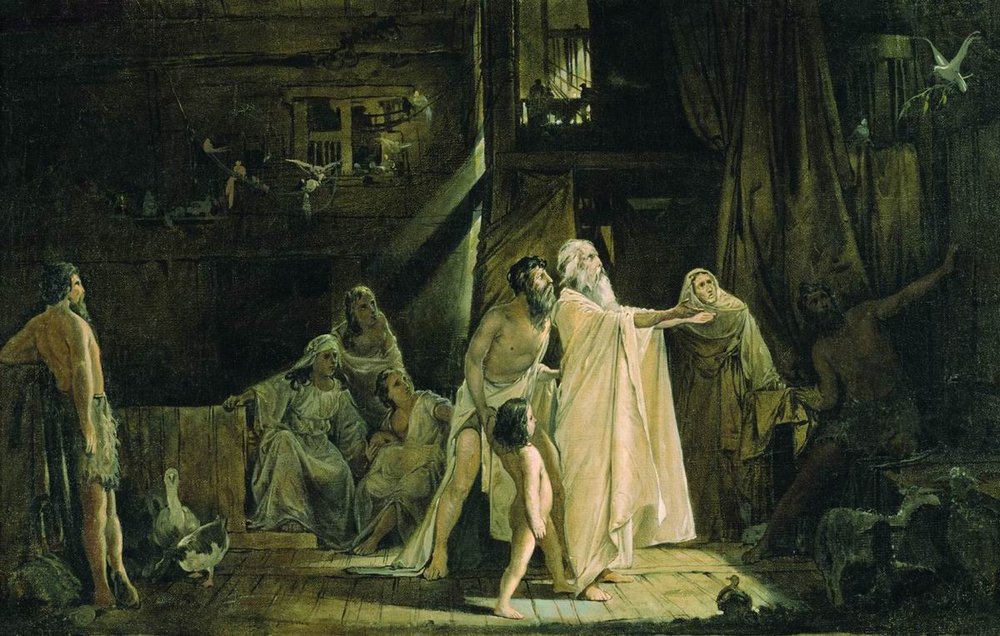
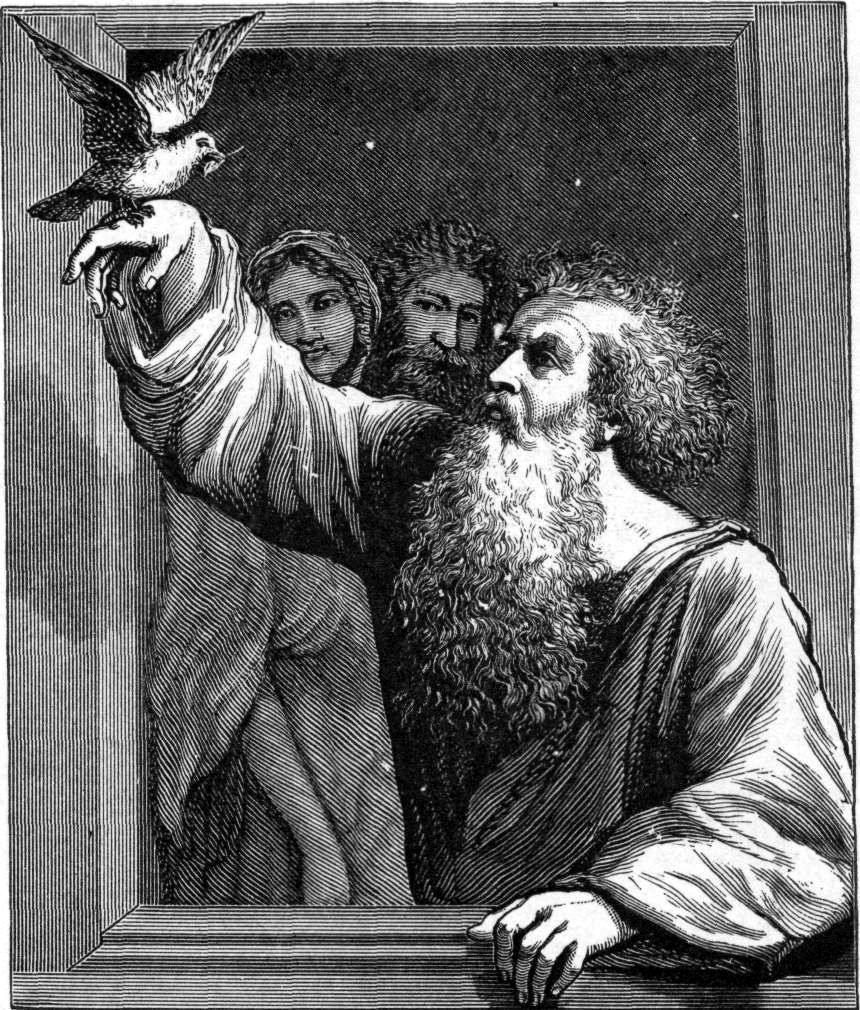
A second picture of patience is seen in the first reading from the Book of Genesis. Noah is “working” with a dove to assess the stages of the flood:
[Noah] sent out a dove,
to see if the waters had lessened on the earth.
But the dove could find no place to alight and perch,
and it returned to him in the ark,
for there was water all over the earth.
Putting out his hand, he caught the dove
and drew it back to him inside the ark.
He waited seven days more and again sent the dove out from the ark.
In the evening the dove came back to him,
and there in its bill was a plucked-off olive leaf!
So Noah knew that the waters had lessened on the earth.
He waited still another seven days
and then released the dove once more;
and this time it did not come back (Gen 8:8-13).
Allow the dove to symbolize our growth and maturity, for we live in a world that is often flooded with trouble.
In the first stage, the dove flutters about and is so terrified by what it sees that Noah must reach out and rescue it by pulling it back into the ark.
In the second stage, the dove finds a sign of hope, serenity, and peace. It is able to return showing this sign of progress and peace.
In the final stage, the dove flies free!
This is a picture of growth and maturity for us, who in stages become free of our fears and from excessive dependence on others; eventually we fly free. As Noah patiently worked with the dove, so God patiently works with us. This is also how we should work with our own self and others.
When I was in my mid-thirties, I was afflicted with grave anxiety and was being treated for it. In a difficult and discouraging moment, I angrily said to God, “If you wanted to, you could just fix this for me in an instant!” God replied, “I will not do violence to you.” I quickly responded, “I didn’t ask you to do violence to me.” God retorted, “Yes, you did.”
Indeed, healing takes time. For example, heart surgery is a delicate work and not to be rushed. Many people want relief, not healing. Healing involves hard work; it means making important changes in our life. It usually means looking honestly at our wounds and then doing the spiritual and psychological equivalent of “physical therapy.”
This leads us back to where we began: We need to learn greater patience. But patience is not passive; it is not resignation to sin or other harmful drives. Patience involves suffering; it is a resolve to stay in an often-difficult relationship with what (or who) troubles us so as to lay hold of the greater goal of holiness and healing. Patience is not looking for a quick fix or mere relief; it is looking for healing. Healing is hard, but it is better—far better—than mere relief.

 We live in times when many people take offense very easily. While this may have been a human problem seen in all ages, it is particularly evident today, when relativism and subjectivism are so widespread. Relativism is essentially a form of subjectivism. In subjectivism, the measure of truth shifts from the object (i.e., that which is being perceived) to the subject (i.e., the one who is perceiving). In this system, truth becomes relative, because there are as many versions of truth as there are subjects to perceive it. In this highly subjective perception of reality, people tend to take their own views very personally and are easily offended by views contrary to their own.