There is a danger when we speak of God’s Law, to consider it as we might any secular law. For example, we may well consider secular merely to be some sort of impersonal code written by some nameless legislators or bureaucrats. We have not met them, we do not know them, or necessarily love or trust them. In effect, they are an abstraction in our mind called “the government” or “the man” or just “they,” as in, “They don’t want you to park here” or “They’ll fine you for that.”
God’s Law is Personal – But when it comes to God’s Law we are dealing with something different, something very personal, if we have faith. For God’s law is not given by someone we do not know, love or trust. If we have faith, God is someone we do in fact know, someone we love and trust. Further, we believe he loves us and wants what is best for us. God’s law is not the equivalent of a no-parking sign hung by some nameless, faceless city government. Rather it is a personal exhortation, instruction and command given by someone we know and who knows and loves us.
Consider an example. Suppose you pull in front of my church to park and you see a no-parking sign. Now suppose you also decide to ignore it. Alright, you have broken a law, not a big one, but a law nonetheless. You’ve chosen to ignore a sign put there by “the government.” But suppose another scenario: I your beloved blogger and the pastor of the Church you are attending or visiting is standing out there, and I say to you, “Please don’t park here.” Now the situation is very different. I, someone you know and love, 🙂 , am personally requesting that you leave the space open for some reason. When you experience the law this way you are far more likely to follow it, because someone you know and trust is asking and directing you. But what if, despite this, you still choose to ignore the instruction not to park there. Well then, the situation is quite different in this case, for, in this case, the law is personal. The refusal to follow it now becomes personal as well and there is a far more serious situation we are dealing with.
Scripture: In the first reading for Mass today (Monday, week one of Lent) the Law of the Lord is announced. I will not reproduce the whole reading but here is an excerpt:
“You shall not defraud or rob your neighbor.
You shall not withhold overnight the wages of your day laborer.
You shall not curse the deaf,
or put a stumbling block in front of the blind,
but you shall fear your God.
I am the LORD.
“You shall not act dishonestly in rendering judgment.
Show neither partiality to the weak nor deference to the mighty,
but judge your fellow men justly.
You shall not go about spreading slander among your kin;
nor shall you stand by idly when your neighbor’s life is at stake.
I am the LORD. (Lev 19:11-14)
Note how the litanies of the law each end: “I am the Lord.” (These are but two of other litanies). I am the Lord. On the one hand it gives solemnity to the pronouncement. But, at another level what God is saying is, This is Me talking. It is I who speak to you. I who created you, who led you out of slavery, parted the Red Sea, dispatched your enemies, fed you in the desert and gave you drink from the rock. It I, I who love you, I who care for you, I who has given you everything you have, I who want what is best for you, I who have earned your trust. It is I, your Father who speak to you and give you this command.
God’s law is personal. Do we see and experience it this way? This will happen only if we come to know the Lord personally. Otherwise, the danger becomes that we see the Law of God as merely an impersonal code, an abstract set of rules to follow. They might as well have been issued by the deity, the godhead, or even just the religious leaders of the day.
Hence a gift to pray for in terms of keeping God’s Law is a closer walk with the Lord and an experience of his love for us. Such an experience is a great help in loving the Law of the Lord. For when we love the Lord we love his law and see it not as an imposition, but a personal code of love that is meant to protect us. And when we offend against it either willfully or through weakness, we are more able to repent with a more perfect contrition for we experience that we have offended someone we love and who is deserving of all our love.
Abba – St. Paul indicates that one of the gift of the Holy Spirit is that we are able to experience God as Abba. Abba is the Hebrew and Aramaic family word for father. It is best translated, Papa, or Daddy. When my earthly father was alive I did not call him “Father,” I called him “Dad.” That’s the family word for father. This is the insight of the word Abba, that God is my Papa, my Dad. He is not merely “The Father” in some abstract, or merely titular sense. He is someone I experience as my own dear Father, Papa, Dad. It is a personal and family relationship that the Holy Spirit wants to grant us.
This personal relationship brings God’s law alive, makes it personal. And so God says as he reminds of of his Law: I am the Lord. This is me talking – It is I, the one who loves you.
This song says, I Love the Lord. He heard my cry. Long As I live, and troubles rise, I’ll hasten to his throne.” (Sung by Whitney Houston)
When I was younger and through my seminary years I had usually seen the crucifix and Jesus’ suffering on the cross in somber tones. It was my sin that put him there, had made him suffer. The cross was something that compelled a silent reverence, and suggested to me that I meditate deeply on what Jesus had to go through. Perhaps too I would think of Mary and John and the other women mournfully beneath the cross beholding Jesus slowly and painfully dying. These were heavy and somber notes, but deeply moving themes.
In addition the crucifix also called forth memories that I must carry a cross and go through the Fridays of my life. I needed to learn the meaning of sacrifice.
Liturgically I also saw the crucifix as a way of restoring greater reverence in the Mass. Through the 70s and 80s parishes had largely removed crucifixes and replaced them, quite often, with “resurrection crosses,” or just an image of Jesus floating in mid air. I used to call this image “touchdown Jesus” since he floated in front of the cross with his arms up in the air as if indicating a touchdown had just been made. In those years we had moved away from the understanding of the Mass as a sacrifice and were more into “meal theology.” The removal of the crucifix from the sanctuary was powerfully indicative of this shift. Many priests and liturgists saw the cross as too somber a theme for their vision of a new and more welcoming Church, upbeat and positive.
A cross-less Christianity tended to give way to what I thought was a rather silly celebratory style of masses in those years and I came to see the restoration of the Crucifix as a necessary remedy to restore proper balance. I was delighted when, through the mid 80s and later, the Vatican began insisting in new liturgical norms that a crucifix (not just a cross) be prominent in the sanctuary and visible to all. Further, that the processional cross had to bear the image of the crucified, not just be a bare cross.
Balance Restored – I was very happy about these new norms (and still am) because they restore the proper balance in seeing the Mass as a making present of the once-for-all perfect sacrifice of Jesus on the cross. It is also a sacred meal, but it is the sacrifice that gives it its power. I further thought that such a move would help restore greater and proper solemnity to the Mass, and to some extent this has been true.
All of this background just to say that I saw the Cross, the crucifix, in somber, serious tones, a theme that was meant to instill solemnity and sobriety, a meditation on the awful reality of sin and our need to repent. And all of this is fine and true.
But the Lord wasn’t finished with me yet and wanted me to see another understanding of the Cross.
In effect he wanted me to experience also the “good” in Good Friday. For while the cross is all the things said above, it is also a place of victory and love, of God’s faithfulness and our deliverance. There’s a lot to celebrate at the foot of the cross.
It happened one Sunday in Lent of 1994, one of my first in an African American Catholic Parish. It being Lent, I expected the highly celebratory quality of Mass to be scaled back a bit. But, much to my surprise, the opening song began with an upbeat, toe-tapping gospel riff. At first I frowned. But the choir began to sing:
Down at the cross where my Savior died,
Down where for cleansing from sin I cried,
There to my heart was the blood applied;
Glory to His name!
Ah, so this WAS a Lenten theme! But how unusual for me to hear of the cross being sung of so joyfully. (You can hear the song in the video below; try not to tap your toe too much).
It was something quite new for me. Perhaps it shouldn’t have been but it was. The 70s and 80s Catholicism that had been my experience found it necessary to remove the cross to celebrate. But here was celebration with and in the cross! Here was the good in Good Friday.
The Choir continued:
I am so wondrously saved from sin,
Jesus so sweetly abides within;
There at the cross where He took me in;
Glory to His name!
Congregation and choir were stepping in time and clapping, rejoicing in the cross, seeing it in the resurrection light of its saving power and as a glorious reflection of God’s love for us. Up the aisle the procession wound and the last verse was transposed a half step up, an even brighter key:
Oh, precious fountain that saves from sin,
I am so glad I have entered in;
There Jesus saves me and keeps me clean;
Glory to His name!
Yes, indeed, glory to his name! A lot of dots were connected for me that day. The cross indeed was a place of great pain, but also of great love, there was grief, but there was also glory, there was suffering, but there was victory.
Please do not misunderstand my point. There IS a place and time for quiet, somber reflection at the foot of the cross. All the things said above are true. But one of the glories of the human person is that we can have more than one feeling at a time. We can even have opposite feelings going on at almost the same moment!
The Balance – Some in the Church of the 70s and rejected the cross as too somber a theme, too negative. They wanted to be more upbeat, less focused on sin, and so, out went the cross. There was no need to do this and it was unbalanced. For at the cross, the vertical, upward pillar of man’s pride and sin is transected by the horizontal and outstretched arms of God’s love. With strong hand, and outstretched arms the Lord has won the victory for us: there at the cross where he took me in, glory to his name!
And the Balance is for the individual, and for the Church. For some prefer a more somber meditation on the cross to prevail and others feel moved by the Spirit to joyfully celebrate at the foot of the Cross. The Church needs both, and I suppose we all need some of both experiences . Yes, it right to weep at the cross, to behold the awful reality of sin, to remember Christ’s sacrifice. But rejoice too, for the Lord has won victory for us, right there: Down at the Cross. There’s a lot of good in Good Friday.
Photo credit (right click on photo for URL)
Here is the song I heard that Sunday in 1994, sung in very much the style I heard.
The Gospel today says that Jesus was tempted by the Devil in the desert. Hebrews 4:15 also affirms: For we do not have a high priest who cannot sympathize with our weaknesses, but one who has been tempted in all things as we are, yet without sin.
How exactly a divine person, with a sinless human nature, experiences temptation is somewhat mysterious to us. And yet the text affirms that He does experience it. A Lenten antiphon from the Breviary teaches that he did this, or allowed this for our sake: Come, let us worship Christ the Lord, who for our sake endured temptation and suffering (Invitatory Antiphon for Lent). Hence, even without pondering too deeply the mystery of how he was tempted or experienced it, we can still learn what Jesus teaches us about how to endure temptation and be victorious over it. (More on the question of how Christ was tempted HERE).
Before we look at each temptation we might learn a few general aspects of what the Lord teaches us in electing to endure temptation.
1. Temptation and Sin – The fact that the Lord is tempted, but did not sin tells us that there is a distinction to be made between temptation and sin. Too often the very experience of temptation makes us feel sinful, makes us feel that we have already sinned. But that is not necessarily the case. For Jesus, who never sinned, experienced temptation. Therefore experiencing temptation is not simply to be equated with sin. One of the tactics of the Devil is to discourage us into thinking that the mere experience of temptation is already sin. It may be true that some of our past sins influence the amount and degree to which we feel tempted, but, of itself, we need not conclude that we have already sinned, or newly sinned, merely because we are tempted. Rather than to feel shame and run from God, we ought to run to him with confidence and seek his help. But do not conclude you have sinned merely because you are tempted.
2. Temptation and Scripture – Notice how, to every temptation, Jesus responds with Scripture. This is not to be merely equated with proof texting, or pronouncing biblical slogans. Rather we ought to see it as indicative of the fact that Jesus was deeply rooted in Scripture, in the wisdom of the Biblical vision. In rebuking temptation in this way, Jesus is teach us to do the same. It will not be enough for us to know a few biblical sayings. But, to the degree that we are deeply rooted in the wisdom of God’s truth available to us through Scripture, and the teachings of the Church, we are able to strongly rebuke unholy, worldly or fleshly thinking. Half the battle to defeating temptation is to know instinctively its erroneous vision and stupidity. Having our minds transformed by the teachings of Scripture and the Church is an essential weapon in fighting temptation. Scripture says, Do not be conformed to this world, but be transformed by the renewal of your mind, that by testing you may discern what is the will of God, what is good and acceptable and perfect (Romans 12:2). Ephesian 6:17 also speaks of the Word of God as “the sword of the Spirit” with which we are properly armed for spiritual warfare. Thus, we are taught here by the Lord to be deeply rooted in his Word.
3. Temptation and Strength – Notice that Jesus is tempted three times, after which the devil leaves him. In a certain way the spiritual life is like the physical life in that we grow stronger through repeated action. After lifting weights repeatedly, our physical strength increases and we are able to overcome increasingly difficult challenges. It is the same with the spiritual life. And old Gospel songs says, Yield not to temptation, for yielding is sin. Each victory will help you, some other to win. Scripture says, Resist the Devil and he will flee (James 4:7). We need not conclude here that Jesus needed to be strengthened (he did not) in order to understand that he is still teaching us what WE need to do. The battle against temptation is not a “one and you’re done” scenario, but an on-going battle wherein each victory makes us stronger and the devil more discouraged. Eventually he stops wasting his time tempting us in certain areas, as we grow stronger. At times, the battle may weary us but, in the long run, it strengthens us. Jesus illustrates this with his three-fold battle with Satan.
Having review a few general principles, let’s look at the three temptation scenes.
Scene I: The Temptation of Passions. The text says. At that time Jesus was led by the Spirit into the desert to be tempted by the devil. He fasted for forty days and forty nights, and afterwards he was hungry. The tempter approached and said to him, “If you are the Son of God, command that these stones become loaves of bread.” He said in reply, “It is written: One does not live on bread alone, but on every word that comes forth from the mouth of God.”
Hunger, as a desire, is a passion. It is not evil per se, for without it we would perish. The same is true with other natural desires for things like: life, drink, and propagation (sexuality). Others sorts of passion also exist in us such as: anger and love, joy, aversion, hatred, hope, despair, fear, courage and so forth. Of themselves these passions are neither good nor bad in themselves, but become so only in relation to their object, or insofar as we allow them to become inordinate.
Hence there is nothing wrong with Jesus as he experiences hunger. What the devil tries to do it to draw Jesus into sin by yielding to his hunger and to use his power inappropriately. Remember, Jesus had been led into the desert to fast and pray by the Spirit. This is his call. His hunger is real and without sin, but now he is tempted to set aside his call, and to yield to his hunger in an inappropriate way, by rejecting his call to fast. He is tempted to serve himself. Now he has the power to do this, to turn stones into bread, and so a second aspect of the temptation is to use his power inappropriately, not to glorify His Father, but to gratify and serve himself.
What about us? We too have passions. And they are not wrong in themselves. But what can happen is that we freely allow them to become inordinate, or we can gratify them in unlawful ways. Remember we, like Jesus, are called to fast. Our fast is from things like: sin, injustice, unrighteousness, sexual impurity, and unlawful pleasures, excessive indulgence, and so forth. And we too have it have it in our power to choose to reject our fast and to gratify our desires by rejecting our call to serve God. And the devil says: reject your call and use your power to gratify your passions: lie, cheat, steal, vent your anger, fornicate, be gluttonous, greedy… and so forth.
But notice how Jesus has recourse to God’s Word:Man does not live on bread alone, but on every Word that comes from the mouth of God. Jesus says to Satan that He would rather live and be sustained by the Word. That his food is to do the will of his Father.
What about us? Can we say with Job: Neither have I gone back from the commandment of his lips; I have esteemed the words of his mouth more than my necessary food (Job 23:12). Can we, like Jesus, say that God’s Word is more to me than my desires for: satisfaction, sex, self preservation, popularity, worldly joys, power, prestige, or possessions. My strongest desire is for God and things waiting for me in heaven and I will gladly forsake all I have for it.
Scene II. The Temptation of Presumption – The text says, Then the devil took him to the holy city, and made him stand on the parapet of the temple, and said to him, “If you are the Son of God, throw yourself down. For it is written: He will command his angels concerning you and with their hands they will support you, lest you dash your foot against a stone.” Jesus answered him, “Again it is written, You shall not put the Lord, your God, to the test.”
There is a value in trusting God, but this is not an invitation to act recklessly. There will come a time when Jesus will throw himself down on the Cross in complete assurance that the Father will raise him. He has this command from his Father. But now is not that time and he must act to preserve and protect his life so as to accomplish his full mission.
For us, too there is no sin in trusting in God’s care for us. But that is not a license to act recklessly. Presumption is a terrible problem today. Too many people think that they can go on sinning and there will be, or should be, no consequences. This is true in worldly ways and in spiritual ways as well. Too many people engage in risky and ruinous behavior and figure, “I’ll be OK….I’ll escape….I won’t be a statistic….I won’t get caught….I won’t lose my job. Many say, “I can use drugs and not get addicted, I can have evil friends and still stay good and live morally, I can skip school and still get good grades and get into college, I can be promiscuous and won’t get STD’s or AIDS….I won’t get pregnant. They think, I can drive recklessly and won’t have an accident or kill someone…I can be disrespectful and still be treated with respect.” In all this people are simply crusin’ for a brusin’
And regarding the moral presumptiveness of thinking that no matter what I or others do, heaven will still be the result, the Lord warns:
Sirach 5:4 Say not I have sinned, yet what has befallen me? For the Lord bides his time. But of forgiveness be not overconfident adding sin upon sin. …Delay not your conversion to the Lord, put it not off from day to day for mercy and justice are alike with him.
Gal 6:7 Do not be deceived; God is not mocked, for whatever a man sows, that he will also reap. For he who sows to his own flesh will from the flesh reap corruption; but he who sows to the Spirit will from the Spirit reap eternal life. And let us not grow weary in well‑doing, for in due season we shall reap, if we do not lose heart.
Hosea 8:7 For they have sown the wind, and they shall reap the whirlwind.
Psalm 81:11 “But my people would not listen to me; Israel would not submit to me. So I gave them over to their stubborn hearts to follow their own devices. “If my people would but listen to me, if Israel would follow my ways, how quickly would I subdue their enemies and turn my hand against their foes!
God is clear to warn us that sin sets us on a path that hardens our heart and makes our final conversion increasingly unlikely. He is pleading with us in this Lenten season to be serious about sin and its consequences. Sin renders us not only unfit for heaven, but simply incapable of entering it.
Bad idea – Simply presuming that everything will be fine is not only a poor strategy, it is a temptation and snare of the devil who seeks to cloud our mind with false hope and unreasonable expectations. Jesus has a very clear message for the devil and for any of us who would engage in presumption (a VERY common sin today): “Don’t you dare put the Lord your God to the test in this way. Obey him out of love, but do not put Him to the test.” Presumption is a very bad and foolish idea.
Scene III. The Temptation of Possessions– The text says, Then the devil took him up to a very high mountain, and showed him all the kingdoms of the world in their magnificence, and he said to him, “All these I shall give to you, if you will prostrate yourself and worship me.” At this, Jesus said to him, “Get away, Satan! It is written: The Lord, your God, shall you worship and him alone shall you serve.”
There is here the obvious temptation of worldly possessions. Everything, EVERYTHING, is offered to Jesus in exchange for a little worship of the devil. Now, it may seem strong to us that having an abundance of things would be linked to worshiping the devil and forsaking God. But scripture attests to the connection elsewhere:
Adulterous people! Do you not know that friendship with the world is hatred toward God? Whoever therefore wants to be a friend of the world makes himself an enemy of God. (James 4:4)
Do not love the world or anything in the world. If anyone loves the world, the love of the Father is not in him. (1 John 2:15)
No one can serve two masters. Either he will hate the one and love the other, or he will be devoted to the one and despise the other. You cannot serve both God and Money (Matt 6:24)
All pretty blunt. We want to have both but the Lord is clear in rebuking the temptation by insisting that we have to serve God alone, adore God alone. The inordinate love of this world causes us to hate God more and more and to bow before Satan in order to get it. Don’t kid yourself. If this seems extreme then we are calling God an extremist. The Lord is warning us that there is a major conflict here that steals our heart. For where a man’s treasure is, there is his heart (Matt 6:21). It is not wrong to desire what we really need to live, but it is our wants that get us into trouble. And the desire for riches ruins us and makes God seem as a thief, rather than a savior. This is a very severe temptation and Jesus rebukes it forcefully. Him ALONE shall you serve.
We need to beg God for a single-hearted devotion of him. The Book of Proverbs has a nice prayer in this regard: Give me neither poverty nor riches, lest in my poverty I steal or in my riches I say “Who is the Lord?” (Prov 30:8-9 gloss).
In the end, temptations are real and we either accept God’s grace to fight them or we are going down. The Lord wants to teach us today about the reality of temptation and how to fight it, by his grace. Remember, the battle is the Lord’s and no weapon waged against us will prosper if we cling to God’s grace. But in the end, the choice is clear: either Tackle temptation (by God’s grace) or risk ruination (by Satan’s “ministrations”).
(Photo credit above right: Evolutionary Times (right click on photo for URL))
This song says, Yield not to temptation, for yielding is sin. Each victory will help you, some other to win. Fight valiantly onward. Evil passions subdue. Look ever to Jesus, He will carry you through. Ask the Savior to help you, comfort strengthen and keep you; he is willing to aid you, He will carry you through.
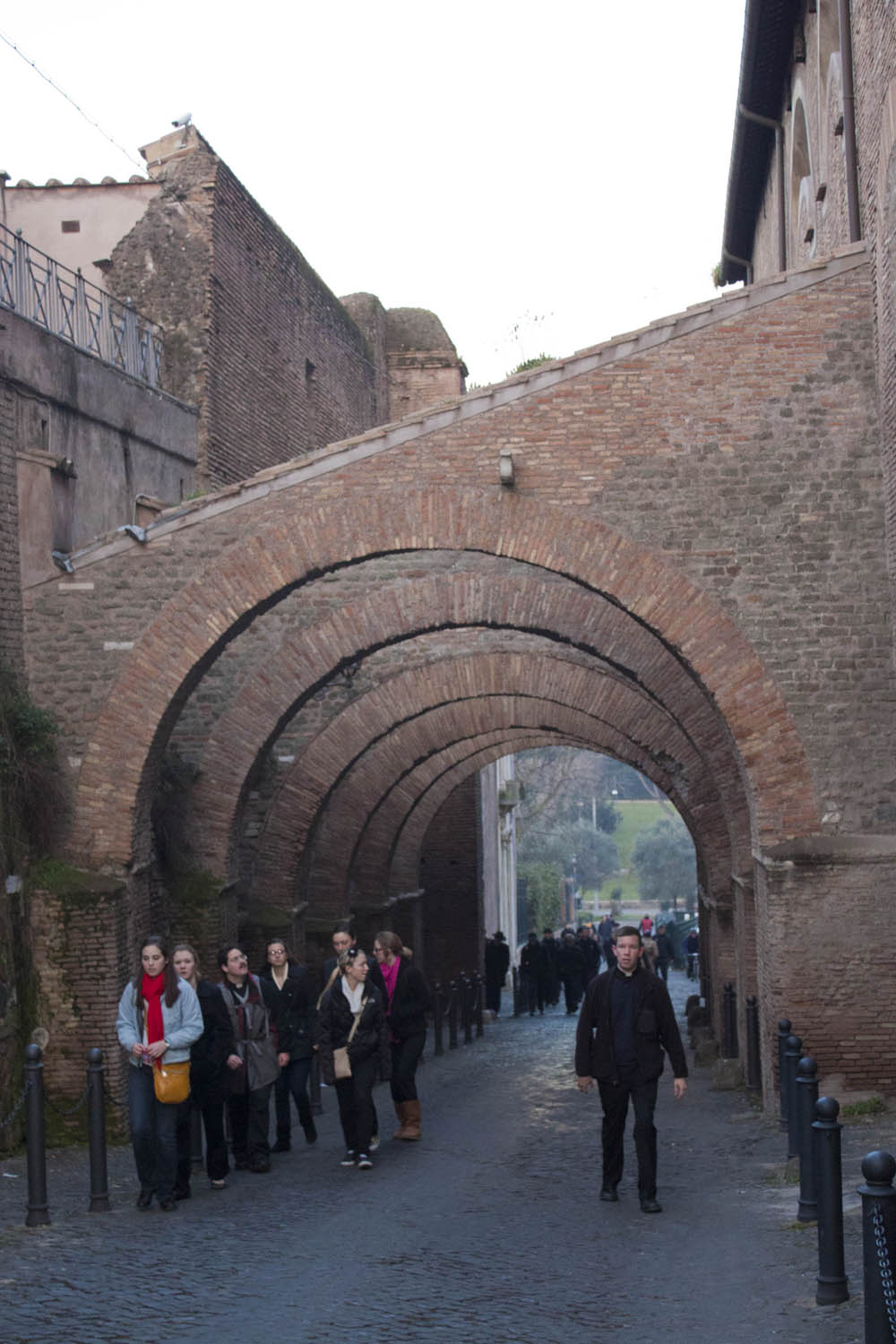
Pilgrims in Rome celebrated Mass at the Church of Ss. Giovanni e Paola who were brothers who served as officers at the Imperial Court in the service of the daughter of Constantine, Constantia, where they held high positions. They returned to their home in Rome on the Coelian hill, where they were asked by the emperor Julian the Apostate, to retake their positions in his service. They were martyred in secret, in their own house, after they refused to take Julian’s trial of faith and renounce their Faith and profess belief in pagan deities. Eventually a Church was built over the remains of their house. Today, the Passionists run the Church, which contains the relics of the saints whose names it bears, as well as those of the Passionist’s founder, St. Paul of the Cross.
In the Quiet of the Church
It is a wonderful thing, during this Station Church season, to be able to arrive early to the Church, when it is not fully lit, it is still quiet and the crowd has not yet arrived. It is a time of great peace and a perfect time for prayerfully preparing oneself for the Sacrifice of the Mass. It is especially wonderful in this Church, as you finish your morning prayers, to have all those bright Chandeliers come alight and really make you feel that, what you are preparing to participate in is truly something wonderful, to witness God’s glory.
Gathered as God’s People
The Mass in English is sponsored by the North American College, yet looking around in the morning, you see that there are many English-speaking pilgrims who you have never seen before, that are drawn on this Lenten pilgrimage to draw deeper into the spirit of Lent. As Mass begins, one cannot help but feel the diversity of God’s people, and yet also the familiarity. We all gather around the Eucharist and are united together by it.
It takes more than desire
Today, the homilist preached that it is not enough to simply have a desire to be with God, but that we should seek a way to work for it. It is not simply a desire to be holy, but a desire to work at becoming more and more open to God’s will in our lives. The desire is from God, who puts it in our hearts. It is a reminder, “What am I doing, this Lent, to respond to God’s invitation? How can I grow closer to God, through my pilgrimage through Lent?”
Written by Mario Majano, Archdiocese of Washington
Photos by Fr. Justin Huber, Archdiocese of Washington
Wedding banquets don’t usually come to mind when we fast during Lent; I’ve never seen fish sticks served at a reception, and I’ve been to more than a few!
Nevertheless, when Jesus was challenged about fasting in today’s gospel, he responded by calling himself a bridegroom, and by referring to us, his friends, as his wedding guests. Jesus was saying that our relationship with him, in many ways, is like a joyful wedding feast.
Jesus wants us to keep this joy in mind as we approach the discipline of fasting. We fast during Lent, not primarily to lose weight, not because it’s a Catholic cultural badge, and not because we need to prove our holiness to God or anyone else. As Catholics, we fast- from food or from anything else that can become a compulsion in our life- to help us grow in freedom, and thus bring us a little bit closer to Jesus. And anytime we grow a little bit closer to our Lord, the result is always joy. You might say, then, that we fast in order to feast- feast upon the new and abundant life that Jesus wishes to pour out on us, during this special season of grace.
At yesterday’s Ash Wednesday Masses many of you heard the ancient acclamation, as ashes were imposed: Remember that you are dust, and unto dust you shall return. Yesterday’s beginning of the Lenten season puts before us an urgent plea that we should be sober and watchful of our soul and its condition, for the form of this world is passing away (1 Cor 7:31). Simply put, we are going to die and we need to be made ready to meet our God. Recall some of the urgency present in the readings:
Even now, says the LORD, return to me with your whole heart…..
Sound the trumpet in Zion!
We implore you on behalf of Christ, be reconciled to God!
Behold, now is the day of salvation.
Yes, Now, not later. There is an urgency announced that we must hear and heed.
What’s in a picture? The Picture at the upper right was taken April 2, 1967. It was my sister, Mary Anne’s 7th birthday. Ash Wednesday morning the picture appeared on my screen-saver slideshow and I thought, “There it is, a picture of passing things.” For, as you look at the picture know this, there is absolutely nothing and no one in the picture that is still here in this world today. My sister who is blowing out the candles died in 1991, tragically in a fire. My mother who leans over her died in 2005 (also tragically). My maternal Grandmother, who is seated died of cancer in the late 1970s. But that is not all. This building in which the picture was taken was demolished 8 years ago. My Father who is taking the picture died in 2007. The Polaroid camera with which he took the photo is long gone as well. There is simply nothing in this picture that any longer exists in this world, and there is no one in the photo who still walks this earth. Yes, the form of this world is passing away. Remember that you are dust, and unto dust you shall return.
The Church’s reminder to us is a strong rejoinder to most of our priorities. Most of the things we think are so important, are not really that important in the long run. Most of the things that claim our attention are not all that critical either. We like Martha, are anxious about many things. We worry about our money, our house, our car, our physical health, how we look, what people think of us, and so forth. But none of this really matters all that much in the end. All these things pass.
But what about what really does matter? What of our soul and its well being? What of our direction? Is it heavenward? What are we doing with our life? Where are we headed? Do we know God, love and serve him? Are our eyes on the prize of God and heaven? These things get little attention in most people’s lives. The unessential and passing things are our passion, and the most essential and critical things are all but ignored.
In Lent the Church says stop. Be thoughtful and earnest. You are going to die. What are you doing to get ready to meet God? Your body and the things of this world are but dust, a mere passing reality. But what of your soul? Are you caring for your soul? Is it nourished on God’s Word and Holy Communion? Are the medicines of prayer, Scripture, Sacraments and holy fellowship (cf Acts 2:24) being applied so that your soul stands a chance?
Remember…..REMEMBER……you are dust, you are going to die. Get ready. Now is the time, be earnest about it. Be thoughtful and live a reflective life that considers carefully what your decisions amount to, where you are headed, what your life means. Too many people live unreflected lives, never thinking much on these things. But not you. You have heard the trumpet sound in Zion and the Church has implored you. Will you listen? Will I? Where are you going? Where will you be when the last trumpet sounds?
I have often thought that the second greatest prayer ever written is the Universal Prayer attributed to Pope Clement XI. Most people have never heard of it. But it is magnificent. Its sweeping themes cascade like a fountain and it is comprehensive without being too detailed so that it looses its poetry.
So many themes are covered in its short verses: faith, trust, beginnings and ends, wisdom, justice, mercy, mindfulness, purity, repentance, journey, judgment, authority, greed, gentleness, generosity, apathy, fervor, prudence, courage, justice, temperance, fortitude, vigilance, and the our last end, just to mention some.
If you are among the many who have never heard of this prayer, click here to see it:
And yet as I pray it, the prayer is so sweeping that I often feel overwhelmed by its sheer volume. It’s as though I am standing before an open fire hydrant with a little dixie cup trying to capture the water. Most of it rushes past me.
So for Lent I have thought to pray this prayer every day but also to take one line and meditate on it in particular. Here is a version of the Prayer that I have numbered so as to focus on a particular line for each of the forty days:
I hope the Universal prayer will bless you as much as it has blessed me. Consider this practice. Print out the PDF files and use them when you can. I think you’ll find that the prayer provides a lot on which to meditate.
In case you would like the Latin original with a literal and poetic translation it is here:
GOOD FRIDAY – All through the night Jesus has been locked in the dungeon of the high priest’s house. Early this morning he was bought before a Pilate who transferred his case to Herod. Herod sent him back to Pilate who, sometime in the mid-morning, bowed to the pressure of the Temple leadership and the crowds, and condemned Jesus to a horrible death by crucifixion. In the late morning Jesus was taken by the soldiers through the city and up the hillside of Golgotha. By noon he is nailed to the cross where he hangs in agony for some three hours. He dies around three in the afternoon. He is taken down from the cross and placed in the tomb hastily before sundown. Today is a day of prayer, fasting and abstinence. Whenever possible, Christians are urged to keep today free of work, of social engagements, of entertainment, and to devote themselves to communal prayer and worship. At noon many parishes gather for stations of the cross for recollections of the seven last words of Jesus. Many parishes also offer stations of the cross at 3pm the hour of Jesus death. In the evening, we gather quietly in our parish Churches to enter into time of prayer as we reflect on Jesus death on the cross. We also pray for the needs of the world. To acknowledge the power of the cross in our lives today, we one by one come forward to venerate the cross with a kiss. Our hunger from this day of fasting is satisfied with Holy Communion distributed at the end of this liturgy.Consider too how the apostles might have gathered that night together in fear and prayer reflecting on all that happened.
The following video depicts Jesus and Pilate. It is from the movie The Gospel of John.Notice how Jesus turns the tables on Pilate. Although Jesus is on trial, he ends up putting Pilate on trial! Notice too how many times Pilate goes in and out of Praetorium (Audience Hall). At least four times! He is vacillating. He knows Jesus is innocent of the charges. But in the end, out of fear, he suppresses his conscience and hands Jesus over. Pilate had wanted to avoid committing to Jesus one way or the other. But he, like you and me had to make a decision. You might say he goes from vacillation to assassination!
Notice particularly the question Pilate wrestles with over Jesus’ Kingship. He asks, “Are you the King of the Jews?” But Jesus will not answer. This is a question Pilate must answer. It is a question you and I must answer. And so Jesus says, “Are you saying this on your own or have others been saying this to you?” In other words am I a King becuase you say so or are you just saying what others say? Only Pilate can aswer if Jesus is a king. Only you and I can answer for ourselves. Is he your King?