Walking in the footsteps: Drinking of the chalice…

Can you drink of the chalice?

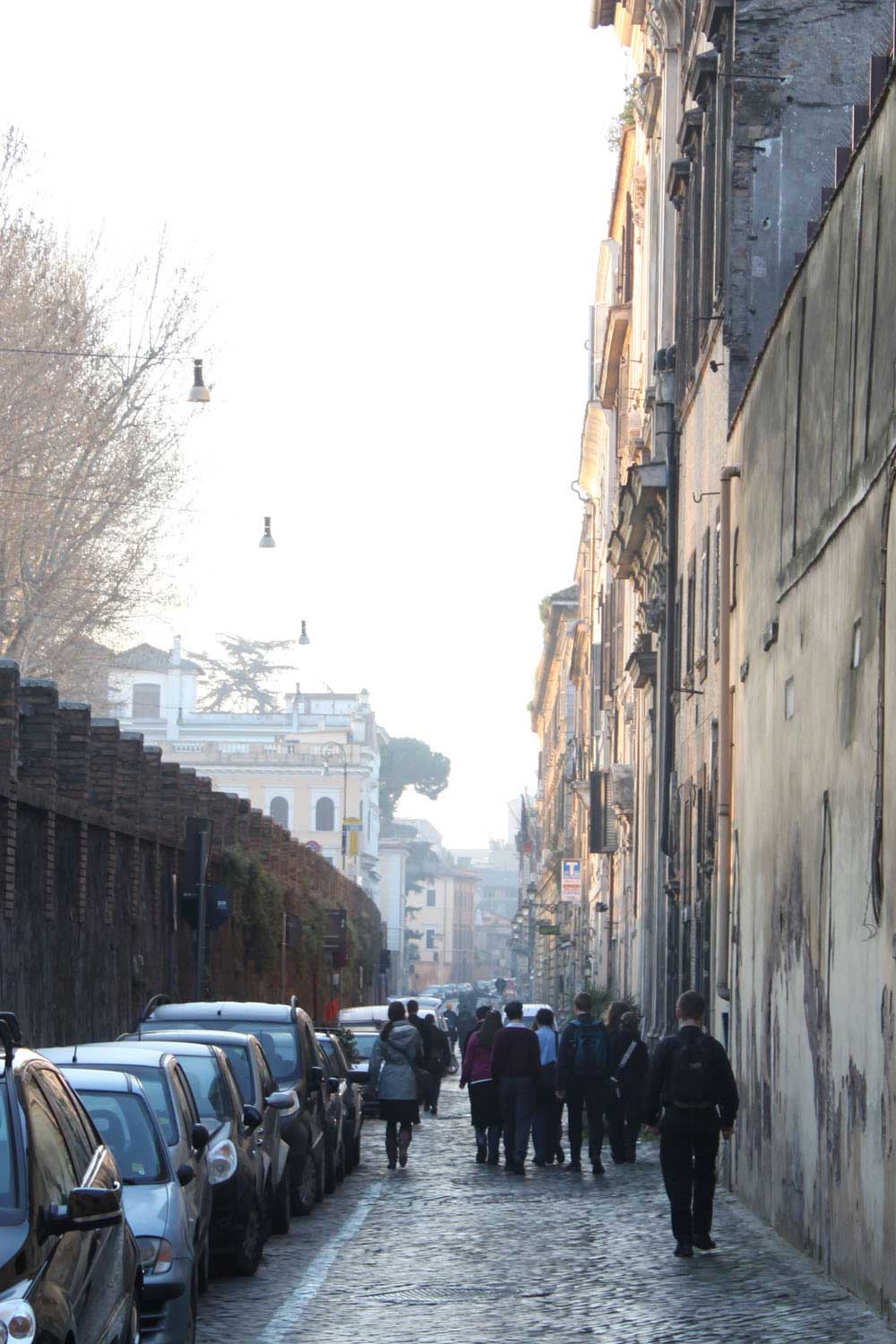
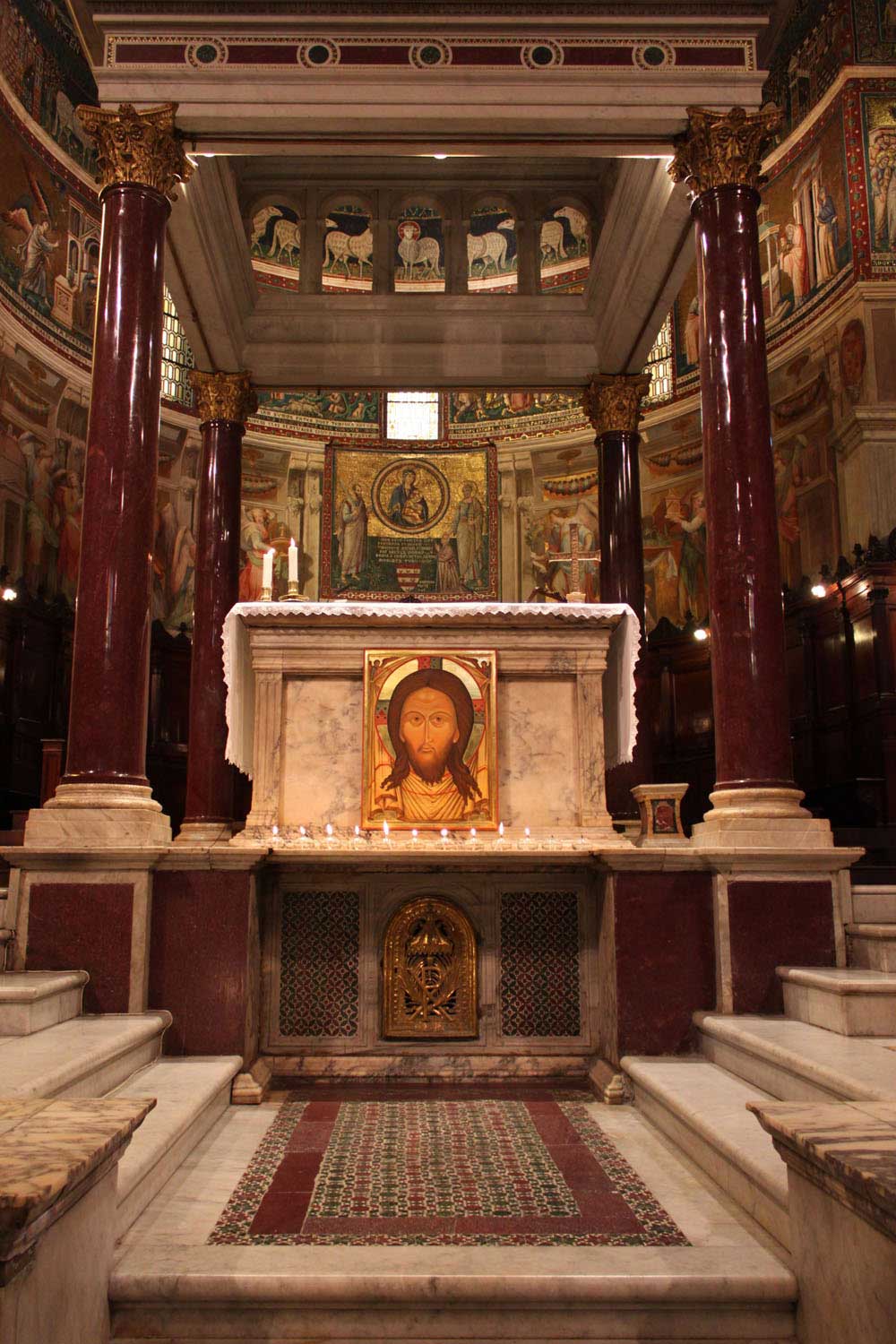
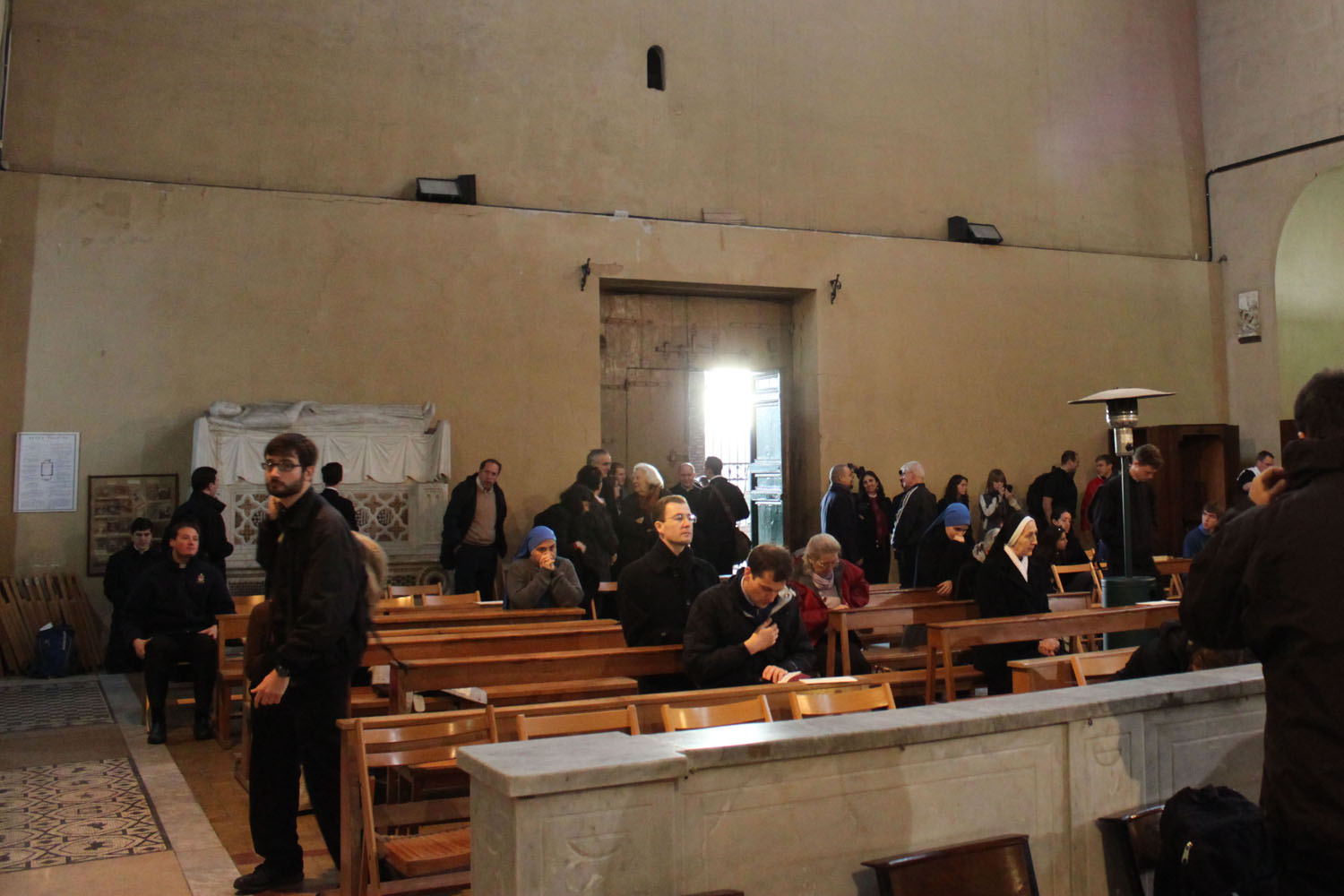
This morning pilgrims starting from the North American College were blessed with clear skies for a relatively short trek to San Cecilia.  The church, found in Rome’s Trastevere neighborhood, literally “across the Tiber” from the ancient city of Rome, is located just at the bottom of the Janiculum Hill.  Excavations under the church suggest that it is built over the baths of St. Cecilia’s home, where Roman authorities first tried to execute her by drowning.  Failing to do so, executioners attempted to decapitate the saintly woman, but failed again, ultimately leaving St. Cecilia to die of her fatal wounds.  Tradition holds that prior to dying she entrusted all her goods to the church and asked Pope Urban to turn her home into a place of worship.

St. Cecilia gives great witness to Christ’s question in the Gospel, “Can you drink of the chalice I am going to drink?”  As today’ celebrant noted in his homily, the sons of Zebedee enthusiastically replied “yes” to Christ’s question out of sheer love and devotion for Our Lord,  but perhaps without a full understanding of the questions implications. In the case of St. Cecilia, who likewise replied yes, it might be said that she did so with greater awareness of the implications to her response. She was seeking to live the Christian life at a time when it was an illegal religion and fully aware that it could be punishable by death.

Saying “YES”

Throughout the centuries various men and women, lay, religious and cleric, have responded yes to Christ’s question and have aided in passing on the faith from generation to generation. As such, the faith has come down to each one of us. Having received that faith, Our Lord now poses the question to each of us, Can you drink of the chalice I am going to drink?

This season of Lent offers us an opportunity to reflect on our readiness to drink from Christ’s chalice in witness to the faith.  The season gives us a chance to strengthen ourselves by turning to God and seeking to keep a proper relationship with the world and those around us through prayer, fasting and almsgiving.  These practices deepen and fortify us interiorly so we can give public witness to our faith in ordinary and extraordinary ways; to live our faith in such a way that others will take notice. Doing so, we will express our desire to drink from Christ’s chalice.

Written by Francisco Aguirre

Who can you invite?

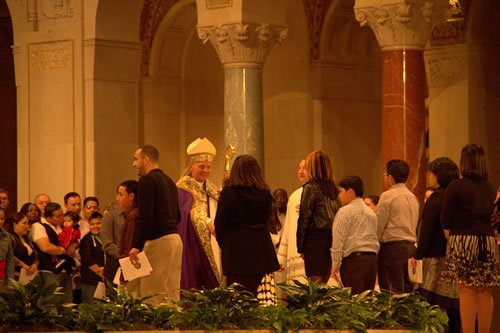
For one candidate, his journey to the Catholic faith began with a conversation with a Buddhist monk. For a couple expecting their first child, it was the result of hours of conversation about what was missing in their lives and what they wanted to be able to give their child. I knew these two stories and I wondered at the amazing number of ways our Lord calls people to a deeper relationship with him and with the church as I watched Cardinal Wuerl greet more than 1,000 men, women and children who will enter our church at Easter.

A church of many faces

In five different languages the names of the elect were called  and they started to move forward. One young boy’s sneakers lighted up as he climbed the steps into the sanctuary at the Basilica. Cardinal Wuerl bent down on one knee to greet him eye to eye!  Young girls in flip-flops and tattooed young men followed. There were people dressed in the suits they wear as the walk the halls of Congress and people dressed to head to work at hospitals, restaurants and construction sites following the ceremony.  There were whole families coming into the church and there were college students who have made the decision on their own. Some walked the length of the Shrine with the hand of their sponsors on their shoulders. Some had huge smiles and some looked a bit overwhelmed by the size of the sanctuary, the presence of the Cardinal and bishops and unsure of what would happen next. I couldn’t help but wonder at what exactly was the event or turning point in their lives that led them to this moment today.

An Evangelizing Church

Though the event or turning point is as unique as each individual, in chatting with the newest members of our church, what is repeated over and over is the importance of feeling welcomed and the witness and testimony of the Catholics they have met in their RCIA classes, at the parish and in their workplaces.  In the Catholics they met, they encountered Christ!  

Agents of the New Evangelization

I also wondered how many more people might we welcome if all of us were more faithful to our mission as evangelizers. As Cardinal Wuerl reminds us in his pastoral letter, Disciples of the Lord: Sharing the Vision, all of us share in the mission of evangelization. “To be true disciples of the Lord, believers must bear witness to their faith, and ‘witnesses testify not only with words, but also with their lives.'” affirms Pope John Paul II.  It is not too early to start thinking about who in your life you can invite to come to know Our Lord and whom we can welcome next year at the Rite of Election.

To see more photos,  Like us on facebook. http://www.facebook.com/adw.org

Swimming with the Sharks?

Do you remember Norm from the TV series Cheers? He once said, “It’s a dog eat dog world, and I’m wearing Milk Bone underwear.” That’s funny, but also a tragic reflection on the nature of human relationships, especially in the world of work.. As leadership gurus like to say, we need to learn to swim with the sharks.
When our hearts are set on gaining power and influence, it doesn’t matter who gets trampled upon or left behind. Perhaps this may make us a bit uneasy, but we can always rationalize it by saying things like “It’s not personal, it’s business,” or “Nice guys finish last.”
But is that really true? Not according to Jesus in today’s gospel. He had just told his disciples about his impending torture and execution. But what happens next? The “Sons of thunder,” along with their mother, make a power grab. They thought: Jesus’ time is short, so we’d better make our move to be on top in his kingdom. Carpe diem; you snooze, you lose.
They didn’t express any concern about Jesus’ fate, and they didn’t seem to care what their friends might think. Evidently, their selfish ambition had blinded them to compassion or concern about anyone else.
Jesus turned this situation into a teachable moment. He conceded that the world may seem to belong to those who can swim with the sharks. But as for his disciples, we are to swim against the tide. He invites us to follow in his footsteps- by living a life of service; by being focused on others’ needs; by being humble; by cherishing sacrifice, not selfishness.
The world may indeed delude us into thinking that “nice guys finish last.” Except, Jesus reminds us, in the race that really counts.

Readings for today’s Mass: http://www.usccb.org/nab/032311.shtml

Photo Credit: egarc2 via Creative Commons

Walking in the footsteps: "O God, be merciful to me a sinner."

Our Roman station church liturgies take us today to the church of St. Balbina. Little is known of this saint, though it is said she was a virgin who died a martyr’s death. Her remains are located under the main altar of this church, which has been in use since the late 4th century A.D. The church is located south of the Vatican on the Aventine Hill, very near the Circus Maximus. In a way this location is fitting because most if not all of the Christians who were martyred for their faith in Rome would have been murdered not in the Coliseum, but in Circus Maximus, under the shadow of the Emperor’s palace.

Today’s first reading from Isaiah calls us to recognize our sinfulness in the eyes of the Lord. But this recognition of our sin is not without hope, for the Lord also offers us the opportunity of returning to him. Speaking through Isaiah the Lord says, “Wash yourselves clean!…Though your sins be like scarlet, they may become white as snow”.  The homily this morning focused on this invitation, which is part of every celebration of the Eucharist. At the beginning of every Mass, we are called to remember our sins, adopting the attitude of the tax collector in the Temple who prayed, “O God, be merciful to me a sinner”. And we then cry “Lord, have mercy!”, like the two blind men on the road to Jericho who called out to Jesus, “Lord, Son of David, have pity on us!” Like these two blind men, we thus dispose ourselves to encounter the Lord Jesus in the Eucharist.

During Lent, we are called to remember that it is only through the sacrifice of Jesus Christ that we are able to follow the command of the Lord to “Wash ourselves clean!” Our Lord calls us today to recognize that we are still not perfect, that we still cling to some sins, large or small. But he also invites us to again repent, and to receive his forgiveness in the Sacrament of Reconciliation. For it is only in this Sacrament, in this particular encounter with the Lord Jesus, that “though our sins be like scarlet, they may become white as snow!”

Do as Jesus Says- Not as I Do

               When my grade school son asked me about the appropriateness of a word he’d heard at school, I explained that he shouldn’t use it under any circumstances. He looked at me and said: “But Dad, I’ve heard you and Mom use it!” Oops… I realized that what I had taught my son was: “Do as I say, but not as I do.”
Which is not a good position to be in, as Jesus acknowledged in today’s gospel, when he lamented that the religious leaders of his day didn’t always practice what they preached. But that could be said about any one of us, couldn’t it? We all give moral instruction or correction to others, and we run the risk of being a hypocrite: of talking the talk, without walking the walk.
Sometimes we realize this and choose not to say anything at all, when actually we should be saying something. For instance, many parents avoid speaking about sex or drinking or drugs with their children, because their own histories are, shall we say, less than perfect.
So what are we to do? If we say something, others might simply roll their eyes at us; but if we say nothing, they might turn their eyes elsewhere and find answers that are contrary to those Jesus would give. Thankfully, Jesus suggests a way forward when he taught about humility in today’s gospel. When speaking to others about moral matters, we need to humbly admit that we ourselves are far from perfect, and humbly place ourselves beside those we instruct, instead of exalting ourselves above them. Because at one level, we all stand before Christ as brothers and sisters: as students before our teacher, servants before our master, sinners before our savior.

Should we do this, what others will hear is: “Do as Jesus says…not as I do.”

Readings for today’s Mass: http://www.usccb.org/nab/032211.shtml

Photo credit: Brett Hammond via Creative Commons

Walking in the Footsteps: "Breathing with both lungs"

A Church in Layers

One of the delights to be discovered about the city of Rome is its three-dimensionality: the city exists in layers. In a three-thousand-year-old city, it seems that every building is built on top of an older building. In the case of today’s station church, in fact, two older buildings. The current church of St. Clement, dedicated in 1128 and named after the fourth pope, rises on the ruins of its older 4th century predecessor. This, in turn, lies on top of a cluster of buildings from the imperial Roman era, one of which belonged to a wealthy Christian and had been entrusted to the Church for use as a parish. Few buildings better exemplify the continuity of our faith from its earliest days as a small and persecuted sect to its current status as a mature and flourishing religion.

Ecumenical Considerations

In addition to these archaeological delights, St. Clement holds another type of treasure: the relics of both St. Clement and of St. Ignatius of Antioch. The two men took opposite routes in their lives: St. Clement was exiled from Rome around 100 by the emperor and was later martyred near the Black Sea in the east, where he had gone to evangelize; St. Ignatius was arrested around the same time in Antioch (in Syria) and brought west to Rome to be thrown to the lions in the Coliseum. Today’s celebrant noted that in this church, “The Church breathes deeply with both lungs” – that is, with a faith handed on by both eastern Greek and western Latin Christians. We might pause today in our own Lenten journey to pray for the many other Christians who are also making this journey to Easter, our Orthodox and Protestant brethren, and to ask God that, through Christ, we might soon all be united in worship and belief as were Sts. Clement and Ignatius.

Pilgrim Profile

After Mass I stopped to chat with a tall and lanky college student who sang in today’s choir. Ephrem Shaffer is a seminarian from the diocese of St. Cloud, Minnesota, and a student at the University of St. Thomas in St. Paul, Minnesota. Ephrem arrived in Rome in January for a semester abroad, along with some 30 other students from St. Thomas. His dark and cold morning walk this morning to the 7 a.m. station church Mass took him about 50 minutes – “Done in a Lenten spirit of penance!” he laughs. But the lure of seeing ancient churches and approaching saints’ relics is tough to resist. “It is hard to think of faith as mythical after visiting these places. The saints are real people, and they have passed on to us an Incarnational faith.”

A Dangerous Double Standard

When a car speeds past us on the highway, we typically label the driver “reckless” or a “jerk.” But when we’re the one speeding, it’s because we’re in a hurry for a very important reason! We condemn others but excuse ourselves for doing the exact same thing! We reason that we act with the best of motives, but assume that others do not. Why? Because we evaluate ourselves based on our intentions, but judge others based on their behavior.

Jesus cautions us in today’s gospel about applying this double standard; he warns us against being quick to judge and condemn. Instead, he invites us to imitate the compassion, forgiveness, and generosity of God the Father. He invites us, in the words of Charles de Foucauld: “Do unto others, as you would have God do unto you.”

Readings for today’s Mass: http://www.usccb.org/nab/032111.shtml

Photo Credit: maxim303 via Creative Commons

From Grief to Joy

Over the holidays I was approached at a party by a friend whose eyes were filled with tears. She had lost her dad earlier in the year, and she still grieving. The fact that it was Christmastime only made things worse, as it often does. My friend also shared with me that her dad’s death was affecting her faith. She said: “I’m not really sure what I believe any more.” God seemed very distant to her. She was wondering if God even existed at all.

My friend’s experience is not unusual. When someone close to us dies, we’re often forced to take a good hard look at our beliefs– beliefs we may have been taking for granted. It can seem as if God doesn’t care; we can feel as if God has abandoned us; we can think that we’re being punished. But in reality Jesus understands what we’re going through. And he doesn’t leave us to face our crisis alone. When we’re filled with grief, Jesus is right there beside us, whether we’re able to recognize it or not.

We can see Jesus’ love for those who grieve in the gospel account of the Transfiguration. Jesus knew that his death was approaching. Jesus knew also that his death would leave his disciples sad, confused, and angry. So he took three of them-Peter, James and John- up to a mountaintop, to show them something they would never forget. On that mountaintop, Jesus was transfigured before them. The disciples were awestruck by the magnificence of his glory, amazed to see him speak with Moses and Elijah, and knocked to their knees upon hearing the voice of God the Father himself. Jesus blessed his friends with this experience to leave them with a memory that would be a source of hope when it would be easy to despair, and a sign that his story would end, not with death and a cross, but with resurrection and an empty tomb.

I imagine that many of us here today have been through a significant experience of grief. At some point, all of us will, as we face the death of those we love. And of course, death isn’t the only thing that can lead to grief. There’s also divorce, the loss of a job, suffering a major illnesses, and moving away from a beloved home, just to name a few. Grief is inevitable. Today’s transfiguration gospel, however, gives us five clues about how we as Christians can prepare for, face, and emerge on the other side grief.

First, we need to prepare ourselves beforehand, just as Jesus prepared his disciples for his death. To do this, we need to develop our relationship with God now. Because if God is a stranger to us today, chances are he will still be a stranger to us when grief strikes. We need something to fall back on when things fall apart.

Second, we need to embrace our memories. Jesus wanted his friends to remember his transfiguration in the hours and days after his death. We too need to remember how God has touched our lives in special ways. This will help us to trust and to endure during difficult times. If we’re grieving someone who has died, we need to hang on to and celebrate the good memories we have of that person. And if there are bad memories, then we can’t ignore them either. Perhaps we’ll need to forgive that person for things they did to us. Perhaps we’ll need to forgive ourselves for things we did to them.

Third, we need to reach out to others for their support. It’s been said that misery loves company. But misery is more miserable when we face it alone. That’s why Jesus shared the transfiguration with three disciples, and not just one, because after his death, he didn’t want them to suffer alone. And he doesn’t want us to suffer alone either. When we grieve, others can pray for us, pray with us, give us practical help, and bolster our faith by sharing their stories of how the Lord may have help them during their time of grief.

Fourth, we need to express our grief. Jesus shared his transfiguration with his friends because he knew they would be sad after his death. Jesus himself had wept at the grave of his friend Lazarus. And it’s okay for us to cry too. When someone we love has died, sometimes people say things like: “He’s in a better place now;” or “At least she’s not suffering any more;” or “I guess God needed another angel.” They mean well. But there’s an implication that we should cheer up, or even that our sadness is selfish somehow. But tears aren’t selfish. They’re a sign of our loss, and often a sign of our love.

Fifth, we need to pray while we grieve, even if we don’t feel much like praying. We may think that we can’t pray, because we associate prayer with feelings of warmth and peace. Any when we’re grieving, we usually feel anything but warm and peaceful. But prayer isn’t just about happy feelings. Prayer is an honest communication between us and God. If we’re feeling angry, confused, hurt, or hopeless, we need to share this with God, even if we think he isn’t going to like what we have to say! At the same time, we need to listen to the voice of Jesus spoken to us in Scripture, just as God the Father told the disciples to do on the Transfiguration mount.

The truth is that when we grieve, God knows exactly how we feel, and God knows what we’re thinking. There’s no sense trying to hide it from him, especially since he loves us so much. And because he loves us, he won’t allow grief to have the final word. Because for we Christians, it is our resurrection hope that night is always followed by the morning, and that grief can be transfigured into joy.

Readings for today’s Mass: http://www.usccb.org/nab/032011.shtml

Photo credits (top to bottom): philcampbell, See the Holy Land, debaird, via Creative Commons