Following in the footsteps: Seeking first His Kingdom

Lenten Reminder

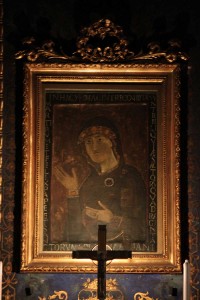
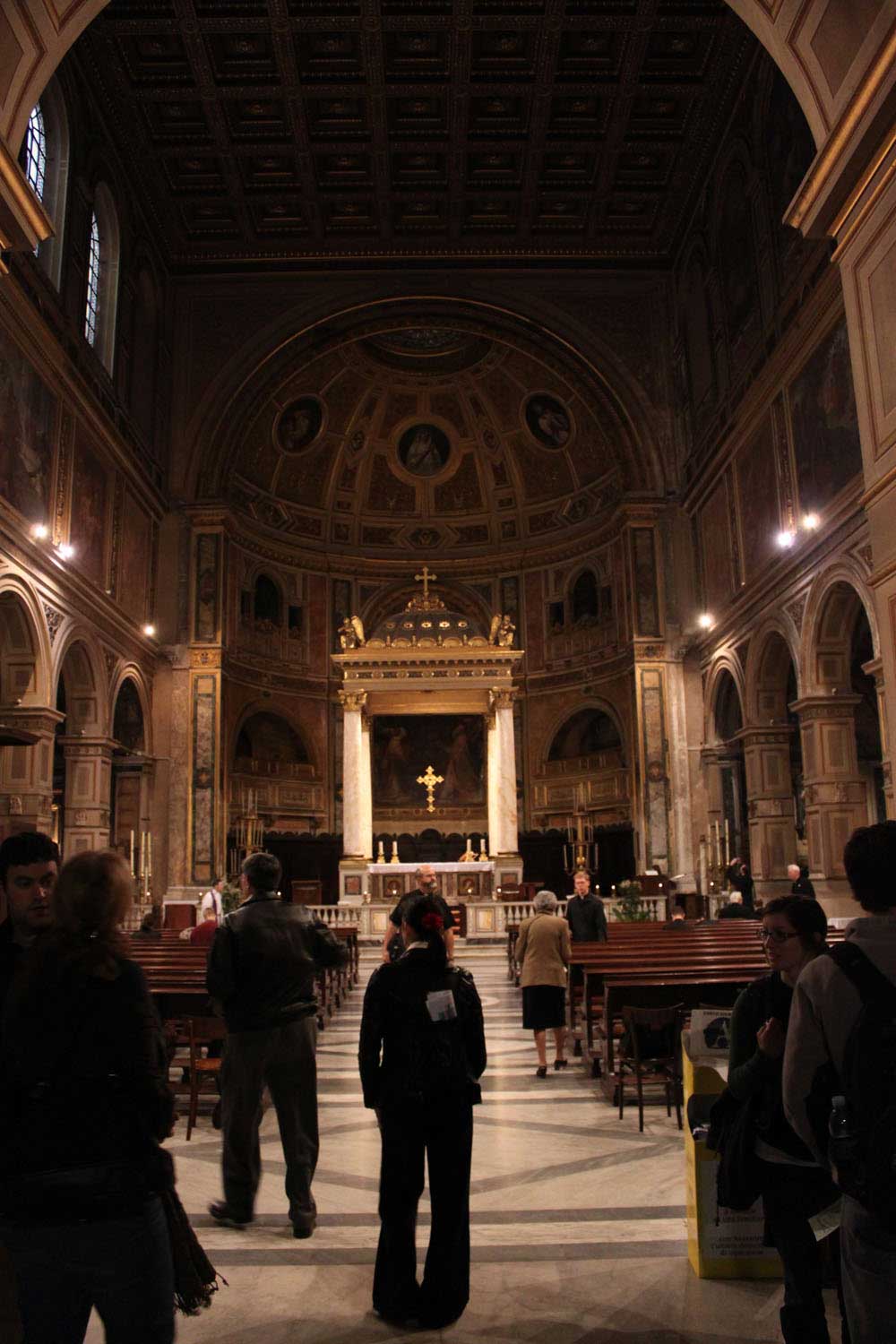
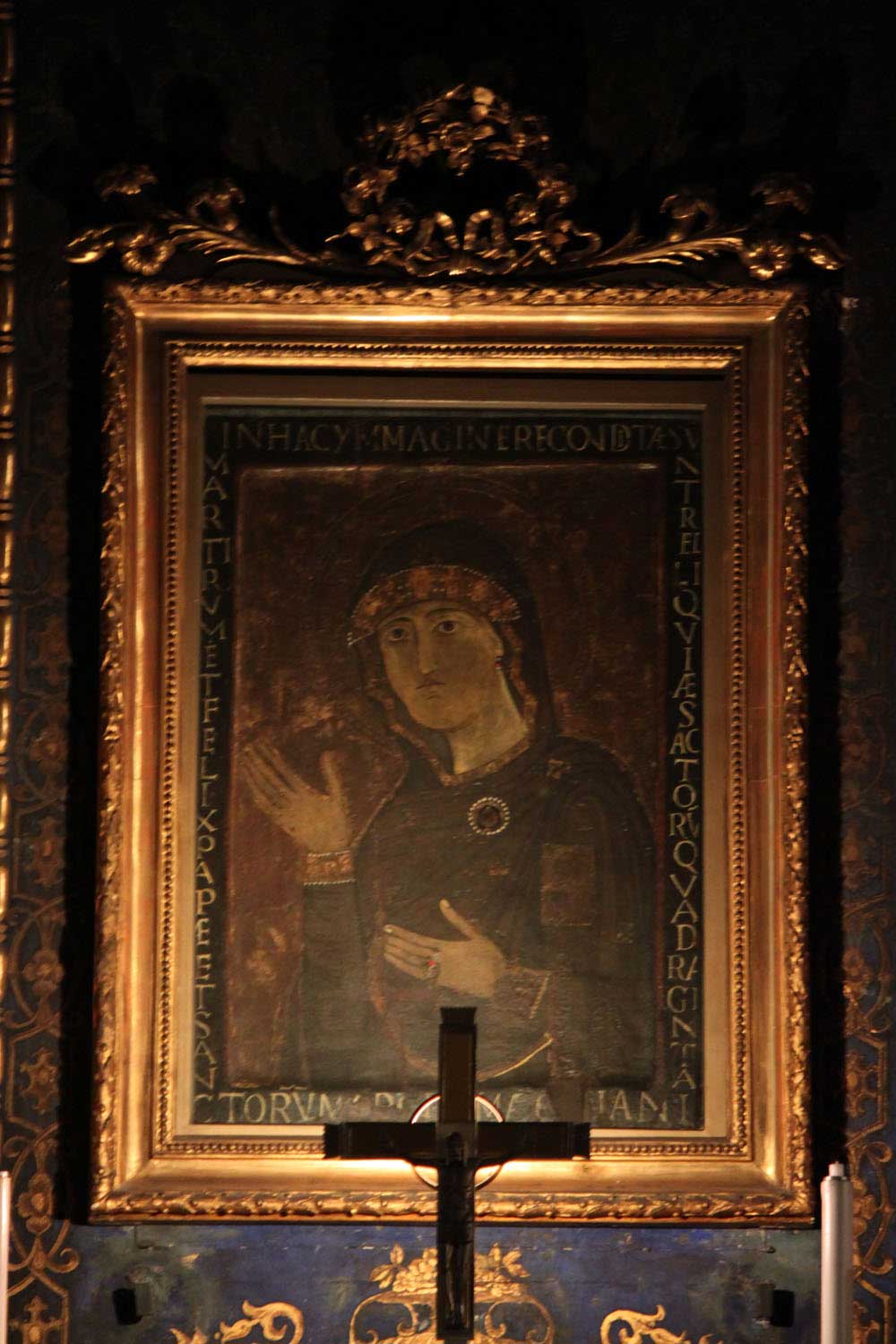
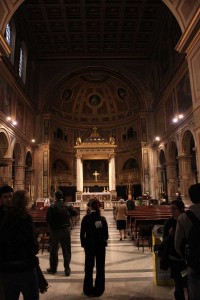
Today pilgrims made their way to the Basilica da San Lorenzo in Lucina.  This church lies nestled in a quiet piazza.  Just a few yards away one finds the busy Via del Corso lined with boutiques and shops.  Contrasting the quiet church piazza and the busy via offers a great Lenten reminder.  It calls to mind this season’s invitation to take some steps back from the interests of this world to reflect instead on God and to seek first His Kingdom.

In the Gospel we hear Christ tell the scribe, “you are not far from the Kingdom of God.”  Christ speaks these words just as much to each of us today as he did to the scribe in the Gospel.  We do well to remember that we believe the Kingdom exists both “already” and “not yet.”  While the fulfillment of the Kingdom will be marked with Christ’s return, we nevertheless believe that through his Incarnation, Passion, Death and Resurrection it has already been inaugurated.  Each one of us can here and now draw closer to the reality of that Kingdom.  For Catechumens and Candidates, they will do so at the Easter Vigil by being fully received into the Church.  For others, drawing nearer to the Kingdom this Lent may involve returning to the practice of the faith and/or seeking the sacrament of Reconciliation.  For most of us, I imagine that drawing near to the Kingdom lies in the small daily conversions which aim to bring us closer to God.  Often this is the fruit we desired from our Lenten practices.

Our Call to Rejoice

This Sunday the Church marks Laetare Sunday.  She invites us to “rejoice!” as we cross this threshold over the midpoint of Lent and, more importantly, come closer to the Resurrection, Christ’s victory over sin and death on our behalf, which serves as the true source of our joy.  This midpoint provides a wonderful opportunity to take stock of our Lenten practices.  For some of us this will be a cause for rejoicing and giving thanks as we take note at how God has used these practices to turn us more towards Himself.  For others of us it is still a cause for rejoicing!  Although we may have experienced difficulty up to this point with our practices, there is still time and God is generous!  Just recall the parable of the landowner (Mt 20:1-16).  He paid the laborers he called at the waning hours of the day the same amount as those who had been at work from the early morning.

Written by Francisco Aquirre

Photos by Fr. Justin Huber

Difficult to Love?

Who is it today that you’re finding it difficult to love? Is it someone at home, on the job, in the neighborhood, at church, in the public spotlight? Whoever it may be, today’s gospel challenges us to make the intentional effort- to go the extra mile- to love that person.

As we heard, a scribe asked Jesus what he thought was the first of all the commandments. But Jesus didn’t just give him the first, which is the commandment to love God above all else. Jesus gave him the second as well, which is the commandment to love our neighbor as ourselves. Jesus did this because we cannot love God if we don’t love our neighbor.

But just how are we to love? What are we supposed to do? St. Thomas Aquinas said, “Love is wanting what is best for a person and doing what you reasonably can to bring goodness and good things to that person.”

Applying this to the person we’re finding it difficult to love will take different forms, depending on the circumstances. We may need to exercise patience, swallow our pride, offer forgiveness, be intentionally kind, give them some type of help, or make amends for something hurtful we may have done to them.

But regardless of what we might need to do to these difficult people, love them we must, if we wish to be people who truly love God.

Readings for today’s Mass: http://www.usccb.org/nab/040111.shtml

Photo Credit: tourist_on_earth via Creative Commons

Following in the footsteps: Is Jesus enough for me?

Our pilgrimage today takes us to the small church of Saints Cosmas and Damian, a basilica actually located in the Roman Forum, the ancient center of Rome. Parts of this church in fact come from buildings in use during the time of the Roman Empire. The present day church also boasts of a beautiful mosaic of Christ behind the altar in the apse, artwork that dates back to the 6th century. This basilica honors the two brothers, Cosmas and Damian, who were tortured and beheaded for their faith around the year 303 A.D. In fact, their names appear in Eucharistic Prayer I (the Roman Canon).

Today’s Responsorial Psalm reads, “If today you hear his voice, harden not your hearts”. The homily at Mass spoke of Lent being a time where we look into our hearts to see what it is we really desire. We have many wants and needs, but during Lent we must ask ourselves frankly: “Is Jesus Christ enough for me?” If we are not satisfied with him in this life, will we be satisfied with him in the next? This Lent Jesus Christ is calling us anew, calling us to trust that by seeking him first, everything else will be given to us. Let us not harden our hearts to his invitation.

Written by Fr. Anthony Lickteig

Photos by Fr. Justin Huber

Whose Side are You On?

Are you with me or against me? This is the choice Jesus presents to us in today’s gospel. As we heard, Jesus had performed a miraculous healing. Critics said his action was evil. Jesus said it was a sign of the kingdom of God. Then he said we needed to choose whose side we were on. If you think about it, this is a choice we need to make every day, if not several times a day.

On our worst days, we reject Jesus altogether. We’re like the people Jeremiah spoke about in the first reading: disobedient, disloyal, deaf to God’s word. On other days, however, we do want to side with Jesus…but only on our terms. In other words:

• We’re willing to sacrifice…within reasonable limits;

• We’re willing to forgive…those people who are truly sorry;

• We’re willing to love…those people we find lovable;

• We’re willing to give…so long as we receive;

• We’re happy to follow Jesus…as long as he goes where we want him to.

Today’s gospel reminds us that we can’t have it both ways. As Jesus said, the kingdom of God has indeed come upon us. And we need to choose to follow our king, without limit, and without compromise. So today when we hear his voice, let us harden not our hearts.

Readings for today’s Mass: http://www.usccb.org/nab/033111.shtml

Photo Credit: vlxa via Creative Commons.

Walking in the Footsteps: Illuminating the way

Wednesday after the Third Sunday of Lent brings us to San Sisto. This Church was built to mark the spot where on his way to martyrdom Pope Saint Sixtus II (257-258) met St. Lawrence. St. Sixtus’s courageous witness has earned him a place in the Roman Canon, Eucharistic prayer one.

Early records from 595 mention this church existing. In 1219 Pope Honorius III entrusted this church to the newly formed Dominican order, and St. Dominic himself lived here before he died in 1221.

Our reflection today focuses on the early Christian martyrs. One of emperor Nero’s favorite hobbies was to find new ways to torture Christians in Rome. One way was to set them on fire, making torches out of them to light the streets of Rome at night. What Nero did not realize is that the light from these torches would shine through the millennia, pierce through the centuries, and become a beacon for Christians throughout history. The reason we celebrate the early martyrs is because they had the faith Christ calls us to in the Gospel today. In the violent storm of their lives, they trusted in the Lord and publically proclaimed that their primary allegiance was to Christ over any earthly power. They trusted that not even death could separate them from the love of Christ. We pray that St. Sixtus will intercede for us so that God would grant us the same profound faith that he and the martyrs had. May the light that early martyrs produced continue to illuminate our path to sanctity.

Written by Fr. Charles M. Gallagher

Photos by Fr. Justin Huber

Read the Fine Print

Are you familiar with the expression, “Always read the fine print?” Do you always read the fine print? I know I don’t. I once heard a comedy routine that put “always read the fine print” in the same category as “rinse and repeat” and “do not insert cotton swab into the ear canal.” The point was, of course, that we usually ignore this good advice.

In today’s gospel, however, Jesus tells us that we do need to read the fine print when it comes to the law of God. He promises us that until the end of time, not an iota, not a dot of God’s law will pass away.  Jesus explained that he wouldn’t abolish even the smallest part of it, as some of his contemporaries had feared, or perhaps had hoped.

But we might ask ourselves the question: Who would want this law to pass away? Who would wish to see it abolished? In today’s first reading, Moses said that the keeping of this just, life-giving law brings God close to us, and shows us to be wise and intelligent.

And let’s be honest: Who amongst us doesn’t want justice, life, wisdom, and intelligence? Who amongst us doesn’t want God to be close beside us? Deep down, this is what we all want, because God has made us this way.  That’s why Jesus said that those who keep and teach God’s law are truly great in the kingdom of God. Indeed, when it comes to God’s law, we should always read the fine print.

Readings for today’s Mass: http://www.usccb.org/nab/033011.shtml

Photo Credit: Jeff_Golden via Creative Commons

Walking in the Footsteps: At all costs

Santa Pudenziana:  Resting Place for Martyrs

This old basilica takes its name from one of two sisters, Pudentiana and Praxedes, who lived in the time of the first Christian persecutions. They are said to have buried martyrs from the persecutions in a well, which is now on the left side of the Church. When Pope Paschal I began moving relics from the catacombs these two sister’s names appear together first in a list of holy virgins whose relics were being transferred.  This Church also holds, in a chapel at the head of the left aisle, a slice of St. Peter’s altar table. The rest of it can be found embedded into the Papal altar in the basilica of St. John Lateran.

At the front of the Church, in the apse, there is a mosaic of Christ and the apostles from the 4th Century in front of a Roman Panorama, although representing Churches in Jerusalem that had been built by Constantine. It is meant to represent the heavenly Jerusalem towards which we are all on pilgrimage.

The Path to Humility and Love

The priest this morning (Fr. Nicholas Schneider, Diocese of Bismarck ), preached  on what exactly the amounts were that the two servants owed. He mentioned that the fellow servant owed the other a “much smaller amount.” This smaller amount was actually 100 denari, the equivalent of 100 days’ wages. On the other hand the “huge” debt that the first servant was forgiven of by his master was 100 talents which could be up to 150,000 day’s wages. We are being told in the Gospel today, that whatever debts or offenses our neighbors may cause us are really that “much smaller amount” which is conceivably payable, when compared with that “huge” amount , because of our sins, that we owe to God, which in no way we could ever be able to pay back.  And yet, the Good Master has been so kind as to forgive us that debt. Viewed in this way, it would be good to follow St. John Chrysostom’s advice to make small of the ways in which our neighbors give us offense and to realize and really accuse ourselves before the Lord of the Greatness of our sins, no matter how small. Going before the Lord in this way, will lead us to a deeper humility, a more profound love of God, who always shows us his great mercy and asks us to share in it.

Written by Mario Majano

Photos by Fr. Justin Huber

Three Strikes, But Not Out

St. Peter never played baseball. Nevertheless, “Three strikes and you’re out!” seems to be what he had in mind when he asked Jesus about the limits of forgiveness. Like we’re often tempted to do, he assumed that forgiveness has its limits. Jesus understood this. That’s why he stressed that those who follow him are to forgive without limit.

Jesus doesn’t say that we need to condone what was done to us, deny our pain in being hurt, or trust the person who harmed us. However, he does call us to make the decision to forgive, and free ourselves from resentment and the desire for revenge.

When we refuse to forgive, we contribute to the world’s sorrow (and there’s enough of that already); we demonize the person who wronged us (and that’s unfair to them); and we deny ourselves the gift of God’s forgiveness (which is foolishness to us).

Forgiveness is indeed hard, but Jesus shows us the way. As Pope John Paul II reminds us, “Jesus’ cross invites us to respond to love with love.”

Readings for today’s Mass: http://www.usccb.org/nab/032911.shtml