Most Lenten reflections center on fasting or abstinence along with prayer and almsgiving. However, the word “repent” in our English bibles translates the Greek word “Metanoiate” which most literally summons us “to change (meta) the way we think (noiate).” With this in mind, I would like to post some articles this Lent that help us to think of and see things differently, and in a more helpful way.
Family life is so central to our experience and moral life that I begin by offering a humble picture of it that emphasizes its somewhat tumultuous quality. As we well know, family life can be wonderful, but it can also be challenging and even terrible at times. We can choose our friends, but seldom can we choose our family. Family is assigned by God and thus, we do well to understand that what we want is not always the same as what we need.
Family members have a way way of keeping us humble. Siblings, especially, are ever present to remind us that we are not all we are “not all that” and that life isn’t just about us. Sadly today, many people have few, if any, siblings and this factor tends to produce a lot more narcissism and idiosyncrasy. But oh, for a few siblings to keep you humble! Parents too can humble us and also encourage us, they can edify us and also cause deep pain. Add to the mix cousins and in-laws of every sort and the mix becomes quite a show. Our families can have all the glory, and all the gorey. Among us there are saints and there are aint’s; there are the mighty oaks of legendary renown and more than a few nuts falling from the same family tree. Ah family, can’t live with it, can’t live without it.
This Lent we do well to ponder however that even the difficult and trying aspects of family life have a way of helping us. Somehow it all reminds me of a rock tumbler.
Indeed, when I was a kid there was a school geology kit that included a “rock-tumbler” which was meant to teach us how stones can go from being jagged and drab to being smooth, polished and even colorful. It was a round drum that looked a bit link a cement mixer. Throw in some rocks and various sorts of sand and run it for a few weeks and, shazam, the rocks came out looking beautiful, almost like gems or marble.
And this is all a paradigm or image for family life. We are the rocks and the tumbler represents life with all its twists and turns. The sand is the tuff grit that comes from living in a world that has its fair weather but overall, is a kind of sandstorm of trials and tumult, tensions and disagreements. And so the world turns and we, especially in our families, bump up against each other and face the often-abrasive sands of life. But through it all, our rough edges are chipped away, the sands cause a polish to emerge on each of us. The process is harsh and gorey, but at the end, someone beautiful emerges: the very man or woman God has created us to be. We begin as diamonds in the rough or coarse stones and come forth as beautiful jewels, polished and lightesome.
Hence, even the less desirable aspects of life can ultimately be a blessing for us. Scripture says that “All things work together for good to those who trust the Lord and are called according to His purposes.” (Rom 8:28) So, in marriages, families and parishes, the rough and tumble of human interactions is often permitted by God to smooth us, polish us and beautify us.
This is not to sanctify every problem in family life. There is some abuse that is simply evil and should in no way be considered part of the rough and tumble that helps perfect us.
But in Lent, we do well to see beyond the annoyances of life and the tensions of family, to the greater purposes of God who permits such things for our good. A little less resentment and a lot more acceptance is a good lenten theme.
Metanoiate! Think differently this Lent about the ups and downs of Family life. Thank God even for those gifts in strange packages.
In today’s Gospel the Lord is teaching us, by His grace, to break the cycle of hatred and retribution. When someone harms me I may well become angry, and in my anger seek to get back at the offender. If I do that, though, then Satan has earned a second victory and brought the anger and retribution to a higher level. Most likely, the one who originally harmed me will then take exception to my retribution and try to inflict more harm on me. And so the cycle continues and escalates. Satan loves this.
Break the cycle. The Lord has dispatched us onto the field to turn the game around and break this cycle of retribution and hatred. The “play” He wants us to execute is the “it ends with me” play.
Don’t play on Satan’s team. To hate those who hate me, to get back at those who harm me, is to work for Satan, to play on his team. Why do that?
To advance the ball for Jesus is to break the cycle of retribution and hatred by taking the hit and not returning it. By loving our enemy, we break the cycle of hate. By refusing retribution, we rob Satan of a double victory.
Recall the words of Dr. Martin Luther King, Jr.:
Darkness cannot drive out darkness; only light can do that. Hate cannot drive out hate; only love can do that. Hate multiplies hate, violence multiplies violence, and toughness multiplies toughness in a descending spiral of destruction. … The chain reaction of evil—hate begetting hate, wars producing more wars—must be broken, or we shall be plunged into the dark abyss of annihilation (From Strength to Love, 1963).
Christ, living in us, wants to break the cycle.
The Necessity of Grace – Recall as well a point made in last Sunday’s reflection: that the antitheses contained in chapter 5 of the Gospel of Matthew are pictures of the transformed human person. Jesus is describing here what happens to a person in whom He has begun to live through the Holy Spirit. The verses are a description more so than a prescription. Jesus is not merely telling us to stop being so thin-skinned, easily offended, and retaliatory. He’s not just telling us to stop hating people. If that were the case, it would be easy for us to get discouraged or to write them off as some impossible ideal. No, the Lord is doing something far greater than just giving us a set of rules. He is describing what will happen to us more and more as His grace transforms us.
With this in mind, let’s look at the particulars in three sections.
I. Regarding Retaliation – The first of the antitheses reads as follows:
You have heard that it was said, “An eye for an eye and a tooth for a tooth.” But I say to you, offer no resistance to one who is evil. When someone strikes you on the right cheek, turn the other one to him as well. If anyone wants to go to law with you over your tunic, hand him your cloak as well. Should anyone press you into service for one mile, go with him for two miles. Give to the one who asks of you, and do not turn your back on one who wants to borrow.
Behind this text is the gift from the Lord of a generous heart. Psalm 118 says, In the ways of your precepts I run O Lord for you have enlarged my heart. It takes a large heart not to retaliate, to go the extra mile, to give alms. The transformed mind and heart that Jesus gives us is like this. It is a big heart, able to endure personal slights and attacks, refuse retaliation, and let go of personal possessions in pursuit of a higher goal.
That said, there are surely many questions that arise out of these sayings of Jesus’. Most of them, however, come from seeing Jesus’ words as a legalistic prescription rather than as a descriptive example. Nevertheless, they are important questions.
What does it mean to offer no resistance to injury?
Does it mean that there is no place for a criminal justice system?
Should police forces be banned?
It there no place for national defense or armed forces?
Should all punishment be banned?
Should bad behavior never be rebuked?
Am I required to relinquish anything anyone asks me for?
Must I always give money to beggars?
Is it always wise to give someone whatever he asks for?
Should I agree to accept every task that is asked of me?
To answer some of these questions, we do well to recall that the Lord is speaking to us as individuals. The state, which has an obligation to protect the innocent from enemies within and without, may be required to use force to repel threats. Further, it has an obligation to secure basic justice and may therefore be required to impose punishment on those who commit crimes. This has been the most common Catholic understanding of this passage. The New Testament seems to accept that the state does have punitive powers, to be used for the common good.
But don’t miss Jesus’ main point, which is directed to us as individuals. He testifies that, to the degree that we are transformed, we will not seek to retaliate or avenge personal injuries. Rather, due to our relationship with God the Father, we will be content to leave such matters to God. As Scripture testifies, Beloved, never avenge yourselves, but leave it to the wrath of God; for it is written, “Vengeance is mine, I will repay, says the Lord” (Rom 12:19). Further and even more important, to the degree that Jesus lives in us, we will be less easily offended. This is because our sense of our dignity is rooted in Him, not in what some mere mortal thinks, says, or does.
Jesus goes on to give four examples of what He means by us becoming less vengeful and retaliatory.
When someone strikes you on the right cheek, turn the other one to him as well.In ancient times, striking someone in this manner was a sign of disrespect, just as it would be today. There is an intended humiliation when someone strikes another on the cheek. By turning the other cheek, one would then be struck with the back side of the striker’s hand. This was an even greater indignity in the ancient world! But as a Christian in whom Christ is really living, who can really dishonor me? God is the source of my dignity; no one can take it from me. By this grace, I can let any slight pass, because I have not been stripped of my dignity. The world did not give me my dignity and the world cannot take it away. From this perspective, Jesus is not offering us merely the grace to endure indignity, but the grace not to suffer or experience indignity at all.
If anyone wants to go to the law with you over your tunic, hand him your cloak as well.In ancient times, it was forbidden to take someone’s tunic in pledge for a loan. Thus Jesus would seem to be using this example as a symbol of our rights. There are some people who are forever demanding and clinging to their rights. They clutch their privileges and will not let them go even if the common good would require it. They will go to the law rather than suffer any infringement upon their rights. The true Christian thinks more in terms of duties than rights, more of responsibilities than privileges. All this
“personal honor” stuff is unimportant when Christ lives in us. To be sure, there are some rights necessary for the completion of our duties or for meeting our basic needs. It is unlikely that Jesus has in mind to forbid this. But as a general rule, Jesus is indicating that we can be freed of obsession over our “rights,” “dignity,” and also our personal possessions. Increasingly, we can be freed of the anger that can arise when someone might even think of touching anything that is “ours.” The more we are detached from earthly possessions, the less we get anxious or angry when these things are somehow threatened or used without our permission, or when our precious “rights” are trampled upon.
Should anyone press you into service for one mile, go with him for two miles.It was legal for a Roman solider to press a person into service for one mile to carry things. Some might be bent out of shape over such indignities. Jesus offers us a generous heart that will go the extra mile. Jesus came as the servant of all; He came to serve rather than to be served. To the degree that He lives in us, we will willingly serve and not feel slighted when someone asks us to do something. Neither will we cop the “Why me?” attitude that commonly afflicts the ungenerous soul. The key gift here is a generous heart, even in situations in which others do not assign work to us fairly or appreciate our efforts sufficiently. This is of little concern for us, because we work for God.
Give to the one who asks of you, and do not turn your back on one who wants to borrow.Many questions arise related to indiscriminate giving. In some cases, it may not be wise thing to give money simply because someone asks. But don’t miss the main point here: when Jesus lives in us, we will be more generous. We will give cheerfully and assist others gladly. We will not get bent out of shape when someone asks us for help. We may not always be able to help, but our generous heart will not begrudge the beggar; we will remain cheerful and treat him or her with respect.
Here, then, is a description of a transformation of the mind and heart. We will view things differently. We will not be so easily bent out of shape, retaliatory, or vengeful. We will be more patient, more generous, less grasping, and more giving. This is what happens when we live in a transformative relationship with Jesus.
II. Radical Requirement – Love your enemy.
You have heard that it was said, “You shall love your neighbor and hate your enemy.” But I say to you, love your enemies, and pray for those who persecute you, that you may be children of your heavenly Father, for he makes his sun rise on the bad and the good, and causes rain to fall on the just and the unjust. For if you love those who love you, what recompense will you have? Do not the tax collectors do the same? And if you greet your brothers only, what is unusual about that? Do not the pagans do the same?
This is the acid test, the hallmark of a true Christian: love of one’s enemy. Note that the Lord links this to being a true child of God. Why? Because God loves everyone and gives gifts of sun and rain to all. If we are a “chip off the old block,” we will do the same. It’s easy to love those who love us, but a Christian is called to fulfill the Law and exceed it.
If Christ lives in us, then we will love even our enemy. Recall that Jesus loved us even when we hated Him and killed Him. Jesus said, Father, forgive them; for they know not what they do (Luke 23:34). Elsewhere in Scripture is written, While we were his enemies we were reconciled to God by the death of his Son (Rom 5:10).
We should be careful not to make love an abstraction. The Lord is talking about a real transformation of our hearts. Sometimes we say silly things like this: You don’t have to like everyone but you have to love them. This turns love into something of an abstraction. God doesn’t just love me; he even likes me. The Lord is talking about a deep love that wills good things for our enemy and even works toward them.
We are called to have compassion, understanding, and even affection for those who hate us and will us evil. We may wonder how this can happen in us. How can we have affection for those who hate us? It can be so when Christ lives His life in us. We will good and do good to them who hate us, just as Jesus did.
It is also important not to sentimentalize this love. Jesus loved His enemies but did not coddle them. He spoke the truth to the Scribes and Pharisees of His day, often forcefully and uncompromisingly. We are called to a strong love, one which wants the truth for everyone, but we must give this testimony with understanding and true (not fake or false) compassion.
III. Remarkable Recapitulation – Finally, the Lord says,
So be perfect, just as your heavenly Father is perfect.
Here is the fundamental summary, the recapitulation: God-like perfection! Nothing less will do. How could there be anything less when Christ lives His life in us? To the degree that He lives in us and the old Adam dies, we become perfect. This is the state of the saints in Heaven: they have been made perfect. Christ’s work in them is complete. The Greek word used here is τέλειός (teleios) which means complete or perfect. Thus, the emphasis is on the completion of a work in us more so than mere excellence in performance. Paul writes to the Philippians, And I am sure that he who began a good work in you will bring it to completion at the day of Jesus Christ (Phil 1:6).
This sentence also serves as an open-ended conclusion to the antitheses today’s Gospel. It’s almost as if Jesus says, “I’ve only given you a few examples here. The point is to be perfect, complete in every way, totally transformed in your mind, heart, and behavior.”
And thus we return to the original theme: it ends with me. In these final two antitheses the Lord wants to break the cycle of anger, retribution, and violence. He wants the downward spiral of hatred and vengeance to end with me. When, on account of His grace, I do not retaliate, I break the cycle. When I do not escalate the bitterness or return the spite, when I refuse to allow hate to take possession of me, the cycle ends with me. Only God can do this for me.
But He does do it. I promise you in the Lord Jesus Christ that He can deliver us from anger, wrath, vengefulness, and pettiness. I can promise you because He is doing it in me. I do not boast; I am only telling you what the Lord has done. For the most part, I have been delivered from my anger, something that was once a major struggle for me. It is not any longer. I did not deliver myself—Jesus did. The promise of the Lord here is true. Only God can do it. He has said it and He will do it—if we let Him.
This song says, “I Look to you. After all my strength is gone, in you I can be strong. I look to you!”
The image of Salt occurs more frequently in the Bible than we often realize. Most of us remember Jesus calling us the salt of the earth. But there are many other references as noted in the linked article in the previous sentence. Let’s just list a few here that are most curious to New Testament readers.
Everyone will be salted with fire. Salt is good, but if salt becomes insipid, with what will you restore its flavor? Keep salt in yourselves and you will have peace with one another (Mark 9:49-50).
Another interesting passage is in the Acts of the Apostles:
And while eating salt with them he charged them not to depart from Jerusalem, but to wait for the promise of the Father. (Acts 1:4)
These are odd references to us who live in an age that often demonizes salt as detriment to good health. How should we understand the biblical references to salt? Let’s begin with a few observations about salt in those times.
Salt was valuable. Some people were even paid with salt (which is where we get the word “salary”).
Salt was connected with healing and purity. Saltwater was applied to infections and wounds (it helps heal afflictions of the skin). Newborn babies were washed with saltwater.
Salt was connected with preservation. In the years before refrigeration, salt was one of the most common ways of preserving meat and fish.
Salt was connected with flavor. Salt adds spice to life; it brings out the flavor in food.
Salt was an image for wisdom. Gregory the Great said, “Now by salt is denoted the word of wisdom. Let him therefore who strives to speak wisely, fear greatly” (Pastoral Rule 4.12).
Salt was connected with worship and covenant. Scripture says, Season all your grain offerings with salt. Do not leave the salt of the covenant of your God out of your grain offerings; add salt to all your offerings (Lev 2:13). So, the use of salt was ordered first for the meal offerings, and afterwards for “all” offerings, including the “burnt offering.”
Scripture speaks elsewhere of a “covenant of salt.” For example, Don’t you know that the LORD, the God of Israel, has given the kingship of Israel to David and his descendants forever by a covenant of salt? (2 Chron 13:5) The covenant of salt refers to the imperishable and irrevocable quality of the engagement made between the two parties to the covenant.
The use of salt to signify and ratify what was sacred was widespread. There is a Latin saying attributed to Pliny the Elder (and Virgil, too), Nulla sacra conficiuntur sine mola salsa (Sacred things are not made without salted meal).
To apply the image of salt to the Christian life, we should see that the Christian is charged with purifying, sanctifying, and preserving this wounded and decaying world by being salt to it. The Christian is called to bring flavor to life in a world that is so often filled with despair and meaninglessness.
With that background, let’s turn to an analysis of Jesus’ words from the Gospel of Mark.
1. Everyone will be salted with fire. Two images of salt and fire come together here, but the result is the same: purification. We have already seen how salt purifies. Fire does the same thing through the refining process. Precious metals come from the ground admixed with iron and many other metals. Subjecting them to fire purifies the gold or silver, separating it from the iron and other metals.
Both salt and fire purify by burning, each in its own way. Hence the Lord marvelously brings those two images together, telling us that we will all be “salted with fire.”
Indeed, it must be so. We must all be purified. Scripture says of Heaven, nothing impure will ever enter it (Rev 21:27). St. Paul speaks of purgatorial fire as effecting whatever purification has not taken place here on earth:
If anyone builds on this foundation [of Christ] using gold, silver, costly stones, wood, hay or straw, their work will be shown for what it is, because the Day will bring it to light. It will be revealed with fire, and the fire will test the quality of each person’s work. If what has been built survives, the builder will receive a reward. If it is burned up, the builder will suffer loss but yet will be saved—yet as one escaping through the flames (1 Cor 3:15-15).
The Book of Malachi also reminds us of our need to be purified, to be “salted with fire.”
But who can endure the day of his coming? Who can stand when he appears? For he will be like a refiner’s fire or a launderer’s soap. He will sit as a refiner and purifier of silver; he will purify the Levites and refine them like gold and silver (Mal 3:2-3).
Yes, we must all be salted with fire. We must be purified, both here, and if necessary (as it likely will be), in Purgatory.
2. Salt is good, but if salt becomes insipid, with what will you restore its flavor?In other words, we must let the salt of God’s grace have its effect or else we, who are to be salt for others, become flat, tasteless, and good for nothing but to be thrown out and trampled underfoot (cf Matt 5:13).
If the salt will not be salt, there is no substitute for it. Jesus asks rhetorically, if salt becomes insipid, with what will you restore its flavor? There is no substitute for Christians. If we will not be light, then the world will be in darkness. If we will not be salt, then the world will not be purified, preserved, or have anything good or tasty about it at all. The decay of Western culture has happened on our watch, when we collectively decided to stop being salt and light.
3. Keep salt in yourselves and you will have peace with one another.In other words, allow the salt, the purification, to have its effect. Only if we do this will we have peace with one another.
Our divisions and lack of peace are caused by our sins. Thus, to accept the purification of being salted with fire is our only true hope for peace. When the Lord burns away my envy, I no longer resent your gifts; I rejoice in them and come to appreciate that I need you to complete me. In this way there is peace. When the Lord burns away my jealousy and greed and helps me to be grateful for what I have, I no longer desire to take what is rightly yours nor do I resent you for having it. In this way there is peace. When the Lord burns away my bitter memories of past hurts and gives me the grace to forgive, an enormous amount of poison goes out of my soul and I am equipped to love and to be kind, generous, and patient. In this way there is peace.
Yes, allowing ourselves to be salted with fire is a source of peace for us. And while we may resist the pain of fire and salt, just as with any stinging medicine we must learn that although it is painful it is good for us. Yes, it brings peace; it ushers in shalom.
The Gospel for Sunday’s Mass is from the Sermon on the Mount (Matthew 5-7), specifically 5:17-37. In a way the Lord is drawing a picture for us of the transformed human person. He is presenting a kind of slide show of what sanctity really is. In understanding this rather lengthy text we do well to reflect on it in three parts.
I. The Power of New Life in Christ – We have discussed before that an important principle of the Christian moral vision is that it is received, not achieved. Holiness is a work of God. The human being acting out the power of his flesh alone cannot keep, and surely cannot fulfill, the Law. The experience of God’s people in the Old Testament bears this out. True holiness (not merely ethical rule-keeping) is possible only by and through God’s grace.
We must understand the moral vision given by Jesus as a description rather than a mere prescription. Notice what the text says here: I have come not to abolish but to fulfill [the Law]. It is Jesus who fulfills the Law. And we, who are more and more in Him and He in us, do what He does; it is His work.
Jesus describes these signs that we are transformed human beings:
Jesus Christ really begins to live His life in us (Gal 2:20).
The power of His cross goes to work in us and puts sin to death (Rom 6:2).
Jesus increases and we decrease (Jn 3:30).
Our old self is crucified with Him so that sin will no longer master us (Rom 6:6-7).
This is a work of God; the power is in the Blood and the cross. The power comes to us by grace. It is all a work of God.
Hence, in today’s Gospel, Jesus is not giving us a rigorous set of rules to follow (and they are rigorous), but is describing what the transformed human person is like. His description is not an impossible ideal, but is set forth as the normal Christian life. The normal Christian is a transformed human person. The normal Christian man has authority over his anger and sexuality, loves his wife and family, and is a man of his word. All this comes to him as the fruit of God’s grace.
It is very important to understand that this is a life offered to us by God. If we do not see it in that we, we are simply left with moral rules: Don’t be so angry or unchaste; don’t get divorced; and don’t lie. Rather, what is offered here is new life in Christ such that, on account of an inner transformation by the power of grace, our anger abates, our unchastity diminishes, our love of others increases, and we speak the truth in love. The power to do this comes not from our flesh but from the Lord, through the power of His cross to put sin to death and bring forth new life in us.
II. The Principle of New Life in Christ – Jesus’ moral vision is that, by His grace, we do not merely keep the Law, but fulfill it. The key word is “fulfill,” meaning to fill something until it is full, to exceed the minimum requirements. When we fulfill the Law, we enter into the full vision and meaning of the Law.
Thus, to use Jesus’ examples from today’s Gospel:
It is not enough to refrain from killing. True life in God means that I harbor no vengeful hatred. I love even my enemies and am reconciled with people I have wrongfully hurt or offended.
It is not enough to avoid adultery. True life in Christ means that I am chaste and pure even in my thoughts. By God’s grace, I have authority over what I am thinking and shun unchaste thoughts.
It is not enough to follow proper divorce law. True life in Christ means I have no desire to divorce my wife. I love her and my children. I am reconciled to her and accept that she is not perfect, just as I am not perfect.
It is not enough to refrain from swearing false oaths. True life in Christ means speaking the truth in love, being a man of my words. The grace of God keeps me from being duplicitous and deceitful.
In all these ways, the Law is not merely kept; it is fulfilled. It is filled full in that all these implications are abundantly and joyfully lived out as Jesus Christ transforms me. Christ came to fulfill the Law, and as our union with Christ grows more perfect we also fulfill the Law. For what Christ does, we do; we are in Him and He in us. I am the vine; you are the branches. If you remain in me and I in you, you will bear much fruit; apart from me you can do nothing (John 15:5).
III. The Picture of New Life in Christ. – The Lord then continues on to provide six descriptions of a transformed person. Today’s Gospel contains four of them. These pictures are often called “antitheses” because they are all formulated in this way: You have heard that it was said … but I say to you …. The key point is to see them as pictures of what happens to a person in whom Jesus Christ is really living. Let’s look at each.
A. On Anger– You have heard that it was said to your ancestors, You shall not kill; and whoever kills will be liable to judgment. But I say to you, whoever is angry with brother will be liable to judgment; and whoever says to brother, ‘Raqa,’ will be answerable to the Sanhedrin; and whoever says, ‘You fool,’ will be liable to fiery Gehenna. The Lord teaches us that the commandment not to kill has a deeper meaning. What leads to murder? Is it not the furnace of anger, retribution, and hatred within us? We may all experience a flash of anger and it passes. Further, there is such a thing as righteous anger, which is caused by the perception of injustice and sin. The Lord Himself exhibited this sort of anger on many occasions. This type of anger is not condemned. Rather the anger that is condemned is that which is born of hate and vengeance, anger that goes so far as to wish harm to another or to deny his human dignity; this is what leads to murder.
That the Lord has this sort of anger in mind is revealed in the examples He cites, which use the words Raqa and fool. These words express contempt and hatred. Raqa has no clear translation, but seems to have had the same impact as the “N word” does today. It was a very hurtful word expressing deep contempt. Such utterances cannot come from a person in whom the Lord authentically lives. And to the degree that we allow Christ to live in us, they will not. Increasingly, we cannot hate others, for the Lord is in us and He died for all of us out of love. How can I hate someone He loves?
The Lord makes it clear that if we don’t rid ourselves of this anger, we are going to jail: Therefore, if you bring your gift to the altar, and there recall that your brother has anything against you, leave your gift there at the altar, go first and be reconciled with your brother, and then come and offer your gift. Settle with your opponent quickly while on the way to court. Otherwise your opponent will hand you over to the judge, and the judge will hand you over to the guard, and you will be thrown into prison. Amen, I say to you, you will not be released until you have paid the last penny. Either we allow the Lord to effect this reconciliation in us or we’re off to jail! Whether the jail is Hell or purgatory (for it would seem that there is release from this jail after the last penny is paid), it is jail. We are not going to Heaven unless and until this matter is resolved. Why delay the issue? Let the Lord work it now. Don’t go to jail because of your grudges and your stubborn refusal to admit your own offenses.
B. On Lust – You have heard that it was said, You shall not commit adultery. But I say to you, everyone who looks at a woman with lust has already committed adultery with her in his heart. The Lord teaches us that the commandment against adultery has a deeper meaning. It is not merely about transgressing marital boundaries. To fill this Law full means to be chaste in all matters, in mind and in heart.
It is certainly wrong to engage in any illicit sexual union, but if one is looking at pornography or fanaticizing about others sexually, one is already in adultery. What the Lord is offering us here is a clean mind and pure heart. He is offering us authority over our sexuality and our thoughts. For those who are in Christ, self-mastery increases and purity of mind and heart become a greater reality. Our flesh alone cannot do this, but thanks be to God, who gives us the victory in Christ. It is His work in us to give us these gifts.
If your right eye causes you to sin, tear it out and throw it away. It is better for you to lose one of your members than to have your whole body thrown into Gehenna. And if your right hand causes you to sin, cut it off and throw it away. It is better for you to lose one of your members than to have your whole body go into Gehenna. We have to be serious about these matters. The Lord is using hyperbole to make a point: it is more serious to sin than to lose your eyesight or one of your limbs.
Most people don’t think this way; they make light of sin—sexual sin in particular. God does not make light of sin. Jesus teaches here that it is worse to lose our soul than to lose a part of our body. If we were to lose our eyesight or a limb to cancer, we would probably beg the Lord to deliver us. Why do we not think of sin in this way? Why are we not horrified to the same degree? We are clearly skewed in our thinking. Jesus is clear that these sorts of sins can land us in Hell (which is here called Gehenna). Lustful thinking, pornography, masturbation, fornication, adultery, contraception, and homosexual acts are not part of life in Christ, who wants to give us freedom and authority over our sexual passions.
Many people today are in some pretty serious bondage when it comes to sexuality. Jesus stands before us all and says, “Come let me live in you and give you the gift of sexual purity. It will be my gift to you. It will be my work in you to set you free from all disordered passions.”
C. On Divorce – It was also said, Whoever divorces his wife must give her a bill of divorce. But I say to you, whoever divorces his wife—unless the marriage is unlawful—causes her to commit adultery, and whoever marries a divorced woman commits adultery. At the time of the Lord Jesus, divorce was permitted in Israel, but a man had to follow certain rules. But the Lord says that to fulfill marriage law is to love your spouse. He teaches that when He begins to live His life in us, love for our spouse will grow; love for our children will deepen. Divorce won’t even occur to us! Who wants to divorce someone he loves?
If the Lord can help us to love our enemy, then He can surely cause us to love our spouse. Some of the deepest hurts can occur in marriage, but the Lord can heal all wounds and help us to forget the painful things of the past.
The Lord is blunt here. He simply refuses to recognize a piece of paper from a human judge approving a divorce. God is not impressed by a legal document and may well consider the couple married despite it.
The Lord says, “Come to me, bring me your broken marriage, your broken heart. Let me bring healing. Sometimes one of the spouses simply leaves or refuses to live in peace. In such a case, the Lord can heal by removing the loneliness and hurt that might drive one to a second “marriage” in which there is more trouble waiting. Let the Lord bring strength, healing, and a restoration of unity. He still works miracles and sometimes that is what it takes.
D. On Oaths – Again you have heard that it was said to your ancestors, Do not take a false oath, but make good to the Lord all that you vow. But I say to you, do not swear at all; not by heaven, for it is God’s throne; nor by the earth, for it is his footstool; nor by Jerusalem, for it is the city of the great King. Do not swear by your head, for you cannot make a single hair white or black. Let your ‘Yes’ mean ‘Yes,’ and your ‘No’ mean ‘No.’ Anything more is from the evil one. The people of Jesus’ time had lots of legalism associated with oaths and lots of tricky ways of watering down the truth. The Lord says, just be a man or woman of your word. When Jesus begins to live His life in us, we speak the truth in Love. When we make commitments, we are faithful to them; we do not lie; we don’t “play games” with the truth. God is truth. As He lives in us, we become the truth, speak the truth, and live the truth. This is the gift that Jesus offers us here.
So, then, here are four pictures of a transformed human being. Remember, the Sermon on the Mount is filled more with promises than with prescriptions, descriptions more so than prescriptions. The Lord is telling us what He can and will do for us.
I am a witness to the transformative power of Jesus’ grace and love. I promise you, brethren in the Lord Jesus Christ, that He will do everything He offers us here. It is already happening and is taking deep root in my life. How about you? Are you a witness?
This song, “Breathe in Me,” speaks of the power of Jesus to transform us and of our need for His grace.
You breathe in me, and I’m alive with the power of your holiness.
You breathe in me, and you revive feelings in my soul that I have laid to rest
Chorus: So breathe in me, I need you now.
I’ve never felt so dead within, so breathe in me.
Maybe somehow you can breathe new life in me again
They have been called by many names: the prayer of the faithful, the general intercessions, and now most commonly the universal prayers.
But they are not the prayers of the faithful since they are usually written by an individual. They are really general intercessions, since they are often rather specific, and they are not universal in the sense that they are, by necessity, particular. It would be impossible to cover the full or universal range of human needs. So even the nomenclature of this part of the Mass is difficult to pin down. This, in turn reflects a merely vague understanding of the purpose of these prayers.
Further, there is an often disappointing quality to the intentions as they are used today. Some years ago, Peter Kwasniewski, in an article at New Liturgical Movement.org (here), summarized the problem very well.
It is surely no exaggeration to say that throughout the world the quality of these intercessions has tended to be deplorable, ranging from trite and saccharine sentiments to political propaganda, from progressivist daydreams to downright heretical propositions to which no one could assent without offending God. Even when the content is doctrinally unobjectionable, all too often the literary style is dull, flaccid, rambling, or vague. … [There is] problematic content, poor writing, and [a] monotonous manner of delivery.
Additional problems occur when there are people of many different nationalities present and it is felt necessary to have the petitions read in multiple languages. The impression is given that the intentions are directed more to the congregation than to God, who knows all languages and thoughts. I have been at Mass in the Basilica here in Washington, D.C. when as many as nine different languages were used in the Prayer of the Faithful, despite the fact that the vast majority of those present spoke English and/or Spanish. I seriously doubt that there were more than five people in attendance who could speak only German, Mandarin, or one of the other languages used. It quickly gets very tedious as a line of people traipse back and forth to the microphone. Is God the focus of these prayers or are we, in a self-referential concern just checking the diversity box?
It is all so different in the Eastern Liturgies, in which the Great Litany is so artfully woven into the liturgical experience and beautifully sung as well. I have memorized the Great Litany from the Liturgy of St. John Chrysostom (see video below).
History – These intentions were very common in the early Church, occurring at about the same point in the Mass as today. They followed the Homily (note that in earlier days the Creed was typically not said). All of the Fathers of the Church make mention of them. In the beginning, this prayer was recited antiphonally by the priest and the assembly. Over time, the deacon assumed a more prominent role; he announced all the intentions and then the faithful responded with Kyrie eleison or some other acclamation. You can read the Kyrie Litany of Pope Gelasius here: Litany of Gelasius
These intercessions endured until about the 9th century, well past the close of the patristic period. Their disappearance seems to coincide with their evolution into a Kyrie litany and their transfer to the beginning of the Mass. They eventually came to be regarded as an unnecessary appendage and were phased out. In the West they were used only on Good Friday, though they endured longer in certain particular areas. In the East they were never dropped. Today they have been restored to their original place in the Mass, but as noted, are difficult to craft in such as way that they feel integrated more than interruptive, as something to get through, rather than as something that flows from our liturgical experience
In his article (here), Mr. Kwasniewski offers a variety of intercessions, and download links are provided. I have done so for my own use and you might wish to do the same.
I would also like to add that St. Peter Canisius composed intercessions for use in his time. Saints are certainly reputable sources of such things! Here is an article by Mark Woodruff that details those prayers.
The point is that much can be done to improve the quality of the Prayer of the Faithful, which has remained an amateur outing at best and an ideological hornet’s nest at worst.
Perhaps some benefit can be obtained from reviewing the norms and the history of this portion of the Mass.
The General Instruction in the Roman Missal (GIRM) has this to say about the Prayer of the Faithful:
In the Prayer of the Faithful, the people respond in a certain way to the word of God which they have welcomed in faith and, exercising the office of their baptismal priesthood, offer prayers to God for the salvation of all. It is fitting that such a prayer be included, as a rule, in Masses celebrated with a congregation, so that petitions will be offered for the holy Church, for civil authorities, for those weighed down by various needs, for all men and women, and for the salvation of the whole world. As a rule, the series of intentions is to be
For the needs of the Church;
2. For public authorities and the salvation of the whole world;
3. For those burdened by any kind of difficulty;
4. For the local community.
Nevertheless, in a particular celebration, such as Confirmation, Marriage, or a Funeral, the series of intentions may reflect more closely the particular occasion.
It is for the priest celebrant to direct this prayer from the chair. He himself begins it with a brief introduction, by which he invites the faithful to pray, and likewise he concludes it with a prayer. The intentions announced should be sober, be composed freely but prudently, and be succinct, and they should express the prayer of the entire community (GIRM 69-71).
In the end, I think these intentions deserve better than we have given them. I realize that enthusiasts of the Traditional Latin Mass (of which I am one) may say, “Just get rid of them entirely,” but that is not realistic. They are here to stay, at least in our lifetime. Maybe we can try to do better by making use of multiple sources: ancient, Eastern, and modern yet elegant. I
Here is the Great Litany from the Liturgy of St. John Chrysostom:
One of the more basic human problems in our relationship with God is that we forget. Over and over again in the Scriptures comes an almost exasperated accusation from God: “You forgot!” Consider just a few of hundreds of such texts:
You deserted the Rock, who fathered you; you forgot the God who gave you birth (Deuteronomy 32:8).
When I fed them, they were satisfied; when they were satisfied, they became proud; then they forgot me (Hosea 13:6).
and when your herds and flocks grow large and your silver and gold increase and all you have is multiplied, then your heart will become proud and you will forget the LORD your God, who brought you out of Egypt, out of the land of slavery (Deuteronomy 8:13-14).
They forgot His deeds and His miracles that He had shown them (Psalm 78:11).
But they soon forgot his works; they did not wait for his counsel. … They forgot God their Savior, Who had done great things in Egypt (Psalm 106:13, 21).
But they forgot the LORD their God; so he sold them into the hand of Sisera, the commander of the army of Hazor, and into the hands of the Philistines and the king of Moab, who fought against them. They cried out to the LORD and said, “We have sinned; we have forsaken the LORD and served the Baals and the Ashtoreths. But now deliver us from the hands of our enemies, and we will serve you”‘ (1 Sam 12:9-10).
Another form of this comes in the refrain of God as the Law is announced in Leviticus and Deuteronomy: “I am the Lord.” For example,
You shall not oppress your neighbor or rob him …. You shall not curse the deaf or put a stumbling block before the blind, but you shall fear your God: I am the Lord. Do not turn to mediums or necromancers; do not seek them out, and so make yourselves unclean by them: I am the Lord your God. You shall stand up before the gray head and honor the face of an old man, and you shall fear your God: I am the Lord (Leviticus 19:31-32).
The ancient rabbis explained this expression in a humorous way. They taught that when God says “I am the Lord,” he means, “Look, I am the one who fished you out of the mud. Now come over here and listen to me.” In other words, “Don’t forget that who it is that is talking to you. I am the one who loves you and has rescued you, the one who provides for you and sustains you. Pay attention. Never forget that I speak to you for your good, not to burden you.”
But as it is, we so easily forget. God’s lament is as true as ever: “You forgot!” We discount the vast and almost unimaginable blessings of each day from the hand of God and grumble at the smallest problem, setback, or slight.
What God is most concerned with is not that we forget small details of the law, but that we so easily forget the wonderful things He has done for us. For indeed, He rescued them from slavery, parted the Red Sea for them, fed them with manna, and gave them water in the desert. He led them forth and settled them in the promised land. But how easily and quickly they forgot His saving deeds!
God’s lament is not about His ego needs to be thanked or repaid for his goodness. God is not vain like man. It is essential that we remember. To remember is to have a healing knowledge.
What does it mean to remember? To remember is to have deeply present in our mind and heart what God has done for us such that we are grateful and different. Grateful people are more hopeful, confident, trusting, and serene. They are more generous, forgiving, and joyful. They are this way because they have not forgotten; they remember how good God has been to them.
One essential solution to our tendency to forget is the Liturgy itself. First, because we read every day from God’s word and remember His saving acts and the teachings of the past. Further, at every Eucharist Jesus repeats His command that we “do this in memory of [Him].” In other words, we are not to live unreflective lives. We are to remember what He has done for us. We are to have present in our mind and heart what He has done for us so that we are grateful and different.
The word amnesia (rooted in Greek) means forgetfulness. A key element in the Eucharistic prayer takes place after Jesus’ command that we do this in memory of Him. It is called the anamnesis, which means remembering, the opposite of forgetting. In the Roman Canon the anamnesis begins after the consecration with the words, “Unde et memores (Wherefore and remembering). The second Eucharistic prayer says, Memores igitur mortis et resurrectionis (therefore in memory of the death and resurrection of Christ).
Yes, remembering is at heart of the Eucharistic Liturgy. And we need it! We so easily forget all the good things God does to sustain and prosper us. Every fiber of our being is created and sustained by God. Everything on which we depend is also created, sustained, and given by God. Every single day, trillions of things go right and trillions of gifts are ours. Yet if one thing goes wrong, we are easily downcast, angry, and despondent. What a disproportionate response! It is primarily because we forget and discount His blessings.
Don’t forget! At best, forgetting makes us grouchy. At worst, it makes us anxious and fretful, even mentally ill.
Remember! Remember the innumerable things God has done for you. If you do, you’ll be more grateful and different.
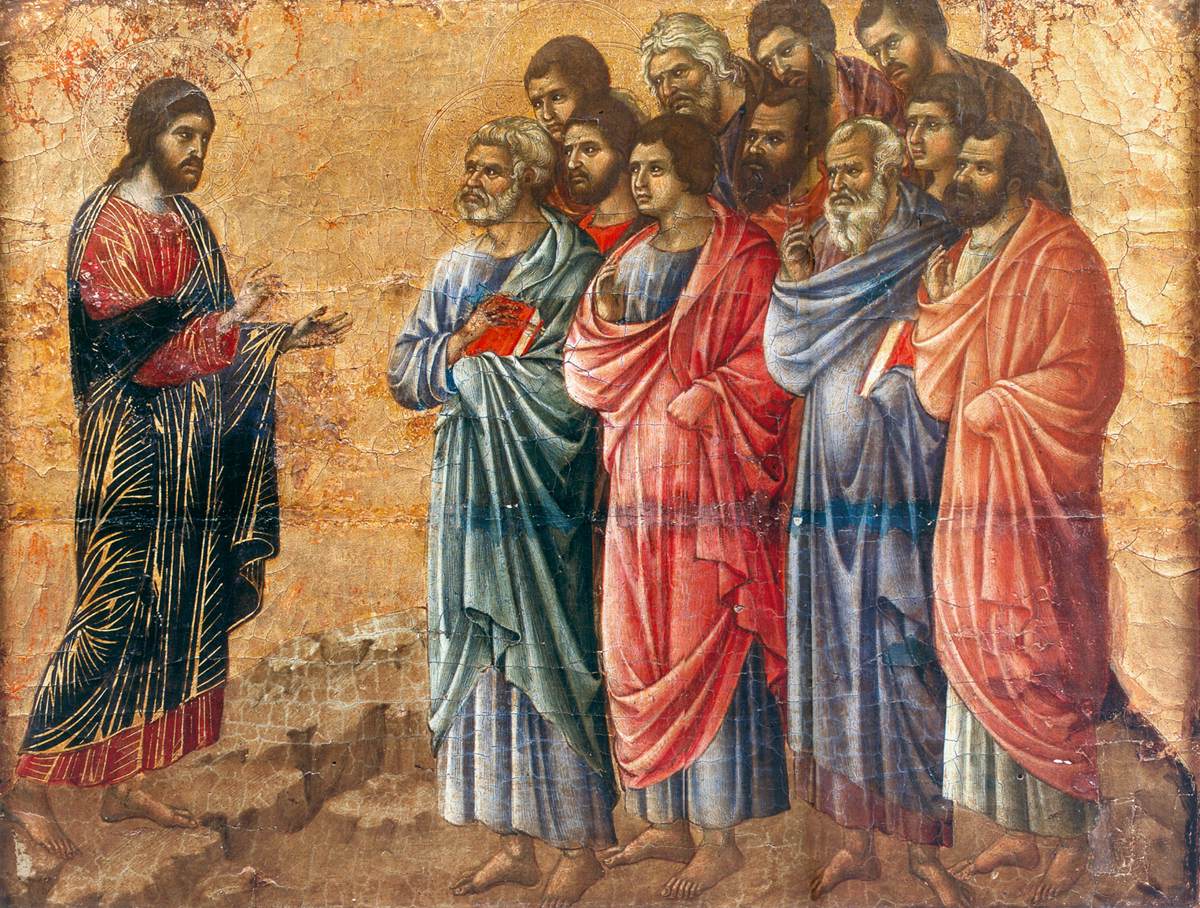
In the Gospel today the Lord describes metaphorically what a Christian is and what He expects of us. Note five things about what God says:
I. The Definitiveness of His Proclamation– The text says, You are the Salt of the earth. … You are the light of the World. … But if salt goes flat it is good for nothing. … No one lights a lamp and puts it under a basket.
The Lord is definitive in two ways. First,He says, “You.” He is not talking just to people long ago or to the person next to you. He is not merely talking to your pastor or the Saints. He is talking to you. Youare salt. Youare light. You. It’s too easy to say, “Look at what the Lord is saying to those people long ago near the lakeside.” It’s not long ago; it’s now. It’s you.
The second way that the Lord is definitive isin saying that bothimages depend on us; if we are not salt and light then no one else will be and we will have utterly voided our worth.
The metaphor of salt: You are either salt or you are nothing; in fact, you are good for nothing. As Christians, we have signed up to be specialists. This means is that if we go off and do something else instead, we arenothing and are good for nothing. It’s an all-or-nothing scenario. Jesus says that if you have decided to be His disciple you are either going to do that or else be nothing. You may go on to be a doctor, lawyer, teacher, laborer, or social worker, but the Lord has plenty of those (and so does the devil). Your first and only mission is to be a true and uncompromised Christian; everything else is mere commentary. You may be a great doctor, but if you don’t do it as a clear and visible Christian you are nothing. You may be a skilled social worker, but if you don’t do it as a Christian you are good for nothing. Any non-believer can be socially useful as a doctor or social worker, but only a Christian can be a Christian. If you don’t do “job one,” you are nothing. If you supply your children with every good thing, but do not act as a Christian witness to them and bring them to Christ, you are good for nothing. Any parent can provide his children with material things, but only a Christian can give them Christ. Got it? You’re either salt (a true Christian) or you are nothing.
The metaphor of light: The Lord says that you are thelight of the world, not merely alight. What this means is that if we do not shine, the world is darker; no one can take our place. If we don’t shine by living our faith and proclaiming it, the world is in darkness. Buddha can’t help. Mohamed can’t pull it off. Science and humanism can’t substitute. Either we are light or there is none. Some may call this arrogant, but I just call it Scripture. The Lord said it, not us. We are either light or else the world is dark. And if the world is getting darker, whose fault is that? We need not go far. Too many Christians fulfill Isaiah 56:10, which says, Israel’s watchmen are blind, they all lack knowledge; they are all dumb dogs, they cannot bark; they lie around and dream, they love to sleep. You may be an exception, but too many Christians are not.
Therefore, notice the definitive pronouncement the Lord makes here. We Christians are either with the Lord or we’re nothing. We’re either light or the world is in darkness.
II. The Dynamics of Salt– When Jesus says that we are the salt of the earth, what are some of the lessons we can learn? Consider these four things:
Salt seasons.Christians are called to add spice to life, to bring beauty, joy, and hope to the world. Joy is the surest sign of a Christian. Even our keeping of the Commandments is a source of joy, as we experience God’s power to put sin to death in us and bring forth order, self-discipline, and holiness. Hope, too, ought to distinguish us from a world that is often cynical and thinks sin is inevitable. To this world we are not only to declare that the Commandments are possible and bring joy, but to demonstrate it in our lives. We are to be zesty, passionate, alive, and free from sin in Christ. Yet, sadly, we Christians are known more for what we are against. Too many Christians are not spicy; they do not really add flavor. They are more like bored believers, depressed disciples, fearful faithful, and frozen chosen. In our best moments, look what spicy things the faith has contributed: Art, music, churches, hospitals, universities, the scholastic and scientific methods, and holidays (a mispronunciation of Holy Days). Our tradition and Scriptural teaching of justice, mercy, love, and the dignity of the human person has blessed the world. Do you bring spice to the lives of others? Do you bring hope and joy? Scripture says, Always be prepared to make a defense to anyone who calls you to account for the hope that is in you(1 Peter 3:15). That means that people notice hope in you! Do they? How?
Salt preserves. Before refrigeration, people often used salt to cure or preserve meat. The salt killed bacteria and other microorganisms that caused rot and decay. As Christians, we are called to prevent further decay in this sin-soaked world. The truth that we proclaim is meant to preserve people from the decay of sin and overindulgence. Chastity, justice, generosity, and the proclamation of the truth, are like salt that preserves this world from decay. We must be salt. If we are not, nothing else is. Youare the salt.
Salt heals. In the ancient world, salt was used on wounds. It helped to stop bleeding, killed bacteria, and prevented further infection. So, too, the Christian faith. Through our doctrinal and moral teaching, and our living of it, we are called to bring healing to this world, which is wounded by sin, strife, war, jealousy, anger, bitterness, retribution, promiscuity, unfaithfulness, greed, and countless other errors. The Word of God and His plan is a healing medicine for what ails this world.
Salt burns. Yes, salt stings when applied to wounds. We Christians aren’t just sugar and spice and everything nice. When salt is applied to wounds it burns and often brings out loud protest. The truth stings, too. The truth of the Gospel can be irritating to a world that is wounded by sin. But despite the protests of the world, the sting is a healing one. It is driving out the disease of the world and preventing further infection. Just because people protest the Church and howl in complaint at the truth of the Gospel does not mean we have done anything wrong. In fact, protests often show that we are doing exactly what we must.
III. The Destination of Salt– The Lord says that you are the salt of the earth. He did not say that you are the salt of the Church. For salt to be effective it has to get out of the shaker! Too many Christians are bold in the pew but cowards in the world. They will speak of the faith in the relative security of the Church and among certain friends, but don’t ask them to preach to their spouse, their co-worker, or even their children; that’s too scary. And don’t even thinkabout asking them to knock on doors, or to go to the local mall and witness, or to stand in front of an abortion clinic.
Salt in the shaker is useless. It has to come out of the shaker in order to make any difference. You don’t salt salt. Witnessing to fellow Christians may have a limited benefit, but it is not really the true destination of salt. The salt has to go forth. When the priest or deacon says “The Mass is ended go in peace,” he might as well be holding up a salt shaker and shaking it!
It’s long past time for the salt (you and me) to go forth. Consider these observations about life in our country today:
In the last fifty years there has been an increase of more than a 500% in violent crime.
There are more than half a million abortions each year.
Since 1970, the divorce rate has quadrupled. The overall number of divorces may have declined recently, but it is due more to people not getting married in the first place.
More than 40% of children today do not live with both their biological parents. Since the 1970s, the percentage of children living in single-parent homes has tripled.
As the family has broken down, here is what has been happening to our young:
a quadrupling in juvenile arrests,
a 400% increase in births outside of wedlock,
one million teenage pregnancies annually,
three million teenagers treated annually for sexually transmitted diseases,
a 200% increase in the rate of teenage suicide,
a drop in average SAT scores,
two-thirds of high school students have experimented with illegal drugs.
In the schools, one cannot pray or mention religion, yet condoms are freely available and all sorts of aberrant and alternative lifestyles and philosophies are openly promoted.
Parental consent is required for a child to go on a field trip or to get an aspirin, but in many states abortion referrals can be made without parental consent.
Our neighborhoods are devastated by poverty, injustice, crime, and despair.
All of this has happened on our watch. It’s time for the salt to work. The world needs the salt to get out of the shaker and do its work of seasoning, purifying, and preserving.
The Designation of Pure light– You are the light of the world. A city set on a mountain cannot be hidden. Nor do they light a lamp and then put it under a bushel basket; it is set on a lampstand, where it gives light to all in the house.You don’t light light; it is the darkness that needs the light. Light is meant to be seen. There are too many undercover Christians, secret agent saints, and hidden holy ones. Jesus didn’t light our light so that we could hide it under a basket out of fear. He wants the Church, you and me, to shine. The Lord wants every Christian to be a light so that it’s like a city on a hill! He wants us to shine so that we can’t be hidden.
The Details of Light– Jesus goes on to say, Let your light shine before others, that they may see your good deeds and glorify your heavenly Father. Let’s consider four things about this light:
The CAUSE of the light – Notice that little word: “Let.” We are to yield to Christ, to allow Him to shine through us. He is the cause of our light. Let your light shine. There’s an old gospel song that says, “When you see me trying to do good, trying to live as a Christian should, it’s just Jesus, Jesus in me.”
The COST of the light– The light is to shine, but there is no shining without burning. Shining costs us something. It may be Christ’s light, but it shines through us. This means sacrifice. It means letting Him use you. It means not always sleeping when you want to. It means not just sitting at home and saying, “Ain’t it awful.” It means getting out and getting involved. It means getting “out there” and risking a few things. It means being visible, targeted, and identified with someone (Jesus) who is hated by many. And in a world that prefers the darkness to light (cf.John 3:19-21), it means being called harsh, out-of-touch, and hateful. There is no shining without burning.
The CONCRETENESS of the light –Letting our light shine is no mere abstraction. Jesus speaks of deeds. Shining involves concrete behavior. Your light shines by the way you live, the choices you make, the behavior you exhibit. It shines when Christians get married and stay married, stay faithful to their commitments, and are people of their word. Our light shines when we tell the truth instead of lying, live chastely instead of fornicating, are courteous and respectful instead of rude. It shines when we respect life, drive safely, and shun reckless and risky behavior. Our light shines when we clean up our language, give to the poor, and work for justice. It shines when we refuse to purchase pornographic, violent, or other degrading materials. Our light shines when we love instead of hate, seek reconciliation instead of revenge, and pray for our enemies instead of cursing them. It shines when we walk uprightly and speak the truth in love, without compromise. That’s when our light begins to shine.
The CONSEQUENCE of the light– God is glorified when our light shines. We do not act or get involved merely to vent our own anger or to fight for our own sake. We are light to glorify God. It is not about our winning, it is about God shining and being glorified. When we do get involved, too often we seek merely to win the argument rather than to glorify God. Often we act in order to garner praise rather than to have God glorified. We need to pray for good intentions, for it is possible to do the right thing for the wrong reason. The desired result is God’s glory not our glory.
Go with me to the year 1969. We are on the Texas border with Mexico not far from El Paso. Three men are leading a protest march arguing that the U.S. Government is not protecting the U.S. border and is allowing illegal immigration to occur is large numbers. The three men are Cesar Chavez, Walter Mondale and Ralph Abernathy Jr. They are the protesters with them argue that illegal immigration in such large numbers is driving down wages and making it nearly impossible to organize migrant workers.
Yes, three prominent Democrats demanding that the Federal Government enforce our borders. Today of course, things are largely reversed and most on the left support practically open borders.
Politics change like that. Issues come and go, coalitions shift and change. What was once thought of as doctrinaire liberalism or conservatism can switch sides in many and important ways. This is increasingly important for Catholics who too easily cast their loyalties with political parties and cultural trends that come and go, rather than the faith and the teachings of the Lord. Indeed they are more passionate about politics and the latest trends than the faith. This should not be the case. Our loyalty must always be with the Lord and the teachings of the Church which do not change or reflect the times. Scripture and the doctrines of the faith are ancient and stable and we should hold to them wherever the political lines fall. A Democrat should not support abortion, no matter what the party says. A Republican should hold the Church teaching on immigration not simply the language of the party. We need to be Catholic when it comes to the crucial moral issues of our day to include: Abortion, the Definition of Marriage, fornication, cohabitation, homosexual acts, transgenderism, immigration, physician assisted suicide and the like. Too easily however we will base our views on our politics and jettison our faith. We need to be anchored in the Lord not in the vicissitudes of politics and culture.
Consider some other examples of the many flip flops of politics:
Free speech was once the bastion and hallmark of 1960s liberalism. The University of California at Berkeley, Stanford University and many other colleges, were synonymous with the free speech movement, seeing free speech as almost unlimited. While many Americans were appalled at some of the vigorous condemnation of our country, the burning of American flags, advocacy for forms of government inimical to our system, promotion of “free love,” drug use and other attacks on core American values, free speech largely won the day and withstood challenges to most of its limits. Today however, places like Berkley and Stanford are just the opposite. There are extensive limits to what may be said on many such campuses. Many words are banned, other pronouns and words are required. Students as well as faculty often seek to forbid speakers with traditional or conservative positions from speaking on campus at all and, when they are cannot ban such speech, they show up to shout it down and make a lecture of any sort impossible. Now, it is conservatives who advocate for free speech who seek for the free exchange of ideas on college campuses and elsewhere. On social media, the Left seeks to
Conservatives were once considered the natural ally of “Big Business” while the left saw it as privileged, undertaxed, polluting, and unjust in nearly all it did. Today however, many if not most large corporations have allied with the left and adopted countless “woke” policies.
The Democratic Party was once considered the friend of the working class. Decades of being “down with the struggle “ and advocacy for labor unions, concerns for improved work conditions, worker safety, proper wages and benefits, made the Democratic Party the most likely destination for most blue collar workers and laborers. Today however, many of these same workers often hear from the party that once advocated for them a strong aversion to all they represent. Coal workers, the oil, steel and auto industries, are often considered by the left to be almost evil and are slated by them for elimination. In the 2016 election an major shift occurred as Donald Trump and the Republican Party became the defender of these industries and workers
Conservative Republicans were once labeled as the party of the rich and well landed in this country. “Country Club Republicans” was a designation that sought to portray them as aloof and removed from the care of the everyday person. Today however, it is the Left and the Democratic Party that is largely the bastion of the ruling class. Liberal elites dominate the world of social and news media, entertainment, Hollywood, government officials, large corporations, university and college faculty and administrators and the like.
The news media was once the watchdog of government and big industry, now they are frequently an ally and apologist for them.
The cultural left once had a stance that was anti-authoritarian. It was suspicious of government claims and often counseled resistance and civil disobedience against an oppressive government, demanding investigations and accountability. Today the left more often proposes increasing laws and expansive government.
Liberals and many Democrats once championed the rights of women and also sought “Title IX” protections to preserve and enhance women’s sports. Now they are on the vanguard of a movement that permits men to call themselves women, enter the locker rooms and restrooms of women, invading their privacy. It is now Conservatives who speak of unfairness and seek to keep women’s sports from dying.
The cultural Left road in on a “free love” philosophy. Now theirs is more the language of sexual abuse allegations and an advocacy of expansive list of dos and don’ts the wake of the “me-too” movement. While that movement raised many legitimate concerns, many on the right (the traditionally regarded prudish party) think may go too far, casting a chill on romance and possibly resulting in the “sudden death” of accusations that are hard to refute.
The Republican Party was once the champion of African American civil rights, founded on ending slavery and insisting on their rights and reparations after the Civil War. Republican votes along with many Democrat votes were also essential in passing civil rights bills by countering the votes of racist Southern democrats. Today, racial justice is often perceived as a priority of the Democratic Party.
President Barack Obama ran in 2008 against Gay “marriage” and in 2012 for it.
Finally, and most importantly, when Roe V. Wade invented a constitutional right to abort, that is, kill children in the womb. At first, Democrats were just as likely as Republicans to oppose this decision. In 1976, the Hyde amendment banning federal funding for most abortions first passed the House, with 247 Democratic votes. Just 22 Democrats voted no. Prominent Democrats such as Hubert Humphrey, Sargent Shriver, Ted Kennedy, Bill Clinton, and Al Gore and many others were originally pro-life before switching their positions. One of the strongest statements issued against Abortion was by the Rev. Jesse Jackson in 1977. Sadly he too changed his view in the 1980s as the politics changed. Today the political lines are hardened and there are almost pro life democrats in the House or Senate. It was not always so.
Enough. As can be seen politics is shifty; culture too. Don’t give your loyalty to this world. Are you worthy of Jesus Christ, or are you just worthy of the party or the latest trend? Stay put, stay Catholic.