 One of the greatest and most painful of mysteries is the problem of suffering and the broader problem of evil in the world. I was meditating with my Sunday School parents this past weekend on the Old Testament Patriarch Joseph. That story is rich with lessons about family struggles, envy, jealousy, pride, mercy and forgiveness. But the story also has a lot to say about suffering and the way that God can use it to bring blessings.
Lets take a moment and consider the problem of suffering and see what Joseph’s life has to teach us. But first we ought to begin with some background.
I. Prequel – God had set forth a vision for us; let’s call it “Plan A” also known as paradise. But of course that plan came at the “price” of a an intimate relationship with God the Father. Man would not be at the center; God would be.
God also asked Adam and Eve to trust him in an important matter. And that matter was both symbolized and focused on a tree called “The Tree of the Knowledge of Good and Evil.”
The word “knowledge” is key here. In scripture, to “know” almost never means simple intellectual knowing. Rather, it means to know something by experience. In effect, the title of the tree teaches that God did not want Adam and Eve to know what was good and evil by experience. Rather, he wished them simply to trust Him to be their teacher, to be their Father who would guide them in these matters.
But as we know, Adam and Eve gave way to the temptation of the devil yielded to pride. They insisted on “knowing” good, and, more problematically, evil by experience. In effect, their decision amounted to saying,
“I will not be told what to do. I will decide what I want to do and I will decide whether it is right or wrong. I will conduct experiments in this way for myself because I do not trust God to act in my interest, or to teach me accurately.”
The Catechism says Man, tempted by the devil, let his trust in his Creator die in his heart and, abusing his freedom, disobeyed God’s command. This is what man’s first sin consisted of. All subsequent sin would be disobedience toward God and lack of trust in his goodness. (# 397)
Thus, they would not trust God to teach them what was good and not. They insisted on knowing and deciding for themselves. Adam and Eve wanted a “better deal” than paradise. So welcome to the better deal.
We live now in Paradise Lost, a world where the imperial autonomous self creates a kind of hellish existence often marked with great suffering and, ultimately, death. In wanting to know, that is experience, evil we sadly got what we wanted: sin and evil, sorrow and death as our daily fare. And this is the first Biblical explanation of the problem of evil.
But why was the tree there in the first place? Simply put, it had to be. Without choice, there can be no freedom, and without freedom, there can be no love. God wants his human children to be lovers, not slaves or instinct-driven animals but rather, children who can freely choose to love God or not. God is very serious about our freedom. Our “yes” is of no real meaning if our capacity to say “no” is not also very real.
II. Prescription – What then is God to do? If He simply canceled our choice, or the consequences associated with it, could we really say that he is serious about our freedom? No. So working within the parameters of our decision, a decision that included the experiencing of evil, suffering and death, God chose to make those consequences the very path of our healing and salvation if we will walk with him in these.
Thus Christ came and endured the full fury of evil and suffering unleashed by that ancient tree in the garden, and He now mounts another tree of the cross in a place called “the skull.”
Now suffering and death provide a way back. And by his suffering and death Jesus sets us free and, still respectful of the choice we have made, Jesus bids us to follow him in the way of the cross.
So, as we’ve seen, God has entered our broken world, and made this brokenness a pathway by God’s grace. Suffering often produces glory and refines us so that we are pure gold. Through suffering, grants us wisdom and helps us to learn new skills, new insights.
III. Picture Perhaps the story of saint of Joseph in the Old Testament helps illustrate a lot of this. While are many layers to the story, both personal and communal, it is clear that God often allows great injustice and suffering, only to produce great glory and healing on account of it. Lets weave the story with some basic teachings about suffering.
A. Structures of Sin bring suffering – The story of Joseph begins in the dysfunctionality of Jacob’s household. Jacob had two wives (Leah and Rachel) and 12 sons in different combinations with them and their maids (Zilpah and Bilhah). Now polygamy, and adultery is not God’s plan! And, to be out of God’s will is always to ask for trouble. And having sons by four different women produces no end of internecine conflicts. Sure enough Jacobs sons all vie for power and have divided loyalties because they have different mothers.
And in this matter we see that a lot of suffering is ushered in by human sinfulness. When we are out of God’s will we invite trouble. Sadly, the trouble does not affect merely the sinners, it also affects many others.
Thus the sons of Jacob have been born into a mess, and into what moralists describe as the “structures of sin.” In these broken situations of structural sin, sin and suffering multiply.
And it is often the children who suffer. They themselves, inheriting a mess begin to act badly an disdainfully. Suffering and evil grow rapidly in these settings.
In the world today, it is probably not an exaggeration that 80% of our suffering would go away at once, if we all kept the Commandments. But sadly we do not repent, individually or collectively.
And thus the first answer to why there is suffering, is sin. Original Sin ended paradise, and individual sin brings dysfunction and a host of social ills and the sins that go with it. And while this does not explain all suffering (e.g. natural disasters etc) is does explain a lot of suffering.
Thus we see Joseph is about to suffer on account of a structurally sinful situation brought about by Jacob and his wives and mistresses and contributed to all the members of the household. It’s not his fault but he will suffer.
B. Suffering can bring purification and humility – Though the brothers of Joseph all fought among themselves, all of them agreed on one thing, Jacob’s youngest son Joseph had to go. Jacob’s favorite wife was Rachel and when she finally had a son, Joseph, he became Jacob’s favorite son. Jacob doted on him, praised him, and even gave him a beautiful coat that enraged his brothers with jealousy. They were also enraged and envious because Joseph had many gifts. He was a natural leader, and had the special gift to be able to interpret dreams. Joseph had the kind of self-esteem that perhaps too boldly celebrated his own gifts. Among the dreams that he had and articulated was if he would one day rule over his brothers. This was altogether too much for them. Even Jacob at the school Joseph for speaking in this manner.
Here we see a possible flaw or character defect in Joseph. It is hard to know if Joseph actually crossed the line. His dreams after all, were true. He was a gifted young man and would one day rule his brothers. Some one once said, “It’s not boasting if its true.”
And while this has some validity, it is possible for us to conclude that Joseph was awfully self assured and may have lacked the kind of humility that required purification.
Surely as a young man he also had a lot to learn, and suffering has a way of both purifying us and granting us humility and wisdom. If Joseph is going to be a great leader, he like Moses, needs some time in the desert of suffering. And thus we sense God permitting trials for him to prepare him for wise, effective and compassionate leadership.
And so too for us. Trials and sufferings prepare us for greater things and purify us of pride and self-reliance. Woe to the man who has not suffered, who is unbroken. Thus God permits us trials and difficulties that help us hone our skills, know our limits, grow in wisdom and develop compassion and trust.
C. Suffering Opens Doors – On account of all of this is brothers plotted to kill him. But figuring they could make money on the deal, they instead sold him to the Ishmaelites as a slave. He ends up in Egypt, in the house of Potiphar. His natural leadership skills earned him quick promotions and he soon came to manage the household of this very wealthy man.
It is true that Joseph has had a disaster befall him. He was sold into slavery. It is hard to imagine a worse fate. Yet strangely God permits it to open a door. Now on his way off to Egypt in chains it would hard to convince Joseph that his life was anything but a disaster. Yet, God was up to something good.
And within months Joseph was in a good spot, working for a wealthy man as a trusted adviser and manager. As we shall see, more will be required for Joseph to be prepared for his ultimate work.
But for now, the lesson is clear enough, God permits some sufferings to get us to move to the next stage. He closes one door to open another. There is pain in the closing of the door to the familiar, but there is greater joy beyond in the door He opens.
How about for you? What doors has God closed in your life, only to open something better? At the time a door closes we may suffer, and wonder if God cares. But later we see what God was doing. For the new door opens to things far greater.
D. Suffering helps summon courage – In a tragic way, sorrow was again to come to Joseph. For Potiphar’s wife took a liking to Joseph and sought to seduce him. Joseph refused her advances out of fear of God, and respect for Potiphar. But in her scorn she falsely accused Joseph of having made advances on her, and Joseph lands in jail! More misery, more suffering, and on account of the sins of others, not his own! Joseph is suffering for doing what is right!
One of the great virtues that we must all have, and see developed, is the virtue of courage. In a world steeped in sin, it takes great courage to resist the tide.
But courage, like any virtue cannot simply be developed in the abstract. Rather, it is developed and refined quite often in the crucible of opposition and persecution.
And thus we see how God helps Joseph develop his courage and trust by permitting this trial. Jesus would say many centuries later, In this world you shall have tribulation, but have confidence, I have overcome the world (Jn 16:33) He also said, Blessed are those who are persecuted for the sake of righteousness, for the kingdom of heaven is theirs (Matt 5:10).
As for Joseph, so also for us. If we are going to make it through this sinful world with our soul intact, we are going to need a lot of courage. The Lord often develops his courage in the crucible, asking us to trust him that we will be vindicated, whether in this world or the next.
E. Suffering builds trust – Joseph just happened to meet to prisoners from Pharaoh’s household, the Cup-bearer, and the Baker. In prison, they experience Joseph’s ability to interpret dreams, and observe his natural leadership skills. In accordance with a prophecy given by Joseph, the cup-bearer was restored to Pharaoh’s service who then reported Joseph’s skills to Pharaoh who just happened to be having dreams that troubled him.
God humbles us, only to exalt us. As Joseph has already learned, God can make a way out of no way. He can do anything but fail, and he writes straight with crooked lines.
Sure enough, in jail Joseph has his trust confirmed. Through his connections in jail, of all places, he will rise to become the prime minister of all Egypt. Having come through the crucible, Joseph is now ready for the main work that God has for him.
Consider how in your life, God’s providence has prepared you for something that an earlier stage in your life you couldn’t handle. Surely he prepared you in many ways; but among those ways was the way of humility and suffering. Setbacks or failures have a way of teaching us and preparing us for some of the greatest things that we enjoy. And in our struggles we learn the essential truth and we must come to trust and depend on God who knows what we need, what is best for us, and who knows how to prepare us for the works he expects of us.
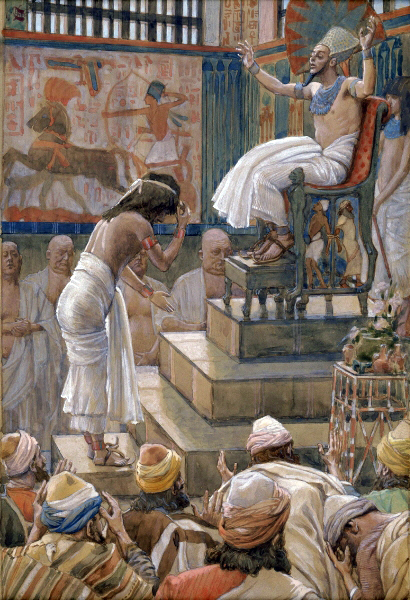
F. Suffering produces wisdom. – Joseph is brought to Pharaoh and he so powerfully interprets Pharaoh’s dreams, not only as to their meaning, but even as to a 14-year plan that will lead them through a looming crisis. Pharaoh was impressed, and Joseph is appointed to the equivalent of prime minister of all Egypt.
Joseph is able to interpret Pharaoh’s dream. But he doesn’t simply interpret what it means, he also sets forth a wise plan. He explains to Pharaoh that the next fourteen years will have its ups and downs. Where might Joseph have learned this truth? Of course we know, in the crucible of his own life.
There’s a great wisdom in grasping that what is seen and experienced in this world is transitory. And thus we do well to listen to the Lord’s wisdom which is eternal.
Centuries later, the Lord spoke a parable of the certain wealthy man who had a great harvest and thought he was forever set. Lord called him a fool for thinking this way. Our abundance is not meant to be hoarded for ourselves. Excess food is not to be stored for myself, but rather stored in the stomachs of the poor and the hungry.
And thus Joseph, has been prepared for this moment by God, and he’s no fool. He has learned God’s wisdom and direction. Whatever abundance occurs in the next seven years must be set aside for those who will be hungry in the years that follow.
His wisdom is no accident, no mere hunch. It has come from the crucible of suffering. Suffering does that, it helps us become wise, get our priorities straight, and in this case, understand that our wealth depends on the Commonwealth. We cannot live merely for ourselves. That is foolishness, we are called to live for others.
What wisdom has God taught you through suffering? How has suffering helped you to get your priorities straight; to see the passing quality of life in this world, and to set your sights on the world it is to come and on the judgment awaits you? On the day of judgment will God call you a fool or a wise person? And if you are wise how did you get there?
G. In our suffering, we learn that our lives are not about us. – Joseph had predicted seven years of plenty, to be followed by seven years of famine. Hence, under Joseph’s direction during the years of plenty, grain was stored in abundance. So abundant was the harvest that with the grain stored, not only was Egypt saved from the famine, but also many neighboring lands. In a twist, Joseph’s brothers come to Egypt seeking food. And he is able to save the very brothers who thought to kill him. To his anxious brothers, who recognizing him fear for their lives, Joseph reassured them by saying you intended for evil, but God intended for good.
Yes, in our suffering, we learn that our lives are not about us. Joseph was not purified and prepared for this moment simply for his own sake, but even more, for the sake of others. God has led Joseph, often through terrible suffering to prepare him to help save others.
God did not simply prepare him to be a big cheese. God did not prepared him for glorious leadership for his own sake, but for the sake of others.
One of the lessons that we learn in Joseph’s story is that our life is interconnected with many other members of the Body of Christ, all of whom are precious and important to God.
God had to put Joseph through a lot to prepare him for his role of helping others. We are not called to live only for our self. God loves us individually, he also loves others through us; and he loves them enough that sometimes he is willing to make us wait, for their sake, or to cause us to suffer in order to groom us to help them. And the same is true of them toward us. All of us have received from the sacrifices of others, and are called to make sacrifices for others.
It is a hard truth, but true nonetheless, that God sometimes asks us to accept suffering for the sake of others, even as we are blessed by the sufferings of others who made many sacrifices for the things we enjoy.
This is the communal dimension of suffering. How is God prepared you through sufferings today to be able to help others?
Biblical stories have a wonderful way of teaching truth, and about our own life. And thus the Patriarch Joseph speaks to us from antiquity, and the pages of God’s holy Word. And somehow, I can hear Joseph saying that God can make a way out of no way. Somehow I hear him calling us to courage in our sufferings, and to perspective. Somehow I can hear him singing an old gospel hymn “God never fails. He abides in me, give me the victory for God never fails!”