The Gospel Train Reaches Temptation Station – Stay on Board, Children! A Homily for the First Sunday of Lent

There’s an old gospel song tradition that speaks of the Christian life as a ride on the “gospel train.” The gospel train is not always an easy ride with perfect scenery, but you’ve gotta get your ticket and stay on board.

Mysteriously, the train sometimes passes through difficult terrain, but just stay on board! On His way to glory, Jesus faced trials, hatred, and even temptation (yet without sinning).

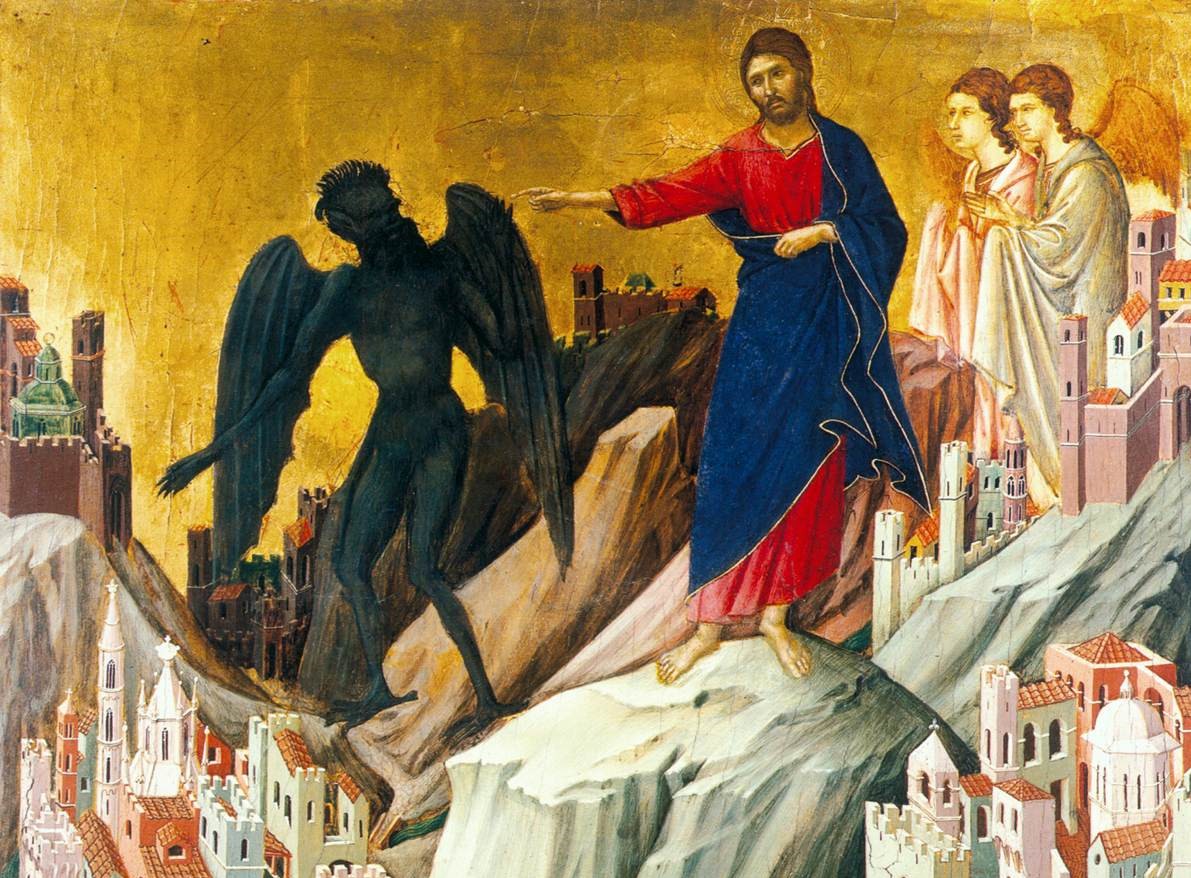
Today the gospel train pulls into “Temptation Station” and we are asked to consider some of life’s temptations. The three temptations faced by Jesus are surely on wide display in our own times. What are these temptations and how do we resist them?

In this desert scene, the Lord Jesus faces down three fundamental areas of temptation, all of which have one thing in common: they seek to substitute a couch for the cross.

In a way, the devil has one argument: “Why the cross?” His question is a rhetorical one. He wants you to blame God for the cross, and in your anger, to reject Him as some sort of despot.

Well, pay attention, Church! The cross comes from the fact that you and I, ratifying Adam and Eve’s choice, have rejected the tree of life in favor of the tree that brought death. We, along with the devil, may wish to wince at the cross and scornfully blame God for it, but in the end the cross was our choice.

If you think that you have never chosen the tree of death and that God is “unfair,” then prove to me that you have never sinned. Only if you can do that will I accept that you have never chosen the Tree of the Knowledge of Good and Evil over the Tree of Life and that you deserve something better than the cross. Only then will I accept that you have never insisted on “knowing” evil as well as good.

If you can’t, then you’ve made the same self-destructive, absurd choice that the rest of us have. It is not God that is cruel but we who are wicked and are to blame for the presence of the cross. The cross comes not from God but from us. We ought to stop blaming God for evil, suffering, and the cross, and instead look in the mirror. The glory of this gospel is that the Lord Jesus came into this twisted world of our making and endured its full absurdity for our sake. If there is evil in this world, it is our choice, not God’s.

Have we finished blaming God? Are we ready to focus on our own issues? If so then let’s look at some areas of temptation that the devil can exploit because we indulge them. Let’s also see the answer that the Lord Jesus has for these temptations; for He, though tempted, never yielded.

Pleasures and Passions – The devil encourages Jesus to turn stones into bread. After such a long fast, the thought of bread is surely a strong temptation. In effect, the devil tells Jesus to “scratch where it itches,” to indulge His desire, to give in to what His body craves.

We, too, have many desires and are told by the devil in many ways to “scratch where it itches.” Perhaps no generation before has faced such strong temptation. We live in a consumer culture that is highly skilled at eliciting and then satisfying our every desire. All day long, we are bombarded with advertisements that arouse desire and then advise us that we simply must fulfill those desires. If something is out of stock or unavailable in exactly the way we want at the instant we want it, we are indignant. Why should I have to wait? Why can’t I have it in that color? The advertiser’s basic message is that you can have it all. This is a lie, of course, but it is told so frequently that we feel entitled to just about everything.

Some of our biggest cultural problems are ones stemming from overindulgence. We are a culture that struggles with obesity, addiction, sexual misconduct, and greed. We experience overstimulation that robs us of a reasonable attention span; boredom is a significant issue for many who are too used to the frantic pace of video games and action movies. We have done well in turning stones into bread.

Jesus rebukes the devil, saying, Man does not live on bread alone. In other words, there are things that are just more important than bread and circuses, than creature comforts and indulgence. Elsewhere Jesus says, A man’s life does not consist in the abundance of his possessions (Lk 12:15). I have written further on this in another post: The Most Important Things in Life Aren’t Things.

Popularity and Power – Taking Jesus up a high mountain, the devil shows Him all the nations and people of the earth and promises them to Him if Jesus will but bow down and worship him. This is a temptation to both power and popularity; the devil promises Jesus not only sovereignty but glory.

Because most of us are not likely to become sovereigns and because temptation is only strong in those matters that seem remotely possible for us, I will focus instead on popularity—something we deal with regularly in this life. One of the deeper wounds in our soul is the extreme need that most of us have to be liked, to be popular, to be respected, and to fit in. We dread being laughed at, scorned, or ridiculed. We cannot stand the thought of feeling minimized in any way.

For many people the desire for popularity is so strong that they’ll do almost anything to attain it. It usually starts in youth, when peer pressure “causes” young people to do many foolish things. They may join gangs, get tattoos, pierce their bodies, and/or wear outlandish clothes. Many a young lady, desperate to have a boyfriend (and thus feel loved and/or impress her friends), will sleep with boys or do other inappropriate things in order to gain that “love.” As we get older, we might be tempted to bear false witness, to make “compromises” to advance our career, to lie to impress others, to spend money we don’t have to buy things we don’t really need, and/or to try to impress people whom we don’t even like. Likewise, we may be tempted to be silent when we should speak out for what is right.

All of this is a way of bowing before the devil, because it demonstrates that we are willing to sin in order to fit in, to advance, or to be popular. Jesus says, You shall worship the Lord, your God, and him alone shall you serve.

The real solution to this terrible temptation of popularity is to fear the Lord. When we fear God, we need fear no one else. If I can kneel before God I can stand before any man. If God is the only one we need to please, then we don’t have to expend effort trying to please anyone else. I have written more on this matter elsewhere: What Does It Mean to Fear the Lord?.

Presumption and Pride – Finally (for now) the devil encourages Jesus to test God’s love for Him by casting Himself off the highest wall of the Temple Mount. Does not Scripture say that God will rescue Him? The devil quotes Psalm 91: With their hands they will support you, lest you dash your foot against a stone. In our time the sin of presumption is epidemic.

Many people think that they can go one behaving sinfully, recklessly, and wantonly and that they will never face punishment. “God is love,” they boldly say. “He would never send people to Hell or punish them!” In saying this, they reject literally thousands of verses of Scripture that say otherwise; they have refashioned God and worship a man-made idol. “God doesn’t care whether I go to Church,” they claim. “He doesn’t mind if I live with my girlfriend.” The list of things God “doesn’t mind” continues to grow.

The attitude seems to be that no matter what I do, God will save me. It is presumptuous to speak or think like this. Hell and punishment are surely difficult teachings to fully comprehend and to reconcile with God’s patience and mercy, but He teaches of them and therefore we need to stop pretending He doesn’t.

I have written elsewhere on the topic of Hell and why it makes sense in the context of a God who loves and respects us: Hell Has to Be.

A mitigated form of presumption is procrastination, wherein we constantly put our return to the Lord out of our mind. About this tendency it is said,

There were three demons summoned by Satan as to their plan to entrap as many human beings as possible. The first demon announced that he would tell them there is no God. But Satan wasn’t too impressed. “You’ll get a few, but not many and even those atheists are mostly lying and know deep down inside that someone greater than they made them and all things.” The second demon said he would tell them there is no devil. But Satan said, “That won’t work, most of them have already met me and know my power.” Finally, the third demon said, “I will not tell them there is no God or no devil, I will simply tell them there is no hurry!” And Satan smiled an ugly grin and said, “You’re the man!”

Jesus rebukes the devil by quoting Deuteronomy: You shall not put the Lord, your God, to the test. We ought to be very careful about presumption, for it is widespread today.

This does not mean that we have to retreat into fear and scrupulosity. God loves us and is rich in mercy, but we cannot willfully go on calling “no big deal” what He calls sin. We should be sober about sin and call on the Lord’s mercy rather than doubting that we that really need it or just presuming that He doesn’t mind.

The train is leaving the station soon. I hope that we’ve all benefited from this brief stop and have stored up provisions for the journey ahead: insight, resolve, appreciation, understanding, determination, and hope.

The journey ahead is scenic but difficult and temptation is a reality, but as an old gospel song says, “The gospel train’s comin’, I hear it just at hand. I hear the car wheel rumblin’ and rollin’ thro’ the land. Get on board little children, get on board. There’s room for many more!”

Never heard the song? Here’s a rendition of it:

Cross-posted at the Catholic Standard: The Gospel Train Reaches Temptation Station – Stay on Board, Children!


“Depth Control,” as Seen in a Commercial

The video below is an advertisement for the “depth control” feature in a smartphone camera. It enables the production of an image in which the essential part is emphasized by blurring the background.

We must learn to exhibit similar “depth control” in our own life. Indeed, much goes on in the background or far away. Life has many complexities; we need to decide where we should focus our attention, time, and energy. This is especially important in this age of non-stop communication and constant interruption. The 24/7 news features many stories about far away places or issues over which we have little control. We need to practice depth control by understanding what is ours and focusing on what we can personally do.

There may be a lot of foolishness in government or out in Hollywood, but I personally can’t do much about it. I can, however, work on my own life and speak the truth to people I know and love.  I may not be able to fix politicians or celebrities, but I can work on fixing myself and helping those closest to me to do the same.

Simply shaking our heads and saying that the world is awful is not a solution. Depth control comes with knowing what part of the awful world has been assigned to me and my influence. We must focus there and leave the rest to God and those to whom he assigns pieces of it.


Cross-posted at the Catholic Standard:  “Depth Control,” as Seen in a Commercial

What Does Scripture Mean by “the Flesh”?

There are many references to “the flesh” in the New Testament, especially in the letters of St. Paul. The phrase is confusing to those who think it synonymous with the physical body. While Scripture many times uses the word “flesh” to refer to the physical body, when it is preceded by the definite article, it usually means something more. Only rarely does the biblical phrase “the flesh” (ἡ σὰρξ (he sarx), in Greek) refer only to the physical body (e.g., John 6:53, Phil 3:2, 1 John 4:2).

What, then, is meant by the term “the flesh”? Most plainly, it refers to the part of us that is alienated from God. It is the rebellious, unruly, and obstinate part of our inner self that is always operative. It is the part of us that does not want to be told what to do. It is stubborn, refuses correction, and does not want to have anything to do with God. It bristles at limits and rules. It recoils at anything that might cause one to be diminished or something less than the center of the universe. The flesh hates to be under authority or to yield to anything other than its own wishes and desires. It often wants something simply because it is forbidden. The Protestants often call the flesh our “sin nature,” which is not a bad definition. In Catholic tradition the flesh is where concupiscence sets up shop. Concupiscence refers to the strong inclination to sin that is within us as a result of the wound of original sin. If you do not think that your flesh is strong, just try to pray for five minutes and see how quickly your mind wants to think of anything but God. Just try to fast or be less selfish and watch how your flesh goes to war.

The flesh is in direct conflict with the spirit. The “spirit” here refers not to the Holy Spirit but to the human spirit. The (human) spirit is the part of us that is open to God, that desires Him and is drawn to Him. It is the part of us that is attracted by goodness, beauty, and truth; the part that yearns for completion in God; the part that longs to see His face. Without the spirit we would be totally turned in on ourselves and consumed by the flesh. Thank goodness our spirit, assisted by the Holy Spirit, draws us to desire what is best, upright, and helpful.

Let’s examine a few texts that reference “the flesh” and in so doing, learn more of its ways. This will help us to be on our guard, and by God’s grace to rebuke it and learn not to feed it.

The flesh does not grasp spiritual teachings. [Jesus said,] The Spirit gives life; the flesh counts for nothing. The words I have spoken to you are spirit and they are life (John 6:63).

Having heard Jesus’ teaching on the Eucharist, most of His listeners ridiculed it and will no longer take Him seriously. Jesus indicates that their hostility to the teaching is of the flesh. The flesh demands that everything be obvious to it on its own terms. The flesh demands to see physical proof for everything. It demands that it be able to “see” using its own power, and if it cannot see based on its own limited view it simply rejects spiritual truth out of hand. In effect, the flesh refuses to believe at all because what it really demands is something that will “force” it to accept something. Absolute proof takes things out of the realm of faith and trust. Faith is no longer necessary when something is absolutely proven and plainly visible to the eyes.

The flesh is not willing to depend on anyone or anything outside its own power or control. For it is we who are the circumcision, we who worship by the Spirit of God, who glory in Christ Jesus, and who put no confidence in the flesh—though I myself have reasons for such confidence. If anyone else thinks he has reasons to put confidence in the flesh, I have more: circumcised on the eighth day, of the people of Israel, of the tribe of Benjamin, a Hebrew of Hebrews; in regard to the law, a Pharisee; as for zeal, persecuting the church; as for legalistic righteousness, faultless. … I [now] consider this rubbish, that I may gain Christ and be found in him, not having a righteousness of my own that comes from the law, but that which is through faith in Christ (Phil 3:3-9 selected).

The flesh wants to be in control rather than to have to trust in God. Hence, it sets up its own observance, under its own control, and when it has met its own demands it declares itself to be righteous. Because the flesh hates being told what to do, it takes God’s law and makes it “manageable” based on its own terms. For example, if I’m supposed to love, let me limit it to my family or countrymen; I’m “allowed” to hate my enemy. Jesus says that we must love our enemy. The flesh recoils at this because unless the law is manageable and within the power of the flesh to accomplish it, the law cannot be controlled. The flesh trusts only in its own power. The Pharisees were “self-righteous.” That is to say, they believed in a righteousness that they themselves brought about through the power of their own flesh. The law and flesh cannot save, however; only Jesus Christ can save. The flesh refuses this and wants to control the outcome based on its own power and terms.

The flesh hates to be told what to do. For when we were controlled by the flesh, the sinful passions aroused by the law were at work in our bodies, so that we bore fruit for death (Rom 7:5).

The disobedience and rebelliousness of the flesh roots us in sinful behavior and a prideful attitude. The prideful attitude of the flesh is even more dangerous than the sins that flow from the flesh because pride precludes instruction in holiness and possible repentance that lead to life. The flesh does not like to be told what to do, so it rejects the testimony of the Church, the scriptures, and the conscience. Notice that according to this passage the very existence of God’s law arouses the passions of the flesh. The fact that something is forbidden makes the flesh want it all the more! This strong inclination to sin is in the flesh and comes from pride and from indignation at “being told what to do.” The flesh refuses God’s law and sets up its own rules. Yes, the flesh will not be told what to do.

Flesh is as flesh does. Those who live according to the flesh have their minds set on what the flesh desires; but those who live in accordance with the spirit have their minds set on what the spirit desires. The concern of the flesh is death, but the concern of the spirit is life and peace (Rom 8:5-6),

The flesh is intent on things of this world, on gratifying its own passions and desires. On account of the flesh, we are concerned primarily with ourselves and seek to be at the center. The flesh is turned primarily inward. St Augustine describes the human person in the flesh as incurvatus in se (turned in upon himself). The spirit is that part of us that looks outward toward God and opens us to the truth and holiness that God offers. Ultimately, the flesh is focused on death, for it is concerned with what is passing away: the body and the world. The human spirit is focused on life, for it focuses on God, who is life and light.

The flesh is intrinsically hostile to God. – The mind of the flesh is hostile to God. It does not submit to God’s law, nor can it do so. Those controlled by the flesh cannot please God (Rom 8:7-8).

The flesh is hostile to God because it is pridefully hostile to any one more important than itself. Further, the flesh does not like being told what to do. Hence, it despises authority or anyone who tries to tell it what to do. It cannot please God because it does not want to.

The flesh abuses freedom. You, my brothers, were called to be free. But do not use your freedom to indulge the flesh; rather, serve one another in love (Gal 5:13).

The flesh turns God-given freedom into licentiousness, demanding freedom without limits. Because the flesh does not like to be told what to do, it demands to be able to do whatever it wants. In effect, the flesh says, “I will do what I want to do, and I will decide if it is right or wrong.” This is licentiousness and it is an abuse of freedom. It results in indulgence and, paradoxically, leads to a slavery to the senses and the passions.

The flesh demands to be fed. So I say, live by the Spirit, and you will not gratify the desires of the flesh. For the flesh desires what is contrary to the Spirit, and the Spirit what is contrary to the sinful nature. They are in conflict with each other, so that you do not do what you want. (Gal 5:16-17).

Within the human person is this deep conflict between the flesh and the spirit. We must not be mistaken; the flesh is in us and it is strong. It has declared war on our spirit and on the Holy Spirit of God. When the spirit tries to obey, the flesh resists and tries to sabotage its best aspirations. We must be sober about this conflict and understand that this is why we often do not do what we know is right. The flesh must die and the spirit come more alive. What you feed, grows. If we feed the flesh it will grow. If we feed the spirit it will grow. What are you feeding? Are you sober about the power of the flesh? Do you feed your spirit well through God’s Word, Holy Communion, prayer, and the healing power of Confession? What are you feeding?

The flesh fuels sin. The acts of the flesh are obvious: sexual immorality, impurity and debauchery; idolatry and witchcraft; hatred, discord, jealousy, fits of rage, selfish ambition, dissensions, factions and envy; drunkenness, orgies, and the like. I warn you, as I did before, that those who live like this will not inherit the kingdom of God (Gal 5:19-210).

This catalogue of sins that flow from the flesh is not exhaustive but is representative of the offensive and obnoxious behaviors that arise from it. Be sober about the flesh; it produces ugly children.

So here is a portrait of “the flesh.” It is ugly. You may say I’m exaggerating, that the flesh is not really that bad—I’m not. Just look at the news and you can see what the flesh is up to. You may, by God’s grace, have seen a diminishment in the power of the flesh in your life. That is ultimately what God can and will do for us. He will put the flesh to death in us and bring alive our spirit by the power of his Holy Spirit.

The first step is to appreciate what the flesh is and understand its moves. The second is to bring this understanding to God through repentance. Step three is (by God’s grace) to stop feeding the flesh and start feeding the spirit with prayer, Scripture, Church teaching, Holy Communion, and Confession. The last step is to repeat the first three steps for the rest of our lives! God will cause the flesh to die and the spirit to live, by His grace at work in us through Jesus Christ.

Cross-posted at the Catholic Standard: What Does Scripture Mean by “the Flesh”?

The Battle Theme of Lent

A brief observation of the first two days in Lent reveals militaristic, even violent imagery in the battle against sin and the unruly passions of the flesh. The Collect (opening prayer) of Ash Wednesday provides an image of troops mustering for battle:

Grant, O Lord, that we may begin with holy fasting this campaign of Christian service,
so that, as we take up battle against spiritual evils, we may be armed with weapons of self-restraint.
Through our Lord Jesus Christ, your Son,
who lives and reigns with you in the unity of the Holy Spirit, one God, for ever and ever.

“Battle,” “weapons,” and “armed” all clearly have military connotations, but so does the phrase “campaign of Christian service” if we look at the Latin text: praesidia miltiae Christianae. The service or action (praesidia) is one of Christian battle or militancy (militiae). This refers to the Church Militant—the Church here on earth—waging war against sin and the kingdom of darkness.

Thus the opening prayer on Ash Wednesday announced and summoned us to a battle that is engaged by the Church with special intensity during Lent.

The Gospel for Thursday after Ash Wednesday also has a battle theme. Jesus says,

If anyone wishes to come after me, he must deny himself and take up his cross daily and follow me.
For whoever wishes to save his life will lose it, but whoever loses his life for my sake will save it
(Luke 9:23-25).

The battle theme is particularly apparent if one looks at the Greek text. The word translated as “lose” in English does not capture the vigor of the Greek word ἀπόλλυμι (apollumi). Apollumi comes from the root apó, meaning away from, with the intensifier ollymi, “to destroy.” Thus apollumi means to fully destroy, cutting off entirely. It implies permanent or absolute destruction.

So when Jesus says we must “lose” our life, it is really far stronger than the English translation captures. Losing our life involves a kind of violent overthrow of our worldly notions and the deep drives of sin. We must lose. That is, we must see utterly destroyed and cut off all things worldly, fleshly, and of the devil. This is war and it is going to involve more than a mumbled, half-hearted prayer on our part. Scripture says, In your struggle against sin, you have not yet resisted to the point of shedding your blood (Heb 12:4).

So behold the militaristic imagery as Lent begins. To arms!

The idea of such a battle might overwhelm us if we thought it must all be done in one day. Jesus says that we should take up our cross daily. Our daily cross is vital to our success. It’s not our weekly cross, or our monthly cross, or our yearly cross. We ought to do each day what we should do. If we put off or postpone the daily cross, the problems pile up. A monthly cross can seem overwhelming, and a yearly cross might seem impossible. Everyday discipline is crucial. Soon enough, the daily discipline becomes virtue; it becomes a good habit that one accomplishes fairly easily. To take up our cross daily is to endure short-term pain for long-term gain.

The battle is engaged! Fight it daily. Fight it with the Lord. Understand that it is battle, but in Jesus (and only in Jesus) the victory is won. Stay on the winning side and fight daily to the end.

Cross-posted at the Catholic Standard: The Battle Theme of Lent

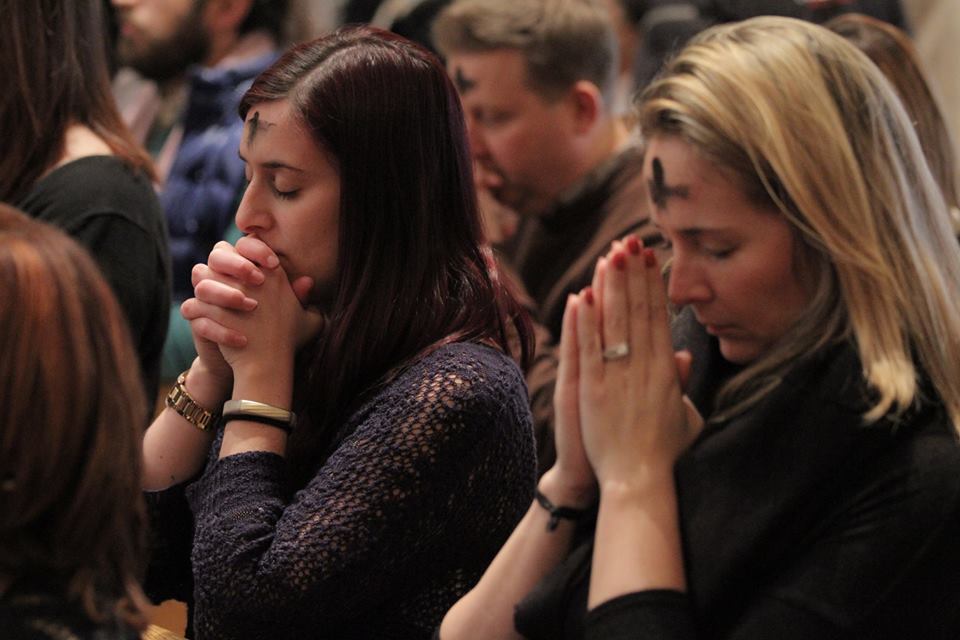
Five Meanings of the Ashes We Receive Today

As a boy, I remember wondering why so many people liked to rush to Church to get ashes smudged on their foreheads. Frankly, I had some revulsion at the idea. I didn’t like it at all and would secretly rub them off when no one was looking. Today, though I’ll admit I still don’t like it too much, I behave myself and don’t rub them off!

I pray that this doesn’t seem impious, but I still marvel at how many people pack into the church to get ashes on their foreheads. Sadder still, some who come don’t seem to want Holy Communion nearly as much. In fact, in some of the parishes where I served in the past, significant numbers walked out the door after receiving ashes and did not even stay for Communion.

Of course most people who come to Mass are faithful and have their priorities straight, but it still interests me how large the numbers are for something that seems to me so unappealing and challenging.

Indeed, the sign of ashes is quite challenging if understand what it really means. We are saying some pretty powerful stuff and making some extensive promises of a sort.

What do ashes signify? Perhaps a brief tour of Scripture is in order:

Humility – Job said, “You [Oh Lord] asked, ‘Who is this that obscures my counsel without knowledge?’ Surely I spoke of things I did not understand, things too wonderful for me to know. You said, ‘Listen now, and I will speak; I will question you, and you shall answer me.’ My ears had heard of you but now my eyes have seen you. Therefore, I despise myself and repent in dust and ashes” (Job 42:3-6).

Notice that Job does not merely repent in a general sense. Rather, having encountered God, he realizes that God is God, and that he, Jacob, is a creature, mere dust and ashes in the presence of God, who is being itself, who is all in all. Yes, Jacob is a son in the presence of a Father; he is not God’s equal that he might question Him or put Him on trial.

Hence in this case the ashes represent not only repentance but humility as well. The Church’s liturgy echoes this theme of humility in quoting Gen 3:19: “Remember, you are dust and unto dust you shall return” as the ashes are placed on the individual’s forehead.

A reminder of death and a call to wisdom – After Adam sinned, God told him, By the sweat of your brow you shall eat bread, till you return to the ground, for out of it you were taken; for you are dust, and to dust you shall return (Gen 3:19).

As he imposes the ashes, the priest usually recites some form of this passage. And memorable though it is, consider an even blunter form: “You are going to die.”

This is a salient and sobering reminder that we often get worked up and anxious about passing things, while at the same time being unmindful of the certain and most important thing, for which we really must be ready. We tend to maximize the minimum and minimize the maximum. Sadly, like the man in one of the Lord’s parables, we can amass worldly things and forget the final things. To him the Lord said, “You fool! This very night your soul is required of you; and now who will own what you have prepared?” So is the man who stores up treasure for himself, and is not rich toward God. (Luke 12:21-22).

Thus, to consider our final end is wise; to fail to do so is foolishness defined.

Ashes are a sacramental that points to the Sacrament – The Old Testament declared, You shall gather up the ashes of the heifer and put them in a ceremonially clean place outside the camp. They shall be kept by the Israelite community for use in the water of cleansing; it is for purification from sin … For the unclean person, put some ashes from the burned purification offering into a jar and pour fresh water over them. Then a man who is ceremonially clean is to take some hyssop, dip it in the water and sprinkle the tent and all the furnishings and the people who were there (Numbers 19:9, 17).

This text shows ashes obtained from a burned sin offering and mixed with sprinkled water as a cleansing ritual. In the Old Testament, this ritual could not actually take away sin (cf Heb 9:9-13), but it did provide for ritual purity. It also symbolized repentance and a desire to be free from sin.

In the same way, ashes on Ash Wednesday (mixed with holy water) cannot take away sin. They are a sacramental, not a sacrament.

To receive ashes on Ash Wednesday and then not go to confession some time during Lent is really to miss the point. If one really desires to repent and to be cleansed and free of sin, then from the sacramental of ashes one goes to the Sacrament of Confession. Otherwise the ritual of Ash Wednesday is pointless.

A sign of a true change – Scripture says, When the news [of Nineveh’s possible destruction in forty days] reached the king of Nineveh, he rose from his throne, took off his royal robes, covered himself with sackcloth and sat down in the dust (Jonah 3:6).

Here, too, repentance is symbolized, but the symbol alone is not enough—actual repentance is required. The king does not just “get ashes”; he issues a decree calling for fasting, prayer, and true reform: Do not let any man or beast, herd or flock, taste anything; do not let them eat or drink. But let man and beast be covered with sackcloth. Let everyone call urgently on God. Let them give up their evil ways and their violence. Who knows? God may yet relent and with compassion turn from his fierce anger so that we will not perish (Jonah 3:7-9).

Hence another option for the priest to say as he applies the ashes is, “Turn away from sin and be faithful to the Gospel.”

It is not enough to get a sooty forehead. True repentance is called for, an actual intent to change. Otherwise the ashes are a false sign.

A summons to faith and a new mind – Jesus said, Woe to you, Korazin! Woe to you, Bethsaida! If the miracles that were performed in you had been performed in Tyre and Sidon, they would have repented long ago in sackcloth and ashes (Matt 11:21).

Jesus rebukes ancient towns for their lack of faith. It is good to recall that the Greek word translated here as “repented” is μετενόησαν (metenoesan), which more literally means “to come to a new mind or way of thinking.”

There are many ways that we think about things that are more of the world than of God. Our ongoing challenge is to come to a new mind and to think more as God thinks. This is only possible by His grace, working through Scripture and Church teaching.

It is significant that the ashes are smeared on the forehead or sprinkled on the head—we are called to a faith that transforms our mind. We are called to be transformed by the renewal of our minds (Romans 12:2).

Hence yet another option for the priest is to say, “Repent and believe the Good News” as he imposes the ashes.

How real are your ashes? Do you intend the things described above as you go forth? Or is it just a ritual, something to do because it’s “sorta neat”? Pray and reflect on the deeper meaning of the ashes.

Cross-posted at the Catholic Standard: Five Meanings of the Ashes We Receive Today

“Church-Speak” – Strange Things Church People Say

2.3.blogMany groups have a tendency to use words that make sense to their members but are unintelligible to outsiders. I have sometimes had to decode “Church-speak” for recent converts.

For example, one time I proudly announced, “RCIA classes will begin next week, so if you know anyone who is interested in attending please fill out an information card on the table just outside the sacristy door.” I thought I’d been perfectly clear, but then a new member approached me after Mass to inquire about the availability of classes to become Catholic and when they would begin. Wondering if she’d forgotten the announcement I reminded her what I had said about RCIA classes. She looked at me blankly. “Oh,” I said, “Let me explain what I mean by RCIA.” After I did so, I mentioned that she could pick up a flyer over by the sacristy door. Again I got a blank stare, followed by the question “What’s a sacristy?” Did I dare tell her that the classes would be held in the rectory?

I’ve had a similar reaction when announcing CCD classes. One angry parent called me to protest that she had been told by the DRE (more Church-speak) that her daughter could not make her First Holy Communion unless she started attending CCD. The mother, the non-Catholic wife of a less-than-practicing Catholic husband, had no idea what CCD meant and why it should be required in order for her daughter to receive Holy Communion. She had never connected the term CCD with Sunday school or any form of religious instruction.

Over my years as a priest I have become more and more aware that although I use what I would call ordinary terms of traditional Catholicism, given the poor catechesis (another Church word, meaning religious training, by the way) of so many, the meaning of what I am saying is lost. For example, I have discovered that some Catholics think that “mortal sin” refers only to killing someone. Even the expression “grave sin” is nebulous to many; they know it isn’t good, but aren’t really sure what it means. “Venial sin” is even less understood!

Other words such as covenant, matrimony, incarnation, transubstantiation, liturgy, oration, epistle, gospel, Collect, Sanctus, chalice, paten, alb, Holy Orders, theological, missal, Monsignor, and Eucharistic, while meaningful to many in the Church, are often only vaguely understood by others in the Church, not to mention the unchurched (is that another Church word?).

Once at daily Mass I was preaching based on a reading from the First Letter of John and was attempting to make the point that our faith is “incarnational.” I noticed vacant looks out in the pews. And so I asked the small group gathered that day if anyone knew what “incarnational” meant; no one did. I went on to explain that it meant that the Word of God had to become flesh in us; it had to become real in the way we live our lives. To me, the word “incarnational” captured the concept perfectly, but most of the people didn’t even really know for sure what “incarnation” meant, let alone “incarnational.”

Ah, Church-speak!

During my years in the seminary the art of Church-speak seemed to rise to new levels. I remember that many of my professors, while railing against the use of Latin in the liturgy, had a strange fascination with Greek-based terminology. Mass was out, Eucharist was in. “Going to mass” was out, “confecting the synaxis” was in. Canon was out, “anamnesis” and “anaphora” were in. Communion was out, koinonia was in. Mystagogia, catechumenate, mysterion, epikaia, protoevangelion, hapax legomenon, epiklesis, synderesis, eschatology, Parousia, and apakatastasis were all in. These are necessary words, I suppose, but surely opaque to most parishioners. Church-speak indeed, or should I say ekklesia-legomenon.

Ah, Church-speak! Here is an online list of many other Church words for your edification (and amusement): Church words defined

At any rate, I have learned to be a little more careful when speaking so as to avoid too much Church-speak, too many insider terms, too many older terms, without carefully explaining them. I think we can and should learn many of them, but we should not assume that most people know them.

The great and Venerable Archbishop Fulton Sheen once said that he discovered early on that he often got credit for being learned when in fact he was merely being obscure. And for any who knew him in his later years, especially through his television show, he was always very careful to explain Church teaching in a way that made it accessible to the masses. It’s good advice for all of us: a little less of the CCD and RCIA jargon and little more of the clear “religious instruction” can help others to decode our Church-speak.

I would not argue that we should “dumb down” our vocabulary, for indeed it is a precious patrimony in many cases. But we need to do more explaining rather than merely presuming that most people will know what some of our terms mean.

This video has a lot of gibberish in it, but it illustrates how we can sound at times if we’re not careful!

Here’s another funny one:

Cross-posted at the Catholic Standard: “Church-Speak” – Strange Things Church People Say

Bite Your Tongue! A Homily for the 8th Sunday of the Year

The first reading this Sunday reminds us that our speech discloses our character:

When a sieve is shaken, the husks appear; so do one’s faults when one speaks. The fruit of a tree shows the care it has had; so too does one’s speech disclose the bent of one’s mind.

Praise no one before he speaks,
for it is then that people are tested
(Sirach 27:4-7).

What we say reveals a great deal about us—more than we imagine. Speech is among our greatest gifts, yet self-mastery in speech is among the rarest. Some of the most common sins we commit are related to speech: gossip, idle chatter, lies, exaggeration, harsh attack, and uncharitable remarks. With our tongue we can spew hatred, incite fear, spread misinformation, tempt, discourage, promote error, and ruin reputations. With a gift capable of bringing such good, we can surely cause great harm!

The Letter of James says this:

We all stumble in many ways. Anyone who is never at fault in what he says is perfect, able to keep his whole body in check. When we put bits into the mouths of horses to make them obey us, and thus we can turn the whole animal. Or take ships as an example. Although they are so large and are driven by strong winds, they are steered by a very small rudder wherever the pilot wants to go. Likewise, the tongue is a small part of the body, but it makes great boasts.

Consider how a great forest is set on fire by a small spark. The tongue also is a fire, a world of evil among the parts of the body. It corrupts the whole body, sets the whole course of one’s life on fire, and is itself set on fire by hell.

All kinds of animals, birds, reptiles and sea creatures are being tamed and have been tamed by mankind, but no human being can tame the tongue. It is a restless evil, full of deadly poison. With the tongue we praise our Lord and Father, and with it we curse human beings, who have been made in God’s likeness. Out of the same mouth come praise and cursing. My brothers and sisters, this should not be (Jam 3:2-10).

Although one may conquer any sin by God’s grace, those associated with speech are among the hardest to overcome. Sometimes it seems as if our speech is being controlled by a separate, baser part of our brain. We can be halfway through saying something before realizing how foolish and sinful we are being. Scripture speaks artistically of the sinful tongue.

Here are some common sins of the tongue:

The Lying Tongue – speaking falsehoods with the intention of misleading others.

  • The LORD detests lying lips, but he delights in people who are trustworthy (Prov 12:22).
  • A false witness will not go unpunished, and one who utters lies will not escape (Prov 19:5).
  • Not every story should you believe (Sir 19:14).

The Backbiting Tongue – talking about others behind their backs, injuring their reputations through detraction.

  • A man’s tongue can be his downfall. Be not called a detractor; use not your tongue for calumny (Sir 5:13-16).
  • Never repeat gossip, and you will not be reviled. … Let anything you hear die within you … (Sir 19:5).

The Indiscreet Tongue – spreading confidential, unnecessary, or hurtful information about others.

  • He that goes about as a tale-bearer reveals secrets, therefore keep no company with such a one (Prov 20:19).
  • A gossip betrays a confidence; so avoid a man who talks too much (Prov 20:19).
  • He who repeats an evil report has no sense. Never repeat gossip… Let anything you hear die within you; be assured it will not make you burst. But when a fool hears something, he is in labor, like a woman giving birth to a child … (Sir 19:5, 14).
  • Thou shalt not go up and down as a tale-bearer among thy people (Lev 19:16).

The Flattering Tongue – exaggerating the good qualities of others in order to ingratiate ourselves to them.

  • May the Lord silence all flattering lips and every boastful tongue (Ps 12:4).
  • Wounds from a friend can be trusted, but an enemy multiplies kisses (Prov 27:6).

The Proud Tongue – speaking boastfully or in an overly certain way.

There is a saying that a proud tongue comes with two closed ears. Those of proud tongue are not easily corrected and do not qualify or distinguish their remarks as they should.

  • May the Lord silence all flattering lips and every boastful tongue, Those who say, “By our tongues we will prevail; when our lips speak, who can lord it over us?” (Ps 12:4-5)
  • An evil man is trapped by his rebellious speech, but a righteous man escapes from trouble (Prov 12:13).
  • The prudent man does not make a show of his knowledge, but fools broadcast their foolishness (Prov 12:23).

The Overused Tongue – saying too much, which usually ushers in sin by its excess.

  • A fool’s voice [comes] along with a multitude of words (Ecc 5:2).
  • When words are many, sin is inevitable, but he who restrains his lips is wise (Prov 10:19).

The Rash Tongue – speaking before one should, often without having all the information.

  • Be not rash with your mouth, and let not your heart be hasty to utter anything before God (Ecc 5:1).
  • Be swift to hear, but slow to answer. If you have the knowledge, answer your neighbor; if not, put your hand over your mouth (Sir 5:13).
  • Even a fool is thought wise if he keeps silent, and discerning if he holds his tongue (Prov 17:28).

The Quarrelsome Tongue – speaking in an overly opinionated way, attacking others personally, and/or provoking unnecessary division.

  • Fools’ words get them into constant quarrels; they are asking for a beating (Prov 18:6).
  • A fool finds no pleasure in understanding but delights in airing his own opinions (Prov 18:2).
  • Drive out the mocker, and out goes strife; quarrels and insults are ended (Prov 22:10).

The Cursing Tongue – wishing harm upon others, often that they be damned.

  • He loved to pronounce a curse—may it come back on him. He found no pleasure in blessing—may it be far from him (Ps 109:17).
  • Whoever curses his father or mother, his lamp will be extinguished in deepest darkness (Prov 20:20).

The Piercing Tongue – speaking unnecessarily harshly or severely.

  • The heart of the righteous weighs its answers, but the mouth of the wicked gushes evil (Prov 15:28).
  • Some people make cutting remarks, but the words of the wise bring healing (Prov 12:18).
  • Do not rebuke an older man harshly, but exhort him as if he were your father. Treat younger men as brothers, older women as mothers, and younger women as sisters, with absolute purity (1 Tim 5:1-2).

The Silent Tongue – failing to speak up when we ought to warn people of sin, call them to the Kingdom, and announce the truth of Jesus Christ.

In our age, the triumph of evil and poor behavior has been facilitated by our silence. As prophets, we are called to speak God’s Word.

  • Proclaim the message; persist in it in season and out of season; rebuke, correct, and encourage with great patience and teaching (2 Tim 4:2).
  • Israel’s watchmen are blind; they are all ignorant, they are all dumb dogs, they cannot bark (Is 56:10).

Yes, our speech is riddled with what it should not have and lacking in what it should. How wretched is our condition! Well, James did say, Anyone who is never at fault in what he says is perfect. Indeed, if anyone masters his tongue, he is a spiritual superman!

Set a guard over my mouth, O LORD; keep watch over the door of my lips (Ps 141:3).

Yes, help me, Lord. Keep your arm around my shoulder and your hand over my mouth! Put your Word in my heart so that when I do speak, it’s really you speaking.

Cross-posted at the Catholic Standard: Bite Your Tongue! A Homily for the 8th Sunday of the Year

A Message of Evangelization in an Old Spiritual

The video below is of a performance of the traditional African-American spiritual “Children Go Where I Send Thee.”

It is a “cumulative song” in that each verse builds on the prior one (like “The 12 Days of Christmas”). The children’s choir in my parish recently sang it to great effect.

Although there are many variations in the verses, the ones below are the most clearly biblical and liturgical. There is a catechetical purpose to the spiritual, and it presents basic teachings in a memorable way:

Children go where I send Thee.
How shall I send thee?
I’m gonna send thee one by one
One for the little bitty baby
born by the Virgin Mary
Born in Bethlehem!

Children go where I send Thee.
How shall I send thee?
I’m gonna send thee two by two
Two for Paul and Silas
One for the little bitty baby
born by the Virgin Mary
Born in Bethlehem!

Children go where I send Thee . . .
Three for the Hebrew children
Two for Paul and Silas
One for the little bitty baby . . .

Children go where I send Thee . . .
Four for the four that knock on the door (Four Evangelists) . . .

Children go where I send Thee . . .
Five for the bread they did divide . . .

Children go where I send Thee . . .
Six for the days when the world was fixed . . .

Children go where I send Thee . . .
Seven for the seven that lead to Heaven (Seven Sacraments) . . .

Children go where I send Thee . . .
Eight for the eight that the flood couldn’t take . . .

Children go where I send Thee . . .
Nine for the angel choirs divine . . .

Children go where I send Thee . . .
Ten for the Ten Commandments . . .

Children go where I send Thee . . .
Eleven for them who saw him ascend . . .

Children go where I send Thee . . .
Twelve for the Twelve Apostles . . .

Enjoy the song:

Cross-posted at the Catholic Standard: A Message of Evangelization in an Old Spiritual