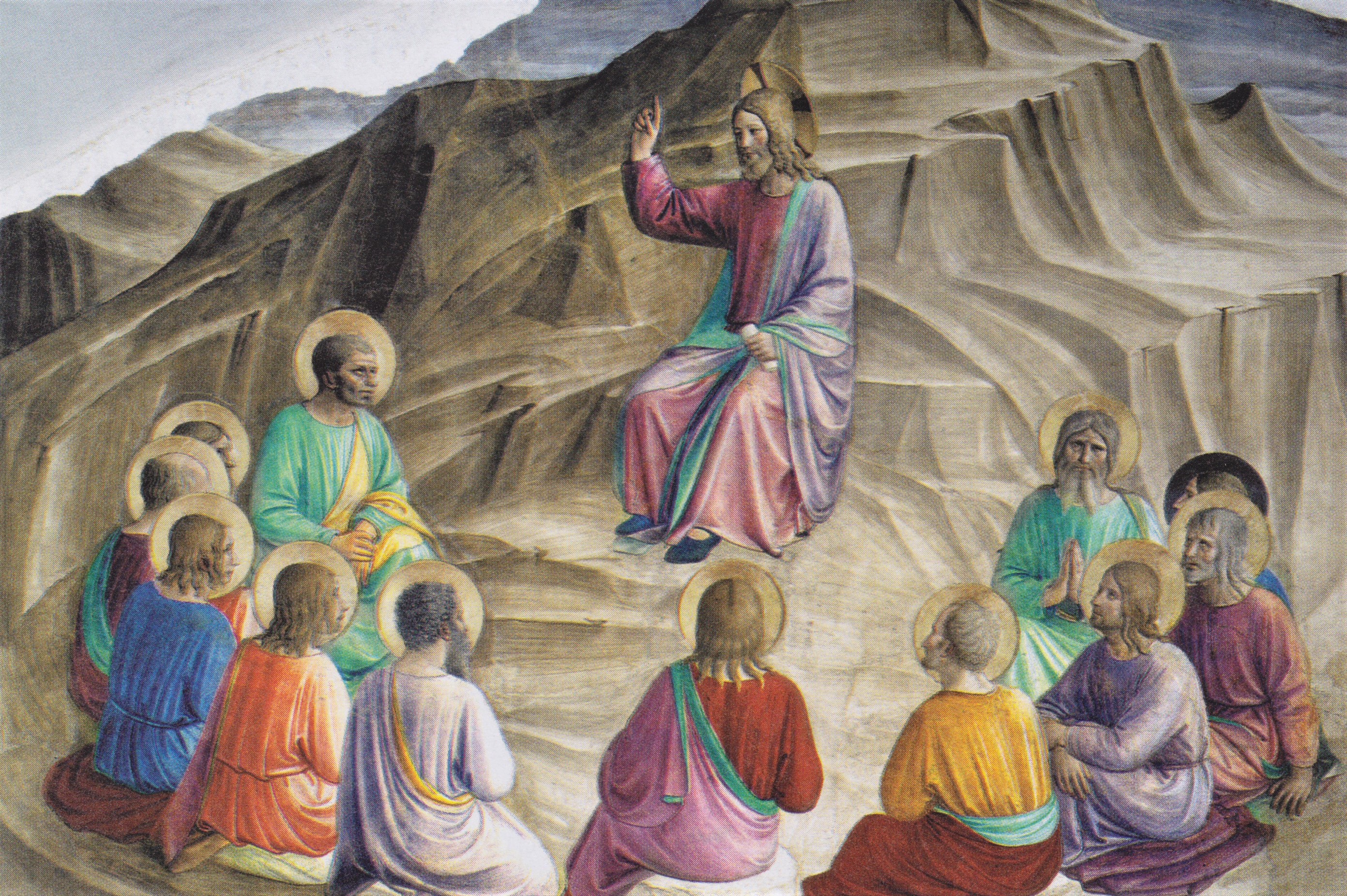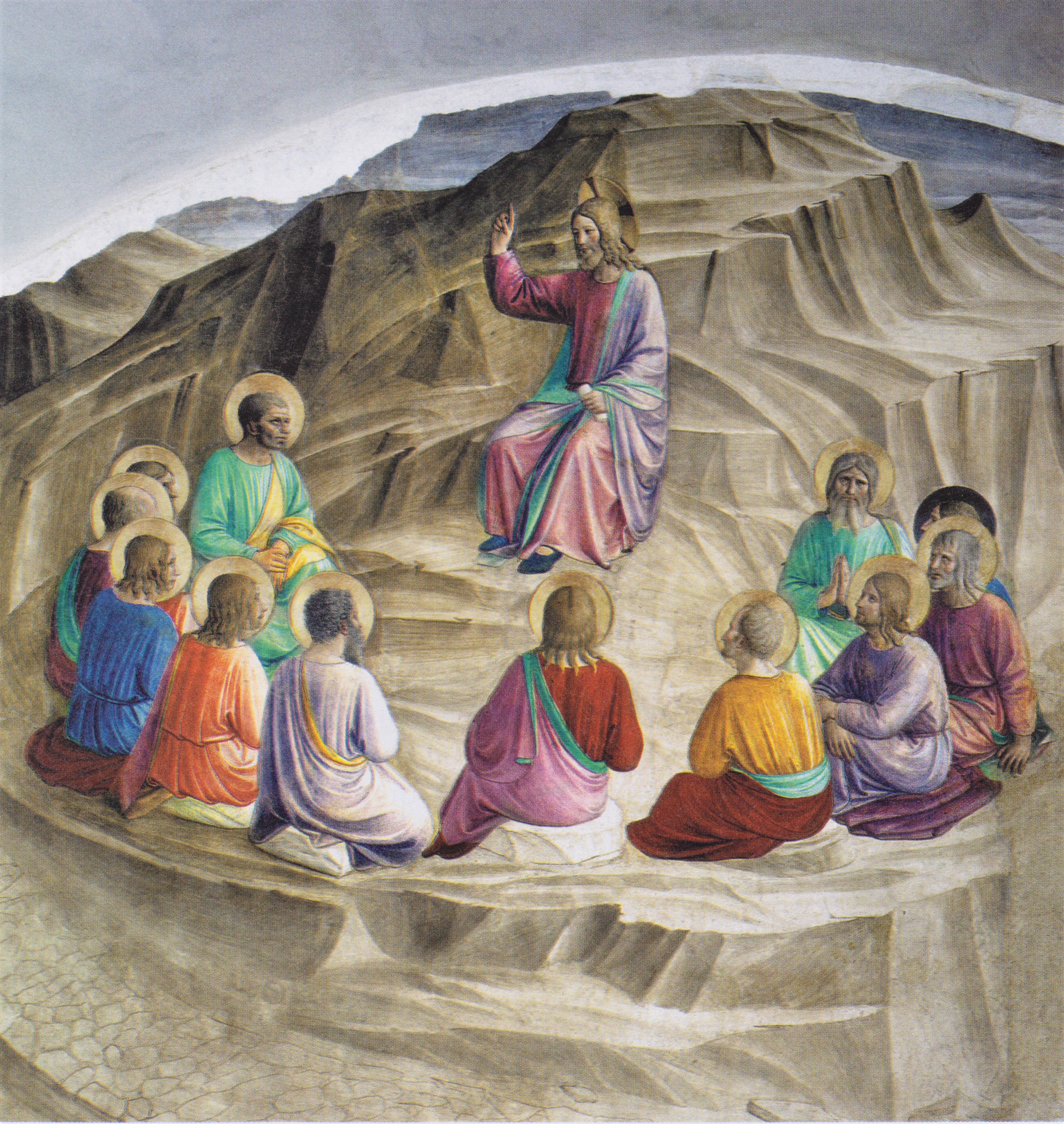
Be Different, Be a Christian – A Homily for the 7th Sunday of the Year

Are you a Christian? Before you answer, consider these other questions: Do you love your enemy? Do you do good to them who hate you? The honest answers to these questions are at the very heart of Christianity and represent what distinguishes a Christian from others. Let’s follow Jesus’ teachings in several stages. In so doing, we can learn our truest identity and how He seeks to transform us.

The ATTITUDE of a Christian

Jesus said to his disciples, “To you who hear I say, love your enemies, do good to those who hate you, bless those who curse you, pray for those who mistreat you. To the person who strikes you on one cheek, offer the other one as well, and from the person who takes your cloak, do not withhold even your tunic. Give to everyone who asks of you, and from the one who takes what is yours do not demand it back. Do to others as you would have them do to you.”

In effect, Jesus is telling us to put an end to the cycle of injustice and violence, by His grace. The Christian is to stand in the gap and say, “It ends with me.” This is Jesus’ game plan, his battle strategy. Defeat Satan’s cycle and thwart his plan to get two birds with one stone. Satan’s usual tactic is to inspire hatred or vengeance in someone, who then attacks us; in response, we lash back and become just like our enemy. In this way, Satan has captured two disciples for the price of one. The Lord tells us not to fall for that. We are to kill our enemies with kindness, get them with goodness, and lure them with love.

Note, then, four attitudes that the Lord distinguishes:

Merciful – Love your enemies, do good to those who hate you, bless those who curse you, pray for those who mistreat you. We ought to remember how merciful God has been to us. Even when we mistreated Him and were His enemies through sin, God show[ed] his love for us in that while we were yet sinners Christ died for us (Rom 5:8). Allow God to make you aware of His abundant mercy so that you are deeply grateful and thus equipped to love your enemy and mercifully withhold your wrath and vengeance toward him.

Meek – To the person who strikes you on one cheek, offer the other one as well, and from the person who takes your cloak, do not withhold even your tunic. Meekness is the virtue that governs anger. It is the proper middle ground between too much anger and not enough. Even when anger is an appropriate response, meekness moderates it, steering it away from destructive ends to helpful ones. It takes a strong person to control his anger, to refrain from retaliating or seeking revenge. Through meekness, we can also direct our anger toward the proper target: Satan. Use the energy of anger to defeat Satan’s plan!

Magnanimous – Give to everyone who asks of you, and from the one who takes what is yours do not demand it back. We are too easily angered when people seek our time, talent, or treasure; this anger can give way to wrath. Those who are magnanimous are open to being asked, at peace with saying no when necessary, and generous in sharing their gifts. Christians graced by Christ are less apt to say, “This is mine; leave me alone” and more likely to realize that God has been good to them. This joy in what God has given them disposes them to generosity with others. Joy is like an energy that fuels magnanimity.

Meet – Do to others as you would have them do to you. An old meaning of “meet” is suitable, proper, fitting, correct, or just. Christians are aware that if we want the world to be more just, it has to begin with us. We understand that we are going to need the help of others in countless ways and therefore treat others as we hoped to be treated. We sow justice, mercy, and patience in order to reap them in others.

The ALTITUDE of a Christian

For if you love those who love you, what credit is that to you? Even sinners love those who love them. And if you do good to those who do good to you, what credit is that to you? Even sinners do the same. If you lend money to those from whom you expect repayment, what credit is that to you? Even sinners lend to sinners and get back the same amount. But rather, love your enemies and do good to them, and lend expecting nothing back; then your reward will be great, and you will be children of the Most High, for he himself is kind to the ungrateful and the wicked. Be merciful, just as your Father is merciful.

Christians are supposed to stand out. By God’s grace, we are to rise above mere human norms. Note what Jesus expects of us:

We are to Excel – In effect, Jesus asks us these questions: How are you excelling? What makes you different from a virtuous atheist or pagan? What credit is it to you if you only do what they do? What makes you different from a sinner? The mark of a Christian is

  • that we love our enemies,
  • that we do good to them who do ill to us,
  • that we lend even when we expect to get nothing back, and
  • that we stop the cycle of injustice and violence.

We are to Exemplify – The text goes on to say, and you will be children of the Most High, for he himself is kind to the ungrateful and the wicked. Be merciful, just as your Father is merciful. In Matthew’s Gospel, Jesus says, But I say to you, Love your enemies and pray for those who persecute you, so that you may be sons of your Father who is in heaven; for he makes his sun rise on the evil and on the good, and sends rain on the just and on the unjust (Mat 5:44-45). Thus, we are to exemplify, to show forth who God is. We are to demonstrate that we are true children of the Father by doing what He does.

The ASSETS of a Christian

Stop judging and you will not be judged. Stop condemning and you will not be condemned. Forgive and you will be forgiven. Give, and gifts will be given to you; a good measure, packed together, shaken down, and overflowing, will be poured into your lap. For the measure with which you measure will in return be measured out to you.

Jesus teaches that, by His grace, we should do the following to store up treasures in Heaven:

Forego Condemnation – Jesus says, Stop condemning and you will not be condemned. Condemning means quickly and routinely seeking the worst of punishments for others. There are no second chances, no tempering of punishment or consideration of the context or background of people’s struggles; “Hang ’em high” is the cry of condemnation. Punishment is meant to be remedial. There are times when the strictest of punishments must be meted out, but typically only after lesser measures have been unsuccessful. However, correcting an erring brother is a spiritual work of mercy.

  • My brothers, if one of you should wander from the truth and someone should bring him back, remember this: Whoever turns a sinner from the error of his way will save him from death and cover over a multitude of sins (James 5:19-20).
  • Let the word of Christ dwell in you richly, teach and admonish one another in all wisdom (Col 3:16).
  • Thou shalt not hate thy brother in thine heart: thou shalt in fact rebuke thy neighbor, and not suffer sin upon him (Lev 19:17).
  • Brethren, if someone is detected in sin, you who live by the Spirit should gently set him right, each of you trying to avoid falling into temptation himself (Gal 5:25).

Nevertheless, be careful. The Lord says, The measure that you measure to others will be measured back to you (Mat 7:2). James also warns, Merciless is the judgment on the one who has shown no mercy (James 2:13). Thus, among our assets in Heaven will be mercy stored up for us at our judgment if we show mercy to others.

Forgive Transgressions – Jesus says, Forgive and you will be forgiven. If we do this, there is the promise of forgiveness being shown to us at our judgment. For if you forgive men their trespasses, your heavenly Father also will forgive you; but if you do not forgive men their trespasses, neither will your Father forgive your trespasses (Mat 6:13-15).

Freely Give – Jesus says, Give, and gifts will be given to you. Paradoxically, one of the ways we keep something in the Kingdom of God is by giving it away. When we give it away, we thereby store it up in Heaven.

  • I tell you, use worldly wealth to gain friends for yourselves, so that when it is gone, you will be welcomed into eternal dwellings. Whoever can be trusted with very little can also be trusted with much, and whoever is dishonest with very little will also be dishonest with much (Luke 16:9).
  • Whoever sows sparingly will also reap sparingly, and whoever sows generously will also reap generously. Each man should give what he has decided in his heart to give, not reluctantly or under compulsion, for God loves a cheerful giver. … As it is written, “He has scattered abroad his gifts to the poor; his righteousness endures forever.” Now he who supplies seed to the sower and bread for food will also supply and increase your store of seed and will enlarge the harvest of your righteousness. You will be made rich in every way so that you can be generous on every occasion, and through us your generosity will result in thanksgiving to God (2 Cor 9:6-11).
  • Jesus said to him, “If you would be perfect, go, sell what you possess and give to the poor, and you will have treasure in heaven; and come, follow me” (Matt 19:21).
  • Do not lay up for yourselves treasures on earth, where moth and rust consume and where thieves break in and steal, but lay up for yourselves treasures in heaven, where neither moth nor rust consumes and where thieves do not break in and steal (Matt 6:19).

Fully Receive – a good measure, packed together, shaken down, and overflowing, will be poured into your lap. For the measure with which you measure will in return be measured out to you. Here, then, is the promise of our assets if we become, by God’s grace, true Christians. In effect, your yardstick will become a boomerang. Let it come back to bless you. If you have been merciful you will find mercy. If you have forgiven you will find forgiveness. If you have given it shall be returned to you many times over. These are the assets of the Christian. Invest wisely!

Cross-posted at the Catholic Standard: Be Different, Be a Christian
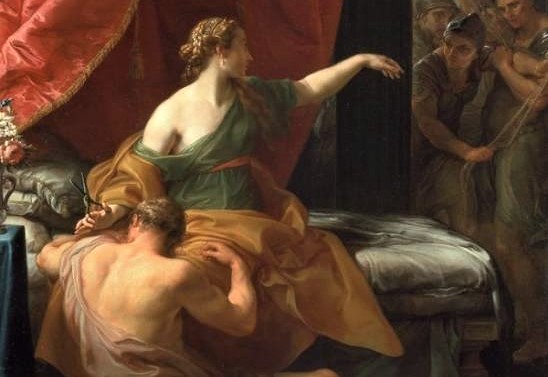
Samson And Delilah As Seen in Cartoon – Or a Parable on the Wages of Lust and Power

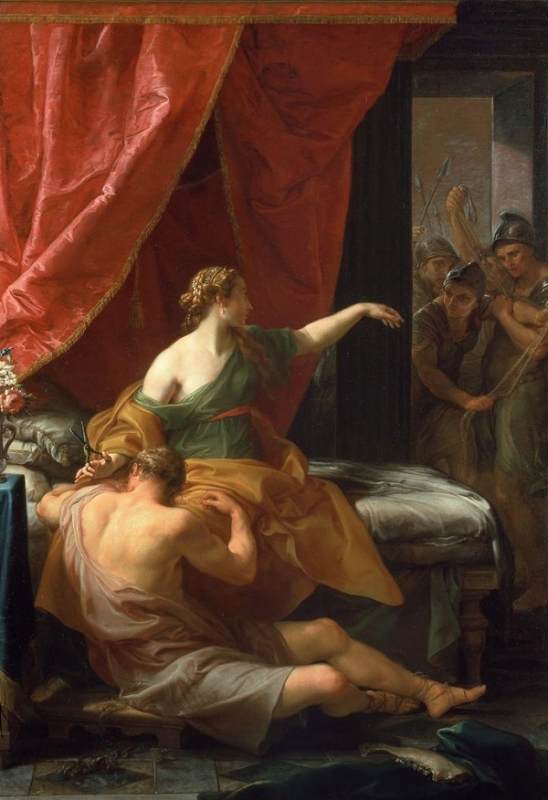
Samson and Delilah – Pompeo Batoni (1766)

The video below is a dramatization (sort of) of the story of Samson and Delilah as well as a commentary on lust and power. In case you would like to review the story of Samson and Delilah, CLICK HERE.

As the video opens, two superheroes are summoned to an emergency. They rush to the scene, but in a reckless fashion, and a great crash occurs. And here is a symbol for pride, for too often we rush headlong into solving problems, but often with little concern for other problems we may create in the process. For example, our quest to “end poverty in our time” has resulted more in the demise of the family; our quest to liberate the world from tyranny (through violence, drone strikes, and war) has led more often to inciting even more violence, and to the rise of new villainies.

After the crash, the superheroes seek to blame each other for the accident. And here is an image for our tendency to shift blame and avoid personal responsibility. We speak endlessly of our rights and the freedom to do as we please, but we want none of the responsibility. And of course any consequences are someone else’s fault.

There then ensues a great conflict between them to wrest control of the situation. And here is an image for power and the desire to overpower others. It merely serves to usher in a brutal and deadly struggle—one in which ultimately no one can win. Rather, all suffer devastating loss. Even victory is brief before the cycle of violence repeats.

Our male superhero, let’s call him Samson, seems to have the upper hand in the conflict. But the female superhero, let’s call her Delilah, is not to be undone and seeks to overcome Samson through her charms. And here is lust. For Samson, whatever his strengths, has a fatal flaw that destroys many men—lust. And as a result of it, many men (and women) and have ruined their lives. They’ve brought on poverty, STDs, abortion, teenage pregnancy, shattered dreams, broken families, and broken hearts.

The end of both of these superheroes is death and destruction. For pride, irresponsibility, unrestrained power, and lust unleash only devastation, destruction, and death—both individually and collectively.

In the biblical story, though Delilah “won,” it was only for a moment. And so it is with every worldly victory; it is temporary at best. Only heavenly victory and treasure stored up there will prevail. The wages of sin is death (Rom 6:23).

Cross-posted at the Catholic Standard: Samson And Delilah As Seen in Cartoon – Or a Parable on the Wages of Lust and Power

Some Proverbs for the Bishops Gathered in Rome

As the summit on sexual abuse begins in Rome, the prelates of the Latin Rite of the Church are reading from the Book of Proverbs in the Office of Readings of the Liturgy of the Hours. Some of the proverbs listed in today’s reading are particularly appropriate to the task at hand.

He who winks at a fault causes trouble, but he who frankly reproves promotes peace (Prov 10:10).

There is tremendous pressure today to remain silent about sin and evil. Those who do speak of sin are often labeled judgmental and intolerant. Sadly, many Christians have succumbed to this pressure; nothing but trouble can result from such capitulation. The moral cesspool that is our modern age is stark evidence of this.

The correction of faults, frankly and with love, is an act of charity (St. Thomas Aquinas). Error and sin bring war and division, both individually and collectively, but God’s truth, lovingly proclaimed, brings peace by insisting on what is good, right, true, and beautiful.

We live in an age that turns a blind eye to evil. The world often celebrates it in visual entertainment, books, the news media, and music. One can see the destructiveness of the glamorization of evil simply by reading the news.

God’s law is His peace plan for this broken world of ours; it is His wisdom that will bring us peace.

It seems obvious that the failure to correct sin in others and the downplaying of sin are at the heart of this crisis. We pray for our Church leaders to clearly and confidently proclaim God’s law and to courageously correct and reprove error.

A fountain of life is the mouth of the just, but the mouth of the wicked conceals violence (Proverbs 10:11).

Jesus warned that Satan and those who are evil often masquerade in sheep’s clothing, while underneath they are ravenous wolves (see Mat 7:15). Many in our world today who despise God’s wisdom attempt to conceal it with euphemistic or deceptive phrases such as pro-choice, pro-woman, no-fault divorce, reproductive freedom, euthanasia, and death with dignity.

Despite the cloak of pseudo-compassion, they ultimately peddle death and division. God’s wisdom, on the other hand, speaks to the dignity of every human life, to hope, and to the promise of eternal life despite difficulties in this world.

We pray that the clergy and leaders of the Church will be like a fountain of truth and justice. Sadly, too many pulpits have been silent; teaching on many critical moral issues has been lacking or even erroneous. Many prefer to speak of tolerance and love in vague and unmoored ways. Tolerance and love have their place, but only in the context of truth and concern for the ultimate good of souls (not necessarily their present comfort).

Where words are many, sin is not wanting; but he who restrains his lips does well (Proverbs 10:19).

In an age of non-stop communication and 24/7 news reporting, the sin of gossip is an almost ever-present temptation. Discretion appears to have been lost.

Our age is one of easy access to various media (e.g., movies, television, books, news, music), and on account of this sin is not wanting. We talk endlessly about other people’s business and often ignore our own issues.

Rare indeed are those who “restrain their lips” and limit their criticism to what is truly helpful unto conversion.

The Pope has warned in this crisis of the need for care in how we speak to it. On the one hand, there has been too much silence and the faithful are rightly finding their voices. However, all of us must restrain the impulse to speak with invective, undue anger, and cynicism; these can generate more heat than light. Many criticisms of the hierarchy are rightly deserved, but we should not fail to praise what is good, to pray for a miraculous conversion, and to assist in crafting solutions that will restore holiness to the Church.

Crime is the entertainment of the fool; so is wisdom for the man of sense (Proverbs 10:23).

Our culture often celebrates the sins of others as entertainment. Fornication, adultery, and all kinds of sexual misconduct are normalized—even celebrated—in books, movies, and on television.

It is the same with violence. Most adventure movies today glamorize its use to solve problems.

Where are the movies that depict wisdom, beauty, love, truth, chastity, and strong families? There are some out there, but they are far outnumbered by those that celebrate crime, violence, dysfunction, and sinfulness.

As the prelates gather in Rome, we must recall that we are dealing with a cultural issue, not just a Church issue. Our whole culture has turned foolishness into entertainment and proposes we not take grave error seriously. We pray that Church leaders will realize anew our obligation to return to the font of God’s wisdom as the source of truth. Pleasing the world by conformity to its language and narrative is neither our role nor our goal. Proclaiming God’s truth is our purpose and our mandate.

When the tempest passes, the wicked man is no more; but the just man is established forever (Proverbs 10:25).

The truth will out. Evil will not remain; it cannot last. Christ has already won the victory.

The foolish keep resisting; they laugh at God’s wisdom, dismiss the Scriptures, and reject Church teaching. When they are gone, though, we will still be here proclaiming Christ crucified, gloriously resurrected, and ascended to glory.

Though the Lord permits His enemies time to repent, their days are ultimately numbered—evil cannot last.

As the bishops gather, we pray that they will see the need to purge evil from the Church, to resist the pressure to succumb to the spirit of the age. Pray that they recall we will ultimately win only with loyalty to Christ Jesus. Persecution is not the worst thing in life; compromise with the world and dying in our sins is. The victory is in the Lord Jesus, who was crucified to this world, rose gloriously, and is reigning over a Kingdom that is established forever.

These are just a few proverbs that are particularly appropriate for our bishops as they gather. Please pray for them all.


Cross-posted at the Catholic Standard: Some Proverbs for the Bishops Gathered in Rome

Rare Jewel: Earth-Like Planets May Be Very Rare

As we conclude our mini-series on the Genesis accounts of creation and the fall, I would like to ponder God’s magnificent work. We are not here by accident; God has carefully arranged things so that we can exist and flourish. In this regard, I have written a good bit over the years about what is known as the “Rare Earth Hypothesis.” Let’s review some of the basics of this hypothesis.

While most people, including most scientists, believe that there may be billions of inhabitable planets capable of sustaining complex life, the Rare Earth Hypothesis suggests that such a large number is overstated.

This is because there are not just a few things that come together to support life here on Earth—there are many. Here are some:

  1. Earth is at just the right distance from the Sun so that water is warm enough to melt, but not so hot as to boil and steam away into space. Water is also able, in this habitable zone (the so-called “Goldilocks” region), to both evaporate and condense at lower levels in the atmosphere, thus permitting a more even distribution of water, and the cycle of water over dry land known as precipitation.
  2. For suns to spawn Earth-like planets they must have sufficient “metallicity,” which is necessary for the formation of terrestrials rather than gaseous planets.
  3. Earth is in a “habitable zone” within the galaxy as well. Closer to the center of galaxies, radiation and the presence of wandering planetoids make life there unlikely.
  4. Earth exists in a disk-shaped spiral galaxy (the Milky Way) rather than in an elliptical (spheroid) galaxy. Spiral galaxies are thought to be the only type capable of supporting life.
  5. Earth’s orbit around the sun is an almost perfect circle rather than the more common “eccentric” (elongated) ellipse. Steep elliptical orbits take a planet relatively close to and then relatively far from the sun, with great consequences for warmth and light. Earth’s stable, nearly circular orbit around the sun keeps our distance from it relatively constant, and hence the amount heat and light does not vary tremendously.
  6. Two nearby “gas giants” (Jupiter and Saturn) attract and catch many wandering asteroids and comets and generally keep them from hitting Earth. The asteroid belts also keep a lot of flying rock in a stable orbit and away from us.
  7. Our molten core creates a magnetic field that holds the Van Allen radiation belts in place. These belts protect Earth from the most harmful rays of the sun.
  8. Earth’s volcanism plays a role in generating our atmosphere and in cycling rich minerals widely.
  9. Our sun is just the right kind of star, putting out a fairly steady amount of energy. Other types of stars are more variable in their output and this variance can utterly destroy life or cause it to be unsustainable due to the extremes caused.
  10. Earth’s fairly rapid rotation reduces the daily variation in temperature. It also makes photosynthesis viable because there is enough sunlight all over the planet.
  11. Earth’s axis is tilted just enough relative to its orbital plane to allow seasonal variations that help complex life but not so tilted as to make those variations too extreme.
  12. Our moon also has a good effect by causing tides that are just strong enough to permit tidal zones (a great breeding ground for diverse life) but not so severe as to destroy life by extreme tides.

There are many more items on the list (see the first video below), but allow these to suffice. The conditions that come together on this planet such that it is capable of sustaining complex life are complicated, remarkable, and some argue rare in the universe. The ability to support life here is the balance of many fascinating things. We cannot but be amazed at the complexity of life and the intricacies required for it to flourish here. It would appear that for complex life to be sustained, many factors must come together in just the right way. The sheer number of these factors sharply decreases the number of possible Earth-like planets, despite the billions of galaxies and stars.

All this background information leads us to a blog at discovermagazine.com: Earth-is-a-1-in-700 quintillion kind of place. (700 quintillion is 7 followed by 20 zeros!) The blog references a study by Astrophysicist Erik Zackrisson from Uppsala University in Sweden.

Here are some excerpts:

Zackrisson’s work suggests an alternative to the commonly held assumption that planets similar to Earth must exist, based on the sheer number of planets out there …. Current estimates hold that there are some 100 billion galaxies in the universe containing about 10^18th stars, or a billion trillion …. Probability seems to dictate that Earth-twins are out there somewhere.

But according to Zackrisson … Earth’s existence presents a mild statistical anomaly in the multiplicity of planets …. Most of the worlds predicted … orbit stars with different compositions—an important factor in determining a planet’s characteristics. His research indicates that, from a purely statistical standpoint, Earth perhaps shouldn’t exist …. Researchers are confident in the broader implications of their model: Earth is more than your garden-variety planet.

I write on this topic more in wonder and awe than anything else. Our faith does not require that we believe ourselves alone in the universe. God can, and even might have, created intelligent beings on other planets, beings with whom He interacts and whom He loves.

Neither should we too quickly assume that Earth is not a rare jewel. Statistically, it would seem that we and Earth are rare jewels. Humble amazement at all that it takes to sustain life on our planet is a proper stance at this stage of the evidence. The more we learn, the more it seems that the convergence of all the factors we enjoy on Earth is rare rather than commonplace. Consider well all that God and nature—sustained by God—have done so that you and I can exist. Be amazed; be very amazed!

Cross-posted at the Catholic Standard: Rare Jewel: Earth-like Planets May Be Very Rare

The Mystery of Iniquity – A Meditation on the Mystery of Rebelliousness

There is a phrase in the Scriptures that, while speaking of mystery, is itself a bit mysterious and is debated among scholars: the “mystery of iniquity.” St. Paul mentions it in Second Thessalonians and ties it to an equally mysterious “man of iniquity” who will appear before Jesus’ second coming.

The Latin root of the English word “iniquity” is iniquitas (in (not) + aequus (equal)), meaning unjust or harmful, but the Greek μυστήριον τῆς ἀνομίας (mysterion tes anomias) is probably best rendered as “mystery of lawlessness.” Many modern translations use the “mystery of lawlessness,” though it doesn’t have quite the same ring to it.

Translation issues aside, Paul seems to be writing in a kind of secret code:

Concerning the coming of our Lord Jesus Christ and our being gathered to him, we ask you, brothers and sisters, not to become easily unsettled or alarmed by the teaching allegedly from us—whether by a prophecy or by word of mouth or by letter—asserting that the day of the Lord has already come. Don’t let anyone deceive you in any way, for that day will not come until the rebellion occurs and the man of lawlessness is revealed, the man doomed to destruction. He will oppose and will exalt himself over everything that is called God or is worshiped, so that he sets himself up in God’s temple, proclaiming himself to be God. Don’t you remember that when I was with you, I used to tell you these things? And now you know what is holding him back, so that he may be revealed at the proper time. For the mystery of lawlessness is already at work; but the one who now holds it back will continue to do so till he is taken out of the way. And then the lawless one will be revealed, whom the Lord Jesus will overthrow with the breath of his mouth and destroy by the splendor of his coming (2 Thess 2:1-8).

Although St. Paul tells the Thessalonians that they know what is holding back the lawless one, we moderns struggle to know. Some scholars say that Paul is referring to the Roman government (which I doubt). Others say that it is the power of grace and God’s decision to “restrain” the evil one and thereby limit his power for the time being. Of course, if Satan is limited now, what horrifying things will be set loose when he is no longer restrained! Can it get any worse? Apparently, it can!

But there it is in the seventh verse; even before the lawless one is set loose there already exists the mystery of lawlessness, the mystery of iniquity. That phrase comes down through the centuries to us, provoking us to ponder its rich meaning.

The danger is that we can focus too much on the “man of iniquity,” who is not yet fully here, and fail to ponder the present reality. As St. Paul says, For the mystery of lawlessness is already at work. Yes, the danger is that we focus on the future, which is murky, and ignore the present.

Hence, I propose that we ponder the “mystery of iniquity,” which is already here. I’d like to explore how it affects us, both personally and collectively. In doing so, we cannot ignore the operative word “mystery.” We must ponder with humility, realizing that some of what we are confronting is revealed, but much of it is hidden. Therefore, I do not propose to “explain” this phrase to you, but rather to ponder its mystery and confront its questions so as to draw us to reverence and a deeper understanding of our need for salvation.

Let’s look at the mystery of iniquity in four parts, wherein we ponder the mysterious reality of lawlessness that seems so operative among us, individually and collectively.

1. “Rational” Man’s Irrationality – Why do we, who are otherwise rational creatures, choose to do that which we know is wrong? Why do we choose to do that which we know causes harm to ourselves and others? Why do we do that which endangers us, threatens us, compromises our future, and further weakens us? Why do we choose evil, knowing that it is evil?

Some argue that our will has been weakened on account of original sin and thus we give way easily to temptation. While this offers some insight, it does not ultimately solve the mystery, for we consistently seem to choose to do that which we know is wrong or harmful.

Some contend that we are choosing what we perceive to be good, but despite our darkened intellects and our tendency to lie to ourselves, deep down we really know better. We know that choosing evil leads to harm in the long run. Our conscience tells us, “This is wrong. Don’t do it.” Yet, knowing this, we still do it.

Are we weak? Yes, but that is not the complete answer. We are staring once again into the face of the “mystery of iniquity.”

2. The Angelic Rebellion – The mystery only deepens when we consider that this is not just a human problem; it is also an angelic one. The presence of demons, revealed to us by Scripture and by our own experience, speaks to the reality of fallen angels.

There was a great rebellion among the angels. Scripture more than hints at the fact that a third of the angels fell from Heaven in this rebellion, before the creation of man (cf Rev 12:4).

Thus, ascribing iniquity and lawlessness to human weakness cannot be a complete answer.

How could angels, with a nature and intellect far more glorious than ours, knowingly reject what is good, true, and beautiful? Here is the deep “mystery of iniquity” having nothing to do with the flesh, or with sensuality, or with human limits. It is raw, intellectual, willful rebellion against the good by creatures far superior to us. The mystery only deepens.

3. The Corruption of the Best and Brightest – The intellect and free will are arguably God’s greatest gifts. Why, then, do they come at such a high price for both God and us? Surely God foresaw that many angels and human beings would reject Him.

Some answer that God also saw the magnificent love and beauty that would be ushered in by those who accepted Him and the glorious vision of His truth. Perhaps God, who is love, saw love as so magnificent that even its rejection by some could not overrule its glory in those who accepted it. Seeking beloved children rather than robots or animals was so precious to God that he risked losing some—even many—in order to gain some.

Others speculate that, at least in this fallen world, contrast is necessary to highlight the glory of truth. What is light if there is no darkness with which to compare it? What is justice if there is no injustice against which to contrast it? What is the glory of our yes if it is not possible to utter a no?

Even these reasonable speculations cannot fully address the mystery of why so many men and angels reject what is good, true, and beautiful; why so many prefer to reign in Hell rather than to serve in Heaven; why so many obstinately refuse to trust in God and obey even simple commands that they know are ultimately good for them. The glory of our freedom and our intellect are abused. Our greatest strengths are also our greatest struggles. Liberty becomes license; lasciviousness and intellect become insubordination and intransigence. Corruptio optime pessima! (The corruption of the best is the worst!)

4. The Final Refusal to Repent – Many today like to blame God for Hell, and they particularly scoff at the notion that Hell is eternal. As the Catechism of the Catholic Church teaches, the eternity of Hell is not due to a defect in divine mercy (CCC # 393). Rather, Hell is eternal because the decision of the damned is irrevocable.

The stubbornness and hardness of heart of the damned reach a point of no return. How does a soul end up in this state? Surely it happens gradually. Sin is added upon sin and the hardness of heart grows. Over time, the demands of God’s justice seem increasingly obnoxious. The hardened soul starts to sneer at God’s law, calling it intolerant, backwards, and simplistic. Of course, God’s law is none of these things, but as the darkness grows within a heart, the light seems more and more obnoxious and hateful. Soon enough, concepts such as forgiveness, love of enemies, generosity, and chastity seem “unrealistic,” even ludicrous.

When does a soul reach the point of no return? Is it at death or sometime before? It is hard to say, but here we reach the deepest mystery: the permanently unrepentant heart.

Our tour has yielded only crumbs. We are back to confronting our mysterious rebelliousness, stubbornness, and hardness of heart; our almost knee-jerk tendency to bristle when we are told what to do, even if we know it to be good for us and others. Even the most minor prohibition makes the thing seem all the more desirable to us. There lurks that rebellious voice that says, “I will not be told what to do! I will do what I want to do, and I will decide whether it is right or wrong.”

Yes, at the end of the day, we are left looking squarely at a mystery. It is the deep, almost unfathomable mystery of our very own iniquity, our lawlessness, our irrational refusal to be under any law or restraint.

Perhaps it is not a mystery that is meant to be solved but to be accepted and to cause us to turn to God, who alone understands. The mystery of iniquity is so profound and so terrifying that it should send us running to God as fast as we can exclaiming, “Lord save me from myself, from my obtuseness, my hardened heart, my rebelliousness, and my iniquity. Save me from the lawlessness in me! I cannot understand it, let alone save myself from it! Only you, Lord, can save me from my greatest threat, my greatest enemy: my very self.”

Yes, the great mystery of iniquity! St. Paul says, the mystery of iniquity is already at work, but he does not say why or even how. He only says that God can restrain it.

Yes, only God can restrain and explain.

More tortuous than anything is the human heart, beyond remedy; who can understand it? I, alone, the LORD, explore the mind and test the heart (Jer 17:9-10).

Here is a song from my youth that celebrates rebellion, iniquity, and lawlessness. The refrain admits that we are “fooling no one but ourselves,” but we do it anyway. It’s foolish and mysterious!

Cross-posted at the Catholic Standard: The Mystery of Iniquity – A Meditation on the Mystery of Rebelliousness

Why is Original Sin called the “Sin of Adam,” not the Sin of Adam and Eve?

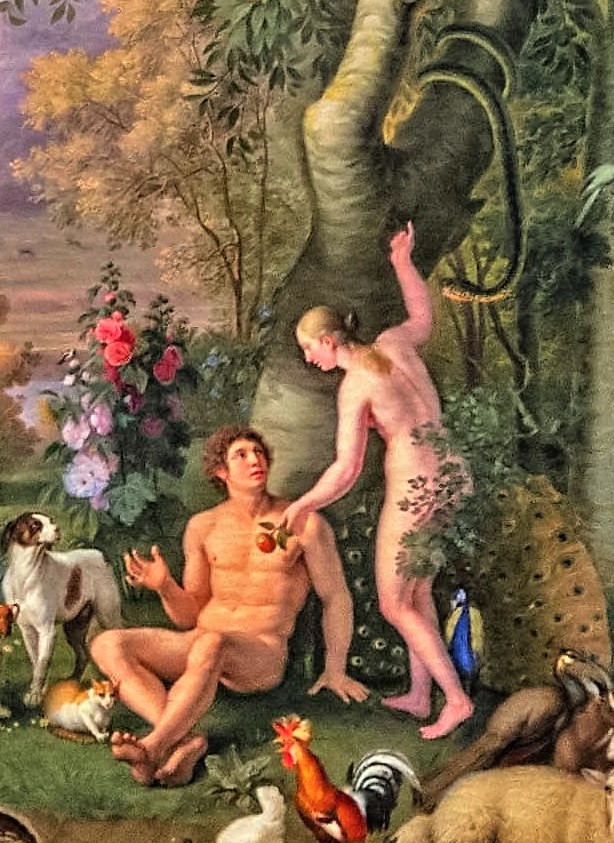
Adam and Eve – Johann Wenzel Peter

Original sin is that first sin of Adam and Eve in the Garden of Eden, committed when they ate the forbidden fruit from the Tree of the Knowledge of Good and Evil (Gen 3:1-7). While it clearly involved them both, Scripture and Tradition refer to it formally as the “Sin of Adam” or “Adam’s Sin,” not the “Sin of Adam and Eve.” It is also described as coming to us “through one man,” not “through one man and one woman.” Consider the following quotes from Scripture and the Catechism of the Catholic Church:

  • Like Adam, they [Israel] have broken the covenant—they were unfaithful to me there (Hosea 6:7).
  • Therefore, just as sin entered the world through one man, … death reigned from the time of Adam to the time of Moses, even over those who did not sin by breaking a command, as did Adam (Rom 5:12, 14).
  • For as in Adam all die, so in Christ all will be made alive (1 Cor 15:22).
  • All men are implicated in Adam’s sin, as St. Paul affirms: “By one man’s disobedience many (that is, all men) were made sinners” “sin came into the world through one man …” (CCC # 402).
  • Following St. Paul, the Church has always taught that the overwhelming misery which oppresses men and their inclination towards evil and death cannot be understood apart from their connection with Adam’s sin … (CCC # 403).
  • How did the sin of Adam become the sin of all his descendants? The whole human race is in Adam “as one body of one man.” By this “unity of the human race” all men are implicated in Adam’s sin, as all are implicated in Christ’s justice (CCC # 404).

Again, why just Adam?

I want to propose several answers, some of them somewhat politically incorrect. Not everything I am about to write represents formal Church teaching; some of it is speculation on my part.

Parallelism – St. Paul makes it clear that we are saved by Christ alone. This is because sin came through “one man” and hence we are saved by “one Man,” the Lord Jesus Christ. Just as in Adam all die, so in Christ are all made alive (cf Rom 5:17; 1 Cor 15:22). Parallelism makes it fitting that because we were saved by one Man, we were steeped in sin through one man. This argument is ultimately unsatisfying because it amounts to a kind of post hoc ergo propter hoc argument by starting with the conclusion (we were saved by one Man) and then developing the premise (that it is because one man sinned). The New Testament guides and influences our understanding of the Old Testament, and it should. Hence, there are two Adams, a “man-for-Man” parallelism. In this sense the first sin is fittingly called the “Sin of Adam.”

The Headship of Adam – Scripture teaches of the headship of the husband in marriage (cf Eph 5:22; 1 Peter 3:1; Titus 5:2; Col 3:18). When God ordained marriage, He stated, A man shall leave his father and mother and cling to his wife, and the two of them shall be one (Gen 2:24). The man leads the marriage and is its head, but this makes him ultimately responsible for what takes place in that marriage.

Today, we tend to think of headship as a privilege, but Scripture speaks of it more in terms of responsibility and service (cf Mark 10:41-45; Lk 12:48). Thus, the headship of the husband brings upon him the ultimate responsibility for what happens in his household. This does not mean that his wife is necessarily without guilt, only that that he must answer for it.

I am the head of my parish. As such, if one of my parishioners or staff does something wrong, the bishop calls me and expects me to handle the matter. I am ultimately responsible for what happens in my parish and must account for it, accept shared responsibility for it, and correct it. It may be because I failed to teach properly. Perhaps I did not exercise enough oversight. It may not be entirely my fault, but as head, I must answer for it.

Hence, original sin is called the “Sin of Adam” because as head of the household he bore ultimate responsibility for what took place. When God was looking for them after they had sinned, He did not say, “Adam and Eve, where are you?” He said, “Adam, where are you?” (Gen 3:9) Eve was not without blame, but God called on Adam to render an account. Adam had headship and, in this sense, the first sin is fittingly called the “Sin of Adam.”

The “Complexity” of Original Sin – When we think of the first sin, we tend to think of it simplistically, as simply the eating of forbidden fruit. I suggest that it was more complicated than that and involved Adam a little more than is commonly thought.

Adam had been placed in the Garden of Eden prior to Eve’s creation and had been told to work it and keep it (Gen 2:15). (Some translations say that he is to work in it and guard it.)

After Eve’s creation, she has a somewhat lengthy conversation with the devil, during which he spars with her, tempting her and ultimately causing her to fall. During this time, where was Adam? One would think he wasn’t there because the text does not record him saying anything, but in fact Adam was right there the whole time! One would expect Adam to say to Satan, “Why are you talking to my wife? What are you saying to her? Why are you trying to mislead her?” One would further expect Adam to dispute what Satan was saying and to defend his wife from this temptation and error. Surely, Eve should not have had to answer Satan all on her own. She does well at the outset but then weakens under his onslaught. Why does Adam not step in to protect her and to bolster her strength? Why does he not assist her in this struggle and defend her against this threat? Is his silence not part of the first sin? Is his omission not integral to the fall of them both?

Adam had an obligation to rebuff Satan and to guard his wife and the garden, but he remained passive. As head of the house, Adam had the primary responsibility of defending his household from all error, sin, and threat. Eve should not have had to face Satan alone. Adam was worse than useless; his silence gave strength to Satan’s arguments. Eve was not without sin, but Adam failed to assist her and to provide her the support she needed and deserved.

Thus, the first sin involved more than merely eating the fruit; that was its culmination. Adam’s complicit silence was integral to the fall; it set the stage. In this sense the first sin is fittingly called the “Sin of Adam.”


Cross-posted at the Catholic Standard: Why is Original Sin called the “Sin of Adam,” not the Sin of Adam and Eve?

How Is Adam’s Sin Different From Eve’s?

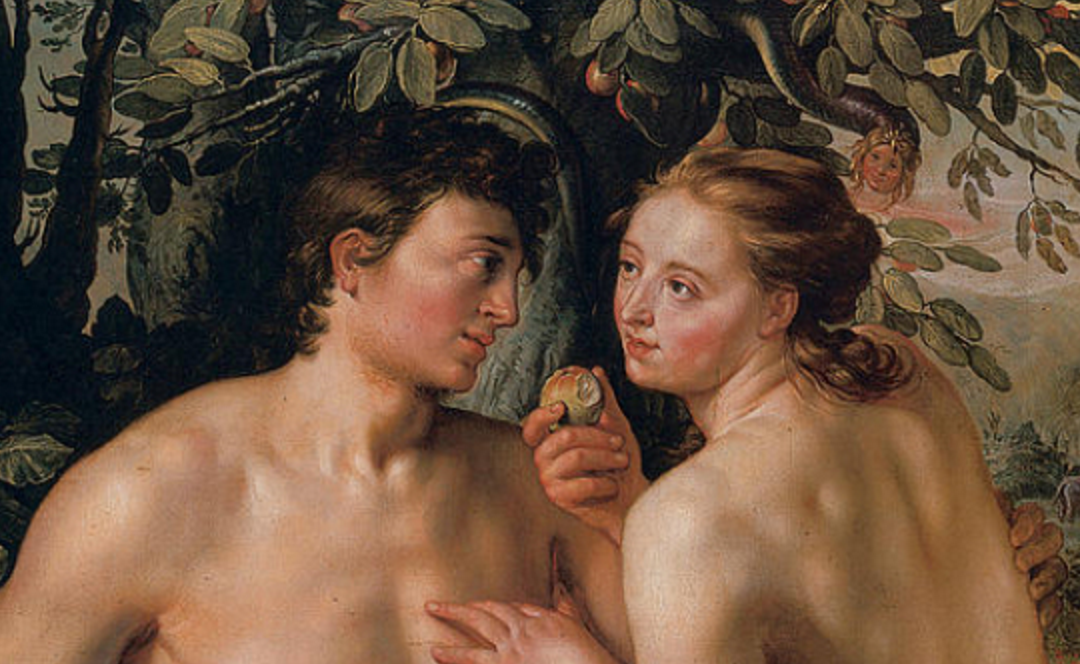
The Fall of Man – Hendrik Goltzius (1616)

In Friday’s blog post, I sought to explore the details of original sin and to convey that there are subtleties and stages to it. The sin was more than eating a piece of fruit; there were things that led up to it, both externally and internally.

Today I would like to consider how the sacred text speaks of the sin of Adam and differentiates it to some extent from that of Eve. Biblically, original sin is Adam’s sin, not Eve’s (cf Rom 5:12 inter al).

It is not that Eve did not sin, nor that her actions have no interest for us, but as the head of his household and of the human family, it is Adam who bore the responsibility and thereby incurred the “original sin,” which comes down to all of us.

Today’s post isn’t going to be very politically correct, because in striving to differentiate Eve’s sin from Adam’s I will take up a controversial text from St. Paul. It does not comport well with modern notions, so it is important to consider a couple of points before beginning.

First, we ought to remember that it is a sacred text, and even if St. Paul may draw some of his reflections on the cultural experience of his time, he also gives theological reasons for what he writes.

Second, this is only one text from one author. Further, what St. Paul says rather absolutely in the verse that follows, he qualifies to some extent in other writings.

With this in mind, let’s examine the controversial text and strive to see the distinctions between Adam’s sin and Eve’s. St. Paul writes,

A woman should learn in quietness and full submission. I do not permit a woman to teach or to assume authority over a man; she must be quiet. For Adam was formed first, then Eve. And Adam was not the one deceived; it was the woman who was deceived and became a sinner (1 Tim 2:11b-14).

Upon reading the text like this, so astonishingly out of step with modern thinking, many are prone to dismiss it out of hand as a relic of a past dark age. It is debatable whether this edict that women should not teach or have authority over men was merely a disciplinary norm that need not be observed today. It is also debatable how absolute Paul’s words were, for Paul speaks elsewhere of women as catechists (e.g., Phoebe in Romans 16), spiritual leaders, and benefactors (e.g., Lydia in Acts 16) in the early church communities. And in Corinthians, he says that when a woman speaks in the assembly, she is to cover her head (1 Cor 11:5). So, what St. Paul says in his Letter to Timothy is distinguished elsewhere in a way that allows for women to both speak and teach the faith.

In the passage from Timothy, the context seems to be that of the family and marriage. St. Paul affirms the headship of the husband here just as he does in Ephesians 5:22 and Colossians 3:18 as does Peter in 1 Peter 3:1-6.

There is another text in which Paul speaks of women being silent in the church. The context in the following passage seems to be liturgical:

Women should remain silent in the churches. They are not allowed to speak, but must be in submission, as the law says. If they want to inquire about something, they should ask their own husbands at home; for it is disgraceful for a woman to speak in the church (1 Cor 14:34-35).

Here again, there is legitimate debate about how strictly the silence described in this passage is to be interpreted. Generally, Church practice has understood it to mean that women are not to give the official teaching in the liturgy that we refer to as the sermon or homily. This stricture has been observed from antiquity to the present day; the homily can only be given by a bishop, priest, or deacon. In more recent times women have been permitted to serve as lectors, cantors, and singers, but the official teaching moment of the homily is still reserved for the male clergy.

While some prefer to see St. Paul’s observations as cultural artifacts that can be adjusted, we need to see that Paul sets forth theological reasoning for the difference between Adam’s sin and Eve’s.

For Adam was formed first, then Eve. And Adam was not the one deceived; it was the woman who was deceived and became a sinner (1 Tim 2:13-14).

St. Paul begins by saying that Adam was formed first, then Eve. So, here he teaches, as he does in other passages, that the husband has headship, authority. The husband is head of his wife just as Christ is head of the Church (Eph 5:22).

In terms of original sin, St. Paul says that Adam was not the one deceived, it was Eve who was deceived. Thus, St. Paul speaks of Eve’s sin as different from Adam’s. She was deceived and so sinned. Adam was not deceived; his sin lay elsewhere.

Eve herself speaks of her own deception: “The serpent tricked me and so I ate it” (Gen 3:13). Of Adam’s sin, God says, “Because you listened to your wife and ate fruit from the tree about which I commanded you, ‘You must not eat from it’ …” (Gen 3:17).  Thus, Adam’s sin lay in his willingness to allow his wife to tempt him. These sorts of teachings grate on modern ears, but this does not make them untrue.

Perhaps a little additional reflection may help to avoid knee-jerk reactions to either gloat or become angry. Adam’s and Eve’s sins are described differently and can also be understood as weaknesses to which each was particularly susceptible: she to deception, he to being swayed by Eve’s feminine mystique and beauty.

St. Paul does not simply ascribe these two weaknesses to Adam and Eve as individuals but also as male and female. Hence, St. Paul seems to teach that a woman ought not to have solemn teaching authority in the Church because of her tendency to be deceived.

Why might this be, that a woman could be more easily deceived? Perhaps it is rooted paradoxically in her strength. Women are more naturally spiritual and inclined to be a source of unity and peace in the family. While these are wonderful strengths, in certain circumstances they can provide an easy opening for deception. If one seeks to make peace too easily, one may compromise with error and sin; and though being open to spiritual things is of itself good, one should not be open to erroneous spiritual concepts.

Further, should a woman cede to these, she can have undue power over her husband and other men who may be drawn by her beauty into setting aside their better judgment.

To my mind, this is St. Paul’s point when he says that Eve was deceived and Adam was not, and therefore a woman cannot have teaching authority in the Church. There was a similar warning in ancient Israel that a man should not take a foreign wife because she might confuse his heart into the worship of her foreign gods. A man’s heart can easily be swayed by a beautiful and influential woman.

Addressing this double threat, St. Paul forbids women to have teaching authority in the Church and ties it back to the archetypal incident of Adam and Eve. Eve was deceived and then was able to seduce her husband to sin.

In modern times it may well be that St. Paul’s caution is affirmed by the problems in liberal Protestant denominations that have a large number of female leaders. It is these very denominations that have departed significantly from the orthodox Christian faith, denying basic tenets of the Trinity, moral teaching, and biblical interpretation. This was not caused solely by the presence of women in leadership roles, but there is a high correlation between denominations that have embraced women as leaders and departure from orthodox Christian beliefs.

Have I been politically incorrect enough for you? Please feel free to comment below, but keep in mind that the focus I am interested in is the different descriptions of the Adam’s sin and Eve’s sin.


Cross-posted at the Catholic Standard: How Is Adam’s Sin Different From Eve’s?

Blessing or Woe: You Decide. A Homily for the 6th Sunday of the Year

Fra Angelico, Convent of San Marco (1445)

The Gospel passage this Sunday is Luke’s version of the Beatitudes. Being paradoxical, they are difficult to understand. We do not usually refer to the poor as blessed, but rather the well off; we do not typically call those who mourn blessed, but rather the joyful.

The word “beatitude” itself means “supreme blessedness.” In ancient Greek, makarios (blessed) referred to a deep, serene, and stable happiness largely unaffected by external matters. It also corresponds to the Hebrew word asher, which is more of an exclamation.

Each beatitude could easily be translated to begin in this way: “O, the blessedness of ….” Such a translation emphasizes that something is being described and experienced rather than prescribed.

So, it is critical to understand that beatitude is not something we achieve; rather, it is something we receive. The Beatitudes declare an objective reality as the result of a divine act. The use of the indicative mood in the passage should be taken seriously; we should not turn it into an imperative. In other words, as noted, the Beatitudes are more descriptions than prescriptions. Jesus is not simply saying that we should be poor or meek and then God will bless us. Rather, He is saying that this is what the transformed human person is like; this is what happens to us when He lives His life in us and transforms us; this is what our life is like when His grace and the power of His cross bring about in us a greater meekness and poverty of spirit—we will experience being blessed.

This helps to explain the paradox of some of the Beatitudes. We are still blessed even when we are poor, or mourning, or persecuted. Further, we are confirmed in blessedness by such realities because they serve as reminders that we are not at home in this world; God and His kingdom are our preoccupation and the source of our true beatitude.

In Luke’s version of the Beatitudes there are also woes described for those who reject the Lord’s offer. Let’s pair them up and consider them together, seeing the choice the Lord presents in each case: blessing or woe.

Blessed are you who are poor, for the kingdom of God is yours.

Who are the poor? They are those who, by God’s grace, have their true treasure in Heaven rather than on earth. They are poor to this world but rich to God. They have learned to depend on Him and are not obsessed with the passing riches of this world.

All of us are dependent on God, but we may not realize it. The poor in spirit are those who have come to peace in the knowledge that they depend on God for every beat of their heart, for every good thing they have. Humans strongly resist any such sense of dependence or lack of control. Many people strive to acquire wealth, power, and possessions in order to create the illusion that they are in control—they are not. Ultimately this whole system will fail; it is a recipe for frustration and unhappiness.

Further, control is like an addictive drug. The more we get, the more we need in order to feel less anxious. Our modern age illustrates this. Consider, for example, modern medicine, through which we can control things we never could before. Are all our fears gone as a result? No. Humans have never lived so long nor been so healthy, yet we have never been so anxious about our health. Our medicine cabinets are filled with prescriptions and over-the-counter medications, but we still worry! Control is an illusion, an addiction all its own. In the end, it seems we can never have enough of it to feel sufficiently “safe.”

How blessed are those who delight in depending on God, who realize that every beat of their heart is His gift and that everything they have is from Him and belongs to Him! They are blessed because they are free from the countless fears that flow from an endless quest for illusory control.

But woe to you who are rich, for you have received your consolation.

It’s nice to be rich, but if that’s all you live for, that’s all you’ll get. When it’s over it’s over, and then comes the judgment. Paradoxically, the only way to retain riches is to give them away or use them in serving others. Jesus instructs,

Store up for yourselves treasures in heaven, where moth and rust do not destroy, and where thieves do not break in and steal. For where your treasure is, there your heart will be also will be (Matt 6:20).

St. Paul says,

Instruct those who are rich in the present age not to be conceited and not to put their hope in the uncertainty of wealth, but in God, who richly provides all things for us to enjoy. Instruct them to do good, to be rich in good works, and to be generous and ready to share, treasuring up for themselves a firm foundation for the future, so that they may take hold of that which is truly life (1 Tim 6:17-19).

If we hoard wealth when others are in need or use our wealth in unjust ways, we may enjoy comforts in this world, but a stern judgment awaits. Live with the final judgment in mind; share and be generous. Jesus warns of woe that will come to those who resist his grace to be generous.

Blessed are you who are now hungry, for you will be satisfied.

All of us hunger physically, but the important thing is to hunger for God and the things waiting for us in Heaven. Many people hunger for anything but God—wealth, power, popularity, the latest fad.

It is in our hunger that we make room for God. It is then that we seek Him.

How blessed are those who hunger and thirst for the righteousness and justice of God and the values of His Kingdom! God will satisfy them with the joy of living under His law and they will rejoice to see the wisdom of His ways. They hunger for God’s Word and devour it when they find it. They rejoice to see God put sin to death in them and bring about virtue. They are excited and satisfied at what God is doing in their life. They are blessed indeed.

But woe to you who are filled now, for you will be hungry.

If we are filled with the things of this world, there is no room for God. Worldly things can only satisfy temporarily; being finite they cannot fill the infinite longing we have. We were made to know and love God; He alone can satisfy our longing. If we refuse this true food and true drink (see John 6:55), which is Christ Himself in the Eucharist, there awaits only a longing that will one day be permanent if we reject the Lord to the end. The Lord warns of woe to those who resist His gift to feed them with His Body and Blood and fill their minds with His Word.

Blessed are you who are now weeping, for you will laugh.

Who are those who weep? First, they are those who are not obsessed with emotional happiness and who accept sorrow as a part of life. Their sorrow is not about merely worldly things. They weep because they delight in the Kingdom of Heaven yet see the awful state of most of God’s people. They see so many who do not know God nor why they were created. They see people willfully locked in sin and darkness. They see still others who are victims of the sins of injustice and oppression. Because of these things they weep, mourn, and pray. This beatitude is the basis of intercessory prayer and deepening love for sinners. Because we mourn, we pray for the world.

Again, the object of this beatitude is rooted in the Kingdom of God and its values, not the passing values of this world. If our car gets scratched or the stock market goes down and we may mourn, but that’s not the subject of this beatitude.

How blessed are those who mourn over what really matters and who pray! They will laugh in the sense that God will console, strengthen, and encourage them. He will cause their mourning to bear fruit in prayer and action for others. To mourn in this way is to be blessed. It is a grief that “hurts so good,” because we know that it brings abundant blessings for the world as it intensifies our prayer and our own commitment to God and His Kingdom.

Woe to you who laugh now, for you will grieve and weep.

Rejoicing with the world is like celebrating on the Titanic before it hits the iceberg. The ride is wonderful for a while but then comes the cold and unforgiving depths. Too many in our world live frivolous lives. They “major in the minors.” They call good or no big deal what God calls sin; they even celebrate it and praise it. Jesus says, woe to them. While there are things to enjoy in this world, there is also much to lament. Sin and injustice, moral darkness, and confusion are nothing to celebrate. The Lord warns of woe to those who do not let Him transform their hearts so that they grieve over sin and darkness.

Blessed are you when people hate you, and when they exclude and insult you, and denounce your name as evil on account of the Son of Man. Rejoice and leap for joy on that day! Behold, your reward will be great in heaven. For their ancestors treated the prophets in the same way.

In life we are going to suffer, so it might as well be for something decent and noble. How blessed are those who, because they love God and His kingdom, are hated by this world! At least they share a common lot with Jesus. They know that only false prophets are loved by all. There is a paradoxical serenity that comes from this sort of persecution because it is a sign that we are no longer of this world, that the world has lost its hold on us and thus hates us (Jn 15:19). Forsaking this world and being hated by it, they are blessed, because the Kingdom of God is theirs in abundance.

Woe to you when all speak well of you, for their ancestors treated the false prophets in this way.

If the world is cheering for you, you’re playing on the wrong team, the losing team. The “world” is the set of philosophies, power structures, and inclinations at odds with the teachings and truths of God. A friend of the world becomes an enemy of God (James 4:4). Jesus says,

If the world hates you, understand that it hated Me first. If you were of the world, it would love you as its own. Instead, the world hates you, because you are not of the world, but I have chosen you out of the world. Remember the word that I spoke to you: ‘No servant is greater than his master.’ If they persecuted Me, they will persecute you as well (Jn 15:18-20).

Jesus warns of woe to those who pitch their tents in this world. It is passing away as are all those who seek its friendship. Jesus warns of the woe that comes from being too friendly with a lost and sinful world.

In all these ways, the Lord paints a kind of picture for us of the transformed human person. He shows us what happens to us as He lives His life in us.

Decisions have consequences. Depending on our choice to let God work in our life or not, there is either blessing or woe. Choose the blessings, dear brethren, choose the blessings.

One of my mentors over the years was the late Fr. Francis Martin, a teacher at the Dominican House of Studies (among many other places), a great scholar of Scripture, and the author of numerous books and articles; he also gave many a retreat for priests. Here are some of his reflections on the Gospel:

Cross-posted at the Catholic Standard: Blessing or Woe: You Decide. A Homily for the 6th Sunday of the Year