
Here is one of the most extraordinary videos I have seen in a while. I am not sure how it was done but the portraits of Christ “morph” one into another. My only wish would have been that the author/artist might have used images of Christ from many cultures and nations. As it is, all the images here are European. Nevertheless, this remains an amazing work and a very fitting meditation for Holy Week.
40 Reasons for Coming Home – Reason # 32 – 100 % Performance Record
Reason # 32 – 100% Performance Record. There are very few certainties in this world about anything but one thing is for sure: The Church will prevail, the Church will be here to infallibly lead us to the end of days. “How arrogant!” you might say. And yet, say it I did. Why? Not because of any human guarantee, but based rather on the firm promise of Jesus himself.
The place is Ceasarea Phillipi and Jesus is speaking to Simon Peter who had just confessed him to be the Christ and the Son of the Living God. Now Jesus speaks and says, You are Peter (Rock), and upon this rock I will build my church,and the gates of hell shall not prevail against it. (Matt 16:18) The Church will surely be hated, attacked and persecuted but Hell will never prevail, never defeat the Church Jesus founded. Now I want to emphasize that this power of the Church to endure to the end is no human power. It is not based on brilliant or perfect human leaders. It is based solely on Jesus’ promise. So it is not arrogant to make this claim, it is simply biblical and a matter of faith in Jesus.
This prevailing power of the Church can be understood in a couple of ways. First it means that the Church will be here to the end. Count on it since Jesus promised it. This is what is meant by the “indefectability” of Church. Secondly, this promise means that the Church cannot mislead us or teachly falsely in a matter of faith and morals.
In order to preserve the Church in the purity of the faith handed on by the apostles, Christ who is the Truth willed to confer on her a share in his own infallibility…The mission of the Magisterium is linked to the definitive nature of the covenant established by God with his people in Christ. It is this Magisterium’s task to preserve God’s people from deviations and defections and to guarantee them the objective possibility of professing the true faith without error. Thus, the pastoral duty of the Magisterium is aimed at seeing to it that the People of God abides in the truth that liberates. To fulfill this service, Christ endowed the Church’s shepherds with the charism of infallibility in matters of faith and morals. The exercise of this charism takes several forms: “The Roman Pontiff, head of the college of bishops, enjoys this infallibility in virtue of his office, when, as supreme pastor and teacher of all the faithful – who confirms his brethren in the faith he proclaims by a definitive act a doctrine pertaining to faith or morals. The infallibility promised to the Church is also present in the body of bishops when, together with Peter’s successor, they exercise the supreme Magisterium, above all in an Ecumenical Council. (Catechism of the Catholic Church 889-891)
Now some object to claim. But reason with me for a minute. Jesus promised that the gates of Hell could not prevail against the Church. But if the Church could formally teach error about faith and morals, if the Church could mislead people about what was necessary for their eternal salvation, then it would be a fact that the gates of Hell HAD prevailed. But since Jesus promised it could never happen, then, by God’s grace, the Church is protected from formally teaching falsely on matters of faith and morals. Do you trust Jesus and believe his word? Then the Church is unsinkable and infallible regarding faith and morals.
So why is this a reason to come home? Well, let’s say you have a choice to take one of two airplanes to take to a distant city, lets call it “Heavenly City.” The one plane (Church Airlines) gets there 100% of the time. The other plane (Alsoran Airlines) gets there sometimes, but other times it is in disrepair, or it lands in the wrong city, or at still other times it crashes. OK, which plane are you going to take? Now I am not going to tell you that only Church Airline riders get to Heavenly City. A few people on the other plane do sometimes get there, but its a pretty uncertain ride. At least with Church Airlines the plane is certain to get there: it won’t crash, get lost or fail to take off. So, choose this airline! The world might not get you there, untested spiritualities and the latest trends won’t cut it. Only Jesus and the Catholic Church he founded are up to the job 100% of the time. Now be careful though. You have to stay on the plane for the whole journey. Don’t get off at a connecting city (Sin City) or any such thing. The plane is 100% reliable by Jesus own promise. It’s a pretty good reason to come home and get on board before the door cloese and walkway swings back. There is a mid-flight meal, the Eucharist, and an in-flight movie, the Word of God included in the price of your ticket which is, by the way, free.
Now this video is about the Gospel Train not a plane but the thought is still the same: “Then Get on Board, Children, there’s room for many a more!”
The Wisdom of the Cross
It is Holy Week and we ponder the many gifts we have received from the Cross that Christ carried for us. The Cross was terrible and difficult but the gain was enormous. So too for the crosses we carry. Think of one thing in your life that you truly value and ponder the sacrifices that were neecessary so that you could enjoy it. Maybe it is your children; think of all the scarifices you made so that they could come to where they are today. Maybe it is your career, think of all the years of college and training that went into this blessing. Whatever it is, nothing of value comes without the cross. Where would you be today without your crosses?
This is the wisdom of the cross. Difficult and painful though it may be it always brings blessings if we carry it with faith. The following video is a little “homespun” but it illustrates well the wisdom of the cross.
40 Reasons for Coming Home – Reason # 31 – The Church is Catholic
Reason # 31 – The Church is Catholic– The word “catholic” means “universal.” One of the most remarkable things I experience about being a Catholic and a priest is this universality of the Church. I experience it in two ways.
First, the Catholic Church is everywhere. On every Continent, in every country, in most towns and even rather small communities. Mass is conducted in most of the languages that exist on this planet and displays an enormous cultural diversity as well. There are over 1 Billion Roman Catholics on this planet.
Secondly, the Catholic Church is not only every place it is in every Christian time. We go back officially 2000 years right to Jesus himself. There has never been a time since Christ when we did not exist. Every now and then you may hear complaints that the Catholic Church doesn’t change and update fast enough. Well, generally for this I am grateful. It is true, one might wish that we could learn to use certain technological things of modernity like the Internet more quickly. But, as a rule, we hold an ancient wisdom that “remembers long.” So, even as we gain strength from our cultural diversity, we also gain stability by our ancient roots.
So the Church is “catholic.” That is to say, we include every people, nation and time. Why does this mean you should come home? Well, in a word, “enrichment.” It is enriching to be part of something bigger than just me, my neighborhood, my country, or my time. I benefit from the rich experience of over one billion currently living and many more billions who have gone before. And the enrichment has more to it than just how we dress or speak. It has to do with wisdom, knowledge, experience, and prayers that are multiplied not just by people currently living but even of those who are now beyond the veil. (I’ll say more of that in a future post). Imagine the effects of these prayers and this collective wisdom.
Come home to a rich feast, spanning the globe, stretching across time. Even just here in the Archdiocese Mass is celebrated in almost a dozen languages and liturgies encorporate a rich diveristy of things ancient and new. Haven’t found what you’re looking for? Search a little more among the Catholic Parishes and communities. You’re bound to find what you’re looking for in the “universal” Catholic Church.
Here’s a little video sampling of the universality of the Church. Our gracious host, from Eastern Europe(?), quickly ushers us around the planet to ponder what the Church and Catholics are experiencing in those locales.
40 Reasons For Coming Home – Reason # 30 – You Really Want to
Reason # 30 – You really want to. – Many Centuries ago St. Augustine wrote this classic line in his Confessions: Our hearts were made for Thee O Lord and they are restless until they rest in Thee. We have talked before in this blog about our desire and that, if we are honest, we will see they are infinite. But a finite and limited world cannot give infinite, unlimited desire.
All the things we think we want are really just symbols pointing to a greater desire: God. Deep down you know he exists and it calling you. Somewhere, in the depths of your soul he is calling to you and your soul is calling for him, yearning for him. God has written his Name in our hearts and our hearts seek his face.
Come home to the Lord. Let him minister to you in Word and Sacrament. Let Him, who alone can satisfy, begin to satisfy your hunger and your thirst. Come home. You know you want to. All your other desires are really about this one desire, to be with God.
Enjoy this beautiful video and music of Psalm 42 which says it better than I ever could.
Making Holy Week Holy
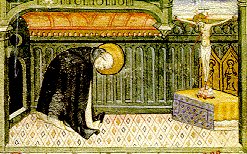
Fr. Bill Byrne, Pastor at St. Peter’s on Capitol Hill sure had good news to share at Mass yesterday. In his homily, he said that if we’ve come to these final days of Lent disappointed with our failure to keep our Lenten fast or we gave up on the practice we took up in the early days of Lent, all is not lost. There is plenty of God’s mercy and grace to be received in the days ahead!
To receive those graces, we need to set aside time in our schedule for prayer and for participation in our parish services. I suggest you begin by making a visit to the Blessed Sacrament in the quiet of these first few days of Holy Week.
Pope Benedict XVI in his book The Spirit of the Liturgy writes that with the presence of the Blessed Sacrament, our churches are never empty, lifeless spaces. “Jesus is always there, waiting, watching, wanting to make us Eucharist.” Take a few minutes today or tomorrow or Wednesday to stop in and spend some time in the quiet of the church or chapel asking the Lord to help you enter into the holiest days of the Church year open to all he is waiting to share with you.
Christ bore our sins in his own body on the cross so that we might die to sin
and be alive to all that is good.
Diversity on Display – Maronite Passion Hymn
Among the Eastern Catholic Churches is the Maronite Catholic Church. It is rooted in Lebanon but its members are now all over the world. This Church is in union with Rome and the Holy Father but has its own Maronite Liturgy conducted in both the vernacular and Aramaic, the Language of Jesus himself. You can read more about the Maronite Church HERE and HERE and of its liturgy HERE.
The Following Video features the hauntingly beauty Passion hymn from the Maronite Liturgy Wa Habibi. Here is the text and translation:
Arabic Lyrics:
وا حبيبي وا حبيبي أي حال أنت فيه
من رآك فشجاك أنت أنت المفتدي
يا حبيبي أي ذنب حمل العدل بنيه
فأزادوك جراحاً ليس فيها من شفاء
حين في البستان ليلاً سجد الفادي الإلة
كانت الدنيا تصلي للذي أغنى الصلاة
شجر الزيتون يبكي و تناديه الشفاء
يا حبيبي كيف تمضي أترى ضاع الوفاء
English Translation:
My Love, My Love
What has befallen you?
Who saw you and grieved for you,
You who are righteous?
My Love, what is the sin of our times and our children?
These wounds have no cure.
Of the last line “These wounds have no cure” it is well to reflect that even in his resurrected and glorified body the wounds of Jesus still appear. This is because they are wounds of love and his love for us will never pass away or ever be “healed.”
Pray along with this video, it captures well the somber and prayerful mood of Holy Week.
Here in the Archdiocese of Washington the Maronite Rite is celebrated at Our Lady of Lebanon 7142 Alaska Rd. NW 202-829-5554
The Centurion’s Anguish
Here is another video based on the Passion of the Christ. It is a powerful though imaginary account of the the reflection of the Centurion who was ordered to crucify Christ. As the account goes on he becomes anguished in his cry: “Why Am I killing this man?!?” In the end he accepts Jesus’ request that God forgive us and the Centurion comes to faith.
Watch this video! It is long (13 minutes) but well worth the time. If you can’t watch it now, come back later in Holy Week. But watch it. It is very well done.