This weekend I attended Peter Kreeft’s talk in Alexandria, VA entitled “The Power of Beauty in the Sacred Arts”, sponsored by the Foundation for Sacred Arts. Dr. Kreeft is a professor of philosophy at Boston College and the King’s College and is a prolific writer. The talk was brilliant, and while I’m sure I could blog about more profound things, today I choose food in the hopes that we might think more profoundly about food.
One of the questions asked during the Q&A session had to do with whether or not there was beauty in “fast food”. Dr. Kreeft’s answer was that, it being fast food, it is likely that even if beauty were present we would not stop to contemplate it. (typical Kreeft witticism)
For me, it’s not so much that the food is “fast” but that it’s so processed. One could say we process the hell out of our foods, but I would actually say that we process the Heaven out of our foods. There is something spectacular about the plants, animals, and grains that God has placed on earth to nourish our bodies.
Today (shortly before lunch) I was contemplating the beauty of food. What came to mind as particularly beauitful foods were corn on the cob, a fresh raspberry, and the avocado: the straight plump rows of yellow kernels; the fuzzy red seed pockets; and the bumpy black skin protecting the creamy green fruit. With such beauty, I wonder why our society adulterates it so often and to such a degree.
Now I can’t say all of this without acknowledging that there are people in the world who are not blessed with access to fresh food, or food at all. So my prayer today is that we who have access to fresh food take the time to contemplate its beauty, thank God for the gift our food, and continue to share our food and argicultural technology with the poor and the hungry.
For I was hungry and you gave me something to eat, I was thirsty and you gave me something to drink, I was a stranger and you invited me in. Matthew 25:35
The Gospel for today has Jesus clearly telling us he must carry his cross and we must carry ours. Generally we flee the cross. But somewhere deep inside we know the need for the cross. Where would you be today without the crosses you learned to carry. The cross is more than suffering, it is self discipline, it is generosity, it is obedience, it is doing what is right even without immediate reward, it is working hard when we’d rather sleep. Where would you and I be had we not learned to accept corsses like these. Most of our progress comes at the cost of sacrifice, ours and others for us. We know, deep inside, that the corss is necessary.
The following video is a little silly but it makes a good point, so learn while you laugh at a corny but clever video:
Here’s another rather clever but corny video which I’ve posted before. In it a pastor and his cat try to explain suffering.
Most of us remember well that terrible day 8 years ago when terrorists ruthlessly attacked us. Although that day is etched deeply in most of our memories, what may have slipped away is how we experienced September 12 and the days that followed. We wondered, was this the first of many more attacks? Was another shoe about to drop? How would we protect ourselves from new attacks? There was a lot of anxiety in the days and weeks that followed. But most people agreed, this nation had to protect itself from further attack. We needed to identify our enemy and end the threat that enemy posed.
In the weeks, months and years that followed this Country undertook significant actions to end the threat posed to us by Al Qaeda. The problem was that this enemy did not live in a single region or country. The field of battle was difficult to define. The army we faced wore no uniforms and lived among non-combatants. Opinions began to differ widely as to the best way to address the threat posed to us.
Among Christians who reflected on what to do, Biblical teaching, the example and words of Jesus present definite challenges to those who proposed a strong military solution. Jesus seems so clear and unequivocal when he teaches in this regard:
You have heard that it was said, ‘An eye for an eye and a tooth for a tooth.’ But I say to you, offer no resistance to one who is evil. When someone strikes you on (your) right cheek, turn the other one to him as well. If anyone wants to go to law with you over your tunic, hand him your cloak as well….”You have heard that it was said, ‘You shall love your neighbor and hate your enemy. But I say to you, love your enemies, and pray for those who persecute you, (Matt 5:38-44)
What a text! It is so radical as it seems to exclude self-defense. What does it mean to offer no resistance to one who is evil? When you are attacked Jesus does not say “defend yourself” he says “turn the other cheek.” So radical does this text seem to most that they are overwhelmed and simply turn the page. Is this a call to radical pacifism? Does it mean that a Nation should have no police force, no judicial system, no army?
Instead of turning the page, we might do well to reflect on the message of a text like this. Perhaps some observations and clarifications are due here:
The text seems to be more about matters of personal dignity than actual physical attack. True, the strike on the cheek seems quite physical, but in the ancient world such attacks were understood as an attack on one’s personal dignity no so much a grave physical threat. This is true even today. Being slapped on the face is not a devastating threat to our physical well-being. Rather it is an insult. In the ancient world one who wished to humiliate struck (always with the open right hand) the left cheek of the person. This was an indignity but not the worst one that could be inflicted. The worst insult was to strike the right cheek of a person with the back of your right hand. So what Jesus is describing here is a question of dignity. His basic teaching then is that if some one tries to rob you of your dignity by a slap on the cheek, realize that your dignity is not in what others think of you. Realize that your dignity is given by God and no one can take from you. Show this by offering your other cheek. Don’t stand on your precious dignity, don’t retaliate to regain your dignity. The one who struck didn’t give you your dignity and they cannot take it away.
Hence this text is not about defending from life threatening physical attack, it is a text about personal dignity. All the getting back at others because they offended you or did not praise you, or poked fun at you, or did not give you your due, all the revenge for stuff like that ends because it no longer matters to you, at least not when Jesus starts to live his life in you.
So this text has a cultural context that would not necessarily require us to interpret Jesus’ words as an absolute exclusion of legitimate self defense in moments of serious physical threat.
But any distinctions I have made above by way of explanation cannot remove the core of Jesus’ message which is meant to limit our retaliation and remove from it anything “personal” other than the protection of life from imminent threat or significant injustice.
This then serves as background to the Church’s very careful and thoughtful approach to necessary self-defense. The Catechsim sets forth this teaching in its exposition of the 5th Commandment (Thou Shall not Kill). Here are some excerpts:
2263The legitimate defense of persons and societies is not an exception to the prohibition against the murder of the innocent that constitutes intentional killing. “The act of self-defense can have a double effect: the preservation of one’s own life; and the killing of the aggressor…. The one is intended, the other is not.”
2264Love toward oneself remains a fundamental principle of morality. Therefore it is legitimate to insist on respect for one’s own right to life. Someone who defends his life is not guilty of murder even if he is forced to deal his aggressor a lethal blow: If a man in self-defense uses more than necessary violence, it will be unlawful: whereas if he repels force with moderation, his defense will be lawful….
2265Legitimate defense can be not only a right but a grave duty for someone responsible for another’s life, the common good of the family or of the state.
2266Preserving the common good of society requires rendering the aggressor unable to inflict harm. For this reason the traditional teaching of the Church has acknowledged as well-founded the right and duty of legitimate public authority to punish malefactors by means of penalties commensurate with the gravity of the crime, not excluding, in cases of extreme gravity, the death penalty. For analogous reasons those holding authority have the right to repel by armed force aggressors against the community in their charge.
2267….the traditional teaching of the Church does not exclude recourse to the death penalty if this is the only possible way of effectively defending human lives against the unjust aggressor. If however non-lethal means are sufficient…authority will limit itself to such means….the cases in which the execution of the offender is an absolute necessity are very rare, if not practically non-existent.
2308All citizens and all governments are obliged to work for the avoidance of war. However…governments cannot be denied the right of lawful self-defense, once all peace efforts have failed.”
2309The strict conditions for legitimate defense by military force require rigorous consideration. The gravity of such a decision makes it subject to rigorous conditions of moral legitimacy. At one and the same time: 1- the damage inflicted by the aggressor on the nation or community of nations must be lasting, grave, and certain; 2- all other means of putting an end to it must have been shown to be impractical or ineffective; 3- there must be serious prospects of success; 4- the use of arms must not produce evils and disorders graver than the evil to be eliminated. The power of modem means of destruction weighs very heavily in evaluating this condition. These are the traditional elements enumerated in what is called the “just war” doctrine.
So, some reflections on 9/11. How have we done? It seems we had a right to defend ourselves by discovering our enemy who so threatened us and removing this threat. I do not claim that we got it all right and that every action of ours was right. Indeed, if I can leave you with one “take away” from this reflection it might be this: Self defense and the ending of unjust aggression can never be something we do lightly and without reflection. The Lord and the Church require of us serious reasons for bringing lethal blows even to enemies and we should never undertake such measures without considering carefully other less lethal means. Respect for life means that it is right that I demand my enemy respect my life but also means that I must respect his. Recourse to war or other lethal means may sometimes be necessary but we do well to carefully consider our motives and means in such a serious undertaking.
Have we done this? I leave this to your prayerful consideration. Pray for also our leaders who have important decisions to make in the protection of this great nation of ours.
A few years ago Father Greg Shaffer started a basketball team of priests and seminarians called DC ‘Hood (as in priest-HOOD) that would offer to play parish teams in order to promote vocations and show another side of parish priests. The team has been a huge success playing at a variety of parishes in the Archdiocese of Washington. At each game there is a talk at halftime where a priest or religious sister talks to the young people present (as well as their parents) about their call. Although the ‘HOOD doesn’t always win (but actually does most of the time), it’s always a great event for families and the promotion of vocations.
The following video clip is from a game at the Verizon Center in 2008 that DC ‘HOOD played against the “Men in Black” which a team of priests and seminarians from the Archdiocese of Baltimore. Please continue to pray for vocations!
This Year marks the 40th Anniversary of No-Fault Divorce. With the signature of Governor Ronald Regan on Sept 5, 1969, the State of California became the first State to enact “No-Fault Divorce.” Other states quickly followed and within 15 years it was nationwide. In effect this law simplified divorce and streamlined it by allowing only one party to petition for divorce. By this act Marriage became the easiest contract in civil law to break.
Prior to 1969 the States processed divorce requests but the process was long and difficult. Shouldn’t it be? The breakup of marriages has potentially powerful implications for families and for society. It is especially children who suffer from unstable family situations. The State and the wider society has good reason to insist that couples remain faithful to vows they have made (to use Church language) and to “contractual obligations” binding on them (to use the language of civil law). With the introduction of “No-fault Divorce” the notion of obligations and duties toward Children and the wider society was set aside. Marriage became a whimsical arrangement subject to easy and rather sudden end – no questions asked. “Irreconcilable differences” is all that needs to be said.
Late in life, Reagan admitted his son, Michael that, signing the bill was one of the worst mistakes he ever made in public office.
How have we done since 1969? Well no one would say marriage is a healthier institution as a result. Divorce has skyrocketed. Now more than half the children of this country no longer enjoy a stable nuclear family but instead are sent back and forth between the households of divorced parents. Often they have to endure the confusion and turmoil of their parents’ second marriages, half brothers and sisters, moms and step moms, dads and stepdads and every other sort of relationship you can imagine. What sort of a toll has this taken on children in terms of things like drug use, suicide rates, premarital sex, SAT scores, etc.? Well, you know the answer. And how do we fare as a society, as a nation, as Church when our most basic pillar is on shaky ground? Here again, you know the answer, we have not fared well.
There was a time in this land when divorce was rare. When it occurred people were shocked and whispered about it. Really it was not so long ago. I who am only 48 remember those times from my early childhood. It is not as though every marriage was happy before 1965. Indeed, there were many “unhappy marriages.” But people had a different outlook which emphasized the importance of staying true to commitments that had been made and to sticking them “for the sake of the kids.” These attitudes were enshrined in law which made divorce difficult. Marriage was for the Children and children had needs for stability and for parents who stuck to their commitments. Today, the attitude is that marriage is for the adults and the needs of children are somewhat secondary.
Do you also see how this had led to the current trend to “redefine” marriage. If Marriage is essentially only about the relationship of the adults involved and children are only an optional accessory, who is to say that marriage should be stable or even heterosexual? Or so the thinking goes. But if, as the Church continues to teach, the procreation and rearing of children is an essential end of marriage then it makes sense that God would establish marriage as between one man and one woman till death do them part. As God puts it, “This is why a man leaves his father and mother and clings to his wife and they become one flesh.” (Gen 2:24) God goes on further to command them to be fruitful and multiply (Gen 1:28).
So here we are today, marriage, family, and children are all on the ropes. Our own strength as a civilization depends on us getting this right again. The first major and serious blow took place 40 years ago this month. God invites us to return.
To those who are divorced, I mean you no disrespect. Many are divorced today due to complicated reasons. Not all wanted the divorce they had. Others made decisions early in life that they now regret. Still others had unique situations too complicated to speculate about here. But I’ll bet most who are divorced would be the first to describe its pains and ramifications in the family. Easy divorce has not made life easy. “Amicable solutions” are seldom pain-free and they are seldom solutions at all. Rather they unleash a whole new set of problems. Somewhere in the midst of all this God is calling to us and he invites us all to rediscover his plan for marriage and the family.
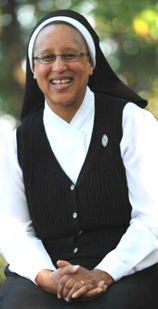
Seriously, some of my best friends where called to religious life. One in particular, Sister Marcia Hall, OSP, helped me to discern my call to the diaconate. She is truly gifted at walking with those who have a desire to follow Christ. Fittingly, she is helping several people in discerning God’s call as the director of vocations for her community.
The Oblate Sisters of Providence taught me in elementary school at Our Lady of the Divine Shepherd School in Trenton, New Jersey. However, I did not feel called to the community until I was in my late 20s and in graduate school. One day I had a vision of myself in an Oblate habit. At the time I wasn’t interested, so I finished my PhD in sociology and went on to work at the college level, as a teacher and administrator.
Feeling unsatisfied and realizing the “Hound of Heaven” had never let go, I started to visit Baltimore, to see what it really meant to be a sister. My discernment took eleven years – if you look up “stubborn” in the dictionary, you’ll see my picture! I finally entered the community on my 42nd birthday. In December 2008 I celebrated 10 years as an Oblate Sister of Providence.
As a sister still young in religious life I have only been missioned a few places. As a junior sister I was interim principal at St. Benedict the Moor School in Washington, DC for a year. The next three years I spent as assistant principal at The Seton Keough High School, an Archdiocesan school where Oblates had never served. Next, I was principal of our high school, St. Frances Academy, also for three years. During my time at Saint Frances I made my final vows to God and the community. Now I happily serve as US vocation director.
There are certainly ups and downs in this life, as there are in any other way of life. But I stay because I have never been more satisfied. I know God called me, and I am glad I answered the call. Can my life get any more exciting? I’ve been photographed for a national magazine {December 2008 EBONY} and interviewed for a national radio program (Tell Me More, NPR, December 26, 2008). I can’t wait to see what else God has in store for me!
Please pray for Sister Marcia and for all who are discerning a call to religious life.
Here is a very nice Video on the History of the Oblate Sisters of Providence. The woman pictured below is Sharon Knecht who is the archivist for the Order. This video interiviews her and many of the Sisters at the Motherhouse in Baltimore: Video on the Oblate Sisters of Providence

 This weekend I attended Peter Kreeft’s talk in Alexandria, VA entitled “The Power of Beauty in the Sacred Arts”, sponsored by the Foundation for Sacred Arts. Dr. Kreeft is a professor of philosophy at Boston College and the King’s College and is a prolific writer. The talk was brilliant, and while I’m sure I could blog about more profound things, today I choose food in the hopes that we might think more profoundly about food.