Adding to my thoughts on “grateful and brokenhearted”, one common mistake we make upon learning of someone’s death, is that we try to avoid or minimize our grief. I think those who know us and love us but, were not necessarily as affected by the loss, want us to get past the grieving as quickly as possible. So, frankly, in their attempts to help us, they do and say some silly things.
“Homegoing service”
Let start with calling a funeral a “Homegoing service.” I have always been bothered by this! I have begged my family to make sure that when I die, do let anyone call my funeral a “homegoing service.” I need a funeral, not a “homegoing service.” I need an evening of prayers followed by a Mass of Christian burial. Why? First of all, anything else it implies that no one is supposed to be sad at my death. Not only are we supposed to be sad at the death of someone; God is sad at the death of someone because, death was never part of His plan for us. Death entered the world because of our sins, not because God planned it. God will overcome it nonetheless. But, to call the funeral rites a “homegoing service” confuses joy with hope.
My father died when I was only nine years old and there was NOTHING joyous about that. I was sad then and over 30 years later, I get sad now. Furthermore, I actually get resentful if someone suggests that I am not supposed to be sad anymore. However, each time I pray for him, I am filled with hope. That is what being a Catholic is all about; Hope. And genuine Christian hope feels wonderful and can actually make you smile.
God needed another angel in heaven.
First off, we are not angels. Angels are angels. Human beings are human beings. God does not need us to be an angel or anything else for that matter. Rather, God WANTS us to be part of the heavenly kingdom. To suggest that when a musician dies, God needed another player for some ethereal orchestra is silly. The heavenly kingdom would get along fine without us. Instead, God loves us and WANTS us to be part of it. He does not NEED us. How cruel and selfish would it be for God to cause pain and suffering because of some otherworldly essential? God did not plan for your death or the death of your loved one. He only planned His response, through His own death and resurrection.
We should not be sad today.
When I hear this, I want to scream, “Are you kidding?!” When Lazarus died, Jesus wept. When any of the faithful dies, I would like to think Jesus weeps. I am convinced that Jesus shares our sadness. However, unlike us sinners, Jesus responds to death with perfect love and hope. Nonetheless, even though death has been overcome by Christ, the pain and sadness we feel initially is no different from the pain and sadness our own Mother Mary felt at the foot of the Cross. When I preside at a funeral, I pray that the congregates leave with a renewed and sustained hope in the resurrection of their loved one. But to suggest that one should not be sad or that one should not cry would be misguided at best, if not cruel.
Christ our Hope
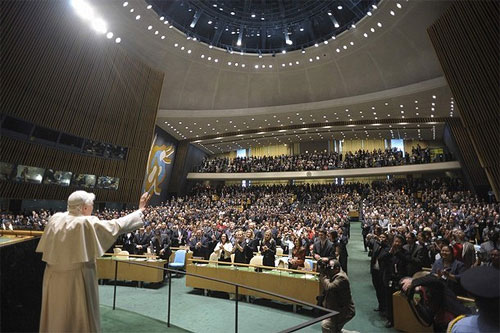
During Pope Benedict’s visit to the United States, the theme “Christ our hope” was repeated throughout the visit. Regarding Christian hope, the Catechism of the Catholic Church reads, “We firmly believe, and hence we hope that, just as Christ is truly risen from the dead and lives for ever, so after death the righteous will live for ever with the risen Christ and he will raise them up on the last day. Our resurrection, like his own, will be the work of the Most Holy Trinity:
If the Spirit of him who raised Jesus from the dead dwells in you, he who raised Christ Jesus from the dead will give life to your mortal bodies also through his Spirit who dwells in you. – Rom 8:11
Brothers and Sisters, as we commemorate the faithful departed today, let us weep if needed and let us be sad. Also, let us remember fondly our loved ones and, if possible recall a good memory or two. But, most importantly, let us hope for the joy of the resurrection of all us.