Recent news reports have mistakenly claimed that the Archdiocese of Washington and Catholic Charities are threatening to cease providing social services in the District of Columbia if the propsed bill to legalize same-sex marriage is passed.
For many years now secularists and self-described progressives have made the claim that religious believers, especially those from traditional perspectives, were trying to impose their beliefs on others. They have also make frequent accusations that religious believers are “intolerant.” It has been my usual experience that people who stridently accuse others of things are themselves often most guilty of the attitudes they most decry in others. And now today we see just such an example in the looming actions of an increasingly extreme contingent of the DC City Council in reference to same sex marriage.
The crafters of the Bill have chosen to significantly narrow religious exemptions and thereby force religious organizations into the untenable position of accepting and even promoting so-called same-sex marriage. The Archdiocese of Washington has released a a statement that pretty well details the situation. I reproduce it here:
The DC City Council’s Committee on Public Safety and the Judiciary today narrowed the exemption for religious freedom in a bill that would legalize marriage between same-sex couples. The bill is headed to the full council.
The committee’s narrowing of the exemption leaves religious organizations and individuals at risk for adhering to the teachings of their faith, and could prevent social service providers such as Catholic Charities from continuing their long-term partnerships with the District government to provide critical social services for thousands of the city’s most vulnerable residents. The bill provides no exemption for individuals with sincerely-held religious beliefs, as required under federal law. In fact, one council member opposed an amendment that would have respected an individual’s federally-protected, deeply-held religious beliefs by saying that would encourage a “discriminatory impulse.”
The committee rejected concerns raised in testimony by the ACLU, the Archdiocese of Washington, the InterFaith Conference of Metropolitan Washington and a group of nationally-recognized legal scholars, including Robin Fretwell Wilson, professor at Washington & Lee University Law School. In calling for broader religious liberty protections in the bill, the experts cited well established United States Supreme Court case law under Title VII of the Civil Rights Act of 1964, and the Religious Freedom Restoration Act (RFRA), a federal law that applies to the District of Columbia.
Under the bill, religious organizations do not have to participate in the “solemnization or celebration” of a same-sex marriage ceremony. An earlier version of the bill also exempted them from “the promotion of marriage that is in violation of the entity’s religious beliefs.” The revised language significantly narrows that exemption to the “promotion of marriage through religious programs, counseling, courses, or retreats.”
As a result, religious organizations and individuals are at risk of legal action for refusing to promote and support same-sex marriages in a host of settings where it would compromise their religious beliefs. This includes employee benefits, adoption services and even the use of a church hall for non-wedding events for same-sex married couples. Religious organizations such as Catholic Charities could be denied licenses or certification by the government, denied the right to offer adoption and foster care services, or no longer be able to partner with the city to provide social services for the needy.
“It is our concern that the committee’s narrowing of the religious exemption language will cause the government to discontinue our long partnership with them and open up the agency to litigation and the use of resources to defend our religious beliefs rather than serve the poor,” said Edward Orzechowski, president/CEO of Catholic Charities of the Archdiocese of Washington. Catholic Charities serves 68,000 people in the city each year. The city’s 40 Catholic parishes operate another 93 social service programs to provide crucial services.
The teachings of the Catholic Church, including those of the Archdiocese of Washington, hold that all individuals have equal dignity and deserve equal respect. However, marriage by its very nature must be between a man and a woman. One essential purpose of marriage is an openness to creating and nurturing the next generation, which is the reason that governments and cultures throughout all time have given these relationships special recognition and support. See www.MarriageMattersDC.org for more information on marriage.
Many media reports today have indicated incorrectly that the Archdiocese of Washington is “threatening to end social services to the poor” if the Bill is not changed. But the true fact is that the Bill would force us out since to accept or administer even $1.00 of DC money would put us under a whole series of unacceptable rules requiring us to recognize or even facilitate aspects of Gay “marriage.” I could also open us to lawsuits and to “decertification” which would exc;ude us from providing social servies in DC. It is not we who threaten, it is we who are threatened by the implications of this Bill.
I hope you can see what is happening here. Through judicial fiat seculars and progressives are trying to impose recognition of same sex “marriage.” By severely reducing religious exemptions members of the City Council and their allies are simply bullying and forcing their will. They have the votes on the Council and refuse to allow the citizens of this city to have their voices heard by placing this initiative on the ballot. This Bill is, simply put, an imposition.
It is also an example of intolerance toward the traditional religious community. The views of the religious communities in question are not some recent trend or theological speculation. The definition of marriage that is being rejected is some 5,000 years old and stretches all the way back to the earliest pages of Scripture. There are also solid Natural Law arguments at the root of the traditional understanding of Marriage. We are not bigots or homophobes merely for holding the traditional view of marriage. The narrowing of religious exemptions in the current draft of the Bill seems another example of intolerance for ancient and deeply held religious belief.
It is an irony that many who have marched under the banners tolerance and open-mindedness, now that they have power, show that it never really was about either of those things. It appears it was really about power and imposition. The very ones who have so often accused the religious and traditional of imposing our will and being intolerant now give evidence of the very things they accused others of.
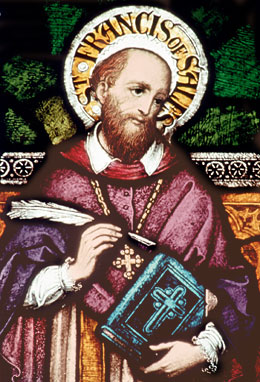
Recently, I’ve been making my way through “Introduction to the Devout Life”. It’s a brilliant book by the brilliant spiritual director St. Francis de Sales!
Chapter 6 begins the process of purifying ourselves from sin and the attachment to sin. St. Francis makes these remarks about how many of us approach confession:
“It often happens that the usual confessions of those who live a common and ordinary life are full of great defects. Generally they make little or no preparation, and they do not have sufficient contrition. In fact, it frequently happens that they go to confession with the implicit determination of returning to sin, since they are not willing to avoid the occasions of sin or to make use of the measures required to amend their life.”
Yikes! For this reason, he suggests a general confession. A general confession is a confession during which you confess all the sins you have committed from the age of reason to the present. (This is not to be confused with a general absolution.) General confessions are recommended for anyone entering a new phase in life or as recommended by a spiritual director.
A few weeks ago, I made my first general confession. The priest with whom I had schedule the confession told me to prepare by recalling the first few times I had ever sinned and by doing a thorough examination of conscience. I found an examination guide online which went through each of the ten commandments in detail.
The confession lasted about forty-five minutes…and then it was over. I think I was expecting something a little more dramatic: perhaps a little psychoanalysis, maybe some fireworks, gongs, or euphoric shouts of joy. But after the confession, I realized that what had happened was that I had quietly and contritely laid my sins at the feet of Jesus. Beautifully simple.
Has it made a difference? Yes! First, there is the freedom of knowing, with certainty, that all those sins are forgiven. Secondly, I realized again the importance of a true commitment to amend my life in my decisions and actions. Finally, after this process I certainly think about each confession I make more prayerfully.
“If we acknowledge our sins, he is faithful and just and will forgive our sins and cleanse us from every wrongdoing.” 1 John 1:8
In these times one of the most forgotten virtues and obligations we have is the duty to correct the sinner. It is listed among the Spiritual Works of Mercy. St. Thomas Aquinas lists it in the Summa as a work of Charity: [F]raternal correction properly so called, is directed to the amendment of the sinner. Now to do away with anyone’s evil is the same as to procure his good: and to procure a person’s good is an act of charity, whereby we wish and do our friend well. (II, IIae, 33.1)
The World and the Devil have largely succeeded in shaming Christians from this essential work. We are said to be “judging” someone when we call attention to their sin or wrongdoing. In a culture where tolerance is one of the only virtues left, to “judge” is a capital offense. “How dare we do such a thing!” The world protests, “Who are you to judge someone else!”
Now to be sure, there are some judgements that are forbidden us. For example we cannot assess that we are better or worse than someone else before God. Neither can we always understand and ultimate culpability or inner intentions of another person as though we were God. Scripture says regarding judgments such as these: Not as man sees does God see, because man sees the appearance but the LORD looks into the heart (1 Sam 16:7). Further we are instructed that we cannot make the judgment of condemnation. That is to say, we do not have the power or knowledge to condemn someone to Hell. God alone is judge in this sense. The same scriptures also caution us against being uncessesarily harsh or punitive. And so we read, Be merciful, just as your Father is merciful. Stop judging and you will not be judged. Stop condemning and you will not be condemned. Forgive and you will be forgiven…. For the measure with which you measure will in return be measured out to you (Luke 6:36-38). So in this text “to judge” means to condemn or to be unmerciful, to be unreasonably harsh.
Another text that is often used by the world to forbid making “judgments” is Matt 7:
Do not judge, or you too will be judged. 2For in the same way you judge others, you will be judged, and with the measure you use, it will be measured to you. 3“Why do you look at the speck of sawdust in your brother’s eye and pay no attention to the plank in your own eye? 4How can you say to your brother, ‘Let me take the speck out of your eye,’ when all the time there is a plank in your own eye? 5You hypocrite, first take the plank out of your own eye, and then you will see clearly to remove the speck from your brother’s eye. (Matt 7:1-5)
But pay careful attention to what this text is actually saying. First as we have already seen the Luke version the word “judge” here is understood to mean an unnecessarily harsh and punitive condemnation. The second verse makes this clear. To paraphrase verse two would be to say, If you lower the boom on others, you will have the boom lowered on you. If you throw the book at others, it will also be thrown at you.” Further, the parable that follows does NOT say not to correct sinners. If says, get right with God yourself and then you will see clearly enough to properly correct your brother.
The fact is that over and over again Scripture tells us to correct the sinner. Far from forbidding fraternal correction, the Scriptures command and commend it. I would like to share some of those texts here and add a little commentary of my own in Red.
Jesus said, “If your brother sins against you, go and tell him his fault, between you and him alone. If he listens to you, you have gained your brother. But if he does not listen, take one or two others along with you, that every word may be confirmed by the evidence of two or three witnesses. If he refuses to listen to them, tell it to the church; and if he refuses to listen even to the church, let him be to you as a Gentile and a tax collector. Truly, I say to you, whatever you bind on earth shall be bound in heaven, and whatever you loose on earth shall be loosed in heaven (Matt 18:15-18) Jesus instructs us to speak to a sinning brother or sister and summon them to repentance. If private rebuke does not work and, assuming the matter is serious, others who are trustworthy should be summoned to the task. Finally the Church should be informed. If they will not listen even to the Church then they should be excommunicated (treated as a tax collector or Gentile). Hence in serious matters excommunication should be considered as a kind of medicine that will inform the sinner of how serious the matter is. Sadly this “medicine” is seldom used today even though Jesus clearly prescribes it (at least in more serious matters).
It is actually reported that there is immorality among you, and of a kind that is not found even among pagans; for a man is living with his father’s wife. And you are arrogant! Ought you not rather to mourn? Let him who has done this be removed from among you. For though absent in body I am present in spirit, and as if present, I have already pronounced judgment in the name of the Lord Jesus on the man who has done such a thing. When you are assembled, and my spirit is present, with the power of our Lord Jesus, you are to deliver this man to Satan for the destruction of the flesh, that his spirit may be saved in the day of the Lord Jesus. Your boasting is not good. Do you not know that a little leaven leavens the whole lump? Cleanse out the old leaven that you may be a new lump, as you really are unleavened….I wrote to you in my letter not to associate with immoral men; 10not at all meaning the immoral of this world, or the greedy and robbers, or idolaters, since then you would need to go out of the world. But rather I wrote to you not to associate with any one who bears the name of brother if he is guilty of immorality or greed, or is an idolater, reviler, drunkard, or robber not even to eat with such a one. For what have I to do with judging outsiders? Is it not those inside the church whom you are to judge? God judges those outside. “Drive out the wicked person from among you. So the Holy Spirit speaking through Paul commands that we “judge” the evil doer. Now again in this case the matter is very serious (incest). Notice how the text says he should be excommunicated (handed over to Satan). Here too the purpose is medicinal. It is to be hoped that Satan will beat him up enough that he will come to his senses and repent before the day of judgment. It is also medicinal in the sense that the community is protected from bad example, scandal and the presence of evil. The text also requires us to be able to size people up. There ARE immoral and unrepentant people with whom it is harmful for us to associate. We are instructed to discern this and not keep friendly company with people who can mislead us or tempt us to sin. This requires a judgment on our part. Some judgements ARE required of us.
Brethren, if a man is overtaken in any sin, you who are spiritual should recall him in a spirit of gentleness. Look to yourself, lest you too be tempted. Bear one another’s burdens, and so fulfil the law of Christ. (Gal 6:1-2) Notice we are called to note when a person has been overtaken in sin and to correct him. Note too that the text cautions us to do so in a spirit of gentleness. Otherwise we may sin in the very process of correcting the sinner. Perhaps we are prideful or unnecessarily harsh in our words of correction. This is no way to correct. Gentle and humble but clear, seems to be the instruction here. It also seems that patience is called for since we must bear the burden’s of one another’s sin. We bear this in two ways. First we accept the fact that others have imperfections and faults that trouble us. Secondly we bear the obligation of helping others know their sin and of helping them to repent.
My brethren, if any one among you wanders from the truth and some one brings him back, let him know that whoever brings back a sinner from the error of his way will save his soul from death and will cover a multitude of sins (James 5:19) The text is ambiguous as to whose soul is actually saved but that is good since it seems both the corrected and the corrector are beneficiaries of fraternal correction well executed.
You shall not hate your brother in your heart: You shall in any case rebuke your neighbor, and not suffer sin upon him. (Lev 19:17) The text instructs us that to refuse to correct a sinning neighbor is a form of hatred. Instead we are instructed to love our neighbors by not wanting sin to overtake them.
If any one refuses to obey what we say in this letter, note that man, and have nothing to do with him, that he may be ashamed. Do not look on him as an enemy, but warn him as a brother 2 Thess 3:14 Notice again the medicine of rebuke even to the point of refusing fellowship in more serious matters is commanded. But note too that even a sinner does not lose his dignity, he is still to be regarded as a brother, not an enemy. A similar text from 2 Thess 3:6 says We instruct you, brethren, in the name of our Lord Jesus Christ, to shun any brother who walks in a disorderly way and not according to the tradition they received from us.
Let the word of Christ dwell in you richly, teach and admonish one another in all wisdom Col 3:16 To admonish means to warn. Hence, if the word of Christ is rich within us we will warn when that becomes necessary. A similar text from 2 Tim 3:16 says: All scripture is inspired by God and profitable for teaching, for reproof, for correction, and for training in righteousness, that the man of God may be complete, equipped for every good work. Reproof and correction is thus part of what is necessary to equip us for every good work.
And we exhort you, brethren, admonish the unruly, encourage the fainthearted, help the weak, be patient with them all 1 Thess 5:14. Here fraternal correction is described as admonishing, encouraging and helping. We are also exhorted to patience is these works.
Well there are more but by now you get the point. Fraternal correction, correcting the sinner it prescribed and commanded by scripture. We must resist the shame that the world tries to inflict on us by saying, simplistically, that we are “judging” people. Not all judgment is forbidden, some judgment is commanded. Correction of the sinner is both charitable and virtuous. True enough it is possible to correct poorly or even sinfully.
But if we are to have any shame about fraternal correction it should be that we have so severely failed to correct. Because of our failure in this regard the world is a much more sinful, coarse and undisciplined place. Too many people today are out of control, undisciplined, and incorrigible. Too many are locked in sin and have never been properly corrected. The world is less pleasant and charitable, less teachable. It is also more sinful and in greater bondage. To fail to correct is to fail in charity and mercy, it is to fail to be virtuous and to fail in calling others to virtue. We are all impoverished by our failure to correct the sinner. Proverbs 10:10, 17 says He who winks at a fault causes trouble; but he who frankly reproves promotes peace….A path to life is his who heeds admonition; but he who disregards reproof goes go astray.
The following video explores the reasonability and necessity of correction and the problems that emerge when correction is forgone.
Some years ago I preached a sermon that covered the Christian and Biblical teaching on Hell. I believe the Gospel that day was from Matthew 7:13ff wherein Jesus warns that we should strive to enter through the narrow gate and declares that, “The road that leads to destruction is wide and many follow it. But the road that leads to salvation is narrow and the way is hard and how few there are who find it. I preached what I thought was a very balanced teaching on hell and also the reason it made sense as a doctrine. After the Mass a woman approached me and said, “I didn’t hear the Jesus I know in your words today.” “But mam,” I said, “I was quoting Jesus!’ Unfazed she replied, “We know he never really said those words, the Church merely invented them to scare us.”
There is a tendency for many to “privatize” the faith today. The faith communally declared and held by the Church is considered adaptable by them. They chose rather to have a private faith, a personal doctrine. Pope’s bishops, catechisms and creeds are all rejected in favor of a private, personal and ultimately self-serving and egotistical private doctrine. Those who scoff at the need for a Pope become pope themselves. Not content with the faith revealed in the Scriptures and in Church teaching have chosen to refashion the faith in a way that pleases them. In effect they invent their own religion and their own “designer” god. The God of the Bible does not suit them, so they make up a new one. I think the Scriptures have a word for crafting your own God and worshiping it: “idolatry.”
Bishop Tobin of Providence Rhode Island has entered into a rather public discussion with Congressman Patrick Kennedy who claims that he is still a faithful Catholic despite a consistent record of voting to fund abortion. In his own words Kennedy says, The fact that I disagree with the hierarchy on some issues does not make me any less of a Catholic. Hmm…sounds like privatized religion to me. The communal consensus of Catholic faith going back 2000 years is not “essential” to his being a Catholic. Rather, he has a privatized faith. Bishop Tobin, his bishop, has rejected any such notion and strongly teaches that one cannot merely redefine Catholicism according to their own whim. Here are excerpts from his statement released today:
….[W]hen someone rejects the teachings of the Church, especially on a grave matter, a life-and-death issue like abortion, it certainly does diminish their ecclesial communion, their unity with the Church….The “Catechism of the Catholic Church” says this: “Mindful of Christ’s words to his apostles, ‘He who hears you, hears me,’ the faithful receive with docility the teaching and directives that their pastors give them in different forms.” (#87)….If you don’t accept the teachings of the Church [Congressman] your communion with the Church is flawed, or in your own words, makes you “less of a Catholic.”….Being a Catholic means that you’re part of a faith community that possesses a clearly defined authority and doctrine, obligations and expectations. It means that you believe and accept the teachings of the Church, especially on essential matters of faith and morals; that you belong to a local Catholic community, a parish; that you attend Mass on Sundays and receive the sacraments regularly; that you support the Church, personally, publicly, spiritually and financially.
Congressman, I’m not sure whether or not you fulfill the basic requirements of being a Catholic….Your letter also says that your faith “acknowledges the existence of an imperfect humanity.” Absolutely true. But in confronting your rejection of the Church’s teaching, we’re not dealing just with “an imperfect humanity” – as we do when we wrestle with sins such as anger, pride, greed, impurity or dishonesty. We all struggle with those things, and often fail. Your rejection of the Church’s teaching on abortion falls into a different category – it’s a deliberate and obstinate act of the will; a conscious decision that you’ve re-affirmed on many occasions. Sorry, you can’t chalk it up to an “imperfect humanity.” Your position is unacceptable to the Church and scandalous to many of our members. It absolutely diminishes your communion with the Church.
Perhaps most key to our discussion here are these words of Bishop Tobin: being a Catholic means that you’re part of a faith community that possesses a clearly defined authority and doctrine, obligations and expectations. But many today do not want to be part of a community with clearly defined authority and and doctrine. They want instead a private religion that answers to no one. They want a religion they can define on their own and still claim to belong to the community, a community they really want little to do with if it comes to soemthing they don’t like. Some go even further and insist on a designer God who has exactly their understanding, their priorities, their views. This god is made in their own image and is an idol. The “Jesus I know” over-rules the Jesus of Scripture. The reinvented god trumps the God revealed in the Scriptures.
Privatized religion and a designer God, these are surely signs that point to the arrogance and ego-centricity of our times. The challenge for all of us is to have the true faith, the faith of the Church, the faith and the God revealed in Scripture. Anything less is privatized religions, worse yet heresy’ a designer God, worse yet, idolatry.
A friend asked me if I had seen a comment in the Washington Post’s On Faith section about the recent announcement by the Vatican of its Anglican Provision. The comment is by Richard Dawkins, the author of The God Delusion. The title of the commentary is “Give us your misogynists and bigots”. I’m sorry to say it only gets worse. It can be found here.
My friend asked if there was an official response to this blatant bigotry that seemed to pass through all of the editorial pens at the Washington Post and deemed suitable for its newspaper and Web forum. I don’t know of any official response, but I wondered how many people were concerned enough to question the Post’s decision to run the commentary.
My immediate reaction to something like this is to say, “look on the bright side, it shows that the Church still matters.” If someone, who has publicly professed his atheism, feels the need to take on the Church, it can only be because he thinks it has power.” However, I have to ask myself if this attitude is a bit of a cop-out. I think it is more accurate to say that I am typical of the Catholic who lets these things slide. Does this make me an accomplice in allowing anti-Catholic bias to flourish in a way that the media and the public would never accept (and rightly so) for Judaism or Islam? Look how justifiably careful the media is being in covering the shooting at Fort Hood. In looking over some of the comments in the On Faith section, there are the usual range of opinions that reflect ignorance or poor judgement or bias, but none that come close to the bigotry expressed in Mr. Dawkins’ column. I can’t imagine that the Post did not receive some hateful mail about the suspected shooter at Fort Hood and made choices about which to accept and not to accept.
Defending the Church
As Catholics we have to be better at standing up and saying that Catholic bigotry is not acceptable. We have a responsibility to defend the faith. Opposing bigotry seems to be a good example of when one is called to defend the faith. To be sure, the question of the Anglican Provision is an interesting one and opens many avenues for debate and discussion related to ecumenical dialogue, evangelization, and ecclesiology. No doubt, many people have quite strong opinions and they make for interesting conversation and thought. In the case of this commentary, it is a conversation non-starter because it has no fact or reasonable opinion to which one can respond.
The Courage of Martyrs
Karl Rahner, the great 20th century theologian, wrote as essay in 1981 called “The Christian of the Future.” He said that in a world that was becoming increasingly hostile to Judeo-Christian principles, Christians of the future would have to have the courage of the martyrs in giving public witness to their faith. For a church built on the witness of those killed for the faith, opposing this kind of bigotry does not seem to be too much for the Lord to ask of his followers.
Defense of the Faith as Evangelization
Some people don’t like the tone of “defending the faith” for fear that it sounds triumphalist, it need not be. We are also called to be evangelizers and to find ways to tell the story of Christianity and the church in a way that people see it is the most wonderful story of life and love. The church is first and foremost an instrument of God’s love to draw others to life and love.
John Allen Muhammad is scheduled to die today by lethal injection. Muhammad terrorized the Washington D.C. area back in October 2002 when he and Lee Malvo, the DC Snipers randomly shot 13 people, killing ten of them. It was a time of great terror. It was especially frightening since it seemed so random and unpredictable. They covered almost the entire DC area and struck at odd intervals of time. No place or time seemed safe. The simple act of pumping gas or coming out of a store might get you killed. Few of us are emotionally sympathetic to John Allen Muhammad’s fate. He caused great harm and terror.
But what of the use of the death penalty? What, if anything, should a Catholic consider as John Allen Muhammad likely dies today by the hand of the State?
It is not my purpose here reconsider Catholic teaching on the death penalty. That has been done by far greater scholars than I. I would like to recommend to your attention one of the best articles I have ever read on the subject. It is by Cardinal Avery Dulles who published on the topic in the journal First Things. The article is fair and quite thorough and you can read it here: Catholicism and Capital Punishment. After carefully setting forth the traditional Catholic teaching Cardinal Dulles concludes by appealing to concept of pastoral judgement:
In coming to this prudential conclusion [of negatively assessing Capital Punishment], the magisterium is not changing the doctrine of the Church. The doctrine remains what it has been: that the State, in principle, has the right to impose the death penalty on persons convicted of very serious crimes. But the classical tradition held that the State should not exercise this right when the evil effects outweigh the good effects. Thus the principle still leaves open the question whether and when the death penalty ought to be applied. The pope and the bishops, using their prudential judgment, have concluded that in contemporary society, at least in countries like our own, the death penalty ought not to be invoked, because, on balance, it does more harm than good. I personally support this position.
It seems that the key phrase is “prudential judgment.” Catholics often like to get in protracted discussions and debates about whether or not the death penalty is allowed. Acutally the answer to that question is not unclear. It is allowed, but strongly discouraged by the Church. The Catechism of the Catholic Church states:
Assuming that the guilty party’s identity and responsibility have been fully determined, the traditional teaching of the Church does not exclude recourse to the death penalty, if this is the only possible way of effectively defending human lives against the unjust aggressor. If, however, non-lethal means are sufficient to defend and protect people’s safety from the aggressor, authority will limit itself to such means, as these are more in keeping with the concrete conditions of the common good and are more in conformity to the dignity of the human person. Today, in fact, as a consequence of the possibilities which the state has for effectively preventing crime, by rendering one who has committed an offense incapable of doing harm – without definitely taking away from him the possibility of redeeming himself – the cases in which the execution of the offender is an absolute necessity “are very rare, if not practically non-existent.” (CCC 2267)
So, in the end we are dealing with a prudential judgment by recent Popes and most of the worlds bishops who conclude that the Death Penalty is allowable under certain circumstances but it is not expedient since it does more harm than good. It is not a question of orthodoxy per se but of pastoral judgment. Catholics are not absolutely bound to follow prudential judgments of the bishops or even the pope. But let me ask you to ponder why we ought to follow such a judgment.
Addressing the Culture of Death effectively – We are living in what Pope John Paul called a “culture of death.” In this culture, the death or non existence of another human being is increasingly proposed as the “solution” to problems. Is the baby inconvenient, unhealthy or conceived in adverse economic conditions? Well then, abort (kill) the baby. Is a person suffering a poor quality of life at the end of their days? Well then, euthanize (kill) the patient. Are children difficult to raise and costly too? Well then, contracept (veto the life) of such children. The death penalty too manifests and promotes death as a solution to problems. One of the ways to contravene the culture of death is to live prophetically and to consistently call for an end to such thinking across the board. While it is possible for us to make distinctions between the death penalty and other forms of killing, the world may not always understand our message and its nuance. What if the Pope and bishops are asking us to accept this fact and, as a pastoral strategy, to battle the culture of death across the board? It is a pastoral strategy that seems reasonable given the fact that we live in a culture of death.
So instead of debating what is doctrinal or not, what if we considered what is most effective? What if we allowed our shepherds (the Pope and bishops) to establish a pastoral strategy? What we we trusted their charism to lead us in this matter? Some Catholics have doubted the pastoral judgements of bishops in recent decades. But consider this is not just one bishop, not just one bishops conference, it is recent Popes and the vast majority of bishops worldwide in a collective pastoral judgment, a judgment that is written right in the Catechism. What if we trusted them and the charism they have received to lead us not just in absolute doctrinal matters but also in significant pastoral matters?
Unity is essential in war – We are in time of war culturally speaking, and in such times strategies are necessary. It is also necessary to stand together. What if we set aside all the debates about the Church’s teaching on the death penalty and simply accepted our Pope’s strategy and that of the bishops? In war the troops may sometimes wonder as to the strategy at the top but in the end teamwork and obedience to the chain of command wins the day a lot more effectively than 10,000 soldiers all doing their own thing. Unity around a reasonable strategy seems best. Our Pope and the bishops have asked us to stand unified, strong and consistently against the culture of death.
Religious submission extends beyond defined dogma– Hence it seems that the pastoral judgment of the Pope and bishops in this matter should not simply be considered as one opinion among many. We ought to give special emphasis to what they teach in this matter and other moral issues of our day. There is a lot of legalism among Catholics today about what we “have to believe.” There may well be technical distinctions worthy of discussion but there is also a general teachability (docility) we ought to manifest as well. Lumen Gentium # 25 encourages a submission and docility of the faithful that extends beyond merely defined dogma: Bishops who teach in communion with the Roman Pontiff are to be respected by all as witnesses of divine and catholic truth; the faithful, for their part, should concur with their bishop’s judgment, made in the name of Christ, in matters of faith and morals, and adhere to it with a religious docility of spirit. This religious docility of the will and intellect must be extended, in a special way, to the authentic teaching authority of the Roman Pontiff, even when he does not speak ex cathedra, in such wise, indeed, that his supreme teaching authority be acknowledged with respect, and that one sincerely adhere to decisions made by him conformably with his manifest mind and intention…
In the end we are invited to stand together with the Pope and Bishops in their prudential judgment on the matter of captial punishment. We may be emotionally glad to see the likes of John Allen Muhammad ushered out but in the end we should have serious questions about what we are really doing here. Our Pope and bishops ask us to ponder such things and to stand with them against such death oriented solutions. Why not, in time of war, stand with them in their strategy?
One of the beautiful things about the Bible is that it does not present our heroes as epic figures who never fell. Rather it presents us with real human beings who struggle and eventually “get there.” As an example, I was talking the other day with someone who remarked, “Too bad we can’t all be strong in faith like Abraham.” Ah Abraham, the paragon of faith! Well….eventually but Abraham had some very bad moments in his journey that we ought not to overlook. Surely he became strong in faith but only after some pretty bad falls along the way. Consider some of Abraham’s struggles.
Abram (He was only called Abraham by God later), was told, “Leave your country, your people and your father’s household and go to the land I will show you (Gen 12:1) And he does. At one level this is remarkable since God gave him no road maps etc. He just said, “Set out” and Abram did, trusting God would direct him. But note a little detail that I would argue amounts to a lack of total obedience: So Abram left, as the LORD had told him; and Lot went with him (Gen 12:4) Oops, where did his nephew Lot get included? Now some many argue that this is no big deal, but for the record God did not mention Lot in his instructions. And sure enough, Lot’s presence will cause trouble later on. There is always trouble lurking when we do not wholeheartedly obey God.
Abram gets to the Holy Land and God shows him its beauty.He reconnoiters the land and eventually pitches his tent near Bethel, a name which means house of God. So there he is right where he ought to be, in the House of God, on the Land God had shown him (cf Gen 12: 5-9) Only one problem though, there is a famine in the land. Will Abram Trust God who has called him to this land? He will not! He goes off to Egypt (Gen 12:10), trusting Pharaoh to feed him but not God. God never said, “Go to Egypt.” It is dripping with irony that Abram leaves a place called “Bethel” (house of God) to go to the house of Pharaoh.
In Egypt Abram does something awful. His wife Sarai (only called Sarah later in the narrative) is very beautiful and Abram is worried that men will want her and thus kill him so they can have her. So Abram tells a lie and has her lie too, asserting that she is his sister. (Gen 12:11-13) He even goes so far as to allow her to be placed in Pharaoh’s harem! (Gen 12:14-16) This is all to protect his own hide and gain influence. Lets just make it plain, he pimps out his own wife. Pharaoh eventually discovers the lie and, suffering its consequences, denounces Abram (Gen 12:17-19). In effect Pharaoh fears God more that Abram. It takes Pharaoh to get Abram to go back to were he belongs. So Abram returns to the Holy Land, to Bethel, not because of his faith but because of Pharaoh’s threats (Gen 12:19-20).
Ok, so at least he’s back where he needs to be, in Bethel, right? Well now the Lot mistake manifests itself. Abram and Lot actually did quite well in Egypt and return with flocks that are so large that the Land cannot sustain them both together (Gen 13:1-8). Now notice, the Holy Land could sustain Abram but not Abram and Lot together. This inability of the Land to sustain them both goes back to the original disobedience of Abram in bringing Lot in the first place. Lot and Abram agree to part company and Lot picks the choicest of the land, which at that time was where the dead sea is now (Gen 13:8-12) Ok, end of problem right? Not exactly. The text says that Lot “pitched his tent toward Sodom.” (Gen 13:12). Now you know where all that is going to lead. In the end it will be another distraction for Abram who brought Lot along when he should not have. Lot has bad judgement and has no business associating with the wicked in Sodom and Gomorrah. All of this draws Lot into a big mess in which his family is corrupted. His Wife cannot turn her back on Sodom and is killed, his daughters are also corrupted and later attempt incest with him (gen 19:30ff). All this is a distraction for Abram who should never have brought Lot in the first place.
God promises Abram and Sarai many descendants. But both Abraham and Sarah falter in faith several times with regards this. Abraham’s first struggle comes when, after many years of promises from God, no child has yet been born. So, in effect he says to God, “Look, I know you got a little carried away by all this offspring talk so I guess I’m going to have to settle on giving my inheritance to my steward, Eliezar.” But God says, NO, not that one, but rather your own issue will be your heir. (Gen 15:1-4). Later, Sarah, also despairing that God can deliver suggests adultery and that he sexually exploit Hagar her slave girl and have a child by her. And he does! (Gen 16:1-4) Ishamel is born and the ugliness begins between Hagar and Sarah (imagine that!) (Gen 16:4-6). God once again has to rebuke Abraham and remind Abram of his promises. Sarah, paranoid at Hagar’s newly exulted position as the mother of Abraham’s only Child not in jealous rage tells Abraham to commit an act of great injustice and to drive her into the desert with her child. He does! (Gen 18:23ff)
God renews his promises to Abram and Sarai and changes their names by entering into a covenant with them (Gen 17:1-15). As God renews his promises for multiplied descendants Abraham falls to his faces and laughs (Gen 17:17). Later, Sarah laughs too (Gen 18:2). Finally Isaac is born (a name which means “He laughs”) which commemorates the struggle of Abraham ad Sarah to believe what God is telling them.
Do you see? Abraham’s journey was marred by some pretty ugly setbacks. But ultimately Abraham doescome to believe God and he receives the fruit of faith in His Son Isaac. God prepares one final test to strengthen Abraham’s faith (Gen 22). He tells him to offer his son in sacrifice. This time Abraham does not draw back. He sets out for Moriah to obey God. Isaac asks, “Where is the Lamb for sacrifice?” Abraham has finally made it to faith and he simply says to his son, “God will provide the Lamb.” (Gen 22:7-8). Abraham has arrived. He has come to trust God and knows that obeying God will not be without its reward. And God DID provide the lamb as you know.
But Abraham didn’t simply “have faith.” He had to get there by years of struggle, setbacks, and hard lessons. He had to learn that to obey God brings blessings. To disobey God spells trouble. He had to learn that God means exactly what he says and to trust him in all things. If Abraham, the great hero of faith had to go through all this to arrive at faith, maybe there is hope for you and me too. But we too are summoned to learn of faith and grow in it. We are called to obey more and more perfectly and to stop trying to improve on God’s plan. So the example of Abraham is not just a relief to those of us who struggle it is also a road map of what we must do. Faith has to grow and we have to let it.
Here’s an old gospel song that says, “A Saint is just a sinner who fell down and got up.” Maybe there is hope for us too, if we get back up.