
Even Demons Believe and Tremble – A Eucharistic Story

St Marys Trid Mass smaller
Msgr Pope At St Mary’s

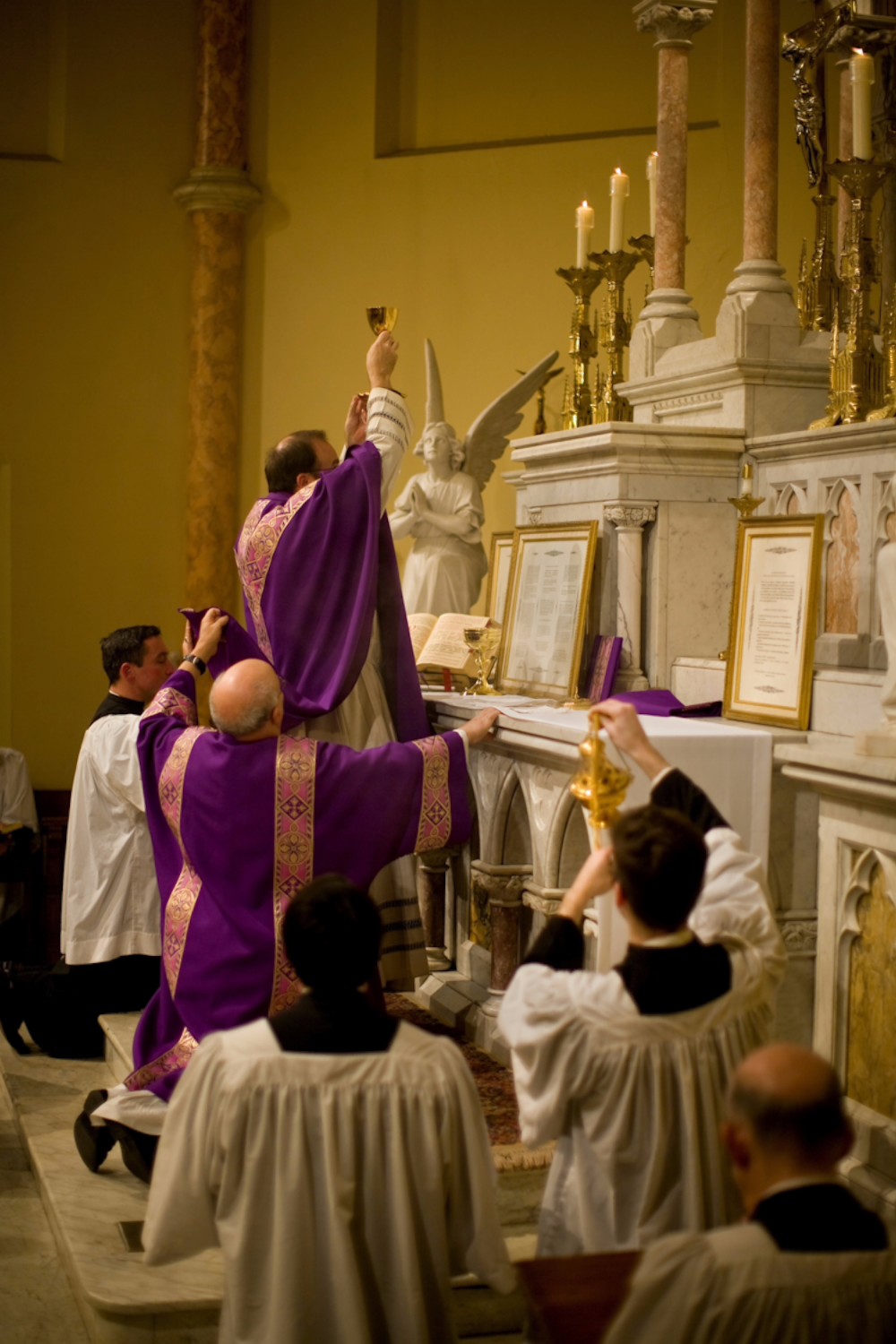
It was almost 15 years ago. I was At Old St. Mary’s here in D.C. celebrating Mass in the Latin (Extraordinary Form). It was a solemn high Mass. I don’t suppose I thought it any different than most Sunday’s but something quite amazing was about to happen.

As you may know the ancient Latin Mass is celebrated  “ad orientem” (towards the Liturgical East). Priest and people all face one direction. What this means practically for the celebrant is that the people are behind him. It was time for the consecration. The priest is directed to bow low, his forearms on the altar table the host between his fingers. As directed I said the venerable words of Consecration in a low but distinct voice, Hoc est enim Corpus meum (For this is my Body). The bells rang as I genuflected, but behind me a disturbance of some sort, a shaking or rustling in the front pews behind me to my right. And then a moaning or grumbling. What was that? It did not really sound human, more like the grumbling of a large animal such as a boar or a bear, along with a plaintive moan that did not seem human. I elevated the host and wondered, “What was that?”  Then silence. I could not turn to look easily for that is awkward for the celebrant in the ancient Latin Mass. But still I thought,  What was that?

But it was time for the consecration of the Chalice. Again, bowing low and pronouncing clearly and distinctly but in a low voice:  Hic est enim calix sanguinis mei, novi et æterni testamenti; mysterium fidei; qui pro vobis et pro multis effundetur in remissionem pecatorum. Haec quotiescumque feceritis in mei memoriam facietis (for this is the cup of my Blood, of the new and eternal covenant; the mystery of faith; which will for the many be shed unto the remission of sins. When so ever you do this, you do it in my memory). But then, I heard another sound this time an undeniable moan and then a shriek as some one cried out: “Leave me alone Jesus! Why do you torture me!” Suddenly a scuffling as some one ran out with the groaning sound of having been injured. The back doors swung open, then closed. Then silence.

I could not turn to look for I was raising the Chalice high over my head. But I knew in an instant that some poor demon-tormented soul had encountered Christ in the Eucharistic and could not endure his real presence displayed for all to see. And the words of Scripture occurred to me: Even Demons believe and tremble (James 2:19).

But just as James used those words to rebuke the weak faith of his flock I too had to repent. Way was a demon-troubled man more aware of the true presence and astonished by it than me? He was moved in the negative sense to run. Why was I not more moved in a positive and comparable way? What of the other believers in the pews? I don’t doubt that any of us believed intellectually in the true presence. But there is something very different and far more wonderful in being moved to the depth of your soul! It is so easy for us to be sleepy in the presence of the Divine, forgetful of the miraculous and awesome Presence available to us.

But let the record show that one day, almost 15 years ago, it was made quite plain to me that I held in my hands the Lord of Glory, the King of heaven and earth, the just Judge and Ruler of the kings of the earth. Is the Lord truly present in the Eucharist? You’d better beleive it, even demons believe that!

On the”Beauty”of Dying

As a priest it has been my privilege to accompany many on their final journey as they prepare for death. Some have gone quickly others have lingered for years in nursing homes. From a pure worldly perspective death seems little less than a disaster and a cause for great sadness. But from a perspective of faith there is something “beautiful” going on. I know you may think it bold that I describe it this way but in the dying process something necessary and beautiful is taking place. It is born in pain but it brings forth gifts and glory if we are faithful.

In particular I see two scriptures essentailly fulfilled in many who are dying.

  1. And Jesus said, “Unless you change and become like little children you will never enter the kingdom of heaven” (Matt 18:3). When I walk the halls of nursing homes I behold a rather astonishing thing: Men and women who raised families, ran businesses, protested bravely in the Civil Rights Movement, fought wars, gave sage advice to their children, commanded respect in their workplace and communities, most of these have become like little children. Some can no longer walk, some need to be fed, some cry and need consolation, some hold dolls, many wear diapers, some can no longer talk, many need constant care. “Ah, how tragic,” the world says. But an increasing part of me sees a beauty,  for they are changing and becoming like little children. A kind of innocence is being restored and a complete dependence without which they may never make it to heaven. Now their status as little children is fully evident and theybecome humble enough for heaven. Painful but beautiful, very beautiful. A very dear friend of mine died a couple of years ago. Catherine had been the Pastoral Associate and business manger of the parish of my first pastorate. I depended on her for practically everything and she knew just about everything, having been at the parish for over 50 years. Rather suddenly she came down with a rare and aggressive form of Alzheimer’s disease. Within 6 months of diagnosis she no longer remembered anyone. And yet there was a childlike joy that came over her. She had a favorite doll she hugged close and when I would walk in the room she would light up. She no longer recognized me as far as I could tell but she loved company. And she would sing, without clearly understood words but it seemed a kind of childlike nursery song. A remarkable thing to see. Here was a woman I had so thoroughly depended on now in such a state. But she was happier than I had ever seen her. She had become like a little child and it was clear  that God was preparing her for heaven. That was a gift, though a painful one.  And another great gift was this: Almost to her last day she never failed to recognize Jesus in the Eucharist. Long after she had stopped recognizing anyone else she still received communion with great devotion. She might be humming or looking around but as soon as I reached in my pocket for the pyx, she stopped, looked and made the sign of the cross and folded her hands. That was years of training and faithfulness. It was a beautiful testimony of her undying faith in the Eucharist and her last lesson to all of us.
  2. There is only one thing I ask of the Lord, this alone I seek, that I may dwell in the house of the Lord all the days of my life and gaze on the beauty of the Lord within his temple.(Psalm 27:4)  Now I suppose most of us who are still healthy and reasonably active would have a hard time really praying this prayer absolutely. The fact is we want a lot of things: a pay increase, creature comforts, good health, for the project we are working to go well, and yes, somewhere in all that, God too and heaven, but later. You understand, heaven can wait. And yet how obtuse our desires can be. It’s really quite strange to want anything more than God and heaven, but, fact is, many struggle to want God more than the things of this earth. Somehow God has to gently purge us of earthly desires so that, little by little, all we want is Him. And here too the dying process is so important and beautiful. Little by little in life we give back to God our abilities, our health, many of our loved ones. And finally we are led to that place in our dying days when we are given the grace to give everything back. I remember my father saying to me in his final weeks, “I just want to be with God.” I heard my grandmother say that too and many other I have accompanied on their final journey,  “I just want to be with God.” And they meant it too. It wasn’t  a slogan now. They had given everything back, their treasure was now in heaven. They had sold all they had for the “pearl of great price.” Now they could sing the words of the old spiritual: “You may have all this world, just give me Jesus.” For just about all of us it will take the dying process to get us to the place where we too can say, “There is only one thing I ask of the Lord, this alone I seek, that I may dwell in the house of the Lord all the days of my life and gaze on the beauty of the Lord within his temple.”

And so there it is, the “beauty” of dying. It is a strange and painful beauty to be sure but it is beautiful nonetheless. In an age of euthanasia that sees no purpose, no value in the dying process, we do well to behold and proclaim its strange but true beauty. We ought not fail to recognize the dignity of the dying who fulfill scripture as they make their final passage. Surely we grieve but through faith we also perceive a strange and wonderful beauty.

One of the finest hymns about dying was written by Henry F. Lyte in 1847. He wrote this as he approached his own death from tuberculosis:

  • Abide with me; fast falls the eventide;
  • The darkness deepens; Lord, with me abide;
  • When other helpers fail and comforts flee,
  • Help of the helpless, oh, abide with me.
  • Swift to its close ebbs out life’s little day;
  • Earth’s joys grow dim, its glories pass away;
  • Change and decay in all around I see—
  • O Thou who changest not, abide with me.
  • Hold Thou Thy cross before my closing eyes;
  • Shine through the gloom and point me to the skies;
  • Heav’n’s morning breaks, and earth’s vain shadows flee;
  • In life, in death, O Lord, abide with me.

The Paradoxes of True Freedom

In our age freedom is a distorted and detached concept, a kind of abstraction. There is little connection of freedom to responsibility , to the common good or to truth.  To the modern world freedom is essentially understood as “the ability to do whatever I please.”  Now the absurdity of such a definition is usually evident in our time as my radical freedom bumps up against your radical freedom and suddenly we’re demanding laws!

For a Christian however freedom is the capacity or ability to obey God. Now this is paradoxical to be sure, especially for the modern world where obedience and freedom aren’t usually linked. But for the Christian, sin is slavery and the truth which God reveals sets us free. Consider these quotes from the catechism:

The more one does what is good, the freer one becomes. There is no true freedom except in the service of what is good and just. The choice to disobey and do evil is an abuse of freedom and leads to “the slavery of sin.” (Catechism of the Catholic Church # 1733)…By deviating from the moral law man violates his own freedom, becomes imprisoned within himself, disrupts neighborly fellowship, and rebels against divine truth (1740)

Consider too the words of the Lord who said,   Truly, truly, I say to you, every one who commits sin is a slave to sin. …[But] if the Son makes you free, you will be free indeed. (John 8:34-35)

The first paradox of freedom is that true freedom is experienced only in relation to what is good and true.

  1. It does not take us long to see how enslaving sin can be. There are bad habits, addictions, compulsions and tendencies that set in as we dabble in sin and these can be very hard to break. We may march under the banner of doing what we please but before long we have to do what our unruly passions demand and it becomes hard to break sin’s hold.
  2. True freedom is the capacity to obey God, to do what is right, to be free to speak the truth courageously, to have the capacity to be chaste, self-controlled, to have authority over our anger and other passions, to have the power to forgive, this is what it really means to be free.

The second paradox of freedom is that, since we are contingent and limited beings,  we can only experience freedom within parameters and by limiting our freedom to a certain extent:

  1. For example suppose I were to demand freedom from laws of  gravity. Suppose I simply wished to reject the limits that gravity imposed on me and in an act of revolutionary freedom and defiance stepped off a tall building. It would surely be the last act of freedom I ever exercised. Only by accepting the parameters of gravity can I really be free. To deny the truth of gravity and act as though it were irrelevant not only enslaves, it kills.
  2. Take another example. I am free to speak and communicate with you, but only if I stay within the limits of grammar, vocabulary, punctuation and so forth. In general with Americans I must limit myself to English properly spoken. Can you read this sentence: open to went found they they it the when was tomb?  Of course you cannot make sense of this “sentence” since the word order is so garbled. So, to be free to communicate with you I have to accept some of the rules of word order. Now at least these were  all intelligible words but what if I were to demand the ability to use whatever words and letters I wanted, whatever punctuation and so forth. Can you read this sentence: bey 887q99y0 eh ‘[;0! you to dsfhi piyt! ??  Of course you cannot read it. It may mean something to me, but I cannot really be free to communicate with you unless I accept some limits that language imposes and operate within them .
  3. Yet another example is driving. I am only free to drive if I operate within basic traffic laws and so do others. Unless we all agree to limit our freedom to drive anywhere at any speed in any direction, we really are not free to drive, there is simply too much chaos to get anywhere. Freedom is exercised only within limits.

The Third paradox of freedom is that my freedom today often exists due to prior constraint:

  1. I am free to play the piano today only because I constrained myself to years of practice. I limited my freedom to go out and play and disciplined myself to practice.
  2. I am free to spend money today only because I previously constrained myself to earn it and save it.
  3. I am healthy and in good shape today only because I limited my food intake and exercised regularly.

The Fourth and religious paradox of freedom is that we are only free by becoming slaves and servants of God:

  1. John 8:36 So if the Son sets you free, you will be free indeed.
  2. John 8:32 Then you will know the truth, and the truth will set you free.”
  3. Rom 6:17 But thanks be to God that, though you used to be slaves to sin, you wholeheartedly obeyed the form of teaching to which you were entrusted. You have been set free from sin and have become slaves to righteousness….20 When you were slaves to sin, you were free from the control of righteousness. What benefit did you reap at that time from the things you are now ashamed of? Those things result in death! But now that you have been set free from sin and have become slaves to God, the benefit you reap leads to holiness, and the result is eternal life.
  4. 1 Peter 2:16 Live as free men, yet without using your freedom as a pretext for evil; but live as servants of God.

Conclusion: the absolute and detached freedom imagined by the world does not exist. Insisting on freedom without any connection to what is good and true does not free, it enslaves. True freedom exists within boundaries and guard rails. Some things must be held constant and unyielding if there is to be freedom. There must be some rules or freedom breaks down and is crushed by anarchy, chaos and power struggle. In the end, what makes us truly free is to obey the Father. This frees us from the slavery of sin and gives the capacity to obey God. Anything less is the slavery of sin.

Archbishop Wuerl’s Op-Ed in today’s Washington Post

D.C.’s same-sex marriage bill: Finding the right balance

By [Archbishop] Donald W. Wuerl

Washington

One year ago, I stood with city leaders on a hill in Northeast as we broke ground for affordable housing in the District. When the St. Martin’s Apartments are completed, nearly 200 low-income families and individuals will get a fresh start on life in a wonderful example of the type of effective public-private partnerships the residents of our nation’s capital need.

 St. Martin’s is being developed by Catholic Charities, on land owned by the Catholic Church and with funding sources that include the District of Columbia.

 Catholic Charities and the Archdiocese of Washington are committed to continuing to serve the people of the District as we have for many decades. That includes partnerships such as St. Martin’s. Unfortunately, the D.C. Council is considering legislation that could end these kinds of partnerships.

It doesn’t need to be that way. While we do not agree with the council on redefining marriage, we recognize that it is firmly committed to opening marriage to homosexual couples. We are asking that new language be developed that more fairly balances different interests — those of the city to redefine marriage and those of faith groups so that they can continue to provide services without compromising their deeply held religious teachings and beliefs. The Archdiocese is not alone in this request. Other groups, including the American Civil Liberties Union, the InterFaith Conference of Metropolitan Washington and nationally recognized legal scholars all called for stronger protections for religious freedom in their testimony on the bill.

 For the Archdiocese and Catholic Charities, two core tenets of our faith are at the heart of our concerns: our understanding of the nature of marriage and our commitment to expressing Christ’s love through service to others. Under the legislative language before the D.C. Council, the Archdiocese would be forced to choose between these two principles. The archdiocese has long made clear that all people have equal dignity, regardless of sexual orientation. But marriage is reserved for husband and wife because of its essential connection with the creation of children.

 The proposed legislation offers little protection for religious beliefs, including no protections for individuals, as is required under the federal Religious Freedom Restoration Act. Under the bill, religious organizations would be exempt from participating in ceremonies or from teaching about same-sex marriage in religion classes and retreats in accord with their faith beliefs, but they would be required to recognize and promote same-sex marriage everywhere else, including in employment policies, and adoption and foster-care policies, against their  beliefs.

 So what does this mean?

 The Archdiocese and Catholic Charities are committed to continuing to provide services in the District. Despite the headlines, there has been no threat or ultimatum to end services, just a simple recognition that the new requirements by the city for religious organizations to recognize same-sex marriages in their policies could restrict our ability to provide the same level of services as we do now. This is so because the District requires Catholic Charities to certify its compliance with city laws when applying for contracts and grants. This includes contracts for homeless services, mental health services, foster care and more. Since Catholic Charities cannot comply with city mandates to recognize and promote same-sex marriages, the city would withhold contracts and licenses.

 Each year, 68,000 people in the District rely on Catholic Charities for shelter, nutrition, medical and legal care, job training, immigration assistance, and more. This assistance is offered to whoever needs it, regardless of race, religion, gender, nationality or sexual orientation. Many of the programs are offered in partnership with the city, which turns to Catholic Charities and other ministries when it cannot provide social services on its own. Catholic Charities has a proven track record of high-quality service, supported through caring, qualified staff, thousands of dedicated volunteers and millions of dollars in financial support from parishioners all over the region. This legislation won’t end Catholic Charities’ services, but it would reduce unnecessarily the resources available for outreach.

 We recognize that the council is likely to legalize same-sex marriage. It is the hope of the Archdiocese and Catholic Charities that council members will work with us to find a way to better balance interests so religious organizations that have served this city well for many decades may continue to provide services without compromising the tenets of their faith.

 The writer is Archbishop of Washington.  

Delight in the Dies Irae!

I am of the mind that we set aside a great treasure and masterpiece when the sequence hymn for funeral Masses, Dies Irae got the boot some forty years ago. I know it was a “heavy” hymn with a sobering message, but it sure was glorious. The gorgeous chant was one of the more beautiful and soaring melodies of Gregorian Chant and manycomposers such as Mozart and Verdi set the text to stirring musical compositions.

Ah the Dies Irae!  It’s syllables hammering away in trochaic dimeter: Dies irae dies illa solvet saeclum in favilla, teste David cum Sybila! (Day of wrath that day when the world dissolves to ashes, David bears witness to it along with the Sibyl!) Many came to think it a theme too dark and sobering for the modern funeral. Perhaps at times it is a bit heavy but at the same time no hymn more beautifully sets forth a basis for God’s mercy. The dark clouds of judgment part and give way to the bright beauty of the final line Pie Jesu Domine, dona eis requiem (Sweet Jesus Lord, give them [the dead] rest).

The hymn was not composed for funerals. Actually it was composed by Thomas of Celano in the 13th century as an Advent Hymn. Yes, that’s right an Advent hymn. Don’t forget that Advent isn’t just about getting ready for Christmas, it is about getting ready for the Second Coming of the Lord. And that is what this hymn is really about. At this time of year, as the the leaves fall and summer turns to winter, we are reminded of the passing of all things. The Gospels we read are those that remind us of death and the judgment to come.

Journey with me into the beauty and solemn majesty of this hymn. I will give you an inspiring English translation by W J Irons, one that preserves the meter and renders the Latin close enough. A few comments from me along the way but enjoy this largely lost masterpiece and mediation on the Last Judgment. (You can see the Latin Text along with English here: Dies Irae)

The hymn opens on the Day of Judgement warning that the day will reveal God’s wrath upon all injustice and unrepented sin. God’s wrath is his passion to set things right. And now it is time to put an end of wickedness and lies:

    • Day of wrath and doom impending,
    • Heaven and earth in ashes ending:
    • David’s words with Sibyl’s blending.

And all are struck with a holy fear! No one  and no thing can treat of this moment lightly: all are summoned to holy fear. The bodies of the dead come forth from their tombs at the sound of the trumpet and will all of creation answer to jesus, the Judge and Lord of all:

    • Oh what fear man’s bosom rendeth
    • When from heaven the judge descendeth
    • On whose sentence all dependeth!
    •  
    • Wondrous sound the trumpet flingeth,
    • Through earth’s sepulchers it ringeth,
    • All before the throne it bringeth.
    •  
    • Death is struck and nature quaking,
    • All creation is awaking,
    • To its judge an answer making.
    •  
    • Lo the book exactly worded,
    • Wherein all hath been recorded,
    • Thence shall judgement be awarded.
    •  
    • When the Judge his seat attaineth,
    • And each hidden deed arraigneth:
    • Nothing unavenged remaineth.

Judgment shall be according to our deeds, whatever is in the Book  (Rev 20:12; Romans 2:6)! Ah but also in God’s Word is the hope for mercy and so our hymn turns to ponder the need for mercy and appeals to God for that mercy:

    • What shall I frail man be pleading?
    • Who for me be interceding?
    • When the just are mercy needing?
    •  
    • King of majesty tremendous,
    • Who does free salvation send us,
    • Font of pity then befriend us.
    •  
    • Think kind Jesus, my salvation,
    • Caused thy wondrous incarnation:
    • Leave me not to reprobation.
    •  
    • Faint and weary thou hast sought me:
    • On the cross of suffering bought me:
    • Shall such grace be vainly brought me?
    •  
    • Righteous judge for sin’s pollution,
    • Grant thy gift of absolution,
    • Before the day of retribution.
    •  
    • Guilty now I pour my moaning:
    • All my shame and anguish owning:
    • Spare, O God my suppliant groaning.
    • Through the sinful Mary shriven,
    • Through the dying thief forgiven,
    • Thou to me a hope has given.

Yes there is a basis for hope! God is rich in mercy and, pondering the Day of Judgment is salutary since for now we can call on that mercy. And, in the end it is only grace and mercy that can see us through that day:

    • Worthless are my tears and sighing:
    • Yet good Lord in grace complying,
    • Rescue me from fire undying.
    •  
    • With thy sheep a place provide me,
    • From the goats afar divide me,
    • To thy right hand do thou guide me.
    •  
    • When the wicked are confounded,
    • Doomed to flames of woe unbounded:
    • Call me with thy saints surrounded.
    •  
    • Lo I kneel with heart-submission,
    • See like ashes my contrition:
    • Help me in my last condition.

 And now comes the great summation: That Day is surely coming! Grant me O lord your grace to be ready:

    • Lo, that day of tears and mourning,
    • from the dust of earth returning.
    • Man for judgement must prepare him,
    • Spare O God, in mercy spare him.
    •  
    • Sweet Jesus Lord most  blest,
    • Grant the dead eternal rest.

A masterpiece of beauty and truth if you ask me. Some years ago I memorized most of it. I sing it from time to time over in Church late at night, the hauntingly beautiful chant rings through the echoing arches of our Church. When I die sing it at my funeral!  For I go to the Lord, the judge of all and only grace and mercy will see me through. Perhaps the plaintive calls of the choir below at my funeral will resonate to the very heavens as I am judged. And maybe the Lord will look at me and say,

    • I think they’re praying for you down there, asking mercy.”
    • “Yes, Lord, mercy.”
    • “They’re making a pretty good case.”
    • Yes Lord, mercy.
    • Then mercy it shall be

Amen.

Dies Irae from elena mannocci on Vimeo.

Catholicism and Car Sales

OK Y’all, there’s been some heavy weather here on the blog of late and it’s time for a little humor. The following video is a little glimpse into the humorous culture of Catholicism.

I want to say that I sometimes feel like the Deacon salesman in this video as I try to get people back to sacraments and regular Church attendance! I also remember that, some years ago, in the Catholic Standard, our Archdiocesan Newspaper, a certain Deacon who was also a car dealer used to advertise each week. He loved to point out that he was a permanent Deacon at such-and-so a parish. There was more than a hint in his add that he had a special deal for practicing Catholics: An outrageously low price for a new or used car! Just bring a Church Bulletin and get the discount!  Hey,  why not. I think if I’d been in the market for a car I might of just paid him a visit!

Anyway, enjoy this rather humorous and well done video.

The Forgotten Principle of Social Justice

In many discussions of Catholic Social Justice Teaching, the principles of solidarity and subsidiarity are often prominent. Solidarity is the principle wherein I am my brother’s keeper and I cannot simply ignore the needs of others or injustices experienced by them. When others suffer I suffer too. When others are treated unjustly so am I. Hence I am compelled to act on behalf of others who suffer actual injustice or who experience poverty. Subsidiarity is the principle wherein we ought to solve these social ills and injustices at the lowest level possible. Making everything a “federal case” is not wise and can lead to worse injustices and to a loss of legitimate freedom. Further “biggie-wow”  solutions are often impersonal and often ill suited to the particular needs of a given community. Some problems do require federal Government solutions but others are better suited to state, local, church or family based solutions.

But a third principle in the Catechism is almost never mentioned and that is the principle of the “Universal Desintation of Goods.”  The Catechism treats of this principle under its analysis of the 7th Commandment not to steal. Here is what it has to say:

In the beginning God entrusted the earth and its resources to the common stewardship of mankind to take care of them, master them by labor, and enjoy their fruits. The goods of creation are destined for the whole human race. … The appropriation of property is legitimate for guaranteeing the freedom and dignity of persons and for helping each of them to meet his basic needs and the needs of those in his charge. It should allow for a natural solidarity to develop between men. [But] the right to private property, acquired or received in a just way, does not do away with the original gift of the earth to the whole of mankind. The universal destination of goods remains primordial, even if the promotion of the common good requires respect for the right to private property and its exercise. [Hence] in his use of things man should regard the external goods he legitimately owns not merely as exclusive to himself but common to others also, in the sense that they can benefit others as well as himself.”The ownership of any property makes its holder a steward of Providence, with the task of making it fruitful and communicating its benefits to others, first of all his family. (CCC # 2402-2404)

So in effect, all the goods of this earth belong to all the people of this earth. We need to uphold the concept of private property which is an efficient way to deploy the goods of this earth and link them to to an enlightened self-interest. But we cannot allow private property to overrule the more basic truth that everything belongs to God and it is his will that his property benefit all. Hence, whatever I have I ought to use to benefit others, beginning with my family but not ending there. Maybe it is raw capital or entrepreneurial opportunities that I can turn into job opportunities for others. Maybe it is savings that I consistently set aside for my kids college one day, maybe it is simply the fact that I have money to spend which then enters the economy and creates markets which create jobs and incomes for others. But the bottom line is that my money is not simply my money. My talents are not simply my talents. My gifts are not simply mine. All these are given to me not only for me but for others. If I have two coats, perhaps one belongs to the poor. If I have excess money perhaps it can benefit others. This need not be in a simplistic sort of way which merely gives it away indiscriminately. Perhaps I can invest in way that helps it grow so that, down the line even more can benefit. But the bottom line is that I should be thinking that this money, or these talents, or these things are not just mine. How can I use them to benefit others and to create greater opportunities?

Now here comes the tough point. To fail significantly in any of these regards is a form of theft! First of all we rob God. All the things we have really belong to him. Now if I use his stuff in ways that he doesn’t approve, in ways that are against his will, I am stealing from him. Suppose you loan me your car to go to the store nearby. Fine, no theft there. But now suppose I took your car and started drag racing with it. Or suppose I decided to use it to go off to California for a trip. Now this would be theft since you did not give me your car to use with any of this in mind. To use your things against your will is a form of theft. Well, if God gives us his creation to use then it is clear if I start hoarding it, or refuse to use it for the good of others in some way then it is clear I am using his things against his will. I am stealing.

Further, I am stealing from the poor who have a rightful claim to some of what I have. Wait a minute you say, they didn’t earn it! Well, what the Catechism says is that it belongs to them in the first place since God gave all the good of the earth for all the people of the earth. It is true that we should be able to benefit from the work we do and that there is such a thing as earning and enjoying the fruits of our labor. This is just but it cannot ultimately cancel the fact that everything I have belongs to God and that he intends for everyone to enjoy the fruits of this world. If I have two coats, one of them belongs to the poor and I ought to generously return it to its owner.

Please understand neither I nor the Catechism is denying personal property rights. But what the principle of the universal destination of all goods does is to balance, not cancel, personal property rights. No one, especially the government,  ought to be able to come and merely take your stuff. It’s yours viz a viz them. However, we ought to be more mindful that what I have is not absolutely mine. It is all God’s and he intends for the poor and needy to be blessed as well.

So, when was the last time you thought that everything you “have” really belongs to God. When have you thought to ponder what God might have you do with all “your stuff?” When was the last time you looked into your closet and thought, “A lot of this stuff really belongs to the poor?”

Think about it. Remember its about balance. It’s not communism, or socialism or that the State should control things. It’s NOT about there being no such thing as private property. There is private property. But it is about balance, like most things orthodox. Its about remembering to balance the concept of “my stuff” with the concept that it’s really God’s stuff and that some of it belongs to the poor by God’s will who gave everything for all.

Fr. Barron does a pretty good job of sorting all this out as he reviews the latest (crazy) Michael Moore movie.