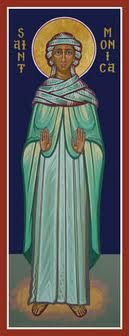
Today we celebrate the feast of Saint Monica, mother of Augustine and Patroness of all mothers who storm heaven on behalf of their sons and daughters. Monica was born in 332 in Thagaste, North Africa. She was born into a Christian home and practiced her faith seriously. She had a particular devotion to the martyrs who lives were a source of strength for the Christians of her day.
In re-reading the life of Monica, I was struck by a quote of Augustine in the Confessions. Augustine writes “She did not die sadly nor did she die completely” (IX, 12). What a pithy way to get at the heart of the Christian experience of dying. Death is not the end of the story for those who love God. It seems to me from reading of Monica’s life that she seemed rather peaceful and confident in facing death. I think it was her devotion to the Eucharist that prepared her for death. It is in every celebration of the Eucharist that the church on earth and the church in heaven are united in praise of God (loosely quoted from the Catechism). So, while dying with the finality that marks the end of life on earth, it is in this very death that the seeds of new life begin. They are seeds that have been planted in the way in which we live. Augustine prays.
But you, O God of mercy, would not despise the contrite and humble heart of that chaste and pious widow, so generous in giving alms, so prompt in serving Your saints, who never let a day pass without assisting at the sacrifice of Your altar, and came twice daily, morning and evening without fail, to Your church…that she might hear You in your preaching and You her in her prayers. (Confessions, V, 19).
Perhaps the best way we can celebrate the feast of St. Monica is to pray for and if possible, call or visit our mothers, who in many cases are our first and most influential teachers of the faith!
In my over 21 years as a priest and even longer in serving in some capacity at the Holy Liturgy I have seen more than a few people faint. Some just slump over, others go over with a real bang. Weddings are a big source of fainting spells but just about any long Mass can produce its share of a “lights out” experience. Last year I was serving as First Assistant Deacon for a Pontifical Solemn High Mass in the Basilica and prior to the Mass we predicted at least some one would pass out. It’s usually one of the torch bearers since they have to kneel on the marble for so long. Sure enough right at communion time, one of them went over, torch and all. It wouldn’t be a valid solemn High Pontifical Mass if at least one didn’t pass out!
OK, so what’s going one here? Are people overwhelmed by the presence of God and then just “rest in the Spirit?” Well, that’s a fine thought and I perhaps I should just stop the article here out piety. However, beyond the this holy thought there are probably other explanations.
It could be the heat in some churches which causes dehydration. Dehydration then causes there to be a lower volume of blood which causes the pressure to drop and makes it harder to get the blood to the brain and out you go.
Anemia – Some women have borderline anemia especially at certain times of their cycle and this reduces the number of red blood and thus reduces the ability of the blood to deliver oxygen to the brain and, especially after standing a while or getting a little dehydrated, out you go.
Stress – In order to maintain proper blood pressure there must be a proper balance between two chemicals: adrenaline and acetylcholine. Adrenaline stimulates the body, including making the heart beat faster and blood vessels narrower, thereby increasing blood pressure. Acetylcholine does the opposite. Fainting can happen when something stimulates the vagus nerve and causes too much acetylcholine to be produced at the wrong time. Pain can do this, so can “situational stressors” such as something like seeing blood or just prolonged stress that often happens at funerals or weddings. Such things cause too much acetylcholine to slow the heart, dilate the blood vessels, pressure drops more than it should, blood can’t reach the brain and out you go.
Standing for a length of time can also cause the blood to collect a bit in the lower legs. The movement of the blood back from the limbs is assisted by the movement of those limbs. I was always taught never to lock my knees when I was standing since this slowed blood flow and made blood accumulate in the legs. More blood in the legs means less blood that can go to the brain and out you go. It is important when standing to slightly bend the knees a bit and to allow for some movement of the legs by shifting your weight. This improves circulation and keeps the pressure at a proper level to get blood up to the brain. The same is true with kneeling.
In some cases low blood sugar can cause one to faint. The brain requires blood flow to provide oxygen and glucose (sugar) to its cells to sustain life. Hence excessively low blood sugar can cause one to feel drowsy, weak and in some cases to faint, especially if some of the other factors are present. Hence if one has been fasting (rare today!) before communion and also has a tendency to be hypoglycemic it is possible one can faint.
There are surely other causes, (some of them very serious but more rare) but let this suffice. It would seem that Masses and Church services are over-represented in the fainting department due to any combination of the above, especially: stress, dehydration, and standing or kneeling for long periods.
It is surely a weird experience to faint. I have done it a number of times related to an asthmatic cough I often get. When an extreme coughing episode ensues the rhythm of the heart is disturbed, blood pressure drops and out you go. It is a very strange experience to just see everything fade to black, the lights just go out and sometimes I can even feel myself falling but can do little about it. I just hope I fall gracefully 🙂 I usually come to a moment or so later but it is strange to say the least. Our brains go only go without blood (oxygen) for a few seconds before unconsciousness envelopes and out you go.
We are wonderfully, fearfully made to be sure. And yet we are earthen vessels, fragile and in need of delicate balance. We are contingent beings, depending on God for every beat of our heart, and His sustaining of every function of every cell of our body. Maybe fainting in Church isn’t so bad since it helps keep us humble and that is always a good “posture” before God. Maybe before the immensity of God it is good to be reminded of our fragility and dependence upon Him for all things, even the most hidden processes of our body.
Enjoy this video of Church faintings and consider well that “To be absent from the body is to be present to God.” (2 Cor 5:8)
Over 21 years ago as I was finishing seminary and about to be ordained my spiritual director gave me some advice on seeking a new spiritual director in my diocese. “Look for some one who has suffered,” He said. At the time I wondered about this but have come to find that it was true.
Suffering brings a profound wisdom if it is endured with faith. I have also discovered this in my own life. As much as I have hated any suffering I have endured I have to admit it has brought gifts in strange packages. Through it I discovered gifts and strengths I did not know I had. Through it I experienced things I would have avoided. Through I learned to seek help and not depend so much on myself. Through it I became better equipped to help others in their struggles. Through suffering my faith grew and so did my compassion and generosity for others who have struggled.
The scriptures say that “A broken humbled heart the Lord will not scorn” (Ps 51). A few years ago my spiritual director shared a strange saying with me: Everything needs a crack in it, that’s how the light gets in.” Yes indeed, the light gets in through a broken heart, a heart with fissures or openings. Rarely does the light get in through a perfect wall, a perfect and strong barrier.
This is a painful truth to be sure and it makes me want to run. But in the end I have learned that it is true. God has done more with my brokenness than my strength. And, in a paradoxical way, my brokenness has become more and more my strength. I wonder if you have experienced the same? Where would we be without our crosses and sufferings? What do we have of true value that has not come at the price of suffering?
Let me get out the way and let a Saint explain it. This is from St. Rose of Lima whose feast we celebrated yesterday. This is an excerpt of what was in the breviary:
Our Lord and Saviour lifted up his voice and said with incomparable majesty: “Let all men know that grace comes after tribulation. Let them know that without the burden of afflictions it is impossible to reach the height of grace. Let them know that the gifts of grace increase as the struggles increase. Let men take care not to stray and be deceived. This is the only true stairway to paradise, and without the cross they can find no road to climb to heaven.”
When I heard these words, a strong force came upon me and seemed to place me in the middle of a street, so that I might say in a loud voice to people of every age, sex and status: “Hear, O people; hear, O nations. I am warning you about the commandment of Christ by using words that came from his own lips: We cannot obtain grace unless we suffer afflictions. We must heap trouble upon trouble to attain a deep participation in the divine nature, the glory of the sons of God and perfect happiness of soul.”
Suffer well fellow Christians. Beg deliverance to be sure but realize that even in the delay of relief, God is up to something good.
One of my favorite stages in the lives of my nieces and nephews is when they start putting the family connections together. That “Grand pop” is Dad’s father, that I and their dad are siblings who were once little kids. Of course, they find these ideas to be some of the craziest things they ever heard. Imagine, “dad” as a little kid! For days they will announce each relationship. The phone rings and they say “Dad, it’s your sister, Aunt Susan,” or they will ask someone who walks into the gathering, “Hey, did you know that when Mom was little, her mother was Grand mom?” They love tracing all of the relationships and it inevitably leads to questions about where we grew-up, where we went to school, who else is related to us. At some point, out comes the photo album and we marvel at how much Grand pop, when he was 12 looks like Daniel who is about to be twelve. It is these conversations that help a child find their place in the world; feel connected to a group of people who have influenced and them in ways that can’t always be seen. We are beginning to see a whole generation of kids who will never know their father or their father’s family. They may never learn that their passion for music has been shared by three generations of people before them, they may never know that their grandfather was also an all-star athlete or that their great-grandmother chose medicine as well. Dads, it seems are becoming optional.
Life according to Hollywood
This summer Hollywood is all about celebrating that dads are really not necessary in a child’s life. In two movies with huge stars, Jennifer Aniston, Annette Bening, Julianne Moore and Mark Ruffalo, the theme is the lives of children whose father’s origin is a donated sperm. In The kids are All Right, a brother and sister born of the same donor begin a search to find and meet their “dad.”
From the time that the movie came out, I was struck by the title “The Kids are All Right.” It seems to beg the question, “Might they not be all right? Or, did someone suggest that the kids are not“all right?” As is often typical with Hollywood, these movies want to promote a new norm. It is just fine for woman to choose motherhood as a single adult. If a mother can provide for all the child needs—who needs a father? In a recent interview Jennifer Aniston comments “Women are realizing more and more that you don’t have to settle, they don’t have to fiddle with a man to have that child.” While science makes that possible what science can’t change is that a child comes into the world with the imprint of a mother and father on his or her heart. It is not just that a child inherits certain physical features from Mom and Dad –I watched my brother and his son walk across a baseball field this summer and they walk exactly alike—they inherit a desire to be known by and to know mother and father.
Exactly how do you explain the “donor dad” concept to a child?
Any parent can tell you this is the case. I wish we would see more about how difficult it must be for those mothers who have to explain the concept of “donor dad” to a child who wants a Dad like the other kid’s dad. What you don’t see too much these days is social science supporting the idea that the best environment for children is a stable home with a mother and a father. The evidence is there in studies. In the early 1990’s, France commissioned a 33 member group panel to examine issues related to same-sex marriage and adoption by same-sex couples. The member organizations were not religious; they represented education, social service, mental health and government. The panel concluded that a child has a right to a mother and a father and so therefore laws ought to support the mother-father-child- construct as normative.
Studies paint a troubling picture
In a Wall Street Journal article dated June 18, W. Bradford Wilcox reports on more recent studies. Results of a study co-authored by Elizabeth Marquardt, Norval Glenn and Karen Clark, suggest that children are negatively impacted by the experience of being born of a “donor dad.” For example, 50% “feel sad” when they see “friends with their biological fathers and mothers.” In an article in the Washington Post, a few years ago, Katrina Clark writes about envying friends who have a biological mother and father. “That was when the emptiness came over me, I realized that I am in a sense a freak. I really truly would never have a dad. I finally understood what it meant to be a donor-conceived, and I hated it.”
What about the future of “donor dads”
I wonder also about the “donor dads” who probably have many reasons for participating in such a program; easy money, genuine interest in “helping” a woman out, or finding the idea of offspring for whom they have no responsibility appealing. I wonder however, if they give thought to the phone call that might come one day from the child looking for a relationship or as in the movie The Kids Are All Right points out meeting up with these young children who share some of your quirkiest habits. As much as five years ago on a news program, I saw a feature story about a group of kids in Colorado who were all the children of the same “donor dad.” They had formed a support group because they wanted to know their “siblings.” That to me is evidence of the innate desire to belong, to be family in a way they do not experience with a single-Mom. As much as I think being a sperm or egg donor is wrong, I feel for the “donor dads” and “donor-moms”. They did not sign-on to be in the lives of these kids, imagine what it must be like, twelve-fifteen-twenty years after the fact to be approached by a child who in their mind has called you “dad” or “mom.”
The wisdom of Catholic Moral Teaching
One of the beauties of Catholic teaching is that we do try to anticipate the consequence of moral actions on individuals and society, we say “no” in many cases because we see implications down the road that will be detrimental to everyone involved. In this case, we say “no” to protect a young person from an in the moment–seeing only an easy way to make quick and serious cash– (An Ivy League school alumni magazine posts want ads for donor eggs, offering as much as $10,000 dollars) and not really thinking about the child that will be born. We say “no” to protect a woman who may find at some point in her surrogate pregnancy that she does not want to give the child up, that she had no idea what it would mean to carry a child to birth for someone else. We say “no” to a decision that is so self-centered, it does not, in the moment, give full consideration to the still unborn child. How hard can it be to put ourselves in the position of a child who asks “who is my Dad” and imagine how crazy the “donor dad” answer will sound.
I’ve been reading a Book on the Spirituals (Wade in the Water: the Wisdom of the Spirituals by Arthur C Jones). Now the thing about the Spirituals is that they move your spirit for they come from the depths of souls deeply moved by God, by suffering and the joys and sorrows of life. Most of them came from the years of slavery and the Jim Crow oppression that emerged after slavery. Most of them are also sung in the Pentatonic Scale (a scale using five basic notes that equate to the black keys on the piano). Both these facts gave them a mournful quality at times that led some to call them “sorrow songs.” But to be fair, the spirituals embraced every human emotion and always summoned to hope. One of the most beautiful qualities of these spirituals is that, despite the oppression that gave rise to them there is no bitterness in them, no calls for retribution, only the reminder that judgment day was coming when God would set things right.
I want to take one of the Spirituals, give a little background and ask you to allow the spiritual to do its work by raising a question that can stir the soul. The basic text of this spiritual is very straight forward
Sometimes I feel like a motherless child, a long way from home.
Sometimes I feel like I’m almost gone. A long way from home.
True Believers. A long way from home.
A painful history gave rise to this plaintive spiritual. On the one hand it could apply to the slave who had been torn from his motherland of Africa and was now far from home. On the other hand it also referred to the devastation of a child torn from his parents at sold away in the salve auctions. Consider this testimony from an escaped slave, Harriet Jacobs:
One of these sale days, I saw a mother and seven children on the auction block. She knew that some of them would be taken from her; but they took all. The children were sold to a slave trader, and their mother was bought by [another] man in her own town. …She begged the slave trader to tell here where he intended to take them; this he refused to do….[for] he would sell them one by one whenever he could command the highest price. I met that mother on the street and her wild haggard face lives today in my mind. She wrung her hands in anguish and exclaimed, “Gone! All Gone! Why don’t God kill me?” I had no words wherewith to comfort her. Instances of this kind are of daily, yea, of hourly occurrence. (quoted in Wade in the Water, p. 18).
The mournful and plaintive cry of this spiritual which you can hear below is not just a song, not just a tune meant to entertain or pass the time. It is a sigh from the heart, an exhaling of the soul giving expression to the deepest grief a mother or child can know. And the grief is not just over the separation, but also over the fact that it was inflicted by someone who knew no pity, who disregarded the pain they heard as of no account.
And so here is the spiritual question we are left to ponder: What has happened in the heart of a human being who could inflict such pain and take no note of it, lose no sleep, not be dissuaded? And this question is not just of an historical brutality. Throughout this world to this day there are unspeakable cruelties inflicted on others by fellow human beings. There are tortures, murders, terrorism, intentional policies of starvation, the inflicting of devastating blows on others and those loved by them, most often without pity, with little thought as to the grief or pain that is caused. What has happened in the heart of a person who would do such things? How has it become so insensitive and hardened? I realize our minds may go to war here and understand that war is a complicated issue (Is the State killing people and breaking things or is it restoring justice and protecting the innocent). I am speaking here more of the heart of the individual who does such things to another human being. What has happened to them on the inside?
Here we are confronted with the mystery of evil. But it is a true fact that the human heart can be progressively hardened so that ordinary human kindness and pity melt away. God surely warns us of this: “See to it, brothers, that none of you has a sinful, unbelieving heart that turns away from the living God….[may] none of you may be hardened by sin’s deceitfulness…..As has just been said: “Today, if you hear his voice, do not harden your hearts as you did in the rebellion.” (Heb 3:12-15).
And there it is, somewhere in hardening process many stop listening to the voice of God, the conscience. They ignore the message of faith and disregard the humanity of others and fail to consider them as a brother or sister, sons and daughters of the same Father as they. They no longer identify with their suffering, are no longer moved by it, they have become hardened. Of them Jesus lamented: For this people’s heart has become calloused; they hardly hear with their ears, and they have closed their eyes. Otherwise they might see with their eyes, hear with their ears, understand with their hearts and turn, and I would heal them (Matt 13:14-16)
Here too former slave Harriet Jacob also spoke of the effects of slavery on the oppressors:
I can testify, from my own experience and observation, that slavery is a cures to the whites as well as to the blacks. It makes the white fathers cruel and sensual, the sons violent and licentious, it contaminates the daughters and makes the wives wretched….Yet few slave holders seem to be aware of the widespread moral ruin occasioned by this wicked system. Their talk is of blighted crops, not of the blight of their children’s souls. (quoted in Wade in the Water, p 20).
So the oppressed are not the only ones stripped of humanity and a “long way from home.” The oppressor too has to a great extent sinfully lost his humanity and become hardened by insensitivity and cruelty. And he is a long way from home, the home where God’s mercy and love reign supreme. Spirituals have a way of moving the spirit and asking questions that probe the depths.
What of us? Perhaps we have not murdered, broken families or sold people into slavery. But we are capable of very inconsiderate words, hurtful actions and sinful omissions. We are capable of no longer hearing the cry of the poor, no longer being moved by the troubled and burdened who feel like a motherless child, a long way from home. What of us? Spirituals have a way of asking spiritual questions.
There is a remarkable event that took place between the Emperor Theodosius and St. Ambrose, Bishop of Milan. What makes it remarkable is that it shows an ancient Bishop interacting with an ancient politician over the dignity of human life. In this case the politician was the Emperor and he had the power of life and death over Ambrose the Bishop. St. Ambrose knew he had to correct the Emperor but also knew this might endanger his life or freedom. Nevertheless he did it and wrote a personal letter of rebuke to the Emperor. Let’s look at this remarkable incident, what Bishop Ambrose did and what the outcome was.
The Offending Incident –Theodosius, Roman Emperor from 378 – 392 was in many ways and extraordinary Emperor. He had successfully dealt with the Goths and other tribes and brought greater unity to the troubled Empire in the West. But the Emperor was also famous for having a bad temper. In 390 AD in Thesolonica, a bad riot broke out which resulted in the death of the Captain of the Roman Garrison there. It seems a certain charioteer had become very popular with the crowds. Now he also lived a rather debauched life. This offended the Captain of the Roman Garrison, a Goth, and also a very upright and disciplined man. The name of the Garrison Captain was Botheric. He had the charioteer arrested for debauchery . The crowds in turn rose up in favor of the athlete and rioted. In addition to the arrest there may also have been ethnic jealously involved on both sides since the Roman Garrison was comprised largely of Goths and the town was largely Greek. In the riot Botheric, the Captain was killed.
When Theodosius heard of this he was incensed and his temper flared and he ordered the Roman Army to round up the whole town and place them in the stadium and have them all killed. 7000 were killed that day! The day after issuing the order when his temper had cooled Theodosius regretted his decision and sent another messenger to try and stop it but it was too late.
Theodosius was mortified and went to Milan to seek solace from St. Ambrose. But Ambrose, fearing the Church was just be used as a political prop or fig leaf left the city before Theodosius arrived and in effect refused to meet with the Emperor. This surely endangered Ambrose for it risked inflaming the Emperor’s infamous temper once more.
Ambrose then wrote to the Emperor a private letter (now known as Letter 51). You can read the whole letter here: http://www.newadvent.org/fathers/340951.htm The Letter is a respectful but clear call to public repentance by the Emperor and a refusal to admit him to the Holy Sacrifice of the Mass or to celebrate it in his presence until such public repentance had occurred. Here are excerpts:
The memory of your old friendship is pleasant to me, and I gratefully call to mind the kindnesses which, in reply to my frequent intercessions, you have most graciously conferred on others. Whence it may be inferred that I did not from any ungrateful feeling avoid meeting you on your arrival, which I had always before earnestly desired. And I will now briefly set forth the reason for my acting as I did…..
Listen, august Emperor. I cannot deny that you have a zeal for the faith; I do confess that you have the fear of God. But you have a natural vehemence [i.e. temper] , which….if any one stirs it up, you rouse it so much more that you can scarcely restrain it……Would that….no one may inflame it! …. restrain yourself, and overcome your natural vehemence by the love of piety….
This vehemence of yours I preferred to commend privately to your own consideration, rather than possibly raise it by any action of mine in public…..
There was that done in the city of the Thessalonians of which no similar record exists, which I was not able to prevent happening; which, indeed, I had before said would be most atrocious when I so often petitioned against it, and that which you yourself show by revoking it too late you consider to be grave, this I could not extenuate [i.e. minimize] when done. When it was first heard of….there was not one who did not lament it, not one who thought lightly of it; your being in fellowship with Ambrose was no excuse for your deed…..
Are you ashamed, O Emperor, to do that which the royal prophet David, the forefather of Christ, according to the flesh, did? ….he said: I have sinned against the Lord. Bear it, then, without impatience, O Emperor, if it be said to you: You have done that which was spoken of…. say: I have sinned against the Lord. If you repeat those words of the royal prophet: O come let us worship and fall down before Him, and mourn before the Lord our God, Who made us. [I]t shall be said to you also: Since you repent, the Lord puts away your sin, and you shall not die.
Holy Job, himself also powerful in this world, says: I hid not my sin, but declared it before all the people…..
I have written this, not in order to confound you, but that the examples of these kings may stir you up to put away this sin from your kingdom, for you will do it away by humbling your soul before God. You are a man, and it has come upon you, conquer it. Sin is not done away but by tears and penitence. Neither angel can do it, nor archangel. The Lord Himself, Who alone can say, I am with you, Matthew 28:20 if we have sinned, does not forgive any but those who repent….
I urge, I beg, I exhort, I warn, for it is a grief to me, that you who were an example of unusual piety, who were conspicuous for clemency…, The devil envied that which was your most excellent possession. Conquer him while you still possess that wherewith you may conquer. Do not add another sin to your sin by a course of action which has injured many.
I, indeed, though a debtor to your kindness, for which I cannot be ungrateful, that kindness which has surpassed that of many emperors…. but have cause for fear; I dare not offer the sacrifice if you intend to be present. Is that which is not allowed after shedding the blood of one innocent person, allowed after shedding the blood of many? I do not think so.
Lastly, I am writing with my own hand that which you alone may read….Our God gives warnings in many ways, by heavenly signs, by the precepts of the prophets; by the visions even of sinners He wills that we should understand, that we should entreat Him to take away all disturbances, to preserve peace for you emperors, that the faith and peace of the Church, whose advantage it is that emperors should be Christians and devout, may continue.
You certainly desire to be approved by God. To everything there is a time, Ecclesiastes 3:1 as it is written: It is time for You, Lord, to work. It is an acceptable time, O Lord. You shall then make your offering when you have received permission to sacrifice, when your offering shall be acceptable to God. Would it not delight me to enjoy the favor of the Emperor, to act according to your wish, if the case allowed it….when the oblation would bring offense, for the one is a sign of humility, the other of contempt. For the Word of God Himself tells us that He prefers the performance of His commandments to the offering of sacrifice. God proclaims this, Moses declares it to the people, Paul preaches it to the Gentiles. ….Are they not, then, rather Christians in truth who condemn their own sin, than they who think to defend it? The just is an accuser of himself in the beginning of his words. He who accuses himself when he has sinned is just, not he who praises himself.
…..But thanks be to the Lord, Who wills to chastise His servants, that He may not lose them. This I have in common with the prophets, and you shall have it in common with the saints….If you believe me, be guided by me…..acknowledge what I say; if you believe me not, pardon that which I do, in that I set God before you. May you, most august Emperor, with your holy offspring, enjoy perpetual peace with perfect happiness and prosperity.
Assessment – So here is a Bishop speaking the truth to the Emperor and calling him to repentance. Remember there were no laws protecting Ambrose from execution or exile for doing this. An Emperor could act with impunity doing either. Yet St. Ambrose speaks a rebuke meant to provoke sincere repentance. Neither would Ambrose allow the Church to be used as a prop for some false and flattering acclamation. What was need was sincere and public repentance. He rebukes both with the Emperor’s salvation in mind as well as the good of the faithful. He used the Shepherd’s staff (which is a weapon used to defend the Sheep) to defend the flock from damnation, error and discouragement. He insisted on truth when it could have gotten him killed by the wolf.
So what did Emperor Theodosius do?He went to the Cathedral of Milan and brought his whole entourage. Ambrose agreed to meet him there. The emperor walked into the door of the Cathedral and shed all his royal robes and insignia and bowed down in public penance. One year later in 391 he personally went to Thessolonica and asked forgiveness. He died in 395 at the age of 48 and likely saved his soul by listening to Ambrose and placing his faith higher than his civil authority.
A remarkable story of the power of the gospel to transform the hearts of all. A remarkable story of what risking to speak the truth can do. May God be praise.
Disclaimer – I do not relate this story to critique the modern struggle of some bishops (and priests) to speak the truth to those in power. I write rather to encourage us all by an epic tale from the past. It remains true that every bishop has to make prudential judgments in each situation based on the individual politician or prominent person involved, what is best for the faithful, and the common good. Some have judged to speak forth as Ambrose. Others in different circumstances are still pursuing quiet measures. Still others judge that public rebukes in the circumstances they face will only make heroes of the one rebuked. It is a prudential judgment that every bishop has to make. A bishop in the Midwest may face one set of circumstances, a bishop in the northeast another set. The faithful do well to encourage their bishops and priests and pray for them to make good judgments in this regard.
Finally, I am indebted to Rev. Michael John Witt, Church History Professor at Kendrick-Glennon Seminary in St. Louis for the background on the this story. He has a wonderful Church History site here: http://www.kenrickparish.com/michaelwitt/ The site includes hundreds of mp3 lectures on Church history that are engaging and inspiring as well as manifesting a love for the Church.
Priests too face challenges in speaking forthrightly to their congregations and need to courage to announce that which may not always be popular or may be out of season. In this clip the famous preacher Vernon Johns (who preceded Dr. Martin Luther King in Birmingham) seeks to rouse a sleepy congregation to realize its own role in perpetuating injustice. Even as bishops and priests are called to speak up, so too are the laity. The clip is an remarkable glimpse at what a prophet often must sound like.
I had heard from some to expect a few changes in the new English translation of the Roman Missal, even in the ordinary texts that have been published for some time now. And sure enough I have noticed several of them. Two of them are a bit disappointing to me, I must say.
Misereatur – The “absolution” formula that the priest says after the Confiteor or the Kyrie Litany in the latest version reads: May almighty God have mercy on us, forgive us our sins and bring us to everlasting life. But the first draft read: May almighty God have mercy on us and lead us, with our sins forgiven, to eternal life. I preferred the first draft for two reasons. First it better translates the Latin: misereatur nobis omnipotens Deus et, dimissis peccatis nostris, perducat nos ad vitam aeternum (may almighty God have mercy on us and having forgiven our sins, lead us to life eternal). Secondly the first draft better distinguished the absolution formula said at Mass from the absolution in Confession.
Introduction to the Penitential Rite – There is also a slight difference in the introduction to the Penitential Rite but it is very slight: “that we may” becomes “and so”
St. Joseph – In the Roman Canon there has been a change in reference to St. Joseph. The First Draft referenced him as and blessed Joseph, Spouse of the same Virgin whereas the latest version simply says, and blessed Joseph her spouse. This too is disappointing since the Latin clearly says, sed et beati Joseph ejusdemVirginis sponsi (the spouse of the same Virgin). It is said that Pope John XXIII insisted on this wording to indicate that she remained a Virgin though married to Joseph.
In primis quae tibi – There is another minor change in the Te Igitur. The first draft said, which we offer you first of all whereas the final draft says which we offer you firstly.
There may be other changes too I just quickly looked and found these. Let me know if you find more. Though I am a bit disappointed, especially in the one about St. Joseph, let me be clear to state that I am very happy to receive this wonderful new translation.
Today’s Gospel is a sobering summons to be serious about our spiritual life. Now it is a sad fact today that many, if not most people are not serious about their spiritual life. They do not pray, they do not read scripture, do not attend Mass or go to confession. They are playing around and goofing off like life were some big joke. They are often locked in serious and unrepented sin and will not be ready when judgment day comes. It is just a fact.
Perhaps you think I am overly pessimistic but I would argue that I am on strong biblical grounds. In today’s Gospel the Lord dispatches one of the most common errors of today. The error held is that most people are going to heaven. The Lord rather directly refutes this and summons us to be sober and serious in seeking salvation. Let’s look at the readings for today in three stages.
1. The Danger Described. – Jesus passed through towns and villages, teaching as he went and making his way to Jerusalem. Someone asked him, “Lord, will only a few people be saved?” He answered them, “Strive to enter through the narrow gate, for many, I tell you, will attempt to enter but will not be strong enough (Luke 13:22-23). Elsewhere Jesus elaborated on this more: Enter by the narrow gate; for the gate is wide and the way is easy, that leads to destruction, and those who enter by it are many. For the gate is narrow and the way is hard, that leads to life, and those who find it are few (Mat 7:13-15). So, when asked if those to be saved are many or few the Lord answers, “Few” and goes on to describe that “many” will be unable to enter the Kingdom of Heaven but are on the wide and easy road that leads to destruction – see photo above right!
This of course flies in the face of what most people think today. We have to be sober about this and realize that many live lives that show little interest in God or the Kingdom of God. At some point this decision becomes final and God accepts their disinterest as their final choice. Beware! To persist in worldliness and to be self absorbed increasingly becomes our final disposition.
Now it is true that every says they want to go to heaven. But it is usually a heaven that they have invented. But the real heaven is the fullness of the Kingdom of God. And the Kingdom of God has values that many people today do not want. It is a place where justice, mercy, generosity and chastity are celebrated. Now it is clear today that many today are not interested in forgiving those who have hurt them. They do not want to love their enemy. They surely do not want to live chastely. The concept of justice annoys them and usually makes them suspicious that someone is after their money. Generosity too annoys them for they would rather not part with a dime. But this is what the Kingdom of God is all about and what is celebrated in heaven.
Further, heaven is described in the Book of Revelation (4,5,8) as like a liturgy where God is at the center and is praised. Hymns are sung, a scroll containing the meaning of all things (Scripture) is read and the Lamb is on a throne-like altar. There are candles incense, prostrations, standing and all the things of the Mass. Now many people today say by their absence from Mass that none of this interests them. OK fine, God will not force it on any of them. Neither will he force them to accept the values of the Kingdom of God. But THIS is what heaven is about, the fullness of the Kingdom.
Now as time goes on, a person grows hardened in their aversion to the Kingdom of God, to heaven. Eventually their aversion becomes forever fixed. So on Judgment Day they are not able to enter heaven and frankly would not be happy there anyway. So here is the danger: walking the wide and worldly road that hardens the heart to God and the things of God so that heaven is “not able” to be tolerated. Hell is not God’s fault, it is the preference of damned who have hardened their hearts to God and the realities of the true (not the fanciful) heaven.
2. The Divine Desire. Now God does not want hell for anyone. He does not rejoice in the decision of the damned but he does respect it. God is clear he wants to save everyone: As surely as I live, says the LORD, I take no pleasure in the death of the wicked, but rather that they turn from their ways and live. Turn! Turn from your evil ways! Why will you die, O house of Israel? (Ez 33:11-12) Thus in today’s First Reading there is described how God widens the call of salvation to the whole world: I come to gather nations of every language; they shall come and see my glory. …that have never heard of my fame, or seen my glory; and they shall proclaim my glory among the nations. …Some of these I will take as priests and Levites, says the LORD. (Is 66:18-21) Yes indeed, the Lord wants to bring people from every nation and race to his kingdom. The Lord wants to save us all. So the problem of Hell is not about God and what He wants, it is about us and what we want. God will ultimately respect our final choice. I have written more on this here: http://blog.adw.org/2010/07/hell-has-to-be/
3. The Delivering Discipline This then leads to a manner in which we can be sober and serious in seeking salvation. It is described in the 2nd reading today: My son, do not disdain the discipline of the Lord or lose heart when reproved by him; for whom the Lord loves, he disciplines; he scourges every son he acknowledges.” Endure your trials as “discipline”; God treats you as sons. For what “son” is there whom his father does not discipline? At the time, all discipline seems a cause not for joy but for pain, yet later it brings the peaceful fruit of righteousness to those who are trained by it (Heb 12:5-7). We have a clear call from the Lord to submit our lives to his discipline and training. Notice how closely related the discipline is to discipleship. The Lord has a discipline for us that makes us true disciples.
Our discipline includes daily prayer, daily scripture, daily repentance, frequent confession, Mass every Sunday. We are to grow in the training of the Lord which comes from the study of our faith and the reception of the Sacraments. As we do this we grow in desire for the things of God and heaven. We come to share the kingdom values and are less worldly. More and more we start to love who and what God loves, we start to have His priorities, are transformed by the renewal of our minds. This is what God’s discipline, what his teaching, grace and mercy do for us.
So, in the end, God is not our enemy, he is our Savior and the only one who can get us ready for judgment day. But we have to be sober and serious in seeking salvation. All the playing around and goofing off, the presumption and worldliness has to end. The Letter to the Hebrews from today’s second reading has three last things to tell us:
So strengthen your drooping hands and your weak knees – In other words lift up your hands in prayer and have strong knees that are accustomed to kneeling in prayer.
Make straight paths for your feet – get off that wide road that leads to destruction and get on the narrow path that leads to God. The Next time some one calls you narrow minded thank them and invite them to join you!
that what is lame may not be disjointed but healed – Sin makes us lame, weak and tired of doing good. But get used to walking the straight and narrow path that is uphill to heaven and watch your strength grow, and your weak knees be healed.
Here’s an excerpt from a Funeral Sermon I posted some time ago that seems apt for today’s theme: