Tackle Temptation or Risk Ruination – A Reflection on the Gospel for the First Sunday of Lent

The Gospel today says that Jesus was tempted by the Devil in the desert. Hebrews 4:15  also affirms: For we do not have a high priest who cannot sympathize with our weaknesses, but one who has been tempted in all things as we are, yet without sin.

How exactly a divine person, with a sinless human nature, experiences temptation is somewhat mysterious to us. And yet the text affirms that He does experience it. A Lenten antiphon from the Breviary teaches that he did this, or allowed this for our sake: Come, let us worship Christ the Lord, who for our sake endured temptation and suffering (Invitatory Antiphon for Lent). Hence, even without pondering too deeply the mystery of how he was tempted or experienced it, we can still learn what Jesus teaches us about how to endure temptation and be victorious over it. (More on the question of how Christ was tempted HERE).

Before we look at each temptation we might learn a few general aspects of what the Lord teaches us in electing to endure temptation.

 1. Temptation and Sin – The fact that the Lord is tempted, but did not sin tells us that there is a distinction to be made between temptation and sin. Too often the very experience of temptation makes us feel sinful, makes us feel that we have already sinned. But that is not necessarily the case. For Jesus, who never sinned, experienced temptation. Therefore experiencing temptation is not simply to be equated with sin. One of the tactics of the Devil is to discourage us into thinking that the mere experience of temptation is already sin. It may be true that some of our past sins influence the amount and degree to which we feel tempted, but, of itself, we need not conclude that we have already sinned, or newly sinned, merely because we are tempted. Rather than to feel shame and run from God, we ought to run to him with confidence and seek his help. But do not conclude you have sinned merely because you are tempted.

2. Temptation and Scripture – Notice how, to every temptation, Jesus responds with Scripture. This is not to be merely equated with proof texting, or pronouncing biblical slogans. Rather we ought to see it as indicative of the fact that Jesus was deeply rooted in Scripture, in the wisdom of the Biblical vision. In rebuking temptation in this way, Jesus is teach us to do the same. It will not be enough for us to know a few biblical sayings. But, to the degree that we are deeply rooted in the wisdom of God’s truth available to us through Scripture, and the teachings of the Church, we are able to strongly rebuke unholy, worldly or fleshly thinking. Half the battle to defeating temptation is to know instinctively its erroneous vision and stupidity. Having our minds transformed by the teachings of Scripture and the Church is an essential weapon in fighting temptation. Scripture says, Do not be conformed to this world, but be transformed by the renewal of your mind, that by testing you may discern what is the will of God, what is good and acceptable and perfect (Romans 12:2). Ephesian 6:17 also speaks of the Word of God as “the sword of the Spirit”  with which we are properly armed for spiritual warfare. Thus, we are taught here by the Lord to be deeply rooted in his Word.

3. Temptation and Strength – Notice that Jesus is tempted three times, after which the devil leaves him. In a certain way the spiritual life is like the physical life in that we grow stronger through repeated action. After lifting weights repeatedly, our physical strength increases and we are able to overcome increasingly difficult challenges. It is the same with the spiritual life. And old Gospel songs says, Yield not to temptation, for yielding is sin. Each victory will help you, some other to win. Scripture says, Resist the Devil and he will flee (James 4:7). We need not conclude here that Jesus needed to be strengthened (he did not) in order to understand that he is still teaching us what WE need to do. The battle against temptation is not a “one and you’re done” scenario, but an on-going battle wherein each victory makes us stronger and the devil more discouraged. Eventually he stops wasting his time tempting us in certain areas, as we grow stronger. At times, the battle may weary us but, in the long run, it strengthens us. Jesus illustrates this with his three-fold battle with Satan.

Having review a few general principles, let’s look at the three temptation scenes.

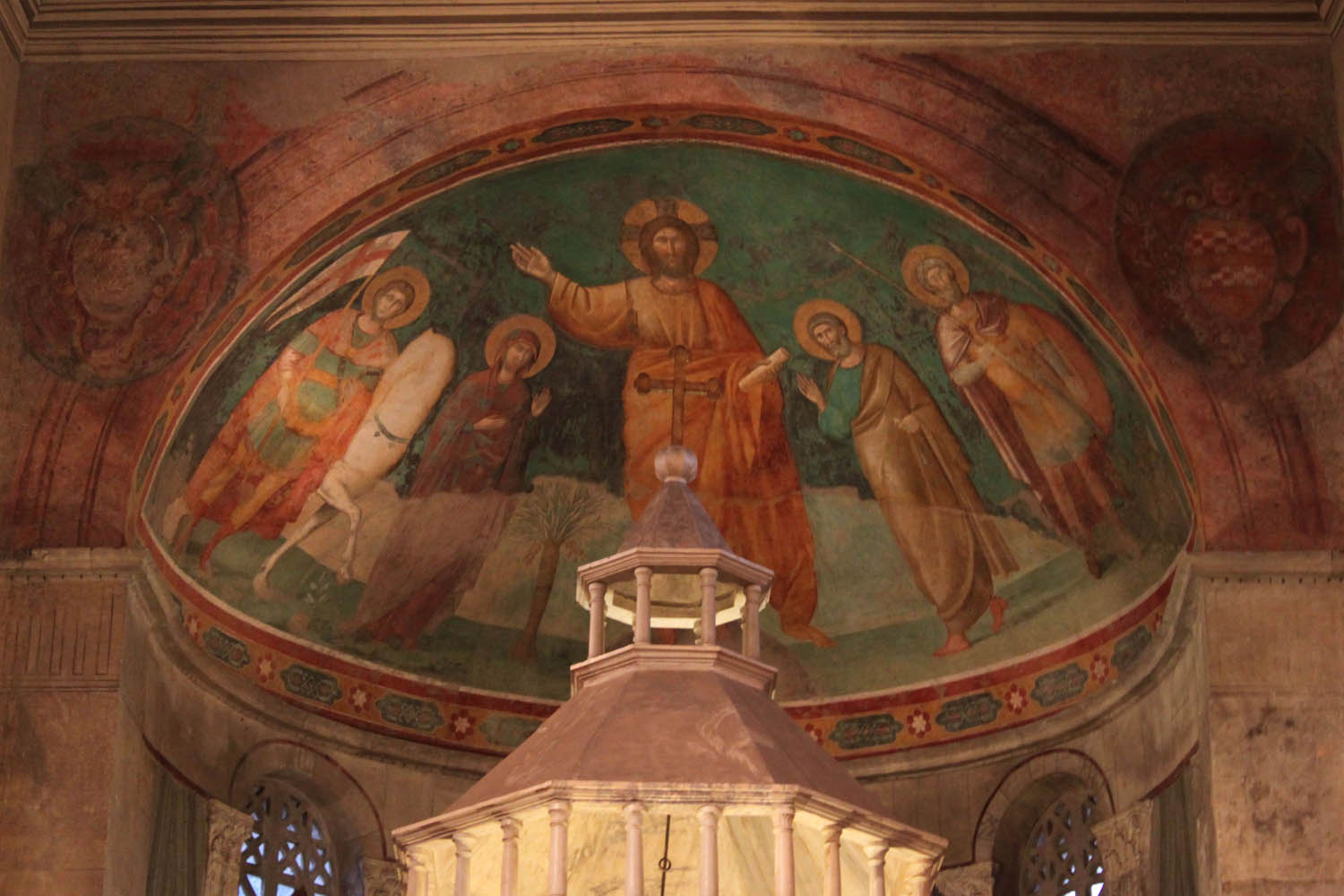
Scene I: The Temptation of Passions. The text says. At that time Jesus was led by the Spirit into the desert to be tempted by the devil.  He fasted for forty days and forty nights,  and afterwards he was hungry.  The tempter approached and said to him,  “If you are the Son of God,  command that these stones become loaves of bread.” He said in reply, “It is written: One does not live on bread alone,  but on every word that comes forth from the mouth of God.”

Hunger, as a desire, is a passion.  It is not evil per se, for without it we would perish. The same is true with other natural desires for things like: life, drink, and propagation (sexuality). Others sorts of passion also exist in us such as: anger and love, joy, aversion, hatred, hope, despair, fear, courage and so forth. Of themselves these passions are neither good nor bad in themselves, but become so only in relation to their object, or insofar as we allow them to become inordinate.

Hence there is nothing wrong with Jesus as he experiences hunger. What the devil tries to do it to draw Jesus into sin by yielding to his hunger and to use his power inappropriately. Remember, Jesus had been led into the desert to fast and pray by the Spirit. This is his call. His hunger is real and without sin, but now he is tempted to set aside his call, and to yield to his hunger in an inappropriate way, by rejecting his call to fast. He is tempted to serve himself. Now he has the power to do this, to turn stones into bread, and so a second aspect of the temptation is to use his power inappropriately, not to glorify His Father, but to gratify and serve himself.

What about us? We too have passions. And they are not wrong in themselves. But what can happen is that we freely allow them to become inordinate, or we can gratify them in unlawful ways. Remember we, like Jesus, are called to fast. Our fast is from things like: sin, injustice, unrighteousness, sexual impurity, and unlawful pleasures, excessive indulgence,  and so forth. And we too have it have it in our power to choose to reject our fast and to gratify our desires by rejecting our call to serve God. And the devil says: reject your call and use your power to gratify your passions: lie, cheat, steal, vent your anger, fornicate, be gluttonous, greedy… and so forth.

But notice how Jesus has recourse to God’s Word: Man does not live on bread alone, but on every Word that comes from the mouth of God. Jesus says to Satan that He would rather live and be sustained by the Word. That his food is to do the will of his Father.

What about us? Can we say with Job: Neither have I gone back from the commandment of his lips; I have esteemed the words of his mouth more than my necessary food (Job 23:12). Can we, like Jesus, say that God’s Word is more to me than my desires for: satisfaction, sex, self preservation, popularity, worldly joys, power, prestige, or possessions. My strongest desire is for God and things waiting for me in heaven and I will gladly forsake all I have for it.

Scene II. The Temptation of Presumption – The text says, Then the devil took him to the holy city, and made him stand on the parapet of the temple, and said to him, “If you are the Son of God, throw yourself down. For it is written:  He will command his angels concerning you and with their hands they will support you, lest you dash your foot against a stone.”  Jesus answered him, “Again it is written, You shall not put the Lord, your God, to the test.”

There is a value in trusting God, but this is not an invitation to act recklessly. There will come a time when Jesus will throw himself down on the Cross in complete assurance that the Father will raise him. He has this command from his Father. But now is not that time and he must act to preserve and protect his life so as to accomplish his full mission.

For us, too there is no sin in trusting in God’s care for us. But that is not a license to act recklessly. Presumption is a terrible problem today. Too many people think that they can go on sinning and there will be, or should be, no consequences. This is true in worldly ways and in spiritual ways as well. Too many people engage in risky and ruinous behavior and figure, “I’ll be OK….I’ll escape….I won’t be a statistic….I won’t get caught….I won’t lose my job. Many say, “I can use drugs and not get addicted, I can have evil friends and still stay good and live morally,  I can skip school and still get good grades and get into college, I can be promiscuous and won’t get STD’s or AIDS….I won’t get pregnant. They think, I can drive recklessly and won’t have an accident or kill someone…I can be disrespectful and still be treated with respect.” In all this people are simply crusin’ for a brusin’

And regarding the moral presumptiveness of thinking that no matter what I or others do, heaven will still be the result, the Lord warns:

  1. Sirach 5:4 Say not I have sinned, yet what has befallen me? For the Lord bides his time. But of forgiveness be not overconfident adding sin upon sin. …Delay not your conversion to the Lord, put it not off from day to day for mercy and justice are alike with him.
  2. Gal 6:7  Do not be deceived; God is not mocked, for whatever a man sows, that he will also reap.  For he who sows to his own flesh will from the flesh reap corruption; but he who sows to the Spirit will from the Spirit reap eternal life.  And let us not grow weary in well‑doing, for in due season we shall reap, if we do not lose heart.
  3. Hosea 8:7  For they have sown the wind, and they shall reap the whirlwind.
  4. Psalm 81:11  “But my people would not listen to me; Israel would not submit to me.  So I gave them over to their stubborn hearts to follow their own devices.  “If my people would but listen to me, if Israel would follow my ways,   how quickly would I subdue their enemies and turn my hand against their foes!

God is clear to warn us that sin sets us on a path that hardens our heart and makes our final conversion increasingly unlikely. He is pleading with us in this Lenten season to be serious about sin and its consequences. Sin renders us not only unfit for heaven, but simply incapable of entering it.

Bad idea – Simply presuming that everything will be fine is not only a poor strategy, it is a temptation and snare of the devil who seeks to cloud our mind with false hope and unreasonable expectations. Jesus has a very clear message for the devil and for any of us who would engage in presumption (a VERY common sin today): “Don’t you dare put the Lord your God to the test in this way. Obey him out of love, but do not put Him to the test.” Presumption is a very bad and foolish idea.

Scene III. The Temptation of Possessions – The text says, Then the devil took him up to a very high mountain, and showed him all the kingdoms of the world in their magnificence, and he said to him, “All these I shall give to you, if you will prostrate yourself and worship me.”  At this, Jesus said to him, “Get away, Satan!  It is written:  The Lord, your God, shall you worship and him alone shall you serve.” 

 There is here the obvious temptation of worldly possessions. Everything, EVERYTHING, is offered to Jesus in exchange for a little worship of the devil. Now, it may seem strong to us that having an abundance of things would be linked to worshiping the devil and forsaking God. But scripture attests to the connection elsewhere:

  1. Adulterous people!  Do you not know that friendship with the world is hatred toward God? Whoever therefore wants to be a friend of the world makes himself an enemy of God. (James 4:4)
  2. Do not love the world or anything in the world. If anyone loves the world, the love of the Father is not in him. (1 John 2:15)
  3. No one can serve two masters. Either he will hate the one and love the other, or he will be devoted to the one and despise the other. You cannot serve both God and Money (Matt 6:24)

All pretty blunt. We want to have both but the Lord is clear in rebuking the temptation by insisting that we have to serve God alone, adore God alone. The inordinate love of this world causes us to hate God more and more and to bow before Satan in order to get it. Don’t kid yourself. If this seems extreme then we are calling God an extremist. The Lord is warning us that there is a major conflict here that steals our heart. For where a man’s treasure is, there is his heart (Matt 6:21). It is not wrong to desire what we really need to live, but it is our wants that get us into trouble. And the desire for riches ruins us and makes God seem as a thief, rather than a savior. This is a very severe temptation and Jesus rebukes it forcefully. Him ALONE shall you serve.

We need to beg God for a single-hearted devotion of him. The Book of Proverbs has a nice prayer in this regard: Give me neither poverty nor riches, lest in my poverty I steal or in my riches I say “Who is the Lord?” (Prov 30:8-9 gloss).

In the end, temptations are real and we either accept God’s grace to fight them or we are going down. The Lord wants to teach us today about the reality of temptation and how to fight it, by his grace. Remember, the battle is the Lord’s and no weapon waged against us will prosper if we cling to God’s grace. But in the end, the choice is clear: either Tackle temptation (by God’s grace) or risk ruination (by Satan’s “ministrations”).

(Photo credit above right: Evolutionary Times (right click on photo for URL))

This song says, Yield not  to temptation, for yielding is sin. Each victory will help you, some other to win. Fight valiantly onward. Evil passions subdue. Look ever to Jesus, He will carry you through. Ask the Savior to help you, comfort strengthen and keep you; he is willing to aid you, He will carry you through.
Walking in the Footsteps: Persistent Prayer

Monica said, “There was indeed one thing for which I wished to stay a while in this life, and that was to see you a Catholic Christian.”

… And when we were at Ostia on the Tiber, my mother died.

                              (St. Augustine, Confessions, Book IX)

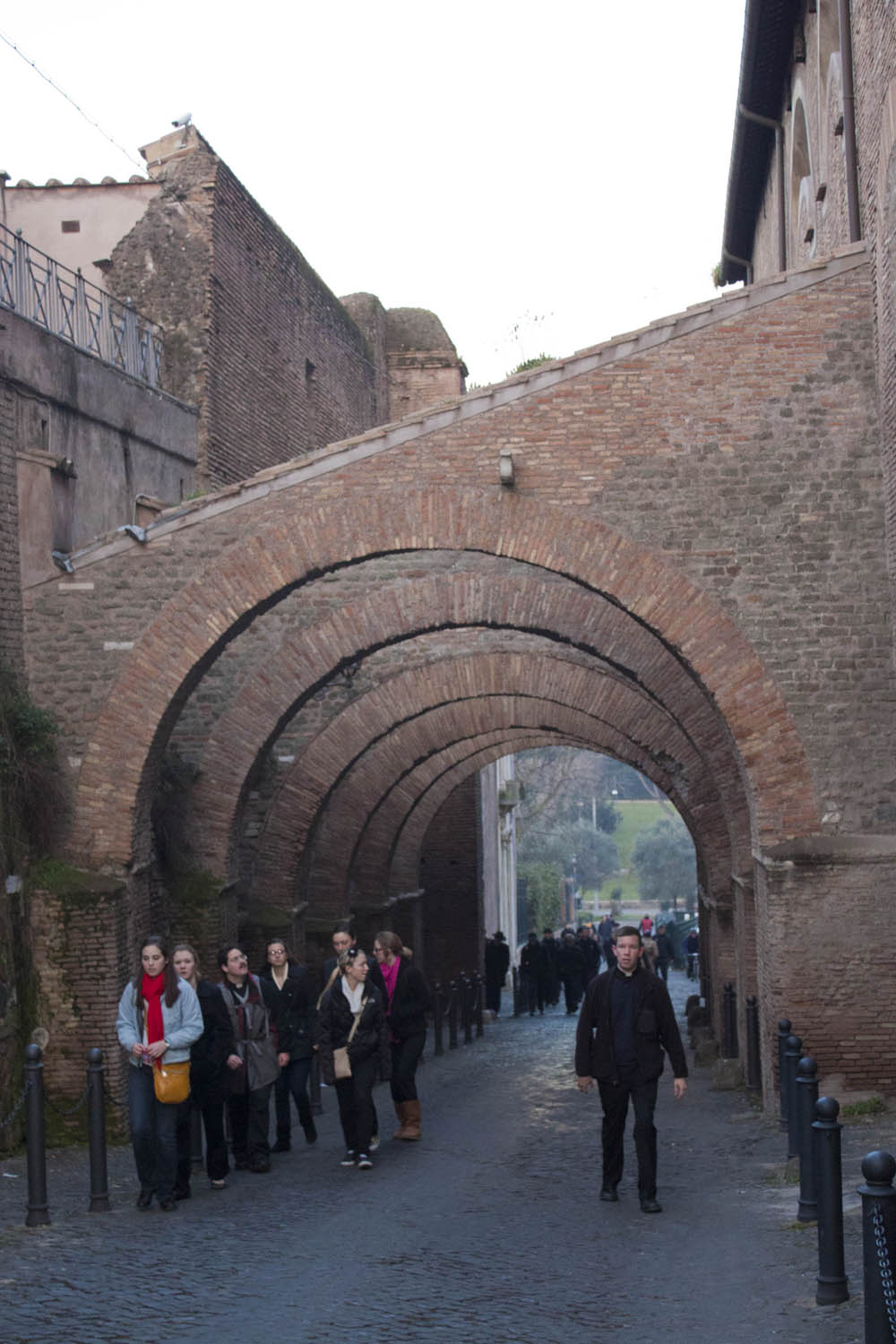
After pursuing her son, Augustine, from Africa to Italy and seeing him convert to Christianity in 386, it was almost as though Monica’s purpose in life had been fulfilled. Hardly a year later, she took ill in Ostia (a seaport outside of Rome)and died there, never returning to her home in Africa. Her remains were eventually laid to rest in the church of San Agostino here in Rome, and it is to this church – run, naturally, by the Augustinian fathers – that our Lenten pilgrimage takes us today.

As I watched many of our pilgrims cluster around Monica’s tomb to pray after Mass, I couldn’t help but admire her story and reflect how much her intercession is needed today. I would guess that many of the pilgrims were praying for someone they knew, some “Augustine-in-waiting”: a family member who had drifted away from, or even outright rejected, Christ and his Church.

Monica: A model of  Persistent Prayer

Monica watched her son’s spiritual wanderings in sadness and in frustration, but never in despair. She prayed constantly for his return to the faith – and of course, she was not shy in letting him know about it! So often did her prayers for Augustine end in weeping that her bishop once assured her, “It is not possible that the son of so many tears should perish.” And indeed, Augustine’s conversion to Christianity would give the Church not only a devout believer, but one of the most brilliant theologians that Christianity has ever known. Before Monica’s tomb, I offered a prayer for our families – yours and mine – and for all those spiritual wanderers whom God, this Lent, is lovingly seeking out in ways they do not yet know.

Pilgrim Profile

Among the 200-odd pilgrims at today’s station church was Mary Breed from Mclean, Virginia, visiting Rome for a few days with her husband Jerry. I caught her just outside St. Monica’s chapel. Mary heard about the station church devotions from a friend who had lived in Rome, and leaped at the chance to hear Mass in English rather than in Italian! She was very moved by the number of pilgrims and especially seminarians who were present at today’s Mass – “We are praying for you seminarians all the time,” she encouraged me. By coincidence (or providence?) Mary has a deep personal devotion to St. Monica and was grateful to be able to ask her, “in person” as it were, to intercede for family and friends, as well as for some girls Mary knows who share Monica’s name.

Post by Seminarian, Aaron Qureshi (pictured in photo)

Photos by Fr. Justin Huber

The Sexual Revolution Reconsidered in a New York Times Article?

Columnist Ross Douthat at the New York Times has posted some interesting information and reflections on the sexual revolution. I want to present excerpts from both his column and blog. The bold black italics are his remarks, the red normal face type are my reflections.

My column todaymakes what I hope is a non-utopian argument for why social conservatives are right to welcome the recent evidence that American teens and twenty-somethings are waiting somewhat longer to have sex…. [I]t makes a huge difference not only whether people have premarital sex, but how early and how often and how casually, and that this is what social conservatives think changed for the worse starting in the 1960s…. It is a helpful distinction to indicate the trifold: whether, how early and how often. It would be preferable if there were no-premarital sex at all, for it would refelct God’s clear teaching on this. But even if we can’t fully roll back the fact that some do have pre-marital sex, at least its impact can also be minimized by chipping away at how early and how often young people engage in sexually sinful behaviors.

But I think it’s worth saying something about [another] question, because it’s crucial to the debate over how we should think about the sexual revolution and its consequences: Did the social trends of the last 50 years bring about “unprecedented gender equality”? Absolutely. Did they bring about “unprecedented personal fulfillment”? Well … for some people they did. But it’s very easy to find indicators that paint a more complicated picture. Female happiness has dropped since the 1970s, despite enormous female economic gains. Marital happiness has dipped as well, even though fewer people get married and it’s easier to leave an unhappy union. And then of course there’s the impact of higher divorce rates on children’s psychological well-being, the impact of rising single parenthood on child poverty, and so forth.All this is a way of saying that the only obvious gains women have made are economic and career related. Big whoop….It seems clearer, in other areas, that women are generally the big losers in the sexual revolution. Mr. Douthat has detailed a few of them here. I might add that women are far more likely to contract STDs, be used and cast aside, be left to largely raise children alone, and have far less social leverage over men. Men pretty much come and go as they please and for some reason women seem to tolerate it. Most of the social structures, that in the past, insisted that men do right by women have been stripped away. Pregnancy places few obligations on a man. He may have to pay some child support, but even here, many men get away with underpaying, paying late, or not paying at all.  

In many cases women have fewer options, if you ask me. Many, if not most HAVE to work. Many feel strong pressure to have sex casually in our promiscuous culture. Many feel strong pressures, economic and social to (sinfully) take strong medicine that radically alters their hormonal balance and suppresses the perfectly normal and healthy process of ovulation. Many are pressured to have abortions when “inconvenient” pregnancies occur. Women, perhaps as never before, because of our strongly visual and media driven culture, feel enormous pressure to look perfect and have bodies that are unnaturally thin and yet also curvaceous. This has always been the case to some extent but it has gone into high gear due to the widespread celebration of lust that has come from the sexual revolution. In so many ways, women have been the losers in the sexual revolution IMHO. Some will say, as a man, I cannot really have an opinion here. But perhaps some of the women who read will want to express their view.

The crucial question, to my mind, is whether all of the social changes that swept America in the 1960s and the 1970s are a package deal. [Some feminists and progressives] seem convinced that everything goes together — that the cultural shifts that have made our personal lives more unstable and (possibly) less fulfilling are inextricably bound to the shifts that made female equality a possibility, and then more or less a fact. Hence their reflexive hostility to the idea that anything could have changed for the worse in American sexual culture: To suggest that the general welfare might be enhanced if teenage sexual activity were a little more stigmatized or divorce a little harder to get, in their eyes, is to implicitly suggest that women belong in kitchens and finishing schools, rather than boardrooms and the Senate. It’s the slippery slope in reverse: Many progressives and feminists have committed themselves to an absolute defense of everything that changed during the sexual revolution, out of a fear that one concession will cost women every gain…..[T]he fact that smart feminists… feel compelled to act all blasé about the pornography industry, lest they give an inch to the forces of reaction, seems like one of the more regrettable aspects of the contemporary cultural debate. This is very well said. There is a kind of all-or-nothing thinking that seems to dominate the feminists and other progressives. It leads them to a strange sort fo silence about things that actually harm and degrade women. They make this deal with the devil for their economic gains and seem almost to fear common-sense traditional morality.

I don’t think this is the right way to look at it. The connection between feminism and sexual permissiveness strikes me as historically contingent rather than strictly necessary, and the economic and social gains that women have made since the 1960s seem robust enough to endure — or, more likely, continue apace — even amid a reconsideration of some of the social changes that accompanied them. Yes, an ethic of sexual restraint can be turned to patriarchal ends, but so can an ethic of sexual permissiveness, as anyone who’s hung out in a frat house for any length of time can attest. Exactly.

Mr Douthat then turns his attention to the relationship between traditional morality and happiness.

Two sociologists, Mark Regnerus and Jeremy Uecker, in their recent book, “Premarital Sex in America.”….look at sexual behavior among contemporary young adults, [and] find a significant correlation between sexual restraint and emotional well-being, between monogamy and happiness — and between promiscuity and depression. This correlation is much stronger for women than for men. Female emotional well-being seems to be tightly bound to sexual stability — which may help explain why overall female happiness has actually drifted downward since the sexual revolution. Imagine that! Following the norms that God and Natural Law prescribe actually might make us happier! How can this be? We were all taught by the social revolutionaries of the 1960s that free love and a casting off of the restraints would be liberating, and bring for contentment without guilt, and happiness. Now after all that, some forty years later, we come to find that God’s had it right after all.  🙂

When social conservatives talk about restoring the link between sex, monogamy and marriage, they often have these kinds of realities in mind…..The ultimate goal is a sexual culture that makes it easier for young people to achieve romantic happiness — by encouraging them to wait a little longer, choose more carefully and judge their sex lives against a strong moral standard. And I would add, wait till marriage. Because the bottom line is that promiscuity is destructive of marriage. Most men figure, “Why get married?” After all they get what they want, or what they think they want, without it. Why commit? So I would just go a little further than Mr. Douthat here and encourage women to insist that men wait until the wedding night. Of course, until a significant number of women start insisting on this, it is likely men will continue to stray and shun commitment. Now, some will comment that I am putting the onus on the women here. Perhaps I am. Men should behave and, Lord knows,  I’ve surely preached this to them. But I’m also being realisitic here. Women hold the cards in this matter and need to set the limits. I’m not excusing men, I’m just saying that women have most of the power and that men will, and are able, to follow their lead here.

Liberals argue, not unreasonably, that Planned Parenthood’s approach… — in which teen sexual activity is taken for granted, and the most important judgment to be made about a sexual encounter is whether it’s clinically “safe” —…. is tailored to the gritty realities of teenage sexuality. But realism can blur into cynicism, and a jaded attitude can become a self-fulfilling prophecy. Yes, the Christian view is rooted ultimately in hope and the vision that chastity is possible. Realism can be a virtue but, as Mr Douthat rightly points out, there is a false “realism” which is actually not realism at all but is cynicism in disguise. The theological virtue of Hope is the confident expectation of God’s help. Showing young people the way and having high expectations of them is rooted in a confidence that comes from Hope .

Social conservatives look at the contemporary sexual landscape and remember that it wasn’t always thus, and they look at current trends and hope that it doesn’t have to be this way forever. In this sense, despite their instinctive gloominess, they’re actually the optimists in the debate. Amen!

In the footsteps…"It takes more than desire"

 Ss. Giovanni e Paola

Pilgrims in Rome celebrated Mass at the Church of Ss. Giovanni e Paola who were brothers who served as officers at the Imperial Court in the service of the daughter of Constantine, Constantia, where they held high positions. They returned to their home in Rome on the Coelian hill, where they were asked by the emperor Julian the Apostate, to retake their positions in his service. They were martyred in secret, in their own house, after they refused to take Julian’s trial of faith and renounce their Faith and profess belief in pagan deities. Eventually a Church was built over the remains of their house. Today, the Passionists run the Church, which contains the relics of the saints whose names it bears, as well as those of the Passionist’s founder, St. Paul of the Cross.

In the Quiet of the Church

It is a wonderful thing, during this Station Church season, to be able to arrive early to the Church, when it is not fully lit, it is still quiet and the crowd has not yet arrived. It is a time of  great peace and a perfect time for prayerfully preparing oneself for the Sacrifice of the Mass. It is especially wonderful in this Church, as you finish your morning prayers, to have all those bright Chandeliers come alight and really make you feel that, what you are preparing to participate in is truly something wonderful, to witness God’s glory.

Gathered as God’s People  

The Mass in English is sponsored by the North American College, yet looking around in the morning, you see that there are many English-speaking pilgrims who you have never seen before, that are drawn on this Lenten pilgrimage to draw deeper into the spirit of Lent. As Mass begins, one cannot help but feel the diversity of God’s people, and yet also the familiarity. We all gather around the Eucharist and are united together by it.

It takes more than desire

Today, the homilist preached that it is not enough to simply have a desire to be with God, but that we should seek a way to work for it. It is not simply a desire to be holy, but a desire to work at becoming more and more open to God’s will in our lives. The desire is from God, who puts it in our hearts. It is a reminder, “What am I doing, this Lent, to respond to God’s invitation? How can I grow closer to God, through my pilgrimage through Lent?”

Written by Mario Majano, Archdiocese of Washington

Photos by Fr. Justin Huber, Archdiocese of Washington

We Fast in Order to Feast

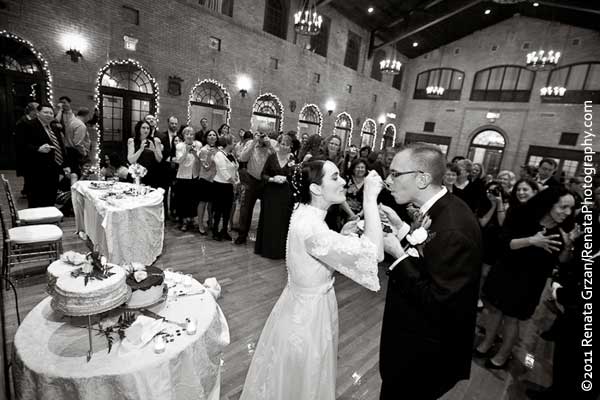
Wedding banquets don’t usually come to mind when we fast during Lent; I’ve never seen fish sticks served at a reception, and I’ve been to more than a few!

Nevertheless, when Jesus was challenged about fasting in today’s gospel, he responded by calling himself a bridegroom, and by referring to us, his friends, as his wedding guests. Jesus was saying that our relationship with him, in many ways, is like a joyful wedding feast.

Jesus wants us to keep this joy in mind as we approach the discipline of fasting. We fast during Lent, not primarily to lose weight, not because it’s a Catholic cultural badge, and not because we need to prove our holiness to God or anyone else. As Catholics, we fast- from food or from anything else that can become a compulsion in our life- to help us grow in freedom, and thus bring us a little bit closer to Jesus. And anytime we grow a little bit closer to our Lord, the result is always joy. You might say, then, that we fast in order to feast- feast upon the new and abundant life that Jesus wishes to pour out on us, during this special season of grace.

Readings for today’s Mass: http://www.usccb.org/nab/031111.shtml

Photo courtesy of Renata Grzan/RenataPhotography.com Used with permission.

(Pictured is Archdiocese of Washington colleague Julia Chandler’s recent wedding reception. No fish sticks were served.)

On Seeking Greater Serenity

In Lent, a gift to seek is greater serenity. The word comes from the Latin serenus, meaning clear or unclouded (skies). By extension it thus means calm, without storm. Serenity has become more used in modern times with the advent of many 12-Step programs which use the serenity prayer as an important help to their work. Perhaps the closest Greek word to serenity is γαλήνη(galene) and it is used most specifically when Jesus stood in the boat, rebuked the storm and there was a great calm, a serenity (cf Matt 8:26). In this sense we can see how true serenity must come as a gift from God. For the storms of life can overwhelm and overpower us. So we need to seek serenity from God and receive it from him.

My own personal experience of serenity is that it is a calm and peaceful joy, an experience that everything is alright, everything is in God’s hands.

I would like to look at four sayings that are related to serenity. I am not exactly sure where I first got them. They were in a collection of old clippings I had from years ago. Recently I rediscovered them, along with other clippings. These sayings both describe serenity (often without using the word) and also describe its sources. Let’s look at them one by one, with a little commentary by yours truly.  The sayings take the form of the stories of the desert Fathers but I am quite sure they are modern reflections put in the older form.

1. The disciples ask the master, “Are there ways for gauging one’s  spiritual strength?” “Many,” said the master. “Give us one,” beseeched the disciples. And the master responded, “Find out how often you become disturbed in the course of a single day.”

For the normal Christian life is to be increasingly free from anger, anxiety and disturbance. This results from the increasing trust that faith begets. The closer our walk with God and our experience of his love for us, the more inconsequential is the hatred of the world, the insensitivity of others. We are increasingly untroubled that we are not praised or promoted, for God’s love is more and more enough for us, and is experienced as real. We are less obsessed with what others think of us. Our fears give way to a powerful experience of God’s loving providence and his capacity to make a way out of no way. Anger abates as we leave vengeance to God and are less prone to anger in the first place. This is because most anger is rooted in fear, and as fear gives way to trust, the cause of much of our anger is gone. Gratitude for the graces we have received makes jealousy and envy less possible. Disturbances diminish overall.

Yes, serenity is a true indicator of spiritual progress. The increasing lack of disturbances in our day is a sign of God’s work in our soul. Here is a gift to be sought.

2. Sometimes there would be a rush of noisy visitors and the silence of the monastery would be shattered. This would upset the disciples; not the Master, who seemed just as content with the noise as with the silence. To his protesting disciples he said one day, “Silence is not the absence of sound, but the absence of self.”

For it often happens that even when we go to pray, and there is physical silence, yet our minds are filled with many concerns. But the deepest prayer is to be caught up in God, to be gifted with contemplative silence. This silence is within and cannot easily be disrupted by the physical noises of the world; for it is a deep, inner, spiritual serenity that envelopes the soul. It is a peace that the world did not give, and world cannot take away. Here too is a gift to seek from God: a deep an inner serenity.

In the Beatitudes the Lord speaks of those who are “blessed.” And the Greek word of that text is makarios which refers to a deep, serene happiness, a calm joy. The secular Greeks used this word to describe the “happiness of the gods,” whose happiness was unaffected by worldly events. For us too, we must ultimately discover that happiness, serenity, is an inside job, and the true gift of serenity is not from the world, but from God. Thus it does not depend on external realities for its existence and can be experienced even in the midst of difficult “externals.”

3. To a disciple who was forever complaining about others the Master said, “If it is peace you want, seek to change yourself, not other people. It is easier to protect your feet with slippers, than to carpet the whole of the earth.”

There is an old saying, “If I get better, others get better too.” The reform and transformation of the whole world begins with me. There is great serenity to be found in staying in our own lane and working our own issues.

Much anger is abated in a marriage when an aggrieved spouse says within, “My marriage is not perfect because I am in it.” Perfect marriages, perfect churches, perfect families, perfect workplaces do not exist because there are no perfect people to populate them. And the imperfection begins with me. There is serenity in realizing and accepting this.

Unrealistic expectations (e.g. that others should be perfect) are premeditated resentments. And resentments rob us of serenity.

It is true that we must engage in properly ordered fraternal correction. But fraternal correction has little impact without humility and the serenity that defuses the difficultly of the moment correction is administered.

I will only get what I sow.  If I want respect, then I must show respect. If I want compassion and understanding, then I must show them. If I want others to be better, then I must first get better. Scripture says,  Cast your bread on the water, it will come back to you after many days (Eccl 11:1).

4. “How can I be a great man like you?” “Why be a great man?” said the Master. “Being a man is a great enough achievement.”

For it often happens that we become imbued with unrealistic dreams for our self. It is not wrong to have dreams, but we must also come to accept that it is God who ultimately assigns us our place in his kingdom.

One of the great secrets of serenity is to gradually discover the man or woman God has created us to be. Simply becoming what we are and were made to be and respecting what God is doing, is a great source of serenity. God alone can give us this self knowledge of his plan for us.

Scripture says, LORD, my heart is not proud; nor are my eyes haughty. I do not busy myself with great matters, with things too sublime for me. Rather, I have stilled my soul, hushed it like a weaned child. Like a weaned child on its mother’s lap, so is my soul within me. (Psalm 131:1-2)

There is a story about Rabbi Eliezer who said, I have often said to myself, “Eliezer, why are you not more like Moses? Moses was a great man!” But then it occurs to me that if I do that, God will one day say to me, “Eliezer, why were you not Eliezer?”

Yes, there is serenity in not trying to be others whom we think are greater. It is possible to imitate their virtues, which are common to us all. But as for our vocation and personal make-up, that belongs to God. God likes tall and short people, talkative and shy ones, skinny and fat ones, because he’s made a lot of them all.

Just a few thoughts on serenity. In the Scriptures Jesus brought serenity by calming the storm that night in the boat. But did you notice he slept right through most of it and had to be awakened by the frightened disciples that night?  Who was right, Jesus to be calm or the disciples to be panicked? You decide. There ARE real problems in life that need attention. But an awful lot of our anxieties are about things that are better simply to sleep on. It is also a likely fact that we self-generate the majority of our storms in life.  The gift of serenity comes as we gradually, by God’s grace, experience the self-inflicted storms abating. The four parables above offer insights into the internal dimensions of the gift of serenity.

Finally, most people have heard the Serenity Prayer. But the widely known part is only a part of slightly longer prayer. The Author of the prayer is disputed, but the full prayer is here:

  •  GOD, grant me the serenity to accept the things  I cannot change,
  • Courage to change the things I can,
  • and the wisdom to know the difference.
  • Living one day at a time; Enjoying one moment at a time;
  • Accepting hardship as the pathway to peace.
  • Taking, as He did, this sinful world as it is, not as I would have it.
  • Trusting that He will make all things right if I surrender to His Will;
  • That I may be reasonably happy in this life, and supremely happy with Him forever in the next.
  • Amen

 This song says, When peace like a river attendeth by way, when sorrows like sea billows roll. Whatever my lot, thou hast taught me to say, “It is well, it is well with my soul.”

Walking in the Footsteps:San Giorgio

Guest blogger Chris Seith and photographer, Fr. Justin Huber guide us through San Giorgio:

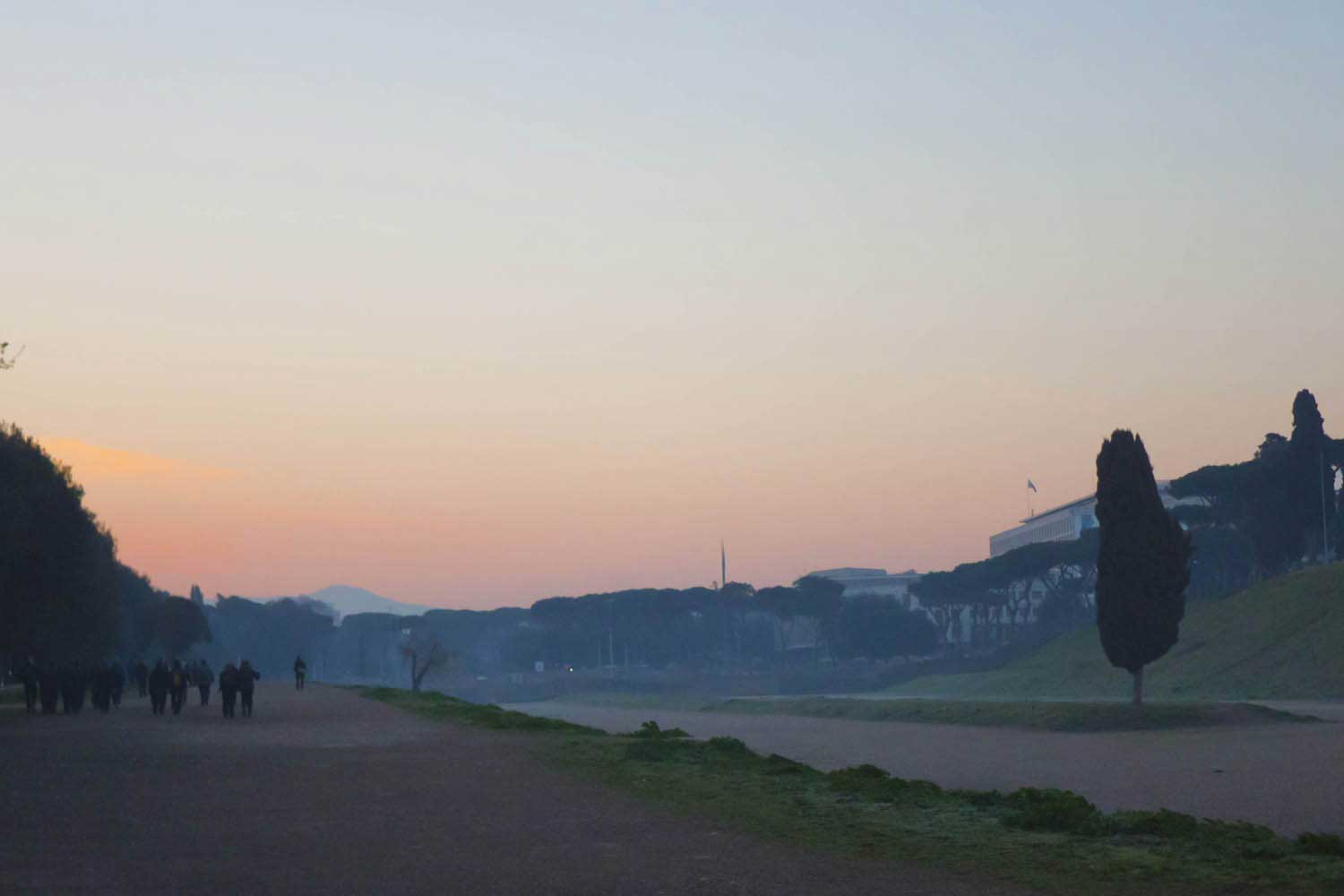
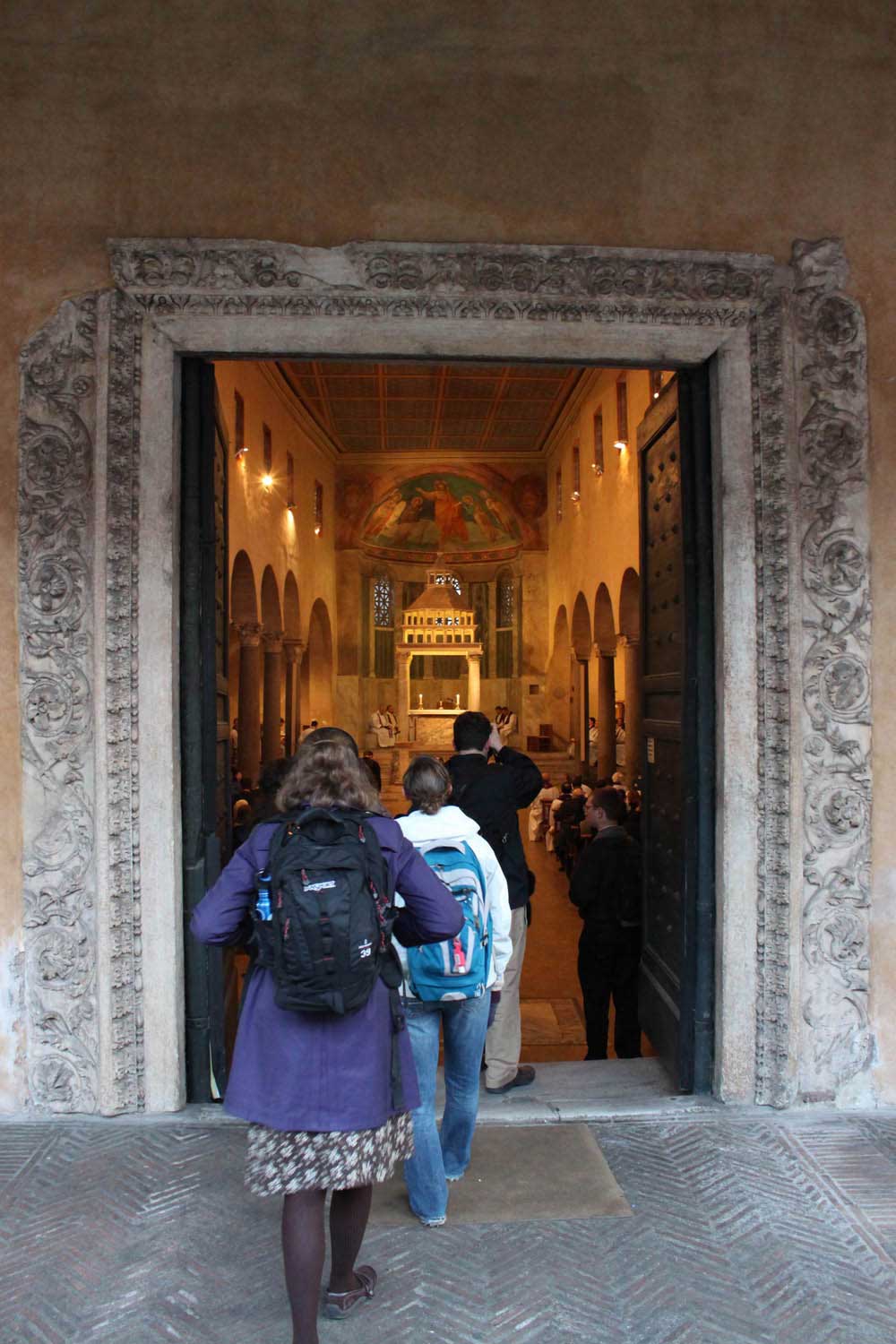
Today, the English-speaking pilgrims walked to San Giorgio for the second day of Lent.  For those of us at the Pontifical North American College, we began our trek at 6:15 in the morning, walking alongside the Tiber River as the sun rose.  The location towards which we were headed has been used by Christians since the late fifth century.  Originally, the location was used as a center for social services and was later turned into a church in the ninth century.  The Saint it commemorates was a popular martyr during the Diocletian Persecution, the bloodiest persecution of the early Church lasting from the late third century until the year 311.  This Saint inspired many soldiers to remain courageous while they struggled to follow Christ.  He is also an inspiring Saint for the seminarians at the Pontifical North American College who hope to lay down their lives for Christ as Saint George did.  The church is connected to another inspiring figure as well.  San Giorgio was the titular church of the newly beatified John Henry Cardinal Newman.

The readings for today connect us in a particular way to the witness of the martyrs.  In Deuteronomy, Moses tells us, “I have set before you life and death, the blessing and the curse.  Choose life, then…”  With these words, Moses reminds the Israelites of the great gift of life which God has given them.  No doubt this seemed strange for a people wandering through the desert with no relief in sight.  Much like many in our time, the Israelites doubted the beauty of life amidst their many sufferings.  Yet in the Gospel, Jesus offers clarity by telling us that “whoever wishes to save his life will lose it, but whoever loses his life for my sake will save it.”  Our Lord offers a new perspective on life and invites us today to reconsider the grace of our Baptism.  Through this Sacrament, we have become sons and daughters of God.  God sees us as having died with Christ and risen with Him.  Therefore, when we embrace our daily crosses out of love for God, we live the reality of our Baptism by sharing in the death and resurrection of Jesus Christ.  Suffering, then, is not a hindrance to living life abundantly but is rather the very means by which we do so.  When we unite ourselves to Him who is Love, life reclaims its original magnificence and beauty no matter what situation we find ourselves in.

Learn more at Church:  http://www.pnac.org/station-churches/week-of-ash-wed/thursday-after-ash-wednesday-san-giorgio/

Follow in the Right Direction

An old joke asks: Why did Moses and the Israelites wander in the wilderness for 40 years? Because they didn’t ask for directions!

We’re on a journey too – not of 40 years, but 40 days of Lent – and proper direction is just as important for us. Consider today’s gospel: Jesus invites us to carry crosses. Those crosses are the suffering that enters every human life. Jesus stresses, however, that when we bear a cross, we’re to “follow him.” That’s our proper direction.

If we take off in a different direction, and follow a path different than our Lord’s, we’ll wind up exhausted, resentful, and alone. Chances are we won’t get very far, because our cross will become too heavy to bear.

But when we do follow Jesus, we’ll be given the courage we need to carry on, and a strength that can only come as God’s gift. We’ll have the consolation of seeing Jesus’ footsteps before us, or even planted right alongside ours. Because if there’s one thing his own cross can teach us, it’s that Jesus doesn’t want us to carry our crosses alone.

Readings for today’s Mass: http://www.usccb.org/nab/031011.shtml

Photo Credit: hlkljgk via Creative Commons