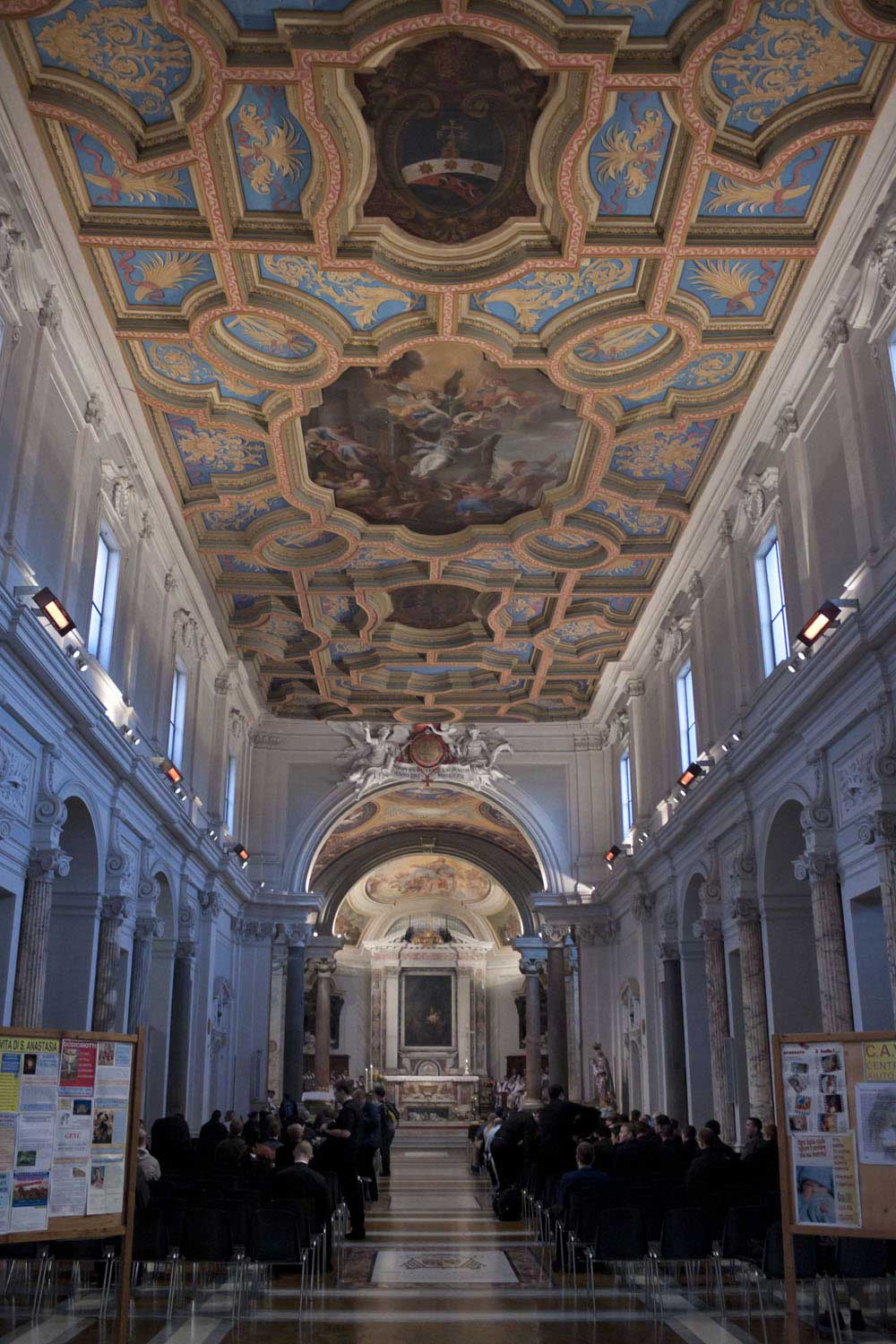
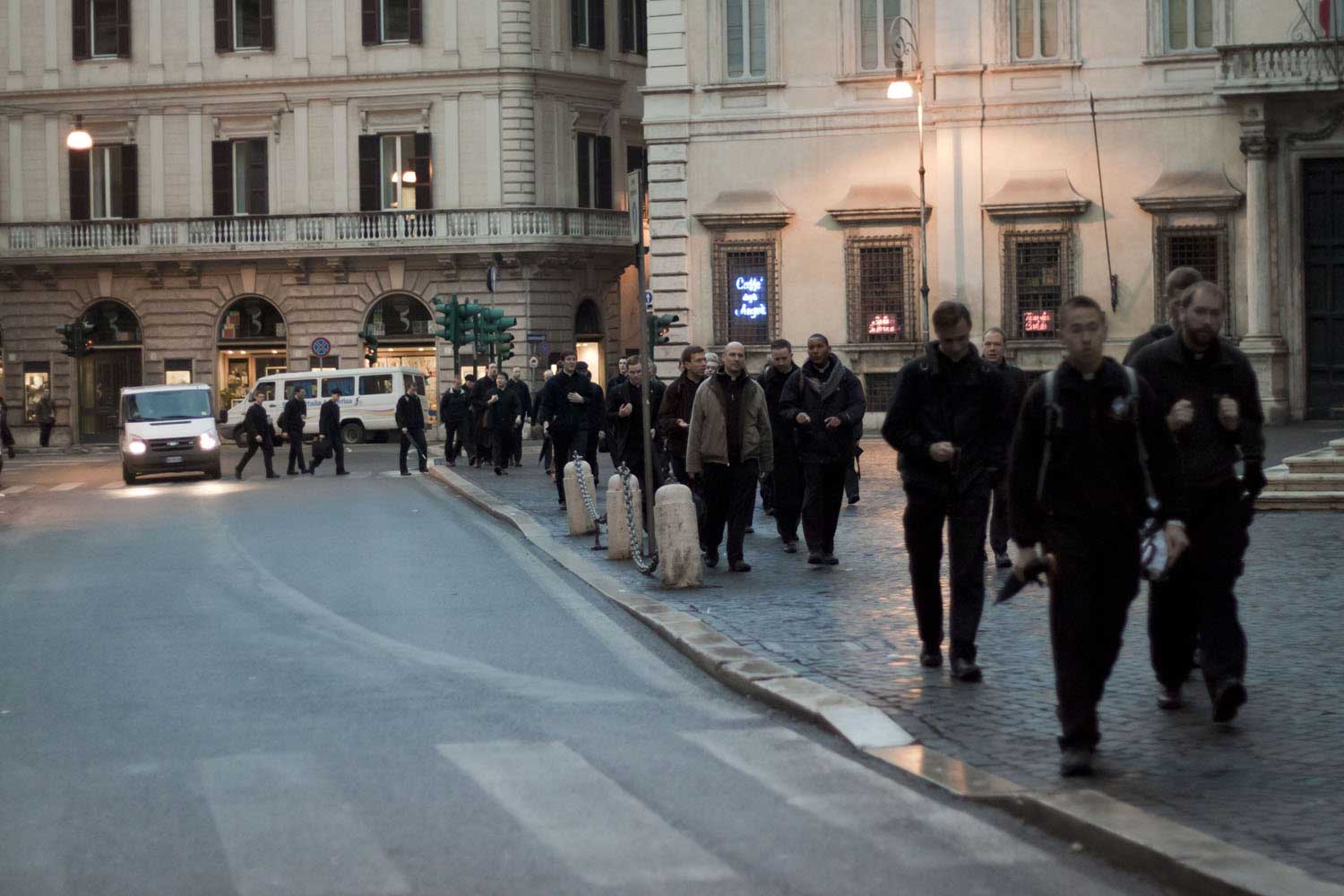
Today, we continued our Lenten Station Masses at Sant’Anastasia. On the way to this church, we walked past the Circus Maximus, a great field dedicated to sporting events in Ancient Rome. Although Roman charioteers would have entertained the crowds in the Circus Maximus, this sight was also the place where many martyrs gave their lives for their faith in Christ.
St. Anastasia was martyred during the Diocletian Persecution in the late third century in what is today Serbia, making the location of this church very appropriate. The church itself was built in the late fourth century and St. Jerome, who came from the same region as Anastasia, is said to have often celebrated Mass here.
While little is known about St. Anastasia herself, it is moving to know that this martyr’s name means “resurrection” and that her feast day was traditionally celebrated on December 25. She therefore connects Christ’s birth, death, and resurrection and shows us the true purpose of our Lord’s coming. It was a nice reminder for us as we entered the church that as we continue through Lent, we do so with the hope of Easter!
Learning how to pray
During the homily, the priest encouraged us to remember the great gift Jesus has given us in teaching us how to pray. We do not pray like the pagans do, hoping that the more we shout the better God will hear us. Rather, we trust in the goodness of our Loving Father who has taken the initiative in meeting us. As the Catechism so beautifully reminds us, “In prayer, the faithful God’s initiative of love always comes first; our own first step is always a response.” In sending His own Son to Earth to suffer, die, and rise from the dead, God has taken the first step in our relationship with Him. Now it’s our turn to accept His invitation and respond with all our hearts.
A familiar expression, “The squeaky wheel gets the grease,” means that noisy, pesky people usually are heard, and get what they want. Thankfully, as Jesus explained in today’s gospel, we don’t need to be a “squeaky wheel” with God. When we pray, we don’t need to pester God to get his attention; we don’t need to jump and shout or, to borrow Jesus’ phrase, “babble on and on like the pagans,” to get God to hear us. The truth is, God is already listening. He knows what we need even before we ask, because he knows us and loves us better than we know and love ourselves.
Nevertheless, we are to ask God for what we need, simply and honestly, for four reasons:
• First, so that we can learn to depend on God, and not on ourselves;
• Second; so we can acknowledge that all good things come from God, and give him thanks and praise in return;
• Third, so we can share with God, in a relationship of mutual love, those people and situations that are important to us;
• And fourth, because our prayer- really and truly- does change things.
We might say that God loves to hear our voice! We don’t have to raise it or cry out, because we already have his undivided attention. For us, God is “all ears.”
There is a danger when we speak of God’s Law, to consider it as we might any secular law. For example, we may well consider secular merely to be some sort of impersonal code written by some nameless legislators or bureaucrats. We have not met them, we do not know them, or necessarily love or trust them. In effect, they are an abstraction in our mind called “the government” or “the man” or just “they,” as in, “They don’t want you to park here” or “They’ll fine you for that.”
God’s Law is Personal – But when it comes to God’s Law we are dealing with something different, something very personal, if we have faith. For God’s law is not given by someone we do not know, love or trust. If we have faith, God is someone we do in fact know, someone we love and trust. Further, we believe he loves us and wants what is best for us. God’s law is not the equivalent of a no-parking sign hung by some nameless, faceless city government. Rather it is a personal exhortation, instruction and command given by someone we know and who knows and loves us.
Consider an example. Suppose you pull in front of my church to park and you see a no-parking sign. Now suppose you also decide to ignore it. Alright, you have broken a law, not a big one, but a law nonetheless. You’ve chosen to ignore a sign put there by “the government.” But suppose another scenario: I your beloved blogger and the pastor of the Church you are attending or visiting is standing out there, and I say to you, “Please don’t park here.” Now the situation is very different. I, someone you know and love, 🙂 , am personally requesting that you leave the space open for some reason. When you experience the law this way you are far more likely to follow it, because someone you know and trust is asking and directing you. But what if, despite this, you still choose to ignore the instruction not to park there. Well then, the situation is quite different in this case, for, in this case, the law is personal. The refusal to follow it now becomes personal as well and there is a far more serious situation we are dealing with.
Scripture: In the first reading for Mass today (Monday, week one of Lent) the Law of the Lord is announced. I will not reproduce the whole reading but here is an excerpt:
“You shall not defraud or rob your neighbor.
You shall not withhold overnight the wages of your day laborer.
You shall not curse the deaf,
or put a stumbling block in front of the blind,
but you shall fear your God.
I am the LORD.
“You shall not act dishonestly in rendering judgment.
Show neither partiality to the weak nor deference to the mighty,
but judge your fellow men justly.
You shall not go about spreading slander among your kin;
nor shall you stand by idly when your neighbor’s life is at stake.
I am the LORD. (Lev 19:11-14)
Note how the litanies of the law each end: “I am the Lord.” (These are but two of other litanies). I am the Lord. On the one hand it gives solemnity to the pronouncement. But, at another level what God is saying is, This is Me talking. It is I who speak to you. I who created you, who led you out of slavery, parted the Red Sea, dispatched your enemies, fed you in the desert and gave you drink from the rock. It I, I who love you, I who care for you, I who has given you everything you have, I who want what is best for you, I who have earned your trust. It is I, your Father who speak to you and give you this command.
God’s law is personal. Do we see and experience it this way? This will happen only if we come to know the Lord personally. Otherwise, the danger becomes that we see the Law of God as merely an impersonal code, an abstract set of rules to follow. They might as well have been issued by the deity, the godhead, or even just the religious leaders of the day.
Hence a gift to pray for in terms of keeping God’s Law is a closer walk with the Lord and an experience of his love for us. Such an experience is a great help in loving the Law of the Lord. For when we love the Lord we love his law and see it not as an imposition, but a personal code of love that is meant to protect us. And when we offend against it either willfully or through weakness, we are more able to repent with a more perfect contrition for we experience that we have offended someone we love and who is deserving of all our love.
Abba – St. Paul indicates that one of the gift of the Holy Spirit is that we are able to experience God as Abba. Abba is the Hebrew and Aramaic family word for father. It is best translated, Papa, or Daddy. When my earthly father was alive I did not call him “Father,” I called him “Dad.” That’s the family word for father. This is the insight of the word Abba, that God is my Papa, my Dad. He is not merely “The Father” in some abstract, or merely titular sense. He is someone I experience as my own dear Father, Papa, Dad. It is a personal and family relationship that the Holy Spirit wants to grant us.
This personal relationship brings God’s law alive, makes it personal. And so God says as he reminds of of his Law: I am the Lord. This is me talking – It is I, the one who loves you.
This song says, I Love the Lord. He heard my cry. Long As I live, and troubles rise, I’ll hasten to his throne.” (Sung by Whitney Houston)
In the last six months, three different friends, two who were newly dating, and one whose relationship was getting more serious mentioned that recent dates had included a visit to Adoration! And what is more interesting, Adoration was the suggestion of the guy. Date night Adoration. Who knew? Just last week, Sarah Yaklic, the coordinator of young adult ministry was sharing with me that the number of young adults coming to our monthly Adoration is increasing. Two different generations of Catholics are rediscovering the grace of Adoration. Growing up I thought Adoration was strictly for grandmothers, then it seemed to have disappeared from parish life. But it’s back!
At Home with the Lord
For me, Adoration is the experience of being “at home”with the Lord. My parents moved into the house in which I was raised a week before I was born and they lived in the house for 45 years. When they were ready to move, my brother and his wife bought the house and so today, it remains in my family. When I visit, I love to walk through each room, though different then when I was living there, it feels like “home” in a way no other place I have lived has felt. For me, Adoration is the spiritual experience of home. Sitting in the presence of the Lord, feeling completely myself with the Lord, allowing that presence to fill me.
A few years back, I discovered a homily on the story of Jesus in the house of Martha and Mary, in which Augustine talks about the meaning of Mary choosing the better part. Augustine points out that Mary, sitting at the feet of the Lord prefigures the experience of heaven. In heaven there will be no more work or service in the name of the Lord, we will live in the presence of the Lord and we will “be” rather than “do.” Augustine suggests that for many of us, this may come as a shock, that we may need to learn how to be with Our Lord. Augustine had my number! I decided that I needed to practice the prayer of being. Now, if it has been awhile since I have made a visit, I miss it, the way I miss quality time with a good friend. Luckily, this Lent, all over the archdiocese, parishes are offering Adoration.
The Light is On for You
Beginning Wednesday, our annual The Light is On Campaign begins. In all of our churches, from 6 p.m. to 8 p.m. Confession will be offered. In many of our churches, there will also be Adoration. In the words of Pope Benedict XVI, The Lord is present, watching and waiting for us to come into his presence. Adoration in an invitation to be with the Lord. For many of our parishes, Adoration is also a regular part of parish life. If you would like to find a parish near where you live or work that has regular Adoration, contact my office at [email protected] and we will help you find one.
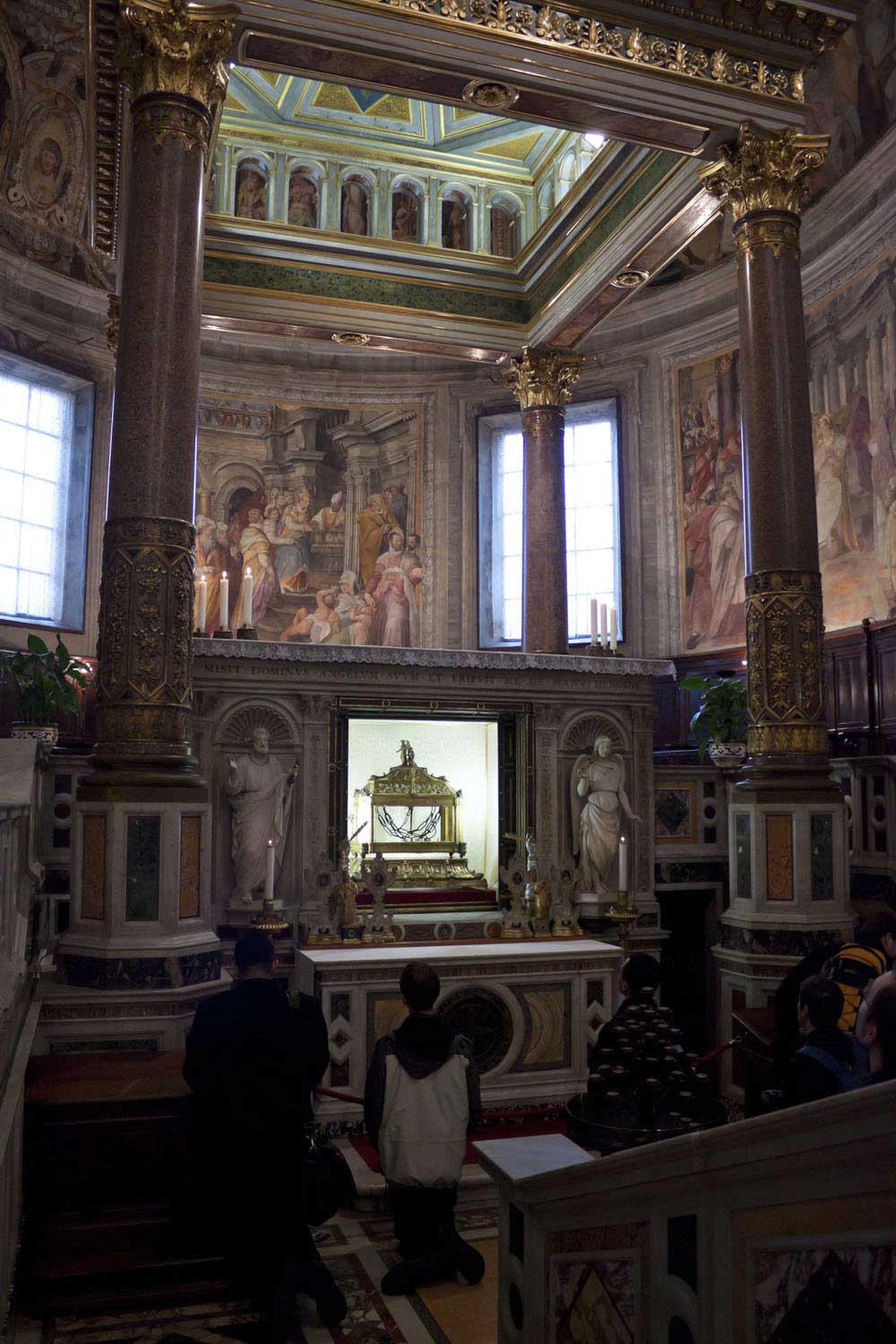
Today’s station church is significant for the Church of Washington. This past November, Pope Benedict XVI entrusted St. Peter in Chains, situated in the heart of Rome, to Cardinal Wuerl as his titular church. I had the great honor of being the acolyte at today’s Mass. Chris Seith, a Washington seminarian in his first year at the North American College, was the lector.
Two of the church’s treasures brought me to reflect on the meaning and importance of freedom in Christ. The statue of Moses and chains of Peter remind me to allow God to free me, helping me overcome the slavery of sin and self-centeredness in my heart this Lent.
A marble statue of Moses, a masterpiece by Michelangelo, sits prominently on the right side of church. The marble Moses sits majestically – powerfully muscular, bearded, and ready to take on any obstacle standing in the way of God’s people. Just as Moses led his people from the clutches of slavery, so we should follow Jesus who will lead us out of our slavery to sin.
Proclaim the Gospel of Christ
Secondly, hanging in a glass case below the high altar, one can see and venerate the chains that give the church its name. Peter, the first pope, was thrown into prison and locked in these chains. What was his crime? He was spreading the Gospel and its message of freedom in Christ. In the Acts of the Apostles (Acts 12:7), we read about Peter’s miraculous rescue by an angel who released him from these chains. The passage says, “And behold an angel of the Lord stood by him and a light shined in the room. And he, striking Peter on the side, raised him up, saying: Arise quickly. And the chains fell off from his hands.” Peter was released so that he could boldly proclaim the message of Christ and continue to spread the Gospel throughout the Empire.
Looking upon those chains and reflecting on the heroism of Peter and Moses, I prayed that God would release me from the chains that hold me back from proclaiming his Word and following him in true freedom. I pray that you, reader, have that experience of freedom from the chains of sin this Lent. I ask that you pray that I receive the grace of this freedom as well.
A youth minister once shared with me how he had led a group of young people in song outside a high security prison. After some time, hands were seen sticking wet pieces of toilet paper on the prison wall’s small slit windows. Letters began to emerge, then a complete message. It read: “Pray for us.” “We went to visit our brothers in prison,” the speaker explained to me, “because Jesus was a prisoner too.”
As I listened to this, I recalled another conversation, this time with a parish volunteer. Her pastor had asked her arrange for parish children to stuff Christmas goody bags of toiletries for local inmates. She was appalled at this suggestion and flatly refused. Those people were being punished for their crimes, she insisted; they didn’t deserve any goody bags.
What a contrast between these two people. Both are committed Catholics. Yet they held very different attitudes about the exercise of mercy. In today’s gospel, Jesus makes clear what he wants our attitude to be. He spoke of prisoners, the sick, the poor, and strangers in our midst – people we might be tempted to judge, condemn, dismiss, ignore, or neglect out of selfishness, indifference, and hardness of heart. Yet Jesus refers to them as his brothers, and explained that we serve him when we serve them. His challenge to us today, then, is to extend mercy to others, just as he has showered his mercy upon us.
When I was younger and through my seminary years I had usually seen the crucifix and Jesus’ suffering on the cross in somber tones. It was my sin that put him there, had made him suffer. The cross was something that compelled a silent reverence, and suggested to me that I meditate deeply on what Jesus had to go through. Perhaps too I would think of Mary and John and the other women mournfully beneath the cross beholding Jesus slowly and painfully dying. These were heavy and somber notes, but deeply moving themes.
In addition the crucifix also called forth memories that I must carry a cross and go through the Fridays of my life. I needed to learn the meaning of sacrifice.
Liturgically I also saw the crucifix as a way of restoring greater reverence in the Mass. Through the 70s and 80s parishes had largely removed crucifixes and replaced them, quite often, with “resurrection crosses,” or just an image of Jesus floating in mid air. I used to call this image “touchdown Jesus” since he floated in front of the cross with his arms up in the air as if indicating a touchdown had just been made. In those years we had moved away from the understanding of the Mass as a sacrifice and were more into “meal theology.” The removal of the crucifix from the sanctuary was powerfully indicative of this shift. Many priests and liturgists saw the cross as too somber a theme for their vision of a new and more welcoming Church, upbeat and positive.
A cross-less Christianity tended to give way to what I thought was a rather silly celebratory style of masses in those years and I came to see the restoration of the Crucifix as a necessary remedy to restore proper balance. I was delighted when, through the mid 80s and later, the Vatican began insisting in new liturgical norms that a crucifix (not just a cross) be prominent in the sanctuary and visible to all. Further, that the processional cross had to bear the image of the crucified, not just be a bare cross.
Balance Restored – I was very happy about these new norms (and still am) because they restore the proper balance in seeing the Mass as a making present of the once-for-all perfect sacrifice of Jesus on the cross. It is also a sacred meal, but it is the sacrifice that gives it its power. I further thought that such a move would help restore greater and proper solemnity to the Mass, and to some extent this has been true.
All of this background just to say that I saw the Cross, the crucifix, in somber, serious tones, a theme that was meant to instill solemnity and sobriety, a meditation on the awful reality of sin and our need to repent. And all of this is fine and true.
But the Lord wasn’t finished with me yet and wanted me to see another understanding of the Cross.
In effect he wanted me to experience also the “good” in Good Friday. For while the cross is all the things said above, it is also a place of victory and love, of God’s faithfulness and our deliverance. There’s a lot to celebrate at the foot of the cross.
It happened one Sunday in Lent of 1994, one of my first in an African American Catholic Parish. It being Lent, I expected the highly celebratory quality of Mass to be scaled back a bit. But, much to my surprise, the opening song began with an upbeat, toe-tapping gospel riff. At first I frowned. But the choir began to sing:
Down at the cross where my Savior died,
Down where for cleansing from sin I cried,
There to my heart was the blood applied;
Glory to His name!
Ah, so this WAS a Lenten theme! But how unusual for me to hear of the cross being sung of so joyfully. (You can hear the song in the video below; try not to tap your toe too much).
It was something quite new for me. Perhaps it shouldn’t have been but it was. The 70s and 80s Catholicism that had been my experience found it necessary to remove the cross to celebrate. But here was celebration with and in the cross! Here was the good in Good Friday.
The Choir continued:
I am so wondrously saved from sin,
Jesus so sweetly abides within;
There at the cross where He took me in;
Glory to His name!
Congregation and choir were stepping in time and clapping, rejoicing in the cross, seeing it in the resurrection light of its saving power and as a glorious reflection of God’s love for us. Up the aisle the procession wound and the last verse was transposed a half step up, an even brighter key:
Oh, precious fountain that saves from sin,
I am so glad I have entered in;
There Jesus saves me and keeps me clean;
Glory to His name!
Yes, indeed, glory to his name! A lot of dots were connected for me that day. The cross indeed was a place of great pain, but also of great love, there was grief, but there was also glory, there was suffering, but there was victory.
Please do not misunderstand my point. There IS a place and time for quiet, somber reflection at the foot of the cross. All the things said above are true. But one of the glories of the human person is that we can have more than one feeling at a time. We can even have opposite feelings going on at almost the same moment!
The Balance – Some in the Church of the 70s and rejected the cross as too somber a theme, too negative. They wanted to be more upbeat, less focused on sin, and so, out went the cross. There was no need to do this and it was unbalanced. For at the cross, the vertical, upward pillar of man’s pride and sin is transected by the horizontal and outstretched arms of God’s love. With strong hand, and outstretched arms the Lord has won the victory for us: there at the cross where he took me in, glory to his name!
And the Balance is for the individual, and for the Church. For some prefer a more somber meditation on the cross to prevail and others feel moved by the Spirit to joyfully celebrate at the foot of the Cross. The Church needs both, and I suppose we all need some of both experiences . Yes, it right to weep at the cross, to behold the awful reality of sin, to remember Christ’s sacrifice. But rejoice too, for the Lord has won victory for us, right there: Down at the Cross. There’s a lot of good in Good Friday.
Photo credit (right click on photo for URL)
Here is the song I heard that Sunday in 1994, sung in very much the style I heard.
One Mardi Gras, Today Show personality Al Roker was broadcasting from New Orleans. He had before him a traditional Mardi Gras king cake, in which is hidden a small baby Jesus. Whoever finds Jesus in his or her slice of cake at a party is declared king or queen for the day, and is expected to bring another king cake to the next Mardi Gras party. As Al Roker was explaining this, he was slicing the king cake before him, looking for the little baby Jesus. As time wore on, he began to slice and chop at his cake with increasing frustration. With a note of mock panic in his voice he exclaimed: “I can’t find the baby Jesus!” When he finally did find it, the cake had been reduced to a crumbled mess. Needless to say, this was not one of Al Roker’s finer moments.
Today’s gospel account of the temptations of Jesus shows how easy it is for us to be unable to find Jesus, or even lose him altogether. When we read the temptation story, it’s natural for us to identify with Jesus, because we’re all familiar with being tempted. But have we ever placed ourselves in the devil’s shoes? We should, because most of us, at one time or another, will make the same demand of Jesus that the devil did, by insisting that he prove himself.
The devil began each of his three temptations by saying to Jesus: “If you are the Son of God…” These were the same words used by mocking bystanders as Jesus hung dying on the cross. But haven’t these same words come from our own mouths? When we’ve been frustrated or in trouble, haven’t we said, “If you are the Son of God, fix my problem now?” Or when Jesus seems to be absent from some situation, like a terrible disaster, haven’t we said, “If you are the Son of God, why did you let this happen?” And when our faith is shaken, and we wonder if Jesus even exists at all, haven’t we said: “If you really are the Son of God, you’d better show yourself more clearly than you’re doing now!”
Throughout his ministry, people were always complaining that Jesus never did enough to show who he really is. Throughout history, we Christians have continued to make the same complaint. So we put Jesus to the test. We ask him to jump through hoops. We throw down the gauntlet, and condition our faith and discipleship upon a set of conditions that we lay out. Jesus needs to play by our rules.
Whenever we fall into this trap, we will lose Jesus. We may seek for him, but we will not find him. We’ll be like Al Roker, frantically chopping at our king cake, but unlike Al Roker, Jesus will not be revealed to us. In his book, Jesus of Nazareth, Pope Benedict writes: “The arrogance that would…impose our laboratory conditions upon (God) is incapable of finding him. For it already implies that we deny God as God by placing ourselves above him. To think like that is to make oneself God.” And isn’t that what the devil wants us to do? Isn’t that what he tempted Eve to do in the Garden of Eden? “Eat this apple,” he hissed, “and you will be like God.”
Now, sometimes the demands we make of Jesus are simply expressions of our fear, frustration, and confusion. Jesus understands that. He knows that we are weak. At the same time, he wants us to appreciate that he was weak as well. Yes, as the Son of God he possesses unlimited, almighty power. And while he was on earth, people wanted him to demonstrate this power all the time. They wanted him to crush their enemies and fix all their problems. They wanted him to use power like the world likes to use power. But Jesus came among us in weakness, not in power. He became weak to share our weakness and save us from the mess our weakness has made. That’s why people got so frustrated with him. That’s why we too can get so frustrated with him. If we had a choice, we wouldn’t want to see Jesus on a cross. We’d want to see him on a throne! But that’s for the end of time. Not now.
Sometimes we just don’t want Jesus to be Jesus. We want him to be our kind of Jesus. Not the kind of Jesus he really is. Which isn’t really fair, if you think about it. Most of us want other people to know and understand us for who we really are. We want other people to let us be ourselves! But do we try to understand Jesus for who he really is? Do we try to let Jesus be who he really is? When we don’t, we again find ourselves in the devil’s shoes. The devil tempted Jesus to be someone other than the real Jesus. He showed Jesus all the kingdoms of the world and promised that they could all be his if he would only fall down and worship him. Yet if Jesus were to do that, he would be denying that he is God’s Son. He would be denying himself. But Jesus was true to himself. He always is. And we need to accept that.
This is perhaps the greatest challenge that the temptations of Jesus place before us. They teach us that we’re not to make demands of Jesus; we’re to embrace his demands of us. We’re not to place ourselves above Jesus; we’re to humble ourselves beneath him. We need to let Jesus be Jesus, and not remake him in our image. And we need to follow Jesus, not along a path of worldly power, but the godly path of weakness, sacrifice, and trust. Should we do this, we’ll never have to frantically search for an elusive Jesus. He’ll always be there, at our side.