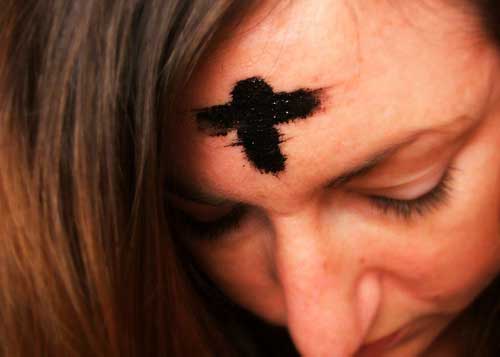
At yesterday’s Ash Wednesday Masses many of you heard the ancient acclamation, as ashes were imposed: Remember that you are dust, and unto dust you shall return. Yesterday’s beginning of the Lenten season puts before us an urgent plea that we should be sober and watchful of our soul and its condition, for the form of this world is passing away (1 Cor 7:31). Simply put, we are going to die and we need to be made ready to meet our God. Recall some of the urgency present in the readings:
Even now, says the LORD, return to me with your whole heart…..
Sound the trumpet in Zion!
We implore you on behalf of Christ, be reconciled to God!
Behold, now is the day of salvation.
Yes, Now, not later. There is an urgency announced that we must hear and heed.
What’s in a picture? The Picture at the upper right was taken April 2, 1967. It was my sister, Mary Anne’s 7th birthday. Ash Wednesday morning the picture appeared on my screen-saver slideshow and I thought, “There it is, a picture of passing things.” For, as you look at the picture know this, there is absolutely nothing and no one in the picture that is still here in this world today. My sister who is blowing out the candles died in 1991, tragically in a fire. My mother who leans over her died in 2005 (also tragically). My maternal Grandmother, who is seated died of cancer in the late 1970s. But that is not all. This building in which the picture was taken was demolished 8 years ago. My Father who is taking the picture died in 2007. The Polaroid camera with which he took the photo is long gone as well. There is simply nothing in this picture that any longer exists in this world, and there is no one in the photo who still walks this earth. Yes, the form of this world is passing away. Remember that you are dust, and unto dust you shall return.
The Church’s reminder to us is a strong rejoinder to most of our priorities. Most of the things we think are so important, are not really that important in the long run. Most of the things that claim our attention are not all that critical either. We like Martha, are anxious about many things. We worry about our money, our house, our car, our physical health, how we look, what people think of us, and so forth. But none of this really matters all that much in the end. All these things pass.
But what about what really does matter? What of our soul and its well being? What of our direction? Is it heavenward? What are we doing with our life? Where are we headed? Do we know God, love and serve him? Are our eyes on the prize of God and heaven? These things get little attention in most people’s lives. The unessential and passing things are our passion, and the most essential and critical things are all but ignored.
In Lent the Church says stop. Be thoughtful and earnest. You are going to die. What are you doing to get ready to meet God? Your body and the things of this world are but dust, a mere passing reality. But what of your soul? Are you caring for your soul? Is it nourished on God’s Word and Holy Communion? Are the medicines of prayer, Scripture, Sacraments and holy fellowship (cf Acts 2:24) being applied so that your soul stands a chance?
Remember…..REMEMBER……you are dust, you are going to die. Get ready. Now is the time, be earnest about it. Be thoughtful and live a reflective life that considers carefully what your decisions amount to, where you are headed, what your life means. Too many people live unreflected lives, never thinking much on these things. But not you. You have heard the trumpet sound in Zion and the Church has implored you. Will you listen? Will I? Where are you going? Where will you be when the last trumpet sounds?
With the help of our seminarians and priests studying in Rome, we will be able to participate in one of the most ancient Lenten practices of the Roman Church. Dating back to the late second or early third century, the Bishop of Rome would celebrate Mass in parishes around the city. By the fifth century, there was a fixed calendar in place for the dates of those liturgies.
Today, it has become the practice of the North American College to “host” the English speaking stational churches liturgies. Each day Mass is also celebrated in German and Italian and for many years the Pope has celebrated the Ash Wednesday liturgy at the first of the stational churches. We begin our pilgrimage with a reflection by Patrick Lewis and photos by Fr. Justin Huber.
Santa Sabina
Today the Church begins Lent, the season of prayer, penance, and almsgiving that prepares Catholics for the coming of Easter. For seminarians and priests at the Pontifical North American College in Rome, Ash Wednesday begins the pilgrimages to the station churches in Rome.
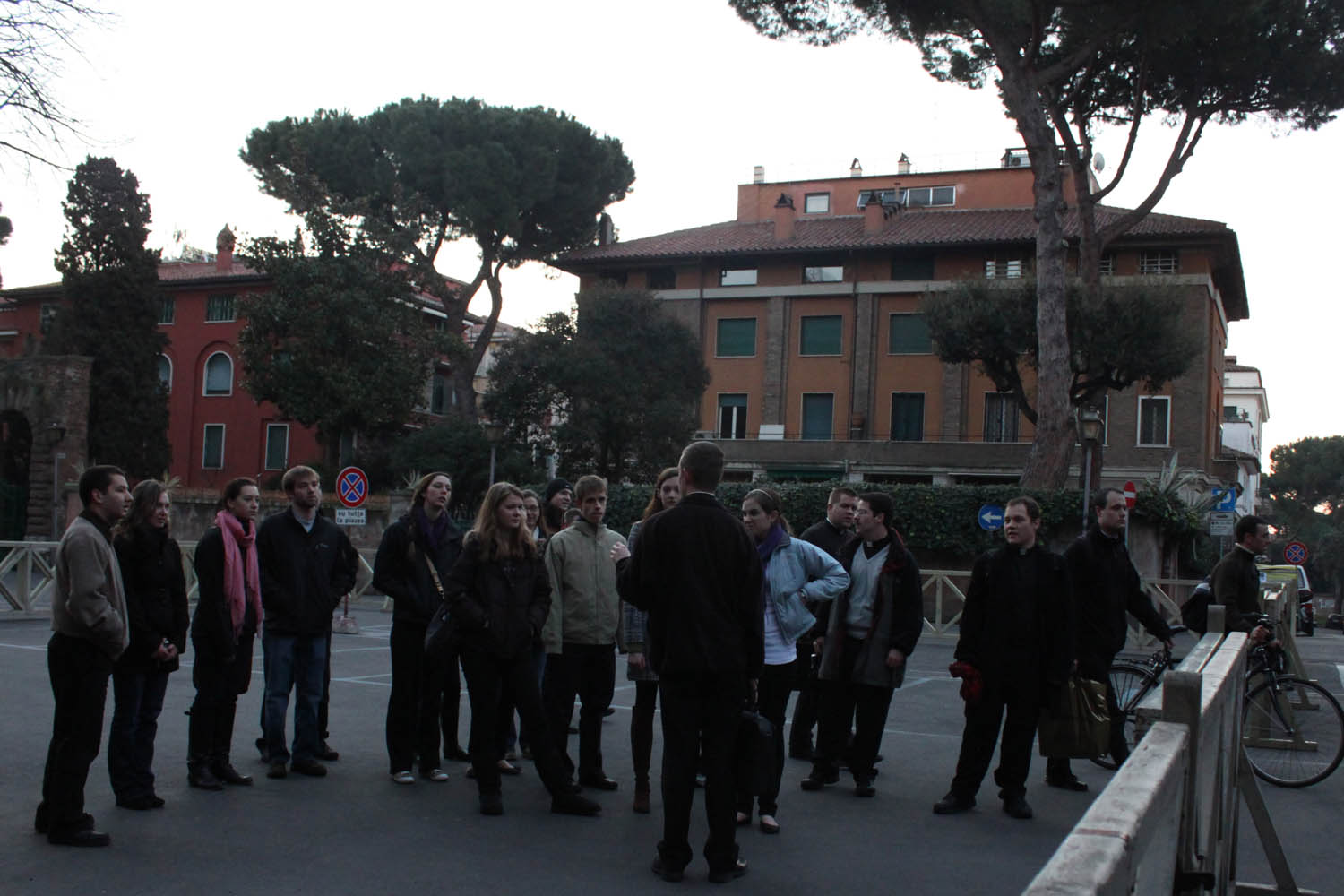
Seminarians and priests gathered early in the morning at the Pontifical North American College to make their trek out to Santa Sabina. The sacristans, masters of ceremonies, choir, lectors, and acolytes arrived at the quiet church early to ensure that everything was set up and the Mass was prepared to be celebrated with due reverence. I joined a small group of seminarians and a priest and headed out toward Santa Sabina around 5:45AM. Walking along the Tiber in the cold, brisk darkness of the morning, we prayed the rosary and quietly made our way to the church. As I headed up the cobbled-stoned street that goes up the Aventine Hill, the sun began to rise.
The entire community from the Pontifical North American College and Casa Santa Maria gathered for Mass at Santa Sabina, the first of the station churches. Many other English speakers joined the College for the Mass. Students who are studying abroad in Rome and other people from around the city joined us for Mass. The 6:45AM Mass was somber, as the community entered into this holy penitential season.
Santa Sabina has been a place of worship since early in the second century. St. Sabina, a Roman matron from the second century, lived at or near the sight of this church. According to tradition, Sabina was a widow who was converted to the faith by her slave, Seraphia. The current church was built in the fifth century. The church was remodeled many times. The priests and servers sit in a choir section walled off with a marble rail. Pillars line the massive structure. Tombs from throughout the history of the Church line the walls and floors. Saints and martyrs since the time of the early Church have prayed at this holy sanctuary.
Santa Sabina is a particularly powerful church in which to begin the Lenten season not only because it is the traditional Ash Wednesday church, but because of the treasures that are found there. For example, one of the doors to the entrance has a panel with a carved wooden image that is one of the oldest crucifixion scenes in existence. Also, a small casket underneath the high altar contains the relics of various martyrs, including Santa Sabina herself. The image of Christ crucified and the presence of the martyrs are a fitting reminder that we should offer ourselves completely to God, inviting him into our lives and withholding nothing from him this Lent.
For “New Men” who are experiencing their first Lent in Rome, the Mass at Santa Sabina was a powerful introduction to the richness of the Lenten tradition in Rome. For those of us who have studied in Rome for a few years, Ash Wednesday and the church of Santa Sabina will be forever linked in our memories. After the Mass, we left Santa Sabina with ash on our foreheads, to go out and recommit ourselves to the Lord this Lenten season.
Public relations are very important in our culture, aren’t they? Great value is placed upon how we’re seen and perceived by others, and we’re very concerned about doing things that will get us noticed, appreciated, and admired. This is true even for matters of faith and religion.
That’s why Jesus’ words in the gospel today can be so challenging. He told us that we should be on our guard against performing religious acts for others to see. Our left hand must not know what our right hand is doing; we’re to pray in private behind closed doors; and our appearance shouldn’t reveal that we’re fasting.
Jesus knows that we often bring mixed motives to our religious undertakings. Some of our motivations- the ones inspired by God- are noble and good. Things like wanting to serve others, meet their needs, alleviate their suffering, grow closer to God, and do penance for our sins.
But sometimes we have other motives that aren’t as laudable. We may do religious things because we hope others will see us as holy or be grateful to us for the kind things we’ve done.
When we act in this way, we’re seeking to glorify ourselves- and there’s the catch. Because as Christians, all we do, in one way or another, should be done for the glory of God. As we journey through the 40 days of Lent, let’s always examine our motives, and ask the Lord to purify them, so that what we do is not driven by concern for public relations, but by a spirit of private praise.
I have often thought that the second greatest prayer ever written is the Universal Prayer attributed to Pope Clement XI. Most people have never heard of it. But it is magnificent. Its sweeping themes cascade like a fountain and it is comprehensive without being too detailed so that it looses its poetry.
So many themes are covered in its short verses: faith, trust, beginnings and ends, wisdom, justice, mercy, mindfulness, purity, repentance, journey, judgment, authority, greed, gentleness, generosity, apathy, fervor, prudence, courage, justice, temperance, fortitude, vigilance, and the our last end, just to mention some.
If you are among the many who have never heard of this prayer, click here to see it:
And yet as I pray it, the prayer is so sweeping that I often feel overwhelmed by its sheer volume. It’s as though I am standing before an open fire hydrant with a little dixie cup trying to capture the water. Most of it rushes past me.
So for Lent I have thought to pray this prayer every day but also to take one line and meditate on it in particular. Here is a version of the Prayer that I have numbered so as to focus on a particular line for each of the forty days:
I hope the Universal prayer will bless you as much as it has blessed me. Consider this practice. Print out the PDF files and use them when you can. I think you’ll find that the prayer provides a lot on which to meditate.
In case you would like the Latin original with a literal and poetic translation it is here:
During a big religious festival, a seventeenth century Portuguese shepherd and soldier, heard a homily which convinced him of his need to repent. For months afterwards he wandered the streets, beating his breasts and screaming for mercy, until he was thrown into an insane asylum.
Blessed John of Avila, who preached the homily, visited St. John of God and insisted that instead of punishing himself for his past, it was better to try and build a better future. The repentant man did exactly that, through loving service to the sick and poor as a friar. He know him today as St. John of God.
As we celebrate his memorial today, St. John of God’s story is good to reflect upon as we move toward Lent, a season of renewal and penance. Penance shouldn’t be about beating up ourselves for past sins. Instead, it should be about building up ourselves into saints. In short: Do good, instead of feeling bad.
Readings for today’s Mass: http://www.usccb.org/nab/030811.shtml
The erosion of a coherent and shared vision for marriage in America continues. Nationally, the decision of the President to stop defending the Defense of Marriage Act (DOMA), constitutes a shift in the position of the Federal Government. Locally in the Washington DC area, (already enduring a City-Council imposed redefinition of marriage), the Maryland legislature is debating a proposal to redefine marriage to include Gay Unions.
We have previously discussed on this blog the long road that has gotten us here. (eg: HERE). The fact is, the traditional and biblical understanding of marriage has been eroding for over fifty years in this nation. Most people, even Church going Christians, do not have a vigorous understanding of Marriage that is either biblical or rooted in Natural Law.
Because of this, advocates of so-called “gay marriage” have been able to successfully shift the conversation to a question of civil rights and bigotry. The President, in his order to the Justice Department to stand down from defending DOMA, stated that he thinks DOMA is an impermissible form of sexual orientation discrimination. Never mind that such a judgment is not his to make, that he is neither the judicial nor the legislative branch of Government. The point here is that the concept of “gay marriage” as a civil right has won the day with the President, and frankly with many Americans. In so acting the President more than suggests that supporters of traditional marriage are guilty of supporting unjust discrimination. To this the US Conference of Catholic Bishops Conference has this to say:
This decision represents an abdication of the responsibility of the Executive Branch to carry out its constitutional obligation to ensure that the laws of the United States are faithfully executed. It is also a grave affront to the millions of Americans who both reject unjust discrimination and affirm the unique and inestimable value of marriage as between one man and one woman. Support for actual marriage is not bigotry, but instead an eminently reasonable, common judgment affirming the foundational institution of civil society. Any suggestion by the government that such a judgment represents “discrimination” is a serious threat to the religious liberty of marriage supporters nationwide. [1] .
The statement is well worded and forceful. And yet it remains true that It is clearly an uphill battle for the Church to reassert a vision for traditional marriage. Seeing the issue as a matter of civil rights, and not about the nature and purpose of marriage, is increasingly common in the public discussion and explains why even many Church-going Catholics support so called “gay marriage.”
Finding our way back – Part of the essential work we must do in re-establishing a coherent vision for marriage rooted in tradition, Natural Law and, for believers, Scripture, is to restore a proper reference point so that all the pieces of the discussion make sense.
And what is this proper reference point? Simply this, Marriage is about children and what is best for them. It is not essentially about civil rights. It is not merely about two adults being happy and fulfilled. It is essentially about children and what is best for them. If we use this as our starting point a lot of other things begin to fall in place:
1. That Marriage should be a stable and lasting union– Children require 18-20 years to come to maturity. A stable environment is obviously best for them. The modern scenario, in too many cases, is that children are shifted back and forth between parents who are often divorced or never married in the first place. One weekend here, another weekend there, summers here, summers there. The instability is terrible for children. Parents should seek, above all to resolve their differences and stay married.
Stable homes, even though imperfect (and all homes ARE imperfect) are an important way that children learn virtues and values such as trust, commitment, forgiveness, toleration, generosity, conflict resolution, love, loyalty, and integrity. A stable home, even if imperfect, inculcates in children a sense of true marriage and family, knits together important family ties at a multigenerational level, and sets them up to also form stronger families themselves. They also learn proper dynamics between men and women, how to treat and regard a member of the opposite sex, and so forth
Those who simply dismiss the traditional and stable family as no better or worse than other arrangements are ignoring what long experience has taught the human family in this regard. Scripture affirms the value of a stable family when it speaks of a husband clinging to his wife (Gen 2:24 Matt 19:1ffinter alia) and when Jesus forbids divorce (Matt 5, Matt 19, Mark 10 inter al). Marriage is about what is best for children. And stability, as a general rule, is what is best.
2. That Marriage should be heterosexual – Though, obviously heterosexuality is necessary for the actual procreation of children, this is not the main point here, for many Gays argue that they can adopt. The central point here is not the mere pro-creation of children, but what is best in raising them.
And the fact is, that children are best raised with a father and mother present. In terms of simple human formation, children are best raised with male and female influence. There are things that a father has to say and model for his children that only a father can properly and best do. There are things that a mother has to say and model for her children that only a mother can properly and best do. This is what nature herself provides in linking pro-creation, necessarily, to a father and a mother. Two fathers, or two mothers, or just one parent present, are not ideal situations for children. As a general rule it will always be best for children to be raised in a traditional family setting.
There are times were death or illnesses intervene. There are exceptional circumstances where a certain father or mother is unfit. But the general and common rule is that a traditional heterosexual marriage is ideal for children. Again, it is what nature herself has set forth, and for believers, it is also what God has set forth. In the rarer cases where a parent is missing from the family, it is essential for the remaining parent to provide opportunities for children to interact in a proper way with mentors of the missing sex. This can be accomplished most frequently with aunts, uncles, grandparents and the like.
But the bottom line is that traditional heterosexual marriage is optimal for children and their human formation. All other arrangements are less than optimal and to the degree possible children should always be raised in the optimal setting that Nature, and Nature’s God has set forth.
In adoption situations, married heterosexual couples should enjoy priority over single parent settings and homosexual couples. This is what is best for children. In terms of infant adoptions there is a usually a waiting list and these infants are thus best placed in the homes of qualified, married, heterosexual couples. This is not bigotry. This is what is best for children. As for older children, there is the sad reality that it is harder to find couples to adopt. But here too, married heterosexual couples should generally speaking be favored by that fact.
Again, the question is, what is best for the child. Not, how and whether certain adults may be offended by perceived bigotry, or whether the approach is politically correct or not. In the end we want what is best for children.
3. That traditional, heterosexual marriage should enjoy the favor of law and recognition – One of the great battle lines in the marriage debate has been that married couples do enjoy certain favors under law such as tax credits, inheritance scenarios, hospital visitation etc. Most fair minded people see room for some give on these sorts of things. On a case by case basis, it may make some sense to allow, under civil law, a greater capacity for Americans to legally enact a wider variety of arrangements for power of attorney, inheritance, tax issues and the like.
However, if what is best for children remains our starting point, then it also follows that traditional, heterosexual marriage should enjoy some legitimate favors. Strengthening traditional marriage is a worthwhile goal for public policy. It may be of value that some tax breaks that make it easier to form and keep traditional families. Granted, the degree of such proactive policies is debatable. Even among supporters of traditional marriage there are many who have a more libertarian preference when it comes to ANY government involvement.
But in the end, whether it is through tax breaks, or other laws, or simply through special recognition, a strong support and advocacy of traditional marriage is proper and good. For, whatever strengthens the traditional family is good for children. Whatever we can do as a society to uphold traditional marriage, insist on fidelity, limit divorce and give special recognition and honor to these families is good for children.
And this also is why simply calling other unions “marriage” is problematic. To use the same term “marriage” for traditional marriages and also for gay unions implies an equality and identical reality which is not true. Gay unions are not on the same footing with traditional marriage since they are not what is best for children. Traditional marriage is what is best for children and it should enjoy an elevated and special status on account of this. Using the same word for the two blurs all this and traditional marriage loses the favor it should have and the recognition is it should receive.
Enough said for now. But note again the fundamental point: Marriage is about children and what is best for them. When children and what is best for them is our starting point, traditional marriage is clearly a best and proper. This starting point not only challenges advocates of “gay marriage” but also challenges advocates of traditional (actual) marriage. For, it sometimes happens that those in traditional marriage do not always have what is best for children in mind either. Too often couples do not work at their marriage and overcome difficulties. Too quickly many rush to divorces courts. What is best for children too often takes a back seat throughout our culture.
This weekend, I had the pleasure of celebrating my Uncle Walter’s 55th Birthday. For many people, birthdays are a big deal. This is especially true for my uncle! For well over a decade, he has battled polycystic kidney disease and through the help of dialysis, his kidneys remain minimally functioning at low 4%. It’s also increasingly more apparent that the disease is taking a toll on his frail body. The other part of his story – he will never be considered for a kidney transplant because he is mentally disabled. So this weekend, we decided to celebrate his birthday in style, with a visit to Hershey, PA and a tour of the chocolate factory.
Society often tells us that persons with disabilities are burdensome or are simply not worth it. Many argue that persons with disabilities do not have much to offer society – and somehow believe that our worth as a person is somehow linked to what we can contribute or give back. Unfortunately, society more often than not, fails to recognize the inherent dignity of the sick and disabled. And perhaps even more alarming, society fails to recognize all the ways persons with disabilities enrich and bless our lives. As a result, we see the growing trend of prenatal diagnosis and selective abortions of those babies likely to be born with disabilities. A common explanation – the disruption to families caused by the birth of a child with a disability. Yes, it’s true. Living with persons with disabilities is often challenging, and honestly sometimes even frustrating. But without a doubt, I would never ever trade those challenges for the many lessons I’ve learned and blessings I’ve received.
My uncle has taught me that all life is sacred, that God has willed each of us into being, and we all have a place in His family. He’s taught me how to be patient. He’s taught me how to trust with an innocent child-like faith…although I’m still trying to learn that lesson. And this weekend, walking through the chocolate factory, his presence reminded me about the freedom found in the simplicity of things. As we slowly walked through the tour, many other families would pass us by, displaying in their faces a somewhat hurried rush. Looking ahead to what was next. Nope, not my uncle. He slowed us down – and what a gift that was! It gave my family the opportunity to soak everything in and enjoy the time to the fullest! It gave us an opportunity to cherish even the littlest of things. Or maybe even more simply put, he helped us open our eyes to the many gifts God had put before us.
On the drive back to DC, I found myself thanking God for yet another great lesson. Sure my uncle may not be able to “give back” to society. But without even knowing it, Walter teaches me some of life’s great lessons.
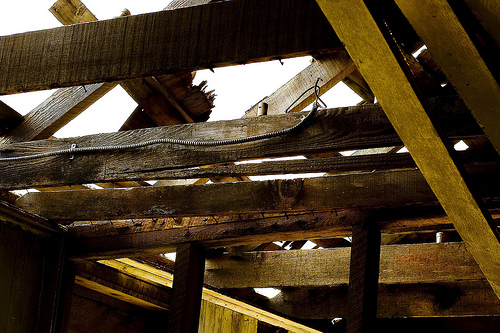
Six months ago we had a flood at our home which caused extensive damage to our first floor. As the walls were being removed, we discovered mold, some that was caused by the flood and some that had been there for quite some time, growing and spreading. The discovery of mold led to the removal of ceilings and sub floors. Until recently, our first and second floors were exposed down to floor and ceiling beams!
As I begin to prepare for the season of Lent, I find that our home renovation is a nice working image for the spiritual potential of Lent. Like how a fresh coat of paint can completely change the feel of a room, adding some more time for personal prayer or joining in a service project might be enough to enrich your spiritual life. On the other hand, the season of Lent is really about a much larger renovation project. Lent invites us with the tools of prayer, fasting and almsgiving to strip the old paint off, to pull up the floors and look for the sin that is like mold. What is the sin, that like mold is growing unseen within us but spreading out through our thoughts and actions. Through the disciplines of Lent we are called to strip away the walls that may be allowing that sin to spread.
This Lent the archdiocese has some tools to offer for the renovation project. If you are thinking about praying more with Scripture, consider buying the newly revised New American Bible which is the fruit of almost 20 years of new Scholarship on the books of the Old Testament. Again this year, on Wednesday evenings in the Archdiocese of Washington and Diocese of Arlington churches will be open for prayer and confession.
We can make our fasting a tool for feeding the hungry by participation in Operation Rice Bowl. I know that the presence of the rice bowl on my table is a reminder of the fast I have chosen and it makes it easy to put the money I save by giving up my daily Starbucks fix right in the bowl.
Our Environmental Concerns committee is offering a Lent Calendar that invites us to reflect on the stewardship dimension of our discipleshipfrom an environmental perspective through prayer and a “carbon fast.” All of these are tools to aid us in deepening our relationship with the Lord and leaving go of bad habits that grow into sin and take on good habits that grow into virtues.