Benjamin Franklin once said, “Never leave that ‘till tomorrow which you can do today.” It’s good advice, and it also happens to be Jesus’ message in today’s gospel. First he told us to look at the signs of the times and see that the kingdom of God is at hand. Then he spoke of the need to settle with one’s opponent before it’s too late, and we be thrown into prison. This was Jesus’ way of saying that when it comes to matters of faith, religion, and conscience, don’t put off until tomorrow what we should do today. For instance,
· Do we have a sins we need to confess?
· A wound we need to heal?
· A restitution to make?
· A good intention to act upon?
· Priorities to shift?
· A relationship to restore?
If so, Jesus says to us: “What are you waiting for?” Do what you need to do today! Because one day, there will be no tomorrow.
I have often pondered how the Church has survived 2000 years. I have considered how long the Church could have survived without the promise of Christ that gates of Hell would not prevail, and without the Holy Spirit. I have concluded that we would have lasted about twenty minutes, max.
Yet here we are, a kind of miracle, so big, that no one notices. 2,000 years old, (longer if you ponder our Jewish roots). Empires and nations have risen and fallen during that time: The Roman Empire, the Holy Roman Empire, the great and expansive European nations with their widespread colonies: the British empire, the Spanish and French expansions and later contractions. It was once said, “The Sun never sets on the British Empire.” Now it does. And all Europe, as we know it, may be in the late autumn of its existence. Chinese dynasties have risen and fallen, more recently the Nazi and then Soviet regimes have come and gone. In the 7th Century the Muslims came on the scene, expanded, contracted and now, it would seem, are expanding again.
But through all this the Church has withstood. Sometimes stronger, sometimes weaker, but always, miraculously left standing, though all crumble around her. What other nation or organization can, as we do, trace its roots in an unbroken line of successors (Popes and bishops) back to its founder? It is true we have suffered some divisions within, some precarious moments, and it is true some have broken away from us. But the center has held, and the line is unbroken. Ubi Petrus, ibi Ecclesia (where Peter is, there is the Church). The Church stands, while Empires, nations, movements, and fads have come and gone.
And this miracle shines forth despite significant human obstacles within her: often terrible scandals, poor preaching, bad example, abuse of power, poor priorities, disorganization, sweeping heresies, schisms, lack of faith, and just plain stupidity.
It is said that the Napoleon, threatening to destroy the Catholic Church, was scoffed at by the Cardinal Archbishop of Paris in these words, “Priests have been trying to destroy the Church for 1800 years and been unable!” Words sad, but at times true. Corruptio optime pessima (the Corruption of the best, is the worst). Yet here we still are.
An old hymn (though Protestant in origin) is true when applied to the Catholic Church:
Though with a scornful wonder
we see her sore oppressed,
by schisms rent asunder,
by heresies distressed,
yet saints their watch are keeping;
their cry goes up, “How long?”
And soon the night of weeping
shall be the morn of song.
Mid toil and tribulation,
and tumult of her war,
she waits the consummation
of peace forevermore;
till, with the vision glorious,
her longing eyes are blest,
and the great Church victorious
shall be the Church at rest.
Until that time, we shall endure and the gates of Hell shall not prevail against us. Though dismissed by many who predict our demise, it is a promise of Christ (Matt 16:18) and it has proved true despite many previous predictions of our demise.
This does not mean that the Church is not in need of purification and pruning. And we have and will continue to experience this. I am convinced that we are still in a time of pruning. The Lord has taken the tall and proud vine of the Church, so luxuriant, it seemed, fifty years and before in this land, and has pruned us, by allowing us to be tested. This is a time of purification. A time not yet complete. But, as I have remarked before, I experience the Church here in America to be in much better condition than the more terrible times of the 1970s and 1980s. The pruning may not yet be fully over, but there are signs of greater purity and intensity already in: fervent and orthodox younger clergy, fine and wonderful new religious, many new and superb lay movements, and many individual lay people powerfully dedicated, sober and clear about their faith and the need to be light, even to accepting a kind of martyrdom in this ever darkening world.
The Church is surely a miracle; one before our very eyes. The world, and even many of the faithful, may think we are on the ropes and ready to go down. But we will endure, by the promise of Christ. An old spiritual says, Get on board children, children, there’s room for many-a-more. Nations, cultures, empires, and ideologies, will come and go. But there’s one ship that’s going to make it through this old storm tossed world, and that is the Church. Get on board children, (and stay on board), there’s room for many-a-more.
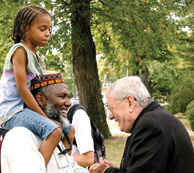
Photo Credit: The Cardinal’s Portrait by Rosenthal – A wonderful diptych of sorts. On the canvas painted by the monk, we see an image of the Church as we want her to be. On the left is the all too human reality of the Church. Ah, but the Church endures, by God’s grace.
This video of the Church being (re)built in France inspired me to write this post. Enjoy the video as you see a sign of new life and a visual image of the church being (re)built.
A priest from Nepal once shared with me his amazing conversion story. Born and raised a Hindu, Fr. Silas Bogati became involved with the American “hippie” drug scene of Katmandu in the 1970’s. He was headed down the wrong path until he was introduced to Jesus Christ by a street preacher. Fr. Silas was ultimately was ordained the first native-born Nepalese priest. But his conversion came at a terrible cost. When he became a Christian, Fr. Silas was shunned by his Hindu family because, according to the caste system, he had become an “untouchable.”
Many of the earliest Christians, who were Jewish, experienced much the same thing, because when Jews became Christian, they were expelled from the local synagogue and effectively cast out of their families. Jesus’ words in today’s gospel about divided families spoke directly to their situation, and to their pain. However, these early believers must have been consoled by the fact that by following Jesus they received a new family: the Church, a family of brothers and sisters in Christ, united not by blood ties, but by the unbreakable bonds of the Holy Spirit.
The same is true today. We Christians, throughout the world, are one big family. And in a world full of broken families, families separated by great distances, and those who have no families, this reality should fill many people with inspiration and hope.
The task for us, however, is to act and live as if weThe task for us, however, is to act and live as if we are family. In our parish communities, we need to work at being welcoming, friendly, and inclusive. We need to serve one another, respond to one another’s needs, and challenge, support, and pray for each other. In short, we need to make our parishes feel like family to attract those who are looking for a new family to call their own.
There is a magnificent interview over at National Review Online of professor of philosophy at Loyola Marymount University in Los Angeles, Christopher Kaczor. He is the author of the new book The Ethics of Abortion: Women’s Rights, Human Life, and the Question of Justice (Available at Amazon HERE). The interview is conducted by Kathryn Jean Lopez, of National Review, and though she takes up the voice of a pro-“choice” advocate, she is not.
Professor Kaczor answers the most common questions and objects with great clarity. I would like to present a few excerpts of the lengthy interview here and encourage you to read the rest. I will excerpt it in the form of listing the question and the pertinent point he makes. And few minor remarks by me are in red. The Full article is here Pro-Life Aristotle
1. What right do you, a man, have to make such a case [against abortion]?
KACZOR: Legally speaking, everyone has a right to free speech, including speech about abortion….has the right and obligation to speak out in defense of the defenseless and in favor of a just social order. The question …seems to presuppose that abortion is simply and solely about women, but this is a false supposition. The majority of abortionists are men — more men than women describe themselves as “pro-choice” — and in the United States, men pay for abortions with their tax dollars. Aside from these considerations, every abortion involves the pregnant woman, the expectant father, the one who is aborted, and the society that allows it.
I would only add here that just under 50% of babies killed are male. I remember be “serenaded” at the last Pro-life march here in DC by pro-abortion counter demonstrators who I had witnessed to. They “sang” for me: “Hey, hey, ho, ho, pro-life men have got to go. Hey, hey, ho, ho, if you got pregnant then you’d know!” They also told me, that as a man, I had no right to speak on this issue and since I was a priest, I was even more disqualified. As you might guess, a few of them accused me of being a pedophile. Yes, yes, if you put yourself out there expect to get it with both barrels
2. No book [or law] will eradicate the fact that there are women who will feel the need to abort their unborn children and doctors who will provide the service. It was the case before it was legal and it will be after.
KACZOR: I think you are right that abortions took place prior to legalization and abortions would continue if abortion were made illegal. The same point can be made for theft, child abuse, and assault, which have always happened in human history and which will always happen. Indeed, if people never did the act in question, making a law about it would be superfluous.
Exactly and I would add that i think laws do influence some people not to do certain things. I know that one of the reasons I never tried drugs in High School was that I knew they were illegal and the risk associated with such use helped to deter me. Many say you cannot legislate morality. To certain extent I agree and don’t lots of unnecessary laws, but my own experience is that law both reflects and influences moral decision making.
3. What’s the least compelling argument supporters of legal abortion make?
KACZOR: “It is my body, it is my choice.” [Actually], in abortion, there are two bodies involved, the body of the pregnant woman and the body of the human being in utero. [They] can be of different blood types and different races, and it can happen that one of them dies and the other lives and vice versa. If there were only one body involved, then absurdities follow such as that a pregnant woman has two heads, four arms, and, if she is carrying a boy, also a penis. Further, “choice” is a euphemism disguising the reality. Everyone supports good choices that are just and promote human welfare. The question is whether abortion is such a choice. Great answer, and humorous to boot, showing the thoughtless absurdity of the slogan.
4. What’s different about your Book and your argument?
My argument is not faith-based, but rather based on reason and evidence. There is no appeal to theological authority; there are no Scripture citations to justify conclusions, and no premises that come from ecclesial authority. The case against abortion is made to all persons of good will, regardless of their faith or lack thereof. As a priest I usually have recourse to Scripture. But it is clear that we must also make use of Natural Law arguments based on natural reason.
5. Is it just to tell a [pregnant] teen she’s got to have a kid…?
Of course, no one should ever be forced to become pregnant, but a pregnant woman already “has a kid.” After pregnancy has begun, the question is not, “Do we force her to have a kid?” but rather “Will we support this expectant mother and her child?” People of good will should answer “yes.” A wonderful turning back of the the phrase “have a kid.”
6. What does Aristotle have to do with the poor mom who feels as if she has no alternatives when she realizes she is pregnant? The desperate teenager? The single professional who can’t both do her job and have this child?
KACZOR: I believe that everyone, including the poor mom, the desperate teenager, and the single professional, desires to find true happiness. I also believe that Aristotle, and even more fully Thomas Aquinas, showed that the way to true happiness consists in activity in accordance with virtue. There can be, therefore, no authentic happiness found in activity that is unjust.
I can think of one case in particular: a young student, not yet finished with her education, who found herself pregnant with a man she did not know well. With so many responsibilities, both to her extended family and to her studies, she felt desperate, alone, and trapped. It was truly an act of heroism for that woman to decide to place that child for adoption. I know the woman in the story very well. She is my birth mother. I feel such an enormous debt of gratitude to her….I don’t think there is any woman who in the long term regrets, even in the most difficult of circumstances, making the choice for life. But I know there are many thousands of women who still remember and mourn, even decades later, the date that their baby would have been born.
A moving and wonderful story of how making virtuous choices, even when difficult brings happiness.
7. Are there myths about abortion you’d like to use this book to shoot down?
[One] myth is that there is a debate about “when life begins.” In fact, informed parties, both those opposed to and those in favor of abortion, acknowledge that the human fetus is a living organism. Notice the phrase, informed parties. I have met more than a few uniformed people who still buy into the “tissue” argument or have been convinced of it by a Planned Parenthood official. Still, I am convinced that, deep down, everyone knows the child is alive and is a human being.
[Another] myth is that the debate is about whether the “fetus is a human being.” Informed participants in this discussion, regardless of their views about abortion, understand that the living organism within the woman is a member of the species homo sapiens…..The real question in the debate is: Should all human beings be respected and protected, or just some?
The debate about “personhood” is really the debate about who will be included in the human community, who will be respected, and who will receive legal protection. This debate goes back over the centuries, throughout which various classes of human beings were excluded from the human family. Those excluded tend to change over time but have been at various points Native Americans, Africans, Catholics in Protestant-dominated countries, Protestants in Catholic-dominated countries, non-Muslims, Jews, the handicapped, and women. Every single time we’ve said, this or that class of human beings does not merit protection and respect, I think we’ve made a terrible mistake. Today, I believe we’re making another terrible mistake in excluding from full protection and respect human beings prior to birth.
Yes, those who deny personhood or full legal recognition to the infant are in some pretty terrible company and heir to so pretty awful chapters in human history. Any quick look at history reveals how ugly it all is.
8. So what if a mother’s life is in danger? What if she has cancer? What if she will likely die if she is not treated? And what if when she is treated, the child might very well die?
KACZOR: Any legitimate medical procedure that is needed to save the woman’s life — whether or not she is pregnant — may be performed, so long as the death of the unborn child is not sought as a means or as an end. Of course, a pregnant woman may choose, if she wishes, to decline such interventions in order to preserve the life developing within her. These cases are governed by what is called the principle of double effect….So long as the death of the unborn child is not sought as a means or as an end, and the procedure is necessary in order to save the life of the mother, it may be done even if it brings about the bad effect of fetal death. In a similar way, the death of the mother may not be sought as an end or as a means, yet she may choose to accept her own death as a side effect of protecting the life of her child. Innocent human life is worthy of respect and protection, but in some tragic situations, life will be lost whatever is chosen.
Again, the key point with double effect, is intent. There can be no direct intent to harm the child in the womb. One may forsee the possible or even likely loss of the the child, but does not wish or intend it. Further, the death of the child cannot be means by which the woman is saved. The death of the child is only the regrettable side effect of a procedure that is critically necessary to save the mother.
The whole interview is wonderful and he even uses a Star Trek analogy at one point. Consider reading the article. I am interested in your comments. I also realize that the “double effect” scenario mentioned at the end is troubling and difficult for some who are not used to hearing it. But it is straight-forward Catholic moral theology. Nevertheless, I welcome questions about that and also that readers might also supply greater insight to that or any of the points made here.
When I was in High School, a school of 3,500 students, we had several academic tracks for the students. Some of us took the college prep track which emphasize the academic disciplines such as math, science, literature, grammar, writing, history etc. But back in those days (1970s) there was still a sense that college wasn’t for everyone. And so we also had some other tracks. On one side of the school there was a magnificent “industrial arts” lab where guys learned most of the trades, such as plumbing, basic electrical, carpentry, sheet rock, masonry, and car repair, even drafting. Another section of the school trained mostly the young ladies in licensed practical nursing, typing, stenography and basic book-keeping. There was also a culinary school.
Quite remarkable really.
Most of that is gone now, at least here in the Washington DC area. I say with some degree of frustration and sadness that I have heard that the drafting lab where I once learned mechanical drawing is now a nursery for the many young girls to have their babies watched while they go to class. Another sign of the cultural meltdown.
There was a lot wrong in the 1970s, but the insight of multiple tracks wasn’t one of them. Frankly not every one is cut out to go to college or needs to. There seems to be hyper emphasis on college. Many public and Catholic high schools like to boast that 98% of their graduates went to college. But why should 98% go? Is it possible that the pressure and increasing “requirement” that everyone go to college is an unjust expectation? Is it really necessary that everyone have a college degree to get, even entry level, clerical work or tradesman status? Why?
I wonder about “justice” here for two reasons
1. Tuition rates are disgracefully high. Many families and students incur enormous debt to jump through the increasingly required college “hoop.” There are some State Colleges and community college alternatives that are more reasonable, but even there, books are horribly expensive as are the increasing requirements for laptops, lab equipment, electronic readers and many other ancillary stuff. I am not asking for any regulation of tuition rates but I wonder about many of these college campuses which pride themselves on their “socially enlightened” views and then jack up prices like this.
Tuition has gone way out of sight. Currently over 60 colleges and universities in the country charge over $50,000 a year for tuition. Here in DC, Georgetown charges $52,161 and George Washington charges $51,775.[1] At some point, rates like this become unjust and drive up other more affordable schools as well.
Again, I am not asking for some Government agency to regulate tuition rates. What I am proposing is if we as a culture ought not step back and ask if “requiring” college for so many, is necessary and just. Perhaps it is time to reexamine trade schools and other avenues as entry points into our economy.
2. Time – A college degree used to take four years. Not exactly short, but manageable. You got your BA or BS, your ticket was punched, and you went into the workforce. Today, however, there are increasing requirements for the MA and even the doctoral degree to get “access.” So, add two, three or more years and, by the way, pay even more, and go deeper into debt.
In short, creeping credentialism is costly in terms of time and money. When things get this costly and time consuming, it is time to ask if it is necessary that we require such an elaborate and expensive system for people to “get their ticket punched.”
I have seen employment ads for car mechanics that listed a college education as preferred. Why? I have seen the same thing in want ads for chefs and cooks. College? Is that necessary? Closer to home, I have seen Catholic parishes list secretarial openings that strongly prefer college degrees. Why? Sure, for the parish business manager a degree and or significant professional experience is essential. But for a secretary who types, answers phones, keep records, and makes ordinary use of Word, Excel, and Powerpoint, is a college degree necessary? Why do we do this, and is it possible we are unnecessarily shutting out the poor or others who, for various reasons, could not have access to the college scene?
Finally, I am going to get really controversial and wonder if a College Education is not overrated as well. Years ago, College was an intense experience of the life of the mind where one sampled from the deepest veins of human learning; reading the classics, studying ancient languages, reading the philosophers, theologians and scientists. One emerged having drawn deeply of these, and being rather conversant in the great ideas that underlay the modern sciences, culture, economics and political theory.
Today college has morphed into a kind of trade school, but a very expensive and time consuming one. Students specialize quickly and sample far less of the foundations of learning and knowledge.
Further the lifestyle of college campuses (as we have discussed before) is poisonous to the moral life, and even the education of young people. Widespread drinking, fornication and drug use are usually unchecked by academic leaders. None of these help the life of the mind, and they surely kill the life of the soul. The college scene also devastates maturity and many leave college less mature and self disciplined than they entered.
I have talked with a few people in HR departments in both private and government sectors and they indicate that many college graduates are unprepared for the discipline of work. Many of them have short attention spans, a party-rock spirit, and are not used to hard work and showing up on time. Job one is for many of them to grow up and quickly, otherwise they do not retain employment long. While not all college students exhibit these problems it is enough of a trend to mentioned.
While this topic is not strictly a theological one, I have tried to couch my remarks in terms of justice, and also culture, which we comment on a lot here.
Please let me know what you think and what your experiences are. I do not want to be unjust in my own reflections, but at the bottom line I think we need to augment and open other viable paths into the workforce for high school students today. A college degree has its place, but is far less necessary than we make it; or so I think. How about you?
Here’s a classic comedy routine by Guido Sarducci called Five Minute College:
Have you ever picked up a book and thought: “Wow! This was written just for me! This is exactly what I needed to hear.” I have a suspicion that this is what St. Luke wanted each of us to think about the gospel he wrote.
In the very first line, he addressed his gospel to a person named “Theophilus.” In Greek, Theophilus means “Lover of God”- which is what we are! Luke, it would seem, wrote his gospel just for us. And as we read it, I’d bet he’d want us to think: “This is exactly what I needed to hear!”
Luke’s gospel is distinguished by themes of thankfulness, joy, and praise. It paints for us a portrait of Jesus who is prayerful, merciful, forgiving, concerned for the poor and outcast, and welcoming of all people- men and women, Jew and Gentile- into the kingdom of God. And Jesus is depicted as teaching at a series of meals as he journeys toward Jerusalem, where he celebrates a final meal- the Last Supper- at which he gives us a meal, the Holy Eucharist.
Like Jesus, we are on a journey to Jerusalem- the heavenly Jerusalem. And as we walk with Jesus, Luke would have us be nourished by the Eucharistic meal, so we can become more prayerful, joyful, thankful, compassionate, merciful, forgiving, and welcoming like Jesus- in other words, a true “Theophilus,” or lover of God.
Deep down, this is what we all want to become. That’s why Luke wrote his gospel, just for us. So we might say: “This is exactly what I needed to hear!”
The Gospel from today’s Mass was of the familiar parable of the man with a big harvest who built larger barns to store his excess, but then was called a fool by the Lord for he would die that night and his riches profit him nothing. I have written before on the parable itself but would like to reflect here a bit more on the lines just before and after the parable.
The passage begins as such:
Someone in the crowd said to Jesus, “Teacher, tell my brother to share the inheritance with me.” He replied to him, “Friend, who appointed me as your judge and arbitrator?”
The Lord then tells the familiar parable and how the rich man dies surrounded by his riches, but a fool and unprepared to meet God because he thought somehow that his wealth could sustain him for years.
Then comes the memorable line:
Thus will it be for the one who stores up treasure for himself but is not rich in what matters to God.
While this line may invite a post describing at length a list of what matters most to God, I’d like to limit the reflection more on how, what we are usually most anxious and concerned about is not usually what matters to God.
Look at how the passage begins. A man is concerned about money and that he should get some share of the family estate. Surely Jesus who cares about justice will side with him! But the reaction of Jesus indicates a kind of irritation with the nature of the request. In effect he says, “Look, this sort of stuff is small potatoes. You’re all concerned about the wrong thing. You have far bigger issues in your life you ought to be thinking about (like greed, and a host of other sinful drives that will destroy you) than money and fair share. I have not come to be a banker, a real estate attorney, a probate judge, or a financial adviser. And as for you, you need to get your focus and priorities right.”
Here of course is a kind of paradigm (or example) of a common human problem, and that is, that we often get all worked up about the wrong things and pay little attention to things that matter far more. Consider a few examples:
I. In listening to people pray, including myself, at public gatherings it is interesting how most of the prayers (almost 100%) deal with worldly matters. “O Lord, fix my finances, fix my health, fix my spouse, fix this or that situation so I am more comfortable and better situated, help me get a promotion at work.” None of these things are wrong to pray about, but notice the worldly and passing quality of most of it. It is almost as if we were saying to God, “Just make this world a better and comfortable place for me. Give me enough health, friends, money and creature comforts, and that’s all I need, I’ll just stay here forever!” In a way it’s a terrible thing to say to God and surely there are things for which we should ask that matter more to God.
I am sure God waits for the day when we will finally say from our heart, “Lord give me a closer walk with you….help me hunger for your justice, righteousness, truth and holiness. Help me repent of my sins and desire greater holiness. Help me yearn for the day when I can come and live with you and grant me the grace to be prepared to enter your presence. Take away my sinful attachments to this world and make my heart’s truest desire to be You and the joys waiting for me in heaven with you.” I am sure God’s waits for the day, for these are things that matter to God.
In the end, nothing matters more to God than you, yourself, and that you be made ready to be with him forever. Money, who cares? Health? That passes anyway, as does the body, and worldly glories. But the soul? Now here is something that matters particularly to God. But we go one praying for money, health, greater comforts, etc. Not wrong per se, but not the true priority, a priority which is often wholly neglected by us.
II. What then is our greatest problem? Lack of money, health or resources? No! Our greatest problem is our sin. Jesus says, If your hand causes you to sin, cut it off. It is better to loose part of your body than to have it all cast into hell (Matt 5:30).
What is Jesus saying? He is saying that it is more serious to sin than to lose your hand, or your eye, or your foot.
Now we don’t think like this. If I were to lose my hand in some terrible accident, I would hate this day for the rest of my life. Indeed, it would be terrible. But why don’t I think this way about my sin? To God my sin is a far greater problem than a financial shortfall, or even bodily loss.
My sin matters to God, because he sees what it does to me, and that it is a far greater danger for me than any other worldly danger or problem. And yet, most of us pay little heed to this and are un-alarmed by it. But we sure know how to hit the panic button if we lose our job or get a diagnosis of cancer.
Our priorities are wrong and we are not rich in what matters to God. That is, we are not rich in repentance, cries for mercy, and a sober understanding of our truest and deepest problem, our sin.
III. And look how we too often raise our children. Almost all the focus is on worldly success. Johnny might know little or nothing about God, the Mass, Scripture or Sacraments, but let Johnny bring home a bad report card, and the reaction is quick. Here is a problem to get to the bottom of, because if Johnny doesn’t get better grades, he might not get into the premier local High School, and then, might not get into the best college, so he can make a killing, (oops, I mean a living).
So, the parents go into action. Perhaps a tutor is hired to help with math etc. Meanwhile Johnny barely knows the Our Father, doesn’t have a clue at Mass, his moral life is heading south, and all he knows about Adam and Eve is that they were “in the Bible or something.” Finally Johnny’s scores are better and he proceeds apace to the finest local High School.
One day his father proudly says to the Catholic pastor, “Great news! John has gotten a full scholarship to Princeton.” And the pastor says “Great!” When what he should say to the father is “OK fine. Now let’s find out who is going to preach the gospel to him up there. You know that it will be, (like most college campuses), a moral cesspool of fornication and drinking. So, if we’re not serious about John’s spiritual life, he may go in there, come out a big-wig lawyer, and yet be heading straight for Hell. So what’s the plan for his spiritual welfare and growth?”
But do the pastor or parents really give any thought to this? Usually not.
And so John climbs the ladder of success but it’s leaning up against the the wrong wall.
Too often parents, pastors, families and parishes are not rich in what matters to God. Our children hear that they should study hard, get good grades etc., to make it in this world. Of itself this is not wrong. But their souls are more important, and matter more to God. How well do we teach and equip them to care for the vineyard of their own soul? How does this compare to worldly preparations? And do we conform to what matters more to God?
Well, perhaps this is enough. But the point here is that too often, too many of us are not rich in what matters to God. We too easily resemble the man in the crowd who was asking Jesus, the Savior of the world from sin and hell, about money. A sad demotion of Jesus to be sure, but also highly disclosing of a basic human tendency of caring more about passing worldly things, than eternal lasting things or God himself. Too easily we store up riches for ourselves but are not rich in what matters to God.
Help Lord! We need a new mind, but even more, a new heart.
OK I admit it, I am likely making up a word. But, by the term “noninfallibilist” am I referring to those who, in the discourse of matters of faith and morals, are dismissive of any teaching by the bishops and Pope that is not infallibly defined. Now as you may have guessed, those of this school, not only wish to exhibit a lot of freedom in what they have to believe, but also will define downward what qualifies as infallible.
Back when I was in seminary, thinkers of this sort were predominantly, if not exclusively on the theologically liberal end of the spectrum, and generally they used as their starting point their dispute with Humanae Vitae. Of course they insisted that it was not infallibly taught and, hence, they were free to dissent. They also appealed to the “spirit of Vatican II” which they claimed among many other things, had liberated us from from child-like obedience to the magisterium. The only problem was that the actual letter of the documents of Vatican II were not quite as “liberating” as the so-called “spirit” was.
For example, Vatican II in Lumen Gentium spoke of the Infallibility of the ordinary magisterium when it said:
Although the individual bishops do not enjoy the prerogative of infallibility, they nevertheless proclaim Christ’s doctrine in- fallibly whenever, even though dispersed through the world, but still maintaining the bond of communion among them- selves and with the successor of Peter, and authentically teaching matters of faith and morals, they are in agreement on one position as definitively to be held [definitive tendendam]. This is even more clearly verified when, gathered together in an ecumenical council, they are teachers and judges of faith and morals for the universal Church, whose definitions must be adhered to with the submission of faith. (LG, 41)
Further, it also said,
Religious submission of the will and intellect must be given, in a special way, to the authoritative Magisterium (authentico magisterio) of the Roman Pontiff, even when he does not speak ex cathedra; indeed, that his supreme Magisterium be acknowledged with respect, and that one sincerely adhere to decisions made by him, according to his manifest mind and intention.” (Lumen Gentium 25.2)
Oh Yeah? As you may remember, if you’re a bit older, or may suspect even if younger, the dissenting theologians of the late 60s and 70s parsed every word of these paragraphs, not to richly understand them, but to be done with them. And, as you may have guessed, they could find almost no instance in which the criteria set forth for the infallibility of the ordinary magisterium or submission to the non-infallible teachings of a pope, actually or ever applied. Reams and reams of papers were published trying to minimize or neutralize the notion that we should open to being taught in faith and morals by the ordinary magisterium, and that if something wasn’t infallibly declared by the Pope (a rare exercise of the extraordinary Papal Magisterium), we were simply free to go our way, confident that the the ordinary magisterium or the the local bishop was no wiser that we in just about anything, including faith and morals.
Docility (teachableness) and obedience were on vacation.
Further, those were the times in which the great indoor sport of most prominent theologians was to show how nothing really applied, and how what seemed to have been quite plainly stated, did not mean what it actually said. Scripture was diced and sliced. Apparently Jesus never really said or did most of what Scripture sets forth. And plainly stated biblical morality didn’t really mean what it apparently and rather plainly stated. And, as we have seen, the actual texts of the Second Vatican Council had to yield to the spirit in which they were “obviously” intended. Actually quoting the texts was “indelicate,” “reactionary” and indicated “rigidity.” Ah, such were those heady days.
But today, I am concerned that such an attitude is not the sole mindset of dissenters on the theological left. The attitude is becoming increasingly widespread among most of the faithful, whether theologically liberal or conservative. Further, the attitude is less theologically considered and more just an unquestioned, even unconscious assumption, to wit: if something is not infallibly taught, I am free to wholly disregard what the bishops and even the Pope is saying. Of course what is meant by “infallibly taught” is a concept only vaguely understood by many, and very narrowly defined and interpreted by others. At some point, infallibility, a valid theological distinction, can become a sort of legalism.
Imagine a child explaining to his parent why he is ignoring them: “You didn’t threaten me with significant punishment, so I just ignored you.” But frankly a parent shouldn’t have to threaten a child, a child should be willing to be taught even without official threats and pronouncements. And yet many Catholics exhibit just this sort of attitude when it comes to the Church, our Mother: an unwillingness to be taught unless very stern and strict pronouncements are forthcoming or very specific formulae are iterated (As one theologian opined: mater si, magistra no! – Mother yes, teacher, no!).
Pervasive – As I have said this attitude was once the domain, largely, of the theological left. But now many on the theological right, irritated by a few decades of Bishops who, according to them, have strayed politically left, or have not towed the line tightly enough on liturgy, pro-life, etc., are also adopting an attitude, that they can wholly ignore the Bishops, who have a teaching office, unless we are dealing with something “infallibly” taught.
Last week on the blog I posted the issue of Capital Punishment, and while granting that the death penalty was not intrinsically evil, wondered if it wasn’t time to allow our shepherds (the Pope and the world’s bishops) to lead and teach us in the matter that, given our struggle with the culture of death, we ought to stand against the use of the death penalty in all but the rarest cases. The answer I got back from most readers was an emphatic “no.” And many reasoned that, since the matter was not definitely taught they had no obligation whatsoever to consider or stand with the Pope and the Bishops on this.
Many of the same Catholics are shocked and angered at the decision of some bishops and liturgists to simply ignore or withstand the Pope’s Motu Proprio Summorum Pontificum, encouraging more widespread use of the Traditional Latin Mass. But such are the times in which we live, where the climate of camps and the rigid refusal to be taught or be open to even non-infallible issues is common throughout the Church.
Some will argue that the Bishops have strayed beyond faith and morals when they issue letters on immigration, the economy, healthcare and the like. Possibly, but in all these areas there ARE important moral issues, biblical teachings, and Catholic social teachings that OUGHT to be brought to the discussion. Bishops do have duties to keep Catholic and Biblical teaching part of the discussion. And Catholics especially, ought to be more open to being taught, even when the matters are non-infallible and even if the view is at odds with their own political, economic and scientific views.
Consider the following quote from the Catechism:
Divine assistance is also given to the successors of the apostles, teaching in communion with the successor of Peter, and, in a particular way, to the bishop of Rome, pastor of the whole Church, when, without arriving at an infallible definition and without pronouncing in a “definitive manner,” they propose in the exercise of the ordinary Magisterium a teaching that leads to better understanding of Revelation in matters of faith and morals. To this ordinary teaching the faithful “are to adhere to it with religious assent” which, though distinct from the assent of faith, is nonetheless an extension of it. (Catechism 892)
Now, some will want to endlessly parse the words, and so strictly define everything, that the statement above almost never applies.
But pastorally what # 892 says to me is that I should be willing to be taught by my Bishop and that what he, and especially the bishops as a whole teach together, ought to be a very important part of my thinking. What the Republicans or Democrats or talking heads think may be an influence, but how much more so my Bishop, in matters local, and all the Bishops and the Pope, in matters more universal.
Why should a newspaper editor, or political party influence me more than the the bishops of the Church? At bare minimum I should seriously consider what is taught by the bishops, and, even if I come to a technically different conclusion on some policy matter, I will at least take seriously the Catholic and Biblical principles they enunciate, and seek to include them in the policy considerations of the temporal order.
Having quoted this Catechism paragraph to one of the interlocutors in the Capital Punishment combox they (in effect) sniffed and said, that # 892 is not an infallible teaching and “I am free to disregard it.” I will not even argue the question of infallibility here, but the point stands that we ought to be more willing to be taught.
To conclude we might reflect on two virtues that are critical to having faith: docility and obedience.
The word docility is scorned in the modern world and caricatured as causing one to be a pushover, easily brainwashed etc. But docile in Latin means to be “teachable.” Hence, to be docile means to be teachable, to be open to the wisdom and knowledge of others. Like it or not, our Bishops do have a teaching office and, like it or not, they are the bishops God has permitted and intended for us. We ought not simply dismiss what we do not like, but remain open and teachable. Docility, though often maligned, is the door to deeper knowledge and faith and it better disposes us for wisdom.
Obedience too is maligned by the modern age. But here too there are Latin roots that disclose the deeper meaning: ob + audire means “to give a hearing to,” “to listen with open ears.” Hence obedience too implies that we are willing to listen, to be taught, and to strive to understand what someone in authority is teaching and setting forth as a course of action. Like it or not, our Bishops have authority and, unless they are setting forth evil or error, we ought to give careful consideration to what they teach and the vision they set forth.
I wonder if the “noninfallibilists” of our time will have anything to do with these notions. But my question remains, are we really free simply to ignore the bishops, and the Pope except when they clearly teach infallibly? Are we not in fact defining faith and Church-life downward by this attitude? What of docility and obedience in more ordinary matters? Is it really an all or nothing scenario, or are we on more of a continuum here where the default setting ought to be a listening ear and a teachable spirit?
I am sure many of you will have responses and distinctions to make. Remember I am starting a conversation not issuing an edict (as if I could). But I only ask this, that you might be careful not to so distinguish docility and obedience that they cease to exist as real categories. I know there are distinctions to be made and scenarios to consider which I have not set forth here, but there is also a general norm to be followed of docility and obedience, of religious assent of mind and heart. So have at it, and remember: caritas, caritas!
This video is a lot of fun. I have often thought of the aging of dissent in the Church, and still see a lot of hope in many younger Catholics. But given the reflection here, I am not so sure that dissent has had a few grandchildren. Anyway, the video is a hoot.