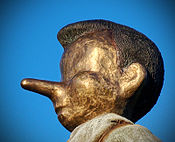
A cartoon I once saw featured a boss speaking to his staff. “Honesty may be the best policy,” he said, “but it’s not our company policy.” And while it may be funny, this cartoon reflects the sad truth that lying in our society has reached epidemic proportions. For instance, newspaper headlines speak of corporate scandals, fraudulent accounting practices, and insider trading. In schools today, surveys have shown that a majority of students cheat on tests or download research papers which they try to pass off as their own work. Job seekers pad their résumés with fake or exaggerated information. Car odometers are rolled back, expense accounts are padded, and spouses fib about how much they spent on that new dress or set of golf clubs. A recent university study revealed that a quarter of people’s “most serious lies” related to an affair. And considering that Jesus in today’s gospel spoke of the need to pay one’s taxes, it needs to be said that tax cheating is all too common.
Jesus gave this teaching after he had been approached by his opponents. They said to him, “Teacher, we know that you are a truthful man and that you teach the way of God in accordance with the truth.” The irony is, when they said that they believed Jesus to teach the truth, they were lying through their teeth. In a sense, all of us can relate to this experience of our Lord, because all of us have been lied to. And let’s face it: We’ve probably told a few lies ourselves.
People tell lies for all sorts of reasons. In our highly competitive society, , lies can help one gain an advantage over others and stand out from the crowd. And if everyone else is doing it, that makes it all the easier! Some people lie to get their “fifteen seconds” of fame- like the guy a few years ago who made up the story about witnessing one of the sniper attacks.
Other people, seeking revenge against someone they believe has hurt them, may start a vicious rumor. Some experience a thrill from lying because it gives them a feeling of having power over others. It’s not uncommon to lie in order to avoid punishment. You may remember Susan Smith, who in 1994 strapped her two boys into her car and then sent them into a lake to drown. If you recall, she tried to stay out of trouble by going on TV, saying her sons had been kidnapped, and pleading for their safe return. Finally, low self-esteem can lead some to exaggerate or even make up accomplishments or achievements, in order to feel better about themselves or impress others. For instance, phony war stories allow people with feelings of inferiority to be linked with the virtues of loyalty and courage.
Most of us believe that we do what we do for good reasons and with honest intentions. Therefore, when we lie, it’s easy to rationalize that what we’re doing is justified or even the right thing to do. We can think things like: “Nobody’s really getting hurt, so there’s really nothing wrong.” Or “I cheated on taxes or insurance- but only to get the money I rightly deserve.” Or “If everyone else lies on their resume, I better do it too so I won’t lose that job offer I want.” Or “If I told the truth about the way I feel, we’d just get in a fight and things would become even worse.”
As Christians, however, we are called to honesty and truth. This doesn’t mean that we have to be a bull in a china shop. We do need to be prudent and discrete in revealing the truth, because we don’t want to needlessly hurt or antagonize others. And this doesn’t mean that everyone has the right to hear the truth from us. To give an extreme example, no one would have to tell the Nazis where a Jewish family was hiding.
Nevertheless, God insists that we be honest people. As we all know, “You shall not bear false witness against your neighbor,” is one of the Ten Commandments. Indeed, God himself is truth, Jesus his Son reveals the truth, and they have sent the Holy Spirit of truth into our lives that we might walk in the truth and bear witness to it. Any lie, then, is really an offense against God himself.
Honesty and truthfulness are also requirements for justice and are essential for a civil society. “Men could not live with one another,” wrote St. Thomas Aquinas, “if there were not mutual confidence that they were being truthful to one another.” This is because lies always hurt those around us- even when we think they don’t.
In addition, Jesus has promised that the truth will set us free. It will free us from having to cover our tracks, live with shame and guilt, and the fear of our lies being discovered and exposed. The truth will liberate us to take off our masks and just be ourselves. It will also result in better relationships, less stress for ourselves, and less anger from others.
There is a cost to being honest! We may lose that job offer to the person who lied on their resume. We may have to “face the music” for something we’ve done or accept the reality of who we are, and not who we’ve been pretending to be. Our co-workers may resent us, because as one human resources expert has said, “employees who operate honestly and ethically often inspire anger, guilt, and resentment (from others).” Maybe we’ll end up with less money than we may have had if we’d fudged our tax returns. Nevertheless, we’ll be blessed with the assurance that God smiles upon our honesty, and we can unite our suffering with those of Jesus upon the cross.
As Mother Teresa once wrote, “If you are honest and frank, people may cheat you; be honest and frank anyway. You see, in the final analysis, it is between you and God. It was never between you and them anyway.”
Readings for today’s Mass: http://www.usccb.org/bible/readings/101611.cfm
The Gospel today contains lots of interesting juxtapositions: Hatred for Jesus, but grudging respect for him, real questions, versus rhetorical questions, politics and faith, duties to Caesar and duties to God. The word “juxtaposition” is from the Latin juxta (meaning “near”) and positio (meaning “place or position”). Hence a juxtaposition is the placing of two things near each other to see how they are similar and yet different. Usually, in English, a juxtaposition emphasizes differences more than similarities.
Let’s look at these one by one, spending the most time on the juxtaposition of our duties toward God and toward “Caesar.” The essential lesson in all these juxtapositions is that God will not be reduced to fit into our little categories. He is God, not man.
Juxtaposition 1 – The Enemy of my enemy is my friend. – The Gospel begins by describing an extremely unlikely set of “bedfellows.” The text says, The Pharisees went off and plotted how they might entrap Jesus in speech. They sent their disciples to him, with the Herodians. A very unlikely set of allies here. The Pharisees hated the Herodians. It was a combination of political and racial hatred; just about as poisonous as you could get in the ancient world. Yet they both agreed on this: This Jesus has to go.
Here is an important teaching, if you’re going to be a true Christian: the world will hate you. Too many Christians think some segment of the world will agree to live in peace with us, and so we strive to forge allegiances with it. In the modern American scene some think that the Republicans, or the Democrats are natural allies for us. As we will discuss later, we really don’t fit well into either party, or, frankly, any worldly club.
Catholicism is an “equal-opportunity offender” if it is proclaimed in an unabridged form. Issue by issue, we may appeal to one political party or another. But taken as a whole, we’re a nuisance: Pro-life, traditional family values, over here, Immigrants rights, contra capital punishment, affordable housing, etc., over there. But in the end we both please and annoy at the same time. Which is another way of saying we don’t fit into the world’s categories, and everyone has a reason to hate us.
Welcome to Jesus’ world where the Herodians and Pharisees, who agree on nothing, do agree to hate Jesus.
Juxtaposition 2 – Prophet and Lord or Political talking head? In their opening remarks to Jesus, his enemies give him grudging respect, but not to actually praise him, rather to provoke him. They say, Teacher, we know that you are a truthful man and that you teach the way of God in accordance with the truth. And you are not concerned with anyone’s opinion, for you do not regard a person’s status. Tell us, then, what is your opinion…
Now the juxtaposition here is to use praise as a pretext, to use praise to provoke. In effect, they think they can they can force a definition on Jesus: “You’re the Man, You’re the prophet….You’re the answer man….you’re the only one around here who tells the truth no matter what.” Now none of these things are false and they bespeak a grudging respect for Jesus.
But they are only using this to draw Jesus into a worldly debate well below his pay grade. They want Jesus to take sides in a stupid human debate over politics and worldly power. They want him to get arrested and killed over something not worth dying for.
Prophets die for the truth revealed by God, not for who the “big cheese” should be in human affairs, and who human beings think are the best. They want Jesus to opine as if he were some sort of talking head on T.V., rather than the prophet and Lord that he is. A question of this sort is not worthy of Jesus’ attention. Ask this of the local Senator or mayor, but leave God out of human political distinctions and camps do not expect him to take sides. He is beyond our distinctions and will not be confined by party lines, national boundaries, political philosophies and the like.
We may well debate that certain systems better reflect the Kingdom than others, but in the end, God cannot be reduced to being an Republican, a Democrat, or for that matter an American. He is God, and he transcends our endless debates and camps. He is not a talking head, he is God.
Juxtaposition 3- Real or Rhetorical? The odd coalition of Jesus haters asks him a question: Is it lawful to pay the census tax to Caesar or not? Though this is in the form of a question, it is not a sincere question, it is a rhetorical question.
Generally speaking rhetorical questions are statements or arguments in the form of a question. If I say to you, “Are you crazy?” I am not really looking for an answer. Though it is in the form of a question, I am really making a statement: “You ARE crazy.” This is what takes takes place here. The questioners already have their own opinion, and they are not about to change based on any answer Jesus would give. They don’t really want an answer per se. They just want something to use against Jesus.
If he says, “Yes, pay the taxes.” That is politically incorrect and will make him unpopular with the crowds. If he says “No, don’t pay the taxes” he gets arrested and will likely be executed.
In the end Jesus calls them what they are: hypocrites, a Greek word which means “actor.” And that is what they are, and are doing. This whole thing is an act. No real answer is sought, just a showdown. This is not about the truth, it is about a trap.
But Jesus will have none of it. He will not be reduced to human distinctions and categories. The truth he proclaims transcends the passing political order and struggles for human power. He will not be drawn in to declaring one side or the other better. Rather, He will apply the ruler of truth evenly to all.
He is Reality in the face of rhetoric, Perfection in the face of politics, Divinity in the face of division.
Juxtaposition 4 – God and Caesar – Jesus says, simply, and in a way that transcends worldly “all or nothing” scenarios: Then repay to Caesar what belongs to Caesar and to God what belongs to God.
This of course generates the wish for elaboration. But in our demands for more detail, we too often seek to conceal the fact that we really know the answer. And we also betray the need of the flesh to specify everything so as to control and limit its impact.
But if a list is demanded we might include some of the following things we ought to “pay” to Caesar (i.e. in our scenario, pay to our Country and locale):
To obey all just laws
Pay legally assessed taxes
Pray for our country and leaders.
Participate in the common defense based on our abilities and state in life.
Take an active and informed part in the political process
Engage in movements of necessary and on-going reform
Contribute to the common good through work, domestic and market based, and through the sharing of our abilities and talents.
Maintain strong family ties, and raise disciplined children well prepared to contribute to the common good and the good order of society.
Encourage patriotic love of this Country
Strive for unity and love rooted in Truth.
And we might include some of the following in what we owe to God:
Adoration, love and gratitude
Obedience to his Word and Law
Worship
Repentance
Support of his Church by attendance at sacred worship, financial support and sharing of our gifts and talents
Proclamation of his Word by witness and in verbal ways
Devoted reception of the Sacraments.
Raising our Children in His truth and in reverence of Him
Evangelization – making disciples
Preparing for death and judgement through a holy and reverent sojourn here
A glance at these lists reveals however that there is overlap, and one would expect this with God. For, He defies many of our human categories and distinctions. In effect we see a setting forth of the great commandment of Love: that we should love the Lord our God with all our soul, strength and mind, and our neighbor as our self (e.g. Matt 22:37). For, while God is not Caesar and Caesar is not God, yet love unites both categories.
Hence we see that to love our Country is to love our neighbor. To work for, support and be involved in the common good is to love our neighbor. And to love our neighbor whom we see is to begin to love God whom we do not see. Further, to seek to reform our land, secure justice, and ensure unity rooted in truth, is to help usher in the Kingdom of God. Yet again, to be rooted in God’s law, walk in his truth and raise our children as strong and disciplined disciples of the Lord is to bless this Country. To obey God and to walk in sobriety, love and self-discipline, is to render, not only to God, but to also have the ingredients of good citizenship.
However, it must be clear that God is, and must be our supreme love. And So Jesus is not setting forth a mere equivalence here. It remains a sad fact that this world is often at odds with God. And thus, we, who would be his disciples, must often accept the fact that we will be seen as aliens from another planet, according to this world. As we have already set forth, neither Jesus, nor we, should expect to fit precisely into any worldly category or club. We will be an equal-opportunity irritant to any large group. If you are going to be a faithful Catholic, expect to be an outsider, and outlier, and an outcast.
Let’s move from the abstract to the real. Is the Catholic Church Republican? Democrat? And what are you? As for me:
I’m against abortion, and they call me a Republican
I want greater justice for immigrants, and they call me a Democrat
I stand against “Gay” “Marriage,” and they call me a Republican
I work for affordable housing, and stand with unemployed in DC, and they call me a Democrat
I talk of subsidiarity and they say: “Republican, for sure.”
I mention the common good, and solidarity and they say, “Not only a Democrat, but a Socialist for sure.”
Embryonic Stem cell research should end, “See, he’s Republican!”
Not a supporter of the death penalty, standing with the Bishops and the Popes against it…”Ah, told you! He’s really a Democrat!…Dye in the wool and Yellow Dog to boot!”
Gee, and all this time I just thought I was trying to be a Catholic Christian. I just don’t seem to fit in. And, frankly, no Catholic should. We cannot be encompassed by any Party as currently defined.
Rendering to God comes first. But too many people today are more passionate about their politics than their faith. They tuck their faith under their politics and worldview. They more more inclined to agree with their party, than the Church, or even the Scriptures. And just try to tell them that, and they’ll say you’re violating Church/State barriers (a phrase not in the Constitution, by the way), or that since something is not infallibly defined (as they determine it), and thus they are free to entirely ignore the teaching of the Bishops, the Pope and/or the Catechism on any number of matters.
Hence the question goes up: Is God really first? Is his Word really the foundation of our thoughts and views? Or are we just playing games. Loving this world and working for the common good are not at odds with our love for God. But submitting to worldly categories and human divisions, and permitting them to drive our views IS most often opposed to God, who will not simply be conformed to human political movements.
God has set forth the Catholic Church to speak for him, but he has not anointed any political movement, or worldly organization to speak as such. No Catholic ought to surrender to artificial and passing distinctions, organizations, or permit worldly allegiances to them to trump what the Scriptures and the Church clearly proclaim. Sadly today, many do, and in such wise seem far more willing to render to some version of “Caesar” than to render first obedience and allegiance to God, and to the Church which speaks for Him. The Church is an object of faith, a political party is not. Render to God what is God’s.
This Song says, God and God alone is fit to take the Universe’s Throne:
Back when I was in Mount St. Mary’s Seminary some twenty-five years ago, Rap music had burst on the scene. But the thing about rap in those days was that it was more clever than today (if you ask me). Rap at that time was supposed to rhyme. Today, it sounds just a lot more like rambling soliloquies and a little too unintelligible. Again, just my opinion. But “back in the day” Rap had to rhyme and so you had to be very creative.
Some of the guys in the seminary were working in the inner city of Baltimore and they developed the “Jesus Rap.” I was amazed at how creative it was and have kept it all these years. Living in working in the inner city I would take it out and dust it off every now and again and I’ve adapted it over the years, a little change here and there, but it’s basically the same. I wish I could give credit by name to the seminarians (now priests) who wrote it but their names are lost in the dust bin of my memory.
But enjoy this (Old Fashion) “Jesus Rap” You’ll need to provide your own rhythm by tapping on the desk as you read. And please! Read it with a little rhythm! If you can’t do it ask a fifth grader.
NOW THE THING ABOUT JESUS, HE’S HIGH ABOVE THE REST,
THAT’S WHY I WEAR THIS CROSS ON MY CHEST.
HE LEADS ME TO THE FATHER,
I’M SO GLAD I COULD CLAP!
SO WON’T YOU JOIN ME NOW TO DO THE JESUS RAP!
PRAY TO JESUS,
WORSHIP JESUS.
I WAS DOWN! FEELING DEPRESSED!
MAYBE IT’S BECAUSE MY LIFE WAS A MESS.
IN DESPAIR! SO FULL OF DOUBT!
WELL I TURNED TO JESUS AND HE HELPED ME OUT!
NOW MY LIFE IS DANDY,
EVERYTHING’S A SNAP!
DO YOU WANT THE SAME?
THEN DO THE JESUS RAP!
PRAY TO JESUS
WORSHIP JESUS
PRAY TO JESUS
WORSHIP JESUS (Fade)
– – – – – – – –
Now here’s a video that “so bad its good.” Here are three suburban teenage girls trying to rap and, well, lets just admit, sometimes we white folks are a bit “challenged” in this area 🙂 They surely do a better job than I could! Actually they are quite creative in rapping several gospel stories such as the water made wine and the walking on the water. Enjoy!
And here’s another rap that’s a little more “hip.” It’s an interesting blend of rap, freestyle and call-response. I am NOT recommending this for Mass! Save it for the Church hall. Warning:This video was made using well-trained rappers, do not try this at your Church hall without proper supervision and safety gear.
“Everyone has a little dirty laundry.” Or so proclaimed an ad for a popular TV show about desperate housewives. Well, I don’t know if everyone has a little dirty laundry, but I do know that today’s gospel speaks to us when we do. Jesus reminded us that while we might keep secrets from other people, we can’t keep them from God. He sees and knows all that we do, and he holds us accountable for it.
Yet at the same time, God wants to forgive us of these things. We might say that while God sees all our dirty laundry, he wants to wash it for us too! Or as St. Augustine once said, “The one who made you is watching you, and the one who called you is helping you.”
It’s important that we me realize this, because sometimes our “dirty laundry” can fill us with so much shame that we become afraid to bring it to the Lord. We worry that we’ll be rejected or condemned. Then we avoid confession, we avoid Holy Communion, and sometimes we avoid church altogether.
But this is not what God wants us to do. He wants instead to release us from our shame and lift the burden of our guilt so he can fill us with his peace and joy. As the author of today’s psalm wrote, “I said, ‘I confess my faults to the Lord, and you took away the guilt of my sin.’”
In the video below there is a fascinating demonstration of what is known as the McGurk Effect, wherein what we hear is strongly influenced by what we see. Though the sounds heard in the experiment are exactly the same, when the visual cues change, we hear another sound. Even knowing the “trick” does not change the effect.
And this is a paradigm for faith, if you ask me.
Scripture speaks often of the fact that faith is a matter of hearing and not seeing:
So faith comes from hearing, and hearing by the word of Christ (Rom 10:17).
For we walk by faith, not by sight (2 Cor 5:7).
For now we see in a mirror dimly, but then face to face (1 Cor 13:12).
For in this hope we were saved. Now hope that is seen is not hope. For who hopes for what he sees? (Rom 8:24)
Now faith is the assurance of things hoped for, the conviction of things not seen (Heb 11:1).
Though you have not seen him, you love him; and even though you do not see him now, you believe in him and are filled with an inexpressible and glorious joy (1 Peter 1:8)
Blessed are those who have not seen and yet have believed (Jn 20:29).
So while it is true that many say, “Seeing is believing,” it really isn’t so. Seeing is just seeing. Faith comes by hearing.
Now this principle is very important for many of the truths of our faith are “mysterious.” The word “mysterious” here does not mean spooky, or strange, but rather, that what we “see” or intellectually grasp, is but a small part, and that the greater part of it is hidden from our sight and intellect. Since this is so, we must be taught the faith through hearing, and receiving the faith by hearing, gives us a prophetic interpretation of the reality we perceive by the other senses.
Consider especially the sacraments. What we see is often very limited. We many see, merely, water poured in baptism. But with the faith, granted though our hearing of the sacred words, we grasp the deeper meaning, that sins are being washed away, that new life is being conveyed, and a heavenly inheritance is being bestowed.
At a wedding, our eyes see a man and a woman, but as we hear their vows proclaimed we must disregard what our eyes see (still two) and grasp through faith, what our ears tell us from the very Word of Jesus: They are no longer two, but one and what God has joined together, let no one divide (Matt 19:6). Faith comes by hearing.
Regarding the Holy Eucharist St Thomas lovingly wrote in the hymn Adoro Te Devote:
Visus, tactus, gustus in te fallitur, (Sight, touch, taste, in thee falter), Sed auditu solo tuto creditur. (But the hearing alone is safely believed). Credo quidquid dixit Dei Filius; (I believe whatever the Son of God has said); Nil hoc verbo veritátis verius (Nothing is truer that this word of truth).
So again, the eyes deceive, and we must believe through what we hear. The world and the flesh are always demanding to see, but Faith comes by hearing. There may be some motives of credibility that seeing can give, but, frankly, the eyes are too easily deceived, we are often misled by what we see.
And that brings us to the video. As has already been mentioned, the sound in the video remains unchanged, but when the visual cue changes, we insist that the sound has changed. But it hasn’t. Yet, even knowing this, we tend to trust our eyes more than our ears, and insist on what we see not what we hear.
But then comes the strangest thing of all. The BBC announcer, almost in a subconscious illustration of the McGurk effect, comes to precisely the WRONG conclusion. She says, “The McGurk effect shows us that what we hear may not always be the truth.” Wrong! And exactly backwards! The McGurk effect demonstrates that what we SEE may not always be the truth. Stubbornly, she then reiterates, “So we can’t always trust what we hear.” But again, wrong in terms of this experiment, and exactly backwards! It is what we SEE that we cannot trust in this instance. Indeed a very strange error on her part, and almost Freudian in its psychological significance.
In the end, I hope you “see” what I mean: faith comes by hearing. And it is a very important dimension of faith to not let our eyes or other senses merely override our ears. The eyes and other senses can supply us certain data, even motives of credibility. But in the end, it is through hearing, and by the Word of God heard, that we have a prophetic interpretation of the reality perceived by our other senses. Faith which comes by hearing, is a prophetic interpretation of reality: Sed auditu solo tuto creditur.
Enjoy the video, it’ll mess with your mind but it confirms an important truth.
In my experience of working with permanent deacons, many applicants to our formation program confess that they don’t think they’re worthy enough to answer such a high calling. They often say this as if such a belief is a bad thing. In reality, however, it’s a good thing. It means that a person is approaching ordained ministry with reverence and humility, and not with pride, indifference, or a sense of entitlement. To be a deacon is a wonderful privilege. But it is also a great responsibility. To him whom God has given much, much will be expected.
I think we see this reflected in today’s gospel. Jesus spoke very stern words of judgment to certain scribes and Pharisees. Here, as always, Jesus harshest words are for those in religious authority. Jesus could be very gentle with thieves, prostitutes, adulterers, even his own executioners. But he was very different when dealing with religious authorities- the bishops, priests, and permanent deacons of his day.
He held them to a higher standard, because they should have known better, and because their attitudes, practices, and beliefs harmed many other people’s relationship with God. Think about what we have seen and experienced in our own day: If ministers are arrogant or lazy, their parish suffers; if they teach false doctrine, the sheep are led astray, and divisions are created; if they cause a scandal, the church is wounded, and the world laughs.
Today’s gospel should challenge all ministers of the gospel to be always mindful of the great trust God has placed in them. Indeed, it should challenge all the baptized, because through that sacrament we become public witnesses to Christ. This shouldn’t fill us with fear, because God is merciful and all things are possible with him. But it should fill us with awe for what God expects of us, and commit us to do his will and seek his kingdom above all else, that we might be faithful servants of the one who came only to serve.
An interesting article appeared the in the Wall Street Journal on the Saturday after the passing of Steve Jobs. Written by Andy Crouch, it does a good job (pardon the pun) of distilling the philosophy of technology that is common today. Steve Jobs, a master at technology and business, articulated and exemplified many of its tenants. We do well to examine this philosophy for it is a strong rival to the Christian outlook and has growing numbers of loyalists who see technology as a kind of saving god which has over thrown the older paradigm of the Judeo Christian heritage. It is a kind of substitutional philosophy that deserves so analysis.
I want to present excerpts from the article which is excellent. The full article can be read here: Steve Jobs: Secular Prophet. The text of Mr. Crouch is in bold, black italics, my comments are in red plain text.
Disclaimer: I am a fan of Apple products. I use them and will probably use more in the near future. I respect what Steve Jobs has accomplished and that what he has done has provided benefits for many to include good products, employment and the promotion of excellence. In responding to the philosophical claims of Mr Jobs and others, I am using a form of response that is akin to “rant.” I mean no personal disrespect to Mr Jobs (de mortuis nil nisi bonum). I disagree with his outlook and philosophy but personally respect what he has accomplished. I regret he did not have faith, yet still I hope to see I hope to see him in the great parousia.
Further, If I seem to be disagreeing with Mr Crouch, I am not, for he is but reporting the philosophy of technology and in the ends raises many of the same questions I do. Remember, to some degree I am using “rant” here in order to pull memorably in the other direction. It is a form of speech that requires context and some degree of appreciation for hyperbole (exaggeration).
Steve Jobs was extraordinary in countless ways—as a designer, an innovator, a (demanding and occasionally ruthless) leader. But his most singular quality was his ability to articulate a perfectly secular form of hope. Nothing exemplifies that ability more than Apple’s early logo, which slapped a rainbow on the very archetype of human fallenness and failure—the bitten fruit—and turned it into a sign of promise and progress. That bitten apple was just one of Steve Jobs’s many touches of genius, capturing the promise of technology in a single glance.
To be honest, I never really connected the Apple logo with a shot across the bow of the Judeo-Christian vision of our fallenness. I recently bought an iMac, which I like very much. But frankly the world of Apple and Mac have not been on my radar that much until recently.
But to be clear, I want to personally testify, that neither Macs nor PCs have made even a dent in the problem of sin. Any look at the typical combox of a blog will show that. If anything we’ve become more coarse and divided in our dialogue, as we tend to retreat from real interactions to virtual ones.
Granted, many new connections can be made, and some of them very beneficial, but not all of them are good. Internet porn sites are by far the most visited sites on the Internet, most them completely blowing away the nearest competitors.
Viruses also shout sin. Imagine some one sitting at home writing code to infect my computer and crash the hard disk. Talk about evil.
If there is a rainbow over the bitten apple, it’s a hologram, not real at all. The promise of technology to save or redeem us seems hollow, indeed, empty.
The philosopher Albert Borgmann has observed that technology promises to relieve us of the burden of being merely human, of being finite creatures in a harsh and unyielding world. The biblical story of the Fall pronounced a curse upon human work—”cursed is the ground for thy sake; in sorrow shalt thou eat of it all the days of thy life.” All technology implicitly promises to reverse the curse, easing the burden of creaturely existence. And technology is most celebrated when it is most invisible—when the machinery is completely hidden, combining godlike effortlessness with blissful ignorance about the mechanisms that deliver our disburdened lives.
To say that our lives are “disburdened” is a stretch. It is true that there are many creature comforts today and many once tedious tasks have been eliminated.
But honestly, the more we have, the less satisfied we seem to be. Stress and living at 90 mph with endless interruptions, e-mails, text messages, voice mails, tweets, and Facebook pokes, ain’t no paradise. Psychotropic drugs are sold at record levels to help manage the stress and depression that often results.
The wealthier and more well apportioned we have become, the more anxious we become. Frankly, we have too much to loose and so we are fearful. And, all our many possessions breed a kind of addiction to them.
Steve Jobs was great at showing us how that phone he just sold a year ago us is no longer enough. In fact, since his new phone came out, the one he sold us last year is now a piece of junk. You ain’t nothing until you get the latest iPhone 5! And there is something sad and pathetic, seeing people lined up for three days in front of a store to buy a stupid phone (oops, I mean “smart phone”), especially when the one they just bought a year ago, is working fine.
Further, the promises of advertisers et al. to make life peachy, also breeds unrealistic expectations, which in turn breeds resentments and disappointments.
Don’t get me wrong, I like technology and use it, but I am not sure it has “relieved me of the burden of being merely human.” The basic contours of life remain essentially unchanged, and that is, that life has its pleasures and pains, it’s joys and disappointments. Technology hasn’t changed that.
In the end, nothing in this world can fill the God-sized hole in our hearts. This world is not home and we’re always going to feel that we’re living out of a suitcase, because we are.
Politically, militarily, economically, the decade was defined by disappointment after disappointment—but technologically, it was defined by a series of elegantly produced events in which Steve Jobs, commanding more attention and publicity each time, strode on stage with a miracle in his pocket.
But wait a minute, I thought technology was supposed to relieve us of the burden of being merely human! What this I hear about military political and economic disappointment? Isn’t there an app for that? Looks like we need more than a miracle in a pocket.
He believed so sincerely in the “magical, revolutionary” promise of Apple precisely because he believed in no higher power.
Well, this “magical promise” that replaces the “higher power” has a lot of work to do. We still ain’t back in paradise, no matter what the holographic rainbow over the bitten apple says.
In his celebrated Stanford commencement address (which is itself an elegant, excellent model of the genre), he spoke frankly….”No one wants to die. Even people who want to go to heaven don’t want to die to get there. And yet death is the destination we all share. No one has ever escaped it. And that is as it should be, because death is very likely the single best invention of life. It’s life’s change agent; it clears out the old to make way for the new. Right now, the new is you. But someday, not too long from now, you will gradually become the old and be cleared away.”
Sad really. The human person’s dignity reduced to “doing something,” and then, when your usefulness is over and you get in the way of “change,” you need to be cleared away. Sounds like the voice of pure utilitarianism, wherein we are reduced to human doings, rather than human beings. It is clear that, by this philosophy, you do not exist for your own sake. Rather you exist for the purpose of being a “change agent.” And when you start getting in the way of blessed “progress,” holy “change” and other utopian notions, you need to be cut down and cleared away.
[Mr Jobs went on to say] “Sorry to be so dramatic, but it’s quite true. Your time is limited, so don’t waste it living someone else’s life. Don’t be trapped by dogma, which is living with the results of other people’s thinking. Don’t let the noise of others’ opinions drown out your own inner voice, heart and intuition.”
Of course dogma is a “no-no” in techno-religion, since it tends to block blessed and holy “progress” and “change.” For, “dogma” is actually more than “other people’s thinking,” it is the wisdom of past ages, and we can’t have any of that around here. That would get in the way of holy and blessed progress and change. And remember, as soon as you get in the way, you too must be cut down and carried away. Imagine! Learning from the past. No indeed, we certainly can’t be “trapped” by dogma for the reasons stated. Change is all, progress is the pearl of great price. Away with any wisdom from the past (a.k.a “dogma”)!
This is the gospel of a secular age….but the gospel of self-fulfillment does require an extra helping of stability and privilege to be plausible……
Exactly, a philosophy like this can only emerge among the comfortable and well healed, those who are most insulated from life’s often shocking turns. The “do your own thing” dictum is simply not possible for most of the less privileged who are not as free and privileged as Mr Jobs. I wonder if Mr Job’s own employees felt free not to let the noise of others’ opinions drown out your own inner voice, heart and intuition. It would seem he did give a lot a freedom to some on his staff, but I doubt the guy in shipping, packing boxes, felt free to ignore Mr Job’s opinion and follow his own inner voice, heart and ambition. I suspect he felt very obliged obey Mr Job’s thinking (i.e. “dogma”).
Is it possible to live a good, full, human life without that kind of hope? Steve Jobs would have said yes in a heartbeat. A convert to Zen Buddhism, he was convinced as anyone could be that this life is all there is. But the rest of us, as grateful as we are for his legacy, still have to decide whether technology’s promise is enough to take us to the promised land. Is technology enough? Has the curse truly been repealed? [Technology] works wonders within its own walled garden, but it falters when confronted with the worst of the world and the worst in ourselves. Exactly
OK, so there’s my rant. How say you?
Portrait above, by Tim O’Brien
I don’t know that I agree with the final line of this video, but it does bring home the point that there are a few thorns and thistles in techno-paradise.
Cited below is a summary of a recent report in USA Today on why teenagers leave the Church. As you will see I have a lot of questions about the study which, though admittedly summarized here, seems rather front-loaded. That is, it seems to have asked questions of teens that more imply the expected answer than really seek for the actual answer.
All that said, there is no doubt the Church has had trouble in recent decades retaining young people once they head to college and then begin careers. It used to be that, when they married and started having kids, we’d get many of them back. But with marriage and family being postponed as late as the mid 30s, many of them are lost so long, they never return.
Dubious Study? It is always a good endeavor to seek to understand the dynamics of the current problem. Nevertheless I am not sure this study is very helpful. First, the results seem a bit dubious to me. They seem more a projection of the poll taker’s issues, than authentic issues of modern youth. Second, some of the reported responses seem rather typical of what all teenagers go through to some extent (rebellion, no one is going to tell me what to do, etc.) Third, even if these responses are accurate, I am not sure what the Church is suppose to do about many of them, since to remedy the problem, would be to ask the Church to not be the Church.
Let’s look at the summary of the report. Again, all I have access to here is the USA Today summary, hence the actual report may not fall under every critique I make. The Full USA Today articel can be read here: USA Today – Teens leave Church. The excerpts presented here are in bold, black, italic type. My remarks are in red plain text.
Why do young Christians leave the church? New research by the Barna Group finds they view churches as judgmental, overprotective, exclusive and unfriendly towards doubters. They also consider congregations antagonistic to science and say their Christian experience has been shallow.
Now, does this really sound like teenagers talking? Most teens I talk to reference more basic things like boredom and not understanding what is going on. I have never heard a teen talk about the Church’s “antagonism to science” on his own. Now, if you front load the question and ask “Do you think the Church is antagonistic to science?” The first thing many teens will ask is what “antagonistic” means. Then when you explain it means “hostile” or “against” they’ll likely say yes, since this is often the subtle narrative in their public school curriculum. But honestly, I doubt this is a big deal with most of them and it sounds like the surveyors are putting words in the teens’ mouths.
And can you really imagine a teenager, even an 18 or 19 year old talking about a church being “unfriendly to doubters?” This sounds more like a Gen X or Baby Boomer phrase that comes out of the Willow Creek “seeker sensitive” lingo.
And again, “shallow” sounds like a word that was put in their mouth by the survey takers. I don’t think current teens use words like this. Perhaps, boring, or dumb or stupid, or irrelevant, but shallow?
Pardon me for being dubious about the nature of this survey. It sounds like older and rather cynical poll takers putting thoughts, words and phrases in young people’s mouths.
The findings, the result of a five-year study, are featured in You Lost Me: Why Young Christians are Leaving Church and Rethinking Faith, a new book by Barna president David Kinnaman. The project included a study of 1,296 young adults who were current or former churchgoers.
Researchers found that almost three out of five young Christians (59 percent) leave church life either permanently or for an extended period of time after age 15. One in four 18- to 29-year-olds said “Christians demonize everything outside of the church.” One in three said “Church is boring.”
OK, these are serious numbers and I’ve sure heard the “Church is boring” claim. But frankly, young people find a lot of things boring including school, family gatherings, museums, conversations, reading, you name it. While we can’t ignore it, there does seem to be something inevitable about boredom at this stage of life. One of my visual images of a teenager is of a young man slouched in a chair, hands in his pocket, looking up and about, somewhat dazed, bored and with mild contempt on his face. Not every teen is this way, but it is a common trait. We can try to engage them better, but there is something of a phase they are going through that may not entirely be the fault of the Church.
As for “Christians demonizing everything outside of the church” this too sounds like a supplied view in the survey. For example, if I were a teen and heard a question, “Do you thing Christians demonize everything outside the church?” I might first wonder what “demonize” meant. Then, having been told that to demonize means “to consider as evil,” I’d probably say, “Yeah, right. That’s exactly right!” But frankly I have never heard a teen use a phrase like this and I figure it was a phrase supplied by the poll takers, not a phrase actually emerging from interviews with current teenagers.
Further I wonder as to the neutrality of the poll takers who speak of “Christians demonizing everything outside the Church.” The question seems more rhetorical than an authentic question. Would these same poll takers think to ask young people if they thought “Scientists demonize or dismiss everything outside science?” No, of course not. That doesn’t fit the narrative that says it is only Christians who are judgmental and “demonize.”
Clashes between church expectations and youths’ experience of sexuality have driven some away. One in six young Christians said they “have made mistakes and feel judged in church because of them.” And 40 percent of 18- to 29-year-old Catholics said their church’s doctrine on sexuality and birth control is “out of date.“
What to do? OK, but here is an example of data that is not surprising but, at the end of the day, what is the Church supposed to do? We cannot change our doctrine on this. Perhaps we can catechize on human sexuality better. But, frankly, even with a lot of education on the matter, many in today’s world still reject the teaching.
Frankly, many people reject Church teaching on sexuality not due only to lack of knowledge, but mainly because it is inconvenient to their moral life. To a great extent they do know, deep down, that much of what they are doing is wrong. I have never spoken with a cohabiting couple who didn’t know, deep down, that what they were doing was wrong.
But psychologically we usually like to deflect our guilt. And so people say the Church is “out of date,” and if you call me on it “you are being judgmental.” But, deep down, they know it’s wrong.
Also, I am not sure that the “out of date” charge from teens is unique to these times. Even back in the stricter 1950s, I am willing to bet that young people saw the Church teachings on sex as “out of date.” Things like that were just less openly discussed and surveyed in those days. And, there were more cultural mechanisms in place to ensure compliance. Plus, marriage happened a lot earlier, and people grew up a lot faster, and saw the wisdom of the teaching more clearly, at least insofar as fornication and adultery go.
Contraception is another story, and much more has to be done to help people see how this hideous recasting of sex has led huge problems with promiscuity, STDs, abortion, higher divorce rates, an explosion of single parent families, homosexual confusion and on and on. In the 1960s we sowed in the wind and we have reaped the whirlwind. We have discussed that here before, and will need to do so again.
Kinnaman called the problem of young dropouts from church “particularly urgent” since many churches are used to “traditional” young adults who leave home, get educated, find a job and start a family before age 30.
Yes, this is a big shift. When I was ordained, just under 25 years ago, most couples I prepared for marriage were in their mid 20s. Now they are in their mid 30s. Starting a family was a traditional path back to Church. Not any more.
“Churches are not prepared to handle the ‘new normal,'” said Kinnaman. “However, the world for young adults is changing in significant ways, such as their remarkable access to the world and worldviews via technology, their alienation from various institutions, and their skepticism toward external sources of authority, including Christianity and the Bible.“
All this could be said for older Church members as well. There’s no doubt, we’re in a real pickle when it comes to secularization and increasingly vocal hostility to the Christian faith. The Catholic Church is especially singled out for hatred.
But here again, the Church can only do so much. Simply changing to fit the times, has been tried by most of the main-line Protestants denominations and look at them, they are far worse off than we are in the Catholic Church. Surely we must continue to engage the culture in an on-going discussion and use every form of media possible. Fr. Barron’s Catholicism Series is a good example of how we can more effectively teach the faith.
But in the end we are what we are. Paul wrote to Timothy that the Gospel must be preached in season and out of season. Right now we’re increasingly out of season. We can make some strategic moves to better communicate the faith, but at some level, there are also some cultural mega-trends that may simply limit our numbers for now. When it came to numbers Jesus never seemed all that obsessed. In fact, when the crowds grew large Jesus would often give a “hard saying.” (e.g. Lk 11:29; Matt 19:1ff; John 6; Lk 5:19ff; Matt 9:23 ff, inter al). And while it is true that Jesus said we should go to all the nations, he did say we could, should, or would please most of them.
So our task seems clear. We must not cease to evangelize, but we must also realize that these may be times of sowing more than harvesting. Turing around things simply and quickly may be difficult. But above all we must never compromise the Gospel merely to draw numbers. The Church must be the Church. I am working to double the numbers at my parish this year. But we’re not going to do it by being conforming to consumerist demands, but by being compelling in the proclamation of the truth faith.
As always, I am interested in what you think.
At some level teenage rebellion is just a phase. Sadly though our modern culture puts it on steroids by glorifying it in music etc. Here’s an example from my high school daze:
Sittin’ in the classroom thinkin’ it’s a drag
Listening to the teacher rap-just ain’t my bag
When two bells ring you know it’s my cue
Gonna meet the boys on floor number 2
Smokin’ in the boys room
Teacher don’t you fill me up with your rule
Everybody knows that smokin’ ain’t allowed in school

 A cartoon I once saw featured a boss speaking to his staff. “Honesty may be the best policy,” he said, “but it’s not our company policy.” And while it may be funny, this cartoon reflects the sad truth that lying in our society has reached epidemic proportions. For instance, newspaper headlines speak of corporate scandals, fraudulent accounting practices, and insider trading. In schools today, surveys have shown that a majority of students cheat on tests or download research papers which they try to pass off as their own work. Job seekers pad their résumés with fake or exaggerated information. Car odometers are rolled back, expense accounts are padded, and spouses fib about how much they spent on that new dress or set of golf clubs. A recent university study revealed that a quarter of people’s “most serious lies” related to an affair. And considering that Jesus in today’s gospel spoke of the need to pay one’s taxes, it needs to be said that tax cheating is all too common.
 stay out of trouble by going on TV, saying her sons had been kidnapped, and pleading for their safe return. Finally, low self-esteem can lead some to exaggerate or even make up accomplishments or achievements, in order to feel better about themselves or impress others. For instance, phony war stories allow people with feelings of inferiority to be linked with the virtues of loyalty and courage.
 In addition, Jesus has promised that the truth will set us free. It will free us from having to cover our tracks, live with shame and guilt, and the fear of our lies being discovered and exposed. The truth will liberate us to take off our masks and just be ourselves. It will also result in better relationships, less stress for ourselves, and less anger from others.