Death by a Thousand Cuts – Pondering Painful Divsions in the Church

011413There is, to me, a certain sad division in the Church that has set up in recent decades that is rooted in what I think is ultimately a false dichotomy. It makes me particularly sad because I respect and esteem people in both camps. And though I hold them both in my heart, they barely speak to one another and hold one another in deep suspicion and sometimes outright contempt.

I speak specifically of the division in the Church between those who focus especially on the moral issues related to Life, sexuality and family and those who focus on the moral issues related to the social teachings of the Church such as poverty, immigration, housing, healthcare, wages and so forth.

The issue recently resurfaced on the comment thread of this blog on Saturday. The blog post featured a video (re-posted below) that speak to the problem of being Catholic in name only.

Certain commentors opined that the video was unbalanced because it ends by highlighting the corporal works of mercy as essential to being a good Catholic. To be fair, the video also deals with issues of mass attendance, modesty, chastity, and respect for authority and is aimed at teenagers.

Despite this, some readers saw the video as only emphasizing the corporal works of mercy and were troubled that no mention was made about abortion, redefining marriage, and other issues often termed non-negotiables. Here is a sample of some of the comments:

  1. I think there is the danger that the “take away” here is that as long as I am freely volunteering to help the poor that is all that is needed to be a good Catholic. I know many students at the nearby Jesuit high school who have gone New Age or totally lapsed into religious non-observance and yet are service oriented.
  2. Strangely, there is not a single criterion mentioned in this video that would help identify this young lady as a Catholic. Generic Christian, yes, but not Catholic. The defense lawyer should have asked her whether she completely upheld the truth of the Scripture, Tradition and Magisterium; whether she unreservedly believed in the doctrine of transubstantiation; and whether the Pope was for her the visible head of the one true holy and apostolic Church (to name just a few pertinent issues). One can be an atheist and still follow Jesus’ call for charitable behavior.
  3. I’ll echo some of the other comments by saying the video, while clever, runs the risk of reducing Catholicism to social service work. Jenny Smith could well have claimed to be Catholic and worked in a soup kitchen and still not have been Catholic. It would have been nice to have seen the defense attorney ask her if she believed abortion to be evil (with her being pro-choice) or if she could explain transubstantiation (with her holding the Eucharist to be just a symbol) or have her recite the new translation of the Nicene Creed (which of course she wouldn’t be able to do from heart) or even ask her when the last time she went to confession was (years, no doubt).
  4. Interesting. The Gospel of Matthew is clear about the corporal works of mercy. But, the movie would be good for discussion with youth if there were clear Catholic teachings that were in question.

Well OK, you get the point. The comments above all think the focus was either wrong or incomplete. Though, as I point out, the movie does reference things other than the corporal works of mercy.

To be sure, there is a special priority to be had on the life issues especially today. As some have rightly observed, it is necessary to be alive in order to enjoy other things such as decent housing, healthcare, just immigration laws etc.

That said, I think the sorts of comments highlighted above do call for some concern, and show forth the need for some distinctions.  I would like to highlight some of the following concerns distinctions:

I.  The comment expressed concern about balance. But the comments themselves show some lack of balance. For, critical and foundational as they are, focusing in the life/sex/marriage  issues cannot eclipse the fact that there are a wide range of other moral issues as well.

Both Scripture and tradition set forth a wide range of issues, certain issues ranking higher importance  than others. But that some issues are more foundational and critical than others  should not artificially truncate the wholistic presentation of Biblical and Catholic moral teaching tradition.

For example, the necessary discussion and emphasis on mortal sin, should not preclude any discussion of venial sin. Indeed, venial sins often contribute to mortal sin and lay the foundation for it.

So the discussion on being an authentic Catholic is not a zero-sum game, as if discussing and focusing on certain critical issues, means we cannot thereby engage other issues as well. Certain areas may need special attention, but it is not healthy to completely forsake one thing for another. The priority the urgent should not wholly eclipse the priority of the important,  and the whole is often in service of the particular and the urgent.

Thus, the Catholic teachings on the sacredness of life are part of a wider teaching that respects the dignity of the human person at many levels. Demonstrating the Catholic concern for the individual involves wide and diverse issues, fosters credibility in terms of our concerns for issues of life and family.

II. The comments seem to presume an animus against certain issues or intentionally omission of them where it may not be. While it is true, but the video does not mention abortion, the marriage issue or euthanasia,  it is also true it does not mention divorce, or theft. This does not thereby mean video either supports divorce or theft, or is indifferent to these issues. It may simply mean that not everything could be covered in the span of a short video.

Jesus does not cover every moral topic in the Sermon on the Mount (Matt 5-7) either. In fact, some very critical issues are left out from that sermon. Many gay activists love to emphasize that Jesus never explicitly mentioned homosexuality. (Never mind that the Apostles He commissioned to speak in his name did speak to the issue very clearly and excluded it entirely). Never mind all that,  they say Jesus never mentioned it!

But an argument from silence, is one of the weakest inductive arguments. To argue a position from someone based on something they did not say is at best chancy, and at worst unjust. The video’s silence on abortion and other important moral issues does not constitute an argument or just accusation that the video makers intend thereby a selective reading of Catholic teaching, or a setting aside of pro-life priorities.

III. Many things help make the whole. The Church today faces a world and a culture that is in increasing and widespread disrepair. There are many things that need attention and it is good that we have some in the Church who specialize in many different ways.

I am mindful of a recent experience when, after I tripped over a loose pavement stone and had a bad fall, I was knocked unconscious. The rescue squad was summoned and I was taken to a nearby shock-trauma unit.  As I was wheeled in, now conscious, no less than six people went immediately to work, and each had a very specific job. One took my blood pressure, another got other vitals such as EKG. Yet another had a job to remove my outside clothing, and another interviewed me in order to test my mental state. Still another collected information on my medical history from a brother priest who accompanied me to the hospital. Someone else drew true blood, and so forth. Eventually I was handed to others and got a brain scan and an x-ray of my sprained ankle. Each one had an important job to do, some things were more critical than others, but all were necessary and important.

As a pastor, and priest who walks in the wide Church, I am grateful that there is not only a diversity of gifts, but also the diversity of specialties and interests. I have parishioners who are  passionate pro-life activists, and others who are wonderfully dedicated to the cause of affordable housing and youth programs in the community. I am glad that I have people passionate and concerned and committed in all these areas and more besides.  Some issues are more critical than others, but all are important, all affect human beings, their dignity, and how we best and justly treat one another.

I live for the day when we will all appreciate and respect that there is some need for a division of labor, and come to appreciate that it is good thing that some work for affordable housing, so that others are free to work for pro-life, that’s some volunteer in crisis pregnancy centers run by the Church, so that others can reach out to immigrants, or provide clothing for the poor.

IV. I am aware, and share the concern that, in recent decades to some extent, the Church drifted too strongly in the direction of social action, and away from the sacramental life, prayer, and the study of the faith.

But that said, it does not follow that we should over-correct and or be suspicious of every reference to the social Gospel. The fact is, there are corporal works of mercy, as well as spiritual works of mercy.

And, the fact is, God is passionately concerned about how we treat the poor. A significant amount of Scripture is devoted to matters of justice for the poor, the widow, the resident alien, and other socially vulnerable individuals. Some of God’s greatest anger is directed toward those who would neglect obligations to the poor and needy.

Nowhere does scripture require or even envision that this should be a large role for big government. But God does speak to Israel both individually and collectively. That is to say, we all have individual obligations, and also communal obligations.

The Church cannot be the Church, and cannot credibly claim lay hold of faith without consistently and strongly advocating for the poor. And thus, whatever correction we need to do to add back the spiritual and personal moral conversion we have sometimes neglected, neither can we neglect to mention the very things which this video well articulates, namely the corporal works of mercy.

We ought to avoid either-or scenarios. It is not the spiritual works of mercy or the corporal works of mercy, it is not the moral issues or the social issues, it is all of these things in proper balance. This is necessary both for catholicity and credibility.

Let me again be clear that I am not hereby advocating large government programs, or expansive federal management of problems related to the poor.

And to be fair, neither is the video. The video speaks directly to the young lady named Jenny and to what she has or has not done. Reasonable Catholics will disagree on how best to help the poor, but we cannot disagree that we must help the poor, and that God expects, even demands it of us.  Poverty is complicated, many social ills are very complicated, but this does not exempt us from entering into vigorous discussion and action regarding solutions.

I have written more on my concerns in this matter on the Blog of the US Bishops (to read CLICK HERE). In the article there I argue that the Church needs two wings and one heart to fly. Thank God for the diverse passions and actions of many in the Church on many and different fronts. In the end it is one battle to usher in the full kingdom of God and insist on the whole counsel of God. The “justice wing” is not in competition with the “life wing”. Both wings are needed and necessary. And both wings are and must be united in one Heart, the heart of the Church, the heart of Christ.

I’ll tell you what, perhaps the most discouraging thing about being a blogger and being out there is not the scorn of the secular. It is the death by a thousand cuts executed by some (thank God not most) fellow believers who nit-pick, and object that something I say is not said just they way they want it said. This is very painful and part of the cost of being out there. But think about it now, how many give way under such scorn, and fear to be “out there.”

It is very unfortunate by my estimation that some have seen fit to criticize this video for what it does not (even) say. To my mind it is an excellent video, well produced and thought-provoking. Brevity cannot permit every issue to be addressed.

If you think you can do better or add to it, raise your own money and do your own project. More is better. But the kind of particularism and the narrow-casting attitudes that set up in the blogosphere can be very discouraging and even harmful. It is a big Church and a lot issues need addressing in this dysfunctional culture of the West. Lets thank God for each other and learn to appreciate the diverse efforts that are needed today.

In case you missed it, here is the video in question.

What is Does Scripture Mean by”The Flesh?”

011313I was recently talking with someone and I recalled that there is  a common misunderstanding of the meaning of the Biblical phrase “the flesh.”  There are many references to “the flesh” in New Testament Scripture, especially in the letters of St. Paul. The phrase confuses some who think it synonymous with the physical body.

It is true that there are many times when Scripture uses the word “flesh” to refer to the physical body. However when the definite article “the” is placed before the word “flesh” we are dealing with something else. Only very rarely does the Biblical phrase “the flesh” (ἡ σὰρξ (he sarx), in Greek) refer only to the physical body (eg. John 6:53; Phil 3:2; 1 John 4:2) , but almost always the phrase refers to something quite distinct from merely the physical body.

What then is meant by the term “the flesh” (ἡ σὰρξ)? Perhaps most plainly it refers to that part of us that is alienated from God. It is the rebellious, unruly and obstinate part of our inner self that is operative all the time. It is that part of us that does not want to be told what to do. It is stubborn, refuses correction, and does not want to have a thing to do with God. It bristles at limits and rules. It recoils at anything that might cause me to be diminished or something less than the center of the universe. The flesh hates to be under authority or to have to yield to anything other than its own wishes and desires. The flesh often desires something simply because it is forbidden.

The recent Protestant translations of the Bible such as the NIV often call the flesh our “sin nature” which is not a bad term in summarizing what the flesh is. In Catholic tradition the flesh is where concupiscence sets up shop. Concupiscence refers to the strong inclination to sin that is in us as a result of the wound of Original Sin. If you do not think that your flesh is strong, just try to pray for five minutes and watch how quickly your mind wants to think of anything but God. Just try to fast, or be less selfish, and watch how quickly your flesh goes to war.

The flesh is in direct conflict with the spirit. “The spirit” here refers not to the Holy Spirit but to the human spirit. The (human) spirit is that part of us which is open to God, which desires him and is drawn to him. It is that part of us which is attracted by goodness, beauty and truth, which yearns for completion in God and to see His face. Without the spirit we would be totally turned in on ourselves and consumed by the flesh. Thankfully our spirit, assisted by the Holy Spirit draws us to desire what is best, what is upright, good and helpful.

Perhaps it is good that we look at just a few texts which reference “the flesh” and thus here in Lent learn more of the flesh and its ways. This will help us to be on our guard and to rebuke it by God’s grace and learn not to feed it. I make some comments in red with each quote.

  1. The Flesh does not grasp spiritual teachings – [Jesus said] The Spirit gives life; the flesh counts for nothing. The words I have spoken to you are spirit and they are life. (John 6:63) Having taught on the Eucharist, most of his listeners ridicule his teaching and will no longer take Jesus seriously. So Jesus indicates that their hostility to the teaching on the Eucharist is of the flesh. The flesh demands that everything be obvious to it on its own terms. The flesh demands to see physical proof for everything; demands that it be able to “see” using its own unregenerate power. And if it cannot see based on its own limited view, it simply rejects spiritual truth out of hand. In effect the flesh refuses to believe at all since what it really demands is something that will “force” it to accept something. Inexorable proof which faith demands takes things out of the realm of faith and trust. Faith is no longer necessary when something is absolutely proven and plainly visible to the eyes of flesh. The flesh simply refuses to believe and demands proof.
  2. The flesh is not willing to depend on anyone or anything outside its own power or control – For it is we who are the circumcision, we who worship by the Spirit of God, who glory in Christ Jesus, and who put no confidence in the flesh— though I myself have reasons for such confidence. If anyone else thinks he has reasons to put confidence in the flesh, I have more: circumcised on the eighth day, of the people of Israel, of the tribe of Benjamin, a Hebrew of Hebrews; in regard to the law, a Pharisee; as for zeal, persecuting the church; as for legalistic righteousness, faultless….I [now] consider this rubbish, that I may gain Christ and be found in him, not having a righteousness of my own that comes from the law, but that which is through faith in Christ (Phil 3:3-9 selected) The flesh wants to be in control rather than to have to trust in God. Hence it sets up its own observance, under its own control. And when it has met its own demands it declares itself to be righteous. Since the flesh hates being told what to do it takes God’s law and makes it “manageable” based on the flesh’s own terms. So, for example, if I am supposed to love, let me limit it to my family and countrymen but I am “allowed” to hate my enemy. But Jesus says, no, love your enemy. The flesh recoils at this for unless the law is manageable and within the power of the flesh to accomplish it, the Law cannot be controlled. The flesh trusts only in its own power. The Pharisees were “self-righteous” That is to say, they believed in a righteousness that they themselves brought about through their flesh power. But the Law and flesh cannot save. Only Jesus Christ can save. The flesh refuses this and wants to control the outcome based on its own power and terms.
  3. The Flesh hates to be told what to do – For when we were controlled by the flesh, the sinful passions aroused by the law were at work in our bodies, so that we bore fruit for death. (Rom 7:5) The disobedience and rebelliousness of the flesh roots us in sinful behavior and prideful attitudes. The prideful attitude of the flesh is even more dangerous than the sins that flow from the flesh since pride precludes instruction in holiness and possible repentance that lead to life. But the flesh does not like to be told what to do. Hence it rejects the testimony of the the Church, the scriptures and the conscience. Notice, according to the text, the very existence of God’s Law arouses the passions of the flesh. The fact that something is forbidden makes the flesh want it all the more! This strong inclination to sin is in the flesh and comes from pride and indignation at “being told what to do.” The flesh is refuses God’s Law and sets up its own rules. The flesh will not be told what to do.
  4. Flesh is as flesh doesThose who live according to the flesh have their minds set on what the flesh desires; but those who live in accordance with the spirit have their minds set on what the spirit desires. The concern of the flesh is death, but the concern of the spirit is life and peace (Rom 8:5-6) The flesh is intent on things of this world, upon gratifying its own passions and desires. On account of the flesh we are concerned primarily with ourselves and seek to be at the center. The flesh is turned primarily inward. St Augustine describes the human person in the flesh as “curvatus in se” (turned in upon himself). But the spirit is that part of us that looks outward toward God and opens us the truth and holiness that God offers. Ultimately the flesh is focused on death for it is concerned with what is passing away: the body and the world. The human spirit is focused on life for it focuses on God who is life and light.
  5. The Flesh is intrinsically hostile to God – The mind of the flesh is hostile to God. It does not submit to God’s law, nor can it do so. Those controlled by the flesh cannot please God. (Rom 8:7-8) The flesh is hostile to God because it is pridefully hostile to any one more important than itself. Further the flesh does not like being told what to do. Hence it despises authority or anyone who tries to tell it what to do. It cannot please God because it does not want to.
  6. The Flesh abuses freedomYou, my brothers, were called to be free. But do not use your freedom to indulge the flesh; rather, serve one another in love. (Gal 5:13) The flesh turns God given freedom into licentiousness. Licentiousness is to demand freedom without limit. Since the flesh does not want to be told what to do it demands to be able to do what ever it wants. In effect the flesh says, “I will do what I want to do and I will decide if it is right or wrong.” This is licentiousness and it is an abuse of freedom. It results in indulgence and paradoxically leads to a slavery to the senses and the passions.
  7. The Flesh Demands to be fed – So I say, live by the Spirit, and you will not gratify the desires of the flesh. For the flesh desires what is contrary to the Spirit, and the Spirit what is contrary to the sinful nature. They are in conflict with each other, so that you do not do what you want. (Gal 5:16-17) Within the human person is this deep conflict between the flesh and spirit. We must not be mistaken, the flesh is in us and it is strong. It has declared war on our spirit and on the Holy Spirit of God. When the spirit tries to obey the flesh resists and tries to sabotage the best aspirations of the spirit. We must be sober about this conflict and understand that this is why we do not do what we most know is right. The flesh has to die and the spirit come more alive. What you feed grows. If we feed the flesh it will grow. If we feed the spirit it will grow. What are you feeding? Are you sober about the power of the flesh and do you and I therefore feed our spirit well through God’s word and holy communion, through prayer and the healing power of confession. What are you feeding?
  8. The Flesh fuels sin – The acts of the flesh are obvious: sexual immorality, impurity and debauchery; idolatry and witchcraft; hatred, discord, jealousy, fits of rage, selfish ambition, dissensions, factions and envy; drunkenness, orgies, and the like. I warn you, as I did before, that those who live like this will not inherit the kingdom of God (Gal 5:19-210) This catalogue of sins that flow from the flesh is not exhaustive but is representative of the offensive and obnoxious behavior that flows from the flesh. Be sober about the flesh, it produces ugly children.
  9. This [condemnation by God] is especially true of those who follow the corrupt desire of the flesh and despise authority. (2 Peter 2:10) Clear enough, the flesh hates authority and, did I mention (?) The flesh does not want to be told what to do.

So here is a portrait of “the flesh.” It is ugly. You may say I have exaggerated, that the flesh is not really this bad. Well I am not, just buy a newspaper and see what the flesh is up to. You may, by God’s grace, have seen a diminishment in the power of the flesh in your life. That is ultimately what God can and will do for us. He will put the flesh to death in us and bring alive our spirit by the power of his Holy Spirit. But step one is to appreciate what the flesh is and understand its moves. Step two is to bring this understanding to God through repentance. Step three is, by God’s grace, to stop feeding the flesh and start feeding the spirit on prayer, scripture, Church teaching and Holy Communion. Step four is to repeat steps 1-3 for the rest of our lives. God by his grace will cause the flesh to die and the spirit to live by his grace at work in us through Jesus Christ.

There is no musical better at (humorously) depicting the flesh as Camelot. Here are a few video clips that depict well the flesh

In this first video Sir Lancelot ponders what a great and perfect guy he is. He goes so far as to say that “Had I been made the partner of Eve we’d be Eden still!”

In this clip, the Knights (in the flesh) ridicule goodness and sing “Fie On Goodness!” It well illustrates the tendency of the flesh not only to indulge sin, but also to resist and ridicule what is good.

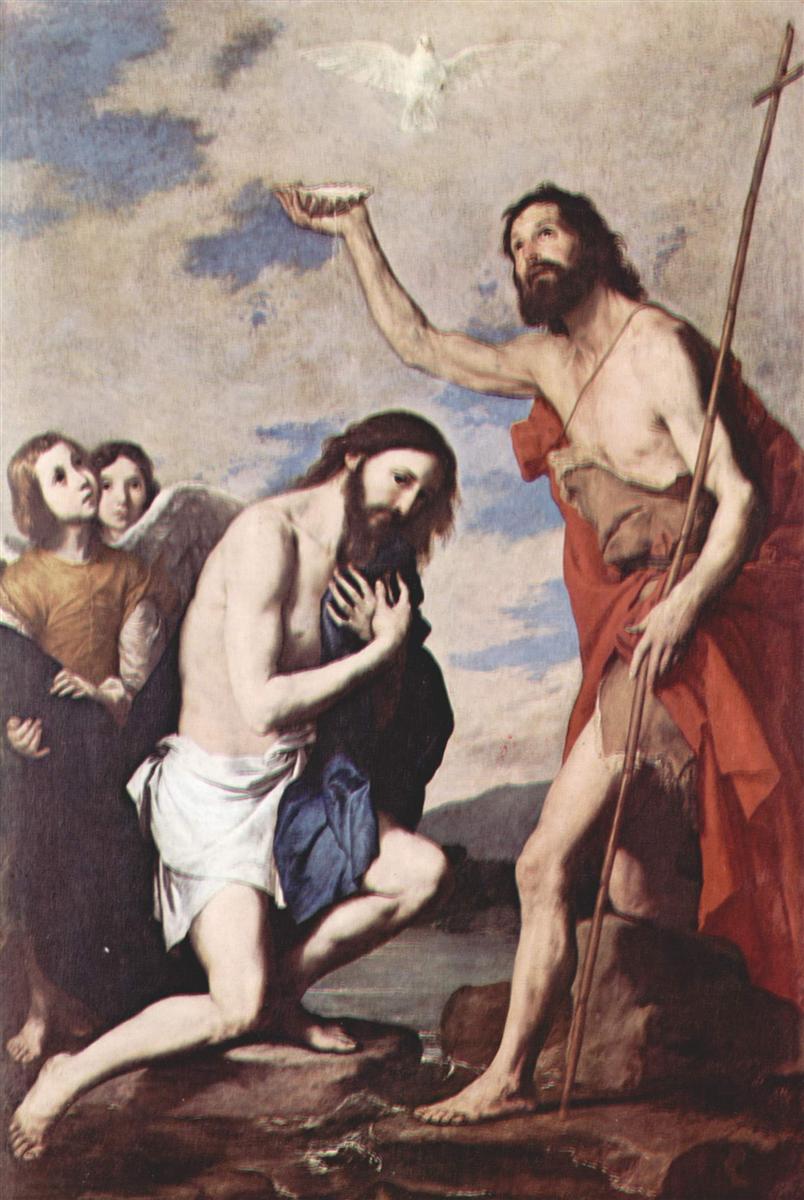
Jesus does not go into the Water alone. He takes us with Him. A reflection on the Baptism of the Lord

011213Today’s feast of the Baptism of the Lord is a moment to reflect not only on the Lord’s baptism, but also on our own. For in an extended sense, when Christ is baptized, so are we, for we are members of his body. As Christ enters the water, he makes holy the water that will baptize us. He enters the water and we follow. And in these waters he acquires gifts to give us, as we shall see below.

Let’s examine this text in three stages:

1. The Fraternity of Baptism – The text says After all the people had been baptized and Jesus also had been baptized”

Luke puts the fact of Jesus’ baptism in the middle of a sentence. Perhaps he mentions it in passing because he, like many of us  is puzzled about Jesus requesting baptism.  Why? John’s baptism of repentance presumes the presence of sin. But the scriptures are clear, Jesus had no sin.

  1. For we have not a high priest who is unable to sympathize with our weaknesses, but one who in every respect has been tempted as we are, yet without sin (Heb 4:15 ).
  2. You know that he appeared to take away sins, and in him there is no sin (1 John 3:5 ).

Jesus identifies with sinners, even if he never sinned. As he comes to the riverside he has no ego concerns. He is not embarrassed or ashamed that some might think him a sinner even though he was not. It is a remarkable humiliation he accepts to be found in the company of sinners like us, and even to be seen as one of us. He freely enters the waters and, to any outsider who knew him not, he would simply be numbered among the sinners, which he was not.

Consider how amazing this is. The Scripture says He is not ashamed to call us his Brethren (Heb 2:11). It also says God made him who had no sin to be sin for us, so that in him we might become the righteousness of God (2 Cor 5:21).

Jesus ate with sinners to the scandal of many of the religious leaders: -This man welcomes sinners and eats with them!” (Lk 15:2). Jesus was known as a friend of sinners, had pity on the woman caught in adultery, allowed a sinful woman to touch him and anoint his feet. He cast out demons and fought for sinners. He suffered and died for sinners in the way reserved for the worst criminals. He was crucified between two thieves and He was assigned a grave among the wicked (Is 53).

Praise God, Jesus is not ashamed to be found in our presence and to share a brotherhood with us. There is a great shedding of his glory in doing this. Again, Scripture says, [Jesus], being in very nature God, did not consider equality with God something to be grasped, but made himself nothing, taking the very nature of a servant, being made in human likeness. And being found in appearance as a man, he humbled himself (Phil 1:3)

2. The Foreshadowing of our Baptism – In accepting Baptism, Jesus does not enter the water alone. He takes us with him, for we are members of His Body. He the Head of the Body, goes where the members will follow. St. Maximus says:

I understand the mystery as this. The column of fire went before the sons of Israel through the Red Sea so that they could follow on their brave journey; the column went first through the waters to prepare a path for those who followed……But Christ the Lord does all these things: in the column of fire He went through the sea before the sons of Israel; so now in the column of his body he goes through baptism before the Christian people….At the time of the Exodus the column…made a pathway through the waters; now it strengthens the footsteps of faith in the bath of baptism. (de sancta Epiphania 1.3)

So what God promised in the in the Old Testament by way of prefigurement he now fulfills in Christ. They were delivered from the slavery of Egypt as the column led them through the waters. But more wonderfully, we are delivered from the slavery to sin as the column of Christ’s body leads us through the waters of baptism. God’s righteousness is his fidelity to his promises. Hence Jesus says, in his baptism and all it signifies (his death and resurrection) he has come to fulfill all righteous and he thus fulfills the promises made by God at the Red Sea and throughout the Old Testament.

3. The Four Gifts of Baptism – The Text says, heaven was opened and the Holy Spirit descended upon him in bodily form like a dove. And a voice came from heaven, “You are my beloved Son; with you I am well pleased.

Eph 5:30 says we are members of Christ’s body. Thus when Jesus goes into the water we go with him. And in going there he acquires four gifts on our behalf as this text sets them forth. Lets look at the four gifts he acquires on our behalf:

  1. Access the heavens are opened . The heavens and paradise had been closed to us after Original Sin. But now, at Jesus’ baptism, the text says the heavens are opened. Jesus acquires this gift for us. So, at our baptism, the heavens open for us and we have access to the Father and to the heavenly places. Scripture says: Therefore, since we are justified by faith, we have peace with God through our Lord Jesus Christ. Through him we have obtained access to this grace in which we stand, (Romans 5:1) It also says, For through Jesus we have access in one Spirit to the Father. So then you are no longer strangers and sojourners, but you are fellow citizens with the saints and members of the household of God (Eph 2:17). Hence the heavens are opened also at our own Baptism and we have access to the Father.
  2. Anointing the Spirit of God descends on him like a dove – Here too, Jesus acquires the Gift of the Holy Spirit for us. In Baptism we are not just washed of sins, but we also become temples of the Holy Spirit. After baptism there is the anointing with chrism which signifies the presence of the Holy Spirit. For adults this is Confirmation. But even for infants, there is an anointing at baptism to recognize that the Spirit of God dwells in the baptized as in a temple. Scripture says, Do you not know that you are God’s temple and that God’s Spirit dwells in you? (1 Cor 3:16)
  3. AcknowledgmentYou are my beloved Son. Jesus receives this acknowledgment from his Father for the faith of those who heard, but also to acquire this gift for us. In our own Baptism we become the children of God. Since we become members of Christ’s body, we now have the status of sons of God. On the day of your Baptism the heavenly Father acknowledged you as his own dear Child. Scripture says: You are all sons of God through faith in Christ Jesus, for all of you who were baptized into Christ have clothed yourselves with Christ (Gal 3:26)
  4. ApprovalWith you I am pleased . Jesus had always pleased his Father. But now he acquires this gift for you as well. Our own Baptism gives us sanctifying grace. Sanctifying grace is the grace to be holy and pleasing to God. Scripture says, Blessed be the God and Father of our Lord Jesus Christ, who has blessed us in Christ with every spiritual blessing in the heavens, as he chose us in him, before the foundation of the world, to be holy and blameless in his sight. (Eph 1:1-3)

Thus, at his Baptism, Christ acquired these gifts for us so that our own Baptism we could receive them. Consider well the glorious gift of your Baptism. Perhaps you know the exact day. It should be a day as highly celebrated as your birthday. Christ is baptized for our sakes, not his own. All these gifts had always been his. Now, in his baptism he fulfills God’s righteousness by going into the water to get them for you. It’s alright to say, “Hallelujah!”

On Trial for Being a Catholic – A Creative Video

Gavel in court room
Gavel in court room

There is an old saying, “If being a Catholic were against the Law, would there be enough evidence to convict you?” Tragically for many Catholics, being a Catholic is little less than a sound or label they go by when they need to fill in the blank on a questionnaire: Religion ______________. Only 25% go to Mass on Sunday and even many at Mass dissent on many critical matters.

In a more ecumenical vein, the writer Maya Angelou once wrote: “A woman said to me the other day, regarding herself, “I am a Christian.” And I said in reply, “Already?”

Indeed, for Christian is more than a label, it is a life.

The video below is a very creative one that addresses the question of being a Catholic. A young woman is a trial for “the crime” of being Catholic and the case seems like a slam-dunk when she “admits” to “the crime.” But her defense attorney comes “to the rescue” and in so doing well illustrates that there is more to being a Catholic that saying you are one. Consider watching this video. It is more creative than first meets the eye, and it lays out a lot of tendencies that are quite common today.

Answering an Atheist and Asking for Fairness and Accuracy

011113-pope-2Susan Jacoby, an author and atheist wrote a column in last Sunday’s New York Times entitled “The Blessings of Atheism.” In it she proposes that atheism has a lot to offer, especially in times of tragic loss and that it frees human beings from having to ask and answer difficult question. As you may imagine, I am not so sure that asserting a question can be avoided means that it has actually been avoided, or that what she calls blessings are in fact blessings.

I would like to excerpt her article and make a few comments. Her original writing is in bold, black italics. My comments are plain red text. These are excerpts. For the full article CLICK HERE

In a recent conversation with a fellow journalist, I voiced my exasperation at the endless talk about faith in God as the only consolation for those devastated by the unfathomable murders in Newtown, Conn. Some of those grieving parents surely believe, as I do, that this is our one and only life. Atheists cannot find solace in the idea that dead children are now angels in heaven. “That only shows the limits of atheism,” my colleague replied. “It’s all about nonbelief and has nothing to offer when people are suffering.” …..

Just a minor quibbles here, the Christian faith does not teach that “dead children are now angels in heaven.” Human beings never become angels, we always remain quite human.

Secondly, I am not sure that what her friend said should be allowed to represent what all Christians think of atheism. I for one do not hold that atheism “has nothing to offer.” People generally do not cling to philosophies that offer them nothing. Atheists clearly do have reasons for holding to their philosophy and it must offer them something. For some it is their response to the problem of evil or the seeming absurdities of this world. For others it is merely that the existence of God is inconvenient to their moral life, or worldview. For still others, it is a way for detaching from what they see as the problems posed by belief (e.g. our concepts of sin, guilt, judgment, and so on). Yet others have many complaints about the Church. I am not trying to speak here for atheists, or put words in their mouths, but the bottom line is people usually hold to things for a reason.

Ms. Jacoby goes on, in a part of the article not reproduced here, to trace the origins of her atheism to the problem of evil and suffering. She saw a friend die a lingering death from polio back in the 1950s. Being dissatisfied with the answers faith provided, she detached from faith and sees atheism as an alternative to believing in a God who would allow such things to happen.

So it would seem that atheism does have something to offer her. She seems to think that the non-answer of atheism is an answer and that denying the existence of God means she can avoid struggling with the questions related to evil and suffering. As we shall see, I propose that here solution offers neither an answer, nor an escape from the problem of evil.

[But] it is primarily in the face of suffering, whether the tragedy is individual or collective, that I am forcefully reminded of what atheism has to offer. When I try to help a loved one losing his mind to Alzheimer’s, when I see homeless people shivering in the wake of a deadly storm, when the news media bring me almost obscenely close to the raw grief of bereft parents, I do not have to ask, as all people of faith must, why an all-powerful, all-good God allows such things to happen.

I am not sure why Ms. Jacoby considers herself free of having to ask this question. I think the problem of evil and suffering is something that perplexes every human being on the planet, and Ms. Jacoby cannot so easily exempt herself from the questions surrounding it. While she may not direct them to God, she cannot ultimately avoid the universal human struggle to inquire into the meaning of all things, including evil and suffering.

Human beings seek meaning, seek reasons. I am not at all convinced that her demurring from the question of suffering is either possible or authentic. The only truly authentic “refuge” from this question is to insist that life and this world really has no meaning at all, to insist that everything is ultimately meaningless, absurd, and pointless. But I have never met a human being, let alone an atheist, that “brave” to live in a world of utter meaninglessness. And hence even Atheists search for meaning, something to work for, base their lives on, something by which to navigate. They too seek answers.

So unless Ms. Jacoby is insistent that nothing has meaning, then she too must somehow wrestle with the basic questions we all wrestle with. Questions that underlie our alarm at the presence of suffering and evil, even before God is included in the question. For example:

  1. Why does anything exist at all?
  2. What is existence?
  3. Why do we value existence over non-existence?
  4. Why is there Love?
  5. Why do we ponder meaning, assign value, grieve loss and celebrate gain, in ways that other animals do not seem to do?
  6. What is justice?
  7. And how do we come to know it and distinguish it from injustice?
  8. Why are its basic concepts so ubiquitous?
  9. And why do humans ponder justice whereas animals do not?
  10. Why does injustice trouble us?
  11. What is suffering?
  12. Why does some suffering alarm us more than other forms?
  13. Why does death alarm us and life please us?
  14. Why are we alarmed at what happened at Sandy Hook?
  15. Why do we say it was wrong or evil?
  16. Why do we seek ways to prevent it in the future?
  17. Where does human wickedness come from?
  18. Why do we call it wicked?
  19. Why do we do such horrible things to each other (things not even animals do) and why does it bother us?
  20. Why do we even have these questions?
  21. Why do we seek answers for them?
  22. Why do we care at all?

I am not trying to be impertinent or playful. But just dismissing “the God question” does not let Ms. Jacoby off the hook. She like all of us, is stuck with trying to make sense out of all this. And there are a ton of underlying questions and imponderables beneath tragedies like this.

I am sure that Ms. Jacoby would have to say, to many of these questions, “I don’t know for sure. I have some ideas but I cannot answer all this.” And that is a fine and honest answer. And you know, I cannot answer it all either.

But then why do we suddenly have to have a clear answer to the God question? Why does Ms. Jacoby say that all people of faith must ask (and I presume answer?) as to why an all-powerful, all-good God allows such things to happen?

Honestly, I don’t have a simple pat answer. And if Ms. Jacoby is ready to answer all the questions above thoroughly and with air-tight completeness that maybe I’ll answer this one. But until then, I don’t know why believers are required to answer such a mysterious and complex question, while she goes free.

To be sure faith does supply some answers to aspects of the problem (e.g. God allows suffering for some greater good or purpose, God draws good from struggles, one moment in time is not the full picture and God will reward those who have suffered, many who are last shall be first, etc.) But none of these are full answers to the great mystery of suffering, evil and iniquity. In many places God is clear that we cannot comprehend all his ways, and believers are content to recognize in humility that we only see a very small part of the picture.

But Ms. Jacoby’s implicit insistence that we must have an air-tight answer to “the God question” is no more binding on us or reasonable to demand than that she should also have air-tight answers to the thousands of other questions that underlie incidents like Sandy Hook. Neither can she reasonably claim to be wholly free of having to ask these questions and both answer them to some extent and admit that she does not have complete answers either.

It is a positive blessing, not a negation of belief, to be free of what is known as the theodicy problem. Human “free will” is Western monotheism’s answer to the question of why God does not use his power to prevent the slaughter of innocents, and many people throughout history (some murdered as heretics) have not been able to let God off the hook in that fashion.

Her assessment is not fair or correct. Theodicy is not “Western monotheism’s answer” to the problem of suffering or evil. The Church does not have a simple answer to the very deep mystery of suffering. Theodicy is surely one of the factors in a framing of the discussion, but the truth of human freedom is held in tension and balance with God’s sovereignty. This is what orthodoxy does, it often holds competing truths in balance and tension. Human freedom is part of the picture, but it is not alone the answer, and we do not propose it as such.

Hence, her statement as written is incorrect.

Her parenthetical remark about the murdering of heretics is gratuitous, and displays the negative animus she brings toward believers and the Church. In this she tips her hand. I will agree that if she will not mention those murdered as heretics, I will not mention 100+ million who were murdered in the last century under the aegis of Atheistic Communism and other secular philosophies.

The atheist is free to concentrate on the fate of this world — whether that means visiting a friend in a hospital or advocating for tougher gun control laws — without trying to square things with an unseen overlord in the next. Atheists do not want to deny religious believers the comfort of their faith. We do want our fellow citizens to respect our deeply held conviction that the absence of an afterlife lends a greater, not a lesser, moral importance to our actions on earth.

Her remarks here fail in terms of relevance. Believers are no less interested in the matters she describes than atheists. The Christian faith has had a remarkable role in inspiring countless people to undertake works of charity. The Church has founded and runs a huge number of hospitals, orphanages, shelters, soup kitchens and many other such outreach. Her implicit suggestion that atheists place a higher moral importance on our actions on earth is not only insulting, it is wrong and misinformed. I’d like to see some statistics to back up her claim. Meantime, I’ll continue put the outreach of Christians and other believers up against any group and I’ll bet we have nothing to be ashamed of.

We must speak up as atheists in order to take responsibility for whatever it is humans are responsible for — including violence in our streets and schools. We need to demonstrate that atheism is rooted in empathy as well as intellect. And although atheism is not a religion, we need community-based outreach programs so that our activists will be as recognizable to their neighbors as the clergy.

Fair enough. But I wonder how atheists would do this as a group since there is no real way they consistently come together in large numbers that I know of. Perhaps that will change. But as it is now, atheists do not seem to be a group that come together or act together in any large.

Robert Green Ingersoll, [an agnostic], frequently delivered secular eulogies at funerals and offered consolation that he clearly considered an important part of his mission. In 1882, at the graveside of a friend’s child, he declared: “They who stand with breaking hearts around this little grave, need have no fear. The larger and the nobler faith in all that is, and is to be, tells us that death, even at its worst, is only perfect rest … The dead do not suffer.”

Yeah, well, it’s a kind of the “death as therapy” thinking. Frankly death is a very strange therapy. But I find it is common today among many to esteem death as therapy. For example, some applaud abortion because otherwise the child might be born in poverty, or have a birth defect or something.

But death is a very strange therapy. To folk who talk like this, I wonder how they would feel if someone from the government came to them and said, “It must be tough earning less than $27,000 a year, so I’m going to kill you.” Or if someone lost an arm in an accident, and the doctor said, “Gee, it must be awful having a defective body. Here let me kill you.” At any rate the “death as therapy” movement is pretty active in this country via abortion and euthanasia.

I suppose I can relate to the fact that it’s good when suffering ends. But I’d kinda like to be alive to experience the relief, if you know what I mean. And even if I could say of my father, when he died, “I am glad his suffering is over,” I’d kind of like for him to be alive somewhere to experience that relief. I’m not really sure what good a benefit of any sort is when you’re not alive to experience it.

Too bad that this is the best consolation that Ms. Jacoby could cite. There’s just something about life and existence that seems essential for consolation to really matter. Non-existence just doesn’t “get me right here.” I’m looking for something with a little more heart.

In the end, a simple request of Ms. Jacoby. How about a little accuracy and fairness? Consistently in her article she has misrepresented what we teach. And while she thinks that “the God question” should have an airtight answer for a believer (it does not for it contains mystery) she would not likely insist on such an answer to any number of other questions apart form the God question. So in fairness, please answer, (with an airtight answer), “Why does anything exist?” And for a bonus question, “Why is there love?” Perhaps there is not a simple answer to such questions. And perhaps there isn’t a simple answer to the problem of suffering and evil. And perhaps that’s OK. Maybe we’d like complete answers, but maybe we can live without them too.


A Source-text for Serenity

010913-1I saw a YouTube video today by a fellow Catholic who was quite concerned and animated over what he describes as the desperate condition of the Church. It is true that there is much to be sober about in these troubled times, and we have discussed them quite thoroughly here. There are current and necessary struggles in which we are engaged, especially in seeking to re-evangelize our increasingly disordered culture.

But in all this we cannot afford to lose our serenity. Unsettled warriors are ultimately ineffectual for we cannot bring peace to others unless we first have it ourselves.

I was meditating recently, just before Christmas, on a text from Isaiah and I found it most encouraging, and a kind of source text for serenity. I would like to present the reading and then consider in four parts how a proper understanding of God can help give us greater serenity.

Hear me, O house of Jacob, all who remain of the house of Israel, My burden since your birth, whom I have carried from your infancy. Even to your old age I am the same, even when your hair is gray I will bear you; It is I who have done this, I who will continue, and I who will carry you. Remember the former things, those long ago: I am God, there is no other; I am God, there is none like me. At the beginning I foretell the outcome; in advance, things not yet done. I say that my plan shall stand, I accomplish my every purpose. I call from the east a bird of prey, from a distant land, one to carry out my plan. Yes, I have spoken, I will accomplish it; I have planned it, and I will do it.  Listen to me, you fainthearted, you who seem far from the victory of justice: I am bringing on my justice, it is not far off, my salvation shall not tarry; I will put salvation within Zion, and give to Israel my glory. (Isaiah 46:3-4; 9-13)

I. God is Tender. The Text says, Hear me, O house of Jacob, all who remain of the house of Israel, My burden since your birth, whom I have carried from your infancy. Even to your old age I am the same, even when your hair is gray I will bear you; It is I who have done this, I who will continue, and I who will carry you.

One of the great misconceptions of the Old Testament portrait of God is that God is described there only in cruel and punishing terms. It is true that God was dealing with a hardened people in very tough and cruel times, a people who lived in ancient times largely unschooled in law and what we would even call today “civilization.”  Tough times, and tough people sometimes called for very tough measures.

And yet despite this, some of the most beautiful and tender passages describing God’s love and rich mercy are in the Old Testament. These opening lines from our passage is one of them, speaking of God lovingly carrying us as a kind a blessed burden from our earliest youth, all the way through old age. Yes, he carries us. As a loving father and he feeds and provides for us. Hosea has a similar passage:

When Israel was a child, I loved him, and out of Egypt I called my son. But the more I called Israel, the further they went from me. They sacrificed to the Baals and they burned incense to images. It was I who taught Ephraim to walk, taking them by the arms; but they did not realize it was I who healed them. I led them with cords of human kindness, with ties of love; I fostered them like one who raises an infant to his cheek; and bent down to feed them…. My heart is moved within me; all my compassion is aroused. (Hosea 11:1-4; 8-9)

How true it is, as Hosea describes that we often run from God, when he merely stoops to feed us. We forget that he is the one who taught us to walk. We forget how in tender mercy he has held as close to his cheek. Instead, we run from him in rebellion and fear. God speaks through Hosea in terms that are almost heartbroken, quite sad at how we run from him.

Yes, God is a father who loves us, who cherishes us, and who, in a mysterious way, grieves that we run from him. In all of this he continues to carry us, he does not forsake us.

And here is an important source of serenity for us: that we recall that God is a tender Father who loves us and wants to save us, who is grieved at our running and joyous at our return. If we can know and experience this love, we are more serene and confident.

II. God is Tried and True – The text says, Remember the former things, those long ago: I am God, there is no other; I am God, there is none like me. At the beginning I foretell the outcome; in advance, things not yet done.

The Lord invites us to ponder the memory of his providence deep in our hearts. To treasure and meditate on his providence of the past, is to grow and hope for today, and trust for tomorrow. How critical is for our own mental health and sense of well-being that  we should dedicate ourselves to thankfulness, and meditate frequently on how God has delivered us in the past. He has provided for our most fundamental needs and, whatever our struggles, they have not overcome us. Even our burdens often mysteriously bless us, and are gifts in strange packages. All things work together for good for those who love and trust the Lord of the called according to his purpose (Romans 8:28).

And whatever our concerns for tomorrow whatever our fears, God is not fearful. God has already provided. Tomorrow is just as present to God as our yesterday and this very day. (Providentia Providebit)”Providence will provide.” God knows and foretells every outcome. There is no panic in heaven, just plans. Such a deep conviction, that God is tried and true, a conviction of providence rooted in gratitude is key to our serenity.

III. God is Triumphant – The text says, I say that my plan shall stand, I accomplish my every purpose. I call from the east a bird of prey, from a distant land, one to carry out my plan. Yes, I have spoken, I will accomplish it; I have planned it, and I will do it.

In God the victory is already won. For us life unfolds in stages, but for God all is accomplished. From the cross Jesus said, “It is finished.” Yes, the victory is won: in dying he destroys our death, in humility he conquers pride. The battle is the Lord’s, and the victories is His, it is already won, only the new has not yet leaked out.

If we could but learn to live as though the victory were already ours. Yet so easily we are conquered by negativity troubled by thoughts of doom. The world is lost, the cause is failed, or so we think. But we are deceived, even deluded. And in this delusion, our peace and serenity depart from us, and so often fear and depression take their place.

If we could but understand ponder the God has already won the victory, if we could but recall how many nations and empires have risen and fallen in the age of the Church. Yes, and how many of them have menacingly threatened God and his Church. They have come, had their night, and always been replaced by the day. Light always conquers the darkness. The Church has buried everyone of her undertakers. Where is Cesar now? Where is Napoleon? Where are the Soviets? Whoever will contend with God soon enough are history and the Church will remain.

Philosophies too come and go, but the truth of the Gospel remains. Currently many atheists stand proud, announcing the age of faith is over.  They too will have their night,  and the light returns again. God’s plan will stand.

We may be puzzled over temporary defeats and setbacks that God mysteriously permits. But here too, he is working his purposes out, he’s pruning and strengthening his Church, purifying his people, and distinguishing those who accept him, and those who reject him.

Recalling that the victory is already won, that the triumph has already been announced, that the winning team is already announced and assured, this too is a source of great serenity for many of us who would fret over momentary setbacks.

IV. God is Trustworthy – The text says, Listen to me, you fainthearted, you who seem far from the victory of justice: I am bringing on my justice, it is not far off, my salvation shall not tarry; I will put salvation within Zion, and give to Israel my glory.

To all those who are anxious and fearful God gives the simple remedy, “Listen to me!” Yes, if we will but listen to God and his Word, we will see how. again and again, he has delivered his people. Is this not what we do it every Mass? We gather and listen to God’s Word. We tell our story that does describe the difficulties of living in a fallen world, but always, in the end, these same texts describe victory and vindication for those who trust God. Didn’t my Lord deliver Daniel? Didn’t he deliver the Hebrew children? Didn’t he vindicate Joseph, and uphold the dignity of Leah? Didn’t the Lord free Paul and Silas, as well as Peter, from prison? And why not me too?

Not only does God tell us to listen,  but also to look again.  He speaks to those who seem far from the victory of justice.  But to seem is not to be. To say that something “seems” is to indicate that what it appears to be, in fact it is not. And thus, to the fainthearted, the doubtful, the doomsayers and all the negative minded, God says that help and salvation are on the way, they shall not tarry. God may not bring all solutions and salvation on our own terms, but he will establish justice in a very little while.

An old hymn says:

Harder yet may be the fight;
right may often yield to might;
wickedness a while may reign;
Satan’s cause may seem to gain.
But there’s a God that rules above
with hand of power and heart of love;
and if I’m right, he’ll fight my battle,
I shall have peace someday
.

So here to serenity is rooted in surety. A Surety that knows the victory is already won, and though the news has not yet leaked out, it will soon be clear for all to see.

Here then is a kind of source-text for greater serenity. If we can remember that God is tender, tried and true, triumphant and trustworthy, we can be well assured that greater serenity will be ours. This serenity is crucial for us who would fight the battles necessary today. Serenity will preserve us from wild flaying actions, and imprudent and hasty actions. Serenity helps us to be well rested, even in the storm, as was Jesus in the boat on the storm-tossed sea. Having rebuked the storm he turns to his disciples as asks, “Why were you afraid?”

Faith has to Become Flesh

010913-2In yesterday’s post we pondered the insistence of the Johannine scriptures on the fact that Christ Jesus came in the flesh, was incarnate. To the deny the incarnation is a serious heresy that not only misunderstands Jesus, but misunderstands the nature of the faith as well. For if Jesus came in the flesh, if the Word become flesh, then so also must our faith be fleshly. We cannot reduce it to mere ideas. Those ideas, and all doctrine must bear real fruit in our lives that extends to the created and material word, to actual deeds in space and time. Our faith has to become flesh.

At Christmas we celebrated the fact of the Word Becoming Flesh. God’s love for us is not just some theory or idea. It is a flesh and blood reality that can actually be seen, heard and touched. But the challenge of the Christmas season is for us to allow the same thing to happen to our faith. So again, The Word of God and our faith cannot simply remain on the pages of a book or the recesses of our intellect. They have to become flesh in our life. Our faith has to leap off the pages of the Bible and Catechism and become flesh in the very way we live our lives, the decisions we make, the very way we use our body, mind, intellect and will.

Consider a passage from the liturgy of the Christmas Octave from the First Letter of John. I would like to produce an excerpt and then make a few comments.

The way we may be sure that we know Jesus is to keep his commandments. Whoever says, “I know him,” but does not keep his commandments is a liar, and the truth is not in him. But whoever keeps his word, the love of God is truly perfected in him. This is the way we may know that we are in union with him: whoever claims to abide in him ought to walk just as he walked. (1 John 2:3ff)

  1. Faith is incarnational – Note first of all what a practical man John is. Faith is not an abstraction, it is not about theories and words on a page. It is not about slogans. It is about a transformed life, it is about the actual love of God and his Commandments. It is about the actual love of of my neighbor. True faith is incarnational, it takes on flesh in my very “body-person.” Remember, we human beings are not pure spirit, we are not intellect and will only, we are also flesh and blood. And what we are cannot remain merely immaterial. What we most are must be reflected in our bodies, what we actually, physically do as well. Too many people often repeat the phrase, “I’ll be with you in spirit.” Perhaps an occasional absence is understandable but after a while the phrase rings hollow. Actually showing up and actually doing what we say is an essential demonstration of our sincerity. We are body persons and our faith must have a physical, flesh and blood dimension. Our faith is to be reflected in our actual behavior and the physical conduct of our life.
  2. A sure sign – John says that The way we may be sure that we know Jesus is to keep his commandments. Now be careful of the logic here. The keeping of the commandments is not the cause of faith, it is the fruit of it. It is not the cause of love, it is the fruit of it. Note this too, in the Scriptures, to “know” is always more than a mere intellectual knowing. To “know” in the Scriptures means, “deep intimate personal experience of the thing or person known.” It is one thing to know about God, it is another thing to “know the Lord.” So, what John is saying here is that to be sure we authentically have deep intimate personal experience of God is to observe the fact that this changes the way we live. An authentic faith, an authentic knowing of the Lord will change our actual behavior in such a way that we keep the commandments as a fruit of that authentic faith and relationship with the Lord. It means that our faith becomes flesh in us. It changes the way we live and move and have our being. For a human being who is a body-person faith cannot be an abstraction, it has to become flesh and blood if it is authentic. John also uses the image of walking: This is the way we may know that we are in union with him: whoever claims to abide in him ought to walk just as he walked. Now walking is a very physical thing. It is also a very symbolic thing. The very place we take our body is both physical and indicative of what we value, what we think.
  3. Liar? – John goes on to say Whoever says, “I know him,” but does not keep his commandments is a liar. John uses strong language here. Either we believe and keep the commandments or we fail to keep the commandments and thus lie about knowing the Lord. But all of us struggle to keep the commandments fully! John seems so “all or nothing.” But his math is clear. To know the Lord fully, is never to sin (cf 1 John 3:9). To know him imperfectly is still to experience sin. Hence, the more we know him (remember the definition of know from above!) the less we sin. If we still sin it is a sign that we do not know him enough. It is not really John who speaks too absolutely. It is really we who do so. We say, “I have faith, I am a believer, I love the Lord, I know the the Lord!” We speak so absolutely. Perhaps we could better say, I am growing in faith, I am striving to be a better believer, I’m learning to love and know the Lord better and better. Otherwise we risk lying. Faith is something we grow in. Many Protestants have a bad habit of reducing faith to an event such as answering an altar call, or accepting the Lord as “personal Lord and savior.” But we Catholics do it too. Many think all they have to do is be baptized but they never attend Mass faithfully later. Others claim to be “loyal” even “devout” Catholics but they dissent from important Church teachings. Faith is about more than membership. It is about the way we walk, the decisions we actually make. Without this harmony between faith and our actual walk we live a lie. We lie to ourselves and to others. Bottom line: Come to know the Lord more an more perfectly and, if this knowing is real knowing, we will grow in holiness, keep the commandments be of the mind of Christ. We will walk just as Jesus walked.
  4. Uh Oh! Is this salvation by works? Of course not. The keeping of the commandments is not the cause of saving and real faith it is the result of it. The keeping of the commandments is the necessary evidence of saving faith but it does not cause us to be saved, it only indicates that the Lord is saving us from sin and its effects. But here too certain Protestants have a nasty habit of dividing faith and works. The cry went up in the 16th Century by the Protestants that we are saved by faith “alone.” Careful. Faith is never alone. It always brings effects with it. Our big brains can get in the way here and we think that just because we can distinguish or divide something in our mind we can divide it in reality. This is arrogant and silly. Consider for a moment a candle flame. Now the flame has two qualities: heat and light. In our mind we can separate the two but not in reality. I could never take a knife and divide the heat of the flame and the light. They are so together as to be one reality. Yes, heat and light in a candle flame are separate theoretically but they are always together in reality. This is how it is with faith and works. We are not saved by works but as John here teaches to know the Lord is always accompanied by the evidence of keeping the commandments and walking as Jesus did.

Faith is real. It is incarnational. The Word became flesh and dwelt among us, really and physically. So too our own faith must become flesh in us, really, physically in our actual behavior in our very body-person.

I put this video together with a lesser known carol (composed by Richard Proulx). The translation is as follows:

  • Verbum Caro Factum Est (The Word was made flesh)
  • Habitavit in Nobis (And dwelt among us)
  • Alleluia
  • Notum fecti Dominus (The Lord has made known)
  • Salutare suum (His Salvation)
  • Alleluia
  • Prope invocavit me: (Near is he who calls me: )
  • Frater meus est tu!”” (“You are my brother!”)
  • Alleluia

Living on the Dark Side of the Cartesian Divide. A Reflection on the Gnosticism of our Times

010713There is a line in the first letter of John (read on the Monday of this week), a line that proves of critical important to many difficulties today with heresy, unbelief and moral decay. The line says:

Beloved, do not trust every spirit but test the spirits to see whether they belong to God, because many false prophets have gone out into the world. This is how you can know the Spirit of God: every spirit that acknowledges Jesus Christ come in the flesh belongs to God, and every spirit that does not acknowledge Jesus does not belong to God. This is the spirit of the antichrist... (1 John 4:1-3)

John also writes in the second Letter:

Many deceivers, who do not acknowledge Jesus Christ as coming in the flesh, have gone out into the world. Any such person is the deceiver and the antichrist. 2 John 1:7

One of those fundamental principles at the heart of the Johannine scriptures is that the Word become flesh. Jesus actually came in the flesh, we could touch our God. The true faith is incarnational. In Jesus Christ, God takes up the physical order, Justice, Truth springs up from the earth (cf Ps 85:11). God actually becomes man. The love of God and his salvation are tangible, and real, not merely ideals, wishes, or hopes, but real and tangible. Faith is about reality. This is John and the Holy Spirit’s insistence, and it is adamantly expressed that we not let this true slip from our understanding even for a moment.

For there are, and have been, many Gnostic and neo-gnostic tendencies down through the centuries which seek to reduce faith merely to intellectualism, to ideas or opinions, and to remove things from the world of reality. Thus St. John and the Church have had to insist over and over that Jesus is real, that faith is real, and is about real, tangible, even material things.

When Jesus came among us, He was not content merely to speak of ideas. He did not simply advance ethical theories or set forth merely philosophical notions. He also spoke to actual human behaviors, not merely speaking of them, but actually living them, and modeling them in the flesh. He demands for his followers not mere intellectual affirmations, but an actual walking in his truth, using our very bodies, and living his teaching. We are to renounce unnecessary possessions, actually feed the poor, confess him with our lips, reverence human sexuality through chaste living, accept suffering, even embraced it, for the sake of the kingdom, and so forth.

Yes, faith is about real things, about actual concrete behaviors that involve not only what we think, but actually how we physically move our body through  the created order, how we interact with the physical order, and with one another.

Jesus also took up and made use of the physical and created order in his saving mission. Obviously he took it up in the incarnation, but he also referenced creation in many of his parables, pointing to the lilies of the field, to the sparrow. He made paste with saliva and mud, anointed with oil, change water to wine, laid hands on the bodies of countless individuals in healing, took bread and wine and change it to the body and blood. He took up The wood of the cross, lay down his body in suffering and death, and raised it up again on the third day. Then He took his body, yes his physical body with him to heaven and sat down at the right hand of the Father.

Yet despite this radical physicality seen in the Gospel and the work of God, there remains a persistent tendency on the part of many to reduce the faith by removing it from the physical and temporal order rendering it a merely ethical notion, an intellectualism, or a set of ideas, and even mere opinion. Faith rooted in daily reality, and with measurable parameters, is set aside, and sophistry takes place. Never mind what a person does, all that seems to matter to many us what they think about it, or what their intentions are.

Gnostic tendencies have existed in every stage, but were most severe in the early centuries among heretical groups, only to resurface in recent centuries, especially since the so-called enlightenment where human reason is exulted unreasonably.

The Protestant revolt took up the rationalism of those “enlightenment” times and brought the first great blow to the house of faith by rendering the Sacraments mere symbols,  no longer the touch of God. No longer for them does baptism actually save us by washing away our sins, for many of them it only symbolizes faith. Holy Communion for most of them was no longer the actual Body, Blood, Soul and Divinity of Jesus Christ, but only a symbol of him,  something that evokes thoughts and memories what he said and did. For the Protestant groups, most of the other Sacraments simply fell away. No longer was it necessary to lay hands on the sick, to lay hands on to ordain or bless. All such things were unnecessary, even abhorrent to many Protestants who took up enlightenment rationalism, and reduced faith to intellectualism,  ideas, and words on the page.

Along with the Sacraments, many of the Enlightenment-era Protestants banished most beauty in the churches with iconoclastic tendencies. No longer should creation in the pigmented paints, beautiful stained glass, precious metals, candles incense and so forth be raised up to the glory of God. This too is far too incarnational for the the “purity” of the rationalist mind. Stark white-washed churches were exulted,  and the feast of the senses common in Catholicism was frowned upon. Faith that was “purified” of all this incarnational “excess” and was to exist only in one’s mind and heart.

The use of the body to worship in Protestantism was also largely banished. Kneeling, sitting, standing, signs of the cross, vestments,  all of this was banished. Afterall what did the body have to do with it? It was in the mind, and in the heart that one worshiped God. Why bend the knee when it sufficed to bow in one’s heart?

And thus, there was a great retreat from the bodily aspect of the incarnation.

We should be clear, that not all Protestant denominations equally indulged iconoclastic and rationalistic tendencies in this aftermath of the enlightenment. There remained many great artistic and musical accomplishments within the Protestant realm, to include architecture.  But the general pattern is clear to some extent in all the denominations founded by men after the “Enlightenment.” Worship and faith moved more into the mind, and world of ideas and away from the created, tangible and physical realities of this world.

Many other moral troubles of our day also bespeak a Gnostic, anti-incarnational tendency. For example the exultation of intention over actual behavior. Never mind what a person actually does. The only morally significant matter is what they intend, that they mean well.

Yet another tendency is the word-smithing of our day. It’s not abortion, it’s choice. It is not contraception, it is reproductive choice. I’m not religious, but I’m spiritual. They’re not fornicating, they’re cohabiting, it’s not an act of sodomy it is “gay” etc. The more vague, vapid and non-descriptive the word the better. Abstractions and generalities replace clearer and reality based descriptions.

Here then is a brief tour of the Gnosticism of our times. We can see why St. John and the Holy Spirit were so passionate to warn against any false teachers who denied the incarnation, call them not only false teachers, but “antichrist.” We live on the ever darker side of the Cartesian divide, living in our minds, denying that creation or our bodies are revelation or have anything to say to us.

Of course this is antichrist, it is a slap in the face of God who made all things and established the created by his Word, the Logos. And since all things were made through Christ, the Logos, then all creation has a “logike” (a logic) that is clearly perceived in what God has made. To go on denying this is “illogical” is “anti-logical” is contrary to the Logos, the Word through whom God created and sustains all things. Contrary to the Logos is just another way of saying, “antichrist.”

(One paradox to all this is the flourishing o the material (physical) sciences in our times. I have written more on this paradox here: Cartesian Anxiety)