Does God Harden Human Hearts?

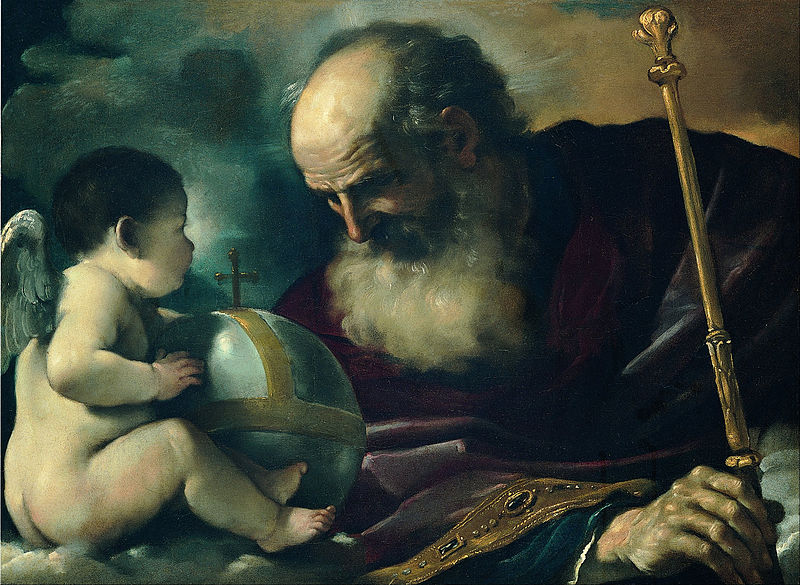
082713One of the more difficult Biblical themes to understand is the concept of God hardening the hearts and minds of certain human beings. The most memorable case is that of Pharaoh wherein, before sending Moses to him God said he would “harden Pharaoh’s heart” (Ex 4:21). But there are other instances where biblical texts speak of God as hardening the hearts of sinners, even from among his own people.

What are we to make of texts like these? How can God, who does no evil, be the source of a sinful mind or heart? Why would God do such a thing since he has said elsewhere:

  1. As surely as I live, declares the Sovereign LORD, I take no pleasure in the death of the wicked, but rather that they turn from their ways and live. Turn! Turn from your evil ways! Why will you die, O house of Israel?’ (Ez 33:11)
  2. God our Savior…wants all men to be saved and to come to a knowledge of the truth. (1 Tim 2:4)

To be sure, these questions involve very deep mysteries, mysteries about God’s sovereignty and how it interacts with our freedom, mysteries of time, and mysteries of causality. As a mystery within mysteries, the question of God hardening hearts cannot simply be resolved. Greater minds than I have pondered these things, and it would be foolish to think that a easy resolution is to be found in a blog post.

But some distinctions can and should be made, and some context supplied. We do not want to understand the “hardening texts” in simplistic ways, or in ways that use one truth to cancel out other important truths that balance it. So please permit only a modest summary of the ancient discussion.

I propose we examine these sorts of texts along four lines:

  1. The Context of Connivance.
  2. The Mystery of Time
  3. The Mystery of Primary Causality
  4. The Necessity of Humility

To begin it is important simply to list a selection of the hardening texts. The following are not the only ones, but they sample them widely enough:

  1. The LORD said to Moses, “When you return to Egypt, see that you perform before Pharaoh all the wonders I have given you the power to do. But I will harden his heart so that he will not let the people go. (Ex 4:21)
  2. Moses and Aaron performed all these wonders before Pharaoh, but the LORD hardened Pharaoh’s heart, and he would not let the Israelites go out of his country. (Ex 11:10)
  3. Why, O LORD, do you make us wander from your ways and harden our hearts so we do not revere you? Return for the sake of your servants, the tribes that are your inheritance. (Is 63:17)
  4. He [God] has blinded their eyes and deadened their hearts, so they can neither see with their eyes, nor understand with their hearts, nor turn–and I would heal them. (Jesus quoting Isaiah Isaiah 6:9-10, at John 12:40)
  5. They perish because they refused to love the truth and so be saved. For this reason God sends them a powerful delusion so that they will believe the lie (2 Thess 2:11)
  6. Therefore God gave them over in the sinful desires of their hearts to sexual impurity for the degrading of their bodies with one another…..Furthermore, since they did not think it worthwhile to retain the knowledge of God, he gave them over to a depraved mind, to do what ought not to be done. (Rom 1:24, 28)

Point I. – THE CONTEXT OF CONNIVANCE – In properly assessing texts like these we ought first to consider the contexts in which they were made and written. Generally speaking, most all of these declarations that God hardens the heart, come after a significant period of disobedience on the part of those hardened. In a way, God “cements” the deal and gives them fully what they really want. For having hardened their own hearts to God, God determines that their disposition is a permanent one, and in a sovereign exercise of his will, (for nothing can happen without God’s allowance), declares and permits their heart to be hardened in a definitive kind of way. In this sense, there is a judgement of God upon the individual that recognizes their definitive decision against him. Hence, this hardening can be understood as voluntary, on the part of the one hardened, for God hardens in such a way that he uses their own will, whom he hardens, for the executing of his judgment and his acceptance that their will against him is definitive.

A. For example, in the case of Pharaoh, it is true, as the Exodus 4:21 text says above, God indicated to Moses that he would harden Pharaoh’s heart. But the actual working out of this is a bit more complicated than that. We see in the first five plagues, it is Pharaoh who hardens his own heart (Ex. 7:13; 7:22; 8:11; 8:28; & 9:7). It is only after this repeated hardening of his own heart, that the Exodus text shifts, and speaks of God as the one who hardens (Ex 9:12; 9:34; 10:1; 10:20; 10:27). Hence the hardening here is not without Pharaoh’s repeated demonstration of his own hardness, and God, if you will, “cements the deal” as a kind of sovereign judgment on Pharaoh.

B. The Isaiah texts, many in number, that speak of a hardening being visited upon Israel by God, (e.g. #s 3 and 4 above), are also the culmination of a long testimony, by the prophet, of Israel’s hardness. At the beginning of the Isaiah’s ministry, Israel’s hardness was described as of their own doing by God who said through Isaiah: For the LORD has spoken: “I reared children and brought them up, but they have rebelled against me. The ox knows his master, the donkey his owner’s manger, but Israel does not know, my people do not understand.” Ah, sinful nation, a people loaded with guilt, a brood of evildoers, children given to corruption! They have forsaken the LORD; they have spurned the Holy One of Israel and turned their backs on him. (Is 1:2-4). There follows a long list of their crimes, their hardness and their refusal to repent.

1. St. John Chrysostom – of the numerous texts Later in Isaiah (and also referenced by Jesus (e.g. Jn 12:40), that speak of Israel as being hardened by God, and having him shut their eyes, St John Chrysostom says, That the saying of Isaiah might be fulfilled: that here is expressive not of the cause, but of the event. They did not disbelieve because Isaias said they would; but because they would disbelieve, Isaias said they would…. For He does not leave us, except we wish Him….Whereby it is plain that we begin to forsake first, and are the cause of our own perdition. For as it is not the fault of the sun, that it hurts weak eyes, so neither is God to blame for punishing those who do not attend to His words. (on a gloss of Is. 6:9-10 at Jn 12:40, quoted in the Catena Aurea).

2. St Augustine also says, This is not said to be the devil’s doing, but God’s. Yet if any ask why they could not believe, I answer, because they would not…But the Prophet, you say, mentions another cause, not their will; but that God had blinded their eyes, and hardened their heart. But I answer, that they well deserved this. For God hardens and blinds a man, by forsaking and not supporting him; and this He makes by a secret sentence, for by an unjust one He cannot (Quoted in the Catena Aurea at Jn 12:40).

C. Of the text of 2 Thessalonians, God sends them a powerful delusion so that they will believe the lie quoted in # 5 above, while the text speaks of God as having sent the delusion, the verse before and after make clear the sinful role of the punished saying: They perish because they refused to love the truth and so be saved….so that all will be condemned who have not believed the truth but have delighted in wickedness ( 2 Thess 2:10,12).

1. Of this text, St. Augustine says, From a hidden judgment of God comes perversity of heart, so that the refusal to hear the truth leads to the commission of sin, and this sin is itself a punishment for the preceding sin [of refusing to hear the truth]. (Against Julian 5.3.12).

2. St John Damascus says, [God does this] so that all may be condemned who did not believe the truth but had pleasure in unrighteousness (The Orthodox Faith 4.26).

D. The texts from Romans 1 speak of God handing them over only after they have suppressed the truth (1:18), persevered in their wickedness (1:18) and preferred lust and idolatry (1:23-24), hence, as a just judgement, he hands them over to sexual confusion (homosexuality) and to countless other destructive drives. So here too, though it is said God hands them over, it is really not that simple. God has, in effect, cemented the deal. They do not want to serve them and so He, knowing their definitive decision, gives them what they want.

E. Thus, our first point of distinction in understanding the “hardening” texts is that the context of connivance is important in assessing them. It is not asserted by Scripture that God takes a reasonably righteous man and, out of the blue, hardens his heart, confuses his mind or causes him, against his will, to become obstinate. The texts are usually presented as a kind of prevenient judgement by God, that the state of the person’s hardness has now become permanent. They refuse and so God cements the deal and “causes” them to walk in their own sinful ways since they have insisted so.

Point II. – THE MYSTERY OF TIME – In understanding these hardening texts, which we have seen, are akin to judgment texts, we must strive to recall that God does not live in time in the same we do. Scripture speaks often of God’s knowledge and vision of time as being comprehensive, rather than speculative or serial (e.g. Ex 3:14; Ps 90:2-4; Ps 93:2; Is 43:13; Ps 139; 2 Peter 3:8; James 1:17; inter al.).

A. To say that God is eternal and that he lives in eternity is to say that he lives in the fullness of time. For God, past, present and future are all the same. God is not wondering what I will do tomorrow, neither is he waiting for it to happen. For Him, my tomorrow has always been present to Him. All of my days were written in His book before one of them ever came to be (Ps 139:16). Whether, and how long I live, has always been known to him. Before he ever formed me in my mother’s womb he knew me (Jer 1:4). My final destiny is already known and present to him.

B. Hence, when we strive to understand God’s judgments in the form of hardening the hearts of certain people, we must be careful not to think he lives in time like we do. It is not as though God is watching my life like a movie. He already knows the choice I will make. Thus, when God hardens the hearts of some, it is not as though he were merely trying to negatively influence the outcome, and trip certain people up. He already knows the outcome and has always known it, he knows the destiny they have chosen.

C. Now be very careful with this insight, for it is a mystery to us. We cannot really know what it is like to live in eternity, in the fullness of time, where the future is just is present as the past. If you think you know, you really don’t. What is essential for us is that we realize that God does not live in time like we do. If we try too hard to solve the mystery (rather than merely accept and respect it) we risk falling into the denial of human freedom, or double predestination, or other wrong-headed notions that sacrifice one truth for another, rather than to hold them in balance. That God knows what I will do tomorrow, does not destroy my freedom to actually do it. How this all works out is mysterious. But we are free, Scripture teaches this, and God holds us accountable for our choices. Further, even though God knows my destiny already, and yours as well, does not mean that He is revealing anything about that to us, as though we should look for signs and seek to call ourselves saved or lost. We ought to work out our salvation in a reverential fear and trembling (Phil 2:12).

D. The Key point here is mystery. Striving to understand how, why and when God hardens the heart of anyone is caught up in the mysterious fact that he lives outside of time and knows all things before they happen. Thus he acts with comprehensive knowledge of all outcomes.

Point III. – THE MYSTERY OF CAUSALITY – One of the major differences between the ancient and the modern world is that the ancient world was much more comfortable in dealing with something known as primary causality.

A. Up until the Renaissance God was at the center of all things and people instinctively saw the hand of God in everything, even terrible things. Job of old said, The LORD gave and the LORD has taken away; may the name of the LORD be praised….if we have received good things at the hand of God, why should we not receive evil?” (Job 1:21; 2:10). Thus the ancients would commonly attribute everything as coming from the hand of God, for he was the “first cause” of everything that happened. This is what we mean by primary causality. The ancients were thus more comfortable attributing things to God that we are not. In speaking like this, they were not engaged in a form of superstitious or primitive thinking, but they emphasized that God was sovereign, omnipotent and omnipresent and that nothing happened apart from his sovereign will, He is the Primary Cause of all that is.

1. Of this ancient and scriptural way of thinking the Catechism says, And so we see the Holy Spirit, the principal author of Sacred Scripture, often attributing actions to God without mentioning any secondary causes [e.g. human or natural]. This is not a “primitive mode of speech”, but a profound way of recalling God’s primacy and absolute Lordship over history and the world, and so of educating his people to trust in him. (CCC # 304)

2. The Key point here is understanding that the ancient Biblical texts while often speaking of God as hardening the hearts of sinners, did not, as we saw above, mean that man had no role, or no responsibility. Neither did it mean that God acted in a merely arbitrary way. Rather, the emphasis was on God’s sovereign power as the first cause of all that is and hence he is often called the cause of all things and his hand is seen in everything. We moderns are uncomfortable in speaking this way as we shall see.

B. After the Renaissance man moved to the center and God was gradually “escorted” to the periphery. Thus our manner of thinking and speaking began to shift to secondary causes (causes related to man and nature). If something happens we look to natural causes, or in human situations, to the humans who caused it. These are secondary causes however, since I cannot cause something to happen unless God causes me. Yet increasingly the modern mind struggles to maintain a balance between the two mysteries of our freedom, and responsibility and God’s Sovereignty and omnipotence.

C. In effect we have largely thrown primary causality overboard as a category. Even modern believers unconsciously do this and thus exhibit three issues related to this.

1. We fail to maintain the proper balance between two mysteries: God’s Sovereignty and our freedom.

2. We exhibit shock at things like the “hardening texts” of the Bible because we understand them poorly.

3. We try to resolve the shock by favoring one truth over the other. Maybe we just brush aside the ancient biblical texts as a “primitive mode of speech” and say, inappropriately, “God didn’t have anything to do with this or that.” Or we go to the other extreme and become fatalistic, deny human freedom, deny secondary causality (our part) and accuse God of everything; as if he were the only cause and had the sole blame for everything. Thus, we either read the hardening texts with a clumsy literalism, or dismiss them as misguided notions from an immature, primitive, and pre-scientific age.

D. The point here is that we have to balance the mysteries of primary and secondary causality. We cannot fully understand how they interrelate, but they do. Both mysteries need to be held. The ancients were more sophisticated in holding these mysteries in the proper balance. We are not. We handle causality very clumsily and do not appreciate the distinctions of primary causality (God’s part) and secondary causality (our part, and nature’s too). We try to resolve the mystery rather than hold it in balance and speak to both realities. As such, we are poor interpreters of the “hardening texts.”

Point IV – THE NECESSITY OF HUMILITY – By now it will be seen that we are dealing with a mysterious interrelationship of God and Man, between our freedom and God’s sovereignty, between primary and secondary causality. In the face of such mysteries we have to be very humble. We ought not think more of the details than is proper for us, for, frankly they are largely hidden from us. Too many moderns either dismiss the hardening texts or accept them and sit in harsh judgment over God, as if we could do such a thing. Neither approach bespeaks humility. Consider a shocking but very humbling text where Paul warns us in this very matter:

What then shall we say? Is God unjust? Not at all! For he says to Moses, “I will have mercy on whom I have mercy, and I will have compassion on whom I have compassion.” It does not, therefore, depend on man’s desire or effort, but on God’s mercy. For the Scripture says to Pharaoh: “I raised you up for this very purpose, that I might display my power in you and that my name might be proclaimed in all the earth.” Therefore God has mercy on whom he wants to have mercy, and he hardens whom he wants to harden. One of you will say to me: “Then why does God still blame us? For who resists his will?” But who are you, O man, to talk back to God? “Shall what is formed say to him who formed it, ‘Why did you make me like this?’” (Romans 9:14-20)

In effect, none of can demand an absolute account of God for what he does. Even if he were to tell us, could our small and worldly minds ever really comprehend it? My thoughts are not your thoughts, and my ways are not your ways, says the Lord (Is 55:8).

Summary – In this post, rather too long, we have considered the “hardening texts” where it seems that God is said to harden the hearts of certain people and groups. And so he does. But texts like these must be carefully approached with proper distinctions, appeal to the scriptural and historical context, and deep humility. There are profound mysteries at work here: mysteries of God’s sovereignty, our freedom, his mercy and also his justice.

We ought to careful to admit the limits of our knowledge when it comes to such texts. As the Catechism so beautifully stated, when it comes to texts like these, they are to appreciated as a profound way of recalling God’s primacy and absolute Lordship over history and the world, and so of educating his people to trust in him. (CCC # 304)

This song says, “Lord I’ve sinned, But you’re still calling my name…”
Don’t Just Solve Mysteries. Live them. A Meditation on the Christian Meaning of Mystery

082613In our modern culture we tend to use the word “mystery” differently than the Christian antiquity to which the Church is heir. We have discussed this notion on this blog before. In this brief post I’d like to review that, and add a new insight I heard recently from Fr. Francis Martin.

As we have noted before, our modern culture tends to think of a mystery as something to be solved, and the failure to resolve it is considered a negative outcome. So, in the typical mystery novel some event, usually a crime, takes place, and it is the job of our hero to uncover cause of the problem, or the perpetrator of the crime. If he does not, he is a failure. And frankly, if word got out that, in a certain mystery movie, the mystery was not solved, there would be poor reviews and low attendance. Imagine in the series “House MD” if Dr. House routinely failed to “solve” the medical mystery. Ratings would drop rather fast.

But in the ancient Christian tradition, mystery is something to be accepted and even appreciated. Further, the attempt to solve many of the mysteries in the Christian tradition would be disrespectful, and prideful too.

Why is this so?

One reason is that the Christian understanding of mystery is slightly different that the worldly one. For the world, a mystery is something, currently hidden, that must be found and brought to light. The Christian understanding of mystery is something that is is revealed, but much of which lies hidden.

Further, in the Christian view, some, even most, of what lies hid, ought to be respected as hidden, and appreciated rather than solved. We can surely seek to gain insight into what is hidden, and mystery does reveal the depths of things and events. But, respectfully, we dare not say we have wholly resolved or fully comprehended everyone or everything. For, even when we think we know everything, there are still greater depths beyond our sight. Thus mystery is to be appreciated and accepted rather than solved.

Perhaps an example will help. Consider your very self. You are a mystery. There is much about you that you and others know. Your physical appearance is surely revealed. There are also aspects of you personality that you and others know. But, that said, there is much more about you that others do not see. Even many aspects of your physicality lie hid. No one sees your inner organs for example. And regarding your inner life, your thoughts, memories, drives, and so forth, much of this too lies hid. Some of these things are hidden even from you. Do you really know and fully grasp every drive within you? can you really explain every aspect yourself? No, of course not. Much of you is mysterious even to you.

Now, part of the respect that I owe you is to reverence the mystery of who you are. I cannot really say, “I have you figured out.” For that fails to respect that there are deep mysteries about you caught up in the very designs of God. To reduce you to something explainable merely by words is both disrespectful to you and prideful unto myself. I may gain insights into your personality, and you into mine, but we can never say we have one another figured out.

Hence, mystery is to be both respected and even appreciated. There is something delightfully mysterious, even quirky, about every human person. At some level we ought to grow in an appreciation that every person we know has an inner dimension, partially known to us but much of which is hidden and gives each person a dignity and a mystique.

Another example of mystery is the Sacraments. Indeed, the Eastern Church calls them the “Mysteries.” They are mysteries because, while something is seen, much more is unseen, but very real. When a child is baptized, our earthly eyes see water poured and a kind of washing taking place. But much more, very real, lies hidden. For, in that moment the Child dies to his old life and rises to a new one, with all his sins forgiven. He becomes, in that moment, a member of the Body of Christ, he inherits the Kingdom, and becomes the Temple of the Holy Spirit. Spiritually dead, he is now alive, and the recipient of all of God’s graces. These things lie hidden from our early eyes, by they do in fact take place. We know this by faith. Thus there is a hidden, a mysterious dimension to what we see. What we physically see is not all there is, by a long shot. The mystery speaks to the interior dimension which, though hidden from physical sight, is very real.

So mystery in the Christian understanding is not something to get to the bottom of. Rather, mysteries are something to appreciate, something to reverence, something to humbly accept as real. Aspects of them are revealed to us, but much more is hidden.

That said, we are not remain wholly ignorant of the deeper dimensions of things either. As we journey with God, one of the gifts to be sought is that we penetrate deeper into the mysteries of who we are, who God is, the mystery of one another, the mystery of creation, Sacraments and Holy Scripture. As we grow spiritually, we gain insights into these mysteries, to be sure. But we can never say we have fully exhausted their meaning or “solved” them. There remain ever deeper meanings that we should reverence.

In the video that follows, Fr. Francis Martin develops how mystery is the interior dimension of something. In other words, what our eyes see, or other senses perceive does not exhaust the meaning of most things, there are deeper dimensions that to some extent can be seen, and appreciated, but also respected as not fully seen or comprehended.

Fr. Martin gives the example of a man, Smith, who walks across the room and cordially greets Jones with a warm handshake. Jones smiles and reciprocates. OK fine, two men shaking hands, so what? But what if I tell that Smith and Jones have been enemies for years? Ah! That is significant. So the handshake has an inner dimension that, knowing it, helps us to appreciate the deeper reality of that particular handshake. To the average observer, this inner dimension lay hidden. But once we begin to have more of the mystery reveled to us, we appreciate more than the surface. But we cannot say, “Ah I have fully grasped this!” For, even here, we have grasped only some of the mystery of mercy, reconciliation, grace, and the inner lives of these two men. For mystery has a majesty all its own and we reverence it best by appreciating its ever deeper realities, caught up, finally, in the unfathomable mystery of God himself.

This video is part of a series Fr. Martin has done on the Gospel of John. I would strongly encourage you to podcast the series and view it or listen to it. It will bless your soul. Here is the podcast site for the whole Fr. Martin Gospel of John Series: Fr. Martin Gospel of John Series.

Liturgy at the End of Era – Revisited

082513

Some years ago (2009) I published on this blog a recollection of my youth in those critical years of the changeover from the “old Mass” to the “new” Mass. And, while I recall some puzzlement in those years about the changes and how they violated my training, I do not recall big protests from adults to the changes.

And while many people today who prefer the Traditional Latin Mass speak of the changes forced on us after the Council, I do not recall big protests, or objections as the changes came in swiftly in those years from about 1965 -1975. Granted, I was a pre-teen kid. But I do not recall protestors outside with signs, any even any vocal objections, that reached me at the time.

It is my recollection that the objections to the new Mass came largely about ten years later (mid to late 70s). By that time radical priests and nuns had abandoned all show and were either leaving in droves or were staying and causing all sorts of trouble with dissent and rebellion.

At any rate, I am interested in your experiences if you are a bit older, say 55+ and recall the changeover. My thesis is that the true reaction did not happen on “Sunday 1” when the altar was changed to face the people etc. Rather the negative reactions came later. For those were times when “Father says…” was enough to quell most concerns or protests. Only later when, for many “Father” had left with “Sister” to get married or, if he stayed he was misbehaving and commanded little respect, only then did the protests from some mount.

Anyway, tell me your experiences. It is also helpful if you can point to anything written at the time (65-75) that documents concerns.

What follows are my own recollections and a cool (strange) video from the era.

I received my First Holy Communion in 1968 on my knees at the altar rail in our parish church of Our Lady of Perpetual Help in a suburb North of Chicago called Glenview. I received from a very elderly pastor, Fr. Dussman, whose hands shook from Parkinson’s. It was an awesome and fearsome event. I was more nervous since Father’s hands shook and receiving communion from him could be a challenge, especially for the first time.

I remember well how seriously we took Church in those days. We had special Church clothes (always a coat and tie), special Sunday shoes and approaching the altar rail was something quite wonderful but very formal: hands folded before the chest, fingers straight, right thumb crossed over left. Kneeling and waiting for the priest and altar boy to pass by was a time of anticipation, a kind of distracted prayer, alert and ready, don’t make the priest wait! Suddenly a altar boy slid a Paten under your chin. Head back, tongue out (not too far!) just over the lower lip! The priest spoke in an ancient language (Latin). Only years later did I learn exactly what he said. I am sure the Sisters taught me but I couldn’t remember(I was only 7 going on 8): Corpus Domini Nostri Jesu Christi custodiat animam tuam in vitam aeternam (May the Body of our Lord Jesus Christ guard your soul unto life eternal). And suddenly there he was, Jesus in Holy Communion. Pretty awesome, very special, beyond my comprehension but no doubt this was holy, this was serious and sacred.

But little did I know I was at the end of an era. Within a year strange things began to occur that I did not understand, things that did not comport with my training. I remember my mother telling me that we were going to a special youth mass. I had heard of a school mass, but not a youth Mass. We got there early and I noticed something that confused me. “Mom!” I whispered, (you always whispered in Church in those days), “What are those drums doing there? Right in front of the Mary Altar, behind the rail too, were electric guitars, a drum set and chairs. Then out came these guys I had never seen before, a couple of them were wearing jeans too (a major no-no in the old days).

After Church my mother asked me if I liked it. I said no and she was surprised. “But Mom, I don’t know those songs and they were so loud.” I was confused. The sisters said we should dress well, be very quiet in Church so others could pray and only talk or sing when it was time to do that. It all seemed “a violation of my training.”

But little did we know (I would argue) that it was the end of an era. Something was taking the place of what came to be call the “old Mass.” But none of us call it that then. And if some one were to mention in those days the Missal of 1962, blank stares would have resulted. These were all later terms and distinctions. We certainly talke about Mass in the vernacular etc. But it was Mass. And yet little by little the familiar gave way to the new. The transition was at times startling, at times exciting. But I don’t remember a lot of protests at first. That came later when for some “a bridge too far” had been reached. Anyway I am interested in your remembrances and experiences from that time if you’re old enough to remember.

I do not write this post to “bash” the liturgical changes. Just to document an experience. I have become quite accustomed to the “new” Mass. I am also privileged to say the Traditional Latin Mass. I guess I am blessed to enjoy the best of both worlds. I am proud of the of how the new Mass is celebrated in my parish. We have a wonderful gospel choir which also does classical very well. There is great joy at every Mass. I am also so happy to be able to celebrate ancient Latin Mass that reminds me of the joy of my youth (qui laetificat juventutem meam). I merely document here, I leave the judgements to you my faithful readers.

The following video depicts a Mass in the year 1969. It is from an Elvis movie entitled “Change of Habit.” What an amazing little video for me! It’s just as I remember it as the changes set it. Notice the still strong presence of traditions: people all dressed up for Church, nuns in traditional habits, the priest at the high altar facing east. But notice too the guitars and “informality” of the musicians. The music is up front not back in the choir loft. And many struggle to understand the new lay of the land. It was 1969. It was the end of an era. But I wonder if we knew that?

A powerful and humorous look at vanity in a commercial.

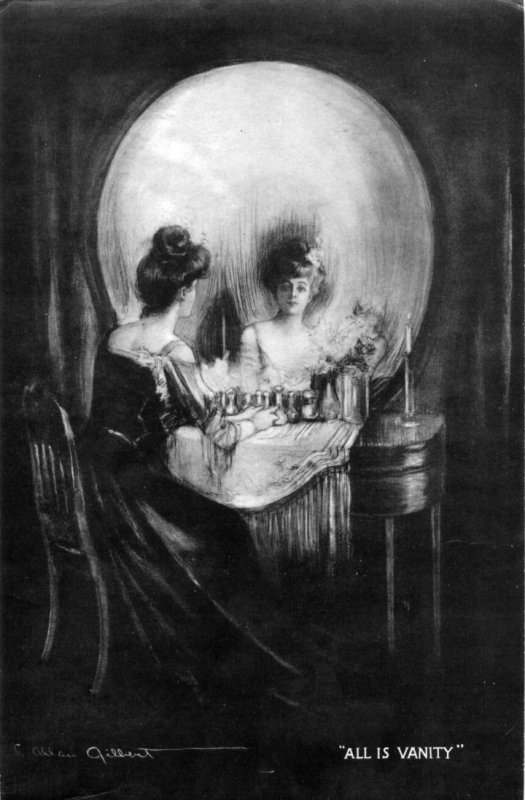
Most people associate the word “vanity” with an excessive concern or pride in ones appearance, or sometimes with ones own qualities. But at its root the word “vain” or “vanity” refers to emptiness. To say that something or someone is “vain” is to say that it, or they, are empty or largely lacking in meaning, depth or substance.

It makes sense that people get worked up about externals when there isn’t much happening on the inside. And thus it makes sense that we connect emptiness (vanity) to excessive show.

There are lots of expressions that enshrine this connection:

All form and no substance
That Texan is all hat and no cattle
All bark and no bite
All booster, no payload
All foam, no beer
All sizzle and no steak
All talk
Show me the money

The Wisdom Tradition in the Bible, especially the Book of Ecclesiastes, speaks of vanity at great length. And there the word tends to refer to the ultimate futility of whatever this world offers, that the world is ultimately empty and vacuous. For example –

Eccl 2:11 Then I considered all that my hands had done and the toil I had expended in doing it, and behold, all was vanity and a striving after wind, and there was nothing to be gained under the sun.

Eccl 5:10 He who loves money will not be satisfied with money, nor he who loves wealth with his income; this also is vanity.

And thus the world which so mesmerizes our senses shows itself ultimately to be empty of power, or any lasting substance:

We have here, no lasting city (Heb 13:14).

As for man, his days are like grass: or as the flower of the field. Behold, he flourishes. But the wind blows and he is gone; and his place never sees him again. (Ps 103:15-16)

I thought of these notions of vanity when I saw this admittedly very funny commercial. It shows a man concerned only with his appearance. Actually, he is even more vain than that! It is how he smells that concerns him (this is an Old Spice commercial). He is so vapid, so vain, that even if he doesn’t look good, at least he smells like some one who looks good!

As he moves through the scenes of the commercial he becomes increasingly devoid of substance (literally)!

Symbolically we can see him as the vain person who goes through life carelessly, paying no attention to the way in which the world, the desires of the flesh, and the devil strike at, and eat away at him. But again, never mind all that, at least he smells like some one who looks good! His only real substance is to be lighter than air, a whiff. It is form over substance, impression over reality. It is empty show, it is vanity on steroids.

Here is a humorous look at vanity, a vanity so vain that it exists even beyond appearance and extends into the vapid, vacuous and vaporous vanity of merely “smelling like some one who looks good.” A remarkable portrait really of the empty show that vanity ultimately is. Enjoy!

I Got a Robe! A Teaching on one of the most shocking parables Jesus ever told

082213The Gospel from Thursday’s  Mass contains one of the most shocking parables Jesus ever told. It is the Parable of the Wedding Banquet a King gives for his Son. Most know it well, but in case you want to review it, the full text of the Gospel is here: Parable of the Wedding Feast

It does not take a degree in biblical theology to understand that the Parable is an allegory. The “King” is God the Father, the “Son” is Jesus, and the Wedding feast is the Great Wedding Feast of the Lamb further described in Revelation:

Then I heard what sounded like a great multitude, like the roar of rushing waters and like loud peals of thunder, shouting: “Hallelujah! For our Lord God Almighty reigns.Let us rejoice and be glad and give him glory! For the wedding of the Lamb has come, and his bride has made herself ready. Fine linen, bright and clean, was given her to wear.” (Fine linen stands for the righteousness of God’s holy people.) Then the angel said to me, “Write this: Blessed are those who are invited to the wedding supper of the Lamb!” And he added, “These are the true words of God.” (Revelation 19:6-9)

The invited guests are the Jewish people of that time who, when the feast is ready, ignore or reject it for various reasons. There are concerns for land (I just bought a farm), profit (another owns a business), and  third group who, for indeterminate reasons lay hold the the King’s servants (who represent the prophets), to beat and even kill them.

And in this rejection is illustrated, not just the Jews of history, but also the long human history of ignoring or rejecting God in favor of worldliness (the land), profit (the business) and hostility to the truth, (the beating and killing of the profits).

And yet, the rejection, while not unique to Jews, does focus on their historical rejection. For the parable calls them the “invited guests.”

Further, upon their rejection comes the horrible detail, told by Jesus himself, that the King (God the Father) was enraged and sent his troops, destroyed those murderers, and burned their city. (Matt 22:6).

This detail shocks many modern readers especially for we have bought into a watered down notion of the holiness of God, and the significance of human choice for or against God. Our common modern vision of the Father is of a kind of doting older man (such as George Burns, or Morgan Freeman) who exists more to get us out of trouble and offer friendly advice, than to summon us to holiness, obedience and a critical choice.

But take note! This detail of the King burning their city is told by Jesus. And as we shall see in Sunday’s Gospel about the wide and narrow road, he is not playing around either. However we want to rework God, and render him harmless, however we want to try and hold opposed God’s love and justice, however we want to render human choice insignificant, the biblical text will have none of it. The bottom line fact is that no one loves you more than Jesus Christ, and yet no one warned of judgement and Hell more than Jesus Christ.

If this parable shocks, it is meant to. It is a call to sobriety in the face of the four most critical truths of our life: death, judgment, heaven and hell. In effect, this parable teaches that we will either enter the wedding feast and celebrate with the Father, or we will be caught up in the conflagration when the Lord comes to judge this world by fire (e.g. 2 Pet 3:7; Malachi 4:1; 2 Thess 1:7).

The choice is ours, but the judgement is certain to come:

God gave Noah the rainbow sign,
no more water but the fire next time! (Negro Spiritual)

The only safe place to be is in the wedding feast of the Jesus the Lamb, who saves us from the wrath to come (1 Thess 1:10).

Add to this shock the fact that the parable was actually fulfilled in 70 AD (as a kind of precursor of the final end of the age) when, after forty years of pleading with the Jewish people to come to Christ, a fiery destruction came on Jerusalem. Rejecting the Lord’s warnings (cf Matthew 24, 25; Mark 13; Luke 21), rejecting the call of the early Apostles and Church, and picking a pointless war with the Romans, the Jewish nation was utterly defeated.  Jerusalem was sacked and burned, killing over 1.2 million Jews.

Jesus with weeping had warned:

Jerusalem, Jerusalem, you who kill the prophets and stone those sent to you, how often I have longed to gather your children together, as a hen gathers her chicks under her wings, and you were not willing. Look, your house is left to you desolate. (Matt 23:37)

The next shocking part of the parable comes in the second half. The enraged King (The Father) orders his servants to go into the streets and gather everyone they can. And in this detail is an allegory for the going unto the Gentiles and the Great Commission.

And thanks be to God the response is good and the banquet is filled. But then comes the second shock:

When the king came in to meet the guests he saw a man there not dressed in a wedding garment. He said to him, ‘My friend, how is it that you came in here without a wedding garment?’ But he was reduced to silence. Then the king said to his attendants, ‘Bind his hands and feet, and cast him into the darkness outside, where there will be wailing and grinding of teeth.’ Many are invited, but few are chosen.

Here too, we moderns with our soft notions, wince. Perhaps part of our trouble with these verses is that we may think that the newly invited guests were dragged in, right off the street with no chance to change clothes. But there is nothing in the text to suggest they had no time to don their wedding clothes. The other guests all seem clothed properly. But the focus shifts to one man, not properly dressed.

Whatever the debated cultural parameters of the story, the theological parameters are more clear. The wedding garment is provided by the King (the Father), who clothes us in righteousness at our baptism. as we saw in the quote above from Revelation:

For the wedding of the Lamb has come, and his bride has made herself ready. Fine linen, bright and clean, was given her to wear.” (Fine linen stands for the righteousness of God’s holy people. (Rev 19:8)

Yes, here is the baptismal gown, the robe of righteousness, which God gives to the baptized who have been washed in the blood of the Lamb! In the baptismal rite the celebrant says to the newly baptized, pointing to their white garment:

You have clothed yourself in Christ. Receive this baptismal garment and bring it unstained to the judgment seat of our Lord Jesus Christ, so that you may have everlasting life. (# 578)

Hence, in the parable, the man is not clothed properly not because he is poor or was pulled in off the street. He is not clothed properly because he has cast aside the garment he was given. Now again recall the garment is no mere cloth. It is an allegory for righteousness. And this righteousness is received and must be cherished. Without it, we cannot endure or remain in the Wedding Feast of the Lamb, which is heaven.

And thus ends one of the most shocking parables Jesus ever told. (We will examine the “many are called, few are chosen” aspect of the text this Sunday). And though the parameters of this parable do shock, Jesus speaks them with an urgent love to bring forth godly repentance from us and to stir an evangelical urgency in us to reach others before “Great and Terrible Day of the Lord” comes (cf Joel 2:31; Mal 4:5 inter al). On that day there will be only two places: safe in the wedding feast with the Lord, or outside in a fiery judgement that is coming on this world.

An old spiritual says, God’s gonna set this world on Fire one of these days. Another old spiritual says, I got a robe, you got a robe, all God’s children got a robe. When I get to heaven gonna put on my robe and go wear it all over God’s heaven! Everybody talkin’ bout heaven ain’t a goin’ there!

Make sure you’ve got your robe and keep it washed in the blood of the Lamb.

“Pure and Simple”- Pondering a commonly misunderstood Beatitude

082113One of the beatitudes taught by Jesus is often misunderstood today, largely due to the most popular translations of it from the Greek text.  The Beatitude is, “Blessed are the pure of heart.” Or sometimes rendered, “clean” of heart.”

While the word “pure” or “clean,” is not an inauthentic translation of the Greek word καθαρός (katharos). A more literal translation of the word is to be without admixture, to be simply one thing, and hence, on that account to be purely and simply that thing, with nothing else mixed in. Hence, another helpful way of translating the Greek μακάριοι οἱ καθαροὶ τῇ καρδίᾳ (makarioi hoi katharoi te kardia) is “Blessed are the single-hearted.”

The reason to suggest, as more descriptive, the  phrase “single-hearted” is that, in modern English, the words “pure” and “clean”  tend to evoke a merely moral sense of being free of sin, of being morally upright.  And this is good, and is surely a significant part of being single-hearted. But being single-hearted is it a deeper and richer concept than simply being well behaved, since to be well behaved is the result of the deeper truth of being one thing, not duplicitous, or with a divided heart.

To be single-hearted, means to have my life focused on what Jesus calls “the one thing necessary” (Luke 10:42).  It is to have my life focused on the Lord, and my one goal of reaching heaven and being with him forever.

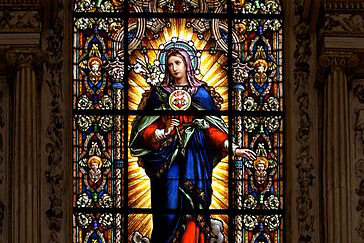
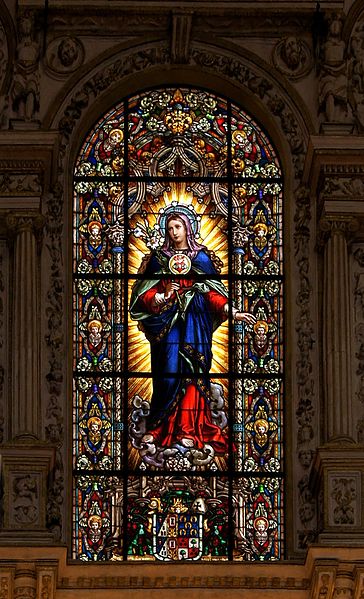
The image of the Rose window that the upper right, which I have used before on this blog, is a good illustration of what it means to be single-hearted. It does not mean that there are not different facets to my life, but rather, that every facet of my life is ordered around, and points to Christ, is subsumed to  Jesus, and his heavenly kingdom along with the Father and the Spirit as the ordering principle of every other thing. And thus, career, family, marriage, finances, spending priorities, use of time, where I live, and any other imaginable aspect of life, is subsumed in Christ; it points to him, and leads to the Lord and his kingdom on high.

The single-hearted life, is a well ordered life. Each step, and each decision leads me in the right direction. St. Paul says, This one thing I do: forgetting what lies behind and reaching forward to what lies ahead, I press on toward the goal for the prize of the upward call of God in Christ Jesus (Philippians 3:13-14). And hence, while Paul made many journeys to many places, he was really on one journey and heading to one place. This simplified and ordered his life. He was single-hearted.

We can see why the beatitude often gets translated as pure or clean of heart. As noted, to be pure or clean means to be the one thing, not admixed with lots of other impurities, or things which cause me not to be what I really meant to be.  And perhaps this is how we get the connection in the phrase, “pure and simple.”

Consider for example that the impurities of a copper wire, will reduce its effectiveness in carrying electrical current. When the copper is not pure, it is not its very self, the electrical energy which is meant to be directed through it becomes more scattered or hindered from its goal.

And this image of scattering or being hindered, unfortunately describes the lives of many Christians whose lives are not ordered on the one thing necessary, whose hearts are not single, whose hearts are not focused on the one thing they should be.  Such a one has a life which is often scattered, confused, disordered, and a jumble of many conflicting and contrary drives which hinder one from the goal of life. And thus the Lord Jesus says, He who does not gather with me, scatters (Luke 11:23). And the Book of James says, The double minded man is unstable in all his ways (James 1:8).

Finally, being single-hearted, being pure of heart not only orders our life, but it also grants freedom. In modern, Western thinking, we often equate freedom with doing more, not less. So freedom is equated with being able to “do anything I please.” And this attitude has led to the kind of jumble that much of modern life has become, the kind of tangled web of many contrary wishes and desires, but with little unifying direction or purpose. We think of freedom in very abstract terms. And hence we tend to get very abstract and disconnected results

But biblically and spiritually, freedom is the capacity or ability to do what is right, best and proper. And thus, paradoxically, freedom often means doing less, not more.

Being single-hearted, helps to focus us and to pare away a lot of the excess growth and unnecessary baggage of modern life. And life gets simpler, and simplicity is a form of freedom, such that we focus on what is important more than what is urgent.  And we discover that what often claims to be urgent, is not really necessary or urgent after all.

Life, especially modern life, has many options. And not all these options are simply distinguished by being good or bad, moral or immoral. Many of them are altogether good options. But how to sort through, to choose, and to focus my life on the one thing necessary?

Being single-hearted is the beatitude which helps us to do this.  As St. Paul says, regarding the good options in life:  All things are lawful to me, but not all things are expedient (1 Cor 6:12).

To be single-hearted is to become more free, not (paradoxically) by doing more, but by doing less, by becoming more focused on the Lord, hearing his voice, and basing my life simply on what he says and teaches me,

Pray for the gift to become more single-hearted. More than ever, in our modern age, with its distractions and endless possibilities, we need to learn the lesson of the Rose window, and center our lives increasingly on Christ, the one thing necessary.

I have used this clip in other posts before. Pardon a brief profane word, but it does help emphasize the point being made:

Two Hard Sayings of the Lord that Offend Modern Notions

082013The Gospel of Matthew features two hard sayings, or expressions, of the Lord. They are “hard” because they offend against modern notions. And since they are difficult for us “moderns” to hear and we are easily taken aback by their abrupt and coarse quality. Here is the “offending” verse:

Do not give what is holy to dogs, or throw your pearls before swine, lest they trample them underfoot, and turn and tear you to pieces.” (Mt 7:6)

The modern notion offended against here is: You’re not supposed to call people ugly names. This notion, though not wrong in itself, has become a rather excessively applied norm in our times and also misses the point in terms of this passage.

We live in what I would call “dainty” times where many people are easily offended. These are thin-skinned times of fragile egos where the merest slight often brings threats of lawsuits. Even observations intended as humor are excoriated and hurtful and out of line. And so, horror of horrors, here we have Jesus calling certain (unnamed) people “dogs” and “swine!” Explanations are demanded in times like these of such horrible words coming forth from the sinless Lord Jesus. Older commentaries felt less need to comment extensively on these verses.

Sophistication is needed – One of the reasons we are so easily offended in our modern age is, frankly, that we lack sophistication. We seem to have lost understanding, to a great extent, of simile and metaphor.

A simile is a figure of speech comparing two unlike things and normally includes words such as “like” and “as.” For example: “He is as swift and strong as a horse!” Similes have the two ideas remain distinct in spite of their similarities.

Metaphors compare two things without using “like” or “as”. For example, “He’s a real work-horse!” Metaphors are usually more forceful than similes since the distinction intended between the compared things is often ambiguous. For example if I were to observe someone doing something mean or cruel I might say, “Wow, what a dog!” Now the expression does not mean I have gone blind and think that this person is actually a dog. I mean that he is manifesting qualities of a (wild or mean) dog. However, just how distinct he is from an actual dog is left open to interpretation. But for the record, I am NOT saying he is a dog.

The point here is that some sophistication and appreciation for the nuances of language and the art of comparison are necessary as we negotiate life’s road. In modern times we seem to have lost some of this and so, are easily offended.

This does not mean that no one ever intends offense, it only means that more is necessary than simply hearing everything in a crudely literal way. The usual modern person in my example would object, “Hey, he called me a dog!” No, what he means is that you have taken on some of the qualities of a wild dog. Now to what extent he means you are like a dog is intentionally ambiguous, and an invitation for you to think of how you may have surrendered some of your humanity and become more like baser creatures.

Examining what the Lord says – This sort of sophistication is necessary as we examine these two of the Lord’s “offensive” sayings here. Let’s look at them both in terms of their historical root and then to what is being taught.

1. First of all let’s be clear that the Jewish people were not indicating positive traits when they used the term dog or swine to refer to someone. Dogs in the ancient world were not the pets of today. They were wild, and ran in packs. Pigs were unclean animals and something no Jew would ever touch, let alone eat. These are strong metaphors indicating significant aversion to some aspect of the person.

2. Do not give what is holy to dogs– This was a Jewish saying that was rooted in tradition. Some of the meat that had been sacrificed to God in the Temple was returned to the family to be eaten by them, and some was retained to be eaten by the Levites. But in no way was this meat that had been consecrated to God ever to be thrown to dogs or other animals to eat. If, for some reason,  it was not eaten by humans it was to be burned. Hence holy and sanctified meat was not to be thrown to dogs because it was holy.

3. [Do not] throw your pearls before swine, lest they trample them underfoot – Pearls were an image for wisdom in the Old Testament. Now the point here is that pigs value nothing they cannot eat. Pearls could not be eaten, thus if they were placed before pigs they would sniff them, determine they were not food, and simply trample them underfoot. The pigs have no appreciation of pearls.

4. So what is being said? Sacred matters, sacred things, wisdom, and participation in sacred things should not be easily offered to those who are incapable of appreciating them. There are those who despise what we call holy. There is little that can be done in such cases except deny them the pleasure of tearing apart holy things or trampling them underfoot.

Jesus is saying that some people are like dogs who tear apart sacred things and have no concept of their holiness. Some people are like pigs who do not appreciate anything they cannot eat or use for their pleasure. They simply trample under foot anything that does not please them or make sense to them, in the same way that pigs would trample pearls underfoot or dogs irreverently tear apart blessed food dedicated to God.

Further, there are some who, though not hostile, are ignorant of sacred realities. They do not perhaps intend offense but it is necessary that they should be taught, and then admitted to sacred rites or further instructed in deeper mysteries. Children, for example in the Western Rite, are not given the Holy Eucharist until they can distinguish it from ordinary food. Further, it is a necessary truth that some more advanced spiritual notions such as contemplative prayer are not often appreciated by those who have not been led there in stages.

The Lord is thus indicating that holy things are to be shared in appropriate ways with those who are able to appreciate them. It is usually necessary to be led into the Holy and just walk in unprepared or unappreciative.

In the ancient Church there was something known as the disciplina arcani (discipline of the secret) wherein only the baptized and confirmed would be admitted to the sacred mysteries of the Liturgy. Given the holiness with which the early Christians regarded the Mass, they exactly observed what the Lord is saying here. Careful instruction and gradual introduction to sacred truth was necessary before entering something so holy as the Sacred Liturgy. Even the unintentional trampling underfoot of sacred realities through simple ignorance was to be strictly avoided. To be sure, these were difficult times for the Church and persecution was common. Hence the Lord’s warning to protect the holy things was not just that they might be trampled underfoot but also that those who were like unto wild dogs and swine might not turn and tear you to pieces (Mat 7:6).

In the centuries after the Edict of Constantine the disciplina arcani gradually dissipated. Some remnants of it revived in the modern RCIA wherein the Catechumens are dismissed halfway through the Mass to reflect more fully on the Liturgy of the Word. And yet we have much to relearn in modern times about a deep reverence for the Sacred Liturgy. While it would not seem opportune to lock our Church doors as in ancient times, but preserving good order in the Liturgy, encouraging reverence, proper dress, and instilling deeper knowledge of the true meaning of the Sacred Liturgy are all important ways to ensure that we do not trample underfoot what is sacred.

 Regarding this video, the Text says, Sinner please don’t let this harvest pass, and die and lose your soul at last. One of the things I like about the old spirituals was that they still used older biblical language that had fallen out of fashion. For example calling people “Sinner.” You don’t hear preachers speak like this much today in these hypersensitive times. But the truth is we are all sinners.

Give me Wisdom! A Reflection on a”Scientific”Report that Calls believers less intelligent than Athiests

By Shubert Ciencia  Licensed under  CC BY 2.0 via Wikimedia Commons
By Shubert Ciencia Licensed under CC BY 2.0 via Wikimedia Commons

It would seem, according to how some people measure intelligence, that those of us who believe in God rank as “less intelligent” than those who do not. A recent report in the “Mail” (a U.K. paper) reports this “fact” as the result of extensive and scientific IQ testing and summarizes what I would call the rather “non-scientific” conclusions of the researchers.

You know the usual drill when I comment on texts. The text of the original report is in bold, black italics, my remarks are in plain red text. I am excerpting a longer article.

The full article by Daniel Bates is HERE. – However,  be forewarned, there are a lot of unchaste and risque photos often appear in the margins of this “news”paper.

Reporter Bates begins:

Atheists tend to be more intelligent than religious people, according to a US study. Researchers found that those with high IQs had greater self-control and were able to do more for themselves – so did not need the benefits that religion provides.

OK, so lets just stipulate that IQ tests are a common way of measuring at least some aspects of intelligence. Of course having a high IQ is no guarantee that one will necessarily navigate life well.

I do terribly on IQ tests, and tests in general. But I do a pretty good job of navigating life. My “smarts” are more verbal and less numerical. I love etymology, I also have a more keen sense of  paradox and symbol, and the mystical connections of many apparently dissimilar things. Not bad strengths for a preacher, teacher and occasional writer.  Of course this type of  “smarts” is less easily measured  in IQ tests, since this sort of intelligence is harder to quantify.

But OK, lets just stipulate that IQ tests have some validity in measuring a certain kind of mechanistic and basic intelligence.

But then our intrepid reporter goes on to claim that the “science” shows that atheists had “greater self control.”  Now honestly, how did they measure that? I am going to guess that “self control,” at least as defined by our reporter, has little to do with what most of us traditionally meant by the term. 

I would tend to think that the term means things like drinking in moderation, not being given to wild carousing and fornication, having authority over one’s emotions like anger and love, being moderate in behavior, frugal in spending,  and so forth.

But something tells me that this understanding of self control has little to do with our author means, or what the “scientists” he claims to reference mean. For it is clear that the modern, and I would add secular and increasingly unbelieving West,  is collectively given to almost every excess and lack of self control: drinking, fornication, pornography, addictions, fornication, carousing, overspending, excesses of every kind. And did I mention fornication?

Of course our intrepid reporter does not define what is meant by self control or how it is measured. But how anyone can connect our modern secular (unbelieving) culture to greater self control is puzzling, to say the least.

Again, I realize that I am among those of lesser intelligence, as a believer, but the correlation between atheism and self control seems to be an inverse one to this observer. In other words, as atheism and secularism have increased in the West, self control has demonstrably decreased during that same period. Just a simple analysis of the debt crisis shows that. Add divorce rates, addiction rates, STD rates etc. and the picture of low self control is consistent. There are many reasons for this but an inverse relationship seems the logical conclusion than to assert unbelievers ipso facto have more self control.

Similar puzzlement arises at the observation that atheists “do more for themselves.” First of all, what does that mean? It is true that Christian believers speak of depending on God. But this does not mean we expect God to be some sort of divine butler. Rather it means that we attribute our strength to God and seek his grace to do our work.

But theology aside, I must say I am mystified at the claim, however it can possibly be measured, that atheists “do more for themselves.” For again the evidence seems (to this admittedly less intelligent believing observer), that as atheism and secularism have risen, so has socialism, wherein increasing numbers expect the central government to do more and more for them.

What evidence is there that (globally) unbelievers and seculars do more for themselves? The big picture suggests just the opposite and correlates the nanny state with increasing secularism and unbelief. Maybe they don’t turn to God, but the State sure has grown.

I realize that the growth of socialism is not wholly attributable to unbelievers. But again I remain puzzled at any claim that anyone, or any group is “doing more for themselves” these days. The whole trend is away from personal responsibility, as it is from self control.

They also have better self esteem and built more supportive relationships, the study authors said.

Here too I would have loved for our intrepid reporter to have asked the “scientists” how “self esteem” is defined and then measured. I do think that Christians may test lower in this area, not because we actually do lack self esteem, but because we have a traditional language that emphasizes humility.

Many modern notions (not all) of self esteem are far too close to simple “pride” and we believers will  be less likely to affirm vague modern notions and statements like: “I feel good about myself…..I like myself just the way I am…” If our tendency to caution regarding pride makes us “less intelligent,” then so be it.

As to “supportive relationships” again, please define. I suppose this could include anything from bowling leagues, to labor unions, to group therapy, and 12-step programs. But how would I know, since the term is undefined. I wonder if “Church” counts, because, frankly that is my biggest source of supportive relationships. I have a funny feeling the testers don’t consider “Church” to be in the realm of “supportive relationships.”

The conclusions were the result of a review of 63 scientific studies about religion and intelligence dating between 1928 and last year.

Notice these are called “scientific” studies. But again many of the claims, at least as reported, are presented in very vague and non-scientific language. Might I even say some of the claims are metaphysical?

Honestly are terms such as “self-control,” “supportive relationships,” “self-esteem,” “benefits,” “do more for themselves” scientific terms at all? Calling a study “scientific” does not make it so.

All the terms above contain a priori  and metaphysical judgments about what is good or not good. And while there may be some methodologies from the social sciences at work, most people have (sadly) reduced the word “science” and “scientific” to the physical sciences. And thus to speak of atheists  being more intelligent that believers as being “scientifically” demonstrated is misleading because it is not how most people use the word today.

The judgment of this scientific study is filled with many non-scientific  judgments about things that cannot simply be quantified, measured or compared. There are complicated social realities at work.  Words such as “better” worse” “esteem” and so forth bespeak a more Metaphysical stance.

Now don’t get me wrong, I am all for metaphysics, but calling a report “scientific” that indulges in so many metaphysical concepts and judgements is not how people use the word “science” today. As such it is misleading to call this report a “scientific study.”

So finally here comes the money quote:

In 53 of these (studies) there was a ‘reliable negative relation between intelligence and religiosity’. In just 10 was that relationship positive. Even among children, the more intelligent a child was the more probable it was that they would shun the church. The University of Rochester psychologists behind the study defined religion as involvement in some or all parts of a belief. – Vague, to say the least.

They defined intelligence as the ‘ability to reason, plan, solve problems, think abstractly, comprehend complex ideas, learn quickly, and learn from experience’.

Also vague. For example define “ability.” Some people are “genius” at intuition, others at analysis of data, still others are said to have empathic abilities, emotional intelligence, photographic memory and so forth.

Also define “comprehend,” and who gets to say something is complex? For some a Bach fugue is complex but a car engine is easy. For others it is the reverse. etc.

Vague, vague and more vague.

So, if you’re going to call me stupid or even less intelligent, I want clearer parameters.

In their conclusions, they said: ‘Most extant explanations (of a negative relation) share one central theme – the premise that religious beliefs are irrational, not anchored in science, not testable and, therefore, unappealing to intelligent people who ‘know better’. –

Well I guess it takes one to know one. For as we have seen, this study commits the very errors it claims we do. But at least we admit to being in the realm of metaphysics and do not claim to be able to measure things that defy simple measurement. The arrogance of this final quote is so bold as to require little response, res ipsa loquitur (the thing speaks for itself).

And perhaps a final thought from yours truly. I want to say that how ever some one wants to regard my intelligence compared to theirs, or my group (believers) compared to theirs, I will probably take little real offense.

For, at the end of the day it is not so much intelligence that I value as wisdom. Intelligence has its place, and is nice to have. But intelligence is a human thing. Wisdom comes from God and as such is a greater gift. And wisdom need not depend on a lot of formal education. I have met some very wise people who had little formal education. I have also met people who were highly educated, but possessed of little wisdom. I have also met every combination in between.

Wisdom pertains to the things of God, to heaven and our final goal. To be wise is to discover God, to learn of Him and know Him, It is to know also, who I am in God, to grasp the meaning of my life and to move steadily toward my goal of the upward calling in Christ. Wisdom is infused by God who is able to grant it to the simplest and undereducated, or to the most intellectually astute.

But Wisdom is always gift. Intelligence, how ever we adduce it, too easily leads to pride. But Wisdom requires humility and thrives only on it. To be wise is to know that I know only very little, no matter how high my intellectual ranking among men. For as St. Paul once boldly said,

For the foolishness of God is wiser than human wisdom, and the weakness of God is stronger than human strength….But God chose the foolish things of the world to shame the wise; God chose the weak things of the world to shame the strong. God chose the lowly things of this world and the despised things—and the things that are not—to nullify the things that are, so that no one may boast before him. It is because of him that you are in Christ Jesus, who has become for us wisdom from God—that is, our righteousness, holiness and redemption. Therefore, as it is written: “Let the one who boasts boast in the Lord.” (1 Cor 1:26-31)

So you may call me stupid, or less intelligent. You may call me a fool, but at least add that I was a fool for Christ.

Oremus: Intelligence has its place, but above all Lord, give me your wisdom. Indeed, you have hidden from the learned and clever, what you have reveled to the merest children. Thank you Lord for holy Wisdom. Thank you.