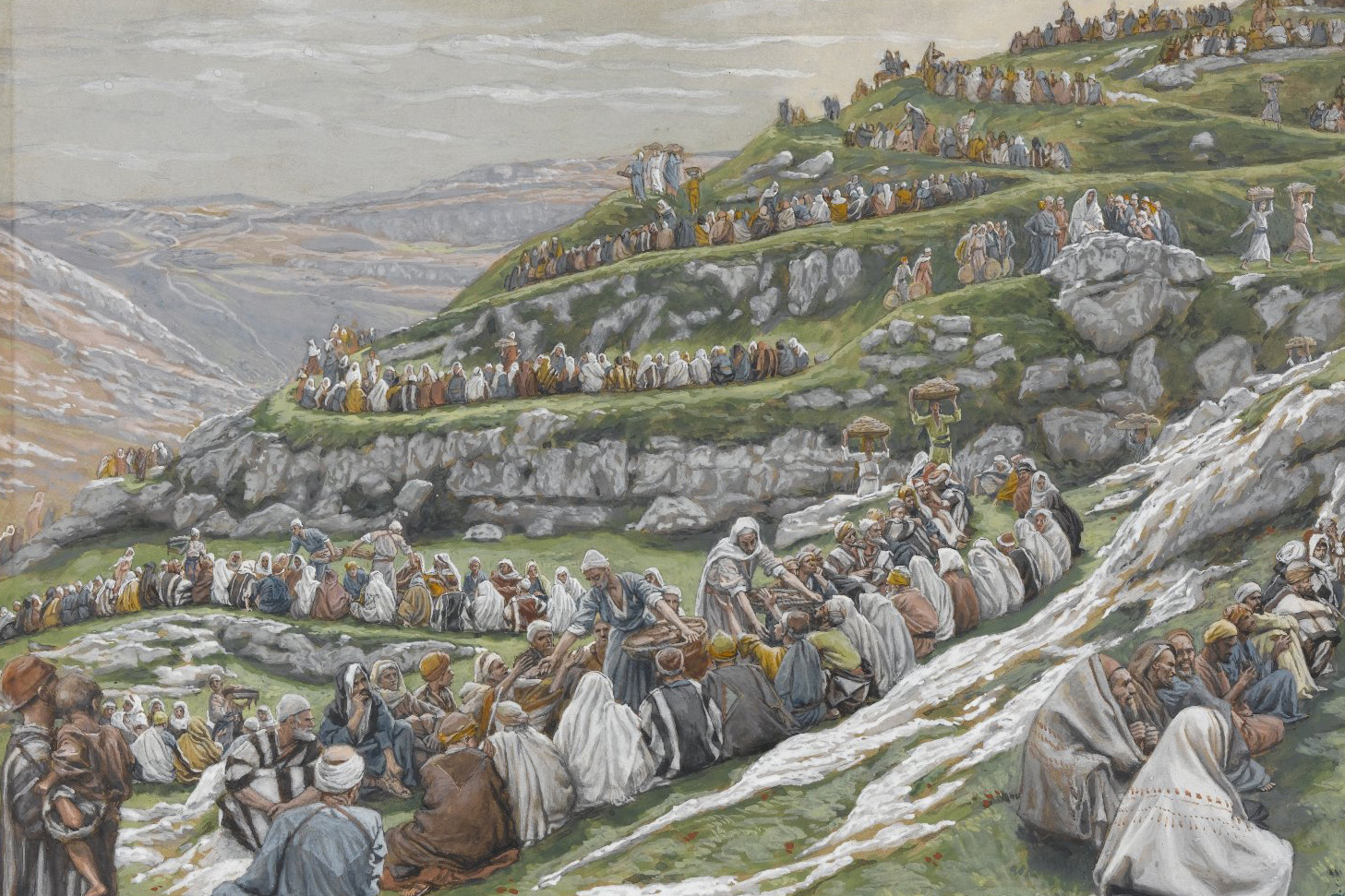
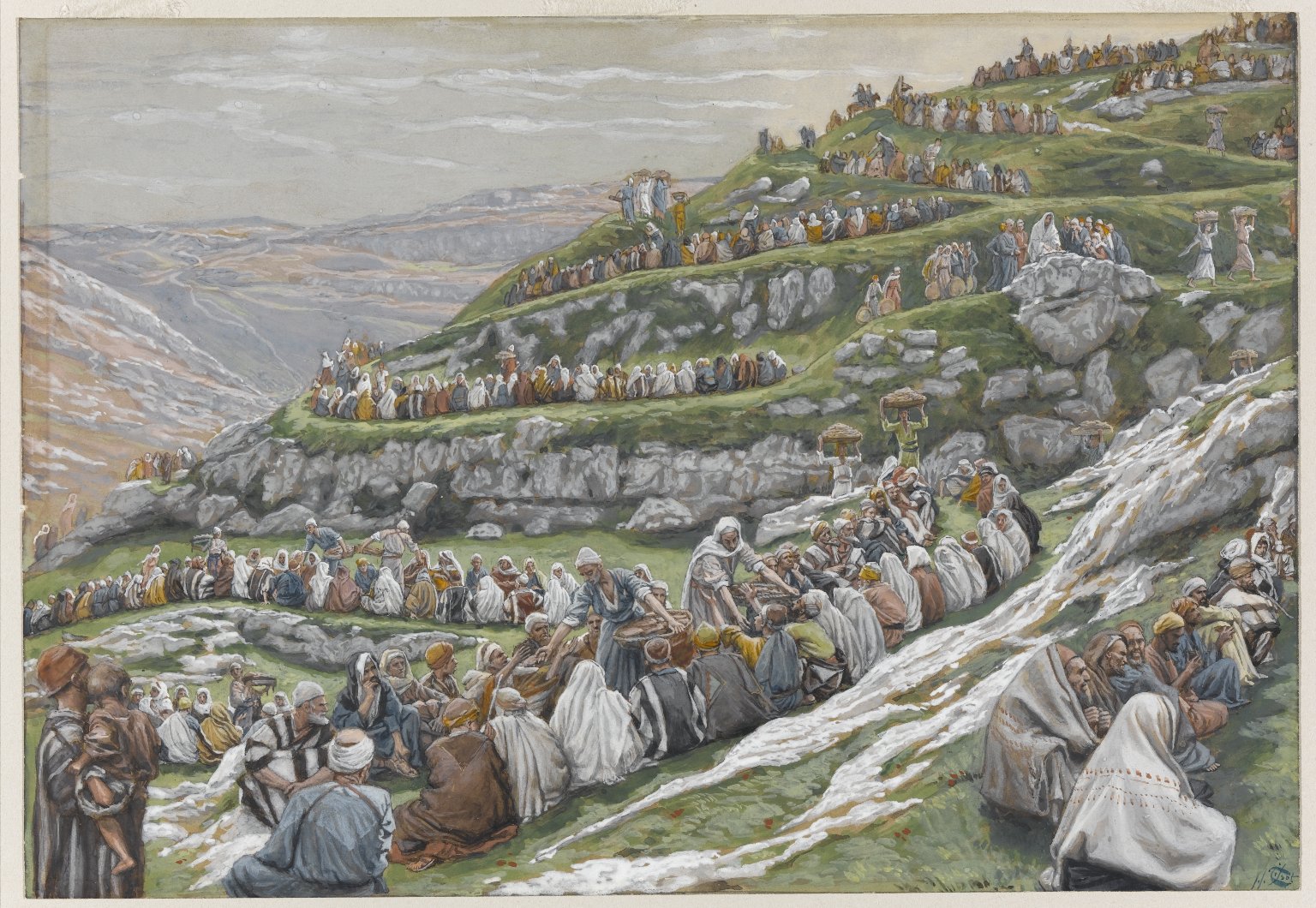
 We have in today’s Gospel the very familiar miracle of the loaves and fish. One is tempted to say, “Oh that one…” and then tune out. But if we will accept it, the Gospel today contains a very personal appeal from the Lord’s lips to your (my) ears: “There is no need to dismiss the crowds; give them some food yourself.”
Immediately all the objections begin to swim through our minds. But be still, and let us allow the Lord to instruct us and apply this Gospel in five stages.
I. THE IMAGE THAT IS EXTOLLED – The text says, When Jesus heard of the death of John the Baptist, he withdrew in a boat to a deserted place by himself. The crowds heard of this and followed him on foot from their towns. When he disembarked and saw the vast crowd, his heart was moved with pity for them, and he cured their sick.
The text begins on a very sad note, with the death of Jesus’ cousin, John the Baptist. We should not simply dismiss the kind of human grief Jesus must have experienced, and the text says He wanted to go away for a while, presumably to pray and grieve. It would seem that at the pinnacle of His public ministry He could only get apart by going out on a boat; and so He does. The text is unclear as to how long He was out on the water but it implies that it was only a short time.
Approaching the opposite shore, Jesus sees a large crowd and is moved with pity. He teaches them at great length and heals the sick. And here is the image that is extolled: although Jesus allowed himself this moment of grief, He also shows that the way out of grief is through love and concern for others. It is too easy for us in our own grief, anger, sorrow, or anxiety to retreat, to hide away. As an immediate reaction, this is understandable. But it is not a disposition we ought to maintain for long. For others have needs, and even in our grief and with our limitations we are still called to reach out to others. And that very reaching out often provides our own healing as well.
Just because we have needs does not mean that others stop having them. Jesus shows the courage and the love to still recognize the needs of others even in his own grief. So He goes ashore and shares love with others.
II. THE ISSUE THAT IS EVADED – The text says, When it was evening, the disciples approached him and said, “This is a deserted place and it is already late; dismiss the crowds so that they can go to the villages and buy food for themselves.”
There is a human tendency to want needy people to go away, to disappear. The apostles, noticing the needy crowd (a crowd about to have a hunger problem), want it to go away before there is a problem.
We too, both individually and collectively, often desire the needy and poor to just disappear. If we see a beggar we may cross to the other side of the street or refuse to look at him. If our caller ID indicates a troubled family member is calling, one who might ask for money or want to talk for a long time, we may let the call go to voice mail rather than answering. In society we tend to segregate the poor and needy. The “not in my backyard” (NIMBY) syndrome seeks to confine the poor, the mentally handicapped, and others to certain marginal sections of the city largely out of sight and out of mind. The sick and the dying, too, are often relegated to nursing homes. Perhaps this is necessary for proper care, but the thought of an elderly relative living and dying in our own homes is too much for many, even when it is possible. So generally people go away to die.
Notice the threefold basis of the disciples’ evasion:
- They are DESPAIRING – for they say, this is a deserted place and it is already late.
- They are DISMISSIVE – for they want Jesus to dismiss the crowd, to send them away.
- They are DETACHED – for instead of wanting to help, they want the crowd to go away and get food for themselves.
Yes, it is a sad human tendency to want to be rid of people who have problems. And so the disciples beg Jesus to send the increasingly troublesome crowd away. The issue is evaded rather than accepted as a shared problem to be solved together.
III. THE INSTRUCTION THAT ENSUES – Jesus said to them, “There is no need for them to go away; give them some food yourselves.”
Uh oh, this is starting to get personal! Jesus is not willing to keep this merely as a problem that “they” have; He wants me to do something!
Yes, He rejects their premise by saying there is no need for them to go away. And He redirects their plan by saying, give them something to eat yourselves.
Refusing to accept the presence of the poor and needy is simply not a viable option for Jesus, nor is it for us who would be His disciples. Jesus wants and expects us to get started with a solution, a solution that includes both “them” and us. It looks like we are our brother’s keeper.
This is the instruction that ensues when the apostles, or we, try to evade the issue.
IV. THE INSUFFICIENCY THAT IS EXPRESSED – The text says, But they said to him, “Five loaves and two fish are all we have here.”
But we can’t possibly pull this thing off; their needs are far too great! The Lord is not interested in our excuses; He just says, “Let’s get started.”
Observe two things about the five loaves and two fish:
- First, as John’s Gospel (6:9) notes, the loaves and fish came from among the poor themselves. Hence this is not mere “do-good-ism.” The teaching here is not to be a “limousine liberal” who rolls down the window, throws money to the poor, an then goes back to his mansion. Neither is it a “We’re from the government and we’re here to help you” sort of solution. For we should not do for others what they can reasonably do for themselves. Rather we ought to work with the poor, engaging them in what they do have, in the talents and leadership they do possess, and solve problems with them rather than for them. There are loaves and fish even among the poor; there are talents and resources to be included in the solution.
- Second, regardless of where the loaves and fish come from, they are not nothing, and the Lord expects all of us to be part of the solution. Simply telling God (or these days the government) to go do something about the problem is not a full or authentic Christian response.
Hence our complaints about meager resources do not impress the Lord, who says, simply, Bring them here to me. The journey of a thousand miles begins with a single step. And thus we go to the principal point.
V. THE IMMENSITY THAT IS EXPERIENCED – The text says, Then he said, “Bring them here to me, ” and he ordered the crowds to sit down on the grass. Taking the five loaves and the two fish, and looking up to heaven, he said the blessing, broke the loaves, and gave them to the disciples, who in turn gave them to the crowds. They all ate and were satisfied, and they picked up the fragments left over—twelve wicker baskets full. Those who ate were about five thousand men, not counting women and children.
Now this story is so familiar that you and I are not surprised by the outcome. But no matter how many times we hear it, we still do not really accept its astonishing truth:
- I can do all things in God who strengthens me (Phil 4:13).
- All things are possible to him who believes (Mk 9:23).
- For man it is impossible, but not with God, for all things are possible with God (Mk 10:27).
- Now he who supplies seed to the sower and bread for food will also supply and increase your store of seed and will enlarge the harvest of your righteousness (2 Cor 9:10).
Now take special note of that last quote, for this Gospel is about more than caring for the poor (although it is about that). This Gospel is also about taking this world back for Christ.
We all know that this world is in an increasingly bad state: rampant secularism, moral relativism, a Church with many self-inflicted wounds. All of this has led to the real mess we have on our hands today. And the problems are overwhelming: sexual confusion, the culture of death, the breakdown of marriage, compulsive sin, compulsive overspending, greed, insensitivity to the poor, deep and widespread addiction to pornography, drugs, alcohol abuse, abortion, widespread promiscuity, adultery, corruption, cynicism, low mass attendance, and on and on.
The problems seem overwhelming and our resources seem so limited to turn back the tide. What will we ever do with only five loaves and two fish?
Jesus says, Bring them here to me.
Yet again, the journey of a thousand miles begins with just one step. The conversion of the whole world begins with me. As I look at the huge problems before me, I (and this means you, too) assess my loaves and fish:
- I work on my own conversion. For a holier world has to start with me. If I get holier, the world gets holier.
- I look to the poor I can serve; maybe with money, maybe with talents like tutoring and counseling, maybe just with my time by listening.
- I pick up the phone and call a family member I know is hurting.
- I love my spouse and children.
- I spend the time to raise my own children properly—to know the Lord and seek His kingdom.
- I exhort the weak in my own family. And, with love, I rebuke sin and encourage righteousness.
- If I am a priest or religious, I live my vocation faithfully and heroically call others to Christ by teaching and proclaiming the Gospel without compromise.
- If I am a young person, I seek to prepare myself devoutly for a vocation to marriage or the priesthood or religious life.
- If I am older, I seek to manifest wisdom and a good example to the young.
- If I am elderly, I seek to prepare myself for death devoutly and to be a good example in this. I witness to the desire for Heaven.
- I pray for this world and attend mass faithfully, begging God’s mercy on this sin-soaked world.
It is too easy to simply lament this world’s condition and, like the apostles, feel overwhelmed. Jesus just says, bring me what you have, and let’s get started. The conversion of the whole world will begin with me, with my meager loaves and fish.
And Jesus will surely multiply them; he will not fail. Already there is renewal evident in the Church through a faithful core willing to bring their loaves and fish: some of the things mentioned above and more besides. They are bringing them to Jesus and He is multiplying them. Renewal is happening and signs of spring are evident in the Church.
There is a saying that it is easier to wear slippers than to carpet the whole world. Indeed it is. If it is to be a converted world you want start with yourself. Bring your loaves and fish to Jesus, bring your slippers, and let’s get started. It begins with me.
This song says,
If I can help somebody, as I pass along,
If I can cheer somebody, with a word or song,
If I can show somebody, how they’re traveling wrong,
Then my living shall not be in vain.
If I can do my duty, as a good man ought,
If I can bring back beauty, to a world up wrought,
If I can spread love’s message, as the Master taught,
Then my living shall not be in vain.