Most of you know that I write a weekly “Question and Answer” Column for Our Sunday Visitor. An interesting question came in on the question of some older Catholic prayers and Bible translations that uses the term “slave” or “slavery” to reference our relationship to God. While such terminology makes must modern people wince, it is an important biblical concept that we should not wholly lose by simply rejecting it or by covering it up with euphemistic terms such as “servant” or “handmaid.” I reproduce here what I wrote for the column.
Question:
I was recently reading a prayer of consecration wherein we were asking the Lord and our Lady to makes us slaves to the will of God. How is this not outrageous and horrifying given the history of slavery in our culture? Name withheld.
Answer:
Your concern is understandable. The slavery of the colonial period was detestable for many reasons. In biblical times, slavery resulted largely from three causes: one owed large debts, one had committed a range of serious crimes but not capitol, or one was a solider in a losing army. Hence slavery replaced prison or death. But, the slavery of the colonial period (16th – 19th Centuries) exploited peoples who committed no crimes, engaged in no war and owed no debt. It was unjust and horrible. The slavery of biblical times was not without serious problems, hence the biblical texts admonish both slaves and slave masters to observe certain limits (eg. Eph 6:5). There is no blanket-approval of slavery as critics allege.
So, prayers that speak of us as “slaves” to God or, subordinately, to the Virgin Mother, need to understood in the biblical tradition from which they are drawn.
Let’s look at some texts wherein the term “slave” is applied to disciples. Often today, the Greek word “doulos” (slave) is translated as “servant.” But this is a euphemism since a “servant” is paid and free to leave employment. Slaves do not have these options. Hence our modern translations hide a more provocative image than most of us know. Consider some of the following examples:
In the Letter to the Philippians we read: Jesus Christ, though existing as God, did not consider equality with God something to which he should cling. Rather, he emptied Himself, taking the form of a slave, and being made in human likeness… (Phil 2:7) Notice then, while some translations say he became a “servant” the Greek word is δοῦλος (doulous) which translates “slave.” What this means is that Jesus became wholly obedient to death obeying his Father completely, and though, despising the shame of the Cross, he went there because his Father willed it. He did not negotiate a better deal or, like a servant, resign. As a “slave” he obeyed his Father absolutely.
When Mary said, “Behold, I am the handmaid of the Lord,” as most modern translations render it, there is hidden from us what she more literally said, “Behold, I am the slave-girl (δούλη = doule = slave girl) of the Lord. Let it be done to me as you have said.” Perhaps we wince at this sort of talk, but that is most literally what it says.
In Romans 6, St Paul teaches that, although we like to think we are “big-shots,” we are actually just little specks of dust in vast universe. We are going to be slaves to someone: either the devil, the world, the flesh, or God. We might as well be slaves to God who loves us. St. Paul writes: : Just as you used to offer the parts of your body in slavery to impurity and wickedness, so now offer them in slavery to righteousness .… For when you were slaves to sin, you were free of obligation to righteousness. …But the outcome of those things is death. But now that you have become slaves to God, the fruit you reap leads to holiness, and eternal life… (Romans 6:20-23). Herein St Paul presents the paradox, namely that there is no place safer and freer than inside the will of God and in a “slavish” but loving and absolute obedience to his commands. Slavery to God paradoxically provides the greatest freedom we can ever hope to experience.
Hence, as our Lord teaches, Amen, amen, I say to you, everyone who sins is a slave to sin…. So if the Son sets you free, you will be free indeed. (Jn 8:34-36). So, “bondage” and obedience to the truth our Lord teaches is the paradoxical and surest way out of destructive slavery. The horrific slavery of the devil and his world are the surest way to the glorious freedom of the children of God.
In the end, we do best to live in a biblical world and understand its terms, not demand that it conform to our terminology. While words in our times may provoke understandable feelings, we are best served by overcoming this and learning what our Lord teaches in a counter and cross cultural way. “Slavery” in God’s commands is the surest path to true freedom.
In the Gospel for today’s Mass, Jesus gives us three lessons on love meant to prepare us for the coming of the Holy Spirit at Pentecost. They also go a long way in describing the normal Christian life.
Too many Christians see the Faith more as a set of rules to keep than as a love that transforms—if we accept it. Let’s take a look at the revolutionary life of love and grace that the Lord is offering us in three stages: the power of love, the person of love, and the proof of love.
1.The Power of Love – “If you love me, you will keep my commandments … Whoever has my commandments and observes them is the one who loves me.”
We must be very careful how we hear this, for it is possible to think that the Lord is saying, in effect, “If you love me, prove it by keeping my commandments.” This understanding reduces the Christian faith to a moral maxim: do good, avoid evil, and thus prove that you love God. Loving God, then, becomes a human achievement.
Understanding this text from the standpoint of grace, however, yields a different—and I would argue, more proper—understanding. Loving God is not a human work; it is the gift of God. The text should be read to say, in effect, “If you love me, then by this love I have given you, you will keep my commandments.” Thus, the keeping of the commandments is the fruit of the love, not the cause of it. Love comes first. When love is received and experienced, we begin, by the power of that love, to keep the commandments. Love is the power by which we keep the commandments.
It is possible to keep the commandments to some extent out of fear and by the power of the flesh, but obedience based on fear tends not to last and brings with it many resentments. Further, attempting to keep the commandments through our own power brings not only exhaustion and frustration, but also the prideful delusion that somehow we have placed God in our debt because we obey.
It is far better to keep the commandments by the grace of God’s love at work within us. Consider the following qualities of love:
A. Love is extravagant – The flesh is minimalist and asks, “Do I really have to do this?” Love, however, is extravagant and wants to do more than the minimum. Consider a young man who loves a young woman. It is unlikely that he would say, “Your birthday is coming soon and I must engage in the wearisome tradition of buying you a gift. So, what is the cheapest and quickest gift I can get you?” Of course he would not say this! Love does not ask questions like this. Love is extravagant; it goes beyond the minimal requirements and even lavishes gifts on the beloved, eagerly. Love has the power to overrule the selfishness of the flesh. No young man would say to his beloved, “What is the least amount of time I must spend with you?” Love doesn’t talk or think like this. Love wants to spend time with the beloved. Love has the power to transform our desires from our own selfish ends, toward the beloved.
While these examples might seem obvious, it is apparently not so obvious to many Christians, who say they love God but then ask such things as, “Do I have to go to church?” “Do I have to pray, and if so, how often and for how long? “Do I have to go to confession, and if so, how frequently? “What’s the least amount I can put in the collection plate or give to the poor in order to be in compliance?” Asking for guidelines may not be wrong, but too often the question amounts to a version of “What’s the least I can do?” or “What’s the bare minimum?”
Love is extravagant and excited to do and to give, to please the beloved. Love is its own answer, its own power.
B. Love Expands – When we really love someone we also learn to love whom and what he or she loves.
During high school, I dated a girl who liked square dancing. At first I thought it was hokey, but since she liked it, I started to like it. Over time, I even came to enjoy it a great deal. Love expanded my horizons.
I have lived, served, and loved in the Black community for most of my priesthood. In those years, I have come to love and respect gospel music and the spirituals. I have also come to respect and learn from the Black experience of spirituality, and have done extensive study on the history of the African-American experience. This is all because I love the people I serve. When you love people, you begin to love and appreciate what they do. Love expands our horizons.
What if we really begin to love God? The more His love takes root in us, the more we love the things and the people He loves. We begin to have God’s priorities. We start to love justice, mercy, chastity, and all the people He loves—even our enemies. Love expands our hearts.
The saints say, “If God wants it, I want it. If God doesn’t want it, I don’t want it.” Too many Christians say, “How come I can’t have it? It’s not so bad. Besides, everyone else is doing it.” Love does not speak this way.
As God’s love grows in us it has the power to change our hearts, minds, desires, and vision. The more we love God, the more we love His commands and share the vision He offers for our lives. Love expands our hearts and minds.
C. Love excites – Imagine again a young man who loves a young woman. Now suppose she asks him to drive her to work one day because her car is in the shop. He does this gladly and sees it as an opportunity to be with her and to help her. He is excited to do so and is glad that she asked. This is true even if he has to go miles out of his way. Love stirs us to fulfill the wishes and desires of the beloved.
In the first Letter of John we read, “For this is the love of God, that we keep his commandments. And his commandments are not burdensome” (1 John 5:3). Yes, love lightens every load. As we grow in love for God, we are excited to please Him. We keep His commandments, not because we have to, but because we want to. Even if His commandments involve significant changes, we do it with the same kind of gladness that fills a young man who drives miles out of his way to take his beloved to work. Love excites in us a desire to keep God’s law, to fulfill His wishes for us.
2.The Person of Love – “And I will ask the Father, and he will give you another Advocate to be with you always, the Spirit of truth, whom the world cannot accept, because it neither sees nor knows him. But you know him, because he remains with you, and will be in you.”
In this text, Jesus tells us that the power to change us is not an impersonal power like “The Force” in Star Wars. Rather, what changes us is not a “what” at all but a “who.” The Third Person of the Blessed Trinity, living in us as in a temple, will change us and stir us to love. He who is Love will love God in us. Love is not our work; it is the work of God. “We love, because He first loved us” (1 John 4:10). God the Holy Spirit enables us to love God the Father and God the Son, and this love is the power in us that equips, empowers, and enables us to keep God’s law. He, the Holy Spirit, is the one who enables us to love extravagantly and in a way that expands and excites.
The Lord says that He, the Holy Spirit, remains in us. Are you aware of His presence? Too often our minds and hearts are dulled and distracted by the world and we are unaware of the power of love available to us. The Holy Spirit of Jesus and the Father is gentle and awaits the open doors we provide (cf Rev 3:20). As we open them, a power from His Person becomes more and more available to us and we see our lives being transformed. We keep the commandments; we become more loving, confident, joyful, chaste, forgiving, merciful, and holy. I am a witness! Are you?
3.The Proof of God’s Love – “I will not leave you orphans; I will come to you. In a little while the world will no longer see me, but you will see me, because I live and you will live. On that day you will realize that I am in my Father and you are in me and I in you.”
The key phrases here are “You will live” and “You will realize,” for the Lord says that He will not leave us as orphans, that He will come to us and remain with us.
How do you know that these are more than just slogans? Simply put, you and I know this because of the new life we are receiving, which causes us to realize that Jesus lives, is in the Father, and is in us.
To “know” in the Bible is more than intellectual knowing. To “know” in the Bible is to “have intimate and personal experience of the thing or person known.” I know Jesus is alive and in me through His Holy Spirit because I am experiencing my life changing. I am seeing sins put to death and graces coming alive! I am a new creation in Christ (2 Cor 5:17). This is what Jesus means when He says, “You will realize that I am in the Father and in you.” To “realize” means to experience something as real.
I am proof of God’s love and its power to transform, mylife is proof! In the laboratory of my own life I have tested God’s word and His promises, and I can report to you that they are true. I have come to experience as real (i.e., “realized”) that Jesus lives, that through His Holy Spirit I have a power available to me to keep the commandments and to embrace the new life, the new creation they both describe and offer to me.
I am a witness; are you?
This song says, “He changed my life and now I’m free …”
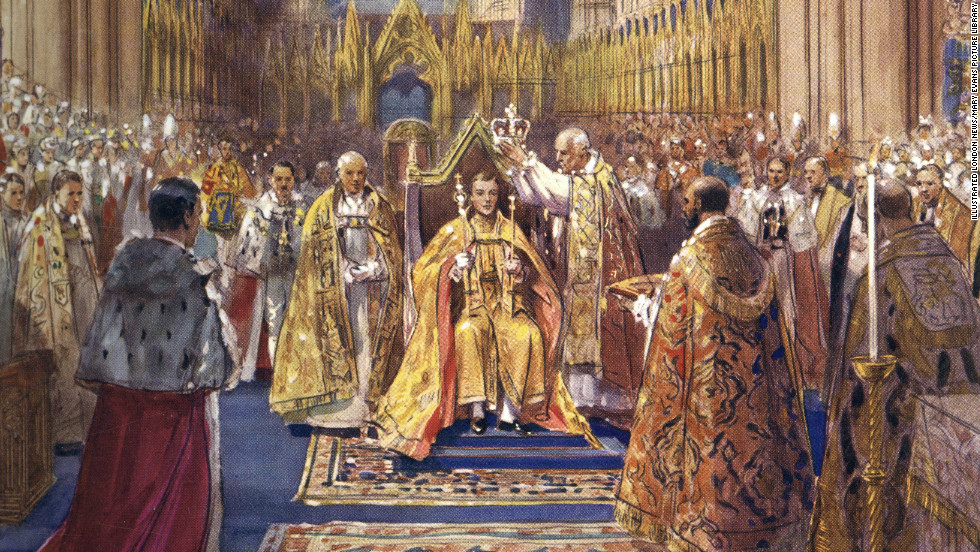
If you saw some or all of the coronation rituals for King Charles in England, you were certainly treated to an exceedingly beautiful event but also a “blast from the past.” It is highly significant that this is the first coronation in England in seventy years. Seventy years reaches back, prior to the wreckovation, iconoclasm and rude casting aside of all tradition and formality which occurred in the West in the period of the 1960s and after. Today we are relentlessly casual; we almost never dress up and, practically, nothing is sacred. I have little doubt that, if coronations in England had occurred in the sixties, seventies or eighties, the rituals would have been gutted and cast aside as something hopelessly old and therefore bad by that simple fact. Likely it would have been reduced to a mere swearing in, in a secular venue with everyone in business suits.
Yes, I remember the spirit of that time of the late 1960s and beyond, how proud and scoffing we were to anything “old.” Old was just another word for bad. We were mesmerized by our technology and confused it for the wisdom we sorely lacked. Reverence for elders and our traditions was supplanted by a glorification of youth culture with its trendy ephemeral ideas. Beautiful old buildings were replaced with soulless glass boxes. Churches were wreckovated. Patriotism was dismissed as harmful nationalism and the wisdom of past generations was sullied by the mere emphasis on sins of the past. What did dead white men who may have owned slaves have to say to us!? Worst of all was the steady marginalization of God, biblical wisdom, the worship that is owed to God, and the salutary notion that we will all answer to Him. Today we live in a largely soulless culture devoid of moral bearings or firm foundations. The coronation rites we saw lay dormant in this reckless period and seemed to open a window on the ways things largely were before the cultural revolution that set in during the late sixties.
However, I do not exult them as utterly good and devoid of any problems. Clearly there were anti-Catholic aspects and other notions of kings and kingship that offend against our more democratic American ideals. I know too that rituals can be properly celebrated but be very empty. Frankly, the faith in God constantly expressed in the Coronation rites is something few Anglicans and Episcopalians share today in the “anything-goes” mentality of most of its Western adherents.
Nevertheless, the window that opened on the way we once were is important and if there is a way back, it paints a picture of what we have lost and what we could regain through such edifying rituals. Certain things stood out:
The constant reference to God and our need to depend on him for everything.
That a King, or any leader must answer to God and seek to foster and protect the holy Faith for God’s people.
The modesty of conducting the anointing behind a screen showed the discretion of the past toward sacred things and is an antidote to the modern insistence that everything, even the most sacred, be visible and on open display.
The liturgies were conducted ad orientem (facing the altar). Which mean that everyone, people, clergy and kings stand before God and face him together. God is the focus, not us.
The concept that rites and liturgies directed to God should be the best we can offer. The attention to detail, the stately and careful pace, the sense of wonder and awe and that we are before God are concepts that need rediscovery today.
And finally, tradition is beautiful and deserves to be rediscovered.
Though this reflection is wider than the Catholic Church, it is clear that we are desperately in need of rediscovering many of the things we cast aside. As we prepare to focus on the Eucharist this coming year we do well to ponder if our liturgies reflect our belief. Is it really surprising that belief in the true presence of Jesus is lost on many Catholics given the way we behave at Holy Mass? Does not our widespread casual approach say, “Nothing special here?” What of our own rituals and traditions do we need to rediscover? What will assist most in reviving Eucharistic faith? More on that later.
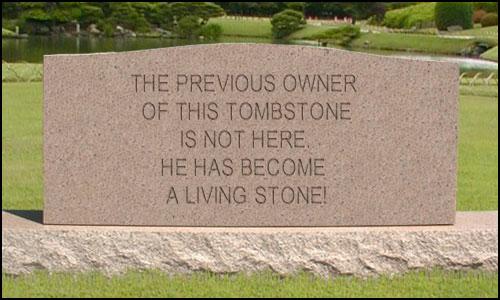
By His resurrection, Jesus has brought us from death to life. He has snatched us from this present evil age (Gal 1:4) and from the death-directed desires of our body (Rom 6:12), and made us into a new and living creation (2 Cor 5:17). As such, we have exchanged the tombstones that once indicated we were dead in our sins and have become living stones in the spiritual edifice that is the Body of Christ and also the Church.
In the Epistle for today’s Mass (1 Peter 2:4-9), we are summoned to this new life and told what some of its characteristics are. Let’s take a look at how we go from being tombstones to living stones by considering this text in three sections.
1. The Call of Salvation –Come to him, a living stone, rejected by human beings but chosen and precious in the sight of God, and, like living stones, let yourselves be built into a spiritual house.
Notice first the invitation that is made: Come to Him! Let yourself be built! The entire Christian life is based on our response to an invitation to accept Jesus Christ and to let Him transform our life. We are to say, “yes,” not only to Jesus, but also to what He can do for us. He will take our broken, crumbling lives and rebuild them. In what sense will He do this? Two images are offered:
Living Stones – A stone is an odd image for life. There doesn’t seem to be anything less living than a stone! What does it mean to be a “living stone”? First, it means to be alive, to be full of life! Second, it means that some of the better qualities of stone are to be ours. A stone is firm, weighty, not easily moved, and able to withstand a heavy load. Thus we too are to be strong and firm in our faith, not easily moved about by the currents of the world or tossed to and fro by the waves and carried about by every wind of doctrine, by human cunning, by craftiness in deceitful schemes (Eph 4:14). Stable and firm, we are also able to carry the weight and bear the difficulties imposed by this world. We are able to support and carry others in their time of need, sharing their burdens. Yes, living stones—strong, firm, not easily moved, and alive, quite alive!
A Spiritual House – The image implies that in a spiritual sense, we as living stones make up the walls of the Church. We are fitted together like stones into a wall that is strong and sure. We are not saved merely unto ourselves, but also for the sake of others. By God’s grace, we depend upon one another, each of us carrying his share of the burden. Each stone in the wall does its part. Remove one stone and the whole wall is weakened. Only together is the wall solid and sure.
2. The Choice for Salvation – whoever believes in it shall not be put to shame. Therefore, its value is for you who have faith, but for those without faith: The stone that the builders rejected has become the cornerstone, and a stone that will make people stumble, and a rock that will make them fall. They stumble by disobeying the word, as is their destiny.
Simply put, we have a choice to make. That choice will determine if Jesus is the cornerstone who supports us or a stumbling block over which we trip and fall. It is an interesting phenomenon that when a person is being rescued at sea, sometimes the victim will reach out and grab the life ring that is tossed to them, while others will resist attempts to save them, seeing it as something that will further endanger them.
What is meant by the “cornerstone”? It usually brings to mind a ceremonial stone with an inscription and possibly some historical things embedded. Here, though, it refers more to the stone at the bottom of an arch or the row of bricks that supports the whole arch. It had to be a very carefully crafted stone since all the other stones depended on its integrity and perfect shape to support them. This is Jesus Christ for us. We are all leaning on Him; He is the perfect stone who carries our weight.
But for those who reject Christ, He is a stone over which they trip and fall. Surely Jesus wants to save us all, but some reject Him and for them He becomes a stumbling block. We cannot remain neutral about Jesus. We must decide one way or the other about Him: yes means salvation; no means condemnation. He will either be a cornerstone or a stumbling block; there is no third way. To those who knowingly reject Him, He is a stumbling block. This image also explains some of the venomous attacks on Christ and Christianity from the world. When one trips over something and falls, one tends to curse what caused the fall.
The choice is ours. May it be Christ and may He be our cornerstone—the only One on whom we can lean and rely with certainty. Only this will take us from being tombstones to living stones.
3. The Characteristics of Salvation – You are a chosen race, a royal priesthood, a holy nation, a people of his own, so that you may announce the praises of him who called you out of darkness into his wonderful light.
Notice four characteristics of those who are no longer tombstones, but are living stones:
Our Pedigree – The text calls us a “chosen race.” We’ve reflected on making Christ our choice, but here we are reminded that before we chose Him, He chose us. If we received an invitation to the White House, many of us would feel that we had “made it” and would proudly tell our friends of the great honor. Yet we take little notice that we are chosen by God and invited to the great Wedding Feast of the Lamb. Yes, we are chosen; we have a pedigree. We are of the household of God. This is greater than any worldly dignity and it is able to overcome any indignity that the world heaps upon us.
Our Priesthood – Each of us who is baptized into Christ Jesus is made priest, prophet, and king. This “royal” priesthood, while different from the ministerial priesthood, has this similarity: every priest is enabled to offer a sacrifice pleasing to God. In the Old Testament, priests offered up something distinct from them, usually an animal. But in the priesthood of Jesus Christ, the priest and the victim are one and the same. Jesus offered Himself. All of the baptized are equipped by God to offer the pleasing sacrifice of their very selves to God. Here is a very great dignity given to us by Jesus: to have a perfect right to stand in His Father’s presence, praise Him, and offer a fitting sacrifice. Only ministerial priests of the Church can bring us the sacraments, but all baptized believers share in the royal priesthood, wherein they freely offer themselves to God.
Our Place – The text calls us a “holy nation.” To be holy means to be set apart. Hence we are called out from among the many to be a people that is set apart for God. While all are invited to Christ, only those who accept the invitation receive the grace to be called a holy nation. As such, we should understand that our role is not to “fit in” with this sin-soaked world, but rather to stand apart from it, to be recognizably distinct from it. Our behavior, priorities, love, joy, and charity should be obvious to all. To be a holy nation is a great honor, but also a great responsibility. May this curse of Scripture never be said about us: As it is written: “God’s name is blasphemed among the Gentiles because of you” (Rom 2:24).
Our Proclamation – The text says that the Lord has acted in our life so that you may announce the praises of him, who called you out of darkness into his own, wonderful light. Yes, the Lord has been good to us and is changing our lives! If you are faithful, then you know what He has done for you and you have a testimony to give. Scripture says that we were made for the praise of his glory (Eph 1:6). Do people hear you praise the Lord? Have you glorified His name among the Gentiles? (Rom 15:9) Do people know of your gratitude? Have they heard of your witness to the Lord? Can you articulate how God has called you out of darkness into His marvelous light? You ought to be a witness for the Lord! This is a necessary characteristic of those who are no longer tombstones, but living stones.
Many groups have a tendency to use words that make sense to their members but are unintelligible to outsiders. I have sometimes had to decode “Church-speak” for recent converts.
Here in the aftermath of Easter with all our fancy words like catechumen, mystogogia, neophyte, regeneration, etc, I muse on our overall tendency to “church-speak. To some degree, we need these words and should educate God’s faithful as to their meaning. But it is a source of some humor to ponder how arcane, how obscure our language can become.
For example, one time I proudly announced, “RCIA classes will begin next week, so if you know anyone who is interested in attending please fill out an information card on the table just outside the sacristy door.” I thought I’d been perfectly clear, but then a new member approached me after Mass to inquire about the availability of classes to become Catholic and when they would begin. Wondering if she’d forgotten the announcement I reminded her what I had said about RCIA classes. She looked at me blankly. “Oh,” I said, “Let me explain what I mean by RCIA.” After I did so, I mentioned that she could pick up a flyer over by the sacristy door. Again I got a blank stare, followed by the question “What’s a sacristy?” Did I dare tell her that the classes would be held in the rectory?
I’ve had a similar reaction when announcing CCD classes. One angry parent called me to protest that she had been told by the DRE (more Church-speak) that her daughter could not make her First Holy Communion unless she started attending CCD. The mother, the non-Catholic wife of a less-than-practicing Catholic husband, had no idea what CCD meant and why it should be required in order for her daughter to receive Holy Communion. She had never connected the term CCD with Sunday school or any form of religious instruction.
Over my years as a priest I have become more and more aware that although I use what I would call ordinary terms of traditional Catholicism, given the poor catechesis (another Church word, meaning religious training, by the way) of so many, the meaning of what I am saying is lost. For example, I have discovered that some Catholics think that “mortal sin” refers only to killing someone. Even the expression “grave sin” is nebulous to many; they know it isn’t good, but aren’t really sure what it means. “Venial sin” is even less understood!
Other words such as covenant, matrimony, incarnation, transubstantiation, liturgy, oration, epistle, gospel, Collect, Sanctus, chalice, paten, alb, Holy Orders, theological, missal, Monsignor, and Eucharistic, while meaningful to many in the Church, are often only vaguely understood by others in the Church, not to mention the unchurched (is that another Church word?).
Once at daily Mass I was preaching based on a reading from the First Letter of John and was attempting to make the point that our faith is “incarnational.” I noticed vacant looks out in the pews. And so I asked the small group gathered that day if anyone knew what “incarnational” meant; no one did. I went on to explain that it meant that the Word of God had to become flesh in us; it had to become real in the way we live our lives. To me, the word “incarnational” captured the concept perfectly, but most of the people didn’t even really know for sure what “incarnation” meant, let alone “incarnational.”
Ah, Church-speak!
During my years in the seminary the art of Church-speak seemed to rise to new levels. I remember that many of my professors, while railing against the use of Latin in the liturgy, had a strange fascination with Greek-based terminology. Mass was out, Eucharist was in. “Going to mass” was out, “confecting the synaxis” was in. Canon was out, “anamnesis” and “anaphora” were in. Communion was out, koinonia was in. Mystagogia, catechumenate, mysterion, epikaia, protoevangelion, hapax legomenon, epiklesis, synderesis, eschatology, Parousia, and apakatastasis were all in. These are necessary words, I suppose, but surely opaque to most parishioners. Church-speak indeed, or should I say ekklesia-legomenon.
Ah, Church-speak! Here is an online list of many other Church words for your edification (and amusement): Church words defined
At any rate, I have learned to be a little more careful when speaking so as to avoid too much Church-speak, too many insider terms, too many older terms, without carefully explaining them. I think we can and should learn many of them, but we should not assume that most people know them.
The great and Venerable Archbishop Fulton Sheen once said that he discovered early on that he often got credit for being learned when in fact he was merely being obscure. And for any who knew him in his later years, especially through his television show, he was always very careful to explain Church teaching in a way that made it accessible to the masses. It’s good advice for all of us: a little less of the CCD and RCIA jargon and little more of the clear “religious instruction” can help others to decode our Church-speak.
Again, I would not argue that we should “dumb down” our vocabulary, for indeed it is a precious patrimony in many cases. But we need to do more explaining rather than merely presuming that most people will know what some of our terms mean.
This video has a lot of gibberish in it, but it illustrates how we can sound at times if we’re not careful!
The Lord says, “My sheep hear my voice.” That’s right, He called us sheep. Get a little indignant with me here! The Lord is comparing us not to majestic eagles, beautiful gazelles, swift horses, mighty lions, or clever doges, but to sheep. While reality may hurt, the truth can liberate. Although sheep are considered somewhat lowly animals, they are valuable as well. Let’s consider some qualities of sheep that may help illustrate what He is teaching. Two are more negative, two are positive
Sheep are WAYWARD – They tend to wander off. A sheep will graze for a while and then look around and seem to wonder, “Where am I?” Dogs and cats can find their way home, horses can find the barn, but sheep can’t manage to find their way back without the shepherd and his sheepdogs leading and herding them. Without this, sheep are lost, they stand a chance. Too soon they fall in a hole, crevasse or ravine or are easily picked off by wolves.
Don’t tell me that doesn’t describe us! Like sheep, we have gone astray, each to his own way (Isaiah 53:6). Yes, we easily become lost. We need the sheepfold of the Church; we need Christ the Shepherd, ministering through Priests, bishops, religious sisters, parents and other leaders with He himself as our Chief Shepherd. But too many of us are wayward. Less than 20% of Catholics even go to Mass. And sure enough, wandering from the care of the Shepherd they fall into the holes and pitfalls of foolish errors, lies of the world and the devil, and are easy prey for the wolves of this world. Oh yes, we like sheep are very wayward and unless we stay in the care of the shepherd we don’t stand a chance.
Sheep are WEAK – Sheep have no way to protect themselves. Mules can kick, cats can scratch, dogs can bite, rabbits can run away, and skunks—well, you know what they can do—but without the care of the shepherd and the help of sheepdogs, sheep are doomed! The wolf comes and all they can do is stand there get devoured. The only safe place is in the sheepfold, in the fenced in pasture with the Shepherd himself as the gatekeeper. Inside are green and safe pastures, outside, all bets are off; just presume They’ll be picked off by the wolf.
So it is with us. If it were not for the care of Jesus the Good Shepherd, we’d be cornered by the world, the flesh, and the devil. If it were not for the Lord and the power of His grace, we would be toast!
We like to think we’re strong; we have armies, political power, monetary power, and star power that can feed that illusion. Then at the slightest temptation we fall! We need the Lord and His grace and mercy, or we don’t stand a chance. We are weak and prone to sin.
Only inside, the defending walls of God’s Commandments and the safety of the Kingdom do we stand a chance. We need to get there and stay there. Choosing any other place is just dumb.
YET …
Sheep are WORTHWHILE – In Jesus’ day, many a man counted his wealth by the number of sheep he owned. Shepherds made many sacrifices to breed, herd, and protect these valuable animals, which provided meat, milk, and wool. So it is with us. At times we may not feel worthy, but apparently we were worth saving because the Lord paid the price of our redemption. He knew the price and paid it all—not with silver and gold but with His own precious blood (1 Peter 1:18-19).
Sheep are WARY – In the Gospel of John, Jesus says, He who enters by the door is the shepherd of the sheep. To him the gatekeeper opens; the sheep hear his voice, and he calls his own sheep by name and leads them out. When he has brought out all his own, he goes before them, and the sheep follow him, for they know his voice. A stranger they will not follow, but they will flee from him, for they do not know the voice of strangers (John 10:11-14).
Sheep have the remarkable quality of knowing their master’s voice and of instinctively fearing any other.
In this matter, sheep are smarter than most of us, for we do not flee voices contrary to Christ’s. Instead, we draw close to those voices and ask, “Tell me more.” In fact, we spend a lot of time and money to listen to those other voices. We buy televisions so that the enemy’s voice can influence us and our children. We spend large amounts of time watching television, listening to the radio, and perusing the Internet.
Yes, we can so easily be drawn to the enemy’s voice. Not only do we not flee from it, we feast upon it! Instead of rebuking it, we rebuke the voice of God. We put His Word on trial instead of putting the world on trial. How dumb is that!
We must be more wary, like sheep, and respond only to one voice: that of the Lord speaking though His Church. We must flee every other voice.
Pay attention, my fellow sheep: do not stray from the Shepherd. The protection of the Lord is only for those who desire and freely choose such protection. He can protect you, but not if you live a double life or open the door to your heart to Satan. The Lord is not a slave owner; He is a lover who invites us to freely accept His offer of new life rooted in a loving and trusting relationship with Him.
Do you know His voice? Do you know only His voice? Do you run form every voice contrary to His, or do you seek counselors who tell you what your itching ears want to hear? (cf2 Tim 4:3) If you remain true, you have the protection of the Savior Jesus Christ, and nothing will ever harm you (Luke 10:19)—but if you stray, be not surprised at the presence of wolves.
N.B. There is a video version of this homily below
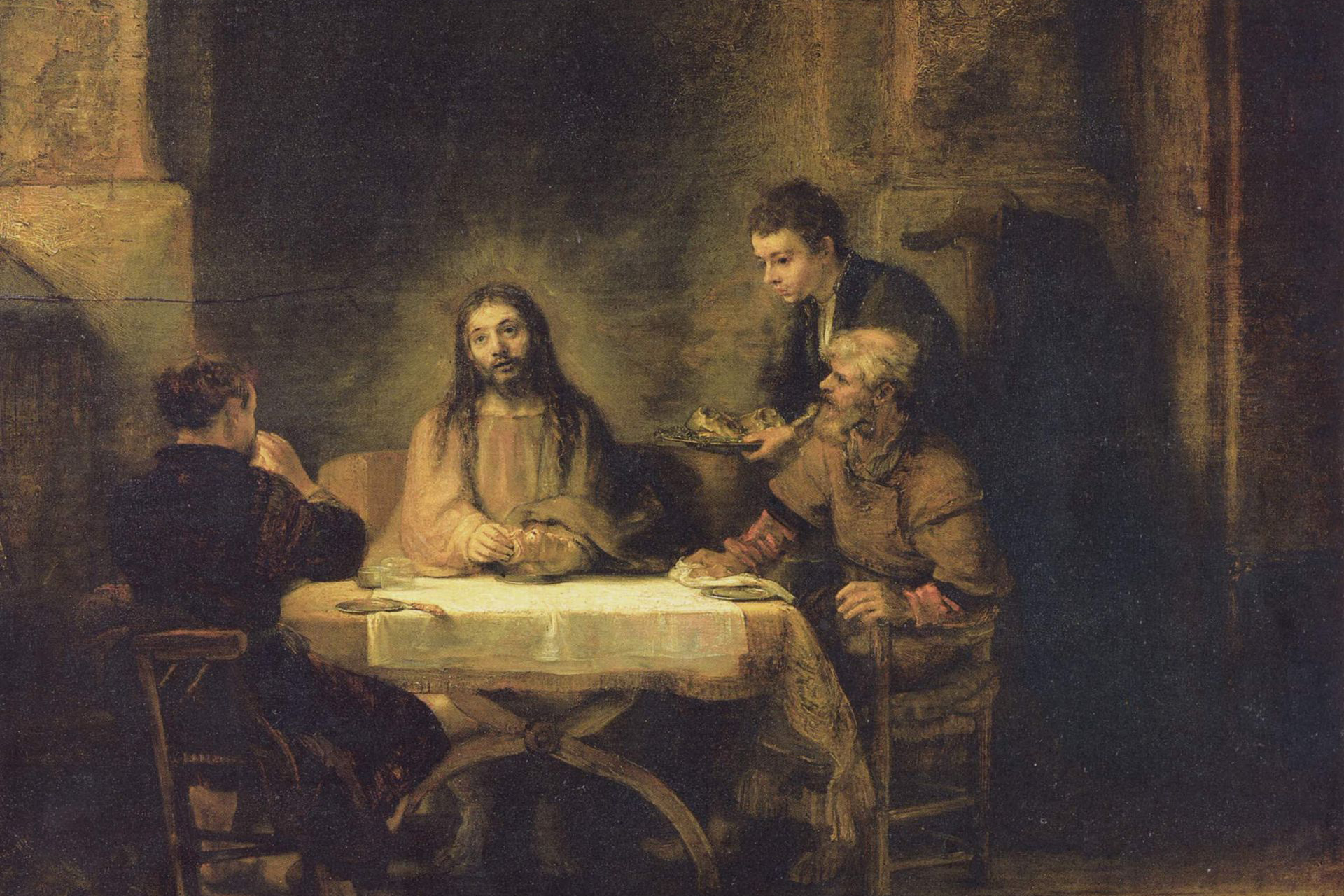
In today’s Gospel we encounter two discouraged and broken men making their way to Emmaus. The text describes them as “downcast.” That is to say, their eyes are cast on the ground, their heads are hung low. Their Lord and Messiah has been killed, the one they had thought would finally liberate Israel. Some women had claimed that He was alive, but these disciples have discredited those reports and are now leaving Jerusalem. It is late in the afternoon and the sun is sinking low.
They are also moving in the wrong direction, West, away from Jerusalem, away form the resurrection. They have their backs to the Lord, rising in the East.
The men cannot see or understand God’s plan. They cannot “see” that He must be alive, just as they were told. They are quite blind as to the glorious things that happened hours before. In this, they are much like us, who also struggle to see and understand that we have already won the victory. Too easily our eyes are cast downward in depression rather than upward in faith.
How will the Lord give them vision? How will He reorient them, turn them in the right direction? How will He enable them to see His risen glory? How will He encourage them to look up from their downward focus and behold new life?
If you are prepared to “see” it, the Lord will celebrate Holy Mass with them. In the context of a sacred meal we call the Mass, He will open their eyes and they will recognize Him; they will see glory and new life.
Note that the entire gospel, not just the last part, is in the form of a Mass. There is a gathering, a penitential rite, a Liturgy of the Word, intercessory prayers, a Liturgy of the Eucharist, and an ite missa est. In this manner of a whole Mass, they have their eyes opened to Him and to glory. They will fulfill the psalm that says, Taste, and see, the goodness of the Lord (Psalm 34:8).
Let’s examine this Mass, which opens their eyes, and ponder how we also taste and see in every Mass.
Stage One: Gathering Rite – The curtain rises on this Mass with two disciples having gathered together on a journey: Now that very day two of them were going to a village seven miles from Jerusalem called Emmaus (Lk 24:13). We have already discussed above that they are in the midst of a serious struggle and are downcast. We only know one of them by name, Cleopas. Who is the other? If you are prepared to accept it, the other is you. So, they have gathered. This is what we do as the preliminary act of every Mass. We who are pilgrims on a journey come together on our journey.
It so happens for these two disciples that Jesus joins them:And it happened that while they were conversing and debating, Jesus himself drew near and walked with them (Luke 24:15). The text goes on to tell us that they did not recognize Jesus yet.
The Lord walks with us, too. It is essential to acknowledge by faith that when we gather together at Mass the Lord Jesus is with us. Scripture says, For where two or three are gathered in my name, there am I among them (Matt 18:20). For many of us, too, although Jesus is present we do not recognize Him. Yet he is no less among us than He was present to these two disciples who fail to recognize Him.
Liturgically, we acknowledge the presence of the Lord at the beginning of the Mass in two ways. First, as the priest processes down the aisle the congregation sings a hymn of praise. It is not “Fr. Jones” they praise; it is Jesus, whom “Fr. Jones” represents. Once at the chair the celebrant (who is really Christ) says, “The Lord be with you.” In so doing He announces the presence of Christ among us promised by the Scriptures.
The Mass has now begun and our two disciples are gathered; the Lord is with them. So, too, for us at every Mass. The two disciples still struggle to see the Lord, to experience new life, and to realize that the victory has already been won. So, too, do some of us who gather for Mass. The fact that these disciples are gathered is already the beginning of the solution. Mass has begun. Help is on the way!
Stage Two: Penitential Rite – The two disciples seem troubled and the Lord inquires of them the source of their distress: What are you discussing as you walk along? (Lk 24:17). In effect, the Lord invites them to speak with Him about what is troubling them. It may also be a gentle rebuke from the Lord that the two of them are walking away from Jerusalem, away from the site of the resurrection.
Clearly their sorrow and distress are governing their behavior. Even though they have already heard evidence of Jesus’ resurrection (cf 24:22-24), they seem hopeless and have turned away from this good news.
Thus the Lord engages them in a kind of gentle penitential rite, engages them about their negativity.
So, too, for us at Mass. The penitential rite is a moment when the celebrant (who is really Christ) invites us to lay down our burdens and sins before the Lord, who alone can heal us. We, too, often enter the presence of God looking downcast and carrying many burdens and sins. Like these disciples, we may be walking in the wrong direction. In effect, the Lord says to us, “What are thinking about and doing as you walk along? Where are you going with your life?”
The Lord asks them to articulate their struggles. This calling to mind of struggles, for them that day and for us in the penitential rite, is a first step to healing and recovery of sight.
Again, we see in this story about the two disciples on the road to Emmaus, the Mass that is so familiar to us.
Stage Three: Liturgy of the Word – In response to their concerns and struggles, the Lord breaks open the Word of God, the Scriptures: Then beginning with Moses and all the prophets, he interpreted to them what referred to him in all the scriptures (Luke 24:27).
Not only does the Lord refer to Scripture, He interprets it for them. Hence the Word is not merely read; there is a homily, an explanation and application of the Scripture to the men’s struggles. The homily must have been a good one, too, for the disciples later remark, Were not our hearts burning (within us) while he spoke to us on the way and opened the scriptures to us? (Luke 24:32)
So, too, for us at Mass. Whatever struggles we may have brought, the Lord bids us to listen to His Word as the Scriptures are proclaimed. Then the homilist (who is really Christ) interprets and applies the Word to our life. Although the Lord works through a weak human agent (the priest or deacon), He can write straight with crooked lines. As long as the homilist is orthodox, it is Christ who speaks. Pray for your homilist to be an obedient and useful instrument for Christ at the homily moment.
Notice, too, that although the disciples do not yet fully see, their downcast attitude is gone; their hearts are now on fire. Pray God, that it will be so for us who come to Mass each week and hear from God that the victory is already ours in Christ Jesus. God reminds us, through Scripture passages that repeat every three years, that although the cross is part of our life, the resurrection surely is, too. We are carrying our crosses to an eternal Easter victory. If we are faithful to listening to God’s Word, hope and joy build within our hearts and we come, through being transformed by Christ in the Liturgy, to be men and women of hope and confidence.
Stage Four: Intercessory Prayers – After the homily, we usually make prayers and requests of Christ. We do this based on the hope, provided by His Word, that He lives, loves us, and is able. So it is that we also see these two disciples request of Christ, Stay with us, for it is nearly evening and the day is almost over (Luke 24:29).
Is this not what we are doing when we say, in so many words, “Stay with us, Lord, for it is sometimes dark in our lives and the shadows are growing long. Stay with us, Lord, and with those we love, so that we will not be alone in the dark. In our darkest hours, be to us a light, O Lord, a light that never fades away”?
Indeed, it is already getting brighter, for we are already more than halfway through the Mass!
Stage Five: Liturgy of the Eucharist – Christ does stay with them. Then come the lines that no Catholic could miss: And it happened that, while he was with them at table, he took bread, said the blessing, broke it, and gave it to them (Luke 24:30). Yes, it is the Mass to be sure. All the basic actions of the Eucharist are there: He took, blessed, broke, and gave. They are the same actions that took place at the Last Supper and that we repeat at every Mass. Later, the two disciples refer back to this moment as the breaking of the bread (Luke 24:35), a clear biblical reference to the Holy Eucharist.
The words of Mass immediately come to mind: “While they were at supper, He took the bread and gave you thanks and praise. He broke the bread, gave it to His disciples, and said, “Take this all of you and eat it. This is my Body, which will be given up for you.”
A fascinating thing then occurs: With that their eyes were opened and they recognized him, but he vanished from their sight (Luke 24:31).
It is the very act of consecration that opens their eyes. Is this not what Holy Communion is to do for us? Are we not to learn to recognize Christ by the very mysteries we celebrate? Are we not to “taste and see”?
The liturgy and the sacraments are not mere rituals; they are encounters with Jesus Christ. Through our repeated celebration of the holy mysteries, our eyes are increasingly opened, if we are faithful. We learn to see and hear Christ in the liturgy, to experience his ministry to us.
The fact that Jesus vanishes from their sight teaches us that He is no longer seen with the eyes of the flesh, but with the eyes of faith and the eyes of the heart. Although He is gone from our earthly, fleshly, carnal sight, He is now to be seen in the sacrament of the altar and experienced in the Liturgy and in other sacraments. The Mass has reached its pinnacle for these two disciples and for us. They have tasted and now they see.
Consider these two men who began this Gospel quite downcast. Their hearts are on fire and they now see. The Lord has celebrated Mass in order to get them to this point. So, too, for us: the Lord celebrates Mass in order to set our hearts on fire and open our eyes to glory. We need to taste in order to see.
I sought the Lord, and he answered me; he delivered me from all my fears. Those who look to him are radiant; their faces are never covered with shame. This poor man called, and the Lord heard him; he saved him out of all his troubles. … Taste and see that the Lord is good; blessed is the man who takes refuge in him (Psalm 34:4-8).
Yes, blessed are we if we faithfully taste in order to see, every Sunday at Mass.
Stage Six: Ite Missa Est– Not able to contain their joy or hide their experience, the two disciples run seven miles back to Jerusalem to tell their brethren what has happened and how they encountered Jesus in the breaking of the bread. They want to, they must speak of the Christ they have encountered, what He said and what He did.
Note that this liturgy has reoriented them. They are now heading back east, toward the Risen Son.
How about us? At the end of every Mass, the priest or deacon says, “The Mass is ended. Go in peace.” This does not mean, “We’re done, go home and have nice day.” It means, “Go into the world and bring the Christ you have received to others. Tell them what you have seen and heard here, what you have experienced. Share with others the joy and hope that this Liturgy gives.”
Have you ever noticed that part of the word “mission” is in the word “dismissal”? You are being commissioned, sent on a mission to announce Christ to others.
Finally, the Lucan text says of these two disciples, So they set out at once and returned to Jerusalem where they found gathered together the eleven and those with them … Then the two recounted what had taken place on the way and how he was made known to them in the breaking of the bread (Lk 24:33,35). How about us? Does our Mass finish that well, that enthusiastically? Can you tell others that you have come to Christ in “the breaking of the bread,” in the Mass?
Jesus has used the Mass to drawn them from gloom to glory, from downcast to delighted, from darkness to light. It was the Mass. Do you “see” it there? It is the Mass. What else could it be?
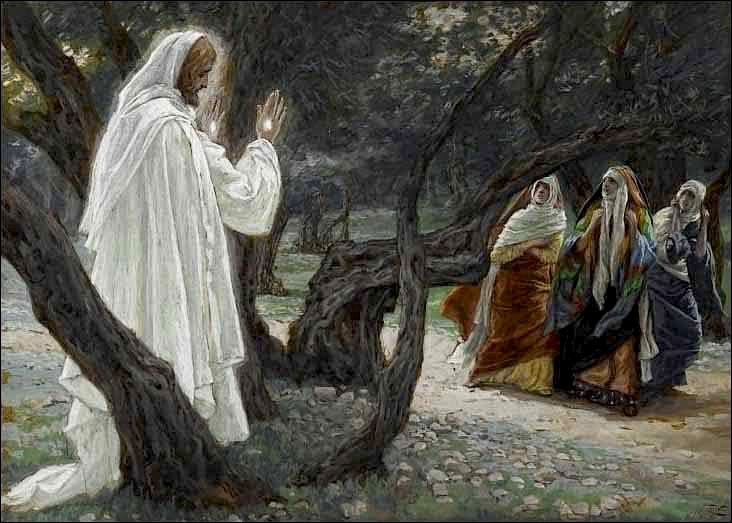
After Christ rose from the dead, He appeared to His disciples at certain places and times, but did not seem to stay with them continuously. On the first Easter Sunday, He appeared six times in rather rapid succession: first to Mary Magdalene, then to the women at the tomb, third as the women left the tomb, fourth to Peter, fifth to the two disciples going to Emmaus, and sixth to the ten Apostles in Jerusalem (when Thomas was not present).
In His public ministry, Jesus seemed to be with His disciples nearly all the time. However, after His Resurrection he would appear, converse, and teach, but then be absent from them bodily. For example, John 20:26 says that “after eight days” Christ appeared to the disciples, suggesting that He was not otherwise present to them during that period.
While it is true that we do not have an exact calendar of His appearances and not every appearance is necessary recorded, it seems apparent that the Lord was not constantly with the disciples during the forty days prior to His ascension.
Why is this?
St. Thomas Aquinas reflected on this question and offers two basic reasons. In so doing he does not propose an absolute explanation, but rather demonstrates why it was fitting that Christ was not with them continuously during the forty days prior to the ascension. St. Thomas writes,
Concerning the Resurrection two things had to be manifested to the disciples, namely, the truth of the Resurrection, and the glory of Him who rose.
Now in order to manifest the truth of the Resurrection, it sufficed for Him to appear several times before them, to speak familiarly to them, to eat and drink, and let them touch Him. But in order to manifest the glory of the risen Christ, He was not desirous of living with them constantly as He had done before, lest it might seem that He rose unto the same life as before … [For as Bede says] “He had then risen in the same flesh, but was not in the same state of mortality as they.”
That Christ did not stay continually with the disciples was not because He deemed it more expedient to be elsewhere: but because He judged it to be more suitable for the apostles’ instruction that He should not abide continually with them, for the reason given above.
He appeared oftener on the first day, because the disciples were to be admonished by many proofs to accept the faith in His Resurrection from the very out set: but after they had once accepted it, they had no further need of being instructed by so many apparitions (Summa Theologiae, Part III, Q. 55, Art. 3).
While St. Thomas observes that there may well be appearances that were not recorded, he is inclined to hold that there were not a lot more of them. He writes,
One reads in the Gospel that after the first day He appeared again only five times. For, as Augustine says (De Consens. Evang. iii), after the first five apparitions “He came again a sixth time when Thomas saw Him; a seventh time was by the sea of Tiberias at the capture of the fishes; the eighth was on the mountain of Galilee, according to Matthew; the ninth occasion is expressed by Mark, ‘at length when they were at table,’ because no more were they going to eat with Him upon earth; the tenth was on the very day, when no longer upon the earth, but uplifted into the cloud, He was ascending into heaven. But, as John admits, not all things were written down. And He visited them frequently before He went up to heaven,” in order to comfort them. Hence it is written (1 Corinthians 15:6-7) that “He was seen by more than five hundred brethren at once … after that He was seen by James”; of which apparitions no mention is made in the Gospels (ibid).
St. Thomas strikes a balance between the Lord’s need to instruct them and summon them to faith in the resurrection, and the need for them to grasp His risen glory. Christ did not merely resume His former life. The disciples were not to cling to their former understandings of Him as Rabbi and teacher; now they were to grasp more fully that He is Lord.
Though Thomas does not mention it here, I would add another reason for the Lord’s action of not abiding with them continuously: It was fitting for Him to do this to accustom them to the fact that they would no longer see Him as they had with their physical eyes. Once He ascended, they would see Him mystically in the Sacraments and in His Body the Church. Thus, as the Lord broke the Bread and gave it them in Emmaus, they recognized Him the Eucharist (Luke 24). Thereupon He vanished from them. It was as if to say, “You will no longer go on seeing me in the same manner. Now you will experience me mystically and in the Sacraments.”