There is an old saying that sometimes “less is more.” In other words, at some point excess becomes burdensome and pointless.
In the commercial below, the upgrades to mowing equipment begin as helpful, but end as silly and even dangerous. Meanwhile, the poor wife struggles with an “upgraded” watering can that is downright burdensome.
One of the secrets of life is learning to enjoy things in moderation. A glass of wine brings joy; a full bottle brings inebriation and a hangover. A nice dinner is satisfying, but too much food brings obesity and even disease.
What in your life has become excessive? Where have you come to realize that less is in fact more?
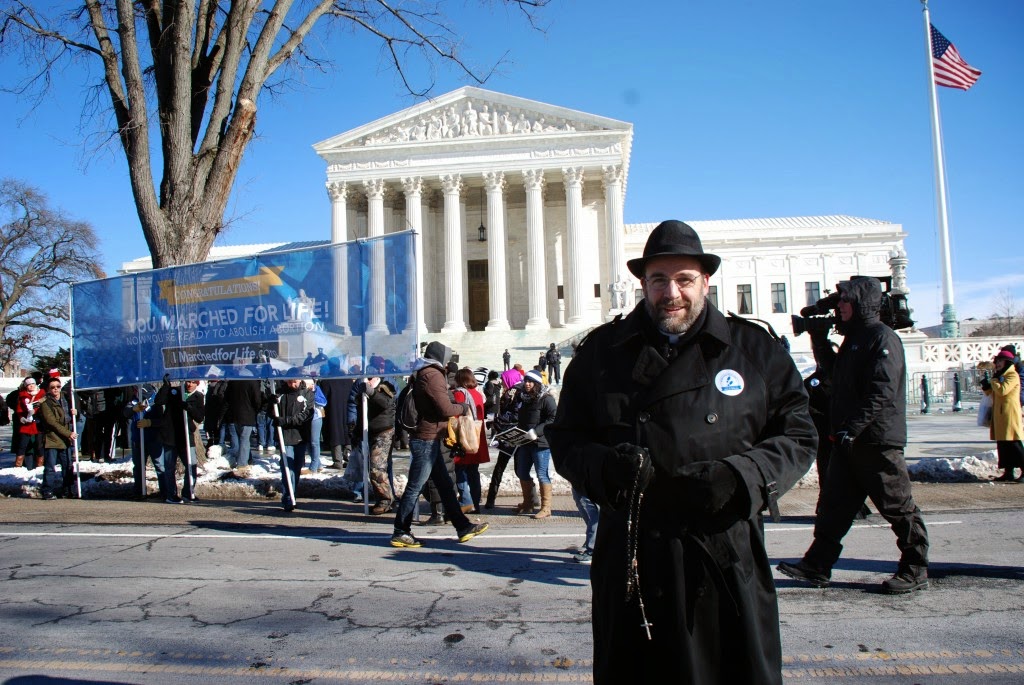
We who participate in the March for Life are always in need of the Lord’s strength and guidance, His grace and mercy, in order to see our goal of ending legalized abortion. To that end, I offer some lessons drawn from the 24th chapter of the Book of Proverbs:
OUR SUMMONS TO TESTIMONY –If you remain indifferent in times of adversity, your strength will depart from you. Rescue those who are being dragged to death, and from those tottering to execution withdraw not. If you say, “I know not this man!” does not he who tests hearts perceive it? He who guards your life knows it, and he will repay each according to his deeds (Prov 24:10-12).
In this passage, we are being told that this is a battle in which we must engage; we must take a stance. We must stand up and be counted; we must witness for life. Either our silence will condemn us, or our witness will bring forth blessings.
Tens of millions of unborn babies have been and are being taken to their deaths, “tottering to execution” in abortion centers throughout the country. Too many Americans say, “I don’t know about this,” or “It’s not my issue,” or “It’s none of my business,” or (worst of all) “I’m personally opposed but don’t want to impose my view on others.”
God knows and sees through all of this. Each of us will have to render an account for what we have done or not done in the face of the scourge of abortion. This public slaughter cannot remain something that we are merely privately bothered by. This passage from Proverbs indicates that silence and inaction when the innocent are being dragged off to slaughter is tacit approval.
We are summoned to respond!
OUR STRENGTH IN TRUTH – A wise man is more powerful than a strong man, a man of knowledge than a man of might; for it is by wise guidance that you wage your war, and the victory is due to the wealth of counselors (Prov 24:5-6).
One thing is for sure: in this battle of the last 40+ years, our primary strength has not been in the law or in politics. Judges and princes (politicians) have done little to limit abortion on demand. At best, we have mildly limited access to unrestricted abortion. In general, the federal courts have resisted even the most reasonable and minor restrictions on abortion. There is also insufficient political resolve in the legislative branch to bring an end to abortion.
Our strength is in our wisdom and knowledge. The wisdom of God teaches us that God knew us before we were ever formed in our Mother’s womb (Jer 1:5) and that no life is an accident. It teaches us that God knit each of us together in our mother’s womb and fashioned us wonderfully and fearfully in the secret and sacred place of the womb (Ps 139). The wisdom of God is clear that to abort a child in the womb is to snatch the knitting from God’s hands and pridefully say, “This shall not be.” Scripture says, Woe to those who quarrel with their Maker, those who are nothing but potsherds among the potsherds on the ground. Does the clay say to the potter, “What are you making?” Does your work say, “The potter has no hands”? (Is 45:9)
In the end the truth will out. We are in a battle for hearts and minds. As medical evidence continues to mount, along with vivid 3-D imagery of babies in the womb, it is getting harder and harder for supporters of abortion to argue that abortion does not end the life of a human person who is, from the very early months, aware and able to feel pain. We must persistently and consistently persuade by assembling and presenting evidence.
Although some stubbornly resist the truth of what they do not wish to see, there are many others whose ambivalence can be eroded and who have not hardened their hearts. Pulling back the curtain further and further is slowly winning the day. The truth is on our side and facts will eventually prevail.
Deep down, people know the truth; they understand what they are doing but do not want to be faced with it. This explains a lot of the anger directed toward us.
Consider how the facts about cigarette smoking, once a commonplace habit that was even viewed as glamorous, have practically ended its acceptance. Consider, too, how the acceptance of slavery (rooted in many similar arguments and flawed logic) is now considered a disgrace in our nation’s history, along with the segregationist attitudes that followed. Harmful lies cannot persist forever.
Our strength must continue to be rooted in the wisdom of God and in the knowledge of medical facts about human life in the womb. People can and will be stubborn, but facts are stubborn things, too. We must boldly and confidently present those facts.
OUR SURETY IN TIME–Be not provoked with evildoers, nor envious of the wicked; For the evil man has no future, the lamp of the wicked will be put out. … For the just man falls seven times and rises again, but the wicked stumble to ruin. Rejoice not when your enemy falls, and when he stumbles, let not your heart exult, lest the Lord see it and be displeased with you, and withdraw his wrath from your enemy (Proverbs 24:19-20,16-18).
It is easy to become battle-weary and discouraged. This has been a long fight and the death toll overwhelming to contemplate. Every now and then I encounter pro-life and other cultural warriors who have become grouchy; they struggle with anger, even directing it at fellow pro-lifers. We must remember that wicked philosophies and erroneous doctrines have their time, but they will not last. As this proverb reminds us, the lamp of the wicked will be put out; if they do not repent, the wicked will stumble to ruin.
Scripture says, For the Lord who avenges blood is mindful of the oppressed; he does not forget the cry of the afflicted (Ps 9:12). God will requite the blood of the innocent who cry out to Him (see Gen 4:10; Rev 6:10). He will do so in His time and in His way, but all will one day know and be ashamed of the horror that this nation has inflicted on our most innocent and defenseless members. The world will one day look back with deep shame upon this era, when the killing of infants in the womb was celebrated as a “right.” This period in history will deservedly be called the second “Dark Ages.” For now, we can only soldier on in our work of changing the hearts of others.
The passage also says that we should not let the wicked provoke us to vengeful anger or hatred. Unless they repent, they will be the saddest of people in the end; their lamps will go out and the darkness of what they have done will envelop them. Our only true and godly stance is to pray for their conversion.
Many who formerly supported legalized abortion have now joined our ranks. There are more than a few who left the abortion industry and now work tirelessly to save lives and to scatter the darkness and lies of abortion supporters/providers. Thank God that they escaped; thank God for their witness. We can only pray that more will have a change of heart and join with us. Keep praying and working for the conversion—not the destruction—of our opponents.
Indeed, we cannot become like our enemy, Satan, who hates human beings and loves to see their downfall. We cannot, as the proverb says, rejoice at the downfall or destruction of our opponent or of any human being. While we may rejoice when evil influences end, we should never delight in the destruction of any person because each of us was made in God’s image.
The worst deception of the Devil is to draw us into hate and vengeance (cloaked in righteousness) even as we work to preach the glory of life. Such behavior is a deception because no end, however good, can justify evil means or can excuse becoming like our enemy. If we become like Satan, he has us, no matter the cause. Leave final judgment to God because only He can see well enough to do so.
These are a few proverbs to which I piously believe God pointed me when I asked for guidance. Our battle is difficult and wearying, but we must recall that we are summoned to it regardless of how hard it is; silence is unacceptable. This is all the more reason to rest in the gifts of wisdom and knowledge, to insist that others look to the truth that is written on their hearts, to understand that we are on the right side of history and that the lie of abortion cannot forever stand.
At Mass for Wednesday of the first week of the year, we read a text from Hebrews that describes our most basic and primal fear. Our inordinate fear of what people think of us is rooted in an even deeper fear, one that is at the very core of our being. The Hebrews text both names it and describes it as being the source of our bondage. In order to unlock the secret of the text, I want to suggest to you an interpretation that will allow its powerful diagnosis to have a wider and deeper effect.
Consider, then, this text from Hebrews:
Since the children have flesh and blood, [Jesus] too shared in their humanity so that by his death he might destroy him who holds the power of death—that is, the devil— and free those who all their lives were held in slavery by their fear of death (Heb 2:14-15).
This passage is clear in saying that the devil is the origin of our bondage to sin, but also that hold on us is through the fear of death. This is what he exploits in order to keep us in bondage.
When I have explored this teaching with people, I have found that many have difficulty understanding it at first. Especially for the young, death is almost a theoretical concept; it is not something they consciously fear. This is particularly true in the modern age, when medical advances have so successfully pushed back the boundary between life and death. Every now and then something may shake us out of our complacency (perhaps a brush with death), but in general death does not dominate our thoughts. So, then, what is meant by the fear of death and how does it hold us in bondage?
Well, what if we were to replace the word “death” with “diminishment”? To be sure, this is an adaption of the text (the Greek text (φόβῳ θανάτου – phobo thanatou) is accurately translated as “fear of death”), but doing so can help us to see what the text is getting at in a wider sense. It doesn’t take long to realize that each diminishment we experience is a kind of “little death.” Diminishments make us feel smaller, less powerful, less glorious.
What are some examples of diminishments we might experience? On one level, a diminishment is anything that makes us feel less adequate than others. Maybe we think others are smarter or more popular. Perhaps we do not feel attractive enough; we’re too tall, too short, too fat, or too thin. Maybe we resent the fact that others are richer or more powerful. Perhaps we wish we were younger, stronger, and more energetic. Maybe we wish we were older, wiser, and more settled. Perhaps we feel diminished because we think others have a better marriage, a nicer home, or more accomplished children. Maybe we compare ourselves unfavorably to a sibling who has done better financially or socially than we have.
Can you see how this fear of diminishment sets up many sins? It plugs right into envy and jealousy. Pride comes along for the ride, too, because we try to compensate for our fear of inadequacy by finding people to whom we feel superior. We thus indulge our pride or seek to build up our ego in unhealthy ways. Perhaps we run to the cosmetic surgeon or torture ourselves with unhealthy diets. Maybe we ignore our own gifts and try to be someone we really aren’t. Perhaps we spend money we don’t have trying to impress others so that we feel less inadequate.
Think of the countless sins we commit trying to be popular and to fit in. We give in to peer pressure and sometimes do terrible things. Young people will join gangs, use drugs, skip school, have sex before marriage, pierce and tattoo their bodies, use foul language, etc. Adults also have many of these things on their list. All of these things are done in a quest to be popular and to fit in. This desire to fit in is all about not wanting to feel diminished, and diminishment is about the fear of death, because every experience of diminishment is like a small death.
Advertisers know how to exploit the fear of diminishment in marketing their products. I remember studying this topic in business school at George Mason University. The logic goes something like this: You’re not pretty enough, happy enough, adequate enough, or comfortable enough; you don’t look young enough; you have some chronic illness (e.g., depression, asthma, diabetes)—but just buy our product and you will be “enough”; you won’t be so pathetic, incomplete, and, basically, diminished. If you drink this beer, you’ll be happy, have good times, and be surrounded by friends. If you use this toothpaste, soap, or cosmetic product, you’ll be surrounded by beautiful people and sex will be more available to you. If you drive this car, people will turn their heads and be impressed with you. The message is that you don’t measure up now (you’re diminished) but our product will get you there. Just buy it and you’ll be happier, healthier, and more alive!
Perhaps you can see how such advertising appeals to greed, pride, materialism, and worldliness; it puts forth the lie that these material things will solve our problems. In fact, appeals like this actually increase our fear of diminishment (and death) because they feed the notion that we have to measure up to these false and/or unrealistic standards.
It is my hope that you can see how very deep this drive is and how it enslaves us in countless ways.
This demon (fear of death, of diminishment) must be named. Once named and brought to light, we must learn its moves and begin to rebuke it in the name of Jesus. As we start to recognize the thought patterns emerging from this most primal of fears, we can gradually, by God’s grace, replace this distorted thinking with proper, sober, and humble thinking—thinking rooted in God’s love for us and the availability of His grace and mercy.
The text from Hebrews above is clear in saying that this deep and highly negative drive is an essential way in which Satan keeps us in bondage. It also says that Jesus Christ died to save us and free us from this bondage. Allow the Lord to give you a penetrating and sober vision of this deep drive, this deep fear of diminishment and death. Allow the light of God’s grace and His Word to both expose and heal this deepest of wounds.
This song pokes fun at our fad-centered culture, which is always trying to make us feel inadequate.
The first reading from Mass for Tuesday of the First Week of the Year is from the Letter to the Hebrews. It sets forth the total victory of Christ and that the Father has subjected all things to Christ. Yet the text also shows how the outworking of this subjugation is paradoxical.
Note first the declaration of all things being subject to Jesus Christ:
In “subjecting” all things to him,he left nothing not “subject to him” (Hebrews 2:8b).
“All things” is a pretty substantial category. Yes, everything is subject to Him: the wicked and powerful men of this earth as well as demons. This, of course, brings to mind a question that is addressed in the very next sentence:
Yet at present we do not see “all things subject to him,” … (Hebrews 2:8c)
The text notes we do not currently see all things subjected to Christ; this implies that our inability to see does not mean that all things are not subject to Him! The fact that a blind man cannot see the sun does not mean that the sun is not there. The defect is not in the sun or in reality; it is in the man. So too for us, who do not see that all things are subject to Christ.
Scripture is a prophetic declaration of reality. In effect, it says to us, “This is what is really going on regardless of what you think. You should conform your thinking to this prophetic declaration of reality from God Himself.”
So, then, although we might not see that all things are subject to Christ, we are challenged to permit God to help us perceive this. This is accomplished by instruction in His word, so that we see and interpret things rightly and in conformity with the prophetic declaration of reality contained in Scripture.
The next verses show forth the paradox of Christ’s triumph:
… but we do see Jesus “crowned with glory and honor”because he suffered death …. For it was fitting that he, for whom and through whom all things exist, in bringing many children to glory, should make the leader to their salvation perfect through suffering (Heb 2:10).
Here, simply put, is the paradox of the cross. It is by the cross that Christ conquers both Satan and our pride. Dr. Martin Luther King, Jr. noted that darkness cannot drive out darkness; only light can do that; and hatred cannot drive out hatred; only love can do that. Continuing in that vein, I would add that pride cannot drive out pride; only humility can do that. Christ does not conquer by having more pride than Satan or than us. He does not conquer by becoming an even worse version of His enemy. No, He conquers through humility, obedience, and suffering. Because of this, He has been exalted by the Father and given a name above every other name, so that at the name of Jesus every knee should bend, whether in Heaven, on earth, or under the earth (See Phil 2:10). The text from Hebrews says that because Christ suffered, we now see Him crowned with glory and honor.
This is the paradox for us as well. As Jesus was crowned because of His humble suffering, we too will have the victory because of our suffering.
We tend to think that “all things being subject to” Christ means that all suffering and wickedness are eradicated—not so. As Christ attained to the highest places in this way of the cross, so will we who follow Him. Suffering is not a sign of defeat but the very path to victory! The devil loses at his own game.
Scripture says elsewhere,
For our light and momentary affliction is producing for us an eternal glory that is far beyond comparison. (2 Cor 4:17).
All things work together for good to them that love the Lord and are called according to his purposes (Rom 8:28).
The more suffering Satan inflicts, the more ground he loses.
This, then, is how all things are subject to Christ: even sufferings that seem antithetical to His sovereignty are part of His plan to give us greater glory. Even when Satan does his worst to the believer he loses. The more he attacks, the greater our glory in Christ if we persevere. It all backfires for Satan. He loses and God is always sovereign. God can make a way out of no way, write straight with crooked lines, and do anything but fail.
All things, even our sufferings, are subject to Christ.
This week in daily Mass, we are reading from The Letter to the Hebrews, one of the most underappreciated books of the New Testament. It has long been one of my favorites from which to teach; in it we are summoned to faith in Jesus, our Savior and Great High Priest.
The opening lines in the Latin Vulgate are exquisite, particularly to those who can read and recite Latin well.
Multifáriam, multísque modis, olim Deus lóquens pátribus in prophétis. Novíssime, diébus istis locútus est nobis in Fílio. (In many and varied ways, God once spoke to our fathers through the prophets. In these last days, he has spoken to us through the Son.)
Though many doubt that St. Paul wrote Hebrews, I believe he did; it is here that we best see his priestly identity as an apostle, his deep knowledge of the Temple rituals and how they pointed to Christ and are perfected by Him.
The Letter to the Hebrews does not begin with the usual epistolary greetings and salutations, though it does end with them. Throughout, the text “sounds” more like a sermon. The audience of the letter is clearly Jewish Christians; the writer is exhorting them not to fall back on Jewish rituals, which cannot save, but rather to cling ever more closely to Christ, who alone is savior and Lord.
Hebrews was surely written before the destruction of Jerusalem and the Temple in 70 A.D. (References to the Temple speak of sacrifices as still going on there.) It occurs to me that the context of Hebrews is that of the years from 65-70 A.D., a time during which wars and rumors of wars were growing. Indeed, the tragic Jewish war began in 66 A.D. The Romans had had more than enough of Jewish Messianism and uprisings. It was a horrible, bloody war that cost the lives of more than one million Jews. During this period, Jewish nationalism was on the rise, likely even among those who had become Christians.
Politics has a strong pull, and it is in this context that the author addresses his audience. In effect, his position is that they should not return to what cannot save merely out of some sense of loyalty to a doomed nation. Jesus had prophesied the tragic destruction of Jerusalem in the Mount Olivet discourse recorded in the Synoptic Gospels (Matthew 24 and 25, Mark 13, and Luke 21). With the war clouds gathering, this was the time to cling to Him ever more!
What follows is a quick summary of the exhortation in the Letter to the Hebrews. (In most cases I have not cited chapter and verse below because I pulled from many parts at once.)
Jesus is Lord: Particularly in the first three chapters of Hebrews, the author reminds his audience of the glory of Christ.
Jesus Christ is the radiance of God’s glory and the exact representation of His nature, upholding all things by His powerful word. Having provided purification for sins, He now sits at the right hand of the Majesty on high. Christ is far superior to the angels, as the name He has inherited is excellent beyond theirs. To which of the angels did God ever say, “You are My Son; today I have become Your Father,” or “I will be His Father, and He will be My Son”? When God brings His firstborn into the world, He says: “Let all God’s angels worship Him.”
Yes, God has subjected all things to Him, leaving nothing outside of His control. Christ is crowned with glory and honor because He suffered death so that by the grace of God He might taste death for everyone, bringing many sons to glory. By His death Christ destroyed him who holds the power of death—that is, the devil—and freed those were held in slavery by the fear of death.
Jesus is the True High Priest:The author of the Letter to the Hebrews then goes on to describe how Jesus has a true priesthood, greater than that of the priests in the Temple.
Jesus has been counted worthy of greater glory than Moses. He is the great high priest who has passed through the heavens, entering the inner sanctuary behind the curtain. Jesus has entered on our behalf. He has become a high priest forever in the order of Melchizedek. Indeed, God the Father says of Jesus His Son, “You are a priest forever in the order of Melchizedek.”
If perfection could have been attained through the Levitical priesthood, why would there have been a need for another priest to appear, one in the order of Melchizedek and not in the order of Aaron?
Jesus is the Perfection that was Promised: The Letter to the Hebrews is essentially an exhortation not to leave the perfect to go back to the imperfect. The Temple and what takes place there is now no more than a movie set filled with actors playing their roles. Jesus is the true and perfect High Priest, who enters into the true and actual Holy of Holies. The Temple rituals merely point to what Jesus actually does:
Jesus is the true High Priest, who sat down at the right hand of the throne of the Majesty in Heaven and who ministers in the sanctuary and true tabernacle set up by the Lord, not man. He entered the greater and more perfect tabernacle, not made by hands (that is, not of this creation).
Because every high priest is appointed to offer both gifts and sacrifices, it was necessary for this One also to have something to offer. He did not enter by the blood of goats and calves, but He entered the Most Holy Place once for all by His own blood, thus securing eternal redemption. If the blood of goats and bulls and the ashes of a heifer sprinkled on those who are ceremonially unclean sanctify them so that their bodies are clean, how much more will the blood of Christ, who through the eternal Spirit offered Himself unblemished to God, purify our consciences from works of death so that we may serve the living God?
Jesus has established the New Covenant in His Blood: The author exhorts his audience not to return to the Old Covenant from the New Covenant. To this he adds this warning:
By speaking of a new covenant, He has made the first one obsolete, and what is obsolete and aging will soon disappear (Heb 8:13).
Anyone who rejected the Law of Moses died without mercy on the testimony of two or three witnesses. How much more severely do you think one deserves to be punished who has trampled on the Son of God, profaned the blood of the covenant that sanctified Him, and insulted the Spirit of grace?
Do not throw away your confidence; it holds a great reward. You need to persevere, so that after you have done God’s will, you will receive what He has promised.
What is the meaning of this letter for us who read it so long after the Jewish war of 70 A.D? It is simply this:
We are easily mesmerized by politics and cultural movements, exhibiting more loyalty to them that to our Savior and Lord, Jesus Christ. Distracted by modern ideas and urgencies, we forsake the message of Christ. We’ll salute Christ, but only if His message agrees with our views and priorities. The Letter to the Hebrews tell us not to give our heart to what cannot save, not to return to the obsessions of a worldly kingdom of darkness now that we have been summoned to the Kingdom of Light.
Jesus deserves your highest loyalty; He alone can save you. Put not your trust in princes and in mortal men in whom there is not help (Psalm 146:3-4). If we forsake Christ for something lesser, do we not treat lightly His blood, which sanctified us, and insult the spirit of grace? Are you worthy of Jesus Christ or are you just worthy of a political party or some popular ideologies of this passing world?
It snowed yesterday in Washington, D.C. It wasn’t anything epic, just a decent six-incher.
There were drawbacks, of course: Mass attendance was poor, and I had to get up early to shovel a path to the doors. (Thank you, Lord, for the helpers you sent!) Despite the inconvenience, snow incites wonder and awe in me.
I realize that not everyone likes snow, but it is an amazing work of God. He takes a barren winter landscape and creates it anew. I can almost hear Him saying, “Behold, I make all things new!”
We often walk past the glory of God hardly noticing the gifts He provides every day. Tonight and tomorrow I don’t want to miss winter’s white gown. Maybe—just maybe—God can get a few of us here on the East Coast to stop for a moment, rest, and behold His glory.
Having to cancel a few plans because of the weather can provide a wonderful opportunity to become reacquainted with our family and even with our very self. Just looking out the window and marveling at the snow as it falls with hypnotic and calming steadiness can be a prayer—if we think of God who sends it. Wherever you are, don’t walk through life and miss the glory of God!
In the Book of Sirach there is a beautiful and poetic description of God and the majestic work He creates even in the “dead” of winter. Enjoy this excerpt from Sirach and reflect spiritually on the glory of God in winter.
A word from God drives on the north wind.
He scatters frost like so much salt;
It shines like blossoms on the thornbush.
Cold northern blasts he sends that turn the ponds to lumps of ice.
He freezes over every body of water,
And clothes each pool with a coat of mail.
He sprinkles the snow like fluttering birds.
Its shining whiteness blinds the eyes,
The mind is baffled by its steady fall.
(Sirach 43, selected verses)
The video below brings back childhood memories of the joy and wonder of snow; I hope you enjoy it as much as I did.
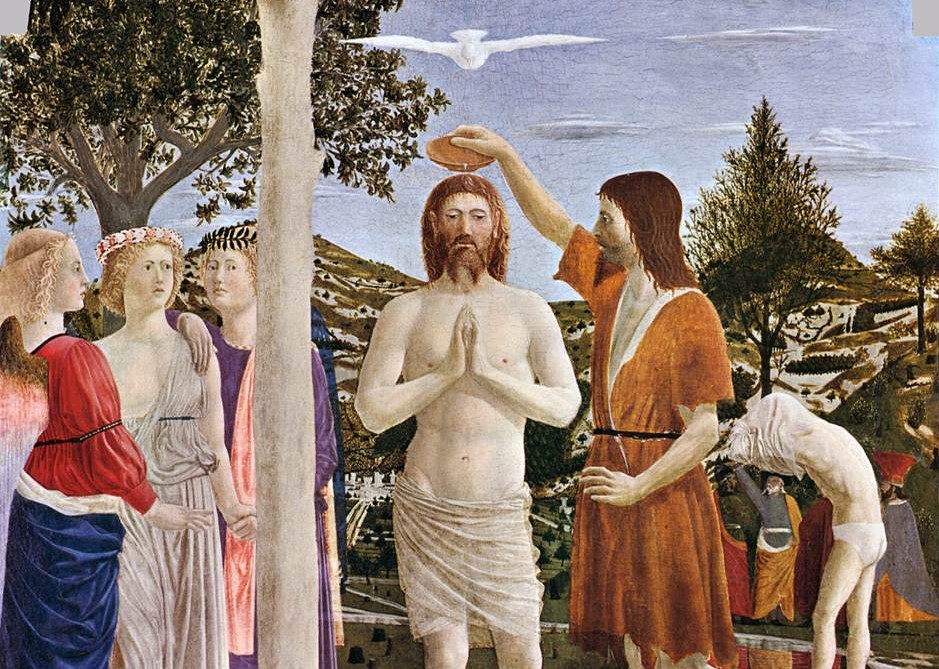
This Sunday’s Feast of the Baptism of the Lord is a time to reflect on not only the Lord’s Baptism but our own. In an extended sense, when Christ is baptized, so are we, for we are members of His Body. As Christ enters the water, He makes holy the water that will baptize us. He enters the water and we follow. In these waters, He acquires gifts to give us.
Let’s examine the Gospel in three stages.
The Fraternity of Baptism – The text says, After all the people had been baptized and Jesus also had been baptized …
Luke mentions Jesus’ Baptism in passing, in the middle of a sentence. Perhaps he, like many of us, is puzzled as to why Jesus would request baptism. John’s baptism of repentance presumes the presence of sin, but the scriptures are clear that Jesus had no sin.
For we have not a high priest who is unable to sympathize with our weaknesses, but one who in every respect has been tempted as we are, yet without sin (Heb 4:15).
You know that he appeared to take away sins, and in him there is no sin (1 John 3:5).
Even though He never sinned, Jesus identifies with sinners. As He comes to the bank of the river, He has no ego concerns. He is not embarrassed or ashamed that some might think Him a sinner (though He was not). He accepts the humiliation of being seen in the company of sinners. Jesus freely enters the waters knowing that anyone who does not know Him will count Him among the sinners.
Consider how amazing this is. Scripture says, He is not ashamed to call us his Brethren (Heb 2:11). Elsewhere it says, God made him who had no sin to be sin for us, so that in him we might become the righteousness of God (2 Cor 5:21).
Jesus ate with sinners, something many of the religious leaders found scandalous. This man welcomes sinners and eats with them (Lk 15:2). Jesus was known as a friend of sinners. He had pity on the woman caught in adultery. He allowed a sinful woman to touch Him and anoint His feet. He cast out demons and fought for sinners. He suffered and died for sinners in a manner reserved for the worst of criminals. He was crucified between two thieves and was assigned a grave among the wicked (Is 53).
Praise God, Jesus is not ashamed to be found in our presence and to share a brotherhood with us. There is a great shedding of His glory in doing this. Scripture says, [Jesus], being in very nature God, did not consider equality with God something to be grasped, but made himself nothing, taking the very nature of a servant, being made in human likeness. And being found in appearance as a man, he humbled himself (Phil 1:3).
The Foreshadowing of our Baptism – In accepting baptism, Jesus does not enter the water alone. He takes us with Him, for we are members of His Body. As the Head of the Body, He goes where the members will follow. St. Maximus says,
I understand the mystery as this. The column of fire went before the sons of Israel through the Red Sea so that they could follow on their brave journey; the column went first through the waters to prepare a path for those who followed … But Christ the Lord does all these things: in the column of fire He went through the sea before the sons of Israel; so now in the column of his body he goes through baptism before the Christian people … At the time of the Exodus the column … made a pathway through the waters; now it strengthens the footsteps of faith in the bath of baptism (de sancta Epiphania 1.3).
So what God promised in the Old Testament by way of prefigurement, He now fulfills in Christ. They were delivered from the slavery of Egypt as the column led them through the waters. More wonderfully, we are delivered from the slavery to sin as the column of Christ’s Body leads us through the waters of baptism. God’s righteousness is His fidelity to His promises. In His Baptism and all it signifies (His death and resurrection), Jesus has come to fulfill all righteousness, and thus fulfills the promises made by God at the Red Sea and throughout the Old Testament.
The Four Gifts of Baptism – The text says, heaven was opened and the Holy Spirit descended upon him in bodily form like a dove. And a voice came from heaven, “You are my beloved Son; with you I am well pleased.”
Scripture says, we are members of Christ’s body (Eph 5:30). Thus, when Jesus goes into the water, we go with Him. In going there, He acquires four gifts on our behalf:
Access – The heavens are opened. The heavens and paradise were closed to us after Original Sin, but at Jesus’ Baptism, they are opened. Jesus acquires this gift for us. At our Baptism, the heavens open for us and we have access to the Father and to the heavenly places. Scripture says, Therefore, since we are justified by faith, we have peace with God through our Lord Jesus Christ. Through him we have obtained access to this grace in which we stand (Romans 5:1). Scripture also says, For through Jesus we have access in one Spirit to the Father. So then you are no longer strangers and sojourners, but you are fellow citizens with the saints and members of the household of God (Eph 2:17).
Anointing –The Spirit of God descends on him like a dove. Here, too, Jesus acquires the gift of the Holy Spirit for us. At our Baptism we are not just washed of sins, but we also become temples of the Holy Spirit. After our Baptism we are anointed with chrism, signifying the presence of the Holy Spirit. For adults, this happens at Confirmation, but even for infants there is an anointing at Baptism to recognize that the Spirit of God dwells in the baptized as in a temple. Scripture says, Do you not know that you are God’s temple and that God’s Spirit dwells in you? (1 Cor 3:16)
Acknowledgment – You are my beloved Son. Jesus receives this acknowledgment from His Father for the faith of those who heard it and to acquire this gift for us. In our own Baptism we become the children of God. Because we become members of Christ’s Body, we now have the status of sons of God. On the day of your Baptism, the heavenly Father acknowledges you as His own dear child. Scripture says, You are all sons of God through faith in Christ Jesus, for all of you who were baptized into Christ have clothed yourselves with Christ (Gal 3:26).
Approval – With you I am well pleased. Jesus had always pleased His Father, but now He acquires this gift for us as well. Our own Baptism gives us sanctifying grace, the grace to be holy and pleasing to God. Scripture says, Blessed be the God and Father of our Lord Jesus Christ, who has blessed us in Christ with every spiritual blessing in the heavens, as he chose us in him, before the foundation of the world, to be holy and blameless in his sight (Eph 1:1-3).
Thus, at His Baptism Christ acquires these gifts for us so that we can receive them at our own Baptism. Consider well the glorious gift of your Baptism. If you don’t know the date, find out. It should be a day as highly celebrated as your birthday. Christ was baptized for our sake, not His own. All these gifts had always been His. In His Baptism, Jesus fulfilled God’s righteousness by going into the water to get them for you. It’s all right to say, “Hallelujah!”
The commercial below illustrates an important principle about side effects. When faced with a problem, we often wish for an easy cure, one without any personal costs or side effects. However, in general, the bigger the problem, the more drastic the cure and the larger the side effects.
In my experiences with deliverance ministry and pastoral counseling, I have found that many people are desperate for a solution. They are hoping without hope that a few prayers will drive away the demons or problems and everything will be fine again.
Most people want relief, not healing — but healing is hard work and true deliverance often requires making significant changes. Some of the uncomfortable “side effects” can be having to confront past sins and traumas. Relief is cheap but often temporary. Healing is costly, but it brings about more lasting effects.
Enjoy this zany commercial. I got a particular kick out of the ending, when the pets reap a bountiful harvest as a side effect of the family’s unusual stress reduction technique.

 There is an old saying that sometimes “less is more.” In other words, at some point excess becomes burdensome and pointless.