On The Feast of the Holy Innocents, A Meditation on the Sins Committed Against Children

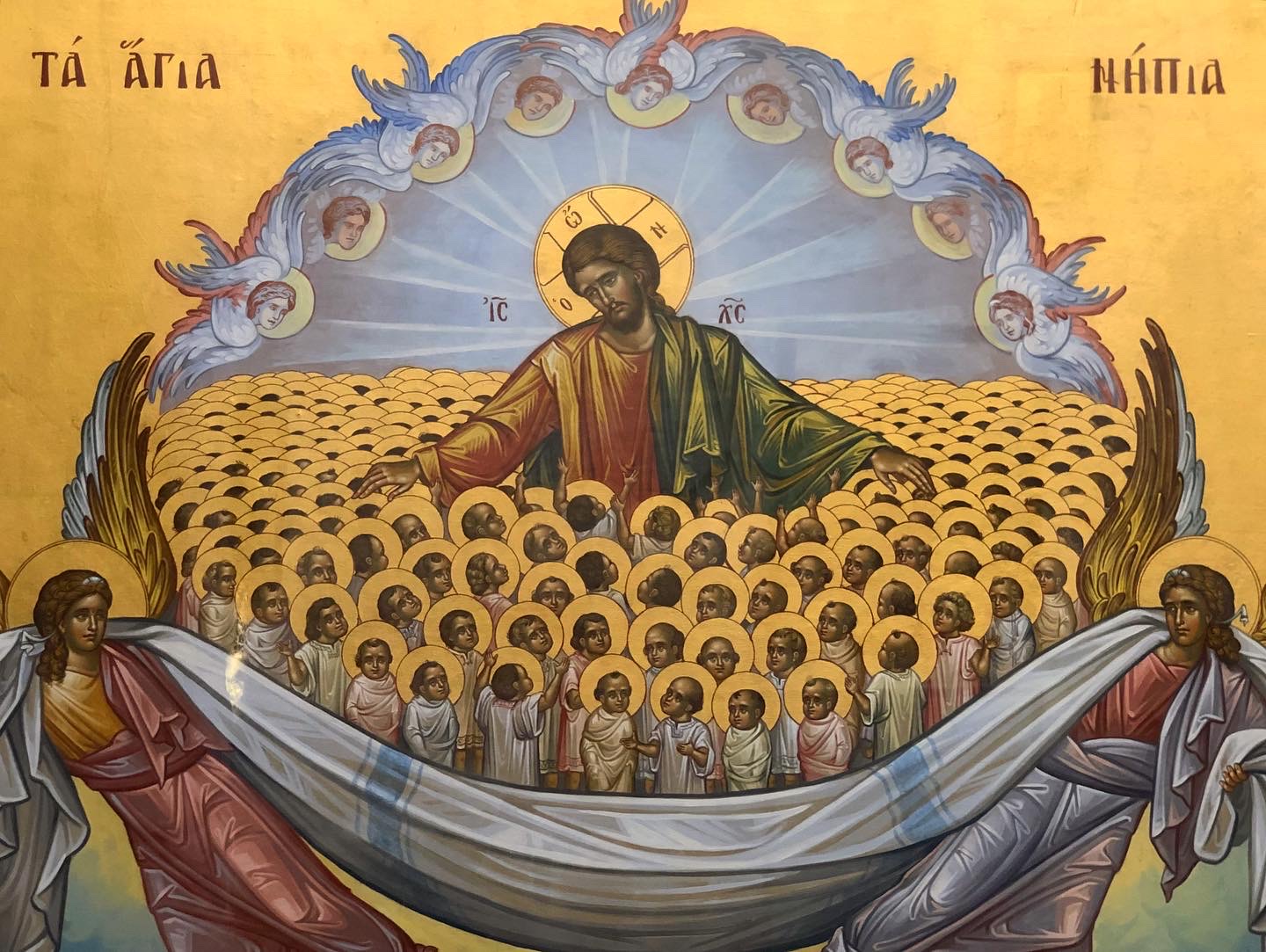
Today, we observe the feast of the Holy Innocents, a feast commemorating the young children, of even younger age who were cruelly murdered by the paranoid and crazed killer known as Herod “the Great.” So paranoid was he that others might usurp or limit his power that he killed three of his own sons, and his wife. He ruthlessly killed many others as well. As his own death drew near, according to Josephus,  Herod decreed that in order that the nation properly mourn his death, one member of each family should be killed in his honor, and thus the mourning in all Israel for him would be sincere. His last and final act as King was to rise from his death bed and sentence to death a group of Jewish zealots who had removed an Eagle he place over the entrance of the temple. They had thought the image a desecration. Having killed them, he himself died (in bed) the next day.

Herod was a cruel tyrant and a ruthless and paranoid killer. Calling him “the Great” can only be a reference to his skill in architecture and building and to his headship of the equally cruel Herodian dynasty.

Yet here Christ was born and found, in the midst of crisis and disaster. More than ever, the Christmas message is relevant. For despite our cruelty and despite the crises of this world, Christ is still to be found. He was born in one of the most crisis-torn regions of the world. He bids us to find him in just these sorts of places and times, as if to say, there is still hope: The mercies of the Lord are not exhausted, his compassion is not spent; it is renewed each morning (Lam 3:22-23).

That he was willing to be born in such circumstances is clear, and from this we see his mercy.

But  from our perspective he should not have to have been born like this. And thus our call to repentance remains. This crisis at Christmas was our human doing, our insensitivity. As Scripture says, He came unto his own, and his own received him not (Jn 1:11). That’s us the scriptures are talking about, No room in the inn.

And while Herod may be said to have acted alone, we cannot evade all responsibility, for to some extent we all participate in making and maintaining a cruel world where such ignominies routinely happen.

Children have much to suffer in this world of our collective making. And while not all of us are equally guilty of contributing to the suffering of children, none of us are wholly innocent either, if for no other reason than our silence.

      • Our culture has sinned against children by sexualizing them, robbing them of their innocence at an earlier and earlier age, and exposing them to all sorts of indoctrination and experimentation in schools. The most recent horrors center on exposing even kindergarteners to confusing sexual messages and practices related to transgenderism, homosexuality, “drag-queen story hours” and many other practices that desensitize and groom little children in sexual matters about which they need not know so far before puberty. We used to have a discretion about this; we used to protect little children from sexual matters, rightly concluding that they were too young to understand and that such matters could trouble and confuse them. Adults speaking to little children about these matters used to be considered a grave and even criminal violation.  What is wrong with so many today? And how is it legal for doctors to administer puberty blocking drugs and even perform mastectomies and genital mutilations on minors (with or without parental permission)?  Imagine the health complications in stopping puberty, a natural and essential stage of growth! How can a minor make such life-altering and often permanent decisions?  It is a sin against these children to incite sexual confusion, indulge it and even cooperate in dangerous hormonal and surgical interventions in service of a lie that one can alter their sex. All this used to be obvious to us until about five minutes ago in our culture. 

      • Next, consider that most children born today are no longer born into the lasting family units they deserve with a father and mother committed to one another till death do them part. The problems begin with fornication, which is rampant in our culture. And while most do not think of this as a sin of injustice, it is. It is so because of what it does primarily to children.
      • Many children are also conceived of fornication. Tragically most of these children who are thus conceived are outright killed by abortion. 85% of abortions are performed on unmarried women. And for all the vaunted declarations of how contraception makes every baby a wanted baby, nothing could be further from the truth. Abortion has skyrocketed with the availability of contraception. This is because the problem is not fertility, it is lust, promiscuity, fornication and adultery. And contraception fuels these problems by further enabling them. The promises associated with contraception are lies, it does the opposite of what it promises.
      • So, fornication and the contraceptive mentality (founded on lies) cause grave harm to children, beginning with death, in huge numbers. And the children, conceived of fornication who do (thankfully) survive are, nevertheless subjected to the injustice of usually being born into irregular situations. There are single mothers, some single fathers, and many other irregularities.
      • Add to this picture the large number of divorced families. And make no mistake, these shredded families cause great hardships and pain for children that include: children being shuttled back and forth between different household each week, having to meet “daddy’s new girlfriend” or mommy’s new “live-in boy-friend” and all sorts of other family chaos. Blended families also dramatically increase the likelihood of sexual and emotional abuse, since legal relationships seldom have the built-in protections of natural relationships. To be sure, not all people are divorced in the same way. Some tried to prevent it but their spouse was unwilling, etc. Still the harm caused to children remains.

All of this misbehavior, individual and cultural, harms children. Not being raised in a traditional marriage dramatically increases a child’s likelihood of suffering many other social ills, starting with poverty.

The chief cause of poverty in this country, is the single motherhood, absent fatherhood.
71% of poor families are not married.
Children of single parent homes are 2 times more likely to be arrested for juvenile crime,
2 times more likely be treated for emotional and behavioral problems,
Twice as likely to be suspended or expelled from school,
33% more likely to drop out of school,
3 times more likely to end up in jail by age 30.
50% more likely to live in poverty as adults,
And twice as likely to have a child outside of marriage themselves
. [*]

Not all of us do all these things personally and to the same degree. We should further note that abortion is complex and some women have recourse to it out of despair, others are pressured and so forth. But the point emphasized in this reflection is that all of us do contribute to the sort of culture that is increasingly poisonous and unjust to children if not downright deadly.

If nothing else, too many of (starting with clergy) are far too silent about the sins of injustice committed against children. Many remain quite silent while the bad behaviors adults pile up in our culture. Our silence is largely the product of fearing to offend other adults. Meanwhile children suffer, and the injustices pile higher, beginning with the body count of aborted babies and watered by the tears of surviving children who have had much to suffer.

Something to think about on the feast of the Holy Innocents.

I put the following video together to honor these young martyrs. The musical setting is by Michael Haydn of the hymn for the Feast of the Holy Innocents: Salvete Flores Martyrum The Latin text of this ancient hymn is quite beautiful. I produce here the Latin text followed by a fairly literal translation.

Salvete flores martyrum, – Hail Martyr Flowers
quos lucis ipso in limine – On the very threshold of the dawn (of life)
Christi insecutor sustulit – Christ’s persecutor destroyed (you)
ceu turbo nascentes rosas. – like the whirlwind does the budding roses.

Vos prima Christi victima, – You Christ’s firstfruits
grex immolatorum tener, – A flock of tender sacrificial victims
aram sub ipsam simplices – right up by the very altar
palma et coronis luditis. – now play with your palms and crowns

Iesu, tibi sit gloria, – Jesus to you be glory
qui natus es de Virgine, – who were born of the Virgin
cum Patre et almo Spiritu, – with the Father and loving Spirit
in sempiterna saecula. Amen. – unto to eternal ages. Amen.


The Nativity Set is Snapshot of the Church

It is a nearly universal practice among Catholics to have a nativity set in our homes and surely in our parishes. Not only does the nativity set remind us of the birth of Christ, it is also a miniature replica of the Church. In the scene we see God (Jesus) and man, saints (Jesus Mary and Joseph) and sinners (all the rest), the rich (the Magi) and the poor, (Mary Joseph, Jesus and the shepherds). We see the learned (the Magi) and the simple (the shepherds). There are Jews and Gentiles since the Magi are Gentiles and the rest are Jews. In this midst of this diverse scene, Jesus is found! 

While it may seem “institutional” to ponder the Church on Christmas Day, please realize that it is not. The Church is not an institution, the Church is the Body of Christ; He the Head of the Body, the Church and we, his members (cf Col 1:18; 1 Cor 12:27). Therefore we do well to ponder Christ’s presence in the Nativity setting and what it teaches us about his Body, the Church. Let’s ponder some of the elements:

Divine and Human –  Cleary, Christ alone is divine and all the other figures are human or animals. But it is essential, when pondering the Church to remember that the Church is both divine and human. The Church is divine because it is Christ’s body and he is the head of the Body as noted above. It is human because we are members of Christ’s Body, the Church. Let’s be clear, if it wasn’t for the divine indwelling of the Church by Christ’s headship and the presence of his Holy Spirit, the Church would have lasted only twenty minutes, max. But the Church is still here, 2,000 years later proclaiming the same Gospel. The Church is a miracle. There is simply no way to explain it perdurance except that Christ is its head. We can call the Church “Holy” because of Christ, but without him we know sin from the human dimension of the Church would have destroy it centuries ago. Jesus, the Second Person of the Blessed Trinity is found at the center of the nativity scene, surrounded by the human beings he loves. The Church is human, to be sure, but the Church is also divine and thus holy and an object of faith.

Saints and Sinners – Jesus of course is sinless and holy. By his grace so is Mary his mother. Joseph is surely a saint even if not sinless from conception. The rest are sinners. Today also in the Church are saints and sinners. Some of the saints are perfected and in heaven. Some of the saintly are still among us here on earth, even if not perfected yet. And, to be sure, most of us are still sinners trying to make it in. This is the Church: many who are holy, and many who are sinners striving for holiness. Sadly there are also among us some who aren’t even trying to be holy, but the Church still holds us close and Christ is still calling. There is an impatience by many that the Church is not very holy and has too many scandals. Indeed, one is too many, but a perfect Church would be an empty Church, at least here on earth. Hospitals work for healing, but must admit the sick. So too the Church which is called to heal, must admit sinners to do so. Christ is found in Bethlehem among both saints and sinners. So too today.

Learned and Simple – In the Nativity Scene we Have Jesus surrounded by the learned and the simple. The wise men were learned, the shepherds were likely simple, unlettered men. Joseph and Mary knew their Scripture and the Jewish Law but were not likely credentialed scholars. In the Church too we have those of great learning, we have unlettered peasants and everyone in between. Saints Augustine and Aquinas, Saints Theresa of Avila and Catherine of Siena are all learned Doctors (teachers) of the faith in a Church which has a great deposit of faith and learning. And yet, many unlettered and simple believers also fill our pews throughout the world and through time.  The Church is the patron of the arts and sciences and also the refuge of the poor and simple.

Rich And Poor – The Magi were surely wealthy for they came with gold, frankincense and myrrh. The rest were likely among the working poor. They were not destitute, but their wages permitted little frills. So to the Church through time has included the rich and the poor and always together. A certain Anglican, years ago converted to the Catholic Faith in England. Upon hearing of his plans, his mother fretted: “Oh dear, you will be worshipping with ‘the help.'” Indeed, in a Catholic parish one may just as easily find the banker and the laborer kneeling in the same pew. The Church has benefited from certain wealthy benefactors, but has always been a home to the poor.

Jew and Gentile – In the nativity scene, wth the arrival of the Magi, we see Jews and Gentiles together with Christ. In the Creed we describe the Church as one, holy, catholic and apostolic. The term “catholic” means universal. People of every nation, race and language are summoned to Christ and the Church has a mission “unto the ends of the earth.”  Jesus said to the apostles, Going therefore, teach all nations; baptizing them in the name of the Father, and of the Son, and of the Holy Spirit. Teaching them to observe all things whatsoever I have commanded you (Matt 28:19-20). Today we can rightly claim that the Catholic Church is in every land, speaks every language and summons everyone to accept Jesus Christ and live his teachings. If you look at most Catholic parishes in our region you will see what looks like the United Nations. There is an old expression regarding the Church: “Here comes everyone!” 

Added to our Nativity scene are also the Angels who gathered that night. And, though invisible to our eyes, they dwell among us in unimaginable numbers. Wherever you go, the angels are everywhere attending to creation and assisting in our human endeavors. Trust God’s assistance and providence! We are not alone, myriads of angels assist and surround us and assist the Church!

Finally, and most humbly, do not neglect to notice what the older translations called the “ox and the ass.” St. Francis of Assisi who gave us the Nativity Set as a devotion placed them there in fulfillment of the Prophet Isaiah who wrote: The ox knows his owner, and the donkey his master’s manger: but Israel has not known me, and my people has not understood (Is 1:3). I suppose the implied question is “Are you as smart as an ox or an ass?” We ought to be smarter, but too often we compare poorly to these otherwise stubborn and stupid animals if we fail to seek the Lord where he is humbly found. 

This Christmas and every Christmas, we can learn a lot just by studying the Nativity sets we set up. I like you, strive to go to that humble and challenging place where the Lord is actually found. We may wish to find him in a church or family of our own design. Instead, he is found in a complex place that includes the rich and poor, the learned and simple, Jew and Gentile, saints and sinners, even the likes of you and me.

And he is not ashamed to call us his brethren (see Heb 2:11). 

An Ancient Bishop Rebukes His Emperor for Crimes Against Life: A Story of St. Ambrose and the Emperor Theodosius

On this feast of St Ambrose we do well to reflect on a story from his life. It is a story that should inspire bishops and priests. It is the story of a remarkable event that took place between the Emperor Theodosius and St. Ambrose, Bishop of Milan. What makes it remarkable is that it shows an ancient bishop (Ambrose) and a politician (Theodosius) interacting over the dignity of human life. The Emperor Theodosius had the power of life and death over Ambrose the Bishop. St. Ambrose knew he had to correct the Emperor but also knew that this might endanger his freedom or even his life. Nevertheless, he did it and wrote a personal letter of rebuke to the Emperor.

Let’s look at this remarkable incident of a courageous bishop.

 The Offending Incident – Theodosius (Roman Emperor from 378 to 392) was in many ways an extraordinary emperor. He had successfully dealt with the Goths and other tribes and brought greater unity to the troubled Roman Empire in the West. But he was also known to have a very bad temper. In 390 A.D. in Thessalonica, a terrible riot broke out, which resulted in the death of Botheric, the captain of the Roman garrison there. It seems that a certain charioteer  had become very popular with the crowds. Now this charioteer also lived a rather debauched life. This offended Botheric, a Goth, and also a very upright and disciplined man. He had the charioteer arrested for debauchery. The crowds rioted, rising up in favor of the charioteer. In addition to the arrest there may also have been ethnic jealously involved on both sides since the Roman Garrison was comprised largely of Goths and the town was largely Greek. In the riot Botheric, the Captain was killed.

When Theodosius  heard of this, he was incensed. He ordered  the Roman army to round up the entire town and place them in the stadium  to be slaughtered.  7000 were killed that day!  The day after issuing the order, when his temper had cooled, Theodosius regretted his decision and sent another messenger to try to stop the massacre, but it was too late.

Theodosius  was mortified. He went to Milan to seek solace from St. Ambrose. But Ambrose, fearing the Church was  just being used as a political prop or fig leaf, left the city before Theodosius  arrived, in effect refusing to meet with the emperor.  This surely endangered Ambrose, for it risked inflaming the emperor’s infamous temper once more.

Ambrose then wrote the emperor a private letter (now known as Letter 51). You can read the whole letter here:  http://www.newadvent.org/fathers/340951.htm. The letter was a respectful but clear call to public repentance by the emperor and a refusal to admit him to the Holy Sacrifice of the Mass or to celebrate it in his presence until such public repentance had occurred. Here are some excerpts:

 The memory of your old friendship is pleasant to me, and I gratefully call to mind the kindnesses which, in reply to my frequent intercessions, you have most graciously conferred on others. Whence it may be inferred that I did not from any ungrateful feeling avoid meeting you on your arrival, which I had always before earnestly desired. And I will now briefly set forth the reason for my acting as I did …

 Listen, august Emperor, I cannot deny that you have a zeal for the faith; I do confess that you have the fear of God. But you have a natural vehemence [i.e., temper] , which … if any one stirs it up, you rouse it so much more that you can scarcely restrain it … Would that … no one may inflame it! … restrain yourself, and overcome your natural vehemence by the love of piety …

  This vehemence of yours I preferred to commend privately to your own consideration, rather than possibly raise it by any action of mine in public …

 There was that done in the city of the Thessalonians of which no similar record exists, which I was not able to prevent happening; which, indeed, I had before said would be most atrocious when I so often petitioned against it, and that which you yourself show by revoking it too late you consider to be grave, this I could not extenuate [i.e., minimize]  when done. When it was first heard of … there was not one who did not lament it, not one who thought lightly of it; your being in fellowship with Ambrose was no excuse for your deed …

 Are you ashamed, O Emperor, to do that which the royal prophet David, the forefather of Christ, according to the flesh, did? … he said: I have sinned against the Lord. Bear it, then, without impatience, O Emperor, if it be said to you: You have done that which was spoken of … say: I have sinned against the Lord. If you repeat those words of the royal prophet: O come let us worship and fall down before Him, and mourn before the Lord our God, Who made us. [I]t shall be said to you also: Since you repent, the Lord puts away your sin, and you shall not die.

  Holy Job, himself also powerful in this world, says: I hid not my sin, but declared it before all the people …

 I have written this, not in order to confound you, but that the examples of these kings may stir you up to put away this sin from your kingdom, for you will do it away by humbling your soul before God. You are a man, and it has come upon you, conquer it. Sin is not done away but by tears and penitence. Neither angel can do it, nor archangel. The Lord Himself, Who alone can say, I am with you, Matthew 28:20 if we have sinned, does not forgive any but those who repent …

  I urge, I beg, I exhort, I warn, for it is a grief to me, that you who were an example of unusual piety, who were conspicuous for clemency … The devil envied that which was your most excellent possession. Conquer him while you still possess that wherewith you may conquer. Do not add another sin to your sin by a course of action which has injured many.

 I, indeed, though a debtor to your kindness, for which I cannot be ungrateful, that kindness which has surpassed that of many emperors … but have cause for fear; I dare not offer the sacrifice if you intend to be present. Is that which is not allowed after shedding the blood of one innocent person, allowed after shedding the blood of many? I do not think so.

 Lastly, I am writing with my own hand that which you alone may read … Our God gives warnings in many ways, by heavenly signs, by the precepts of the prophets; by the visions even of sinners He wills that we should understand, that we should entreat Him to take away all disturbances, to preserve peace for you emperors, that the faith and peace of the Church, whose advantage it is that emperors should be Christians and devout, may continue.

 You certainly desire to be approved by God. To everything there is a time, Ecclesiastes 3:1 as it is written: It is time for You, Lord, to work. It is an acceptable time, O Lord. You shall then make your offering when you have received permission to sacrifice, when your offering shall be acceptable to God. Would it not delight me to enjoy the favor of the Emperor, to act according to your wish, if the case allowed it….when the oblation would bring offense, for the one is a sign of humility, the other of contempt.  For the Word of God Himself tells us that He prefers the performance of His commandments to the offering of sacrifice. God proclaims this, Moses declares it to the people, Paul preaches it to the Gentiles. … Are they not, then, rather Christians in truth who condemn their own sin, than they who think to defend it? The just is an accuser of himself in the beginning of his words. He who accuses himself when he has sinned is just, not he who praises himself.

… But thanks be to the Lord, Who wills to chastise His servants, that He may not lose them. This I have in common with the prophets, and you shall have it in common with the saints … If you believe me, be guided by me … acknowledge what I say; if you believe me not, pardon that which I do, in that I set God before you. May you, most august Emperor, with your holy offspring, enjoy perpetual peace with perfect happiness and prosperity.

Assessment – So here is a bishop speaking the truth to the emperor and calling him to repentance. Remember there were no laws protecting Ambrose from execution or exile for doing this. An emperor could act with impunity doing either. Yet St. Ambrose speaks a rebuke meant to provoke sincere repentance. Neither would Ambrose allow the Church to be used as a prop for some false and flattering acclamation. What was needed was sincere and public repentance. He rebukes both with the emperor’s salvation in mind as well as the good of the faithful. He used the Shepherd’s staff (which is a weapon used to defend the Sheep) to defend the flock from damnation, error, and discouragement. He insisted on truth when it could have gotten him killed by the wolf.

So what did Emperor Theodosius do? He went to the Cathedral of Milan and brought his whole entourage. Ambrose agreed to meet him there. The emperor walked into the door of the cathedral, shed his royal robes and insignia, and bowed down in public penance. One year later, in 391, he personally went to Thessalonica and asked for forgiveness. Theodosius died in 395 at the age of 48 and likely saved his soul by listening to Ambrose and placing his faith higher than his civil authority.

This is a remarkable story of the power of the gospel to transform the hearts of all. It is a remarkable story showing what risking to speak the truth can do. May God be praised.

So, here is an epic story. While every bishop must make prudential judgments in each situation based on the common good prudence looks to the essential goal of the salvation of souls. Some have judged to speak forth as did Ambrose. Others pursue quieter measures or judge that public rebukes would only make heroes of those being rebuked.  The faithful do well to encourage their bishops and priests and pray for them to make good judgments.

Priests, too, face challenges in speaking forthrightly to their congregations. They need courage to announce that which may not always be popular or may be out-of-season. In this clip, the famous preacher Vernon Johns (who preceded Dr. Martin Luther King in Birmingham) seeks to rouse a sleepy congregation to realize its own role in perpetuating injustice. Even as bishops and priests are called to speak up, so, too, are the laity. This clip is a remarkable glimpse of what a prophet must sound like. My favorite moment is the classic line, “Are you worthy of Jesus or are you just worthy of the State of Alabama?”

Courage, fellow clergy and people of God, courage!


A Prophet Who Prepares. A Homily for the Second Sunday of Advent

The Second Sunday of Advent usually features the Ministry of St. John the Baptist. He was the Prophet who fulfilled the Office of Elijah of whom it was said: See, I will send the prophet Elijah to you before that great and dreadful day of the Lord comes. He will turn the hearts of the fathers to their children, and the hearts of the children to their fathers; or else I will come and strike the land with total destruction (Mal 4:4-6).

Therefore St. John is a prophet who prepared the people of his time for the coming of Jesus, by summoning them to repentance and opening them to the Kingdom of God in its fullness.

But of course the coming of Jesus for which St. John prepared them has been fulfilled. And thus, for us who ponder John’s office, we need to realize that the coming of Christ for which we must be ready is his Second Coming.

Who is “John the Baptist” for us? Surely it is the Church, which Christ founded to prepare a people for him and draw us from darkness to light. But of course we experience the Church, not as an abstraction, but more locally in our Bishop, priests and deacons. Further we experience the Church in our parents and catechists. Through them all, the Church fulfills her mission to be a Prophet who prepares us.

And further, if you are prepared to accept it, YOU are also called to be a prophet who prepares others for the coming of Christ as judge. You do not work independent of the Church (at least you better not!). Rather the Church works through you.

The Catechism of the Catholic Church speaks of our prophetic office in the following way:

[the baptized] must profess before men the faith they have received from God through the Church” and participate in the apostolic and missionary activity of the People of God. (CCC, 1270)

So, we have an obligation to evangelize and to be prophets in this world who prepare others for judgement day. We are called to go before the Judge who is to follow and prepare the hearts of people we know.

But how can we do this effectively? What are the some of the essential ingredients of being a prophet who prepares? The ministry of St. John the Baptist in today’s Gospel provides four principles for prophets who prepare.  Let’s look at the elements that are displayed

I. Poise . Poise here refers to balance. The text says, John the Baptist appeared, preaching in the desert of Judea and saying, “Repent, for the kingdom of heaven is at hand!” Note the content of John’s preaching is twofold. He first says, “Repent!” And then adds, “For the Kingdom of God is at hand.”

Here is a balance to get right. The preacher and the prophet must speak frankly of sin and call people to repentance. But the prophet must also speak of the grace available to conquer that sin and the Good News that the Kingdom of Heaven is now open and available. Hence John the Baptist is willing and able to declare the reality of sin and the necessity of repenting from it. But he is also able to declare the availability of the Kingdom wherein one is able to find the grace to overcome sin.

Too many preachers, catechists and even parents lack this balance. In the past, some argue, that sermons were all fire and brimstone. Today it is too often, the steady diet “God is love” with little reference to the need to repent. This is one explanation of why our Churches have emptied in the past 40 years.

This is because the good news only has relevance and significance if the bad news is first understood. If you don’t know the bad news, the good news is no news. To illustrate, suppose you are looking at a newspaper and see a headline that announces a cure for a deadly disease has been found. But what if you have never heard of this disease and don’t even know you have it? It is not likely you will read the article, it will be only of passing interest. But, now suppose you know of this disease, and that you have it, and you know others who have it. Suddenly this headline jumps out, is very relevant, causes joy and is an article to read very carefully by you! Because you know very personally the bad news of the disease, the good news of the cure now means everything to you.

It is the same with the Kingdom. We have to know the bad news of sin in a very personal and profound way if the Good News of Salvation is going to be appreciated. But in the Church we have lately soft-pedaled the bad news. Thus the Good News is irrelevant to people and the medicine of the cure is pointless. Why pray, receive sacraments or read scripture if everything is really fine? Why bother coming to Church for all that stuff? Hence our Churches have emptied, in part, due to a lack of the proper balance of repent and the Kingdom of God is at hand.

If we are going to be powerful and effective prophet we are going to have to be able to speak frankly to others about the reality of sin and balance it with the joyful announcement of the Kingdom with its grace and mercy now being available. Prophecy must be proper by having the right balance.

Notice the St. John the Baptist wasn’t messing around and sugar-coating things. He was explicit, we need to repent or else. He spoke of a coming day of wrath and judgement for those who did not do so. He spoke of the axe being laid to the root of the tree. He spoke of fiery judgment, and unquenchable fire. And to the self-righteous he was not afraid to equate their pride with that of the ancient serpent, calling them vipers.

Too many are afraid to speak like this today, and therefore lack the balance necessary for a true preparing prophet. St. John joyfully announced the in-breaking of the Kingdom of God and the coming of the Messiah, but he spoke of repentance as the door of access. Do we have this balance, or do we preach mercy without repentance?

II. Product –  The text says, At that time Jerusalem, all Judea, and the whole region around the Jordan were going out to him and were being baptized by him in the Jordan River as they acknowledged their sins.

Here is the desired product of powerful prophecy: repentance unto salvation for all who believe. Prophets want to save people by drawing them to God’s grace, this is goal, the salvation of souls! Preparing prophets do not seek merely to scare people, they seek to prepare people.

To repent, to come to a new mind and heart by God’s grace, is to be prepared. This is the central work of the prophet who prepares and thus works to save others: repentance is unto salvation.

St. Paul wrote to the Corinthians about this aspect of prophecy and preaching. He is aware that he grieved some of them due to a strong rebuke he gave the community (cf 1 Cor 5) but he is glad that it produced a godly sorrow which in turn produced repentance and holiness. He also distinguishes between godly sorrow and worldly sorrow:

Even if I caused you sorrow by my letter, I do not regret it. Though I did regret it—I see that my letter hurt you, but only for a little while—yet now I am happy, not because you were made sorry, but because your sorrow led you to repentance. For you became sorrowful as God intended and so were not harmed in any way by us. Godly sorrow brings repentance that leads to salvation and leaves no regret, but worldly sorrow brings death. See what this godly sorrow has produced in you: what earnestness, what eagerness to clear yourselves, what indignation [at sin], what alarm, what longing, what concern, what readiness to see justice done…..By all this we are encouraged. (2 Cor 7:8-13)

An old priest once told me, “Never think you have preached well unless the line to the confessional is long.” Good preaching, among other things produces repentance unto salvation. It may cause some to be mad or sad, but if it is proper prophecy, it will produce a godly sorrow and the madness and sadness gives way to gladness. Here is the expected product of proper preaching: repentance unto salvation.

III. Purity – The text says: When [John] saw many of the Pharisees and Sadducees coming to his baptism, he said to them, “You brood of vipers! Who warned you to flee from the coming wrath? Produce good fruit as evidence of your repentance. And do not presume to say to yourselves, ‘We have Abraham as our father.’ For I tell you, God can raise up children to Abraham from these stones. Even now the ax lies at the root of the trees. Therefore every tree that does not bear good fruit will be cut down and thrown into the fire.

John the Baptist had no fear of people’s opinion and would not compromise the message based on his audience. All the credentials of the temple leaders did not impress him. Neither did the status of the Jews as the chosen people cause him to soften his message. John had no fear of human opinion, no need for the good favor of others, especially the rich and powerful.

Because of this his preaching had purity. He did not compromise the message out of fear or the need to flatter others. He spoke boldly, plainly and with love and desire for the ultimate salvation of all. If that called for strong medicine he was willing to do it.

The ancient martyrs went to their death proclaiming Christ but many of us moderns are afraid even of someone raising their eyebrows at us. Fear is a great enemy of powerful prophecy for by it many remain silent when they should speak. The fear of what other people may think causes many to compromise the truth and even sin against it. This sort of fear has to go if our prophecy is going to have the purity necessary to reach the goal.

IV. Person –  The text says, I am baptizing you with water, for repentance, but the one who is coming after me is mightier than I. I am not worthy to carry his sandals. He will baptize you with the Holy Spirit and fire. His winnowing fan is in his hand. He will clear his threshing floor and gather his wheat into his barn, but the chaff he will burn with unquenchable fire.

John’s audience and disciples were fascinated by him, and drawn by his charisma. But as they want to know more about him, John talks instead about Jesus. That’s the message, “Jesus, not me.” If we are going to be powerful prophets the message has got to be about Jesus, not about me and what I think. We are not out to win an argument and boost our own egos. We are not out to become famous. We are about Jesus Christ and his gospel, his message, his truth. John said of Jesus, “He must increase, I must decrease” (John 3:30). A prophet speaks for the Lord, not himself. A prophet announces God’s agenda not his own. A prophet is about Jesus.

Here then are four Principles of Powerful Prophecy: Poise, Product, Purity, Person.

You are now a preparing prophet whom the Lord seeks. Someone was John the Baptist for you. Someone brought you to Christ. Thank God for that individual or those individuals. But you too are to be John the Baptist for others. Learn from John, apply his principles and make disciples for Jesus Christ.

Who Was Isaiah, and What Does His Message Mean for Us?

During Advent, we read quite a bit from the Prophet Isaiah. Therefore, for my own meditation and yours, I offer the following reflection on Isaiah, the man and his message. Each of the issues with which he dealt is still with us, even though we live in a far more secular world than he could have imagined. Let’s consider key elements of his life, his struggle, and his message.

Isaiah was born in 760 B.C. He is further identified as the son of Amoz (Isaiah 1:1). His name in Hebrew (Yeshayahu) means “Yah[weh] is salvation.” Isaiah lived this name well, insisting that Judah’s kings and people trust only in God, make no alliances with foreign nations, and refuse to fear anyone but God.

Isaiah lived in the terrible period following the great severing of the northern kingdom of Israel (with its ten tribes) from the southern kingdom of Judah. In the period prior to Isaiah’s birth, the northern kingdom had known almost nothing but godless kings. Idolatry had begun there from the start, when the first king, Jeroboam, erected golden calves (of all things!) in two northern cities and strove to dissuade northern Jews from going south to Jerusalem (in Judah) to worship. Other ugly moments in the north featured King Ahab and the wicked Queen Jezebel, who advanced the worship of the Canaanite fertility god, Baal, and who persecuted Elijah and the few others who sought to stay true to the faith of Abraham.

By the time Isaiah began his ministry (742 B.C.), the division was some 200 years old. Though living in Judah to the south, Isaiah both prophesied doom for the north and warned the kings of the south to rebuke wickedness and fears and to form no foreign alliances against the growing menaces to the north (Israel) and the east (Assyria). In this passage, he warned of northern destruction: In a single day the Lord will destroy both the head and the tail … The leaders of Israel are the head, and the lying prophets are the tail (Is 9:14-15). But his own Judah remained the focus of his concern and warnings.

Isaiah’s mission and ministry in Judah spanned four kings: Uzziah, Jotham, Ahaz, and Hezekiah. It is likely that he was a cousin of King Uzziah, which gave him both access and influence. Isaiah’s eloquence and influence also suggest that he received a royal education; little else is known of him personally.

Although the opening chapters of the Book of Isaiah describe the wickedness of the people of Judah and the need for their repentance and his ministry, Isaiah’s prophetic call seems to have begun in 742 B.C., “the year King Uzziah died,” and is described in Chapter 6:

In the year that King Uzziah died I saw the Lord sitting upon a throne, high and lifted up; and his train filled the temple. Above him stood the seraphim; each had six wings: with two he covered his face, and with two he covered his feet, and with two he flew. And one called to another and said: “Holy, holy, holy is the Lord of hosts; the whole earth is full of his glory.” And the foundations of the thresholds shook at the voice of him who called, and the house was filled with smoke. And I said, “Woe is me! For I am lost; for I am a man of unclean lips, and I dwell in the midst of a people of unclean lips; for my eyes have seen the King, the Lord of hosts!” Then flew one of the seraphim to me, having in his hand a burning coal, which he had taken with tongs from the altar. And he touched my mouth, and said: “Behold, this has touched your lips; your guilt is taken away, and your sin forgiven.” And I heard the voice of the Lord saying, “Whom shall I send, and who will go for us?” Then I said, “Here am I! Send me” (Is 6:1–8).

While God accepts Isaiah’s offer, He warns that Isaiah’s message will be resisted. Isaiah asks, sadly,

“How long, O Lord?” And he said, “Until cities lie waste without inhabitant, and houses without men, and the land is utterly desolate, and the Lord removes men far away, and the forsaken places are many in the midst of the land. And though a tenth remain in it, it will be burned” (Is 6:11–13).

Sure enough, the first 39 chapters of Isaiah describe a fiercely stubborn resistance to Isaiah’s calls. However, the prophesied destruction of the south would not occur until 587 B.C., long into the future, due in part to some limited success Isaiah had in working with King Hezekiah at a critical moment.

The winds of war were blowing. Assyria was expanding and the ominous clouds of its destructive conquest were moving westward. Israel to the north joined in a coalition to fight Assyria and tried to strong-arm Judah to join, threatening invasion and overthrow of King Ahaz if there was no agreement. Let’s just say that Ahaz was anxious, and all of Judah with him—threats to the north, threats to the east, and the Mediterranean to the west. There was no real escape.

God dispatches Isaiah to Ahaz with the following message:

… Take heed, be quiet, do not fear, and do not let your heart be faint because of these two smoldering stumps of firebrands … [who have] devised evil against you, saying, “Let us go up against Judah and terrify it, and let us conquer it for ourselves, and set up the son of Tabe-el as king in the midst of it,” thus says the Lord GOD: It shall not stand, and it shall not come to pass (Is 7:4–7).

In other words, trust God. Make no alliances and do not give in to your fears. Stand your ground! God offers Ahaz a sign that a virgin shall conceive and bear a Son, Immanuel (God is with us). But Ahaz cops a falsely pious attitude, talking about not putting God to the test. Yet it is Ahaz who fails the test. Caving in, he sends tribute to Assyria and offers to become a vassal state.

In the end, this frees Assyria to concentrate on destroying Israel to the north. And while it can be argued that Israel’s wickedness brought her destruction, Ahaz helped seal the fate of fellow Jews in the north through his fearful and self-serving political calculations. The northern kingdom of Israel fell to the Assyrians in 721 B.C. and the survivors were carried off into exile. It was farewell to the Ten Lost Tribes. Only Judah and the Levites in the south remained intact.

Though Judah was spared, the relief from threatening Assyria was to be temporary. Meanwhile, Ahaz’s son Hezekiah became king (ruling from 715-687 B.C.). Hezekiah was a better king: more faithful, more trusting, and thus less fearful. He rid Judah of any elements of Canaanite religious practice and by 705 B.C. had courageously broken free of the alliance with Assyria. He fortified Jerusalem (and his faith) against the backlash that was sure to come from Assyria.

Sure enough, in 701 B.C., Assyria came to collect past-due tribute and to assert who was boss. Jerusalem was surrounded with troops and her fate seemed sealed. But Isaiah summoned Hezekiah and Judah to courage:

“Therefore thus says the Lord concerning the king of Assyria: He shall not come into this city, or shoot an arrow here, or come before it with a shield, or cast up a siege mound against it. By the way that he came, by the same he shall return, and he shall not come into this city, says the Lord. For I will defend this city to save it, for my own sake and for the sake of my servant David.” And the angel of the Lord went forth, and slew a hundred and eighty-five thousand in the camp of the Assyrians; and when men arose early in the morning, behold, these were all dead bodies (Is 37:33–36).

The Assyrian survivors left and returned by the way they had come. Their king, Sennacherib, returned home and was killed by his own sons.

A fear rebuked brought victory to Judah. Now maybe people would listen to Isaiah and trust God rather than foreign alliances! Well, not so fast. Hezekiah, who had been ill but miraculously recovered, started to get awfully friendly with the Babylonians, who were then emerging as a power to the east. Faith and trust are surely difficult things, especially for a king.

Because it looked like another alliance was being formed with a pagan state, Isaiah warned,

“Hear the word of the Lord of hosts: Behold, the days are coming, when all that is in your house, and that which your fathers have stored up till this day, shall be carried to Babylon; nothing shall be left, says the Lord. And some of your own sons, who are born to you, shall be taken away; and they shall be eunuchs in the palace of the king of Babylon.” Then said Hezekiah to Isaiah, “The word of the Lord which you have spoken is good.” For he thought, “There will be peace and security in my days” (Is 39:5–8).

Hezekiah’s selfish response reminds me of an old saying of my father’s: “People disappoint.” Alliances and dalliances with foreign lands and a corresponding lack of trust in God would continue to plague Judah despite miracles against Assyria.

We know little of Isaiah’s final demise. According to an extra-biblical tradition (and hinted at in Hebrews 11:37), he died by being sawed in half by Hezekiah’s unfaithful son, Manasseh. If the tradition is true, Manasseh answered to God for Isaiah’s murder.

Lessons from Isaiah:

Despite often disappointing results, Isaiah never gave up. God told him to prophesy and so he did. Isaiah lived what he preached. He feared God, not man. He never thought twice about going up to kings and declaring to their faces, “Thus saith the Lord!” Isaiah was willing to rebuke and encourage people regardless of their standing.

In the end, Isaiah’s message is remarkably clear: Do not fear! Clearly, fear leads all of us to a lot of foolish decisions. It is through fear that the devil holds us in bondage (Heb 2:15). The solution to fear is trust in God. And even if we were to be killed, we would still win, for the martyr’s crown would await us. Do not fear!

Why were foreign alliances so troubling to Isaiah? First of all, they manifested a lack of trust in the Lord with the following thinking: “Can God really save us? Maybe, but just in case He doesn’t come through, let’s make sure we have a plan B.” Hmm … not much faith there! But second (and related) the secular states of today were unknown at that time. People and nations were deeply religious. Alliances with foreign lands meant marriages to foreign queens as well as adopting the false religions of those nations and queens. Can someone say, “Jezebel”? Or how about Solomon and his 1000 wives and all their foreign gods? It was his folly that led to a divided Jewish nation and that introduced the wicked practices of the Baals and other Canaanite atrocities. These alliances manifested a lack of trust in God and introduced, inevitably, the adultery of “sleeping with” other gods.

An admonition is in order for us as well. As a Church, we ought to be wary of too many entanglements or partnerships with our increasingly hostile secular government. Many strings are attached to the federal and state monies we accept to serve the poor, give tuition assistance, etc. Compromises are increasingly demanded of us. Sadly, some sectors of the Church (especially certain universities) are caving in to the power and slavery of money and are compromising on same-sex unions and providing contraception (and even abortifacients) to their employees through health care plans. Large blocks of federal money are currently administered by Catholic charitable organizations. These government entanglements increasingly demand compromises of us and it is only going to get worse. Beware! We need to shift back to using our own monies to care for the poor. We need to be willing to say no to funding that comes with the demand to make compromises we cannot make. Serving the poor is important, but we cannot let even that become an idol. And frankly, if we are using mostly government money, can we really say that we are serving the poor? Are we not, rather, merely administering a government program? The Pope recently warned that the Church is not merely an NGO (non-governmental organization, voluntary and not-for-profit).

Individual Catholics would also do well to be more hesitant to form political alliances. Too often, we allow political views to overrule our faith. Catholics need to be Catholics first, and be willing to denounce sin and evil no matter who perpetrates it or promotes it.

Alliances are often dangerous things. Too easily do we slip into adultery with the world. Beware! Compromise is ugly; adultery is a disgraceful betrayal of the Lord, whom we should fear and love.

Do not be afraid!

Saint Isaiah, pray for us!

A Recipe for Readiness – A Homily for the First Sunday of Advent

The first weeks of Advent focus more on the Lord’s second coming in glory than on His first coming at Bethlehem. The gospel clearly states that we must always be prepared, for at an hour we do not expect, the Son of Man will come. “Ready” is the key word, but how should we be ready? 

The second reading from today’s Mass (Romans 13:11-14) gives us a basic recipe for readiness. We can distinguish five fundamental instructions in Paul’s recipe.

Wake up – The text says, … you know the time; it is the hour now for you to awake from sleep. For our salvation is nearer now than when we first believed; the night is advanced, the day is at hand. Let us then throw off the works of darkness and put on the armor of light; let us conduct ourselves properly as in the day, …

Although St. Paul has more in mind here than physical sleep, let’s consider for a moment some its aspects. When we sleep, we are unaware of what is taking place around us or even of what we are doing. A family member might tell us, “You were snoring and mumbling in your sleep!” “Really?” we might reply, “I didn’t realize I was doing that!” Another time we might doze off in front of the television and miss the game-winning touchdown or the critical scene that helped the movie to make sense. Further, when we are asleep our minds are dreamy and confused. Some of the craziest things happen in dreams because the more rational part of the brain is asleep; any absurd thought might manifest itself and seem perfectly understandable. When we finally do awake, we think, “What was that all about?”

This text, which tells us to wake up, refers to the moral and mindful sense of sleep. What St. Paul is really saying here is that we need to become more aware of what is happening in our life.

We cannot sleep through life like someone who is dozing on a couch. We need to be alert and aware of what is happening. We need to be morally awake and responsible for our actions. We cannot and must not engage in dreamy thinking that is not rooted in reality or is fundamentally absurd in its premises.

We need to be alert, rooted in what is real and what is revealed. We cannot go on calling good what God has called sinful. We need to wake up, drink the “coffee” of God’s Word, shake off the cobwebs of drowsiness, and start living in the light of holiness rather than in the darkness of deceit and sin.

Waking up also means taking responsibility and exercising authority over one’s life. When we sleep, we toss and turn, having little control over our movements, but when we are awake, we have authority over our actions and are responsible for them.

The first instruction in the recipe for readiness is to wake up. The cobwebs of groggy behavior must give way to the alertness of a new mind. There are many passages in Scriptures that make a similar point:

      • Do not be conformed to this world but be transformed by the renewal of your mind, that you may prove what is the will of God, what is good and acceptable and perfect (Rom 12:2).
      • Come to your right mind, and sin no more. For some have no knowledge of God. I say this to your shame (1 Cor 15:34).
      • Now this I affirm and testify in the Lord, that you must no longer live as the Gentiles do, in the futility of their minds; they are darkened in their understanding, alienated from the life of God because of the ignorance that is in them … put off your old nature, which belongs to your former manner of life and is corrupt through deceitful lusts, and be renewed in the spirit of your minds (Eph 4:17-18, 22-23).
      • Set your minds on things that are above, not on things that are on earth (Col 3:2).

Clean up – The text says, … not in orgies … not in promiscuity and lust … and make no provision for the desires of the flesh.

Notice the emphasis in this passage on sexuality. This is because the pagan world at the time of Paul was sexually confused and immature. Promiscuity, fornication, homosexual activity, divorce, abortion, and infanticide were all rampant. Sound familiar? We have slipped right back into that pagan immaturity and immorality. This text tells us it is time to clean up, grow up, and take authority over our sexuality, by God’s grace. It’s time to act more like adults than like irresponsible teenagers.

In saying that we should make no provision for the desires of the flesh, the text is indicating we should avoid the near occasion of sin. We should not put ourselves in compromising and/or tempting situations. To make “provision” literally means to “see ahead” or to “look toward” something in such a way as to facilitate it. The text says to resolve ahead of time not to provide occasion for the flesh.

Many people make light of sexual sin today, saying that it’s “no big deal” and that “everyone is doing it.” God says otherwise and speaks very strongly against it in His Word. He does not do this because He is a prude or because He wants to limit our fun. Rather, God wants to save us from a lot of suffering.

What does promiscuity get us? Sexually transmitted diseases, abortion, teenage pregnancies, children born outside of the nuclear and properly formed family, divorce, bitterness, jealousy, broken hearts, and discarded human beings. God is not out to limit our fun; He is trying to protect us. He is also trying to protect marriage and children. With all this promiscuity, it is children who suffer most. Many of them are simply killed by abortion. Those who do survive to be born are often raised in less-than-ideal settings, without both parents in the stable union of marriage. Many are born to teenage mothers who are not prepared to raise them.

God says that in order to be ready we have to clean up. We must take authority over our sexuality, by His grace. Promiscuity, pornography, illicit sexual union, and lust have to go. Those who make light of sexual sin have been deceived; it is a very serious matter and God makes this clear in His word:

      • As for lewd conduct or promiscuousness or lust of any sort, let them not even be mentioned among you; your holiness forbids this. Nor should there be any obscene, silly or suggestive talk; all that is out of place. Instead, give thanks. Make no mistake about this: no fornicator, no unclean or lustful person—in effect an idolater—has any inheritance in the kingdom of God. Let no one deceive you with worthless arguments. These are sins that bring God’s wrath down upon the disobedient; therefore, have nothing to do with them (Eph 5:3-7).
      • Can you not realize that the unholy will not fall heir to the Kingdom of God? Do not deceive yourselves: no fornicators, idolaters, or adulterers, no sodomites, thieves, misers, or drunkards, no slanderers or robbers will inherit the kingdom of God … Flee fornication … You must know that your body is a temple of the Holy Spirit, who is within—the Spirit you have received from God. You are not your own. You have been purchased at a price. So glorify God in your body (1 Cor 6:9-11).

Sober up – The text says, … not in drunkenness …

Physically, to be drunk means to have our mind confused due to the influence of alcohol. Conversely, to be sober is to have a clear mind that is capable of making sound judgments.

So much of our battle to be ready to meet God comes down to our mind. There are many fuzzy-headed, crazy, and just plain wrongful notions today that come out of a lack of sobriety. They emerge from the haze of unsound thinking and from a world that increasingly resembles the famous Star Wars barroom scene (in a moral sense).

Don’t believe everything you think. Much of what we think has come from a drunken and confused world. Reconcile everything you think with God’s Word and the teachings of the Church.

So, the third instruction in the recipe for readiness is to sober up, to request and receive from God a clear and sound mind. Here are some other Scripture passages that speak to this need:

      • Therefore, gird up your minds, be sober, set your hope fully upon the grace that is coming to you at the revelation of Jesus Christ (1 Peter 1:13).
      • Be sober, be watchful. Your adversary the devil prowls around like a roaring lion, seeking some one to devour. Resist him, solid in your faith (1 Peter 5:8).
      • Let the older men be sober, serious and temperate (Titus 2:2).

Lighten up – The text says, … not in rivalry and jealousy …

An awful lot of our sins revolve around our sensitive egos. In Galatians, Paul warns of other things that flow from this source: enmity, strife, anger, selfishness, dissension, factions, and envy (Gal 5:20).

These sorts of things have to go. We need to be more forgiving if we expect to be forgiven. We also need to be less stingy, more generous to the poor, and less prone to the kind of anger that comes from being thin-skinned or from a lack of humility.

Our biggest sin is pride; it is enemy number one. It has to go and along with it all its minions: envy, jealously, selfishness, hatred, fear, bitterness, a hard and unforgiving heart, and just plain old meanness.

The Lord wants to give us the gift of being more lighthearted and less serious about ourselves. He wants to give us a heart that is loving, generous, considerate, happy for the gifts of others, forgiving, truthful, patient, meek, and open to others; a heart that is less egocentric and more theocentric.

Dress up – The text says, But put on the Lord Jesus Christ …

If we miss this point, then everything else is just a bunch of rules about how to live. The moral life of the New Testament is not achieved; it is received. The moral life of the New Testament is not so much a prescription, as it is a description. It describes what we are like when Jesus Christ really begins to live His life in us.

St. Paul says, I have been crucified with Christ; and it is no longer I who live but Christ lives in me (Gal 2:20). Jesus says, I am the vine; you are the branches. Those who remain in me, and I in them, will produce much fruit. For apart from me you can do nothing (John 15:5). St. John says, But if anyone obeys his word, God’s love is truly made complete in him. This is how we know [i.e., experience that] we are in him: Whoever claims to live in him must walk as Jesus did (1 John 2:5-6).

Hence, the moral life is not imposed; it is imparted. It is not achieved; it is received. It is not demanded; it is delivered. There is surely a requirement that the moral law describes, but it can only be met in a real or full sense when Jesus Christ is living in us. If we try to accomplish it solely by our own flesh, we are destined to fail.

We must put on the Lord Jesus Christ. We must humbly give Him our life and assent to His kingship and authority over us. The more we surrender, the more He renders us fit to the life He describes. If we really hope to wake up, clean up, sober up, and lighten up, it will have to be a work of His grace.

The Book of Revelation speaks of the garment, the long white robe that is given to each of the saints to wear (Rev 6:11). Later, Revelation 19:8 describes the long white robe (of the Bride of the Lamb) as the righteous deeds of all the saints. It is in this sense that St. Paul tells us to “put on the Lord Jesus Christ.”

Hence, righteousness is given to us like a precious wedding garment. In the baptismal ritual, the newly baptized are clothed in white and told that their garments represent their dignity, which they are to bring unstained to the judgment seat of Christ. In the funeral rite, the cloth placed over the casket recalls the baptismal garment. Yes, the final instruction in the recipe for readiness is to dress up, to “put on the Lord Jesus Christ.” Only Jesus can truly get us ready.

King of Thieves – A Homily for the Solemnity of Christ the King

Jesus Christ is King of Thieves, though He never stole. He is savior of sinners, though He never sinned.

Today’s Gospel chosen presents Jesus as reigning from the cross. Nothing could be more paradoxical. Let’s look at it from four perspectives:

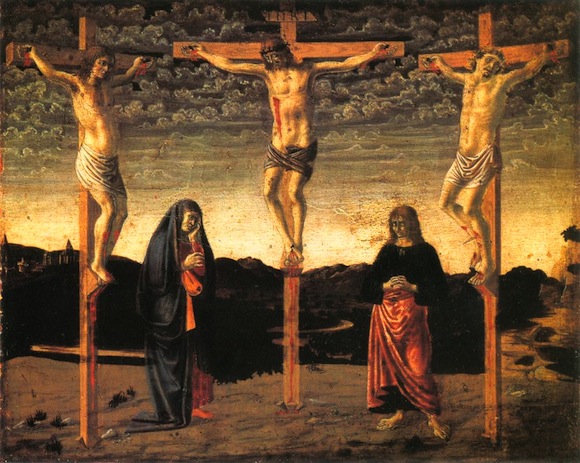
Vision Today’s Gospel presents a vision or image of the Church.We like to think of more pleasant images: the Church is the Bride of Christ or the Body of Christ. Today’s image is more humbling to be sure: the Church is Christ, crucified between two thieves.

Yes, this is the Church too. In a way, we are all thieves.We are all sinners and have used the gifts and things that belong to God in a way contrary to His will. To misuse things that belong to others is a form of theft.

Consider some of the things we claim as our own and how easily we misuse them:our bodies, our time, our talents, our money, the gift of our speech, and the gift of our freedom. We call them ours but they really belong to God, and if we use them in ways contrary to His intention we are guilty of a form of theft.

Variance Consider, also, that the two thieves were very different. In the Church we have saints and sinners, and in the world there are those who will turn to Christ and be saved and others who will turn away and be lost.

One thief (the “bad thief”) derides Jesus and makes demands of Him.Are you not the Christ? Save yourself and us!The text says that this thief “reviles” Jesus, treating him with contempt.

The other thief (the “good thief”) reverences Christ and rebukes the other, saying,Have you no fear of God?The good thief recognizes his guilt: We have been condemned justly. He asks, Jesus remember me when you come into your kingdom, but he leaves the terms of it up to Christ. He acknowledges that he is a thief and now places his life under the authority of Christ the King.

Christ came to call sinners—thieves, if you will.Yes, we are all thieves, but pray God that we are the good thief, the repentant thief, the thief who is now ready to submit himself to the authority of Christ, who is King of all creation.

Heaven is a real steal, something we don’t deserve; it is only accessed through repentance and faith. The bad thief wants relief but will not open the door of his heart so that Jesus can save him. Mercy is offered and available to him, but it is accessed only through repentance and faith. The good thief does open the door of his heart and thereby is saved.

III. Veracity Is Christ really your king?A King has authority, so another way of posing this question is, “Does Christ have authority in your life?” Consider whether you acknowledge that everything you call your own really belongs to God and think about how well you use those gifts.

      1. How do you use our time?
      2. Are you committed to pray and to attend Mass every Sunday without fail?
      3. Do you use enough of your time to serve God and others, or merely for selfish pursuits?
      4. Do you use the gift of your speech to witness and evangelize, or merely for small talk and gossip?
      5. Do you exhibit proper care for your body?
      6. Are you chaste?
      7. Do you observe proper safety or are you sometimes reckless?
      8. Do you reverence life?
      9. Are you faithful to the Lord’s command to tithe?
      10. Do you spend wisely?
      11. Do you pay your debts in a timely way?
      12. Are you generous enough to the poor and needy?
      13. Do you love the poor and help them to sustain their lives?

It is one thing to call Christ our King, but it is another to be truly under His authority. The Lord is clear enough in telling us that he expects our obedience: Why do you call me, “Lord, Lord,” but do not do what I tell you? (Luke 6:46)

Is Christ your King? Which thief are you, really?

Victory The thief who asked Jesus to remember him manifested repentance, faith, and a kind of baptism of desire. In so doing, he moved into the victor’s column. Jesus’s words, Today you shall be with me in paradise,indicate a dramatic shift in the thief’s fortunes.

To be with Jesus—wherever He is—is paradise and victory. Soon enough, the heavens will be opened, but the victory is now and paradise begins now.

Thus the good thief claims the victory through his choice for Jesus Christ. Will you have the victory? That depends on whether you choose the prince of this world or the King of the Universe, Jesus. Some think that they can tread some middle path, choosing neither Jesus nor Satan. But if you do that, you’ve actually chosen the prince of this world, who loves compromise. Jesus says, Whoever is not with me is against me, and whoever does not gather with me scatters(Matt 12:30).

As for me, I’ve decided to make Jesus my choice. I pray that he will truly be my King in all things and that my choice will be more than mere lip service. Come, Jesus, reign in my heart. Let me begin to experience victory and paradise, even now!

The Not-so-Nice Origins and Meanings of the Word “Nice”

Blog11-24Words can change meaning over time—sometimes dramatically. For example, “manufactured” originally meant “handmade” (manu (hand) + facere (make)). The word “decimate” used to mean “to reduce by a tenth” (decem = ten); now people usually use it mean “to wipe out completely.” The list of examples could go on and on. Yes, words do change meaning over time.

One word that has changed meaning dramatically over time is “nice.” Today it is an overused word that usually means pleasant, kind, or easygoing. In our culture there is often a standing admonition that we should be nice, as in “Stop fighting and be nice now!”

But the adjective “nice” once meant anything but nice in the modern sense. Rather, it was a derogatory word used to describe a person as something of a fool.

The word “nice” comes from the Latin nescius, meaning “ignorant, unaware” (ne (not) + scire (know)). The Old French word “nice” (12th century) also came from this Latin root and meant “careless, clumsy, weak, simple, foolish, or stupid.”

In the 13th century, “nice” meant “foolish, stupid, or senseless.” In the 14th century, the word started to morph into meaning “fussy, fastidious.” In the 15th century it meant “dainty, delicate.” In the 1500s it was used to mean “precise, careful.” By the 18th century it shifted to meaning “agreeable, delightful.” And by the 19th century it had acquired its current connotation of “kind and thoughtful.”

The word “nice” has certainly had a tortured history!

Given its older meaning of “ignorant, stupid, or foolish,” it is not surprising that the word “nice” is used only twice in the Douay-Rheims Bible, and in both cases pejoratively.

Today the word can have a meaning that is properly praiseworthy and is basically a synonym for “good.” For example, one might comment, “That was a nice distinction you made.” Or, observing a sporting event, one might say, “That was a nice move!”

However, I am also convinced that the word “nice” is beginning to return to its less noble meanings. This takes place when it is used in a reductionist manner that seeks to simplify the entire moral life to being “nice.” Here, nice is used in the sense of being pleasant and agreeable. To the modern world, in which “pseudo-tolerance” is one of the only “virtues” left, being nice is about the only commandment left. It seems that much will be forgiven a person just so long as he is “nice.” And little will be accepted from a person who is not thought of as “nice.”

I suppose niceness has its place, but being nice is too akin to being harmless, to being someone who introduces no tension and is most often agreeable. As such, a nice person is not so far away from being a pushover, one who is easily manipulated, silenced, and pressured into tacit approval. And thus “nice” begins to move backward into its older meanings: dainty, agreeable, weak, simple, and even further back into weak, simple, unaware, and ignorant.

The pressure to “be nice” easily translates into pressure to put a dumb grin on your face and pretend that things are great even when they’re not. And to the degree that we succumb to this pressure, we allow those who seek to shame us if we aren’t nice get to watch with glee as we walk around with s dumb grin. And they get to think of us, “What an ignorant fool. What a useful idiot.” And thus “nice” takes up its original meaning.

We follow a Lord who was anything but a harmless hippie, or a kind pushover. He introduced tension, was a sign of contradiction, and was opposed by many because he didn’t always say and do pleasant things. Not everything he said was “nice.” He often used strong words: hypocrites, brood of vipers, whitewashed tombs, murderers of the prophets, and evildoers. He warned of judgment and Hell. He spoke in parables about burning cities, doom, destruction, wailing and grinding of teeth, and of seeing enemies slain. These are not kind words, but they are loving words, because they seek to shock us unto conversion. They speak to us of our true state if we remain rebels. Jesus certainly didn’t end up nailed to cross by being nice in any sense of the word.

In the end, “nice” is a weird word. Its meaning has shifted so many times as to be practically without a stable meaning. Today it has further degraded and increasingly returned to its original meaning. Those who insist on the importance of being “nice” usually mean it for you, but not for themselves. They want to have you walk around with a silly grin on your face, being foolishly pleasant, while they laugh behind your back.

To be sure, being “nice” in its best modern sense has its place. We surely should not go around acting like a grouch all day. But just as being nice has its place, so does being insistent, bold, and uncompromising.