Sober but Serene Themes of Judgment in the Spirituals

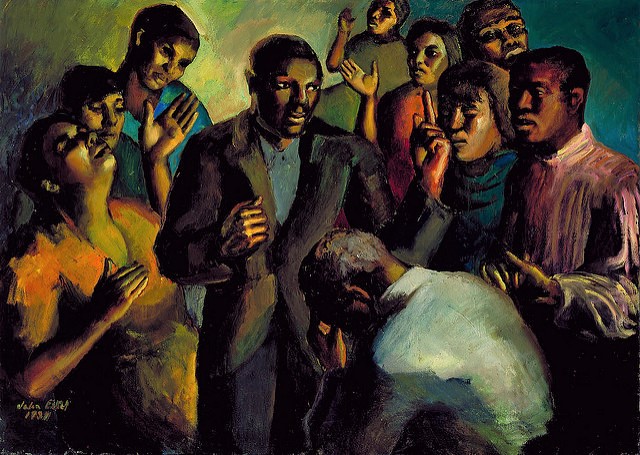
Julia Eckel, Smithsonian American Art Museum

I’ve often been impressed by the ability of old African-American spirituals to treat serious subjects in a clear, memorable, and almost joyful way. This is true even of weighty matters like sin and judgment. During early November we are focused on the four last things (death, judgment, Heaven, and hell) and November is also Black Catholic History Month. So, this seems like a good time to look at some of the creative lines from different spirituals that articulate these topics.

It can be very helpful to the preacher, teacher, and parent in recovering an ethos of coming judgment, but in a way that is almost playfully bright while at the same time deeply soulful.

In a certain sense, the spirituals are unimpeachable, even by hypersensitive post-moderns who seek to shame preachers for announcing sterner biblical themes. Most of the spirituals were written by slaves, who creatively worked biblical themes into these songs that helped accompany both their work and their worship.

The spirituals were written in the cauldron of great suffering. If any people might be excused from thinking that the Lord would exempt them from judgment day, it was surely the enslaved in the deep South. If any people might be excused from crying out for vengeance, it was they. Yet the spirituals are almost entirely devoid of condemning language; enslaved blacks sang in ways that looked also to their own sins and the need to be prepared. If they were prepared, God, who knew their trouble, would help them steal away to Jesus. They did not see themselves as exempt from the need to be ready.

If they, who worked hard in the cotton fields and endured the horrors of slavery, thought these texts applied to them, how much more do they apply to us, who recline on our couches and speak of our freedom to do as we please?

Here are some lines from a few of the many spirituals that speak to judgment and the last things:

  • I would not be a sinner, I’ll tell you the reason why. I’m afraid my Lord might call my name and I wouldn’t be ready to die.
  • Some go to Church for to sing and shout, before six months they’s all turned out!
  • Everybody talkin’ ’bout heaven ain’t a goin’ there, Oh my Lord!
  • Where shall I be when the first trumpet sounds? Oh where shall I be when it sounds so loud, when it sounds so loud as to wake up the dead? Oh where shall I be when it sounds? How will it be with my poor soul, Oh where shall I be?
  • Better watch my brother how you walk on the cross! Your foot might slip and your soul get lost!
  • God gave Noah the rainbow sign, no more water but the fire next time!
  • Old Satan wears a hypocrite’s shoe, If you don’t watch he’ll slip it on you!
  • Noah, Noah let me come in!
    The doors are fastened and the windows pinned! fastened an’ de winders pinned
    Noah said, “Ya lost your track
    Can’t plow straight! you keep a-lookin’ back!
  • Knock at the window knock at the door
    Callin’ brother Noah
    Can’t you take more?
    No said Noah cause you’re full of sin!
    God has the key you can’t get in!
  • Well I went to the rock to hide my face
    The rock cried out, no hiding place
    There’s no hiding place down here
    Oh the rock cried I’m burnin’ too!
    I wanna go to heaven just as much as you!
  • Oh sinner man better repent!
    Oh you’d better repent
    for God’s gonna call you to judgment
    There’s no hiding place down there!
  • No signal for another train
    To follow in this line
    Oh sinner you’re forever lost
    When once you’re left behind.
    She’s nearing now the station
    Oh, sinner don’t be vain
    But come and get your ticket
    Be ready for that train!
  • Sinner please don’t let this harvest pass
    And die and lose your soul at last.
  • My Lord, what a morning
    When the stars begin to fall

    You’ll hear the trumpet sound, to wake the nations underground
    Looking to my God’s right hand,
    When the stars begin to fall
    You’ll hear the sinner moan,
    When the stars begin to fall

    You’ll hear the Christian shout,
    Oh, when the stars begin to fall!

Most of these songs are deeply scriptural and make serious appeals to the human soul, but they do so in a way that is creative. They get you tapping your foot and invite you to a joyful consideration of the need to repent before it’s too late. Others are more soulful, even mournful, in their pentatonic scale.

Given all the reluctance to discuss the four last things (death, judgment, Heaven, and Hell), songs like these may help to reopen the door to necessary conversations between preacher and congregation, parents and children. They are a valuable resource.

I’d like to conclude with a creative spiritual about the last judgment. Note that it is rich in biblical references. It is joyful—a real toe-tapper—and makes a serious point along with a wish.

In That Great Getting’ Up Mornin’ Fare You Well

I’m gonna tell ya ’bout da comin’ of da judgment
Dere’s a better day a comin’,
Fare thee well, fare thee well!

Chorus:
In dat great gettin’ up mornin’,
Fare thee well, fare thee well
In dat great gettin’ up mornin’,
Fare thee well, fare thee well

Oh preacher fold yo’ bible,
For dat last souls converted,
Fare thee well, fare thee well

Blow yo’ trumpet Gabriel,
Lord, how loud shall I blow it?
Blow it right and calm and easy,

Do not alarm all my people,
Tell dem all come to da judgment,
Fare thee well, fare thee well!

Do you see dem coffins burstin’,
do you see dem folks is risin’
Do you see dat fork of lightnin’,
Do you hear dat rumblin’ thunder?
Fare thee well, fare thee well!

Do you see dem stars a fallin’,
Do you see da world on fire?
Fare thee well, fare thee well

Do you see dem Saints is risin’,
Fare thee well, fare thee well
See ’em marchin’ home for heaven,
Fare thee well, fare thee well

Oh! Fare thee well poor sinners, fare thee well, fare thee well
Fare thee well poor sinners, fare thee well, fare thee well!

Here are renditions of a few other spirituals:
An Unequivocal Affirmation by Jesus that the Dead Will Rise

In the Gospel for Wednesday of the 9th week, the Church presents us with a strong reminder and teaching on the resurrection. Let’s look at what we are taught:

The Ridicule of the Resurrection – The Gospel opens as follows: Some Sadducees, who deny there is a resurrection, came forward and put [a] question to Jesus. They proposed a hypothetical situation in which a woman is married seven times, to brothers who successively die without siring any children by her. The Sadducees suggested that at the resurrection there would be confusion as to whose wife she really is; we’re supposed to laugh and conclude that the idea of resurrection is absurd.

Jesus will dismiss their absurd question handily, as we shall see in a moment, but let’s consider why the Sadducees disbelieved the resurrection.

Fundamentally, the Sadducees rejected the resurrection because they only accepted the first five books of the Bible (Genesis, Exodus, Leviticus, Numbers, and Deuteronomy). This point is debated among scholars, but we can surely say that if something was not explicitly in the Law of Moses (which the resurrection was not), the Sadducees were unlikely to accept it. All the other Old Testament books such as the prophets, the historical books, the psalms, and the wisdom tradition, were not considered authoritative sources.

While most other Jews of Jesus’ time did accept the complete Old Testament (and teachings within it such as the resurrection of the dead), the Sadducees simply did not. They were a small party within Judaism (Josephus said that they were able to persuade none but the rich). Nevertheless, they were influential due to their wealth and to the fact that they predominated among the Temple leadership. You can read more about them here: Sadducees.

The Sadducees approached Jesus to poke fun at Him and all others who believed that the dead would rise.

They are no match for Jesus, who easily dispatches their arguments using the Book of Exodus (a book they accept) to do it. In effect, Jesus’ argument proceeds as follows:

  • You accept Moses, do you not? (They would surely reply yes.)
  • But Moses teaches that the dead will rise. (They must look puzzled now, but He presses on.)
  • Do you accept that God is a God of the living, not the dead? (They would surely reply yes.)
  • Then why does God (in Exodus) identify Himself as the God of Abraham, Isaac, and Jacob, all of whom have been dead some 400 years?
  • How can He call Himself their God if they are dead?
  • They must be alive, or He could not call Himself their God, for He is not a God of the dead but of the living.
  • Therefore, they are alive to God; they are not dead.

In this way, Jesus dispatches their argument. For us, the point is to see how forcefully and clearly Jesus upholds the fact that the dead are alive in the Lord. He powerfully asserts an essential doctrine of the Church. We should rejoice at how firmly Jesus rebukes their disbelief in the resurrection of the dead.

Rejoice, for your loved ones are alive before God! To this world they may seem dead, but Jesus tells us clearly and firmly that they live. And we, who will also face physical death, will live on. Let the world ridicule this, but hear what Jesus says and how He easily dispatches them. Though the idea is ridiculed, the resurrection is real.

The Resplendence of the Resurrection – Jesus also sets aside the absurd hypothetical scenario that the Sadducees pose by teaching that earthly realities cannot simply be projected into Heaven. Scenarios perceived in earthly ways cannot be used to understand heavenly realities. The saints in Heaven live beyond earthly categories.

Heaven is more than the absence of bad things and the accumulation of good things. It is far beyond anything this world can offer. Scripture says,

No eye has seen, no ear has heard, and no human mind has conceived—the things God has prepared for those who love him (1 Cor 2:9).

The sufferings of this world cannot compare to the glory that will be revealed in us (Rom 8:18).

Do you see the majesty of this teaching? We have a glory waiting for us beyond imagining. Consider your greatest pleasure, your happiest experience, your most fulfilled moment. Then multiply it by a thousand, or a million, or a trillion; you are still not even close understanding the glory that awaits.

And this glory will transform us. The Lord once told Catherine of Siena that if she ever saw the glory of a saint in Heaven she would fall down and worship because she would think she was looking at God. This is our dignity: to be transformed into the very likeness of God and reflect His glory. The following is a summary of St. Catherine’s vision of the soul of a saint in Heaven:

It was so beautiful that she could not look on it; the brightness of that soul dazzled her. Blessed Raymond, her confessor, asked her to describe to him, as far as she was able, the beauty of the soul she had seen. St. Catherine thought of the sweet light of that morning, and of the beautiful colors of the rainbow, but that soul was far more beautiful. She remembered the dazzling beams of the noonday sun, but the light which beamed from that soul was far brighter. She thought of the pure whiteness of the lily and of the fresh snow, but that is only an earthly whiteness. The soul she had seen was bright with the whiteness of Heaven, such as there is not to be found on earth. “My father,” she answered. “I cannot find anything in this world that can give you the smallest idea of what I have seen. Oh, if you could but see the beauty of a soul in the state of grace, you would sacrifice your life a thousand times for its salvation. I asked the angel who was with me what had made that soul so beautiful, and he answered me, “It is the image and likeness of God in that soul, and the Divine Grace which made it so beautiful” [1].

Yes, Heaven is glorious, and we shall be changed. Scripture says, we shall be like the Lord for we shall see him as he is (1 John 3:2). He will change our lowly body to conform with his glorified Body by the power that enables him also to bring all things into subjection to himself (Phil 3:19). I have written more on our resurrected bodies here: What will our resurrected bodies be like?

Too many people have egocentric notions of Heaven. It’s a place where I will have a mansion, I will see my relatives, and I will be able to play all the golf I want. But the heart of Heaven is to be with God, for whom our heart longs. In God we will experience fulfillment and a peace that is beyond earthly imagination. Heaven is far greater than golf, mansions, and family reunions. There is certainly more to it than clouds and harps. Heaven can never be described because it is beyond words. St. Paul speaks of a man (himself) who was caught up into Heaven; he affirms that it cannot be described; it is ineffable; it is unspeakable.

I know a man in Christ who fourteen years ago was caught up to the third heaven …. And I know that this man—whether in the body or apart from the body I do not know, but God knows—was caught up to paradise and heard inexpressible things, things that no one is permitted to tell (2 Cor 12:2-3).

Do you long for heaven? Do you meditate on it? Is there a part of you that can’t wait to get there? There’s an old spiritual that says,

I’m gonna ride the chariot in the morning, Lord.
I’m getting’ ready for the judgment day, my Lord, my Lord!
Are you ready my brother? (Oh yes!)
Are you ready for the journey? (Oh Yes!)
Do you want to see Jesus (Yes, Yes!)
I’m waiting for the chariot ’cause I ready to go.
I never can forget that day,
(Ride in the chariot to see my Lord!).
My feet were snatched from the miry clay!
(Ride in the chariot to see my Lord!)

The Fire Next Time: A Meditation on the Second Letter of Peter

The first reading for Mass this Tuesday, taken from the Second Letter of Peter, is a warning to us. There’s an old spiritual that says, “God gave Noah the rainbow sign, no more water but the fire next time.” This reading today speaks to us of the “fire next time” and reminds of the need to be ready for the coming of the Lord. There are four aspects of teaching contained in the Second Letter of Peter:

1. The PATIENCE that is PURPOSEFUL – The text says, Do not ignore this one fact, beloved, that with the Lord one day is like a thousand years and a thousand years like one day. The Lord does not delay his promise, as some regard “delay,” but he is patient with you, not wishing that any should perish but that all should come to repentance.

Though the Lord seems long delayed in coming (about 2000 years!), the text tells us that this is so that as many of us can be saved as possible.

Notice that the text says that God wants us to come to repentance. His patience should not be viewed as an excuse for presumption but rather as an opportunity for repentance. This is no time to be saying, “I’ll do it later.” This is a time to be serious about repentance and to prepare to meet the Lord.

Note, too, that the Greek word here translated as repentance is μετάνοιαν (metanoian), referring not just to better behavior but also to new mind. Our transformation is not merely external but internal as well. When what we think changes so does our behavior. When our thinking is conformed to God’s revealed truth, our priorities, feelings, desires, and decisions all begin to change. Conversion and repentance are the results of being a transformed human being with a new mind.

2. The PASSING that is PERILOUS – The text says, But the day of the Lord will come like a thief, and then the heavens will pass away with a mighty roar and the elements will be dissolved by fire, and the earth and everything done on it will be found out.

In effect, this says that God’s gonna to set this world on fire one of these days, and when He comes it’ll be

Sudden, for the text says that the Day of the Lord will come like a thief. This is a consistent image that Jesus used for the Day of Judgment as well, but it should not be true for us who wait and watch. St. Paul says, But you, brothers, are not in darkness so that this day should surprise you like a thief …. So then, let us not be like others, who are asleep, but let us be alert and self-controlled (1 Thess 5:4,6).

Further, the image of the thief is also not appropriate for us if we realize that all we have and all we are belongs to God. For those who are worldly and claim authority over themselves and ownership over their possessions, God is a thief who comes suddenly and in a hidden way. He overtakes their apparent ownership and puts an end to it. To them He seems like a thief because He “steals” what they consider to be theirs. They are badly misled.

For us who watch and are prepared (pray God), the Lord comes not to take but to give, to bestow upon us and reward us as we inherit His Kingdom.

Shocking, for the text speaks of roaring heavens and fire that overwhelms, dissolving everything.

Here, too, although the image is shocking it should not alarm us if we are already on fire. At Pentecost (and personally at our baptism and confirmation), the Lord lit a fire within us to set us on fire spiritually, to bring us up to the temperature of glory. Thus, for those in the Lord, the “weather” on that day will seem just fine.

The prophet Malachi speaks of the twofold experience of the Day of the Lord in this way: “Surely the day is coming; it will burn like a furnace. All the arrogant and every evildoer will be stubble, and that day that is coming will set them on fire,” says the Lord Almighty. “Not a root or a branch will be left to them. But for you who revere my name, the sun of righteousness will rise with healing in its wings. Notice therefore, that for some the Day is burning with wrathful heat, but for the Just, it is a sunny day wherein the Sun (Son) of righteousness will bring warmth and healing (Mal 4:1-3).

An old spiritual gloss on this verse says, “God gave Noah the rainbow sign, no water but the fire next time.” Thus, God wants to get us ready by setting us on fire with His love and grace. If God is a holy fire, then we must become fire ourselves to be able to endure the day of His coming.

Showing, for the text says that all things will be revealed.

This fire burns away the masks that many people wear, exposing them for what they are. The Lord says,

But I tell you that men will have to give account on the day of judgment for every careless word they have spoken (Matt 12:36).

There is nothing concealed that will not be disclosed or hidden that will not be made known. What you have said in the dark will be heard in the daylight, and what you have whispered in the ear in the inner rooms will be proclaimed from the roofs (Lk 12:2-3).

Now even the just may wince at this, for all have a past and would prefer that the past stay in the past. However, when I’ve visited 12-Step meetings I’ve noticed that many of the recovered attendees will recount vividly what they did when they were drinking. They seem to do so with little shame and much laughter, for they share it with those who understand, and as ones who have been set free from the source of the problem. Perhaps the disclosing day will be like that for the just. For the unrepentant, however, imagine the fear and embarrassment as their secrets, sins, and injustices are disclosed to those who are also unforgiving and unmerciful. It’ll be a bad scene, really.

3. The PRESCRIPTION that is PROCLAIMED – The text says, Since everything is to be dissolved in this way, what sort of persons ought you to be? You ought to conduct yourselves in holiness and devotion, waiting for and hastening the coming of the day of God, because of which the heavens will be dissolved in flames and the elements melted by fire …. Therefore, beloved, since you await these things, be eager to be found without spot or blemish before him, at peace.

The text asks, rhetorically, “What sort of persons ought you to be?” The answer, in a word, is “fiery.” God has lit a fire in us to purify and refine us. Hence on that day, when the Lord will judge by fire, we will pass through. Though some final purification (purgation) may take place, the fact that the fire has been kindled in us and fanned into flame, will mean just that: purification, not destruction. St. Paul describes the just as going through the purgatorial fire that leads to purification rather than to destruction in Hell: If any man builds on this foundation using gold, silver, costly stones, wood, hay or straw, his work will be shown for what it is, because the Day will bring it to light. It will be revealed with fire, and the fire will test the quality of each man’s work. If what he has built survives, he will receive his reward. If it is burned up, he will suffer loss; he himself will be saved, but only as one escaping through the flames (1 Cor 3:12-15).

So, the prescription for us is to let God set us afire now to purify us, making us more holy and devout. The fire of His Holy Spirit is the only thing that can truly prepare us and permit us to endure the day of His coming and to be spared the “wrath to come” (cf 1 Thess 1:10, Matt 3:7, Romans 5:9; 1 Thess 5:9), when God will judge the world and everything in it by fire.

4. The PERFECTION that is PROMISED The text says, But according to his promise we await new heavens and a new earth in which righteousness dwells.

This text presents the possibility that the created world will not so much be destroyed as purified by God’s fiery judgment. While it may also signify the total destruction of all that now is and a replacement of it with new heavens and a new earth, some posit that it means that the created world will instead be renewed. This view would correspond with other texts such as Romans 8 (For the creation was subjected to frustration, not by its own choice, but by the will of the one who subjected it, in hope that the creation itself will be liberated from its bondage to decay and brought into the glorious freedom of the children of God (Rom 8:20-21)) and Isaiah 1.

Whatever the answer to the debate, the bottom line is that the new (or renewed) world will be a heaven wedded to earth in which the full righteousness of God will be manifest. Further, we will be without blemish and at peace.

Yes, God’s gonna set this world on fire one of these days, Hallelujah! God’s fire purifies that which is holy and burns away all that is lacking or unholy. God will restore all things in Christ!

Who or What Is the Antichrist? A Reflection on the Biblical Teaching

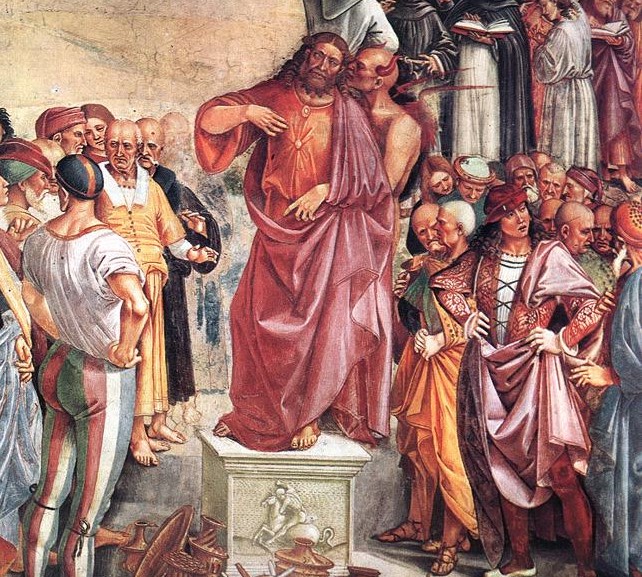
Sermon and Deeds of the Antichrist, Luca Signorelli (1499)

There is much lore about the antichrist (especially among certain Evangelicals) that is out of proportion to the attention Scripture pays to the concept, and more importantly is at possible variance from what is certainly taught. It easily becomes fodder for movies and novels: the antichrist figure steps on the scene, deceiving many, and mesmerizing the whole world with apparent miracles and a message of false peace.

But is this really what or whom the Scriptures call the antichrist?  I would argue not, for in order to create such a picture one would have to splice in images from the Book of Revelation and the Letter to the Thessalonians that do not likely apply to antichrists.

In fact, the use of the term antichrist occurs only in the Johannine epistles. It does not occur in the Book of Revelation at all, though many have the mistaken idea that it does. There are plenty of beasts, dragons, harlots, demons, and satanic legions in Revelation, but no mention of antichrists.

Many also stitch the teaching about antichrists together with St. Paul’s teaching on the “man of lawlessness” (also called “the lawless one”) who is to appear just before the end. The lawless one may well be the stuff of movies, but calling him the antichrist may be to borrow too much from a concept that is more specific. While it is not inauthentic to make a connection between them (some of the Church Fathers seem to), it is not necessarily correct to do so.

In this reflection I take the position that it is improbable that the antichrist and the man of lawlessness are one and the same. In order to explain why, let’s first look at the occurrences of the term antichrist in St. John’s Epistles.

  • Little children, it is the last hour: and as you have heard that antichrist shall come, even now are there many antichrists; whereby we know that it is the last time (1 John 2:18).
  • Who is the liar but the one who denies that Jesus is the Christ? This is the antichrist, the one who denies the Father and the Son (1 John 2:22).
  • By this you know the Spirit of God: every spirit that confesses that Jesus Christ has come in the flesh is from God, and every spirit that does not confess Jesus is not from God. And this is the spirit of the antichrist, of which you have heard that it is coming; and now it is already in the world (1 John 4:2–3).
  • Many deceivers have gone out into the world, those who do not confess that Jesus Christ has come in the flesh; any such person is the deceiver and the antichrist! (2 John 1:7)

Note two things about antichrists. First, St. John (writing in the first century) teaches that he has already appeared. In calling this the “last hour,” St. John and the Holy Spirit do not mean that the Second Coming will take place in the next sixty minutes or even in the next few years. Rather, the teaching is that we are in the Last Age, the Age of the Messiah (also called the Age of the Church), when God is sending out His angels to the four winds to gather all the elect from the ends of the earth (cf Mark 4:21). Sadly, St. John also teaches that the antichrist has already come as well.

Second, after saying that the antichrist has come, St. John immediately clarifies by saying that actually many antichrists have appeared.

Thus St. John does not seem to present the antichrist as a single figure who has come. Rather, he says that there are many antichrists.

And what do these antichrists do? They perpetrate heresy, error, and false teaching. St. John notes in particular that heretics who deny that Jesus is the Christ (the Messiah) are antichrists. He also calls antichrists those who deny Christ having come in the flesh.

What does it mean to deny Christ having come in the flesh? It means reducing the saving work of God to mere appearances by claiming that Jesus did not actually take up a human nature but only appeared to do so. By extension, these same antichrists reduce the Christian moral and spiritual life to mere gnostic ideas rather than a true flesh-and-blood, body-and-soul change in our lives.

Many today extend these denials of the incarnation by undermining the historic authenticity of the Gospels, doubting or outright denying what Jesus actually said and did. Some of them say that Jesus’ resurrection was not a bodily one, but rather that His “ideas live on.” There can be no more fundamental heresy that to deny the bodily resurrection of Christ. As St. Paul says, And if Christ has not been raised, then our preaching is in vain and your faith is in vain … if Christ has not been raised, your faith is futile and you are still in your sins … [and] we are of all people most to be pitied (1 Cor 15:14-17).

Thus St. John, along with all the early Church, emphatically upholds an incarnational faith. We could actually touch our God and He touched us by taking up our human nature. He suffered on the cross and died. And though His suffering was tied to His human nature (for His divine nature is impassible), Jesus, the Second Person of the Blessed Trinity, hypostatically united to His human nature, suffered and died for us. It was this same human nature that God raised from the dead, gloriously transformed.

John takes up this theme elsewhere when he says that Christ came in water and in blood, not in water alone (cf 1 John 5:6). A certain heretic of that time, Cerinthus, held that the Second Person of the Blessed Trinity departed just before Jesus’ passion. John refutes this, insisting that just as at His baptism Jesus’ divine nature was affirmed (This is my beloved Son in whom I am well pleased), so also was it affirmed during the shedding of His blood on Calvary (the inspired word of God records the centurion, on seeing the manner of Jesus’ death, saying, Surely this was the Son of God (Mat 27:54)). Jesus Christ, the Son of God, though of two natures, is one person, and He did in fact die suffer and die for us.

Thus to St. John, the essence of the antichrist is denial that Jesus came in the flesh. An antichrist is one who would relegate Jesus’ presence among us to mere appearances or His teachings to mere abstractions or ideals rather than transformative realities.

By extension, it can be argued that the term antichrist refers to all deceivers, though only logically, not specifically in the text. St. John does not indicate that he means the term antichrist this broadly, but in a wider sense all heresy pertains to the antichrist because Jesus Christ is the truth. Jesus teaches through His apostles that to deny the truth is to deny Christ Himself; it is to deny truth itself and thus to be an antichrist.

So perhaps this is not fodder for movies and novels after all; sorry! And that’s a shame because the term antichrist is so catchy! This brings us to a discussion of the man of lawlessness (or the lawless one).

What or who is the man of lawlessness whom St. Paul mentions and how is he related to the antichrist? As I stated above, I do not think there is a connection. To see why, let’s consider what St. Paul teaches:

  • As to the coming of our Lord Jesus Christ and our being gathered together to him, we beg you, brothers and sisters, not to be quickly shaken in mind or alarmed, either by spirit or by word or by letter, as though from us, to the effect that the day of the Lord is already here. Let no one deceive you in any way; for that day will not come unless the rebellion comes first and the Man of lawlessness is revealed, the one destined for destruction. He opposes and exalts himself above every so-called god or object of worship, so that he takes his seat in the temple of God, declaring himself to be God (2 Thessalonians 2:1–4).
  • For the mystery of lawlessness is already at work, but only until the one who now restrains it is removed. And then the lawless one will be revealed, whom the Lord Jesus will destroy with the breath of his mouth, annihilating him by the manifestation of his coming. The coming of the lawless one is apparent in the working of Satan, who uses all power, signs, lying wonders, and every kind of wicked deception for those who are perishing, because they refused to love the truth and so be saved (2 Thessalonians 2:7–10).

Note the following crucial differences between antichrists and the lawless one:

  1. John speaks of antichrists in the plural whereas St. Paul speaks in the singular: the man of lawlessness or the lawless one.
  2. The lawless one’s deceptions are rather general (every kind of wicked deception), whereas deceptions of antichrists are more specifically related to denying the incarnation of the Son of God.

Jesus also speaks of those who will lead many astray, though He speaks of them in the plural and is likely referring to occurrences in the first century during the time leading up to the war with the Romans in 70 A.D: For false messiahs and false prophets will appear and produce great signs and wonders, to lead astray, if possible, even the elect (Matthew 24:24).

As you can see, there are a lot of moving parts here as well as a lot of singulars and plurals to sort out and time frames to consider. Permit me the following conclusions:

  1. Antichrist is a more restrictive term than most people today think. While the antichrist is not a single person but rather any number of persons, the concept of antichrists seems limited to those who deny that Jesus is the Christ, come in the flesh. However, the term can possibly be applied to heretics in general.
  2. Jesus warns of false prophets and messiahs, but the context of His warning seems to be the first century and the looming destruction of Jerusalem not the end times per se. Further, He speak of many false prophets, not a single one.
  3. It is the man of lawlessness spoken of by St. Paul that most fits the charismatic figure of our “movie script,” a person able to unite the world in a false peace by mesmerizing and deceiving the nations. This lawless one will signal the end times. While I am not saying that these are the end times, I will note that the advent of instant, worldwide communication has made things easier than ever before for the lawless one. One individual actually could mesmerize and deceive all the nations—right on the worldwide web!

All that said, I believe that equating this lawless one with one of the beasts of Revelation or with the antichrist may be too speculative, and possibly inaccurate.

I hope I haven’t toyed with your “movie script” too much, but Scripture is nuanced in these matters and we do well to avoid reducing its teachings to popular concepts and catchy notions.

Scripture does speak to us of the end times and of difficult times preceding them, but the information is often given in general, even cryptic, terms. It is as if Scripture wants to tell us to be ready and to let us know that we don’t need to (and shouldn’t want to) know all the details. Just be ready, and when those times set in remember that Christ has already won the battle. Viva Christo Rey!

The Bridegroom is Near

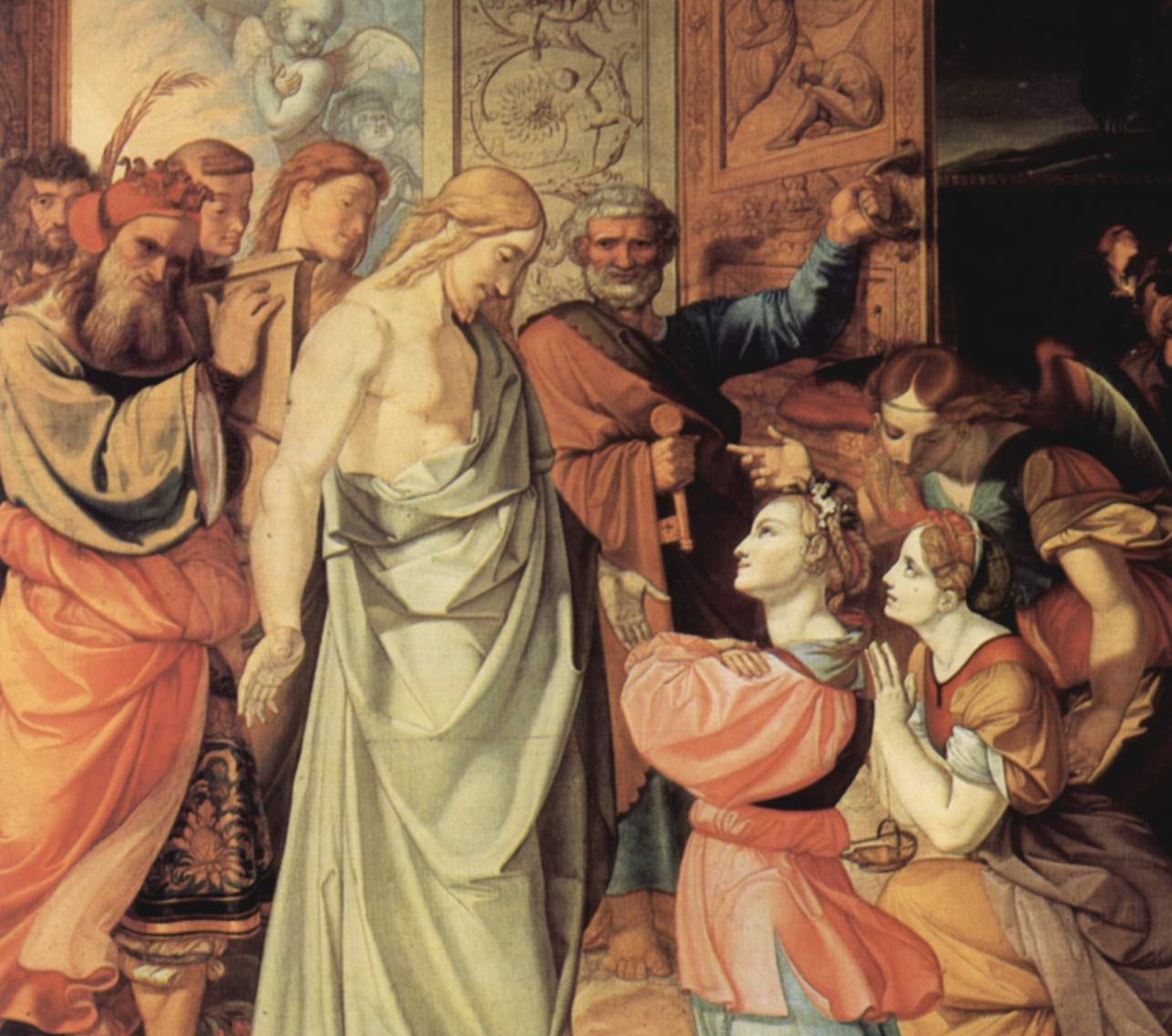
Christ and the Ten Virgins, Peter von Cornelius

Christ came at Christmas as an infant and thus we don’t usually think of wedding imagery. Because the first coming has already been fulfilled, however, we can focus more on His second coming, of which the first is a sacramental reminder.

Thus, during Advent, our longing and excitement are also directed to His glorious second coming. In the parable of the wise and foolish virgins, this is the excited cry:

At midnight the cry rang out: Here is the bridegroom! Come out to meet him! Then all the virgins woke up and trimmed their lamps (Matt 25:6-7).

Here is a picture of Mother Church, the New Jerusalem, our Mother, looking eagerly for her groom Jesus to come again all His glory:

I saw the Holy City, the new Jerusalem, coming down out of heaven from God, prepared as a bride beautifully dressed for her husband. And I heard a loud voice from the throne saying, “Now the dwelling of God is with men, and he will live with them. They will be his people, and God himself will be with them and be their God. … I heard what sounded like the roar of a great multitude in heaven shouting, “Hallelujah! Salvation and glory and power belong to our God. Let us rejoice and be glad and give him glory! For the wedding of the Lamb has come, and his bride has made herself ready. Fine linen, bright and clean was given her to wear” (Rev 21:2-3; 19:7-8).

This longing remains until Mother Church, Christ’s beautiful bride, hears these words from Him: Surge amica mea, speciosa mea et veni! (Arise my beloved, my beautiful one and come!) (Songs 2:10). Her longing cannot be quenched until He comes again in all His radiant beauty and majesty. Until then she longs, looks, and waits.

Although some of her children have attained to this glory, she waits and longs until the number of her elect children are complete and she, in her fullness, will go to be with her spouse forever in beatific glory.

One of the great Advent hymns of the Protestant tradition, “Wake, O Wake,” picks up this bridal theme and “weds” it with Advent longing. This particular translation (from the German) is a masterpiece; it is both biblical and artistic:

Wake, O wake with tidings thrilling;
The Watchmen all the air are filling;
Arise, Jerusalem, Arise!
Midnight strikes, no more delaying;
“The hour has come,” we hear them saying;
Where are ye all ye virgins wise?

The bridegroom comes in sight
Raise high, your torches bright!
Alleluia!
The wedding song swells loud and strong;
Go forth and join the festal throng.

Zion hears the watchman shouting;
Her heart leaps up with joy undoubting;
She stands and waits with eager eyes!
She her love from heaven descending;
Adorned with truth and grace unending;
Her light burns clear her star doth rise!

Now come our precious crown;
Lord Jesus, God’s own Son;
Hosanna!
Let us prepare to follow there
Where in thy supper we may share
.

Yes, there is a great wedding feast in every liturgy and its culmination looks to the glorious second coming of Jesus. This Christmas, look to your wedding garment, which the Lord gave you at baptism to bring unstained to the great judgment seat of Christ. The Bridegroom comes! Let us go out to meet Christ the Lord (cf Matt 25:6).

Here is a performance of “Wake, O Wake,” by the choir of Trinity College in Cambridge.

The Second Coming and Its Stages

During Advent, as we continue to meditate on the Parousia (the Second Coming), we do well to allow our imaginations to be engaged in contemplating the glory that awaits those who are faithful, to meditate on the joy and ecstasy of the culmination of all things!

We must soberly admit our need to be ready by God’s grace, but if we are, what glories await us! The “great and terrible day of the Lord” will indeed be great for those who have allowed the Lord to prepare them.

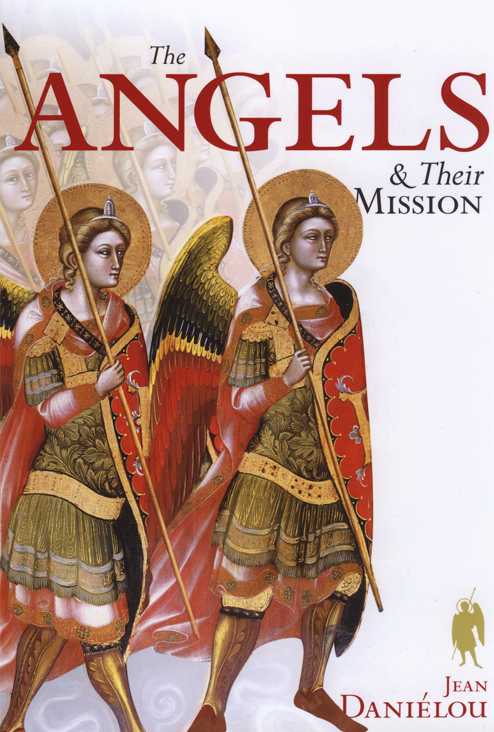
I was stirred some years ago in reading a magnificent book by Jean Cardinal Danielou on angelology (an-GELL-o-gee), which is the study of angels. The book, The Angels and Their Mission: According to the Fathers of the Church, is must reading (and a mere 114 pages long). It is packed with stirring and edifying accounts of the wonderful works of the angels, according to Scripture and the Fathers of the Church.

The final chapters, on the eschaton (the last things) and the Parousia (the Second Coming), are particularly magnificent. I would like to distill them here, adding some material and reworking it just a bit. However, the assembling of the material is fundamentally that of Cardinal Danielou. I hope you will be stirred with as much joy and zeal in reading this as I was in preparing it.

1. Sending forth the multitude of angels:

Scripture is replete with descriptions of the role of angels in the great Second Coming of the Lord. In the Gospel of Matthew there is a text that may refer to 70 A.D., but surely also describes the end of time:

Then will appear the sign of the Son of man in heaven, and then all the tribes of the earth will mourn, and they will see the Son of man coming on the clouds of heaven with power and great glory; and he will send out his angels with a loud trumpet call, and they will gather his elect from the four winds, from one end of heaven to the other (Matt 24:30-31).

The first epistle to the Thessalonians says,

For the Lord himself will descend from heaven with a cry of command, with the archangel’s call, and with the sound of the trumpet of God. And the dead in Christ will rise … (1 Thess 4:16).

St Cyril describes the extraordinary magnificence given to the final judgment by the presence of the multitude of angels. He considers how the great depth and breadth of the spiritual world has been invisible until now, except to the eyes of faith. Suddenly, it is made manifest! He asks us to imagine the multitude of angels by considering the vast numbers of human beings who have ever existed, from the time of Adam to the present day, standing before the Lord Jesus. Then he asks us to consider that the angels are vastly more numerous than that, for they are the 99 sheep whereas humanity is but the one! As Daniel poetically says,

Thrones were set up and the Ancient of Days took his throne. His clothing was white as snow, the hair on his head like pure wool; His throne was flames of fire, with wheels of burning fire. A river of fire surged forth, flowing from where he sat; Thousands upon thousands were ministering to him, and myriads upon myriads stood before him (Dan 7:9-10).

Such a vision and such multitudes can scarcely be imagined.

2. Waking the dead (the angels are surely part of this):

The Second Sibylline Book, a Christian work, describes the archangels shattering the gates of death and raising up even the bodies of those who had been drowned in the sea or whom savage beasts had devoured (Sib, 2:214–235).

St. Ephrem speaks of the angels as waking the dead, saying,

Then the Lord will appear in the heavens like lightning with an unspeakable glory. The Angels and the Archangels will go on before his glory like flames of fire, like a mighty torrent. The Cherubim will turn their faces and the Seraphim will fly ahead crying out in fear: “Arise, you who sleep. Behold the bridegroom is coming!” Then the tombs will be opened and in the flash of an eye all the people will rise and behold the beauty of the Bridegroom.

St. Paul says that our bodies will rise, our bodies, but gloriously transformed:

He will change our lowly body to conform with his glorified body by the power that enables him also to bring all things into subjection to himself (Phil 3:21).

So will it be with the resurrection of the dead. The body that is sown is perishable, it is raised imperishable; it is sown in dishonor, it is raised in glory; it is sown in weakness, it is raised in power (1 Cor 15:42).

3. The Judgment by Christ and its execution by the angels:

Matthew 13 describes the angels as separating the wicked from the just:

The Son of Man will send his angels, and they will gather out of his kingdom all causes of sin and all evildoers, and throw them into the furnace of fire; there men will weep and gnash their teeth. Then the righteous will shine like the sun in the kingdom of their Father (Mat 14:41-43).

Matthew 25 describes the angels as being with Christ when He takes His judgment seat:

When the Son of Man comes in his glory, and all the angels with him, then he will sit on his glorious throne. Before him will be gathered all the nations, and he will separate them one from another as a shepherd separates the sheep from the goats (Matt 25:31-32).

St. Cyril of Jerusalem speaks of the angels leading the sinners away, body and soul, “in the full sight of the armies of heaven and they will be unable to escape.” But the angels are also uniting the just.

Matthew 13 describes the angels leading evildoers away:

The Son of Man will send his angels, and they will collect out of his kingdom all who caused others to sin and all evildoers. They will throw them into the fiery furnace (Mat 13:41-42).

St. Ephrem describes the angels leading the elect to paradise:

Then the angels will come together from all sides and take up the holy and faithful people into the glory of the clouds above, to their meeting place with Christ.

Origen speaks of the angels escorting the blessed to paradise:

When … we have begun to enter the holy place and pass on to the promised land, those who are really holy and whose place is the Holy of Holies will make their way, supported by the angels and unto the tabernacle of God … They will be carried on [the angels’] shoulders and raised up by their hands.

St. Paul seems to speak to the same glory when he writes to the Thessalonians:

The dead in Christ will rise first. Then we who are alive, who are left, will be caught up together with them in the clouds to meet the Lord in the air. Thus we shall always be with the Lord (1 Thess 4:17).

4. The final ordering of the Kingdom:

Of this final ordering, Scripture says,

The last enemy to be destroyed is death. “For God has put all things in subjection under [Jesus’] feet.” But when it says, “All things are put in subjection under him,” it is plain that he [the Father] is excepted who put all things under him. When all things are subjected to him, then the Son himself will also be subjected to him who put all things under him, that God may be everything to every one (1 Cor 15:26-28).

5. After executing judgment, Jesus returns to His Father’s right, in the Holy of Holies:

He ascends there, now with all the members of His body (body and soul) joined to Him. He ascends to the throne as Unus Christus, amans seipsum (one Christ, loving Himself). Though co-equal to His Father in glory and majesty, He is delighted to hand over the Kingdom of His Body, the Church, to His Father, who is (as Father) the Principium Deitatis.

At this ascension, the Fathers ponder that the angels will make the same declaration, the heavens echoing with their cry:

 Lift up your heads, O gates; and be lifted up, O ancient doors, that the King of glory may come in. Who is the King of glory? The Lord, strong and mighty, the Lord, mighty in battle. Lift up your heads, O gates; and be lifted up, O ancient doors; that the King of glory may come in. Who is this King of glory? The Lord of hosts, he is the King of glory (Psalm 24: 7-10).

6. The transformation of all creation:

The longing of creation for its share in the glorious freedom of the Children of God is prophesied through St. Paul:

For the creation waits with eager longing for the revealing of the sons of God; for the creation was subjected to futility, not of its own will but by the will of him who subjected it [because of our sins]. But the creation itself will be set free from its bondage to decay and obtain the glorious freedom of the children of God. We know that the whole creation has been groaning in travail together until now; and not only the creation, but we ourselves, who have the first fruits of the Spirit, groan inwardly as we wait for adoption as sons, the redemption of our bodies (Rom 8:19-23).

And now it comes! Heaven and earth are united and creation receives its original glory and more, for the heavenly realities are now joined to the earth, beautifully restored and raised. Scripture says,

Then I saw a new heaven and a new earth; for the first heaven and the first earth had passed away, and the sea was no more. And I saw the holy city, new Jerusalem, coming down out of heaven from God, prepared as a bride adorned for her husband; and I heard a loud voice from the throne saying, “Behold, the dwelling of God is with men. He will dwell with them, and they shall be his people, and God himself will be with them; he will wipe away every tear from their eyes, and death shall be no more, neither shall there be mourning nor crying nor pain any more, for the former things have passed away.” And he who sat upon the throne said, “Behold, I make all things new” (Rev 21:1-5).

7. The Joy and rest of the angels:

Cardinal Danielou beautifully concludes,

On that day, the joy of the friends of the Bridegroom, [the angels] will be complete. They have led to paradise the souls of the just who are entrusted to them. They have kept watch over their mortal remains. But [for now] they still await the day in which the Bridegroom will come to look for his Bride, when her beauty is finally perfect, in order to lead her into the House of his Father for the eternal wedding feast (p. 114).

Of this magnificent beauty, St. Methodius says,

Oh dearly beloved, [the angels] burn to see the day of your marriage, all the angels Christ has called from heaven. They will come, O Lord, O Word, and they will carry with them mighty gifts, in their spotless robes.

Thus we shall always be with the Lord (1 Thess 4:17).

The Spirit and the Bride say, “Come.” … He who testifies to these things says, “Surely I am coming soon.” Amen! Come, Lord Jesus! The grace of the Lord Jesus be with all the saints (Rev 22:17; 20-21).

Only What You Do for Christ Will Last – A Meditation on the Rise and Fall of Civilizations

In the readings for Tuesday of the 34th Week of the Year, both Daniel and Jesus speak of the destruction that is upon nations and empires of this world. Daniel spoke to the people of his time and indicated that the Jewish people would suffer from four oppressive kingdoms, which though unnamed we now know as Babylon, Persia, Greece, and Rome. Each of these kingdoms would eventually fall. The only sure kingdom is one that Daniel describes:

the God of heaven will set up a kingdom that shall never be destroyed or delivered up to another people; rather, it shall break in pieces all these kingdoms and put an end to them, and it shall stand forever (Daniel 2:44).

Jesus takes up the theme in His Mount Olivet discourse, warning that the Temple so admired by the Apostles so admired was going to be destroyed and that the hopes of the restoration of a Jewish nation and political power were mistaken.

All that you see here—the days will come when there will not be left a stone upon another stone that will not be thrown down (Luke 21:6).

The Temple and the Jewish nation were not so much being destroyed as being replaced. Jesus Himself is the Temple of the New Covenant and the nation is His Body the Church.

The message of these readings is clear enough: earthly nations and powers come and go, but the Kingdom of God is forever. Though the gates (i.e., powers) of this world and Hell itself would seek to destroy Christ and His Church, they will never prevail. Put not your trust in princes, in mortal men in whom there is no salvation (Psalm 146:3).

Yes, nations, cultures, and civilizations go through cycles. Over time, many civilizations and cultures have risen and then fallen. We who live in painful times like these do well to recall this. Cultures and civilizations come and go; only the Church (although often in need of reform) and true biblical culture remain. An old song says, “Only what you do for Christ will last.” Yes, all else passes; the Church is like an ark in the passing waters of this world and in the floodwaters of times such as these.

For those of us who love our country and our culture, the pain is real. By God’s grace, many fair flowers have come from Western culture as it has grown over the past thousand or so years. Whatever its imperfections (and there were many), great beauty, civilization, and progress emerged at the crossroads of faith and human giftedness. It appears that today we are at the end of an era. We are in a tailspin from which we can’t seem to extricate ourselves. Greed, aversion to sacrifice, secularism, divorce, promiscuity, and the destruction of the most basic unit of civilization (the family), do not make for a healthy culture. There seems to be no basis for true reform and the deepening darkness suggests that we are moving into the last stages of a disease. This is painful but not unprecedented.

 Sociologists and anthropologists have described the stages of the rise and fall of the world’s great civilizations. Scottish philosopher Alexander Tyler of the University of Edinburg noted eight stages that articulate well what history has demonstrated. I first encountered these stages in Ted Flynn’s book The Great Transformation.

Let’s look at each of the eight stages. The names of the stages are taken directly from Tyler’s book and are presented in bold red text. My brief reflections follow in plain text.

  1. From bondage to spiritual growth – Great civilizations are formed in the crucible. The Ancient Jews were in bondage for 400 years in Egypt. The Christian faith and the Church came out of 300 years of persecution. Western Christendom emerged from the chaotic conflicts during the decline of the Roman Empire and the movements of often fierce “barbarian” tribes. American culture was formed by the injustices that grew in colonial times. Sufferings and injustices cause—even force—spiritual growth. Suffering brings wisdom and demands a spiritual discipline that seeks justice and solutions.
  2. From spiritual growth to great courage – Having been steeled in the crucible of suffering, courage and the ability to endure great sacrifice come forth. Anointed leaders emerge and people are summoned to courage and sacrifice (including loss of life) in order to create a better, more just world for succeeding generations. People who have little or nothing, also have little or nothing to lose and are often more willing to live for something more important than themselves and their own pleasure. A battle is begun; a battle requiring courage, discipline, and other virtues.
  3. From courage to liberty – As a result of the courageous fight, the foe is vanquished and liberty and greater justice emerge. At this point, a civilization comes forth, rooted in its greatest ideals. Many who led the battle are still alive and the legacy of those who are not is still fresh. Heroism and the virtues that brought about liberty are still esteemed. The ideals that were struggled for during the years in the crucible are still largely agreed upon.
  4. From liberty to abundance – Liberty ushers in greater prosperity because a civilization is still functioning with the virtues of sacrifice and hard work. But then comes the first danger: abundance. Things that are in too easily available tend to weigh us down and take on a life of their own. At the same time, the struggles that engender wisdom and steel the soul to proper discipline and priorities move to the background. Jesus said that man’s life does not consist in his possessions. But just try to tell that to people in a culture that starts to experience abundance! Such a culture is living on the fumes of earlier sacrifices; its people become less and less willing to make such sacrifices themselves. Ideals diminish in importance and abundance weighs down the souls of the citizens. The sacrifices, discipline, and virtues responsible for the thriving of the civilization are increasingly remote from the collective conscience; the enjoyment of their fruits becomes the focus.
  5. From abundance to complacency – To be complacent means to be self-satisfied and increasingly unaware of serious trends that undermine health and the ability to thrive. Everything looks fine, so it must be Yet foundations, resources, infrastructures, and necessary virtues are all crumbling. As virtues, disciplines, and ideals become ever more remote, those who raise alarms are labeled by the complacent as “killjoys” and often considered extreme, harsh, or judgmental.
  6. From complacency to apathy – The word apathy comes from the Greek and refers to a lack of interest in or passion for the things that once animated and inspired. Due to the complacency of the previous stage, the growing lack of attention to disturbing trends advances to outright dismissal. Many seldom think or care about the sacrifices of previous generations and lose a sense that they must work for and contribute to the common good. “Civilization” suffers the serious blow of being replaced by personalization and privatization in growing degrees. Working and sacrificing for others becomes more uncommon. Growing numbers becoming increasingly willing to feed on the carcass of previous sacrifices. They park on someone else’s dime but will not fill the parking meter themselves. Hard work and self-discipline continue to erode.
  7. From apathy to dependence – Increasing numbers of people lack the virtues and zeal necessary to work and contribute. The suffering and the sacrifices that built the culture are now a distant memory. As discipline and work increasingly seem “too hard,” dependence grows. The collective culture now tips in the direction of dependence. Suffering of any sort seems intolerable; virtue is not seen as the solution. Having lived on the sacrifices of others for years, the civilization now insists that “others” must solve their woes. This ushers in growing demands for governmental, collective solutions. This in turns deepens dependence, as solutions move from personal virtue and local, family-based sacrifices to centralized ones.
  8. From dependence back to bondage – As dependence increases, so does centralized power. Dependent people tend to become increasingly dysfunctional and desperate. Seeking a savior, they look to strong central leadership. But centralized power corrupts, and tends to usher in increasing intrusion by that centralized power. Injustice and intrusion multiplies, but those in bondage know of no other solutions. Family and personal virtue (essential ingredients for any civilization) are now effectively replaced by an increasingly dark and despotic centralized control, hungry for more and more power. In this way, the civilization is gradually ended, because people in bondage no longer have the virtues necessary to fight. In this atmosphere, another more powerful nation or group is able to enter, by invasion or replacement, and destroy the final vestiges of the decadent civilization and replace it with their own culture.

These are the stages of civilizations. Sic transit gloria mundi. The Church has witnessed a lot of this in just the brief two millennia of her time. In addition to civilizations, nations have come and gone quite frequently over the years.

 The only true ark of safety is the Church, who received her promise of indefectibility from the Lord (Matt 16:18). The Church is always in need of reform and will have much to suffer, but she alone will survive this changing world, because she is the Bride of Christ and also His Body.

These are hard days, but perspective can help. It is hard to deny that we are living at the end of an era. It is painful because something we love is dying, but from death comes forth new life. Only the Lord knows the next stage and long this interregnum will be. Look to Him. Go ahead and vote, but put not your trust in princes (Ps 146:3). God will preserve His people, as He did in the Old Covenant. He will preserve those of us who are now joined to Him in the New Covenant. Find your place in the ark, ever ancient and yet new.

This song says, “Only what you do for Christ will last.”

Why Damnation Is Eternal and Other Teachings on Hell

This is the thirteenth and final installment in a series on the Four Last Things: Death, Judgment, Heaven and Hell.

The teachings of the Lord on Hell are difficult, especially in today’s climate. The most difficult questions that arise relate to its eternal nature and how to square its existence with a God who is loving and rich in mercy. As a closing reflection on Hell and on the Four Last Things, let us ponder a series of questions.

1. Does God love the souls in Hell? Yes.

How could they continue to exist if He did not love them, sustain them, and continue to provide for them? God loves because He is love. Although we may fail to be able to experience or accept His love, God loves every being He has made, human or angelic.

The souls in Hell may have refused to empty their arms to receive His embrace, but God has not withdrawn His love for them. He permits those who have rejected Him to live apart from him. God honors their freedom to say no, even respecting it when it becomes permanent, as it has for fallen angels and the souls in Hell.

God is not tormenting the damned. The fire and other miseries are largely expressions of the sad condition of those who have rejected the one thing for which they were made: to be caught up into the love and perfection of God and the joy of all the saints.

2. Is there any good at all in Hell? Yes. Are all the damned punished equally? No.

While Heaven is perfection and pure goodness, Hell is not pure evil. The reason for this is that evil is the privation or absence of something good that should be there. If goodness were completely absent, there would be nothing there. Therefore, there must be some goodness in Hell or there would be nothing at all. St. Thomas Aquinas teaches,

It is impossible for evil to be pure and without the admixture of good …. [So]those who will be thrust into hell will not be free from all good … those who are in hell can receive the reward of their goods, in so far as their past goods avail for the mitigation of their punishment (Summa Theologica, Supplement 69.7, reply ad 9).

This can assist us in understanding that God’s punishments are just and that the damned are neither devoid of all good nor lacking in any experience of good. Even though a soul does not wish to dwell in God’s Kingdom (evidenced by rejection of God or the values of His Kingdom), the nature of suffering in Hell is commensurate with the sin(s) that caused exclusion from Heaven.

This would seem to be true even of demons. In the Rite of Exorcism, the exorcist warns the possessing demons, “The longer you delay your departure, the worse your punishment shall be.” This suggest levels of punishment in Hell based on the degree of unrepented wickedness.

In his Inferno, Dante described levels within Hell and wrote that not all the damned experience identical sufferings. Thus, an unrepentant adulterer might not experience the same suffering in kind or degree as would a genocidal, atheistic head of state responsible for the death of millions. Both have rejected key values of the Kingdom: one rejected chastity, the other rejected the worship due to God and the sacredness of human life. The magnitude of those sins is very different and so would be the consequences.

Heaven is a place of absolute perfection, a work accomplished by God for those who say yes. Hell, though a place of great evil, is not one of absolute evil. It cannot be, because God continues to sustain human and angelic beings in existence there and existence itself is good. God also judges them according to their deeds (Rom 2:6). Their good deeds may ameliorate their sufferings. This, too, is good and allows for good in varying degrees there. Hell is not in any way pleasant, but it is not equally bad for all. Thus God’s justice, which is good, reaches even Hell.

3. Do the souls in Hell repent of what they have done? No, not directly.

After death, repentance in the formal sense is not possible. However, St. Thomas makes an important distinction. He says,

A person may repent of sin in two ways: in one way directly, in another way indirectly. He repents of a sin directly who hates sin as such: and he repents indirectly who hates it on account of something connected with it, for instance punishment or something of that kind. Accordingly, the wicked will not repent of their sins directly, because consent in the malice of sin will remain in them; but they will repent indirectly, inasmuch as they will suffer from the punishment inflicted on them for sin (Summa Theologica, Supplement, q 98, art 2).

This explains the “wailing and grinding of teeth” in so far as it points to the lament of the damned. They do not lament their choice to sin without repenting, but for the consequences. In the Parable of Lazarus, the rich man in Hell laments his suffering but expresses no regret over the way he treated the beggar Lazarus. Indeed, he still sees Lazarus as a kind of errand-boy, who should fetch him water and warn his brothers. In a certain sense the rich man cannot repent; his character is now quickened and his choices forever fixed.

4. Is eternal punishment just? Yes.

Many who might otherwise accept God’s punishment of sinners are still dismayed that Hell is eternal. Why should one be punished eternally for sins committed over a brief time span, perhaps in just a moment? The punishment does not seem to fit the crime.

This logic presumes that the eternal nature of Hell is intrinsic to the punishment, but it is not. Rather, Hell is eternal because repentance is no longer available after death. Our decision for or against God and the values of His Kingdom values becomes forever fixed. Because at this point the will is fixed and obstinate, the repentance that unlocks mercy will never be forthcoming.

St. Thomas teaches,

[A]s Damascene says (De Fide Orth. ii) “death is to men what their fall was to the angels.” Now after their fall the angels could not be restored [Cf. I:64:2]. Therefore, neither can man after death: and thus the punishment of the damned will have no end. … [So] just as the demons are obstinate in wickedness and therefore have to be punished for ever, so too are the souls of men who die without charity, since “death is to men what their fall was to the angels,” as Damascene says (Summa Theologica, Supplement, q 99, art 3).

5. Do the souls in Hell hate God? No, not directly.

St. Thomas teaches,

The appetite is moved by good or evil apprehended. Now God is apprehended in two ways, namely in Himself, as by the blessed, who see Him in His essence; and in His effects, as by us and by the damned. Since, then, He is goodness by His essence, He cannot in Himself be displeasing to any will; wherefore whoever sees Him in His essence cannot hate Him.

On the other hand, some of His effects are displeasing to the will in so far as they are opposed to any one: and accordingly a person may hate God not in Himself, but by reason of His effects. Therefore, the damned, perceiving God in His punishment, which is the effect of His justice, hate Him, even as they hate the punishment inflicted on them (Summa Theologica, Supplement, q 98, art 5).

6. Do the souls in hell wish they were dead? No.

It is impossible to detest what is fundamentally good, and to exist is fundamentally good. Those who say that they “wish they were dead” do not really wish nonexistence upon themselves. Rather, they wish an end to their suffering. So it is with the souls in Hell. St. Thomas teaches,

Not to be may be considered in two ways. First, in itself, and thus it can nowise be desirable, since it has no aspect of good, but is pure privation of good. Secondly, it may be considered as a relief from a painful life or from some unhappiness: and thus “not to be” takes on the aspect of good, since “to lack an evil is a kind of good” as the Philosopher says (Ethic. v, 1). In this way it is better for the damned not to be than to be unhappy. Hence it is said (Matthew 26:24): “It were better for him, if that man had not been born,” and (Jeremiah 20:14): “Cursed be the day wherein I was born,” where a gloss of Jerome observes: “It is better not to be than to be evilly.” In this sense the damned can prefer “not to be” according to their deliberate reason (Summa Theologica, Supplement, q 98, art 3).

7. Do the souls in Hell see the blessed in Heaven?

Some biblical texts say that the damned see the saints in glory. For example, the rich man in the parable can see Lazarus in the Bosom of Abraham (Lk 16:3). Further, Jesus says, There will be weeping and gnashing of teeth when you see Abraham, Isaac, Jacob, and all the prophets in the kingdom of God, but you yourselves are thrown out (Lk 13:28). However, St Thomas makes a distinction:

The damned, before the judgment day, will see the blessed in glory, in such a way as to know, not what that glory is like, but only that they are in a state of glory that surpasses all thought. This will trouble them, both because they will, through envy, grieve for their happiness, and because they have forfeited that glory. Hence it is written (Wisdom 5:2) concerning the wicked: “Seeing it” they “shall be troubled with terrible fear.”

After the judgment day, however, they will be altogether deprived of seeing the blessed: nor will this lessen their punishment, but will increase it; because they will bear in remembrance the glory of the blessed which they saw at or before the judgment: and this will torment them. Moreover, they will be tormented by finding themselves deemed unworthy even to see the glory which the saints merit to have (Summa Theologica, Supplement, q 98, art 9).

St Thomas does not cite a Scripture for this conclusion. However, certain texts about the Last Judgment emphasize a kind of definitive separation. For example, in Matthew 25 we read this: All the nations will be gathered before [the Son of Man], and he will separate the people one from another as a shepherd separates the sheep from the goats. … Then they will go away to eternal punishment, but the righteous to eternal life (Mat 25:32, 46).

Clearly, Hell is a tragic and eternal separation from God. Repentance, which unlocks mercy, is available to us; but after death, like clay pottery placed in the kiln, our decision is forever fixed.

Choose the Lord today! Judgment day looms. Now is the time to admit our sins humbly and to seek the Lord’s mercy. There is simply nothing more foolish than defiance and an obstinate refusal to repent. At some point, our hardened hearts will reach a state in which there is no turning back. To die in such a condition is to close the door of our heart on God forever.

Somebody’s knocking at your door.
Oh sinner, why don’t you answer?
Somebody’s knocking at your door!