It’s Holy Week and Lent is drawing to a close. Have you made a good confession? It just doesn’t seem possible that any Lent can be complete or even proper without going to confession. In many diocese there is a “Light is On for You” outreach wherein confession is available in all the parishes of that diocese every Wednesday night from 6:30 pm – 8:00pm. That is surely the case here in the Washington Area. I’ll be in the box waiting for people this Wednesday! So will all the other priests in the Washington and Arlington Dioceses. I am aware that Boston and other dioceses are doing something similar. But wherever you are it’s not too late to get to confession.
There are a number of reasons people postpone or even refuse to go to confession. Here are a few, plus a helps and suggestions.
1. I don’t need to go to the priest to confess my sins. Really? I wonder where you might have heard that? Is there some Bible verse that says that? Or is it perhaps just an unproven opinion? For scripture nowhere says, that you should only tell your sins privately to God. To the contrary, it says, Declare your sins, one to another (James 5:16). This same text goes on to specify that the priest is the one to do this and declares: The prayer of a righteous man is powerful and effective. Hence the Scriptures do not affirm a merely private notion in terms of confession. Quite the opposite. I have written more on the thoroughly Biblical origin of the Sacrament of Confession HERE. Please consider reading it if you have doubts that confession is an integral part of the life of a Christian.
2. I’m anxious because it’s been a long time and I have forgotten the ritual. Be of good cheer, you are not alone. Priests are well aware that many people need a little help with the format and things like the Act of Contrition. And don’t be too quick to think of Confession merely in terms of ritual. Fundamentally, Confession is a discussion. Feel free to ask the priest questions and to request help. If you’d like to review some of the aspects of Confession, how to prepare, and how the rite is celebrated here is a good site: How to Make a Good Confession.
3. I don’t have a lot of time and am not available to go at the usual time. Consider calling your parish or a nearby parish and asking for an appointment with the priest when you ARE available. Most priests are quite willing to make time to hear confessions at other than usual times. This is one of the essential reasons we were ordained. In larger cities there are often monasteries and Religious houses that make confession available all through the week at frequent hours. Here in DC both the Basilica and the Franciscan Monastery are legendary as places to go daily at all the major hours to celebrate Confession.
4. I don’t have to go if I don’t have mortal sin. Well, perhaps a lawyer will agree with you. But two things come to mind. First even little things have a way of piling up. Before long a room can look pretty cluttered, one little thing at a time. Secondly, mortal sin isn’t as rare as some people think. There is not the time to develop a whole theology of sin here, but simply realize that it is possible for all of us to do some pretty harsh and mean-spirited things, to say things that harm the reputation of others, to indulge in highly inappropriate sexual thoughts, to look a pornography, engage in masturbation, skip miss on Sunday, be prideful, thin-skinned and egotistical, misuse God’s name and refuse charity to the poor. And many of these things can become mortal sin, or are, by nature mortal sin. There is an old saying: Nemo judex in sua causa (no one is a judge in his own case). Simply making declarations that “I don’t have mortal sin” might not be a judgment you should be making. Regular confession is a more humble approach, it is less legalistic and also brings forth the grace to avoid sin in the future.
4. I don’t know what to confess. This is a common problem today where moral formation in our culture and even among Catholics is poor and generally vague. But there is help available. The sight already mentioned How to Make a Good Confession has a pretty good examination of conscience. I have also posted before what I consider one of the best helps I have discovered in preparing for confession. It is called the Litany of Penance and Reparation and is available by simply clicking on the title. If you prefer a more biblical preparation trying reading this passage:
Put to death, therefore, whatever belongs to your earthly nature: sexual immorality, impurity, lust, evil desires and greed, which is idolatry. Because of these, the wrath of God is coming. You used to walk in these ways, in the life you once lived. But now you must rid yourselves of all such things as these: anger, rage, malice, slander, and filthy language from your lips. Do not lie to each other, since you have taken off your old self with its practices and have put on the new self, which is being renewed in knowledge in the image of its Creator. Here there is no Greek or Jew, circumcised or uncircumcised, barbarian, Scythian, slave or free, but Christ is all, and is in all. Therefore, as God’s chosen people, holy and dearly loved, clothe yourselves with compassion, kindness, humility, gentleness and patience. Bear with each other and forgive whatever grievances you may have against one another. Forgive as the Lord forgave you. And over all these virtues put on love, which binds them all together in perfect unity. Let the peace of Christ rule in your hearts, since as members of one body you were called to peace. And be thankful. Let the word of Christ dwell in you richly as you teach and admonish one another with all wisdom, and as you sing psalms, hymns and spiritual songs with gratitude in your hearts to God. And whatever you do, whether in word or deed, do it all in the name of the Lord Jesus, giving thanks to God the Father through him. (Col 3:5-17)
It’s pretty hard to read a passage like this and come away thinking we have little to confess.
The bottom line is this: Go to Confession. Make the time. We find time for everything else. Remember how Lent began with this plea on Ash Wednesday: We are ambassadors for Christ, as if God were appealing through us. We implore you on behalf of Christ, be reconciled to God!…Behold, now is a very acceptable time; behold, now is the day of salvation (2 Cor 5:20, 6:2).
A story is told of a king who had a nightmare. His wizard interpreted the dream to mean that the king would be killed on his next birthday and all his wealth would be stolen.
Upon hearing this, the king was filled with fear. He gathered his riches into his throne room and surrounded it with armed guards. But as his birthday drew closer, the king only became more afraid. He moved his riches to a more secure room and doubled the number of guards. On the day before his birthday, he moved his treasures to a vault with only one entrance. The king himself entered the vault, ordered that the doorway be sealed up with a wall of bricks, and instructed his guards not to take the wall down until his birthday had come and gone.
At one minute past midnight, the day after the king’s birthday, the guards tore down the wall as they’d been instructed. The found the king. But he was dead- from suffocation. His nightmare had indeed come true- he was dead and his possessions had been taken from him. But the guilty party wasn’t an enemy. It was his own fear.
Our fears can consume us and paralyze us. Fear can lead us to act irrationally and make poor decisions. That’s why our faith tradition has always insisted that we “be not afraid.”
But what exactly does this mean? That we shouldn’t fear anything at all? That’s a pretty impossible standard, because fear is a natural response to scary situations. In fact, to not be afraid might sometimes be a bad thing, as it might lead us to do something reckless, or be a sign that something isn’t quite right with us. Actor Hugh Laurie, of the TV series “House,” began treatment for depression after driving in a charity demolition derby, and discovering that he was bored instead of frightened. “Boredom,” he reflected, “is not an appropriate response to exploding cars.” But fear is.
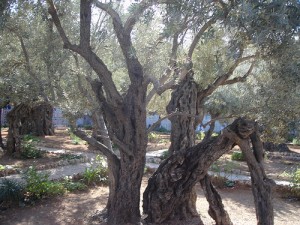
When he was in the Garden of Gethsemane, knowing that he faced an unimaginably painful and brutal death, Jesus experienced fear. Like any of us would be, he was afraid. We may find it hard to accept that Jesus would have had such feelings. But think of it this way: in Jesus, the Son of God became like us in every way except sin. Jesus had to experience fear, if he was to be truly human.
So what about “Be not afraid?” Does what happened to Jesus in Gethsemane turn that into nonsense? No. There’s a difference between “Be not afraid” and “Do not be afraid.” “Do not be afraid” means what it says, and it’s just not possible in certain circumstances. But “Be not afraid” means that we shouldn’t “be” our fear. In other words, we shouldn’t let fear define us or control us or overwhelm us or make us do things that we wouldn’t do if the fear wasn’t there. Fear happens. But there are ways we can respond to it that are better than others.
Think back to Gethsemane. Jesus was afraid, and the sleepy disciples with him were afraid too. But they reacted to the same frightening situation in very different ways. At least one of them lashed out in violence, and all of them ran away, leaving their friend to those who hated him. For his part, Jesus was probably angry, but certainly not violent; he was afraid, but he was courageous too. His fortitude was greater than his fear.
Why this difference? And how is it that you and I might be able to follow our Lord’s example and face our fears with courage? To begin with, Jesus trusted in God the Father. Through this trust, Jesus knew that evil and darkness would not have the final word, and that the Father would be always with him in his trials. Because he knew these things, Jesus could hope that beyond the sufferings he would endure, there was something better- something better for him, and something better for the rest of us, too.
This hope and trust of Jesus was fed by prayer. In Gethsemane, the disciples failed to pray, even after Jesus had basically ordered them to do so. That’s one reason why, when the test came, they failed and fled the scene. On the other hand, Jesus prayed through his fears. It was an honest prayer in which he shared his fear with the Father: “Let this cup pass from me!” At the same time, he surrendered himself into the Father’s hands, asking for help to do what the Father wanted him to do: “Nevertheless, not as I will, but what you will.”
Today’s Scripture readings share with us other prayers of faithful people who faced frightening challenges, but who nevertheless had hope in God. “Hasten to help me!” was the plea of the psalm. “My God, why have you forsaken me?” it asked, words Jesus himself cried from the cross. But it ended on a note of glory and praise to God. The first reading, from Isaiah, spoke of one who would face a cruel mocking and beating, but who still could insist: “The Lord God is my help.”
All of us fear something: Terrorism, a struggling economy, a warming climate, a rapidly changing public morality. We may fear rejection, failure, violence, loss of a job, the death of a loved one, the prospect of an illness. Maybe we’re afraid of the consequences of doing the right thing, like what might happen if we blew the whistle in a corrupt workplace, kept the baby of the unplanned pregnancy, or challenged the negative behavior of a friend or relative.
To us, our fears might be nightmarish, like the king in our opening story. But unlike that king, we need not let our fears defeat us. We can take our cue from the King of Kings, and turn to our heavenly Father, and find in him all the hope and courage we need.
The Passion which we read in today’s liturgy is too long to comment on in detail. We are only able to take a portion and examine it.
It may be of some value to examine the “middle range” of problems and personalities. The usual villains such as the Temple leaders, Judas, and the recruited crowd which shouted “Crucify him!” are fairly obvious in displaying their sinfulness and are unambiguously wicked. But there are others who participate in the Passion accounts whose sinfulness, struggles and neglect are more subtle, but still real. It is perhaps in these figures that we can learn a great deal about ourselves who, like them, may not overtly shout “crucify,” but who are often not as unambiguously holy and heroic as the persecutors are unambiguously wicked and bold.
As these behaviors are noted, we must understand that WE do these things. For the Passion accounts are not merely portraits of people long gone, they are portraits of you and me. We do these things.
So, lets look at this middle range group in three stages.
I. The Perception that is Partial – Near the beginning of today’s passion account the apostles, who are st the Last Supper with Jesus are reminded of what the next days will hold. Jesus says,
This night all of you will have your faith in me shaken, for it is written: ‘I will strike the shepherd, and the sheep of the flock will be dispersed;’ but after I have been raised up, I shall go before you to Galilee.
Note that the apostles are reminded of these facts since Jesus has said them before on a few occasions. For example:
From that time on Jesus began to explain to his disciples that he must go to Jerusalem and suffer many things at the hands of the elders, chief priests and teachers of the law, and that he must be killed and on the third day be raised to life. (Matt 16:21)
When they came together in Galilee, he said to them, “The Son of Man is going to be betrayed into the hands of men.They will kill him, and on the third day he will be raised to life.” And the disciples were filled with grief. (Matt 17:22-23)
We are going up to Jerusalem, and the Son of Man will be betrayed to the chief priests and the teachers of the law. They will condemn him to death and will turn him over to the Gentiles to be mocked and flogged and crucified. On the third day he will be raised to life!” (Matt 20:19)
Thus we see that the Lord has consistently tried to teach and prepare them for the difficulties ahead. He has told them exactly what is going to happen and how it will end, NOT in death, but rising to new life. But though he has told them over and over, they still do not understand or see. Thus he predicts that their faith in in will be shaken.
Their perception is partial. They will see only the negative and forget that he has promised to rise. Since they cannot see beyond the apparent defeat of the moment they will retreat into fear and not boldly and confidently accompany him to his passion and glorification (for his passion IS is lifting up, his glorification). Instead they will flee. He has shown the “what the end shall be.” But they cannot see or accept it. Thus fear overwhelms them and draw back into a sinful fear and disassociation from Jesus. Only a few, Mary his Mother, John, Magdalene, and a few other women would see him through to the end.
But as for the rest they see only what is gory and awful and miss what is glory and awesome. Their perception is quite partial and their blindness comes, paradoxically, from not hearing or listening to what Jesus has been telling them all along.
We too can easily suffer from a blindness caused by poor hearing. For the Lord has often told us, that if we trust, our struggles will end in glory and new life. But, blind and forgetful we give way to our fears and fail to boldly walk the way of Christ’s passion. We draw back and disassociate ourselves from Jesus and exhibit some of the same tendencies and problems we will now observe in the people of that day.
So lets examine some of the problems that emerge from the Partial perception and forgetful fear of many of the disciples and others.
II. The Problems Presented – The problems that emerge are at least five. They are unhealthy and sinful patterns that emerge from the fear generated in not trusting Jesus vision and refusing to see it. We can consider them one by one. Please understand that the word “we” used here is short hand and does not mean that every single person does this. Rather, it means that collectively we have these tendencies. But no need to take everything here personally.
A. They Become Drowsy – One of the common human techniques for dealing with stress and the hardships of life is to just go numb and drowsy. We can just doze off into a moral sleep. Being vigilant to threats posed to our souls by sin, or the harm caused by injustice, (whether to ourselves or others) is just too stressful. So we just tune out. We stop noting or really even caring about critically important matters. We anesthetize ourselves with things like creature comforts, meaningless distractions, alcohol or drugs. We go into a kind of moral sleep and we begin to lack a prayerful vigilance. Prayer and spirituality pose too many uncomfortable questions. So we just tune out and day dream about meaningless things like what a certain Hollywood star is doing, or what the latest sports stats are.
In the passions accounts, Peter, James and John are personally asked by the Lord to pray with him. But they doze. Perhaps it is the wine. Surely it is the flesh (for the Lord speaks of it). But unwilling or unable to deal with the stress the Lord is clearly under they just tune out, go numb, and drowse away. Grave evil is at the very door. But they sleep on. The Lord warns them to stay awake, lest they give way to temptation. But still they sleep. Some one they know and love is in grave danger, but it is too much, so they just tune out, much as we tune out at the overwhelming suffering of Christ in the poor and needy. We just stop noticing. It’s too painful, so we tune out.
The Lord had often warned them to be vigilant, sober and alert (Mk 13:34, Matt 25:13, Mk 13:37; Matt 24:42; Luke 21:36, inter al). Other scriptures would later pick up the theme (Romans 13:11; 1 Peter 5:8; 1 Thess 5:6, inter al). For drowsiness is a significant and serious spiritual problem.
Sadly God described us well when he remarked to Isaiah: Israel’s watchmen are blind, they all lack knowledge; they are all mute dogs, they cannot bark; they lie around and dream, they love to sleep. (Is 56:10)
We do this, not only because we might be lazy, but also because we fear. And one strategy is to try and not notice, to go numb, to tune out. But, despite the sleepiness of the disciples, the wicked are still awake, and the threat does not go away by a drowsy inattentiveness to it. Thus we ought to be confident and sober. Life’s challenges are nothing to fear, for the Lord has told us we have already won, if we trust him. But the disciples have forgotten Jesus promise to rise after three days. And so, often, have we. So they, and we just give way to stress and tune out.
B. They Seek to Destroy – It is said in the text when Peter finally does come awake that he lashes out with a sword and wounds Malchus, the servant of the High priest. The Lord rebukes Peter and reminds him of the vision: Put your sword away! Shall I not drink the cup the Father has given me? (John 18:11). He goes on to heal Malchus who, tradition says later became a follower.
We too, in our fear can often lash out and even seek to destroy our opponents. We usually act in this way because of fear. But if we are already certain of our victory, as the Lord has promised, why do we fear and why do we need to ruthlessly suppress our opponents and enemies. It is one thing to speak the truth in love, boldly and confidently. But too often we aggressively lash out and seek to win a debate. In so doing we may lose a soul. The Lord healed Malchus and saw in him a future disciple. The Lord saw what the end shall be. Peter did not, and in fear, lashed out with an aggression that did not bespeak a confidence in final victory.
It is true that we are required to confront evil, resist injustice and speak to a confuse world with clarity. But above all we are to love those whom we address. There is little place for fear in our conversation with the world. The truth will out, the truth will prevail. We may not win every encounter. But we do not have to, all we have to do is plant seeds. God will water them and others may well harvest them. But in Christ we have already won. And this confidence should give us a serenity.
But Peter has forgotten Jesus promise to rise after three days. And so, often, have we. So Peter, and we just give way to fear and lash out, or attack and have a need to win, when we already have won.
C. They Deny – Peter, confronted with the fearful prospect of being condemned with Jesus denies that he knows him or is one of his followers. He disassociates himself from Christ. We too, confronted with the possibility of far lesser things like ridicule, will often deny a connection with the Lord or with the Church.
Someone might say of one of the more controversial passages of scripture (such as prohibitions on divorces, fornication, homosexual activity, commands to tithe, etc), “Oh, you don’t really believe that, do you?” And it’s too easy to give way to fear and either say “no” or to qualify our belief. Why suffer ridicule, endure further questioning, or experience the unpleasantry of debate? So we just disassociate, compromise, or qualify our faith to avoid the stress.We even congratulate ourselves for being tolerant, etc. when we do it.
Jesus says, If anyone is ashamed of me and my words in this adulterous and sinful generation, the Son of Man will be ashamed of him when he comes in his Father’s glory with the holy angels. (Mat 16:21). But too easily we ARE ashamed. And so, like Peter, we engage in some form of denial. Peter was afraid because he has forgotten to “see what the end shall be.” He has forgotten that Jesus will rise after three days. So too do we often forget that. So we lack confidence and give way to fear, and we deny, so as to avoid suffering with Jesus.
D. They Dodge – Simply put, when Jesus is arrested, all the disciples except John split. They “get the heck out of Dodge.” They are nowhere to be found. After Jesus arrest, it is said that Peter, prior to his own denials had followed the Lord, “at a distance” (Mk 14:54) but as soon as trouble rose, he scrammed.
And we too can run. Sometimes it’s persecutions from the world. But sometimes its just our own self-generated fear that following the Lord is too hard, and involves too many sacrifices we are just not willing to make. Maybe it will endanger our money since the Lord insists that we tithe and be generous to the poor. Maybe it will endanger our playboy lifestyle since the Lord insists on chastity and respect. Maybe we are doing something we have no business doing, that is unjust, excessive or sinful. But, rather than face our fears, whether from within or without, we just high-tail it out.
The disciples forgot that Jesus has shown them what the end shall be. In three days he would win the victory. But, this forgotten, their fears emerged and they ran. We too, must see what the end shall be to resist and confront our many fears.
E. They Deflect – Now in this case our example is Pontius Pilate, not one of the disciples. But the fact is that Pilate was summoned to faith, just like anyone else. Are you a King? he asked Jesus. And Jesus responds by putting Pilate on trial: Are you saying this on your own, or have others been telling you about me.” The fact is, Pilate has a choice to make. Either he will accept what Jesus is saying as true, or he will give way to fear and commit a terrible sin of injustice. Now the text all make it clear that Pilate knew Jesus was innocent. But, because he feared the crowds he handed Jesus over.
Now, note PILATE did this. The crowds tempted him through fear, but HE did the condemning. Yet note that he tries to deflect his choice. The text says, he took water and washed his hands in front of the crowd. “I am innocent of this man’s blood,” he said. “It is your responsibility!” (Mat 16:21). Well, actually Pilate it is also YOUR responsibility. You had a choice and you made. Your own career and hide were more important that justice. And, though you wanted to do what was right and were sympathetic with Jesus, merely wanting to do what is right is not enough.
So too for us. We also will favor our career or hide over what is right. And in so doing we will often blame others for what we freely choose. “I am not responsible, my mother dropped me on my head when I was two” ….etc.
In effect we are often willing to say, “Look Jesus, I love you. You get my Sundays, and my tithe and, generally I obey you. But you have to understand, I have a career, I need to make money for my family. If I really stand up for what is right, I might not make it in this world. You understand, don’t you?…I know the company is doing some things that are unjust, I know the world needs a clearer witness from me….and I’ll do all that, after I retire. But for now…..well, you know. It’s really may boss whose to blame. It’s this old hell bound sin soaked world that’s to blame. Not me!” And we wash our hands and excuse our silence and inaction in the face of injustice and sin.
And all this is done in fear. We forget what the end shall be and get focused on the fearful present. We lack the vision Jesus is trying to give us that in three days we will rise with him. But we stay blind to that and only see the threat of now.
III. The Path that is Prescribed – OK, by now you ought to know the path that is prescribed: See what the end shall be! In three days we rise! Why are we afraid. Jesus has already won the victory. It is true, we get there through the cross. But, never forget what the end shall be! Today we read the Gospel of Friday, but wait till Sunday morning! I’ll rise!
We end where we began with this gospel: This night all of you will have your faith in me shaken, for it is written: ‘I will strike the shepherd, and the sheep of the flock will be dispersed;’ but after I have been raised up, I shall go before you to Galilee.
Yes, after he has been raised, he goes before us into Galilee. And for us, Galilee is heaven. Whatever our sorrows, if we are faithful we will see Jesus in the Galilee of heaven. Never forget this vision. After three days we will rise with him and be reunited in Galilee.
So take courage, see what the end shall be! The end for those who are faithful is total victory. We don’t need to drowse, destroy, deny, dodge and deflect. We’ve already won. All we need to do is hold out.
An old Gospel songs says, I promise the Lord that I would hold out! He said he’s meet me in Galilee! So hold out, Galilee is not far, in three days we rise with him.
At the heart of our faith is the Paschal Mystery: the Passion, Death, Resurrection, and Ascension of Jesus Christ. All of salvation history leads up to and goes forth from these saving events. The purpose of this post is to describe Jesus’ Final week. We call this “Holy Week” for Jesus’ public ministry culminates with his suffering, death and resurrection.
What follows is a brief description of each day of Holy Week. It is hoped that you might print out the pdf flyer (Walking-with-Jesus-In-Holy-Week) and read it each day of this week. Prayerfully walk with Jesus in his most difficult and yet glorious week.
I realize that some scripture scholars scoff at the idea that we can construct a day-by-day journal of Jesus’ last week. There ARE historical gaps and things in the accounts that don’t add up perfectly. Further, St. John, posits a whole different scenario (perhaps as a theological interpretation) of the Last Supper and how it relates to Passover. The following sequence follows primarily the synoptic (Matt, Mark and Luke) accounts, in terms of timing. Despite certain scholarly doubts, the account really do add up pretty well if we use a little imagination and see the differences not as differences in fact, but only in the level detail.
So read this Chronology as a likely but not certain scenario of the the last week of Jesus. It is still a great blessing to consider the Lord’s last week and walk with him.
Plan to attend some or all of the special liturgies of Palm Sunday, Holy Thursday, and Good Friday and Saturday at your parish. By celebrating them in community, we make them present today and learn again, in a new way, the reality of our Risen Lord alive in our midst.
PALM SUNDAY – Our celebration of Holy Week begins this Sunday as we remember and make present the triumphal entrance of Jesus into Jerusalem to begin his final week and initiate his Passion. All four Gospels recount this triumphant entry that Sunday Morning so long ago, but made present to us today. As you receive your palms, consider that you are part of that vast crowd. How will you journey with Jesus this week? Let the palm remind you to praise him with your prayerful presence during the sacred Triduum. According to Mark 11:11 Jesus returned that evening to Bethany, a suburb of Jerusalem. Perhaps he stayed with his friends Martha, Mary and Lazarus. Pray with Jesus this evening as he considers the difficult days ahead of him.
Monday of Holy Week According to Matthew 21, Mark 11 and Luke 19, Jesus returns to Jerusalem today and, seeing shameful practices in the Temple area, he cleanses the Temple. John’s Gospel also records that he rebuked the unbelief of the crowds. Mark 11:19 records that he returned to Bethany that night. Pray with Jesus as he is zealous to purify us.
Tuesday of Holy Week According to Matthew, Mark and Luke, Jesus again returns to Jerusalem where he is confronted by the Temple leadership for what he did yesterday. They question his authority. He also teaches extensively using parables and other forms. There is the parable of the vineyard (cf Mt 21:33-46), the parable of the wedding banquet, (cf Mt. 22:1). There is also the teaching on paying taxes (cf Mt 22:15) and the rebuke of the Sadducees who deny the resurrection (cf Mt. 22:23). There is also the fearful prophecy about the destruction of Jerusalem if the inhabitants do not come to faith in him. He warns that not one stone will be left on another (cf Mt 24). Continue to pray with Jesus and listen carefully to his final teachings just before his passion.
Wednesday of Holy Week. Traditionally this day was called “Spy Wednesday” for it was on this Wednesday before the crucifixion that Judas conspired to hand Jesus over. For this he was paid thirty pieces of silver (cf Mt. 26:14). Jesus likely spent the day In Bethany. In the evening Mary of Bethany anoints Jesus with costly perfumed oil. Judas objects but Jesus rebukes him and says Mary has anointed him for his burial! (cf Mt 26:6). The wicked are besetting Jesus and plotting against him. Are you praying?
HOLY THURSDAY, marks the beginning of the sacred Triduum, or “three days.” Earlier this day Jesus had given instructions to the disciples on how to prepare for this most holy meal, which will be his last supper. Through the day they make these preparations (cf Mt 26:17). In the Mass of the Lord’s Supper conducted at our parishes, we remember and make present that Last Supper which Jesus shared with his disciples. We are in the upper room with Jesus and the Apostles and do what they did. Through the ritual of washing the feet (Jn 13:1) of 12 parishioners, we unite in service to one another. Through our celebration of this first Mass and Holy Eucharist (Mt 26:26), we unite ourselves to Jesus and receive his Body and Blood as if for the first time. At this Eucharist, we especially thank God for his gift of the ministerial priesthood. After the Last Supper (First Mass) the apostles and Jesus made a short journey across the Kidron Valley to the Garden where he asks them to pray and he experiences his agony (cf Mt 26:30). We too will process in Church with Jesus in the Blessed Sacrament to a garden (the altar of repose) which has been prepared. The liturgy ends in silence. It is an ancient custom to spend an hour before the reposed Blessed Sacrament tonight. We are with Jesus in the Garden and pray as he goes through his agony. Most of our parish churches remain open until close to midnight. It was near Midnight that Jesus was betrayed by Judas, was arrested and taken to the house of the High Priest (cf Mt. 26:47).
GOOD FRIDAY, All through the night Jesus has been locked in the dungeon of the high priest’s house. Early this morning he was bought before a Pilate who transferred his case to Herod. Herod sent him back to Pilate who, sometime in the mid-morning, bowed to the pressure of the Temple leadership and the crowds, and condemned Jesus to a horrible death by crucifixion. In the late morning Jesus was taken by the soldiers through the city and up the hillside of Golgotha. By noon he is nailed to the cross where he hangs in agony for some three hours. He dies around three in the afternoon. He is taken down from the cross and placed in the tomb hastily before sundown. Today is a day of prayer, fasting and abstinence. Whenever possible, Christians are urged to keep today free of work, of social engagements, of entertainment, and to devote themselves to communal prayer and worship. At noon many parishes gather for stations of the cross for recollections of the seven last words of Jesus. Many parishes also offer staions of the cross at 3pm the hour of Jesus death. In the evening, we gather quietly in our parish Churches to enter into time of prayer as we reflect on Jesus death on the cross. We also pray for the needs of the world. To acknowledge the power of the cross in our lives today, we one by one come forward to venerate the cross with a kiss. Our hunger from this day of fasting is satisfied with Holy Communion distributed at the end of this liturgy.Consider too how the apostles might have gathered that night together in fear and prayer reflecting on all that happened.
HOLY SATURDAY – The body of Jesus is in the tomb but His soul is among the dead to announce the kingdom. The hour is coming, and now is, when the dead will hear the voice of the Son of God, and those who hear it will Live (John 5:25). Consider what it must have been like for the dead in Sheol to awaken to the voice of Jesus! Meanwhile The Disciples, heartbroken at the death of Jesus, observed the Jewish Sabbath in sorrow. They had forgotten the promise of Jesus that He would rise. We cannot forget His promise. We cannot forget. Tonight in our parishes after sundown we gather for the Great Easter Vigil where we will experience Jesus rising from the dead. We gather in darkness and light the Easter fire which reminds us that Jesus is light in the darkness. He is the light of the world. We enter into the church and attentively listen to Bible stories describing God’s saving work of the past. Suddenly, the church lights are lit and the Gloria is sung as we celebrate the moment of Christ’s resurrection. He Lives! In the joy of the resurrection we then celebrate the Sacraments of Baptism, Confirmation and Eucharist for our Catechumens and Candidates who have prepared for many weeks for this night. As a Church we sing Alleluia for the first time in forty days. Do everything you can to be present on this evening and invite friends and family to join. Our Vigil ushers in an Easter joy that never ends!
A classic case of the pot calling the kettle black is to be found in today’s gospel. Certain critics scolded Jesus, saying: “You, a man, are making yourself God!” Of course, Jesus wasn’t making himself God- he is God! However, don’t we try to make ourselves God all the time? Isn’t this an accusation that Jesus could legitimately make of those critics and many others- including us?
Just think about it:
So often, we want to glorify ourselves, and not God;
We want to be independent, not dependent on God;
We want to do what we want, not what God wants;
We want God to serve us, not the other way around.
The truth is, God didn’t create us to be God. God created us to be ourselves! Which is a good thing, as we’re all made in God’s image and likeness. And that’s why God calls us, not to be God, but to be godly, God-like.
Our challenge, then, is for us to stop trying so hard to be God, and instead surrender to God, that we may become like God, just a little bit more, every day.
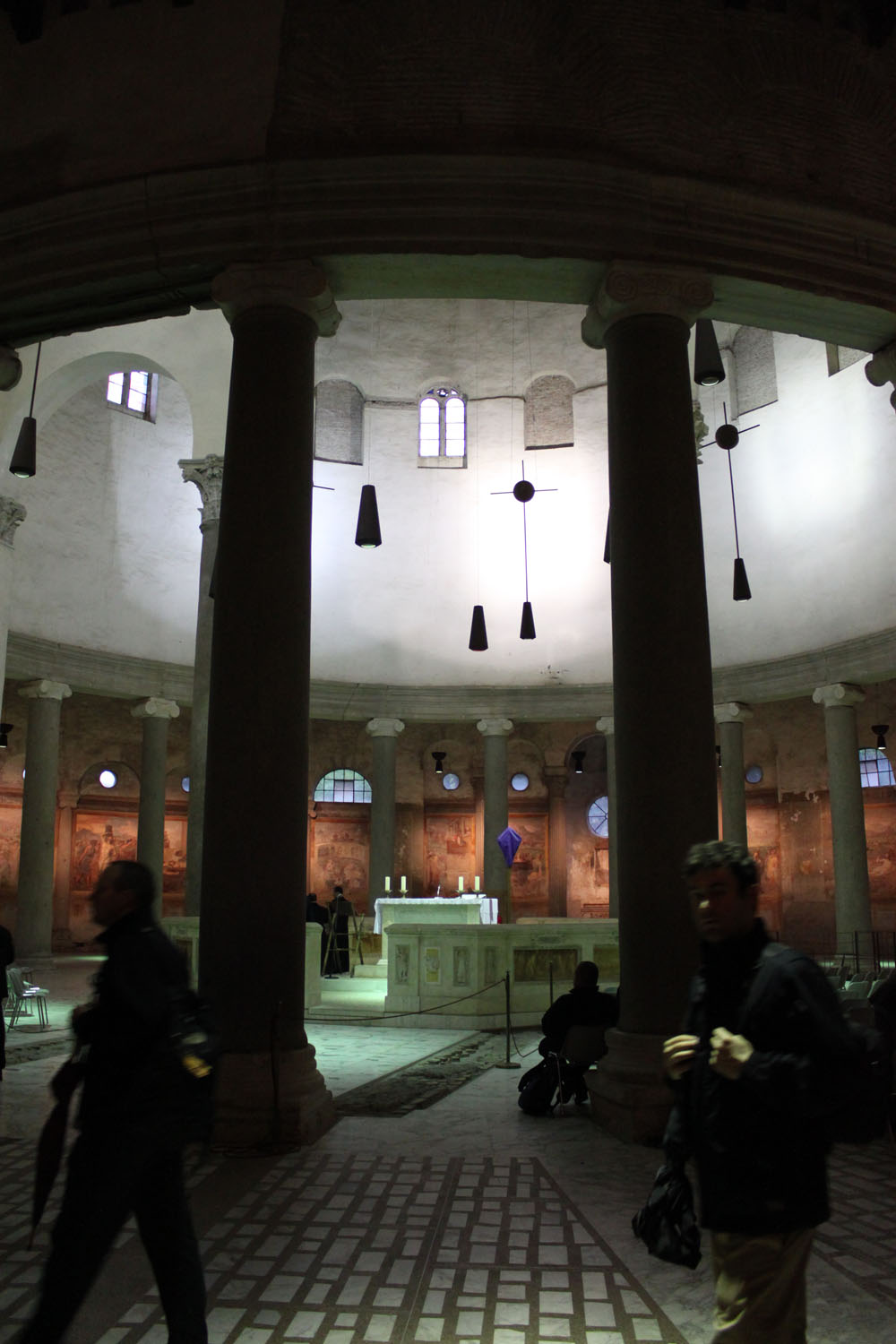
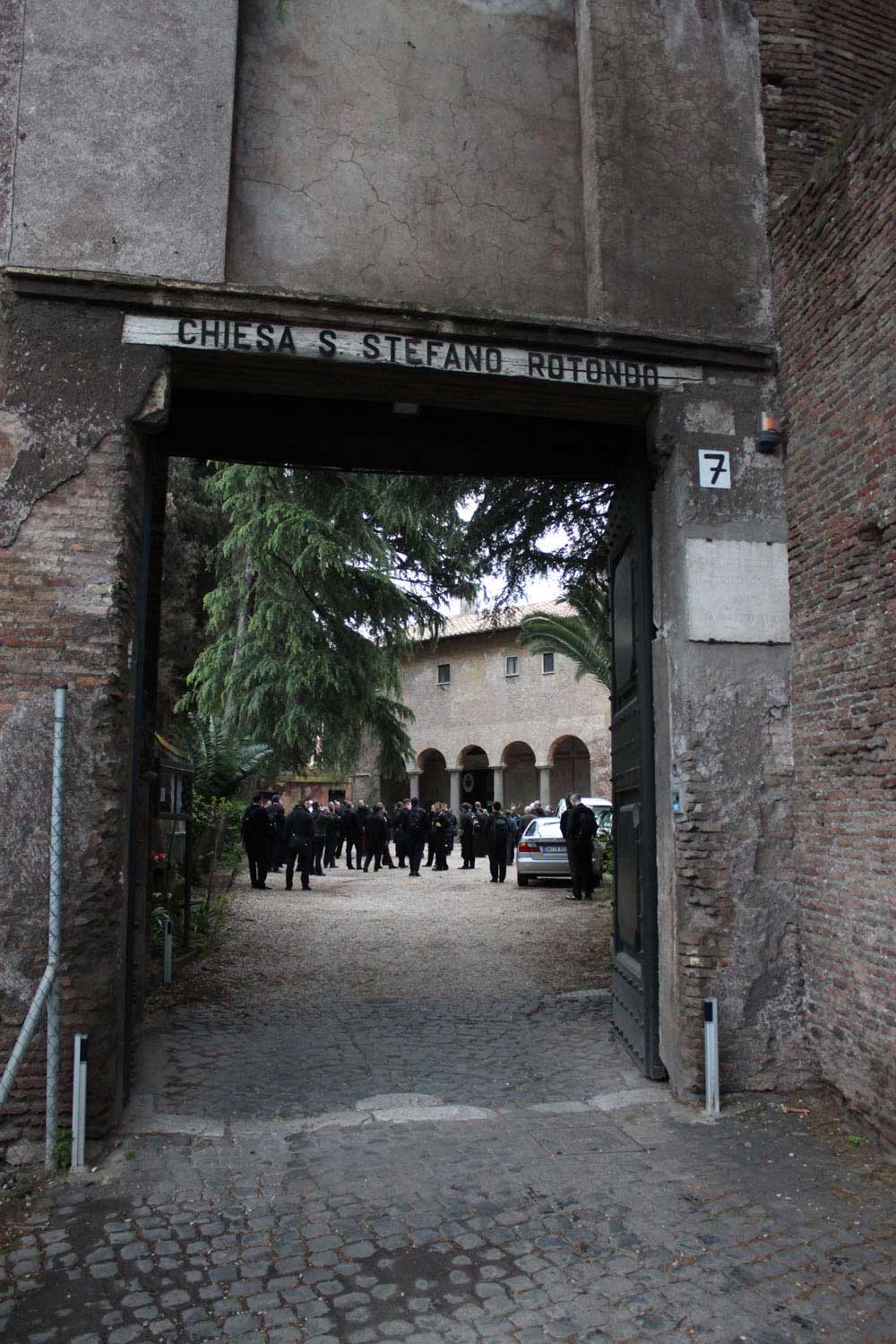
San Stefano Rotondo dates from the 5th century, may be the oldest round Roman Church. It originally held the relics of St. Stephen, the first Martyr , whose relics had been discovered in the Holy Land. Because of this connection, the Church was modeled after the Church of the Holy Sepulcher. The frescoes on the walls, depicting twenty-four scenes of martyrdom, depicting how saints suffered for the Faith are a constant reminder of the importance our Faith should have in our lives and they are quite memorable. The relics of St. Stephen are unfortunately not kept here anymore, so the Church was later rededicated to St. Stefan, King of Hungary.
Proclaiming the truth
Being in the Church originally dedicated to St. Stephen, it is fitting that the readings today speak of persecution and of an attempted stoning of Jesus. Stephen was stoned to death for proclaiming the truth about Christ, that he was the Son of God. In the Gospel, that is what the crowd takes issue with, that Jesus says he is the Son of God. But that is true. As he asks them, “can you say that the one
whom the Father has consecrated and sent into the world blasphemes because I said, ‘I am the Son of God’?” We are called to witness to the truth, despite who may find it difficult to accept, because the truth does not depend on people’s perception of it. They tried to stone Jesus for it, but he escaped from their power.
Choosing Christ and the Gospel
Today’s station church, which has stood from the 4th Century, with its wonderful frescoes, stands as a testament to those who gave their lives for Christ. It bears witness to the extreme worth of their choice to cling on to Christ and the Gospel, that now millennia later we can stand here now as believers. For through the sacrifice of these martyrs, we can see that they bore witness to the truth, just as in the end of today’s Gospel people came to believe because they saw that Jesus bore the truth. “everything John said about this man was true.” And many there began to believe in him.” That is still our mission in the world. That others may believe in Christ, because they see we bear witness to the Truth.
Written by: Mario Majano
Photos by: Fr Justin Huber
As we draw near to Holy Week, and on this Friday when many of us pray the Stations of the Cross, we do well to meditate on the wood of the cross. For it is a fascinating fact that, when saving His people, God often had recourse to wood. Indeed, one of the great themes of the Old Testament and into the New Testament is that “God Works Wonders With Wood.”
Consider with me a number of places in the Scriptures where God uses wood to save:
1. Ark of Safety– One of the most terrifying stories of the ancient world is the flood. The world had grown so wicked, and sin so multiplied that God concluded he must literally wash it clean. (And you think its bad now!) God went to a man named Noah and told him that He was going to trouble the waters and that Noah had to be ready. He was instructed to build an ark of Gopher wood. Now this was not a small project. The Ark was the length of one and a half football fields (150 yards), it was 75 feet wide and 45 feet tall. God then, troubled the waters and the flood made an end of wickedness and a new beginning of goodness. Through the wood of the ark God saved Noah and his family from the flood waters. (cf Gen 6-9) An old Latin Hymn says, Arbor una nobilis (One and only noble tree)! By this wood, God saved his people.
2. Victory at the Red Sea– Pharaoh had finally relented and the Jewish People were leaving Egypt for the Promised Land. But fickle Pharaoh has once again changed his mind and pursues them. With the Red Sea before them and Pharaoh behind them the people were struck with fear. Yet, God would win through for them. How?! God told Moses to take up the wooden staff and to trouble the waters with these words: And you lift up your staff and with hand outstretched over the sea, split the sea in two… So Moses stretched out his hand over the sea; and the LORD drove the sea back by a strong east wind all night, and made the sea dry land, and the waters were divided. (Ex 14:16, 21). And God brought them through those troubled waters, and they went out of slavery and into freedom. Are you noticing a pattern? Wood works wonders. The wooden staff and troubled waters bring forth freedom: Arbor una nobilis (One and only Noble Tree)!
3. Water in the Desert – It is a fine thing to be free but thirst has a way of making itself known. When they came to Marah, they could not drink the water of Marah because it was bitter; therefore it was named Marah. But notice again how God uses wood to bring forth saving water: And the people murmured against Moses, saying, “What shall we drink?” And he cried to the LORD; and the LORD showed him a tree, and he threw it into the water, and the water became sweet! (Ex 15:23) So once again, God saves through wood and brings forth water. The wood of the tree made sweet the water: Arbor una nobilis (One and only Noble Tree)!
4. Saving Stream – But yet again, as they journeyed further, more thirst. And once again God used wood to save them: God said to Moses: Go over in front of the people holding in your hand as you go the staff with which you struck the sea, …Strike the rock and the water will flow from it for the people to drink. (Ex 17:5-6). With God’s power the wood works wonders. The wood of the staff troubled those waters and they came forth with the blessing that preserved life in the desert. Arbor una nobilis (One and only Noble Tree)!
5. Down by the Riverside – After forty years of wandering in the desert the Israelites are finally ready to enter the promised land. But the Jordan is in flood stage, impossible to cross! But once again God had a plan and it involved wood. He instructed Joshua to have the priests place the Ark of the Covenant on their shoulders and wade in the water. Now the Ark was a box made of Acacia wood and covered in gold. In it were the tables of the Law, the staff of Aaron and a ciborium of the manna. The also knew and believed that the very presence of God was carried in that ancient wooden box, even as in our tabernacles today. And when those who bore that wooden Ark had come to the Jordan, and the feet of the priests touched the water the waters, those waters rose up in a heap far off, and the people passed over opposite Jericho (cf Joshua 3:15) So again, with God, wood works wonders! The wooden box of the ark troubled the waters and they parted bringing the blessing of the promised land. Arbor una nobilis (One and only Noble Tree)!
Now all of these prefigure the noblest tree of all: the Cross of our Lord. For as we have amply seen, God works wonders with wood.
It is said that Jesus was a carpenter. Actually the Greek calls him a teckton (builder). But surely carpentry was among his skills. But more truly he was the greatest carpenter of all, not merely for any table or chair he built, but for the salvation he won us through the wood of his cross: Arbor una nobilis (One and only Noble Tree)!
Jesus, master carpenter among all master carpenters! Wood alone cannot save, but God works wonders with wood, and by his power, and his grace he wills to use wood to save us: Wood Works Wonders!
Please consider these beautiful lines from the 6th Century Hymn Crux Fidelis:
FAITHFUL Cross!
above all other,
one and only noble Tree!
None in foliage, none in blossom,
none in fruit thy peers may be;
sweetest wood and sweetest iron!
Sweetest Weight is hung on thee!
Lofty tree, bend down thy branches,
to embrace thy sacred load;
oh, relax the native tension
of that all too rigid wood;
gently, gently bear the members
of thy dying King and God.
Tree, which solely wast found worthy
the world’s Victim to sustain.
harbor from the raging tempest!
ark, that saved the world again!
Tree, with sacred blood anointed
of the Lamb for sinners slain.
When he published a work about St. Joan of Arc, the French Catholic poet Charles Peguy intentionally left the first pages blank. He did this, he explained, to give the reader time to think.
Perhaps giving people the time to think was Jesus’ motivation in today’s gospel. As we heard, hostile men had confronted him about what to do with a woman who had been caught in adultery.
But Jesus didn’t respond right away. Instead, he sat quietly on the ground, tracing his finger in the dirt. It was only after the angry mob continued to press him for an answer that Jesus finally spoke. “Let the man among you who has no sin,” he said, “be the first to cast a stone.”
But why did Jesus take so long to speak? Why the hesitation? Was Jesus stalling for time so he could find something appropriate to say? I don’t think so.
Maybe Jesus was trying to teach us that we need to take the time to think before we impulsively cast a stone at another. Time for our emotions to cool. Time to consider all the variables and circumstances involved. Time to recall our own sins. And time to think of God’s mercy, not only to others, but especially to us.

 It’s Holy Week and Lent is drawing to a close. Have you made a good confession? It just doesn’t seem possible that any Lent can be complete or even proper without going to confession. In many diocese there is a “Light is On for You” outreach wherein confession is available in all the parishes of that diocese every Wednesday night from 6:30 pm – 8:00pm. That is surely the case here in the Washington Area. I’ll be in the box waiting for people this Wednesday! So will all the other priests in the Washington and Arlington Dioceses. I am aware that Boston and other dioceses are doing something similar. But wherever you are it’s not too late to get to confession.