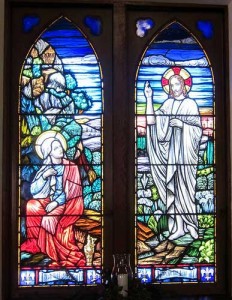
A Lover’s Search

A beautiful love story lies at the heart of today’s Easter gospel. In a subtle way, the evangelist has portrayed Mary Magdalene as the woman lover in the Old Testament’s Song of Songs.

This lover searches for her beloved in the night, just as Mary Magdalene went to the tomb before the sun had risen. The lover asks the city watchmen if they had seen her beloved, just as Mary Magdalene laments to the angels keeping watch that she doesn’t know where Jesus is to be found. As it was in a secret garden that the lover would meet her beloved, so Mary Magdalene first mistook Jesus for a gardener. And finally, when the lover finally discovered her beloved she took hold of him and refused to let go, just as Mary Magdalene clung to Jesus, after he revealed himself to her.

Mary Magdalene’s deep love for Jesus gave her the courage to overcome the doubts and fears that seemed to paralyze the disciples after the crucifixion. As a reward for her courageous love, Jesus appeared to her first and appointed her the messenger to tell the others the good news of the resurrection. Because of this, she has been honored throughout history as the “Apostle to the Apostles.”

Mary Magdalene’s courageous love is an inspiration and example for us, because so often we need courage in order to be a follower of Jesus. For instance:

• We need courage to trust God, when we can’t see the road ahead of us;

• We need courage to confess our sins when our shame would hold us back;

• We need courage to witness to our faith in the face of injustice and ridicule;

• We need courage to love others when we risk being rejected by them;

• We need courage to forgive, when we’re afraid of appearing weak;

• And we need courage to grow in holiness, when we fear the change that growth requires.

Mary Magdalene serves to remind us that perfect love casts out fear, because we love a Lord whose love for us conquered not only fear, but even death itself.

Readings for today’s Mass: http://www.usccb.org/nab/042611.shtml

Photo Credit: bobosh_t via Creative Commons

Civilization Killers – On the Decline of Three Basic Cultural Indicators and What it Means for America

Recently, there was a remarkable article over At Real Clear Politics which summarizes important social trends in the United States. The article by Rich Lowry summarizes the views of Charles Murray who gave a talk at the American Enterprise Institute. Mr. Murray focuses his data on White America only to avoid the sticky wicket of race politics that so often clouds a conversation on social and moral trends that are wider than race.

The recent unpleasantness in New York where the high rates of abortion in the Black community (simply a statistical fact) were featured in a billboard, quickly devolved into a discussion of race, rather than abortion. Hence, to avoid this sort of thing, Mr. Murray used data only on the White community.

And what he has discovered is that there are significant differences between economic classes in this Country that sheds important light on the cultural crisis we are facing. In effect, economic class is a big indicator in moral behavior today. This was not the case in the past and the class division in America has led to two very different Americas, two increasingly parallel worlds in effect. Likewise, it becomes increasingly clear which world is influencing which.

I would like to presents excerpts of the article by Rich Lowry and make comments of my own. Lowry’s original remarks are in bold, black italics, my remarks are plain text, red. The full article is here: Coming Apart at the Seams.

The social threat to the American way of life is…dire….it is [also] insidious, and…complicated. No grassroots movement has mobilized against it, and no high-profile bipartisan commission is suggesting remedies. Yet it proceeds apace, all but ignored except in the lives of Americans Lowry refers here to the decline in important “founding virtues” which have made this country strong: marriage, industriousness, and religiosity. And he is right that almost no one wants to talk about the decline of these things. If we had a reform program only half as committed as the anti-smoking campaign of the past 25 years, we’d be well on our way to recovery, I suspect. But sadly there is little agreement on such a campaign, even in the Church where too may pastors, catechists and leaders seem to emphasize not offending, over being real clinicians and doctors with real and clear direction for what ails us.

If there is ambivalence in the Church, it is far worse in the wider civic world where a consensus on good behavior has broken down.

A personal story comes to mind here. I was in a meeting with some local activists here in DC and we were discussing the social structures of poverty. The usual list was announced in the room to include things like, capitalism, the greed of (rich) people, racism, not enough Government action, even lead paint. I happened to interject that the chief cause of poverty is single motherhood and also wondered if we ought no counsel sexual abstinence, and encourage marriage. The room was suddenly silent, and all eyes were on me. Most of those eyes were glaring, some dismayed. Only a few showed understanding or agreement. Some one finally broke the icy silence and suggested that I leave such controversial views to my own pulpit and stick to things where there was real consensus and which was less…ahem… “judgmental.”

Yes, the lack of a grassroots movement seems directly tied to a loss in common moral vision. We do not seem to agree on what is vice, and what is virtue. Here again, I fault the Church and Protestant denominations for failing to hand on the vision and to insist upon it among their (our) rather sizable number. I think we are improving in the Catholic Church and some of the evangelical denominations are doing a better job. Collectively, the Catholic moral vision is being better articulated by many bishops and pastors who see no choice but to speak out.  But for a long time we have been too silent, and there still is to much silence from Catholic pulpits as a whole. If there is going to be any sort of grassroots movement it is going to have begin with us.

Among those trying to sound the alarm is Charles Murray of the American Enterprise Institute…..In a bracing lecture on “The State of White America,” he notes that America has long had an exceptional civic culture. “That culture is unraveling,” he warns. “America is coming apart at the seams. Not the seams of race or ethnicity, but of class.” – It does seem that class, even more than race, has become a large dividing line in this country and the question of virtue and vice is significantly influenced by it, as we shall see.

Murray takes whites as his subject to avoid the question of whether racism is responsible for the problem he describes, namely the “emergence of classes that diverge on core behaviors and values.” – Good move, as stated above. If this discussion gets tagged with race, the question of race will rob all the oxygen from the discussion and the moral questions will be unaddressed.

Murray identifies what he calls the “founding virtues,” such as marriage, industriousness, and religiosity, which have always been considered the social basis of self-government. He looks at whites aged 30-49 and divides them into the top 20 percent socio-economically and the bottom 30 percent. The top tier is basically the upper middle class, the bottom the working class. He finds two worlds, increasingly separate and unequal. – So the basic groups we are dealing with in this reflection are upper middle class and working class.

Notice, the very rich are not mentioned. It seems to me that they are a group unto themselves when it comes to the moral life. They (e.g. Hollywood, national politicians, and the very rich) often manifest poor moral values but are more able to “get away with it,” not often suffering all the usual social ills that go with bad behavior. The very poor seem also not on the radar here. Their problems in the moral realm are very often even more complicated and tied in with a very corrupt welfare system that rewards bad behavior and punishes good.

So let’s look at the data of the middle range of classes, the upper middle class and the working class:


In 1960, everyone was married – 88 percent of the upper middle class and 83 percent of the working class. In 2010, 83 percent of the upper middle class is married and only 48 percent of the working class. This gap “amounts to a revolution in the separation of classes.” – Now stable marriage is a key indicator and component of a strong culture. And we can see here that it is the working class that has taken a huge hit in the marriage statistics. In the Church we have noticed this too. In 1974 there were approximately 400,000 weddings in the Catholic Church. In 2004 there we about just under 200,000. The drop in Catholic weddings was attributable to numerous factors including a fall-off in general Church attendance, but the trend is similar to the overall working class, where marriages have dropped by almost half.

In 1960, births to single mothers in the working class were just 6 percent; now they are close to 50 percent. Interesting that our author does not give the number for upper middle class single mothers. My own thought on this is that, while the number is not as high as among working class people, the number is still a lot higher than 1960. Single motherhood began as a problem in the inner-cities and was influenced by a perverse welfare system that rewarded single mothers and comparatively punished married mothers. But the trend of out of wedlock birth has long since reached the suburbs, where the numbers as not as high (close to 80% of children on welfare are born to single mothers), but the numbers have trended much higher.


When it comes to industriousness, there’s the same divergence. In 1960, 1.5 percent of men in the upper middle class were out of the workforce; it’s 2 percent now. In 1968, the number for working-class men hit a low of 5 percent; even before the spike in unemployment after the financial crisis, it was 12 percent in 2008. “The deteriorations in industriousness,” Murray notes, “have occurred in labor markets that were booming as well as in soft ones.” – OK, so Mr. Murray has screened for unemployment. What we’re talking about here is the number of people who simply don’t bother to look for work anymore but live off others or the State. So the “loafers” have doubled in number. The ethic of hard work has taken a hit. However, I would note here that the 12% figure, though higher, is still fairly low, and America remains a nation of hard workers. We still have a work ethic, it would seem, almost to a fault, since many Americans have their career as more important that their vocation (IMHO). Thus children are in day-care and many marriages are strained by overwork and long hours.

Although secularization has long been on the rise, it’s more pronounced in the working class. Among the upper middle class, 42 percent say they either don’t believe in God or don’t go to church. In the working class, it’s 61 percent. In other words, a majority of the upper middle class still has some religious commitment, while a majority of the working class does not. Now this is very paradoxical to some I am sure. I happened to discover the truth of this when I lived among the poor of Southeast Washington for 7 years. I had always thought that the poor were very religious. I think the Scriptures themselves influenced me in this as they warned of riches and indicated God’s loving favor to the poor. But one of the discoveries I made about the very poor was that almost none of them ever went to church! I came to see this as one of the things that contributed to their poverty. For what it indicated was their disconnectedness from others. Churches, among other social functions, serve to knit people together in a socially supportive structure. Having severed themselves from such a community, the poor were even more vulnerable.

Here too, government welfare has had a deleterious effect since many of the poor look to an impersonal government for “the check” rather than to others around them. The advantage of course is that the Government doesn’t ask too many questions or insist upon weekly attendance at services or social functions.

I did not see or experience these poor as atheists in any way. But religion and faith were simply not a big part of their lives. I often had long talks exhorting the poor I met to reconnect with God and the Church. I would even eventually tie on-going help to attendance.

It would seem that the trend of irreligiosity has also reached the working class in higher proportions too. Some will tie this to bad work schedules and the like, rooted in the fact that everything is open on Sundays now. But most churches have a wide variety of things on the schedule including Saturday evening masses, Sunday evening Masses, mid-week bible studies and the like. The fact is people in general are more secular, and this does not bode well for them of for this country as a whole.

These trends mean, just as it is suffering economically, the working class is getting cut off from the richest sources of social capital: marriage, two-parent families, and church-going. More people are falling into a lower class characterized by men who can’t make a minimal living and single women with children….. And this goes back to my point raised in that room of social activists. The fact is that living a life rooted in biblical and natural virtue is just better for you. It leads to fewer complications, greater stability and prosperity, better health, and a higher degree of satisfaction.

Social activists who want to make life better for the poor should reconsider their “agnostic” position regarding sexual choices, and the role of marriage and traditional family values.

In re-proposing the Gospel to an increasingly secular and cynical culture  we should not forget to “sell” the Gospel and traditional moral norms as just plain smart, even from a worldly point of view. That is not the only reason we seek to live them, but the fact is, blessings come from following God’s plan, burdens and hardships multiply to those who fail in this regard.  Mr. Lowry says it succinctly and well: the working class is getting cut off from the richest sources of social capital.

He quotes the 19th-century observer of American life Francis Grund: “The American Constitution is remarkable for its simplicity; but it can only suffice a people habitually correct in their actions, and would be utterly inadequate to the wants of a different nation. Change the domestic habits of the Americans, their religious devotion, and their high respect for morality, and it will not be necessary to change a single letter of the Constitution in order to vary the whole form of their government.” I believe De Tocqueville said something very similar: Despotism may govern without faith, but liberty cannot. How is it possible that society should escape destruction if the moral tie is not strengthened in proportion as the political tie is relaxed? And what can be done with a people who are their own masters if they are not submissive to the Deity?

In other words, if freedom is to be politically advanced, then the self control of most Americans must be a presupposed foundation. If that foundation of morality and self-control is lost, the foundations of democracy are threatened.

And we see this in our times. As the decency and self control of more and more Americans diminishes, legal restrictions and punitive measures increase, lawsuits ensue, legal fears increase, and political liberties are gradually eclipsed. Our growing and increasingly intrusive Federal Government does seem very tied to our inability, or unwillingness, as citizens to curb and govern our behaviors. The Constitution, and the freedoms it ensures are thus gradually eroded.

Some consider the Constitution too dated, others see it not permitting enough Government restrictions to curb the bad or unpleasant behaviors of people today. Perhaps this is so. But the solution is not to disregard the Constitution but to reform our lives. We shouldn’t need a nanny state, we ought to grow up and do what is right and proper.

When it comes to saving the American way, balancing the budget is the easy part. -Yes, being saved from ourselves would seem much more difficult.

Murray argues that America can maintain its national power even if these trends continue. I disagree. I think these downward trends are civilization killers.

If the family is not strong and continues to slide into disarray, we cannot continue as a strong nation and, like ancient Rome, will fade away.

Our work ethic remains strong and there is some hope here.

But as for secularization, that we can have an intelligible and reasonably unified culture without a common “cult” seems  dubious. We need not be united on every particular dogma, but, we must have someone and something above us, as a culture, to unite us. The source of our unity cannot be within us, it must transcend us. Pretending that we can have real unity when increasing numbers reject that transcendent vision is fanciful in the end, for with nothing bigger than “us” to unite us, we end in power struggles and endless divisions. The disunity may ultimately be too strong for the great American experience to continue. I do not say it will come soon, but the trend lines do not currently point in promising directions.

As always I am interested in your thoughts.


This song says, America! America! God mend thine every flaw, Confirm thy soul in self-control, Thy liberty in law!

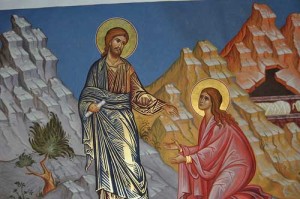
Come to Jesus?!?

Ever hear of a “Come to Jesus” meeting? That’s how some refer to summons from a superior when they know they’re in trouble. It’s something to be dreaded.

Perhaps the disciples felt dread when the two Marys told them that the risen Jesus would meet them in Galilee. After all, most of them had abandoned him in his hour of need. One had denied him. And it wasn’t they who came to his tomb on Easter morning. It was the women. In light of all this, maybe they feared some sort of punishment from Jesus- a tongue-lashing, a dressing-down, or worse.

We too can dread coming before Jesus when we feel guilty about something. We imagine that he’ll shame us or even reject us. But that’s not the case at all, and today’s gospel gives us a hint of what to expect. In speaking to the two Marys, he calls his disciples “brothers.” He makes no threats. They’re family, he loves them, and he very much wants to see them.

We’re Jesus’ family too. He loves us, and he wants to see is. He will call us to a “Come to Jesus” meeting! Not to make us shake in fear! But so we can share his resurrection joy.

Readings for today’s Mass: http://www.usccb.org/nab/042511.shtml

Photo Credit: epicxero via Creative Commons

The Normal Christian Life – Coming to Appreciate The Life That The Risen Christ Offers

At the Great Easter Vigil, after a lengthy series of Old Testament readings, The lights come on full, the Gloria is intoned and the opening prayer is sung. Then all are seated for the first reading from the New Testament proclaimed in the new light of Easter glory. It is Romans 6, the opening text from the New Testament proclaimed by the Church as Christ steps forth from the tomb! It would seem the Church considers this an important reading for our consideration, given it’s placement.

Romans 6 is a kind of mini-Gospel where in the fact of our new status as redeemed transformed Children of God is declared. And within these lines is contained “Standing Order # 1” for the Christian who is a new creation: “No longer let sin continue to reign in your death directed bodies.”

Perhaps we can take a look at this central passage from the New Testament. Here it is in total and them some verse by verse commentary:

We died to sin; how can we live in it any longer? 3Or don’t you know that all of us who were baptized into Christ Jesus were baptized into his death? 4We were therefore buried with him through baptism into death in order that, just as Christ was raised from the dead through the glory of the Father, we too may live a new life. 5If we have been united with him like this in his death, we will certainly also be united with him in his resurrection. 6For we know that our old self was crucified with him so that the body of sin might be done away with,that we should no longer be slaves to sin— 7because anyone who has died has been freed from sin. 8Now if we died with Christ, we believe that we will also live with him. 9For we know that since Christ was raised from the dead, he cannot die again; death no longer has mastery over him. 10The death he died, he died to sin once for all; but the life he lives, he lives to God. 11In the same way, count yourselves dead to sin but alive to God in Christ Jesus. 12Therefore do not let sin reign in your mortal body so that you obey its evil desires. 13Do not offer the parts of your body to sin, as instruments of wickedness, but rather offer yourselves to God, as those who have been brought from death to life; and offer the parts of your body to him as instruments of righteousness. 14For sin shall not be your master, because you are not under law, but under grace. (Romans 6:1-14)

1. THE PRINCIPLE We have died to sin; how can we live in it any longer? – Here is a powerful and uncompromising statement. Paul is setting forth  the most fundamental principle for the Christian life. Namely that sin is not to have any power over us. This is the NORMAL (i.e. normative, to be expected) Christian life, a life that is victorious and that is seeing sin put to death and the blessings of grace come alive. Paul says, quite clearly, we have died to sin.

Before returning to this concept it might be important to consider what the word “sin” means here. The Greek word is ἁμαρτίᾳ (hamartia). In its root sin (ἁμαρτίᾳ) means “missing the mark” or falling short of a designated goal. In the Greek tragedies the hero often had a “fatal flaw” wherein he misses the mark, or fails to obtain what he sought due to a moral failing or error in judgment. In Scripture the word ἁμαρτίᾳ usually means something closer to what we mean by sin today, namely “a moral failing.” But we should not completely leave behind the notion that sin is a missing of the mark. It is not untrue to say that sin is not so much a reality unto itself as it is a “privation,” a lack of something that should be there. In every sin, something is missing that should be there.

Now St. Paul often describes sin (ἁμαρτίᾳ) at two levels: the personal experience with sin, but also as a “climate” in which we live. So we might distinguish between Sin (upper case) and sin (lower case). Hence, Sin is the climate in which we live that is hostile to God, that has values in direct opposition to what God values. It is materialistic, worldly in its preoccupations, carnal and not spiritual, lustful, greedy, self-centered, and alienated from the truth. It will not submit to God and seeks either to deny Him or to marginalize him. This is Sin. (We need to understand this distinction for in verse 10 of this passage Paul says Christ “died to Sin.” But clearly Christ had no personal sin. But he DID live in a world dominated by Sin and it was to THAT which he died).

As for sin (lower case), it is our personal appropriation of Sin. It is our internalization and acceptance of the overall climate of sin. For example, a Bosnian child is not born hating a Croat or Serbian child. That hatred is “in the air” and the child often (usually) internalizes and then acts upon it. Hence Sin becomes sin.

Now Paul says, we have DIED to all of this. That is to say the overall climate of Sin cannot any longer influence us, neither can the deep drives of our own sin continue to affect us.

But how can this be, most of us feel very strongly influenced by Sin and sin? Consider for a moment a corpse. You cannot humiliate or tempt, win an argument with or in anyway personally affect a corpse. The corpse is dead and you and I can no longer have any influence over it. Paul is saying that this is to be the case with us. We are dead to the world and its Sin. It’s influence on us is broken. Because of this, our personal sins and drives of sin are also broken in terms of their influence.

Ah but you say, “This does not seem true.” Nevertheless, it IS the principle of the Christian life. It is what is normative for us and what we should increasingly expect because of our relationship with Jesus Christ. It is true, death for us is a process, more than an event. But to the degree that the old Adam has been put to death in us, then his vital signs are diminishing. He is assuming room temperature and Christ Jesus is coming alive in us.

And here is the central question Is Jesus becoming more alive in you? It is a remarkable thing how little most Christians expect from their relationship with Jesus Christ. The best that most people hope for is to muddle through this life and just make it (barely) over the finish line to heaven. Mediocrity seems what most people expect. But this is not the normal Christian life! The normal Christian life is to be increasingly victorious over sin, to be experiencing the power of the Lord Jesus Christ at work in our lives. We have died to sin. It’s influence on us is waning, is diminishing. Increasingly the world and its values seem ludicrous to us and God’s vision becomes precious.

So here is the principle – have died and are dying to sin, it is increasingly impossible for us to live in it or experience it’s influence.

2. THE POWER Or don’t you know that all of us who were baptized into Christ Jesus were baptized into his death? 4We were therefore buried with him through baptism into death in order that, just as Christ was raised from the dead through the glory of the Father, we too may live a new life. If we have been united with him like this in his death, we will certainly also be united with him in his resurrection.

When Paul (and Scripture) use the word “know” it always means more that grasping something intellectually. To “know” in the Bible means to personally experience something and to have grasped it as true. Thus, what Paul is really saying here, “Or is it possible that you have not experienced that we died with Christ and risen with him to new life?” In effect he is saying, grab hold of yourself and come to experience that you have died to your old life and now received a completely new life. Start to personally experience this.

If anyone is in Christ, he is a new creation! (2 Cor 5:17). This is the normal Christian life and we ought to be experiencing it more and more.

But here again, we have to fight the sloth of low expectations. Do you think that Jesus Christ died for you so that you would continue to be in bondage to anger, or lust, or hatred? Surely he died to free us from this!

To see your life transformed is NOT your work, it is the work of the Lord Jesus. Since it is his power at work we ought to expect a lot. But low expectations yield poor results. So Paul is saying, come to know, come to personally experience and grasp his power at work in you. Have high expectations! How can we have anything less when the death and resurrection of Jesus are the cause of this?

3. THE PERSONAL WITNESS – For we know that our old self was crucified with him so that the body of sin might be done away with,that we should no longer be slaves to sin— because anyone who has died has been freed from sin. –

Once again Paul says we “know” this. This is the normal Christian life: to experience that our old self was crucified and has died and that increasingly we are no longer slaves to sin.

In my own life I have experienced just this. Have you? I have seen many sins and sinful attitudes put to death in me. My mind has become so much clearer in the light of Christian faith and I now see and experience how silly and insubstantial are many claims of this world. So, my mind and my heart are being transformed. I have died to many of my former and negative attitudes and drives.

I’m not what I want to be but I’m not what I used to be, praise God. A wonderful change has come over me.

How about you? Do you have a testimony? Do you “know” (experience) that your old self has been crucified and that you are being freed from sin?

4. THE PROCLAMATION – in various ways then in the verses that follow, Paul sets forth the essential proclamation of the Normal (normative) Christian life:

  1. count yourselves dead to sin but alive to God in Christ Jesus.
  2. Therefore do not let sin reign in your mortal body so that you obey its evil desires…..
  3. [you] have been brought from death to life….
  4. For sin shall not be your master, because you are not under law, but under grace.

Some final questions:

  • Do you believe this?
  • Do you know (experience) this?
  • What do you expect from your relationship with Jesus Christ?
  • How are you different from some one who lived under the Old Covenant?
  • How are you different from the unbelievers in this world?
  • Are you living the normal Christian life of dying to sin and rising to new life in Christ, or are you just muddling through?

Icon above is 18th Century Russian, and is available at most Icon Distributor. In this vision, is the Harrowing of Hades where Christ pulls Adam and Even from their tombs and summons them to new life.

This song says, Victory is mine, I told Satan, “Get thee behind” for victory today is mine.

Jesus is Real to Me – A Reflection on the Gospel For Easter Sunday

Just about all of the Resurrection Accounts in the Gospels present the apostles and disciples on a journey to deeper faith. In stages they come out of the darkness of despair and this world into the light of faith.  Matthew’s (28:1-10) account that is read at the Easter Vigil this year, and which can also be read at Masses during the day, is no exception.

Let’s look at the Easter journey that Mary Magdalene and Mary, (likely, Mary the Mother of James and Joses) make out of darkness into light.  Mark (16:1) adds that “Salome” went with them. Salome was the wife of Zebedee, and the mother of James and John. From Luke (24:10) it also appears that Joanna, wife of Chusa, Herod’s steward was with them.  Hence, though Matthew only mentions the two by name, it would seem that our analysis includes these four women. As these women journey through the events of Easter Morning we see their faith deepen and brighten. In a condensed sort of way, we also see the whole life of the Christian as we, journeying in stages, come to deeper faith and a brighter vision of the paschal mystery that our life is.

Lets observe their journey in four stages.

Stage 1 – Disturbance at Dawn . The text says,

After the Sabbath, as the first day of the week was dawning, Mary Magdalene and the other Mary came to see the tomb. And behold, there was a great earthquake; for an angel of the Lord descended from heaven, approached, rolled back the stone, and sat upon it. His appearance was like lightning and his clothing was white as snow. The guards were shaken with fear of him and became like dead men.

Note that in this first stage, it is still quite dark. The text here says, with hope, that the new day was dawning. The Greek word however properly means as the first day “approached,” or drew on, without specifying the precise time. Mark 16:1-2 that it was very early in the morning, at the rising of the sun – that is, not that the sun “was risen,” but that it was about to rise, or at the early break of day. Luke 24:1 that it was “very early in the morning;” (in the Greek text, “deep twilight,” or when there was scarcely any light). John 20:1 says it was “very early, while it was yet dark” – that is, it was not yet full daylight, or the sun had not yet risen.

So the point is, it is still quite dark, but dawn is near! And all this creates for us who read an air of great expectation.  An old Song by the Taize Community says, “Within our darkest night, you kindle a fire that never dies away!”

Next, there is a great earthquake! Sometimes God has to shake things up to open new doors and new vision. And in our life too, there are often violent shakings. But, remember, we are at the dawning of a new day. In just a few short years we’ll be with God, if we are faithful. And so it is that this earthquake is not unto destruction, but is unto the opening of the tomb that has claimed our Lord, and unto the opening of tombs that have claimed us, emotionally, spiritually, mentally and so forth. This earthquake, frightening though it may seem, serves only to draw these women deeper into the paschal mystery and toward the risen Christ.

Now, note, they haven’t seen him yet or even heard he is risen. There is only this earthquake. But it has a purpose. Yet, for now, it is barely dawn, and things are still very unclear to them..

Stage one: Disturbance at dawn

Stage Two: Declaration: Do Not Be Afraid. The text says,

Then the angel said to the women in reply, “Do not be afraid! I know that you are seeking Jesus the crucified. He is not here, for he has been raised just as he said. Come and see the place where he lay.

Note that the angel summons them to deeper faith. He exclaims, “Do not be afraid.” Now, to most of us this may merely seem a slogan; one we often hear when we are perceived by others as anxious. Frankly, when others say this to us, it is both annoying and unhelpful. But in this case, the Angel presents a basis on which their faith should grow and their anxiety dissipate.

That they should not be anxious or afraid is rooted in the Lord’s promise and in his word. The angel is reminding them that the Lord had promised to rise on the third day, and that he has done, just as he said. The Lord, who had raised others from death, and healed multitudes, has now done just exactly what he promised.

Hence, the angel summons them to grow in their faith by pondering the Word of Jesus Christ and coming to trust in his promise.

The angel also presents evidence to them, the evidence of the empty tomb. He invites them to connect the dots between the promise of Jesus and the present data of an empty tomb.

So, it’s getting brighter, by the power of God’s word and the application of that word to the present situation.

We too must journey through this stage as we become more deeply immersed in God’s Word and apply it to our present situation. As we grow in knowledge and remembrance of God’s promises and his word, our anxiety begins to flee. This happens especially when, like these women, God helps us to connect his word to what is actually happening in our life. We start to notice the empty tombs, the many signs of God’s favor and blessing. Things start to add up and we begin to connect the dots between faith and experience. And as we do this it gets brighter and our faith grows stronger.

Stage two: Declaration: “Do not be afraid!”

Stage Three – Deepening Dispatch. The text says,

Then go quickly and tell his disciples, ‘He has been raised from the dead, and he is going before you to Galilee; there you will see him.’ Behold, I have told you.

Learn by teaching – Having been instructed in the paschal mystery, and grown deeper in their faith, the Lord sends them to inform others. An interesting aspect of teaching is that we often learn more by teaching than we ever learned merely as a student. Hence we grow in our faith as we begin to teach and testify to it. And simply the fact of teaching and witnessing causes us to grow.

But note the text, “Behold, I have told you.”  The true faith is received from God, not invented by us. St. Paul says, “Faith comes by hearing.” Do NOT go and invent your own faith; that is a very bad idea! We receive the faith from God through the Church and the Scriptures approved by the Church. These women have first been instructed by God’s angel, and only after that, are they told to go and tell someone. We too, are instructed by the Church. Our Faith comes from what is heard and we pass on what we have heard.

So, these women are sent. And, as they go, we shall see that they have a great breakthrough. But prior to that breakthrough, they are sent to witness, to proclaim. And this very act for them, and for us, deepens the faith even more.

Stage Three: Deepening Dispatch.

There is one final stage they must attain. For they are still only able to say what others have said, they have not yet personally seen the Risen Lord. That comes next.

Stage Four: The Discovery that is Definitive. The text says,

Then they went away quickly from the tomb, fearful yet overjoyed, and ran to announce this to his disciples. And behold, Jesus met them on their way and greeted them. They approached, embraced his feet, and did him homage. Then Jesus said to them, “Do not be afraid. Go tell my brothers to go to Galilee, and there they will see me.

Here we see an important and powerful stage that, frankly, too many Christians ignore. Note that, in this moment, they go from inference to experience. Inference is a form of knowledge based only on what others have said. But experience, includes personal witness. Experience means that I myself can personally vouch for the truth of what I proclaim. As we have seen, inference is a necessary stage of our faith (do NOT go and invent your own religion). But the Lord invites us deeper to more personally experience the truth of what the Church has always proclaimed and what her Scriptures have always announced.

Inference to experience – These women have heard from the angel, that Jesus is risen, and they receive the teaching with joy. But, on the way, on the road of their life, they come to personally meet the risen Lord Jesus Christ. Suddenly the truth of what they have been taught is made quite personal to them and experienced as real. They have gone from inference to experience. And now, they will tell not only what they have heard from others, but also how they have personally experienced it as true.

We too are invited to do the same. I need to be able to say, “In the laboratory of my own life I have come to personally experience as true all that the Church and her Scriptures proclaim.” I am now a first hand witnesses to Jesus, for I have experienced him personally in my life. I have met him in my prayer and in my experience. He is alive and real to me, and he is changing my life. I have done more than hear about the Lord, I have met him. I do not merely know about him, I KNOW him.

Stage Four: The Discovery that is Definitive.

Do you know the Lord, or do you just know about him? Have you met him, or just heard about him. On Easter Sunday morning we have observed a group of women go from the darkness of this world to the light of the normal Christian life. And what is the normal Christian life? It is to be in living, conscious contact with God in my life and to personally know the Lord of all glory. It is to be in a living and transformative relationship with the Lord Jesus Christ.

Happy Easter – Jesus is on line one

Do you have a cell phone?  Does your cell phone tell you who it is that is trying to call you?  Do you usually check that caller ID and decide, based on who it is, whether to answer the phone or not?

“Answer”, “Ignore” or “Send to voicemail”?

I do! In all honesty, when someone at my school says to me, “You have a call on line one,” I almost always ask, “Who is it?”  Then, I decide if the person is worthy of my time, if I am prepared to talk to that person, if I don’t like that person or if it is conversation I would prefer to have later.  I am sure the same thing happens to me when I call others as well.  I am not offended , trust me, I am a high school principal.  Try calling a parent in the middle of the day.

Caller ID

I love caller ID.  When I know who is calling, I know how I am going to react.  I am going to pickup the phone if it is my mom or wife because I want to make sure they are OK.  I am going to pick up my calendar if it is my Pastor because he probably has something for me to do.  I am not going to always pick up the phone if it is my best friend because, we will talk forever and I got to make sure I have time to sit and chat.  I am not going to pick up the phone at all if I am driving because that is dangerous and I am not trying to kill anyone. Like many of you, I make these discernments each time my phone rings.  And that it OK.

If it is God, pick up and answer!

But, when it comes to Christ, when it comes to God, you can’t hit the “ignore” button but so many times; Can I get an amen?  I shouldn’t say to God,” I will call you back later.”  You shouldn’t say to God, “Not now I am busy.”  We shouldn’t say to God, “I have something more important to do.” You can’t say to God, “This isn’t a good time, go talk to someone else and get back to me later.”  You can’t put God into your voicemail but so many times.  When God calls, you must pick up the phone and answer.  And unlike your mother, pastor, wife or best friend, don’t simply say “Hello.”  Answer God’s call by saying, “Here I am Lord, what do you want me to do!”

Are you sure you have the right number?

Brother and sisters, I know at least for me, I have put God on hold many times in my life.  I hit the ignore button, turned on my voice mail and took a message.  And he kept calling.  I tried my best to not be a deacon but God kept calling and I kept saying, “You must have the wrong number.”  God said, “Follow me” and I said, but I don’t have the time. I said to myself, “Most Deacon’s are retired, I still have to work” (Which isn’t true by-the-way, but that was my excuse at the time).  God said, “I gave you that job that keeps you so busy, want to keep it?”  I said “God, I have not studied religion since high school, and I wasn’t all that great at it.”  God said, “I am the perfect teacher, I can teach anyone, including you.”  I even said “God, I am really not sure I am worthy.” And God said, “I know; That is why the Holy Spirit will be heavily involved in this endeavor.”  Like the disciples on the Sea of Galilee, with me, God knew whom he was calling.  Sometimes, we think God doesn’t know what he is doing don’t we?  God’s doesn’t ask for a resume because he already knows our qualifications.  This is important because we often ignore God’s call not out of spite for Our Lord but rather lack of confidence in the graces he has given us.  You see, God is not asking us to change who we are, he is asking us to take the talents that he built into us and use them for the Kingdom of God.

I knew you before you were formed in the womb

I often meditate upon the reason why God chose fisherman to be the first disciples, the first Bishops of the flock.  Maybe because fishing was a dangerous profession and he needed men who would not be frightened easily.  Maybe it was because fisherman had to be patient and building the Kingdom of God requires among many things patience.  Perhaps it was because fisherman had to be able to read subtle changes in the weather and water conditions in order to fill their nets and those same skills were needed in leading the early Christian community.  Perhaps it was because fisherman rarely worked alone and they had a sense of community that he wanted in his Church on Earth.  Maybe it was all of the above and maybe it was a set of qualities that I have yet to understand. But he never said to them, “Stop being fisherman.”  Rather, I will take those skills I gave you and make yourselves “Fishers of men.”

Brothers and sisters, when God calls us, he knows what he is doing and he knows whom he is calling.  When you answer God’s call, you will never hear God say, “Sorry, I dialed the wrong number!”   I heard a priest say once, “God never calls the qualified but qualifies everyone he calls.”

Each of us has a talent or a gift that God wants us to use to build his Kingdom.  God is calling us to use that talent.  For some of us, you are being called to lector, join the choir, be a minister of holy communion, join the St. Vincent de Paul Society become active in any number of ministries we have in an average parish.  Your phone is ringing, answer the call, it’s God!  Some of you are called to be priests, deacons, religious sisters or brothers.  Don’t send God to your voice mail, answer and say, “Here I am Lord.”  Some of you are called to be married and to be parents, maybe even adoptive parents, God is calling, don’t text him back saying, “I am busy.”

Say yes!

Brothers and sisters, God is calling and when we answer yes, he doesn’t promise that our life will be easy.  But, he promises that our life will be fulfilled.  In your prayer life, God is calling; Through your friends, God is calling;  Through the voices of your family, God is calling.  Perhaps even through this blog post, God is calling.  Answer the phone and say, “Here I am Lord.  What do you want me to do?”   Happy Easter!

More than Words

As I cross the Potomac River on my Sunday morning drive to St. Hugh’s, I’m typically treated to a beautiful scene filled with peaceful water, impressive monuments, a rising sun, and a sky colored with brilliant shades of red, orange, and blue. As I take in this sight, I often imagine that another Sunday, the first Easter morning, must have been beautiful as well. I think of Mary Magdalene making her way to the tomb, and I picture her as disheveled, head hung low in grief, and bleary-eyed from weeping and a lack of sleep. But then I try to imagine the change that must have come over her when she finally realized that her beloved Jesus had risen from the dead. I wonder what she did. Did she shed tears of joy? Did she leap or dance or burst into song? Did she fall on her knees, lift her head, and raise her hands to the sky in a gesture of gratitude to God?

The Bible doesn’t tell us, so I guess that this side of heaven we’ll never really know what Mary Magdalene did. But I think it fair to say that she didn’t just stand there, and that her joy over Jesus’ resurrection was expressed with more than just words. Perhaps, for those first moments, she couldn’t find anything to say at all. Which would be understandable, because the Resurrection is such a marvelous and magnificent event that it’s hard to find the right words to describe it. Mere words can’t seem to do it justice.

In a sense, we Christians on Easter morning are a bit like the victorious team at the Super Bowl. As they celebrate their victory, the winning players express their jubilation by jumping, shouting, hugging, running, dog piling, pumping their fists, slapping high fives, lifting teammates on their shoulders, popping champagne bottles in the locker room, and dumping Gatorade on their coach. It would seem that they have to express their joy with much more than words.

The same is true for us today. We celebrate the rising of Jesus from the dead! The Son of God, who died for us on a cross, has risen to new life so that we might live in hope of living forever with him in heaven. This is something far more wonderful than winning a Super Bowl ring. In fact, it’s far more wonderful than anything else we will ever have, learn about, or experience. So how can words alone possibly be sufficient to celebrate such an event? We sing, “This is the day the Lord has made! Let us rejoice and be glad!” But that’s not enough. There has to be something we can do, in addition to what we can say. Not necessarily jumping or dancing, although maybe we can imagine doing that. And while I can sprinkle Holy Water on all of you, please do not dump any Gatorade on me.

Perhaps the greatest thing we can do to celebrate the resurrection with more than words it to share some of the love that Jesus has already shared with us by rising from the dead. Consider the two disciples in today’s gospel. We know that Peter was one of them. The other is simply identified as the “beloved disciple.” He’s not given a name here; we’re just told that Jesus loved him. But, in a sense, that’s all we need to know. Because even though he was a real person, the so-called “beloved disciple” represents each one of us because we, like him, are beloved of Jesus.

Remember what the beloved disciple did. When he and Peter learned from Mary Magdalene that Jesus’ tomb was empty, they ran to the tomb. Which is a reasonable thing to do, given the circumstances. Yet the gospel makes the point that they actually got into something of a race, and the beloved disciple won. Then he waited at the tomb, so that Peter could go in first. But what’s the point of our knowing this? Who cares which disciple was the fastest? Who cares that Peter went into the tomb first? Is this just a bit of biblical trivia, or is there some hidden meaning here?

Indeed there is a hidden meaning here. We’re meant to understand that the beloved disciple ran so fast, not because he was especially quick or Peter was particularly slow, but because he was impelled forward by his great love for Jesus. Yet he chose to allow Peter to enter the tomb first, not because he was courteous or catching his breath or afraid of going in, but because he acknowledged the authority of Peter, the head of the band of disciples and, of course, our first pope. By acting in this way, the beloved disciple shows the rest of us who are loved by Jesus how we can celebrate his resurrection with more than words. Like him, our lives are to be driven by love for Jesus within the fellowship of, and under the authority of, the Church and its chief shepherd, the pope.

At the beginning of this Mass, we were sprinkled with Holy Water, the water of baptism, to remind us of our own baptism and the promises that we made, or were made for us, on that day. Immediately after this homily, we will renew those baptismal promises, and pledge once again to live a life driven by the love of Jesus, and lived within the Church. We will promise to reject sin, so we can live in real freedom. We will promise to reject the “glamour of evil”- in other words, all the selfish, materialistic, and superficial temptations of our culture. We will promise to reject Satan, who hates us as much as Jesus loves us.  And we will renew our promise, and I quote, “to serve God faithfully in his holy Catholic Church.” Should we honor these promises, we will be able to celebrate the resurrection of Jesus with far more than mere words.

Readings for today’s Mass: http://www.usccb.org/nab/042411.shtml

Photo Credits (top to bottom): randomduck,  avinashkunnath, http://www.flickr.com/photos/jbtaylor/, via Creative Commons

Where is Jesus Between His Death and Resurrection?

Where is Christ after he dies on Friday afternoon and before he rises on Easter Sunday? Both Scripture and Tradition answer this question. Consider the following from a Second Century Sermon and also a mediation from the Catechism of the Catholic Church.

An Ancient Sermon:

Today a great silence reigns on earth, a great silence and a great stillness. A great silence because the King is asleep. The earth trembled and is still because God has fallen asleep in the flesh and he has raised up all who have slept ever since the world began. . . He has gone to search for Adam, our first father, as for a lost sheep. Greatly desiring to visit those who live in darkness and in the shadow of death, he has gone to free from sorrow Adam in his bonds and Eve, captive with him – He who is both their God and the son of Eve. . . “I am your God, who for your sake have become your son. . . I order you, O sleeper, to awake. I did not create you to be a prisoner in hell. Rise from the dead, for I am the life of the dead.” [From an Ancient Holy Saturday Homily ca 2nd Century]

Nothing could be more beautiful than that line addressed to Adam and Eve: I am your God, who, for your sake, became your Son.”

Scripture also testifies to Christ’s descent to the dead and what he did: For Christ also suffered once for sins, the righteous for the unrighteous, that he might bring us to God, being put to death in the flesh but made alive in the spirit, in which he went and proclaimed to the spirits in prison….For this is why the gospel was preached even to those who are dead, that though judged in the flesh the way people are, they might live in the spirit the way God does. (1 Peter 3:18; 1 Peter 4:6).

Consider also this from the Catechism on Christ’s descent to the dead, which I summarize and excerpt from CCC # 631-635

[The] first meaning given in the apostolic preaching to Christ’s descent into hell [is] that Jesus, like all men, experienced death and in his soul joined the others in the realm of the dead.

But he descended there as Savior, proclaiming the Good News to the spirits imprisoned there [1 Peter 3:18-19; 1 Peter 4:6; Heb. 13:20]. Scripture calls [this] abode of the dead, to which the dead Christ went down, “hell” – Sheol in Hebrew, or Hades in Greek – because those who are there are deprived of the vision of God [1 Peter 3:18-19].

Such [was] the case for all the dead, whether evil or righteous, while they awaited the Redeemer: It is precisely these holy souls, who awaited their Savior …whom Christ the Lord delivered when he descended into hell.”[cf Psalms 89:49; 1 Sam. 28:19; Ezek 32:17ff; Luke 16:22-26]

Jesus did not descend into hell to deliver the damned, nor to destroy the hell of damnation, but to free the just who had gone before him.

[So] the gospel was preached even to the dead. The descent into hell brings the Gospel message of salvation to complete fulfillment. This is the last phase of Jesus’ messianic mission, a phase which is condensed in time but vast in its real significance: the spread of Christ’s redemptive work to all men of all times and all places, for all who are saved have been made sharers in the redemption.

Christ went down into the depths of death so that “the dead will hear the voice of the Son of God, and those who hear will live.”[1 Peter 4:6] Jesus, “the Author of life”, by dying, destroyed “him who has the power of death, that is, the devil, and [delivered] all those who through fear of death were subject to lifelong bondage” [John 5:25; Mt 12:40; Rom 10:7; Eph 4:9].

Henceforth the risen Christ holds “the keys of Death and Hades”, so that “at the name of Jesus every knee should bow, in heaven and on earth and under the earth.”[Heb 2:14-15; Acts 3:15]