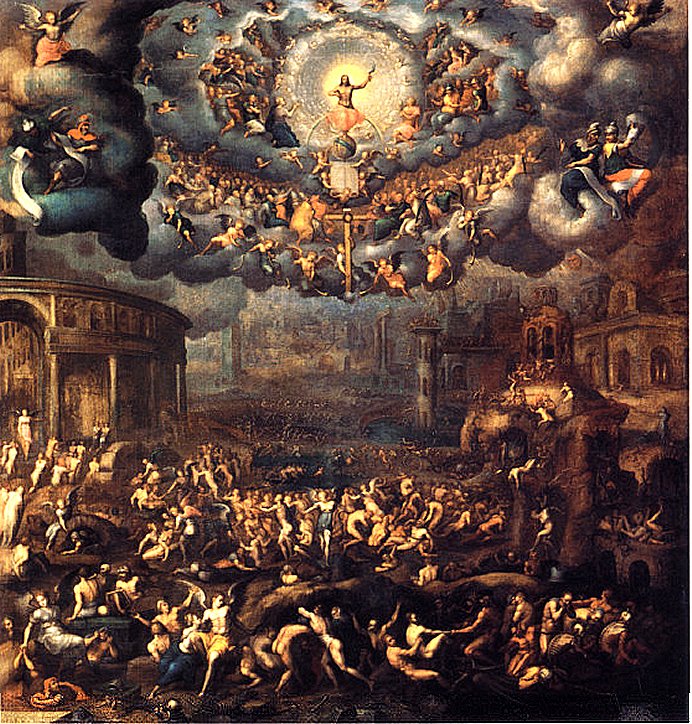
Come Lord Jesus! A Meditation on the Stunning Glory of Being Gathered to Christ on the Last Day

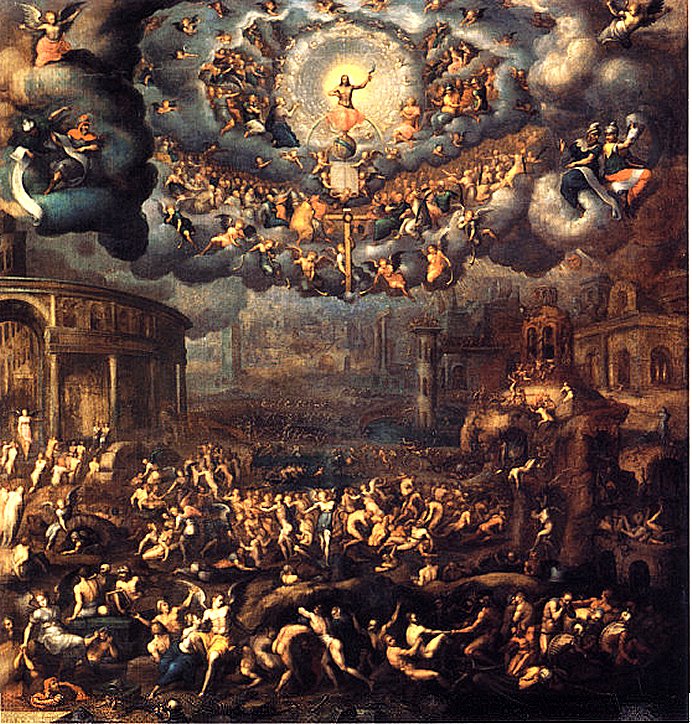
120914In Advent, as we continue to meditate on the Parousia (the magnificent Second Coming of the Lord), we do well to allow our imaginations to be engaged in contemplating the glory that awaits those who are faithful, to meditate on the joy and ecstasy of the culmination of all things!

Though we have soberly meditated on the need to be ready and on the great danger that many who are not serious may be lost, for those who ARE ready, what glories await! The great and terrible day of the Lord will indeed be great for those who have allowed the Lord to prepare them.

I was stirred this past month in reading a magnificent book by Cardinal Jean Danielou on Angelology (usually pronounced an-GELL-o-gee), the study of angels. The book is entitled The Angels and their Mission: According to the Fathers of the Church. It is must reading and very accessible—only 114 pages—but packed full of stirring and edifying accounts of the wonderful works of the angels, according to Scripture and the Fathers of the Church.

The final chapters on the eschaton (the last things) and the Parousia (the Second Coming) are particularly magnificent. I would like to distill them here, adding some material and reworking it just a bit. However, the research is that of Jean Cardinal Danielou. I hope you will be stirred with as much joy and zeal as I was in reading and preparing this material. And thus we proceed:

Perhaps as a beginning point, we may wonder what happens to the ministry of our Guardian Angel when we die. Even if our souls are in heaven, our bodies are still awaiting the resurrection. Ancient Christian tradition maintains that during this time the angels keep watch over the tombs of the saints. In the Jewish apocalyptic book The Assumption of Moses, it is said that Joshua saw Moses’ soul rising to Heaven with the angels (40:1–7). However, the Epistle of Jude also says that the Archangel Michael fiercely disputed with the devil about the body of Moses (cf Jude 1:9). Stories such as these, combined with the ancient Christian practice of frequently depicting angels in cemetery art and funeral monuments, indicate a role for the angels in guarding the bodily remains of the elect, even those sadly scattered about or buried in the depths of the sea.

Scripture is replete with descriptions of the role of angels in the great Second Coming of the Lord. In the Gospel of Matthew there is a text that may refer to 70 AD, but surely also describes the end of time:

Then will appear the sign of the Son of man in heaven, and then all the tribes of the earth will mourn, and they will see the Son of man coming on the clouds of heaven with power and great glory; and he will send out his angels with a loud trumpet call, and they will gather his elect from the four winds, from one end of heaven to the other (Matt 24:30-31).

The first epistle to the Thessalonians also says,

For the Lord himself will descend from heaven with a cry of command, with the archangel’s call, and with the sound of the trumpet of God. And the dead in Christ will rise … (1 Thess 4:16).

St Cyril goes on to describe the extraordinary magnificence that the presence of the immense multitude of angels gives to the final judgment. He considers how the great depth and breadth of the spiritual world has been invisible until now, except to the eyes of faith. But suddenly it is made manifest! He asks us to try to imagine the immense multitude of angels by considering the vast numbers of human beings who ever existed, from the time of Adam to the present day, now standing before the Lord Jesus. And then he asks us to imagine that the angels are vastly more numerous than we are. For they are the 99 sheep whereas humanity is but the one sheep! Such vast numbers can only be spoken of as myriads and myriads! Or as Daniel poetically says,

Thrones were set up and the Ancient of Days took his throne. His clothing was white as snow, the hair on his head like pure wool; His throne was flames of fire,  with wheels of burning fire. A river of fire surged forth,  flowing from where he sat;  Thousands upon thousands were ministering to him,  and myriads upon myriads stood before him (Dan 7:9-10).

Such a vision and such multitudes can hardly be imagined.

Of course the first step in assembling this Great Judgement is to wake the dead. And the angels are surely part of this: 

The Second Sibylline Book, a Christian work, describes the archangels shattering the gates of death, raising up even the bodies of those who had been drowned in the sea or whom savage beasts had devoured (Sib, 2:214–235).

St. Ephrem speaks of the angels as waking the dead, and says,

Then the Lord will appear in the heavens like lightning with an unspeakable glory. The Angels and the Archangels will go on before his glory like flames of fire, like a mighty torrent. The Cherubim will turn their faces and the Seraphim will fly ahead crying out in fear: “Arise, you who sleep. Behold the bridegroom is coming!” Then the tombs will be opened and in the flash of an eye all the people will rise and behold the beauty of the Bridegroom.

St. Paul says that our bodies will rise, truly our bodies, but gloriously transformed:

He will change our lowly body to conform with his glorified body by the power that enables him also to bring all things into subjection to himself (Phil 3:21).

So will it be with the resurrection of the dead. The body that is sown is perishable, it is raised imperishable; it is sown in dishonor, it is raised in glory; it is sown in weakness, it is raised in power (1 Cor 15:42).

Then of course Comes the Judgment by Christ and the here too the angels execute that Judgement:

Matthew 13 describes the angels as separating the wicked from the just:

The Son of man will send his angels, and they will gather out of his kingdom all causes of sin and all evildoers, and throw them into the furnace of fire; there men will weep and gnash their teeth. Then the righteous will shine like the sun in the kingdom of their Father (Mat 14:41-43).

And Matthew 25 describes the angels as with Christ when He takes His judgment seat:

When the Son of man comes in his glory, and all the angels with him, then he will sit on his glorious throne. Before him will be gathered all the nations, and he will separate them one from another as a shepherd separates the sheep from the goats (Matt 25:31-32)

St Cyril of Jerusalem speaks of the angels leading the sinners away, body and soul, “in the full sight of the armies of heaven and they will be unable to escape.” But the angels are also uniting the just.

So, on the one hand, Matthew 13 describes the angels leading evildoers away:

The Son of Man will send his angels, and they will collect out of his kingdom all who caused others to sin and all evildoers. They will throw them into the fiery furnace (Mat 13:41-42).

On the other hand, St Ephrem also goes on to describe the angels leading the elect to paradise:

Then the angels will come together from all sides and take up the holy and faithful people into the glory of the clouds above, to their meeting place with Christ.

Origen also speaks of the angels escorting the blessed to paradise:

When … we have begun to enter the holy place and pass on to the promised land, those who are really holy and whose place is the Holy of Holies will make their way, supported by the angels and unto the tabernacle of God … They will be carried on [the angels’] shoulders and raised up by their hands.

St Paul seems to speak to the same glory when he writes to the Thessalonians,

The dead in Christ will rise first. Then we who are alive, who are left, will be caught up together with them in the clouds to meet the Lord in the air. Thus we shall always be with the Lord. (1 Thessalonians 4:17).

The Fathers of the Church then consider and imagine the joy (and relief) of the angels whose long work is now done. Of this final culmination, Scripture says,

The last enemy to be destroyed is death. “For God has put all things in subjection under [Jesus’] feet.” But when it says, “All things are put in subjection under him,” it is plain that he [the Father] is excepted who put all things under him. When all things are subjected to him, then the Son himself will also be subjected to him who put all things under him, that God may be everything to every one (1 Cor 15:26-28).

And thus, having gone forth to execute judgment, Jesus now returns to His Father’s right, in the Holy Of Holies. He ascends there, now with all the members of His body (body and soul) joined to Him. He ascends to the throne as Unus Christus, amans seipsum (one Christ, loving Himself). And though co-equal to His Father in glory and majesty, He is delighted to hand over the Kingdom of His Body, the Church, to His Father, who is, as Father, the Principium Deitatis.

And at this ascension, the Fathers ponder that the angels will make the same declaration, the heavens echoing with their cry:

 Lift up your heads, O gates! and be lifted up, O ancient doors! that the King of glory may come in. Who is the King of glory?  The Lord, strong and mighty, the Lord, mighty in battle! Lift up your heads, O gates! and be lifted up, O ancient doors!  that the King of glory may come in. Who is this King of glory?  The Lord of hosts, he is the King of glory! (Psalm 24: 7-10)

And there shall then come to pass the transformation of all creation and the fulfillment of its longing for its share in the glorious freedom of the Children of God, as prophesied through St. Paul:

For the creation waits with eager longing for the revealing of the sons of God; for the creation was subjected to futility, not of its own will but by the will of him who subjected it [because of our sins]. But the creation itself will be set free from its bondage to decay and obtain the glorious freedom of the children of God. We know that the whole creation has been groaning in travail together until now; and not only the creation, but we ourselves, who have the first fruits of the Spirit, groan inwardly as we wait for adoption as sons, the redemption of our bodies … (Rom 8:19-25).

And now it comes! Heaven and earth are united and creation receives its original glory and more besides, for the heavenly realities are now joined to the earth, beautifully restored and raised. Again, as Scripture says,

Then I saw a new heaven and a new earth; for the first heaven and the first earth had passed away, and the sea was no more. And I saw the holy city, new Jerusalem, coming down out of heaven from God, prepared as a bride adorned for her husband; and I heard a loud voice from the throne saying, “Behold, the dwelling of God is with men. He will dwell with them, and they shall be his people, and God himself will be with them; he will wipe away every tear from their eyes, and death shall be no more, neither shall there be mourning nor crying nor pain any more, for the former things have passed away.” And he who sat upon the throne said, “Behold, I make all things new” (Rev 21:1-5).

Cardinal Danielou beautifully concludes,

On that day, the joy of the friends of the Bridegroom, [the angels] will be complete. They have led to paradise the souls of the just who are entrusted to them. They have kept watch over their mortal remains. But [for now] they still await the day in which the Bridegroom will come to look for his Bride, when her beauty is finally perfect, in order to lead her into the House of his Father for the eternal wedding feast (p. 114).

Of this magnificent beauty, St. Methodius says to us,

Oh dearly beloved, [the angels]  burn to see the day of your marriage, all the angels Christ has called from heaven. They will come, O Lord, O Word, and they will carry with them mighty gifts, in their spotless robes.

Thus we shall always be with the Lord (1 Thess 4:17).

The Spirit and the Bride say, “Come.” … He who testifies to these things says, “Surely I am coming soon.” Amen. Come, Lord Jesus! The grace of the Lord Jesus be with all the saints. Amen.  (Rev 22:17; 20-21).
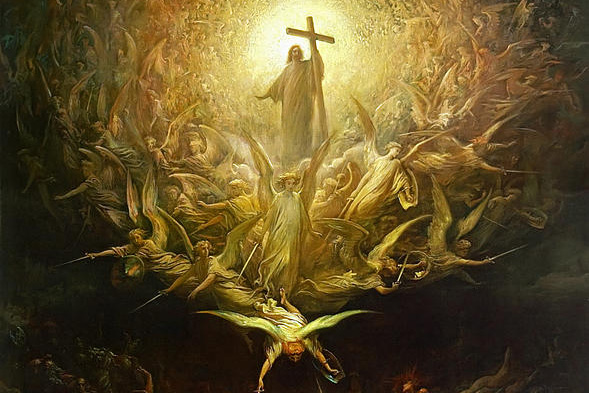
The "Great Gettin’ Up Morning" as Described in an Unlikely Advent Hymn

120814Here in the heart of Advent, we are considering how prepared we are for the Lord to come again. Either He will come to us or we will go to Him, but either way we must prepare. In today’s post I’d like to consider some teachings about the Day of Judgment, from an Advent hymn that most do not know is an Advent hymn. Tomorrow I would like to consider the great Parousia, wherein the saved enter into glory with the Lord.

Regarding the “Great and Terrible Day of the Lord, Judgment Day,” I am of the mind that one of the great treasures and masterpieces of the Church’s Gregorian Chant is the current sequence hymn for Latin Requiem Masses, the Dies Irae. This gorgeous chant was one of the more beautiful and soaring melodies of Gregorian Chant, and many composers such as Mozart and Verdi set the text to stirring musical compositions.

But the hymn was not in fact composed for funerals. Actually, it was composed, by Thomas of Celano in the 13th century, as an Advent hymn. Yes, that’s right, an Advent hymn. Don’t forget that Advent isn’t just about getting ready for Christmas; it is also about getting ready for the Second Coming of the Lord. And that is what this hymn is really about. At this time of year, as the the leaves fall and summer turns to winter, we are reminded of the passing of all things. The Gospels we read are those that remind us of death and the judgment to come.

Journey with me into the beauty and solemn majesty of this hymn. I will offer an inspiring English translation by W. J. Irons, one that preserves the meter and renders the Latin well enough. (You can see the Latin Text along with English here: Dies Irae.) I will also offer the scriptural verses that serve as background to the text.

The syllables of this magnificent hymn hammer away in trochaic dimeter: Dies irae dies illa solvet saeclum in favilla, teste David cum Sybila!  Perhaps at times it is a bit heavy, but at the same time, no hymn more beautifully sets forth a basis for God’s mercy. The dark clouds of judgment part and give way to the bright beauty of the final line: Pie Jesu Domine, dona eis requiem (Sweet Jesus Lord, give them [the dead] rest).

The hymn opens on the Day of Judgment warning that the day will reveal God’s wrath upon all injustice and unrepented sin. God’s wrath is His passion to set things right. And now it is time to put an end to wickedness and lies:

    • Day of wrath and doom impending,
    • Heaven and earth in ashes ending:
    • David’s words with Sibyl’s blending.

Yes, all are struck with a holy fear! No one and no thing can treat this moment lightly: all are summoned to holy fear. The bodies of the dead come forth from their tombs at the sound of the trumpet and all of creation will answer to Jesus, the Judge and Lord of all. Consider two scriptural roots to this first verse:

  1. (Zeph 1:15-18) A day of wrath is that day, a day of distress and anguish, a day of ruin and devastation, a day of darkness and gloom, a day of clouds and thick darkness, a day of trumpet blast and battle cry against the fortified cities and against the lofty battlements. I will bring distress on men, so that they shall walk like the blind, because they have sinned against the Lord; their blood shall be poured out like dust, and their flesh like dung. Neither their silver nor their gold shall be able to deliver them on the day of the wrath of the Lord. In the fire of his jealous wrath, all the earth shall be consumed; for a full, yea, sudden end he will make of all the inhabitants of the earth.
  2. (2 Peter 3:10-13) But the day of the Lord will come like a thief, and then the heavens will pass away with a loud noise, and the elements will be dissolved with fire, and the earth and the works that are upon it will be burned up … the heavens will be kindled and dissolved, and the elements will melt with fire!

The “Sibyl” referred to here is most likely the Erythraean Sibyl, who wrote an acrostic on the name of the Christ in the Sibylline Oracles. These will figure prominently in tomorrow’s meditation on the Parousia.

And now the stunning, opening stunning scene of creation. All have been set aghast; our rapt attention turns to Jesus, who has come to judge the living and the dead and the whole world by fire:

    • Oh what fear man’s bosom rendeth
    • When from heaven the judge descendeth
    • On whose sentence all dependeth!
    • Wondrous sound the trumpet flingeth,
    • Through earth’s sepulchers it ringeth,
    • All before the throne it bringeth.
    • Death is struck and nature quaking,
    • All creation is awaking,
    • To its judge an answer making.
    • Lo the book exactly worded,
    • Wherein all hath been recorded,
    • Thence shall judgment be awarded.
    • When the Judge his seat attaineth,
    • And each hidden deed arraigneth:
    • Nothing unavenged remaineth.

Here, too, many Biblical texts are brought to mind and masterfully united. Here are just a few of them:

  1. (Matt 25:31-33) When the Son of man comes in his glory, and all the angels with him, then he will sit on his glorious throne. Before him will be gathered all the nations, and he will separate them one from another as a shepherd separates the sheep from the goats, and he will place the sheep at his right hand, but the goats at the left …
  2. (Matt 24:30-32)  And then shall appear the sign of the Son of man in heaven. And then shall all tribes of the earth mourn: and they shall see the Son of man coming in the clouds of heaven with much power and majesty.  And he shall send his angels with a trumpet and a great voice: and they shall gather together his elect from the four winds, from the farthest parts of the heavens to the utmost bounds of them.
  3. (Rev 20:12) And I saw the dead, great and small, standing before the throne, and books were opened. Another book was opened, which is the book of life. The dead were judged according to what they had done as recorded in the books.
  4. (Rom 2:4-6) Do you not know that God’s kindness is meant to lead you to repentance? But by your hard and impenitent heart you are storing up wrath for yourself on the day of wrath when God’s righteous judgment will be revealed. For he will render to every man according to his works:
  5. Luke 12:3 What you have said in the dark will be heard in the daylight, and what you have whispered in the ear in the inner rooms will be proclaimed from the roofs.
  6. 2 Peter 3:14 and the earth and everything done on it will be found out.

So, Judgment shall be according to our deeds; whatever is in the Book! Ah, but also in God’s Word is the hope for mercy. And so our hymn turns to pondering the need for mercy, and appeals to God for that mercy, basing it on the very will of God to save us. Was He not to be called Jesus because He would save us from our sins? (Mt 1:21) Did not God so love the world that He sent His own Son? And did He not come to save rather than condemn? (Jn 3:16-17) Did He not endure great sorrows and the cross itself to save us? Ah, Lord, do not now forsake me as I ponder my last end. Keep me faithful unto death!

    • What shall I frail man be pleading?
    • Who for me be interceding?
    • When the just are mercy needing?
    • King of majesty tremendous,
    • Who does free salvation send us,
    • Font of pity then befriend us.
    • Think kind Jesus, my salvation,
    • Caused thy wondrous incarnation:
    • Leave me not to reprobation.
    • Faint and weary thou hast sought me:
    • On the cross of suffering bought me:
    • Shall such grace be vainly brought me?
    • Righteous judge for sin’s pollution,
    • Grant thy gift of absolution,
    • Before the day of retribution.
    • Guilty now I pour my moaning:
    • All my shame and anguish owning:
    • Spare, O God my suppliant groaning.
    • Through the sinful Mary shriven,
    • Through the dying thief forgiven,
    • Thou to me a hope has given.

Yes, there is a basis for hope! God is rich in mercy. Pondering the Day of Judgment is salutary, since for now we can call on that mercy. For of that day, though there will be wailing and grinding of teeth at a just condemnation, such tears will be of no avail then (Mt 13:42). Please Lord, let me not be with the goats at the left, but with the sheep on the right (Mt 25:33). And in the end, it is only grace and mercy that can see us through that day. Only you, Jesus, can save me from the wrath to come (1 Thess 1:10):

    • Worthless are my tears and sighing:
    • Yet good Lord in grace complying,
    • Rescue me from fire undying.
    • With thy sheep a place provide me,
    • From the goats afar divide me,
    • To thy right hand do thou guide me.
    • When the wicked are confounded,
    • Doomed to flames of woe unbounded:
    • Call me with thy saints surrounded.
    • Lo I kneel with heart-submission,
    • See like ashes my contrition:
    • Help me in my last condition.

And now comes the great summation: that day is surely coming! Grant me O Lord your grace to be ready; prepare me:

    • Lo, that day of tears and mourning,
    • from the dust of earth returning.
    • Man for judgment must prepare him,
    • Spare O God, in mercy spare him.
    • Sweet Jesus Lord most blest,
    • Grant the dead eternal rest.

It is a masterpiece of beauty and truth, if you ask me. Some years ago, I memorized most of it. I sing it from time to time over in Church late at night, the hauntingly beautiful chant ringing through her echoing arches. When I die, please sing it at my funeral! For I go to the Lord, the judge of all, and only grace and mercy will see me through. Perhaps the plaintive calls of the choir below at my funeral will resonate to the very heavens as I am judged. Amen.

Celebrating the Spirituals: Sober but Serene on Themes of Judgment

120314
“Soweto Gospel Choir” by www.sowetogospelchoir.com/History.html Licensed under CC BY-SA 1.0 via Wikipedia

I’ve often been impressed at the ability of the old African-American spirituals to treat serious subjects in a clear, memorable, and almost joyful way. This is true even of very weighty matters like sin and judgment.  And while we are here in the opening weeks of Advent, quite focused on the Second Coming of Jesus to judge the world by fire, we do well to look at some of the creative lines from different spirituals that articulate this theme.

It can be very helpful to the preacher, teacher, and parent to help recover an ethos of coming judgment, but in a way that is almost playfully bright while at the same time deeply soulful.

In a certain sense, the Spirituals are unimpeachable even by hypersensitive post-moderns who seek to shame the preacher for announcing the sterner biblical themes. Most of the spirituals were written by slaves, who creatively worked biblical themes into these songs, songs that helped accompany their work as well as their worship.

As such, they were written in the cauldron of great suffering. If any people might be excused from thinking that the Lord would exempt them from judgment day, it is surely the enslaved in the deep South. If any people might be excused from crying out for vengeance, it is those enslaved in the South. And yet the spirituals are almost wholly devoid of condemning language; enslaved blacks sang in ways that looked also to their own sins and need to be prepared. If they were prepared, God, who knew their trouble, would help them to steal away to Jesus. They did not see themselves as exempt from the need to be ready.

If they, who worked hard in the cotton fields and endured the horrors of slavery, thought these texts applied to them, how much more do they apply to us, who recline on our couches and speak of our freedom to do as we please?

So let’s sample some of these lines from numerous spirituals that speak to judgment and the last things:

1. I would not be a sinner, I’ll tell you the reason why. I’m afraid my Lord might call my name and I wouldn’t be ready to die.

2. Some go to Church for to sing and shout, before six months they’s all turned out! 

3. Everybody talkin’ ’bout heaven aint a goin’ there, Oh my Lord!

4. Where shall I be when the first Trumpet sounds, Oh where shall I be when it sounds so loud, when it sounds so loud as to wake up the dead, Oh where shall be when it sounds. How will it be with my poor soul, Oh Where Shall I be?

5. Better watch my brother how you walk on the cross! Your foot might slip and your soul get lost!

6. God gave Noah the rainbow sign, no more water but the fire next time!

7. Old Satan wears a hypocrite’s shoe, If you don’t watch he’ll slip it on you! 

8. Noah, Noah let me come in!
The Doors are fastened and the windows pinned!  fast’ned an’ de winders pinned
Noah said, “Ya lost your track
Can’t plow straight! you keep a-lookin’ back!

9. Knock at the window knock at the door
Callin’ brother Noah
Can’t you take more?!
No said Noah cause you’re full of sin!
God has the key you can’t get in!

10. Well I went to the rock to hide my face
The rock cried out, no hiding place
There’s no hiding place down here
Oh the Rock cried I’m burnin too!
I wanna go to heaven just as much as you!

11. Oh sinner man better repent!
Oh you’d better repent
for God’s gonna call you to judgment
There’s No hiding place down there!

12. No signal for another train
To follow in this line
Oh sinner you’re forever lost
When once you’re left behind.
She’s nearing now the station
Oh, sinner don’t be vain
But come and get your ticket
Be ready for that train!

13. Sinner please don’t let this harvest Pass
And die and lose your soul at last.

14. My Lord, what a morning, When the stars begin to fall
You’ll hear the trumpet sound, To wake the nations underground
Looking to my God’s right hand,
When the stars begin to fall
You’ll hear the sinner moan, When the stars begin to fall
You’ll hear the Christian shout,
Oh, When the stars begin to fall!

Most of these songs are deeply scriptural and make serious appeals to the human soul, but they do so in a way that is creative. They get you tapping your foot and invite you to a joyful consideration of the need to repent before it’s too late. Others are more soulful, even mournful, in their pentatonic scale.

Given all the reticence to discuss the four last things (death, judgment, Heaven, and Hell), songs like these may help to reopen the door to necessary conversations between preacher and congregation, parents and children. They are a valuable resource.

I have attached to this post a brief treatment of the some of the scriptural roots of these spirituals. You can read that hereEschatological Spirituals

I’d like to conclude with a creative spiritual about the Last Judgment that is featured in the video below. Note that it is rich in biblical references. It is joyful—a real toe-tapper—and makes a serious point along with a wish: “In That Great Gettin’ Up Mornin Fare You Well!” First, the text (with phonetic spelling), and then the video:

I’m Gonna tell ya ’bout da comin’ of da judgment
Der’s a better day a comin’,
Fare thee well, fare thee well!

Chorus:
In dat great gettin’ up mornin’,
Fare thee well, fare thee well
In dat great gettin’ up mornin’,
Fare thee well, fare thee well

Oh preacher fold yo’ bible,
For dat last souls converted,
Fare thee well, fare thee well

Blow yo’ trumpet Gabriel,
Lord, how loud shall I blow it?
Blow it right and calm and easy,

Do not alarm all my people,
Tell dem all come to da judgment,
Fare thee well, fare thee well!

Do you see dem coffins burstin,
do you see dem folks is risin’
Do you see dat fork of lightenin’,
Do you hear dat rumblin’ thunder ?!?
Fare thee well, fare thee well!

Do you see dem stars a fallin’,
Do you see da world on fire?!?
Fare thee well, fare thee well

Do you see dem Saints is risin’,
Fare thee well, fare thee well
See ’em marchin’ home for heaven,
Fare thee well, fare thee well

Oh! Fare thee well po’r sinners, fare thee well, fare thee well
Fare thee well po’r sinners, fare thee well, fare thee well!

There are many good version of this out on YouTube. I picked this particular one because the lyrics are easier to make out than in some other renditions. Enjoy!

Here are a few more spirituals. Listen especially to the verses.

Blessed (and also very smart) are the Merciful

031214
by RRKennison|Rebecca K Licensed under Creative Commons

If, on the way to court, you received advice on how you could influence the judge to be less severe in your case, would you not consider following that advice? Surely you would, unless the “way” involved bribery, or something corrupt.

And in fact Jesus, our very judge, has described an upright way that we can avoid severity on the Day of Judgment. Simply put, the way is for us to show mercy.

Now I don’t know about you, but I am going to need a lot of mercy on the Day of Judgment. So I, and probably you as well, am glad that the Lord has shown how we can positively influence the Day we are judged and see that mercy is magnified. Consider some of the following texts:

  1. Blessed are the merciful, for they will be shown mercy. (Matt 5:7)
  2. For if you forgive men when they sin against you, your heavenly Father will also forgive you. But if you do not forgive men their sins, your Father will not forgive your sins. (Matt 6:14-15)
  3. Speak and act as those who are going to be judged by the law that gives freedom, because judgment without mercy will be shown to anyone who has not been merciful. But mercy triumphs over judgment! (James 2:12-13)
  4. If a man shuts his ears to the cry of the poor, he too will cry out and not be answered. (Proverbs 21:13)
  5. Do not condemn, and you will not be condemned. Forgive, and you will be forgiven. (Luke 6:37)
  6. For the measure with which you measure others, will be the measure by which you are measured (Mark 4:24)
  7. And then there is the terrifying parable too long to quote here of the man who owed a huge debt he could never repay. The king cancelled the whole debt. But the man refused to cancel the debt of one who owed him a smaller amount. To this unmerciful man the King then decreed: You wicked servant,’ he said, ‘I canceled all that debt of yours because you begged me to. Shouldn’t you have had mercy on your fellow servant just as I had on you?’ In anger his master turned him over to the jailers to be tortured, until he should pay back all he owed. “This is how my heavenly Father will treat each of you unless you forgive your brother from your heart.” (Matt 18:32-35)

So the basic point is clear enough: if we want to be shown mercy in our judgment (and trust me, we’re all going to need a LOT of it), then we need to pray for a merciful heart.

Let’s go so far as to say that if anyone is harsh, mean-spirited, unforgiving, hypercritical, or condemning, he is a fool. He is simply storing up wrath for himself on the Day of Judgment. Now why do that?

Mercy is our only hope of avoiding strict judgment. And these texts show us that mercy here will lead to mercy there.

It is true that there are times in this world when punishments must be issued and penalties assessed. But to the degree that these are made with an eye to correction and reform, they are part of love, and relate to mercy. For fraternal correction is a work of charity. It is better to suffer punishment here that leads to reform, than to evade punishment here and possibly end in hell. Thus, not all punishment is excluded by the edict of mercy, but, only let mercy and love be the sources from which it comes.

So, some advice to the wise: bury the hatchet now. Ask the Lord for a merciful and forgiving heart, or suffer the full force of a strict judgment. Pay attention! The judge is willing to be influenced on our behalf and has signaled what will move him in our direction. Why hesitate any longer? The merciful are blessed because they are going to be shown mercy. And without mercy, we don’t stand a chance.

Here is the great Miserere by Allegri. The text, sung in Latin is Psalm 51 which begins, “Have Mercy on me Lord in your great mercy.”


Some Standards and Concerns Jesus will NOT have on the Day of Judgment

We human beings tend to assess our relative status and success based on things like money, possessions, popularity, career, and power. Am I wealthy and well-connected? Do I have a large house with a great room, cathedral ceilings, granite counter tops, and numerous widescreen TVs (even in strange places like the bathroom)? Do I have a glamorous career instead of a “demeaning” job? Do I have good looks (through big hair, cosmetics, or even plastic surgery)? From a worldly perspective, all of these things mean that I am successful, that my life has reached its goal, that I have made it to the top.

But of course none of this really matters to God. Even worse, it may even negatively configure us for the day of judgment. Too often, we amass great worldly riches, but are poor in what matters to God.

Do we honestly think that God will be impressed by many of the things that impress us? Does God measure success by our standards? Countless Bible verses teach that the answer to this is a definitive “no.”

Summarizing his inverse stance to all we hold glorious, God says,

  1. For My thoughts are not your thoughts, Nor are your ways My ways,” declares the LORD For as the heavens are higher than the earth, So are My ways higher than your ways And My thoughts than your thoughts. (Is 55:8-9).
  2. Or again, Many who are last shall be first (Matt 19:30).
  3. Or yet again, (speaking of the rich man who built bigger barns) Thus will it be for the one who stores up treasure for himself but is not rich in what matters to God (Luke 12:21).

And thus on the day of judgment, it does not seem that God will be impressed by some of the following human benchmarks for success:

1. How much money was in your bank account when you died. In and of itself, acquired wealth is not intrinsically evil. The Lord made no universal condemnation of wealth.

However, wealth carries with it great responsibility.  The Lord is not impressed with our six- or seven-figure income. Rather he is interested in what we did with it.

Were the poor blessed? Were jobs created? Did you use the excess of your wealth to bless the common good in some way? This need not mean that you indiscriminately threw money about to those who could not reasonably use it well. It might mean that you used it to develop new technologies that created new job sectors. It could mean that you endowed worthy and holy causes. It could mean any number of things. But the bottom line is that your excess wealth should benefit others, not simply glorify you.

Dying with lots of money in your portfolio does not impress the Lord so much as it will create a responsibility in you who died with it. Whatever wealth you have beyond what you reasonably need really belongs to others, and should be applied intentionally toward the welfare, the goodness, and the growth of others. Wealth carries grave responsibilities. Before we simply boast of it, we ought to remember that those with wealth and power will be judge more strictly. Scripture says,

Command those who are rich in this present world not to be arrogant nor to put their hope in wealth, which is so uncertain, but to put their hope in God, who richly provides us with everything for our enjoyment. Command them to do good, to be rich in good deeds, and to be generous and willing to share. In this way they will lay up treasure for themselves as a firm foundation for the coming age, so that they may take hold of the life that is truly life (1 Timothy 6:17-19).

2. How much money you left to your children as an inheritance. It’s a nice thing to leave a little something for your kids. But inheriting vast amounts of wealth is not necessarily a good thing. It creates the illusion that fruitfulness can or should be obtained without labor.

It does not take much study of the lives of children of the rich and famous to discover that pampering is a huge issue. Add to this the many warnings about wealth in Scripture and it starts to seem that leaving lots of money to your kids is almost like setting a snare for them. Consider the following:

  1. But if we have food and clothing, we will be content with that. Those who want to get rich fall into temptation and a trap and into many foolish and harmful desires that plunge people into ruin and destruction. For the love of money is a root of all kinds of evil. Some people, eager for money, have wandered from the faith and pierced themselves with many griefs (1 Tim 6:8-10).
  2. And Jesus said to His disciples, “Truly I say to you, it is hard for a rich man to enter the kingdom of heaven. “Again I say to you, it is easier for a camel to go through the eye of a needle, than for a rich man to enter the kingdom of God” (Matt 19:23-24).
  3. The seed falling among the thorns refers to someone who hears the word, but the worries of this life and the deceitfulness of wealth choke the word, making it unfruitful (Matt 13:22).

Again, let it be said that money is not intrinsically evil. But if heaven is the goal, and the Lord warns consistently that wealth is dangerous at best and an obstacle at worst, then loading kids up with wealth and material things is problematic and not something that will likely impress the Lord on the day of judgment.

Yet even knowing that wealth is dangerous and makes it hard for us to inherit Heaven, we still want it, congratulate ourselves for having it, and then saddle our kids with it (congratulating ourselves still further). And if we think the Lord is going to be impressed with all this amassing and bequeathing, we probably have another think coming.

3. What the square footage of your dream home amounted to. Most of us who are over 50 grew up in homes of 1200–1500 square feet.  And we thought these were spacious compared to the little tenements and row houses of the previous generation.

Many people now think it is reasonable to demand square footage of 5000 or more. And they further demand many amenities such as a great rooms with cathedral ceilings, master suites with tray ceilings, granite countertops, multiple televisions, and walk-in closets the size of the room I shared with my brother!

But the Son of man had nowhere to lay his head. And Jeremiah warns,

Does it make you a king to have more and more cedar paneled walls? Did not your father have food and drink? He did what was right and just, so all went well with him. He defended the cause of the poor and needy, and so all went well. Is that not what it means to know me?” declares the Lord. …I warned you when you felt secure, but you said, ‘I will not listen!’ This has been your way from your youth; you have not obeyed me. You who are nestled in cedar buildings, how you will groan when pangs come upon you, pain like that of a woman in labor! (Jeremiah 22:15ff)

In other words, it is nice to have a fancy house, but how does it affect our ability to help the poor or to stay focused on spiritual things? Therefore watch out; not only is God unimpressed with  your square footage, he is quite worried about it. Our houses are bigger but emptier. We have fewer children (with widespread contraception and abortion), but bigger houses.  They are emptier, but still they must be bigger and bigger.  There is more and more contraception, more and more abortion, but there is no room in our bigger houses, no room at all! There is no room for the poor, no room to adopt or raise foster children, no room for children of our own. There’s no room for anything but our bigger egos.

4. That you provided a college education for all your children. I know, I know, I’ve attacked a major sacred cow. It is almost universally unquestioned that a college education unlocks the future for the recipient of it.

I only seek to point out major concerns that ought to be considered. First of all, those who seek to acquire these degrees are often exposed to four or more years of a moral cesspool.  They are taught moral relativism and many other things that are unambiguously hostile to the faith we supposedly hold dear. For the majority of young people exposed to this, it will be years (if ever) before they return to their faith.

There are valid options available, but most parents give little attention to good Catholic colleges (such as those the Newman Society recommends) if they can get their kid into Harvard or Yale or “once-Catholic” colleges like Georgetown. Almost no one counts the moral, psychological, and spiritual cost of being educated in these sorts of secular and often pernicious institutions we call higher education.

But even then, one might argue that with a solid grounding in the faith it would be okay. But sadly, while many parents will make incredible sacrifices to send their children to these institutions of so-called higher learning, most lift almost not a finger to teach them the faith that alone can save them. So they make great sacrifices for their children to be able to climb the ladder of success, never considering that it is leaning up against the wrong wall. They send them to moral cesspools but seem more concerned for their grades than for their moral or spiritual lives.

Hence on the day of judgment, the Lord will be less than impressed that you sent your child to an Ivy League school or even to a state college. What he WILL wonder and what WILL impress him is that you handed on to him or her the holy faith that He revealed.

Too harsh you say? Forgive me dear reader. If the shoe fits wear it, otherwise, let it pass over you. But for many, the shoe fits all too well.

5. Whether you were popular and all spoke well of you at your funeral. While we are not called to be sociopaths who care not one wit about what others think, too many of us have turned being nice, being liked, and being esteemed by men into an ideal.

But Jesus was nailed to a cross. And so Jesus also suffered outside the city gate to make the people holy through his own blood. Let us, then, go to him outside the camp, bearing the disgrace he bore (Hebrews 13:12-13).

Are you greater than Jesus? He says,

If the world hates you, you know that it has hated Me before it hated you. If you were of the world, the world would love its own; but because you are not of the world, but I chose you out of the world, because of this the world hates you (Jn 15:18-19).

Jesus will not be impressed that you were esteemed by human beings. He warns, Woe to you when all men speak well of you (Lk 6:26). Rather, Jesus will be impressed that you and I were willing to speak the truth in love and were willing to bear insult for the sake of the Kingdom.

On Judgment Day, fare you well! But be sure of this: the Lord will not use the standards we are so obsessed by. We need to come to a new mind to get ready for Judgment Day! Fare you well.

Where Will You Be When the First Trumpet Sounds? A Good Question Asked in An Advent Hymn

120113Part of the Genius of the African American Spirituals is their ability to treat of serious themes, such as the final judgment, in a creatively compelling manner that steered a middle course between unproductive fear and prideful presumption. Some of them are even playful saying things like, I would not be a sinner, I’ll tell you the reason why. I’m afraid my Lord might call my name, and I wouldn’t be ready to die! Another song says, Satan wears a hypocrite’s shoe, If you don’t watch, he’ll slip it on you! Yet another song warns with love: In that great gettin up morning, fare you well, fare you well! Or fare you well poor sinner, fare you well!

Some of the early African American hymns from the late 19th Century also draw heavily on this tradition. One such hymn is “Where Shall I Be When the First Trumpet Sounds?!” by  Charles P. Jones (1865-1949). The hymn consists in applying this question, “Where shall I be” to a litany of biblically based descriptions about the Second Coming of Jesus,  when He will  judge the world by fire. Each verse is steeped in rich biblical tradition and provides us a series of good advent reflections, all rooted in the essential Advent focus of second coming of the Lord Jesus.

As I sing it with my congregation each Advent, I am reminded of the familiar themes of another masterpiece, the ancient Dies Irae. That hymn too is richly biblical and I have treated of it HERE.

But as for this fine hymn, Where Shall I Be, let’s take a look at each line, asking the question, Where shall I be? I provide a biblical background for each verse and question that might help us since the rich tapestry of faith.

First, here is the hymn in toto, and then a line by line biblical lexicon, with brief commentary by me. Since this is a longish post I have put it here in PDF for you to print and read later. The hymn can be heard in the video at the bottom.

When judgment day is drawing nigh,
Where shall I be?
When God the works of men shall try,
Where shall I be?
When east and west the fire shall roll,
Where shall I be?
How will it be with my poor soul:
Where shall I be?

Refrain

O where shall I be when the first trumpet sounds,
O where shall I be when it sounds so loud?
When it sounds so loud as to wake up the dead?
O where shall I be when it sounds?

When wicked men His wrath shall see,
Where shall I be?
And to the rocks and mountains flee,
Where shall I be?
When hills and mountains flee away,
Where shall I be?
When all the works of man decay,
Where shall I be?

Refrain

When Heav’n and earth as some great scroll,
Where shall I be?
Shall from God’s angry presence roll,
Where shall I be?
When all the saints redeemed shall stand,
Where shall I be?
Forever blest at God’s right hand,
Where shall I be?

Lexicon and Commentary:

1. When judgment day is drawing nigh, Where shall I be?

A. Now learn the parable from the fig tree: when its branch has already become tender and puts forth its leaves, you know that summer is near; so, you too, when you see all these things, recognize that He is near, right at the door. (Matt 24:32-33)
B. Do not grumble….The Judge is standing at the door! (James 5:9)
C. Here I am! I stand at the door and knock. (Rev 3:20)
D. If he comes suddenly, do not let him find you sleeping. (Mk 13:36)
E. For, “In just a little while, he who is coming will come and will not delay.” (Heb 10:37)
F. While people are saying, “Peace and safety,” destruction will come on them suddenly, as labor pains on a pregnant woman, and they will not escape. (1 Thess 5:3)
G. Then the angel I had seen standing on the sea and on the land raised his right hand to heaven. And he swore by him who lives for ever and ever, who created the heavens and all that is in them, the earth and all that is in it, and the sea and all that is in it, and said, “There will be no more delay!” (Rev 10:5-6)
H. Comment – Judgment day is drawer nearer and nearer for us all. Which each beat of our heart the moment edges forward. Are you ready for the Day of Judgment? What are you doing to get ready. The Dies Irae says, Day of Wrath and doom impending, heaven and earth in ashes ending….Do not delay your conversion to the Lord. The Lord has committed to us the word of reconciliation. Therefore, we are ambassadors for Christ, as though God were making an appeal through us; we beg you on behalf of Christ, be reconciled to God. (2 Cor 5:19-20)

2. When God the works of men shall try, Where shall I be?

A. Their work will be shown for what it is, because the Day will bring it to light. It will be revealed with fire, and the fire will test the quality of each person’s work. If what has been built survives, the builder will receive a reward. If it is burned up, the builder will suffer loss but yet will be saved—even though only as one escaping through the flames. (1 Cor 3:13-15)
B. For the Son of Man is going to come in his Father’s glory with his angels, and then he will reward each person according to what they have done. (Matt 16:27)
C. And I saw the dead, the great and the small, standing before the throne, and books were opened; and another book was opened, which is the book of life; and the dead were judged from the things which were written in the books, according to their deeds. (Rev 20:12)
D. God “will repay each person according to what they have done.” To those who by persistence in doing good seek glory, honor and immortality, he will give eternal life. But for those who are self-seeking and who reject the truth and follow evil, there will be wrath and anger. (Rom 2:6-8)
E. But I tell you that everyone will have to give account on the day of judgment for every empty word they have spoken. (Matt 12:36)
F. So we make it our goal to please him, whether we are at home in the body or away from it. For we must all appear before the judgment seat of Christ, so that each of us may receive what is due us for the things done while in the body, whether good or bad (2 Cor 5:9-11)
G. Comment: We will not be saved by our deeds, but we will be judged by them. For the veracity of saving faith is manifest by its work. As Jesus attests: The good man brings out of his good treasure what is good; and the evil man brings out of his evil treasure what is evil. (Matt 12:35) Hence our works shall be tried by God, that is, they shall be judged by the Lord Jesus, to whom we must render and account. The Dies Irae says, Lo the book exactly worded, wherein all hath been recorded, thence shall judgement be awarded.

3. When east and west the fire shall roll, Where shall I be?

A. Surely the day is coming; it will burn like a furnace. All the arrogant and every evildoer will be stubble, and the day that is coming will set them on fire,” says the Lord Almighty. “Not a root or a branch will be left to them. But for you who revere my name, the sun of righteousness will rise with healing in its rays. (Mal 4:1-3)
B. For behold, the LORD is coming forth from His place. He will come down and tread on the high places of the earth. The mountains will melt under Him And the valleys will be split, Like wax before the fire, Like water poured down a steep place. (Micah 1:3-4)
C. By the wrath of the LORD Almighty the land will be scorched and the people will be fuel for the fire; they will not spare one another. (Isaiah 9:19)
D. For behold, the LORD will come in fire And His chariots like the whirlwind, To render His anger with fury, And His rebuke with flames of fire. For the LORD will execute judgment by fire And by His sword on all flesh, And those slain by the LORD will be many (Is 66:15-16)
E. By the same word the present heavens and earth are reserved for fire, being kept for the day of judgment and destruction of the ungodly….But the day of the Lord will come like a thief. The heavens will disappear with a roar; the elements will be destroyed by fire, and the earth and everything done in it will be laid bare.Since everything will be destroyed in this way, what kind of people ought you to be? You ought to live holy and godly lives as you look forward to the day of God and speed its coming. That day will bring about the destruction of the heavens by fire, and the elements will melt in the heat. (2 Peter 7,10-12)
F. Comment: The only way to survive on the day of fire is to be fire yourself. Let God set you on fire with love and bring you up to the temperature of glory. Let God send tongues as of fire to enkindle in you the fire of his love.

4. How will it be with my poor soul: Where shall I be?

A. For it is time for judgment to begin with God’s household; and if it begins with us, what will the outcome be for those who do not obey the gospel of God? And, “If it is hard for the righteous to be saved, what will become of the ungodly and the sinner?” So then, those who suffer according to God’s will should commit themselves to their faithful Creator and continue to do good. (1 Peter 4:17-19)
B. Comment – While we can have confidence for the day of salvation, our confidence cannot be in our own ability, but must rest in the grace and mercy of God. We are all poor sinners, beggars before God. The Dies Irae says: What for I fail sinner pleading, who for me be interceding, when the just are mercy needing?

5. O where shall I be when the first trumpet sounds, O where shall I be when it sounds so loud?

A. Behold, I tell you a mystery; we will not all sleep, but we will all be changed, in a moment, in the twinkling of an eye, at the last trumpet; for the trumpet will sound, and the dead will be raised imperishable, and we will be changed. (1 Cor 15:52)
B. Then will appear the sign of the Son of Man in heaven. And then all the peoples of the earth will mourn when they see the Son of Man coming on the clouds of heaven, with power and great glory. And he will send his angels with a loud trumpet call, and they will gather his elect from the four winds, from one end of the heavens to the other. (Matt 24:30-31)
C. For the Lord himself will come down from heaven, with a loud command, with the voice of the archangel and with the trumpet call of God, and the dead in Christ will rise first. (1 Thess 4:16)
D. The Sovereign Lord will sound the trumpet; he will march in the storms of the south (Zech 9:14)
E. Comment – The trumpet summons all to judgement; some to glory others to wrath. But all must come! This is an appoint all must keep! The Dies Irae says, Wondrous Sound the Trumpet flingeth, Through earth’s sepulchers it ringeth, all before the throne it bringeth.

6. When it sounds so loud as to wake up the dead? O where shall I be when it sounds?

A. And there will be a time of distress such as never occurred since there was a nation until that time; and at that time your people, everyone who is found written in the book, will be rescued. “Many of those who sleep in the dust of the ground will awake, these to everlasting life, but the others to disgrace and everlasting contempt. (Dan 12:1-2)
B. And [The Father] He gave Him authority to execute judgment, because He is the Son of Man. “Do not marvel at this; for an hour is coming, in which all who are in the tombs will hear His voice, and will come forth; those who did the good deeds to a resurrection of life, those who committed the evil deeds to a resurrection of judgment. (Jn 5:27-29)
C. For the trumpet will sound, the dead will be raised imperishable, and we will be changed. (1 Cor 15:52)
D. Comment – Where will you be? With the, with the righteous or with the wicked, with the Saint or the aints. Everyone will rise, but to different realities entirely. Where Shall I be?

7. When wicked men His wrath shall see, Where shall I be?

A. Surely the day is coming; it will burn like a furnace. All the arrogant and every evildoer will be stubble, and the day that is coming will set them on fire,” says the LORD Almighty. “Not a root or a branch will be left to them. (Mal 4:1)
B. By the same word the present heavens and earth are reserved for fire, being kept for the day of judgment and destruction of the ungodly. (2 Peter 3:7)
C. The wrath of God is being revealed from heaven against all the godlessness and wickedness of people, who suppress the truth by their wickedness (Rom 1:18)
D. You formerly walked according to the course of this world, according to the prince of the power of the air, of the spirit that is now working in the sons of disobedience. Among them we too all formerly lived in the lusts of our flesh, indulging the desires of the flesh and of the mind, and were by nature children of wrath, even as the rest. (Eph 2:2-3)
E. You turned to God from idols to serve a living and true God, 10and to wait for His Son from heaven, whom He raised from the dead, that is Jesus, who rescues us from the wrath to come. (1 Thess 1:9-10)
F. Comment: Are you getting this. The Day of Judgment is going to be bad for the wicked. They will experience God’s wrath. What is God’s wrath? It is our experience of the total incompatibility of our sin in the presence of God’s holiness. It is like fire and water coming together. They cannot coexist, there is a fundamental conflict and one has to give way. So it is with sin in the presence of God; no can do. Only Jesus can give us the capacity to stand before God’s utter sanctity. Only Jesus can rescue us from the coming wrath. The dies Irae says, When the wicked are confounded, Doomed to flames of woe unbounded: Call me with thy saints surrounded

8. And to the rocks and mountains flee, Where shall I be? When hills and mountains flee away, Where shall I be?

A. As the soldiers led him away, they seized Simon from Cyrene, who was on his way in from the country, and put the cross on him and made him carry it behind Jesus. A large number of people followed him, including women who mourned and wailed for him. Jesus turned and said to them, “Daughters of Jerusalem, do not weep for me; weep for yourselves and for your children. For the time will come when you will say, ‘Blessed are the childless women, the wombs that never bore and the breasts that never nursed!’ Then they will say to the mountains, “Fall on us!” and to the hills, “Cover us!” ’For if people do these things when the tree is green, what will happen when it is dry?” (Luke 23:26-31)
B. Men will go into caves of the rocks And into holes of the ground Before the terror of the LORD And the splendor of His majesty, When He arises to make the earth tremble. (Is 2:19)
C. Then the kings of the earth and the great men and the commanders and the rich and the strong and every slave and free man hid themselves in the caves and among the rocks of the mountains; and they said to the mountains and to the rocks, “Fall on us and hide us from the presence of Him who sits on the throne, and from the wrath of the Lamb; for the great day of their wrath has come, and who is able to stand?” (Rev 6:15-17)
D. Comment – You can’t run from God, because He’s already there. There will be no escape, no postponing the Day of Judgment.

9. When all the works of man decay, Where shall I be?

A. Each man’s work will be shown for what it is, because the Day will bring it to light. It will be revealed with fire, and the fire will test the quality of each person’s work. If what has been built survives, the builder will receive a reward. If it is burned up, the builder will suffer loss but yet will be saved—even though only as one escaping through the flames. (1 Cor 3:13-15)
B. But the day of the Lord will come like a thief, in which the heavens will pass away with a roar and the elements will be destroyed with intense heat, and the earth and its works will be burned up. (2 Peter 3:10)
C. Jesus came out from the temple and was going away when His disciples came up to point out the temple buildings to Him. And He said to them, “Do you not see all these things? Truly I say to you, not one stone here will be left upon another, which will not be torn down.” (Matt 24:2)
D. Comment – All things of man shall pass away, and all our works. Only what we do for Christ will last. Jesus says, You did not choose me, but I chose you and appointed you so that you might go and bear fruit–fruit that will last–and so that whatever you ask in my name the Father will give you. (Jn 15:16). Only what you do for Christ will last. All other works will decay.

10. When Heav’n and earth as some great scroll, Where shall I be? Shall from God’s angry presence roll, Where shall I be?

A. Come near, you nations, and listen; pay attention, you peoples! Let the earth hear, and all that is in it, the world, and all that comes out of it! The Lord is angry with all nations; his wrath is on all their armies…. the mountains will be soaked with their blood. All the stars in the sky will be dissolved and the heavens rolled up like a scroll; all the starry host will fall like withered leaves… (Isaiah 34:1-4)
B. The fourth angel sounded his trumpet, and a third of the sun was struck, a third of the moon, and a third of the stars, so that a third of them turned dark. A third of the day was without light, and also a third of the night. (Rev 8:12)
C. Comment: The Dies Irae says, Death is struck and nature quaking, All creation is awaking, To its judge and answer making. Come on now, if even the stars are struck and must answer, who are you or I to make light of judgement?

11. When all the saints redeemed shall stand, Where shall I be? Forever blest at God’s right hand, Where shall I be?

A. But who can endure the day of His coming? And who can stand when He appears? For He is like a refiner’s fire and like fullers’ soap. “He will sit as a smelter and purifier of silver, and He will purify the sons of Levi and refine them like gold and silver, so that they may present to the LORD offerings in righteousness (Mal 3:2)
B. Wherefore…having done all to stand, Stand therefore, having your loins girt about with truth, and having on the breastplate of righteousness; And your feet shod with the preparation of the gospel of peace; Above all, taking the shield of faith, wherewith ye shall be able to quench all the fiery darts of the wicked. And take the helmet of salvation, and the sword of the Spirit, which is the word of God: praying always with all prayer and supplication in the Spirit, and watching thereunto with all perseverance and supplication for all saints. (Ephesians 6:10-18)
C. When the Son of Man comes in his glory, and all the angels with him, he will sit on his glorious throne. All the nations will be gathered before him, and he will separate the people one from another as a shepherd separates the sheep from the goats. 33He will put the sheep on his right and the goats on his left. Then the King will say to those on his right, ‘Come, you who are blessed by my Father; take your inheritance, the kingdom prepared for you since the creation of the world. (Matt 25:31-33)
D. Comment: The Dies Irae says, With thy sheep a place provide me, From the goats afar divide me, To thy right hand do thou guide me. When the wicked are confounded, Doomed to flames of woe unbounded: Call me with thy saints surrounded.

Yes, quite a song, so rich in biblical allusion. It, like the Dies Irae accesses many scriptures quite vividly and creatively. And yet like so many of the spiritual is able to combine them in ways that are almost celebratory. The hymn is usually sung in upbeat ways, in my parish we clap hands as it is sung.

But at the end of the day the question remains: Where shall I be? Will it be among the righteous in glory, or the sinful and unrepentant in Hell. Where, poor sinner, where shall you and I be? Thanks be to God for his grace and mercy that help us to stand a chance.

But as with all offers of God, grace and mercy are only accessed through repentance.

This song, like the more ancient Dies Irae could not be more clear, we are hastening to the day of judgement, a day about which to be sober and ready. Are you ready? Where shall you be when the first trumpet sounds.

Here is the Song as sung:

A Brief School of Urgency for Evangelizers – A reflection on the sending of the 72

100313There has been in the past decades a tendency to try and couch evangelization efforts in pleasantries and to use glossy paged flyers showing smiling members “looking normal” and happy in a worldly sort of way. Of itself this is not wrong. Sour faced saints are a disgrace (literally “dis” = contrary to + “grace”). But the joy of the saints is not obtained on worldly terms. And thus we risk trying to appeal to the world by becoming the world and adopting its ways and thoughts, which is a huge disgrace (literally).

In the Gospel of Luke, which we are reading at daily Mass, there is a familiar story the Lord sending forth 72 disciples (read it here: Luke 10). He sent them to prepare the towns and villages that he intended to visit, they were like heralds who went before him to prepare his way. We sometimes get the notion that the Lord just ambled about, going from town to town in a random sort of way. But that is not what the Gospel says, he was quite intentional and followed the plan. He knew where he was going, and sent others to prepare each town he intended to visit.

But is what is most remarkable about the sending texts like these is the urgency and sobriety that is built into them. In this they act as a kind of remedy for our modern tendency to be soft and go too far in meeting the world on its terms. There is, to be sure, a need to meet people personally and walk with them in respect, with patience and kindness. But when it comes to “the world” (understood as the array of powers, philosophies and priorities at odds with God’s Kingdom) there must be a firm and clear delineation.

There are three keywords that help us to understand the sort of urgency and clarity that the Lord announces: Sobriety, Simplicity, and the Sword.

I. As regards Sobriety –  The Lord speaks to the hostility that any evangelizer  will inevitably encounter teaching: Go! I am sending you out like lambs among wolves (Lk 10:3). For we live in a world that is hostile to the things of God. In our own times secularism is not just pervasive, it is becoming increasingly militant, and we can expect even greater hostility to our proclamation of the faith in the years to come.

Whatever strategies we develop in engaging the world, the compromise of the faith cannot be one of them. Observe, that a wolf has no plans to compromise with the lamb. For the Lamb to stand a chance, the wolf must be changed. And thus, as we go forth we cannot engage the wolf on its own terms. We must hold up to the wolf its need to be transformed and converted by the Lamb of God.

Too many Christians have thought the compromise with the world, a kind of serving of two masters, is the way to go. But the Lord says elsewhere that serving two masters is not possible. One will be favored, one will win the day. When the sheep compromises with the wolf, the sheep ends up dead.  Thus, the wolf must be changed or the sheep will be dinner.

Hence, in our stance with the world we cannot simply seek a via media We must be willing to announce the kingdom of God, which is clearly contrasted with the kingdom of this world as light is contrasted with darkness.

And we ought to do this with serene confidence, for Scripture says the Light has already won: The light shines in the darkness and the darkness has not overcome it (Jn 1:5). Yet, as Jesus notes elsewhere though darkness is already conquered, many prefer the darkness because their deeds are wicked (cf Jn 3:19).

Hence, our task is urgent, and we must be sober that as we go forth, the conversion of hearts, is not an easy task.

II. Regarding Simplicity –  the Lord therefore counsels us that we shed anything which  gets in the way of fulfilling our task as disciples and evangelizers: Do not take a purse or bag or sandals; and do not greet anyone on the road (Luke 10:4). And thus if anything or anyone can prevent us from this task, it has too much power, it has to go.

In effect, the Lord counsels us to travel light. Too many attachments to this world hinder our freedom to live and preach the kingdom.  The command he gives the disciples to leave behind purses, bags and money is a solemn reminder to us that our wealth and possessions get in the way, they hinder us from radical dedication to making disciples. Whatever gets in the way has to go.

When the Lord tells them, “greet no one” along the way, He is not calling us to be unkind, but rather, reminding us that no human interaction or relationship should take priority over the mission that he is given us.

For too many Christians, other human beings have more authority and power in life than does the Lord. This must end. Obsession with popularity and intrigue about what famous and glamorous people think, must give way to the Lord’s teaching and the Lord himself. If necessary, we must be willing to be declared a fool for Christ sake.

The simplicity to be embraced here is that we serve one Lord and Master, not 10,000 human beings. The simplicity is that we fear the Lord, and thereby fear no one else.

Another aspect of simplicity of the Lord says for this that we find one place and stay there: When you enter a house, first say, ‘Peace to this house.’ If someone who promotes peace is there, your peace will rest on them; if not, it will return to you. Stay there, eating and drinking whatever they give you, for the worker deserves his wages. Do not move around from house to house. (Luke 10:5-7)

In other words, our job is to do what the Lord told us, and not 100 other things besides. He sent the 72 to particular towns,  not all over God’s green acre. They were to go there, get there, and stay there, doing what he said. Too many Christians have not learned to listen and discern with the Lord, the town to which he sent them, and what “house” what he expects them to dwell in.

Thus, an  important aspect of simplicity in our lives is to find out what the Lord has told us to do, based on our gifts and state in life. And having discovered our task, to do that in preference to anything else. We need to find out where home is and stay there. We need to find our part in the vineyard and work it, and as we work it, we ought not wonder what the next vineyard over might be like. Simplicity:  Go there, get there, and stay there, doing what he said.

And what are we to do? Heal the sick who are there and tell them, ‘The kingdom of God has come near to you.’ (Lk 10:9). That is, we are to announce the Kingdom of God, proclaiming its truth, and thereby bring healing. Everything we do is to be focused on this. But again, too often we get sidetracked into secondary things, or even worse, worldly things.

Keep it simple: we are to be healing heralds, drawing people to Jesus and the truth of his Kingdom.

III. As regards the sword – The Lord says, when you enter a town and are not welcomed, go into its streets and say, ‘Even the dust of your town we wipe from our feet as a warning to you. Yet be sure of this: The kingdom of God has come near.’ I tell you, it will be more bearable on that day for Sodom than for that town. (Lk 10:10-12)

We are reminded in a text like this that regarding Jesus, Simeon said, This child is destined to cause the falling and rising of many in Israel, and to be a sign that will be contradicted.  (Lk 2:34). And hence the Lord says elsewhere, that he has come to bring the sword (Mt 10:32), that he will divide out the sheep from the goats (Matt 25:31ff), and that those who believe are saved,  and those who do not believed are condemned (Jn 3:18).

In this particular gospel, the Lord warns that for those who reject the proclamation of the Gospel, it will be better for the citizens of Sodom, than for them on the day of judgment.

We don’t like to think this way today. We prefer to think that everything is basically nice, everyone means well, and that everything will turn out just fine. These pleasant thoughts are indeed pleasant, but that does not mean they are real or realistic.

Jesus, who loves us wants to save us, and even died to save us, is far more sober, and He warns of judgment and Hell, and sadly observes that many are on a wide road leading to destruction.

None of this is meant to depress us, rather it is to motivate us with a sense of the urgency of evangelizing. We have largely lost this urgency today with drunken notions of universal salvation. Perdition is a very deep mystery in the light of God’s love, but it is taught. Surely it is also caught up in the mystery of human freedom and the sad tendency of our hearts to be rebellious and obtuse.

But note this, the Lord is clear, it’s decision time. The gospel is going forth, and everyone will be judged by it. It is like a sharp sword that judges the thoughts and attitudes of the heart (cf Heb 4:12). People either choose the Kingdom, or not. This is the dividing line, this is the sword that divides, separating the sheep from the goats.

All the more reason for us to be urgent and evangelize, first our own heart, and then the hearts of others. And thus the Lord, in this very familiar Gospel,  councils and commands that we be sober, simple, and  remember the sword that will inevitably divide the sheep from the goats. Choose sides.

Do the Math! Learning the Mathematics of the Kingdom is important for Salvation

091213There is a remarkable set of sayings of Jesus, in Luke’s sermon on the plain that we have been reading recently at daily mass (Click here to See Gospel). These things present a kind of mathematics of the kingdom of God. In effect the Lord says to us, “Pay attention! You are going to be judged by the same standard by which you treat and judge others. So do the math, and realize that you were storing up for yourselves a kind of standard by which I will judge you.”

The key statement from today’s Mass comes at the very end, wherein the Lord says the measure with which you measure will in return be measured out to you (Luke 6:38). But this statement comes at the end of a long string of statements were in the Lord summons us to be generous, forgiving, merciful, patient, and reluctant to condemn others.

In effect, the Lord says “Do the math, and realize it if you are merciful you’ll be judged with mercy. But if you are harsh and critical you will be judged with a harsh and critical standard. If you have refused to forgive, you will not be forgiven.

Like it or not, this is the mathematics of the Kingdom of God that does not mean that we earn salvation, but it does mean that we have a lot of influence over the standard by which we will be judged.

So, if you are going to need mercy and grace on that day, (and we all are) it is good to do the math of the Kingdom, and store up mercy and grace for that day.

We will all, one day, answer to God. And that day, as Scripture repeatedly teaches, it is a day about which we should be sober. Sadly, there are many who give little thought to this truth, and some who outright scoff at it.

Remarkably we can influence the manner in which God will judge us, the standard he will use! Now here, we speak of the manner of God’s judgment, that is whether he will be strict or merciful. We do not refer here to the content. It is an obvious, and axiomatic truth, that God will judge our deeds. Hence, we should avoid grave sins and wickedness, and repent quickly when we commit such sins.

But again here, we ponder the manner of God’s judgment, the standard which he will use. Namely, whether he will judge us strictly, and or severely, or with lenience, and great mercy.

On the one hand, it would seem that we could have no influence on this. For, it would also seem that God is no respecter of persons, and judges with perfect justice.

And yet, there are passages which do speak of ways that we can influence the standard God will use, the a manner of His judgment. Let’s consider a few scripture passages wherein we are taught that we can have some influence over the manner in which God will judge us. Lets look at four related areas that will have influence:

I. Whether we show mercy –

Jesus says, Blessed are the merciful, for they shall obtain mercy (Matthew 5:7). James says something similar, and develops a bit when he says Always speak and act as those were going to be judged under the law of freedom, because judgment without mercy will be shown to anyone who has not been merciful. So mercy triumphs over judgment! (James 2:12 – 13). And thus we are taught that by observing mercy, and patience, in our relations with one another, we will influence the manner in which we are judged.

It is a fact that, sometimes in life, it will be required of us, especially if we are parents, or in leadership roles, that we will need to punish, and/or assign consequences for those who transgress moral laws, or legal limits. Hence, texts like these do not mean we should never correct with punitive measures. Such a way of living is unwise, and often confirms people in bad behaviors. But even when corrective or punitive measures are needed, it makes sense that we should seek to be lenient where possible, and use lesser measures before firmer ones are employed.

It is also clear from these biblical texts, that it is highly foolish to go through life with severity toward others, with a lack of compassion, or a harsh unyielding attitude. We are all going to need a lot of grace and mercy at our judgment. Therefore, how misguided, how foolish it is for us to be harsh and unmerciful toward others. For indeed, these text tell us the merciful are blessed, and warn that the unmerciful will be shown no mercy. Can you or I really expect, that we will make it on the day of judgment, without boatloads of Mercy?

Now therefore is the time for us to seek to invoke the promise of the Lord, Blessed are the merciful for they shall obtain mercy.

II. Whether we have been strict or lenient

In a related text, the Lord Jesus says, The measure that you measure to others, will be measured back to you (Mark 4:24). Here again, if we hope for, and need a merciful judgment, if we want a merciful measure or standard to be used, the Lord makes it clear that he will use the measure or standard that we have used for others. Have we been strict? He will be strict. Have we been merciful? He will be merciful, and so forth. Be very careful before demanding that sinners and others who transgress receive the strongest penalties. There may be a time for penalties, but it is not always true that the most severe punishments be used.

In John 8 the Pharisees wanted to invoke the most severe penalty for a woman caught in adultery (stoning to death). Jesus reasons with them that before they demand he throw the book at her, they might want to recall there are a few things about them that are also written in the book. One by one they drift away, seemingly considering the foolishness of their demands for the most severe penalty. Somehow they realize that the measure they want to measure to her, will be measured back to them.

III. Whether we are generous to the poor

Luke, relates this text more specifically to our generosity: Give and it will be given to you, good measure, pressed down, shaken together, and running over, will be poured into your lap. For the measure that you measure to others will be measured back to you (Luke 6:38). And this leads us to a second area which the Scriptures teach us that we can influence the day of our judgment.

Jesus, after rebuking the Scribes Pharisees for their severity, and their extreme legalism, says to them, who obsessed about cleaning the outside of the dish, You fools, did not the one who made the outside of the cup make the inside also? But if you give what is inside the cup as alms to the poor, everything will be made clean for you (Luke 11:40 – 41). It is a daring text, in the light of the theology of Grace, and almost implies that we could somehow “purchase” forgiveness. But of course, it is the Lord himself who says it, and he does not say we can somehow purchase forgiveness. But surely, he does teach that generosity to the poor will in fact influence the day of our judgment.

Later in Luke’s Gospel, Jesus develops the thought saying, I tell you, use your worldly wealth to gain friends for yourselves, so that when it is gone, you will be welcomed into trouble dwellings (Lk 16:9). It is a complicated text, but Jesus seems to be saying that our generosity to the poor, will surely gain for us advantages at the day of our judgment. Indeed, blessing the poor gives us powerful intercessors, for the Lord hears the cries of the poor. And on the day of our death, and our judgment, the picture that is painted here is of those very poor welcoming us into eternal dwellings.

Scripture elsewhere warns, If a man shuts his ears to the cry of the poor, he too will cry out and not be heard (Proverbs 21:13). So once again, it would seem that we can have some influence over the manner, measure or standard that will be used by God at our judgment. To the merciful, mercy will be shown. The generous too will experience that their cries are heard, for they heard the cries of the poor. And the Lord more than implies that those who have been generous to the poor will have powerful advocates praying and interceding for them on the day of judgment. Indeed, a number of the Fathers of the Church remind us that, in this life, the poor need us, but in the life to come, we will need them.

IV. Whether we have been forgiving –

A final area to explore in terms of how we might have influence over the manner of our judgment is the matter of forgiveness. Just after giving us the “Our Father,” the Lord Jesus says the following, For if you forgive others when they sin against you, your heavenly Father will also forgive you. But if you do not forgive others their sins, your Father will not forgive your sins (Matthew 6:14 – 15).

Later in Matthew, Jesus tells a terrifying parable of a man who had huge debt, a debt that was forgiven him. But when he refused to forgive his brother a much smaller debt, the king grew angry and threw him into debtors prison. Jesus concludes the parable by saying, This is how my heavenly Father will treat each of you, unless you forgive your brother from your heart (Matthew 18:35).

So yes, it would seem that we can have some influence over the manner in which God will judge us, over the standard he will use. And while it is true, God will judge will judge us by our deeds (cf Romans 2:6), yet the manner in which God judges us, whether with strictness or leniency, does seem to be a matter over which we have influence.

As we have already considered, it is a plain fact that we are all going to need lots of grace and mercy, for if God judges with strict justice and strict standards, who can stand? We will all have much to answer for. All the more reason for us to follow the teachings of the Lord, in his Scripture, and be sure that on the day of our judgment, mercy, and the grace of leniency will prevail in abundance. Do we want mercy? Then show mercy. Do we want a gentle standard? Then we must measure out gentleness. Do we want forgiveness? Then we must offer forgiveness. Recruit some good intercessors for the day of judgment, by giving to the poor. They will be the most powerful intercessors for us as we leave this life and go to judgment.

Indeed, God has shown us how we can store up a treasure of mercy, waiting for us in heaven, at the judgment seat of Christ. Some good lessons here to heed.

Perhaps you might like to add some other ways we can influence the standard God will use to judge us.

Photo credit: I have come for division – The Curt Jester

Here’s a funny video that illustrates that the measure we measure to others will be measured back to us: