One Sunday while in college, I invited a friend with me to church. “No thanks” he said, “it’s just not my thing.” For him, having faith was fine for those who found it attractive, but he just wasn’t interested. From his perspective, faith is kind of like a hobby. I have a hobby- running- which I enjoy very much. Many people, however, find running boring or painful. Running, therefore, is definitely “my thing.” But is that all my faith is? Is that all your faith is?
Some say that it is. Some even say that faith is our “thing” because we’re “weak-minded.” If you recall, that’s what pro-wrestler turned Governor of Minnesota Jesse Ventura said to Playboy magazine. But of course, Ventura is far from being alone. Psychologist Sigmund Freud, for instance, insisted that religious faith makes people into neurotic, psychological infants. Karl Marx, the founder of Communism, criticized religious faith as the “Opium of the Masses,” a drug we take to keep us from seeing the world as it really is. And bestselling atheist Sam Harris says that religious faith “allows otherwise normal human beings to reap the fruits of madness and consider them holy.”
Other critics say that our faith is not only a sign that we’re dumb, but also that we’re dangerous. They point out all of the horrible things that have been done, and continue to be done, in the name of religious faith: Wars, persecutions, forced conversions, crusades, inquisitions, jihads, crucifixions, and the like. At the very least, they maintain, faith flies in the face of reason and creates unnecessary divisions within society: believers versus unbelievers, Catholics versus Protestants, Muslim versus Jew. Because of this, claims God is Not Great author Christopher Hitchens, author of God is Not Great: “All religious belief is sinister.”
But that’s not all. According to some critics, like evolutionary biologist Richard Dawkins, who wrote The God Delusion, not only does faith make us dumb and dangerous, it also shows how backward and behind-the-times we are. According to them, religious faith is a product of blind evolution that we just don’t need any more. It once served a purpose for primitive, unenlightened humans, offering security in a dangerous, scary world, and providing answers to the meaning of life, but we’ve progressed beyond that now. We don’t need faith anymore to understand our world. All we really need is science.
In today’s gospel, we heard how “doubting Thomas,” as he’s come to be called, refused to believe in Jesus’ resurrection, even though his friends said it was true. You and I believe in Jesus’ resurrection. Yet there are those who say to us that our resurrection faith shows that we’re crazy, weak, backwards, and dangerous. “Doubting Thomas’” disbelief vanished when Jesus appeared to him in person. But that’s probably not going to happen to us. So how can we keep a firm grip on our faith in the face of criticisms that can easily sow seeds of doubt, and tempt even the most faithful among us, to wonder if what they say might just be true?
We can begin by remembering all of the different ways our faith makes us strong. For starters, numerous studies have shown that people of faith are healthier and live longer. Faith, therefore, helps make us physically strong. And it helps us be emotionally strong too, because our faith can fill us with joy, happiness, contentment, and peace. Even more than this, our faith gives us strength in the face of life’s difficulties, and whenever we confront the realities of pain, suffering, and death. Our faith gives meaning to these events, reminds us that we have a God who walks with us, offers hope for a better life beyond this one, and empowers us to forgive those who may have done us wrong. We should ask ourselves: What kind of people would we be without faith? Probably weaker, less happy, more confused, and certainly not stronger-minded! As the philosopher Kierkegaard once said, life is not a question of belief versus unbelief. It’s a question of belief versus despair.
But does our faith make us dangerous? It’s true that terrible things have been done in the name of Christian faith. As Christians, we should apologize for them and seek to heal any damage that has been done. But let’s not forget that lack of faith has led to far more terrible things. Just think of the tens of millions who have died under Communist regimes. We must also never forget that faith has inspired people and the Church to do wonderfully good things: The promotion of human rights, and the care, protection, and education of the sick, poor, persecuted, and forgotten members of society. Our faith inspires us to a goodness and generosity we wouldn’t have without faith. One prominent atheist today dismisses love of enemies as a “monstrous notion,” while our faith teaches that it’s a virtue. So are people of faith more dangerous than those without it? You tell me.
Yet even if we’re less dangerous, might we still be behind the times? Is our faith nothing more than a left-over evolutionary by-product? Is faith in God is simply a function of the way our brains are wired, and nothing more? Or is it God who wired our brains to have faith in the first place? The answer to that is, well, a matter of faith! But maybe a voice from long ago, St. Augustine, can help us out. He maintained that it is natural for people to have faith. To lack faith, on the other hand, is unnatural, because of the way God has made us. So while there will always be those who say faith is crazy, dangerous, out-of-date, or even just “our thing,” people of every time and place will hunger for Christian faith. Or as G. K. Chesterton once said: “Christianity has been declared dead many times. Thankfully, it has a God who knows his way out of a grave.”
In today’s Gospel we see that the Risen Lord appeared to the apostles who were gathered together in one place. The fact that they were gathered in one place is not without significance, for it is there that the Lord appears to them. One of them, as we shall see, was not in the gathering and this missed the blessing of seeing and experiencing the risen Lord. It might be said that Thomas, the absent disciple, blocked his blessing.
Some people want Jesus without the Church. No can do. Jesus is found in his Church, among those who have gathered. There is surely a joy in a personal relationship with Jesus, but the Lord also announced a special presence whenever two or three are gathered in his name. It is essential for us to discover how Mass attendance is essential for us if we want to experience the healing and blessing of the Lord. This Gospel has a lot to say to us about the need for us to gather together find the Lord’s blessing in the community of the Church, in his Word and the Sacraments. Lets look at the gospel in five stages.
I. The Fearful Fellowship – Notice how the text describes the apostles gathering: On the evening of that first day of the week, when the doors were locked, where the disciples were, for fear of the Jews..… These men are frightened, but they are in the right place. It is Sunday, the first day of the week, and they have gathered together. The text says nothing of what they are doing, other than that they have gathered. But in a sense, this is all we need to know, for this will set the stage for blessings and for the presence of the Lord.
And these are men who need a blessing. The locked doors signify their fear of the Jewish authorities. One may also presume that they are discouraged, lacking in hope, even angry. For they have experienced the earthquake that Jesus’ crucifixion was for them. It is true that some of the women in their midst claimed to have seen him alive. But now it is night and there have been no other sightings of which they have heard.
But, thanks be to God, they have gathered. It is not uncommon for those who have “stuff” going on in their lives to retreat, withdraw, even hide. Of course this is probably the worse thing to do. And it would seem that Thomas may have taken this approach, though is absence is not explained. Their gathering, as we shall see, is an essential part of the solution for all that afflicts them. This gathering is the place in which their new hope, new heart and mind will dawn.
And for us too, afflicted in many ways, troubled at times, and joyful at others, there is the critical importance of gathering each Sunday, each first day of the week. Here too for us in every Mass, is the place where the Lord prepares blessings for us. I am powerfully aware at how every Mass I celebrate, especially Sunday Mass, is a source of powerful blessings for me. Not only does God instruct me with his Word, and feed me with his Body and Blood, but he also helps form me through the presence and praise of others, the people I have been privileged to serve. I don’t know where I’d be if it were not for the string and steady support of the People of God, their prayers, their praise, their witness and encouragement.
The Book of Hebrews states well puyrpose and blessing of our liturgical gatherings:
Let us hold fast the confession of our hope without wavering, for He who promised is faithful; and let us consider how to stir up one another to love and good deeds, not neglecting to meet together, as is the habit of some, but encouraging one another; and all the more as you see the Day drawing near. Heb 10:22-25
So here they are, meeting together, encouraging one another. As we shall see, the Apostles are about to be blessed. But the blessing occurs only the context of the gathering. Thomas, one of the apostles, is missing, and thus he will miss the blessing. This blessing is only for those who are there. And so it is for us who have also have blessings waiting, but only if we are present, gathered for holy Mass. Don’t block your blessings!
II. The Fabulous Fact – And sure enough here comes the blessing, For where two or three are gathered in my name, there am I among them (Matt 18:20). The text from today’s Gospel says, Jesus came and stood in their midst and said to them, “Peace be with you.” When he had said this, he showed them his hands and his side. The disciples rejoiced when they saw the Lord. Jesus said to them again, “Peace be with you.
Suddenly there is a completely new reality, a new hope, a new vision. Note too, there is also a new serenity, a peace, a shalom. For not only do they see and come to experience a wholly new reality, but they also receive an inner peace. Observe again, this is only to those who are present.
And here is a basic purpose of the gathering we call the sacred liturgy. For it is here that we are invited to encounter the Living Lord, who ministers to us and offers us peace. Through his word, we are increasingly enabled to see things in a wholly new way, a way which gives us hope, clarity and confidence. Inwardly too, a greater peace is meant to come upon us in an increasing way as the truth of this newer vision begins to transform us, giving us a new mind and heart. And, looking to the altar we draw confidence that the Lord has prepared a table for me in the sight of my enemies and my cup is overflowing (Ps 23). The eucharist is thus the sign of our victory and election and, as we receive the Body and the Blood of teh Lord we are gradually transformed into the very likeness of Christ.
Is this your experience of the gathering we call the Mass? Is it a transformative reality, or just a tedious ritual?
As for me, I can say that I am being changed, transformed into a new man, into Christ, by this weekly, indeed, daily gathering we call the Mass. I have seen my mind and heart changed, and renewed. I see things more clearly, have greater hope, joy and serenity. I cannot imagine what my life would be like, were it not for this gathering of the Holy Sacrifice of the Mass where Jesus is present to me and says, “Shalom, peace be with you.” Over the years, I am a changed man.
Yes, the Mass works, it transforms, gives a new mind and heart. Don’t bloc your blessings, be there every Sunday.
III. Forgiving Fidelity – Next comes something quite extraordinary that also underscores the necessity of gathering and simply cannot take place in a privatistic notion of faith. The text says, As the Father has sent me, so I send you.” And when he had said this, he breathed on them and said to them, “Receive the Holy Spirit. Whose sins you forgive are forgiven them, and whose sins you retain are retained.”
In this remarkable moment, the Lord gives the apostles the power to forgive sin. Note that he is not simply giving the ability to announce that we are forgiven. He is giving them a juridical power to forgive, or in certain cases, to withhold or delay forgiveness. This is extraordinary. Not only has he given this authority to men (cf Matt 9:8), but he has also given it to men, all of whom but one had abandoned him at his crucifixion. These are men well aware of their shortcomings! Perhaps only with this awareness can he truly trust them with such power.
There are those who deny Confession is a biblical sacrament. But here it is, right here in this biblical text. There are other texts in Scripture that also show confession to be quite biblical. For example:
Also many of those who were now believers came, confessing and divulging their practices. (Acts 19:18).
Is any one of you sick? He should call the presbyters of the church to pray over him and anoint him with oil in the name of the Lord. And the prayer offered in faith will make the sick person well; the Lord will raise him up. If he has sinned, he will be forgiven. Therefore confess your sins to one another and pray for each other so that you may be healed. The prayer of a righteous man is powerful and effective. (James 5:14-16).
Many consider it sufficient merely to speak to God privately about their sons. But the scriptures once again instruct us away from a solitary notion and bid us to approach the Church. The Lord gives the apostles authority to adjudicate sin, but this presupposes that someone has first approach them interpersonally. Paul too was approached by the believers in Ephesus who made open declaration of their sins. The Book of James also places the forgiveness of sins inthe context of the calling of the presbyters, the priests of the Church and sees this as the fulfillment of “declare your sins to one another…the prayer of the righteous man has great power.”
Thus, again, there is a communal context for blessing, not merely a private one. More on the biblical roots of confession here: Confession in Biblical
IV. Faltering Fellowship – We have already noted that Thomas blocked his blessing by not being present. The text says, Thomas, called Didymus, one of the Twelve, was not with them when Jesus came. So the other disciples said to him, “We have seen the Lord.” But he said to them, “Unless I see the mark of the nails in his hands and put my finger into the nail marks and put my hand into his side, I will not believe.”
Thomas exhibits faltering fellowship in two ways.
First he is not with the other apostles on resurrection evening. Thus he misses the blessing of seeing and experiencing the resurrection and the Lord.
Secondly, Thomas exhibits faltering fellowship by refusing to believe the testimony of the Church that the Lord had risen.
One of the most problematic aspects of many people’s faith is that they do not understand that the Church is an object of faith. In the Creed every Sunday, we profess to believe in God the Father, and to believe in Jesus Christ, his only Son, our Lord, and to believe in the Holy Spirit, the Lord and giver of life. But we are not done yet. We go on to say that we believe in one, holy, catholic and apostolic Church. We know and believe what we do about Jesus Christ on the basis of what the Church hands on from the apostles. Some say, “No, I believe in what the Bible says.” But the Bible is a Book of the Church. God has given it to us through the Church who, by God’s grace, collected and compiled its contents and vouches for the veracity of the Scriptures. Without the Church there would be no Bible.
So in rejecting the testimony of the Church, Thomas is breaking fellowship and refusing to believe in what the Church, established by Christ to speak in his name (e.g. Lk 24:48; Lk 10:16; Matt 18:17; Jn 14:26; 1 Tim 3:15; inter al.). And so do we falter in our fellowship with the Church if we refuse to believe the testimony of the Church in matters of faith and morals. Here too is a privatization of faith, a rejection of fellowship, and a refusal to gather with the Church and accept what she proclaims through her Scriptures, Tradition, and the catechism.
But note, as long as Thomas is not present, he has blocked his blessings. He must return to gather with the others in order to overcome his struggle with the faith.
V. Firmer Faith – Thomas returns to fellowship with the other Apostles. As we do not know the reason for his absence, his return is also unexplained. Some may want to simply chalk up his absence to some insignificant factor such as merely being busy, or in ill health or some other possible and largely neutral factor. But John seldom gives us details for neutral reasons. Further, Thomas DOES refuse to believe the testimony of the others, which is not a neutral fact.
But praise God, he is not back with the others and now in the proper place for a blessing. Whatever his struggle with the faith, he has chosen to work it out in the context of fellowship with the Church. He has gathered with the others. And now comes the blessing.
You know the story, but the point here for us is that whatever our doubts and difficulties with the faith, we need to keep gathering with the Church. In some ways faith is like a stained glass window that is only best appreciated when one goes inside the Church. Outside, there may seem very little about it that is beautiful. It may even look dirty and leaden. But once inside and adjusted to the light the window radiates beauty.
It is often this way with the faith. I have personally found that some of the more difficult teachings of the Church could only be best appreciated by me after years of fellowship and instruction by the Church in both here liturgy and in other ways. As my felloowship and communion have grown more intense, so has my faith become clearer and more firm.
Thomas, now that he is inside the room sees the Lord. Outside he did not see and doubted. The eyes of our faith see far more than our fleshly eyes. But in order to see and experience our blessings, we must gather, must be in the Church.
Finally, it is a provocative but essential truth that Christ is found in the Church. Some want Christ without the Church. No can do. He is found in the gathering of the Church, the ekklesia, the assembly of those called out. Whatever aspects of his presence are found outside are but mere glimpses, shadows emanating from the Church. He must be sought where he is found, among sinners in his Church. The Church is his Body, and his Bride. Here he is found. That his presence may be “felt” alone on some mountaintop can never be compared to the words of the priest, “Behold the Lamb of God.”
Thomas found him, but only when he gathered with the others. It is Christ’s will to gather us and unite us (Jn 17:21). Congregavit nos in unum Christi amor (the love of Christ has gathered us in one).
In this Video, Archbishop Dolan speaks of those who want Christ without the Church:
Musical expression is a particular gift and genius of the human person. And our capacity for music is not just to make crude sounds. Rather we are possessed, at least collectively, of creative genius in this regard. The video below illustrates this genius.
Do you remember your grammar and the grammatical term Onomatopoeia? An Onomatopoeia is a word that sounds like the object it describes. Words like oink, meow, Wham! Sizzle, and my personal favorite:”Yackety Yak”
There are times too when music takes up a kind of onomatopoetic quality. In the video below Moses Hogan, one of the great modern arrangers of the old African American Spirituals describes his arrangement of “Joshua Fit the Battle of Jericho.” He has the male and female voices in a frenetic dialogue with lots of staccato notes dominating in the male voices. This creates the very sound of an intense battle! The song sounds like what it is describing. It’s a kind of “musical onomatopoeia.” There are other aspects of the same concept, you’ll hear the trumpet in the soprano and the battle reach climax in a moment of dissonance. And wait till you hear the walls fall at the very end in a cascade of notes!
In this three minute video Moses Hogan describes his intent of echoing the sound of a battle and then the song is sung. Enjoy this brilliant and beautiful arrangement of the Spiritual. Admire too the wonderful discipline of the choir that is necessary to execute this spiritual flawlessly.
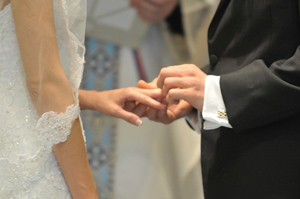
I awoke this morning to a text from my sister – “I love her dress!!!!!” Like many women, I ran down the stairs to catch a quick glimpse of the soon-to-be princess as she stood in Westminster Abbey next to her prince. I must say, I completely agree with my sister. I too, love her dress! It was quite refreshing to see feminine beauty expressed in such an eloquent and sophisticated style. For a brief moment I thought, maybe Kate’s choice in dress will be a trend setter and bring modesty back into bridal fashion.
Then suddenly, my attention was turned to the Bishop of London. He started his sermon with these words, “Be who God meant you to be and you will set the world on fire.” I couldn’t believe it! Today the Church celebrates the feast of St. Catherine of Siena and as millions watched to see the dress, the first balcony kiss, the complete “fairytale wedding” they would also have the opportunity to hear the words from one of our great saints. In some sense, these words which are echoed through time, give meaning today to sacred nature of the marital bond.
God created us out of love as a means to reflect His love. And marriage, as authored by God, is one of the ways we can express that love. For it is in the sacrificial love shared between husband and wife, that man and woman become what God desired them to be – a reflection of His love! When we allow our lives to reflect His goodness, His truth, His love, we reach one conclusion. We set the world on fire. Saint Catherine of Siena, pray for us!
I was ordained a Catholic Priest in 1989, and had received my seminary formation at Mount St. Mary’s Seminary in Emmitsburg Maryland from 1984-1989. The Seminary shared a campus with and was affiliated with Mount St. Mary’s College (now University) also in Emmitsburg. More on that in a minute.
I noticed in a recent listing of Colleges in First Things magazine, Mount St. Mary’s University was listed in the top ten colleges for Catholic Identity. Specifically Catholic Identity refers to a number of factors such as: friendliness to religious faith, vibrancy of campus ministry, faith and theological reasoning among the faculty, students and administration, overall student practice of the faith, and a holding to the religious mission of the school. Mount At. Mary’s (aka “The Mount”) ranked number ten among the 12 colleges listed. See the full list at the upper right. The full article in First Things is here: College Rankings
This fact is, to me nothing short of extraordinary and an example of wonderful reform. I think a great deal of credit is due to the Mount for working so diligently on the Catholic Identity of the University. Special mention ought to be given to Msgr. Stuart Swetland who leads the Council for Catholic Identity at Mt. St. Mary’s. Among other things he and the Council promote on-going discussions about implementing faith in everyday life across the campus. They have also created a series of one-day retreats for administration and staff to assist in this reflection. More on all this here: Msgr. Swetland. Many of you may recognize Msgr. as a regular on EWTN.
As I say, this is a wonderful example of reform. For in my day, back in the mid 1980s the Mount was in terrible shape, if you ask me, when it came to the faith. The most grievous problems in those days, centered on student life which was bacchanalian and pagan to say the least. The seminary where I studied shared a campus and some facilities with the college but was technically a separate entity. I remember how frustrated and angry I would get at the terrible things I observed “over at the college.” In those days drinking and drugs were a terrible problem. Sexual promiscuity and lewd conduct were simply awful. I remember that “jello wrestling” was held in the student union on Friday evenings. When I lodged a protest with the college administration I was informed that it was harmless fun. Eventually it was discontinued because it “caused a real mess to clean up.” It would seem, in those days, the administration was more worried about dirty buildings than dirty souls. Each year there were serious incidents related to heavy drinking. In several of the years I was there, students were killed in drinking related incidents. One died falling out of a third floor window. Another died of alcohol poisoning, several others were killed in car accidents near the campus, related to intoxication. Little was done by campus security to monitor drinking, which, for students under 21 was illegal. Keggers were quite common in the dorms. Students often proudly boasted that the school had made Princeton’s list of top party schools, a fact I could never verify, but I did not doubt that all the necessary qualifications had been fulfilled.
I will say there was little open dissent from Church teaching, on the campus that I was aware of. There were some questionable lectures etc. but, to be honest, there wasn’t a lot of religious study or formation that was a big part on the college side, most of that took place on the seminary side.
Five years after ordination, I returned for a reunion of sorts and college president spoke to us priests and asked us to encourage our parishioners to send their kids to the Mount. I took him aside later and explained that I would never do so until the moral life of the students was addressed and something approaching a lifestyle suitable to the Catholic faith was insisted upon. He seemed angry with me, but was cordial and insisted that progress was being made.
A Middle States Accreditation in my time there gave the Mount academic approval but insisted that they must address Catholic identity to be true to their mission and advertising. It was fascinating and ironic to me that a secular agency would say that and insist upon it.
But that began a process that it looks like the Mount has taken seriously. And I am most happy to see the Mount now ranked high as a truly Catholic School. It is for me a moving story of reform and the power of prayer.
There is a beautiful statue of Mary on the Bell Tower overlooking the campus (see at left). I used to go up on the hill and play the carillon in the bell tower regularly and make sure the bells rang the hours on time. (It was a little side job I had). And as I played those bells I wondered if anyone below might hear gentle reminder of God and heaven. And as Mother Mary looked down from the hillside on the Campus named for her, I know she prayed and kept watch. I know too that many fine priests who were educated in the seminary there have also kept the Mount in fond prayer. And some of those fine priests, like Msgr. Swetland, have returned to work there and make a difference. May God be praised for what he has done for Mount St. Mary’s. Thanks be to God too for the many dedicated faculty, administrators, alumni, and students who have helped the Mount emphasize her Catholic Identity.
It is possible to lament the great loss of so many Catholic Colleges in this country to secularism, and dissent. But here is a story of one of our Universities that had some troubled times, and surely the early 1980s were troubled and uncertain times in the Church, but now the Mount has taken her place on First Things list of the Most Catholic of Catholic Schools.
“Peace be with you” are words we share at Mass. However, this is not just a specifically Catholic form of greeting, and it’s more than a simple expression of best wishes. Instead, this peace is a real gift- a gift that only Jesus can give. In today’s gospel, Jesus gave this peace to his friends when he appeared to them on Easter. Jesus extends this same peace to us at Mass, and invites us to share it with each other.
When Jesus offered his peace to his friends, the wounds of his Passion- the marks of the nails in his hands and feet- were plainly visible for all to see. We know, therefore, that a life touched by his peace is not necessarily free from conflict and pain.
Instead, we might best understand this peace as the peace of heart, and the peace of mind, that comes with the assurance that Jesus is always present with us. It’s the peace of knowing that in the midst of life’s ups and downs, the risen Lord is always at our side- offering us consolation, guidance, and challenge; instilling gratitude, joy, and wisdom; filling us with faith, hope, and charity; calling us to conversion and forgiveness; and strengthening us to carry our cross. With this peace comes an assurance that the Lord will always provide, that his love will never fail, and that the risen life he promises us, will never come to an end.
This blog post is a follow-up from yesterday’s blog. You can read yesterday’s post by clicking HERE.
When we encounter the resurrection accounts in the New Testament we face a challenge in putting all the pieces together in a way that the sequence of the events flow in logical order. This is due to the fact that no one Gospel presents all, or even most of the data. Some of the data also seems to conflict. I tried to show in yesterday’s blog that these apparent conflicts are not, usually, true conflicts. Another problem with putting all the facts together in a coherent and reasonably complete manner is that the time line of the events is often unclear in some of the accounts. Luke and John are the clearest as to the time frame of the events they describe but Matthew and Luke given us very few parameters. Both Acts and Paul also supply data wherein the time frame is not always clear.
Nevertheless I want to propose to you a possible, even likely, sequence of the Resurrection events. The work is my own and I make no claim that this scenario is certain or backed up by recognized ancient authority. St Augustine has done quite a lot of work in this matter and you can read that by clicking HERE. My attempts here are simply the fruit of 20+ years of praying over and pondering the events of those forty days between the Lord’s resurrection and ascension. My reflections are based as solidly as possible on the actual biblical data with a small sprinkling of speculation. I realize that the attempt to do this will irritate some modern biblical scholars who, for reasons unclear to me, seem to insist it is wrong to attempt any synthesis of the texts.
Nevertheless I boldly press on figuring that the average believer will benefit from it and find such a synthesis interesting. Take it for what it is, the work of an obscure pastor who has prayed and carefully sought to follow the sequence of the forty days. You may wish to offer correction or alternative interpretation and are encouraged to do so in the comments. I have posted a PDF of this Document that is easier to read here: Resurrection Chronological Sequence
I. The Morning of Day One
A. Very early in the morning a group of several women, including Mary Magdalene, approach the tomb to complete burial customs on behalf of Jesus (Matt 28:1; Mk 16:1; Jn 20:1).
B. They behold the tomb opened and are alarmed.
C. Mary Magdalene runs to Peter and John with distressing news of likely grave robbers (John 20:2)
D. The women who remain encounter an angel who declared to them that Jesus had risen and that they should tell this to the brethren (Mk 16:5; Lk 24:4; Matt 28:5).
E. They are filled with fear at first and depart from the tomb afraid to speak (Mk 16:8)
F. Recovering their courage they decide to go to the Apostles. (Luke 24:9; Matt 28:8)
G. Meanwhile Peter and John have gone out to the tomb to investigate Mary’s claim. Mary Magdalene followed them back out to the tomb arriving before they left. Peter and John discover the tomb empty though they encounter no angel. John believes in the resurrection. Peter’s conclusion is not recorded.
H. The other women have reported what the angels say to the Apostles. Peter and John have not yet returned and these remaining apostles are dismissive of the women’s story at first (Lk 24:9-11).
I. Mary, lingering at the tomb weeps and is fearful. Peering into the tomb she sees this time two angels who wonder why she weeps. Jesus then approaches her from behind. Not looking directly at Jesus, she supposes him to be the gardener. Then he calls her by name, and Mary, recognizing his voice, turns and sees him. Filled with joy she clings to him. (APPEARANCE 1) (Jn 20:16)
J. Jesus sends her back to the apostles with the news to prepare them for his appearance later that day. (Jn 20:17)
K. The other women have departed the apostles and are on their way possibly back home. Jesus then appears to them (Mat 28:9) after he had dispatched Mary. He also sends them back to the apostles with the news that he had risen and that he would see them. (APPEARANCE 2)
II. The Afternoon and evening of day one.
A. Later that Day, two disciples on their way to Emmaus are pondering what they have heard about rumors of his resurrection. Jesus comes up behind them but they are prevented from recognizing him. First Jesus breaks open the word for them, then sits at table with them and celebrates the Eucharist whereupon their eyes are opened and they recognize him in the breaking of the bread. (APPEARANCE 3) (Luke 24:13-30)
B. The two disciples returned that evening to Jerusalem and went to the Eleven. At first the eleven disbelieved them just as they had the women (Mk 16:13). Nevertheless they continue to relate what they had experienced. At some point Peter drew apart from the others (perhaps for a walk?) And the Lord appeared to Peter (APPEARANCE 4)(Lk 24:34; 1 Cor 15:5) who informed the other ten who then believed. Thus the disciples from Emmaus (still lingering with the apostles) were now told (perhaps by way of apology) that it was in indeed true that Jesus had risen (Lk 24:34).
C. Almost at the same moment Jesus appears to the small gathering of apostles and the two disciples from Emmaus. (APPEARANCE 5) Thomas was absent (although the Lucan text describes the appearance as to “the eleven” this is probably just a euphemism for “the apostles” as a group) They are startled but Jesus reassures them and opens the scriptures to them (Lk 24:36ff).
D. There is some debate as to whether he appeared to them a second time that night. The Johannine account has significantly different data about the appearance on the first Sunday evening from the Lucan account. Is it merely different data about the same account or is it a wholly separate appearance? It is not possible to say. Nevertheless since the data is so different we can call it (APPEARANCE 6) (John 20:19ff) though it is likely synonymous with appearance 5.
III. Interlude –
A. There is no biblical data that Jesus appeared to them during the week that followed. The next account of the resurrection says, “Eight days later” namely the following Sunday.
B. We do know that the apostles surely exclaimed to Thomas that they had seen the Lord but he refused to believe it. (Jn 20:24-26)
C. Were the apostles nervous that Jesus had not appeared again each day? Again we do not know, the data is simply silent as to what happened during this interlude.
IV. One week later, Sunday two.
A. Jesus appears once again (APPEARANCE 7) to the apostles gathered. This time Thomas is with them. He calls Thomas to faith who now confesses Jesus to be Lord and God. (John 20:24-29)
V. Interlude 2
A. The apostles received some instructions to return to Galilee (Mat 28:10; Mk 16:7) where they would see Jesus. Thus they spent some of the week journeying 60 miles to the north. This would have taken some time. We can imagine them making the trek north during the intervening days.
VI. Some time later –
A. The time frame of the next appearance is somewhat vague. John merely says “After this.” Likely it is a matter of days or a week at best. The scene is at the Sea of Galilee. Not all the Twelve are present. They have gone fishing and Jesus summons them from the lakeside. They come to shore and see him (APPEARANCE 8 ) . Peter has a poignant discussion with Jesus in this appearance and is commissioned to tend the flock of Christ (John 21).
B. The Appearance to the 500. Of all the appearances you might think that this one would have been recorded in some detail since it was the most widely experienced appearance. Many accounts it seems would have existed and at least one would have made its way into the scriptures. Yet there is no account of it other than it did in fact happen. Paul records the fact of this appearance: 1Corinithians 15:6 Then he appeared to more than five hundred brethren at one time, most of whom are still alive, though some have fallen asleep. (APPEARANCE 9) Where did this take place. What was it like. What was the reaction? We simply do not know. Proof once again that the Bible is not a history book in the conventional sense. Rather it is a highly selective telling of what took place, not a complete account. The Bible makes no pretenses to be something it is not. It is quite clear that it is a selective book: (John 20:30).
C. The Appearance to James. Here again we do not have a description of this appearance only a remark by Paul that it did in fact happen: 1Cor 15:7 Then he appeared to James. (APPEARANCE 10) The time frame is not clear. Only that it happened after the appearance to the five hundred and before the final appearance to the apostles.
VII. The rest of the forty days.
A. Jesus certainly had other on-going appearances with the disciples. Luke attests to this in Acts when he writes: Acts 1: 3 To them he presented himself alive after his passion by many proofs, appearing to them during forty days, and speaking of the kingdom of God.
B. During this time there is perhaps the one appearance we can attribute to this time period as recorded by Matthew (28:16ff) and Mark (16:14ff). It takes place an “a mountaintop in Galilee.” Mark adds that they were reclining at table. For these notes this appearance (time frame uncertain) is referred to as (APPEARANCE 11) It is here that he give the great commission. Although Mark’s text may seem to imply that Jesus was taken up from this mountain, such a conclusion is rash since Mark only indicates that Jesus ascended only “after he had spoken to them” (Mk 16:19).
Evidently Jesus had also summoned them back to Jerusalem at least toward the end of the period of the forty days. There they would be present for the feast of Pentecost. We can imagine frequent appearances with on-going instruction for Luke records that Jesus “stayed with them.” Most of these appearances and discourses are not recorded. Luke writes in Acts: And while staying with them he charged them not to depart from Jerusalem, but to wait for the promise of the Father, which, he said, “you heard from me, for John baptized with water, but before many days you shall be baptized with the Holy Spirit.” (Acts 1:4)
VIII. The final appearance and ascension:
A. After forty days of appearances and instructions we have a final account of the last appearance (APPEARANCE 12) wherein he led them out to a place near Bethany, gave them final instructions to wait in Jerusalem until the Holy Spirit was sent. And then he was taken up to heaven in their very sight. (Luke 24:50-53; Acts 1).
So here is a possible and, if I do say so myself, likely chronological sequence of the resurrection appearances. It is a kind of synthesis that attempts to collect all the data and present it in a logical order. There are limits to what we can expect of the Scriptural account, and fitting perfectly into a time frame and logical sequence is not what the texts primarily propose to do. Yet such a chronological sequence can prove helpful and it is in that spirit that I present this.
One Easter Sunday Mass, as I went through the church and sprinkled the people with Holy Water, was struck by how many long, gloomy, and sad faces I saw. After I was done I said, “I just want to remind you that it’s Easter Sunday- so it’s okay to smile in church!”
There were long faces on Easter in today’s gospel as well. When the risen Jesus joined two disciples on their journey and asked what they were talking about, “They stopped, looking downcast.” Or as another translation puts it, “They stood still, looking sad.” Just like so many of the people I saw at Easter Mass.
But let’s not forget the rest of the gospel story. After they recognized Jesus in the breaking of the bread, the two disciples were so filled with joy that they ran to tell their friends. The risen Jesus had replaced their sadness with joy!
The good news that Jesus has risen should also fill us with joy this Easter season. As St. Augustine once wrote, “A Christian should be an ‘alleluia’ from head to foot!” Do you remember the Opening Prayer at this Mass? We thanked God for the joy of the resurrection, and asked that the joy of our celebration may bring us to the joy of eternal life. And as we prayed together in the responsorial psalm, “Rejoice, O hearts that seek the Lord.”
Easter joy doesn’t mean that we ignore life’s real difficulties and problems. But it does mean that we confront them with the assurance that if we have a God who loves us so much that he died and rose for us, then surely he will lead us through our present troubles into his everlasting peace. Mother Teresa once put it very well. “Never let anything cause you so much sorrow,” she said, “that you forget the joy of Jesus risen.”