For whatever reason, my garage’s light switch is in the kitchen. One night, while I was in the garage, running on our treadmill, someone accidentally flipped off the lights. For a few scary moments, I found myself in complete darkness, running fast, but going absolutely nowhere.
My experience is a metaphor, I think, for how many people live their lives today: they run around like crazy, but their lives have no real purpose or direction. Kind of like running on a treadmill, in the dark.
Jesus, in today’s gospel, said that he didn’t want people to “remain in darkness.” That’s why “he came into the world as light.” By believing in Jesus, we know what life is about, and we know the direction in which our lives should go, because Jesus lights the way. With Jesus, our lives have purpose, peace, and hope.
Living in darkness can be frightening. My children sometimes admit that they’re a little afraid of the dark, and I completely understand. They prefer to sleep with a light on. Jesus invites us to do the same thing: to keep the light on- his light- to scatter the fear that darkness brings.
As Pope Benedict assures us: “(Christ’s) light will dispel all darkness from your lives, and fill you with love and peace.”[1]
On Friday I will celebrate the funeral of one of my oldest parishioners, Mrs. Gussie Rustin, 103 years old. Incredibly she was born in 1908. Theodore Roosevelt was President. Her husband died in 1946! She was 51 years old when my parents were married. She predated almost everything we call modern. Her home first home in Southern Maryland had neither electricity nor running water. Radios were unknown in this country until 1920 when she was 12 years old. She lived through two World Wars, Korea Vietnam, the Cold War, and Gulf Wars 1 & 2. She saw the advent of almost every modern device, Radios, TV, atomic energy, computers, space travel, modern medicine, open heart surgery, cancer treatment, faxes, pagers, cellphones, microwaves, the Internet, and on and on.
Ms Gussie remained quite healthy until about two years ago, though she didn’t get out much since the early 1990s. I have been bringing her communion along with parishioners since 1993. Her “baby” sister Louise died about a year ago well into her nineties. The family and friends made sure Ms. Gussie never saw a nursing home. She died at home in her bed in the same home she owned since 1948. Cause of death? Old age, pure and simple…but graceful.
Yes there are some who really live long and experience aging to the top. And there is something about aging. It is poignant and beautiful if we accept it. There is a kind of gentle letting go that God effects in us as we age. Little by little we hand things back to God and learn to depend on him more, and those he sends us. To be sure, I am aware that old age is not easy, but there is something strangely beautiful about what God does in old age if we are willing to see and accept it.
One of the more beautiful passages in the Old Testament is the 12th Chapter of Ecclesiastes. It is a melancholy but soulful meditation on old age. It’s poetic imagery is masterful as it draws from the increasingly difficult effects of old age such as hearing loss, fading eyesight, difficulty walking, digestive issues, even gray hair. I’d like to present it here in totality and present commentary below the text:
Remember your Creator in the days of your youth, before the evil days come And the years approach of which you will say, I have no pleasure in them; Before the sun is darkened. and the light, and the moon, and the stars, while the clouds return after the rain; When the guardians of the house tremble, and the strong men are bent, And the grinders are idle because they are few, and they who look through the windows grow blind; When the doors to the street are shut, and the sound of the mill is low; When one waits for the chirp of a bird, but all the daughters of song are suppressed; And one fears heights, and perils in the street; When the almond tree blooms, and the locust grows sluggish and the caper berry is without effect, Because man goes to his lasting home, and mourners go about the streets; Before the silver cord is snapped and the golden bowl is broken, And the pitcher is shattered at the spring, and the broken pulley falls into the well, And the dust returns to the earth as it once was, and the life breath returns to God who gave it. Vanity of vanities, says Qoheleth, all things are vanity! (Ecclesiastes 12:1-8)
And now, if you will, some commentary on each verse. My comments are in red:
1. Remember your Creator in the days of your youth, before the evil days come And the years approach of which you will say, I have no pleasure in them –
We are advised to give thanks to God for the vigor of youth for “evil” days will come. Here evil does not mean evil in the sense of “sinfully evil.” Rather, evil here means the days that are difficult and bad, days that bring challenge and pain.
We might want to be thankful for living in the modern age since the burdens of old age are far less than in the ancient world. Consider all the medicines and helps that make aging less difficult. Pain medicines alleviate arthritis, calcium supplements help with osteoporosis, blood pressure meds help prevent stroke and partial paralysis, motorized scooters help mobility, eye glasses and hearing aids improve our ability to interact and so forth.
But most all of this was missing in the ancient world. Age brought increasing and cumulative burdens so that our author says regarding these days, “I have no pleasure in them.”
2. Before the sun is darkened. and the light, and the moon, and the stars, while the clouds return after the rain – Here is a poignantly poetic description of eyesight going bad. The light darkens, stars and moon are less visible (perhaps blurry) and the clouds of cataracts begin to afflict the elderly.
3. When the guardians of the house tremble, and the strong men are bent, And the grinders are idle because they are few, and they who look through the windows grow blind –
The “guardians of the house” are the biblical reference to our arms, and they start to tremble with the tremors common to old age even without Parkinson’s disease.
The “strong men” are the legs, and they are bent, less able to carry the weight of the body, Bent also indicates the legs when we are seated, unable to walk.
The “grinders” are the teeth and they are few! We have better dental health today, but then, it was common for the elderly to have lost many if not most of their teeth. This made it difficult to eat, requiring food to be mashed.
The image of an elderly person sitting in a window looking out but growing blind is surely sad, but also vivid. I remember my Grandmother in her last years. She could no longer read much because her eyes were bad and her mind could not concentrate on the text. So she sat for hours and just looked out the window.
4. When the doors to the street are shut, and the sound of the mill is low; When one waits for the chirp of a bird, but all the daughters of song are suppressed–
The “doors to the street” are the tightly compressed lips common to the very elderly, especially when teeth are missing. This also depicts how many of the elderly stop talking much. Their mouths are shut tight.
The sound of the mill may be another reference to chewing. Many of the elderly lose their appetite. One the psalms says regarding the elderly “I moan like a dove and forget to eat my bread” (Psalm 102:4).
Waiting for the chirp of the bird may be a reference to the silence of the elderly but it may also be a reference to deafness of the elderly who can no longer hear the singing and chirping of the birds. Something the young take for granted.
5. And one fears heights, and perils in the street; When the almond tree blooms, and the locust grows sluggish and the caper berry is without effect, –
Walking is difficult and treacherous and requires great effort for many of the elderly. Whereas the young may not think twice about a flight of stairs, the elderly may see them as insurmountable. Perils in the street like loose or upturned stones cause fear since a fall for the elderly can be devastating. They may also not be able to get up if they fall.
The almond tree blooming is a symbol for gray hair since almond trees had white blooms. The caper berry had several uses in the ancient world. It was an appetite stimulant, an aphrodisiac, it also was used to treat Rheumatism! But in old age, it would seem that the desired effects are hard to come by.
6. Because man goes to his lasting home, and mourners go about the streets; Before the silver cord is snapped and the golden bowl is broken, And the pitcher is shattered at the spring, and the broken pulley falls into the well, And the dust returns to the earth as it once was, and the life breath returns to God who gave it. –
And finally death comes, as symbolized by the mourners in the street, the silver cord, the golden bowl, symbols of life now snapped and broken.
The broken pitcher symbolizes that the body no longer contains the soul.
The pulley, a device used to lift is now broken, indicating that the body too will no longer rise from its place but falls into the well of the grave.
And we return to the dust and the soul goes to God.
7. Vanity of vanities, says Qoheleth, all things are vanity! – In the end, all things pass. Nothing remains. Since all things are to pass they are vain (empty). The physical world is less real than the spiritual for the physical passes but the spiritual remains. Since you have been raised to new life with Christ, seek the things that are above, where Christ is seated at God’s right hand (Col 1:3)
A sad but powerfully beautiful description of old age and of the dignity of the elderly.
I have often shared it with the very elderly and those who are suffering the ill effects of old age. I remember reading it slowly to my Father as he lay dying in his hospital room. He could no longer talk much. But as I read it to him I saw him nod and raise his hands as if to say “Amen!” Almost too as if he meant to say, “Somebody understands, God understands.”
Perhaps you also know an elderly person who could benefit from this passage. I know it is sad and not everyone is in a place where they can hear such a stark and sad description. But some are in that place where they can derive peace as God, through his word, says He knows exactly what they are going through.
Photo credit: unknown source from my own collection
Here is a humorous meditation on old Age. Don’t be fooled by the first minute and a half, it takes a sudden turn at one minute, 22 seconds.
Sheep, to many Americans, are weak, subservient, and dim-witted creatures. We say “to follow like sheep” when describing unthinking, spineless loyalty. To look “sheepish,” is to look guilty. That’s why when Jesus refers to his followers as sheep, we’re not always sure how to respond.
Jesus and his contemporaries, however, held sheep in high esteem. Sheep were considered honorable and noble animals, because they suffer in silence and are obedient to their shepherds. Some were kept as household pets, and were fed by hand. Ownership of sheep was a sign of wealth. They were offered in sacrifice, not because they were worthless, but because they were so valuable. Jesus himself was called the “lamb of God.”
By calling us sheep, then, Jesus isn’t putting us down. Instead, he’s speaking of how precious we are to him; it’s a reflection of his love. In today’s gospel, he insists that we, his sheep, are the Father’s gift to him. We’re so valuable, that no one can snatch us out of his hand; we’re so treasured, that he gives us eternal life, to be with him forever.
CBS News seems to have confused Stephen Hawking with a Theologian or spiritual guide. For recently they focused on an interview published in the Guardian wherein Hawking calls heaven a fairy tale for those afraid of the dark.
Well, first of all Mr. Hawking, I am not afraid of the dark. Secondly, you should stick to science and stop trying to psychoanalyze believers. And as for CBS News and the Guardian, please note that Mr. Hawking is a scientist. He is no more qualified to opine on life after death or make psychoanalytic pronouncements than some random person on the street. Smarts in one area doesn’t make him an expert in all areas. Perhaps CBS News would like to interview me on string theory? Of course Mr Hawking and many others might object that I wasn’t exactly the best “go-to guy” on this topic. And that would be true. Asking Mr. Hawking to opine on heavenly matters and the psychological makeup of believers is in the same vein as trotting out Hollywood stars to testify before congress as “experts” on global warming, or some other highly technical matter. Mr Hawking’s opinion on believers or the afterlife is of no more value than anyone else. He is entitled to his opinions on this matter, but it doesn’t deserve to be in headlines and is no more true because he is smart in other areas.
Further, I hope you will note a VERY DARK philosophical assumption he makes at the end of the article. Beware, for he is an influential man.
Let’s look at excerpts from the CBS article. These are excerpts of the longer article which you can read HERE. The original article excerpts are in bold italic typeface. My remarks are in normal red typeface.
Physicist Stephen Hawking believes there is no afterlife (so what?), and that the concept of heaven is a “fairy story” for people who fear death. While he is entitled to his opinion, he has never met me and is not able to know why I believe in life after death. Further he is not a trained sociologist or psychotherapist. He cannot really know the motivations of everyone who believes. Frankly he is also showing himself a poor scientist here. For a good scientist looks for real data and knows that large scale phenomenon (like, say, faith?) are not usually explained by simplistic, single source causes. There are usually a variety of causes and influences at work. For example, when a leaf falls from a tree there is surely gravity, but also wind resistance, and the presence of obstacles that influence its descent.
Mr. Hawking is also condescending and (heaven forfend!), judgmental. For what if I were to say Mr. Hawking does not believe in an afterlife because he fears judgment, or because the existence of God is “inconvenient” to his vision and chosen moral life. You would likely say I should not talk like that, and that I had no real way of knowing that. Exactly. And Mr. Hawking has no business making judgments about my motives either. He doesn’t have a clue as to why I believe in heaven. I don’t fear death any more than he does. I believe in an afterlife because some one I trust, (God and the Church) have revealed it to me and taught me of it.
In an interview published in the Guardian, Hawking – author of the bestselling “A Brief History of Time” – said that when the brain ceases to function, that’s it. This is not a scientific statement, it is philosophical belief on his part. It cannot be verified scientifically, one way or the other, that existence ceases when the brain stops functioning. He is entitled to his belief, but that is what it is. This is not a scientifically verifiable statement. That a renowned scientist is speaking in this way may give the impression that this is science, but it is not. He has moved beyond science and is now in the realm of philosophy.
“I regard the brain as a computer which will stop working when its components fail,” he told the Guardian’s Ian Sample. “There is no heaven or afterlife for broken down computers; that is a fairy story for people afraid of the dark.” Reducing the human person to a brain or computer, or to merely our physical components, is also philosophy, not science. It is true, science can only deal with the material, for that is its realm. But to say that physical matter is all there is, or that there is nothing outside of what science can measure, is not a scientific statement, it is a philosophical one.
Consider if a blind person insisted that there was no such thing as light, concluding this merely because he could not measure it with his senses. But of course for him to assert the non-existence of something merely because he cannot measure it, is both arrogant and wrong. Science too would be wrong to conclude in some absolute sense that there is no soul, or nothing beyond the material, merely because science cannot measure it with its own tools. There are just some limits to science, just as there are some limits for a blind person. Science is not bad because it cannot go beyond the material, any more than a blind person is bad because he cannot see. But what IS bad is to insist there is nothing beyond merely what I can sense, or measure. Not only is it bad, it isn’t science, for science cannot prove the non-existence of non material things. It just isn’t set up to do that. To say that nothing exists beyond the material is a philosophy, it is not science.
We have already discussed Mr. Hawking’s incapacity to psychoanalyze believers as afraid of the dark. Indeed his caricature of us is dripping with arrogance and thinly veiled superiority. Would I be psychoanalyzing him if I suggested that his superstar status has gone to his head? I guess I would. I withdraw the remark, your honor!
Hawking, 69, who has survived for nearly five decades with a motor neurone disease that doctors believed would kill him while he was still in his early 20s, said he does not fear death. He also said that having lived with the prospect of death from his incurable illness has ultimately led him to enjoy life more. He has dealt with his disease heroically
…Hawking rejects an afterlife and emphasizes the need for people to realize their full potential on Earth. It is an old and tattered claim that belief in heaven somehow limits our concern for this world. The Christian world is replete with examples of those who have powerfully cared for and impacted the people of this world and the world itself. Indeed, Mr. Hawking might reflect of the debt he owes to belief and to the Church for things like the great universities of Europe, the scientific method, the existence of hospitals and modern medicine. Faith doesn’t just make people “other-worldly” it also gives them hope and insists, in its truest form, for great love for the people of this world and for all God has created.
When asked what is the value of knowing why are we here, Hawking replied, “The universe is governed by science. But science tells us that we can’t solve the equations, directly in the abstract. We need to use the effective theory of Darwinian natural selection of those societies most likely to survive. We assign them higher value.”This is so limiting. It is also philosophy, not science to say this. Mr Hawking is entitled to have a philosophy, but when he says the world is “governed by science” and then goes on to philosophize, that looks pretty silly and contradictory. Further, Mr. Hawking, if you ask me, is edging dangerously close to eugenics in what he says here. What exactly assigning a “higher value” to certain societies looks like as a practical matter is uncertain in what he says, but I sense a growing darkness here, not light. Margaret Sanger and Adolph Hitler may well be smiling as he says this. BEWARE!
Hawking said that our existence is down to pure chance, (Again, philosophy here, not science, Mr Hawking cannot prove this statement scientifically)and that one’s goal should be to “seek the greatest value of our action.”
Well there it is. I will say, not only is Mr. Hawking a poor theologian and psychotherapist, he is also engaging in a very dark and dangerous philosophy in applying once again (as did Sanger and Hitler along with others) a natural selection to societies (races?). Watch out, Mr Hawking is influential, we may be in for some very dark days ahead.
How say you?
Here’s Fr. Barron’s take on Stephen Hawking’s last foray into philosophy and metaphysics some months ago:
I usually think of multiculturalism as a fairly benign concept wherein we are asked to appreciate the enrichment that can come when many cultures have input into the life of this country. The fact is America has always been a rich tapestry of cultures. The English, French, and Spanish colonist interacted with the native populations, they also brought African slaves with them. In the late 1800s through the mid 1900s waves of immigrants from almost every European country also added to the mix. The group we usually call “Whites” today is actually an assimilation of many very different cultures. My father’s generation (b. 1928) made very sharp distinctions between Irish, Italians, Poles, and so forth. Many of these groups lived in distinct neighborhoods, attended different Catholic parishes, and intermarriage was almost unthinkable between them at the early stages. In more recent years, immigrants from the South, from Africa and the Far East have also added to tapestry and the “look” of America. And whatever friction has sometimes existed between various groups, ethnicity and races, I have no doubt that we have been enriched by our interaction and life together in this land.
This is the multiculturalism I know and what I usually mean by the term.
Apparently the experience in Europe has been less satisfactory and we now see some European leaders calling for stricter curbs on multicultural expression. For example, in France the wearing of certain Muslim Garb, especially the Burqa, has been banned.
In the video below, a commentator gives a much more sober assessment of multiculturalism. To some extent I would describe his approach to be in the form of a rant that intentionally overstates the case in a sometimes humorous, even satirical way. It sometimes helps to understand the genre when viewing such viewpoints. So you may wish to read up on the genre of “rant” HERE.
Nevertheless the purpose of “rant,” though overstated and sometimes satirical, is to make a point that the orator considers important. And what I take away from the video is that some distinctions and limits are necessary when it comes to multiculturalism. Without these, we may find multiculturalism fails as a lived reality and may rest on premises that are unacceptable. Here are just a two concerns:
1. Multiculturalism must be rooted in a fundamentally shared vision and in something higher than any individual culture in the mix. When people and groups immigrate, they bring with them their own traditions and culture. Fine, herein lies a richness. But they also come to a new experience, a new culture, shared by those already in the land, which can also enrich them. There must be certain fundamentals to which all in a culture agree to share. Without this there are enclaves which set up, and friction is inevitable. Here in America there have traditionally been two fundamental visions that have united us and helped us to overcome our differences and experience multicultural success: the American Dream, and a fundamental belief in the existence of God.
The American Dream, while difficult to reduce to a sentence or two, is essentially rooted in the economic freedom to work, run and own businesses, own property and participate in the political process without harassment. It includes freedom of speech and assembly, basic equality, and all the rights described in our Constitution. Ultimately most Americans see its fulfillment for them personally when they are economically independent, and able to own a home. It would seem that the American Dream is still largely intact, as a shared vision. I think most people who come to this land are still looking for just these things. They admire our freedoms, our prosperity, and basic form of government. Many take enormous risks to come here and take part in the dream. This existence of this common vision causes a shared unity that makes multiculturalism workable.
As for a shared belief in God, this has become frayed in recent decades. It still remains true that the vast majority of Americans still believe in God, but an increasingly strident form of secularism threatens to undermine the shared “cultus” of our culture. “Cultus” or “cult” here does not mean what modern English has assigned as a narrow, closed and often extreme group, engaged in strange religious practices. Originally in Latin, and even in English, “cult” meant simply a shared faith among the people. That “cult” is at the heart of the word culture is no accident. For every culture needs someone and something above it to which, and to whom, it must answer. That Someone, we in the West, have called the God of the Bible. Without this cult, it is questionable that a culture can survive for there is nothing and no one higher than it to unite it. That Western culture is in serious decline at the same time that secularism is on the rise is, likely, no coincidence.
Here in America, most of our immigrants are Catholics and Christians. Hence they share in the basic Judeo/Christian view or “cultus.” The jury is still out on whether secularization will continue. But for now, the vast majority of Americans still share a common belief in the God of the Bible, even if they do not live this faith perfectly.
In Europe the situation seems quite grave, and the Pope has described that the lights are going out all over Europe. With high secularism and low birthrates among Europeans, the Muslims are largely poised to replace European culture. But it is questionable that the Muslim immigrants value what we call Western culture and their “cultus” is not the same “cultus” that gave rise to Europe. Hence the multicultural tensions are growing fiercer, since there is no shared faith, and no European version of the “American Dream” that unites new immigrants and traditional Europeans.
But here in America, multiculturalism largely still “works,” though threats are on the horizon. This does not mean that there are not certain tensions. But there always have been and there still seems to be a way to work through it.
One of the flash points here is the question of language. And, although I often hear fears expressed by some that “Spanish is taking over,” my own experience is that, in every immigrant family I know, the kids all know English. Hence, I am not personally concerned that Spanish will take over. English remains the language of access in this country. Thankfully, it seems we have gotten over the silly experiment in Education of running bilingual school systems. As far as I can tell, immigrant children are immersed in English and quickly expected to take their seats in an English-speaking classroom. But some of you may correct me on this.
2. While accepting the benefits of multiculturalism, we must avoid the trap that everything is equally valid – The orator in the video below makes the case that multiculturalism is just another form of moral relativism. I am not sure that I accept the word “just” in his argument. But there is a danger that some of the premises do come from moral relativism or tend to be reinforced by unhealthy notions associated with it.
I’ll just be bold (as a Westerner) and say that there is something essentially superior to the what we have come to call “western culture.” We are not perfect, and sadly, western culture does seem to be in significant decay at this time. But historically western culture has produced the highest standard of living, had the most stable economies, produced the most just and equitable forms of democratic government, has a rich deposit of learning, and brought forth a great expression of the dignity of the individual. I, (Christian that I am) attribute a lot of this to faith, for it was the Church that established most of the great universities, the hospitals, the scientific method, and so forth. The Church also, through the tireless work of monks and others helped to preserve the works of classical antiquity which has so blessed us and served as the basis for the high standard of living and the flourishing of the sciences we have today.
As I say, I’ll just be bold and probably “politically incorrect” but western culture is the finest flower in the garden, given our history and what we have contributed to the world. This does not mean that there are no excesses in us, or that other cultures are nothing at all. I do not the deny the World Wars and other sad chapters. But the fact that so many flock to live in the West, especially in America, is silent testimony to the greatness of what we are, and have to offer. They are often fleeing poor economies, corrupt dictatorships and terrible living conditions. To be sure, they bring gifts to us in their cultural heritage and are able to add to rich tapestry of the West, especially in America. But that too is part of the greatness of the West, tolerance, and an open marketplace of ideas.
It is a fact that the West as we have known it is in fairly serious decline. Some centuries ago de Tocqueville noted that for democracy to thrive, morality and self-control of the populace had to be presumed. The fact is, without a general level of moral self-governance, democracy and freedom cannot thrive. For the genius of Western style democracy is that power and control are shifted from the central state more to individual. Freedom is wonderful, but it requires self-control of the populace. If we are not willing to curb our behaviors, proper order and the common good are threatened and freedoms begin to be lost. It is no coincidence that, as bad behaviors begin to proliferate, government grows and freedoms are limited, Today, often due to the breakdown of personal behavior and a sense of personal responsibility, there are increasing demands for laws and for the government intervention. But the tradeoff is that personal freedoms are eroded, taxes increase and fears grow about further intrusions as a litigious attitude grows. Whether the great experience of western culture will continue depends largely on whether we can reclaim some of our lost moral code and live by it without a government insisting on it.
But as it is conceived, I will say again that western culture is the finest flower of the modern world. It is threatened but it is wholly worth saving as the best hope for future generations.
The fact is we ought not become moral relativists in this matter and, as others come to join us, it is not wrong that we insist they observe what is best about us and seek to join, rather than replace what we are. With this premise multiculturalism is enriching and to be celebrated.
OK, please remember this is a discussion. I am not pontificating here, just starting a discussion. Please add your own views, additions, distinctions and so forth!
As for this video remember, it is in the style of a rant. I do not know who Andrew Klavon is, this is the first I have seen of him. Hence, I do not endorse everything he says or may have said elsewhere. I just found his video here to provoke thought and to help me clarify what I think of multiculturalism .
One evening some years ago, Stephanie my wife prayed for guidance as to whether or not she should return to work part time. The very next morning, an absolutely perfect job practically fell into her lap. To us, this was an obvious sign from God. Yet that night, as we adjusted our family budget to reflect Stephanie’s new income, what did we start to do? We started to worry about money. God had just answered our prayer and shown us how much he cares for us. But still we didn’t “get it.” Finally, we looked at each other and said with exasperation, “What are we doing?” What we weren’t doing is trusting in Jesus, which is what he constantly invites us to do. That’s why he calls himself the good shepherd.
The image of Jesus as the “good shepherd” tells us quite a bit about what he wants our relationship with him to be like. I was once reminded of this very early in my ministry, while I served a small Texas church, smack in the middle of cattle country. There were real cowboys in my parish, and one day one of them said to me, “You know, Father there’s a reason Jesus never said: ‘I am the good cowboy.’” Cows, he explained, are very obstinate creatures. To get them going in the right direction, they need to be pushed and poked from behind- sometimes with an electric prodder! Sheep, however, are very different from cows. When they hear their shepherd’s call, they happily follow his lead. Just like Jesus said in today’s gospel: “My sheep hear my voice. I know them, and they follow me.” In other words, Jesus doesn’t want to have to push us like cows. Instead, he wants us to follow him like sheep.
The beautiful 23rd Psalm, which we just prayed together, speaks to us of how Jesus our shepherd cares for us when we trust and follow him. In an often reprinted Reader’s Digest article from over fifty years ago, one old shepherd explained that the psalm’s author obviously knew sheep and shepherds of the Holy Land very well.
Good shepherds, he said, lead their flocks to green pastures where the grazing is best, and where the sheep find contentment. They root out and destroy poisonous plants so their sheep may safely graze. They guide them to still waters, as they know that sheep refuse to drink from noisy, babbling brooks. With their shepherd’s staff they protect them from predators, pull them out of pits should they fall in, and lead them safely through difficult terrain. With oil they anoint and heal the wounds inflicted by thorns and briers, and with jugs of water they cleanse eyes weeping from dust or fever. “Sheep do not worry,” this shepherd concludes, “(Their shepherd’s) guidance has been good in the past, and they have faith in the future because they know he has their well-being in view.”
This psalm refers to God’s care for his chosen people, the Israelites, as he liberated them from slavery in Egypt and led them to the Promised Land. It may very well have been written during the Babylonian exile, that difficult period some six centuries before Christ, after the Jews had been violently evicted from their homeland and forced to resettle in what is now Iraq. Far from their homeland and stripped of their freedoms, the exiled Jews wondered if God still cared for them. God inspired this psalm to be written to assure his people that he did. His message to them was: “I’m in charge, so there’s no need to worry.”
God still uses this psalm today to touch people’s hearts. It beautiful and powerful words continue to fill us with confidence and hope when facing change, difficulties, painful circumstances, or our fear of the unknown. It’s a psalm that calls us to place our trust in God- a call we need to hear time and time and time again.
A member of my parish, Peggy Rooney, has a wonderful story of how she learned to trust in God. In her book Uncommon Conversations with God, Peggy confesses that for years she was apprehensive about life. Peggy dreaded making decisions, was apprehensive of not living up to expectations on the job, and harbored what she describes as unreasonable fears about her children’s safety. She prayed and prayed about her these things, but seemingly to no avail. But then God brought a woman named Irene into her life.
Irene was partially blind and had lost both legs as a result of her diabetes. She had the use of only one hand, because an accident years earlier had left the other one crippled. Nevertheless, instead of being bitter and resentful, Irene was a cheerful, compassionate, genuinely loving, and courageous individual. Irene taught Peggy to let go of hear fears by trusting in God. Irene explained that letting go simply means letting God take control of one’s life. At first, Peggy was hesitant. She wondered who would protect her if she “let go.” Irene’s life, however, provided the answer. She had no choice about being absolutely dependent on others. But she did have a choice about how she related to those she depended upon. She trusted them, and she trusted God- absolutely.
One night Peggy asked Irene how she could be so brave in spite of her dependency. The answer changed Peggy’s life. Irene said, “I figure the worst thing that can happen to me is that I might die and get the chance to actually meet the One who’s been taking care of me for all these years.”
This is the kind of trust we all are called to. Jesus asks us not to worry, not to be filled with fears, and not to place our hopes on ourselves, on others, or on the things of this world. He invites us today to place our trust in him, and in him alone. Because when we trust the Lord who is our shepherd, surely we shall not want.
The Fourth Sunday of Easter is traditionally called Good Shepherd Sunday, for the readings focus on how our risen Lord Jesus is our shepherd who leads us to eternal life. But of course, the flip side of the Lord being our shepherd, is that we are sheep. We sometimes miss the humor of the Lord calling us sheep. The Lord could have said we were strong and swift as horses, beautiful as gazelles, or brave as lions. But, instead, he said we are like sheep. I guess I’ve been called worse, but it’s a little humbling and embarrassing really. And yet sheep are worthwhile animals and they have a certain quality that makes them pretty smart, as we shall see. Are you smarter than a sheep? Well, lets look and see how we stack up as we look at this gospel in three stages.
I. The Situation of the Sheep – In this Gospel the Lord is speaking to pharisees and seeking almost to reassure them that he is not like other false shepherds, false messiahs, who have led many astray in recent years. Jesus says, Amen, amen, I say to you, whoever does not enter a sheepfold through the gate but climbs over elsewhere is a thief and a robber. …All who came before me are thieves and robbers, but the sheep did not listen to them…. A thief comes only to steal and slaughter and destroy.
The times in which Jesus lived were times of great social unrest and political turmoil. There were heightened expectations of a coming messiah who would liberate Israel from its Roman and Herodian oppressors. Given the climate of the times, most had emphasized the role of the messiah as a political and economic liberator who would come and wage war and victoriously reestablish the Davidic Monarchy in all its worldly glory.
Josephus, A Jewish historian of the time, may have exaggerated, but only a little when he spoke of 10,000 insurrections in the years leading up to the Jewish War with the Romans, (which took place from 66 – 70 AD). Even as early as Jesus’ lifetime there had been conflicts and bloody uprisings led by numerous false messiahs. It is most likely to these that Jesus refers as thieves and robbers. It is also the likely explanation of why Jesus resisted being called Messiah except in very specific circumstances (Matt 16:16,20; Mk 8:30; Mk 14:62).
Jesus also warned that after he ascended that false Messiahs would continue to plague the land:
For false Christs and false prophets will appear and perform great signs and miracles to deceive even the elect—if that were possible. See, I have told you ahead of time. “So if anyone tells you, ‘There he is, out in the desert,’ do not go out; or, ‘Here he is, in the inner rooms,’ do not believe it. (Matt 24:24-26)
Ultimately these false Christs did arise and mislead many and the results were horrible. Josephus says that 1.2 million Jewish people lost their lives in the Jewish War with the Romans.
So here is the situation of the sheep. And Jesus speaks of the dangers of false messiahs, false saviors and unambiguously denounces them as thieves and robbers. We too, are in a world were many false and erroneous philosophies, messiahs and “saviors” seek to claim our loyalties and engage us in their error. Perhaps it is the false claims materialism, which says the right combination of wealth and power can bring meaning and happiness. Perhaps it is the error of secular, socialism and atheistic communism, which exalts the State and puts its importance above God. Perhaps it is the arrogance of modern times which claims a special enlightenment over previous eras (such as the biblical era) which were “less enlightened and tolerant.” Perhaps it is the promiscuity of this age which claims sexual liberty for itself but never counts the cost in broken lives, broken families, STDs, AIDS, high divorce rates, teenage pregnancy, abortion and on and on.
Yes, the sheep are still afflicted and false philosophies and messiahs abound. Jesus calls them thieves and marauders (robbers) for they want to steal from us what the Lord has given and harm us by leading us astray. He their wish is ultimately to slaughter and destroy. Do not be misled by the soft focus of these wolves in sheep’s clothes, by their message of “tolerance” and humanitarian concern. A simple look at the death toll in the 20th century from such ideologies with show the actual wolf lurking behind these foolish and evil trends which have misled the flock.
And as for these false shepherd remember this, not one of them ever died for you. Only Jesus did that.
II. The Shepherd of the Sheep – Having rejected false shepherds, Jesus now goes on to describe himself as the true Shepherd:
But whoever enters through the gate is the shepherd of the sheep. The gatekeeper opens it for him, and the sheep hear his voice, as the shepherd calls his own sheep by name and leads them out. When he has driven out all his own, he walks ahead of them, and the sheep follow him, because they recognize his voice. But they will not follow a stranger; they will run away from him, because they do not recognize the voice of strangers.“
Now this passage tells us not only of the true Shepherd, but also his true sheep. For the true Shepherd is sent by the Father who is the gatekeeper and has opened the way for the Son, and True Shepherd. The Father has confirmed the Son by signs and wonders and by the fulfillment of prophesies in abundance.
And of the true sheep the Lord says that they not only recognize his voice, but also that they will run from a stranger because they do not recognize their voice.
In sheep herding areas flocks belonging to different shepherds are often brought together in fenced off areas for the night, especially in the cooler months. And one may wonder how shepherds can tell which sheep belong to which shepherd. Ultimately the sheep sort themselves out. For in the morning a shepherd will go to the gate and call, with a chant like call, his sheep. Those that recognize his voice will run to him, those that do not will recoil in fear. Now that’s pretty smart actually. Sheep may not know how to go to the moon and back, but they DO know their master’s voice.
And so the question for us is, are you smarter than a sheep?
Sheep have the remarkable quality of knowing their master’s voice and of instinctively fearing any other voice and fleeing from it. In this matter, it would seem that sheep are smarter than most of us. For we do not flee voices contrary to Christ. Instead we draw close and say, “Tell me more.” In fact we spend a lot of time and money to listen to other voices. We spend huge amounts of money to buy televisions so that the enemy’s voice can influence us and our children. We spend large amounts of time with TV, radio, Internet. And we can so easily be drawn to the enemy’s voice.
And not only do we NOT flee it, but we feast on it. And instead of rebuking it we turn and rebuke the voice of God and put his Word on trial instead of putting the world on trial.
The goal for us is to be more wary, like sheep and to recognize only one voice, that of the Lord speaking though his Church, and to flee every other voice.
Are you smarter than a sheep? You decide.
III. The Salvation of the Sheep – The text says, Amen, amen, I say to you, I am the gate for the sheep. I am the gate. Whoever enters through me will be saved, and will come in and go out and find pasture…. I came so that they might have life and have it more abundantly.
And here then is the description of the Christian life: Acceptance, access, and abundance.
Acceptance – the text says we must enter through the gate, and the gate is Christ. We are invited to accept the offer of being baptized into Christ Jesus. In today’s first reading from Acts, Peter and the other apostles are asked by the repentant and chastened crowd: “What are we to do, my brothers?” Peter said to them, “Repent and be baptized, every one of you, in the name of Jesus Christ for the forgiveness of your sins; and you will receive the gift of the Holy Spirit…. “Save yourselves from this corrupt generation.” Those who accepted his message were baptized, and about three thousand persons were added that day. Yes we are invited to enter through the gate, to be baptized into Christ Jesus, for he is the gate and the way to the Father.
Access – in accepting baptism we enter through the gate and now have access to the wide and green pastures. Jesus describes this entry as being saved. Now we tend to think of salvation rather abstractly, almost as if we were now in some new legal category, having gone from being guilty to having the charges dismissed. But this is only a very partial understanding of salvation. For the Greek word σωθήσεται (sothesetai) more fully means to be “safe, rescued,” delivered out of danger and into safety. The word in the New Testament is used principally of God rescuing believers from the penalty and power of sin – and bring them into his into His safety and grace. So, being saved is more than changing legal categories, it is new life! It is power over sin, it is being kept safe from the poison of sin and its terrible enslaving effects. Salvation is also related to the concept of health (salus = health and well being). Hence for the believer who accepts Christ’s offer, now there is access to the protected pasture, there is supply or provision of grazing land too. For the Lord feeds his faithful and brings them strength. Yes, there is access to God’s many gifts.
Abundance – The Lord concludes by saying that he came that we might have life more abundantly. And here is the fundamental purpose of all he did: that we might live more abundantly. Abundant life is really the root of what is meant by eternal life. For eternal does not refer merely to the length of life, but even more, to the fullness of life. And while we will not enjoy this fully until heaven it DOES begin now and we, through Christ our good shepherd become gradually, more fully alive. I am fifty and my body in some physical sense is less alive, but my soul is more alive than ever! I have more joy, more confidence, more peace, and contentment. I struggle less with many sins and have a greater capacity to love and to forgive. The Lord has granted this by giving me access to his pasture and his grace, and feeding me there. I am more abundantly alive at fifty than I ever was at twenty. Yes, the Lord came that we might have life more abundantly – I am a witness of this. Eternal life has already begun in me and is growing day by day.
So, are you smarter than a sheep? Then run to Jesus. Flee every other voice. Enter the sheepfold and let him give you life.
This song says, I said I wasn’t gonna tell nobody, but I couldn’t keep it to myself what the Lord has done for me….And then I start walkin, started talkin’ started singin’ started shoutin’ O what the Lord has done for me. Enjoy an old gospel classic.
I was at a meeting of the Seminary Council today for one of our diocesan seminaries. It is the Redemptoris Mater Seminary of the Neocatechumenal Way that is currently training almost thirty of our Washington men for priestly Ministry. Four men are currently stepping forward for Holy Orders this Spring and they each spoke to the Council, seeking our prayers and recommendation to the Cardinal.
They are all fine men. But what most impressed me is that, when they were asked to tell us a little something about themselves, they went beyond the mere, date of birth, country of origin, basic course of studies, sort of answer. Rather, they each gave personal testimony of how the Lord has both ministered to them and transformed them. These men were witnesses of the Lord and his power.
Each of them spoke of how the Lord rescued them from various afflictions, family and personal struggles, and agnostic and/or ambivalent tendencies. They spoke of how the Lord called them and made a way for them, how He has transformed their lives.
I told each of them how important it is for them to share this personal witness with the people they serve. They really did not need for me to say this, since the Neocatechumenal Way has personal witness and testimony as an important hallmark of their formation and liturgical experience.
I too have discovered the importance of the priest bearing personal witness to the gospel in his preaching, teaching and daily life. I have discovered that our people need, and are hungry for, those of us who preach to move beyond mere slogans, information and abstract homilies, to a personal witness of the truth. We cannot simply proclaim the truth, we have to know, to experience that it is true. We have to be first hand witnesses and to be able to say how we have personally experienced the power of of the Cross of Jesus Christ to put sin to death and bring newness of life to us.
St. Paul wrote, If anyone is in Christ, he is a new creation(2 Cor 5:17). The danger for a bishop, priest or deacon who preaches, is that we just quote the Scripture more as a slogan or handy phrase. But what is supposed to happen is that the preacher is able to say:
Yes, if anyone is in Christ he IS a new creation, and I can personally say to you, my people, that this is true not only because it is in the Bible, but because it is happening in my life. I, am a new creation. I am seeing my life changed and transformed by the cross of Jesus Christ. Through the sacraments, his Word, prayer and the ministry of the Church, Jesus Christ is setting me free from sin and every negative thing in my life. He is breaking the chains of the things which held me in bondage. He is giving me a new mind, and new heart. I love people I never thought I could love! I am more chaste than I ever thought possible. Serenity and joy are replacing fear and depression. I am more and more a man of hope, confidence and courage. Yes, I AM a new creation. What the Lord says is true, and I am a witness. I’m not what I want to be, but I’m not what I used to be. A wonderful change has come over me.
I am convinced that many Catholics long to hear their clergy speak with conviction and like men who have actually met Jesus Christ. Of course, before they speak such things, they actually have to be true.
I am glad that the men who testified today have actually met Jesus Christ and experienced his power. They have something to say because something real has happened to them. And herein lies the necessity not only for clergy, but for parents and all Christians who are called to evangelize. It is absolutely critical that we personally know the Lord Jesus Christ, the Love of his Father, and the fellowship of the Holy Spirit. It is essential that, in the laboratory of our own lives, we have tested the Word of God and found it to be true. And from these experiences we can preach, speak and witness with authority.
We preach with authority only if we have met the “Author” and felt his power to transform our lives. Otherwise we risk giving information, but without the conviction or personal witness that helps people to transformation. We can say all the right an orthodox things, but then comes the ultimate question: “That’s all very nice, but how do I know it is true?” And the preacher, the teacher the parent, the catechist, the evangelizer, has got to be able to say in response, “Look at me….I promise you it is true because it is happening in my life. I promise you in the Name of the Lord Jesus Christ that a completely new life is available to you, and I am a first hand witness of it.”
Of course to be able to say all this requires that it is actually happening. That’s why it is so important for the priest, parent and any Church leader to tend to their own spiritual life. To study the Word of God and see its truth in the laboratory of their own life, to consider well the evidence and gather their own testimony.
Fulton Sheen once remarked something to the effect that we have tried every other way to evangelize and grow the Church: seminars, workshops, committees, new music, liturgical creativity. All to little avail. But one thing only has not been tried: holiness. Yes, authentic transformation that comes, only when we finally take the Lord up on his offer, and take his word seriously that we are, and can become, a new creation.
If anyone is in Christ, he is a new creation. St. Paul couldn’t look this up and quote it like a slogan. He had to write it. And before he wrote it he actually experienced it. So when Paul says this, its not a slogan, it is a surety, it is an experienced truth.
This is what the Church needs, humble but strong preachers who have confirmed the Word of God in their own life. Men who can boast, not of what they have done, but what the Lord has done for them through the power of his cross to put sin to death and bring grace alive. And from experience comes authority, for they have met the Author of their salvation.
Thanks be to God for these men at the seminary today, and for their witness, their testimony, their “boasting” in the Cross of our Lord Jesus Christ (cf Gal 6:14).
Photo Above right is of Redemptoris Mater Seminary, Wash. DC and was taken by me
This Songs says, You Should be Witness…..Why don’t you testify? Don’t be afraid to be a witness for the Lord….Stand up and be a witness!

 For whatever reason, my garage’s light switch is in the kitchen. One night, while I was in the garage, running on our treadmill, someone accidentally flipped off the lights. For a few scary moments, I found myself in complete darkness, running fast, but going absolutely nowhere.



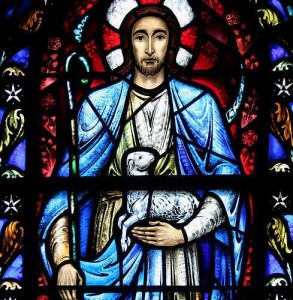
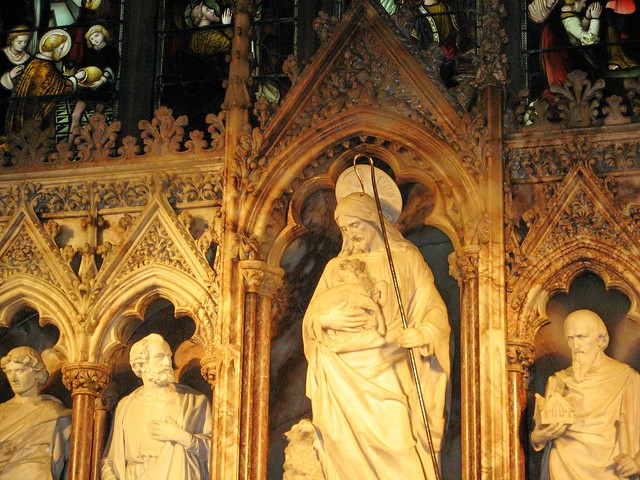 The Fourth Sunday of Easter is traditionally called Good Shepherd Sunday, for the readings focus on how our risen Lord Jesus is our shepherd who leads us to eternal life. But of course, the flip side of the Lord being our shepherd, is that we are sheep. We sometimes miss the humor of the Lord calling us sheep. The Lord could have said we were strong and swift as horses, beautiful as gazelles, or brave as lions. But, instead, he said we are like sheep. I guess I’ve been called worse, but it’s a little humbling and embarrassing really. And yet sheep are worthwhile animals and they have a certain quality that makes them pretty smart, as we shall see. Are you smarter than a sheep? Well, lets look and see how we stack up as we look at this gospel in three stages.