I have a love/hate relationship with slogans, philosophies of life, and pithy sayings. At one level I like the way they make me think. They sort of reduce all the complicated ways we think of things to a simple thought, or insight. It’s good for a moment to cut through all the noise and consider “just one thing.” But that’s also my problem with these things. In reducing everything to one thing we lose the essential nuances and the sophistication that accept that not everything fits into a nice little saying.
For example, consider the saying “All things in moderation!” Well yes, moderation is a good thing most of the time. But there is also a time to throw moderation to the winds and become passionate about things. There is a time to fight (or celebrate) with gusto. Maybe its a fight for justice, or maybe we’re called to sell everything for the “pearl of great price.” So all right, “All things in moderation,… including moderation!”
Anyway I hope you get the point about sayings and slogans: enjoy with caution and careful consideration. Enjoy the truth they convey but remember that life is seldom reduced to just one slogan or thought.
The following video contains a very good collection of sayings and “philosophies of life.” Many of them I have never seen before and some of them are quite good. But remember, like analogies, many of the things said in them are as untrue as they are true. Consider them as a way to make you think: What is true about this saying? What is untrue? What distinctions are necessary, especially for a Christian? So think. But don’t think so hard that you fail to enjoy. Take what you like, take what is true and leave the rest.
So of you who have read this blog a awhile know that, when I was in 10th Grade my hair was long, down on my shoulders, I listened to hard rock, doubted that God existed, and had devilish “blacklight posters” on my wall that frightened my mother. Today I am a priest.
I have no doubt that I emerged from my agnostic, hippie, rebellious stage as the result of prayer. I know my mother prayed for me. I know my Grandmother prayed for me. They are both in the 1963 photo at the right in the front row. My mother lived to see my ordination and enjoy the fruits of her prayer. My grandmother lived to see it too, but I don’t know how much she understood. For, by then, her dementia was advancing. I remember standing before her shortly after my ordination and she turned to my mother and said, “Nancy, why is Charlie wearing those black clothes?” She did not seem to understand that the fruit of her prayer was standing right before her. But that’s OK, she does now.
Both she and my mother have long since died and I have often reminded God of their prayers for me and requested their happy repose.
Then I heard a voice from heaven say, “Write: Blessed are the dead who die in the Lord from now on.” “Yes,” says the Spirit, “they will rest from their labor, for their deeds will follow them. (Rev 14:13)
I also remember how my mother and grandmother teamed up to pray my father back to church. He’s seen in the center of the photo above. He had fallen away from Mass for almost 20 years. But mom and Nana kept praying. And suddenly, one day, Dad just said, “It’s time to go back.” And not only did he go back to Sunday Mass, but he became a penitent of sorts. He went to daily Mass. And prior to Mass he said the rosary, and after every Mass he said the Stations. I remember seeing him pray the Stations one weekday in Eastertide and asked him about it. He just looked at me and said, “Charlie, I’ve committed a lot of sins in my life and I really need to pray…a lot!” And he never missed it. Even when he and my mother traveled, my Father was researching where they could attend daily Mass all through the trip. He had it all mapped out. When they went on a cruise, there had to be a Catholic chaplain on board, it was always the first question before booking passage. Yes, he died a penitent and was the surely the fruit of my mother’s prayer for over twenty years.
You and I have folks that we’re praying for, and it’s easy to despair at times that our prayers are making any difference. But don’t give up. It is my privilege as a priest to receive people at my door who have been away from God for years who are now requesting confession and a return to the Church. Many have been away for decades. But someone prayed for them, witnessed to them, called to them and didn’t give up. Maybe it took 30 years or more. But now they’re back.
Often the person who most prayed for them and desired their return has already died. They had sowed the seeds and I as a priest am reaping the harvest. At moments like these I recall the words of Jesus:
Do you not say, ‘In four months the harvest will be here’? I tell you, look up and see the fields ripe for the harvest. The reaper is already receiving his payment and gathering crops for eternal life, so that the sower and reaper can rejoice together. For here the saying is verified that ‘One sows and another reaps.’ I sent you to reap what you have not worked for; others have done the work, and you are sharing the fruits of their work.” (John 4:34-38)
Sometimes we sow, sometimes we reap. Sometimes too we have to pull weeds, water and feed. The work of evangelizing and shepherding souls is seldom simple or brief. But don’t give up, don’t be discouraged. You just never know how folks will turn out. Pray, work, witness, and trust. Don’t agonize, evangelize! Never give up, keep praying and working for souls!
Photo Credit: My Grandfather, Dr. Charles Evans Pope II
The following video is not about religious conversion per se but it depicts “losers” who became winners. It shows those who were rejected, who became great leaders. You just never know how things and people might turn out.
Today it would be good for us to think about two particular priests.
First, let’s bring to mind a priest whom God has used to touch our lives in some particular way. Maybe it’s a priest who was there for us during an illness or family crisis. Perhaps it’s one whose teaching or personal witness inspires us to greater faith or continued conversion. It could be a priest who has become our spiritual director, a confessor, a personal friend.
Second, let’s also bring to mind a priest with whom, for whatever reason, we’ve found to be a “turn-off.” Rightly or wrongly, we perceive him to be too worldly or lazy or without much talent. Perhaps he’s confused or even scandalized us by his behavior, or his message.
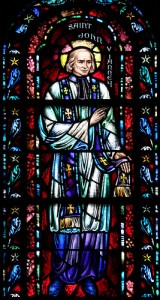
I invite us to think of these two priests, as today is the memorial of St. John Vianney, the patron saint of parish priests. It’s a day for us to thank God for priests, and also lift them up in prayer.
St. John Vianney was a priest who touched countless lives. He was renowned throughout France as a compassionate and insightful confessor, and he made himself available for confession up to sixteen hours a day.
At the same time, St. John had his struggles, and even his critics. Early on, he was almost not ordained because of his lack of a formal education. As a priest, St. John faced demonic temptations and interferences. What’s more, certain brother priests thought him too “extreme,” an assessment sometimes rooted in envy, ignorance, or even fear.
In short, St. John was a priest whom many gave thanks for but also one whom others thought was in particular need of prayer. As we celebrate his life, let’s hold in our hearts today our two particular priests, that they may be blessed by God to be all that they’re called to be. As St. John himself said, “A good shepherd, a pastor after God’s heart, is the greatest treasure which the good Lord can grant to a parish and one of the most precious gifts of divine mercy.”
When we think of evangelization there is a danger that we think first of biggie-wow projects, committees, and Church-wide efforts. Surely these are needed. The Church at the highest levels needs to expand our outreach in all the new media and re-propose the Gospel in creative and ever-widening ways. The same is true at diocesan and parish levels, where coordinated, thoughtful and intentional efforts are made to expand the Kingdom of God.
But don’t miss the little and daily ways that evangelization must first take place.
Consider that evangelization begins:
When Catholics attend to their own conversion and seek to grow in holiness, wisdom and knowledge of God
When parents spend time praying with their children, reading them bible stories, the lives of the saints and explaining the Catechism.
When parents bring their children to Mass every Sunday without fail and make family prayer a priority.
When parents are seen to pray by their children, seen to go to confession, and seen to be devout and joyful at Mass.
When parents carefully monitor what their children are watching, listening to and viewing on the Internet and other media and both protect them from evil and explain to them why certain things are wrong and to be avoided.
When spouses pray together and instruct and admonish one another in wisdom made perfect.
When Catholics manifest joy to others about their faith and the sacraments they receive.
When Catholics are not ashamed to manifest aspects of the faith such as the sign of the Cross, grace at meals, religious art and symbols prominently displayed in their home, and, where possible at work.
When Catholics consider their own testimony so as to be able to articulate what God has done for them when people as them the reason for their faith.
When Catholics are known by others to refrain from gossip, sensuality, vanity and worldliness.
When Catholics are known for their love and respect for others and for their integrity.
When Catholics speak the truth in love and confidence and do not make easy compromises with the world.
When Catholics are known to be kind and gentle, yet clear about moral issues.
When Catholics are known to live devoutly, temperately and modestly.
When Catholics are generous to the poor and the needy.
When Catholics are serene and hopeful, yet zealous for God.
And, Oh, did I mention joy? Mother Teresa says Joy is a net of love by which you can catch souls. St Paul says, Rejoice in the Lord always. I will say it again: Rejoice! Let your gentle spirit be known to all. The Lord is near. (Phil 4:4-5)
There is nothing that gives more evidence of God in us to others than joy. Not a silly, running around, telling jokes kind of joy. But rather, a serene, confident and stable joy that the world did not give and the world cannot take away.
It is a joy that only God, and knowing God, can give. It is a joy that can mourn for this sinful world, but never lose its joy in the kingdom. It is a joy that manifests to others as enthusiasm and zeal for God and his truth. It is joy, God’s great joy. And it is the great net of evangelization.
There is probably nothing worse than a sour faced saint who looks like he just sucked a lemon, grouchy, anxious and unhappy.
And though these times are tough, remember, the Church is a bride, not a widow. The Kingdom of God is a wedding feast, not a funeral. Christ has conquered, and so we speak the truth to an increasingly unwilling world with joy and confidence, willing to suffer for it, yet never losing our joy.
So, we don’t have to wait for the parish evangelization committee to go up a high mountain, or to a far distant land, and bring back the plan. We can begin now. And if you can’t do all the things above, do one.
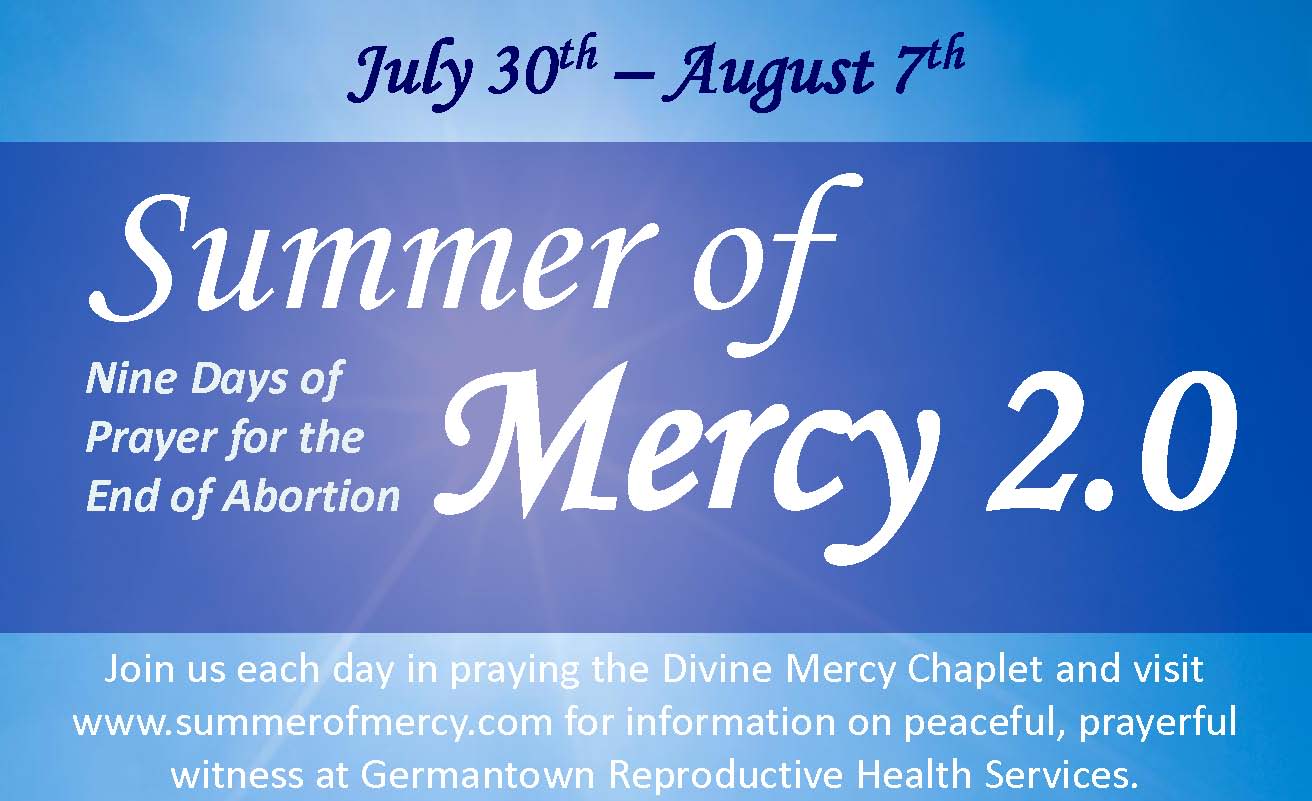
This week is the Archdiocese of Washington is participating in the Summer of Mercy 2.0 initiative. It could not be a more perfect response to decisions being made by the Health and Human Services Department. This posting has been written by Sr. Mary Ann Walsh of the USCCB Communications Office and really gets at the heart of the matter.
Health and Human Services must think Catholics and other religious groups are fools.
That’s all you can think when you read HHS’s recent announcement that it may exempt the church from having to pay for contraceptive services, counseling to use them and sterilizations under the new health reform in certain circumstances. As planned now, HHS would limit the right of the church not to pay for such services in limited instances, such as when the employees involved are teaching religion and in cases where the people served are primarily Catholic.
HHS’s reg conveniently ignores the underlying principle of Catholic charitable actions: we help people because we are Catholic, not because our clients are. There’s no need to show your baptismal certificate in the hospital emergency room, the parish food pantry, or the diocesan drug rehab program. Or any place else the church offers help, either.
With its new regulation, HHS seeks to force church institutions to buy contraceptives, including drugs that can disrupt an existing pregnancy, through insurance they offer their own employees. This is part of HHS’s anticipated list of preventive services for women that private insurance programs must provide under the new health reform law.
The exemption is limited, to say the least. The pastor in the Catholic parish doesn’t have to buy the Pill for his employees, but the religious order that runs a Catholic hospital has to foot the bill for surgical sterilizations. And diocesan Catholic Charities agencies have to use money that would be better spent on feeding the poor to underwrite services that violate church teachings.
Whatever you think of artificial birth control, HHS’s command that everyone, including churches, must pay for it exalts ideology over conscience and common sense.
Perhaps HHS is unduly influenced by lobbyists. No surprise there. Certainly a major lobbyist is Planned Parenthood, the nation’s chief proponent of contraceptive services. Contraceptive services make a lot of money for Planned Parenthood clinics, which (again no surprise) provide the “services” HHS has mandated.
HHS and Planned Parenthood are narrow in focus. Respect for religious rights isn’t likely a key concern for them. However, it ought to be a key concern for President Obama, who last year promised to respect religious rights as he garnered support from the church community to pass the health care reform act. To assuage concerns, President Obama went so far as to issue an executive order promising that the health care reform act would not fund abortion or force people and institutions to violate their consciences. HHS is on its way to violating that promise. For the sake of basic integrity – the President’s keeping his word and for the protection of the right to religious freedom – President Obama needs to speak up now.
When our prayers appear to go unanswered, and God seems distant, indifferent, or deaf, we can wonder if there’s any use in praying at all. At times like this, the experience of the woman in today’s gospel can be very helpful to us.
As we heard, she pleaded with Jesus on behalf of her sick daughter. At first, Jesus gave her no response at all. Next, Jesus’ friends asked him to send her away. And then, after she had literally fallen on her knees and begged for help, Jesus quoted a popular saying which likened her people to dogs.
Jesus was intentionally testing her faith, and she passed the test. Others might have given up, and walked away in bitterness and disappointment. But not this woman! She continued to persist, her prayer was answered, and her daughter was healed.
Her witness demonstrates the importance of persistence in prayer. Persistence is essential, for several reasons. For starters, persistence teaches us patience and honors the fact that God acts in freedom, and isn’t a spigot of grace that we can turn on and off as we wish. In addition, persistence shows to God that some need is close to our hearts, and not just a casual request. Persistence can also make clear to us that God’s agenda, and God’s timetable, are sometimes very different than ours. Sometimes God says “Yes!” Sometimes God says “No.” And sometimes God says “Not yet.”
In short, nothing should discourage us from persisting in prayer. As St. Teresa of Avila said, “God never gets tired of giving; so let us never get tired of asking.”
Looks like were all going to be “treated” to a new series on the Discovery Channel wherein British Physicist Stephen Hawking will ponder theological and philosophical questions. A rather strange thing for a scientist to do actually.
I have no doubt that Stephen Hawking is a fine, even a brilliant scientist and theoretical physicist. But science has a limit, a limit rightly imposed on itself, which explores the physical world using empirical and evidential models that do not go beyond the physically observable world. Scientists, even theoretical physicists, do well who recognize their sphere, their field. And most scientists are quite willing and happy to acknowledge the self defined world of the physical sciences.
Stephen Hawking however, while clutching the mantle of his scientific robes, has recently strayed beyond what science can say. In my opinion he he causes harm to science and also proves himself a poor philosopher to boot. He is free to philosophize of course like any human being, but he ought not cloak it as science and we ought not give any special weight to his philosophical and theological statements, fields in which he clearly has no proper training. When it comes to these fields he is just “some dude” sipping a beer and opining on the deep questions.
But, sadly we DO have to pay attention to him because so many in our world bow their heads with religious reverence as he speaks, and give a weight to his words on these matters that the words do not deserve.
Mr Hawking was recently interviewed in USA Today about his new series. I would like to excerpt the article here and make some comments of my own. As usual the article is in bold, black, italics, my comments are in plain text red. The full article can be read here: USA Today: Science Snapshot
“I recently published a book that asked if God created the universe. It caused something of a stir,” Hawking, 69, begins on the episode. (The “stir”, in fact, was religious leaders denouncing his book’s conclusion that God was unnecessary to the universe.)
Well, of course we shouldn’t expect USA Today to be sympathetic to “religious leaders,” but “denounce” is an unnecessarily provocative description. Why is our position not described as a “principled opposition” rooted in concerns that Mr. Hawking may be making conclusions that science really cannot make, and that he strays from science into philosophy? Or why was our position not described as an “unconvinced?” For, frankly Mr Hawking’s argument is not airtight or invincible. There are many, who find his premises faulty and his conclusions questionable.
But USA Today would rather just depict us as “denouncers” who shout angry things and throw rocks from the sidelines.
As for me, I love science and am very excited about the amazing discoveries of the past 200 years. But I do not expect science, which studies the physical world using empirical observation, to be able to conclude one way or another about God who is pure spirit. To some extent I think science can draw conclusions that there is a design to the universe, but I do not expect it to make definitive claims, one way or the other, as to the who exactly this designer is.
Is this to “denounce,” or is it, as I propose, to take a principled stand that the physical sciences are a careful discipline which study the material world? And that they ought not be invoked to take philosophical and theological stands on the existence of God or angels, or the soul, or anything non-material.
On the show, he takes viewers on a walk through humanity’s history of appraising our place in the universe, from Vikings facing down eclipses to the laws of modern cosmology, which explain the origin and structure of universe. “I believe the discovery of these laws is mankind’s greatest achievement,” he says.
So it would seem that Mr Hawking, in his series, sees ancient and modern belief in God as just some sort of way to “find my place in the universe,” as a mere anthropological projection of cosmology? Somehow we are seen as similar to the superstitious of Vikings and other ancients who feared eclipses and other things things they did not understand.
I suspect I am also to suppose that just like we would laugh at, or pity someone getting spooked by an eclipse, we should also laugh at, or pity those who believe in God? It would seem that I am also supposed to presume that modern cosmology has it all figured out, unlike the pitiable ancients?
Mr Hawking has said elsewhere that he thinks belief in God is just a coping mechanism for believers. Well of course that is one way to believe in God. But it is not why I believe in God. Nor is it why most people I know believe in God.
I believe in God because I have experienced his power and presence in my life. I believe in God because I see evidence for his existence in the things he has made, things that manifest both a first cause and evidence an intelligent and purposeful design. I believe in God because he is changing my life, and in the laboratory of my own life, I have tested his wisdom and Word and found them to be true.
I am not consciously obsessed with dying, nor do I need to be comforted and reassured in the face of it. Frankly my faith challenges, more than comforts me. My faith holds up a cross before me, not a pillow. There is surely some consolation in there being a “meaning to my life,” but Mr. Hawking, indeed every human being, seeks meaning.
Believers should not be demeaned and our faith simplified by equating us with spooked Vikings staring at an eclipse. The Roman Catholic Faith is a smart and thoughtful faith extending back 2000 years to Christ, and 5000 years further into Jewish antiquity. We are not the yahoos some like to think we are. We have a strong, lasting and profound theological and philosophical tradition. And these have served as an important foundation for the development of the natural sciences.
In a short, exclusive interview with USA TODAY, Hawking e-mailed his answers to why he is taking on religion to start off the show, and discussed his life and legacy. Here are his answers to some of the questions:
Q: First, we wonder if you could comment on why you are tackling the existence of God question?A: I think Science can explain the Universe without the need for God.
And I would answer that physical science cannot conclude one way or another on the existence of a purely spiritual Being. Science need have no opinion on whether God is “needed,” for it limits its scope to studying effects, and secondary causality. The primary cause of all things is a philosophical and theological pondering, for it exists before singularity, and thus lies beyond what science can currently measure. In other words, science is not equipped to answer the ultimate question of “why” things exist. It studies things that do exist, and can probe their secondary causes. But primary causality, the ultimate why of the existence of all things lies outside the system.
What Mr Hawking is doing here is not science at all, it is philosophy, and poor philosophy at that. For philosophy carefully distinguishes cause and effect. It also distinguishes primary causality from secondary causality. Even more, it distinguishes material, formal, efficient, and final causality. Mr Hawking would seem to gloss over all this, and thus portrays his amateur status as a philosopher. If you’re going to enter the world of philosophy you might at least brush up on terminology so as to have a reasonably thoughtful discussion with your interlocutors.
Q. What problems you are working on now, and what do you see as the big questions in theoretical physics?A: I’m working on the question, why is there something rather than nothing, why are the laws of physics what they are.
Well, stick the laws of physics please, because science is not well equipped to answer the ultimate question of why. Ultimate meaning and “why all this” it just not a physically measurable thing. It is not a question physical science can really answer. How do you physically measure meaning? What are the scales you weigh it in? Does meaning have physical weight? That said, at least he is describing his work as theoretical physics. But remember, physics is going to have “physical” limits and must limit itself to the physical, material world.
Q: What do you see as your legacy in science or for the people who have become enthusiastic about physics as a result of your work and writing?A: I think my most important discovery is the fundamental relation between gravity and thermodynamics (the study of how heat moves through matter) which gives a black hole a temperature and causes it to evaporate slowly.
Cool!
Essentially on “Is There A Creator?,” Hawking notes that on the sub-atomic scale, particles are seen in experiments to appear from nowhere. And since the Big Bang started out smaller than an atom, similarly the universe likely “popped into existence without violating the known laws of Nature,” he says. Nothing created the universe, so in his view there was no need for a creator. That is his explanation for “why there is something rather than nothing.”
Well, the philosophical and logical errors here are more numerous than there is time to explore.
Even scientifically I wonder how we define “nowhere.” It may be a true fact that we do not know where the particles come from or how they appear, but we cannot logically leap to the absolute conclusion that they come form “nowhere.”
To say that they come from nowhere is an a priori assumption. It is unproved that the particles come from nowhere. And how would we prove that something came from nowhere? It may be that we simply don’t understand where they came from or how.
And, even if we could reasonably prove that something came from nowhere, does that ipso facto mean that it did not exist before it came from nowhere?
I suppose, as a theologian I could proffer that it existed spiritually before it materialized? But of course physical science cannot measure the spiritual and cannot accept my theory or measure it. So it would seem to science that the particle came from nowhere. But that does not mean that it did come from nowhere, only that science cannot explain where it came from or how; at least not now.
For example, a blind man might theorize that raindrops on his head come from nowhere, because he cannot see their cause. But that does not prove they come from nowhere, only that he does not know where they come from or how.
“The series is all about satisfying our curiosity about the world,” Hendricks says. Rather than tackling science like classroom topics, the shows will ask questions and see what research has to say about them, he says, an inversion of the standard science show formula. “That is why we are starting with Stephen Hawking,” Hendricks adds. “We want to be asking the deepest questions we can, such as ‘Did God Create the Universe?”
A question which science can’t answer.
Frankly, save your time from watching this Hawking show. If you do watch it, please remember that Mr Hawking is free to wonder and theorize. But that is all it is, a theory. And remember too that he is wandering as he wonders. He is wandering beyond the proper limits of his discipline. While he may be a fine physicist, but that does make him a good philosopher, any more than it makes him a good car mechanic. I would not want him to work on my car any more than I want to give weight to his amateurish philosophical ponderings. He is free to make them, but they are poorly set forth, based on poor philosophical foundations and logical flaws. Do not be fooled by his lab coat.
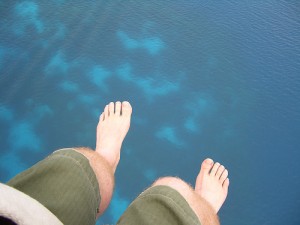
“Don’t look down!” is good advice we can give to those people who have a fear of heights. And in a sense, this is also the advice that Jesus gave to Peter in today’s gospel.
As we heard, Peter and his friends found themselves in the midst of a storm. The wind was howling, the waves were pounding, and their little boat was being dangerously tossed about.
And then, from seemingly out of nowhere, Jesus appeared. He didn’t immediately calm the storm, as he sometimes does. Instead, he came to his friends in the midst of the storm, in order to test them, and to help them learn about faith.
While he walked on the water, Jesus invited Peter to come to him, and what happened next is very instructive for us. As long as Peter kept his eyes focused on Jesus, the wind and the waves didn’t consume him. Instead, he was able to rise above them! It was only when he took his eyes off Jesus that he began to sink, and was filled with fear.
When you and I find ourselves being tossed about by the storms of life, we can take a cue from Peter. As long as we keep our eyes on Jesus, as long as we try our best to stay close to him in faith and trust, we can be assured that we won’t drown, that we won’t sink into despair, and that we won’t be paralyzed by fear. Because we will hear Jesus say to us, as he said to Peter: “Take courage, it is I; do not be afraid.”