While walking home after shopping, a woman encountered an older man with a cardboard sign which read, “Homeless, anything will help.” As she handed him a dollar, a man roared by in an SUV and yelled, “Sucker!” The woman was disturbed by this, not only because of the man’s rudeness, but also because she knew his sentiment is shared by so many. What he thought he saw was a con artist or a lazy bum. But what she saw instead was a human being in need.
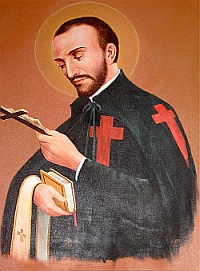
When we encounter the homeless, the poor, the desperately needy, what do we see? A human being in need? If so, that’s good. Better yet, however, is to see the face of Christ himself, as did the sixteenth century Italian saint we honor today, St. Camillus de Lellis.
Thanks to a gambling addiction and an incurable war wound, he knew both poverty and pain. God’s grace, however, helped him conquer his addiction and a lifetime of serving the impoverished sick as a nurse and a priest. To assist in this ministry, he founded an order which still continues today, the Camillians, who wear a distinctive red cross on their cassocks.
St. Camillus made it a point to seek our the impoverished sick to give them consolation and practical help. On occasion, people thought his actions were foolish. If they lived today, they might call him a “sucker.” For his part, however, St. Camillus would remind his critics that, as the gospel teaches, Jesus himself is encountered in the needy, and he challenged them, and he challenges us, to do the same. “The poor and the sick are the heart of God,” he said. “In serving them, we serve Jesus the Christ.”
There is an interesting set of articles in the Our Sunday Visitor by two Catholics on the Budget problem. One, Congressman Paul Ryan, is a Republican. The other is Stephen Schneck, a Democrat and teacher at the Catholic University of America. These articles show how very different Catholics can be among each other when it comes to what is often termed the Social doctrine of the Church. Both men write well and with passion. Both quote Popes encyclicals and bishops. Both claim that the care of the poor is paramount. Yet both have a very different way of understanding these principles in terms of the Federal Budget. Consider their articles with a few comments by me in red.
Congressman Ryan:
Catholic social doctrine is indispensable for officeholders, but there’s a right way and a wrong way to understand it. The wrong way is to treat it like a party platform or a utopian plan to solve all of society’s problems. Social teaching is not the monopoly of one political party, nor is it a moral command that confuses the preferential option for the poor with a preferential option for bigger government.
I think this is fair not only from the position he states it but also from the experience of the Church in terms of politicians. In a sense we in the Church have to state that we have no permanent friends or enemies. No politician has a 100% perfect voting record in terms of Catholic teaching or the positions articulated by the bishops. A certain politician may be with us on abortion but in opposition to us on immigration with us on social policy in regard to the poor but against us on gay “marriage.” The Catholic view doesn’t easily fit into one party of the the other despite what our opponents on a particular issue may insist.
…..The judgments of equally well-intentioned citizens may differ. Usually, there isn’t just one morally valid policy. Instead, there are better and worse ones calling for respectful dialogue and thoughtful judgment. The moral principles are dogmatic; the political responses are prudential.
Yes I have often stated that on these pages. We are often too quick to treat prudential judgments as doctrinal positions. hence some one might hold that because a certain bishop makes a prudential judgment not to discipline a pro-abortion politician then he (the bishop) is soft on abortion. It may simply be that he thinks such a move unwise. Likewise if someone has concerns about big government involvement in care for the poor they “don’t really care about the poor.” But these are not doctrinal stances, they are prudential judgments wherein one tries to apply the doctrine to a given situation. One is free to dispute the prudential judgements of others and whether they best reflect the doctrine, but sweeping judgements ought to be avoided in critiquing prudential judgments. This requires the kind of sophistication that many modern discussions lack. Thus they pretty quickly devolve into name-calling and demagoguery.
…When income and credit dry up, the best will in the world cannot prevent cuts in expenses, including staff layoffs and wage reductions. Governments face choices, but their budgets also shape the economic future. A budget with low taxes, spending restraint and less borrowing can help restart the economy, create jobs and increase resources for investment, charity and assistance for the needy.
Granted, but Mr Ryan could say more about how cuts are prioritized. For, as we shall see, his opponent(s) argue that the poor suffer disproportionately under his budget. It is a worthy goal to restart the economy, but the poor may not be able to wait for this to trickle down to them. Hence his opponents argue that care for the poor should be a higher priority that it is.
Asked about rising government debt, Pope Benedict XVI has said: “[W]e are living at the expense of future generations … in untruth. We live on the basis of appearances, and the huge debts are meanwhile treated as something that we are simply entitled to.” It is immoral for governments to make promises they cannot fulfill.
Budgetary discipline is a moral imperative. In Greece and other European nations, retired pensioners and vulnerable citizens are suffering from harsh benefit cuts as a result of politicians’ empty promises. Preferences for the poor, solidarity, subsidiarity, the common good and human dignity are disregarded when governments default and bankrupt economies stop producing. Economic well-being is a foundation stone of an enduring “civilization of love.”Granted, if the economy goes down every one suffers, the poor first and most.
In his encyclical “Caritas in Veritate,” Pope Benedict warned that solidarity without subsidiarity “gives way to paternalist social assistance that is demeaning to those in need.” Our budget gives more power over federal anti-poverty dollars to the states, directed by governors and state lawmakers who are closer to the problem…..The dignity of the human person, said Blessed Pope John Paul II, is compromised when bureaucratic ways of thinking — which he dubbed the “welfare state” or “social assistance state” — dominate our lives with heartless regulations and impersonal rationing.
Some argue that the States are receiving unfunded mandates and that shifting the burden to states without also shifting the money is tantamount to canceling the care for the poor. Mr. Ryan is not clear that the money is going to states in the same amount. Subsidiarity is surely a Catholic principle but there has to be actual action for there to be subsidiarity. And without the money there can be no action hence no subsidiarity. I am not claiming that there is no money going to the states, I am just not sure, from what he says.
Our budget helps the poor, first and foremost, by promoting urgently needed economic growth and job creation. Our reforms to save Medicare from bankruptcy….our budget repeals the new health care law with its taxpayer funding of abortions, government control over the health care sector and panel of bureaucrats empowered to ration Medicare.
Catholic social thought’s paramount interest is the moral character of society, which takes primacy over dollars and cents….
Congressman Paul Ryan, R-Wis., is chairman of the U.S. House Budget Committee. These are excerpts. The full article is here: Congressman Paul Ryan on Budget
Stephen Schneck replies:
At the beginning of life, Medicaid pays for about one-third of all births in America. Maybe you know a scared young mom who needed such help. If you are pro-life, like me you realize what support for these births can mean. I wonder why the number is this high?
Or maybe, like I do, you have a friend who lost his job and, despite best efforts, hasn’t found work. Unable to stretch unemployment insurance enough to make ends meet, he was embarrassed to need help, but at least he was able to feed his kids with food stamps….
Rep. Paul Ryan, the GOP’s 2012 budget strategist, would cut all these programs and many others like them just when folks are struggling to stay afloat.Instead of trying to balance the budget in a way that protects the most vulnerable — as both parties did in past hard times — Ryan would cut food stamps by 20 percent, would turn away as many as 450,000 poor women and infants from WIC nutrition assistance, and reduce Maternal and Child Health Grants by one-third. Over the next decade he would cut $1.5 trillion from federal Medicaid payments.Some debate if there are actual cuts or as extreme as is claimed. As a novice to these details, I am bewildered by all the numbers and claims back and forth.
Rep. Ryan would gut these critical, life-supporting pro- grams at the same time that his budget would give almost $3 trillion in new tax cuts that overwhelmingly benefit millionaires and corporations.On the face of it, this is egregious. But I suspect that Mr Ryan et al would claim that these cuts are actually incentives to get business to risk expansion and new hiring.
Catholic teachings tell us that public officials must put the vulnerable foremost in their policy decisions. Sure, our Church encourages personal charity; it also promotes local help, and it understands its own call to serve the vulnerable. But, important as such subsidiary efforts are, our Church also insists that national governments cannot shirk responsibility for those needing a helping hand. Every social encyclical since Pope Leo XIII’s Rerum Novarum in 1891 has insisted that this is a fundamental duty for any government.… Yes, Catholic social teaching does indicate that we, individually and collectively have obligations to to the poor and that we owe this to them, not just in charity but also in justice. The poor do have some legitimate claim to our excess wealth.
Like Rep. Ryan, I, too, believe that we must address the national debt. But it’s wrong — it’s immoral — to do this by shredding already stretched safety nets that save lives and give a bit of dignity to those in need. Maybe the rich can forgo more tax breaks? Maybe we can reduce some giveaways to Wall Street? Maybe we can trim weapon systems that the military does not even want? Before we cut Medicaid funds for our elderly and needy, or take food stamps away from hungry kids or slash programs for at-risk moms and babies, let’s pray that those in power — especially Catholics such as Ryan — reflect humbly on the Church’s ancient teachings and consider if there is not some other way.
I wish he hadn’t used the word immoral. I honestly think that we can try and debate this matter, wherein reasonable people will differ as to the details, and assume good will rather than immorality. That said, we need to be very careful not to underestimate the impact that sudden shifts may have on the poor. Rather than all the “class envy” stuff he offers, perhaps we could just ask the tough questions about the real impact to the poor.
My biggest concern about Conservative calls for subsidiarity (a view I largely share) is that, while the calls are made, there is very little detail about how we get there from here. What is the conservative plan to care for the poor? If it is not the government, then who? The Church? Fine. But we don’t have the money or resources to do it now. Where do we get them? How do we make the transition from big Government to more subsidiarity? Though sympathetic to calls for subsidiarity, I do not have simple answers to these questions. The subsidiarity view seems to me to be long on vision but short on details, especially in how we get there from here.
Stephen Schneck is director of the Institute for Policy Research & Catholic Studies at The Catholic University of America. These are excerpts. The full article is here: A Catholic Democrat’s Take
Earlier this week, God reminded me that he has a sense of humor. It happened as I was beginning to prepare this very homily. I was reading today’s gospel and thinking about what to preach, but nothing immediately came to mind. I began to get impatient. And that’s where the joke comes in. Because the gospel I was getting impatient over is all about Jesus telling us to be patient! When I suddenly realized this, I felt a little bit ashamed, but I couldn’t help but smile at the same time.
Jesus, you see, had been preaching about the kingdom of God. When people heard this, many of them expected that God would soon send down his angels and destroy evil for ever. But when this didn’t happen, they became impatient. Jesus was aware of this, and that’s why he told the parables he did. The kingdom of heaven starts small, he said, kind of like a mustard seed or the yeast in bread. It will grow, but only with time. And as for evil, it will never be totally wiped out in this age. That’s the point of the parable about the weeds and the wheat. In the meantime, we need to be patient.
And Jesus is right, isn’t he? People were impatient in his day, and we are often impatient in ours. We live in a fast-paced, “drive through” society. We don’t want to wait for the things we want. And when we do have to wait, we get really frustrated. That’s why driving on the Beltway can be so darned scary!
We even get impatient in our spiritual lives too. We want God to “zap us” and make us into an instant saint. We want overnight holiness. We look for an experience or a retreat or a homily that will fix us once and for all, getting rid of every temptation and solving every problem. But that doesn’t happen, does it? Instead, we find ourselves confessing the same sins over and over and over again, and we become impatient. Which, ironically, is probably one of those sins that we have to repeatedly confess. Then we wind up being impatient with our impatience!!
The truth is, however, that Christian maturity doesn’t happen overnight. Real growth in Christian discipleship takes time! Rome wasn’t built in a day, and neither are saints. It takes a whole life time. In fact, it usually takes more than a whole life time. Because even though we may be a friend of God, we usually have a lot of growing still to do when we die. That’s the whole point of our Catholic belief in Purgatory. It’s where God’s imperfect friends continue to grow into perfection.
Heaven, you see, is only for the perfect. And the only two perfect people were Jesus and Mary. Even the saints weren’t perfect on earth! They had to go to confession like the rest of us sinners. That’s why the Church’s measuring stick for sainthood is not perfection- because no one would qualify! Instead, the standard is what’s called “heroic virtue.” And that’s very different from perfection.
In our quest to become saints, then, we need to learn patience. As St. Alphonsus Liguori once said: “It’s by patience that we gain heaven!” To learn patience, I would suggest three things. First, don’t be a perfectionist. Second, don’t be a pessimist. But third, do be persistent.
Perfectionism is dangerous because perfectionists think that God will love them only if, well, they’re perfect. Which, as we already know, is impossible! Even worse is that for perfectionists, God comes to be seen, not as a loving friend who wants to help us, but as a heavenly scorekeeper who is quick to condemns us. Not surprisingly, perfectionists find very little joy in their faith, if at all.
Perfectionists also have unrealistic expectations and establish impossible standards for themselves. Unfortunately, this only leaves room for failure. A very new Christian once learned this when she tried to follow Saint Paul’s advice to “pray without ceasing.” She tried and tried to pray during every waking moment, but as you might imagine, she quickly tired out. She went to a wise priest with her problem who told her that she had “spiritual indigestion,” because she’d tried to take on too much too soon. Never having really prayed before, the priest explained, she couldn’t all of a sudden start praying eighteen hours a day while doing other things. Because God didn’t expect it of her, he concluded, she shouldn’t expect it of herself.
On the other hand, the priest didn’t tell her to give up and throw in the towel. And that’s important too. We can’t become a pessimist and think that nothing we’ll do will make much of a difference. Pessimists, you see, don’t just think that they’re sinners. They think instead that they’re hopeless sinners. But in God’s eyes there is no such a thing. With God on our side, there’s always hope, which means that we must be persistent in our relationship with him. Even if it seems like we’re making little headway. Even if we think we’re sliding back. We may be slow learners, we may have a lot of baggage and hang-ups, and we may be afraid of change, but God is full of more patience, love, and mercy than we could ever imagine. Today’s first reading from Wisdom told us this. And so did our Psalm.
God, you see, is love. And love is patient. God is patient with us. So we must be patient with ourselves, and take things little by little, bit by bit. We need to measure our progress by the inch, not by the mile; we need to take things one day at a time. As St. Richard of Chichester said in his famous prayer, “O Lord, may I see thee more clearly, follow thee more nearly, and love thee more dearly, day by day.”
We live in difficult times for the Church, and from many sectors the very legitimate cry for reform goes up frequently. Beyond the sexual abuse scandal, there are also deep concerns regarding the uncertain trumpet of Catholic preaching, lukewarm and nominal Catholics, an overall lack of discipline among Catholics, and a lack of disciplining by the bishops and clergy of Catholics, clergy and lay, who cause scandal. In a way, the list is quite long and has been well discussed on this blog, which is, overall sympathetic to the need for reform, and greater zeal in the Church.
But today’s Gospel issues a caution in becoming over zealous to root out sin and sinners from the Church. It is the memorable Parable of the Wheat and Tares. The Lord’s cautionary rebuke to the zealous farmhands who wanted to tear out the weeds, was that they might harm the wheat as well. Wait, says the Lord, leave it to me. There will come a day of reckoning, but it is not now, wait till harvest.
This does not mean that we are never to take no notice of sin or never rebuke it. There is need for discipline in the Church and other texts call for it (see below). But this text is meant to balance a scouring that is too thorough, or a puritanical clean sweep that overrules God’s patience and seeks to turn the Church from a hospital for sinners to a germ-free (and hence people-free) zone.
We are going to need to depend on a lot of patience and mercy from God if any of us are going to stand a chance. Summoning the wrath of God to come on sinners, as some do, may well destroy them as well. We all have a journey to make from being an ain’t to being a saint.
So let’s allow this Gospel to give us some guidance in finding balance between the summons to reform and the summons to patience. The guidance comes in Four Steps.
I. WAKE UP – The text says, Jesus proposed another parable to the crowds, saying: “The kingdom of heaven may be likened to a man who sowed good seed in his field. While everyone was asleep his enemy came and sowed weeds all through the wheat, and then went off.
Notice in this text that every one was sleeping when the enemy sowed weeds. There is a great mystery as to why God allows Satan to sow the seeds in the first place. But there is far less mystery as to why Satan has been so successful in our times. The weeds are numerous, and are vigorously growing in our times. And part of the reason is that we, in the Church, have been sleeping while Satan has steadily sown his weeds among us.
Now don’t just blame the Church leadership. Though we share plenty of the blame. But the fact is that too many in the whole Church have been in a moral sleep. Too many Catholics will just watch anything, listen to anything, expose themselves to anything. We just go with the flow, and live unreflective sleepy lives. We also allow our children to be exposed to almost anything. Too many parents have little knowledge of what their children are watching, listening to or surfing on the Internet, who their friends are etc. We hardly think of God or his plan for our lives, and, collectively, have priorities that are more worldly than spiritual. We are not awake and sober to sin and sin’s incursions, we are not outraged, we take little action other than to shrug, and seem to be more concerned with fitting in than living as a sign of contradiction.
Church leadership too has been inwardly focused. While the culture was melting down beginning in the late 1960s, we were tuning guitars, moving the furniture in the sanctuaries, having debates about Church authority, gender wars, and seemingly endless internal squabbles about every facet of Church life. I do not deny that there were right and wrong answers in these debates, and that rebellious trends had to be addressed, but while all this was going on, Satan was sowing seeds and we lost the culture.
We are just now emerging from our 50 years in the cocoon to find a world gone mad and we, who lead the Church, clergy and lay, have to admit that this happened on our watch.
It is long past time to wake up and sober up to the reality that Satan has been working while we squabbled and sang songs to ourselves.
And lots of hollering and blaming one side of the Church or the other, this kind of liturgy or that, is not very helpful, because that is still inward in its focus.
It’s time to wake up and go out. There is a work to do in reclaiming the culture for Christ and reproposing the gospel to world that has lost it.
Step one in a finding a balance between the need for reform and patience is to wake up
II. WISE UP – the text says, When the crop grew and bore fruit, the weeds appeared as well. The slaves of the householder came to him and said,’Master, did you not sow good seed in your field? Where have the weeds come from?’ He answered, ‘An enemy has done this.‘
Part of the sobriety we have to regain is to understand that we have an enemy who hates us, Satan. He is responsible for much of the spiritual, moral and even physical ruin we see around us. We have too long been dismissive of his presence, as though he were a fairy tale. While we cannot blame everything on him, for we connive with him, and we also suffer the weakness of the flesh and the bad influence of the world. But Satan is real and he is an enemy and he hates you. He hates also your children, he hates the Church, and he hates anything and anyone that is holy, or even on the way to holiness.
We have to wise up and ask the Lord for an anointing. We need not utterly fear the devil, but we need to understand that he is at work. We need to learn and know his moves, his designs, his tactics, and tools. And we need the grace, having recognized him, to rebuke him at every turn.
Now be careful here. To wise up means to learn and understand Satan’s tactics. But it does not mean to imitate them in retaliation. Upon waking up and wising up, some want to go right to battle, but in worldly types of ways. Yet, the Lord often proposes paradoxical tactics which are rooted in the wisdom of the Cross, not the world. Wising up to Satan and his tactics, does not often mean to engage in a full on frontal assault. Often the Lord counsels humility to battle pride, love (not retaliation) to conquer hate, and accepted weakness to overcome strength.
To wise up means to come to the wisdom of the cross, not the world. As we shall see, the Lord is not nearly as warlike in his response to his enemy as some zealous reformers propose to be. We may be properly zealous for reform, and want to usher in change rapidly, but be very careful what wisdom you are appealing to. Scripture says, Do not deceive yourselves. If any one of you thinks he is wise by the standards of this age, he should become a “fool” so that he may become wise. For the wisdom of this world is foolishness in God’s sight. (1 Cor 3:19-20).
Step two in a finding a balance between the need for reform and patience is to wise up.
III. WAIT UP – The text says, His slaves said to him, ‘Do you want us to go and pull them up?’ He replied, ‘No, if you pull up the weeds you might uproot the wheat along with them. Let them grow together until harvest...
We have already laid the ground work for the Lord’s rebuke to these overly-zealous reformers. Today in the Church we are well aware of the need for reform, so is the Lord. He says, clearly, an enemy has done this. And yet, to those who want to go through the Church rooting out every sinner, every ne’er do well, every bad theologian (and there are many), and call for an increasing and severe clamp-down by the bishops across the board, the Lord gives a balancing notion.
There is need for discipline in the Church, and even punitive measures from time to time. The Lord himself proposes excommunication in certain instances (e.g. Matt 18:17), St Paul too (e.g. 1 Cor 5:5). Yet, texts such as those need to be balanced by texts such as the gospel today. Fraternal correction is an essential work of charity (I have written more on that here: Fraternal Correction) and it must be conducted with patience and love.
But the The Lord is patient and here directs us to also to be prepared to wait and not be over zealous in pulling weeds, lest we harm the wheat. The Lord says, remarkably, let them grow together. Notice, now is the time to grow, the harvest comes later. In certain, rarer instances the harm may be so egregious that the Church has to act to remove or discipline a sinner more severely. But there is also a place to wait and allow the wheat and tares to grow together. After all, sinners may repent and the Lord wants to give people the time they need to repent. Scripture says, God’s patience is directed to our salvation (2 Peter 3:9).
So, while there is sometimes need for strong discipline in the Church, there is also this directive to balance such notions: Leave it be, wait, place this in the hands of God, give time for the sinner to convert, keep working and praying for that, but do not act precipitously.
We have had many discussion here on the blog about whether and how the bishops should discipline certain Catholic politicians who, by their bad example and bad votes, undermine the gospel and even cost lives through abortion and euthanasia.
While I am sympathetic to the need for them to be disciplined, how, when and who, remains a prudential judgement for the Bishop to make. And, as we can see, there are certain Scriptures which balance each other. In the end, we cannot simply make a one-size-fits-all norm. There are prudential aspects to the decision and Lord himself speaks to different situations in different ways.
In today’s Gospel the Lord says, wait. And generally it is good advice to follow. After all, how do YOU know that you won’t or don’t need more time? Before we ask God to lower the boom on sinners, we ought to remember that we are going to need his patience and mercy too. Scripture says, The measure that you measure to others will be measured back to you. (Matt 7:2& Luke 6:38). Be very careful before summoning God’s wrath, for who may endure the Day of his coming (Mal 3:2)?
Step three in a finding a balance between the need for reform and patience is to wait up and balance zeal with patience.
IV. WASH UP – The text says, Then at harvest time I will say to the harvesters, “First collect the weeds and tie them in bundles for burning; but gather the wheat into my barn.
So you see, there is a harvest and those who have sinned or led others to sin and have not repented are going to have to answer to the Lord for it.
The Lord is no pushover and he does not make light of sin. In saying wait, he does not mean that judgment will never come. But his general advice is “Leave it to me.” And to us he says, in effect, “As for you, wash up, get ready, and help others to get ready too. For judgment day is surely coming and every knee will bend to me and every one will render and account.
That’s it, Wash up! You’re either going to be a saint, or an ain’t. For now the wheat and tares grow together. But later the tares and all the weeds will be gathered and cast into the fire.
So here’s the balance, God is patient, but there is a harvest and we have to get ready by God’s grace. For the overly zealous God says wait. But to the complacent and sleepy God says, wake up, wise up and wash up!
Are you ready for the coming of the Lord? To put it in a gloss of an old song: Is you is, or is you ain’t a saint?
Here is a great exposition of this Gospel from Fr. Francis Martin. Don’t Miss it.
St. Paul used the image of an athlete to describe the Christian life in Several places. Consider this one:
Do you not know that the runners in the stadium all run in the race, but only one wins the prize? Run so as to win. Every athlete exercises discipline in every way. They do it to win a perishable crown, but we an imperishable one.Thus I do not run aimlessly; I do not fight as if I were shadowboxing. No, I drive my body and train it, for fear that, after having preached to others, I myself should be disqualified. ( 1 Cor. 9:25-27)
Clearly there are many virtues necessary to the athlete that are also of great necessity to the Christian:
Discipline – The athlete must carefully and persistently train the body. Without a clear and repetitive discipline, the sport will not be mastered, and neither will the body have proper stamina, strength and coordination. Athletes train every day and work to perfect their mastery of the sport. So too must Christians undertake a clear discipline, and persistently train in the ways of faith through prayer, scripture, sacraments, moral virtue and self mastery. The Christian must practice every day.
Persistence – The Athlete must follow discipline all the time, not just occasionally. To fail in persistent training not only jeopardizes good performance, but it risks injury. So too for the Christian. We cannot expect much progress with an on-again, off-again regimen. Without a persistent good habit of prayer, scripture, sacraments and practicing of moral virtue the Christian not only stunts progress but also risks injury (sin).
Rules – Every sport has rules that must be accepted and followed. The athlete is not free to reinvent the game. They must play by the rules or risk exclusion and disqualification. S0 too the Christians must play by the rules set by God. If we are going to be on the winning team and secure the victory, we have to abide by the rules. To refuse this, is to risk being disqualified. We are not free to reinvent Christianity as so many try to do today. There is only one playing field and one game. Follow the rules or risk being ejected.
Alert for Injury – A good athlete listens carefully to his or her body and any signs of injury. If injury is detected they see the team doctor quickly and take measures to heal as quickly as possible. Further they avoid injury by learning proper form, stretching etc. So too for the Christian. We must monitor ourselves for injury and upon discovery of even minor injury, we should consult our team physician, the priest, and get on the mend quickly. Further we should avoid injury by learning proper Christian form (moral life) and avoiding what ever leads us to sin (a kind of stretching to avoid moral injury).
Teamwork – Many sports involve learning to work together for the goal. Athletes cannot merely seek glory for themselves, they must have the good of the whole team in mind. They must learn to work with others toward the common good and overcome any idiosyncrasies or selfishness that hinders the common goal. So too Christians must strive to overcome petty and selfish egotism and work for the common good, learning to appreciate the gifts of others. The team is stronger than the individual alone. Life is about more then just me. When others are glorified, so am I, if I am on the same winning team.
Well, you get the point. Why not add a few of your own thoughts on how sports is a good analogy for the Christian life?
It’s one thing to read about what God is like; it’s another thing altogether to experience who God is. In a nutshell, this message is at the heart of the teaching of the saint we honor today: St. Bonaventure.
Bonaventure was a Franciscan, not least because he was healed of a childhood illness through the personal intercession of St. Francis. Bonaventure would later write the famous Life of St. Francis, and he served as the Minister General of the Franciscan order.
Bonaventure was also a great scholar. Alongside his colleague St. Thomas Aquinas, he was a thirteenth century professor of Theology at the University of Paris. Because of his great scholarship, he is recognized today as a Doctor of the Church. On account of his virtue, he is celebrated today as a saint.
As he was both learned and holy, Bonaventure was well aware that knowing God is more important than knowing about him. He wrote, “…seek (your) answer in God’s grace, not in doctrine; in the longing of will, not in the understanding; in the sighs of prayer, not in research.”
The God whom Bonaventure calls us to seek is a God of love. Bonaventure speculates that even if humankind had never sinned, God would still have become one of us in Jesus, because God loves us so much that he always has wished to live among us as one of us. Nevertheless, Jesus had to die for our sins on the cross, which Bonaventure tells us to reflect upon “full of faith, hope, and charity, devoted, full of wonder and joy, marked by gratitude, and open to praise and jubilation.”
Bonaventure the scholar would never discourage us from seeking Jesus with our head. But Bonaventure the saint challenges us to seek Jesus, most of all, with our heart.
I had the great fortune of being in Rome for the past ten days, attending a colloquium and doing some lecturing on the mission and vocation of the laity. The events brought together theologians, canon lawyers, diocesan directors and ecumenists to reflect on the role of the laity in church and society since the Second Vatican Council. In my own preparation I came across a phrase from Hans Urs von Balthasar who described the mission of the laity as “turning the face of the church toward the world.” He went on to say that the laity reveal “the worldliness of the church.”
Is this a good thing?
My first thought was “Is this a good thing?” We often hear the church accused of being too worldly—too concerned about money and material things. On the other hand, we have been trained to think of the church as all about the sacred and the world as all about the secular. Certainly, while walking the streets of Rome you see the sacred and secular living side by side. The vocation of the laity is to move the church from the side into the middle! The laity take the church to places that priests cannot; to boardrooms and bedrooms to breakfast tables and backyards.
A Church committed to the World
Rather than separating the secular and sacred, rather than thinking of the church as a refuge from the world or as an alternate existence, the Council Fathers pledged that the hopes and fears of the world will be the very hopes and fears of the church. We Catholics see the world as full of great ways to experience the love of God and share the love of God. We don’t see the world has hopeless and sit waiting for the kingdom to come. We don’t see people who don’t realize they’ve been given the gift of faith and decide we should simply ignore them. We don’t think that nothing good can possibly come from the marketplace. What we do see is a world that is good and can be made great by the power of the Gospel.
What the Fathers at the Council did realize was that the church can’t do this without the laity. The particular mission of the laity is secular, not in opposition to the sacred but rather living the sacred in the midst of the secular and thereby making the ordinary holy. Don’t we see people whose lives can be transformed by the Gospel and do we decide to share it with them? Haven’t we all seen a situation at work that can be solved or made better with the application of Gospel principles even if we never mention that is where we learned them? Haven’t we found ourselves thinking if only my friend would talk to a priest, he or she would feel so much better and see a way through this situation? Do we offer to make the introduction to the priest?
As lay women and men we need to recognize the power we have to make holy the ordinary things of life by infusing them with the spirit of God. The Church is depending on us to take it to the world.
If you are interested in learning more, my friend and colleague, Aurelie Hagstrom, who is chairperson of the theology department at Providence College wrote a book called The Emerging Laity in which she explores the work of the Second Vatican Council in this area.
At one level “human respect” seems a good thing. After all we ought to respect, honor and appreciate one another. What then is meant by the “sin of human respect?” At its core, the sin of human respect is that sin wherein we fear man more than God; where we more concerned with what people think of us and what we do, than what God thinks. This is an unholy fear, a sinful fear which is at the root of a lot of sins we commit as well as of many sins of omission.
Consider some examples:
A man goes up to a group of other men who are gossiping and also speaking inappropriately about certain women in the office. Perhaps he knows that their disparaging comments about the boss are unfair or even untrue. He knows too that speaking of the women in the office using crude sexual imagery and lustful references is wrong. But, because he has walked up to this group and wants to “fit in” he joins the conversation as contributes to what he knows is wrong. He laughs at off color jokes and makes no attempt to steer the conversation in more appropriate directions. He does this because he fears rejection and is more more anxious as to what his co-workers think of him than what God thinks. He fears man more than God. That God is displeased with his actions is less of a fear and grief than that any of these men should be displeased.
A young woman knows that sex before marriage is wrong and that this displeases God. However, she has dated a number of men now and has slept with most of them. She does this partly because she fears rejection. Perhaps if she does not give way to the desires of the young men she dates they will reject her and she will be alone. She thinks that a woman “has to do this” in order to be popular and desirable. She fears man more than God. What human beings think is more important to her than what God thinks. She may well minimize the displeasure of God by saying. “Oh well, God understands” but at the same time she maximizes possible displeasure of weak and fallible human beings by thinking that displeasing them would lead to catastrophe. She respects, that is, fears man more than God.
A pastor of a parish has a mandate from God and the Church to preach the whole counsel of God. But over the years he has struggled to preach the hard things. After all teaching on things like abortion, fornication, divorce, contraception, homosexuality, euthanasia, Capital Punishment, and so forth, causes some people to be upset. He fears this anger, he fears offending people, he fears being misunderstood. Once, when he spoke about abortion, (because the Bishop said he had to) three parishioners came up to him and told him he should not bring politics into the pulpit. Once, early in his priesthood, he had mentioned divorce since the gospel was about that. A woman came up to him after Mass and said that she was divorced and felt hurt and “excluded” by his mentioning that divorce was problematic. Experiences like these have led the priest to “play it safe.” He always finds joke to start the homily and people love it (him). He chooses to preach only in abstractions and generalities. It is enough to exhort people to be a little more kind, a little more generous, but specificity he avoids. He does this because he fears man more than God. That God might be displeased that his people are not hearing the truth on the important moral issues of the day, or receiving proper instruction in the disciplines of discipleship is a vague and distant fear to this priest. But one person raising an eyebrow at what he says is enough to ruin his whole week. Thus he goes silent as a prophet and becomes a people-pleaser instead. He respects, he fears man more than God. This is the sin of human respect.
A parent knows somehow that she is to raise her children in the fear of the Lord and train them in godly ways. But Oh, the protests when she tells them to clean their room or to go to bed, or to do their homework. It is just such a hassle to endure their anger and disappointment. Then too she remembers how stern her parents were and how she had vowed she would be nicer to her children. So, little by little, she lets her authority erode and the kids more often get their way. Her husband too is not a strong disciplinarian and he too wants to be thought of as a “cool” dad by his kids and his kids’ friends. Thus, God’s insistence on prayer, discipline and respect for elders, gives way to what the kids want. The oldest, a teenager, doesn’t even want to go to Church any more. But after all, “You can’t force religion on kids” they think. Here too, the parents fear their children more than God. They have greater respect for their children than for God.
So here are some examples of the “Sin of Human Respect.” This sin runs very deep in our wounded nature and, as we have seen, causes many other sins. Many people are desperate for attention, respect, acceptance and approval from human beings. Many of these same individuals, even the religiously observant, struggle to be nearly as concerned with what God thinks, or if He approves.
God has a simple solution to this: that we should fear Him and thus not fear anyone else. There is an old saying, “If I kneel before God I can stand before any man.” It makes sense that it is a lot easier to fear (respect) one, than many. Hence, the more we learn to fear (respect) God, the less concerned we become with what others think. Now, to be sure this is not an invitation to become a sociopath who cares not one whit what others think. We are to remain polite, groom ourselves, and not intentionally pick fights. But in the end we are instructed by the Lord to be freed of all the fearful trepidation of what others think.
To say this is a simple solution is a bit of an intellectualism to be sure. It is not easy to extract ourselves from this very deep drive of human respect. In fact it takes a life time. But the first step to any healing is to admit we may have a problem and begin to see it for what it is, understand its moves, and let the Lord steadily free us.
Perhaps some scripture quotes that address various aspects of this problem will be a fitting conclusion to this reflection
Through the fear of the LORD a man avoids evil. (Prov 16:6)
Do not let your heart envy sinners, but always be zealous for the fear of the LORD. (Prov 23:17)
Better a little with the fear of the Lord than great wealth with turmoil. (Prov 15:16)
The fear of God will be with you to keep you from sinning.” (Ex 20:20)
You alone are to be feared O Lord (Psalm 76:7)
God is more awesome than all who surround him. (Psalm 89:7)
I lie down and sleep; I wake again, because the LORD sustains me. I will not fear the tens of thousands drawn up against me on every side. (Psalm 3:4-5)
I will give them singleness of heart and action, so that they will always fear me for their own good and the good of their children after them. (Jer 32:39)
The Pharisees came to Jesus and said, “Teacher, we know you are a man of integrity. You aren’t swayed by men, because you pay no attention to who they are; but you teach the way of God in accordance with the truth.” (Mark 12:14)
Woe to you when all men speak well of you, for that is how their fathers treated the false prophets (Luke 6:26)
If anyone is ashamed of me and my words, the Son of Man will be ashamed of him when he comes in his glory and in the glory of the Father and of the holy angels. (Luke 9:26)
And do not be afraid of those who kill the body but cannot kill the soul; rather, be afraid of the One who can destroy both soul and body in Gehenna (Matt 10:28).
If the world hates you, realize that it hated me first. If you belonged to the world, the world would love its own; but because you do not belong to the world, and I have chosen you out of the world, the world hates you(Jn 15:18-19)
It does not concern me in the least that I be judged by you or any human tribunal; I do not even pass judgment on myself; I am not conscious of anything against me, but I do not thereby stand acquitted; the one who judges me is the Lord. (1 Cor 4:3)
From now on, let no one make troubles for me; for I bear the marks of Jesus on my body. (Gal 6:17)
We know what it is to fear the Lord, we try to persuade men. What we are is plain to God, and I hope it is also plain to your conscience (2 Cor 5:11).
In this video Fr. Frank Pavonne exhorts us to risk all as prophets of God and not to fear any one or anything more than God.

 While walking home after shopping, a woman encountered an older man with a cardboard sign which read, “Homeless, anything will help.” As she handed him a dollar, a man roared by in an SUV and yelled, “Sucker!” The woman was disturbed by this, not only because of the man’s rudeness, but also because she knew his sentiment is shared by so many. What he thought he saw was a con artist or a lazy bum. But what she saw instead was a human being in need.