In yesterday’s post I discussed the overall disconnect from reality effected by nominalism and its successor movements (e.g., Cartesian, Kantian, nihilist). Increasingly we live in our heads and no longer view reality itself as a reliable indicator of what is; we claim a kind of right to determine our own individual notion of reality.
This notion is so widespread today that many don’t even recognize the logical absurdity of such utterances as “Well it may be true for you, but not for me.” Never mind little niceties like the principle of non-contradiction, which says that “A” cannot at the same time be “Not A.” Most moderns are content to claim that they live in their own silo, in their own individual world, in their own head. Increasingly, they do not recognize any debt to a reality “out there” or to their need to make rational claims easily understood by others.
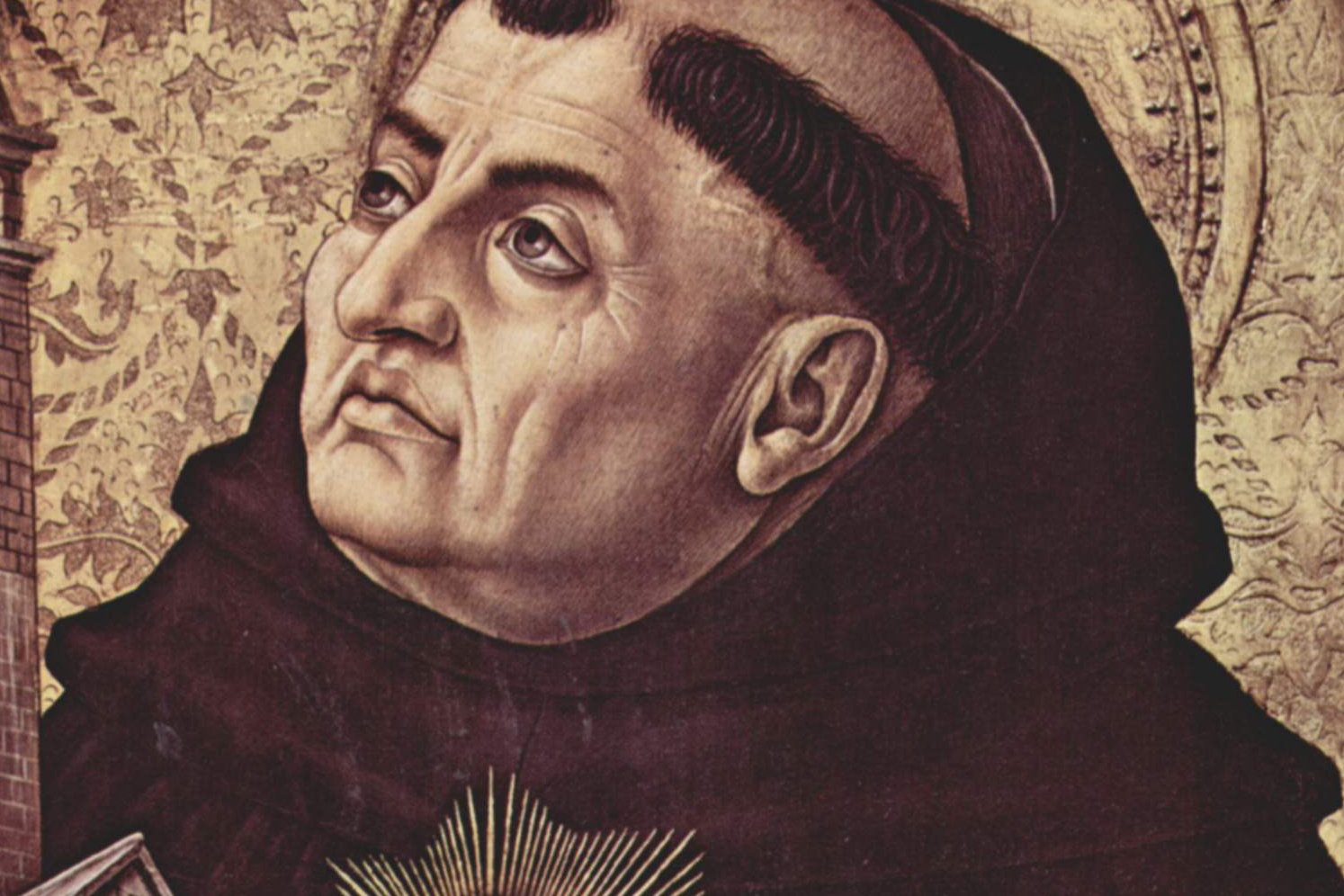
In yesterday’s post I listed the five universal natural inclinations discussed by St. Thomas in both his commentary on Aristotle’s Ethics and in various places in the Summa Theologica (e.g., I IIae qq. 6-10, I q. 5 inter al). Here they are again:
The natural inclination to what we see as good
The natural inclination to self-preservation
The natural inclination to the knowledge of the truth
The natural inclination to sexual intimacy and the rearing of offspring
The natural inclination to live in society
Today I would like to discuss just the first one and leave the others for future posts. Because the ideas of nominalism and its successor movements are lodged very deeply in the minds of many—even pew-sitting, catechism-reading Catholics—the notions on the list may seem to you to be naïve at best and dangerous at worst. Some consider this approach dangerous because it exudes a confidence in our capacity to discover and be inclined to the good and true that some fear is too vague to form the basis for a moral vision.
Because I have written extensively on our human tendency to prefer lies to truth, I pray that you, dear reader, will not accuse me of naiveté. Despite whatever sinful tendencies may cloud our natural inclination to what is good, true, and beautiful, our nature has not changed; we are still wired for the good. We must, in spite of our tendencies to darkness, never forget that we were made for the light and that somewhere under all the layers of denial and sin lies a heart and mind wired for the truth and unhappy with anything less. I might add that the very same Jesus who remarked that many prefer the darkness because their deeds are evil (Jn 3:19) also said that we who are evil know how to give good things to our children (Mat 7:11). Both of these things are collectively true of us.
So again, I would argue that although these inclinations are not lived out perfectly (they are only inclinations) they are hard to completely refute because they are so obviously present in the whole of humanity. As such they form a bridge from the illusion of radical individualism and the “right” to invent our own reality, back to a universal and common understanding of reality. If reality is merely something we “invent” (as our post-nominalist world insists), then how does one account for the existence of such universal human inclinations, which seem to demonstrate a received and common human nature and the existence of goodness and truth “out there” for which we are wired? We must continue to insist on this as a way out of radical individualism and back to a common perception of basic truth.
Let us then press on to the discussion of the first human inclination: The natural inclination to what we see as good.
The principle described and defined – No one is inclined to do what he sees as harmful to himself; we naturally pursue what we consider beneficial. Even when we make sacrifices such as hard work, fasting, or yielding to someone else’s needs, we do so for the sake of some higher goal or good.
So “the good” is not merely that which is immediately pleasurable or preferred. But neither is the good merely that to which we are bound by moral obligation, as if it were wholly separated from happiness or even opposed to it. (I’ll expound further on the morality of the good below.)
Interestingly, St. Thomas did not actually define the good. It is so primordial that it defies description. It is known only as that to which the appetite moves the will (cf 1 Ethics 1). The good is what we desire.
The principle experienced – That people act for what they see as good is a fundamental inclination shared by all. We are attracted to what we perceive will bless or augment us and are averse to things that will curse or harm us. We desire what seems good and are repelled by what seems odious or harmful.
This appetite for the good is so axiomatic that we do it almost without thinking. With very little deliberation, we are almost instantly drawn to basic and necessary goods such as food, shelter, and safety. The same is true for more spiritual things such as what we see as just, true, good, and beautiful. We also, in an almost instinctive sense, seek other perceived goods such as a sense of well-being, honor, respect, and esteem.
This movement toward what is seen as good is universal among human beings. We do well to ask from whence it comes and why it is so universal. It is more than instinct because human beings, unlike animals, will often forgo lower desires for the sake of higher ones. A person may fast for spiritual gain or to be admired for looking thinner. A young man may become a solider and enter a dangerous war in order to be thought brave; he may even forfeit his life to save his friends.
There must be something deeper here than mere physical instinct because many metaphysical goals are often more profound than merely physical ones. For the sake of uncovering new knowledge, new lands, or truth, many have risked life and limb. Some have set sail or voyaged into the very heavens in order to see what is on the other shore or in the skies above. Others have dedicated their whole being to the pursuit of truth and God Himself. This is not only to answer the physical question “What?” but also the more deeply metaphysical question “Why?”
We are intensely drawn to what we see as good. Everyone is wired this way; there are no exceptions.
We do well to ponder this universal inclination to the good (physical and metaphysical) as well as why we all agree on what is good (at least fundamentally). Indeed, beyond the merely physical desires for food, shelter, clothing, and safety (which we all agree are good things to be sought), many metaphysical goods are also universally esteemed. Everyone wants to be treated justly, to be free, to be esteemed, to be respected in basic ways, and to have access to what he sees as beautiful and good. No one wants to be hindered, robbed, treated unjustly, scorned, or mocked. As for social goods, heroism is universally esteemed over cowardice, telling the truth over lying, acting justly over exploiting, earning and sharing over stealing and destroying, honor and trustworthiness over treachery and unreliability. Self-control and personal discipline are esteemed. Personal responsibility and accountability are esteemed while irresponsibility and casting blame are not.
Indeed, writers throughout the centuries (and movies in the modern day) appeal to basic human longings for justice, intimacy, meaning, affirmation, challenge, and belonging to craft books, dramas, and books that appeal to our universal longing and inclination for these things we call “the good.”
We desire these things and are inclined to them even if we do not live them perfectly. They are wired into us in a way that is hard to deny by any truthful admission of our experience as human beings. This is our experience of the universal principle of our inclination to the good.
The principle distinguished– This does not mean that all human desires are lawful or free from evil. It does not mean that whatever we want is morally good. But neither is all that we desire purely egocentric or utterly individualistic. St. Thomas and those before him did not live in the post-nominalist world of radical individualism and thus should not be seen as affirming it at all.
Rather “the good” is what is capable of moving all human beings; it is what all human beings desire. As such, it is distinguished from merely what one or a few people desire. In a pre-nominalist world freer of radical individualism, St. Thomas and others before him could confidently point to “the good” and speak of it as that which all men esteem and can understand (by reason) as good through study, education, perception, and personal experience.
St. Thomas and the ancients were not unaware of the deep difference between real and apparent good. Despite our overall grasp of the good and what constitutes universal appreciation of the good, there are individual assessments of the good that do not coincide with and may even oppose what is truly good. Passions such as anger or lust can cloud individual decisions so that we may reach for what seems apparently good to us in the moment but is not really good for us and/or others in the long term. Such individual choices must be evaluated against better and higher goals to see why they are not only sinful and wrong but are self-defeating (because they substitute apparent good in place of what is truly good).
The principle reiterated – Despite the human tendency to misjudge the good in this way, the fundamental point remains valid: human reason and will are profoundly oriented to the truly good and beautiful; we will never be happy without that. We are wired for the truth. Whatever we do to try to suppress this (e.g., repeated bad choices, rationalizations, or surrounding ourselves with false teachers), ultimately we cannot shake our orientation toward the good, the true, and the beautiful. We are wired for it and cannot silence that small, still voice of God within us saying, “This is the way; walk in it,” whenever we would stray to the right or the left (cf Is 30:21). A thousand misapplications of pursuing the good cannot jettison our deeper desire to lay hold of what we know is truly good. We will either move toward it or else remain sad and angry trying to resist it.
Recovering this crucial insight into our natural inclination is an important milestone on our way out of the radical individualism and skepticism of our day. Because the inclination to the good is so universal it is a first countermeasure against individualism. The individualistic claim of a right to construct a reality that is true for me cannot account for the universal inclination to the good observed everywhere in the human family. Simply put, there are basic goods to which we are all inclined. And this inclination, though not perfectly lived, points inward to a received and common nature, and outward to actual goods out there that are the objects of our inclinations and desires.
I understand that this type of post is heavy reading. I will discuss the other universal inclinations in future posts, but not tomorrow. This sort of stuff is best read in smaller bites with time to digest in between courses!
N.B. I have based some of my post today on reflections made by Fr. Servais Pinckaers, O.P. in his lengthy book The Sources of Christian Ethics (pp. 401-456).
It is easy to suppose that we think and understand the world in substantially the same way that those who lived in the biblical age did. But in important ways this is not so.
We today tend to “live in our heads” a lot more than did the people living in biblical times and even those who lived up to and including the High Middle Ages and the Scholastic Period. Prior to that time, the “real world” was taken to be largely self-evident. By “real world” I mean not just the physical world but also to a significant degree the metaphysical (literally, “beyond the physical”) world.
For the ancients, the metaphysical world included non-physical (but still real) things such as justice, mercy, love, desire, and truth. It also included the characteristics or qualities by which we group and understand reality (e.g., “green-ness,” or “tree-ness”); these are often called “universals.” There were also more technical categories into which things were grouped such as those of biology: kingdom, phylum, class, order, family, genus, and species. Other disciplines employed similar categorizations that, while metaphysical, were considered to be real and reliable ways of explaining the world.
In the 13th and 14th centuries, a school of thought later called “nominalism” began the move away from this sort of thinking. It proposed that universals did not exist at all but were instead merely constructs of the human mind.
But if these things were merely constructs of the human mind and not somehow rooted in reality, then these man-made constructs could be “un-made.” Thus began the journey away from the “real world,” which led to less and less confidence in our ability to even posit a “real world” out there to which we could refer and take as a given.
Less than 300 years later, Rene Descartes was so despairing that anything definitively existed outside himself that he could only say, “I think therefore I am.” Beyond himself as a thinking and doubting agent, all bets were off. Was there actually anything reliably and objectively real outside his own mind? He couldn’t be sure. What was real and what was merely a construct? Who could say for sure? Such skepticism (which is largely useless for daily life) took a long time to reach the masses of people outside the universities, but today it has. We currently live in a post-nominalist, post-Cartesian, post-Kantian world, deeply infected by Nietzsche’s nihilism.
Yes, welcome to the modern age, in which “reality” is increasingly up for negotiation. Relativism and skepticism reign supreme and we can “rationalize” just about anything in our own little world of one. Everything is just an opinion; something can be true for you but not for me. And we actually congratulate ourselves (as “tolerant” and “open-minded”) for spouting these logical absurdities!
Even we who strive to be faithful Catholics are often imbued with nominalist thinking that often rears its head in casuistry, aspects of “manual theology,” and rationalist thinking and tortured legalism. There is no time here to explain the problematic qualities of these except to say that they amount to an overreaction and seek to solve the problem inside the deeply flawed system they critique. It tends to amount to little more than lipstick on a pig.
How do we find our way back out of the flawed intellectual system to which we are heir? It seems a little like asking an amnesiac to find his own way home.
One way to begin is to realize that human nature has not changed, even if our intellects have suffered. As a moral theologian and pastor, I have found it helpful (in recovering some moral sensibility and common ground) to speak to the universal human longings and inclinations we all share. These are longings and inclinations so basic that they almost go unremarked upon. They are so basic as to be practically undeniable.
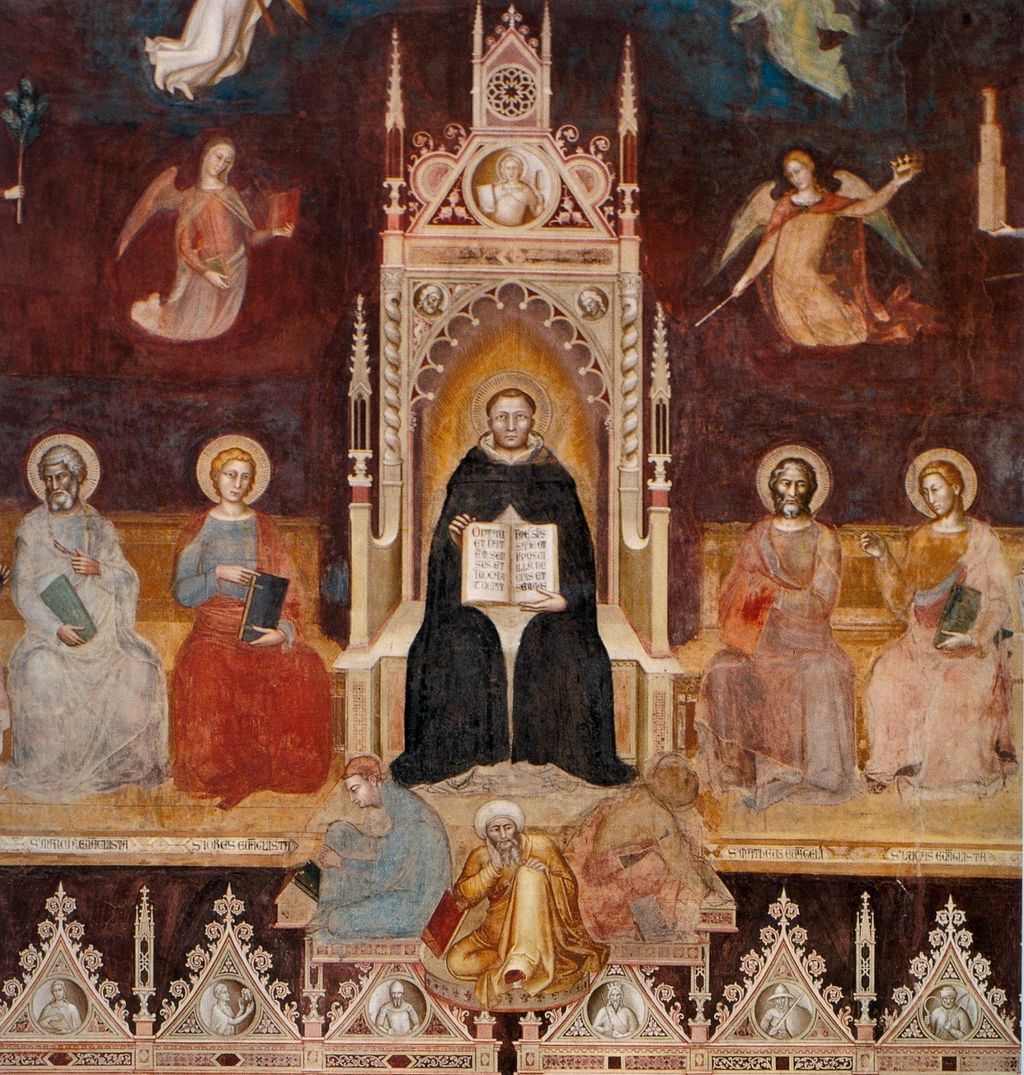
St. Thomas Aquinas (drawing from Aristotle) lists five fundamental human inclinations and shows how they form the basis of (morally) good decision making. St. Thomas (and certainly Aristotle) lived before the nominalist divide cast doubts on our ability to know and contact reality as reality. He lived in a time in which people were more confident in their ability to seek the truth, find it, and conform to it. Thus St. Thomas could propose a moral system based on virtue and our common inclination to the good, the true, and the beautiful, rather than rooted in laws and mandates to be obeyed for fear of reprisal. Though sober about human sinfulness, St. Thomas could still confidently appeal (in his pre-nominalist world) to this shared propensity to make progress out of sin through virtue.
So we amnesiacs do well to look to these inclinations that St. Thomas confidently asserts and recognize how universally they still apply today: from the atheist to the most firm believer, from the worst sinner to the most blessed saint. I will list them in today’s post and develop them further tomorrow.
The natural inclination to what we see as good
The natural inclination to self-preservation
The natural inclination to the knowledge of the truth
The natural inclination to sexual intimacy and the rearing of offspring
The natural inclination to live in society
I realize that in simply listing them here, I may cause many questions and/or doubts to arise in your minds. I will attempt to address these in tomorrow’s post.
Now just because we have an inclination doesn’t mean that we always get it right. While we all share a longing for what we see as good, it does not follow that every apparent good we seek is an actual good. What is evident, however, is that everyone naturally reaches for what he thinks (even if erroneously) is good and not for what he sees as disgusting, loathsome, or harmful. Our natural inclination to the good is not always correct in its aim, but the inclination itself is so universal that it cannot be denied.
This universal inclination is a way out of the individualism, skepticism, and “living in our heads” that is so common today. It is a way back to the universals that must form the basis for recapturing a reality that binds and instructs us all.
I’ll provide more on the particulars tomorrow if you’re brave enough to come back for more!
Disclaimer – I realize that for trained philosophers my layman’s summary of 700 years of intellectual and philosophical trends may cause concern, and it may incite a desire to provide more information and/or to expound upon distinctions I’ve failed to make in this essay. But please remember that I write as a pastor for a general audience, not as a professor addressing graduate students. I want to point to the forest and not get lost in the details of the thousands of trees. At some point too many details obscure the message. Much more can and should be said on the subject (You may say that brevis esse laboro, obscurus fio (when I labor to be brief, I become obscure.)). So please forgive my broad summary. And if you’re still not satisfied, then please write a “readable” book (of fewer than 1000 pages) with the details. 😉
Today’s Gospel is about a man who had two sons, both of whom forsook him and refused to relive in relationship with him. Although the sons seem to have very different personalities (one outwardly rebellious, the other outwardly obedient) they actually have similar internal struggles. In effect, neither one of them really wants a relationship with the father. Both prefer what their father has or can give them to their father himself.
In the end, one son repents and finds his way to the father’s heart. We are not so sure what happens to the second son because the story ends before that detail is supplied. Why did it end without telling us what happened? Because the story is really about you and me; it is we who must finish the story. The question we must answer is this: What do I really want: the consolation of God, or the God of all consolation? Do I want the gifts of God, or the giver of every good and perfect gift?
Let’s look at this Gospel in four parts.
I. Renegade Son – Most of us are quite familiar with today’s Gospel (the Parable of the Prodigal Son). In this story, most of us focus on the younger (and obviously sinful) son rather than the older one. This is interesting because it would seem that the Lord Jesus has His focus on the older son (the parable is addressed to the scribes and Pharisees, who see themselves as obedient). Nevertheless, let’s observe three things about this renegade son, also known as the Prodigal Son.
A. Corruption – This is an angry young man, alienated from his father. He wishes to possess what his father has, yet wants nothing to do with his father. In effect, he tells his father to drop dead. Yes, in effect he says, “Old man, you’re not dying fast enough. I want my inheritance now; I want to be done with you and cash in what is coming to me right now.”
His effrontery is even more astonishing given where and when it happened. Today we live in times when reverence for parents and elders is tragically lacking. But if our times are extreme in the one direction, ancient times in the Middle East were at the opposite extreme. In telling this parable as He does, Jesus shocks His listeners, who lived in a culture where no son would dream of speaking to his father in this way. Indeed, a son could be killed by his father for such insolence! Even to this day, so-called “honor killings” still occur in many parts of the Middle East. If a child brings dishonor to the family, it is not unheard of for the father to kill him or her. And while most governments forbid these practices, in many cultures people will look the other way and governments will seldom prosecute in such cases.
Thus, Jesus must have shocked his listeners with such a parable. Here was a son who did something so bold and daring as to be practically unthinkable. He was as insolent as he was insensitive, ungrateful, and wicked.
So hateful is this son that he has to go to a distant land to live. For even if his father does not kill him, his neighbors would surely set upon him and have him stoned for such insolence.
Even more astonishing than the son’s behavior, however, is the fact that father actually gives him his inheritance and allows him to leave.
This is Jesus’ veiled description of the patience and mercy of our Father, who endures even worse insolence from us, His often ungrateful children. We demand His gifts and grasp them with ingratitude; we want what God has, but do not want Him.
B. Consequences – The text says that the renegade son sets off “to a distant country.” It is always in a distant country that we dwell apart from God. The consequences of his action are great indeed.
This parable does not make light of sin. The Lord Jesus describes well a young man who chooses to live apart from God and in sinful rebellion. The result is that this renegade son lives in anguish and depravity. Once he runs out of money, he has no friends, no family, and no experience of his father.
So low is he that ends up looking up to pigs! So awful is his state that he becomes hungry for the disgusting mash that pigs eat. Yes, he is lower than an unclean animal—the most unclean animal that Jews can imagine—a swine.
Sin debases the human person and if its effects are not avoided, it orients us increasingly toward depravity. What was once unthinkable too easily becomes a common occurrence.
St. Augustine wrote of sin’s hold on individuals in his Confessions: “For of a forward will, was a lust made; and a lust served, became custom; and custom not resisted, became necessity. By which links, as it were, joined together (whence I called it a chain) a hard bondage held me enthralled” (Confessions, 8.5.10).
The renegade son is locked in to the consequences of his sinful choices. He is debased, debauched, and nearly dead.
C. Conversion – In an almost miraculous turn of events, the text says that he comes to his senses at last. Too many, especially today, suffer a darkened intellect due to the debasing effects of their sin; it would seem that no matter how debased, confused, and even enslaved they become, they still do not come to their senses, for their senseless minds have become darkened (cf Romans 1:21).
But thanks be to God, the renegade son does come to his senses and he says, I shall arise and go to my father! In this passage, the Greek text uses the word anistemi, here translated as “arise”—the same word used to describe the resurrection of Jesus. The young man’s father will later joyfully describe him as having been dead but then coming back to life.
St. Paul reminds us that we were dead in our sins, but God made us alive in Christ (cf Col 2:13). Thanks be to God for His mercy and for the conversion that He alone can effect in all of us, His renegade children, who ourselves have been debased, debauched, and dead in our sins. The conversion of this renegade son, we pray, is also our conversion, our rising and going back to the Father.
II. Rejoicing Father – The astonishment in this parable is only just beginning, for Jesus goes on to describe a father who is so merciful as to be shocking. He ascribes to the father things that no ancient father would ever do. And as He describes this ancient father, so filled with love and mercy that he casts aside personal dignity, we must remember that Jesus is saying, “This is what my Father is like.”
As the parable continues to unfold, we hear that the father sees the sonwhile he’s still a long way off. This tells us that he was looking for his son, praying and hoping for his return.
In a human being such mercy is rare. The average person who is hurt and has his dignity scorned becomes resentful and avoidant, saying, “Never darken my door again!”
But how shockingly different this father is, lovingly and longingly waiting for the day when his son will appear on the horizon, looking for him day after day.
The text next tells us that when he saw his son, the father ran out to meet him, something no ancient nobleman would ever do. Running was a sign of being in flight or of being a slave on some errand. Further, in order to run, the ancients (who wore long garments) had to bare their legs—a disgraceful thing for nobility. Only common workers and slaves had their legs exposed.
Thus, here is the portrait of a father willing to debase himself in order to run and greet his returning son. When I take one step God takes two or more; he comes running to me!
In the parable, the robe and the ring that the father puts on his son are signs of family belonging or restoration. This is the full restoration of a young man who was willing to live as a slave in his own father’s house. But the father will have none of it. “You are my son! And my Son you have always been, whatever your sins. They are forgotten. You are my beloved son!”
What kind of Father is this? No earthly father would behave this way. This is the heavenly Father. Jesus is saying, “This is what my Father is like!”
III. Resentful Son – Now we turn our attention to the older brother. His sinfulness is more subtle. Outwardly, he follows his father’s rules; he does not sin in overt ways. His sins are more hidden.
Unlike his prodigal brother, he has never openly rejected his father. But inwardly, as we shall see, he is not so different.
Like his younger brother, the older son wants his father’s goods, not his father himself. To understand the subtlety of his struggle, let’s look at some of the details of the story. Notice the following fundamental issues with the resentful son:
Distant – It is interesting that the last person to find out about the feast (and the reason for it) is the older son. This is the description of a son who is far away from his father, who is unaware of the happenings in his father’s life.
Off on some far-flung part of the property, he is going about his duties, which he seems to fulfill adequately. But we also get the feeling that there is a sense of distance between father and son.
Did this son not know that his father worried about his younger brother and was looking for him each day? It seems not! Even the lowly slaves in the household are drawn into the preparations for this great feast celebrating the return of the renegade son. It appears that the older son is the only one in the whole area who knows nothing about it. Even more telling is that he is unaware of his father’s joy at the return of his brother.
Yes, the resentful son is distant, a thousand miles away from the heart of his father.
Disaffected – When this resentful son learns of the feast and the reason for it, he becomes sullen, angry, and resentful. He is disaffected. He stays away from the feast and refuses to enter.
So bitter is his resentment that his father will soon hear of it and come out to plead with him. Yes, this is a bitter, angry, and disaffected son.
But, dear reader, do not scorn him, for too easily we are he. Too easily, we die the death of a thousand cuts as we see sinners finding mercy. Too quickly do we become envious when others are blessed.
Disconsolate – The father emerges from the feast to plead with his son to come in! Again, such a thing would be unheard of in the ancient world! Every father in those times would have commanded his son to come in to the feast and would expect to be obeyed immediately.
But this father is different, for he represents the heavenly Father, rooted in love more than in prerogatives and privileges. He has already demonstrated his love for his renegade son and now he does so for his resentful son.
The fact is, he loves both of his sons. Yes, the heavenly Father loves you and He loves me.
Tragically, the resentful son is unmoved by this demonstration of love. He remains disconsolate and must be confronted in his resentful anger.
Disrespectful – Now we see the ugly side of the apparently obedient son. He does not really love or respect his father; he doesn’t really know him at all. He disrespects him to his face. He speaks of him as a slave master saying, “I have slaved for you … I have never disobeyed any one of your orders.”
Orders? I have slaved for you? Where is his love for his father? He does not see himself as a son but as an unwilling slave, one who follows orders only because he has to. In effect, he calls his father (to his face) a slave master, a despot.
Further, he accuses his father of injustice. Somehow he views the mercy his father showed to his brother as evidence of a lack of due mercy shown to himself. He considers his father unreasonable, unjust—even despicable. How dare his father show mercy to someone that he, the “obedient” son, does not think deserves it!
In calling his father an unjust slave owner and taskmaster, the son disrespects him to his face. But the father stays in the conversation, pleading with his son to reconsider.
Disordered – Among the older son’s complaints is that his father never even gave him a kid goat to celebrate with his friends. But the goal in life is not to celebrate with friends; the goal is to celebrate with our heavenly Father.
Note how similar the two sons actually are. At one point the renegade son saw his father only in terms of what his father could give him; his father was only valuable to him in terms of the “stuff” he could get from him. And despite all his obedience, the older son—the resentful one—has the same problem. He seems to value only what his father can give him. It is not his father he really loves or even knows. It is the “stuff” that really interests him. He is concerned only what his father can give him.
In this way, the resentful son is disordered. He misses the whole point, which is not the “things” of his father but the relationship with his father. This is the point, the goal in life: to live with the Father forever in a relationship of love.
But again, be very careful before you condemn the resentful son. Too easily, we are he. It is so easy for us to want the good things of God but not God Himself. We want God’s blessings and benefits, but not His beloved self. We want the gifts of God, but not the God who is the giver of every good and perfect gift.
Yes, the disorder of this resentful son is too easily our disorder. There is something about our flesh that wants God to rain down blessings, yet once we have received them we want to run away and keep our distance from God. Relationships are complicated and dynamic. Our flesh prefers trinkets. We prefer to receive gifts on our own terms. Our flesh says, “Give me the priceless pearls, but begone with the powerful person who gives them!”
IV. Response – The father is outside pleading with his resentful son to enter the feast. And then, abruptly, Jesus ends the parable. Yes, the story ends! Does the resentful son go into the party or not? Why is the story left unfinished?
Simply put, it’s because you and I must finish the story. For we are so easily the resentful son.
Right now, the heavenly Father is pleading with you and me to enter the feast. Too easily we can brood and say that we have our reasons for not wanting to go into the feast. After all, that renegade son is in there. My enemy is in there. If Heaven involves meeting our enemy and celebrating with him, then too easily does our flesh say, “I’ll have nothing to do with it!”
Here is the great drama: will we enter the real Heaven? For the real Heaven is not merely a heaven of our own making, a heaven of our own parameters. Heaven is not a “members only” place.
Am I willing to enter on God’s terms? Or will I resentfully stand outside, demanding that Heaven be on my terms? Further, do I see Heaven as being with the Father, or is Heaven merely having the “stuff” I want?
The heart of Heaven is to be with the Father, to be with the Trinity. The danger with so many, even the religiously observant, is becoming the resentful son. The Father is pleading, pleading with us to enter the feast, pleading with us to set aside our prejudices and notions of exclusivity.
To the resentful son who said, “this son of yours …,” the father says, “your brother was lost and is found, was dead, and has come back to life.”
The Father is pleading for us to enter the feast—not some made-up feast where we choose the attendees—but the real, actual feast of Heaven, where some surprising people may be in attendance.
Will you enter the feast? The Father is pleading with you. He is saying, “Come in before it’s finally time to rise and close the door.” How will you answer Him? What is your response?
This parable is unfinished; you and I must finish it. What is your response to the Father’s pleading? Answer him!
Just for fun, here is a “retelling” of the parable in the “key” of F:
Feeling footloose and frisky, a feather-brained fellow forced his fond father to fork over the farthings and flew to foreign fields and frittered his fortune, feasting fabulously with faithless friends.
Fleeced by his fellows, fallen by fornication, and facing famine, he found himself a feed-flinger in a filthy farmyard. Fairly famishing, he fain would have filled his frame with foraged food from fodder fragments. “Fooey! My father’s flunkies fare finer,” the frazzled fugitive forlornly fumbled, frankly facing facts. Frustrated by failure and filled with foreboding, he fled forthwith to his family. Falling at his father’s feet, he forlornly fumbled, “Father, I’ve flunked and fruitlessly forfeited family favor!”
The farsighted father, forestalling further flinching, frantically flagged the flunkies to fetch a fatling from the flock and fix a feast.
The fugitive’s fault-finding brother frowned on fickle forgiveness of former folderol. But the faithful father figured, “Filial fidelity is fine, but the fugitive is found! What forbids fervent festivity? Let flags be unfurled. Let fanfares flare.”
And the father’s forgiveness formed the foundation for the former fugitive’s future faith and fortitude.
There is a rather humorous aspect of the story of the Tower of Babel in the Book of Genesis. You likely know the basic story, which begins with the men of that early time saying, Come, let us build ourselves a city, with a tower that reaches to the heavens, so that we may make a name for ourselves (Gen 11:4). The tower was an image of pride and grandiosity. The funny thing is that when the “great” tower is finally complete, with its top reaching to the skies, it’s actually so puny that God has to come down from Heaven in order to be able to see it! The text says, And the LORD came down to see the city and the tower, which the children of man had built (Gen 11:5).
Now of course God sees everything. The humor in the text is not in some primitive notion of a God who cannot. Rather, it is in the fact that man’s greatest, tallest, most prominent, most glorious work, which is seen as reaching Heaven itself, is in fact so inconsequential that God has to stoop down in order to “see” it. He has to descend to even get a glimpse of it. What ultimately does alarm God is how colossal man’s pride is. He responds by humbling us, by confusing our language and scattering us about the planet.
I recalled this story when I saw the video below. It shows wonderful footage of Earth, taken from the Space Shuttle. There is some accompanying commentary by one of the shuttle astronauts, who explains/identifies the images as they pass by. While the view is quite remarkable, what is even more remarkable is what we do not see: us!
Even though the shuttle is passing over well-populated areas, there is no visual evidence that we even exist. No cities or buildings are visible; no planes streak through the skies; even large-scale agricultural features seem lacking. There is only one mention of a color difference (across the Great Salt Lake) and that is due to a railroad bridge preventing lake circulation. The bridge itself is not visible, only its effect.
We think of ourselves as so big, so important, and so impressive. And yet even from the low Earth orbit of the shuttle, we cannot be seen. At night, our cities light the view, but during the day there is little evidence that we are even here. Even with the images magnified on my 30″ computer screen, there is no indication of our presence.
Viewing the video brought this Psalm to mind:
O Lord, our Lord, how majestic is your name in all the earth! You have set your glory above the heavens … When I consider your heavens, the work of your fingers, the moon and the stars, which you have set in place, what is man that you are mindful of him, the son of man that you care for him? Yet, You made him a little lower than the angels and crowned him with glory and honor. You made him ruler over the works of your hands; you put everything under his feet: all flocks and herds, and the beasts of the field, the birds of the air, and the fish of the sea, all that swim the paths of the seas. O Lord, our Lord, how majestic is your name in all the earth! (Psalm 8)
We are so powerful (by God’s gift) and yet at the same time so tiny as to be nearly invisible from just a short distance into space. Our mighty buildings rise, but they rise on a speck of space dust called Earth. And Earth revolves around a fiery point of light called the Sun, which is but one of more than 100 billion stars in the Milky Way galaxy. And the Milky Way galaxy, so huge to us as to be nearly unfathomable, is but one of an estimated 200 billion galaxies.
Yes, What is man that you are mindful of him …? (Psalm 8:5) Jesus says this of us: And even the very hairs of your head are all numbered (Matt 10:30). God, who numbers all the stars and calls them by name also knows the number of hairs on each of our heads. Nothing escapes Him.
There’s old preacher’s saying, “We serve a God who sits high, yet looks low!” Indeed, never forget how tiny you are. Never cease to marvel that God knit you together in your mother’s womb and sustains every fiber of your being. We cannot even be seen from a low Earth orbit, but God, who sees all, looks into each of our hearts. Always remember that although we are tiny, you and I are wonderfully, fearfully made (Psalm 139), and that He has put all things under our feet.
Most pastors and confessors are aware that in any parish there are going to be a few who are scrupulous, even in times like these. Some have a mild scrupulosity that is almost admirable. A sensitive conscience is a beautiful thing and bespeaks a kind of innocence that is rare today.
Others have a more unhealthy form of scrupulosity, rooted too much in cringing fear of a God who is seen more as a punishing adversary than a delivering Father who wants to help us to overcome our sin.
But saddest of all are the large number of people who have very little compunction for their sins. Most Catholics have lived for so long in a culture that dismisses, excuses, or even makes light of sin that they have very little notion of its seriousness. That God had to send His only Son to die in order save us from our sins shows just how serious they are; weeping for our sins is not some extreme reaction.
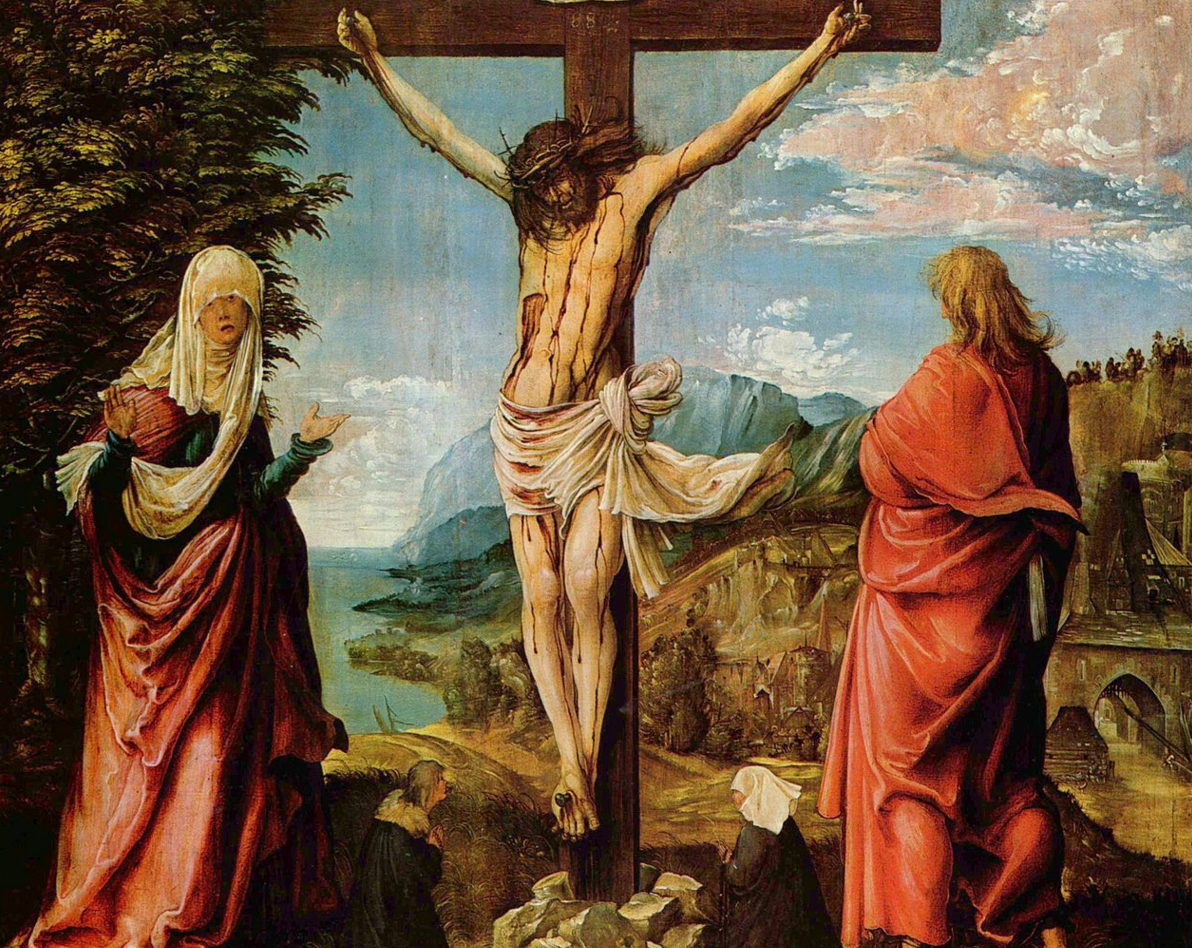
Indeed, a worthy Lenten practice is going to the foot of the Cross and allowing the Lord to anoint us, so that we see both how serious our sins are and at the same time how deep His love for us is. When we finally start to realize that the Son of God died for us, our heart breaks open, light pours in, and we can begin to weep for our sins and in gratitude for His love.
Consider that Jesus looked at a paralyzed man and, seeming not to notice his paralysis, said to him, “Courage, son, your sins are forgiven” (Mat 9:2). In a sense, He saw the man’s sins as more serious than his paralysis. Jesus also said,
I tell you that anyone who looks at a woman lustfully has already committed adultery with her in his heart. If your right eye causes you to stumble, gouge it out and throw it away. It is better for you to lose one part of your body than for your whole body to be thrown into hell. And if your right hand causes you to stumble, cut it off and throw it away. It is better for you to lose one part of your body than for your whole body to go into hell (Matt 5:28-30).
Now the Lord does not mean that we should literally gouge out our eyes or cut off appendages. What He is saying is that it is more serious to sin (in this case through lust) than to lose an eye, hand, or foot.
We don’t usually think this way but we should. Sin is much more serious than most of us imagine; in fact it is our most serious problem. It is more serious than poor physical heath or lack of money. Sin is our most serious problem and whatever is in second place isn’t even close.
In times like these, when self-esteem is overemphasized, personal responsibility is minimized, and excuses abound, we do well to ask for the gift of tears. We do well to ask for a profound and healthy grief for our sins.
More than ever, this is a gift to be sought. Note that these tears are not meant to be tears of depression, discouragement, or self-loathing. The tears to be sought here are tears of what St. Paul calls “godly sorrow.” Godly sorrow causes us to have sorrow for our sins but in such a way that it draws us to God and to great love, gratitude, and appreciation for His mercy. St. Paul writes,
Even if I caused you sorrow by my letter, I do not regret it. Though I did regret it—I see that my letter hurt you, but only for a little while—yet now I am happy, not because you were made sorry, but because your sorrow led you to repentance. For you became sorrowful as God intended and so were not harmed in any way by us. Godly sorrow brings repentance that leads to salvation and leaves no regret, but worldly sorrow brings death. See what this godly sorrow has produced in you: what earnestness, what eagerness to clear yourselves, what indignation [at sin], what alarm, what longing, what concern, what readiness to see justice done (2 Cor 7:8-11).
With all this in mind, consider that in the current (2011) Roman Missal there is a beautiful “Mass for the Forgiveness of Sins (B).” In the old Roman Missal (1962) it is called the Missa ad Petendam Compunctionem Cordis (Mass Requesting Compunction of Heart). It is known more colloquially as the “Mass for the Gift of Tears.”
Consider these beautiful prayers from the Roman Missal (both the 1962 and 2011 versions). I post here the English translation from the 2011 version:
Collect:
Almighty and most gentle God,
who brought forth from the rock
a fountain of living water for your thirsty people,
bring forth we pray,
from the hardness of our heart, tears of sorrow,
that we may lament our sins
and merit forgiveness from your mercy.
Through our Lord Jesus Christ your Son,
who lives and reigns with you
in the unity of the Holy Spirit,
one God forever and ever.
Prayer over the gifts:
Look mercifully, O Lord, upon this oblation,
which we offer to your majesty, for our sins,
and grant, we pray, that the sacrifice
from which forgiveness springs forth for the human race,
may bestow on us the grace of the Holy Spirit,
to shed tears for our offenses.
Through Christ our Lord.
Prayer after Communion:
May the reverent reception of your Sacrament O Lord,
Lead us to wash away the stains of our sins
with sighs and tears, and in your generosity
grant that the pardon we seek may have its effect on us.
Through Christ our Lord.
So beautiful, scriptural, and spiritual! Pray these prayers. Ask your priest to celebrate this votive Mass often. We need the gift of tears today.
Here is the Lacrimosa from the Mozart Requiem. The text says, “Day of tears that day when from the ashes man arises and goes to his judge. Spare O God then, O sweet Jesus, Grant them eternal rest.”
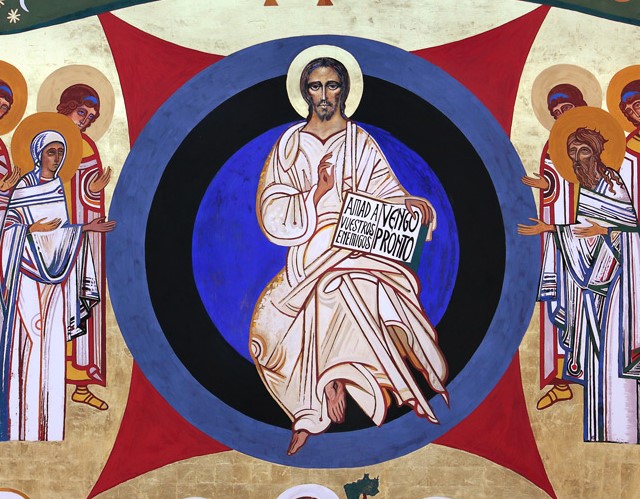
There is a specific depiction of Christ known as Christ Pantocrator. It was widespread in the ancient world and still is today. The title “Pantocrator” is most often translated into English as “The Almighty One” or “The Omnipotent One.” It comes from the Greek words παντός (pantos, meaning all) and κράτος (kratos, meaning strength, might, or power).
In the particular image at right, Christ is seated (as a sign of authority). In many of the specific images he holds a book, sometimes open and sometimes closed. If the book is open, there can be a few of many different texts displayed. In some of the images there is an interesting juxtaposition of texts meant to provoke thought and lead to both catechesis and repentance.
Among the more interesting and provocative juxtapositions of texts is the one commonly used in the Neocatechumenal communities (see above right). On the left-hand page of the open book is the Scripture passage in which Jesus says, “Love your enemies” (Matt 5:44), and on the right is the one in which Jesus says, “I am coming soon” (Rev. 22:7).
Provocative indeed, and a sober call repentance! It is hard to see how we could hope to enter Heaven with hatred or vengeful anger for our enemies in our heart. With that eating at our heart it wouldn’t be Heaven! Therefore we should consider our final end and beg for the grace to love our enemies by praying for them, working for their conversion, and supplying their basic human needs (cf Rom 12:20; Prov. 25:21). Our goal is to be at one with them in Heaven, and even here in this life if it be possible and rooted in the truth.
Jesus sets apart the love of one’s enemies as the “acid test” for Christians:
Love your enemies and pray for those who persecute you, so that you may be sons of your Father who is in heaven. For he makes his sun rise on the evil and on the good, and sends rain on the just and on the unjust. For if you love those who love you, what reward do you have? Do not even the tax collectors do the same? And if you greet only your brothers, what more are you doing than others? Do not even the Gentiles do the same? You therefore must be perfect, as your heavenly Father is perfect (Matt 5:44-48).
There’s nothing like a passage such as this one to get us on our knees asking for grace and mercy! Indeed, we will surely fail if we seek to love our enemies only through the power of our own flesh or from our fallen nature.
Jesus is coming soon and He will look for this fruit in us. All the more reason, then, to ask it of Him:
Good Jesus, who alone can save me from my hard heart, grant me the grace to love my enemies and pray for those that persecute me. I am weak and too self-centered and thin-skinned to do it on my own. I consent, good and merciful Jesus, to this work of yours in me. Accomplish this, Lord, by your grace!
There was a discussion a few years ago on my Facebook page about Church music. My parish, Holy Comforter-St. Cyprian in Washington, D.C., was featured on EWTN’s nightly news (see video below); the discussion centered on that report.
Among the many forms of music we use here at my parish, gospel music is predominant at our 11:00 AM Mass. While many of the comments on the Facebook page were encouraging and supportive of this music, there were still a significant minority that spoke of gospel music as being inappropriate for Catholic liturgy and of it not being sacred. Chant, polyphony, and traditional hymns were held up as sacred, while gospel and some modern forms of music were labeled “not sacred,” and/or inappropriate for Catholic worship.
While everyone is certainly entitled to his personal preferences, is there really a definitive answer to the question, what is sacred music and how is it that some forms have come to be more widely regarded as sacred than others?
The answer to this question is a little more complex than most people realize. With the exception of chant, almost every form of music that is today regarded as sacred initially had a stormy reception in the Church before being admitted to the ranks of music commonly called “sacred.”
That music is controversial in the Church is nothing new, as we shall see in this modest survey that I make of the history of music in Catholic liturgy. Some of my sources are listed at the end of this post, but it is really the product of many years of reading and studying.
On some level, I hope to provide some perspective on the claim that is often made today that certain modern forms of music are inadmissible because they are not “sacred.” In no way do I intend to approve of all forms of modern music nor to encourage the admission of all of them into the liturgy. But it is worth appreciating that the definition of “sacred music” has changed over time. New forms have been admitted— sometimes reluctantly—to the exalted class we refer to as “sacred music.”
Here, then, is a brief look at the history of Church music in terms of what has been considered sacred and what has not.
I. The early, pre-Constantine period: Chant reigns supreme – While little if any music survives in written form from the earliest days of the Church, it seems clear (as Johannes Quasten records) that the leaders of the early Church (the Fathers and bishops) preferred monophonic music. This seems largely due to the association of harmony with the excesses of the pagan world and pagan worship.
Frankly, there was in the early Church a very persistent theme that music itself was problematic. Many ancient bishops and Fathers of the Church barely tolerated it, sought to limit its influence, and/or were deeply suspicious of any singing at all.
In his essay “On the Theological Basis of Church Music,” Cardinal Ratzinger; drawing from sources such as Pope Gregory the Great, St. Jerome, Gratian, and even as recent as St. Thomas Aquinas; describes the rather negative opinion in the early Church of any music involving instruments, harmony, or anything deemed “theatrical.” He writes,
Instrumental music, understood as a Judaizing element, simply disappeared from the early liturgy without any discussion; the instrumental music of the Jewish temple is dismissed as a mere concession to the hardness of heart and sensuality of the people at that time. What the Old Testament said about music and worship could no longer be applied directly, it had to be read by them allegorically, it had to be spiritualized (Ratzinger, “On the Theological Basis of Church Music,” quoted from Collected Works Vol XI, pp 425-432).
Summarizing the views he had received from the earlier Church, St. Thomas writes, “In the praise of God, the Church does not employ musical instruments … lest she appear to be falling back into Jewish ways” (Summa Theologica II, IIae, q. 91 a 2 ad 3).
Cardinal Ratzinger continues,
Analyzing the texts, not infrequent in the Fathers, which are critical of music or even openly hostile to it, one can clearly identify two constant and governing factors:
A. In the first place there is the one-sidedly “spiritual” understanding of the relationship between the Old and New Testaments … [So] Christian liturgy … took on a more or less Puritan form. … The idea that God can only really be praised in the heart means that no status can be accorded to music … In Christian worship … music must be relegated to a secondary level. Augustine is a splendid example of this. His sensitivity to music causes him much torment because his mind is dominated by a spiritualizing theology that ascribes the senses to the Old Testament, the old world; he is afraid of “sinning grievously” when he is “moved more by the music then by the reality to which the singing refers” … and would prefer “not to hear singing at all.” Fortunately his rigorism is dampened when he recalls the profound stirring his soul experienced when he first heard Church music in Milan. [He thus adopted a view of music later stated by St. Thomas, which held that among the reasons for Church music was that] “Thus the minds of the weak be more effectively summoned to piety.”
B. The second group of ideas that stood in the way of a positive the valuation of Church music … is put in a nutshell in Thomas’ fundamental article on the praise of God, where he says that vocal worship is necessary, not for God’s sake, but for the sake of the worshiper (Ibid).
Cardinal Ratzinger argues in the essay that this tended to lead to a utilitarian view of Church music as necessary to some degree, but somehow less than ideal. He reflects that this created a barrier to any satisfactory theology, not only of Church music, but of all prayer whatsoever.
He also adds (in a later essay) another reason for the restrictive notions about music in the early Church:
To the extent that it distanced itself from the Semitic world, the development of Christological art songs [also] threatened more and more to turn into an acute Hellenization of Christianity … The fascination of Greek music and Greek thinking [now excluded] … so that the new music rapidly became the domain of Gnosticism … For this reason [too] the Church immediately and rigorously rejected the poetical and musical innovation and reduced Church music to the psalter … This limitation of liturgical singing which gradually began asserting itself from the second century … led to a forbiddance of private song compositions and noncanonical writings in liturgical services. The singing of the psalms also came to be restricted to the choir whereas others “should not sing in church” (See canon 59 of the Synod of Laodicea 364 AD) (Ratzinger, Ibid, p. 505).
Thus music in general, given its Semitic and pagan associations, was widely resisted in the early Church and tolerated only in limited ways. Music with any harmony was altogether excluded and would not reappear until the Late Middle Ages.
Another reason that the early Church seems to have favored non-harmonic singing was somewhat rooted in the cosmology of the time, wherein there was an emphasis on the unity of all things. Whatever diversity was discovered was viewed as coming from the one hand of God. Monophonic music seemed to better express this unity, at least to the ancient Christian mind.
This cosmology of unity still finds its expression in the way that most Prefaces in the Mass are ended. The Latin text speaks of the multitude of the choirs of angels, joining with the voices of the many saints (cum Angelis, et archangelis, cum Thronis, et Domininationes … et òmnibus Sanctis). And yet despite the vast multitude of voices, at the end of the preface it says that they all sing “as with one voice saying” (una voce dicentes), “Holy, Holy, Holy, Lord God of hosts.”
And so at the earliest stage, sacredness was associated with what we today call chant. To the ancient Church, harmony was widely considered to be secular, even pagan.
II. The Church after Persecution: Chant develops – The earliest chants were quite simple and largely syllabic (one note per syllable); there were few elaborations. However, after the Edict of Constantine (321 A.D.) as the Church came out of a more hidden worship, the use of large, cavernous buildings started to influence the singing. Cantors began to elaborate on the chant, making full use of the echoes in the larger, basilica-like buildings. Vocals became increasingly melismatic (multiple notes per syllable) rather than syllabic, especially during festival seasons. Syllables (such as those in the word “Alleluia”) began to be extended longer with more and more notes.
Singers also “yielded to the spirit,” and the long melismata became a kind of ecstatic “singing in tongues.” Though at first any elaboration was resisted, certain chants did begin to develop in some areas. As these melodies became increasingly complex, they were written down and collected by Pope St. Gregory (among others), hence the modern name, “Gregorian chant.”
As these chants became more and more elaborate, their sacredness was only gradually conceded. In fact they became so complicated that the faithful in the congregation, who were already being discouraged from singing at all, had great difficulty joining in most of the chants. For this reason, special choirs called scholas were formed.
III. The High Middle Ages: Harmony enters – The next major development in Church music took place during the High Middle Ages, generally speaking in the 13th century. The first developments of harmony occurred in the musical schools in France, particularly around Paris. It was here that we saw the first widespread introduction of harmony into Church music.
Several factors influenced the introduction of harmony. First, there was the reintroduction of Greek philosophy and some of its views back into the Western world through scholasticism.
Among the Greek notions there was a cosmology that spoke of the planets orbiting the sun in perfect circles, each of them ringing out a different tone and creating a beautiful celestial harmony in the heavens as they did so. This was the “music of the spheres” and the idea of a great and beautiful harmonic sound in the heavens. Thus the association of harmony with the sacred began to seem more plausible in the minds of Christians.
The first experimentation with harmony seems to have been singing the Gregorian melodies and adding a hollow harmony of a fourth or fifth. Sometimes this involved several singers singing the words in those harmonies. Other times the harmonizers simply “droned” in the background, somewhat like bagpipe drones.
Architecture was another factor that influenced the harmonies. The soaring new cathedrals with their vaulted ceilings that began to dot the landscape of Western Europe seemed to demand more soaring music. These cathedrals were the skyscrapers of their day.
As harmony began to sound more pleasing to the ears, scholars worked to study it using, of all things, the Pythagorean Theorem to mathematically set forth the harmonic scale. Thus mathematics and music came together to quantify a kind of music theory. Gradually, as the years just prior to the 16th century ticked by, we came to have what we know of today as the 12-tone scale.
The introduction of harmony (as with most things musical) in the Church was not always without controversy. Some thought that it made the words harder to understand, a complaint that would plague polyphonic music in its early stages.
Nevertheless, as a general rule, the new harmonies from the Paris school swept through Europe to widespread acclaim. People flocked to the cathedrals to hear this splendid new music.
IV. Late Middle Ages to Renaissance: Musical revolution and growing crisis for polyphony – It is hard to describe what took place in music from the late 1300s to 1500 as anything less than revolutionary. The modern harmonic scale as we now know it came into full realization. Harmony went from two-part, to three-part, and then to four and more parts, amazing listeners everywhere.
The incredible development of music during this period paralleled the remarkable developments in painting: increasing use of shadow, light, perspective, and depth. By the early 1500s, Renaissance polyphony was in all of its glory. Composers such as Isaac, Lassus, Palestrina, Victoria, Tallis, and Byrd brought this art form to an amazing richness.
But the music was not without controversy. There were two main problems with this new style called polyphony.
The first problem was the intelligibility of the text. With multiple harmonies being sung, the Latin text, often staggered across many parts and voices, became harder and harder to understand. Clergy in particular complained of this, arguing that the sacred text was taking a backseat to musical flourishes. In addition, the “theatrical showiness” seemed secular to many.
The second troubling issue was that many of the composers of the day drew from secular melodies that were often heard in taverns, in theaters, and on the streets. They would often take these recognizable melodies and set them as a cantus firmus (musical theme or foundation) of sacred compositions, including the parts of the Mass.
Heinrich Isaac, as early as the 1400s in his Missa Carminum, drew from many of these tavern songs. But perhaps the most egregious example of this, and something that almost caused polyphony to be banned completely from the Catholic Church, was a Mass composed by Orlande de Lassus.
The Mass in question was his Missa Entre Vous Filles. The main melody of both the Kyrie and the Gloria came from a secular piece by the French composer Jacob Clemens non Papa, the words of which bordered on the pornographic. As the Mass grew widely popular (for it is a lovely melody), Church authorities discovered its source and a great uproar ensued.
This controversy took place during the years of the Council of Trent, and though some scholars are dubious of all the details, it is reported that there were Council Fathers who were serious about seeing that sacred polyphony was forever banned from the Catholic liturgy.
Among those who came to the rescue, I am happy to report, was my patron saint, St. Charles Borromeo. He assembled some increasingly dubious bishops and cardinals who were attending the sessions of the Council of Trent so that they could hear the Pope Marcellus Mass by Palestrina. This particular Mass seems to have been specifically composed to address some of the critiques about the intelligibility of the text and the secular origins of many melodies. The presentation calmed some of the fears regarding this new music and the crisis largely passed.
This incident demonstrates that what many today consider a very sacred sound (namely Renaissance polyphony) was quite controversial in its day. It was only thought of as sacred in a widespread way later on. After surviving this first crisis, polyphony became less “florid” and gave greater emphasis to the intelligibility of the text. Secular melodies were also excluded. For these reasons, later works by Palestrina are more austere than those from his earlier period.
Thus we see how the definition of what makes for sacred music had already passed through two major periods. In the first, harmonies were considered too secular; in the second, harmony was introduced but only slowly accepted as sacred in nature.
V. The Renaissance to the Baroque: New controversies, old problems – In the period of the middle Renaissance a new cosmology began to replace the idea that the planets revolved around the sun in perfect circles. Astronomy started to reveal that most of the planets revolved around the sun in elliptical orbits, some of them quite elongated. The notion of the circular orbits of the planets, symbolized by the “music of the spheres” and imitated by Renaissance polyphony, began to give way to the understanding of the mathematical progression of elliptical orbits—a kind of Bach fugue in the sky. This change in cosmology helped to usher in the rather more elaborate, yet mathematical, music of the Baroque period.
In this period we find the wonderful and mathematically precise music of Bach, Vivaldi, Handel, Mozart, Gabrieli, Schubert, Scarlatti, and many others. Perhaps the fugue best exemplifies the kind of mathematical cosmology of the time. In a fugue, mastered by Bach but not wholly unique to him, a musical theme is set forth. For example, quarter notes may announce the theme of the fugue. This theme is then repeated in the left hand and then in the feet (of the organist). It also progresses mathematically: into eighth notes, then into sixteenth and even 32nd notes. Math meets music! Other musical forms like canons emerged similarly. Symphonies also grew to have movements, which were often named for their tempo (e.g., allegro, adagio, presto).
The classical and baroque periods brought the great orchestral or “Classical” Masses, by composers such as Mozart, Schubert, Scarlatti, and many others. Even Bach and Beethoven set the Catholic Mass in great symphonic and orchestral renderings.
Much controversy accompanied these newer forms. Once again, the principle concerns was the intelligibility of the text. Another concern was the length of many of these Masses; in some, the Glorias and Credos could go on for twenty minutes or more.
Some complained that these musical settings of the Mass made it sound more like being at the opera than Church. Indeed, they often broke the sacred text into movements sprinkled with soprano or tenor solos and duets, grand choral sections, and often with a full symphonic accompaniment. It was quite a feast for the ears! These Masses were generally so elaborate that they could only be performed in the larger, well-endowed, city churches.
The controversy concerning these kinds of Masses continued for many years. Even as liturgical reforms began in the early 1900s, Pope Pius X frowned on their usage, referring to these orchestral Masses as “theatrical” (see Tra Le Sollecitudini # 6). This led to a de facto banishing of the form from the Catholic liturgy at that time. Only after the Second Vatican Council was this form rehabilitated in a small way.
Here, too, we see that what many Catholics today consider unquestionably sacred (e.g., a great Mozart Mass) had to survive much controversy and even a kind of banishment. What is thought of as sacred today has not always enjoyed that rarefied distinction!
VI. The Modern Era: New musical forms, new controversies – This leads us to the modern era. As we have seen, those who think that debates about what constitutes sacred music are new are sadly mistaken. These disputes have been quite a consist part of Church life almost from the beginning. To simply place them at the feet of the Second Vatican Council is to lack historical perspective.
It is true that two documents of the Second Vatican Council (Musicam Sacram and Sacrosanctum Concilium) opened the door to newer forms with a greater freedom toward inculturation (e.g., MS # 18, 63), but they also reasserted the special accord to be given to chant (# 50a), polyphony, and the pipe organ (# 4a).
Although debate continues about newer forms of music and whether or not they are sacred, such tensions have long existed. Some newer forms have already been tried and found wanting (e.g., Polka Masses). Other forms such as “folk” or contemporary music, with adaptions over time, have remained.
Finally, let me say a few things about gospel music, the debate about which occasioned this rather lengthy post.
Simply stating that gospel music is not sacred or that it is inappropriate for Catholic liturgy does not make it true. As we have seen, the judgment about what is sacred often takes time to be worked out. The notion of what sounds or seems sacred also changes; there are forms that were once considered improper that have since been admitted to the ranks of the sacred.
Gospel music, unlike many other modern forms (e.g., polka, mariachi), has sacred roots. It emerged from the spirituals and hymns of the antebellum period and the early 20th century. And while gospel music is not strictly Catholic in origin, that fact does not disallow it per se from Catholic liturgy.
One virtue of gospel music is its focus on God. Too many contemporary “worship songs” speak more of us and the “gathered community” than of God. Not so gospel, which is centered almost entirely on God.
Like almost any form of music, gospel can have its excesses, but this does not mean that the whole form is flawed—only that certain rational limits should be observed. This was the case with early polyphony and the Classical Masses, and it is also true of gospel.
Many complain that gospel looks too “performed.” Generally, however, most “outsiders” confuse the exuberance of the congregation and the singers with performance. Clapping is also not for the performer per se but is directed to God and is in gratitude for this manifestation of the Spirit.
If one does not “prefer” or even like gospel music, he is free to stay away from it. But mere preference or taste does not mean that gospel is intrinsically lacking in sacred qualities. Similar things can be said about the use of hymnody. To my mind, the use of metrical hymnody is a good way to once again engage the faithful in the singing of sacred texts in ways that are melodic, memorable, appropriate, and easily learned. But for others, the Protestant origins of this form and most of its repertoire are a sticking point. Over the years, many of these hymns have found a solid place in Catholic liturgy.
Summation: Historically, no form of music currently considered sacred achieved that status without controversy. Indeed, music itself was controversial in the early Church and was barely tolerated by many of the Church Fathers. Time ultimately proves where wisdom lies and ultimately mediates for us what is sacred in a way that transcends mere passing tastes or preferences. Music has made several revolutionary leaps during the age of the Church. Provided necessary rational limits are applied, there is no need to rush to exclude every newer form. If we were to do so, only chant would exist in the Church and we would be deprived of a great treasury of music from the era of polyphony and the classical period.
In saying this I do not mean to indicate that all music is just fine, or that all modern forms are here to stay, or that newer forms should be unquestioned. It is clear that some forms are wholly inimical to the Sacred Liturgy. Rather, I seek to remind people that what we call “sacred music” is historically quite complex. It is the result of long and vigorous discussions, refinements, and other factors as diverse as cosmology, architecture, mathematics, and culture.
We do well to let some of the conversations and controversies work themselves out, lest in too quickly ending them by judicial fiat we impoverish ourselves and block what might bless others and even our very selves.
These are just a few of my sources for the above article:
In the Gospel of the Samaritan Woman from this past Sunday that was read in some parishes, Jesus gives an important teaching on sowing seeds and reaping harvests. The teaching has special importance for us who live in a modern, technological age that is so insistent on instant results. So easily we become resentful and discouraged when our efforts not yield quick fruits or when solutions take time.
We often take these attitudes with our spiritual life as well. Perhaps we think our progress is too slow. Perhaps we are frustrated because we have prayed for years for someone’s conversion and think that little or nothing has come of it. Yes, too often we fail to remember that there is a delay between the sowing of the seed and the reaping of the harvest. Indeed, there are usually many months that pass between them.
In our technological, instant-update, instant-download, Internet-infused culture we have lost the patient insight of the farmer. Thus, we do well to listen carefully to what Jesus teaches us about sowing and reaping.
This particular teaching comes after an interaction that Jesus has with a Samaritan woman at a well. Having had her desires clarified and having been called to conversion by Jesus, she has begun to experience the living waters that result from the dialogue and the journey she has made with Him. She leaves her water jar and runs to town joyfully to bring others to the Lord Jesus. Prior to this, Jesus’ disciples had gone into town to buy food. While Jesus was still speaking to the woman, though, the disciples return and are puzzled because it was quite uncommon for a Jewish man to talk to a Samaritan woman in that modest, segregated culture. After the woman leaves, the disciples say nothing of the encounter but instead urge Jesus to have something to eat. In answer to their concerns about food, Jesus speaks about the harvest, reaping and sowing, and the need to appreciate both aspects of life:
Do you not say, ‘In four months the harvest will be here’? I tell you, look up and see the fields ripe for the harvest (John 4:35).
Thus begins Jesus’ teaching on sowing and reaping. He reminds them of the delay between the sowing of the seed and the reaping of the harvest. And although Jesus is overjoyed to see the quick harvest (the Samaritans walking across the field toward Him), He is quick to remind the disciples of the delay between sowing and reaping.
Yes, Jesus is about to enjoy the harvest. But perhaps His mind also goes back to His many years preparing for ministry, living and working humbly in Nazareth. Perhaps He thinks of His forty days in the desert, or of His many difficult days walking throughout Galilee preaching, calling disciples, and naming apostles. Perhaps He also recalls the months of toil and difficulty, the misunderstandings and hostility of others, the slowness of the apostles to understand, the arduous journey to Samaria, and the long conversation with the Samaritan woman in the heat of the day.
The sowing of the seed was but the beginning. Great labor and time were required for the harvest to be realized.
But now the harvest is here, and how glorious it looks as the Samaritans in their white robes come across the field toward Him!
Jesus goes on to say,
For here the saying is verified that “One sows and another reaps.” I sent you to reap what you have not worked for; others have done the work, and you are sharing the fruits of their work (Jn 4:37-38).
This is another very important lesson about sowing and reaping. We often sow seeds that we ourselves will not be able to reap—others will. Conversely, we sometimes reap the harvests of the seeds that others have sown and tended.
As a priest, I most often walk into buildings that I did not build and minister to congregations that I did not found; others have done this work, and I am grateful for everything I harvest as a result of their hard work. In my last assignment, I built a 5.5 million dollar building for young people. No sooner was the paint dry than I was transferred. Now others are yielding the harvest in that building that I struggled to build. But praise the Lord, it is bearing fruit!
At the rectory, it is not uncommon for the doorbell to ring and for someone I do not know to ask to speak to me. Some years ago, an older man came to the rectory in just that way and told me that his wife of 47 years had recently died. She had always prayed for him to be baptized, but he had always refused. Now that she was dead, somehow he knew it was finally time for him to be baptized. He asked me to prepare him. I joyfully reaped the harvest of seeds I did not sow. His wife had sowed those seeds and watered them with her tears. She did not live to see the harvest in this world, but in fact this was the harvest she had prayed and worked for. Shortly after his baptism, the man died. And now they both enjoy the harvest.
Never give up. Harvests come, but there is time between the sowing of the seeds and the reaping of the harvest. Too many today are easily discouraged by any delay, any separation in time between the sowing and the harvesting. But we must learn to accept this delay; any harvest takes time.
Many also do not like the hard work of planting seeds. They prefer only to reap harvests. But of course life does not work that way. Scripture says, A man will only reap what he sows. Whoever sows sparingly will also reap sparingly, and whoever sows generously will also reap generously (2 Cor 9:6). Scripture also speaks of the difficulty in sowing seeds: Going they went and wept, casting their seeds. But the same verse says this of the harvest: they shall come with joyfulness, carrying their sheaves (Ps 126:6).
In this Gospel, the Lord teaches us not to be discouraged. There is some delay between the sowing of the season and the reaping of the harvest. While Jesus refers to it as a delay of four months, we all know that it is sometimes much longer. The point is that there is some delay. Indeed, we may not even live to see the fruits of some of the seeds we sow. But we must also realize that we often reap the harvests of those before us who did not live to see the fruits of the seeds they sowed.
Scripture says, And let us not be weary in well doing: for in due season we shall reap, if we faint not (Gal 6:9). Another passage says, I planted, Apollos watered, but God gave the growth.So neither he who plants nor he who waters is anything, but only God who gives the growth (1 Cor 3:6-8).
Do your work; leave the harvest to God and the one to whom He assigns it.
This section of the movie The Color Purple is an allegory of the Samaritan woman bringing the townsfolk to see Jesus:

 In yesterday’s post I discussed the overall disconnect from reality effected by nominalism and its successor movements (e.g., Cartesian, Kantian, nihilist). Increasingly we live in our heads and no longer view reality itself as a reliable indicator of what is; we claim a kind of right to determine our own individual notion of reality.