Adversity comes to every one of us. The word’s Latin roots speak to the way in which things can turn against us; the winds, instead of moving us along, turn toward and against us and our progress seems stalled or even reversed.
But has it? Or does adversity have a hidden, benign, or even good purpose?
Consider the following teach from St. Paul, which arose from his own adversity. He is in prison, yet writes this:
I want you to know, brothers, that what has happened to me has really served to advance the gospel, so that it has become known throughout the whole imperial guard and to all the rest that my imprisonment is for Christ. And most of the brothers, having become confident in the Lord by my imprisonment, are much more bold to speak the word without fear. … Yes, and I will rejoice, for I know that through your prayers and the help of the Spirit of Jesus Christ this will turn out for my deliverance, as it is my eager expectation and hope that I will not be at all ashamed, but that with full courage now as always Christ will be honored in my body, whether by life or by death (Phil 1:12-14, 19-20).
One can hardly imagine a set of circumstances more adverse for a missionary on the move than to be confined to a prison cell, unable to preach freely. Nevertheless, with the Holy Spirit to teach him, St. Paul can say that what seems adverse has actually served to advance the Gospel. His willingness to suffer for the truth of the faith both gives him credibility and bestows boldness upon others.
By God’s grace, the most adverse and paradoxical of situations can bear fruit. The blood of martyrs is the seed of Christians. Find a place where the Church is being persecuted and you will find a place where she is growing. At the cross, Satan thought he could kill Christ and be done with Him, but instead, he released Christ’s full power. This is a lesson that seems to continually escape Satan and the world: God can make a way out of no way! When Satan does his worst, God releases the best.
What in our life has at the time seemed adverse but has actually turned out to be a blessing? It is important to reflect on this often because adversity takes an initial emotional toll. Discouragement, anger, fear, or depression can result if we do not quickly recall the paradox of the cross and God’s ability to write straight with the crooked lines of this word and to advance through even the strongest of headwinds. Adversity can help to clarify and strengthen. Persecution can purify us. Those who scoff at and challenge our beliefs can help us to clarify the truth even more. The lamp of truth is most precious and shines most gloriously in the deepest darkness.
While irksome, what seems adverse can still advance the cause of the Gospel. We need not desire adversity, but when it comes we should trust that God has permitted it, for a season and for a reason. If the greatest paradox of all, the cross, could release glory and open a way out of no way, so can our sufferings and adversities if we unite them to that cross.
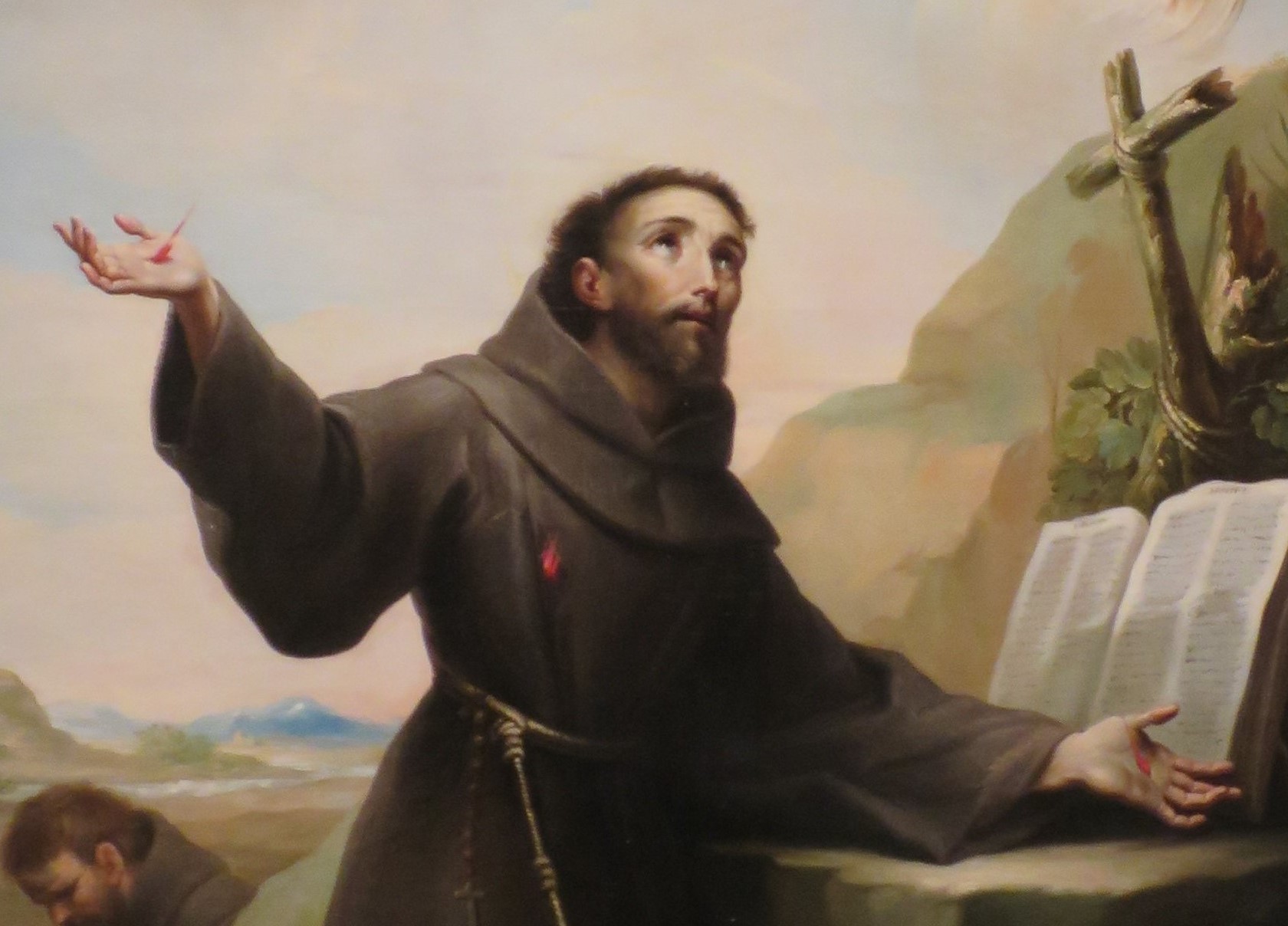
Many fine histories exist on the life of St. Francis of Assisi so there is no need to replicate that information in this post. (Here is a recently published one that is particularly good.) As we prepare for the Memorial of St. Francis of Assisi (Oct. 4), let’s reflect on a few lessons from his life.
1. On the possibility of radical conversion and the role of affliction and humiliation – The son of a successful cloth merchant, St. Francis enjoyed a very affluent, easy life growing up and partook of the permissiveness of the times. He was a natural leader and drew to himself a crowd of young people who spent their nights in wild parties. His biographer, Thomas of Celano, wrote this of him: “He attracted to himself a whole retinue of young people addicted to evil and accustomed to vice.” Francis had visions of grandeur and became a knight. Perhaps the horrors of battle and a year as a prisoner of war began a gradual conversion in him. The Fourth Crusade was called in 1205 and Francis impulsively bought new armor and sallied forth. He turned back, however, perhaps as a result of his own anxiety, and more surely due to a vision he had in which God rebuked his manner of life. When he returned home, Francis was derided as a coward and suffered the great anger of his father.
This crisis in Francis’ life ultimately led to his conversion—and a dramatic one at that. The Book of Psalms says, Before I was afflicted I strayed. But now I have kept your word, O Lord (Psalms 119:67). We all know people whose conversion seems unlikely, but God may yet humble them and draw them to conversion. Further, we ought never to underestimate the fact that affliction and humiliation may be necessary components of conversion for many of us. At times we may feel as though God has abandoned us or others whom we love. In fact, He may be doing some very important work. Our greatest enemy is pride and our best friend is humility. Humility and affliction may be gifts in strange packages. Learn to trust in God’s ways, painful though they may sometimes be. God may be drawing us to deeper conversion.
2. On the freedom of poverty and simplicity – Francis and his early companions embraced a life of radical poverty. So severe was this poverty that some thought them mad and rebuked them as irrational. To this, St. Francis responded, If we had any possessions we should need weapons and laws to defend them. One hagiographer wrote, Possessing something was the death of love for Francis. Also, Francis reasoned, what could you do to a man who owns nothing? You can’t starve a fasting man, you can’t steal from someone who has no money, you can’t ruin someone who hates prestige. They were truly free [1]. Not all of us may be able to embrace such severe poverty due to our obligations to others. More and more, though, we ought to experience a growing simplicity of life that frees us from the power of this world. Poverty and simplicity are powerful and fruitful gifts of God. They, too, are gifts in strange packages. If we can learn to embrace them, we will discover greater freedom.
3. On the Love of God’s Church and how reform is best accomplished – During St. Francis’ lifetime the Church was in need of reform. Greed, worldliness, and scandal were problems among both the clergy and laity. Heresies were abundant. Some, noting sin in the Church, chose to hate the Church and leave her. Others, like Francis, heard the call of God, who never ceases to love His Church; they intensified their love for the Church and worked for her reform. In a vision, St. Francis sensed this call from God: “Francis, repair my Church.” Gradually he deepened his understanding of the Lord’s call and began that reform by seeing first to his own life.
It is possible for critics of the Church to decry the sins of others yet not see their own. Francis began in the vineyard of his own life and then went forth, gently preaching conversion to his neighbors through personal example. The movement for reform spread. It was a grassroots effort; it was personal. Within ten years there were more than 5,000 men in Francis’ community; the Poor Clares (which he founded with St. Clare of Assisi) were also growing.
True reform begins with us. Simply denouncing the sins of others or of the Church, real though they may be, seldom has lasting effect. The best reform starts with personal conversion. Personal conversion spreads to others and then reform is underway. It works. If we allow God to set us on fire, then we can spread that fire.
4. On unity with all creation and the gift of wonder and awe – St. Francis thought of nature—all of God’s creation—as part of his brotherhood. In some sense, the sparrow was as much his brother as was the Pope.
There is a tendency today among some in the radical environmental movement to see man as the enemy of the natural world rather than an integral part of it, to view man as an outsider with respect to the natural world rather than as a partaker and member of it. For St. Francis, though, there was brotherhood.
In brotherhood there are legitimate needs we satisfy for one another. Nature supplies us and we in turn help to perfect nature. We have done this in our best moments by helping to increase the yield of our fields and bringing far greater bounty to the earth through advances in agriculture and animal husbandry. We also seek to master disease and push back the destructive boundaries of what is unruly in nature (e.g., infestation). Although we have often transgressed through unnecessary pollution, in the end we are not the enemies of nature but companions and brethren to the natural world.
St. Francis can help us to find this balance. He surely exhibited a sense of gratitude for God’s creation and a deep wonder and awe at all that God has given. We, too, ought to develop a deep appreciation for the beauty of God’s work and we should reverence our very selves as a part of that creation.
5. On the Need to Evangelize the Muslim World – We may think that the struggle with the Muslim world is new, but it is not. In his life, St. Francis decided to go to Syria to convert the Moslems (the preferred term until about 1940) while the Fifth Crusade was being fought. In the middle of a battle, Francis decided to do the simplest thing and go directly to the sultan, Melek-el Kamel, in order to make peace. He and his companion were captured and Francis was taken to the sultan. Francis challenged the Moslem scholars to a true test of religion by fire, but they refused. Francis proposed to enter the fire first, under the condition that if he left the fire unharmed, the sultan would have to recognize Christ as true God. Although the sultan turned down the challenge, he was so impressed that he allowed Francis to preach to his subjects. While Francis did not succeed in converting him, the sultan’s last words to Francis were these: Pray for me that God may deign to reveal to me that law and faith which is most pleasing to him. This work of Francis’ and his attempted rapprochement with the Moslem world had far reaching consequences, long past his own death: after the fall of the Crusader Kingdom, it was the Franciscans, of all Catholics, who were allowed to stay on in the Holy Land and were recognized as “Custodians of the Holy Land” on behalf of Christianity [2].
Today, with the emergence of extremist forms of Islam, we need more than ever to have the courage of St. Francis to engage the Muslim world and try to bring them to Christ. It may be difficult work and successes may be few at this stage, but God calls us to be faithful, not necessarily successful. Ultimately, success is up to God. We who are Catholics have a special role in this evangelization because the Muslim world shares with us a respect for Mary, Mother of Jesus our Lord. I’ll elaborate more on that point in a future post.
This first video below attempts to capture the magnificence of creation. It is set to the hymn “All Creatures of Our God and King,” whose lyrics are based on a poem by St. Francis known as “The Canticle of the Sun” (Canticum Fratris Solis (Canticle of Brother Sun)).
Here is a video of a dog whose owner taught him to pray!
There was an important passage in the Gospel for Saturday’s Mass (Saturday of the 25th Week of the Year). It displays the human tendency to filter out or ignore what we do not want to hear.
Jesus had been casting out demons. We then read,
While they were all amazed at his every deed, Jesus said to his disciples, “Pay attention to what I am telling you. The Son of Man is to be handed over to men.” But they did not understand this saying; its meaning was hidden from them so that they should not understand it, and they were afraid to ask him about this saying (Luke 9:43-45).
Note that Jesus admonishes them to pay attention. These strong words highlight the human tendency to be inattentive to what the Lord is telling us. In the Greek text, the construction is even more intense (Θέσθε ὑμεῖς εἰς τὰ ὦτα ὑμῶν τοὺς λόγους τούτους). Here is the literal translation of the Greek: Let sink you into the ears of you the words of these. The repetition of the word “you” has the effect of saying: “Hey, you! Pay attention to what I’m telling you! Yeah, I’m talking to you!”
So the Lord wants our attention. He wants us to listen closely, word for word, to what He is about to tell us. What is He going to tell us? He is going to tell us about the cross; and we don’t want to hear it. In effect we say, “Tell us about anything but the cross, Jesus. Tell us about how much you love us, that you are our shepherd, that you are going to open Heaven. Tell us how you will destroy our enemies and Satan, but don’t tell us about the cross you will endure or that we must share in it! We don’t want to hear about sacrifice—yours or ours. We don’t want hear about our need to repent or to change.”
Add to this tendency the historical context wherein the Jews expected the Messiah to be a conquering warlord, not a suffering servant. The Messiah would mow down the Romans by the sword and drown them in their own blood. He would usher in an era of prosperity and restore the Kingdom of David in all its glory. Peter and the others were thinking of a place in the palace, of being heads in the new Government. They were thinking of power and prestige, of a corner office with a commanding view.
On hearing of a suffering servant (cf Isaiah 53) the disciples just tuned out; their eyes glazed over and they seemed incapable of processing the plain meaning of the words The Son of Man is to be handed over to men. Their minds were closed to this truth or they rationalized it as mere hyperbole or some highly unlikely possibility.
That is why Jesus says to them and to us, “Pay attention!”
Are we paying attention? Do we think that the Christian life is merely to be a pleasant one without the need of dying in order to rise with Christ (2 Cor 4:10)? Do we think we can avoid going to Jerusalem to die with Jesus (Jn 11:16), to suffer with Him outside the gate (Hebrews 13:12)? Do we think He was just exaggerating when He said that the world would hate us (Mat 24:9, Jn 15:19), that we would have tribulation, that we would be hauled into court (Lk 21:12), that some in our very families would turn against us (Lk 12:53)?
Too easily we tune out emotionally and intellectually. We dismiss these admonitions as unlikely for us, or at least an exaggeration. Our eyes glaze over we become sluggish about listening.
The text goes on to say that the meaning of Jesus’ words was hidden from them(notice the use of the passive voice). This translation may be too passive, however. The Greek παρακεκαλυμμένον (parakekalummenon) is a perfect participle translated as “veiled” or “hidden” but it is actually in the middle voice. The middle voice is in between the passive and the active voices and indicates some cooperation by the person who is acted upon. Thus, while the meaning may be hidden or veiled in some sense, the disciples cooperate in keeping it veiled; they want to keep it this way. They will not ask questions or even try to understand the teaching because it is paradoxical and threatening to them.
This is true for us as well. Often, when we sense something difficult or challenging in a teaching we fail to pursue any clarification. Our philosophy seems to be this: Ask not, lest you be answered (in a way you don’t like)! We feign ignorance with difficult or challenging teachings. We are forgetful or dull of hearing.
Much of this is attributable to our human weakness. Somewhere, I hear the Lord saying to us, especially regarding the controversial and difficult teachings of our day, “Pay attention to what I am saying to you. Are you listening?”
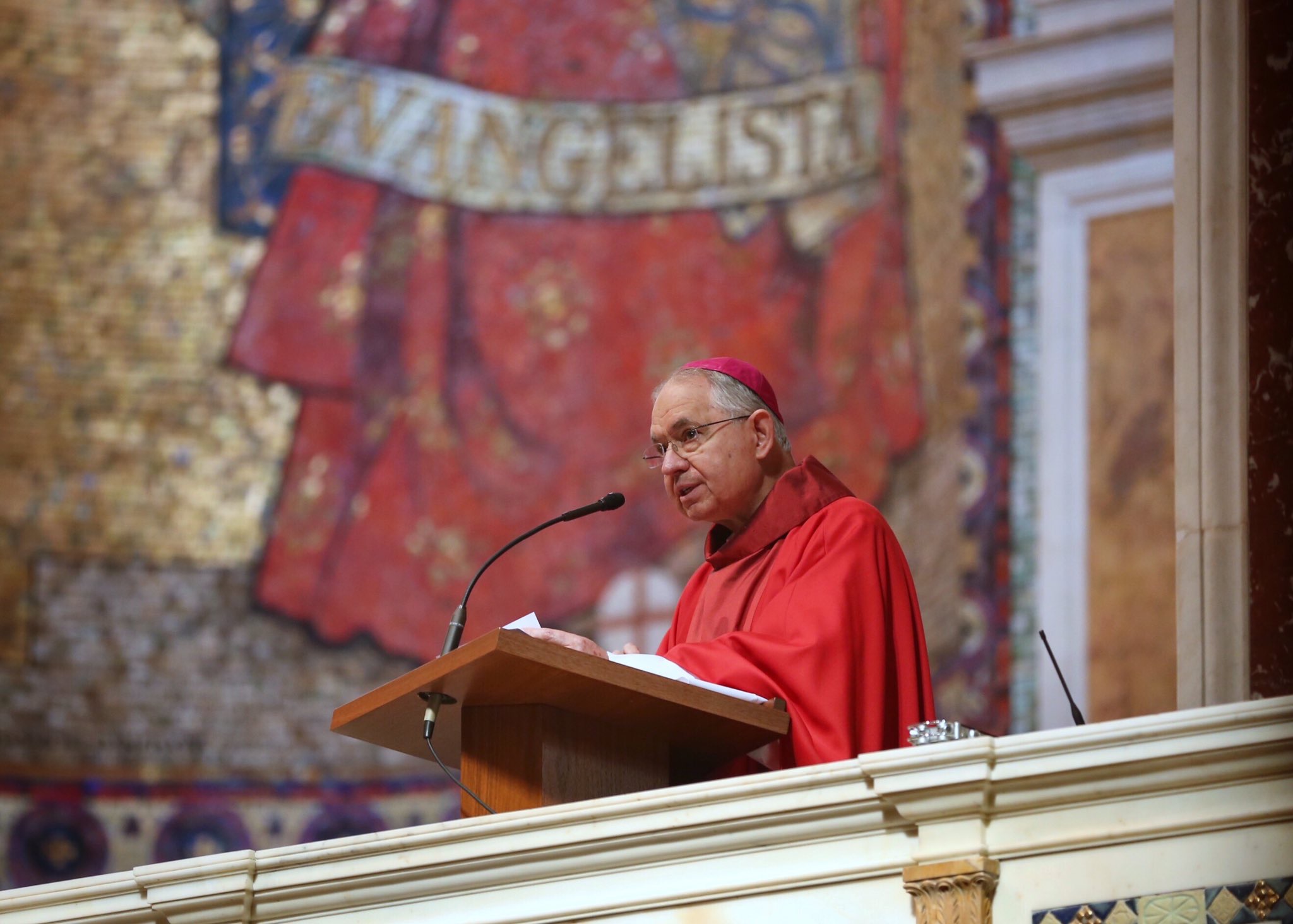
Photo credit: Jaclyn Lippelmann, Catholic Standard
Red Mass Homily
Most Reverend José H. Gomez
Archbishop of Los Angeles
Cathedral of St. Matthew the Apostle
Washington, D.C.
October 1, 2017
My dear brothers and sisters,
I am so honored to be with you this morning. I bring you greetings from the family of God in Los Angeles, the City of the Angels.
The Church in Los Angeles is the largest Catholic community in the country. We are a global church, an immigrant church, made up of people who come from all over the world. We have about 5 million Catholics in L.A. and every day, we pray and worship and we serve in more than 40 different languages.
The Franciscan missionaries who founded Los Angeles named our city for the Mother of God, the Queen of the Angels.
One of those missionaries was St. Junípero Serra, our newest American saint. St. Junípero was Hispanic, a migrant from Spain, and he entered this country after living for more than a decade in Mexico.
In his time, there were many in the California colonial government who denied the full humanity of the indigenous peoples living in this land. St. Junípero became their champion. He even wrote a “bill of rights” to protect them. And by the way — he wrote that bill of rights — three years before America’s Declaration of Independence.
Most Americans do not know this history. But Pope Francis does.
That is why, when the Holy Father came to this country in 2015, his first act was to hold a solemn Mass where he canonized St. Junípero. He held that Mass — not in Los Angeles, but right here in the nation’s capital.
Pope Francis was making a point. He believes we should honor St. Junípero as “one of the founding fathers of the United States.”
I agree. I think we should, too. Because remembering St. Junípero and the first missionaries changes how we remember our national story. It reminds us that America’s first beginnings were not political. America’s first beginnings were spiritual.
The missionaries came here first — long before the Pilgrims, long before George Washington and Thomas Jefferson. Long before this country even had a name.
These missionaries — together with the colonists and the statesmen who came later — they laid the spiritual and intellectual groundwork for a nation that remains unique in human history. A nation conceived under God and committed to promoting human dignity, freedom and the flourishing of a diversity of peoples, races, ideas and beliefs.
That is why this national Red Mass is so important each year. There is a time for politics and a time for prayer. This is a day for prayer.
We acknowledge today, as America’s founders did — that this is still one nation under God; that his laws still govern the world we live in; and that we go forward still “with a firm reliance on the protection of Divine Providence.”
We ask the Holy Spirit today to open our hearts and help us to see our duties — in the light of God’s Word, in the light of his plans for creation.
The first reading we heard this morning, the story of that first Pentecost — reveals the Creator’s beautiful dream for the human race.
As we heard, there were men and women there in Jerusalem — from “every nation under heaven.” And the Spirit of God spoke to all of them in their own “native tongues.”
Pentecost is the “birthday” of the Church and the first day of her mission. And the mission that Jesus gave her is the beautiful mission of gathering all the peoples of the earth into one family of God.
In God’s eyes, there are no foreigners, there are no strangers! All of us are family. When God looks at us, he sees beyond the color of our skin, or the countries where we come from, or the language that we speak. God sees only his children — sons and daughters made in his image.
My brothers and sisters, the truth is this: Before God made the sun and the moon, before he placed the first star in the sky or started to fill the oceans with water — before the foundation of the world — God knew your name and my name. And he had a plan of love for our lives.
Every life is sacred and every life has a purpose in God’s creation! Every one of us is born for greater things. This is not just a beautiful-sounding idea. This is what Jesus Christ came to teach us! And we are still trying to learn it.
The people who wrote this country’s laws and formed our institutions — they understood this teaching. They understood it so well that they called these truths “self-evident.”
America’s founders believed that the only justification for government is to serve the human person — who is created in God’s image; who is endowed with God-given dignity, rights and responsibilities; and who is called by God to a transcendent destiny.
My brothers and sisters, you all share in the responsibility for this great government. Public service is a noble vocation. It takes honesty and courage. It takes prudence and humility. And it takes prayer and sacrifice.
So today, let us ask the Holy Spirit for his gifts and renew our commitment to this vision of a government that serves the human person.
Let us commit ourselves to an America that cares for the young and the elderly, for the poor and the sick; an America where the hungry find bread and the homeless a place to live; an America that welcomes the immigrant and refugee and offers the prisoner a second chance.
Of course, we can always talk about the ways our nation has failed to live up to its founding vision. From the start, Americans have engaged in passionate arguments about these things, and these conversations are vital to our democracy.
From the original sins of slavery and the cruel mistreatment of native peoples, to our struggles today with racism and nativism — the American dream is still a work in progress.
We have come a long way. But we have not come nearly far enough. That should not make us give in to cynicism or despair. For all our weakness and failure: America is still a beacon of hope for peoples of every nation, who look to this country for refuge, for freedom and equality under God.
Throughout our history, men and women of faith have always led movements for justice and social change.
I am thinking of the efforts to abolish slavery and to give women the right to vote. I am thinking of the civil rights movement, the farmworkers movement, the peace movement and the right-to-life movement. It was a book by a Catholic Worker that helped launch the “war on poverty” in the 1960s.
This is why religious freedom is so essential to who we are as Americans. We should never silence the voices of believers. They connect us to our founders’ vision. Today more than ever, we need their spirit of peacemaking and searching for nonviolent solutions.
In the Gospel passage that we heard this morning, Jesus comes to his disciples, he shows them his wounds, and then he “breathes” on them.
What we are witnessing in this scene — is a new creation.
In the beginning, the Creator formed man and woman in his own image. And then, the Book of Genesis tells us, God “blew into his nostrils the breath of life.”
In this passage we heard this morning, Jesus comes to create a new humanity — a new people formed in the image of his forgiveness and made alive by the power of his Spirit.
This scene is rich in meaning. When Jesus breathes on his disciples and says, “Receive the Holy Spirit. Whose sins you forgive are forgiven them, and whose sins you retain are retained” — yes, he is giving his Church the power to forgive sins in his name.
But more than that, he is giving every one of us — the power to forgive those who trespass against us.
And that power to forgive — it is the greatest power that men and women possess under heaven. If only we could understand that! Because when we forgive, we are imitating Jesus Christ.
The power to grant forgiveness and show mercy is the image of God. In many ways, to forgive is what makes us fully human.
My brothers and sisters, let me conclude by suggesting that forgiveness is part of the unfinished revolution in American society.
Forgiveness does not mean forgetting what has happened or excusing what is wrong; it does not mean ignoring what divides us.
True forgiveness sets us free from the cycles of resistance and retaliation; it sets us free to seek reconciliation and healing.
And this is what we need in America today — a new spirit of compassion and cooperation, a new sense of our common humanity.
We need to treat “others” as our brothers and our sisters. Even those who oppose or disagree with us. The mercy and love that we desire — this is the mercy and love that we must show to our neighbors.
May God bless you all for your service to this great country! And may God bless America!
And may Our Blessed Mother Mary, help us all to renew the promise of America. To commit ourselves once again to the truths that our founders entrusted to us.
In understanding Sunday’s Gospel, we cannot overlook the audience Jesus was addressing. The text begins, Jesus said to the chief priests and elders of the people …. In other words, He was addressing the religious leaders and religiously observant of His day. He calls at least three things to their attention, three common sins of the pious, if you will: lost connections, leaping to conclusions and lip service.
Let’s look at each of these in turn, remembering that although they are not exclusive to the religiously observant, they are considered in that context. Let’s also learn how they are particularly problematic when it comes to our mandate to hand on the faith through evangelization.
I. Lost Connections
The text says, A man had two sons. It goes on to describe these two sons as very different yet also quite similar. The man, of course, is God; we are the sons. Although we are all very different, we all have the same Father and we all have sin. A man had two sons is another way of saying that the sons had the same father. Yes, we all have a connection we cannot deny, whatever our differences.
Why emphasize this? Because it is too easy for us to try to sever the link we have with one another, to effect a kind of divorce from people we fear or do not like. For example, on the way to Mass we may drive past tough parts of town and see drug dealers, prostitutes, groups of young men loitering near liquor stores, and other outwardly troubled or rebellious people. It is easy to be cynical and say, “Some people’s children!” or “Look at that; how awful.” Or we may simply ignore them. Yet in doing this we fail to recall that these are my brothers and sisters. So easily we can dismiss them, write them off, separate ourselves from them. But God may have a question for us: “Where is your brother?” (Gen 4:9)
Yes, there are many people whom we try to disown. Perhaps they are of a different political party, economic class, or race. Perhaps we just don’t like them. We divide, but God unites. A man had two sons. Yes, they were different, but he was father to them both; he loved them both. He spoke to them and called them his sons.
In terms of evangelization, remember that Jesus sent us to all the nations. No longer were Israel and the Gentiles to be separated, the one considered chosen people and the other not. Hence the Church is catholic, universal, seeking to unite all. A man had two sons, but the two sons had one father. In seeking to evangelize, has it ever occurred to you that the least likely member of your family could be the one whom God most wants you to reach? Be careful of lost connections, for souls can be lost.
II. Leaping to Conclusions
A second “sin of the pious” is leaping to the conclusion that someone is irredeemably lost, writing someone. Many of the Scribes and Pharisees, the religiously observant of their day, had done just this with a large segment of the population. Rather than to going out and working among them to preach the Word and to teach the observance of the Law, many of them simply labeled the crowds “sinners” and dismissed them as lost. In fact, they were shocked that Jesus “welcomed sinners and ate with them” (e.g., Lk 15:2). In effect, Jesus says to them, “Not so fast. Don’t leap to conclusions or write anyone off. Sick people need a doctor. I have come to be their divine physician and to heal many of them.”
Thus Jesus, in today’s parable, speaks of a sinner who repents: [The Father] came to the first and said, “Son, go out and work in the vineyard today.” He said in reply, “I will not,” but afterwards changed his mind and went.
The point is that we just don’t know about people. We should be very careful not to write people off, even those who appear to be locked in very serious and sinful patterns or who seem to be hostile to God. The example of St. Paul should certainly give us hope, as should that of St. Augustine. St. Augustine wrote well on the fact that we just don’t know how things will turn out with people.
For what man can judge rightly concerning another? Our whole daily life is filled with rash judgments. He of whom we had despaired is converted suddenly and becomes very good. He from whom we had expected a great deal fails and becomes very bad. Neither our fear nor our hope is certain. What any man is today, that man scarcely know. Still in some way he does know. What he will be tomorrow however, he does not know (Sermo 46, 25).
Scripture also says, The oppressed often rise to a throne, and some that none would consider, wear a crown. The exalted often fall into utter disgrace; … Call no man happy before his death, for by how he ends, a man is known (Sirach 11:5-6, 28).
I man I knew (now deceased) once told me his story: He was raised in the Church, got all his Sacraments, went to Church regularly, and was a God-fearing man. In his early forties, though, he descended into alcoholism, began to be unfaithful to his wife, stopped going to Church, and was dismissive of God. Were you or I to have seen him at that time, we might easily have concluded that he was too far gone. When he was in his early sixties, he knows not how (except that someone must have been praying for him) but he pulled out of his rebellion and reentered the vineyard. He sought help for his drinking problem and reconciled with his wife and children. Daily mass, weekly confession, daily rosary, and Stations of the Cross—yes, when he returned, he really returned. He said to me that he had done a lot of sinning and so now it was time to do a lot of praying, to make up for lost time, as he put it. He died a penitent in the bosom of the Church.
You just never know. Don’t write anyone off. Nothing stabs evangelization in the heart more than the presumption that someone is an unlikely candidate for conversion. Keep praying and keep working. Jesus tells us the story of a son who told his father to “buzz off,” but later repented and went into the vineyard. Pray, hope, and work. You just never know. Don’t give up.
Don’t think that anyone is a permanent member of the vineyard, either. Pray, hope, and work even for those who seem well within in the vineyard, even for your own salvation. We all know of former parishioners, even leaders, who later drifted from the faith. St. Paul spoke of how he had a kind of sober vigilance about his own salvation: But I discipline my body and keep it under control, lest after preaching to others I myself should be disqualified (1 Cor 9:27).
III. Lip Service
The text says, The man came to the other son and gave the same order. He said in reply, “Yes, sir,” but did not go.
Consider the second son. He is respectful to his father. When told to go into the vineyard he tells his father that he will do so. He would not dream of cursing his father or addressing him in a strident way. You might say that he was outwardly respectful and religiously observant—a decent sort of fellow.
In the end, though, he doesn’t get around to going to the vineyard. For whatever reason, his obedience to his father was only cursory. His lack of follow-through demonstrates a great danger to the religiously observant: giving God “lip service.” Yes, we will praise the Lord, sing a hymn, shout Hallelujah, and say Amen on Sunday, but come Monday will we obey and go to the vineyard of obedience? Will we forgive those who have wronged us? Will we show generosity to the poor? Will we be chaste and compassionate? Will we love our spouse and children? Will we speak the truth in love, evangelize, and act as God’s prophets?
The greatest sadness of all is that it is our very religious observance (a good and commanded thing to be sure) that often blinds us to our wider disobedience. It is easy (and too common) for the religiously observant person to reduce the faith to rituals and, once the rituals are observed, to check off the “God box.” In effect saying or thinking, “OK, I’ve gone to Mass, paid my tithes, said a few Amens and praised the Lord by singing. Now I’m done.”
“Lip-service Christians” are terrible witnesses and a real blow to evangelization because they are so easy to spot. How on earth can we ever hope to win souls for Christ if people can see that we are just going through the motions, but living lives that are unreformed, and untransformed? Our greatest witness must be a life that is being changed by Jesus Christ, a life that manifests the biblical principles of love, justice, charity, forgiveness, mercy, generosity, and a biblical understanding of sexuality; a life that shows we have a renewed mind and heart.
Now none of us do this perfectly, but pray that God’s transformative power is at work in us and that people can see it in us. There is little that is more destructive to evangelization than phony, lip-service Christians, who give the outward appearance of obedience and religiosity but with no substance behind it. Nothing is more helpful to evangelization than Christians who show lives that are being transformed and made more joyful, serene, and holy.
All of this leads to the title of today’s post: “God can use anything, but He shouldn’t have to.” In other words, although none of us are perfect disciples and God can work through us no matter what—He shouldn’t have to do that.
So in today’s Gospel Jesus points out three powerful obstacles to His grace flowing through us to others: lost connections, leaping to conclusions, and lip service. All of these things lessen our effectiveness as disciples, prophets, and evangelizers sent out to make disciples of all the nations.
Most of us struggle with the fact that God allows bad things to happen to us. Why does He not intervene more often to protect us from attacks of various kinds and from events that cause sadness, setbacks, or suffering?
While mysterious, the clearest answer is that God allows suffering in order that some greater blessing may occur. To some degree I have found this to be so; some of my greatest blessings required that a door slam shut for me or that I endure some suffering. If my college sweetheart had not ended things, I would most likely not have the very great blessing of being a priest today. Had I gotten some of my preferred assignments in my early years as a priest, I would not have been enriched by the assignments I did have. Those difficult assignments have drawn me out and helped me to grow far more than the cozy, familiar placements I desired would have. Had I not entered into the crucible of depression and anxiety in my thirties, I would not have learned to trust God as much as I do, and I would not have learned important lessons about myself and about life.
So despite that fact that we understandably fear suffering and dislike it, for reasons of His own (reasons He knows best), God does allow some degree of it in our lives.
Yet I wonder if we really consider often enough the countless times God did step in to prevent disaster in our lives. We tend to focus on the negative things in life and overlook the enormous number of blessings we often take for granted: every beat of our heart, the proper functioning of every cell in our body, and all of the perfect balances that exist in nature and the cosmos in order to sustain us.
Just think of the simple act of walking, all of the possible missteps we might take but most often do not. Think of all the foolish risks we have taken in our lives—especially when we were young—that did not end in disaster. Think of all the poor choices we have made and yet escaped the worst possible outcomes.
Yes, we wonder why we and others suffer and why God allows it, but do we ever wonder why we don’t suffer? Do we ever think about why and how we have escaped enduring the consequences of some awfully foolish things we have done? In typical human fashion, we minimize our many, many blessings, and magnify and resent our sufferings.
I have a favorite expression, one that I have made my own over the years, that I use in response to people who ask me how I am doing: “I’m pretty well blessed, for a sinner.” I’ve heard others put the same sentiment this way: “I’m more blessed than I deserve.” Yes, we are all pretty well blessed indeed!
I thought of all those things as I watched the commercial below (aired during the 2014 Super Bowl). While it speaks of the watchfulness of a father, it makes me think of my guardian angel, who has surely preserved me from many disasters.
As you watch the commercial, don’t forget to thank God for the many times He has rescued you through the intervention of your guardian angel. Thank Him too for His hidden blessings—blessings that, though you know nothing of them, are bestowed by Him all the same. Finally, think of the wonderful mercy He has often shown in protecting you from the worst of your foolishness.
One of Jesus’ most central qualities was that He loved His Heavenly Father and was loved by Him. To put it colloquially, Jesus was crazy about His Father. He was always talking about Him. Jesus often sought remote places in order to be able to spend extended time with His Father. Clearly He also knew and experienced His Father’s great love for Him.
Indeed, Jesus’ public ministry began with this declaration of the Father: You are my beloved Son; with you I am well pleased” (Mk 1:11; Lk 3:22). Clearly, the Father loves and takes great delight in His Son, Jesus. While we ought not to project our own needs and wounds (such as the “father wound”) into Jesus’ human nature — as if He desperately needed the affirmation of the Father — it seems clear that one of the greatest joys of Jesus’ life was the Father’s love for Him. It supported Him and encouraged Him. It was the foundation, the center, of His identity. Jesus is the beloved Son of the Father.
At one point the disciples, who had admired the powerful love and prayer of Jesus for His Father, asked that He teach them how to pray. Jesus began, “When you pray, say, ‘Father’” (Lk 11:2). He was overheard in the Garden of Gethsemane to say, Abba! Father, all things are possible for you. Remove this cup from me. Yet not what I will, but what you will (Mk 14:36). Yes, Jesus loved His Father and experienced great love from Him.
We have few in the way of lengthy descriptions of Jesus’ prayer, but it would seem that words were seldom needed between Him and His Father. It was Cor ad Cor loquitur (heart speaking to heart); it was what words could never describe nor lips utter.
It is especially in John’s Gospel that we get glimpses of Jesus’ experience with the Father. Jesus discloses His experience of the Father through brief aspirations, attestations, and in his High Priestly prayer. We see a deep relationship of Jesus with His Father that is one of love, trust, confidence, and an unfailing expectation of vindication from the Father. In Jesus there is a joyful obedience and an experience that He is never alone:
I am not alone. I stand with the Father, who sent me (Jn 8:16).
He who sent me is trustworthy, and what I have heard from him I tell the world. … The one who sent me is with me; he has not left me alone … I always do what pleases him (Jn 8:26, 28-29).
I am telling you what I have seen in the Father’s presence (Jn 8:38).
I honor my Father, but you dishonor me. … My Father, whom you claim as your God, is the one who glorifies me. Though you do not know him, I know him. If I said I did not, I would be a liar like you, but I do know him and obey his word (Jn 8:49, 54-55).
Father, … I know that you always hear me (Jn 11:41-42).
I do exactly what the Father has commanded me, so that the world may know that I love the Father. Get up, let us go on from here [to the cross] (Jn 14:31).
As the Father has loved me, so have I loved you (Jn 15:9).
Father, the hour has come. Glorify your Son … glorify me in your presence with the glory I had with you before the world began. … Then the world will know that you sent me and that I have loved them even as you have loved me. … Father you loved me before the creation of the world. … Righteous Father, though the world does not know you, I know you (John 17: selected verses).
Even though on the cross Jesus cried, “My God, My God why have you forsaken me?” (Ps 22:1), we must recall that this psalm is one of hope, not despair. Among its laments come verses of confidence and trust:
Yet you brought me out of the womb; you made me trust in you, even at my mother’s breast. From birth I was cast on you; from my mother’s womb you have been my God. …
… But you, Lord, do not be far from me. You are my strength; come quickly to help me. Deliver me from the sword, my precious life from the power of the dogs. Rescue me from the mouth of the lions; save me from the horns of the wild oxen.
And I will declare your name to my people; in the assembly I will praise you. You who fear the Lord, praise him! All you descendants of Jacob, honor him! Revere him, all you descendants of Israel! For he has not despised or scorned the suffering of the afflicted one; he has not hidden his face from him but has listened to his cry for help. From you comes the theme of my praise in the great assembly; before those who fear you I will fulfill my vows.
Yes, even on the cross there is trust and confidence in the Father’s love; there is a firm conviction that this love will vindicate and rescue. There is also Jesus’ loving willingness to fulfill his vows to God before the people, even if it brings suffering and scorn.
Thus, the Father’s love is greater than any other force in Jesus’ life. It is His foundation, His joy, and His sure defense. If He but has the Father’s love, He has all and conquers all.
What of you and me? Do you experience the Father’s love for you as the foundation of your life and your deepest strength? For too many, the Father seems distant, perhaps even angry. Jesus’ deepest work in your life is to bring you into the heart of the Father so that you will not just know, but experience that the Father loves you; He even likes you! The Father loves you and there’s really nothing you can do about it. You are His beloved!
While we are not sinless, as was Jesus, the Father does not cease loving us. It is His very love and the experience of that love that will drive out sin and usher in holiness. If you love me, you will keep my Commandments (Jn 14:15).
Jesus would have you turn now and see across the distant field that the Father is running toward you (Luke 15:20). He would have you hear him pleading for you to enter the feast (Luke 15:28). If you take one step toward Him, God the Father will take two steps toward you and then come running.
Let the Father’s love be the foundation of your life. As it was for Jesus perfectly, may it be so for us with increasing perfection.
Among the losses in our declining culture is that of “common” or shared spaces and events. In these situations, Americans could come together and enjoy some degree of unity and common purpose. Usually they involved diversions like sports, movies, or other entertaining and uniting activities. Whatever political, religious, or cultural differences, Americans could set aside their differences and enjoy something together.
Sporting events, amateur and professional (e.g., local high school football games, March Madness, the Super Bowl, the World Series)
Blockbuster movies or television shows (e.g., Jaws, the final episode of M*A*S*H)
Awards ceremonies (e.g., the Oscars, the Emmys, the Grammys)
Amusement parks (e.g., Disneyland, Epcot Center, Six Flags)
Parades (e.g., St. Patrick’s Day, Fourth of July, Thanksgiving Day)
These were times when people left their politics behind and enjoyed things common to everyone. Here in Washington, D.C., political divisions could run deep, but come Sunday the stadium was filled with united Redskin’s fans, especially when we played Dallas. Even if some rooted for “the other team,” it was all in good fun. Fans of things like Star Wars and Star Trek might be in different political parties, but they could enjoy talking about their favorite characters and episodes. On July 4th, it was great to be an American regardless of which political party we favored; there were parades, fireworks, and the reading of the Declaration of Independence. We could visit the Disney of more innocent times and watch the Main Street Electrical Parade, shoulder-to-shoulder with people of all shape, sizes, colors, and beliefs.
These and others were common or shared spaces where we could all have a good time and forget our troubles and divisions, even if only briefly.
Such spaces and occasions are disappearing, one by one.Everything these days is being politicized. In the football world, the latest kerfuffle over our National Anthem (another thing that used to unite us) is only the latest in a series of attempts by players, owners, and sports networks to inject politics into the game. Football players and coaches are lecturing to us; sports anchors opine, the PC crowd pores over Super Bowl commercials looking for any sign of offense, the Super Bowl halftime shows reek of the sexual revolution. Blech!
Actors, actresses, and singers wag their fingers at us, issuing political speeches and injecting social commentary at the Grammys, Oscars, and Emmys. Do we really care what some celebrity’s political stance is? Do we need to hear how much they like the sexual revolution? Must they weigh in on the latest cause célèbre? Even the opening monologue is some sort of tirade against someone or an opinionated lecture delivered in the bubble of a like-minded crowd who seem to have little understanding of how condescending it all sounds. Gone are the days of good old-fashioned movies that entertained and/or elevated us. Everything has to have a message—usually an attack on traditional values or a foray into our political divisions. This was the very thing we once turned to entertainment to escape.
Victor Borge once said, “Laughter is the shortest distance between two people.” But today even comedy has been infected with politics and the hypersensitivity of political correctness. What makes things funny is how they often stereotypically capture a truth. Yes, it is exaggerated. Yes, it pokes a little fun. Yes, it plays to expectations, though sometimes with a surprising twist. Today we’re not “allowed” to laugh at much of anything. We’ve become so thin-skinned that we’ve lost the ability to laugh at ourselves. Comedy has also become rife with sexual banter that makes it R-rated, and one-sided attacks that reflect its politicization.
Columnist Ben Shapiro has this to say:
America needs to take a breath from politics every so often. Football is one of those breaths.
Hollywood and pop culture would do well to remind themselves that if they don’t want to alienate half their audience and exacerbate our differences, they can allow us room to breathe. The Super Bowl [once] did that … So much for that rosy notion. The NFL has become ground zero for the culture wars. Which means that we can’t see movies anymore, watch TV shows anymore, or even watch sports anymore without feeling that we’re being judged. That means our common spaces are disappearing. And we have so little political common space already that cultural common space was our last relic of togetherness.
Here’s the bottom line: this conflict isn’t good for the country. We need our shared symbols, and we need our shared spaces. Both of those elements are being destroyed for political and ratings gain. If that doesn’t stop, we’re not going to have anything at all in common anymore [Ben Shapiro, writing in “The Daily Wire”].
While this issue is not a Christian one per se — it is a wider cultural one — Pope Benedict XVI diagnosed its deeper roots when he spoke of the “tyranny of relativism.” Relativism is a form of subjectivism which shifts the locus of truth and reality from the object to the subject. Because subjects (people) differ in their perceptions, the truth is then claimed to be relative. This leads to tyranny, however, because when we can no longer point to reality and reason to make our point, we are left with shouting and pressuring. Who wins when reason and reality itself are jettisoned? Those with the most money, power, and influence; those who are loudest; those who are fiercest; those who are willing to go to extremes to force their opinion. When reason and God’s reality are thrust aside, the loud, the powerful, the arrogant, and the extreme get their way.
Amusement parks, movies, parades, and even the gridiron cannot withstand the politicization; it is forcing its way onto the field and into everything. Common spaces are fewer than ever; everything today is a bitter dispute. Blech!