Finding Forgiveness Through the Magnificence of Mercy – A Homily for the 24th Sunday of the Year

The Gospel this Sunday draws us into a remarkably sensitive area of the faith, that of forgiving others who may have harmed us. There are many who been authentically hurt and others who in offering forgiveness will become vulnerable to further harm. Forgiveness is something we experience as a very personal call; in some cases, it may be the most challenging thing we are ever asked to do.

I have titled this Homily carefully; if we read the parable closely we will come to understand that mercy and forgiveness are not something we do out of our own flesh. Rather, they are capacities we must find within ourselves. As the remarkable reality of God’s incredible mercy for us dawns upon us, our hearts are moved. Suddenly we don’t hate anyone and forgiveness flows from our broken, humbled hearts. This is a gift that the Lord offers us.

Let’s look at this Gospel in four movements.

I.  THE PRESENTATION OF THE PROBLEM – The text says, Peter approached Jesus and asked him, “Lord, if my brother sins against me, how often must I forgive? As many as seven times?” Jesus answered, “I say to you, not seven times but seventy-seven times.”

Peter’s question seems to presuppose that there needs to be a limit to forgiveness, that it is unrealistic to expect human beings to forgive without limit. Many would likely agree with Peter and might not even propose to be as generous as forgiving seven times. Jesus answers by speaking in a Jewish way, telling Peter that we cannot set limits on mercy or forgiveness, but must forgive without limit.

This of course raises many questions. Some people like to use extreme examples to illustrate that they think such a principle absurd or impractical: Do you mean to say that a wife should welcome back her physically abusive husband as long as he says he’s sorry? Should a business welcome back an embezzler and put him in charge of the cash register as long as he says he’s sorry? Should I let my alcoholic uncle stay with us and disturb my children as long as he says he’s sorry and swears he won’t do it again?

On some level these questions imply that forgiveness is to be fully equated with pretending that something never happened, or that it obligates me to maintain an unchanged relationship and let “bygones be bygones.” We are not always able to live in peace and have relaxed boundaries with people who have shown themselves to be untrustworthy in a consistent or fundamental way. Forgiveness does not obligate us to put ourselves or others at unreasonable risk or to set the sinner up for another fall.

But even though we may have to erect necessary and proper boundaries with those who have sinned against us, we are still summoned to forgive them. What does forgiveness mean in situations like this?

In effect, forgiveness is letting go of the need to change the past. Forgiving does not necessarily mean simply returning to the status quo ante, but it does mean letting go of resentments, bitterness, hatefulness, desires for revenge, and the need to lash out at someone for what he did or did not do. Forgiving means setting down ball and chain of hatred and anger we so often carry about. It means learning to love those who have harmed us and understanding the struggles that may have contributed to their harmful behavior. Forgiving can even mean being happy for the health and welfare of those who have hurt us and praying for their continued well being. Ultimately, forgiveness is freeing; a crushing weight is removed when we receive this gift from God.

How are we to receive this gift? The Lord gives an important insight for us to grasp in the verses ahead.

II.  THE POVERTY THAT IS PROFOUND – The text says, That is why the kingdom of heaven may be likened to a king who decided to settle accounts with his servants. When he began the accounting, a debtor was brought before him who owed him a huge amount. Since he had no way of paying it back, his master ordered him to be sold, along with his wife, his children, and all his property, in payment of the debt. At that, the servant fell down, did him homage, and said, ‘Be patient with me, and I will pay you back in full.’

The Lord’s parable begins by describing a man who owes a huge amount. The Greek text says he owed ten thousand talents (μυρίων ταλάντων). Scripture scholars love to debate exactly how much this would be in modern currency, but for our purposes, it is a Jewish way of saying that this fellow owes a great deal of money and it’s going to take more than working a little overtime or taking on a part-time job. This is a debt that is completely beyond his ability to pay. The situation is hopeless; the man is so profoundly poor that he is completely incapable of ever making a dent in what he owes.

This man is each one of us; this is our state before God. We have a debt of sin so high and so heavy that we can never hope to be rid of it on our own. I don’t care how many spiritual pushups we do, how many novenas, chaplets, and rosaries we say, how often we go to Mass, how many pilgrimages we undertake, or how much we give to the poor. We can’t even make a noticeable dent what we owe.

People like to make light of sin today, saying such inane things as, “I’m basically a good person” or “At least I’m not as bad as that prostitute over there.” So you’ve got $500 in your pocket and she’s only got $50. Big deal; the debt owed is three trillion dollars. None of us can even come close to paying it off. Without Christ paying the difference, we’re finished; off to jail; off to Hell. We have all committed the infinite offense of saying no to a God who is infinitely holy. You and I just don’t have the resources to turn back the debt.

You may think I’m belaboring the point, but we really have to get this through our thick skulls. We are in real trouble without Christ. The more we can grasp our profound poverty and understand that without Jesus Hell is our destination, the more we can appreciate the gift of what He has done for us. Let this sink in: We are in big trouble; our situation is grave. An old song says, “In times like these, you need a savior.”

III.  THE PITY THAT IS PERSONAL – The text says, Moved with compassion the master of that servant let him go and forgave him the loan.

Look at that! Don’t miss this! The whole debt is paid. Complete and dramatic mercy! Notice how personal the mercy is. The text uses intensifiers: the master of that servant let him go and forgave him the loan. This man is you. God has done this for you—you.

If we miss this point, nothing else makes sense. We have got to let it get through to us what God has done for us. If we do, it will equip us to show mercy.

One day it will finally dawn on us that the Son of God died for us. When it does, our stone hearts will break and love will pour in. With broken, humbled hearts, we will find it hard to hate anyone. In our gratitude we will gladly forgive those who have hurt us, even those who still hate us. With the new heart that the Lord can give us, we will forgive gladly, joyfully, and consistently out of gratitude and humility.

But we have to understand this. We have to know our poverty and recognize our inability to save ourselves. Then we have to know and experience that Jesus paid it all, that He saved us wholly and freely. If this will break through for us, we will forgive and love others.

If we do not understand this and we refuse to let the Holy Spirit to minister this gift to us, some pretty awful things will happen.

IV.  THE PITILESSNESS THAT IS PERILOUS – The text then relates a tragic story: When that servant had left, he found one of his fellow servants who owed him a much smaller amount. He seized one of his fellow servants and started to choke him, demanding, ‘Pay back what you owe.’ Falling to his knees, his fellow servant begged him, ‘Be patient with me, and I will pay you back.’ But he refused. Instead, he had the fellow servant put in prison until he paid back the debt. Now when his fellow servants saw what had happened, they were deeply disturbed, and went to their master and reported the whole affair. His master summoned him and said to him, ‘You wicked servant! I forgave you your entire debt because you begged me to. Should you not have had pity on your fellow servant, as I had pity on you?’ Then in anger his master handed him over to the torturers until he should pay back the whole debt. So will my heavenly Father do to you, unless each of you forgives your brother from your heart.

Apparently this wicked servant never got in touch with his true poverty and refused to experience the gift that he himself had received. As a result, his heart remained unbroken; it remained hard; it was stone. Having experienced no mercy (though mercy had been extended to him) he was willfully ill-equipped to show mercy to others. Callously unaware of the unbelievable gift he had been given, he remained unchanged. In so doing and being, he was unfit for the Kingdom of God, which can only be entered by gladly receiving mercy.

Yet many Christians are like this. They go through their life unaware and unappreciative of either their need for mercy or even the fact that incredible mercy has been extended to them. Unaware, they are ungrateful. Ungrateful, their hearts are unbroken; no light or love has been able to enter. Hurt by others they respond by hurting back, holding grudges, or growing arrogant and unkind. They lack compassion for or understanding of others and consider themselves superior to those whom they view as worse sinners than they are. They think that forgiveness is either a sign of weakness or something that only foolish people offer. They don’t get angry; they get even.

It all begins with a person who doesn’t understand the gravity of his condition or the depth of his poverty. You say, ‘I am rich; I have acquired wealth and do not need a thing.’ But you do not realize that you are wretched, pitiful, poor, blind and naked (Rev 3:17). Refusing to see their poverty they do not appreciate their gift; so the terrible cycle ensues.

Scripture warns in many places of our need to experience and show mercy:

  1. For if you forgive men when they sin against you, your heavenly Father will also forgive you. But if you do not forgive men their sins, your Father will not forgive your sins (Matt 6:14).
  2. Blessed are the merciful, for they will be shown mercy (Matt 5:7).
  3. For in the same way you judge others, you will be judged, and with the measure you use, it will be measured to you (Matt 7:2).
  4. Do not condemn, and you will not be condemned. Forgive, and you will be forgiven. (Luke 6:37).
  5. This is how my heavenly Father will treat each of you unless you forgive your brother from your heart (Matt 18:35).
  6. For judgment without mercy will be shown to anyone who has not been merciful. But mercy triumphs over judgment! (James 2:13)
  7. The vengeful will suffer the Lord’s vengeance, for He remembers their sin in detail. Forgive your neighbor’s injustice, then when you pray, your own sins will be forgiven. Can anyone nourish anger against another and expect healing from the Lord? Can anyone refuse mercy to another like himself and then seek pardon for his own sins? Remember your last days, set enmity aside. Remember death and cease from sin. Think of the Commandments, hate not your neighbor, remember the Most High’s covenant, and overlook faults (Sirach 27:30).

I don’t know about you, but I’m going to need a lot of mercy on the day of judgement. In texts like these, he Lord teaches that we can have an influence on the standard of judgment He will use. Do you want to find mercy? Then receive it now from Him and show it to others. Otherwise you will be judged with strict justice. I promise you; you don’t want that! If strict justice is the measure, we will surely go to Hell. We just owe too much to think we can make it without mercy.

This is a tough Gospel, but a freeing one. Certainly some of us find it hard to forgive. Some have been deeply hurt. In the end, forgiveness is a gift that we must receive from God. It is a work of God in us. We should, we must ask for it. Even if we feel hurt, we must seek the gift; it will bless us and prepare us to receive more mercy. Listen carefully to the warnings. If we cling to our anger and refuse the freeing gift of forgiveness, we become unfit for the kingdom of Heaven. No matter how deep our hurts we cannot justify our anger and refusal to forgive. God has just been too good to us. If that will dawn on us, our hearts will break with joy and be filled with love; and forgiveness will surely come with a new heart.

This song says, “Your grace and mercy brought me through, I’m living this moment because of you. I want to thank you, and praise you too, your grace and mercy brought me through.”

Power Gone Wrong – As Seen in an Animated Short

We tend to demonize the word “power” in our culture. Of itself, though, power is simply the capacity to act, a kind of energy to accomplish what must be done. In this sense, power can lead to magnificent and creative solutions to difficulties, wonderful breakthroughs and great progress.

God gives us all a certain degree of power to act. We all have capacities, abilities, talents, and charisms. These powers interact with our will and our freedom. It is here that power can bring about great good or go terribly wrong.

Power gone wrong leads us to dominate and impose our will on others in a self-serving way. Used in this way, power can lead to unimaginable human suffering and misery; the wars, conflicts, genocides, and high death tolls of the last century demonstrate this. As many as 100 million people were put to death during the bloody 20th century in the name of many secular ideologies, in the name of ushering in secular “utopias,” and in quests for raw and dominating power.

In the video below we see power gone wrong. A man comes to apply for the job of “superhero” and is put through various tests to discern whether he has the temperament to handle power and use it for good.

The first few tests seem to go well. But suddenly, though, his power goes to his head and he gratuitously kills someone whom he was supposed to protect. From that point on, things go off the rails; the result is utter destruction.

How did this happen? He forgot that he has power for others, not for himself.

It frequently happens that those who stage revolutions “for the good of the people” or to end injustice, then rise to power and proceed to usher in their own reign of terror. While claiming to be revolting on behalf of “the people,” the leaders of the last century, with their secular utopian notions, often created worse oppression and dictatorships than they claimed to replace. Iron curtains fell and a loss of freedom ensued, as killing on a mass scale was ushered in—all “for the sake of the people.” Hitler killed millions, as did Stalin, Mao, Pol Pot, and others.

There is a subtlety to the video as to how the power goes to his head. On the face of it, his turn to darkness is quite sudden, but I would suggest that we could have seen it coming.

How? In the fact that our would-be superhero uses deadly violence to solve every problem with which he is presented during the testing. It is not enough for him to rescue the victim; he must destroy the threat. Finally, a threat sees the prepared response and retreats. He has won without destroying! However, by now he has a lust to kill. He must get the kill! He has been robbed of the kill by the retreat. Overcome by his lust for power, for the kill, he turns on the very person whom he was supposed to protect. From there it is all downhill. No one will limit his power, tell him what to do, or keep his blood lust in check! Power has corrupted him. He is addicted to it and must use it.

This is power gone wrong in miniature, in a video that illustrates the dark side of power well. Power is not wrong in and of itself, but it can go wrong when it interacts with our sinful nature and is no longer used in a measured fashion or when its objective is no longer helping others but merely serving the self.

Pondering the Night of the Senses and the Paradox That We See Farther in the Darkness

As human beings we are very visual; there is a certain demand of our flesh to see on its own terms. But of course God, who is pure spirit, will not be seen in this way.

How can the human eye perceive what is spiritual? It is not designed to do so. We cannot see God as God any more than we should expect to be able to see justice sitting down to lunch with humility. These are not physical concepts; they are metaphysical ones. We may see evidence of their existence, but we do not see them physically—so also with God. We see a lot of evidence of His existence, but we do not see Him with our earthly eyes.

There is a well-known (but inaccurate) saying, “Seeing is believing.” Actually it is not; seeing is only seeing. When we see things physically, one of two things happens, either of which eliminates the existence of any sort of faith:

  1. We see something and accept it as true, in which case faith is no longer necessary, for it is not necessary to believe what we can plainly see.
  2. We scoff or act bemused and continue to disbelieve, saying (for example when we see a magic trick), “There’s a way of doing that; it’s just an illusion.”

In either case, faith (human or supernatural) is set aside when we see something with our earthly eyes.

Therefore, as Scripture insists over and over again, faith is not a matter of seeing in a physical way.

  • Now faith is the substance of things to be hoped for, the evidence of things that appear not (Hebrews 11:1).
  • So we fix our eyes not on what is seen, but on what is unseen, since what is seen is temporary, but what is unseen is eternal (2 Cor 4:18).
  • For we walk by faith, not by sight (2 Cor 5:7).
  • For in this hope we were saved. But hope that is seen is no hope at all. Who hopes for what they already have? (Rom 8:24)
  • For now, we see only a reflection as in a mirror; then, we shall see face to face. Now I know in part; then I shall know fully, even as I am fully known (1 Cor 13:12).
  • And though you have not seen [Jesus], you love Him, and though you do not see Him now, but believe in Him, you greatly rejoice with joy inexpressible and full of glory, obtaining as the outcome of your faith the salvation of your souls (1 Peter 1:8-9).
  • Blessed are those who have not seen and yet believe (John 20:29).
  • So faith comes from hearing, and hearing through the word of Christ (Rom 10:17).

St. Thomas Aquinas says, Faith is a habit of the mind whereby eternal life is begun in us, making the intellect assent to what is non-apparent (Summa Theologica IIa IIae 4 ad 1).

Therefore, faith is not about what is seen with our earthly eyes. It comes from hearing—hearing the Word of God.

That said, faith is a way of knowing and thus also a way of “seeing,” but more in the intellectual sense, such as when we say, “Oh! Now I see” when we grasp a point intellectually. Although we know and “see” by faith, spiritual theologians such as St. John of the Cross remind us that the seeing and knowing by faith is “obscure.”

Usually we think of the word “obscure” with a slightly negative connotation. If something is obscure, it is tricky or hard to figure out; we look for something to illumine the darkness, to scatter the obscurity.

Not so fast. Consider the deeply paradoxical notion that the darkness, the obscurity, actually helps us to see better! Fr. Reginald Garrigou-Lagrange explains it this way:

Obscure faith enlightens us somewhat like the night, which though surrounding us with shadows, allows us to see the stars, and by them, the depths of the firmament. … That we may see the stars, the sun must hide, night must begin. Amazingly, in the obscurity of the night we see to a far greater distance than in the day; we see even the distant stars which reveal to us the immense expanse of the heavens. … [And so] faith, although obscure, opens up to us the supernatural world and its infinite depths: the Kingdom of God, His inner life, which we shall see unveiled and clearly in eternity (The Three Ages of the Interior Life, Tan Publications Vol 1, p. 361).

In the darkness we see farther and deeper into space. Sunlight is precious, but it envelops us; it closes us in a much smaller world. We see better what is near; what is farther off and higher up is lost to us. From the perspective of our physical senses, faith is a “dark” knowing or seeing. By it, we see farther and higher, longer and deeper.

Fr. Garrigou-Lagrange continues,

Faith is obscure but it illumines our intellect … in a way very superior to the senses and to reason. … What is evident for our senses is sensible, not spiritual; therefore, it is not God himself. … Now faith makes us attain here on earth the inner life of God in the penumbra, in obscurity. Consequently, a man who preferred visions to infused faith would deceive himself … for he would prefer what is superficial and exterior, and what is accessible to our faculties, to what surpasses them. He would prefer figures to the divine reality (Ibid).

Therefore, we must be wary of the strong demand of our flesh to see on its own terms. Our earthly eyes cannot see God on the terms that our flesh demands. He is just too immanent, too transcendent, for that. Our eyes see what physically exists but not Existence Himself. If we yield to this demand of our flesh we are going to limit our world immensely. We will certainly see worldly and physical things well, but we will miss the greater portion of reality: the Kingdom of God and God Himself!

Welcome to the modern world; a small world increasingly closed in on itself; a world no longer enchanted and charged with mystery; a world that demands to see only in physical terms, preferring what is superficial and exterior, preferring the creature rather than the Creator, who is blessed forever.

Ponder the great paradox of the “darkness” and “obscurity” of faith. In the humility of accepting the darkness, we see farther, higher, deeper, and longer. Jesus is the Light of the world, but we see Him in the “darkness” of faith; we understand Him most clearly not by the false light of this world, but by faith. Faith is obscure to our senses, but understood by our souls as a necessary condition to loving Him as our true and only Light.

On the Paradoxical Freedom of Poverty

There is a saying that you cannot steal from a man who has nothing and you cannot threaten a man who has nothing to lose. Of Jesus, the Son of Man who had nowhere to lay his head (Matt 8:20), this was surely true. The world had no claim on Him, nothing with which to hook Him or claim His loyalty. Even His life could not be taken from Him, for He had already laid it down freely (cf Jn 10:18).

St. John Chrysostom spoke of it boldly in a sermon that paints well the paradoxical freedom of poverty and enslavement of riches and possessions. I’ll return to that in a moment.

First, consider that for most of us, the heart of the slavery comes from our attachments to this world. So easily do we sell our soul to its allurements; so easily does the world ensnare us with its empty promises and trinkets that so quickly become duties, distractions, and requirements. In our heart, we know that the things of the world weigh us down, but still our addiction to things draws us further into the endless cycle of ever-deepening desires and the increasing inability to live without many burdensome things.

It isn’t just things that entrap us. The world also hooks us with the mesmerizing promise of popularity, promotion, and even fame. In our desperate pursuit of popularity, we soon will do almost anything and make almost any compromise.

Jesus says, No one can serve two masters. Either he will hate the one and love the other, or he will be devoted to the one and despise the other. You cannot serve both God and Money (Matt 6:24).

Other relevant passages from Scripture include these:

Do not love the world or anything in the world. If anyone loves the world, the love of the Father is not in him (1 John 2:15)

Adulterers! Do you not know that the love of this world is hatred toward God? Therefore, whoever chooses to be a friend of this world is an enemy of God (James 4:4).

In the end, most of our slavery and anxiety is rooted in our love for this world and our fear of losing its pleasures and its promises of power and popularity. It is without a doubt the greatest human struggle to escape from this world’s hooks and shackles and become utterly free—free to follow the Lord unreservedly and with no fear of what the world might do in retaliation.

In one of his sermons, St. John Chrysostom describes well the human being who is utterly free. It is a magnificent portrait, one he was able to exhibit not merely by his words but by his life.

Born in 344 at Antioch, he grew into a young man very much admired for his brilliance and oratorical skills. In 374 he fled to the mountains to live quietly and to break the hold that the world had on him. Following six years of “holy silence,” he worked quietly as a priest. In 398, however, he was summoned to be bishop of Constantinople. He was beloved for his powerful capacity to preach and received the name “Chrysostom” (Golden mouth). Yet not all appreciated the freedom with which he preached, a freedom that led him to denounce vice openly, no matter who was doing it. He was exiled twice (in 403 and 407) by powerful enemies, and though they tried to break his spirit and rob him of his joy, they could not prevail. Although he died on his way to his final exile (during a miserable journey in terrible weather), he died with joy, saying, “Glory be to God for all things. Amen.”

The world could not prevail over him. He did not fear it, for he owned nothing of it and owed nothing to it. It had no hold on him.

Thus speaking not only from Scripture but from experience, St. John Chrysostom said,

“The waters have risen and severe storms are upon us, but we do not fear drowning, for we stand firmly upon a rock. Let the sea rage, it cannot break the rock. Let the waves rise, they cannot sink the boat of Jesus. What are we to fear? Death? Life to me means Christ, and death is gain. Exile? The earth and its fullness belong to the Lord. The confiscation of goods? We brought nothing into this world, and we shall surely take nothing from it. I have only contempt for the world’s threats, I find its blessings laughable. I have no fear of poverty, no desire for wealth. I am not afraid of death nor do I long to live, except for your good. I concentrate therefore on the present situation, and I urge you, my friends, to have confidence …

“Let the world be in upheaval. I hold to his promise and read his message; that is my protecting wall and garrison. What message? Know that I am with you always, until the end of the world!

“If Christ is with me, whom shall I fear? Though the waves and the sea and the anger of princes are roused against me, they are less to me than a spider’s web … For I always say: Lord, your will be done; not what this fellow or that would have me do, but what you want me to do. That is my strong tower, my immovable rock, my staff that never gives way. If God wants something, let it be done! If he wants me to stay here, I am grateful. But wherever he wants me to be, I am no less grateful …

“For though my body die, my soul will live and be mindful of my people” (Ante exsilium, nn. 1-3).

This is freedom. You cannot steal from a man who owns nothing and you cannot threaten a man who has nothing to lose. You cannot deprive a man who has Jesus Christ.

Pray for this freedom.

Georgetown Sacred Lecture Series: Pope Francis, Synodality and Amoris Laetitia

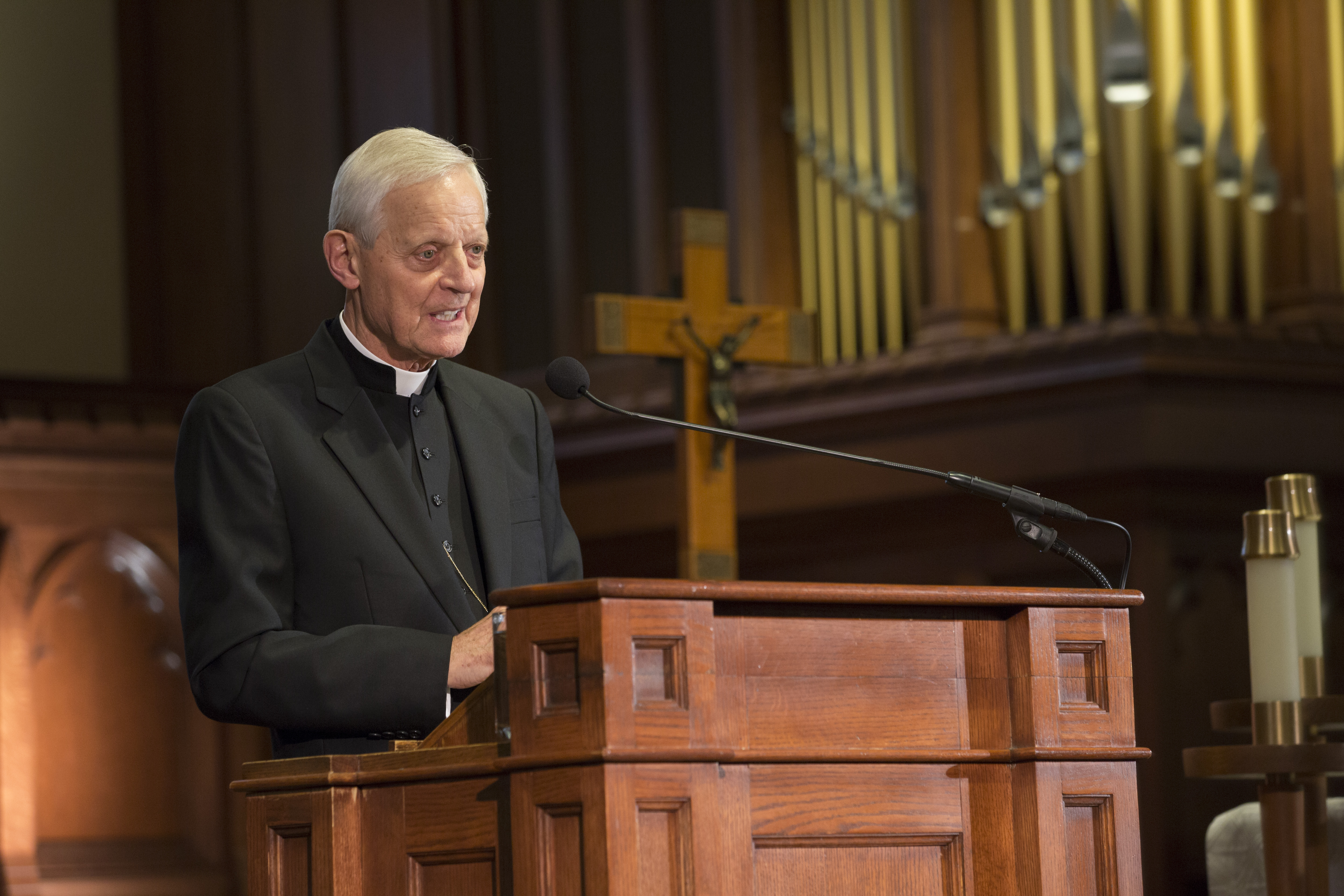
The Catholic Church has a unique process for confirming Church teaching and setting pastoral guidance. “Synodality” is the process that has been used by Catholic bishops for centuries. But on Tuesday, September 12, Cardinal Donald Wuerl, in Georgetown University’s inaugural 2017-18 Sacred Lecture, explains how Pope Francis has taken this ancient Church ritual and, building on the efforts of his predecessors, expanded synodality to help answer the call to evangelization and pastoral accompaniment laid out in the Papal exhortation, Amoris Laetitia. In this lecture, Cardinal Wuerl reflects on how the collegial approach of Pope Francis with the College of Bishops not only builds on the 50-year tradition of synodality after the Second Vatican Council, but opens the door for new and greater opportunities for pastoral care in the Catholic Church today and in the future. Read the transcript of Cardinal Wuerl’s lecture below.

Sacred Lecture Series: Pope Francis, Synodality and Amoris Laetitia

In these reflections, I touch on three points: synodality, an ecclesial experience; Pope Francis’ expansion of the application of this ecclesial reality, and the post-synodal apostolic exhortation, Amoris Laetitia, as an expression of the fruit of synodality.

The word synodality refers to “coming together” or, more technically, “journeying together.” It has historically been used to denote gatherings of bishops describing their pastoral walking together to confirm already expressed teaching and pastoral practice, and to explore and apply Church teaching and practice in terms of the circumstances of the day.

The word takes on new emphasis today as Pope Francis applies it in order to express the concept of the whole Church, pastors and flock, walking and working together to explore the needed pastoral responses to the challenges of today.

COLLEGE OF BISHOPS

To start, it might be helpful to make some very brief observations on the ecclesial reality that we call the College of Bishops.  Just as the 12 Apostles constituted a unique and identifiable group with its own nature and function, so, too, today do their successors.  The bishops today throughout the world constitute the College of Bishops.

The coming together of bishops, in its most formal and authoritative form, is an ecumenical council, a gathering of all the bishops worldwide. Other less inclusive and therefore, less authoritative gatherings, at least as they exist today in the Latin/Western Church, are called synods. Pope Francis uses the term “synod” to reflect the structure, and “synodality” to refer to the process whereby bishops play a more active role in discussing significant issues of the day.

The 1998 Motu Proprio Apostolos Suos of Pope John Paul II on the theological and juridical nature of episcopal conferences goes on to point out that the communion of the College of Bishops has found an outstanding and typical expression in the holding of councils, this includes ecumenical and particular councils, both plenary and provincial (3).  Other gatherings of bishops to exercise certain pastoral functions are a concrete expression of collegial spirit (affectus collegialis) which however “never takes on the collegial nature proper to the action of the Order of Bishops as such…” (12).

Episcopal conferences, for example, meet so that “by sharing their wisdom and experience and exchanging views, they may jointly formulate a program for the common good of the Church” (Motu Proprio citing the Second Vatican Council Degree on the Pastoral Office of Bishops in the Church, Christus dominus, 37 and the Dogmatic Constitution on the Church, Lumen Gentium, 23) (13).

The United States Conference of Catholic Bishops is not an intermediary ecclesial structure that directs or orders the dioceses in the United States. Rather, the bishops come together to find ways to identify and agree on a common exercise of their own proper pastoral ministry.

My observations however will be primarily about the ecclesial structure identified as the Synod of Bishops.  It is not a council of all of the bishops.  Rather, it is a gathering of a number of bishops who are intended to be reflective of the episcopate around the world.  The assembled bishops of the synod do not exercise an authority as if they were the College of Bishops.  However, they do reflect an effort at pastoral solidarity usually directed at specific pastoral issues or aspects of Church structure, mission and ministry.  The synod in the Western or Latin Church, unlike synods in the Eastern Churches, does not govern but it does offer counsel and advice.

Then, in light of Pope Francis’ emphasis on synodality and its place in the process of expressing Church teaching and pastoral practice, I will make some observations on the new perspectives offered by the post-synodal apostolic exhortation, Amoris Laetitia.

COLLEGIALITY

Even though our purpose is to investigate synodality as a means of expression of the collegial nature of the episcopate our starting point must include a brief consideration on the theological nature of collegiality, as this is significant in the understanding of synodality. We must begin, therefore, by recognizing that the Church Universal is made up of many and varied local Churches.

Granted, the one holy, catholic and apostolic Church is more than just a federation of individual churches. It is, nonetheless, made up of local Churches throughout the world. These local Churches are essentially the same today as they were in the days of Saint Paul – the communities of believers centered in a specific area around one bishop, their bond and symbol of unity in faith and charity (cf. CCC 832-835).

Each local Bishop, therefore, has a relationship not only to his local Church but also to the Church Universal. Each bishop by that title bears some responsibility for the whole Church.

The rediscovery or renewed emphasis on this ecclesiological landscape, which found a clear presentation in the Dogmatic Constitution on the Church, Lumen Gentium, of the Second Vatican Council was also reflected in the 1983 revision of the Code of Canon Law.

In the Acts of the Apostles, we find an example of apostolic leadership gathering to resolve a serious issue.  Clearly the coming together or walking together – the root meaning of the word synod – was a somewhat regular experience of Christian leaders – bishops – in the early centuries.

However, in 325, we find the first effort at an ecumenical or general council of bishops.  This meeting was held in Nicaea.  When the Second Vatican Council convened in Rome, from October 1962 to December 1965, it marked the 21st Ecumenical Council of the Catholic Church.  Seven of these councils are shared with the Orthodox Church.  By contrast, the Orthodox have neither summoned nor sanctioned an ecumenical council since the seventh one in 787.

Other gatherings of bishops in the Catholic Church have been a regular part of the life of the Church.  In our country, for example, we had for a number of years the experience of plenary councils held in Baltimore.  In fact, it is one of these, the third plenary council, that gave rise to the well-known and much used Baltimore Catechism.

SYNODS / SYNODALITY

However, the ecclesiastical structure that we now call the Synod of Bishops has its own identifiable origin and a specific purpose.

The idea of having a synod grew out of the experience of Pope Paul VI and the bishops at the time of the Second Vatican Council.  Then some 2,200 bishops from all over the world, from October 1962 to December 1965, came to Rome to reflect on how well the Church was carrying out her mission to be the continuing presence of Christ and his Gospel in the world.  As the Council drew to a conclusion in 1965, there was the hope that some mechanism might be found to keep alive the collaborative experience of the Council.  Thus was born, at the directive of the Pope, what we now call the Synod of Bishops.

Pope Paul VI’s Motu Proprio Apostolica Sollicitudo, re-established the Synod of Bishops as an ecclesial institution and gave it what was, in effect, its constitution.  The document notes that the aims of the Synod are: to promote a closer union and greater cooperation between the Supreme Pontiff and the bishops of the whole world; to see to it that accurate and direct information is supplied on matters and situations that bear upon the internal life of the Church and upon the kind of action that should be carrying on in today’s world; to facilitate agreement, at least on essential matters of doctrine and on the course of action to be taken in the life of the Church.

Saint John Paul II is perhaps the pope that more than any other has underlined the connection between the Synods of Bishops and episcopal collegiality. In his first encyclical, Redemptor Hominis, he referred to the Synod of Bishops as “a permanent organ of collegiality” (51).  In his view, “the Synod constitutes a realization and an illustration of the collegial nature of the order of bishops, of which the Second Vatican Council has, so to speak, come to a renewed awareness” (Address to the Synod of Bishops, October 27, 1990, 7).

In the post-synodal apostolic exhortation, Ecclesia in Africa (1995) he elaborated on this very aspect. “The Synod of Bishops is an extremely beneficial instrument for fostering ecclesial communion… the more the communion of the bishops among themselves is strengthened, the more the communion of the Church as a whole is enriched” (15).  “It is my conviction”, the pope continued, “that a Synodal Assembly cannot be reduced to a consultation on practical matters. Its true raison d’être is the fact that the Church can move forward only by strengthening communion among her members, beginning with her Pastors” (17).   It is this sentiment, articulated over 22 years ago, that Pope Francis is now re-emphasizing.

Pope Francis, elected as the 266th Bishop of Rome, Vicar of Christ, and Head of the Church Universal, now stands on all of the foundation work of his predecessors and begins to pick up, once again, the threads of the energizing focus of the Second Vatican Council.

I do not want to pass over, however, the very significant role of Pope Benedict XVI especially in the 2012 Synod of Bishops on the New Evangelization.  Up to that time, most of the synods and certainly those presided over by Saint Pope John Paul II addressed in significant part the documents of the Second Vatican Council providing a magisterial appreciation of them. In a certain sense, much of the work of the Synod of Bishops was focused on the life of the Church and her structures. It was Pope Benedict who called for, initiated and presided over the Synod that called the entire Church to turn its attention outward and, once again, to invite people to the experience of Jesus Christ. The 13th Ordinary General Assembly of the Synod of Bishops gathered from October 7-28, 2012 to discuss the theme, The New Evangelization for the Transmission of the Christian Faith. Pope Francis makes his own the work of that Synod and presents it in the apostolic exhortation, Evangelii Gaudium, The Joy of the Gospel.

The Synod of Bishops “has been one of the fruits of the Second Vatican Council,” Pope Francis has said. “Thanks to God that, in these almost fifty years, we have been able to feel the benefits of this institution that, in a permanent way, is at the service of the Church’s mission and communion as an expression of collegiality” (Pope Francis, June 2013, preparation for 2014 Extraordinary General Assembly of the Synod on the Family).

POPE FRANCIS: FRESH PERSPECTIVES

Ecclesiologically what Pope Francis has done is to refocus, once again, on the ministry of the College of Bishops as was the case in the Second Vatican Council in the document, Lumen Gentium.

We can see the Pope’s perspective on synodality with the post-synodal apostolic exhortation, Amoris Laetitia.  It follows on the Synods of Bishops that met, one in October of 2014 and the other in 2015, to discuss the challenges to marriage and family today, and reflects the consensus of those meetings and many voices.  In the work of the synod, in the preparation of its documents, and the final exhortation we can see Pope Francis’ appreciation and engagement of synodality.

The Holy Father has highlighted, once again, the role of bishops in collaboration with him in the overall responsibilities for leadership, teaching and pastoral ministry of the Church. In February of 2014, the Holy Father, at a consistory of the cardinals, asked us to begin to reflect on the challenges to marriage today.  He then called for a Synod in 2014 that addressed the difficulties that marriage faces.  It reminded us of the heavily secular culture we live in, of the materialism that is a part of the mentality of many people, the individualism that dominates our culture, particularly in the Western world and in the United States.

It was clear that the overwhelming majority of bishops shared the Holy Father’s vision that there has to be a way to present the Church’s teaching new in ardor, method and expression rather than simply come together to repeat and restate what is already known.  As was quoted later, one bishop indicated that if the purpose of the 2014 Synod was simply to repeat, doctrinally and pastorally, the Church’s teaching it could have ended by the second day and there would have been no need at all for the 2015 Synod.

The open discussion within the synod is clearly a hallmark of Pope Francis’ view of synodality.  At no time was there disagreement on the Church’s doctrine.  But there was lively engagement on how that teaching is received, understood, appropriated and lived in our modern culture, and how in the circumstances of our time do we effectively and pastorally respond.

Pope Francis’ decision to allow free discussion, respect for divergence of opinion, transparency in the process and the publication of the results of the voting by the bishops at each stage of both synods created a refreshing openness that resulted in a new appreciation of a synod.

I have been present in some capacity for eleven synods and as a bishop member for seven.  The last two, the 2014 and the 2015 gatherings were, in my opinion, the most open, engaging and reflective of episcopal collaboration and consultation.

A sign of the growing and expanding nature of synodality can be seen in Pope Francis’ request that there would be a very wide consultation at the level of the local Churches. Invited into this discussion were the faithful of the parishes as well as the voices of Church Institutions such as universities and organizations with a specific expertise in the topic under discussion.

Examples of Pope Francis’ new perspective include his innovative use of the synod structure by calling for two back-to-back assemblies.  In this way, he engaged a very large number of bishops in the one process since the membership of both synods was elected by conferences of bishops and during the interval each conference of bishops was asked to be actively engaged in responding the first synod, 2014, and preparing the material for the second synod, 2015.

I would add that his invitation to openness among the bishops in these discussions reflects his perspective on the significance of dialogue.  We can recall his advice at the beginning of the synod 2014-2015 process to the bishops to speak with openness and clarity, to listen with humility and to be open to the Holy Spirit.

Another very evident element in Pope Francis’ understanding of synodality is the recognition that while the bishops are the official teachers and guardians of the faith, the faith is also expressed and voiced among all of the faithful.  While it is a synod of bishops, it does not mean that the bishops are somehow detached from or not engaged with and immersed in the life of the local Church that the individual bishop serves.  Synodality for Pope Francis carries with it the notion of journeying together – all the members of the Church, clergy, religious and laity.

At the end of all of the discussions and all of the reflections carried out over two full years, there emerged the 2016 apostolic exhortation Amoris Laetitia that I would call a “consensus exhortation.”

AMORIS LAETITIA / POST-SYNODAL APOSTOLIC EXHORTATION

This apostolic exhortation confirms for us the Second Vatican Council’s call for collegial reflection, that is, the bishops coming together and working together, always with and never without Peter (cf. Lumen Gentium, 22).

In Amoris Laetitia, Pope Francis draws deeply and richly on the teaching of his predecessors and from the heart of the Catholic theological tradition.  This engagement is evident in the reaffirmation of the doctrine of the Church in regard to marriage and the moral life—a point which the Holy Father makes repeatedly (Amoris Laetitia, 307). The teaching on marriage and human love of Blessed Paul VI, Saint John Paul II, and Benedict XVI is featured prominently in the document.

Now Pope Francis picks up the threads of the energizing focus of the Council while standing on the foundational work of his predecessors. But this is more than mere repetition of certain points of doctrine.

There is a sense in which one can see in this exhortation a renewed call to recognize our Catholic identity, our connectedness to the Church and how our ministry is validated precisely in our participation in and adherence to the articulated Magisterium of the Church.  This articulation includes that of all of the popes, not just the ones some might deem more Catholic than others.

In Amoris Laetitia specifically, we find long-held, theologically sound teaching that displays the reality of practical, pastoral guidance that is offered to someone who, like all of us, is struggling to live up to the fullness of the norm, but within the circumstances and situations in which they find themselves.

In many ways the document’s teaching is a further response to the Second Vatican Council’s call for a renewal of Catholic moral teaching and practice and the response to this call by the subsequent papal magisterium.

The assertion of the primacy of love does not in any way diminish the role of law.  What the exhortation is calling us to is a recognition that the starting point or principle from which our pastoral actions flow must be the revelation of God’s love and mercy.  Church law certainly has great importance but it is not the only point of reference in pastoral ministry.

The document clearly sounds important notes of its own, and significantly contributes to and applies these hallmarks of post-conciliar renewal.  The focus on the person and his or her dignity is carried forward in the Holy Father’s critique of what he calls “a culture of the ephemeral” (cf. AL, 39) — a culture which views and treats others as sources of affective or sexual pleasure to be discarded when this pleasure runs dry.  This pursuit of a shallow happiness falls short of the joy of which the Exhortation speaks.  As was true for the Council, the dignity of the human person is fully disclosed in Christ but in this case especially in Christ’s embrace of families with their struggles, in children and other vulnerable persons, and in sinners.

LISTENING

One can say that Amoris Laetitia is itself the fruit of very intensive LISTENING on the part of Pope Francis.  The two synods on family called by the Holy Father were themselves preceded by consultation of local churches throughout the world on the lived situation of families, their challenges, and their experience.

This worldwide consultation involving the clergy, religious and laity touches on a significant aspect of Pope Francis’ vision of synodality.  It includes the experience, faith and voice of all the members of the Church, not just the bishops.

Pope Francis understands the process of listening to the faithful and to his brother bishops to be a key part of his own teaching and pastoral ministry.  It is part of the “synodality” or “journeying together” which he sees as essential to the Church at every level.    The fruit of this listening is reflected in the generous citation and engagement of the reports of the two synods in this exhortation.

ACCOMPANYING

Another activity on which the document focuses is ACCOMPANYING, the pastoral accompaniment of all who seek to find a way closer to God.  In many ways this is an extension of listening and of the synodality to which it gives rise.  The journeying together of all of the members of the Church implies this accompaniment.  But it also calls for a change in pastoral style and intensity.

Pope Francis calls pastors to do more than teach the Church’s doctrine—though they clearly must do that.   Pastors must “take on the ‘smell of the sheep’” whom they serve so that “the sheep are willing to hear their voice” (EG, 24).  This requires a more careful and intensive formation of all who minister – all who invite people to renew their faith.

Yet it is precisely in this closeness, the proximity to the faithful that another level of experiencing and living the faith develops. It is this challenging and struggling experience of the lived faith that Pope Francis welcomes as that “walking together” that is synodality.

Pope Francis in Amoris Laetitia and the bishops in the 2014 and 2015 synods renew the understanding that the Church’s pastoral mission and ministry must include not only the presentation of Church teaching (her doctrine), but also take into consideration how that teaching can be and is actually received or grasped by individuals, particularly given their situation and circumstances, and also how pastors of souls can engage in the company of the faithful in the journey towards embracing more fully the Church’s life-giving message.

DISCERNING

The Church’s pastoral ministry is intended to help the faithful to grow in the art of DISCERNING.  A key part of discernment is the formation of conscience.  The Holy Father insists that the Church’s pastors must “make room for the consciences of the faithful, who very often respond as best they can to the Gospel amid their limitations, and are capable of carrying out their own discernment in complex situations.  We have been called to form consciences, not to replace them” (AL, 37).

Admittedly, this individual process of discernment may not be easy.  A person may know full well Church teaching, Pope Francis notes, yet have great difficulty in either understanding its inherent positive value, or in being able to fully embrace it right away because of circumstances (AL, 301).  Yet, the underlying moral principle which should inform both that personal discernment and the priest’s ministry is that a person whose situation in life is objectively contrary to moral teaching can still love and grow in the faith, he or she can still take steps in the right direction and benefit from God’s mercy and grace while receiving the assistance of the Church (AL, 305).

EVANGELIZING

Amoris Laetitia is not a list of answers to each individual human issue.  Rather, it is a call to compassionate accompaniment in helping all to experience Christ’s love and mercy.  To the extent that our ministry does this, it is also an EVANGELIZING action.  As we recall the challenge to go out, to encounter, and to accompany, we also recognize that this is at its heart an act of the evangelizing disciple.

The 2014 and 2015 Synods on marriage and family and the process they represent of sharing, listening, discerning and receiving are beginnings of a fuller and richer concept of synodality. We see in the post-synodal apostolic exhortation Amoris Laetitia, a magisterial expression of the fruit of synodality.  It is now seen as a manifestation of the fruit of the whole Church under the guidance of bishops with Peter walking and discerning together.

CONCLUSION

We began these reflections with an understanding that the word synodality means coming together – journeying together. This concept seems to be central to Pope Francis’ understanding of the nature of the Church, how the Church carries out her mission and who all is engaged in the understanding and articulation of that mission.

Just as Jesus said to his disciples as he prepared to return to his Father in glory: “You will be my witnesses” so Pope Francis is calling the whole body of disciples together in a process of discerning the richness of the proclamation of the faith, accompanying one another as we try: to embrace and appropriate the faith, and to announce it to the world today as much by our actions as by our words.

What Pope Francis is doing is helping us all understand that to be true witnesses to Jesus we have to walk together in witnessing and supporting one another. Only in this way can we truly accept the challenge: “You will be my witnesses.”

Watch the Facebook Live Stream of the Cardinal’s Lecture

Strange Moments In Liturgical History – How a Paragon of Liturgical Tradition May Have Caused Unintended Effects

I have been asked by a number of people what I think of Pope Francis’ recent decision to remand a lot of the task of translating sacred texts to regional bishops’ conferences. To be honest, I have mixed feelings. On the one hand, I share many of the concerns about how the norms will be applied and how consistently accurate translations will be assured, but on the other, I do not know if it is healthy to place almost complete authority over the liturgy in Rome. In recent decades, many Catholics have depended on Rome to stamp out local liturgical abuses. Centralized authority is a double-edged sword, however. While some abuses have been addressed, there have also been many things imposed from Rome that those same Catholics have found far less pleasing.

As a kind of an admonition in this regard, I would like to republish an article I wrote a few years ago. It describes an unusual tale, one with some strange twists and turns, that helps to illustrate the problems with a sometimes heavy-handed centralized authority versus a more regional exercise of authority. Finding a balance for the Church in all this is not easy. I don’t know all the implications of permitting greater regional influence over translations, but something tells me that that either solution has potential problems. Here this is the reprint:

In the modern struggles and disagreements over the Liturgy, there tends to be a list of friends and opponents depending on one’s stance. For those of us with a more traditional leaning, Pope St. Pius X looms large as a friend and an image of tradition. He is usually seen as a defender of tradition and a great proponent of what today is called the Extraordinary Form (EF) or Traditional Latin Mass (TLM)—so much so that the Society of St. Pius X (SSPX) takes its name from him.

Yet things, people, and movements are seldom as simple as we would like them to be. There are many good reasons for admiring Pope St. Pius X’s attention to the Sacred Liturgy, but it can also be argued that he helped lay the groundwork for the revolution that would follow, not so much by his ideas but by his rather sweeping use of papal authority to influence and change the liturgy in his day.

One of the most far-reaching things he did had little impact on the average Catholic but it had a dramatic effect on priests, because it made changes to the Breviary, the prayers said by priests each day in the Divine Office (or Liturgy of the Hours). What makes what he did so significant was his use of papal power to rather summarily effect the change, a change that arguably did away with almost 1500 years of tradition, just because he wanted to. I’ll provide more of the details later, but first here is a little background. (If you want to bypass the background information, skip ahead to the red text below.)

Background:

The Roman Rite of the Mass developed and came to fundamental form in the very early days of the Church. Its most basic elements were mature by the 5th century, though most of its elements date back far earlier. Due to the influence of the Roman See, it was largely the pure template for the liturgical practice of the Western Church. However, there were many local variations to the Roman Rite, some of them significant enough to permit the use of another name altogether (e.g., the Gallican Rite, the Ambrosian Rite, the Sarum).

This diversity of liturgical practice caused tension at times, if for no other reason than its bewildering complexity. From time to time there were attempts made to unify the liturgy throughout Europe by recourse to the Roman Rite and the fundamental purity and antiquity it was accorded. Most notably, the Council of Trent decreed that any form of the liturgy that was less than 200 years old should be suppressed in favor of the Rite as celebrated in Rome. There was a reverence for antiquity and a wariness of novelty and recent innovations.

Yet even after Trent, especially in places like France, there was a tendency for accretions and innovations. In a display of what has sometimes been called Gallicanism, the decrees of the Council of Trent were either ignored or enforced less and less strenuously. Thus many local variations began again to develop. By the 18th century, many liturgists began to critique the disorderly state of affairs and emphasized a kind of ultramontanism (a term meaning, literally, “beyond (or over) the mountains” and referring to Rome), which sought to establish the Roman Rite more purely.

By the time of the First Vatican Council (1869-70), papal influence was already well established from antiquity, but was also growing against Gallicanism and other local episcopal influence. Weariness over local European divisions was also part of the growing influence of the Pope. The Dogma of Papal Infallibility, proclaimed at the First Vatican Council (though narrowly construed and only invoked in very specific circumstances), served only to highlight papal power and influence.

Thus by the time of Pope Pius X (1903-1914), the “booster shot” that had been given to the papacy enabled him to flex his papal muscles and extend his influence in more sweeping ways. All this leads us to the liturgical changes introduced by Pope Pius X.

It was in 1911, with the publication of Divino afflatus, that rather dramatic changes were made to the Roman Breviary.

Some of the changes were small: cleaning up some accretions, adjusting the calendar, and giving greater priority to the temporal cycle over the more erratic sanctoral cycle. The obligations of what parts of the office and other prayers had to be said by priests were also clarified.

Along with these minor changes was a casting aside of the ancient arrangement of the psalter. Most notably, the ancient and almost universal tradition of praying the Laudate psalms (148-150) every morning and again every night at Compline was simply removed and replaced. No tradition in the Church was as universal and ancient as this, but with one stroke of his pen, Pope Pius X did away with it. Almost no liturgist has ever described what the Pope did as anything less than dramatic and sweeping.

Alcuin Reid, OSB, in his The Organic Development of the Liturgy (pp. 74-76), quotes the views of a number of liturgical scholars on this action by Pope St. Pius X:

  1. Anton Baumstark (in a scathing remark): Down to the year 1911 there was nothing in the Christian liturgy of such absolute universality as this practice in the morning office, and no doubt its universality was inherited from the Synagogue … hence, to [this “reform”] of Psalterium Romanun belongs the distinction of having brought to an end the universal observance of a liturgical practice which was followed by the Divine Redeemer himself during his life on earth.
  2. Pius Parsch: It is rather amazing that despite the conservative character of the Church, Pius X should have resolved on this vast change which went counter to a practice of 1500 years’ standing.
  3. Robert Taft, SJ: … this was a shocking departure from the almost universal Christian tradition.
  4. William Bonniwell, OP: In the revision of Pius X the venerable office of the Roman Church was gravely mutilated.

Frankly, Pius X’s move was unprecedented in liturgical history. Although Pope Urban VIII’s redaction of the Latin Hymns of the Breviary was also an unfortunate and imprudent mutilation of ancient masterpieces, their use in the Church was less universal than the psalms of Lauds and the redaction was not imposed by judicial power.

The issue may seem minor to those unfamiliar with the Office, but the precedent of using sweeping judicial power to simply end an ancient tradition is not minor at all. It is this same thinking that would later allow a sweeping change of the Mass to be promulgated in 1970 and for the Old Rite to be “abolished” by judicial fiat of Pope Paul VI. The Mass promulgated in 1970 was not specified by the Second Vatican Council Fathers, but by a small consilium. It was not marked by organic change but (as Pope Benedict XVI and others have observed) rather was characterized by a hermeneutic of rupture and discontinuity. Only later would Pope Benedict XVI teach that there was no precedent for or right to abolish the older form Roman Rite (a rite far older than 200 years).

All of this heavy-handed use of papal power ironically had a precedent in Pope St. Pius X, the favored saint of many lovers of tradition. There were other liturgical waves that emanated from this indisputably good man and pope that have troubled us since. Among them was the disruption in the order of the Sacraments, when Pope Pius X moved First Communion to early youth but did not attend to the Sacrament of Confirmation. Thus the ancient order of initiation: Baptism, Confirmation, and Eucharist, was disrupted; Confirmation became a kind of “hanging” sacrament, detached from its liturgical and theological moorings. The result was its reduction to a sort of Catholic Bar Mitzvah.

Further, Pope Pius X was also dismissive, if not juridically forbidding, of orchestral masses. While he fostered chant—a good thing—he also suppressed a musical form that had inspired most of the classical composers (e.g., Mozart, Schubert, and Beethoven) to contribute to the Church’s musical patrimony. It would be 70 years before such Masses would again be heard widely in the Church.

Again, all of these issues are less significant for their immediate effect than for the groundwork they laid for what came later. The sudden liturgical changes of the 1960s would not have been possible in previous ages because although the Pope and Rome were strongly influential, local bishops and churches had a lot more leeway and influence on the liturgy.

This setup of local freedom is not without troubles. Too much diversity leads to difficulty and chaos. Some general norms need to hold sway; regional and even ecumenical councils need to help rein in extreme diversity by reasserting proper liturgical principles.

However, centralizing power over the liturgy within the papacy also presents serious difficulties. Plainly put, the liturgy is just too important to have it all depend on the notions of one man, even a holy man like Pius X. Many of his reforms were good, even necessary, and his sanctity is not in dispute; but even saints do not get everything right and some of what they say and do may later be exaggerated or corrupted by those that follow.

In recent decades, traditional Catholics have looked to Rome to resolve liturgical debates. On one level this has been necessary, as many local bishops and churches have seemingly abdicated their responsibility to oversee the liturgy, correct abuses, and guarantee the legitimate rights of the faithful.

However, traditional Catholics would also do well to understand the problems inherent in having an overly centralized control of the Sacred Liturgy. More needs to be done by traditional Catholics to build a foundation for good liturgy in their local parishes by building a culture that is respectful of tradition and sober about the pitfalls of depending too much on papal authority.

How strange it is that the paragon of traditional Catholicism should have, even if unwittingly, helped paved the way for what I would argue is the excessive use of supreme judicial authority in regard to the liturgy, a use so sweeping that even Pope Benedict XVI would have to announce that the suppression of the older Roman Rite was neither possible nor in effect.

Just one of those strange moments in liturgical history.

Considerations in Fraternal Correction

Fraternal correction is so important to the health of individuals, the family, the Church, and even nations, that some further reflection following Sunday’s Gospel is in order. The correction of a sinner is complex and difficult to accomplish well. Many avoid it entirely, especially due to these hypersensitive times, when some people base their very identity on their sins. Many take correction very personally, even labeling it “hate speech.” Those who dare to correct are often shamed for doing so and accused of “judging.”

Distinguishing between what God teaches to be good and what He teaches to be sin is a judgment that is required of us; our own judgment in the matter must conform to God’s revealed judgment. All moral exhortation in the Scripture aims to conform our understanding and judgment to God’s truth, revealed in Scripture and Natural Law. While we cannot judge a person’s ultimate state before God, we can and must judge; we must distinguish good from evil, virtue from sin.

Thus, difficult though it is, fraternal correction is required of us by God in a general way. However, this raises many questions: Is correction always required? Are we required to correct everyone? Does our obligation to correct vary and if so, how?

St. Thomas Aquinas sets forth some answers for us, both in terms of the basis of our obligation and its limits.

St. Thomas places the roots our obligation to correct one another in both charity and justice:

Now a man’s sin may be considered in two ways, first as being harmful to the sinner, secondly as conducing to the harm of others, by hurting or scandalizing them, or by being detrimental to the common good, the justice of which is disturbed by that man’s sin. … Now to do away with anyone’s evil is the same as to procure his good; and to procure a person’s good is an act of charity, whereby we wish and do our friend well. … Therefore, fraternal correction is an act of charity …. There is another correction which applies a remedy to the sin of the wrongdoer, considered as hurtful to others, and especially to the common good. This correction is an act of justice, whose concern it is to safeguard the rectitude of justice between one man and another (Summa Theologica II, IIae, q. 33, art. 1, Respondeo).

So, fraternal correction is required of us as a precept or command. However, there are prudential aspects of when and how to correct. This is because the command to correct is not one that forbids us from doing something (in which case we should never do it), but rather one that requires something of us under various circumstances. Although the precept to correct describes what we are to do as a general practice, it cannot possibly address every particular set of circumstances. St. Thomas says,

Fraternal correction is a matter of precept. [W]hile the negative precepts of the Law forbid sinful acts, the positive precepts inculcate acts of virtue. … [N]egative precepts bind always and for all times. On the other hand, acts of virtue must [be done] by observing the due circumstances, which are requisite in order that an act be virtuous; namely, that it be done where, when, and how it ought to be done. … [F]raternal correction is directed to a brother’s amendment: so that it is a matter of precept, in so far as it is necessary for that end, but not so as we have to correct our erring brother at all places and times (Summa Theologica II, IIae, q. 33, art. 2, Respondeo).

Thus, the particular circumstances will determine whom I must correct and how. As a general rule, parents are obligated to correct their children. Those in authority are more obligated to correct their subordinates. Elders are more obligated to correct those significantly younger. Family ties increase the obligation to correct; we are less obligated to correct strangers. Those with special training or standing such as teachers, pastors, bishops, and theologians are obligated to correct error and sin. However, their sphere of influence helps to focus their obligation. For example, a pastor’s greatest obligation is to instruct and correct his own parishioners; a bishop, his own flock; a teacher, his or her own students.

Generally, then, obligations to correct are lessened when the relationship is more distant or when one is in an inferior position.

However, just because an obligation is not as strong does not mean that there is never an obligation. For example, there are times when an inferior still ought to correct his superior. St. Thomas teaches this, but with an important distinction:

[C]orrection is twofold. One is an act of charity, which seeks in a special way the recovery of an erring brother by means of a simple warning: such like correction belongs to anyone who has charity, be he subject or prelate.

But there is another correction which is an act of justice purposing the common good, which is procured not only by warning one’s brother, but also, sometimes, by punishing him, that others may, through fear, desist from sin. Such a correction belongs only to prelates, whose business it is not only to admonish, but also to correct by means of punishments (Summa Theologica II, IIae, q. 33, art. 3, Respondeo).

St. Thomas adds,

A subject is not competent to administer to his prelate the correction which is an act of justice through the coercive nature of punishment: but the fraternal correction which is an act of charity is within the competency of everyone in respect of any person towards whom he is bound by charity, provided there be something in that person which requires correction.

… it follows that when a subject corrects his prelate, he ought to do so in a becoming manner, not with impudence and harshness, but with gentleness and respect. Hence the Apostle says (1 Timothy 5:1): “An ancient man rebuke not, but entreat him as a father” (Summa Theologica II, IIae, q. 33, art 4, Respondeo).

There is an additional consideration in administering fraternal correction publicly. As a general norm, the first approach should be to correct privately, but there are exceptions, which St. Thomas treats here:

With regard to the public denunciation of sins it is necessary to make a distinction: because sins may be either public or secret. On the case of public sins, a remedy is required not only for the sinner, that he may become better, but also for others, who know of his sin, lest they be scandalized. Wherefore such like sins should be denounced in public, according to the saying of the Apostle (1 Timothy 5:20): “Them that sin reprove before all, that the rest also may have fear,” which is to be understood as referring to public sins, as Augustine states (De Verb. Dom. xvi, 7).

On the other hand, in the case of secret sins, the words of Our Lord seem to apply (Matthew 18:15): “If thy brother shall offend against thee tell him his sin, but between you and him alone,” etc. …[So] there are … sins which injure none but the sinner, and the person sinned against, either because he alone is hurt by the sinner, or at least because he alone knows about his sin, and then our one purpose should be to help our sinning brother [privately] … Secondly, we ought to safeguard our sinning brother’s good name, both because the dishonor of one leads to the dishonor of others … and also because when one man’s sin is made public others are incited to sin likewise (Summa Theologica II, IIae, q. 33, art. 7, Respondeo).

When the secret admonition has been given once or several times, as long as there is probable hope of his amendment, we must continue to admonish him in private, but as soon as we are able to judge with any probability that the secret admonition is of no avail, we must take further steps … (Summa Theologica II, IIae, q. 33, art. 8, Reply to obj. 1).

Both St. Thomas’ and our Lord’s words thus indicate that private admonition does not always work. At such times (if the matter is serious), others can and should be brought in. (The even rarer remedy of excommunication should be applied only after repeated entreaties.) St. Thomas says,

Since, however, one’s conscience should be preferred to a good name, Our Lord wished that we should publicly denounce our brother and so deliver his conscience from sin, even though he should forfeit his good name. Therefore, it is evident that the precept requires a secret admonition to precede public denunciation (Summa Theologica, II, IIae, q. 33, art 7, Respondeo).

St. Thomas also addresses the case in which Church prelates must be corrected by those subject to them in some way. Clearly the matter must be serious and other more discreet methods should first be exhausted. St. Thomas teaches as follows regarding the public correction of Church prelates:

To withstand anyone in public exceeds the mode of fraternal correction, and so Paul would not have withstood Peter then, unless he were in some way his equal as regards the defense of the faith. But one who is not an equal can reprove privately and respectfully. Hence the Apostle in writing to the Colossians (4:17) tells them to admonish their prelate: “Say to Archippus: Fulfil thy ministry [Vulgate: ‘Take heed to the ministry which thou hast received in the Lord, that thou fulfil it.’ Cf. 2 Timothy 4:5.” It must be observed, however, that if the faith were endangered, a subject ought to rebuke his prelate even publicly. Hence Paul, who was Peter’s subject, rebuked him in public, on account of the imminent danger of scandal concerning faith, and, as the gloss of Augustine says on Galatians 2:11, “Peter gave an example to superiors, that if at any time they should happen to stray from the straight path, they should not disdain to be reproved by their subjects” (Summa Theologica II, IIae, q. 33, art. 4, Reply to obj. 2).

Note that although St. Thomas gives a general opinion in this regard based on solid principles, Canon Law and other standing practices should be considered if a specific instance arises in which a prelate needs to be reproved by his subjects. Angry denunciations and mere insubordination are out of place. As St. Paul says, An ancient man rebuke not, but entreat him as a father (1 Tim 5:1).

Conclusion: Fraternal correction is central to healthy families, a healthy church, and a healthy culture. In recent times we have done very poorly with this on every level. Our lack of charitable and clear correction goes a long way in explaining the moral confusion and darkness of our time. All of us, clergy and laity alike, need to recover a healthy respect for this act of charity toward the sinner and justice toward the wider community. In addition, all of us need to be more open to correction ourselves. Let us pray for courage, zeal, and charity in this regard.

On the Balance of Kindness and Correction

As a follow-up from Sunday’s Gospel (on correcting the sinner) it is important to reflect on balancing salutary discipline with necessary consolation and encouragement—never an easy task. For example, it is possible for parents to be so severe with their children that they become disheartened and lack necessary self-esteem; but it is also possible for parents to be so lax with them that the children become spoiled and lack proper self-discipline and humility. Scripture, seeking to balance teaching with encouragement, says, Fathers, do not exasperate your children; instead, bring them up in the training and instruction of the Lord (Eph 6:4).

Pastors, in their leadership of parishes, also need to find proper balance, offering kindness, consolation, encouragement, and witness to their congregations, while not failing to properly rebuke sin and warn of its consequences and of the coming judgment. St. Paul says,

You are witnesses, and so is God, how devoutly and uprightly and blamelessly we behaved toward you believers; just as you know how we were exhorting and encouraging and imploring each one of you as a father would his own children, so that you would walk in a manner worthy of the God who calls you into His own kingdom and glory (1 Thess 2:11-13).

Like a loving Father must the priest exhort, as one who teaches and who wants and expects the best for his flock.

It is hard to argue that we have the balance right in the Church today. Correction and rebuke, according to what most Catholics report, are seldom mentioned in the pulpit. Such omission is not acting like a father; a father would see how sin threatens the future of his children and in love would correct them, being willing to upset his children to prevent something far worse. There are also priests who teach and preach as if trying to win an argument and prevail over others, rather than out of loving concern; they may be unduly harsh. Proper balance is necessary.

In families, the trend seems to be toward being overly permissive. Too many children today have become incorrigible because they did not learn discipline when they were young. Too many are bold toward their elders and have lost the humility necessary for learning and maturity. This speaks to families in which the balance between encouragement and discipline has been lost. It is also true that some children are oppressed by the other extreme and are weighed down with discouragement, poor self-image, and anger. Again, proper balance is necessary.

In his Book of Pastoral Rule, St. Gregory presents some good advice in regard to this balance. While much of what he says is common sense, it is important to review it; common sense doesn’t seem to be so common today. St. Gregory’s treatise offers memorable imagery for the thoughtful reader, whether priest or parent. Here is what he has to say about addressing the wound of sin:

But often a wound is made worse by unskilled mending … in every case, care should be provided in such a way that discipline is never rigid, nor kindness lax. … Either discipline or kindness is lacking if one is ever exercised independently of the other. … This is what the scriptures teach through the Samaritan who took the half-dead man to the inn and applied wine and oil to his wounds. The wine purged them and the oil soothed them.

Indeed, it is necessary that whoever directs the healing of wounds must administer with wine the bite of pain, and with oil the caress of kindness; so that what is rotten may be purged to by the wine, and what is curable may be soothed by the oil.

In short, gentleness is to be mixed with severity, a combination that will prevent the laity from becoming exasperated by excessive harshness, or relaxed by undue kindness. … Wherefore David said, “Your rod and your staff have comforted me” (Psalm 23:4). Indeed, by the rod we are punished and by the staff we are sustained. If, therefore, there is correction by the rod, let there also be support through the staff. Let there be love that does not soften, vigor that does not exasperate, zeal that is not immoderate or uncontrolled, and kindness that spares, but not more than is befitting. Therefore, justice and mercy are forged together in the art of spiritual direction. (Rule II.6)

These are practical reminders to be sure, but they also come with the memorable images of wine and oil, rod and staff. Both are necessary; each must balance the other. There must be clarity with charity and charity with clarity; there must be veritatem in caritate (truth in love).