On the Feast of Our Lady of Guadalupe, it is a chance for us to rejoice in the great mercy of our divine Lord and our blessed Lady. I am drawn to mediate on the miraculous quality of our Lady’s eyes on the tilma.
As many of you know, recent discoveries using modern magnification and ophthalmological equipment have shown the seemingly miraculous reflection of as many as a dozen persons in her eyes. How such tiny and accurate reflections could occur in both eyes at just the angles that human stereoscopic sight requires is mysterious to say the least. Even more, there are claims from eye specialists who have had the opportunity to look into our Lady’s eyes on the tilma that they have an iridescence that make the eyes seem almost alive.
I do not propose to write an article here on all the findings and evidence. You can read more our Lady’s eyes HERE and HERE and also in the video below. Rather I propose a short and simple reflection on two merciful facts.
First that our this image demonstrates, in effect that God’s people are the “apple of Mary’s eyes.” Seen there are Juan Diego, the bishop and an assistant, an indigenous family, a woman from Africa and several others. Remarkable; in her own self-portrait, our Lady includes us. In the book of Psalms the cry goes up to God,
Wondrously show your steadfast love,
O Savior of those who seek refuge
from their adversaries at your right hand.
Keep me as the apple of your eye;
hide me in the shadow of your wings (Psalm 17:7-8)
Deuteronomy also says of God,
He found Israel in a desert land, and in the howling waste of the wilderness; he encircled them, he cared for them, he kept them as the apple of his eye. (Dt 32:10)
And by his Grace, our Lord has often dispatched his mother to us. She finds un in difficult days, and in difficult places, speaking to us in love and sometimes in motherly warning. But, by the grace of God we are the apple of her eye too.
She came to Guadalupe at difficult time, to summon the Mexicans from the fearsome religious bondage of their ancient and often bloody religions, to Christ, their true and only Savior. The image on the tilma shows so many reflected in her eyes, reflected in love. They were the apple of her eye.
May our Lord be pleased to continue to send Mother Mary to us and remind us that we are loved and that heaven knows our struggles and is concerned for us. May none of us every forget that we are still reflected in Mary’s eyes and in the eyes of God to whom she intercedes for us. What a beautiful mercy.
And the second mercy is that images in her eyes, unknown for centuries in any detail seem to have been put there for us, who live now, to later discover. The same can be said for the Shroud of Turin. It is as if, knowing of cynical and unbelieving times where the physical sciences are almost idolized, Our Lord and our Lady left images that both speak to science and also confound it. How were the image made? How do they have three dimensional effects and display scientific knowledge or techniques unknown in their time?
Both the shroud and the tilma stand up to rigorous scientific investigation. The amazing truths about both images are backed up by science but also defy simple scientific or technical answers. Many of the “imponderable” mysteries were largely unknown in previous eras without photographic and scientific procedures and techniques. It is almost as if they were hidden there, waiting for us.
And that may in fact be the case. It is a love letter to a scientific but often unbelieving time. Despite our sometimes cynical demands for evidence, to our Lord and our Lady, we are still the apple of their eye. They look to us from afar, from an ancient shroud and very old tilma and they seem to say, “I am here for you to see. And I see you, you whom I love. You are the apple of my eye.”
Many people think of Advent merely in terms of pre-Christmas activities: office parties, shopping, decorating, and so forth. In the Church, though, Advent is something of a penitential period, a time of preparation for both the Christmas Feast and the Second Coming of the Lord. The purple vestments represent penance. The faithful are encouraged to go to Confession and the liturgical texts and readings emphasize readying for the coming of the Lord.
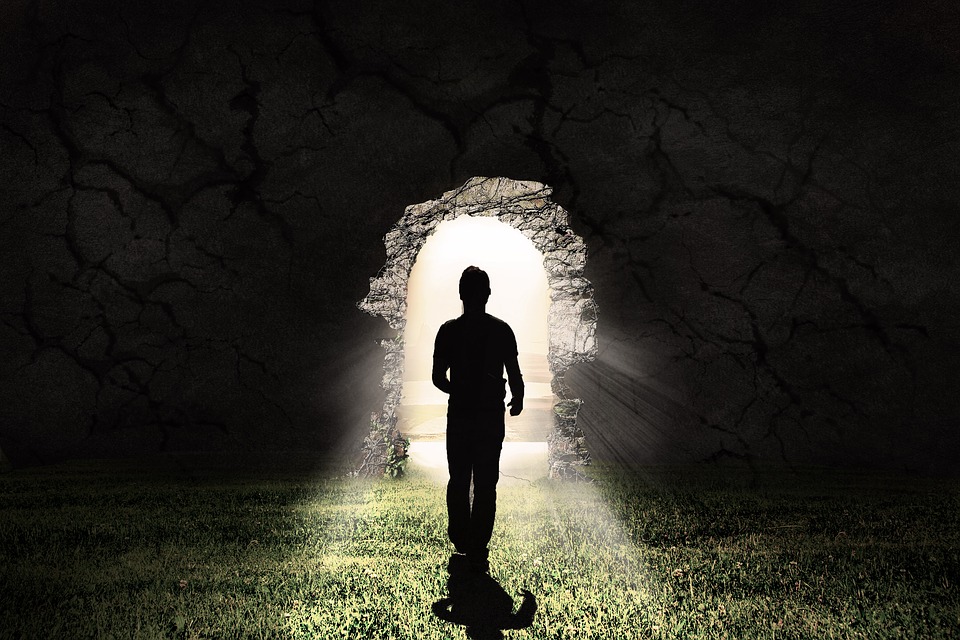
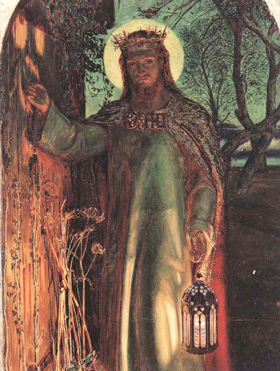
The theme of preparation (and much of the season itself) is couched in the dramatic struggle between light and darkness. This makes sense (at least in the northern hemisphere, where the darkness deepens and the days grow shorter). In these darkest days, we light candles and sing hymns that speak of the light that will come: Jesus, the true Light of the World. Let’s take a look at Advent in three ways.
I. The Symbols of Darkness and Light– Outside, there is a great drama of light and darkness unfolding before us. The light is giving way to darkness. Here in the northern hemisphere, the days are getting very short, and they’re going to get even shorter. In Washington, D.C. (where I live) it is dark by 5:00 PM. On cloudy days, it is nearly dark by 4:00 PM. My brothers both live farther north: one in St. Paul and the other in Seattle. It gets dark even earlier there. There’s even a famous quote (attributed to Yogi Berra), “It’s getting late early out there.”
For us who live in modern times, the drama is less obvious. It is little more than an annoyance, as it means that we must switch on the lights earlier. But think of those who lived not long before us in an age before electrical lights. Perhaps it was possible to huddle near a candle, oil lamp, or fire, but the darkness put a real stop to most things. Neither work, nor reading, nor most forms of recreation could take place. Darkness was a significant factor in their daily lives.
Some years ago, during a widespread power outage, I was struck at just how incredibly dark it was outside at night without the streetlights and the lights emanating from homes. Frankly, it was hard to venture out. I lost my bearings quickly and stumbled over some simple things like a curb and a fencepost. We moderns just aren’t used to this.
Here in a “deep and dark December,” the light continues to recede. The spiritual impact of this drama of light is brought into the Church. Our hymns turn to images of light. The darker it gets, the more candles we light on the Advent wreath. In the darkest days of December, our Advent wreath is at its brightest. As Scripture says, The light shines in the darkness, and the darkness has not overcome it … (John 1:5).
As the drama of light and darkness outside continues, we arrive at December 21st and 22nd—the shortest, darkest days of the year. By December 23rd, the ancients could detect a slight return of the light.
Then, on December 24th, in the middle of one of the longest nights of the year, the liturgy of Christmas begins: Christ is born and on December 25th a new light shines. From then on, the days get longer.
Yes, a great drama of light is unfolding before us. It is Advent. It is a time to recognize our need for the light and just how precious Jesus, the Light of the World, is. Ponder, in these darkest days, the beauty of the light. There are so many Advent hymns that set forth the dramatic images of light, darkness, and expectancy. They are too numerous to list here, but here are some examples if you are interested: Advent Hymns That Speak to the Light.
II. Our Stance to the Light and Darkness – Ultimately we are either facing the light and welcoming Him, or facing the darkness. These are the only two stances possible. There is no third way. Are you walking in the light or are you standing in the darkness?
Scripture warns in many places about the two ways of light and darkness, admonishing us to stand and walk in the light. Here are just a few:
Besides this you know what hour it is, how it is full time now for you to wake from sleep. For salvation is nearer to us now than when we first believed; the night is far gone, the day is at hand. Let us then cast off the works of darkness and put on the armor of light; let us conduct ourselves becomingly as in the day, not in reveling and drunkenness, not in debauchery and licentiousness, not in quarreling and jealousy. But put on the Lord Jesus Christ, and make no provision for the flesh, to gratify its desires (Ro 13:11-14).
But as to the times and the seasons, brethren, you have no need to have anything written to you. For you yourselves know well that the day of the Lord will come like a thief in the night. When people say, “There is peace and security,” then sudden destruction will come upon them as travail comes upon a woman with child, and there will be no escape. But you are not in darkness, brethren, for that day to surprise you like a thief. For you are all sons of light and sons of the day; we are not of the night or of darkness. So then let us not sleep, as others do, but let us keep awake and be sober. For those who sleep, sleep at night, and those who get drunk are drunk at night. But, since we belong to the day, let us be sober, and put on the breastplate of faith and love, and for a helmet the hope of salvation. For God has not destined us for wrath, but to obtain salvation through our Lord Jesus Christ, 10 who died for us so that whether we wake or sleep we might live with him. Therefore, encourage one another and build one another up, just as you are doing (1 Th 5:1-11).
The eye is the lamp of the body. So, if your eye is sound, your whole body will be full of light; but if your eye is not sound, your whole body will be full of darkness. If then the light in you is darkness, how great is the darkness! (Mt 6:22-24)
And we have the prophetic word made more sure. You will do well to pay attention to this as to a lamp shining in a dark place, until the day dawns and the morning star rises in your hearts (2 Pt 1:19).
Thus, we are warned what time it is, that judgment draws ever closer, and that we must walk and stand with the light and not be like those in darkness. The Advent season acknowledges the reality of deepening darkness and that we must all the more run to the coming light, Jesus. We must walk in the light of His truth as set forth in His word, the teachings of the Church, and creation. We must seek the enlightenment of the Sacraments and live in honesty, integrity, and mutual fellowship with the Lord’s Body, the Church. This is to be our moral stance: toward the light and away from the darkness.
III. The Summons to the Light – Having laid out the great drama of light and darkness and heard that we should take a stand for and toward the light, we note that Advent also proclaims, through a series of biblical texts and prayers, a warning to those who either reject the light outright or just fail to prepare for it. Here are just a few biblical texts:
Therefore, I have hewn them by the prophets, I have slain them by the words of my mouth, and my judgment goes forth as the light (Ho 6:5).
‘Behold, the bridegroom! Come out to meet him.’ Then all those maidens rose and trimmed their lamps. And the foolish maidens said to the wise, ‘Give us some of your oil, for our lamps are going out.’ But the wise replied, ‘Perhaps there will not be enough for us and for you; go rather to the dealers and buy for yourselves.’ And while they went to buy, the bridegroom came, and those who were ready went in with him to the marriage feast; and the door was shut. Afterward the other maidens came also, saying, ‘Lord, lord, open to us.’ But he replied, ‘Truly, I say to you, I do not know you.’ Watch therefore, for you know neither the day nor the hour (Mt 25:6-11).
For behold, the day comes, burning like an oven, when all the arrogant and all evildoers will be stubble; the day that comes shall burn them up, says the LORD of hosts, so that it will leave them neither root nor branch. But for you who fear my name the sun of righteousness shall rise, with healing in its wings (Mal 4:1-2).
For God so loved the world that he gave his only Son, that whoever believes in him should not perish but have eternal life. For God sent the Son into the world, not to condemn the world, but that the world might be saved through him. He who believes in him is not condemned; he who does not believe is condemned already, because he has not believed in the name of the only Son of God. 19 And this is the judgment, that the light has come into the world, and men loved darkness rather than light, because their deeds were evil. For every one who does evil hates the light, and does not come to the light, lest his deeds should be exposed. But he who does what is true comes to the light, that it may be clearly seen that his deeds have been wrought in God (Jn 3:16-21).
There is not sufficient time in this brief post to comment on each of these texts except to say that each summons us to the light in a spirit of readiness, having first prepared ourselves by becoming accustomed to the light and the fire of God’s love. If we are not ready, the light will seem blinding and the fiery love unbearable; we will recoil in wrath rather than rejoice in wonder.
Pay attention to these Advent themes. It’s getting late very early these days. Consider this a warning from the natural world (the Book of Creation), which the Church picks up in her liturgy. Prepare the way of the Lord! Repent, the Kingdom of God is at hand. Walk in the light! If we do, light, all glorious and unending, will be ours:
There shall no more be anything accursed, but the throne of God and of the Lamb shall be in it, and his servants shall worship him; they shall see his face, and his name shall be on their foreheads. And night shall be no more; they need no light of lamp or sun, for the Lord God will be their light, and they shall reign for ever and ever (Re 22:3–5).
This is our future, ifwe are faithful and allow the Lord to enlighten us now so that we can love the future light of incomprehensible brightness. Walk in the Light!
The second reading for Sunday Mass speaks to us of “the fire next time” and reminds us of the need to be ready for the coming of the Lord. In this homily I will focus on that reading, in which St. Peter reminds us of the passing that will come for us all one day.
Because Advent is a time to prepare, through prayer and repentance, we do well to heed this sacred teaching and warning. It is echoed by St. John the Baptist, of whom the Gospel today says, A voice of one crying out in the desert: “Prepare the way of the Lord, make straight his paths.”John the Baptist appeared in the desert proclaiming a baptism of repentance for the forgiveness of sins (Mk 1:2-3).
I. The PATIENCE that is PURPOSEFUL– The text says, Do not ignore this one fact, beloved, that with the Lord one day is like a thousand years and a thousand years like one day. The Lord does not delay his promise, as some regard “delay,” but he is patient with you, not wishing that any should perish but that all should come to repentance.
Though the Lord seems long-delayed in coming (about 2000 years!), the text tells us that this delay is so that as many of us as possible can be saved.
Notice that the text says that God wants us to come to repentance. God’s patience should not be seen as an excuse for presumption, but, rather, a time for repentance. This is no time to be saying, “Later.” It is a time to be serious about repenting and about preparing to meet the Lord.
The Greek word here translated as repentance is μετάνοιαν (metanoian), and refers not just to better behavior but also to a new mind. Our transformation is not merely external, but internal as well. When what we think changes, so does our behavior. When our thinking is conformed to God’s revealed truth, our priorities, feelings, desires, and decisions all begin to change. Conversion and repentance are the result of becoming a changed and transformed human being with a new mind.
II. The PASSING that is PERILOUS– The text says, But the day of the Lord will come like a thief, and then the heavens will pass away with a mighty roar and the elements will be dissolved by fire, and the earth and everything done on it will be found out.
In effect, the text says that God’s gonna set this world on fire one of these days. When He comes it will be
Sudden– The text says that the day of the Lord will come like a thief.
This image is quite a consistent with the one Jesus used for the Day of Judgment. However, this image should not be the future for those of us who wait and watch. St. Paul says, But you, brothers, are not in darkness so that this day should surprise you like a thief … So then, let us not be like others, who are asleep, but let us be alert and self-controlled (1 Thess 5:4,6).
Further, the image of God as a thief is not appropriate for us if we realize that all we have and all we are belongs to Him. For those who are worldly and who claim authority over themselves and their things, God is a thief who comes suddenly and in a hidden way. He overtakes their perceived ownership and possession, putting an end to it. To them, God seems to be a thief, as He “steals” what they consider theirs. They are badly misled.
For those who watch and are prepared (pray God), the Lord comes not to take but to give. He comes to bestow and reward as we inherit His Kingdom.
Shocking– The text speaks of the roaring heavens and of a fire that overwhelms; all will be dissolved by fire.
This image, though shocking, should not alarm us if we are already on fire. At Pentecost, as well as at our individual baptism and confirmation, the Lord lights a fire within us in order to set us on fire, to bring us up to the temperature of glory. For those in the Lord, the “weather” on that day will seem just fine.
The prophet Malachi speaks of the different experiences of the day of the Lord in this way: Surely the day is coming; it will burn like a furnace. All the arrogant and every evildoer will be stubble, and that day that is coming will set them on fire, says the Lord Almighty. Not a root or a branch will be left to them. But for you who revere my name, the sun of righteousness will rise with healing in its wings. Notice therefore, that for some the Day is burning with wrathful heat, but for the just, it is a sunny day wherein the sun of righteousness will bring warmth and healing (Mal 4:1-3).
An old spiritual refers to this verse saying, “God gave Noah the rainbow sign, no water but the fire next time.” God wants to get us ready by setting us on fire with His love and grace. If God is a Holy Fire, then we must become fire ourselves in order to endure the day of His coming.
Showing – The text says that all things will be revealed.
It would seem that this fire burns away the masks that many people wear, leaving them to be seen for what they really are. The Lord says, But I tell you that men will have to give account on the day of judgment for every careless word they have spoken (Matt 12:36). In the Gospel of Luke He says, There is nothing concealed that will not be disclosed, or hidden that will not be made known. What you have said in the dark will be heard in the daylight, and what you have whispered in the ear in the inner rooms will be proclaimed from the roofs (Lk 12:2-3).
Even the just may wince at this, for all of us have a past; most would prefer that the past stay in the past. When I have visited “12-Step” meetings, I have sometimes seen people recount what they did when they were drinking. They seem to do so with little shame and much laughter, probably because they are sharing it with others who understand, who have also been set free from the source of the problem. Perhaps, for the just, the “day of disclosing” will be like that.
For those who are unrepentant, though, imagine their embarrassment and fear as their secrets, sins, and past injustices are disclosed to those who are also unforgiving and unmerciful. It’s a bad scene, really.
III. The PRESCRIPTION that is PROCLAIMED– The text says, Since everything is to be dissolved in this way, what sort of persons ought you to be, conducting yourselves in holiness and devotion, waiting for and hastening the coming of the day of God, because of which the heavens will be dissolved in flames and the elements melted by fire … Therefore, beloved, since you await these things, be eager to be found without spot or blemish before him, at peace.
The text asks us to consider what sort of persons we ought to be.
In a word, the answer is “fiery.” God has lit a fire within us to purify and refine us. Hence, on that day when the Lord will judge by fire, we will pass through. Although some final purifications (purgation) may take place, because the fire has been kindled in us and has already been fanned into a flame, we will be purified, not destroyed.
St. Paul describes the just as going through the purgatorial fire that leads to purification rather than destruction in Hell:If any man builds on this foundation using gold, silver, costly stones, wood, hay or straw, his work will be shown for what it is, because the Day will bring it to light. It will be revealed with fire, and the fire will test the quality of each man’s work. If what he has built survives, he will receive his reward. If it is burned up, he will suffer loss; he himself will be saved, but only as one escaping through the flames (1 Cor 3:12-15).
So the prescription for us is to let God set us afire now so as to purify us, making us more holy and devout. The fire of His Holy Spirit is the only thing that can truly prepare us; it will permit us to endure the day of His coming and be spared the “wrath to come” (cf 1 Thess 1:10; Matt 3:7; Romans 5:9; 1 Thess 5:9), when God will judge the world and everything in it by fire.
IV. The PERFECTION that is PROMISED– The text says, But according to his promise we await new heavens and a new earth in which righteousness dwells.
This text presents the possibility that the created world will not so much be destroyed as purified by God’s fiery judgment. While it may also signify a total destruction of all that now exists and a replacement of it by new heavens and a new earth, some argue that it means that the created world will instead be renewed rather than destroyed and replaced. This view is supported by other passages (e.g., Isaiah 11 and Romans 8). For the creation was subjected to frustration, not by its own choice, but by the will of the one who subjected it, in hope that the creation itself will be liberated from its bondage to decay and brought into the glorious freedom of the children of God (Rom 8:20-21).
Whatever the answer to the debate, the bottom line is that the new (or renewed) world will be a Heaven wedded to earth; the full righteousness of God will be manifest. Further, we will be without spot or blemish; we will be at peace. Yes, God’s gonna set this world on fire one of these days, Hallelujah! God’s fire purifies that which is holy and burns away all else. God will restore all things in Christ!
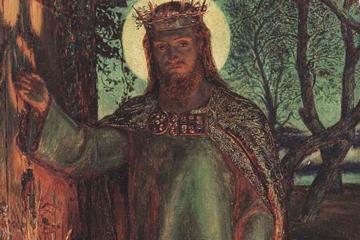
It may seem odd to say, “Let God find you.” After all, God knows just where we are. But there is something very respectful about a God who, as Jesus says in the Book of Revelation, stands at the door and knocks. Even back in the Garden of Eden, as sinful Adam and Eve hid, God walked through the garden and called, “Where are you?”
Yes, God waits until we let Him find us, until we open the door of our heart where He knocks, or until we decide to come out of hiding.
But God does knock. He sends us prophets and speaks through creation and His Word to establish a connection with us. He seeks a connection. Let God find you. Open the gift of His offer.
Something of this dynamic occurred to me while watching the John Lewis Christmas commercial below. And while the roles seem reversed, the dynamic is the same. A little girl spies a lonely man on the moon and seeks to get his attention, to connect with him somehow. But the man seems lost in his loneliness. Through perseverance, she reaches him and the connection is opened.
Let God find you. Let Him connect with you this Christmas.
During Advent, as we continue to meditate on the Parousia (the Second Coming), we do well to allow our imaginations to be engaged in contemplating the glory that awaits those who are faithful, to meditate on the joy and ecstasy of the culmination of all things!
We must soberly admit our need to be ready by God’s grace, but if we are, what glories await us! The “great and terrible day of the Lord” will indeed be great for those who have allowed the Lord to prepare them.
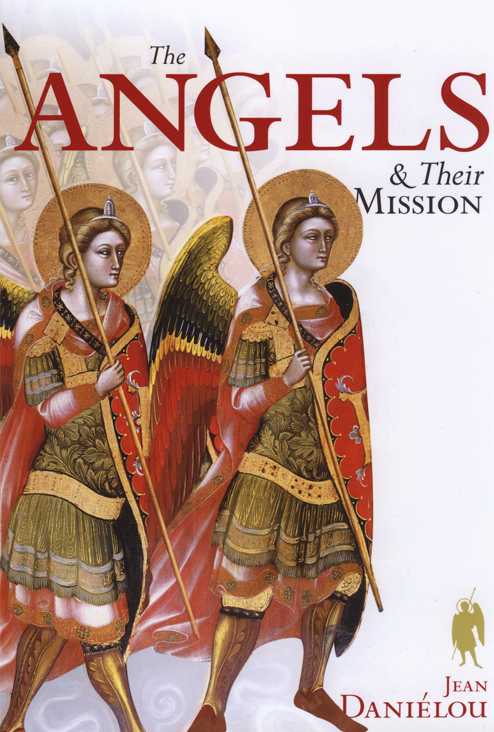
I was stirred some years ago in reading a magnificent book by Jean Cardinal Danielou on angelology (an-GELL-o-gee), which is the study of angels. The book, The Angels and Their Mission: According to the Fathers of the Church, is must reading (and a mere 114 pages long). It is packed with stirring and edifying accounts of the wonderful works of the angels, according to Scripture and the Fathers of the Church.
The final chapters, on the eschaton (the last things) and the Parousia (the Second Coming), are particularly magnificent. I would like to distill them here, adding some material and reworking it just a bit. However, the assembling of the material is fundamentally that of Cardinal Danielou. I hope you will be stirred with as much joy and zeal in reading this as I was in preparing it.
1. Sending forth the multitude of angels:
Scripture is replete with descriptions of the role of angels in the great Second Coming of the Lord. In the Gospel of Matthew there is a text that may refer to 70 A.D., but surely also describes the end of time:
Then will appear the sign of the Son of man in heaven, and then all the tribes of the earth will mourn, and they will see the Son of man coming on the clouds of heaven with power and great glory; and he will send out his angels with a loud trumpet call, and they will gather his elect from the four winds, from one end of heaven to the other (Matt 24:30-31).
The first epistle to the Thessalonians says,
For the Lord himself will descend from heaven with a cry of command, with the archangel’s call, and with the sound of the trumpet of God. And the dead in Christ will rise … (1 Thess 4:16).
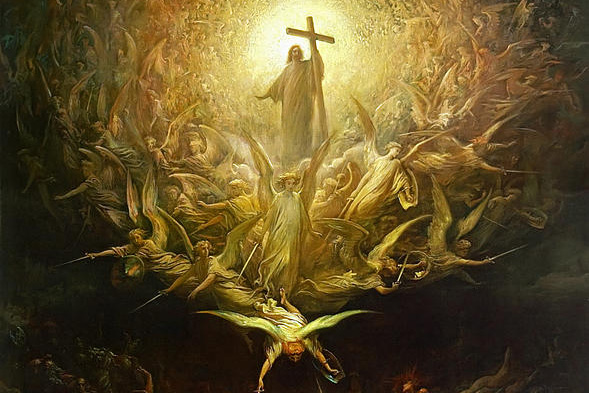
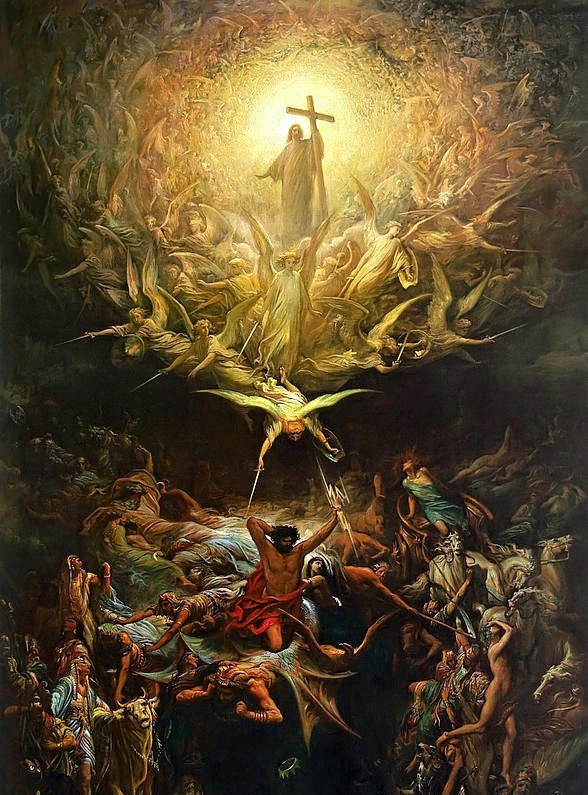
St Cyril describes the extraordinary magnificence given to the final judgment by the presence of the multitude of angels. He considers how the great depth and breadth of the spiritual world has been invisible until now, except to the eyes of faith. Suddenly, it is made manifest! He asks us to imagine the multitude of angels by considering the vast numbers of human beings who have ever existed, from the time of Adam to the present day, standing before the Lord Jesus. Then he asks us to consider that the angels are vastly more numerous than that, for they are the 99 sheep whereas humanity is but the one! As Daniel poetically says,
Thrones were set up and the Ancient of Days took his throne. His clothing was white as snow, the hair on his head like pure wool; His throne was flames of fire, with wheels of burning fire. A river of fire surged forth, flowing from where he sat; Thousands upon thousands were ministering to him, and myriads upon myriads stood before him (Dan 7:9-10).
Such a vision and such multitudes can scarcely be imagined.
2. Waking the dead (the angels are surely part of this):
The Second Sibylline Book, a Christian work, describes the archangels shattering the gates of death and raising up even the bodies of those who had been drowned in the sea or whom savage beasts had devoured (Sib, 2:214–235).
St. Ephrem speaks of the angels as waking the dead, saying,
Then the Lord will appear in the heavens like lightning with an unspeakable glory. The Angels and the Archangels will go on before his glory like flames of fire, like a mighty torrent. The Cherubim will turn their faces and the Seraphim will fly ahead crying out in fear: “Arise, you who sleep. Behold the bridegroom is coming!” Then the tombs will be opened and in the flash of an eye all the people will rise and behold the beauty of the Bridegroom.
St. Paul says that our bodies will rise, our bodies, but gloriously transformed:
He will change our lowly body to conform with his glorified body by the power that enables him also to bring all things into subjection to himself (Phil 3:21).
So will it be with the resurrection of the dead. The body that is sown is perishable, it is raised imperishable; it is sown in dishonor, it is raised in glory; it is sown in weakness, it is raised in power (1 Cor 15:42).
3. The Judgment by Christ and its execution by the angels:
Matthew 13 describes the angels as separating the wicked from the just:
The Son of Man will send his angels, and they will gather out of his kingdom all causes of sin and all evildoers, and throw them into the furnace of fire; there men will weep and gnash their teeth. Then the righteous will shine like the sun in the kingdom of their Father (Mat 14:41-43).
Matthew 25 describes the angels as being with Christ when He takes His judgment seat:
When the Son of Man comes in his glory, and all the angels with him, then he will sit on his glorious throne. Before him will be gathered all the nations, and he will separate them one from another as a shepherd separates the sheep from the goats (Matt 25:31-32).
St. Cyril of Jerusalem speaks of the angels leading the sinners away, body and soul, “in the full sight of the armies of heaven and they will be unable to escape.” But the angels are also uniting the just.
Matthew 13 describes the angels leading evildoers away:
The Son of Man will send his angels, and they will collect out of his kingdom all who caused others to sin and all evildoers. They will throw them into the fiery furnace (Mat 13:41-42).
St. Ephrem describes the angels leading the elect to paradise:
Then the angels will come together from all sides and take up the holy and faithful people into the glory of the clouds above, to their meeting place with Christ.
Origen speaks of the angels escorting the blessed to paradise:
When … we have begun to enter the holy place and pass on to the promised land, those who are really holy and whose place is the Holy of Holies will make their way, supported by the angels and unto the tabernacle of God … They will be carried on [the angels’] shoulders and raised up by their hands.
St. Paul seems to speak to the same glory when he writes to the Thessalonians:
The dead in Christ will rise first. Then we who are alive, who are left, will be caught up together with them in the clouds to meet the Lord in the air. Thus we shall always be with the Lord (1 Thess 4:17).
4. The final ordering of the Kingdom:
Of this final ordering, Scripture says,
The last enemy to be destroyed is death. “For God has put all things in subjection under [Jesus’] feet.” But when it says, “All things are put in subjection under him,” it is plain that he [the Father] is excepted who put all things under him. When all things are subjected to him, then the Son himself will also be subjected to him who put all things under him, that God may be everything to every one (1 Cor 15:26-28).
5. After executing judgment, Jesus returns to His Father’s right, in the Holy of Holies:
He ascends there, now with all the members of His body (body and soul) joined to Him. He ascends to the throne as Unus Christus, amans seipsum (one Christ, loving Himself). Though co-equal to His Father in glory and majesty, He is delighted to hand over the Kingdom of His Body, the Church, to His Father, who is (as Father) the Principium Deitatis.
At this ascension, the Fathers ponder that the angels will make the same declaration, the heavens echoing with their cry:
Lift up your heads, O gates; and be lifted up, O ancient doors, that the King of glory may come in. Who is the King of glory? The Lord, strong and mighty, the Lord, mighty in battle. Lift up your heads, O gates; and be lifted up, O ancient doors; that the King of glory may come in. Who is this King of glory? The Lord of hosts, he is the King of glory (Psalm 24: 7-10).
6. The transformation of all creation:
The longing of creation for its share in the glorious freedom of the Children of God is prophesied through St. Paul:
For the creation waits with eager longing for the revealing of the sons of God; for the creation was subjected to futility, not of its own will but by the will of him who subjected it [because of our sins]. But the creation itself will be set free from its bondage to decay and obtain the glorious freedom of the children of God. We know that the whole creation has been groaning in travail together until now; and not only the creation, but we ourselves, who have the first fruits of the Spirit, groan inwardly as we wait for adoption as sons, the redemption of our bodies (Rom 8:19-23).
And now it comes! Heaven and earth are united and creation receives its original glory and more, for the heavenly realities are now joined to the earth, beautifully restored and raised. Scripture says,
Then I saw a new heaven and a new earth; for the first heaven and the first earth had passed away, and the sea was no more. And I saw the holy city, new Jerusalem, coming down out of heaven from God, prepared as a bride adorned for her husband; and I heard a loud voice from the throne saying, “Behold, the dwelling of God is with men. He will dwell with them, and they shall be his people, and God himself will be with them; he will wipe away every tear from their eyes, and death shall be no more, neither shall there be mourning nor crying nor pain any more, for the former things have passed away.” And he who sat upon the throne said, “Behold, I make all things new” (Rev 21:1-5).
7. The Joy and rest of the angels:
Cardinal Danielou beautifully concludes,
On that day, the joy of the friends of the Bridegroom, [the angels] will be complete. They have led to paradise the souls of the just who are entrusted to them. They have kept watch over their mortal remains. But [for now] they still await the day in which the Bridegroom will come to look for his Bride, when her beauty is finally perfect, in order to lead her into the House of his Father for the eternal wedding feast (p. 114).
Of this magnificent beauty, St. Methodius says,
Oh dearly beloved, [the angels] burn to see the day of your marriage, all the angels Christ has called from heaven. They will come, O Lord, O Word, and they will carry with them mighty gifts, in their spotless robes.
Thus we shall always be with the Lord (1 Thess 4:17).
The Spirit and the Bride say, “Come.” … He who testifies to these things says, “Surely I am coming soon.” Amen! Come, Lord Jesus! The grace of the Lord Jesus be with all the saints (Rev 22:17; 20-21).
The Lord’s coming is near. And though we have all been well taught that the word “Advent” means “coming,” there is the danger that we think that we are only passively waiting for Him to come. It is not just that the Lord is coming to us; we are also journeying to Him. In fact, as the Advent prayers in the Roman Missal instruct, we ought to run, not walk, and hasten to greet Him as He draws near.
This notion of running to meet God is set forth as a consistent theme in the prayers of the Roman Missal. Consider the following prayers and how the theme of our hastening to go out to meet God, even as He is coming to us, is set forth:
Grant your faithful, we pray, almighty God, the resolve to run forth to meet your Christ with righteous deeds at his coming, so that, gathered at his right hand, they may be worthy to possess the heavenly kingdom (First Sunday of Advent).
Almighty and merciful God, may no earthly undertaking hinder those who set out in haste to meet your Son, but may our learning of heavenly wisdom gain us admittance to his company (Second Sunday of Advent).
Stir up your mighty power, O Lord, and come to our help with a mighty strength, so that what our sins impede, the grace of your mercy may hasten (Thursday of the First Week of Advent).
Grant that your people, we pray, almighty God, may be ever watchful for the coming of your Only Begotten Son, that, as the author of our salvation himself has taught us, we may hasten, alert with lighted lamps, to meet him when he comes (Friday of the Second Week of Advent).
May the reception of your sacrament strengthen us O Lord, so that we may go out to meet our savior, with worthy deeds when he comes, and merit the rewards of the blessed (Post-communion, Dec 22).
So, more than merely waiting passively, we should be running and hastening to meet the Lord.
The image of the prodigal son comes to mind. In this parable, the father sees his son and runs toward him. But at the same time, the son is hastening toward his father with contrition and hope. In the same way, we look for the Lord’s coming during Advent. But the Lord also looks for us to come to Him by faith. Like the prodigal son, we should consider our need for salvation. With contrition (have you been to confession recently?) we should hasten to meet our Lord, who by faith we know is coming to us.
Thus, we are not counseled to wait for the Lord in a passive sense, as though we were sitting around waiting for a bus to arrive. Rather, we are counseled to wait for the Lord in an active sense, in much the same way that a waiter in a restaurant waits on tables. Alert and aware, the waiter carefully observes the needs of the patrons in his care and serves them. Good waiters strive to avoid distraction and to do their job of serving well with an alert swiftness.
Notice, too, how the prayers above indicate what it means to run to the Lord. We should not run aimlessly or in circles. Rather, running to the Lord means
being engaged in righteous deeds (holiness) by God’s grace,
not being hindered by worldly preoccupations and distractions,
learning heavenly wisdom,
receiving the Lord’s mercy unto the forgiveness of our sins,
being alert and ready for the Lord’s coming, with the lamp of our soul trimmed (humble and purged of sin) and burning (alive with fiery love), and
being strengthened by the Eucharist, which is our food for the journey.
St. Paul also speaks of running:
Do you not know that in a race all the runners run, but only one gets the prize? Run in such a way as to get the prize. Everyone who competes in the games goes into strict training. They do it to get a crown that will not last; but we do it to get a crown that will last forever. Therefore I do not run like a man running aimlessly; I do not fight like a man beating the air. No, I discipline my body and make it my slave so that after I have preached to others, I myself will not be disqualified for the prize (1 Cor 9:24-27).
Are you running to meet the Lord or are you just waiting passively? Advent involves looking and waiting, but it also means running to meet the Lord, who is coming to us. Run, don’t walk, to the nearing Jesus!
The name of the piece in the clip below is Domine, ad adjuvandum me festina (Lord, make haste to help me). It was composed by Antonio Vivaldi and its series of eighth notes create the image of energetic, joyful running. Vivaldi loved to run a melody up and down the musical scale. In this piece he created a sense of running up and down the hills as we hasten to the Lord. (The video below goes on to include the Gloria Patri.) Just try not to tap your toe during the first and third movements of the Vespers of Vivaldi in G Major!
As we look toward Christmas and ponder the incarnation, we ought to remember that so profound was truth of the incarnation that the early Church fell to her knees at these words: “and He was incarnate by the Holy Spirit, from the virgin Mary, and became man.” This act of falling to one’s knees at these words is still practiced in the extraordinary form of the Roman Rite; in the ordinary form, we are asked to bow.
These gestures acknowledge the profound mystery of the truth of the Incarnation. How does the infinite enter the finite? How does He, whom the very heavens cannot contain, enter the womb of Mary. How can He, who holds all creation together in Himself, be held in Mary’s arms?
In modern times we tend to trivialize God. In this age of empiricism and science we want to fit Him into our categories. But God is not just one more thing in the universe (even if very big or powerful) — He is existence itself. Our feeble words betray more than bespeak Him. We know Him as unknown. Our words about Him, even if true, say more about what He is not than what He is.
To some degree the ancients grasped this better than we; they remained astounded at things like the Incarnation. We avoid the tension of this deep mystery by sentimentalizing it. We speak of “the baby Jesus” and sing sentimental songs. This is not wrong, but one wonders if we do this to avoid the astounding mystery and the tension that such mysteries and imponderables summon.
In a passage we read this week in the Office of Readings, St. Gregory Nazianzen wrote of this mystery:
The very Son of God, older than the ages, the invisible, the incomprehensible, the incorporeal, the beginning of beginning, the light of light, the fountain of life and immortality, the image of the archetype, the immovable seal, the perfect likeness, the definition and word of the Father: he it is who comes to his own image and takes our nature for the good of our nature, and unites himself to an intelligent soul for the good of my soul, to purify like by like. He takes to himself all that is human, except for sin …. He who makes rich is made poor; he takes on the poverty of my flesh, that I may gain the riches of his divinity. He who is full is made empty; he is emptied for a brief space of his glory, that I may share in his fullness. What is this wealth of goodness? What is this mystery that surrounds me? (Sermon, Oratio, 49)
We must all fall silent during Advent to ponder such things. There is a place for sentimentality, but wonder and awe — even shock — should also bring us to our knees. The cooing and crying of the little Infant is the same voice, the same Word that summoned creation into existence. It is an ineffable mystery, an unfathomable truth. And this Eternal Word made Flesh brings gifts to us at Christmas’ approach. An old song by St. Ambrose says,
O equal to thy Father, Thou,
Gird on thy fleshly mantle now
The weakness of our mortal state
With deathless might invigorate.
Hush, fall silent before the mystery; less analysis and more wonder and awe.
The following are five Advent reflections that I prepared for catechumens and candidates in our RCIA program. (They are also available in PDF form here: The Season of Advent.)
Advent is witnessed by creation
Late autumn and early winter are times of great seasonal change. The leaves turn brilliant colors, then fade and fall. Shadows lengthen as the days grow shorter and colder. Vacations and the warmth of summer are distant memories and we are reminded once again that the things of this world last but a moment and then pass away. Even so, we look forward as well. Christmas can be a wonderful time of year. Likewise, the winter ahead has its delights. Few can deny the mesmerizing beauty of falling snow and the childlike excitement a winter storm can arouse. Advent draws us spiritually into this season of change, longing, and expectation. As the days grow shorter and the darkness increases we light candles on our Advent wreaths and remember that Jesus is the true light of the world, the light that shines in the darkness. These lit candles also symbolize our ongoing commitment to come out of the darkness into God’s own marvelous light (cf 1 Peter 2:9). There is a gospel song that says, “Walk in the light, beautiful light, come where the dewdrops of mercy shine bright.”
Longing for salvation
Advent also draws us back to our Old Testament roots. Israel was taught by God through the prophets to expect a Messiah from God who would set them free from sin and injustice. Across many centuries there arose a yearning for this Messiah. Sin and injustice had taken a terrible toll and so a cry from Israel went up:
O that thou wouldst rend the heavens and come down, that the mountains might quake at thy presence–as when fire kindles brushwood and the fire causes water to boil … We have all become like one who is unclean, and all our righteous deeds are like a polluted garment. We all fade like a leaf, and our iniquities, like the wind, take us away. There is no one that calls upon thy name, that bestirs himself to take hold of thee; for thou hast hid thy face from us, and hast delivered us into the hand of our iniquities. Yet, O LORD, thou art our Father; we are the clay, and thou art our potter; we are all the work of thy hand. Be not exceedingly angry, O LORD, and remember not iniquity forever. Behold, consider, we are all thy people (Is 64:1-7).
During Advent we recall these cries of ancient Israel and make them our own. Surely Christ has already come, yet we know that sin and injustice still have terrible effects on our lives and our communities. We very much need Jesus to be our Savior and to set us free every day. Advent is a time to acknowledge our need for the saving work of God and to long for the glorious freedom of children of God. We know that God has already begun this saving work in us; now we long for Him to bring it to completion. We also await the full manifestation of His glory.
Waiting for His sudden and second coming
Advent is also a time to prepare for the second coming of the Lord. In the Nicene Creed, we say, “He will come again in glory to judge the living and the dead.” This truth flows directly from Scripture, which clearly teaches two things on which we must reflect. First, He will come again in glory. Second, we cannot know the day or the hour that He will return. In fact, though some signs will precede His coming, the emphasis of Scripture is on the suddenness of the event.
He will appear like lightning (Mt 24:27).
… with the suddenness of the pangs of child birth … (1 Th. 5:3)
… in the twinkling of an eye and the sound of a trumpet … (1 Cor 15:52)
It will take place when we least expect (Mt 24:44)
Just when everyone is saying, “There is peace and security” … (1 Th. 5:3)
Because this is the case, we must live in constant readiness for that day. Advent is a time when we especially reflect on the necessity of our readiness. An old gospel song says, “Are you ready? Are you ready for the coming of the Lord?” Similarly, there is another gospel song that counsels, “Keep your lamps trimmed and burning. The time is drawing nigh!”
The fire next time
Some of the images of the last day, ones of judgment and destruction, can seem very frightening indeed. Consider, for example, this passage from the Second Letter of Peter:
But the day of the Lord will come like a thief, and then the heavens will pass away with a loud noise, and the elements will be dissolved with fire, and the earth and the works that are upon it will be burned up. Since all these things are thus to be dissolved, what sort of persons ought you to be in lives of holiness and godliness, waiting for and hastening the coming of the day of God, because of which the heavens will be kindled and dissolved, and the elements will melt with fire! But according to his promise we wait for new heavens and a new earth in which righteousness dwells. Therefore, beloved, since you wait for these, be zealous to be found by him without spot or blemish, and at peace (2 Pt. 3:10-14).
Some of the imagery used here is reminiscent of the even more fearsome images of the Book of Revelation. Notice the complete message of this passage and others like it: The heavens and the earth as we know them will pass away, but we who are ready look forward with joy to a “new heaven and a new earth,” where the justice of God will reside in all its fullness.
An African-American spiritual summarizes the teachings of the Second Letter of Peter with these classic lines: “God gave Noah the rainbow sign. No more water, the fire next time.” Here, too, our first reaction might be fear, but in the tradition of the spirituals, the fire referenced was a fire of justice and truth, which destroyed the power of injustice and oppression. Another spiritual expresses it this way: “God’s gonna set this world on fire, one of these days, Alleluia! [and] I’m gonna sit at the welcome table one of these days, Alleluia!” For the slaves, the day of God’s visitation could only be a day of jubilee, vindication, and deliverance. So it will be for us, too, if we are ready. W
What does it mean to be ready? It means to be living faithfully, holding on to God’s unchanging hand in the obedience of faith and trust. It means to be living a holy life, a life of repentance. If we do this, not only do we have nothing to fear about the last day, we can eagerly anticipate it and cry out, “Amen! Come, Lord Jesus!” (Rev 22:20)
Remember, repent, rehearse
All of these reflections help to place Advent in proper perspective for us. We are called to remember, repent, and rehearse. We remember that Christ has already come. He has called us to the obedience of faith and promised that He will return in glory. We repent of whatever hinders our readiness for that day. We rehearse for His second coming in glory by anticipating its demands and celebrating the glory that comes to those whom He finds watchful and ready. In a sense, every Mass is a dress rehearsal for the glory of the kingdom. At every Mass the following prayer is said: Deliver us, Lord, from every evil and grant us peace in our day. In your mercy, keep us free from sin and protect us from all anxiety, as we wait in joyful hope for the coming of our savior, Jesus Christ.
This beautiful prayer recalls that it is entirely God’s work that we be ready for His glorious return. Only He can deliver us, free us from our sin, and remove our anxiety about that day. Only He can give us joy and make us holy. We need only yield to His saving work.
This brings us back to where we started: yearning for our savior. To yearn for Him is to know how much we need Him, to seek His face and call upon His name constantly. Cry out with the Church, “Come, Lord Jesus!” For it is written, The Spirit and the bride say, “Come.” And let him who hears say, “Come.” And let him who is thirsty come, let him who desires take the water of life without price. … He who testifies to these things says, “Surely I am coming soon.” Amen! Come, Lord Jesus! (Rev 22:17, 20)

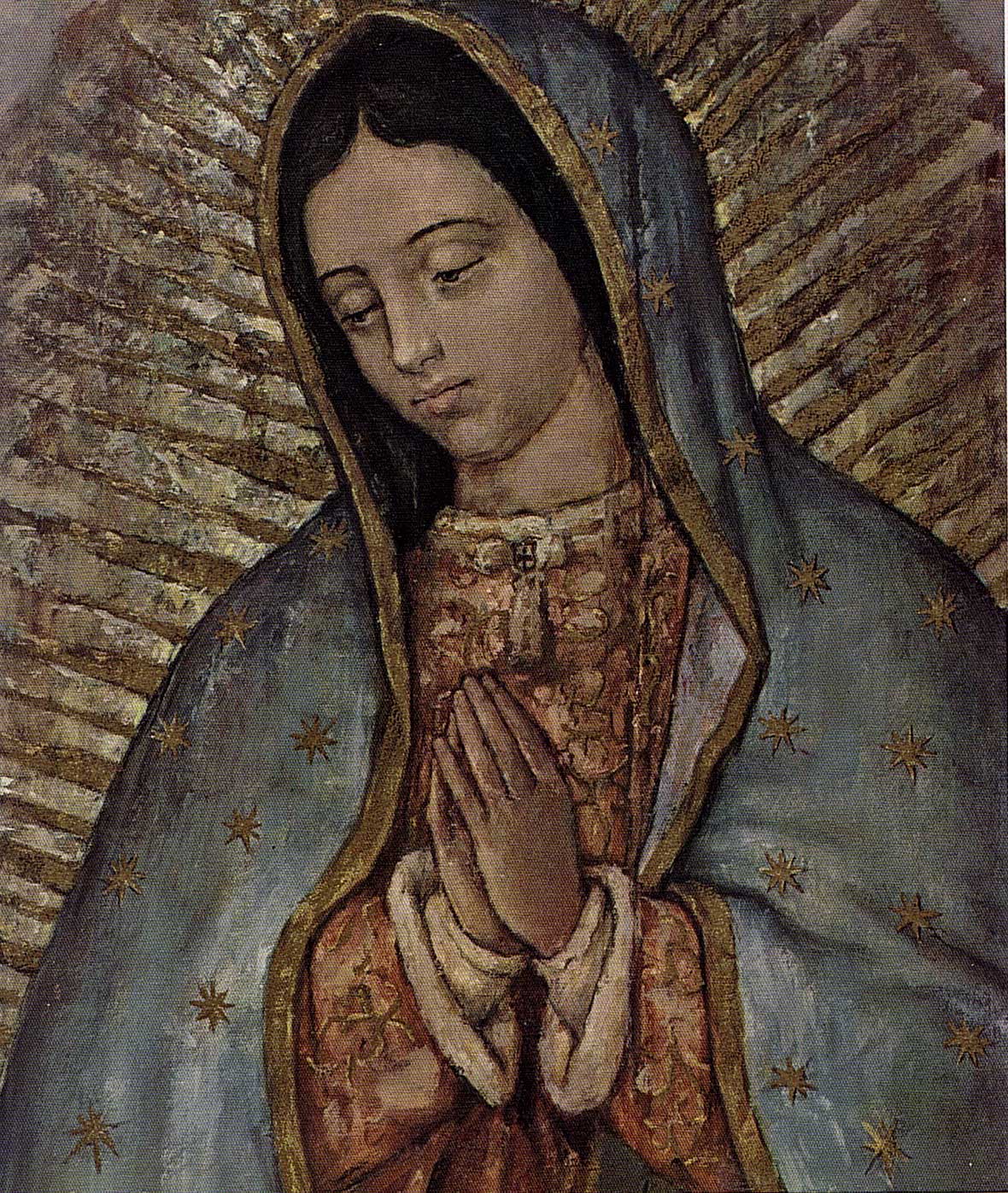 On the Feast of Our Lady of Guadalupe, it is a chance for us to rejoice in the great mercy of our divine Lord and our blessed Lady. I am drawn to mediate on the miraculous quality of our Lady’s eyes on the tilma.