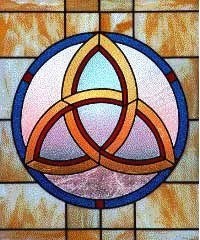
There is a kind of tension in some of the imagery we use for God. On the one hand we call Him the “Unmoved Mover.” We also say that God is everywhere. If He is everywhere then there is nowhere for him to go, no need for Him to move because He is already there. Yet we also speak of “processions” in the Trinity.
St. Thomas artfully and with precision speaks of the Trinity and the two “processions” as Gentori Genitoque laus et jubilation … Procedenti abutroque compar sit laudatio (To the One who generates and to the One who is generated be praise and jubilation … To the One proceeding from them both be equal praise).
St. Thomas also points out an important difference between material procession and divine procession:
In material things, what comes forth from another is no longer in it, since it comes from it by a separation from it in essence or in space. But in God, coming forth does not arise in this way. The Son came forth eternally from the Father in such a way that the Son is still in the Father from all eternity. And so, when he is in the Father, he comes forth. And when he comes forth, he is in him, in such a way that he is always coming forth, and always in him (Commentary on John, 16:28).
So, it would seem that the Unmoved Mover, our Triune God, has processions of love within. There is a kind of dynamism of love! Of course, our feeble words fall short and our analogies are weak.
There is a beautiful Greek word used by the Church Fathers (e.g., St. John Damascene) to describe the inner life of the Trinity: perichoresis. It is a combination of two words: peri, meaning “around” and chorein, meaning “to make space.” Therefore perichoresis, literally translated, means “to make space around.” It points to the way in which someone or something makes space around itself for others or for something else.
What a picturesque word! It suggests a kind of swirling or a dance. It is close in its spelling to the Greek word for dance, choreuo, so many people refer to it as the dance of love in the Trinity. Father, Son, and Holy Spirit make room for one another; they “dance” about and “with” one another in a way that shows a mutual indwelling while still maintaining space for each person.
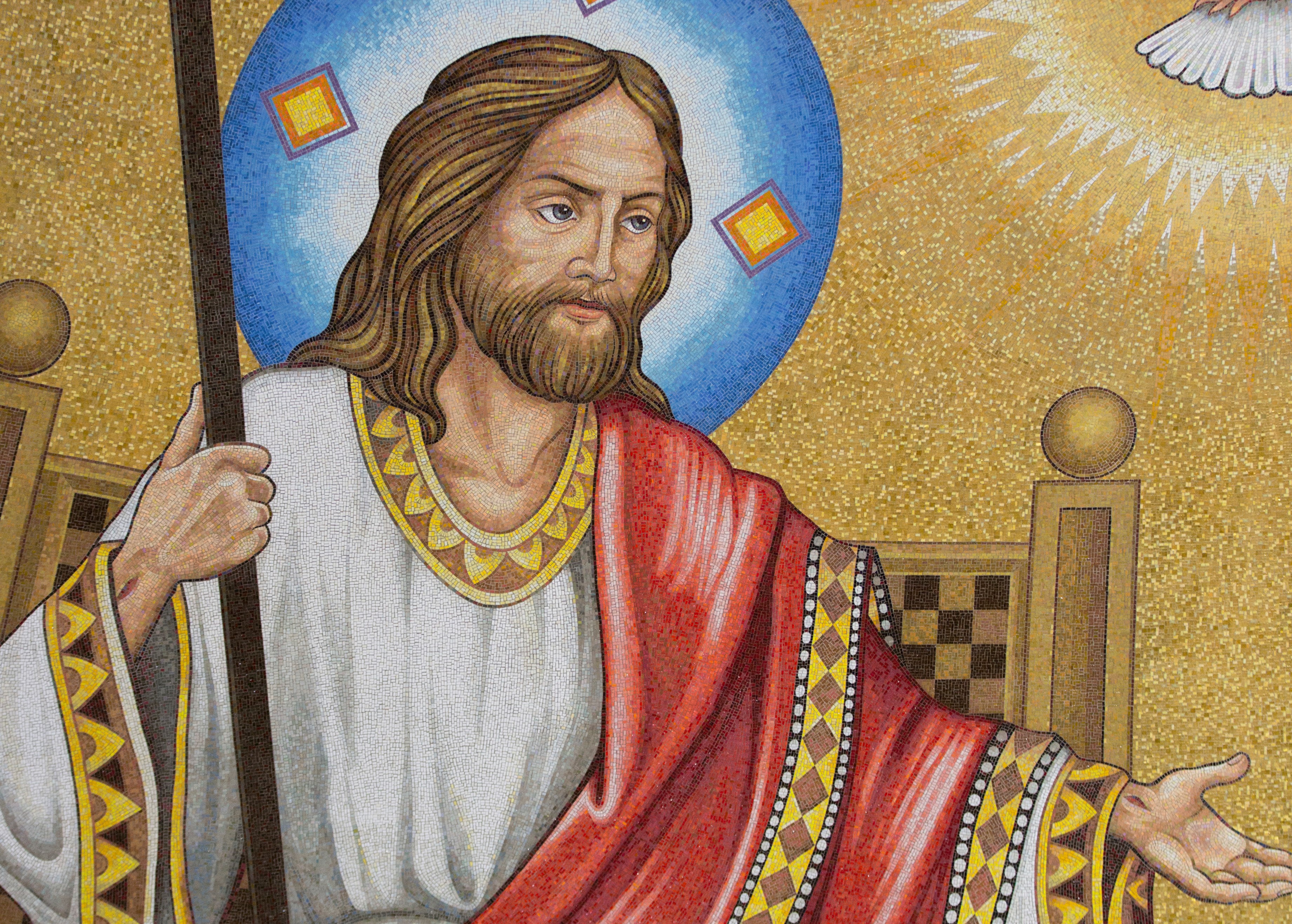
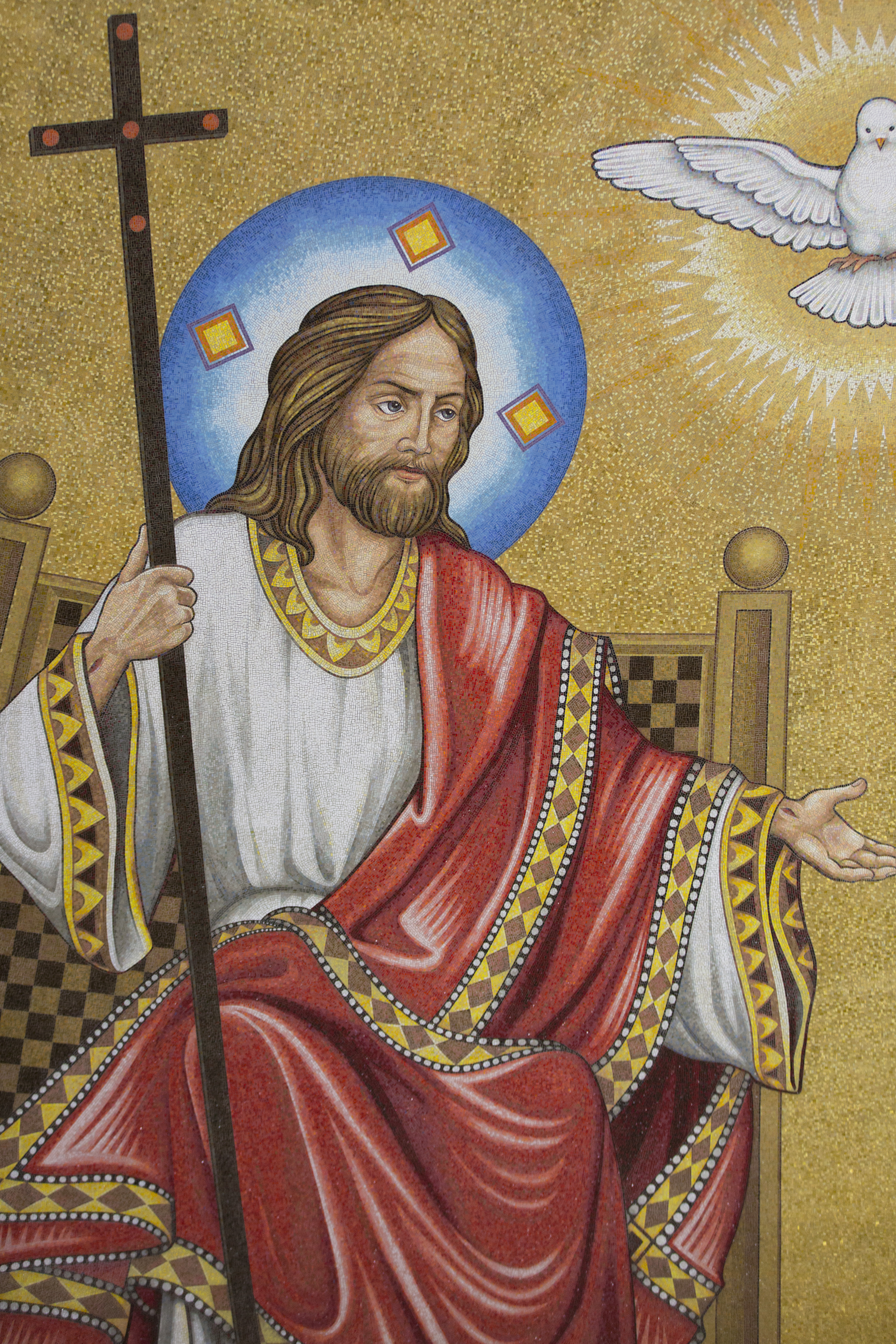
Yes, love is dynamic. There is a movement of love between the persons of the Trinity. This imagery is powerfully different than the one that most people have of the Trinity (God the Father on one throne, sitting next to His Son on another, with the Holy Spirit hovering like a dove between them). This is not wrong. Scripture speaks of thrones in Heaven and of the Father and the Son seated, but the thrones are likely more an image of authority than of inactivity.
Surely the inner life of the Trinity is more than merely being seated. It is a glorious procession of love: The Father loves the Son, the Son loves the Father, and the Holy Spirit is the love proceeding from them both. Yes, there is a great movement, a dance of love.
To this “dance” of love, Christ draws His Bride, the Church. It is our destiny and dignity to be caught up one day to the great dance of love of the Trinity. Heaven is not a static vision of God from some distance; it is a beatific vision, an experience of love that is dynamic and moving, a dance of ecstasy.
Put on your dancing shoes and get ready for the dance! Remember that to dance well we must surrender all pride and learn to dance as if no one is watching. Only the humble can really dance well, only those who can make space for the Lord and let Him lead.
I hope you will forgive the secular source, but below is an image of Christ drawing His bride to the dance.
The photo at the right, which I took in the attic of our parish school, reminds me of the ancient Latin phrase Sic transit gloria mundi (Thus passes the glory of the world). These are the symbols of victory in sports events, much trained for and fought for. Once they were proudly displayed in the trophy case of the main hallway. Over time they were shifted behind the newer trophies, then relocated to less prominent locations in the school, then to the closet, and finally to the attic.
My old “letter jacket” from high school still hangs in my closet, but it stopped fitting me decades ago. I also have a few tarnished medals I won running the mile. They once graced my “letter sweater,” with the big red, white, and blue letters “GF” (Garfield High School) sewn on. That sweater is long gone. I once strutted in it proudly as the medals and gold bars gleamed; now the races that merited them are but dim memories.
Scripture says,
For we have here no lasting city, but we are looking for the city that is to come (Hebrews 13:14).
For what is seen is temporary, but what is unseen is eternal (2 Cor 4:18).
As for man, his days are like grass; he flourishes like a flower of the field; but the wind passes over it, and he is gone, and his place knows him no more. But the steadfast love of the Lord is from everlasting to everlasting on those who fear him (Psalm 103:15-17).
There’s an old hymn that says,
Swift to its close ebbs out life’s little day;
earth’s joys grow dim, its glories pass away.
Change and decay in all around I see.
O Lord who changes not, abide with me.
Yes, earth’s glories pass away, but the glory of the Lord endures forever. If we are faithful, it is into that glory that we will enter. The Lamb is the light of the City of God!
I suppose there is a sadness in seeing all those rusting and bent trophies in the school attic, but there is also something freeing. The transitory nature of earth’s glories helps us to be less obsessed with them. The praise of men has its place, but the praise of God and His rewards will last eternally.
Another old hymn says, “Only what you do for Christ will last.” Whatever glory the trophies in that attic once signified, only the self-discipline and teamwork—if done in Christ—will last.
These are just some things I thought about as I stumbled upon the faded glory of some old trophies.
In the Office of Readings during the sixth week of Easter, we celebrate the Word becoming flesh. We read from the First Letter of John, which emphasizes the Incarnation of Jesus and demands that we experience the Word becoming Flesh in a practical way in our own lives.
Fundamentally, the Incarnation, the Second Person of the Trinity becoming flesh, means that our faith is about things that are tangible. As human beings, we have bodies. We have a soul that is spiritual, but it is joined with a body that is physical and material. Hence it is never enough for our faith to be about only thoughts, philosophies, concepts, or historical facts. Their truth must also touch the physical part of who we are. Our faith must become flesh; it has to influence our behavior. If that is not the case, then the Holy Spirit, speaking through John, has something to call us: liars.
God’s love for us in not just a theory or idea. It is a flesh and blood reality that can be seen, heard, and touched. The challenge of the Christmas season is for us to allow the same thing to happen to our faith. The Word of God and our faith cannot simply remain on the pages of a book or in the recesses of our intellect. They must become flesh in our life. Our faith has to leap off the pages of the Bible and the Catechism and become flesh in the way we live our life, the decisions we make, and the way we use our body, mind, intellect, and will.
Consider the following passage, read at Mass during the Christmas season. (This excerpt is fairly representative of the tone of entire First Letter of John.)
The way we may be sure that we know Jesus is to keep his commandments. Whoever says, “I know him,” but does not keep his commandments is a liar, and the truth is not in him. But whoever keeps his word, the love of God is truly perfected in him. This is the way we may know that we are in union with him: whoever claims to abide in him ought to walk just as he walked (1 John 2:3ff).
Note some teachings that follow from it:
1. Faith is incarnational.What a practical man John is! Faith is not an abstraction; it is not merely about theories and words on a page. It cannot be reduced to slogans or pious sayings. It is about a transformed life; it is about truly loving God and making His Commandments manifest in the way we live. It is about the loving of neighbor. True faith is incarnational. That is to say, it takes on flesh in our very “body.”
Human beings are not pure spirit; we are not just intellect and will but also flesh and blood. What we are must also be reflected in our bodies, in what we physically do.
Many people spout this phrase too often: “I’ll be with you in spirit.” Perhaps an occasional physical absence is understandable, but after a while the phrase rings hollow. Showing up physically and doing what we say is an essential demonstration of our sincerity. Our faith must include a physical, flesh-and-blood dimension.
2. A sure sign – John said, The way we may be sure that we know Jesus is to keep his commandments. Now be careful of the logic here. The keeping of the commandments is not the cause of faith; it is more the fruit of it. It is not the cause of love; it is the fruit of it.
In Scripture, “knowing” refers to more than an intellectual level. It refers to deep, intimate, personal experience of the thing or person. It is one thing to know about God; it is another thing to “know the Lord.”
John is saying here that in order to be sure that we have deep, intimate, personal experience of God, we must change the way we live. An authentic faith, an authentic knowing of the Lord, will change our behavior in such a way that we keep the commandments as a fruit of that authentic faith and relationship with Him. It means that our faith becomes flesh in us. Theory becomes practice and experience. It changes the way we live and move and have our being.
For a human being, faith cannot be a mere abstraction. In order to be authentic, it has to become flesh and blood. In a later passage, John uses the image of walking: This is the way we may know that we are in union with him: whoever claims to abide in him ought to walk just as he walked (1 John 2:6). Although walking is a physical activity, it is also symbolic. The very place we take our body is physical, but it is also indicative of what we value, what we think.
3. Liar? –John went on to say, Whoever says, “I know him,” but does not keep his commandments is a liar. This is strong language. Either we believe and thus keep the commandments, or we are lying about really knowing the Lord and we fail to keep the commandments.
Don’t all of us struggle to keep the commandments fully? John seems so “all or nothing” in his words. His math is clear, though. To know the Lord fully is never to sin (cf 1 John 3:9). If we know Him only imperfectly, we still experience sin. Hence, the more we know Him (remember the definition of “know”) the less we sin. If we still sin, it is a sign that we do not know Him enough.
It is not really John who speaks too absolutely; it is we who do so. We say, “I have faith. I am a believer. I love the Lord. I know the Lord.” Perhaps we would be more accurate by saying, “I am growing in faith. I am striving to be a better believer. I am learning to love and know the Lord better and better.” If we do not, then we risk lying. Faith is something we grow in.
Many in the Protestant tradition tend to reduce faith to an event: answering an altar call or accepting the Lord as “personal Lord and savior.” We Catholics do it, too. Many Catholics think that all they have to do is be baptized; they don’t bother to attend Mass faithfully later. Others claim to be “loyal” or even “devout” Catholics yet dissent from important Church teachings. Faith is about more than membership. It is about the way we walk, the decisions we make. Without this harmony between faith and action, we live a lie. We lie to ourselves and to others. The bottom line is that if we really come to know the Lord more and more perfectly, we will grow in holiness, keep the commandments, and be of the mind of Christ. We will walk just as Jesus walked and our claim to faith will be the truth and not a lie.
4. Uh oh, is this salvation by works? No, but it is a reminder that we cannot separate faith and works. The keeping of the commandments is not the cause of saving or real faith. Properly understood, the keeping of the commandments is the result of saving faith actively present and at work within us. It indicates that the Lord is saving us from sin and its effects.
The Protestant tradition erred in dividing faith and works. In the 16th century, the cry when up from Protestants that we are saved by “faith alone.” Faith is never alone; it always brings effects with it.
Our brains can get in the way here and tempt us to think that just because we can distinguish or divide something in our mind we can do so in reality, but this is not always the case.
Consider, for a moment, a flame. It has the qualities of heat and light. We can separate the two in our mind, but not in reality. I could never take a knife and divide the heat of the flame from its light. They are so interrelated as to be one reality. Yes, heat and light in a flame are distinguishable theoretically, but they are always together in reality.
This is how it is with faith and works. Faith and works are distinguishable theoretically, but the works of true faith and faithitself are always together in reality. We are not saved by works alone or by faith alone. They are together. Faith without works is dead (James 2:14). In other words, faith without works is a nonexistent concept; it is not a saving or living faith. Rather, as John teaches here, to know the Lord by living faith is always accompanied by keeping the commandments and walking as Jesus did.
So, faith is incarnational. The Word became flesh and dwelt among us, really and physically. Similarly, our own faith must become flesh in us, in our actual behavior.
The following was sung in my own parish by the St. Luke’s Ordinariate Choir:
There is a war we must wage in our mind. Indeed, the mind is the central battlefield of our Christian journey. The mind is where we “live,” where we are alone with our thoughts and with God; it is where we think, deliberate, and decide. Our “thought life” determines our ultimate destiny:
Sow a thought, reap a deed. Sow a deed, reap a habit. Sow a habit, reap a character. Sow a character, reap a destiny.
It all begins in the mind. If you can get a person to think in a certain way, you can control his feelings, decisions, and ultimately his destiny. The world and the devil seek access to our minds. They try to influence us, to sow seeds of sin, doubt, and confusion. In addition, our own flesh seems to like being deceived. Too easily we are like those who, as St. Paul says, will not tolerate sound doctrine, but with itching ears will gather around themselves teachers to suit their own desires (2 Tim 4:3).
We must engage in this battle both for ourselves and those whom we love, especially today when the distracting influences of the world are so numerous and so cunning. There is much in the writings of St. Paul to give us encouragement in this battle. Consider these passages:
We tear down arguments, and every presumption set up against the knowledge of God; and we take captive every thought to make it obedient to Christ (2 Cor 10:4-5).
Every thought should be subject to the standard of the Gospel: is this it in conformity with what God teaches or not? If it is not, it is to be taken captive and either excluded or made pure in reference to Christ.
Is this what we do? Too often it is not! Instead, we tolerate error, darkness, impurity, foolishness, and outright blasphemy. Rather than rendering it captive, we allow it free access to our innermost mind and heart. Through movies, music, the Internet, and all sorts of media, we expose ourselves to what is base, boorish, uncharitable, unchaste, violent, dysfunctional, and just plain evil. Not everything in the world is evil or base but, as St. Paul says in Thessalonians, Test everything. Hold fast to what is good. Abstain from every form of evil (1 Thess 5:21-22).
When ideas or any content fails this test, we ought to arrest it and hold it captive. Too often we tolerate or even welcome it. We have too little sense of the battle for our mind and we are easily deceived, carried off by any foolish, unchaste, or ungodly thing. Pay attention, fellow Christians; we are at war and the battleground is our mind.
So, I tell you this, and testify to it in the Lord: You must no longer walk as the Gentiles do, in the futility of their minds. They are darkened in their understanding and alienated from the life of God because of the ignorance that is in them due to the hardness of their hearts. Having lost all sense of shame, they have given themselves over to sensuality for the practice of every kind of impurity, with a craving for more. But this is not the way you came to know Christ. Surely you heard of Him and were taught in Him in keeping with the truth that is in Jesus. You were taught to put off your former way of life, your old self, which is being corrupted by its deceitful desires; to be renewed in the spirit of your minds; and to put on the new self, created to be like God in true righteousness and holiness. Therefore, each of you must put off falsehood and speak truthfully to his neighbor, for we are members of one another (Eph 4:17-45).
We are so easily mesmerized by the world, seeing its ways as sophisticated, classy, and cultural—but this is a deception. St. Paul (with the Holy Spirit) speaks of these things and describes those who promote them as lost in futility, desensitized to evil, as having darkened minds and hardened hearts. We are summoned to separate ourselves from all that and be renewed in our minds and washed in the truth. In other words, do not admire the glamorized evils of this world or by its often-foolish priorities and futile pursuits.
Do not be conformed to this world, but be transformed by the renewing of your mind. Then you will be able to discern what is the good, pleasing, and perfect will of God (Rom 12:2).
There is no safer place in the world than inside the will of God. Our goal is to be transformed into the image of God, not conformed to a doomed and passing world. Our goal is to be sober and to discern the will of God in all things. This alone will bring us satisfaction and salvation. Only by the clear discernment of the will of God can we know the way home.
Are you on the battlefield with the Lord? Where is your mind right now? Be attentive to the battle for your mind. Jesus Christ is the same yesterday and today and forever. Do not be carried away by all kinds of strange teachings (Heb 13:8-9).
In the Sunday Gospel, Jesus cuts right through the modern Western tendency to place love in opposition with law, and law in opposition with joy. Jesus joins all three concepts and summons us to a new attitude.
I. Connections– Jesus says, As the Father loves me, so I also love you. Remain in my love. If you keep my commandments, you will remain in my love, just as I have kept my Father’s commandments and remain in his love. I have told you this so that my joy may be in you and your joy might be complete.
Note how the Lord joins the three concepts of love, law, and joy. This is precisely the opposite of what Western culture does. The best that Western culture will admit of law is that it is a necessary evil; more routinely it is viewed as an unloving imposition by the powerful on the weak, the hierarchy on the laity, the (evil, oppressive, pharisaical) Church on decent people.
Whereas the modern world disconnects law from love, Jesus links them.How do we both experience and show love? Jesus says that we do so by keeping His commandments. He sets forth a vision whereby we, having experienced God’s love, desire and rejoice in His commands. We also show love to the Lord through this very obedience and joyful adherence to His commands. This loving obedience goes even further by setting forth an abundant joy through the very keeping of those commands.
Again, this is completely contrary to modern notions. According to the modern world, a “loving” God has few or no rules. He merely affirms, encourages, accepts, and includes—or so goes the thinking.
The real Jesus is far more complex. He is surely loving, especially of sinners. He encourages, includes the outcast, and so forth, but He also speaks of sin and rebukes it. He embraces the sinner but directs him to “Sin no more.” He sets forth a demanding moral vision even as He shows mercy. In this Gospel, Jesus joins love and the law, saying that the law brings joy. They are not opposed. It is not an either/or, but a both/and. Jesus was not just the “affirmer in chief” who went about saying nothing but pleasant things. In fact, He often held many contrary ideas in tension and balance.
Christianity is a paradoxical religion because the Jew of Nazareth is a paradoxical character. No figure in history or fiction contains as many multitudes as the New Testament’s Jesus. He’s a celibate ascetic who enjoys dining with publicans and changing water into wine at weddings. He’s an apocalyptic prophet one moment, a [careful and] wise ethicist the next. … He promises to set [spouses against one another and] parents against children, and then disallows divorce; he consorts with prostitutes while denouncing even lustful thoughts. … He can be egalitarian and hierarchical, gentle and impatient, extraordinarily charitable and extraordinarily judgmental. He sets impossible standards and then forgives the worst of sinners. He blesses the peacemakers and then promises that he’s brought not peace but the sword. He’s superhuman one moment; the next he’s weeping.
Douthat goes on to conclude:
The boast of Christian orthodoxy, as codified by the councils of the early Church and expounded in the Creeds, has always been its fidelity to the whole of Jesus. … [Where heresy says which one] Both, says orthodoxy…. The goal of the great heresies, on the other hand, has often been to extract from the tensions of the gospel narratives a more consistent, streamlined, and noncontradictory Jesus.
The main point is that Jesus, who is love, does not hesitate to teach on many moral topics and to warn sinners of judgment. He both personally and through his inspired apostles speaks with clarity about anger, greed, malice, neglect of the poor, divorce, fornication, adultery, impure thoughts, homosexual acts, lack of faith, revenge, dishonesty, the sin of human respect, false and worldly priorities, and countless other matters.
In the Sunday Gospel, not only does Jesus link love to the keeping of the commandments, but also says that the keeping of the commandments leads to joy.
Of this, I am a witness. God’s law gives joy to my heart. As a priest, I live as a celibate, like Jesus, and my life is very fulfilling. I have been faithful to my celibate commitment without fail. I have not strayed from proper boundaries. I do not view pornography. I am not in any way sexually active. In all this I am not repressed; I am not sad or lonely. My life is joyful; I am fulfilled and see my celibacy as a gift. To those who cannot marry, whether because they are homosexual, too young, or have not met the right person, I say that God can and still does bless you. Living celibately can be fulfilling and joyful for those who are temporarily and/or permanently called to it.
The Church cannot and will not affirm or call good what God calls sin, whether it is greed, violence, or (more controversially) homosexual acts or illicit heterosexual acts. In so doing we are not being any more unloving, repressed, or sad than Jesus—and He is none of these things. Neither can we affirm any other acts or attitudes that the Bible calls sinful. These things are all taught in love and they bring joy to those who will accept them.
The Lord is no liar, and He promises that love, His commandments, and joy are all interrelated. I am a witness that this is true.
II. The Core – The Lord says, This is my commandment, Love one another as I have loved you. While it is true that the Church and all of us as individuals must speak the truth, we must speak it in love. We are not out to win an argument, to overpower, or merely to criticize. Our goal is to love. It is not helpful, and quite likely harmful, to correct people whom we do not first love.
Hence the Lord’s command to love one another is at the core of any preaching or teaching task. There are many today who declare that they do not experience love from the Church, only “denunciation.” It is difficult for the Church to convey our love to a large number of people, to a nation, or to a culture. To the degree that we have failed to love or to convey that love, we must repent and strive even harder both to love and to express that love.
That said, the mere fact that we announce God’s law and summon others to it does not make us unloving. As we have seen above, Jesus links these concepts. There is no doubt that some will take offense no matter what we say or how we say it, but the fact that others are angry or hurt does not necessarily mean that we have done or said something wrong. Jesus, who was sinless, offended many and was a sign of contradiction both then and now.
As for the Church, we must never fail to ask for a deepening love for all, even for those who hate us, misunderstand us, or misrepresent us. The core of Jesus’ teaching is this: “Love one another.”
Jesus goes so far as to say that we must be willing to endure martyrdom in order to speak the truth to others. He says, No one has greater love than this, to lay down one’s life for one’s friends. Are we willing to endure hatred? Are we willing to be spat upon and mocked? Are we willing to be called hateful, bigoted, homophobic, backward, repressed, intolerant, and so forth? Jesus was willing because He had the kind of love to stay in the conversation even when many (though not all) hated Him. What are you willing to bear to proclaim the truth in love?
III. Camaraderie – Jesus also links friendship to the knowledge of His law. He says, You are my friends if you do what I command you. I no longer call you slaves, because a slave does not know what his master is doing. I have called you friends, because I have told you everything I have heard from my Father.
Here is another connection Jesus makes that the modern world rarely does. The world thinks of rules, laws, and commandments in terms of slavery and subservience. Jesus, however links these to friendship. A friend knows what his friend is about and gladly seeks to understand and support him. Scripture says, Happy are we, O Israel, for what pleases God is known to us (Baruch 4:4).
True friendship means seeking to know and understand one’s friend and to accomplish what is important to him. Many today call themselves friends of Jesus but give Him little more than lip service. A true friend of Jesus is delighted to know His will and to accomplish it.
IV. Call – Jesus says, It was not you who chose me, but I who chose you and appointed you to go and bear fruit that will remain, so that whatever you ask the Father in my name he may give you. This I command you: love one another. In these final lines, we are reminded that the Lord, who has chosen us, can and will equip us to live His law, to bear fruit in the keeping of the commandments, and to be someone whom the Father can trust with blessings.
To be rebellious and resentful is to be untrustworthy of further blessings, but here again the Lord stresses that the keeping of the commandments is linked to love and to further blessings.
The commandments bring joy; they are rooted in love and bring blessings. Do we really believe this? Or will we accept the worldly thinking that places these in opposition with each other: love and law, law and joy, and law and friendship? The choice is ours. As for me, I am already a witness that the law is love, joy, and friendship. How about you?
This song rejoices in the Light of Jesus, the clear Sun (Son) of Righteousness, who shows the way to the Father:
One of the questions I have asked God is, “Why does it always take so long to build something up while it only seems to take moment to tear it down or destroy it?”
Destruction is always so much easier than construction. Decades, centuries, even a millennium of building a culture (e.g., Christendom) seems to have vanished overnight.
All I get from God is, “Never mind, just keep working.” It would seem that God finds value in the work, not just in the results. Even so, my question (my frustration, actually) remains. However, I will do what He asks and keep on teaching, building, and working.
The following commercial speaks humorously to my concern. Months of mathematical analysis is destroyed in a moment by a tuned-out man who does not recognize the beauty or value of what he erases.
Thursday’s feast of Saints Philip and James, like that for almost all the apostles, contains passages from Psalm 19. This has always intrigued me because this psalm is not a reference to human preaching or witness at all, but rather a reference to the wordless witness of creation.
The heavens declare the glory of God, and the sky above proclaims his handiwork. Day to day pours out speech, and night to night reveals knowledge. There is no speech, nor are there words, whose voice is not heard. Their voice goes out through all the earth, and their words to the end of the world (Psalm 19:2-3; 4-5).
While it is true that the voice of the apostles has gone out to all the earth, that is not what this psalm is really about. There is a kind of daring and glorious transposition of meaning. The witness through the words of the apostles is joined to the wordless witness of creation. Why? Well, are not the apostles—indeed all humans—part of creation? And if the lower parts of creation proclaim the glory of God, do not we as well?
Here, then, is a beautiful reminder of the two books of revelation: Scripture and Creation. It is also a reminder that we are part of that creation. Creation is revelation, as St. Paul reminds us:
For God’s invisible attributes, namely, his eternal power and divine nature, have been clearly perceived, ever since the creation of the world, in the things that have been made (Romans 1:20).
Yes, the whole universe shouts, “Order! Consistency! Intelligibility!” Our bodies and all the delicately functioning systems on this planet echo back this refrain. While I do not ask scientists (as scientists) to affirm the biblical and Christian God, the existence of consistent order in the universe is obvious and serves as the basis of the whole scientific method.
If things were truly random, scientists could not propose theories, test results, or verify them; repeated experiments would not turn out similar results. The scientific method presupposes order and consistency within a verifiable range. Thus, while scientists need not draw conclusions as to how this order came about, it is wholly inappropriate for them to be dismissive of believers who conclude from this order that someone must have ordered it so.
Yes, what a glorious and magnificent thing creation is! To this believer, it loudly proclaims the existence of God, who made it.
The beautiful hymn “The Spacious Firmament on High,” which I have seldom heard in Catholic parishes, takes up the voice of creation—especially that part of creation we call the heavens or the sky. It is based on Psalm 19, and to me it is a minor masterpiece of English poetry. It was written by Joseph Addison in 1712.
The hymn was written before skeptical agnosticism and hostility to the very notion (let alone existence) of God had taken deep root in our culture. It also comes from a more sober time, when it was accepted as obvious that creation is ordered and therefore ordered by someone in a purposeful and intelligent manner. We believers call that “someone” God.
Consider the beautiful words of this song and its reasoned conclusion that creation shouts the existence of its Creator.
The spacious firmament on high, with all the blue ethereal sky, and spangled heavens, a shining frame, their great Original proclaim. The unwearied sun from day to day does his Creator’s power display; and publishes to every land the work of an almighty hand.
Soon as the evening shades prevail, the moon takes up the wondrous tale, and nightly to the listening earth repeats the story of her birth: whilst all the stars that round her burn, and all the planets in their turn, confirm the tidings, as they roll and spread the truth from pole to pole.
What though in solemn silence all move round the dark terrestrial ball? What though no real voice nor sound amid their radiant orbs be found? In reason’s ear they all rejoice, and utter forth a glorious voice; forever singing as they shine, “The hand that made us is divine.”
One of the more perplexing claims of the growing number of agnostics and atheists among us is that there is no evidence of an intelligent creator of the universe. Clearly, the created universe manifests intelligibility and order from the farthest reaches of outer space down to our small planet and further down into the “inner space” of cells, atoms, and molecules. Science affirms the existence of a creator by uncovering the inner order and intelligibility of created things. Strangely, though, this age of science seems to be fostering an increasing denial of that evidence.
Indeed, creation is a veritable symphony of billions of notes working together in an extraordinary harmony that seems to shout, “I was composed and carefully thought out; my master composer is also the great conductor of my symphony, so painstakingly laid out.”
That the created world is intelligible is the very basis of the sciences. The world manifests meaning that we can discover and it moves along in predictable ways; it does not randomly change from one thing to the next from one moment to the next. Because there is order and intelligibility, a scientist can predict, propose, and test theories, and can replicate results. Without order and intelligibility there could be no scientific method.
Yet many of these same scientists who use this scientific method deny the very Intelligence who provides the intelligibility that their science presumes. If the created world is intelligible, then clearly an intelligence imposed this intelligibility upon it. That the created world manifests order demonstrates that someone so ordered it.
If all of this intricate order had happened just by accident at one moment in time, it would then require something to maintain that order and keep it from breaking down the very next instant into something completely different—yet this does not happen. Reality does not suddenly and randomly mutate into something else. It follows predictable laws; changes are orderly and exhibit continuity with what went before. Order is present not just at one point in time; rather, it is sustained over time and becomes demonstrably more organized as complex life forms develop. Clearly, creation tends toward a certain end in an orderly and progressive way.
That there is order and intelligibility to the created world is demonstrably true and denying this would seem to be the reaction of a madman. The universe shouts out, “I was planned and carefully executed; I have been intricately designed by an intelligent cause moving me in an intelligible direction!”
I would understand if physical scientists were to say that they are not equipped to opine on who or what this intelligence is. Indeed, the physical sciences are notequipped to measure the metaphysical. For so many scientists to claim the ability to deny that there is an intelligence (whom we believers call God) is for them to step outside of their field of expertise—unreasonably so.
The claim that there is no God is not a scientific one; it is philosophical in nature. Those who maintain that there is only the physical and not the metaphysical are actually making a metaphysical claim. They refute their own assertion in the very act of declaring it! The contention that physical science wholly explains all of reality is not one that can be demonstrated scientifically. The claim is proven false the very moment it is declared.
Many will say that there is no evidence of God’s existence because He cannot be seen under a microscope or through a telescope. But of course God is not a physical being; He does not register on our scales. He cannot be physically measured any more than can justice, mercy, beauty, or any other metaphysical concept. None of these can be seen with the tools of physical science—but they are no less real.
Yes, there is a great deal of evidence of a creator. The entire created world is steeped in intelligibility and order. There is a magnificent interplay between material, efficient, formal, and final causality. By its intelligibility, the created world shouts of the intelligence that made it so. By its order, it sings of the one who so ordered it.
Existence itself provides the answer to the questions: “Why is there something rather than nothing? Why is there anything at all?” The only reasonable answer that can come back from the existing cosmos is this: “I was caused!” Something cannot cause itself any more than you and I can cause ourselves. We, and the entire cosmos, were caused by someone other than ourselves and outside of ourselves. The cosmos says, “Someone outside of me caused me. That is why I exist. That is why anything exists at all.”
We moderns have become obtuse and inwardly focused. If anything, we should be more convinced than ever that God exists, as our sciences have revealed such incredible complexity and intricate order in every layer and at every level of creation. We should be singing of the incredible wisdom of the Creator who has so perfectly ordered every level of His creation. Sadly, though, just the opposite seems to be happening: agnosticism and atheism are growing.
Far too many scientists, who should know better (for there would not be science at all without the intelligibility built into creation), make unfounded denials of God, a pronouncement that is clearly outside their field of expertise. And because so many of us idolize the sciences, we give great weight to the claims of scientists, even when those claims are nonscientific.
Contemplating this tragic turn of events brings to mind a parable told by Venerable Fulton Sheen many decades ago:
Those who refuse to unify the cosmos in terms of Pure Intelligence but content themselves with secondary causes may be likened to an all-wise mouse living in a grand piano who … explained the music by the play of hammers on the strings, the action of which could be seen in his own narrow little world. Scientists catch the tune, but miss the player (Old Errors and New Labels, Fulton J. Sheen 1931, p. 27).
Yes, we have become mousy in our thinking. We prefer to live inside the piano and explain the music of the spheres only internally, never thinking of the great artist outside, who gives and causes the magnificent, understandable, beautiful, and intricate melody we hear.
Sadly, the great debate over the existence of God seems only to grow, even as the evidence of intelligibility, order, and design increases. It is a great debate of mice and men.

 There is a kind of tension in some of the imagery we use for God. On the one hand we call Him the “Unmoved Mover.” We also say that God is everywhere. If He is everywhere then there is nowhere for him to go, no need for Him to move because He is already there. Yet we also speak of “processions” in the Trinity.