Today I’d like to reflect further on the Gospel reading from today’s Mass (Thursday of the 13th week of the year). It tells the story of the paralyzed man whom Jesus tells to have courage because his sins are forgiven.
In one sense this is a rather peculiar response to a paralyzed man: Jesus looks at him and says, “Courage, child, your sins are forgiven.” Now we might be tempted to tap Jesus on the shoulder and say, “Excuse me, Lord, but this man is paralyzed. His problem is paralysis; that’s what he needs healing for!” (The Pharisees and scribes get all worked up for a different reason: they don’t think that Jesus has the authority to forgive sins.)
Of course, Jesus is neither blind nor lacking in intelligence. Unlike us, however, when Jesus looks at the man he does not consider paralysis to be the most serious problem. To Jesus, the man’s biggest issue is his sin.
Living as we do in this world, most of us have the world’s priorities. The Lord sees something more serious than paralysis, while we wonder what could possibly be more serious than paralysis! But not as man sees does God see. For God, the most serious problem we have is our sin. We don’t think like this even if we are told we should think like this.
Influenced by the flesh as we are, most of us are far more devastated by the thought of losing our health, or our money, or our job, than we are by the fact that we have sin. Threaten our health, well-being, or finances, and we’re on our knees begging God for help. Yet most people are far less concerned for their spiritual well-being. Most of us are not nearly so devastated by our sin (which can deprive us of eternal life) as we are by the loss of our health or some worldly possession.
Even many of us who have some sense of the spiritual life still struggle with this obtuseness and with misplaced priorities. Even in our so-called spiritual life, our prayers are often dominated by requests that God fix our health, improve our finances, or help us to find a job. It is not wrong to pray for these things, but how often do we pray to be freed of our sins? Do we earnestly pray to grow in holiness and to be prepared to see God face-to-face? Sometimes it almost sounds as if we are asking God to make this world more comfortable so that we can just stay here forever. This attitude is an affront to the truer gifts that God offers us.
So it is that Jesus, looking at the paralyzed man, says to him, Your sins are forgiven. In so doing, Jesus addresses the man’s most serious problem first. Only secondarily does He speak to the man’s paralysis, which He almost seems to have overlooked in comparison to the issue of his sin.
We have much to learn about how God sees and about what are the most crucial issues in our life.
Joseph and Mary were told to call the child “Jesus” because He would save the people from their sins. In his book Jesus of Nazareth: The Infancy Narratives, Pope Benedict XVI writes,
… Joseph is entrusted with a further task: “Mary will bear a son, and you shall call his name Jesus, for he will save his people from their sins” (Matthew 1:21). … On the one hand, a lofty theological task is assigned to the child, for only God can forgive sins. So this child is immediately associated with God, directly linked with God’s holy and saving power. On the other hand, though, this definition of the Messiah’s mission could appear disappointing. The prevailing expectations of salvation were primarily focused upon Israel’s concrete sufferings—on the reestablishment of the kingdom of David, on Israel’s freedom and independence, and naturally that included material prosperity for this largely impoverished people. The promise of forgiveness of sins seems both too little and too much: too much, because it trespasses upon God’s exclusive sphere; too little, because there seems to be no thought of Israel’s concrete suffering or its true need for salvation.
Benedict then cites the story of the paralytic and comments,
Jesus responded [to the presence of the paralyzed man] in a way that was quite contrary to the expectation of the bearers and the sick man himself, saying: “My son, your sins are forgiven” (Mark 2:5). This was the last thing anyone was expecting; this was the last thing they were concerned about.
The Pope Emeritus concludes,
Man is a relational being. And if his first, fundamental relationship is disturbed—his relationship with God—then nothing else can be truly in order. This is where the priority lies in Jesus’ message and ministry: before all else he wants to point man toward the essence of his malady.
Yes, God sees things rather differently than we do. There is much to ponder about the fact that Jesus said to the paralyzed man, Your sins are forgiven.
To most modern minds, freedom is a very detached concept; it is an abstraction of sorts, a free-floating power unmoored from any limits or defining standards. Freedom today is often viewed as personal and self-referential, with little consideration as to how one’s “freedom” might affect that of someone else. A healthy sense of the common good suffers mightily in a world of deeply conflicting personal freedoms.
I have written before on the paradoxes of freedom and will not repeat all of that here, but one point to reiterate is that for us (who are limited and contingent beings) the only true and healthy freedom is a limited one.
I was free to write this column and you are free to read it, but for shared communication to occur, we must each limit our respective personal freedom by following certain rules. I had to post the article in the expected place and you had to go there to read it. I had to follow many grammatical and linguistic rules in order to be intelligible, and you must apply similar norms in order to understand. As soon as either of us starts to cop an attitude and say, “I won’t be told what to do; I’ll do whatever I please,” communication suffers. Therefore, each of us limits his freedom in order to communicate.
Another example can be found in the realm of sports. Rules, in a sense, make the game. The players and spectators limit their freedom by accepting that a given game has a specific goal. Further, there are boundaries and rules of play. If some or all of these limits were removed, there would be no framework. Players would start moving aimlessly about the field and teams would break apart. Spectators would argue about everything and even forget why they were in the stadium to begin with. All order on the field and in the stands would break down; even the distinction between the field and the stands would start to lose meaning. Chaos and conflict would result.
To some degree this picture describes our modern age. Cultures, like the microcosm of a sports event, need agreed upon goals and rules of play in order to function properly. In the modern Western world, we are currently engaged in a misguided experiment as to whether a culture can exist without a shared cultus.
Obviously, the word cultus is at the heart of the word culture. In Latin, a cultus is something for which we care or about which we are concerned; it is something of worth, something considered valuable. It describes the most central, fundamental values of a group. In later Latin, cultus came to describe the worth or value we attribute to God, who is our truest goal.
Remove the cultus from culture and you get the breakdown we are seeing today. While pluralism and diversity have value, they must exist within a framework that is shared and agreed upon. Otherwise pluralism and diversity are unmoored and become like ships crashing about in a stormy bay.
In order for a culture to exist, there must be a shared cultus, a shared focus on what is good, true, beautiful, and sacred. Our modern experiment shows the failure of trying to have a culture without this.
Bishop Robert Barron, himself commenting on Pope Benedict’s analysis, writes the following:
The setting aside of God can take place both explicitly (as in the musings of the atheists) or implicitly (as in so much of the secular world where “practical” atheism holds sway). In either case the result is a shutting down of the natural human drive toward the transcendent and, even more dangerously, the elevation of self-determining freedom to a position of unchallenged primacy.
[Pope Benedict elaborates] here a theme that was dear to his predecessor, namely, the breakdown of the connection between freedom and truth. On the typically modern reading, truth is construed as an enemy to freedom—which explains precisely why we find such a hostility to truth in the contemporary culture. Indeed, anyone who claims to have the truth—especially in regard to moral matters—is automatically accused of arrogance and intolerance.
Society will be restored to balance and sanity, Benedict argued, only when the natural link between freedom and truth—especially the Truth which is God—is reestablished. … Behind all our arguments about particular moral and political issues is a fundamental argument about the centrality of God [Vibrant Paradoxes, pp. 217-218].
Thus, freedom cannot be an abstraction. It cannot be unmoored. It is not an unlimited concept. Freedom can only exist in a healthy and productive way when it is in reference to the truth—and truth is rooted in God and what He has revealed in creation, Sacred Scripture, and Tradition. This is the cultus necessary for every culture. True and healthy freedom is the capacity to obey God. Anything that departs from this necessary framework is a deformed freedom, on its way to chaos and slavery.
The more one does what is good, the freer one becomes. There is no true freedom except in the service of what is good and just. The choice to disobey and do evil is an abuse of freedom and leads to “the slavery of sin” (Catechism of the Catholic Church, 1733).
It is common to think of detachment as something the poor easily have and the rich seldom have. Whatever the statistics on detachment as related to wealth, it is certainly true that there are some poor folks who are greedy attached to this world’s riches, while there are some rich people who are quite generous and unattached to the possessions their wealth affords.
Two stories come to mind. I do not recall the sources, and I have likely adapted them over the years. They speak to the difficulty of maintaining a healthy detachment from material wealth regardless of one’s financial health.
A wandering monk moved about preaching. He owned only the clothing on his back and, strangely, a golden begging bowl, gifted to him by a benefactor who was also his disciple. One night as he was about to lie down among the ruins of an ancient monastery he spied a thief, lurking among the columns. “Here, take this,” he said, handing the golden begging bowl to the thief. “That way you won’t disturb me once I have fallen asleep.” The thief eagerly took the bowl and ran off. But the next morning he returned, saying, “You have made me feel poor, giving me the bowl so freely. Teach me to acquire the riches that make this sort of lighthearted detachment possible.”
* * * * * * * * * * * * * * * * * * * * * *
Among the wandering shepherds was a leader who lived in riches, with luxurious tents, surrounded by servants. So lavish was his wealth that his tent pegs, driven in the ground, were made of solid gold. A poorer shepherd came by one day with his wooden begging bowl, cracked and warped. Seeing such wealth, he begged from the wealthy man but also upbraided him for such conspicuous wealth. Nevertheless, the wealthy man welcomed him, served him a fine meal, and permitted him to rest in his expansive tents. Early the next day the wealthy man said to the poorer one, “Come, let us go up to Jerusalem.” Staff in hand, the wealthy man left his wealth and luxury behind without a thought or care. A short way into the journey the poor man realized that he had left his wooden begging bowl behind and wanted to go back and get it. But the rich man said, “I left all my wealth behind without care or worry. Yet you are so attached to a cup of little or no worth that you cannot go up to Jerusalem without it. You upbraided me for my wealth, but I want to assure you, the golden tent pegs to which you objected were driven into the earth, not into my heart.”
Yes, detachment is ultimately a matter of the heart. It is not wrong to enjoy the good things of life, but too often they possess us, and we come rely on them so heavily that we cannot imagine living without them. We who live in these times of widespread comfort sometimes discover that we lack the freedom to live without them. Further, though surrounded by abundance, we see to be more fearful, not less. Though this age is filled with luxuries and creature comforts, we seem more anxious than ever; we just have too much to lose. The tent pegs that belong in the earth are so often driven into our heart.
St. Paul describes the grace we should seek:
I have learned to be content regardless of my circumstances. I know how to live humbly, and I know how to abound. I am accustomed to any and every situation—to being filled and being hungry, to having plenty and having need. I can do all things through Christ who gives me strength (Phil 4:11-13).
Without this grace, it is clear how quickly our hearts enter bondage and we go astray. Help us, Lord, to enjoy what you have given but not so much that it becomes a substitute for you. May trust and gratitude be our guide to detachment.
In the Gospel for today (Monday of the 13thWeek of the Year) Jesus gives two teachings on discipleship. They are not easy, and they challenge us—especially those of us who live in the affluent West.
Poverty– The text says, As they were proceeding on their journey someone said to him, “I will follow you wherever you go.” Jesus answered him, “Foxes have dens and birds of the sky have nests, but the Son of Man has nowhere to rest his head.”
Here is a critical discipline of discipleship: following Jesus even if worldly gain not only eludes us but is outright taken from us.Do you love the consolations of God or the God of all consolation? Do you seek the gifts of God, or the Giver of every good and perfect gift? What if following Jesus gives you no earthly gain? What if being a disciple brings you ridicule, loss, prison, or even death? Would you still follow Him? Would you still be a disciple?
In this verse, the potential disciple of Jesus seems to have had power, prestige, or worldly gain in mind. Perhaps he saw Jesus as a political messiah and wanted to get on the “inside track.” Jesus warns him that this is not what discipleship is about. The Son of Man’s kingdom is not of this world.
We need to heed Jesus’ warning. Riches are actually a great danger. Not only do they not help us in what we really need, they can actually hinder us! Poverty is the not the worst thing. There’s a risk in riches, a peril in prosperity, and a worry in wealth.
The Lord Jesus points to poverty and powerlessness (in worldly matters) when it comes to being disciples. This is not merely a remote possibility or an abstraction. If we live as true disciples, we are going to find that piles of wealth are seldom our lot. Why? Well, our lack of wealth comes from the fact that if we are true disciples, we won’t make easy compromises with sin or evil. We won’t take just any job. We won’t be ruthless in the workplace or deal with people unscrupulously. We won’t lie on our resumes, cheat on our taxes, or take easy and sinful shortcuts. We will observe the Sabbath, be generous to the poor, pay a just wage, provide necessary benefits to workers, and observe the tithe. The world hands out (temporary) rewards if we do these sorts of things, but true disciples refuse such compromises with evil. In so doing, they reject the temporary rewards of this earth and may thus have a less comfortable place to lay their head. They may not get every promotion and they may not become powerful.
Thus “poverty” is a discipline of discipleship.What is “poverty”? It is freedom from the snares of power, popularity, and possessions.
Jesus had nowhere to rest his head. Now that is poor. However, it also means being free of the many obligations and compromises that come with wealth. If you’re poor no one can steal from you or threaten take away your possessions. You’re free; you have nothing to lose.
Most of us have too much to lose and so we are not free; our discipleship is hindered. Yes, poverty is an important discipline of discipleship.
Promptness (readiness)–The text says, And to another he said, “Follow me.” But he replied, “Lord, let me go first and bury my father.” But he answered him, “Let the dead bury their dead. But you, go and proclaim the kingdom of God.”
The Lord seems harsh here. However, note that the Greek text can be understood in the following way: “My Father is getting older. I want to wait until he dies and then I will really be able to devote myself to being a disciple!”
Jesus’ point is that if the man didn’t have this excuse, he’d have some other one. He does not have a prompt or willing spirit. We can always find some reason that we can’t follow wholeheartedly today because. There are always a few things resolved first.
It’s the familiar refrain: I’ll do tomorrow!
There is peril in procrastination. Too many people always look to tomorrow. But remember that tomorrow is not promised. In Scripture there is one word that jumps out repeatedly; it’s the word now. There are many references to the importance of now or today rather than tomorrow:
Come now, and let us reason together, saith the LORD (Isaiah 1:18).
…behold, now is the day of salvation (2 Cor 6:2).
Today if ye will hear his voice, Harden not your heart (Ps 95:7).
Boast not thyself of tomorrow; for you know not what a day may bring forth (Prov 27:1).
That’s right, tomorrow is not promised! You’d better choose the Lord today because tomorrow might very well be too late. Now is the day of salvation.
There is an old preacher’s story about delay: There were three demons who told Satan about their plan to destroy a certain man.The first demon said, “I’m going to tell him that there is no Hell.” But Satan said, “People know that there’s a Hell and most have already visited here.” The second demon said, “I’m going to tell him that there is no God.” But Satan said, “Despite atheism being fashionable of late, most people know, deep down, that there is a God, for He has written His name in their hearts.” The third demon said, “I’m not going to tell them that there’s no Hell or that there’s no God; I’m going to tell them that there’s no hurry.” And Satan said, “You’re the man! That’s the plan!”
Yes, promptness is a discipline of discipleship. It is a great gift to be sought from God. It is the gift to run joyfully and without delay to what God promises.
Here are two disciplines of discipleship. They are not easy, but the Lord only commands what truly blesses. There is freedom in poverty and joy in quickly following the Lord!
Today’s Gospel today focuses on a man named Jairus and a journey he makes from despair to deliverance, with the help of Jesus. Of course, Jairus is not merely a synagogue official who lived two thousand years ago; you are Jairus and his journey is your journey. We also meet a woman whom the Lord points out as an exemplar of faith. If you are ready to accept it, she can be you.
Let’s observe this gospel in six stages, as Jairus makes his journey.
I. TRIAL – The text says, When Jesus had crossed again in the boat to the other side, a large crowd gathered around him, and he stayed close to the sea. One of the synagogue officials, named Jairus, came forward. Seeing him he fell at his feet and pleaded earnestly with him, saying, “My daughter is at the point of death. Please, come lay your hands on her that she may get well and live.”
Jairus is going through a crisis, a great trial. Most of us have had similar experiences. Perhaps it was the grave illness of a loved one. Perhaps it was the loss of our job. Perhaps it was the effects of a natural disaster. Perhaps it was simply the fear of some catastrophe.
In his crisis, Jairus seeks Christ. Falling to his knees, he pleads for help and healing for his beloved daughter.
Note that it is this very crisis that brings him to Jesus so prayerfully. While suffering remains a mystery, it sometimes takes suffering to bring us to Jesus. It should not be this way, but it often is. Even for regular church-goers, it sometimes takes a real crisis to make us finally cry out, “Lord, I really need you. I cannot survive without you!”
Thus Jairus, quite possibly a proud synagogue official, is now at Jesus’ feet pleading. What about us? Does it take this kind of calamity? Perhaps it does. For whatever purpose, God often allows suffering for a reason and for a season.
Jairus is now undergoing a trial, a test; but remember, there is a “test” in every testimony.
II. TARRYING – The text says, [Jesus] went off with him, and a large crowd followed him and pressed upon him.
Note that Jesus seems to tarry. He could have healed Jairus’ daughter instantly from right where He was (as He did with the centurion’s servant), but instead He says to Jairus, in effect, “Let’s journey together for a while.” The Lord delays the daughter’s healing and, as we shall see, this delay results in her death.
We, too, must often experience the Lord’s delay, for our crying out for healing and mercy does not often yield instant results. It is as if the Lord wants us to live with our questions and struggles for a while, as if He wants to walk with us on a journey of faith that requires waiting and watchful trust.
Such a delay is likely part of God’s plan to build our trust and faith, but whatever its cause, He often requires us to wait, to hold out. Gospel music is replete with such themes. One song says, “I promised the Lord that I would hold out. He said he’d meet me in Galilee.” Another says, “Hold on just a little while longer, everything’s gonna be all right.” Another says, “Keep your hand on the plow; hold on!” Yet another says, “Lord, help me to hold out until my change comes.”
The Lord walks with Jairus and with us, summoning us to a faith that holds out. Scripture says, Weeping may endure for a night, but joy will come with the morning light (Ps 30:3).
III. TESTIMONY – Along the way, the Lord arranges a lesson in trust for Jairus through the example of a woman of strong faith. The text says, There was a woman afflicted with hemorrhages for twelve years. She had suffered greatly at the hands of many doctors and had spent all that she had. Yet she was not helped but only grew worse. She had heard about Jesus and came up behind him in the crowd and touched his cloak. She said, “If I but touch his clothes, I shall be cured.” Immediately her flow of blood dried up. She felt in her body that she was healed of her affliction. Jesus, aware at once that power had gone out from him, turned around in the crowd and asked, “Who has touched my clothes?” But his disciples said to Jesus, “You see how the crowd is pressing upon you, and yet you ask, ‘Who touched me?’” And he looked around to see who had done it. The woman, realizing what had happened to her, approached in fear and trembling. She fell down before Jesus and told him the whole truth. He said to her, “Daughter, your faith has saved you. Go in peace and be cured of your affliction.”
Here is a woman of remarkable faith. She has come to a point in her life’s journey that she simply knows by faith that all she needs to do in order to be healed is to touch Jesus. Surely, she has come to this faith only through a long and painful journey, but she has come to this moment, and now she has the faith to be saved.
She touches Jesus.
Do not miss the significance of this touch; Jesus does not. Sensing the power of her faith, and that healing power has gone out from Him, He says, “Who touched me?” The disciples react with exasperation, in effect saying, “Lord, hundreds of people have been bumping up against you!” But Jesus did not ask who had brushed against Him; He asked, “Who touched me?” It is one thing to bump up against the Lord but quite another to touch Him in faith.
How many of us really touch God when we come to Mass? He speaks to us in the Liturgy of the Word, but do we really hear Him? He touches us in Holy Communion, but do we touch Him? Do we really expect healing when we go to Mass? Do we really expect a healing touch? Or are we only going to be a face in the crowd bumping up against Jesus accidentally?
Many people put more faith in Tylenol than they do in the Eucharist. When they take Tylenol, they expect something to happen. They expect their pain to go away; they expect to be healed. What do they expect when they receive Holy Communion? Often nothing.
What about you? Are you like the woman who touches Jesus expecting healing or like the crowd that just brushes past Him?
Jesus insists on stopping to meet this woman of faith. It may well be that He had Jairus in mind as He did so, as if to say, “Pay attention to this woman, Jairus. Do you see what her faith has gotten her? Do you believe, Jairus?” Into our own life, the Lord will often send those who can testify to us of faith and show us what faith can do.
Thus, on this journey, Jairus is given a witness to encourage his faith. Who are the witnesses in your life whom the Lord has sent?
IV. TEMPTATION – The text says, While [Jesus] was still speaking, people from the synagogue official’s house arrived and said, “Your daughter has died; why trouble the teacher any longer?”
During Jairus’ journey there is an encouraging testimony of what faith can do, but there are also temptations against faith and temptations to sink into despair and hopelessness.
What about us? We, too, must often confront a world that is largely negative.
Jairus is told by the negative ones that he should dismiss Jesus: “Why bother the teacher any more?” Yes, there are many in this world who not only have no hope themselves, but who also insist that we dismiss Jesus because they say He is irrelevant. Many secularists, themselves without hope, ridicule us who do and try to taunt us into dismissing the Lord from our journey.
This is a temptation that must be rejected.
V. TRUST – The text says, Disregarding the message that was reported, Jesus said to the synagogue official, “Do not be afraid; just have faith.” When they arrived at the house of the synagogue official, he caught sight of a commotion, people weeping and wailing loudly. So, he went in and said to them, “Why this commotion and weeping? The child is not dead but asleep.” And they ridiculed him. Then he put them all out.
To those who are negative and who ridicule, Jesus has this reaction: Then he put them all out.
Turning to Jairus, Jesus then says, Do not be afraid; just have faith. The command that we have faith is not merely an order; it is a dynamic principle. The same God who said, “Let there be light” —and there was light—now says, “Do not be afraid; just have faith.” Trust and saving faith are possible for Jairus and for us.
One of the principal tasks for Jesus and His Holy Spirit is to grow faith within each of us. As this faith grows in us our victories become more and more evident. Scripture says,
For thus says the Lord God, the holy One of Israel, “By waiting and calm you shall be saved, in quiet and in trust your strength lies …” (Is 30:15)
Even youths shall faint and be weary, and young men shall fall exhausted; but they who wait for the LORD shall renew their strength, they shall mount up with wings like eagles, they shall run and not be weary, they shall walk and not faint (Is 40:30-31).
So, do not throw away your confidence; it will be richly rewarded. You need to persevere so that when you have done the will of God, you will receive what he has promised. For in just a very little while, “He who is coming will come and will not delay. But my righteous one will live by faith. And if he shrinks back, I will not be pleased with him.” But we are not of those who shrink back and are destroyed, but of those who believe and are saved (Heb 10:35-39).
The Lord Jesus commands faith in order to bring us reward.
VI. TRIUMPH – The text says, He took along the child’s father and mother and those who were with him and entered the room where the child was. He took the child by the hand and said to her, “Talitha koum,” which means, “Little girl, I say to you, arise!” The girl, a child of twelve, arose immediately and walked around. At that they were utterly astounded. He gave strict orders that no one should know this and said that she should be given something to eat.
Sure enough, Jairus’ journey with Jesus leads to victory—so will ours. It may not be the Lord’s will to raise every recently deceased relative, but He will surely give us the victory in every travail and difficulty. To those who die in Him, He will surely say, as He said to the little girl, “I say to you, arise!”
In every trial, if you are in the Lord and journeying with Him, I promise you complete victory in Jesus. In the face of every trial and distress, just say, “I’ll rise!”
In sufferings and sickness … “I’ll rise!”
In setbacks and sorrows … “I’ll rise!”
Tears in my eyes … “I’ll rise!”
Temptations against faith … “I’ll rise!”
No money in my pocket … “I’ll rise!”
Struggles with sin … “I’ll rise!”
On the rough side of the mountain … “I’ll rise!”
Though death is surely coming … “I’ll rise!”
Jairus has made a journey with Jesus, from trial to traveling with Him, through testimony and temptation to the empowering command to trust, and thereby unto triumph.
The journey of Jairus is our journey. His victory is ours if we journey with Jesus, as he did.
I am not sure what to make of the commercial below. On the one hand it celebrates the many creative acts that take place behind computer screens. On the other, there’s something sadly emblematic about all the solitary figures engrossed in their PCs.
Almost everyone in the commercial is alone behind his or her laptop. Today many people are almost obsessed with the virtual world while seemingly quite uninterested in the real world around them. It is most evident on city streets, on buses, and in the subways, where people stare at their smartphone screens with their earbuds in, only vaguely aware of the people and things around them. Even stranger is to attend family gatherings and see the teenagers not interacting with one another, but instead each plugged into his or her own device texting or playing video games.
I suppose it is a question of balance. Time spent focused on a computer screen can be enriching; it can be a time of creativity. As a writer, I spend quite a bit of time sitting alone at my computer mulling over the most effective way to communicate a particular article of the faith to my readers.
But when do we turn off the electronics and engage with the real people around us? When do we sit down together for dinner? When do we get together to play cards or board games, or even just to talk? When do we take a walk in our neighborhood and engage with our neighbors? When do we go out and attend community meetings? When do we call a friend to actually talk rather than just sending a short text?
Don’t get me wrong; I like my computer. But God and the people He has put in my life are much more important. The reality that God gives me is a much more beautiful place than what I can watch passively on my computer screen.
Below is the link to the commercial. There are a lot of solitary people doing creative things, but it is not clear for whom they are doing them.
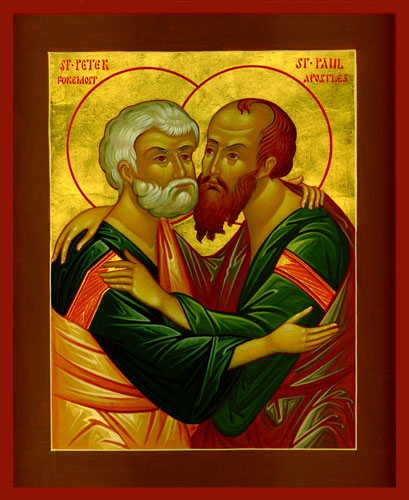
On today’s Feast of Saints Peter and Paul it behooves us to look in detail at the first reading from today’s Mass and see in it a kind of roadmap to growing in faith. Peter’s story and experience were not just for him; they were for us as well. Let’s see what we can learn as we focus on five facts of faith from the story of St. Peter in today’s first reading.
I. The Persecution of Faith – Persecution is the normal state of affairs for a Christian. Not every Christian suffers equally, but Jesus spoke often about the need to be willing to endure persecution for His sake. He said, A servant is not greater than his master. If they persecuted me, they will persecute you also (Jn 15:20). He added, If you belonged to the world, it would love you as its own. As it is, you do not belong to the world, but I have chosen you out of the world. That is why the world hates you (Jn 15:19). He said elsewhere, In the world ye shall have tribulation: but be of good cheer; I have overcome the world (Jn 16:33). He also warned, Woe to you when everyone speaks well of you, for that is how their ancestors treated the false prophets (Lk 6:26).
Therefore, persecution should be expected. If it is wholly absent, we may have some soul-searching to do as to whether we are witnessing to the Faith authentically.
We should not be surprised to see how the early Church was persecuted. This passage describes the persecution, driven by Herod, that breaks out in Jerusalem. During this persecution, James (of “Peter, James, and John” fame) is killed. Peter is also rounded up and slated for death. Sitting in prison, he awaits his fate.
Note the strange excessiveness of the persecution. Peter is secured with double chains and is forced to sleep between two soldiers. Outside there are even more guards keeping watch. Wow! Here’s a persecution that is strangely excessive and obviously rooted in fear!
As we look at persecution today, we notice something similar. There seems to be a very special hatred reserved for Christians, especially Catholics. In the public school system, it is permissible to speak about almost anything: homosexuality, how to use condoms, and even certain religions such as Islam. But if the name of Jesus is mentioned, or Scripture is even obliquely referenced, lawsuits are threatened, and television cameras appear! What drives this strange fear and hatred for Christ? Jews, Buddhists, Muslims, Zoroastrians, and even Methodists and Episcopalians do not face such hostility!
While this animosity is somewhat mysterious, it does speak to us of the uniqueness of Jesus Christ and particularly of the Church He founded the Catholic Church. Satan surely inspires special hatred for Jesus and His Church. In a certain sense, we can take it as a compliment. Perhaps it is driven by the fact that, deep down, they know that what Jesus and His Church teaches is the truth.
The prince of this world hates Jesus and has always inspired his followers to do so as well, whether they follow him consciously or unconsciously. Yes, persecution is a natural, expected ordeal for a Christian.
II. The Prayer of Faith – In the midst of this, we note that the Church is described as praying fervently to God. The Greek word translated here as fervent is ἐκτενῶς (ektenos), which means “fully stretched.” The word evokes the image of a taught rope. Here is prayer that is stretched out, that is costly, that involves more than a brief moment. Here is praying that is persevering. This sort of prayer involves more than an honorable mention in the Prayers of the Faithful at Mass. Here is the sort of prayer that involves long hours. Time and effort are invested. This is the sort of prayer that nags God until the solution is at hand.
There is an expression in the African-American community, “by and by.” It refers to the need to be patient and persevering in prayer while waiting for God to answer in His own time. It is up to us to keep praying, to pray without ceasing, to resist discouragement and just keep on praying.
III. The Prescription of Faith – In the midst of this fervent prayer of the Church, a hidden process begins. An angel is dispatched from Heaven, enters the jail, and comes to Peter. His instructions to Peter amount to a kind a prescription for a life of faith. We note it in five stages:
Rise! – The angel says, “Get up”. Here is a call to rise from death, to rise from despairing and doubt, to stand up! Every Christian must die to sin and rise to new life, must die to slavery and despair and rise as a free and active agent, ready to walk with God.
Restrain – The angel then tells him to put on his cincture (belt). The belt is traditionally a sign of chastity and of continence (restraint). The Christian life cannot be riddled with unchasteness or with other excesses of this world such as greed and gluttony. These hinder the journey; they weigh us down.
Ready – Peter is also told to put on his sandals. This symbolizes readiness to make a journey. When I was young, my mother would often signal me by saying, “Put on your shoes and get ready to go.” Christians must be ready to make the journey, with their feet shod with the gospel of peace, with their shoes on. They must be ready to set out on the great pilgrimage with Jesus to Heaven: up over the hill of Calvary and into glory. Put your shoes on and get ready to go!
Righteous – Peter is then told to put on his cloak. In Scripture, the cloak or robe often symbolizes righteousness. For example, the Book of Revelation says that it was given to the bride to be clothed in fine linen. The text goes on to say that the linen robe is the righteousness of the saints (Rev 19:8). There is also the parable of the wedding guests, one of whom was not properly clothed and was therefore thrown out (Mat 22:11). At a baptism, the priest points to the white garment worn by the infant and tells everyone to see in this white garment the outward sign of the baby’s Christian dignity. He says that the infant is to bring this garment unstained to the great judgment seat of Christ. Thus, the instruction of the angel reminds us that every Christian is to be clothed in righteousness and is to be careful to keep this robe, given by God, unsoiled by the things of this world.
Run! – Finally, there is the command of the angel, “Follow me.” In other words, run the race of faith. Toward the end of his life, St. Paul said, “I have fought the good fight, I have finished the race, I have kept the faith” (2 Tim 4:7). Jesus told His disciples, simply, “Follow me.”
IV. The Procession of Faith – Following this there comes a series of instructions from the angel to Peter (and also to us). These instructions amount to a type of direction to make the procession of faith. We see three things:
Not easy – The text says that they passed the first guard, then a second, and finally came to an iron gate. Similarly, in our journey there are obstacles and dangers. We must recall that we live in paradise lost. Life is not easy; there are hurdles and perils. We are not called to avoid them; we are called the face them with courage. God allows these in our life in order to test us, to see if we will follow Peter’s example and move past the one guard, then the second, and then the apparently locked gate (which God opens for us). Life is not easy, but God’s grace conquers the challenge, if we only trust Him.
Narrow – The text describes a narrow alley through which Peter and the angel pass. Jesus spoke of the way that leads to salvation as a narrow way (e.g., Mat 7:14). Why is this so? Because the narrow way is the cross! Most are not interested in this difficult path, the path that is steep and narrow. Most look for the broad highway through the valley, the easy way. The world still insists that we live in paradise (which Adam rejected) and that life should be easy. It is a lie; the path now is over the hill of Calvary. It is a narrow and steep path, but it is the only true way to glory. Avoid preachers who never mention sin, who never speak of repentance, who never talk about struggles and difficulties. Avoid them. The tuning fork, the A440 of the gospel is the cross. There are glories and joys in this life to be sure, but the fundamental path to Heaven and glory is through the cross. It cannot be avoided. Walk the narrow way, the way of the cross. Do not listen to the “prosperity preachers” who exaggerate one truth and exclude all others.
Need an angel – As soon as Peter emerges from the prison into the openness of freedom, the angel disappears, but until this point, he needed an angel! So do we. Though demons are roaming and patrolling this earth, so are God’s angels. We all have an angel assigned to us and many other angels are along the way to help us. Never forget this. We do not journey alone. For every demon, there are two angels (Rev 9:15). Stop fearing demons and call on God’s angels, trusting in His grace.
V. The Product of Faith – There comes finally the product of faith through which Peter is able to confidently assert, Now I know without a doubt that the Lord has sent his angel and rescued me (Acts 12:11).
Do you know this? Or is it only true because others have said so? Do you experience God’s saving glory? Have you experienced Him rescue you? How? Do you have a testimony? The normal Christian life is to know and experience that our God can and does rescue us from this hell-bound, sin-soaked world. We have a God who can make a way out of no way, and can, as St. Paul says, Rescue us from this present evil age (Gal 1:4). Do you know this? Have you experienced this? Then tell someone! It is the product of faith!
We are in times of strident political protest that includes a lot of harsh language, personal attacks, name calling, and even debased and profane terms. There are tweets, and angry monologues, harsh commentary on news networks, and interruptive press conferences and news interviews that sound more like a brawl than a debate. To put it all more pleasantly, these are times of “colorful” discourse.
What is the overall teaching of Scripture when it comes to this sort of colorful language? Are there some limits and ground rules? Let’s take a look.
The word “civility”dates back to the mid-16th century and has an older meaning that referred to one who possessed the quality of having been schooled in the humanities. In academic settings, debate (at least historically) was governed by a tendency to be nuanced, careful, cautious, formal, and trained in rhetoric. Its rules often included referring to one’s opponents with honorary titles (Doctor, Professor, etc.) and euphemisms such as “my worthy opponent.” Hence as the word entered common usage, it has come to mean speech or behavior that is polite, courteous, gentle, and measured.
As one might guess, there are a lot of cultural variancesin what is civil. And this insight is very important when we look at the biblical data on what constituted civil discourse. Frankly, the biblical world was far less dainty about discourse than we have become in 21st-century America. The Scriptures, including the New Testament, are filled with vigorous discourse. Jesus, for example, really mixes it up with His opponents—even calling them names. We shall see more of this in a moment. But the Scriptures also counsel charity and warn of unnecessarily angry speech. In the end, a balance of the scriptural witness to civility must be sought along with an appreciation of the cultural variables at work.
Let’s examine a few of the texts that counsel charityas well as a modern and American notion of civility:
Anyone who says to his brother, “Raqa” is answerable to the Sanhedrin. But anyone who says, “You fool!” will be in danger of the fire of hell(Matt 5:22).
Do not let any unwholesome talk come out of your mouths, but only what is helpful for building others up according to their needs, that it may benefit those who listen(Eph 4:29).
Fathers, do not provoke your children, lest they become discouraged(Col 3:21).
With the tongue we praise our Lord and Father, and with it we curse men, who have been made in God’s likeness. Out of the same mouth come praise and cursing. My brothers, this should not be (James 3:9-10).
Everyone should be quick to listen, slow to speak, and slow to become angry(James 1:19).
Let your conversation be always full of grace, seasoned with salt(Col 4:6).
Therefore encourage one another and build each other up(1 Thess 5:11).
But now you must rid yourselves of all such things as these: anger, rage, malice, slander, and filthy language from your lips(Col 3:8).
Words from a wise man’s mouth are gracious, but a fool is consumed by his own lips(Eccl 10:12).
The quiet words of the wise are more to be heeded than the shouts of a ruler of fools(Eccles 9:17).
Let us therefore make every effort to do what leads to peace and to mutual edification(Rom 14:19).
Brothers, if anyone is caught in any transgression, you who are spiritual should restore him in a spirit of gentleness. Yet do not regard him as an enemy, but warn him as a brother(Gal 6:1).
Now instead, you ought to forgive and comfort [the repentant sinner], so that he will not be overwhelmed by excessive sorrow(2 Cor 2:7).
All these texts counsel a measured, charitable, and edifying discourse. Name-calling and hateful or unnecessary expressions of anger are out of place. And this is a strong biblical tradition, especially in the New Testament.
But there are also strong contrasts to this instruction evident in the Bible. And a lot of it comes from an unlikely source: Jesus. Paul too, who wrote many of the counsels above, often engages in strident denunciations of his opponents and even members of the early Church. Consider some of the passages below, first by Jesus, then by Paul and other Apostles:
Jesus said, “You brood of vipers, how can you who are evil say anything good?”(Matthew 12:34)
And Jesus turned on them and said, “Woe to you, teachers of the law and Pharisees, you hypocrites! You shut the kingdom of heaven in men’s faces. You yourselves do not enter, nor will you let those enter who are trying to. “Woe to you, teachers of the law and Pharisees, you hypocrites! You travel over land and sea to win a single convert, and when he becomes one, you make him twice as much a son of hell as you are. “Woe to you, blind guides! … You strain out a gnat but swallow a camel. “Woe to you, teachers of the law and Pharisees, you hypocrites! You clean the outside of the cup and dish, but inside they are full of greed and self-indulgence. … You hypocrites! You are like whitewashed tombs, which look beautiful on the outside but on the inside are full of dead men’s bones and everything unclean. … And you say, ‘If we had lived in the days of our forefathers, we would not have taken part with them in shedding the blood of the prophets.’ So you testify against yourselves that you are the descendants of those who murdered the prophets. Fill up, then, the measure of the sin of your forefathers! “You snakes! You brood of vipers! How will you escape being condemned to hell?”(Matt 23 varia)
Jesus said to them, “If God were your Father, you would love me, for I came from God and now am here. I have not come on my own; but he sent me. … You belong to your father, the devil, and you want to carry out your father’s desire. … He who belongs to God hears what God says. The reason you do not hear is that you do not belong to God” (John 8:42-47).
Jesus said, Isaiah was right when he prophesied about you hypocrites; as it is written: “These people honor me with their lips, but their hearts are far from me”(Mark 7:6).
And Jesus answered them, O faithless generation, how long am I to be with you? How long must I tolerate you?(Mark 9:19)
Jesus said to the disciples, “If you, then, though you are evil, know how to give good gifts to your children, how much more will your Father in heaven give good gifts to those who ask him!” (Matt 7:11)
Jesus said to the crowd, “I do not acceptpraise from men, but I know you. I know that you do not have the love of God in your hearts”(Jn 5:41-42).
So he made a whip out of cords, and drove all from the temple area, both sheep and cattle; he scattered the coins of the money changers and overturned their tables(John 2:15).
Then Jesus replied, “Have I not chosen you, the Twelve? Yet one of you is a devil!”(John 6:70)
Paul: O senseless Galatians, who hath bewitched you that you should not obey the truth … As for those circumcisers, I wish they would go the whole way and emasculate themselves!(Galatians 3, 5)
Paul against the false apostles:And I will keep on doing what I am doing in order to cut the ground from under those who want an opportunity to be considered equal with us in the things they boast about. For such men are false apostles, deceitful workmen, masquerading as apostles of Christ. And no wonder, for Satan himself masquerades as an angel of light. It is not surprising, then, if his servants masquerade as servants of righteousness. Their end will be what their actions deserve (2 Cor 11:11-14).
Paul on the Cretans:Even one of their own prophets has said, “Cretans are always liars, evil brutes, lazy gluttons.” This testimony is true. Therefore, rebuke them sharply, so that they will be sound in the faith(Titus 1:12-13).
Peter against dissenters:Bold and arrogant, these men are not afraid to slander celestial beings…these men blaspheme in matters they do not understand. They are like brute beasts, creatures of instinct, born only to be caught and destroyed, and like beasts they too will perish. … They will be paid back with harm for the harm they have done. … They are blots and blemishes, reveling in their pleasures while they feast with you. With eyes full of adultery, they never stop sinning; they seduce the unstable; they are experts in greed—an accursed brood! … Of them the proverbs are true: “A dog returns to its vomit,” and, “A sow that is washed goes back to her wallowing in the mud”(2 Peter 2, varia).
Jude against dissenters:These dreamers pollute their own bodies, reject authority and slander celestial beings….these men speak abusively against whatever they do not understand; and what things they do understand by instinct, like unreasoning animals—these are the very things that destroy them. Woe to them! They have taken the way of Cain; … These men are blemishes at your love feasts, eating with you without the slightest qualm—shepherds who feed only themselves. They are clouds without rain, blown along by the wind; autumn trees, without fruit and uprooted—twice dead. They are wild waves of the sea, foaming up their shame; wandering stars, for whom blackest darkness has been reserved forever. … These men are grumblers and fault finders; they follow their own evil desires; they boast about themselves and flatter others for their own advantage(Jude 1:varia).
Now most of the passages above would violate modern norms about civil discourse.Are they sinful? They are God’s word! And yet they seem rather shocking to modern ears. Imagine getting into your time machine and going to hear Jesus denounce the crowds and calling them children of the devil. It really blows a 21st-century mind!
I want to suggest to you that these sorts of quotes go a long way toward illustrating the cultural dimension of what it means to be civil.The bottom line is that there is a great deal of variability in what people consider civil discourse. In some cultures there is a greater tolerance for anger. In New York and Boston, edgy comments and passionate interruptive debate are common. But in the upper-Midwest and parts of the Deep South, conversation is more gentle and reserved.
At the time of Jesus, angry discourse was apparently more “normal,”for as we see, Jesus Himself engages in a lot of it, even calling people names like “hypocrites,” “brood of vipers,” “liars,” and “wicked.” Yet the same Scriptures that record these facts about Jesus also teach that He never sinned. Hence at that time, the utterance of such terms was not considered sinful.
Careful, now—be careful here. This does not mean it is simply OK for us to talk like this because Jesus did. We do not live then; we live now; and in our culture such dialogue is seldom acceptable and often backfires. There ARE cultural norms we have to respect to remain in the realm of Charity. Exactly how to define civility in every instance is not always clear. An old answer to these hard-to-define things is “I know it when I see it.” So perhaps it is more art than science to define civility. But clearly we tend to prefer gentler discourse in this day and age.
On the other hand, we also tend to be a little thin-skinnedand hyper-sensitive. And the paradoxical result of insisting on greater civility is that we are too easily “outraged” (one of the more overused words in English today). We take offense where none is intended and we presume that the mere act of disagreeing is somehow arrogant, intentionally hurtful, or even hateful. We seem so easily provoked and so quick to be offended. All of this escalates anger further, and charges of hate and intolerance are launched back and forth when there is merely sincere disagreement.
Balance– The Scriptures give us two balanced reminders. First, that we should speak the truth in love, and with compassion and understanding. But it also portrays to us a time when people had thicker skin and were less sensitive and anxious in the presence of disagreement. We can learn from both biblical traditions. The biblical formula seems to be “clarity” with “charity,” the truth with a balance of toughness and tenderness. An old saying comes to mind: “Say what you mean, mean what you say, but don’t say it mean.”
Here is a video that depicts the zeal of Jesus and a bit of his anger.

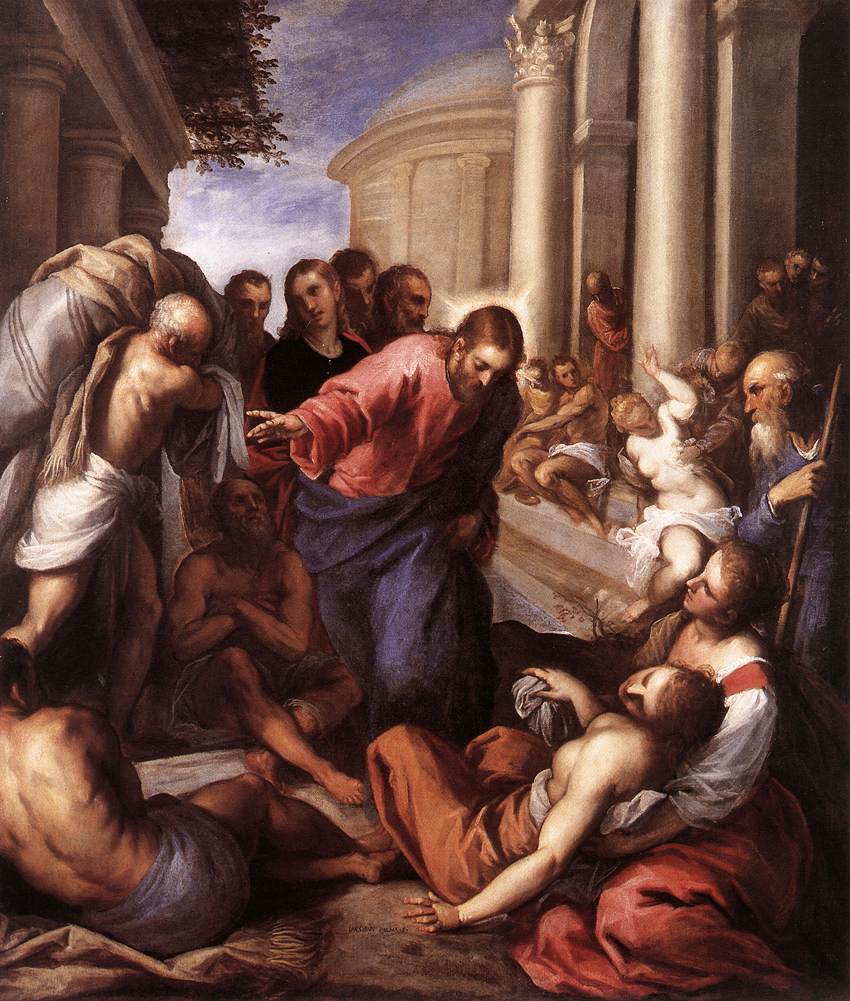 Today I’d like to reflect further on the Gospel reading from today’s Mass (Thursday of the 13th week of the year). It tells the story of the paralyzed man whom Jesus tells to have courage because his sins are forgiven.