In 1929, Edwin Hubble discovered that the universe was not static but was in fact expanding outward from some point of singularity. At first his fellow scientists ridiculed his theory, labeling it with the term “the big bang.” Even as late as the 1960s I remember being taught in school that the universe was eternal and fixed. That “settled science” has since given way to the current view that the universe is expanding outward—quite rapidly, in fact.
There is more, however: a mysterious factor called “dark energy” complicates things. If we think of the analogy of an exploding Fourth of July firework, we observe that its rapid outward expansion decelerates as the force of gravity slows and then finally halts its outward motion. Similarly, as our universe expands outward we would expect to see some slowing in the rate of its outward expansion as stars and galaxies exert their gravitational forces. However, measurements indicate that expansion is not slowing down; it’s speeding up. Many scientists attribute this to “dark energy.” It is called “dark” because it is poorly understood. Its effects can be observed, but what “it” is remains a “dark” or mysterious reality.
Hmm, the universe is speeding up as it expands. This is rather counterintuitive!
So, what is this dark energy that causes the universe to expand ever more rapidly?
I would like to propose an answer not from the physical sciences but from the realm of theology, speculative theology at that. As such, my answer does not dwell on material or efficient causality but rather on formal and final causality. (Material causality focuses on what is changed; efficient causality focuses on the way something is changed. Formal causality focuses on the active agent that causes the change; final causality focuses on the reason that this agent of change acts.)
The answer is love. God, who is love, created all things in love by the powerful effect of His love and Word diffusing outward. Love does not diminish but intensifies and multiplies as it is shared. Love is effusive of itself. It seeks to share and multiply. Adam and Eve are told to be fruitful and multiply in marital love. Yes, love expands and intensifies if it is offered and received generously.
In a finite world, we tend to think of everything in it as part of a zero-sum game. So, if I take something, there is less of it for you. Love is not that way. Hugs multiply when shared. A small act of kindness can have great effect, far beyond its initial limited scope. Knowledge is this way, too. We think that if we learn one thing, then the number of things to learn decreases; in fact, the questions simply multiply and grow more urgent.
As a picture of love, consider the Easter Vigil. From one small flame atop the Easter candle every other candle held by the faithful in the church is lit and shared, and yet the flame of the Easter candle is in no way diminished or dimmed. It is “a flame divided but undimmed.” As that light goes outward, the church brightens more rapidly as the light is shared by more and more people in the congregation. Yes, the speed at which the light (Christ) goes out increases as it is shared by more and more. This is a small picture of our universe.
This is why the universe expands more rapidly as it goes outward: Love, God’s love!
Please understand the humility and lightheartedness with which I offer this explanation. I speak as a “theologian” and look to formal and final causalities. I am under no illusion that the physical sciences can accept my answer; they deal primarily in material and efficient causality and must stay within those limits and work with those premises. Theology, however, based on revelation, can enter into formal and final causality.
To you who believe I have this message: Do not ever forget that everything you see in the abundance of the universe and in its astonishing size and speed is rooted in a creative act of love by God, who is love. You are not simply walking around in a machine; you are walking about in an act of love that is sustained by love.
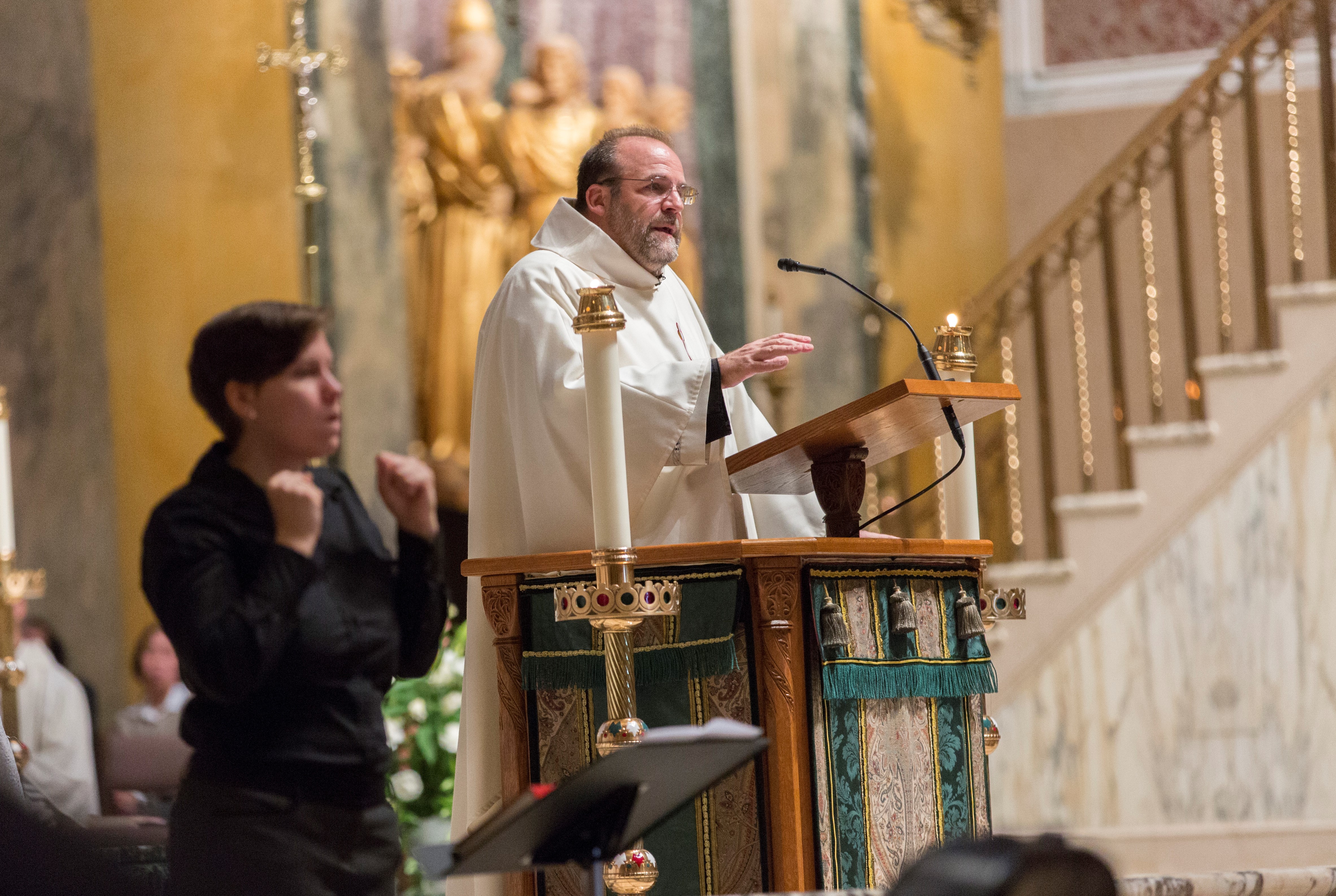
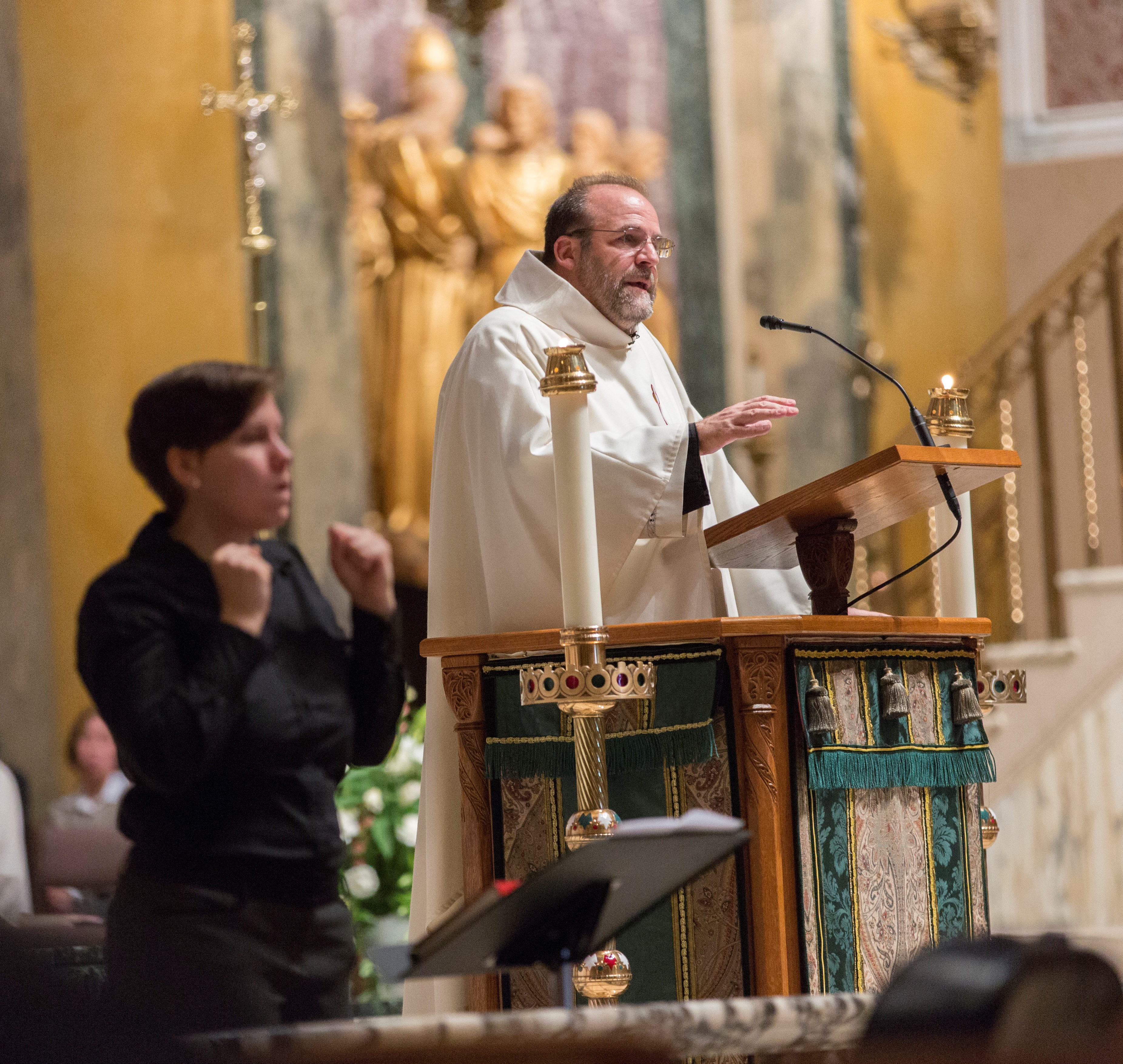
photo credit – J. Lippelmann, Catholic StandardThe following is taken from a homily I preached this past weekend for the Archdiocese of Washington’s annual White Mass, celebrating the gifts of persons with disabilities/special needs and the deaf community. You can view the video of the homily here at the Archdiocese’s YouTube page.
I would like to speak to you today about the courage to see. You might not think that it takes courage to see, but it does. Most of us have many things we either don’t want to see or don’t want to hear. This is typically because it might challenge our way of thinking, summon us to new attitudes, require us to change our behavior, call us to change the way we regard other people, and/or necessitate the reordering of our priorities. Not only does it take courage to see; it takes courage even to want to see.
When we ponder today’s Gospel of the blind man (Bartimaeus) in Jericho, we need to remember that the gospels are not “spectator sports.” We are not simply hearing the story of some man who lived 2,000 years ago. No, this is our story, too; we are in every gospel. We are in today’s Gospel in several ways: we are the blind man; we are in the crowd; and, if you’re prepared to accept it, we are also Jesus (for we, too, are called to help others to see).
How are we the blind man? Some here today are physically blind, and there is obviously no sin in that, but all of us struggle with some degree of spiritual blindness. There are many things we should see, but do not. Sometimes we are afraid to see, at other times we resist seeing because we know it will make new demands upon us. We might have to question some of our political stances, or worldviews. We might be challenged to change the way we live or how we regard others. Yes, some of us are willingly blind or lack the courage to see.
We are gathered here today in particular to recognize the dignity of persons with disabilities/special needs. Some disabilities are readily apparent; others are more hidden. As we age, most of us are headed for some degree of disability. Many in our world recoil from looking at or seeing disability, and even if we see it, we often fail to recognize the dignity and gifts of persons with special needs or disabilities. Yes, many people today remain blind when it comes to seeing the dignity and gifts of those who are disabled.
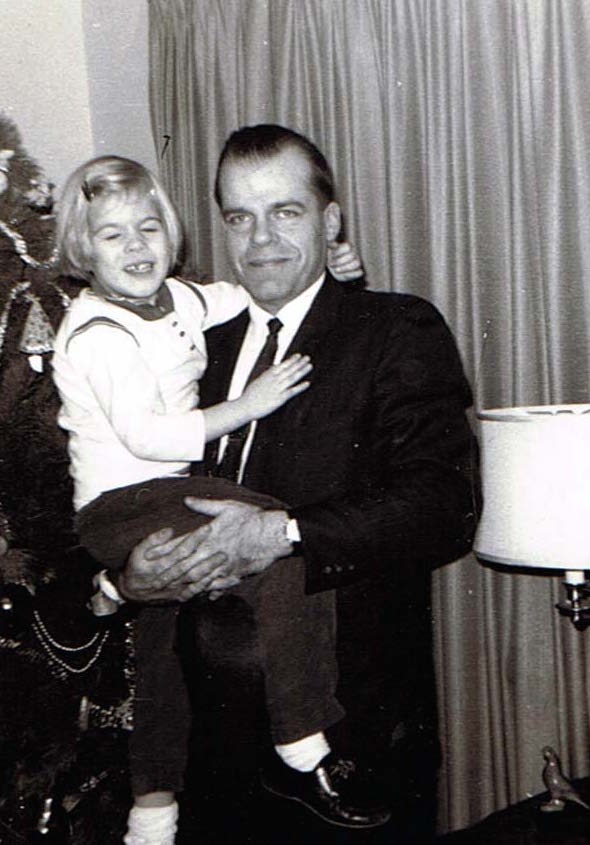
Charles Pope and daughter Mary Anne
To illustrate I will tell a story about my past. My sister, Mary Anne Pope, was gravely afflicted with mental illness. Even when she was in elementary school the guidance counselor called her “disturbed.” By the time she was in sixth grade, Mary Anne had entered the mental health system diagnosed with paranoid schizophrenia. She spent the remainder of her life living in one of fifteen different mental hospitals and five different group homes. Mary Anne died in a fire in 1991, a fire she likely set. She had often heard voices in the past that told her to do terrible things and setting fires was one of them.
A great sadness in my life is that it took Mary Anne’s death for me to see her dignity and her true suffering. I was blind, and in a certain sense I wanted it that way. I had often avoided talking to her. She often wanted to talk to me about her unusual dreams and needed attention, but I made excuses and privately complained to my parents about her unwanted requests.
Four days after her death, however, I looked right into the face of her pain. The funeral directors explained that they had made Mary Anne’s body presentable enough for the immediate family to view briefly, but that her features were delicate because the fire had singed her upper body making it difficult to change her appearance or adjust the expression on her face. We gathered together for a last look, and it was then that I saw it. She had clearly died weeping. Yes, I could see the pain on her face as her body lay in the casket and I wept deeply when I saw her. All of us did. Mary Anne! It was a grief observed, a very deep grief.
How could I have missed it all those years? Was it my fear of her? Was it my annoyance? Perhaps it was my frustration at not being able to do anything, but I was blind to her grief and to her dignity. That day, looking at her one last time, I received the gift to see her more in the way that God did. “Mary Anne,” I thought, “How little I really knew you or understood your pain. I’m so sorry I missed it. I’m sorry I didn’t understand. I’m sorry I didn’t see, that I resisted seeing.”
I was (and in many ways still am) Bartimaeus, the blind man of Jericho. My sister’s final gift was that God taught me to see through her. I resolved that it should not take a tragic death for me to see the dignity and gifts of those with disabilities or special needs.
How are we Jesus in this story? As a Church, we must help others to see. Most people prefer not to see, but we must help them to see by shining the light of Jesus on this world.
It is critical today that we help others to see the dignity of those with special needs or disabilities. In this culture of death, there are many who do not see this at all and many who prefer not to see it, prescribing death as a strange kind of “therapy.” Two critical examples come to mind.
First, there is the sad reality that more than 90 percent of parents who receive a poor prenatal diagnosis respond by aborting their unborn child. Unborn children diagnosed with Down Syndrome, a significant medical issue, or a special need are almost always aborted. Not only do we have no right to do this, but this demonstrates a blindness to the dignity and gifts of persons with disabilities or special needs, whether unborn, young, or elderly. God sends gifts as well as challenges into our lives. We have to be like Jesus and help others to see this.
The second issue is that of physician-assisted suicide/euthanasia. Most of us are going to be less and less able as we get older. The idea that we should be able to end our own life when the perceived quality of life diminishes is an attitude that endangers everyone, especially the disabled. Your “right to die” becomes my duty to die when I become too much of a burden to others. In countries where euthanasia and/or physician-assisted suicide have been legal for a long time, there is indeed significant pressure to end the lives of the disabled, those with profound special needs, and the dying.
This blindness to the dignity of all human persons, from conception to natural death, is one we are called to heal as the active presence of Christ in the world.
A final vision to restore in this world of preferred blindness is the vision of the great reversal that is coming. We ought to be careful to remember that in Heaven, many whom the world calls last are going to be first. Yes, Jesus said, So the last will be first, and the first will be last. (Matt 20:16). Mother Mary said, He has cast down the mighty from their thrones and lifted up the lowly (Luke 1:57). Cardinal George once said, “In this world the poor need us, but in the next world we are going to need them.” This is true not only of the poor, but of those who suffer as well.
As Jesus’s presence in the world, the Church must heal the blindness of the many who fail to see not only the current dignity of those who suffer, but also their future glory.
I think I’m going to need an appointment to meet my sister Mary Anne in Heaven. Because she suffered so much more than I, she will be far more exalted.
For all those gathered here today who endure special sufferings, never forget that the great reversal that is coming. These momentary afflictions will produce a far greater glory (see 2 Cor 4:18ff).
I would like to conclude with some lyrics from an old spiritual, “Done Made My Vow.”
Refrain:
Done made my vow to the Lord, And I never will turn back, Oh I will go, I shall go to see what the end will be.
Verse 1:
Sometimes I’m up, sometimes I’m down; See what the end will be, But still my soul is heav’nly bound, See what the end will be. (Refrain)
The epistle from Monday’s daily Mass (30th Week of the Year) contains an admonition against unchastity. This grave warning is essential in times like these, when many call good or “no big deal” what God calls sinful. This is especially true in the realm of sexuality; entire sectors of society not only tolerate but even celebrate sexual practices that Scripture calls gravely sinful and that will lead to Hell if not repented of. Homosexual acts, fornication, and adultery cannot be considered allowable by any Catholic or any person who sincerely accepts Scripture as the Word of God. Even those who do not share our faith should be able to observe the damage these acts cause: they spread disease, harm marriages and families, subject children to less-than-ideal households (e.g., single mother/absent father), and lead to abortion.
In today’s post I will focus on the sin of fornication and present the clear biblical teaching against it. Sadly, many Catholics report that little to nothing is heard from the pulpit or in the classroom about this issue. The hope in this post today is to present a resounding, biblical trumpet call to purity that leaves no doubt as to the sinfulness of sex before marriage. Scripture is clear: fornicators will not inherit the Kingdom of God. That is to say, fornication is a mortal sin and those who do not repent of it will go to Hell.
The usual conditions for mortal sin apply (grave matter, sufficient reflection, and full consent of the will). In most situations, these conditions are met. Over the years I have met with many sexually active couples preparing for marriage and have never found them to be surprised that I rebuke them for this. They know it is wrong; the voice of God echoes in their consciences. As for consent of the will, although some fall occasionally in a weak moment, consistent fornicating with no measures taken to prevent it (e.g., not cohabitating) is not weakness; it is sinful neglect of prudence and common sense.
We are in a sinfully confused cultural setting in which many either celebrate or make little effort to avoid what God calls serious sin. The Church must not lack clarity, yet pulpits and classrooms have often been silent. This has led to parents themselves to be silent—and silence is often taken as tacit approval.
Fornication cannot be approved of. It is sinful and excludes unrepentant sinners from Heaven. Our charity for souls compels our clarity about the grave sinfulness of premarital sex.
The following passages from the New Testament clearly condemn fornication and other unclean or impure acts. The gravity and clarity of such condemnations are helpful in the sense that they help us to take such matters seriously and steer clear of them. However, the condemnations should not be seen in isolation from God’s mercy, as He never fails to forgive those who come to Him with a humble and contrite heart. God hates sin, but He loves sinners and is full of mercy and compassion for them. This mercy must be accessed through repentance, however.
There is a general requirement for sexual purity.
Among you there must not be even a hint of sexual immorality, or of any kind of impurity, or of greed, because these are improper for God’s holy people. Nor should there be obscenity, foolish talk or crude joking, which are out of place, but rather thanksgiving. For of this you can be sure: No fornicator, no impure or greedy person—such a man is an idolater—has any inheritance in the kingdom of Christ and of God. Let no one deceive you with worthless arguments. These are sins that bring God’s wrath down upon the disobedient; therefore, have nothing to do with them (Ephesians 5:3-7).
Unrepentant fornicators are excluded from the kingdom.
The one who sat on the throne said to me, “See I make all things new!” Then he said, “Write these matters down for the words are trustworthy and true!” He went on to say: “These words are already fulfilled! I am the alpha and the omega, the beginning and the end. To anyone who thirsts I will give to drink without cost from the spring of life-giving water. He who wins the victory shall inherit these gifts and he shall be my son. As for the cowards and traitors to the faith, the depraved and murderers, the fornicators and sorcerers, the idol-worshipers and deceivers of every sort—their lot is the fiery pool of burning sulphur, the second death!” (Revelation 21:5-8)
Happy are they who wash their robes so as to have free access to the tree of life and enter the city through its gates! Outside are the dogs and sorcerers, the fornicators and murderers, the idol-worshipers and all who love falsehood. It is I Jesus who have sent my angel to give you this testimony about the Churches (Rev. 22:14-16).
No fornicator, no impure or greedy person—such a man is an idolater—has any inheritance in the kingdom of Christ and of God (Eph 5:5).
I warn you, as I have warned you before: those who do such things shall not inherit the kingdom of God! (Gal 5:21)
Sins of the flesh crush the spirit within us.
My point is that you should live in accord with the Spirit and you will not yield to the cravings of the flesh. The Flesh lusts against the spirit and the spirit against the flesh; the two are directly opposed. This is why you do not do what your will intends. If you are guided by the spirit you are not under the law. The acts of the sinful nature are obvious: sexual immorality, impurity and debauchery, idolatry, sorcery, hostilities, bickering jealousy, outbursts of rage, selfish rivalries, dissensions, factions, envy, drunkenness, orgies and the like. I warn you, as I have warned you before: those who do such things shall not inherit the kingdom of God! (Galatians 5:16-21)
Even our thought life is summoned to purity.
You have heard the commandment “You shall not commit adultery.” What I say you to is, Anyone who looks lustfully at a woman has already committed adultery with her in his thoughts. If your right eye is your trouble, gouge it out and throw it away! Better to lose part of your body than to have it all cast into Gehenna. Again, if your right hand is your trouble, cut it off and throw it away! Better to lose part of your body than to have it all cast into Gehenna (Matthew 5:27-30).
From the mind stem evil designs—murder, adulterous conduct, fornication, stealing, false witness, blasphemy. These are the things that make a man impure (Matt. 15:19-20).
Wicked designs come from the deep recesses of the heart: acts of fornication, theft, murder, adulterous conduct, greed, maliciousness, deceit, sensuality, envy, blasphemy, arrogance, an obtuse spirit. All these evils come from within and render a man impure (Mark 7:21).
Sexual impurity is a form of worldliness and idolatry.
Put to death whatever in your nature is rooted in earth: fornication, uncleanness, passion, evil desires and that lust which is idolatry. These are sins which provoke God’s wrath (Colossians 3:5-6).
My body is not my own to do with merely as I please.
Can you not realize that the unholy will not fall heir to the Kingdom of God? Do not deceive yourselves: no fornicators, idolaters, or adulterers, no sodomites, thieves, misers, or drunkards, no slanderers or robbers will inherit the kingdom of God. And such were some of you; but you have been washed, consecrated, justified in the name of our Lord Jesus Christ and in the Spirit of our God. Do you not see that your bodies are members of Christ? Would you have me take Christ’s members and make them members of a prostitute? God forbid! Can you not see that the man who is joined to a prostitute becomes one body with her? Scripture says, “The two shall become one flesh.” But whoever is joined to the Lord becomes one spirit with him. Shun lewd conduct. Every other sin a man commits is outside of his body, but the fornicator sins against his own body. You must know that your body is a temple of the Holy Spirit, who is within – the Spirit you have received from God. You are not your own. You have been purchased at a price. So, glorify God in your body (I Cor. 6:9-11, 15-20).
The call to Christian purity is not merely a human opinion; it is God’s declared truth. Further, sexual sin is a form of injustice.
Now my brothers, we beg and exhort you in the Lord Jesus that, even as you learned from us how to conduct yourselves in a way pleasing to God—which you are indeed doing—so you must learn to make still greater progress. You know the instructions we gave you in the Lord Jesus. It is God’s will that you grow in holiness: that you abstain from sexual immorality, each of you guarding his member in sanctity and honor, not in passionate desire as do the Gentiles who know not God; and that each must refrain from overreaching or cheating his brother in the matter at hand; for the Lord is the avenger of all such things, as we once indicated to you by our testimony. God has not called us to sexual immorality but to holiness; hence whoever rejects these instructions rejects, not man, but God who sends the Holy Spirit upon you (I Thess. 4:1-8).
Fornication and other sexual sins are numbered among the more serious sins.
We know that the Law is good, provided one uses it in the way law is supposed to be used—that is, with the understanding that it is aimed, not at good men but at the lawless and unruly, the irreligious and the sinful, the wicked and the godless, men who kill their fathers or mothers, murderers, fornicators, sexual perverts, kidnappers, liars, perjurers, and those who in other ways flout the sound teaching that pertains to the glorious gospel of God—blessed be he—with which I have been entrusted (1 Timothy 1:8-11).
Fornication and adultery dishonor marriage.
Let marriage be honored in every way and the marriage bed be kept undefiled, for God will judge fornicators and adulterers (Heb 13:4).
Therefore, do not be deceived. Fornication is a serious sin, a mortal sin. It is a sin that excludes one who does not repent of it from Heaven. It offends God, harms marriage and the family, spreads disease, encourages abortion, is an injustice to children and society, and dishonors marriage. It merits strong punishment, as God’s Word declares.
Do not despair of God’s mercy but do repent. Mercy is accessed only through repentance. It is wrong—seriously wrong—to fornicate. Repent without delay.
In the Letter to the Ephesians, from which we read at this past Saturday’s daily Mass, St. Paul has this to say:
And [Christ] gave some as Apostles, others as prophets, others as evangelists, others as pastors and teachers, to equip the holy ones for the work of ministry, for building up the Body of Christ, until we all attain to the unity of faith and knowledge of the Son of God, to mature manhood to the extent of the full stature of Christ, so that we may no longer be infants, tossed by waves and swept along by every wind of teaching arising from human trickery, from their cunning in the interests of deceitful scheming. Rather, living the truth in love, we should grow in every way into him who is the head, Christ (Eph 4:11-15).
Coming to maturity is an important step in the Christian walk. Ideally the Church persistently helps people to do so. We are expected to grow, to come to an adult faith, and to draw others—especially our children—to this. The Letter to the Hebrews has something very similar to say:
You are slow to learn. In fact, though by this time you ought to be teachers, you need someone to teach you the elementary truths of God’s word all over again. You need milk, not solid food! Anyone who lives on milk, being still an infant, is not acquainted with the teaching about righteousness. But solid food is for the mature, who by constant use have trained themselves to distinguish good from evil (Heb 5:11-14).
This is especially important today, when maturity is often significantly delayed. In fact, there are many who never seem to grow up. I have argued in other posts that one of the defining characteristics of our culture is its fixation with teenage issues and attitudes. In psychological terms, a person with a fixation is one who has not successfully navigated one of the stages of childhood and thus remains stuck to some degree in the thinking and patterns of that stage.
Our culture’s fixation on teenage issues and attitudes can be seen in some of the following:
Aversion to authority
Refusal to exercise the legitimate authority one has
Titillation and irresponsibility regarding sexuality
Lack of personal accountability
Irresponsibility
Demanding one’s rights while avoiding one’s responsibilities
Blaming others for one’s own personal failings
Being dominated by one’s emotions and carried away easily by the passions
Obsession with fairness, evidenced by the frequent cry, “It’s not fair!”
Expecting others (including the government) to do for one what one should do for oneself
Aversion to being instructed
Rejection of the wisdom of elders and tradition
Obsession with remaining and looking young
Aversion to becoming or appearing old
Lack of respect for elders
Obsession with having a thin, youthful body
Glorification of teenage idols
Inordinate delay of marriage and widespread preference for the single life
Disclaimers
Some of the items in the list above have proper adult versions. For example, the “obsession with fairness” can mature and become a commitment to work for justice; aversion to authority can mature to a healthy and respectful insistence that those in authority be accountable to those whom they serve. It is also true that not every teenager has all the issues listed above. The point here is that the culture in which we live seems stuck on a lot of teenage attitudes and as a result our overall maturity is significantly delayed.
The description above certainly paints a less-than-flattering portrait of our culture. Archbishop Charles Chaput wrote recently on this topic, referring to it as “moral adolescence.” If you reject this assessment, how would you describe our culture? Do you think it is healthy and mature?
The call to maturity and the role of the Church – God’s expectation (expressed through His Scriptures) that we come to maturity, to the fullness of adult faith. Further, the Church is expected, as an essential part of her ministry, to bring this about in us through His grace. The Church does this in her better moments, when we who have leadership in the Church (clergy, parents, catechists, and elders) are faithful to our call. Notice that the Ephesians text says that Christ has given apostles, prophets, evangelists, pastors, and teachers, to equip the holy ones unto this.
The Church is expected to be “the adult in the room.” She is to summon us to live responsible, mature lives. She summons us to be accountable before others, to be sober, serious, and deeply respectful of God’s authority over us by living lives that are obedient to the faith. She teaches us to master our emotions and gain authority over our passions, by God’s grace. She holds forth for us the wisdom of tradition and the teachings of the Scriptures, insisting on reverence for them. She insists on correct doctrine and that we no longer be infants, tossed by the waves of the latest fads and swept along by every wind of false teaching arising from human illusions. We are to be stable and mature in our faith and judge the world by it.
Unfortunately, there is currently something of an internal problem. The Church has faced the grave temptation to “put on jeans” and adopt the teenage fixations. Sadly, not all leaders in the Church have taken seriously their obligation to “equip the holy ones for the work of ministry … until we all attain to the unity of faith and … to mature manhood to the extent of the full stature of Christ.” Preferring popularity to the negative cries that our teachings are “unfair,” or “too hard,” many teachers and pastors have succumbed to the temptation to water down the faith and to tolerate grave immaturity on the part of fellow Catholics. We have a long way to go in terms of vigorously and credibly reasserting the call to maturity within the Church, let alone the world. Corruptio optimi pessima (the corruption of the best is the worst). Clergy and other Church leaders, catechists, and teachers must insist on their own personal maturity and hold one other accountable in attaining it. We must fulfill our role of equipping the faithful unto mature faith by first journeying to an adult faith ourselves.
The Church is not composed only of clergy and religious. Lay people must also take up their proper role as mature, adult Christians, active in renewing the temporal order. Many already have done this magnificently. but more must follow and be formed in this way. Our culture is in dire need of well-formed Christians to restore greater maturity, sobriety, and responsibility.
By God’s grace, we are called to be “the adult in the room.”
Here is a video (from a more mature time) on one aspect of maturity: proper self-reliance. It’s a little corny, but it does model something that is often lacking in families and in youth formation today: clear teaching by adults. The point made in the video is that we should not usually do for others what they can and should do for themselves. Part of maturing is learning that behavior has consequences, as well as learning the value of and need for hard work. While it is appropriate to rely on others to some degree and to rely completely on God, there is also a proper self-reliance in coming to maturity.
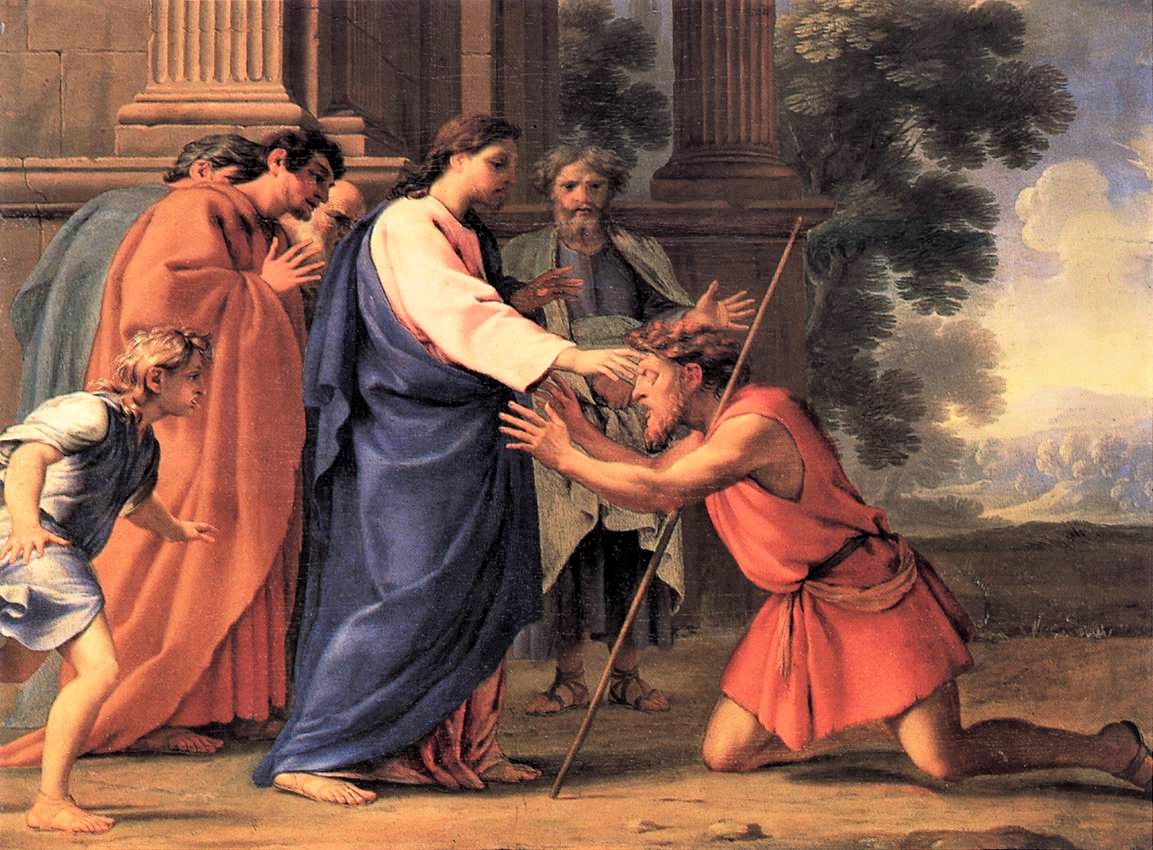
This Sunday’s Gospel features the well-known story of the healing of the blind man (Bartimaeus). When listening to any familiar story, we are inclined, upon hearing its opening lines, to think, “Oh, that story,” and just sort of tune out. If we do so, though, we may miss some important details.
The story of Bartimaeus is also our story; we, too, must let the Lord heal our blindness and give us sight. One paradox of this Gospel is that Bartimaeus receives his sight as the result of hearing.
Let’s look at the Gospel in six stages.
I. The Perception of the Problem – The text says, As Jesus was leaving Jericho with his disciples and a sizable crowd, Bartimaeus, a blind man, sat by the roadside begging.
Bartimaeus has troubles; he is both blind and poor. He is not spiritually blind, however, for he is aware of his problems. Knowing our troubles, being in touch with our neediness, is an important spiritual insight that many people lack.
We all depend on God for every beat of our hearts, yet some people are unaware of how blind, poor, naked, and pitiable they are before God (cf Rev 3:17). In their pride, those who are spiritually blind lose this insight. They fail to ask for help from the Lord; they fail to ask for grace. Jesus said to the Pharisees, “If you were blind, you would not be guilty of sin; but since you claim you can see, your guilt remains” (John 9:41). In other words, physical blindness is not their problem; it is spiritual blindness. Because they think themselves righteous by their own power, they think they do not need God and do not truly seek Him. Only humility and a true “vision” and experience of our poverty can help us to call out to God as we should.
Bartimaeus knows that he is blind, so he calls for help. His pleas need some direction, though; they need to be properly specified and directed.
So, we begin by noting that although Bartimaeus is blind he has spiritual insight.
Do we have this insight? Do we understand how blind we are? We struggle to see God; we struggle to see and understand ourselves; we struggle to see others with compassion and understanding. Indeed, God is more present to us than is anything in this world. Somehow, we can see all the things of this world yet struggle to see God. Neither do we see our own dignity, or the dignity and the gifts of others, including our enemies. We do not see or understand how things work together, and we struggle to see and find meaning in the events of our day. We are also blind to our sin and seldom fully comprehend the harm our sin does.
Yes, we have a great deal of blindness; we struggle to see. Perhaps our worst blindness is not realizing how blind we are. Like the Pharisees, we think that because we know a few things, we therefore know many things.
Consider Bartimaeus’ humility: he knows he is blind, that he needs help, grace, and mercy. It is this humility that opens the door. The first stage in the journey is perceiving the problem.
II. The Proclamation that is Prescribed – The text says, On being told it was Jesus of Nazareth who was passing by, he began to cry out and say, “Jesus son of David have pity on me.”
Note the subtle but important transition here. Up until this point, Bartimaeus has been calling upon anyone passing by for help. But no mere passerby, nor in fact anyone in this world, can ultimately help him with his real problem.
It is the same with us. Though we may turn to science, medicine, philosophy, economics, or politics, none of these can really help us. At best these can serve to specify what is wrong or to provide us with temporary comfort, but all these solutions will be rooted in this world, which is passing away.
True vision can only be granted by the Lord, who opens for us a vision of glory and who alone can draw us safely to that place where joys will never end, and visions will never cease.
When Bartimaeus is told of Jesus’ presence, he directs his cry to the Lord, who alone can heal him: Jesus, son of David, have pity on me! The world and passersby can give him money or a meal, but only Jesus can give him meaning, the true vision he really needs to see.
Do not miss the fact that his seeing comes, paradoxically, through hearing. Faith comes by hearing, and more specifically, hearing from the Word of God (cf Rom 10:17). Faith is about hearing, not seeing. We sometimes doubt things that we see. Even if we see a marvel, we tend to dismiss it, thinking, “Oh, they have some way of doing that.” No, the eye is never satisfied with seeing (cf Eccl. 1:8). Faith comes by hearing, and faith is obedience to what is heard. We walk by faith, by an inner seeing, not by physical sight.
Bartimaeus hears from others that Jesus is passing by and takes up the proclamation that is prescribed: “Jesus, Son of David, have pity on me!”
III. The Perseverance that Produces – The text says, And they rebuked him, telling him to be silent. Yet he kept calling all the more, “Son of David, have pity on me!” Jesus stopped and said, “Call him.” So they called the blind man saying to him, “Take courage; get up. Jesus is calling you.”
Those of us who put our trust in the Lord and call on Him will often experience rebuke, hostility, and ridicule from the world. Bartimaeus ignores all of this and so should we. He has heard the Name above all names, who alone in Heaven and earth can save, and calls upon Him.
Jesus does not answer him right away, but the Bartimaeus perseveres, calling out all the more. Eventually, Jesus stops and says, “Call him.”
Why does God delay? While this is a mystery, one of the effects of His delay is to test our faith and strengthen it. In the end, it is not an incantation that saves us, but faith. Simply shouting, “In the name of Jesus!” is not enough. The name of Jesus is not some magical phrase like “Open, Sesame.” Rather, it is an announcement of faith, and faith is more than words. Ultimately, it is not words alone that save us, but the faith that must underlie the words.
IV. The Priority that is Presented – The text says, He threw aside his cloak, sprang up, and came to Jesus.
Do not miss this important detail: Bartimaeus’ cloak is probably the most valuable thing he owns. In that arid climate, the temperature drops rapidly after sunset, and it gets quite cool. In fact, so critical was the cloak that Scripture forbade taking one as collateral for a loan: If a man is poor, do not go to sleep with his pledge in your possession. Return his cloak to him by sunset so that he may sleep in it (Deut 24:12-13).
Despite this, Bartimaeus casts aside his cloak and goes to Jesus. He leaves behind perhaps the item most necessary for his survival in this world. Missing a meal might be inconvenient or uncomfortable but it would not kill him. Spending one cold night without his cloak might well cause his death by hypothermia. Yet Bartimaeus leaves it behind and runs to the Lord.
What about us? What are we willing to leave behind in order to find Christ? An old gospel song says, “I’d rather have Jesus than silver and gold.” Another old hymn says, “There’s nothing between my soul and the Savior.” Is that true? Are you willing to leave it behind? Are you free enough to do so?
V. The Permission that is Procured – The text says, Jesus said to him in reply, “What do you want me to do for you?” The blind man replied to him, Master, I want to see!”
Why does Jesus ask this question? Can He not see what Bartimaeus needs?
Being healed takes courage. Most of us seek mere relief, not healing. Tue healing takes courage because it brings about change and places new demands on us. If Bartimaeus is healed, it will no longer be acceptable for him to sit and beg; more will be expected of him; his life will be irrevocably changed.
Yes, to be healed requires courage. Many of us wonder why the Lord delays in answering our prayers. Perhaps we should think about a question from last week’s Gospel: “Do you have any idea what you are asking?” Often, we do not.
There is a big difference between relief and healing, and the Lord is in the healing business. Do not miss what the Lord is really saying here. In effect, he asks, “Are you sure you really want to be healed?” The Lord respects us and our free will. He wants our consent before going to work. Though many of us think we want healing, we often don’t really know what we are asking.
The Lord waits until our request makes sense. He knows that many times, though we ask, we are not really ready for what He offers. He asks us, and only when our yes becomes definitive does He go to work.
VI. The Path that is Pursued – The text says, Jesus told him, “Go your way; your faith has saved you.” Immediately he received his sight and followed Jesus on the way.
True healing brings forth radical change. The man who sat by the road begging now sees, but he is also up and walking about. What is he doing? He is following Jesus. Faith has saved him. Faith not only gives sight but also summons us to obedience, an obedience that has us walk in the path of the Lord.
You see (pardon the pun), faith is more than an offer of relief. True faith instills real change: change in direction and change in the way we walk.
Thus, this Sunday Gospel speaks to us of a man who was blind, but, paradoxically, receives his sight and his faith by hearing. Bartimaeus had heard of Jesus and then called on Him. Yes, his sight came from his hearing, and faith grants vision by hearing. True vision is seeing Christ, and having seen Him by hearing, following Him.
I Want to Walk as a Child of the Light
1. I want to walk as a child of the light; I want to follow Jesus. God set the stars to give light to the world; the star of my life is Jesus.
Refrain: In him there is no darkness at all; the night and the day are both alike. The Lamb is the light of the city of God; Shine in my heart, Lord Jesus.
2. I want to see the brightness of God; I want to look at Jesus. Clear Sun of righteousness, shine on my path, and show me the way to the Father.
3. I’m looking for the coming of Christ; I want to be with Jesus. When we have run with patience the race, we shall know the joy of Jesus.
The word “distracted” most literally means to be drawn or pulled aside. When distracted, we lose our focus and may act improperly, unwisely, or incorrectly.
The commercial below depicts a young man trying to play a video game while eating. The results are comical and destructive inside the video game world.
The cosmic battle in which we are engaged, however, is no game, and our distractions can have real effects. Scripture says of Jesus, As the time approached for him to be taken up to heaven, Jesus resolutely set out for Jerusalem (Luke 9:51). St. Paul says, But one thing I do: forgetting what lies behind and straining forward to what lies ahead, I press on toward the goal for the prize of the upward call of God in Christ Jesus (Phil 3:13-14).
Along the way in our lives we are too easily distracted. Remember the goal; remember the battle. Pray for the gift to be resolute and singlehearted. Behold, then, this picture of distraction.
The Gospel for Thursday of the 29th Week of the Year speaks of a great cosmic battle taking place all around us. In it, Jesus speaks of His mission to engage our ancient foe and to gather God’s elect back from the enslaving clutches of Satan, who was a murderer and a liar from the beginning (cf John 8:44).
Jesus is approaching Jerusalem for the final time and describes the battle that is about to unfold. It is a battle He wins at the cross and with His resurrection, but it is one whose parameters extend across time to our own era.
Let’s consider Jesus’ description of the cosmic battle and of His mission as the great Shepherd of the sheep and the Lord of armies.
A Passion to Purify – Jesus begins by saying, I have come to set the earth on fire, and how I wish it were already blazing!
Fire is both powerful and transformative. It gives warmth and makes food palatable, but it also consumes and destroys. Nothing goes away from fire unchanged!
The Lord has come to purify us by the fiery power of His love, His grace, and His Word. He has a passion to set things right.
Purification is seldom easy or painless, though, hence the image of fire. In this great cosmic battle, fire must be cast upon the earth not only to purify but to distinguish. There are things that will be made pure but only if other things are burned away and reduced to ashes.
This image of fire is important because many people today have reduced faith to seeking enrichment and blessings. Faith surely supplies these, but it also demands that we take up our cross and follow Christ without compromise. Many if not most enrichment and blessings come through the fiery purification of God’s grace, which burns away sin and purifies us of our adulterous relationship with this world. Fire incites, demands, and causes change—and change is never easy.
Therefore, Jesus announces the fire by which He will judge and purify this earth and all on it, rescuing us from the power of the evil one.
This is no campfire around which we sit singing songs. Jesus describes it as a blaze that must set the whole world on fire!
How do you get ready for fire? By letting the Lord set you on fire! John the Baptist promised of the Lord, He will baptize you with the Holy Spirit and fire (Matt 3:11). Indeed, the Lord sent forth His Spirit on the early Church as tongues of fire (cf Acts 2:3) to bring them up to the temperature of glory and to prepare them for the coming judgment of the world by fire.
The battle is engaged. Choose sides. If you think you can remain neutral or stand on some middle ground, I’ve got news for you about which side you’re really on. No third way is given. You’re either on the ark or you’re not. You’re either letting the fire purify you or you’re being reduced to ashes. You’re either on fire by God’s grace (and thereby ready for the coming judgment of the world by fire) or you’re not. The choice is yours. Jesus is passionate to set things right. He has come to cast fire upon the earth.
A Painful Path – The text says, There is a baptism with which I must be baptized, and how great is my anguish until it is accomplished!
The Lord does not come among us merely come to get us out of trouble but to get into trouble with us. Though sinless, Jesus takes upon Himself the full weight of human sinfulness and manfully carries it to the cross. He accepts a “baptism” in His own blood on our behalf.
In waging war on our behalf against the evil one, Jesus does not sit in some comfortable headquarters behind the front lines; He goes out “on point,” taking the hill of Calvary and leading us over the top to the resurrection glory. He endures every blow, every hardship on our behalf.
Through His wounds we are healed by being baptized in the very blood and water He shed in the great cosmic war.
It is a painful path He trod, and He speaks of His anguish in doing it, but having won the victory He now turns to us and invites us to follow Him through the cross to glory.
The choice to follow is ours. In this sense the cosmic battle continues, as Jesus describes in the verses that follow.
A Piercing Purgation – In words that are nothing less than shocking, the Lord says, Do you think that I have come to establish peace on the earth? No, I tell you, but rather division. From now on a household of five will be divided, three against two and two against three; a father will be divided against his son and a son against his father, a mother against her daughter and a daughter against her mother, a mother-in-law against her daughter-in-law and a daughter-in-law against her mother-in-law.
The words shock but they speak a truth that sets aside worldly notions of compromise and coexistence with evil. For there to be true peace, holiness, and victory over Satan, there must be distinction not equivocation, clarity not compromise. Fire and water do not mix; you can hear the conflict when they come together: hissing, popping, searing, and steaming. One must win; the other must lose. Compromise and coexistence are not possible.
The Lord said (in Matthew 10:34) that He came not for peace but for the sword. In this there is a kind of analogy to a surgeon’s scalpel. The surgeon must wield this “sword” to separate out healthy flesh from that which is diseased. Coexistence is not possible; the diseased flesh must go. The moment one talks of “coexisting” with cancer, the disease wins. Were a doctor to take this stance he would be guilty of malpractice. When there is cancer, the battle must be engaged.
Thus, in this great cosmic battle, the Lord cannot and will not tolerate a false peace based on compromise or an accepting coexistence. He has come to wield a sword, to divide. Many moderns do not like it, but Scripture is clear: there are wheat and tares, sheep and goats, those on the Lord’s right and those on His left, the just and wicked, the lowly and the proud, the narrow road to salvation and the wide road to damnation.
These distinctions, these divisions, extend into our very families, into our most intimate relationships. This is the battle. There are two armies, two camps. No third way is given. Jesus says elsewhere, Whoever is not with me is against me, and whoever does not gather with me scatters (Matt 12:30).
About all this we must be sober and must work for our own salvation and the salvation of all, for while there may not be a season of mercy and patience now, the time is short for us all. The distinction between good and evil, righteousness and sin, will be definitive and the sword must be wielded.
Thus, the Lord speaks to us of a cosmic battle in the valley of decision (cf Joel 3). Jesus has won, and it is time to choose sides. Even if our own family members reject us, we must choose the Lord. The cosmic battle is engaged. The fire is cast, and the sword of the Spirit and God’s Word is being wielded. The Lord has come to divide the good from the wicked, the sheep from the goats. Judgment begins now, with the house of God. Scripture says,
For it is time for judgment to begin with God’s household; and if it begins with us, what will the outcome be for those who do not obey the gospel of God? (1 Peter 4:17)
If this be the case, how do we choose sides, practically speaking? And having chosen sides, how do we join the fight with the Lord in the cosmic battle?
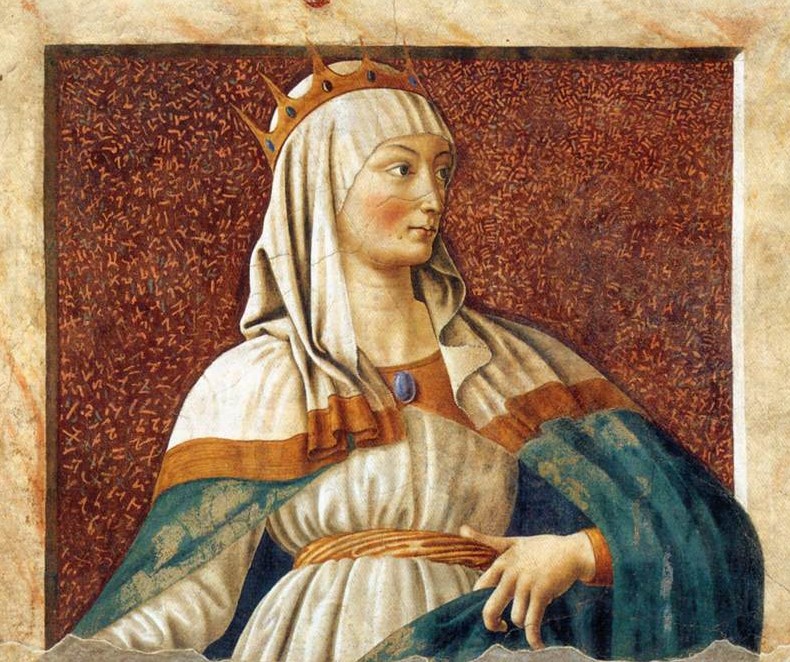
In the Office of the Readings, we are currently reading from the Book of Esther. At the heart of the book is a reminder that there come moments in our lives when we must stand up and be counted whatever the cost. At such times we must confront our fears, choose sides, and act with heroic character to ensure what is right and just. If we are truly to be God’s prophets and want His Kingdom to prevail, staying silent or waiting for others to act is not an acceptable option.
As the Book opens we meet Esther, who though secretly a Jew has become queen due to her rare beauty. The Persian emperor, Ahasuerus (also known as Xerxes and who reigned from 485–464 B.C.), is somewhat easily manipulated, frivolous, and distracted. He leaves much of the ruling to his prime minister, the wicked Haman. Haman takes advantage of the king’s nature to pursue a personal vendetta against the Jews by having a royal decree issued ordering their destruction. Haman’s anger had been kindled by Mordecai, Esther’s foster father, who had refused to kneel and bow before him. Informed that Mordecai was a Jew and that Jews do not comply with such customs due to their religious understandings, the furious Haman arranged the decree.
Mordecai informs Esther of this mortal danger for all Jews and the date certain for their extermination. He sends the following word to her:
Remember the days of your lowly estate … when you were brought up in my charge; for Haman, who is second to the king, has asked for our death. Invoke the Lord and speak to the king for us: save us from death.”
This is a crucial moment for Esther, a moment to decide whether to bravely confront the darkness or to hunker down and hope the storm will pass. Her decision will affect not only her own destiny but the lives and well-being of others as well.
Her first reaction is cowardly and defeatist. She says,
All the servants of the king and the people of his provinces know that any man or woman who goes to the king in the inner court without being summoned, suffers the automatic penalty of death, unless the king extends to him the golden scepter, thus sparing his life. Now as for me, I have not been summoned to the king for thirty days.
The Lord, through Mordecai, rebukes her and summons her to magnanimity and courage. He has this reply brought to her:
Do not imagine that because you are in the king’s palace, you alone of all the Jews will escape. Even if you now remain silent, relief and deliverance will come to the Jews from another source; but you and your father’s house will perish. Who knows but that it was for a time like this that you obtained the royal dignity?
Mordecai makes it clear that Esther’s own destiny is on the line. She will answer one day to God and surely perish if she does not summon courage and greatness. Why else does she think that God put her at a time and place such as this? She must decide and then accept the consequences of her decision. This is no time for fearful self-preservation or even prudential delay; it is the time for action that befits sacrificial love of others, of truth, and of justice.
The original meaning of the word encourage is “to summon to courage,” not just to make people feel better. Mordecai (whose name means “warrior”) has summoned Esther to battle.
Thanks be to God, she hears, repents of her fear, and decides that she will do what is right, whatever the cost. She sends back to Mordecai this response:
Go and assemble all the Jews who are in Susa; fast on my behalf, all of you, not eating or drinking, night or day, for three days. I and my maids will also fast in the same way. Thus prepared, I will go forth to the king, contrary to the law. If I perish, I perish!
Pay attention, fellow Catholics. We, too, are summoned to engage in a battle for the Kingdom of Light against the kingdom of darkness. We live in times of deep moral confusion and an often-fierce rejection of God. The toll of abortion is staggering in numbers. Our families and the lives of so many are being ruined by divorce, promiscuity, and pornography. Sexual confusion is rampant. Greed, gluttony, addiction, and other excesses have drained the vitality of countless people and made them slaves to their senses. In the Church as well there is sin, fearful silence, inaction by clergy of every rank, compromise with the world, and the very smoke of Satan.
If we want to know how such darkness and confusion has proliferated, we need to look honestly at ourselves as Catholics. Collectively, we have cowered in silence while Satan and worldly forces have wreaked havoc. Our pulpits have been too quiet; so too have the dining room tables of our homes.
The Lord wants the light of His truth to shine forth. Jesus, who says to us “You are the light of the world” (Mat 5:14-16), also adds that He did not light our lamp to hide it under a basket. No, He wants His light to shine. This means you! We are not a light, we are the light of the world. Christ, the Light of the World, wants to shine through us. Christ, the Word made Flesh, wants to speak through us.
In other words, as Mordecai says, we were made for times like these. The Lord put us here for this purpose: to turn back the darkness. We must decide whether to speak and shine so as to save the lives of many or to cower and hide and see the losses continue. Ultimately, we will answer to God for our decision.
The following are the lyrics to the hymn “Once to Every Man and Nation.” They were taken from a longer poem written by James Russell Lowell in 1845 to protest the United States’ war with Mexico.
Once to ev’ry man and nation
Comes the moment to decide,
In the strife of truth and falsehood,
For the good or evil side;
Some great cause, some great decision,
Off’ring each the bloom or blight,
And the choice goes by forever
’Twixt that darkness and the light.
Then to side with truth is noble,
When we share her wretched crust,
Ere her cause bring fame and profit,
And ’tis prosperous to be just,
Then it is the brave man chooses
While the coward stands aside.
Till the multitude make virtue
Of the faith they had denied.
By the light of burning martyrs,
Christ, Thy bleeding feet we track,
Toiling up new Calv’ries ever
With the cross that turns not back;
New occasions teach new duties,
Ancient values test our youth;
They must upward still and onward,
Who would keep abreast of truth.
Though the cause of evil prosper,
Yet the truth alone is strong;
Though her portion be the scaffold,
And upon the throne be wrong;
Yet on that scaffold sways the future,
And, behind the dim unknown,
Standeth God within the shadow,
Keeping watch above His own.
In times like these we need more people like Esther, who chose to do what was right and confronted the evil of her time. By God’s grace, we need her courage to echo through us so that we can say with her, I will go forth … If I perish, I perish!

 In 1929, Edwin Hubble discovered that the universe was not static but was in fact expanding outward from some point of singularity. At first his fellow scientists ridiculed his theory, labeling it with the term “the big bang.” Even as late as the 1960s I remember being taught in school that the universe was eternal and fixed. That “settled science” has since given way to the current view that the universe is expanding outward—quite rapidly, in fact.