One of God’s greatest gifts is that of sleep, especially deep, peaceful sleep. Alas, like many hyperactive and overstimulated moderns, I sometimes struggle to find deep sleep. My mother often said that she was a light sleeper, so maybe I also got it from her. But when deep sleep does come, what a wonderful gift! A deep night’s sleep can be so refreshing, truly one of life’s great pleasures.
Some of the Psalms speak of sleep. This Psalm speaks with gratitude of the gift of God to fall asleep quickly and to sleep deeply:
I will lie down in peace and sleep comes at once for you alone, Lord, make me dwell in safety (Ps 4:9).
Another Psalm speaks to us of how God blesses us while we sleep:
In vain is your earlier rising, your going later to rest, you who toil for the bread you eat, when he pours gifts on his beloved while they slumber (Ps 127:2).
What a magnificent thing to think of God bestowing blessings on us while we slumber! The image I have in mind is that of a parent coming to the bedside of a sleeping child and gently kissing him on the forehead, making sure he is all tucked in for the night.
Yet another Psalm speaks of the blessing of not having to get up in the middle of the night (to take care of you know what):
I will bless the LORD who gives me counsel; even in the night he admonishes my kidneys (Psalm 16:7).
Yes, an unusual blessing that God would keep watch over my kidneys! Many of the translators, finding this peculiar, translate it that God keeps watch over our hearts at night. Now that’s a nice thing, too, but the first meaning of the Hebrew word kilyah is “kidney.” There’s something earthy and practical about God keeping watch over our kidneys. Thank you, Lord! Not having to arise several times at night allows me to sleep more deeply. Thank you, Lord, for watching over my kidneys!
So yes, restful and peaceful sleep is such a great gift, a blessing itself, and also a source of blessings. Grant us, good Lord, a restful night and a peaceful slumber!
Dr. Ralph Martin, commenting on a teaching by St. Therese of Lisieux, has this amusing and consoling reflection on the relation of sleep and prayer:
Therese shares about her own long struggle to refrain from falling asleep during prayer times and offers some interesting advice:
I should be desolate for having slept (for seven years) during my hours of prayer and my thanksgivings after Holy Communion; well I am not desolate. I remember that little children are as pleasing to their parents when they are asleep as well as when they are wide awake; I remember, too, that when they perform operations, doctors put their patients to sleep. Finally, I remember that: “the Lord knows our weakness, that he is mindful that we are but dust and ashes.
[Dr. Martin observes]: Those of us who are parents know that we sometimes love our children even more when they finally go to sleep! Therese’s message is one of great confidence in God’s love for us. He knows our weaknesses and loves us anyway. If we just do the little bit we can, he’ll be able to continue the process of transformation even if prayer is sleepy and dry … little by little, even imperfect prayer will change us (Dr. Ralph Martin, The Fulfillment of All Desire, pp. 283-284).
Of course it is also clear that one of the more unpleasant experiences in life is to have a restless or sleepless night, especially if it is accompanied by anxiety or fear. In the worst years of my struggle with anxiety in my mid-thirties, I was actually afraid to go to sleep. I would often fall asleep and then within an hour be startled awake, racked with fear and wrestling with a demonic presence in my room. Somehow, in falling asleep, all my psychological and spiritual defenses seemed to shut down and I would awaken to terrors and fearsome assaults. Those were the difficult years when I feared, as late night drew on, that it was time to try to sleep.
The Book of Job well describes the nights I once experienced:
When I say, “My bed shall comfort me, My couch shall ease my complaint.” Then you [O Lord] affright me with dreams, and with visions terrify me. In bed I say, “When shall I arise!?” But the night drags on; And I am filled with restlessness until the dawn (Job 7:13-14; 4).
I used to keep a printed version of this on my nightstand. And in those dark nights at three in the morning I read it out loud as a kind of complaint to God.
Thanks be to God, I am delivered from those awful times. Thank you, Lord! But I am sympathetic to those whose bed provides no comfort and whose couch permits no sleep. It is an awful thing and a difficult cycle to break. I can only, with sympathy, encourage them to make the journey I’ve had to make: growing in trust, finding greater serenity, and taking back what the devil stole—the gift of a restful night and the peace and serenity the Lord wants to give.
Ah, yes, the gift of restful sleep and quiet nights! It is a beautiful gift to seek from the Lord each night. In the night prayer of the Church, there are these beautiful lines:
Protect us Lord as we stay awake, watch over us as we sleep, that awake we may keep watch with Christ, and asleep rest in his peace.
The office ends with the beautiful wish: May the Lord grant us a restful night and a peaceful death. The Salve Regina having been sung, the lights are switched off and we rest in the arms of God.
Here is one of the most beautiful Night Prayer Hymns:
God, that madest earth and Heaven, darkness and light;
Who the day for toil hast given, for rest the night;
May Thine angel guards defend us,
Slumber sweet Thy mercy send us;
Holy dreams and hopes attend us, all through the night.
When the constant sun returning unseals our eyes,
May we, born anew like morning, to labour rise;
Gird us for the task that calls us,
Let not ease and self enthrall us,
Strong through Thee whate’er befall us, O God most wise!
Guard us waking, guard us sleeping, and when we die,
May we in Thy mighty keeping all peaceful lie;
When the last dread call shall wake us,
Do not Thou, our God, forsake us,
But to reign in glory take us.
In my Parish, I work with the men of the Holy Name Society and the women of the Sodality to ensure that the numerous sick are visited regularly. I try to visit each of the sick members of my parish at least once per quarter to ensure that they have had Confession and the Anointing of the Sick. But since I do not have an assistant priest, as a general rule I must depend on the men and women of these organizations to bring Holy Communion to the sick on a more frequent basis.
We met as a group some time ago and had an interesting discussion about a concern voiced by many: that of a lack of reverence. When they arrive at the home of the sick individual, it is not uncommon to find a television blaring, and that the person to whom they are bringing Holy Communion has not been prepared by others to receive the Eucharist. Often, the extraordinary minister must ask that the television be turned down and that others prayerfully participate. I, too, upon visiting many of the sick encounter similar issues: loud televisions, other family members who do not understand the sacredness of the moment, and a generally difficult setting in which to pray or reflect.
I do not blame either the sick or their family members for this situation. I blame myself and my fellow clergy, many (though not all) of whom have failed to teach or explain to parishioners and family members (some of whom are not Catholic) the proper protocol in this matter.
I explained to the extraordinary ministers that we must re-catechize and teach on this matter. It will take time, but little by little perhaps we can make progress toward restoring a greater reverence to sick calls. Sick calls have become very informal over the past forty years. When the liturgy underwent sweeping changes in the 1970s, many things were dropped (though we were not directed to drop them) that we are now rediscovering to be of importance.
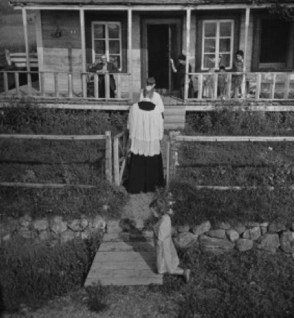
In the “old days,” the visit of the priest to bring Holy Communion and/or Anointing of the Sick was a matter of some formality. Most homes had a “Sick Call Set” on hand that included things like a crucifix, candles, a cloth, cotton, and a bowl of water. If the priest were on First Friday rounds he might even be escorted by a server with a lit candle. At other times, a family member might greet the priest at the door with a candle and escort the priest to the room where the sick person was. Family members usually stood by quietly while the priest administered the Sacraments. If the priest did talk with the sick person or the family, it was usually very brief. Since He had the Blessed Sacrament with him, casual talking was kept to a minimum. As he left, if he still had the Blessed Sacrament, he was again escorted by a family member with a candle.
Now what is described in the paragraph above did vary based on location and circumstances. First Friday Holy Communions were more formal than others. On the other hand, emergencies might cause the exclusion of some of the formalities. And there were also ethnic differences. Other factors (e.g., the catholicity of other family members and how devout each family was) were also taken into account. But what I described above was the usual practice, give or take a few details.
In recent times, though, most of these details have fallen away. As with so many things in our culture, we have become very casual, very informal with sick calls. But it may be beneficial for us to rediscover some of the older practices in order to restore greater reverence. I would like to suggest a few matters of protocol for your reflection. I will begin with a few disclaimers and then offer some suggestions.
Disclaimers:
Not everything in the list that follows is possible or even advisable in every situation. Sometimes sick calls are hastily arranged due to emergencies, and preparing a sick call altar might mean time away from a distressed or dying relative. Sometimes in nursing homes all the implements are not available or even allowed. For example, many nursing homes do not permit the burning of candles. Hence, prudential judgment should be used to determine what is necessary, possible, or even advisable.
Family situations may also affect the preparation of the sick call altar and other protocols. There may be no one in the home healthy enough to assemble the implements. There may be family members who are non-Catholic and choose not to participate in the rites and preparations.
Not all the implements mentioned above are necessary for every sick call. Sometimes there will not be anointing. If that is the case, then a fair number of the items are not necessary. Even if there is an anointing, not every item may be required.
What follows are recommendations only, not absolute requirements. The hope is to instill some thoughtfulness as to the reverence due to the occasion of a sick call. Reverence is not a pure science. Externals can and do help, but ultimately it is our internal disposition that is most important.
Regarding these recommendations, take what you like and leave the rest. Add to them and distinguish as you wish. Discussion with your parish priest is also helpful.
Recommendations:
Consider preparing the place where the sacraments will be celebrated. If possible and necessary, tidy up a bit.
Consider preparing a sick call table or altar. Most commonly such a table includes at least a candle, and preferably a crucifixand two candles. A smallglass of water is helpful since a sick person can sometimes have trouble swallowing the host. A spoon can be useful if the person has a hard time sitting up to drink the water. A napkin of some sort can help if the person spills any water when drinking. If the priest is going to anoint the sick person, it may be useful to have some cotton balls for him to wipe his fingers. If he does use them, though, they should later be burned. Bread and lemons can be used to help the priest to purify his fingers after anointing, but they are rarely necessary and should not be supplied unless the priest asks for them ahead of time.
Sick call sets containing many of these items are available through Catholic catalogues (for example, HERE).
If possible and advisable, have the sick person awake and aware that the sacraments are about to be celebrated.
Be sure that when the priest, deacon, or extraordinary minister arrives, the television, radio, etc. are turned off and that other unnecessary conversations and activities in the house are ended.
In the past, it was customary for someone to meet the priest at the door with a candle. This was done out of reverence for the Blessed Sacrament. This can still be done today and is a wonderful way to teach others of the sacredness of the moment.
It is preferable to have all the members of the household prayerfully aware of what is taking place. If the room is large enough, they can all be encouraged to pray along. It may be necessary for some brief privacy while the priest hears confession, but otherwise, members of the household can and should join in prayer. It is certainly inappropriate for loud conversations to be taking place in the next room, for children to be playing video games, and for unnecessary activities to be taking place. Even non-Catholics should be respectful of the sacred rites. Usually just a word of invitation/encouragement is all that is needed.
It is best for the priest, deacon, or extraordinary minister to celebrate the rites without delay. Surely a greeting is appropriate, but long conversations prior to the reception of sacraments is inadvisable. After the celebration of the sacraments, longer conversations may take place. Sometimes the priest, deacon, or extraordinary minister has other stops to make and thus is still carrying the Blessed Sacrament. In such a case it is not wrong to have a conversation with the sick person as an act of charity, but one ought to balance the fact of the presence of the Blessed Sacrament and the need for conversation with prudence and reverence. Staying for lunch and lengthy, chatty visits are discouraged in such cases.
Reverential prayer and celebration of the rites is also necessary for those who bring Holy Communion.
Those who bring Holy Communion to the sick should go immediately to them and not make stops along the way there. While transporting the Blessed Sacrament it is best to drive in silence, pray, or listen to religious music rather than secular radio.
So those are some of my recommendations. Remember that all of these are not possible all of the time. The recommendations are made in the hope of provoking thought and discussion about reverence in sick calls. They are made more as gentle reminders than polemical pronouncements. I do not assume that any one intends to be irreverent. It is just that we have become very casual these days and reminders seem opportune. I invite you to chime in with your additions and/or critiques in the comment section.
The video at the bottom of this post is a heartwarming one with a surprise ending. I see in it an illustration of something St. Paul wrote of the essentially sacrificial nature of evangelization:
Though I am free and belong to no one, I have made myself a slave to everyone, to win as many as possible. To the Jews I became like a Jew, to win the Jews. To those under the law I became like one under the law (though I myself am not under the law), so as to win those under the law. To those not having the law I became like one not having the law (though I am not free from God’s law but am under Christ’s law), so as to win those not having the law. To the weak I became weak, to win the weak. I have become all things to all people so that by all possible means I might save some. I do all this for the sake of the gospel, that I may share in its blessings (1 Cor 9:19-23).
To be clear, what St. Paul says here must be understood as solidarity and brotherhood, not compromise with sin or evil. At every level, St. Paul is willing to set aside anything in the moment that hinders the preaching of the truth of the Gospel. Every pretense, every honor, every distinction, every preference that interferes with the message of the Gospel message is forsaken where necessary. There is described here a great willingness for kenosis (emptying oneself).
And of course St. Paul is imitating Jesus, who,
though he was in the form of God, did not count equality with God a thing to be grasped, but emptied himself, taking the form of a slave, being born in the likeness of men. And being found in human form, he humbled himself by becoming obedient to the point of death, even death on a cross (Philippians 2:6-8).
Yes, it is remarkable that Jesus, though sinless, was not ashamed to be identified with sinners. And thus He took baptism at the Jordan. He associated with sinners and ate with them. He underwent the most humiliating punishment meted out to the worst of sinners. Yes, He was crucified, and between two thieves! Everyone walking by that Friday would have said, “Look at that sinner!” (which He was not). To us sinners, Jesus was willing to be seen as a sinner (though He was not), in order to save sinners. And He was assigned a grave with the wicked (Is 53:9).
There is an old saying that Jesus didn’t come only to get us out of trouble; He got into trouble with us. Yes, He endured every blow this world and Hell itself could give. Nobody knows the trouble I’ve seen. Nobody but Jesus.
Surely he endured our pain and bore our suffering, yet we considered him punished by God, stricken by him, and afflicted. But he was pierced for our transgressions, he was crushed for our iniquities; the punishment that brought us peace was on him, and by his wounds we are healed. We all, like sheep, have gone astray, each of us has turned to our own way; and the Lord has laid on him the iniquity of us all (Isaiah 53:4-6).
Yes, He got into trouble with us and joined us in order to save us:
In bringing many sons and daughters to glory, it was fitting that God, for whom and through whom everything exists, should make the pioneer of their salvation perfect through what he suffered. 11Both the one who makes people holy and those who are made holy are of the same family. So Jesus is not ashamed to call them brothers He says, “I will declare your name to my brethren…” (Heb 2:9-11)
All these Scriptures ran through my mind as I watched this commercial. To be clear, there is no sin in paralysis. But here let it be a metaphor for our weakness, which the Lord took up, and for our sin, that though sinless, the Lord was willing to be identified with. And what of us? Can we be like St. Paul and imitate Christ in this matter?
For most of us, attachments to this world are THE struggle that most hinders our spiritual growth. 80% of the spiritual life is a battle about desire and the fundamental question, “What do you want most, the world and its pleasures, or God and his Kingdom?” So easily this world gets its hooks into us and we become attached to it. It is hard to break free from inordinate desires.
But what are attachments, and what are they not? Are there ways we can distinguish attachments from ordinary and proper desires? What are the signs that we are too attached to someone or something? To address questions like these, I want to turn to a great teacher of mine in matters spiritual, Fr. Thomas Dubay. Father died a few years ago, but he left us a great legacy of teaching through his books, audio recordings, and programs at EWTN. In addressing these questions, I would like to summarize what he teaches in his spiritual classic, Fire Within, in which he expounds on the teachings of St. Teresa of Avila and St. John of the Cross.
The following excerpts are from pages 133-135 of Fr. Dubay’s book. Father’s teaching is shown in bold, black italics. My remarks are presented in plain, red text. You may wish to read only the excerpts from Fr. Dubay’s text to begin with, and then only read my commentary if you want some elaboration.
I. WHAT ATTACHMENT IS NOT: Sometimes it is easier to say what a thing is not than what it is. Fr. Dubay disabuses us of some wrongful and sometimes puritanical notions that are neither biblical nor Catholic, since they reject as bad what God has made as good and as a blessing. Scripture says, God created [things] to be received with thanksgiving by those who believe and who know the truth. For everything God created is good, and nothing is to be rejected if it is received with thanksgiving (1 Tim 4:3-4).
First of all, attachment is not the experiencing of pleasure in things, not even keen, intense pleasure. The complete avoidance of pleasure is neither possible nor advisable in human life … There is no doubt that the pleasures of the five senses easily lead to a selfish clinging to them for their own sakes, but nonetheless, the pleasures themselves are not blameworthy. God made them, and they are good.
The remarks here are very balanced. Of itself, taking pleasure in what God has made is a kind of thanksgiving and surely an appreciation of what God has created and given.
Yet, due to our fallen nature, we must be cautious that our experience of pleasure, like all our passions, does not become unruly, improperly directed, or take on a life of its own. If we are not mindful, pleasures can divert our attention from the Giver (and His purpose) to the gift alone.
Consider that a husband properly enjoys intense pleasure in his intimate experiences with his wife. Correctly understood, he can hardly fail to enjoy this, other things being equal. But these intimate moments have a meaning beyond themselves. They summon him to greater intimacy, appreciation, and love for his wife and ultimately for the God who created her. Further, these moments draw him to share his love and appreciation through an openness to the fruit this love will bear in his children.
Hence, the gift of intimacy is wonderful and to be enjoyed to the fullest, but it is not an end in itself. When it becomes its own end and exists in our mind only for its own sake, we are on the way to attachment and idolatry.
Nor is possessing or using things an attachment to them. We must all make use of things in this world to accomplish what God has given us to do. God is surely pleased to equip us with what we need to do His will, to build the Kingdom, and to be of help to others.
Nor is being attracted, even mightily attracted, to a beautiful object or person an unhealthy attachment. As a matter of fact, we should be drawn to the splendors of creation, for that is a compliment to the supreme Artist. Saints were and are strongly attracted to the glories of the divine handiwork and especially to holy men and women, the pinnacles of visible creation.
A gift we should pray for is the gift of wonder and awe, wherein we appreciate and are joyful in God’s glory displayed not only in the greatest and most visible things, but also in the smallest and most hidden. We are also summoned to a deep love of, appreciation for, and attraction to the beauty, humor, and even quirkiness displayed in one another.
But here, too, these things are meant to point to God; they are not ends in themselves. It sometimes happens that we fail to connect the dots, as St. Augustine classically describes here: “Late have I loved you, O Beauty, so ancient, and yet so new! Too late did I love You! For behold, You were within, and I without, and there did I seek You; I, unlovely, rushed heedlessly among the things of beauty You made. You were with me, but I was not with You. Those things kept me far from You, which, unless they were in You, would not exist” (Confessions 10.27).
So, once again, to be attracted by beauty is, of itself, good. But it is not an end; it is a sign pointing to the even greater beauty of God and His higher gifts.
II. WHAT ATTACHMENT IS: St. John of the Cross [observes] that if anyone is serious about loving God totally, he must willingly entertain no self-centered pursuit of finite things sought for themselves, that is, devoid of honest direction to God, our sole end and purpose. St. Paul makes exactly the same point when he tells the Corinthians that whatever they eat or drink, or whatever else they do they are to do all for the glory of God … (1 Cor 10:31)
St John of the Cross explicitly states that he is speaking of voluntary desires and not natural ones‚ for the latter are little or no hindrance to advanced prayer as long as the will does not intervene with a selfish clinging. By natural desires the saint has in mind, for example, a felt need for water when we are thirsty, for food when hungry, for rest when fatigued. There is no necessary disorder in experiencing these needs … to eradicate these natural inclinations and to mortify them entirely is impossible in this life.
Of course even natural desires can become unruly and exaggerated to the point that we seek to overly satisfy them and they become ends in themselves. Fr. Dubay makes this point later on. St. Paul also lamented that there were some whose god was their belly and who had their mind set only on worldly things (cf Phil 3:19).
[More problematic and] especially damaging to normal development are what John calls, “habitual appetites,” that is, repeated and willed clingings to things less than God for their own sake. And here we come to some critical distinctions.
[W]e may ask when a desire becomes inordinate and therefore harmful. I would offer three clear signs.
The first is that the activity or thing is diverted from the purpose God intends for it. This is very common today with sex and with many matters related to the body.
The second sign is excess in use. As soon as we go too far in eating, drinking, recreating, speaking, or working, we show that there is something disordered in our activity. We cannot honestly direct to the glory of God what is in excess of what He wills. Hence, a person who buys more clothes than needed is attached to clothing. One who overeats is clinging selfishly to food.
Yes, beer, for example, is a sign that God loves us and wants us to be happy. A couple of beers is gratitude; ten beers is a betrayal. God gives in abundance to be sure, but He does so more that we can share with the needy and the poor than that we should cling to it selfishly as though it existed as its own end.
Sharing spreads God’s glory. As St Paul says, “All this is for your benefit, so that the grace that is reaching more and more people may cause thanksgiving to overflow to the glory of God” (2 Cor 4:15). And later he says, “You will be made rich in every way so that you can be generous on every occasion, and through us your generosity will result in thanksgiving to God” (2 Cor 9:11). Thus the abundance of God is directed to the spreading of His glory and to the widening of thanksgiving, not as an end in itself, that we should hoard it. God’s gifts point back to Himself.
The third sign of attachment is making means into ends. We have one sole purpose in life: the ultimate, enthralling vision of the Trinity in glory, in our risen body. Everything else is meant in the divine plan to bring us and others to this final embrace with Beauty and Love … As soon as honesty requires us to admit that this eating or that travel, this television viewing or that purchase is not directly or indirectly aimed at Father, Son, and Spirit, we have made ourselves into an idol. We are clearly clinging to something created for our own self-centered sake.
This is often the hardest of the three to discern, but I think the heart of the difference between a thing becoming an end rather than a means, is the question of gratitude. How consciously grateful are we to God for the things and pleasures we enjoy? Do they intensify our gratitude or do they merely distract us from thinking about God?
Further, do they help me in my journey upward to God or do they merely root me more deeply in this passing world?
Another (scary) question is, “How easily could I give this up if I discovered that it was hindering me from God or that God no longer wanted it in my life?” This is hard because we really enjoy certain things. But the key question is not that we enjoy them, but whether they lead us to God. And we must be honest about this, avoiding both puritanical notions and self-justifying ones.
Here, too, an important thing to seek from God is not merely the strength to give up things (with a sour face and a bad attitude) but that through His grace we actually begin to prefer good things in moderation to distracting things in excess. If we let God go to work, the good begins to crowd out the bad in an incremental, growing way.
[Therefore:] an attachment is a willed seeking of something finite for its own sake. It is an unreal pursuit, an illusory desire. Nothing exists except for the sake of God who made all things for Himself. Any other use is a distortion.
I am in Avila today, meditating on the great teachings of St. Teresa of Avila and St. John of the Cross. The following is a re-post of a blog I wrote two years ago:
In this post I would like to ponder some hard spiritual truths that will set us free.
In calling them “hard truths,” I mean that they are not the usual cozy bromides that many seek. They speak bluntly about the more irksome and difficult realities we confront. But, if we come to accept them, they have a strange way of bringing serenity by getting us focused on the right things instead of chasing after false dreams.
A person can spend his whole life being resentful that life isn’t perfect, forgetting all the while that we are all in exile. We are making a difficult journey to a life in which, one day, every sorrow and difficultly will be removed and death and sorrow will be no more—but not now.
There is a kind of unexpected serenity in living in the world as it is rather than resenting it for not being the way we want it to be. For now, the journey is hard and we have to be sober about our obtuse desires and destructive tendencies. That is why there is value in calling these insights “hard truths that will set us free.”
In the very opening section of his Spiritual Canticle, St. John of the Cross lays out a presumed worldview that the spiritually mature ought to have attained. And because he presumes it of his reader, he states it only briefly.
We who live in times not known for spiritual maturity ought to slow down for a moment and ponder these truths, which are not only poorly understood but even actively resisted by many today who call themselves wise and spiritually mature.
Remember now, these are hard truths. Many today wish to bypass the harder teachings of God. Thus we do well to pay special attention to St. John, a spiritual master deeply immersed in Scripture, as a remedy for the soft excesses of our times.
Let’s first look at the quote from St. John and then examine his points. With the following preamble of sorts, St. John begins his Spiritual Canticle:
The soul … has grown aware of her obligations and observed that life is short (Job 14:5), the path leading to eternal life constricted (Mt. 7:14), the just one scarcely saved (1 Pet. 4:18), the things of the world vain and deceitful (Eccles. 1:2), that all comes to an end and fails like falling water (2 Sam. 14:14), and that the time is uncertain, the accounting strict, perdition very easy, and salvation very difficult. She knows on the other hand of her immense indebtedness to God for having created her solely for Himself, and that for this she owes Him the service of her whole life; and because He redeemed her solely for Himself she owes Him every response of love. She knows, too, of the thousand other benefits by which she has been obligated to God from before the time of her birth, and that a good part of her life has vanished, that she must render an account of everything—of the beginning of her life as well as the later part—unto the last penny (Mt. 5:25) when God will search Jerusalem with lighted candles (Zeph. 1:12), and that it is already late—and the day far spent (Lk. 24:29)—to remedy so much evil and harm. She feels on the other hand that God is angry and hidden because she desired to forget Him so in the midst of creatures, Touched with dread and interior sorrow of heart over so much loss and danger, renouncing all things, leaving aside all business, and not delaying a day or an hour, with desires and sighs pouring from her heart, wounded now with the love for God, she begins to call her Beloved …
Let’s examine these hard but freeing spiritual insights one by one. My commentary is in red.
The soul has grown aware of her obligations and observed
More than in any other age, we today entertain the illusion that death can easily be postponed; it cannot. We are not guaranteed the next beat of our heart, let alone tomorrow! It is true that with advances in medical science sudden death is not as common today. But too easily this leads us to entertain the notion that we can cheat death; we cannot.
Life is short and we do not get to choose when we will die. Both my mother and sister died suddenly, swept away in an instant. They never got to say goodbye. You do not know if you will even finish reading this sentence before death summons you.
This is wisdom. It is a hard truth that gives us an important perspective. Life is short and you don’t have any way of knowing how short.
What are you doing to get ready to meet God? What do you get worked up about? What are you not concerned about? Are your priorities rooted in the truth that life is short? Or are you waging bets in a foolish game in which the house (death and this world) always wins on its terms and not yours?
There is a strange serenity and freedom in realizing that life is short. We do not get as worked up about passing things and become more invested in lasting things and the things to come.
[that] the path leading to eternal life [is] constricted (Mt. 7:14)
Another illusion we entertain today is that salvation is a cinch, a done deal. The heresy of our time is a belief in an almost-universal salvation, which denies the consistently repeated biblical teaching that declares, Enter by the narrow gate. For the gate is wide and the way is easy that leads to destruction, and those who enter by it are many. For the gate is narrow and the way is hard that leads to life, and those who find it are few (Matt 7:13-14 inter al).
In parable after parable, warning after warning, Jesus speaks with sober admonition about the reality of Hell and the finality of judgment. No one loves you more than Jesus does, and no one warned you more about Hell and Judgment than He did.
Salvation is not easy; it is hard. Jesus said this; I did not. He did not say this because God is mean but because we are stubborn, obtuse, and prefer darkness to light. We need to sober up about our stubbornness and our tendency to prefer “other arrangements” to what God offers and teaches. In the end, God will respect our choice. The day will come when our choice for or against the Kingdom and its values will be sealed forever.
This is a hard saying but it sets us free from the awful sin of presumption, a sin against hope. It instills in us a proper focus on the work that is necessary to root us in God. Accepting this hard truth will make you more serious about your spiritual life and aware of the need for prayer, the Sacraments, Scripture, and the Church. It will help you to have more well-ordered priorities, ones that are less obsessed with the passing and more rooted in the eternal. It will make you more evangelical and urgent to save souls. It will turn you to Jesus and away from Belial.
[that] the just one [is] scarcely saved (1 Pet. 4:18)
This is a further truth that sets aside modern errors about an almost-universal salvation. The fuller context of the quote is this: For it is time for judgment to begin with God’s household; and if it begins with us, what will the outcome be for those who do not obey the gospel of God? And, “If it is hard for the righteous to be saved, what will become of the ungodly and the sinner?” (1 Peter 4:17-18)
And yet despite this and many other quotes and teachings like it, we go one presuming that almost everyone will go to Heaven. We set aside God’s Word for human error and wishful thinking. We substitute human assurances for God’s warnings. We elevate ourselves over St. Paul, who said that we should work out our salvation in fear and trembling (Phil 2:12) and spoke of disciplining himself, lest, after preaching to others, he should be lost (1 Cor 9:27). Are we really better and more enlightened that Jesus? Than Paul? Than Peter?
Salvation is hard. This is not meant to panic us, but it is meant to sober us to the need for prayer, the Sacraments, Scripture and the Church. Without these medicines we don’t stand a chance. And we must persevere to the end.
This hard truth sets us free from illusion and sends us running to the Lord, who alone can save us. Smug presumption roots us in the world. Godly fear and sober awareness of our stubborn and unrepentant hearts send us to Jesus, freeing us.
[that] the things of the world [are] vain and deceitful (Eccles. 1:2)
Such a freeing truth! First, that the things of this world are vain. That is to say, they are empty, passing, and vapid. We so highly value power, popularity, and worldly glories. But they are gone in a moment. Who was Miss America in 1974? Who won the Heisman Trophy in that same year? And if you do know, do you really care? Does it really matter? It’s empty show, glitter, fool’s gold; yet we spend billions and watch this stuff forever.
And though we should fight for justice, for the sake of the kingdom, even here the Scriptures counsel some perspective: I have seen a wicked, ruthless man, spreading himself like a green laurel tree. But he passed away, and behold, he was no more; though I sought him, he could not be found. (Ps 37:35-36).
And how deceitful is this passing world! The main deceit of this world is to say, “I am what you exist for. I am what matters. I am what satisfies.” These are lies and deceptions on all fronts. The form of this world is passing away; it cannot fulfill our infinite desires. Our hearts were made for God and only being with Him one day will satisfy us.
Yet so easily do we listen to the world’s seduction and lies! Too often we want to be lied to. We prefer to chase illusions and indulge vanity and deceit.
How freeing this truth is! We learn to make use of what we need and begin to lose our obsession with vain and passing things and with our insatiable desire for more. Yes, perhaps you can survive without that granite countertop.
This is a very freeing truth if we can accept its hard reality. And becoming more free, a deeper serenity finds us.
that all comes to an end and fails like falling water (2 Sam. 14:14)
The world is passing away. It can’t secure your future. The world’s cruel lie that it can fulfill you is on display in every graveyard. So much for the world’s empty promise: “You can have it all!” Yes, and then you die.
Meditate on death frequently. Indeed, the Church bids us to rehearse our death every night in prayer by reciting the Nunc Dimittis.
Scripture says,For here we have no lasting city, but we seek the city that is to come (Heb 13:14). Do you have your sights fixed where true joys are? Or are you like Lot’s wife?
Let this truth free you to have the proper perspective. Since, then, you have been raised with Christ, set your hearts on things above, where Christ is, seated at the right hand of God (Col 3:1).
that the time is uncertain
You have plans for tomorrow? Great, so do I. The only problem is that tomorrow is not promised or certain. Neither is the next beat of your heart. This is another hard but freeing truth.
[that] the accounting [is] strict
Jesus warns, But I tell you that everyone will have to give account on the day of judgment for every empty word they have spoken (Matt 12:36). St. Paul says, He will bring to light what is hidden in darkness and will expose the motives of the heart (1 Cor 4:5). And he adds, So we make it our goal to please him, whether we are at home in the body or away from it. For we must all appear before the judgment seat of Christ, so that each of us may receive what is due us for the things done while in the body, whether good or bad (2 Cor 5:9-10). And James chillingly says, So speak and so act as those who are to be judged by the law of liberty. For judgment will be merciless to one who has shown no mercy (James 2:12-13). What James says is particularly chilling because so many today are without mercy.
If God judges us with the same strict justice we often dish out to others, we don’t stand a chance. The accounting will be strict anyway, so don’t pile on unnecessary severity and wrath toward others. This is another freeing truth that helps us take heed of the coming judgment.
[that] perdition [is] very easy
I wonder why he might have repeated this. I just wonder!
[that] salvation [is] very difficult
And look, he repeated this, too! I wonder why. Maybe repetition is the mother of studies.
[that we are often and strangely ungrateful and unmoved] She knows on the other hand of her immense indebtedness to God for having created her solely for Himself, and that for this she owes Him the service of her whole life; and because He redeemed her solely for Himself she owes Him every response of love. She knows, too, of the thousand other benefits by which she has been obligated to God from before the time of her birth, and that a good part of her life has vanished
This is a sober truth that calls us to remember. What does it mean to remember? It means to have present in your mind and heart what the Lord has done for you so that you are grateful and different.
We live so many years and so many hours of each day in ingratitude. We get all worked up and resentful about the smallest setbacks, while almost completely ignoring the trillions of blessings we receive each day.
Our ingratitude is obnoxiously massive because of the easy manner in which we mindlessly receive and discount our incredibly numerous blessings, while magnifying every suffering, setback, and trial. We spend so much of our life in the “complaint department.” We are often stingy with even a simple “Thank you, Lord, for all your obvious and hidden blessings. Thank you, Lord, for creating, sustaining, and loving me to the end, and for inviting me to know, love, and serve you.”
that she must render an account of everything—of the beginning of her life as well as the later part—unto the last penny (Mt. 5:25) when God will search Jerusalem with lighted candles (Zeph. 1:12)
Did he repeat himself again? Now why do you suppose he does that? You don’t think he considers us stubborn, do you?
[that] it is already late—and the day far spent (Lk. 24:29)—to remedy so much evil and harm Repetitio mater studiorum.
[that the unrepentant will experience the wrath to come] She feels on the other hand that God is angry and hidden because she desired to forget Him so in the midst of creatures
The wrath of God is really in us, not in God. It is our experience of discomfort before the holiness of God. It is like being accustomed to a dark room and suddenly being brought into the bright afternoon sunlight. We protest and claim that the light is harsh. But the light is not harsh. We are incapable of tolerating the light due to our preference for and acclimation to the darkness. In the same way, God is not “mad.” He is not moody or harsh. He is God and God does not change.
St. John teaches here the hard but freeing truth that God is holy; no one is going to walk into His presence unprepared. If we prefer the world and its creatures to the Creator, we thereby prefer the darkness and cannot tolerate the light. Heaven is simply not possible for those who prefer the darkness. And thus Jesus says, And this is the judgment: the light has come into the world, and people loved the darkness rather than the light because their works were evil (John 3:19). That’s right, this occurs just three verses after the famous and oft-quoted John 3:16.
And while the sinful soul may “feel” that God is angry and is hiding Himself, the problem is in the sinful soul, not God.
The freedom of this hard saying comes in reminding us and urging us to get ready to meet God. God is not going to change; He can’t change. So we must change, and by His grace, become the light of His holiness.
[that we need to call on the Savior] Touched with dread and interior sorrow of heart over so much loss and danger, renouncing all things, leaving aside all business, and not delaying a day or an hour, with desires and sighs pouring from her heart, wounded now with the love for God, she begins to call her Beloved.
Here is the real point of all of these hard truths: to make us love our Savior more, to learn to depend on Him and run to Him as fast as we can. Only when we know the hard truths are we really going to get all that serious.
After all, who is it that goes to the doctor? Is it the one who thinks he doesn’t have cancer (even though he does)? Or is it the one who knows he’s got it bad and that ain’t good?
Sadly, the answer is not clear enough to us in modern times, times in which, even within the Church, there are so many who don’t want to discuss any of the hard truths we need to lay hold of before we can get serious.
A steady diet of “God loves you and all is well no matter what” has emptied our pews. Why? Well, who goes to the spiritual hospital if all he hears is that nothing is wrong and that his salvation is secure, almost no matter what?
The good news of the Gospel has little impact when the bad news is no longer understood. What does salvation mean if there is no sin and nothing to be saved from? Now of course the bad news should not be preached without pointing to the good news. The point is that both are needed.
Thus, St. John’s hard truths are not meant to discourage. They are meant to sober us and send us running to the doctor.
Now look, you’ve got it bad and that ain’t good. But the good news is, there’s a doctor in the house. Run to Him now; He’s calling you!
A 2012 report on men and marriage by the Pew Research Center shows statistically what many of us have noticed anecdotally: men are finding marriage less desirable than in the past and are now marrying later, if at all.
In today’s post I want to present some excerpts from a hard-hitting article that appeared at Lifesite News in 2013, commenting on the Pew study. The full article can be read here: Men Giving Up on Marriage.
As usual, I present the text from the original article in bold, black italics, while my own poor commentary is in plain red text.
Fewer young men in the US want to get married than ever. … The number of young adult men saying that having a successful marriage is one of the most important things dropped from 35 percent to 29 percent [since 1997].
The latest census data showed “barely half” of all adults in the United States are currently married, a “record low.” Since 1960, the number of married adults has decreased from 72 percent to 51 [percent] today and the number of new marriages in the U.S. declined by five percent between 2009 and 2010.
Moreover, the median age at first marriage continues to rise, with women getting married the first time at 26.5 years and men at 28.7 [years]. The declines in marriage are “most dramatic” among young adults. Just 20 percent of those aged 18 to 29 are married, compared with 59 percent in 1960.
In my mere 26 years of priesthood, I have seen the number of weddings I perform each year decrease from 35 to 5, and the average age of engaged couples increase from 24 to 31. These are startling changes, and they largely match those experienced by other priests with whom I have discussed the matter.
29 percent of young adult men desiring marriage is an amazingly low figure. The article notes that the things that once motivated men to marry in the past are largely in eclipse now. Men once enjoyed the esteem they garnered by marrying, and were motivated by the challenge of being breadwinners. Getting married was once a proper and approved way of attaining status, and legitimately enjoying sexual intimacy. It was part of the passage to manhood.
But today, many (if not most) women don’t need (or don’t think they need) men to provide for them economically. It’s goodbye to any notion of the esteem of being a provider.
Further, in an age of promiscuity, most men don’t need marriage to open the door to sexual encounters. Only a few “old-fashioned” Catholic priests and traditionalist Catholics raise any eyebrows at men’s “playing the field.” And women as a group (with certain notable exceptions) seem less insistent on expecting men to connect sexual intimacy and marriage.
Add to this the financial bondage introduced by the racket that college education has become. Many young people graduate from college with six-figure debt. And when undergraduate degrees no longer open doors, advanced degrees became necessary, bringing on even more debt.
And finally, add one more thing: pornography. It is more available than ever before. And though it is theoretically more privately accessible than previously, I would point out that there is nothing private about the Internet; Internet service providers know every site you have ever visited.
Sadly, many young men honestly admit that they prefer pornography to real women. Pornography doesn’t talk back or have preferences or moods. Real relationships are complex and require navigation and negotiation. Pornography, it would seem, is a narcissistic paradise. Click through to your current preference; it’s all about you and what you want. And at the end, the object of your fantasy disappears and does not have issues or attitudes with which you must deal.
The overall image is of a cauldron, filled with a witch’s brew or a satanic stew. That men and women marry at all today is increasingly miraculous. I always make a point of congratulating and thanking engaged couples that get to my rectory door for beating the odds and having the gumption to swim upstream.
Pew’s findings have caught the attention of one US writer who maintains that feminism, deeply entrenched in every segment of the culture, has created an environment in which young men find it more beneficial to simply opt out of [marriage] entirely
Suzanne Venker [in her] article, “The War on Men,” … points out that for the first time in U.S. history, the number of women in the workforce has surpassed the number of men, while more women than men are acquiring university degrees. …
With feminism pushing them out of their traditional role of breadwinner, protector, and provider—and divorce laws increasingly creating a dangerously precarious financial prospect for the men cut loose from marriage—men are simply no longer finding any benefit in it. …
“When I ask [men] why, the answer is always the same: women aren’t women anymore.” Feminism, which teaches women to think of men as the enemy, has made women “angry” and “defensive, though often unknowingly.”
“Men are tired,” Venker wrote. “Tired of being told there’s something fundamentally wrong with them. Tired of being told that if women aren’t happy, it’s men’s fault.”
Most men I know perceive that they are often considered by the wider culture as deficient, even depraved. The “men are stupid” commercials and sitcoms abound. Men are often presented as buffoons, who need women and children to “set them straight” on the simplest of things.
Schools, dominated by feminist ideology, have made a pathology of the normal behavior of boys, which includes competition and roughhousing. They seek to feminize boys, going even so far as to encourage medication for them. Most of these boys merely have the spit and vinegar that was once considered normal, needing to be curbed somewhat rather than suppressed with drugs.
It is little wonder that fewer young men make it to college and are falling behind young women in almost every category. Being told (even indirectly) on a regular basis that you are fundamentally flawed has a significant effect over time.
The article says that feminism has emboldened many women to direct suspicious anger toward men and generally presume that they have bad or evil motives. But it has also caused a lot of men to draw back from the healthy confidence that once bolstered them to go out and seek a wife and to take a leadership role in the community, the Church, and the family.
A feminist culture in effect shames these desires as being “patriarchal.”
This is a situation that should not be celebrated by feminists, Venker says. “It’s the women who lose. Not only are they saddled with the consequences of sex … The fact is, women need men’s linear career goals … in order to live the balanced life they seek.”
Yes, in the end it’s usually the biology that kicks in. Truth be told, men and women are meant to be complementary not competitive. Our very body bespeaks a difference that requires the opposite sex to complement it. The design of women’s bodies speaks to bearing children and nurturing them.
A woman who wants to have and raise children well needs time and flexibility. The 9-to-5 career world does not facilitate that. Thus her husband complements her need by taking up the linear and less-flexible career world, leaving her freer to nurture the children.
This used to be obvious to us. But ideology is often disinterested in the obvious. It may be true that we were once too restrictive, limiting certain jobs and careers to men. But for most women, the freedom to work has become the duty to work, even in the childbearing years. It’s a raw deal for everyone: women, men, and especially children.
The bottom line is, it’s never good for anyone, or for civilization as a whole, when huge numbers opt out of or find no access to our most fundamental building block: the traditional family. We must save traditional marriage if we stand any chance of saving our dying civilization.
One of the questionable, and unfortunately common, forms of moral reasoning today is the rather narcissistic notion that God wants each of us to be happy. Sometimes it is put in the form of a rhetorical question: God wants me to be happy, doesn’t He?
And this sort of reasoning (if you want to call it that) is used to justify just about anything. Thus, in pondering divorce, a spouse might point to his or her misery and conclude that God would approve of the split because God wants me to be happy, doesn’t He? Many seek to justify so-called same-sex marriage, and other illicit sexual notions in the same way.
Further, other responsibilities are often blithely set aside as too demanding, under the pretext that God would not make difficult demands because, after all, He wants me to be happy. Since getting to Mass is difficult for me, God will understand if I don’t go; He wants me to be happy, not burdened. Forgiving someone is hard and God does not ask hard things of us; He wants me to be happy. Refusing to cooperate with some evil at work would risk my income; surely God would not demand that I withstand it since He wants me to be happy, content, and financially secure.
The notion that God wants me to be happy thus becomes a kind of trump card, some sort of definitive declaration that obviates the need for any further moral reflection. Practically speaking, this means that I am now free to do as I please. Since I am happy, God is happy, and this is His will … or so the thinking goes.
There are, of course, multiple problems with the “God wants me to be happy” moral stance. In the first place, happiness is a complex matter that admits of many subjective criteria including personal development, temporal dimensions, and worldview. For example, a spiritually mature person can find happiness simply in knowing that he is pleasing God by follow His Commandments. On an interpersonal level, many are happy to make sacrifices for the people they love. To others who are less mature, even the smallest sacrifice can seem obnoxious and bring on unhappiness; pleasing God is not even on their radar, let alone something that would make them happy.
Happiness is also temporally variable. Most of us are well aware that happiness tomorrow is often contingent upon making certain sacrifices today. For example, the happiness one gets in taking a vacation is usually dependent upon having saved up some money beforehand. Making sacrifices today enables happiness tomorrow. If all I do is please myself in the moment, insist on being happy right now, my ability to be happy in the future will likely be seriously compromised. Setting no limits today might mean that I am broke tomorrow, or addicted, or unhealthily overweight, or afflicted with a sexually-transmitted disease. True, lasting, deep happiness in the future often requires some sacrifice today, some capacity to say “No” right now. Without any consideration of the future or of eternal life, “happiness” in the moment is vague, foolish, and meaningless, if not outright destructive. God desires our happiness, all right, but the happiness He wants for us is that of eternal life with Him forever. He has clearly indicated that this will often involve forsaking many of the passing pleasures and the “happiness” of this world.
More troubling still is the self-referential and narcissistic aspect contained in the simple little word “me.” God wants me to be happy.
Those who expresses this “me” notion might be surprised to discover that God has bigger things in mind. God actually cares about other people, too! He also cares about future generations and about the common good. Yes, there’s just a little more on God’s radar than you.
So the divorced man who might say, “God wants me to be happy” should consider that God might actually care about his children too; He might care about the culture that suffers due to rampant divorce; He might care about future generations that would inherit a culture shredded by destroyed families.
Wow, God might actually want others to be happy besides me! Even more shockingly, God might want me to sacrifice my happiness for them! He might actually want me to consider them and even regard them as more important that I am.
As a moral reference point, “me” is remarkably narrow and usually self-serving. And yet many today use this almost reflexively and authoritatively. “God wants me to be happy, so all discussions and further deliberations are over. God has spoken through my desires. He wants me to be happy. Who are you to dispute that? We’re done here; I will not be judged by you.”
“God wants me to be happy” is not a legitimate moral principle. It bespeaks a narcissism that is, sadly, too common today. Call it “Stuart Smalley theology.” You don’t know who Stuart Smalley is? This video shows it plainly enough. The bottom line is, don’t be Stuart Smalley.
Here at Holy Comforter-St. Cyprian Parish in Washington D.C., we celebrated the Feast of St. Francis of Assisi (one day early, on Saturday, Oct 3rd) with the blessing of the animals. Although most folks bring dogs to be blessed, there are usually some cats and a few other animals like ferrets. Once, someone even brought a snake!
Over the years, I have shared with the dog owners a list of “Things we can learn from dogs” (see below). When I was growing up, we always had a dog, so although I did not personally compose the list, I can vouch for its accuracy.
But over my years of city living I have grown accustomed to having cats (they are great mousers in old rectories). So I set my thoughts toward composing a similar list of what I have learned from cats. They are such independent and self-assured animals! They really let you know who is boss, but mitigate their arrogance somewhat with clownish play and affectionate head-butts.
God speaks to us in all of creation, including our pets, to whom we are often so close. What is God saying? Many things!
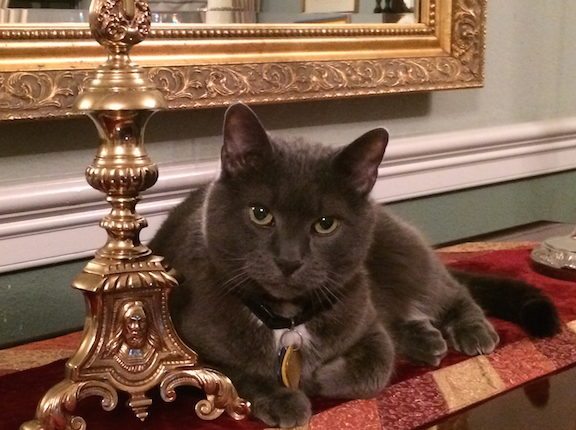
So I’ve composed a list of what I have heard God say through the cats I have adopted and loved over the years: Tupac, Katy Bell, Jenny June, Gracie Girl, Rita Hayworth, Ellen Baine, Jerry McGuire, Benedict (Benny), and Daniel (That’s Daniel’s picture at the upper right). Some of them have lived in the alley, some in the house, but they have all taught me things. Here are a few pearls of wisdom they have conveyed:
If you can’t get your way, lie across the keyboard until you do. (Be persistent.)
Keep them guessing with meows and long looks to keep their attention. (Mystery attracts.)
When you’re hungry, meow loudly so they feed you just to shut you up. (Get your needs met.)
Always find a good patch of sun to lie in. (Simple pleasures have their place.)
Life is hard and then you nap. (Be well-rested.)
Climb your way to the top; that’s why the curtains are there. (Be resourceful and creative.)
We are Siamese if you please. We are Siamese if you don’t please. (Be yourself.)
Purr often and use judicious head-butts. (Express gratitude.)
Sleep on their clothes and personal items to leave your scent. (Forget-me-nots have their place.)
Use your litter box. (Be clean and polite.)
Be a mouser. (Earn your keep.)
Clown around and do silly stuff. (Be humble.)
Run wildly for no apparent reason; chase toys and laser pointers. (Exercise often.)
Rest in hidden places. (Solitude has its place.)
Dogs, generally speaking, have a great outlook on life. The following list of things we can learn from dogs has been making the rounds on the Internet for years, but it really is rather instructive. Dogs do have a lot to teach us, and I thank God for the dogs to whom I have been close over the years: Prince, Missy, Molly, Taco, Salsa, Chili, Kaila, Lucy, Clancy, and many others. And again, although others compiled this second list, I can affirm through much experience how true it is!
Fifteen things we can learn from dogs:
Never pass up the opportunity to go for a joy ride.
Allow the experience of fresh air and the wind in your face to be pure ecstasy.
When loved ones come home, always run to greet them.
Let others know when they’ve invaded your territory.
Take naps and stretch before rising.
Run, romp, and play daily.
Eat with gusto and enthusiasm.
Be loyal.
If what you want lies buried, dig until you find it.
When someone is having a bad day, be silent. Sit close by and nuzzle them gently.
Thrive on attention and let people touch you.
Avoid biting when a simple growl will do.
When you’re happy, dance around and wag your entire body.
No matter how often you’re scolded, don’t buy into the guilt thing and pout … run right back and make friends.
Delight in the simple joys of a long walk.
Happy feast of St. Francis!
All creatures of our God and king Lift up your voice and with us sing, Alleluia! Alleluia!

 One of God’s greatest gifts is that of sleep, especially deep, peaceful sleep. Alas, like many hyperactive and overstimulated moderns, I sometimes struggle to find deep sleep. My mother often said that she was a light sleeper, so maybe I also got it from her. But when deep sleep does come, what a wonderful gift! A deep night’s sleep can be so refreshing, truly one of life’s great pleasures.