An Image of Grace in a Paul Simon Song

gospel musicI’ve got my Gospel glasses on and my holy hearing aids in; I’m seeing and hearing God in strange places. There are several Paul Simon songs that bring holy thoughts to me, even if he didn’t mean them that way. One them is this one (followed by my commentary):

When I was a little boy,
and the devil would call my name
I’d say, “Now who do … who do you think you’re fooling?”

I’m a consecrated boy

Singer in a Sunday choir

Refrain: Oh, my mama loves me, she loves me
She get down on her knees and hug me
Oh, she loves me like a rock
She rock me like the rock of ages
And she loves me
She love me, love me, love me, love me

When I was grown to be a man
and the devil would call my name
I’d say, “Now who do … who you think you’re fooling?”

I’m a consummated man
I can snatch a little purity

Refrain: My mama loves me, she loves me
She get down on her knees and hug me
Oh, she loves me like a rock
She rock me like the rock of ages
And loves me
She love me, love me, love me, love me

And if I was President
and the congress call my name
I’d say, “Now who do … who you think you’re fooling?”

I’ve got the presidential seal
I’m up on the presidential podium

Refrain: My mama loves me, she loves me
She get down on her knees and hug me
And she loves me like a rock
She rock me like the rock of ages
And love me
She love me, love me, love me, love me

Here’s my commentary, wearing my Gospel glasses and with my holy hearing aids in:

When I was a little boy, and the devil would call my name. We live in a fallen world, governed by a fallen angel, with fallen natures. And even the youngest find that these thrice-fallen forces reach them. Scriptures are clear in saying that the devil is prowling through the world like a roaring lion seeking souls to devour. We are to resist him, solid in our faith (cf 1 Peter 5:8).

I’d say, “Now who do … who you think you’re fooling?” There is a power within the soul to refuse Satan’s voice. Where does this power come from? It comes first from our freedom, from our will. It also comes from the voice of our conscience, the voice of God that echoes in the depths of our soul saying, This is the way walk in it (Is 30:21). Even the youngest children know basic right and wrong. It is not hard to appeal to them to understand what they’ve done wrong. But because of the weakness of our human nature, our inclination to selfishness, and our tendency to justify sin, we need additional help.

I’m a consecrated boy; singer in a Sunday choir. This describes a young man who has been consecrated in Baptism and is walking within the life and sacraments of the Church. The Sacrament of Baptism and the life of the Church give us additional insight to understand that the voice of the devil is seeking to deceive us. But human soul and intellect—illumined by the consecration of Baptism, the other sacraments of the Church, and strengthened by the fellowship of the Church —further strengthen us to be able to say to the devil,

“Who do you think you’re you fooling? I’ve been consecrated and I’m living my life in the light of God’s truth as expressed in the Church. I see your darkness for what it is and I’m not fooled. It is error; it is deception. It is darkness, not the light! I am no fool because, consecrated in baptism, the wisdom of God has reached me.”

Oh, my mama loves me, she loves me. She get down on her knees and hug me, oh she loves me like a rock. She rocks me like the rock of ages, and loves me. She loves me, loves me, loves me, loves me. And this “mama” is Mother Church, who loves us as a mother. She is our mother because we have come forth from her womb, the baptismal font, having been conceived by the chaste union with her beloved spouse, Jesus.

She is Mother Church, Christ’s bride, and oh, how she loves us! Down on her knees in prayer for us, she reaches out and embraces us. Yes, she loves us!

It will be noted, that the word “love” occurs seven times in the song’s refrain. Mother Church loves us sevenfold. Is it the seven sacraments? Is it the seven gifts of the Holy Spirit? Is it the seven corporal works of mercy? Is it the seven spiritual works of mercy? Yes, and more besides! It is love in all its perfection.

And in her sevenfold, prayerful love that embraces us, she loves us like a rock. This is the rock of Peter upon whom Christ, the rock of ages, builds His Church.

When I was grown to be a man – All of us are called to the maturity of Christ.

  • We [must] all attain to the unity of the faith and of the knowledge of the Son of God, to mature manhood, to the measure of the stature of the fullness of Christ. So may we no longer be children, tossed to and fro by the waves and carried about by every wind of erroneous doctrine, by human cunning, by craftiness in deceitful schemes (Eph 4:13-14).
  • Brothers and sisters, stop thinking like children. In regard to evil be infants, but in your thinking be adults (1 Cor 14:20).

Our Mother Church raises us to be mature in the fullness of Christ’s truth.

And the devil would call my name – Still the devil calls. He does not give up, hence we must remain ever-vigilant. So the song still says, “… who do you think you’re fooling?”

I’m a consummated man. Yes, we are called to full maturity in Christ, as stated above.

I can snatch a little purity. The strength to resist the devil comes from the maturity and purity that come to us in our walk with Christ and by the ministry of His Bride and our Mother, the Church. The purity and maturity of our faith help us to see even more deeply how the devil tries to fool us. Then we can reject him in strength, and with certainty and clarity.

Oh, my mama loves me, she loves me. Yes, she does! The Church just keeps on loving us. Sadly, many walk away from the Church in young adulthood. For those who come to maturity in Christ, the ever-stronger devil requires an even stronger capacity on our part to say, “Who do you think you’re fooling?” This comes through our maturity, wrought in us by our Mother, the Church. She raises us up in the faith to be strong and mature, teaches us the Word of God, bestows His sacraments, and gives us Holy Teaching. Thank you, Mother Church, for loving me like a rock!

The last verse gets a little strange and must be interpreted allegorically, not politically.

And if I was President – In other words, even if I should rise to the highest worldly power, even should I become a great leader.

And the congress call my name – While to modern American ears this refers to the people gathered in Washington, D.C. (the U.S. Congress), the word “congress” itself comes from two Latin roots: con (with) and gradi (go or walk). “Congress” means “coming or being together with,” or more literally, “going with.”

Scripture often warns of those who gather against us, telling us that they are often gathered by Satan himself. Jesus warns of the “synagogue of Satan” (Rev 3:9; 2:9). “Synagogue” is just the Hebrew word that means gathering or “congress.”  The Book of Psalms also warns of those who gather against us:

Rise up Lord against the rage of my enemies. Awake, my God; decree justice. Let the assembled peoples (Synagogus) gather around you, while you sit enthroned over them on high. Let the Lord judge these people (Psalm 7:7-8).

The devil often calls our name through pressure groups, through our desire to be popular, or through those who are together against us tempting us to do wrong. And thus this verse reminds me that even should I rise to the highest places, with many gathered about me pressuring me to do wrong or trying to intimidate me, yet still will I say to the devil, “Who do you think you’re fooling?”

I got the presidential seal. In other words, I have the highest seal, the seal of the Holy Spirit!

I’m up on the presidential podium. That is, I have the highest office, the office of prophet. I am one who speaks for God by this office! And despite the hatred of the world that comes to me from proclaiming God’s Word, and despite the gathering of my enemies all around me, yet still will I proclaim God’s Word as God’s prophet!

And through whatever hatred comes from those who gather against me, my mama loves me, she loves me like a rock. Yes, I have the love of my Mother, the Church, and my Lord, Jesus Christ, who is my rock, my fortress, and my deliverer.

You may say, “Well, this is all a bit much. And your interpretation is surely far from what the lyricist probably ever intended.” That’s fair enough, but with my Gospel glasses on, I see Christ everywhere. With my holy hearing aids in, I hear Jesus all the time.


Compare and Contrast! Two Pictures from Different Ages – Which Age Looks Healthier?

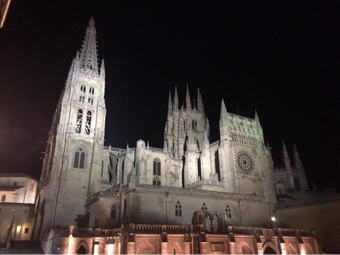
blog10-25-001A couple of years ago I was  in Burgos, Spain and saw the splendid cathedral there. My first views of it came at night and I took the photo at the upper right. What a magnificent building; such proportion and symmetry! To me there is the echo of tall trees in a forest, majestically reaching up to the heavens. There is also evident a great advance in building technique in the flying buttresses that support the soaring walls and towers.

These were the skyscrapers of the middle ages. Such angular, geometric, and vertical beauty; a fair flower of the 13th century echoing God’s creation and pointing to  Him in a great work of human praise.

Two medieval phrases come to mind in the beauty of this building. Beauty is:

  1. Beauty is id quod visum placet – (Beauty is) that which pleases when seen.
  2. Pulchra dicuntur quae visa placent – Things that give pleasure when seen are called beautiful.

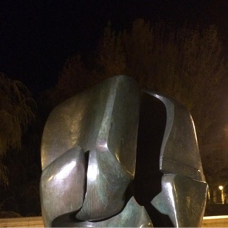
blog10-25-002 A mere thirty yards from this beautiful cathedral in the town square was something that is not beautiful in any traditional sense. I took the photo of it that is here on the left. It was not lightsome; it seemed to correspond to nothing in creation (unless one were to imagine a dinosaur dropping or some giant stumbling block). Frankly, like most modern abstract art, it looks more to me like someone’s nightmare. It seems to have little to say other than “Try to figure me out, you ignoramus.” For indeed, that is what I am usually called by art critics when I express dismay at these sorts of ugly blobs that clutter too many of our public squares and “art” museums today.

There are some who mistakenly call the Middle Ages the “Dark Ages” and smugly call our age “enlightened.” Certainly no age is perfect, but compare and contrast the two items in the photos here: one is lightsome, soaring, and inspiring; the other is dark, brooding, and opaque as to its meaning. One is a lightsome building from the 13th century, the other a dark “who-knows-what” from the 20th century. Based on representational art, which age seems more inspiring? Which seems more enlightened? You decide. But I’ll take the 13th century.

St. Thomas Aquinas (also from the 13th century) spoke of beauty as consisting of integritas, consonantia, and claritas.  He writes,

For beauty includes three conditions: “integrity” or “perfection,” since those things which are impaired are by the very fact ugly; due “proportion” or “harmony”; and lastly, “brightness” or “clarity,” whence things are called beautiful which have a bright color (Summa Theologica I, 38, art 8).

In applying these criteria to human art and architecture, we might consider the following:

 Integritas (integrity) – This speaks to the manner in which something echoes the beauty of what God has done. Thomas says that every created being is beautiful since God gives beauty to all created beings by a certain participation in the divine beauty. Therefore, human art and architecture are said to have integrity insofar as they participate in and point to the divine beauty of things. This need not mean an exact mimicry but at least a respectful glance to creation, holding some aspect of it forth so as to edify us with better and higher things. The cathedral above points to a majestic forest as its form, its soaring stone to the mountains. Its colored glass allows the natural light to dazzle the eye and tell the stories of the Gospel. It is a sermon in glass and stone. As such, it has integrity, since it tells forth God’s glory. I’m not sure what the dark metal blob says. To what does it point? I have no idea. As such, it does not have integrity, since it is not integrated into the glory of creation in any way that I can discern. It seems rather to mock creation. If you think it is beautiful and has integrity, I invite you so explain why and how. But I am at a loss to see any meaning at all in it.

Consonantia (proportion) – This refers to the order and unity within a given thing. What God creates has a unity and purpose in its parts, which work together in an orderly fashion to direct something to its proper function or end. Thus art and architecture intrinsically bespeak a unity and functionality or they point to it extrinsically. They make sense of the world and respect what is given, reflecting the beauty of order, purpose, and design that God has set forth. The cathedral is beautiful because its parts act together in an orderly and harmonious way. There is balance, proportion, and symmetry. There is a recta ratio factibilium (something made according to right reason). As such, the building participates in God’s good order; that is a beautiful thing. As for the dark metal “thing” (I don’t know what to call it), it doesn’t seem to me to have any proportion. It is roundish, but not really. Does it have parts? Do they work together for some end? If so, what end? I cannot tell. Rather than pointing to order, it makes me think of chaos. As such, I see no beauty echoed or pointed to.

Claritas (clarity) – It is through clarity that we can answer the question, “What is it?” with an ample degree of precision and ready understanding. Claritas also refers to the brightness or radiance of a thing. Something of God’s glory shines through; something about it gives light; something teaches and reminds us of God, and God and light are beautiful. The beautiful cathedral reflects the light shining on it, even at night. During the day it proclaims the glory of God by its soaring majesty, its sculptures, its windows, its order and proportion. It is a bright light showing forth the brightness of God and participating in it. As for the metal thing, it seems more to suck the light out of the room; it broods. I see no clarity, no brightness. I still cannot answer the question that clarity demands: “What is it?” There is no clear message. As such, it lacks beauty.

The criteria of beauty discussed here cannot be used for labeling things “beautiful” with absolute certainty, as if by applying a formula. They are more like guidelines to help us pin down some notion of beauty that is not purely subjective. Not all these criteria must be present for an object to be considered beautiful, and the presence of one does not guarantee that the object is beautiful.

So again, you decide. Each item pictured above is emblematic of its age. Were the “Dark Ages” really so dark? And is ours really so enlightened? Compare and contrast!

Let’s Pretend We Know What We’re Talking About – As Seen in a Commercial

blog10-23In life we don’t always have answers. There are just times when the best answer is, “I don’t know.” This is especially the case with the deeper mysteries of life such as the problem of evil, the “why” of suffering, and the reason why things sometimes don’t make sense.

As a younger priest I felt a lot of pressure to “have the answers” when tragedies occurred or when people experienced persistent setbacks in their lives. In more recent years I’ve learned to say less and to be more willing to sit quietly with people in their pain. To be sure, we have some answers, but explanations are poor substitutes for understanding and acceptance. Whatever explanations I can offer still leave even more things unexplained.

In life we sometimes must make decisions even though we don’t have all the information we’d like. Sometimes we simply have to guess at what’s best. At other times we have information and lots of (often-conflicting) advice, yet still remain uncertain as to what to do. We have to decide to trust God, remaining humbly open to His providence.

All of this is hard for us, especially these days, because we’ve cultivated such a high sense of being in control. But control, in anything but a limited sense, is an illusion. While you may have plans for tomorrow, tomorrow isn’t promised; you’re not even guaranteed the next beat of your heart. Your control of little things is based on myriad other things you can’t control.

Enjoy the video below, which humorously reminds us that we aren’t always certain what the best answer is even when the whole world is waiting for us to decide. Sometimes the best we can do is to decide and then accept the consequences of that decision. Hypocrisy—in this case pretending that the decision is all wise and fully informed—has a way of bringing scorn upon us that is far worse that what simple humility offers. Sometimes it’s OK to say, “I’m not sure,” or to accept that our decisions may be flawed.

Divine revelation is certain, but human decisions are flawed and uncertain.

Earth, Air, Fire, and Water: Great and Yet Terrifying Blessings

blog10-22-2015Some of God’s gifts come in strange and terrifying packages. The book of Job says,

The earth, though out of it comes forth bread,
is in fiery upheaval underneath (Job 28:2).

It is a fact that we live just above a fiery cauldron separated from us by a thin membrane of earthly crust rife with cracks through which fire routinely flares in volcanoes in fissures, a crust that is always shifting and even shaking violently in earthquakes.

And yet were it not for this violent cauldron beneath us, it seems unlikely that we would have life here at all. Volcanoes and other tectonic activity keep our soil rich and recycled. In this fiery cauldron are brewed some of our most useful minerals and most beautiful gems. Whole island chains and land masses are formed by eruptions and geothermal energy is a resource we have only just begun to tap. Many scientists think that volcanoes had a profound influence on the formation of an atmosphere in the early Earth period and that the molten core of the earth has an important influence on the Van Allen belt, a magnetic field that keeps the harmful portion of the sun’s radiation away from the earth’s surface.

Yes, Job had it right, some of God’s gifts come strange packages. The earth’s capacity to bring forth bread is directly connected to the fact that it is on fire beneath. And yet what a strange and terrifying package this gift comes in! For volcanoes and other seismic activity have claimed an enormous number of lives and a huge amount of property.

Water, too, such a rich source of life and blessing, can also turn in a moment to utterly destroyed life in huge numbers. Floods and tsunamis can sweep away huge areas in a flash.

And yet who could ever deny that without water life would be impossible? Ah, water, nothing more life-giving and nothing more deadly. Yes, some of God’s gifts come in strange and terrifying packages.

I have often wondered why so many cities throughout the world are built on or near floodplains and along the “ring of fire,” with its volcanoes and fault lines. But of course the answer is plain enough: it is in these very areas that some of the richest soil and the greatest resources are to be found.

God’s and nature’s most life-giving gifts are but a few degrees separated from disaster and instant death. We live on the edge of an abyss because that is where life is found.

Such a thin line, really. Mors et vita duello, conflixere mirando! (Death and life compete in a stupendous conflict!)  To live is to cheat death.

All the basic elements and forces: earth, air, water, and fire are so death-dealing and yet so life-giving; somehow they are all part of the great cycle of living and dying that God intends.

Only God is existence itself; the rest of us are contingent beings and part of a cycle. Only in union with Christ, who said, I am the life, will we ever cheat death. As Fulton Sheen once said, “Christ gave the earth the only serious wound it ever received, the wound of an empty tomb.” And with Christ, and only with Christ, will we one day give the earth that same wound.

For now, we live above the cauldron upon a thin crust; beneath us burns a tremendous fire. But somehow, mysteriously, it is the source of our bread.

The earth, though out of it comes forth bread,
is in fiery upheaval underneath (Job 28:2).

Yes, some of God’s greatest gifts come in strange and terrifying packages.

On the Relationship Between Light, Time, and the Mystery of God

blog.10.21I was meditating on time today, precipitated by some mysteries I’ve recently learned about the light of the Sun that reaches this earth.

I have long known that to look up into the night sky is to look far into the past. Looking up at the star Sirius, I am seeing 9 years into the past. Looking over at the star Antares, I am seeing 250 years into the past. And when I look the star Rigel, I am seeing 600 years into the past. Looking further still at the Andromeda galaxy, I am seeing one million years into the past. That is how long it takes the light of these stars and galaxies to reach us! We are not seeing them as they are now, but as they were then. The past, even the distant past, is very present to us.

The light of the sun takes 8.25 minutes to reach us. Thus we see the surface of the sun not as it is now, but as it was more than 8 minutes ago.

But I learned yesterday that the light of the sun is even older than I had thought. A little research on my part revealed this astonishing fact: the photons of light that reach the surface of the sun (and then reach us 8+ minutes later) were actually generated 100,000 years ago in the sun’s core.

Emerging from the sun’s core as the result of nuclear fusion, a photon of light enters the radiative zone (see diagram above). The plasma in that radiative zone is quite a maze for the photon to get through, such a maze that it takes the better part of 100,000 years to make the journey to the convective zone and the photosphere where it finally begins a rapid journey out into the vacuum of space.

Why does it take this long? Imagine being in a large room filled with people, trying to get to the door on the other side the room. But as you try to make your way across the room, person after person strikes up a conversation with you, delaying your progress. It won’t take you 100,000 years to get to the door, but you get the idea.

The diagram above shows the meandering, zigzag motion of a photon as it makes it way through a maze of plasma that detains the photon for up to 100,000 years!

Thus, the sunlight we currently bask in is much more than 8 minutes old; it’s 100,000 years old! The light we see today was made in the sun’s core back during the beginning of the last ice age.

The great mystery of time is on display for us at every moment. The past is present in many ways. And our past is on display and still present as well. If anyone on a planet near Rigel were looking back through a telescope at the earth right now, he would not see us as we are today, he might see Joan of Arc and her contemporaries of the 15th century. The light of our “today” will not reach Rigel for 600 years.

What is the present? That is mysterious as the sum total space of the universe and it depends on where you are. God, who is just as present at Rigel as He is here, has the same access to the images of 1415, as he does to those of 2015. Indeed, He is present at Andromeda just as much as here on earth; and a million years ago is just as accessible to Him as is now.

The future is even more mysterious, but that is just as available to God as is the past.

Do not miss the irony of the fact that the light of the sun (and the reflected light of the moon), by which we set our clocks and calendars to measure time and tell what time it is now, is 100,000 years old.

Does anybody really know what time it is? Only God, only God. Time is very mysterious and the more we think we know, it seems the less we really do.

All the days ordained for me were written in your book before one of them came to be. How precious to me are your thoughts, God How vast is the sum of them! Were I to count them, they would outnumber the grains of sand—when I awake, I am still with you (Psalm 139:16-18).

A Meditation on the Beautiful Gift of Sleep

deep-sleep=giftOne of God’s greatest gifts is that of sleep, especially deep, peaceful sleep. Alas, like many hyperactive and overstimulated moderns, I sometimes struggle to find deep sleep. My mother often said that she was a light sleeper, so maybe I also got it from her. But when deep sleep does come, what a wonderful gift! A deep night’s sleep can be so refreshing, truly one of life’s great pleasures.

Some of the Psalms speak of sleep. This Psalm speaks with gratitude of the gift of God to fall asleep quickly and to sleep deeply:

I will lie down in peace and sleep comes at once for you alone, Lord, make me dwell in safety (Ps 4:9).

Another Psalm speaks to us of how God blesses us while we sleep:

In vain is your earlier rising, your going later to rest, you who toil for the bread you eat, when he pours gifts on his beloved while they slumber (Ps 127:2).

What a magnificent thing to think of God bestowing blessings on us while we slumber! The image I have in mind is that of a parent coming to the bedside of a sleeping child and gently kissing him on the forehead, making sure he is all tucked in for the night.

Yet another Psalm speaks of the blessing of not having to get up in the middle of the night (to take care of you know what):

I will bless the LORD who gives me counsel; even in the night he admonishes my kidneys (Psalm 16:7).

Yes, an unusual blessing that God would keep watch over my kidneys! Many of the translators, finding this peculiar, translate it that God keeps watch over our hearts at night. Now that’s a nice thing, too, but the first meaning of the Hebrew word kilyah is “kidney.” There’s something earthy and practical about God keeping watch over our kidneys. Thank you, Lord! Not having to arise several times at night allows me to sleep more deeply. Thank you, Lord, for watching over my kidneys!

So yes, restful and peaceful sleep is such a great gift, a blessing itself, and also a source of blessings. Grant us, good Lord, a restful night and a peaceful slumber!

Dr. Ralph Martin, commenting on a teaching by St. Therese of Lisieux, has this amusing and consoling reflection on the relation of sleep and prayer:

Therese shares about her own long struggle to refrain from falling asleep during prayer times and offers some interesting advice:

I should be desolate for having slept (for seven years) during my hours of prayer and my thanksgivings after Holy Communion; well I am not desolate. I remember that little children are as pleasing to their parents when they are asleep as well as when they are wide awake; I remember, too, that when they perform operations, doctors put their patients to sleep. Finally, I remember that: “the Lord knows our weakness, that he is mindful that we are but dust and ashes.

[Dr. Martin observes]: Those of us who are parents know that we sometimes love our children even more when they finally go to sleep! Therese’s message is one of great confidence in God’s love for us. He knows our weaknesses and loves us anyway. If we just do the little bit we can, he’ll be able to continue the process of transformation even if prayer is sleepy and dry … little by little, even imperfect prayer will change us (Dr. Ralph Martin, The Fulfillment of All Desire, pp. 283-284).

Of course it is also clear that one of the more unpleasant experiences in life is to have a restless or sleepless night, especially if it is accompanied by anxiety or fear. In the worst years of my struggle with anxiety in my mid-thirties, I was actually afraid to go to sleep. I would often fall asleep and then within an hour be startled awake, racked with fear and wrestling with a demonic presence in my room. Somehow, in falling asleep, all my psychological and spiritual defenses seemed to shut down and I would awaken to terrors and fearsome assaults. Those were the difficult years when I feared, as late night drew on, that it was time to try to sleep.

The Book of Job well describes the nights I once experienced:

When I say, “My bed shall comfort me,
My couch shall ease my complaint.”
Then you [O Lord] affright me with dreams,
and with visions terrify me.
In bed I say, “When shall I arise!?”
But the night drags on;
And I am filled with restlessness until the dawn (Job 7:13-14; 4).

I used to keep a printed version of this on my nightstand. And in those dark nights at three in the morning I read it out loud as a kind of complaint to God.

Thanks be to God, I am delivered from those awful times. Thank you, Lord! But I am sympathetic to those whose bed provides no comfort and whose couch permits no sleep. It is an awful thing and a difficult cycle to break. I can only, with sympathy, encourage them to make the journey I’ve had to make: growing in trust, finding greater serenity, and taking back what the devil stole—the gift of a restful night and the peace and serenity the Lord wants to give.

Ah, yes, the gift of restful sleep and quiet nights! It is a beautiful gift to seek from the Lord each night. In the night prayer of the Church, there are these beautiful lines:

Protect us Lord as we stay awake, watch over us as we sleep, that awake we may keep watch with Christ, and asleep rest in his peace.

The office ends with the beautiful wish: May the Lord grant us a restful night and a peaceful death. The Salve Regina having been sung, the lights are switched off and we rest in the arms of God.

Here is one of the most beautiful Night Prayer Hymns:

God, that madest earth and Heaven, darkness and light;
Who the day for toil hast given, for rest the night;
May Thine angel guards defend us,
Slumber sweet Thy mercy send us;
Holy dreams and hopes attend us, all through the night.

When the constant sun returning unseals our eyes,
May we, born anew like morning, to labour rise;
Gird us for the task that calls us,
Let not ease and self enthrall us,
Strong through Thee whate’er befall us, O God most wise!

Guard us waking, guard us sleeping, and when we die,
May we in Thy mighty keeping all peaceful lie;
When the last dread call shall wake us,
Do not Thou, our God, forsake us,
But to reign in glory take us.

Restoring Greater Reverence to Sick Calls: Some Considerations

sick-callsIn my Parish, I work with the men of the Holy Name Society and the women of the Sodality to ensure that the numerous sick are visited regularly. I try to visit each of the sick members of my parish at least once per quarter to ensure that they have had Confession and the Anointing of the Sick. But since I do not have an assistant priest, as a general rule I must depend on the men and women of these organizations to bring Holy Communion to the sick on a more frequent basis.

We met as a group some time ago and had an interesting discussion about a concern voiced by many: that of a lack of reverence. When they arrive at the home of the sick individual, it is not uncommon to find a television blaring, and that the person to whom they are bringing Holy Communion has not been prepared by others to receive the Eucharist. Often, the extraordinary minister must ask that the television be turned down and that others prayerfully participate. I, too, upon visiting many of the sick encounter similar issues: loud televisions, other family members who do not understand the sacredness of the moment, and a generally difficult setting in which to pray or reflect.

I do not blame either the sick or their family members for this situation. I blame myself and my fellow clergy, many (though not all) of whom have failed to teach or explain to parishioners and family members (some of whom are not Catholic) the proper protocol in this matter.

I explained to the extraordinary ministers that we must re-catechize and teach on this matter. It will take time, but little by little perhaps we can make progress toward restoring a greater reverence to sick calls. Sick calls have become very informal over the past forty years. When the liturgy underwent sweeping changes in the 1970s, many things were dropped (though we were not directed to drop them) that we are now rediscovering to be of importance.

In the “old days,” the visit of the priest to bring Holy Communion and/or Anointing of the Sick was a matter of some formality. Most homes had a “Sick Call Set” on hand that included things like a crucifix, candles, a cloth, cotton, and a bowl of water. If the priest were on First Friday rounds he might even be escorted by a server with a lit candle. At other times, a family member might greet the priest at the door with a candle and escort the priest to the room where the sick person was. Family members usually stood by quietly while the priest administered the Sacraments. If the priest did talk with the sick person or the family, it was usually very brief. Since He had the Blessed Sacrament with him, casual talking was kept to a minimum. As he left, if he still had the Blessed Sacrament, he was again escorted by a family member with a candle.

Now what is described in the paragraph above did vary based on location and circumstances. First Friday Holy Communions were more formal than others. On the other hand, emergencies might cause the exclusion of some of the formalities. And there were also ethnic differences. Other factors (e.g., the catholicity of other family members and how devout each family was) were also taken into account. But what I described above was the usual practice, give or take a few details.

In recent times, though, most of these details have fallen away. As with so many things in our culture, we have become very casual, very informal with sick calls. But it may be beneficial for us to rediscover some of the older practices in order to restore greater reverence. I would like to suggest a few matters of protocol for your reflection. I will begin with a few disclaimers and then offer some suggestions.

Disclaimers:

  1. Not everything in the list that follows is possible or even advisable in every situation. Sometimes sick calls are hastily arranged due to emergencies, and preparing a sick call altar might mean time away from a distressed or dying relative. Sometimes in nursing homes all the implements are not available or even allowed. For example, many nursing homes do not permit the burning of candles. Hence, prudential judgment should be used to determine what is necessary, possible, or even advisable.
  2. Family situations may also affect the preparation of the sick call altar and other protocols. There may be no one in the home healthy enough to assemble the implements. There may be family members who are non-Catholic and choose not to participate in the rites and preparations.
  3. Not all the implements mentioned above are necessary for every sick call. Sometimes there will not be anointing. If that is the case, then a fair number of the items are not necessary. Even if there is an anointing, not every item may be required.
  4. What follows are recommendations only, not absolute requirements. The hope is to instill some thoughtfulness as to the reverence due to the occasion of a sick call. Reverence is not a pure science. Externals can and do help, but ultimately it is our internal disposition that is most important.
  5. Regarding these recommendations, take what you like and leave the rest. Add to them and distinguish as you wish. Discussion with your parish priest is also helpful.

Recommendations:

    1. Consider preparing the place where the sacraments will be celebrated. If possible and necessary, tidy up a bit.
    2. Consider preparing a sick call table or altar. Most commonly such a table includes at least a candle, and preferably a crucifix and two candles. A small glass of water is helpful since a sick person can sometimes have trouble swallowing the host. A spoon can be useful if the person has a hard time sitting up to drink the water. A napkin of some sort can help if the person spills any water when drinking. If the priest is going to anoint the sick person, it may be useful to have some cotton balls for him to wipe his fingers. If he does use them, though, they should later be burned. Bread and lemons can be used to help the priest to purify his fingers after anointing, but they are rarely necessary and should not be supplied unless the priest asks for them ahead of time.
    3. Sick call sets containing many of these items are available through Catholic catalogues (for example, HERE).
    4. If possible and advisable, have the sick person awake and aware that the sacraments are about to be celebrated.
    5. Be sure that when the priest, deacon, or extraordinary minister arrives, the television, radio, etc. are turned off and that other unnecessary conversations and activities in the house are ended.
    6. In the past, it was customary for someone to meet the priest at the door with a candle. This was done out of reverence for the Blessed Sacrament. This can still be done today and is a wonderful way to teach others of the sacredness of the moment.
    7. It is preferable to have all the members of the household prayerfully aware of what is taking place. If the room is large enough, they can all be encouraged to pray along. It may be necessary for some brief privacy while the priest hears confession, but otherwise, members of the household can and should join in prayer. It is certainly inappropriate for loud conversations to be taking place in the next room, for children to be playing video games, and for unnecessary activities to be taking place. Even non-Catholics should be respectful of the sacred rites. Usually just a word of invitation/encouragement is all that is needed.
    8. It is best for the priest, deacon, or extraordinary minister to celebrate the rites without delay. Surely a greeting is appropriate, but long conversations prior to the reception of sacraments is inadvisable. After the celebration of the sacraments, longer conversations may take place. Sometimes the priest, deacon, or extraordinary minister has other stops to make and thus is still carrying the Blessed Sacrament. In such a case it is not wrong to have a conversation with the sick person as an act of charity, but one ought to balance the fact of the presence of the Blessed Sacrament and the need for conversation with prudence and reverence. Staying for lunch and lengthy, chatty visits are discouraged in such cases.
    9. Reverential prayer and celebration of the rites is also necessary for those who bring Holy Communion.
    10. Those who bring Holy Communion to the sick should go immediately to them and not make stops along the way there. While transporting the Blessed Sacrament it is best to drive in silence, pray, or listen to religious music rather than secular radio.

So those are some of my recommendations. Remember that all of these are not possible all of the time. The recommendations are made in the hope of provoking thought and discussion about reverence in sick calls. They are made more as gentle reminders than polemical pronouncements. I do not assume that any one intends to be irreverent. It is just that we have become very casual these days and reminders seem opportune. I invite you to chime in with your additions and/or critiques in the comment section.

To the Weak I Became Weak – As Seen in a Powerful Commercial

blog10-16-2015The video at the bottom of this post is a heartwarming one with a surprise ending. I see in it an illustration of something St. Paul wrote of the essentially sacrificial nature of evangelization:

Though I am free and belong to no one, I have made myself a slave to everyone, to win as many as possible. To the Jews I became like a Jew, to win the Jews. To those under the law I became like one under the law (though I myself am not under the law), so as to win those under the law. To those not having the law I became like one not having the law (though I am not free from God’s law but am under Christ’s law), so as to win those not having the law. To the weak I became weak, to win the weak. I have become all things to all people so that by all possible means I might save some. I do all this for the sake of the gospel, that I may share in its blessings (1 Cor 9:19-23).

To be clear, what St. Paul says here must be understood as solidarity and brotherhood, not compromise with sin or evil. At every level, St. Paul is willing to set aside anything in the moment that hinders the preaching of the truth of the Gospel. Every pretense, every honor, every distinction, every preference that interferes with the message of the Gospel message is forsaken where necessary. There is described here a great willingness for kenosis (emptying oneself).

And of course St. Paul is imitating Jesus, who,

though he was in the form of God, did not count equality with God a thing to be grasped, but emptied himself, taking the form of a slave, being born in the likeness of men. And being found in human form, he humbled himself by becoming obedient to the point of death, even death on a cross (Philippians 2:6-8).

Yes, it is remarkable that Jesus, though sinless, was not ashamed to be identified with sinners. And thus He took baptism at the Jordan. He associated with sinners and ate with them. He underwent the most humiliating punishment meted out to the worst of sinners. Yes, He was crucified, and between two thieves! Everyone walking by that Friday would have said, “Look at that sinner!” (which He was not). To us sinners, Jesus was willing to be seen as a sinner (though He was not), in order to save sinners. And He was assigned a grave with the wicked (Is 53:9).

There is an old saying that Jesus didn’t come only to get us out of trouble; He got into trouble with us. Yes, He endured every blow this world and Hell itself could give. Nobody knows the trouble I’ve seen. Nobody but Jesus.

Surely he endured our pain and bore our suffering, yet we considered him punished by God, stricken by him, and afflicted. But he was pierced for our transgressions, he was crushed for our iniquities; the punishment that brought us peace was on him, and by his wounds we are healed. We all, like sheep, have gone astray, each of us has turned to our own way; and the Lord has laid on him the iniquity of us all (Isaiah 53:4-6).

Yes, He got into trouble with us and joined us in order to save us:

In bringing many sons and daughters to glory, it was fitting that God, for whom and through whom everything exists, should make the pioneer of their salvation perfect through what he suffered. 11Both the one who makes people holy and those who are made holy are of the same family. So Jesus is not ashamed to call them brothers He says, “I will declare your name to my brethren…” (Heb 2:9-11)

All these Scriptures ran through my mind as I watched this commercial. To be clear, there is no sin in paralysis. But here let it be a metaphor for our weakness, which the Lord took up, and for our sin, that though sinless, the Lord was willing to be identified with. And what of us? Can we be like St. Paul and imitate Christ in this matter?