True gratitude is a grace, or gift, from God. It proceeds from a humble and transformed heart. In such a case we do not render thanks merely because it is polite or expected, or because God commands it, but because it naturally flows from a profound experience of gratitude. The “command” of Scripture to give thanks is not a moralism, but a truth and a description of what flows from a transformed heart.
Thus, an anointing to seek from God is the powerful transformation of our intellect and our heart so that we become deeply aware of the remarkable gift that is everything we have. As this awareness deepens so does our gratitude and joy at the “magnificent munificence” of our God. Everything—literally everything—is a gift from God.
Permit me a few thoughts on the basis for a deepening awareness of gratitude. Ultimately, gratitude is a grace, but having a deeper awareness of its intellectual basis can help to open us more fully to this gift.
We are contingent beings who depend on God for our very existence. He holds together every fiber of our being: every cell and every part of every cell, every molecule and every part of every molecule, every atom and every part of every atom. God facilitates every function of our body: every beat of our heart, the functioning of every organ, and the movement of our body. God sustains every intricate detail of the world in which we live: the perfectly designed orbit of our planet so that we neither boil nor freeze; the magnetic shield that protects Earth from harmful aspects of solar radiation; and every intricate process of our planet, solar system, galaxy, and universe. All of this, including us, is sustained by God and provided for by Him. The depth, height, length, and width of what God does is simply astonishing. And He does it all free of charge. As we ponder such goodness and providence we are helped to be more grateful. All is gift.
Every good thing you or I do is a gift from God. St. Paul says, What have you that you have not received? And if you have received, why do you glory as though you had achieved? (1 Cor 4:7). Elsewhere he writes, For it is by grace you have been saved, through faith—and this not from yourselves, it is the gift of God—not by works, so that no one can boast. For we are God’s workmanship, created in Christ Jesus to do good works, which God prepared in advance for us to do (Eph 2:8-10). Hence even our good works are not our gift to God; they are His gift to us. On Judgment Day we cannot say to God, “Look what I’ve done, you owe me Heaven.” All we can say is “Thank you! All is gift!”
Gifts sometimes come in strange packages. There are some gifts of God that don’t seem like gifts at all. There are sudden losses, tragedies, and natural disasters. In such moments it is easy to feel forsaken by God, and gratitude is probably the last thing on our mind. But here, too, Scripture bids us to look more closely: And we know that all things work together for the good of those who love God and who have been called according to his purpose (Romans 8:28). We don’t always know how, but even in difficult moments God is making a way unto something good. He is paving a path unto glory, perhaps through the cross, but unto glory. Jesus has said to us, But I will see you again and you will rejoice, and no one will take away your joy. On that day you will have no more questions to ask me (Jn 16:22-23). Yes, even in our difficulties we are more than conquerors (Rm 8:37) because the Lord can write straight with crooked lines and make a way out of no way. All is gift!
Yes, all is gift. Absolutely everything is a gift. If we are in Christ, then even our failures are a gift, for we can learn from them and they can teach us humility. For what shall we give thanks? For everything! All is gift!
There is an old saying,Justice is when you get what you deserve. Mercy is when you don’t get what you deserve. Grace is when you get what you don’t deserve. Like you, I get asked a dozen times a day, “How are you?” I have trained myself to answer, “More blessed than I deserve.” Yes, all is gift.
Finally, the word “thanks” in English is unfortunately abstract. In Latin and the romance languages, the word for “thanks” is far more closely tied to the notions of grace and gifts. In Latin one says, “Thank you” by saying, “Gratias ago tibi,” or simply, “Gratias.” Although gratias is translated as “thanks,” it is really the same word that is translated as “grace” or “gift” (gratia). Hence when one receives a gift one exclaims, “Grace!” or “Gift!” It is the similar with the Spanish Gracias and Italian Grazie. Thank you in French is Merci, which comes from the Latin merces, meaning something that has been paid for or given freely. All these languages display the giftedness underlying everything for which we are grateful. The English word “thanks” does not quite make the connection. About the closest we get are the related words gratitude and grateful. All of these words (gratias, gracias, grazie, merci, and gratitude) teach us that everything is a gift!
Ultimately, gratitude is a gift to be received from God. We ought to ask for it humbly. We can dispose ourselves to it by reflecting on things such as those discussed above, but ultimately gratitude comes from a humble, contrite, and transformed heart. Saying “thank you” is not a moralism. True gratitude is a grace, a gift that comes from a heart deeply moved, astonished, and aware of the fact that all is gift.
Words can change meaning over time—sometimes dramatically. For example, “manufactured” originally meant “handmade” (manu (hand) + facere (make)). The word “decimate” used to mean “to reduce by a tenth” (decem = ten); now people usually use it mean “to wipe out completely.” The list of examples could go on and on. Yes, words do change meaning over time.
One word that has changed meaning dramatically over time is “nice.” Today it is an overused word that usually means pleasant, kind, or easygoing. In our culture there is often a standing admonition that we should be nice, as in “Stop fighting and be nice now!”
But the adjective “nice” once meant anything but nice in the modern sense. Rather, it was a derogatory word used to describe a person as something of a fool.
The word “nice” comes from the Latinnescius, meaning “ignorant, unaware” (ne (not) + scire (know)). The Old French word “nice” (12th century) also came from this Latin root and meant “careless, clumsy, weak, simple, foolish, or stupid.”
In the 13th century, “nice” meant “foolish, stupid, or senseless.” In the 14th century, the word started to morph into meaning “fussy, fastidious.” In the 15th century it meant “dainty, delicate.” In the 1500s it was used to mean “precise, careful.” By the 18th century it shifted to meaning “agreeable, delightful.” And by the 19th century it had acquired its current connotation of “kind and thoughtful.”
The word “nice” has certainly had a tortured history!
Given its older meaning of “ignorant, stupid, or foolish,” it is not surprising that the word “nice” is used only twice in the Douay-Rheims Bible, and in both cases pejoratively.
Today the word can have a meaning that is properly praiseworthy and is basically a synonym for “good.” For example, one might comment, “That was a nice distinction you made.” Or, observing a sporting event, one might say, “That was a nice move!”
However, I am also convinced that the word “nice” is beginning to return to its less noble meanings. This takes place when it is used in a reductionist manner that seeks to simplify the entire moral life to being “nice.” Here, nice is used in the sense of being pleasant and agreeable. To the modern world, in which “pseudo-tolerance” is one of the only “virtues” left, being nice is about the only commandment left. It seems that much will be forgiven a person just so long as he is “nice.” And little will be accepted from a person who is not thought of as “nice.”
I suppose niceness has its place, but being nice is too akin to being harmless, to being someone who introduces no tension and is most often agreeable. As such, a nice person is not so far away from being a pushover, one who is easily manipulated, silenced, and pressured into tacit approval. And thus “nice” begins to move backward into its older meanings: dainty, agreeable, weak, simple, and even further back into weak, simple, unaware, and ignorant.
The pressure to “be nice” easily translates into pressure to put a dumb grin on your face and pretend that things are great even when they’re not. And to the degree that we succumb to this pressure, we allow those who seek to shame us if we aren’t nice get to watch with glee as we walk around with s dumb grin. And they get to think of us, “What an ignorant fool. What a useful idiot.” And thus “nice” takes up its original meaning.
We follow a Lord who was anything but a harmless hippie, or a kind pushover. He introduced tension, was a sign of contradiction, and was opposed by many because he didn’t always say and do pleasant things. Not everything he said was “nice.” He often used strong words: hypocrites, brood of vipers, whitewashed tombs, murderers of the prophets, and evildoers. He warned of judgment and Hell. He spoke in parables about burning cities, doom, destruction, wailing and grinding of teeth, and of seeing enemies slain. These are not kind words, but they are loving words, because they seek to shock us unto conversion. They speak to us of our true state if we remain rebels. Jesus certainly didn’t end up nailed to cross by being nice in any sense of the word.
In the end, “nice” is a weird word. Its meaning has shifted so many times as to be practically without a stable meaning. Today it has further degraded and increasingly returned to its original meaning. Those who insist on the importance of being “nice” usually mean it for you, but not for themselves. They want to have you walk around with a silly grin on your face, being foolishly pleasant, while they laugh behind your back.
To be sure, being “nice” in its best modern sense has its place. We surely should not go around acting like a grouch all day. But just as being nice has its place, so does being insistent, bold, and uncompromising.
I have started reading through a recently published book called Subtracting Christianity: Essays on American Culture and Society. It is an anthology of the writings of Joseph Sobran (1946-2010), long-time editor at National Review and a keen observer of culture and its intersection with faith. I recommend it highly, for its penetrating observations and its sober portrait of what happens when we remove Christianity from our culture, the same Christianity that was fundamental in our making.
I’d like to present just a short passage from the first article in the book, and then add some feeble comments of my own. I’m sure that as I read through the articles I will post more reflections, but for today, I offer just this brief meditation.
Sobran writes beautifully of the strange resistance that the world has for Christ:
Great as Shakespeare is, I never lose sleep over anything he said … By the same token nobody ever feels guilty about anything Plato or Aristotle said … We aren’t tempted to resist them as we are tempted to resist Christ (Subtracting Christianity pp. 1-2).
I have often pondered the world’s special hatred for and resistance to Christ and His Body, the Church; it is unparalleled. Few of the Protestant denominations experience this hatred. The Buddhists don’t seem to be subject to it, nor do the Muslims even despite all the recent terrorism.
There is almost a knee-jerk, visceral reaction to Jesus Christ and His Catholic Church that is so over the top, so irrational, that one has to marvel at it. The world doth protest too much. Why?
Is it fear? Perhaps. But the Church is not powerful enough to “force our views” on everyone, as some who hate us say we do.
There is no rational explanation for the intense fear and hatred of the world for Christ and Catholicism except to echo the words of Christ Himself:
If the world hates you, know that it has hated me before it hated you. If you were of the world, the world would love you as its own; but because you are not of the world, but I chose you out of the world, therefore the world hates you. Remember the word that I said to you: ‘A servant is not greater than his master.’ If they persecuted me, they will also persecute you. If they kept my word, they will also keep yours. But all these things they will do to you on account of my name, because they do not know him who sent me. If I had not come and spoken to them, they would not have been guilty of sin, but now they have no excuse for their sin. Whoever hates me hates my Father also. If I had not done among them the works that no one else did, they would not be guilty of sin, but now they have seen and hated both me and my Father. But the word that is written in their Law must be fulfilled: ‘They hated me without cause’ (Jn 15:18-25).
Yes, they hated Him without cause—at least any rational cause. For indeed, there must be a cause. But it is so irrational and hateful that I surmise it must be that Satan himself is interacting with our flesh. Satan hates Christ in a way that he doesn’t hate Mohammed, or Luther, or Deepak Chopra. Christ is a true threat, so Satan rages. And the world and flesh draw from this rage and fear.
Think I’m exaggerating? Try to get excerpts from the Quran studied in public school and the reaction is almost non-existent. But try to get a gospel studied and the lawsuits and public outrage are nearly instantaneous. Why do the “Christmas wars” target not only nativity sets and Santa (who, by the way, is a secular remake of St. Nicholas), but now even the colors red and green? Talk about excessive and over-the-top; the rage and fear is out of control!
Sobran says it well: Christ makes people lose sleep in ways that others do not. His words and teachings touch a core that others never do. That the world bristles is a compliment. Jesus Christ has to be taken seriously. You may be mad, or sad, or glad, but no one goes away from Jesus Christ unchanged or merely “informed.” His words have an authority that demand a response. And the world seems to know this and thus bristles at Jesus. Some love Him, some hate Him, but few are neutral to Him.
Ask yourself, “Why is this so?” Could it be that Christ really is who He says He is: Lord and God? Could it be that it is His voice echoing in your conscience? Call this the argument from irrational hatred and fear. Rank it up there with the argument from motion or the argument from design. This strange, irrational, and excessive fear; this anger toward and even hatred of Christ attests to the truth of His claims to be the One whom we will either love or hate. We cannot serve two masters (cf Mat 6:24).
Shakespeare doesn’t make you lose sleep, neither does Plato or Aristotle. Why is that?
To every secularist and atheist, I direct these questions: Why do you protest Christ and His Church so much? Why do you exaggerate our power? If we really are irrelevant, if our “day is over” and we are laughably outdated, then why the fear, anger, and protest? Do our “myths” scare you? But if they are mere myths, then why the fear and protest? Why don’t you direct the same wrath at Buddha? Is it that still, small voice in your conscience?
What is it? Why your sleepless wrath?
Sobran observes the odd spectacle of greater intensity for Christ from his opponents than his friends in these words:
Sometimes I think the anti-Christian forces take Christ more seriously than most nominal Christians do…[Indeed] Such a strong and unique personality [as Christ had] could only meet strong and unique resistance. That is why Christians shouldn’t resent the resistance of those who refuse to celebrate his birth [and protest us doing so]. In their way, these people are his witnesses too. (Ibid pp 7-8)
Pride is a sin that is so pervasive, and that runs so deep within us, we often don’t even sense it is there. Not only is it is a sinful drive in itself, it also plays a role in every other sin we commit. It is the sin we most share with Satan and all the fallen angels. Satan refused to serve God or to submit to His plan, and these are strong tendencies in every human person as well. Satan planned his strategy well as he tempted Eve: you will be like God. Both Eve and Adam falsely reasoned that in order to be free they should not be told what to do; they should do as they pleased and should decide for themselves what was right and wrong. They pridefully claimed the right to determine good and evil for themselves rather than trusting God. This prideful pronouncement has gone forth from human hearts ever since: “I will not be told what to do.”
Let’s take a brief look at the primordial sin of pride.
I. The Definition of Pride – Pride is an inordinate esteem for our own excellence. It is a habit or vice which disposes us to think more of ourselves than we are. There is a proper esteem we should have for ourselves, rooted in an appreciation for the gifts we have received from God.
Humility, the virtue that is opposed to pride, is not a hangdog disdain for ourselves. Humility is a reverence for the truth about who and whose we are. We do have gifts, but they are gifts, which God has given us. And these gifts are usually given to us through others. We should be humbly grateful for the gifts and talents that God has given us. In contrast, pride sets aside proper and grateful esteem in favor of excessive esteem that is often self-referential and unappreciative of what God and others have enabled us to become.
On the one hand, pride is one particular vice, sinful in itself. On the other hand, it is a more general vice that is involved directly or indirectly in most other sins. Pride plays an especially large role in sins of malice. Sins of malice are those in which one directly and defiantly refuses to obey God, or refuses to be told what to do, or willfully insists that one knows better than God, the Church, or those entrusted with one’s instruction and guidance. Pride plays a more indirect role in sins of weakness. Sins of weakness are those in which one acts sinfully not so much out of defiance as out of a weak inability to do what one admits is right. Pride may be more indirectly present through careless neglect of growing in virtue or seeking God’s help.
Pride is directed not only at God but also at our neighbor. There are times when we refuse to submit to the instruction or authority of others who rightfully have that position. There are other times when we pridefully refuse to admit that others have gifts and abilities that we do not possess, and that we may in fact need in order to be completed. Further, we sometimes refuse to admit that others are just better at certain things than we are. As such pride, is both impoverishing and isolating.
II. The Distinctions Regarding Pride– The word “pride” in modern English and also in pagan philosophy can have a positive meaning. The pagan philosophers often thought of pride as a good thing. Before it becomes sinful, pride inspires us to strive not merely for the ordinary, but for loftier things. In this sense, pride pushes us to be more than we currently are; it inspires in us a kind of drive and effort.
This positive use of the word “pride” is less common in Christian moral theology, which more commonly speaks of pride only as a vice and ascribes striving for the difficult but possible things under the virtues of fortitude and hope.
Note that pride is not the same as vanity. Vanity actually shows some humility since, by manifesting it, one shows the need for the admiration of another. For the same reason, pride is also not the same as pleasure at being praised.
St. Gregory lists four species of pride:
Thinking that one’s good is from oneself
Thinking that one’s good is from God but that is in consequence of one’s own merits
Boasting of excellence that one does not possess
Despising others and wishing to appear the sole possessor of what one has (this is related to the sin of envy)
III. The Dangers of Pride – The central effect of pride is to move God to the periphery of our moral, spiritual, and temporal existence. God is either shunned directly or becomes increasingly irrelevant to us. Man necessarily moves to the center and, even more egotistically, I move to the center. If God exists at all to the prideful person, it is only to gratify his pleasures and confirm his preconceived notions.
The prideful person, having moved God to the periphery, focuses more on his own power and exaggerated notions of control. Money, prestige, power, access, and possessions become his focus. It is himself on whom he relies, not God.
This of course is the height of foolishness since no human being can save himself. The relegation of God to the margins of our life is the chief danger of pride, because He alone can save us. It is said that pride looks down, but no one can see God except by looking up. Pride turns us inward and downward!
Because pride involves entertaining the illusion of self-sufficiency and omits or minimizes God, it can be a serious or mortal sin. However, it is frequently not mortal, since that would require a conscious and fully willed discounting of God. Most individual acts of pride are venial by reason of this deficiency of awareness or full consent of the will.
Even though culpability may be less than mortal,the harm caused by marginalizing God cannot be overstated. The damage grows both individually and collectively until the most foolish things become daily fare. Further, a culture dominated by people who “forget” that God sees all and that they will have to render an account to Him will suffer increasingly from tyrannical, vicious, and destructive behaviors. Such a culture is dominated in growing measure by those who exercise little or no restraint on their behavior and who act imperiously—even despotically.
Pride can get very dark, very quickly because it involves a direct turning away from God. In this sense pride is the first and worst of all sins.
So serious is pride that, as a remedy, God allows us to fall into other sins, especially those of the flesh. Thus, though God does not cause acts of fornication, drunkenness, or gluttony in us, He often permits their stubborn presence in order to save us from pride, which is a more serious sin. Sins of the flesh, especially those related to sexuality, often bring great shame, which is related to humility. And though it is strong medicine, God permits it in order to save us from the sin of pride, which is even more deadly.
IV. The Disease of Pride – Pride is the source of many other sins. Not only is it their source, it is in those sins. Pride conquers at the root, since it conquers the heart of man and disposes him to the other capital sins. St. Gregory does not even account pride as a capital sin, for it is the mother of them all!
A widespread modern form of pride, even among believers, is the reduction of God from the Holy One, to a “harmless hippie,” or a doting Father. Further, the awareness of final judgement and that we will one day have to render an account to God is not a significant factor in the thinking of most moderns. As such, God is trivialized and man is exalted. To many, God exists to please and actualize them on their own terms, and His role is to affirm and console (but never challenge) them. In a certain sense, the ugliest and most self-serving form of pride is refashioning God in our own image. Making your own god and worshipping it used to be called “idolatry.”
Today, many pridefully assert the right to fashion their own god: the god within, the god of their own understanding. This is pride writ large and ugly. It is idolatry, somewhat veiled, but idolatry just the same, and a violation of the First Commandment. Such pride cries out for correction and punishment. Yes, pride is ugly—a deadly disease.
Today’s post shows some contrasts and fulfillments between the first book of the Bible, Genesis, and the last book, Revelation. There is a kind of “bookend” quality to those books wherein things are announced or initiated in Genesis and then fulfilled or finished in Revelation.
Consider the following two lists. I pray that you will appreciate the parallels and paradoxes presented in them, especially during the months of November and December, when we consider the four last things and the culmination of history in Christ Jesus.
The Devil’s doom is announced in Genesis (3:15). It is carried out in Revelation (12 and 20).
Satan is not evident in the first two chapters of Genesis. Neither is Satan present or even mentioned in the last two chapters of Revelation.
Genesis is the seedbed of all theology and cosmology. Revelation is the culmination of all theology and cosmology. (N.B. Cosmology is the study of the origin and development of the universe.)
The First Adam is established on earth in Genesis (2:4ff). The Second Adam is established in glory in Revelation (19).
The night, the darkness, and the sea are created in Genesis (1:1ff). In Revelation there is no more night, no more sea (21:1 and 21:23).
A bride is presented to Adam in Genesis (2:18-24). A bride (the Church) is presented to Christ in Revelation (19:6-8; 21:9-11).
There is the tree of life in the garden of paradise (Genesis 2:8) and the tree of life in God’s new creation (Revelation 22:2).
Sin begins in Genesis and brings death and curse (3:7) In Revelation sin has been put down and death is no more. There is no sighing, dying, crying, moaning, groaning, or pain. The former things are passed away (Revelation 21:4-5).
Satan appears for the first time in Genesis (3:1ff). Satan appears for the last time in Revelation (20:7-10).
Satan utters the first lie (you shall not die) in Genesis (3:4). In Revelation Heaven is a city into which no liar can enter (21:8).
Man is driven from God’s face in Genesis (3:23-24). Man beholds God’s face in glory in Revelation (21:23ff and 22:4).
Genesis begins with a wedding. Revelation ends with a wedding.
Particularly as we prepare for the Feast of Christ the King this coming Sunday, notice the following contrasts between the Lord’s First Coming and His Second Coming:
In His First Coming there is a crucifixion. In His Second Coming there is a coronation.
In His First Coming He hangs from the cross as a judged criminal. In His Second Coming He is enthroned for judgment.
In His First Coming He endures the shame of the cross. In His Second Coming He shines forth in splendor.
In His First Coming He comes to redeem. In His Second Coming He reigns in glory.
In His First Coming He is the suffering servant. In His Second Coming He is the splendid sovereign.
In His First Coming He is the justifier. In His Second Coming He is judge.
In His First Coming He is our redeemer. In His Second Coming He is our ruler.
The Bible has many books and forms a kind of library. But at the center, unifying all the books, is Jesus Christ, Lord of History. He is the Alpha and the Omega. All times and seasons belong to Him.
The video below shows the singing of the hymn “Crown Him with Many Crowns” at Westminster Abbey a few years ago. The second verse of the hymn is,
Crown Him the Lord of love, behold His hands and side,
Rich wounds, yet visible above, in beauty glorified.
No angel in the sky can fully bear that sight,
But downward bends his burning eye at mysteries so bright.
And the last verse is,
Crown Him the Lord of years, the Potentate of time,
Creator of the rolling spheres, ineffably sublime.
All hail, Redeemer, hail! For Thou has died for me;
Thy praise and glory shall not fail throughout eternity.
As winter approaches and we approach the end of the liturgical year, we ponder the passing quality of this world and the fading of its glories. Jesus’ words in the gospel today must surely have shocked, even horrified, his Apostles. Let’s look at His stunning words and seek to apply them in our own life.
The Place of this Gospel – As we complete the liturgical year, we find Jesus standing just outside of Jerusalem. In the last two months we have followed Him on His final journey: leaving Galilee, heading south along the Jordan River, passing through Jericho, and now making the nearly 2000 foot ascent to Jerusalem.
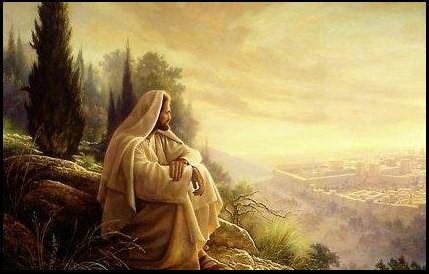
In today’s gospel, Jesus is at the top of the Mount of Olives with His Apostles. From this vantage point, they look across the Kidron Valley to the magnificent Temple and all of Jerusalem spread out before them. The Apostles marvel at the glorious beauty of the Temple. Its large, perfectly carved, white ashlar stones, gilded in gold, gleam like the sun. Indeed, it was one of the wonders of the ancient world, so beautiful and majestic.
But Jesus challenges their admiration. He shocks them with the admonition that all the glory they see is soon to be destroyed, that not one stone will be left on another, that it will all be thrown down (Mk 13:2). Shocked, the Apostles ask Him when this will happen and what signs will precede this awful event.
In what has become known as “Mount Olivet discourse,” the Lord warns, in great detail, of the coming destruction of the Temple and indeed of all Jerusalem. The Gospels of Matthew, Mark, and Luke all contain similar descriptions of what Jesus said on the Mount of Olives, overlooking Jerusalem in her glorious heyday.
Jesus warns of wars and rumors of wars. He speaks of a time in the near future when nation will rise against nation and a terrible conflict will ensue. In effect, He warns His disciples and their followers to have nothing to do with the coming wars. He tells them that when they see Jerusalem being surrounded by an army they should know that her destruction is at hand. If someone is on his rooftop he should not to go back into the house to gather his possessions; he should get out while the getting is good. If someone is out in the field he must not reenter the city of Jerusalem, but must flee to the hills. Jerusalem is doomed for its lack of faith and zealots are picking up the war with the Romans that they are destined to lose (Luke 21, Matt 24, Mark 13).
All of this leads us to today’s gospel (from the Mount Olivet discourse), which picks up in the middle. Jesus warns of days of tribulation, when the sun will be darkened, the moon not give its light, and the stars will fall from the sky!
In reading a text like this, we must not fall prey to an overly literal interpretation. Jesus is using prophetic language, a way of speaking that is meaningful, but not to be understood scientifically or literally. Stars cannot actually fall from the sky.
If I were to say, “The world has been turned upside down,” you wouldn’t expect that if you looked back toward Earth from outer space you would actually see Australia at the top and North America at the bottom of your view. If I were to say, “It’s raining cats and dogs,” you wouldn’t expect to look out your window and see animals coming down from the sky and landing on the front lawn. Although I’m speaking figuratively, you understand what I mean.
And so it is with Jesus’ use of prophetic imagery. Speaking of the heavenly luminaries as being darkened or cast down is a prophetic way of saying that all the fixed points, all the ways in which we tell time, know the seasons, navigate, and find perspective will be lost to us! The world as the Jewish people know it, centered on the Temple and rooted in their liturgical calendar, is about to be swept away. To the ancient Jewish people, the Temple was like their “Big Ben.” It was both the clock of the liturgical cycle and the great visual center of all of Israel.
The Lord is teaching them that what they see as the central hub of all they do is about to be taken away. The Temple, with all of its rituals, its liturgical cycle, and its endless slaughter of animals in sacrifice for sin, is about to be replaced. These ancient rituals merely pointed to Jesus and all that He would do. Jesus is now the Temple; He is also the Lamb Sacrifice. All that the Temple pointed to is fulfilled in Jesus. Thus the Temple is at an end. Jesus is ushering in a New Covenant.
In the Mount Olivet discourse, Jesus prophesies the end of the Temple, which will take place in a biblical 40 years. Sure enough, 40 years later (in A.D. 70), the Roman Army, after having surrounded Jerusalem for a period of 3 1/2 months, breached the walls, poured into the city, and destroyed the Temple and all of Jerusalem. In this epic battle, according to Josephus, 1.2 million Jewish people lost their lives. As Jesus prophesied, not one stone was left on another. According to Josephus, so complete was the destruction of Jerusalem, that when the Romans had finished their work it was not clear that the city had ever existed.
So this is the place of this gospel, a place of epic significance in the ancient world. An era of 1000 years was coming to an end. The world as the Jewish people knew it was ending. The Temple has never been rebuilt; it has been replaced by a Judaism without sacrifice, a rabbinic, a synagogue system. In 2000 years, despite several attempts, the Jewish Temple has never been rebuilt. Everything Jesus predicted came to pass. This is the historical place and context of this gospel.
But what does all of this mean for us, some 2000 years later? Let’s consider three basic themes.
I. The Perspective of Passing – Toward the end of this gospel, the Lord says, Heaven and earth will pass away, but my words will not pass away. Note the definitiveness of this statement: this world will pass away. That is to say, all of the things that impress us at the current moment: the “biggie-wow” stuff of this world, the impressiveness of the powerful, the influence of the popular, the glory of all the glitterati; all of this will pass away.
Indeed, even now it is passing away; its destruction is at hand. Scripture says,
The world in its present form is passing away (1 Cor 7:31).
We have here, no lasting city (Heb 13:14).
Put not your trust in princes, in mortal men in whom there is no hope. Take their breath, they return to clay, and their plans that day come to nothing (Psalm 146:3-4).
Yes, all of the glory, even what seems beautiful and fair, is passing away. Don’t be so impressed with this world’s offerings. All of it—no matter how powerful, influential, or sturdy it may seem—is slated for destruction. It is already passing away.
Some years ago I was in a museum and in one of the exhibits saw a photograph of a family from about the 1880s. At the bottom of the photo was this inscription: “My family, as it appeared for a brief time last summer.” A poignant caption. I thought of the people in that photo and concluded that every one of them was now dead. I also knew that the house in front of which the photo was taken had long since been destroyed, replaced by an expanding city district of buildings. All is passing; nothing remains here for long.
Painful though this perspective may be, it is important and healing. It brings with it a kind of strange serenity. Like every truth, the truth that all things are passing sets us free. Internalizing the truth that, As for man, his days, or the flower of the field are like the grass. The wind blows, and he is gone, and his place never sees him anymore (Psalm 130:15-16), painful though it may be, brings a kind of strange serenity. In this truth we are reminded not to set down too many roots here so that we are not resentful when this world passes away.
II. The Permanence Proclaimed – The Lord tells us that His words will not pass away. So although the world will pass away, the truth and the Word of God will remain forever.
Too many people root their lives in passing, ephemeral things. The challenge for us is to root our lives in the Word of God, which remains forever. Worldly glories, power, access, and wealth—all these things fade and disappear. But God’s wisdom and His plan remain forever.
Consider, for a moment, the Church. The Lord has said that the forces of Hell would strive to prevail, overpower, and destroy the Church. But the Lord promised that such attempts would never be successful (Matt 16:18). The Church is indefectible, by God’s Word, by His promise. No weapons, no war waged against the Church, will prevail.
In all of this the Lord has been proven true. The Church has the Roman Empire, the Carolingian Empire, the British Empire, the Soviet Socialist Republic, and many others rise to power only to fade and disappear.
How many heresies, how many philosophies have come and gone in the age of the Church? How many have laughed at the Church, announcing that she was passé, that her day was over, and that they would bury her? The Church has buried every one of her undertakers, outlived every one of her critics. Despite every prediction of her demise, she has persevered until this very day. By God’s grace, she has a permanence that outlasts every one of her enemies. She has read the funeral rites over every single prophet of her doom. And she will continue to do so.
In recounting all of this we do not simply gloat that an institution known as the Church has survived. Rather, we announce that the Church is the Bride of Christ and also His Body. The Church cannot be destroyed not because of human ingenuity, but on account of the power and grace of God. She will endure even though at times she will suffer, be ridiculed, or be marginalized. She will outlive every enemy. She will emerge from every persecution. She will never be removed. For the Church is the Body of Christ, the living Word of God. Though the world will pass away, the Word of the Lord will remain forever!
III. The Priority Prescribed – If this world as we know it is passing away and the Lord, His Kingdom, His Church, and His Word will remain forever, what then should be our priority? The Lord says, in effect, that we know very well what our priority should be but we willfully ignore it.
Learn a lesson from the fig tree. When its branch becomes tender and sprouts leaves, you know that summer is near. In the same way, when you see these things happening, know that he is near, at the gates.
Yes, we know very well that the Day of Judgment is coming. Too easily, though, we dream on and do not follow the prescribed priority. Wealth, fame, and glory are all uncertain and clearly passing. But death, judgment, Heaven, and Hell are certain and remain forever. We too easy fiddle on with things that are uncertain and passing while neglecting what is certain and eternal. Such foolishness!
It would be foolish to book passage on a sinking ship. Similarly, it is foolish to make this world and its demands our fundamental priority. It is wise to set our sights on, and lay hold of, the Kingdom that lasts forever.
It is sad that so many spend people their time “rearranging the deck chairs on the Titanic” of this world. It is tragic how much time, effort, and passion we spend on things that are pass through our fingers like sand. So much of our effort is expended on furthering our career, amassing wealth, and enlarging our homes. And so little is spent on improving our spiritual life.
Parents spend more time worrying about what college their children will attend than where they will spend eternity. If their child is failing math, they will go to great lengths to hire tutors to improve his test scores. But never mind that the child barely knows the four Gospels, the difference between the Old Testament and the New Testament, or even who Adam and Eve were. Never mind all that; we need to make sure they understand polynomials! It is fine that parents care about math scores and college venues, but how sad it is that eternal things often go unattended.
The greatest duty of parents is to prepare their children for eternity. But far more time and effort is often spent preparing them for passing things like a career. While education and career are important, eternal life is far more so. A son or daughter may graduate from Harvard Law School and become a famous attorney yet still go to Hell!
What are our priorities? Frankly, most of our priorities are not things that matter to God. Even if we attain the passing things we strive for, they will all ultimately slip through our fingers. We obsess over passing things like our physical health while neglecting enduring things like our spiritual health. We should care for our bodies, but even more should we care for our souls. If we would expend as much effort looking for a place and time to pray as we do looking for a restaurant and making a reservation to eat, we would be spiritual heavyweights rather than physically overweight.
In today’s gospel the Lord stands before the Temple: an impressive building, a symbol of power and of worldly glories. But impressed though the Apostles are, the Lord is not impressed with passing things. He counsels us to get our priorities straight and to focus on things that last: His Word, which never passes away, and our ultimate destiny, where we will spend eternity.
We find time for everything else, why not prayer, Scripture, fellowship in the Church, and the sacraments?
What are your priorities? Be honest, now, be honest.
This world is passing away. Far more essential for us than power, prestige, money, possessions, worldly philosophies, and the latest trends, is the Word of the Lord, which never passes away.
The world will laugh and say that God’s word is out-of-date, old-fashioned, or even hateful, bigoted, and intolerant. But in the end, time will prove where wisdom is. Long after the current critics of the Church, those who scorn the teachings of the Lord in the Scriptures and the Church, have passed on, the Church will still be here preaching Christ and Him crucified.
None of this is meant to sound triumphalist. It is simply rooted in a Word of truth that the Lord spoke long ago on a hillside overlooking glorious buildings soon to be reduced to rubble and an age soon to pass away. He said simply this: Heaven and earth will pass away but my words will not pass away.
In the end, Jesus wins. I know because I checked the end of the story. You can look it up (Rev 20-23). Get on the winning team. Stop trying to amass a treasure here that you can’t keep anyway.
It has been said that the shortest distance between two people is laughter. There is something strangely intimate about laughter. Indeed, it is an intimacy that can often break through many divisions. Upon hearing a joke, even enemies can laugh and share a moment of intimate and mutual joy, or at least mirth.
Watch this video and consider how complete strangers share a kind of intimacy through laughter, and how laughter is contagious. “I dare you to watch this and not feel a certain intimacy with the people in the video!”
Worry is a universal human problem. Jesus speaks to it in Matthew 6 and His advice amounts to more than just “Don’t worry.” He actually sets forth how we can avoid it. Let’s see how by looking at three problems He describes that bring about worry.
No one can serve two masters. Either you will hate the one and love the other, or you will be devoted to the one and despise the other. You cannot serve both God and money. Therefore I tell you, do not worry about your life, what you will eat or drink; or about your body, what you will wear. Is not life more than food, and the body more than clothes? Look at the birds of the air; they do not sow or reap or store away in barns, and yet your heavenly Father feeds them. Are you not much more valuable than they? Can any one of you by worrying add a single hour to your life … But seek first his kingdom and his righteousness, and all these things will be given to you as well. Therefore do not worry about tomorrow, for tomorrow will worry about itself. Each day has enough trouble of its own (Matthew 6:24-27, 34).
I. The Problem of Possessions– The text says, No one can serve two masters. He will either hate one and love the other, or be devoted to one and despise the other. You cannot serve God and mammon. Mammon is variously understood as riches, greed, or possession. In an extended sense, it can refer to the agenda of the world, which is focused on material things and ties our dignity only to those things.
Whose slave are you? The Lord is clear that if we wish to serve Him we cannot also serve mammon. The Greek word translated here as “serve” is δουλεύειν (douleuein), which more specifically means “to serve as a slave.” By overlooking the slavery aspect, we miss the strength of the text. In our culture it is typical that one serves in a job or some similar capacity during “working hours,” but goes home afterward and is free of obligations. Perhaps because of this, we tend to think that we can serve both God and mammon. But the Greek text here refers not to a mere servant but to a slave. And a slave is wholly subject to the will of another. Thus Greek is more intense than the English translation.
What the Lord is saying is, “You’re either going to be a slave of the Lord or a slave of the world.” The truth is that most people are slaves of the world, of mammon, of riches, of greed, and of their associated agendas. These worldly things tend to consume us so completely that when we hear of a demand from God, we feel overwhelmed or even angry that something more is being required of us. Our anger at God is a sign that we are a slave to mammon.
Most of us are too proud to admit that we are slaves of the world, but the fact is that to a large extent we are. The world and its demands press in on us and take up nearly all our oxygen. It is this terrible slavery that is a huge source of our anxiety and from which the Lord offers to free us. The Lord describes the anxieties that flow from slavery to mammon, to the world, to its riches and agenda:
I tell you, do not worry about your life, what you will eat or drink, or about your body, what you will wear … Why are you anxious about clothes? Do not worry and say, ‘What are we to eat?’ or ‘What are we to drink?’ or ‘What are we to wear?’
Still anxious! For us who live in the Western world, the anxieties about merely having such things may have receded a bit. We are well-supplied and may not worry whether we will have clothes, food, etc. But even having them in abundance, still we worry about them obsessively. For example, we worry about whether we have the right clothes, or whether they are in style, or whether they look good on us. Many people are quite obsessed about what they eat: they worry about eating too much salt, or sugar, or fat. We have never lived so long or been so healthy, and yet we have never been more anxious about our health. It’s amazing when you think of it: we have plenty of food and still we worry about it; worry, worry, worry! Anxiety about these things is a sign that we are slaves to them. Scripture says, but as for the rich, their abundance permits them no sleep (Eccles 5:12).
The Lord offers to live his life in us so that we will not be slaves to mammon, but to Him. You may not like the image of slavery, but I have news for you: we are so small and powerless that we’re going to be the slaves of someone, so it might as well be the Lord. Being wholly devoted to the Lord and what pleases Him breaks our obsession with the world, money, possessions, popularity, fashion, and the like.
As the Lord’s life and His will begin to replace our own, our obsession with the world’s demands diminishes and its power is broken. As we grow into a deeper relationship with the Lord, our concerns with worldly agendas fade and our anxiety diminishes.
Now you and I aren’t going to be able to completely stop worrying of our own accord. But the Lord, living His life in us, isn’t worried at all. And as His power and influence over us grows, our worries lessen and our anxiety dissipates.
This is the gift that the Lord is offering us if we but let him take greater possession of our heart. How do we do this? Through the medicine of prayer, sacraments, and daily doses of Scripture and spiritual reading. Gradually, the Lord will transform our heart, mind, and will to be like His.
II. The Problem of Paternity– The Lord Jesus wants to draw us into deeper relationship with His Father. It remains a common spiritual problem, even for those who develop something of a relationship with Jesus, to feel that the Eternal Father is distant or remote. To many, the Father is a stranger. They have surely heard of Him and read of Him in the Scriptures, but still He is stranger. Some even have a sort of fear of Him. Perhaps their fear stems from some Old Testament texts, or from their relationship with a stern earthly father. Whatever the problem, the Lord Jesus wants to lead to us His Father. Note that the phrase “your heavenly Father” occurs twice in this passage and four times in Matthew Chapter 6 overall. There are two other references to the Father as “God” in today’s gospel. It is also in Chapter 6 of Matthew that Jesus teaches us the Our Father.
All of these references to the Father, particularly in such close proximity to the invitation not to worry, cannot be overlooked. An antidote to anxiety is having a closer relationship with the Heavenly Father. Our Heavenly Father knows what we need. He cares for birds, flowers, and countless other things and is willing and able to care for us. To embrace and experience His love for us is to experience a lessening in anxiety.
Perhaps an illustration will help. When I was six years old, I was sometimes afraid that someone would break into our home or that something bad would happen during the night. But when my Father was home, I didn’t have these fears. In 1968 he left for Vietnam and was gone for a year. During that time I had an extended bout of ongoing fear at night; Daddy was gone and I felt unsafe. In 1969 he returned and my fears went away. I didn’t cause them to go away. It was not an act of the will on my part. It was simply this: Daddy was home.
You and I may not simply be able to dismiss our fears and anxieties by a simple act of the will. But to the extent that our “Daddy-God” is near and we feel His presence, our fears just go away.
Here is a critical gift that Jesus wants to give us: a deep, personal experience of, and love for, His Father. It is our perceived distance from the Father that causes our anxiety. But when we experience that our Heavenly Father “knows what we need,” we experience our fears melting away.
Seek this gift from Jesus: that his Father will be known and loved by you, that His presence will be close at hand; then watch your fears melt away. The Lord Jesus can do this for us. Take some time and read the Parable of the Prodigal Son (Luke 15) slowly. Recognize that the parable is really more about the father than the sons. Jesus is saying, “This is what my Father is like.
III. The Problem of Priorities – The text says, But seek first the kingdom of God and his righteousness, and all these things will be given you besides. One of our greatest struggles is to have proper priorities, to do, in the end, just one thing. This third matter (priorities) is not unlike the first (possessions) but it is more about choices and directions than things and allegiances.
We have a lot of trouble deciding what is most important and how to make good decisions. This causes us a lot of grief and anxiety. We want too many things. We want to please too many people. We are too easily distracted from our goal. In many ways we have not even fully clarified our goal.
What is it that you want? What is the one thing that really guides every other thing you do? Now be honest! You may say, “God.” You may say, “the world,” or “my career.” But a lot of people don’t really have a clear answer as to what the one thing they want is. The fact is they want a lot of things, and have never really sat down and reflectively determined the one, over-arching goal of their life. And so they run about chasing butterflies and experiencing lots of anxiety.
Imagine a man who is headed for New York City from Philadelphia. Along the way he sees many signs but is able to determine quickly which ones pertain to his journey and which can be ignored. When he sees a sign for “95 South to Baltimore,” he knows he can ignore it and experiences no anxiety about it at all.
But now consider a second man, who is not sure where he is headed. It may be to New York City, but he may go somewhere else; he just isn’t all that certain. He hasn’t thought about much and just sort of lets things happen. When he sees that same sign for “95 South to Baltimore,” he wonders whether or not he should follow it. The sign makes him anxious. It’s a fork in the road and he’s not sure what to do. Should he take it or not? And when he does make a choice, he wonders if he did the right thing. Having made the choice only heightens his anxiety. He keeps looking back, second-guessing himself, and wondering about his choice. He’s anxious because he didn’t first determine his real destination.
Many people today live this way. They have no real priority, no definitive choice. And even if they have some vague direction (e.g., “I want to be happy”) they have little idea what it really takes to get there. And, frankly, they don’t really want to know the specifics. Commitments and decisions are eschewed. But, strangely, in trying to avoid a decision or commitment, they become more anxious, not less. Every fork in the road of life is bewildering to them and brings about the question, “What should I do?”
The Lord wants to save us from all this anxiety and thus offers us the grace to clarify what we want and where we are going. As He begins to live his life more fully in us, our mind gets clearer and our heart desires with greater clarity. When Jesus’ own life begins to replace our own, we want what He wants. And He wants the Kingdom and its values. He loves His Father, and everyone and everything His Father loves.
And so do we. By grace and by degrees, the Lord begins to change us, to clarify things for us. Increasingly, our life becomes about only one thing: That I want to die and leave this world loving God and his kingdom … That I want to be with him forever.
Received, not achieved – In all three of these areas please remember that the Lord is not saying to us that by our own power we must serve only God, experience Him as Father (Abba), and seek first the Kingdom of God. If it depended only on us, it wouldn’t last twenty minutes!
No, what the Lord is doing here is painting a picture of the transformed human person, and of what we will increasingly experience if we let Him live His life in us and transform us by stages. This work begins and continues in us when we get down on our knees and beg the Lord to do it. It begins and continues when we are serious about having a steady diet of prayer, Scripture, Church teaching, sacraments, Holy Mass, and holy fellowship.
Now if you want to just stay anxious and fretful, fine. But if you seek serenity, then ask the Lord into your life; re-invite him every day. Remain faithful to spiritual practices. If you do, I promise (for I am a witness) that you will see your anxieties lessen, your fears abate, your serenity grow, and your confidence strengthen. The choice is yours.
After such solid advice from the Lord, I hope you’ll pardon this lighthearted video. Consider it a tongue-in-cheek bit of advice.

 True gratitude is a grace, or gift, from God. It proceeds from a humble and transformed heart. In such a case we do not render thanks merely because it is polite or expected, or because God commands it, but because it naturally flows from a profound experience of gratitude. The “command” of Scripture to give thanks is not a moralism, but a truth and a description of what flows from a transformed heart.