
I Went, I Washed, and Now I Can See – A Homily for the 4th Sunday of Lent

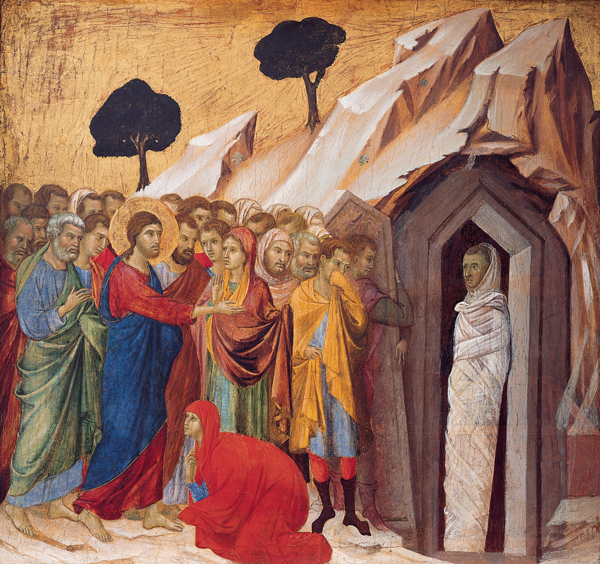
In today’s Gospel, Jesus, the Light of the World, brings light to a man born blind. If you are prepared to accept it, you are the man born blind, for all of us were born blind and in darkness. It was our baptism and the faith it gave that rendered us able to see and to come gradually more fully into the light. The man in today’s Gospel shows forth the stages of the Christian walk, out of darkness and into the beautiful light of Christ. Let’s take a moment to ponder the stages of the blind man’s walk, for each of us is the man.

I. The Problem that is Presented – We are introduced to a man who was blind from birth, incapable of seeing at all. As Jesus passed by he saw a man blind from birth. His disciples asked him, “Rabbi, who sinned, this man or his parents, that he was born blind?” Jesus answered, “Neither he nor his parents sinned; it is so that the works of God might be made visible through him. We have to do the works of the one who sent me while it is day. Night is coming when no one can work. While I am in the world, I am the light of the world.”

So there is the problem: he is blind; he has no vision. On account of Original Sin, we lost all spiritual vision. We could not see God or endure the light of His glory. This lack of vision causes many to have no “vision” for their life. They don’t know why they were made or what the true purpose of their existence is. Many cannot see past the sufferings of this world to the glory that awaits. Others have retreated into the material world and cannot see beyond it. Still others have retreated even further, away from reality into the realm of their own mind, their own opinions. St. Augustine describes this condition of the human person as curvatus in se (man turned in on himself). Yes, there is a blindness that imprisons many in the darkness. Even for us who believe there are still areas where it is hard for us to see. Coming to see God more fully, and to see ourselves as we really are, is a journey; one we are still on.

While the disciples want to dwell on secondary causes, Jesus sidesteps these and focuses on solutions. Assessing blame is unproductive; healing the man is uppermost. In a statement dripping with irony, Jesus says that the works of God will be made visible in a blind man. For the foolishness of God is wiser than man’s wisdom, and the weakness of God is stronger than man’s strength (1 Cor 1:25). Yes, God can make a way out of no way and write straight with crooked lines.

II. The Purification that is PrescribedHaving diagnosed the problem, Jesus begins the work of healing this man. When he had said this, he spat on the ground and made clay with the saliva, and smeared the clay on his eyes, and said to him, “Go wash in the Pool of Siloam”—which means Sent. So he went and washed, and came back able to see.

Hopefully, you can see baptism here. Jesus tells him, “Go wash … he went and washed, and came back able to see.” The Catechism of the Catholic Church says this of the Sacrament of Baptism:

This bath is called enlightenment, because those who receive this [catechetical] instruction are enlightened in their understanding … Having received in Baptism the Word, “the true light that enlightens every man,” the person baptized has been “enlightened,” he becomes a “son of light,” indeed, he becomes “light” himself (CCC 1216).

Baptism is required in order to truly see. It is no accident that John mentions the name of the pool to which the man goes: Siloam, a name meaning “sent.” Jesus sends him and He sends us. Baptism is required. Jesus says elsewhere, Truly, truly, I say to you, unless one is born of water and the Spirit, he cannot enter the kingdom of God (John 3:5).

Notice that the man comes back able to see. But just because you’re able to see doesn’t mean you actually do see. Right now I am able to see the Statue of Liberty; my eyes function properly, but I do not see it; I have to make a journey in order to do that. Similarly, the man here is able to see Jesus, but he does not yet see Him. He has a journey to make in order to do that. He has a long way to go to see Jesus fully, face to face. Baptism is not the end of our journey but the beginning of it. It renders us able to see, but we are still newborn babes. We need to grow. We can see, but there is plenty we haven’t yet seen.

III. The Perception that is Partial – The man can see but still does not know much of the one who has enabled him to see. His neighbors and those who had seen him earlier as a beggar said, “Isn’t this the one who used to sit and beg?” Some said, “It is,” but others said, “No, he just looks like him.” He said, “I am.” So they said to him, “How were your eyes opened?” He replied, “The man called Jesus made clay and anointed my eyes and told me, ‘Go to Siloam and wash.’ So I went there and washed and was able to see.” And they said to him, “Where is he?” He said, “I don’t know.”

So he’s able to see. But he hasn’t yet seen much. The man must grow in faith to come to know who Jesus really is. Look at how his partial perception is described. For now, he merely understands Jesus as “the man called Jesus.” To him, Jesus is just “some guy.” When asked where Jesus is, all he can say is that he doesn’t know. Although he is able to see, he does not yet actually see Jesus.

This describes a lot of Christians. They know about Jesus but they don’t know Him. Many Catholics in the pews are “sacramentalized but unevangelized.” That is, they have received the sacraments but have never really met Jesus Christ; they do not know Him in any more than an intellectual way. Many don’t even expect to know Him. He is little better to them than “the man called Jesus.” They’ve heard of Jesus and even know some basic facts about Him, but He is a distant figure in their lives. When asked questions about Him, they respond like this man: “I don’t know.”

IV. Progress through Persecution and Pondering – The text goes on to show us the progress that this formerly blind man makes in coming to know and finally see Jesus. It is interesting that this progress comes largely through persecution. Persecution need not always be understood as something as severe as being arrested and thrown in jail. It can come in many forms: puzzlement expressed by relatives and friends, ridicule of Catholicism in the media, or even those internal voices that make us question our faith. In whatever form, though, persecution has a way of making us face the questions and refine our understanding. Our vision gets clearer as we meet the challenges.

Notice the man’s progress thus far. He has been baptized and is now able to see, but he still knows little of Jesus, referring to Him only as “the man called Jesus,” He doesn’t know where Jesus is. He is about to grow, though, and does so in several stages.

In stage one of the man’s post-baptismal growth his neighbors turn on him and bring him to the Pharisees, who interrogate him because Jesus had healed him on the Sabbath.

They brought the one who was once blind to the Pharisees. Now Jesus had made clay and opened his eyes on a Sabbath. So then, the Pharisees also asked him how he was able to see. He said to them, “He put clay on my eyes, and I washed, and now I can see.” So some of the Pharisees said, “This man is not from God, because he does not keep the Sabbath.” But others said, “How can a sinful man do such signs?” And there was a division among them. So they said to the blind man again, “What do you have to say about him, since he opened your eyes?” He said, “He is a prophet.”

Notice what this persecution does for him. As he is challenged to say something about Jesus, he moves beyond calling him “the man called Jesus” and describes Him as a prophet. The man has gained some insight. A prophet speaks for God and Jesus is the Word made flesh.

In stage two of the man’s post-baptismal growth the Pharisees doubt his story and broaden their persecution, interrogating and threatening his fearful parents.

Now the Jews did not believe that he had been blind and gained his sight until they summoned the parents of the one who had gained his sight. They asked them, “Is this your son, who you say was born blind? How does he now see?” his parents answered and said, “We know that this is our son and that he was born blind. We do not know how he sees now, nor do we know who opened his eyes. Ask him, he is of age; he can speak for himself.” His parents said this because they were afraid of the Jews, for the Jews had already agreed that if anyone acknowledged him as the Christ, he would be expelled from the synagogue. For this reason, his parents said, “He is of age; question him.”

In stage three of his post-baptismal growth we note that the continuing persecution seems to make him grow even stronger and more able to withstand his opponents. Note his determination and fearlessness during the second interrogation he faces, which includes ridiculing him and placing him under oath:

So a second time they called the man who had been blind and said to him, “Give God the praise! We know that this man is a sinner.” He replied, “If he is a sinner, I do not know. One thing I do know is that I was blind and now I see.” So they said to him, “What did he do to you? How did he open your eyes?” He answered them, “I told you already and you did not listen. Why do you want to hear it again? Do you want to become his disciples, too?” They ridiculed him and said, “You are that man’s disciple; we are disciples of Moses! We know that God spoke to Moses, but we do not know where this one is from.” The man answered and said to them, “This is what is so amazing, that you do not know where he is from, yet he opened my eyes. We know that God does not listen to sinners, but if one is devout and does his will, he listens to him. It is unheard of that anyone ever opened the eyes of a person born blind. If this man were not from God, he would not be able to do anything.” They answered and said to him, “You were born totally in sin, and are you trying to teach us?” Then they threw him out.

The result of this is to further deepen his vision of Jesus. At first, he saw Jesus only as “the man called Jesus.” Then he sees Him as a prophet. Now he goes further and sees Him as “from God.” He’s progressing from sight to insight. His ability to see, given to him in baptism, is now resulting in even clearer vision.

V. Perfection that is Portrayed – The man has been thrown out of the synagogue, as many early Christians were. He has endured the hatred of the world and the loss of many things. When Jesus heard that they had thrown him out, he found him and said, “Do you believe in the Son of Man?” He answered and said, “Who is he, sir, that I may believe in him?” Jesus said to him, “You have seen him, the one speaking with you is he.” He said, “I do believe, Lord,” and he worshiped him.

Now the man’s vision is clear. After all this, he finally sees. Not only does he see Jesus, he sees who Jesus is. First he saw Him only as “the man called Jesus.” Then he sees Him as a prophet. Next, he says that He is from God. The final stage is the best of all. He actually sees Jesus and falls down to worship Him. Jesus is not only from God, he is God. Christ has fully enlightened him.

This is our journey, moving in stages to know Jesus more perfectly. One day we will see Him face to face; we will see Him for who He is.

Where are you on this journey? If we are faithful, our vision is getting better daily, but it is not yet complete. Scripture says,

  1. For now we see in a mirror dimly, but then face to face. Now I know in part; then I shall understand fully, even as I have been fully understood (1 Cor 13:12).
  2. Beloved, we are God’s children now; it does not yet appear what we shall be, but we know that when he appears we shall be like him, for we shall see him as he is (1 John 3:2).
  3. My soul is thirsting for God, the God of my life; when can I enter and see the face of God? (Psalm 42:2)

For now, make this journey. Make it in stages. Come to know who Jesus is.

I have it on the best of authority that the man, on his journey to Jesus, sang this song:

Walk in the Light, beautiful light. Come where the dew-drops of mercy shine bright. Walk all around us by day and by night, O Jesus the Light of the World!

Let there be light!

A Woman Wrapped in Silence – A Meditation for the Feast of the Annunciation

In preparation for today’s Feast of the Annunciation I picked up Jesus of Nazareth, Vol. 3 (The Infancy Narratives), by Pope Emeritus Benedict. I was very moved by a brief reflection that he made on Mary as the Angel Gabriel left her. His remarks consider her faith in a very touching manner.

I must say that I have always been moved—and intrigued—by the faith of the Blessed Mother. She is “a woman wrapped in silence,” a phrase that forms the title of an excellent book by Fr. John Lynch. The pope’s words capture both her faith and her mystery:

I consider it important to focus also on the final sentence of Luke’s Annunciation narrative: “And the angel departed from her” (Luke 1:38). The great hour of Mary’s encounter with God’s messenger—in which her whole life is changed—comes to an end, and she remains there alone, with a task that truly surpasses all human capacity. There are no angels standing around her. She must continue along the path that leads to many dark moments–from Joseph’s dismay at her pregnancy, to the moment when Jesus is said to be out of his mind (cf. Mark 3:21; John 10:20) right up to the night of the cross.

How often in these situations must Mary have returned inwardly to the hour when God’s angel had spoken to her, pondering afresh the greeting: “Rejoice, full of grace!” And the consoling words: “Do not be afraid!” The angel departs; her mission remains, and with it matures her inner closeness to God, a closeness that in her heart she is able to see and touch (Jesus of Nazareth, The Infancy Narratives, Kindle edition (loc 488-501)).

I am moved by this image of Mary, there all alone, perhaps wondering how it would all unfold and whether what she just experienced had really happened. The angel departs and she is alone (and yet never alone).

As background, I would like to say that I have read some accounts of Mary’s life that placed her in such rarefied air that I could no longer relate to her. I vaguely remember reading some accounts of visionaries saying that Mary did not even have to do housework because the angels swept the house, did the dishes, and so forth. Some other accounts spoke of how she had detailed foreknowledge of everything that would take place in her life as well as in Jesus’ life. I even recall one purported visionary who wrote that Mary had extensive theological discussions with Jesus even while He was still an infant. I do not remember who these alleged visionaries were or if any of them were even approved visionaries. Yet in the early 1980s a large number of books were published containing the observations of various “visionaries.”

Such accounts often left me cold and made me feel distant from our Blessed Mother. They also did not seem to comport with the Scriptures, which present Mother Mary as a woman of great faith, but one who has to walk by faith and not by perfect sight, just as all of us do. She wonders at Gabriel’s greeting, is troubled, and does not understand how it will all work out (cf Luke 1:29).

Yet she presses on and we next see her having made haste to the hill country, rejoicing in ecstatic praise with her cousin: My spirit rejoices in God my savior! She still does not know how it will all work out, but in spite of that she is content to know the One who holds the future; it is enough for now.

Years later, when she finds Jesus teaching in the Temple after days of agonized searching for the “missing” boy, she does not fully understand His explanation (Luke 2:48-50), but ponders these things within her heart (Luke 2:51).

At the wedding feast at Cana, Jesus seems almost to rebuke His mother. Although the text omits many of the details, there must have been something in her look, something of the look that only a mother can give to a son. By now, Mary’s understanding of her son has surely deepened; she has known Him and pondered and reflected in her heart over Him for more than thirty years. She simply looks at Him, and He at her—a look that only the two would have known. Something passed between them, a look of understanding. Whatever it was remains wrapped in silence; it’s none of our business, something that only she and her Son could know. Whatever it was, it prompts her to turn and with confidence, knowing the situation will be well-handled, says to the stewards, “Do whatever he tells you” (Jn 2:5).

Of the three years to follow we know very little. We know that she is not far away. We see her in Mark 3:31 as she asks after Jesus, seemingly concerned that others are saying “He is beside himself!”

Now we find her gently and supportively present at the foot of the Cross. The sword that Simeon had prophesied (Lk 2:35) is thrust through her heart. More than thirty years earlier she could only wonder what Simeon meant when he said that her child was destined for the fall and the rise of many in Israel and that a sword would pierce her heart (Luke 2:33). In the intervening years her faith had surely deepened; now, here she is at the foot of the Cross. It is her darkest hour, but surely all those years of pondering and reflecting on these things in her heart helps to sustain her.

Yes, Mother Mary is a woman wrapped in silence. We know so little, for she is reflective and quiet. She says little, silently standing by, silently supportive of Jesus in His public ministry. Now, again silently, she is at the foot of the Cross.

Yes, this is the Mary, this is the Mother that I know: a woman of faith but also a human being like you and me. As the Pope Benedict suggested, she is a woman who had to make a journey of faith without knowing how everything would work out, without the omniscience that some visionaries ascribe to her. She knew what the angel had said, but it seems clear that she did not know how it would all come to pass. She, like us, walked by faith and not by earthly sight.

Mary is the perfect disciple, the woman of faith, the one who presses on, not knowing all, but pondering and reflecting everything in her heart.

How Did People Tell Time in Jesus’ Day?

N.B.: I am in the Holy Land at this time. As my travel schedule is heavy, I am republishing some articles about life in Jesus’ day. I hope you will enjoy reading (or re-reading) them as much as I did.

The modern person, especially in the West, thinks of time in a very mechanistic way. We watch the clock, which is in itself a mechanical device without intrinsic meaning. For shorter periods of time we look at the clock rather than the sun. For longer periods, we watch the crops, track our children’s growth, or more broadly chart the rise and fall of nations. For most of us, time is not the unfolding of eternity or the cycle of life; time is simply a span to be reckoned by its length, by the number of ticks on a device we have invented. We also tend to measure time by what we can do with it: if we have a lot of time we can get a lot done; if we don’t have much time we can’t much done.

The modern, Western mind tries to control by measuring; and boy do we love to measure time! Having measured it, we somehow think we control it. We assign monetary value to it by stating that time is money. We have many expectations based on it: “You’re taking too long to do that,” or “The deadline has passed.”

For the ancients, such precision about time was unknown and to some degree impossible. For them, demarcations of time were of divine origin. God set forth the sun to rule the day, the moon, and the stars the night (cf Ps 135:8-9).

The daily cycle of the sun defined the day and night. A lengthier cycle of the sun, its rising and falling in the horizon, marked the year. Seasons could also be discerned by this cycle. There were the longest and shortest days of the year (the solstices) and the equinoxes, when the night and the day were essentially the same length.

The moon declared the passage of months. In fact, the very word “month” in English has the same origin as the word “moon.”

There were different systems used by the ancients to demarcate time, some of them were based on the sun and others on the moon. It is clear that in Jesus’ time, the lunar year (354 days) was used. The lunar year has the serious disadvantage of being some 11 days behind the solar year, which quickly causes a discrepancy between the months and the seasons. This difference had to be adjusted for periodically; otherwise, “summer” would eventually have occurred in the winter months!

Generally speaking, the Jewish people waited until the error of the lunar calendar amounted to about a full month, at which time they inserted an extra month (Veadar) between the months of Adar and Nisan. A year with this extra month amounted to almost 400 days instead of the usual 354 days of the Jewish lunar calendar.

The decision as to when exactly to insert this extra month was made rather empirically. Farmers might comment to rabbinic officials that the lambs were still too young or the grain was not yet ripe. When consensus built that the month of Veadar needed to be inserted, it was ordered to be done. Decisions of this sort were usually made by a Beth Din (a rabbinical court) following a complex procedure. Witnesses were examined as to the problem of the lagging calendar in relation to the season. Chosen observers of the sun and moon were asked to testify in great detail about the location of the moon, the size of its crescent, and its height above the horizon. When the sufficient evidence was collected, the Veadar month was declared. This happened approximately every three years.

Generally, a month was said to begin in the evening of the 29th day, at the moment when the thin sliver of the new moon appeared in the sky. When all seven Beth Din members agreed to the new month, it legally began; fires were lit on the hilltops to announce it to the populace.

In ordinary years (those without a Veadar) there were 12 months. In actuality, though, the ancient Jews told time more by their feasts than by the month. The Jews thought of yearly time in this manner:

Jewish Month Western Equivalent Cycle of Feasts
Nissan March–April Passover
Iyar April–May Lag B’Omer
Sivan May–June Shavuot
Tammuz June–July
Menachem Av July–August Tisha B’Av
Elul August–September
Tishrei September–October Rosh Hashanah, Yom Kippur, Succoth, Shmini Atzeret, and Simchat Torah
Marcheshvan October–November
Kislev November–December Chanukah
Tevet December–January conclusion of Chanukah
Shevat January–February Tu B’Shvat
Adar February–March Purim


Months (the moon cycle) and festivals were the essential divisions of the year. The four seasons, which are important to us, were less significant to the ancient Jews, who lived in a climate that did not fall into four distinct periods. For them there was only the cool, wet period of October through March and the hot, dry period of April through September; the transition between them was fairly rapid. But again, the chief points of the year were known in relation to the feasts. For ancient Jews, hearing of the Feast of Passover, the Feast of Tabernacles, or the Day of Atonement (Yom Kippur) provided very guides to the time of year.

Despite all these reference points, telling time in Jesus’ day was fairly murky. There were any number of different calendars used in Palestine at the time. The Jews had an official calendar but were divided as to its details. This difference finds its way into the Scriptures, wherein the three synoptic gospels seem to date Passover on one day, while John’s Gospel pinpoints it on another. There is strong evidence that the Essene community used a solar calendar from the Book of Jubilees rather than the lunar calendar of many other Jews. So even in the significant feasts like Passover, different groups of Jews specified them on different days. Added to this was the fact that the Romans had a completely different calendar from the Jews, as did the Samaritans. Further, the Greek cities of the Decapolis used the Macedonian calendar, and others made reference to as many as four calendars: Jewish, Syrian, Egyptian, and Roman.

We who are used to more certainty about time will wonder how anyone knew when to show up anywhere! Yet it must be said that the ancient Jews lived in greater conformity with the natural cycles of the day than we do. They got up when the sun rose and generally followed its daily cycle, finishing work before dusk and then enjoying a few evening hours gathered around oil lamps or illuminated by the moonlight. Their lives were generally synchronized with the sun and the seasons, while our notions of the day are often artificial and in some ways unhealthy.

One of the greater mysteries in terms of telling time is the seven-day week. Most of the other increments make sense based on the cycles of the moon or the sun, but there seems to be no obvious reference in the natural order to explain a week being seven days in length. Surely the book of Genesis is the theological source for this practice. God worked for six days, creating the heavens and the earth, and then rested on the seventh. Thus man, made in God’s image, did the same. It seems clear that most cultures throughout human history have “reset the clock” every seven days. It is possible that the influence of the Jewish scriptures had some role, but the seven-day cycle seems common even where Jewish faith could not have had much influence; perhaps there is some inner circadian rhythm in the human person. For the Jews of Jesus’ time, though, it was clear enough that God had set this forth and thus it was to be followed.

Weeks lasted from one sabbath to the next, but there is no evidence that the Jews named each day. Of course the Sabbath itself was named, and the day before the Sabbath was called Preparation Day (see Mk 15:42), however other days were simply called the first day of the week (see Mk 16:2), the second day of the week, and so forth. Romans and Greeks named each day off after a god or a planet, but there is no evidence that the Jews did this.

For the ancient Jews, the day began at sundown. In larger towns, and especially in Jerusalem, the end of the day was marked by the sound of trumpets. This pattern is of course very different for us, who mark the beginning of the new day literally at midnight but practically most of us consider it as beginning at sunrise. We begin the day with work and then rest; they rested and then worked.

The division of the day and the hours was a comparatively recent phenomenon in Jesus’ time. In fact, the very word “hour” is not even found in the Old Testament, except perhaps once in the book of Daniel. By the time of Jesus, though, the division of the day into 12 hours was commonly accepted. This is referenced in many places in the New Testament. For example, there is the parable of the laborers who were hired at about the eleventh hour (Mt 20:9). There are references to Jesus meeting the Samaritan woman at the well at the sixth hour (Jn 4:6). St. Mark recounts that Jesus was let out for crucifixion at the third hour and died at the ninth hour (Mk 15:25,33). Jesus admonished the disciples when they were unable watch and pray for even one hour.

Exactly how an hour was reckoned was obviously less precise than it is today. There was a general sense of the position of the sun, and there were sundials in use (especially among the Greeks), but there was a vagueness about its length and in determining the time of the day. Yes, our obsession with promptness and our exactitude with respect to time were utterly unknown in Jesus’ day and even in many places in the world today. Time was a much more flexible back then; in Jesus’ day it would’ve been meaningless to set an appointment for 10:30 AM or 6:00 PM. One would have had to be content with arranging to meet in the “late morning” or the “early evening.” To us this would be infuriating, but life was slower then and people were rarely in a hurry.

As for the night hours, things were even less precise. For those who were awake at night (and cared), the night was divided into watches, apparently four of them. St. Matthew, for example, states that it was in the fourth watch of the night that Jesus walked on the water to join His disciples (Mat 14:25). The last watch of the night also featured the cockcrow as dawn drew near.

Imagine how lost most of us would be in a world in which time was not of the essence but rather existed on the periphery. For us who are ruled by the clock, the whole experience might be quite disorienting. On the other hand, though, it might be liberating to look to the gentler, cyclical rhythms of God’s design rather than being slaves to some artificial, unrelenting timepiece. We might actually slow down to the pace of life He intended for us. Most of us could easily say, “I’m so busy I met myself coming back!” Somewhere, even in the world today, there are still those who, by the glow of gentle oil lamps, wait patiently until the day dawns and the morning star rises (2 Peter 1:19).

What Was the Climate Like at the Time of Jesus?

N.B.: I am in the Holy Land at this time. As my travel schedule is heavy, I am republishing some articles about life in Jesus’ day. I hope you will enjoy reading (or re-reading) them as much as I did.

The climate in Palestine, both today and at the time of Jesus, has two distinct seasons. The wet or rainy season runs from the mid-October to the mid-April while the dry season lasts from the mid-June to mid-September. During the dry season rainfall is rare. Although it can get very hot during summer, it often does not feel that way. Cool breezes and low humidity are typical, making the summers quite pleasant, especially in areas directly on the coast or on the higher slopes of the hills. During these months it is almost always sunny and the sky cloudless. Rain rarely falls during the summer because of the dominance of high-pressure zones. This provides challenges for farmers, who have to develop special methods for trapping water during the rainy season. During rainy season, although it does not rain every day, there can be significant rains that cause periodic flooding. While it gets cool in the winter and at higher altitudes (areas near Jerusalem and Bethlehem can even see snow), this is rare and usually limited to brief periods during December and January. Although the Bible refers snow in the area, it is mostly mentioned as occurring in the mountains to the north near Mt. Hermon.

The climate of the Holy Land varies from north to south and from east to west. Because the topography is varied there can be dramatic differences within a few miles. Generally, there is more rain in the eastern part of Palestine and it gets hotter the farther south one travels. The Dead Sea region and the area around Jericho are deep crevasses and pure desert. The mountainous regions have more rain on the west side than on the east side. The hottest days of the year occur during the transition between the two seasons.

The climate of Israel in Jesus’ day may not have been quite as warm and dry as it is today. Several references in Scripture would seem to imply that the land was wetter and more suitable for agriculture, without the need for the significant irrigation that is prevalent in the Middle East today. For example,

And Lot lifted up his eyes, and beheld all the plain of Jordan, that it was well watered everywhere, before the LORD destroyed Sodom and Gomorrah, even as the garden of the LORD, like the land of Egypt, as thou comest unto Zoar (Genesis 13:10).

And the LORD said, I have surely seen the affliction of my people which are in Egypt, and have heard their cry by reason of their taskmasters; for I know their sorrows; And I am come down to deliver them out of the hand of the Egyptians, and to bring them up out of that land unto a good land and a large, unto a land flowing with milk and honey (Exodus 3:7,8).

The Bible also describes Solomon’s use of prodigious quantities of lumber to build the Temple and other buildings (circa 1000 B.C.)

Land-use studies throughout the Mediterranean, North Africa, and the Middle East show the prevalence of crops and forests, which were well suited to the cooler, wetter climates in the period before 1000 B.C.

Just as is the case today, in Jesus’ time the highly varied topography strongly affected the microclimate from mile to mile.

Lower Galilee (pictured at left), where Jesus lived most of His life, was Israel’s lushest region, known for its sunny, temperate climate and its spring-watered lands. Each spring, the valleys and slopes became an ocean of wildflowers and blossoming trees. Beginning in March, the area was covered by a vast blanket of green. The fertile land was a texture of vineyards and fruit orchards. Grapes, figs, olives, pomegranates, oranges, and other fruits flourished in its pleasant, subtropical climate.

The first century Jewish historian Flavius Josephus, who knew the area well, wrote this about it:

Its nature is wonderful as well as its beauty; its soil is so fruitful that all sorts of trees can grow upon it, and the inhabitants accordingly plant all sorts of trees there; for the temper of the air is so well mixed, that it agrees very well with those several sorts, particularly walnuts, which require the coldest air, flourish there in vast plenty; there are palm trees also, which grow best in hot air; fig trees also and olives grow near them, which yet require an air that is more temperate. One may call this place the ambition of nature, where it forces those plants that are naturally enemies to one another to agree together; it is a happy contention of the seasons, as if every one of them laid claim to this country; for it not only nourishes different sorts of autumnal fruit beyond men’s expectation, but preserves them a great while; it supplies men with the principal fruits, with grapes and figs continually, during ten months of the year and the rest of the fruits as they become ripe together through the whole year (The Jewish War, Book 3, Chapter 10:8).

Around the Sea of Galilee crops were plentiful and fish were abundant. Despite its name, the Sea of Galilee is a fresh water lake, about 13 miles long and 8 miles wide. The typical crops grown in the region in Jesus’ day were grain, olives, and grapes. The drier area to the east of the Sea of Galilee had less vegetation.

via Creative Commons 2.5

An area to the south between Galilee and Samaria is called the Valley of Jezreel (pictured at right) and featured rich soil and moderate rainfall. Judea, south of Samaria, has a gradual change in landscape, but the most notable change is the decrease in rainfall.

Since Jesus’ time the overall area has undergone gradual desertification, a process through which once-fertile land becomes desert (typically due to natural factors such as drought or through inappropriate agriculture). Desertification in the area has become especially noticeable during the last few centuries, although it had been occurring to some degree even before Jesus’ time. This leads to less water, less arable land, warmer days, and cooler nights. The chief human contributors to this gradual change have been wars and poor land management. Deforestation was a major issue during the Jewish-Roman War of 66-70 A.D, but in the past two thousand years there have been many other factors causing environmental damage as well.

It seems a reasonable conclusion that in Jesus’ day, the climate was noticeably more moderate and wet than it is today, with more trees. However, there still are many beautiful regions, especially in Galilee in the north. We ought not to overestimate the difference in climate between the ages; although it would be noticeable to people of His day, it would not astonish them. The decrease in the number of trees would likely be more noticeable to them than the slightly warmer, drier weather.

Israel currently has a program that is attempting to reverse the desertification by planting trees (cedars, the same type used by Solomon!). It has received a huge amount of private financial support. They are, in effect, attempting to partially reforest Israel. The expected result is that the land will hold more water, permitting more land to be available for farming.

What Is the Geography of the Holy Land Like?

N.B.: I am in the Holy Land at this time. As my travel schedule is heavy, I am republishing some articles about life in Jesus’ day. I hope you will enjoy reading (or re-reading) them as much as I did.

Karya ini diberi lisensi dan tunduk di bawah ketentuan Creative Commons Atribusi versi 3.0.

Nomenclature – The land today called Israel or the Holy Land, was known to the Greeks and Romans in Jesus’ day as Palestine. This name came from the Philistines, who had lived there some 2000 years before Christ.

The Jewish people, however, never called their land Palestine, although they did use that name to refer to an area near the Mediterranean. They tended to refer to their land is the “Promised Land,” or the “Land of Canaan.” They also spoke of it as the “Land of Judah.” The Talmud simply calls it “The Land.”

Geologically, the Holy Land is a volatile area. Earthquakes and volcanoes have plagued the region for millennia. Numerous plates and rifts run under and adjacent to it. Although many think of the Bible lands as flat, desert landscapes, the region is in fact better described as mountainous (or at least hilly) and has areas that are quite green.

Much of the diversity in terms of vegetation can be seen in the rather significant hills, which stretch from Judah in the south all the way up through Galilee in the north. Although areas to the east are dry, these hills tend to collect the Mediterranean moisture and concentrate it in that region. They are not steep, high mountains like the Rockies, but neither are they small hills. In many areas they resemble the Appalachians here in the United States in terms of slope and height.

Although forests are not widespread in the Holy Land, there are numerous trees in the Mediterranean hills. Sadly, many areas that were once more heavily forested have been deforested. The slender band of forests along the western side of Israel just east of the Mediterranean Sea is sometimes called the Mediterranean Forest. It is not a dense forest, but it is dotted with small pines and oaks. Between the foothills and the encroaching deserts to the east are the steppes—areas filled with low shrubs and wild grasses. These regions are devoid of trees but are particularly good for shepherding. Due to the copious rainfall, the western side of modern Israel was the favored land. This was Canaan, the land of milk and honey.

The Sea of Galilee is actually a freshwater lake. It is 700 feet below the level of the Mediterranean Sea and surrounded by gently sloping hills that descend from the mountains in the west to the lake that is today called Kinneret. Galilee is a beautiful region with reasonably abundant rainfall and it supports various types of agriculture as well as the tending of flocks.

Geographically, the land is rich in complexity, featuring a coastal plain, a semi-mountainous hill country in Judah and Galilee, the wide valley of Jezreel, and a fertile sloping region in Galilee that sloped down to the Sea of Galilee. A tremendous rift in the earth makes up the southern part of the Jordan River near Jericho and the Dead Sea. There is the deep desert of Judah, which swings around south and west to the Negev. West of the Jordan is the steppe and the dry, barren Golan Heights. There is the snow-covered Mount Herman to the northwest and the rich stands of cypress trees in Lebanon to the northeast.

By David Shankbone GFDL or CC-BY-SA-3.0 via Wikimedia Commons

It is a land of great variety and the terrain is incredibly complex. This brings about dramatic, localized effects on the weather and vegetation. Fertile valleys can give way to deep desert within miles. Just to the west of Jerusalem are the green hills of the Judean Hill country that (as previously noted) resemble the Appalachians. Yet just to the east of Jerusalem, over the Mount of Olives, begins a 3500-foot descent into the deep and extremely dry desert of the Dead Sea and Jericho (see photo at right). At 1400 feet below sea level, the Dead Sea is the lowest place on earth. There, two plates in the earth’s crust are opening up.

Indeed, there is probably no place on earth like the Holy Land in terms of the incredible diversity in such a small area. A walk of one hour can take one from one of the richest valleys, up over barren hills, and down on the other side into the hot wind of the desert. And on a clear day one can see the snow shining on Mt. Herman in the north.

It is likely that at the time of Jesus the Holy Land had more greenery than it does today, but not so much more that it would be unrecognizable to an ancient Jew. The diversity described here still existed at that time.

The people who lived in Jesus’ time were surely a hearty stock to be able to thrive in such a wide rage of conditions.

Here’s a video I created that might help to give you a better feel:

What Were Houses Like at the Time of Jesus?

N.B.: I am in the Holy Land at this time. As my travel schedule is heavy, I am republishing some articles about life in Jesus’ day. I hope you will enjoy reading (or re-reading) them as much as I did.

The smallest homes of the very poor might be little better than a square, stone structure, covered with a whitewashed sort of stucco. There would typically be one larger multi-purpose room and a smaller back room for the animals. Some houses in hilly regions were partial cave dwellings, built up against the limestone rock face, perhaps with the front section built on to it. The traditional site at the house of the Annunciation (in Nazareth) seems to have been built this way. However we need not conclude from this that Joseph and Mary were destitute. Many homes employed the hillside strategy that made use of hollowed out caves. Such structures were easy to build and there was a certain natural coolness to them.

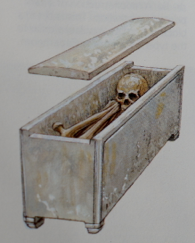
Another sort of house, also common among the working poor and typical village-dwellers, was one built around a central open court with small rooms opening on to it (see drawing at upper right). Because the central court had no roof, this kind of building had the advantage of needing only short beams for the roof structures. The open concept retained the coolness by allowing air to move freely throughout. Cooking could also be done in the open central court, when the weather permitted.

If the family had some animals, they were often kept in this part of the house at night.

Families, sometimes including several generations, tended to live under one roof and had little or no privacy.

The roof was of real importance in everyday life. It was flat, with just enough slope to drain off the rainwater. In the relatively arid climate of the eastern Mediterranean, rainwater was precious; therefore, it was carefully collected into cisterns or large containers. The roof of the house was flat and sturdy, enabling people to go up on it. Because roofs were used so often, the Law of Deuteronomy required guard rails to be installed to prevent falling.

The roof areas provided an open second floor. On it, tools could be stored and laundry put out to dry. Scripture also speaks of it as a place to retire and pray. In the evening, when it was cool, people often sat there and talked; they would even sleep there when the weather was good. The climate of the Mediterranean provides an ideal setting for this at most times of the year. Some also placed tents and other coverings on the roof to increase its usefulness during inclement weather.

Except for the roof structures, which included wood timbers, the basic building material in Palestine was stone. Limestone is excellent building material, and as the stones were fashioned into a wall they would be coated with a stucco-like material and smoothed over. Foundations were dug with great care (Jesus said that we should build upon rock rather than sand). The mortar used to bond the stone was made of clay mixed with shells in potsherds.

Wooden trusses were necessary for the structure of the roofs, since they would be used a kind of second floor. Then a firm lattice of straw mats would be added, covered and smoothed with hard clay. Yearly repairs were made just prior to the rainy season.

Most of the inner doors were narrow. Only the door facing the street was wider and had a hinged door that could be secured.

In poorer homes the floor was simply pounded earth. The more affluent might have had pebbles or tiles made of baked clay. Wooden floors were only an option for the affluent.

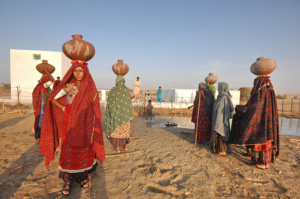
Only the very wealthy could have water piped to their house. Ordinary people went to the well or spring-fount, or perhaps to a local stream, and collected water with skins, jars, and all manner of pitchers. Some larger towns had conduits or aqueducts that brought water into certain public areas. The washing of clothes was done away from the main house lest water run back in.

There was little need for much heating, except in the cooler months of the year. Most of the houses, therefore, had no fireplace. If it did grow cold, there were charcoal braziers in which small fires would be kindled.

Lighting was not very abundant. Small oil lamps were used. Because much time was spent out-of-doors, interior lights were not an absolute necessity.

Furniture was extremely simple. The most important pieces in the home were chests. There were chests for provisions and chests for clothes. For the poorest families, chests doubled as tables. Because clothing was simple, there was little need for many different sets or changes of clothing, thus there was less need for numerous chests and the sorts of insanely large closets many have today.

Most moderately well off families had a low table at which to recline and eat. People in this region and time reclined on their left elbow and ate with their right hand. It was rare to sit on chairs at higher tables in order to eat.

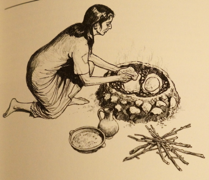
The kitchen as we know it did not exist. In small houses, cooking was done out back over an open fire or fire pit. Utensils were kept in a chest. In larger houses, the courtyard might be the place of the cooking fire with kitchen items kept in a store room. Only the largest homes had a dedicated area with a fiery oven.

Bedding was rolled out on the floor. The bed as a raised piece of furniture was largely unknown then, except among the very wealthy. Family members stretched out on mats, covering themselves with their own cloaks. Many slept on the roof in warmer months.

Even smaller houses seem to have had a bath of some sort. The ancient Jews were conscientious about cleanliness and viewed it as closely related to holiness and ritual purity. The usual bath (often called a mikveh) was narrow and one stepped down into it. Bathing was for hygiene to be sure, but the Jews also undertook ritual baths. In the Holy House in Nazareth, a mikveh is located in or near the house, adjacent to Joseph’s carpenter shop.

Latrines were more likely outhouses, and were removed from the main dwelling. They may have been shared facilities between several dwellings depending on the size and layout of the town or village. There is a phrase used in the Torah, in which Moses tells the ancient Israelites, “build your latrines outside the camp.” It further states, “When you go to the toilet, take a paddle or a shovel with you and use the toilet and then cover it up.” This suggests that some sort of lime was thrown in after the use of the facility. Other directions about latrines were that they should be in discreet and private locations. Certain archeological sites have disclosed the presence of latrines consisting of a pit dug into the ground and of an enclosed, roofed chamber; basically, an outhouse.

It was a simpler time to be sure, but the homes still provided families with their basic need for shelter.

Here’s a video I put together on this topic with lots more pictures:

St. Joseph and Manhood

I remember once being amused to hear that a 19th century Franciscan theologian (whose name I cannot recall) wrote a six-volume set called “The Life of St. Joseph.” How could one possibly get enough material to fill six volumes? We know so little about Joseph from Scripture. He seems to have been the strong, silent type. Not a word of his is recorded, but his actions have much to say, especially to men.

On this feast of St. Joseph, we do well to ponder him as a model for manhood, for husbands and fathers.

  1.  Joseph is a man who obeys God and clings to his wife. Joseph was betrothed to Mary. This is more than being engaged; it means they were actually married. It was common at the time for couples to marry at a young age. Once betrothed they lived an additional year in their parents’ household while they became more acquainted and prepared for life together. At a certain point it was discovered that Mary was pregnant, though not by Joseph. Scripture describes Joseph as “a just man.” This does not mean that Joseph was fair and a nice guy (though I presume he was); it means that he was a follower of the Law. He based his life on the Jewish Law that God gave through Moses, as interpreted by the rabbis. The Law said that if a man discovered that his betrothed was not a virgin, he should divorce her and not “sully” his home. As a follower of the Law, Joseph was prepared to follow its requirements. However, he did not wish to expose Mary to its full force, which would have permitted her to be stoned. Hence, he chose to follow the Law by filing a divorce decree without publicly accusing her. He would remain quiet as to his reason for the divorce and Mary would escape possible stoning. To fail to divorce Mary would expose Joseph to cultural ramifications. Just men didn’t marry women guilty of fornication or adultery. To ignore this might have harmed not only Joseph’s standing in the community but also that of his family of origin. You know the rest of the story: Joseph is told in a dream that he should not be afraid because Mary has committed no sin. Matthew records, When Joseph awoke, he did what the angel of the Lord had commanded him and took Mary home as his wife (Matt 1:24). Now a man obeys God even if it is not popular, even if he has to suffer for it. Joseph is told to cling to his wife; he may suffer for it, but he “obeys God rather than men.” It takes a strong man to do this, especially when we consider the culture in which Joseph lived, and that he lived in a small town no less. Joseph model of strong manhood has something to say to the men of our day. In current Catholic wedding vows, a man promises to cling to his wife for better or worse, for richer or poorer, in sickness and in health. Our culture often pressures men to bail out when there is trouble. Joseph shows the proper way by obeying God over the pressures of the prevailing culture, even if he will personally suffer for it.
  2. Joseph is a man whose vocation is more important to him than his career. In Bethlehem, Joseph is warned by an angel in a dream, Get up, take the child and his mother and escape to Egypt. Stay there until I tell you, for Herod is going to search for the child to kill him (Matt 2:13). Joseph may well have had much to lose in this flight. Back in Nazareth he had a business, a career if you will. He had business prospects, business partners, and contacts. Fleeing to a distant land might mean that others would take away his business. But Joseph was a father and husband before he was a businessman. His child was threatened and his first obligation was to Jesus and Mary. His vocation outweighed his career. Today, too many parents make their careers and livelihood paramount, relegating their children to day care; Joseph demonstrates different priorities. It is true that many parents feel they have no choice but to work, but it is also true that many demand a standard of living that requires extra income to maintain. Perhaps a smaller house and fewer amenities would permit their children to have a childhood without day care. Joseph shows the way for parents: vocation has priority over career. For fathers especially, Joseph shows that a man is a husband and father before he is a businessman.
  3. Joseph is a man who protects his family. Joseph models a protective instinct that too many men lack today. Like Jesus, our children are exposed to many dangers. In the United Sates there aren’t a lot of physical dangers to fear, but moral dangers surely abound. Fathers, what are your children watching on television? What are they looking at on the Internet? Who are their friends? What do your children think about important moral issues? Are you preparing them to face the moral challenges and temptations of life? Are you and your wife teaching them the faith? Are you just a passive father, minimally involved in the raising of your children? A man protects his children from harm, physical, moral, and spiritual. Joseph demonstrates this aspect of manhood.
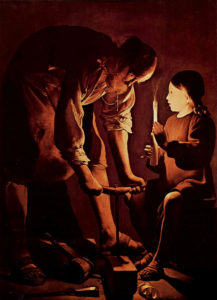
  4. Joseph is a man of work. Scripture refers to Joseph as a “carpenter” (Matt 13:55). The Greek word used, however, is τέκτονος (tekton os), which can mean more than a woodworker. It can also refer to a builder or any craftsman. It seems unlikely that Joseph and Jesus would have worked exclusively in wood, as it was fairly rare in the Holy Land and used more sparingly than it is today. Stone was surely plentiful at that time, so it may be that Joseph worked with stone as well as wood. It was through His work that Joseph supported his family. It is the call of a man to work diligently and to provide for his family responsibly and reliably, and Joseph models this well. St. Paul felt it necessary to rebuke some of the men of his day for their idleness: In the name of the Lord Jesus Christ, we command you to keep away from every brother who is idle and does not live according to the teaching you received from us…. For even when we were with you, we gave you this rule: “If a man will not work, he shall not eat.” We hear that some among you are idle. They are not busy; they are busybodies. Such people we command and urge in the Lord Jesus Christ that with quietness they earn the bread they eat (2 Thess 3:10-12).
  5. Joseph is a man who teaches his son. We learn from Scripture that Jesus was a carpenter (Mk 6:3). It is obvious that it was Joseph who taught Him this trade. Consider the hours that they spent together as Joseph patiently handed his trade on to Jesus, teaching Him its methods and intricacies. It is not enough for a father to provide for his children; he must also prepare them for life. He does this through modeling and teaching discipline, moderation, hard work, self-control, and many other life skills. Today it is relatively rare for men to teach a trade to their sons or to other children. In the end, a man prepares his children for life. Joseph models manhood by preparing Jesus for life as a tradesman. Some (e.g., St. Thomas Aquinas) argue that Joseph did not teach Jesus carpentry and that His knowledge was not learned, but I cannot square this with the Scripture that indicates Jesus grew in age, grace, and wisdom (see Lk 2:52). If Jesus can even grow in human wisdom, how much more so in lesser knowledge. At any rate, however much Jesus was taught by Joseph, every father should teach his sons and daughters!

Joseph is a model for manhood. Nothing he ever said was recorded, but his life speaks eloquently. He is referred to as the Guardian and Patron of the Universal Church. He has these titles because he was guardian, protector, and patron (provider) of the Church in its earliest stage: when the Church was just Jesus and Mary. Because the Church is the mystical Body of Christ, in protecting, providing, and preparing Jesus, he was doing that for us, for we are in Christ as members of His body. Men do well to imitate St. Joseph and invoke his patronage in all their endeavors as husbands, fathers, and providers.

St. Joseph, pray for us.

Learning the Lessons of Lazarus and the Rich Man

Lazarus and the Rich Man – Hendrick ter Brugghen

The well-known story of Lazarus and the rich man was read at Mass this morning (Thursday of the Second Week of Lent). On one level the message of the story seems plain enough: neglecting the poor is a damnable sin. However, there are other important teachings: about death, judgment, Heaven, and Hell. Those teachings are hidden in the details, but the subtlety is part of the story’s beauty. Let’s take a look at some of the teachings, beginning with the obvious one.

1. Neglect of the poor is a damnable sinThere was a rich man who dressed in purple garments and fine linen and dined sumptuously each day. And lying at his door was a poor man named Lazarus, covered with sores, who would gladly have eaten his fill of the scraps that fell from the rich man’s table. Dogs even used to come and lick his sores.

The vision of Lazarus’ poverty is dramatic indeed. The unnamed rich man (dubbed Dives by some because it means “rich” in Latin) does not so much act in an evil way toward Lazarus as he does commit a sin of neglect and omission. He seems undisturbed by and removed from Lazarus’ suffering. This neglect, this omission, this insensitivity, lands him in Hell. The rich man died and was buried, and from the netherworld, where he was in torment, he raised his eyes.

Care for the poor will be a central theme of our judgment, as is made clear in the Gospel of Matthew (25:31 ff), in which Jesus separates the sheep from the goats, the just from the unrighteous, based on whether they cared for the least of their brethren. To those who failed in this regard the Lord Jesus says, Depart from me, you who are cursed, into the eternal fire prepared for the devil and his angels (Matt 25:41).

How best to care for the poor is a matter of some dispute, but that we must care for them is clear. Hence, the rich man who neglected Lazarus is now in Hell. This is a call to sobriety about the reality of judgment; we must consider whether our care for the poor is what it should be.

2. Although he is in torment, the rich man has not changed The rich man, in torment, raised his eyes and saw Abraham far off and Lazarus at his side. And he cried out, “Father Abraham, have pity on me. Send Lazarus to dip the tip of his finger in water and cool my tongue, for I am suffering torment in these flames.”

Notice that the rich man still fails to see Lazarus’ dignity. In effect, he still sees Lazarus as an errand boy. Though he has to look up to see him, the rich man still looks down on Lazarus. He does not ask Abraham to send Lazarus to him so that he can apologize for his sinful neglect and seek his forgiveness. Rather he merely wants Lazarus to serve him. Even though he is in torment, the rich man is unrepentant. Although doesn’t like where he is, he does not reconcile with Lazarus or even realize that he should do so. This rich man is hardened in his sin. While Lazarus was alive, the rich man never recognized his dignity, and he remains blind to it.

Over time, sin hardens our heart. The more we remain in sin, the harder our hearts become, and the less likely it is that we will ever change. Why is Hell eternal? Look at the rich man: He cannot and will not change; his decision, character, and demeanor are forever fixed.

There is an old litany that goes like this: Sow a thought, reap a deed; sow a deed, reap a habit; sow a habit, reap a character; sow a character, reap a destiny. The mystery of the world to come is that our character is forever fixed. The Fathers of the Church described this mystery as being like clay on a potter’s wheel. As long as the clay is moist and on the wheel, the potter can shape and reshape it, but there comes a time when the clay form is placed in the kiln to be fired, fixing its shape forever. It is this way for us when we come before God, who judges us by fire (cf 1 Cor 3:12-15).

Fire will forever fix our character; this judgment through fire will either purify us or bring us condemnation. The fixed quality of the human person is illustrated in the rich man’s unchanged attitude.

3. The rich man does not ask to come to Heaven – It is very strange that the rich man does not ask that he might come to Heaven; rather, he asks that Lazarus be sent to Hell.

One of the saddest facts about the souls in Hell is that they would not be happy in Heaven anyway. After all, Heaven is about being with God. It is about justice, love of the poor, chastity, the heavenly liturgy, the celebration of the truth, the praise of God. God is at the center rather than us. The fact is, many show by the way that they live that they do not want many of these things. Why would someone who has disliked, even hated, these things will suddenly become enamored of them at the moment of death? Someone who ignores or disdains God and considers His faithful to be hypocrites would hardly be happy in Heaven.

The rich man demonstrates this by the fact that he does not ask to come to Heaven. He surely does not like where he is, but he shows no repentant desire for Heaven, either. The teaching, though subtle, seems clear enough: the souls in Hell have little interest in Heaven despite their dislike of Hell.

4. The Great Reversal – Abraham further indicates to the Rich Man and to us the “great reversal”: My child, remember that you received what was good during your lifetime while Lazarus likewise received what was bad; but now he is comforted here, whereas you are tormented.

We spend a lot of time trying to be on top in this world. We want comfort, wealth, position, and power. The Lord warns here that we ought to beware the great reversal that is coming. Lazarus, who was poor, is now rich; and the rich man is now poor.

Jesus teaches this elsewhere: But many who are first will be last, and the last first (Mk 10:31). Mary remarked that He has scattered those who are proud in their inmost thoughts. He has brought down the mighty from their thrones but lifted up the humble. He has filled the hungry with good things but has sent the rich away empty (Lk 1:51-53).

This is the great reversal. We so want to be rich and comfortable in this world, running from any suffering or setback. But the Lord warns of riches, How hard it is for the rich to enter the kingdom of God (Mk 10:23). Yet still we want to be rich. He also says, Anyone who does not carry his cross and follow me cannot be my disciple (Luke 14:27) Yet still we run from the cross and suffering. In the great reversal, many who are first in this world will be last in the world to come.

We cannot assert a direct correlation between success here and loss in the world to come, but neither should we ignore the teaching that striving to “make it” in the world and “be somebody” can be a dangerous path. And if we have amounted to something, we’d better humble ourselves through generosity to the poor and associating with the humble. The goal of worldly success is a dangerous one, for the great reversal is coming. Better to be found among the humble and the poor, or at least well-associated with them, than to be mighty and high. Yes, beware the great reversal!

5. Refusing the truth of Revelation is a damnable sin – The rich man does not repent to God, nor does he seek to be reconciled with Lazarus; but he does have some concerns for his brothers, for his family. We need not assume that the souls in Hell have no affections whatsoever. However, their affections are not for God and what He esteems. And so the rich man, still viewing Lazarus only as an errand boy, asks Abraham to dispatch Lazarus to his family carrying a warning. Perhaps a vision from the grave will convince them!

But Abraham indicates quite clearly that they have the clear witness of God through Moses and the prophets. In other words, they have the Scriptures, the very Word of God, to warn them. The rich man insists, “Oh no, father Abraham, but if someone from the dead goes to them, they will repent.” Then Abraham said, “If they will not listen to Moses and the prophets, neither will they be persuaded if someone should rise from the dead.”

The last point is dripping with irony, considering the fact that Jesus would rise from the dead. Abraham says clearly that there are many sinners who are so hardened in their sin that no matter what the Scriptures say or what the Church solemnly teaches, they will never be convinced. This is so very true today; many remain hardened in their sins. No amount of Scripture or Church teaching will convince them that they are wrong. This is what happens to us if we remain in unrepented sin: Our hearts are hardened, our minds are closed, and our necks are stiffened. In the end, this story teaches that such hardness is damnable.

These are five basic teachings from a well known parable. We do well to heed these lessons!

This song, “Rocka My Soul in the Bosom of Abraham” amounts to a wish that we will find our way to glory. Heeding the lessons of this parable is surely one way to find our rest in God.