Why Jesus’ Resurrected Body Still Had Wounds

When Christ rose from the dead, His body was the same one that had been cast down in death. Yet it manifests qualities not currently enjoyed by our bodies. It was truly Christ’s same body, with its bones and muscles, but it was also a glorified body, wholly reflective of and subservient to the glory and faculties of His soul. He could appear and disappear at will, be somewhere at one moment and then elsewhere the next, and so forth.

St. Thomas Aquinas teaches that in order for the resurrection to be a true one, the same body that fell and died now rises and lives. Thomas writes,

That is said to rise, which fell. [So] Christ’s body fell by death … inasmuch as the soul, which was its formal perfection, was separated from it. Hence, in order for it to be a true resurrection, it was necessary for the same body of Christ to be once more united with the same soul (Summa Theologiae III, Q. 51, Art. 1).

But why did the Lord’s soul not shine through perfectly before the resurrection? Why did He suffer fatigue? Why could He not appear and disappear at will? Thomas answers,

Christ’s soul was glorified from the instant of His conception by perfect fruition of the Godhead. But … owing to the Divine economy, the glory did not pass from His soul to His body, in order that by the Passion He might accomplish the mystery of our redemption. Consequently, when this mystery of Christ’s Passion and death was finished, straightway the soul communicated its glory to the risen body in the Resurrection; and so that body was made glorious (ST III, Q. 51, Art. 2).

In rising, Christ takes up His same, true body, but it now also manifests a perfected glory. When our bodies rise on the last day, the same will be true of ours.

But if all this be the case, then why are Christ’s wounds visible in His glorified body? Are not wounds and scars inconsistent with a glorified body? St. Thomas provides five reasons that Christ’s wounds are fitting in His glorified body. His reflections, from the Summa Theologiae III, Q. 54, Art. 4, are beautiful and poignant. St. Thomas’ words are presented below in bold, black italics, while my remarks appear plain red text.

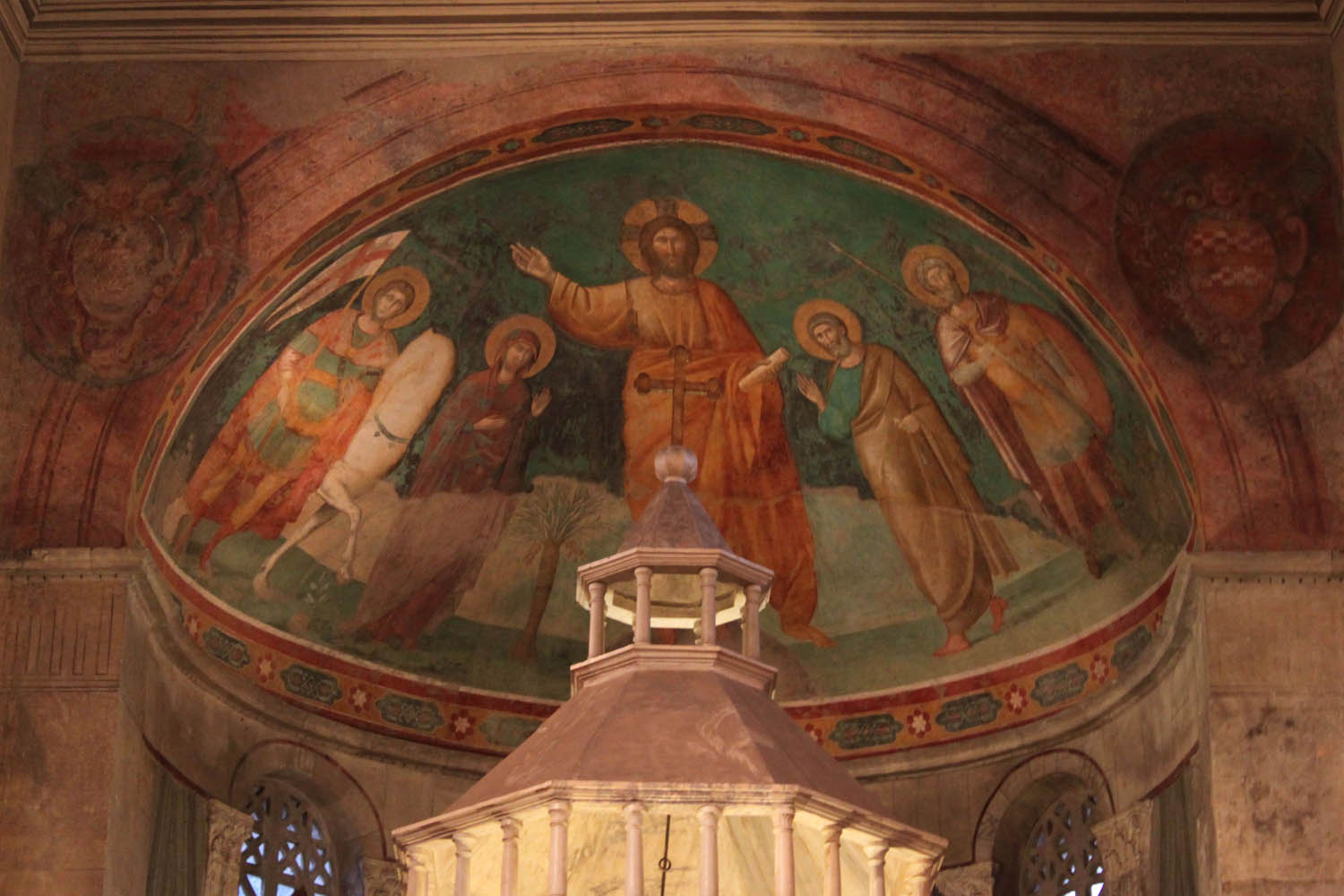
It was fitting for Christ’s soul at His Resurrection to resume the body with its scars. In the first place, for Christ’s own glory. For Bede says on Luke 24:40 that He kept His scars not from inability to heal them, “but to wear them as an everlasting trophy of His victory.” Hence Augustine says (De Civ. Dei xxii): “Perhaps in that kingdom we shall see on the bodies of the Martyrs the traces of the wounds which they bore for Christ’s name: because it will not be a deformity, but a dignity in them; and a certain kind of beauty will shine in them, in the body, though not of the body.”

These wounds are a dignity not a deformity, a sign of love not of loss, an indication of obedience not of onerousness. Through His wounds the Lord can say, “Here is what the world did to me, and yet I live. Here is the cost of your redemption and the lavishness of my love.”

Secondly, to confirm the hearts of the disciples as to “the faith in His Resurrection” (Bede, on Luke 24:40).

This is what theologians refer to as “continuity.” The wounds demonstrate that the same body that died on the cross is the same body the disciples now see standing before them. Continuity means that Christ has not taken up or fashioned some new body or a similar body. Christ is truly risen. The Greek word for resurrection is anastasis, which literally means to stand again. The English word resurrection means the same thing: re (again) + surrexit (he stands). None of this would be true if some different body were before them, no matter how similar. Thus Christ’s wounds confirm the truth of the resurrection.

Thirdly, “that when He pleads for us with the Father, He may always show the manner of death He endured for us” (Bede, on Luke 24:40).

Beautiful! The picture here is of the Son, Jesus, showing His wounds to his Father and saying, “See how I have love them, Father. Have mercy on them.”

Elsewhere, Scripture says, Consequently, Jesus is able to save to the uttermost those who draw near to God through him, since he always lives to make intercession for them. For it was indeed fitting that we should have such a high priest, holy, innocent, unstained, separated from sinners, and exalted above the heavens. He has no need, like those high priests, to offer sacrifices daily, first for his own sins and then for those of the people, since he did this once for all when he offered up himself (Heb 7:25-27).

Fourthly, “that He may convince those redeemed in His blood, how mercifully they have been helped, as He exposes before them the traces of the same death” (Bede, on Luke 24:40).

To those who doubt the Lord’s love or understanding of our trials, Christ’s wounds speak tenderly and clearly of His love and of the price He was willing to pay. His wounds are more eloquent testimony than any words could be. Is God merciful? Does God understand or care at all about our condition? Look to the wounds of Christ; dwell in them. Take shelter in the wounds of Christ.

Lastly, “that in the Judgment Day He may upbraid them with their just condemnation” (Bede, on Luke 24:40). Hence, as Augustine says (De Symb. ii): “… So will [Christ] show His wounds to His enemies, so that He who is the Truth may convict them, saying: ‘Behold the man whom you crucified; see the wounds you inflicted; recognize the side you pierced, since it was opened by you and for you, yet you would not enter.’”

Such powerful and moving words, in this case from St Augustine. There is also an answer here to those who think that God is simply harsh on Judgment Day. In effect He will say, “I endured suffering from you out of love for you. When I was on the Cross, the soldier pierced my side. My heart was literally opened for you and still you would not enter. What more could I have done than to allow your own sins to be your redemption? Still you refused.”

In spite of receiving lifelong graces and unmerited favors and blessings, in spite of God’s call echoing in their depths, many still refuse God’s offer. It is such a tragedy that some hearts are so hardened. The wounds of Christ testify to the justice of God’s only (and final) recourse: to allow them to live apart from Him. Accepting the choice of their free will, God’s last act is simply to recognize their refusal and say, “you would not enter.”

Dwell in the wounds of Christ.

Why Did Christ Rise?

Did Christ have to rise? No, God could have chosen other methods to show us His justice and love. However, for many reasons it was fitting that Jesus should rise bodily and present Himself to His disciples and other believers.

St. Thomas Aquinas presents us with five reasons that the resurrection was fitting. Let’s examine his teaching. St. Thomas’ writing is presented bold, black italics, while my inferior comments appear in plain red text. The teaching is drawn from the Summa Theologiae III, Q. 53, Art. 1.

It behooved Christ to rise again, for five reasons.

First of all; for the commendation of Divine Justice, to which it belongs to exalt them who humble themselves for God’s sake, according to Luke 1:52: “He hath put down the mighty from their seat, and hath exalted the humble.” Consequently, because Christ humbled Himself even to the death of the Cross, from love and obedience to God, it behooved Him to be uplifted by God to a glorious resurrection; hence it is said in His Person (Psalm 138:2): “Thou hast known,” i.e. approved, “my sitting down,” i.e. My humiliation and Passion, “and my rising up,” i.e. My glorification in the resurrection; as the gloss expounds.

God has put His justice in our hearts and it is something for which every human being ultimately longs. While the object of our sense of justice may sometimes be wrong (for some perceive the details of justice wrongly, seeing a grievance where there is none or failing to see injustice where it exists), the longing for justice is hard-wired in our soul.

That acts of murder, theft, violence, injustice to the poor and innocent, and so forth might go unaddressed offends against our deepest sensibilities. God, who put this sense of justice in us—a metaphysical concept that seems wholly lacking in animals—confirms His own justice in Jesus rising from the dead.

Although God’s justice may at times seem delayed, it will come. In the final judgement, all will be set right; hidden deeds and crimes will be disclosed and prosecuted and the truth of God will stand forth vindicated.

This should both console and sober us. For if God’s justice tarries, it is only so as to give us time to repent. There is a day of final justice appointed for this world. Christ’s resurrection proves the world wrong (Jn 16:8-9) and vindicates God’s truth. It sets before us God’s justice so that we understand that nothing unavenged will ultimately remain.

Secondly, for our instruction in the faith, since our belief in Christ’s Godhead is confirmed by His rising again, because, according to 2 Corinthians 13:4, “although He was crucified through weakness, yet He liveth by the power of God.” And therefore it is written (1 Corinthians 15:14): “If Christ be not risen again, then is our preaching vain, and our faith is also vain”: and (Psalm 29:10): “What profit is there in my blood?” that is, in the shedding of My blood, “while I go down,” as by various degrees of evils, “into corruption”? As though He were to answer: “None. ‘For if I do not at once rise again but My body be corrupted, I shall preach to no one, I shall gain no one,’” as the gloss expounds.

The resurrection of Jesus Christ from the dead is the most fundamental of Christian dogmas. If this be not true, then let’s just call the rest of the whole thing off! However, since Christ is raised from the dead, all of what He taught is confirmed and worthy of our faith. He who said I AM the truth (i.e., I am truth itself and all that I have spoken to you is thereby true) has this confirmed by His resurrection. The truth of the resurrection confirms His divinity and the veracity of everything else He proclaimed and announced. Thus the resurrection is fitting for instruction in all the truths of faith.

Thirdly, for the raising of our hope, since through seeing Christ, who is our head, rise again, we hope that we likewise shall rise again. Hence it is written (1 Corinthians 15:12): “Now if Christ be preached that He rose from the dead, how do some among you say, that there is no resurrection of the dead?” And (Job 19:25-27): “I know,” that is with certainty of faith, “that my Redeemer,” i.e., Christ, “liveth,” having risen from the dead; “and” therefore “in the last day I shall rise out of the earth … this my hope is laid up in my bosom.”

Hope is the confident expectation of God’s help in attaining eternal life with Him. What can give greater confidence than to see Christ, who was so brutally struck down, stand victorious over sin and death? Whatever we endure in this life of our own crosses, we can confidently expect to stand victorious over them as well. We shall have the victory in Christ Jesus, our Lord. Indeed, even now, we know that in all things God works for the good of those who love him, who have been called according to his purpose (Rom 8:28).

Fourthly, to set in order the lives of the faithful: according to Romans 6:4: “As Christ is risen from the dead by the glory of the Father, so we also may walk in newness of life”: and further on; “Christ rising from the dead dieth now no more; so do you also reckon that you are dead to sin, but alive to God.”

In His resurrection, Jesus shows not only His divinity, but also a transformed humanity. While in His sinlessness prior to the resurrection He already showed forth a life free from disorder, in His resurrected humanity He shows this even more gloriously. He manifests qualities such as agility, subtlety, and clarity. (I have written more about that here.)

Some of these last qualities will be known by us only when our bodies rise, perfected and glorified. Even now, though, the Lord, by the grace of His passion, death, and resurrection, has purchased for us a new life—a life transformed and increasingly free from sin, sorrow, regret, anger, greed, lust, and all forms of negativity. To be a new creation in Christ is to be more confident, serene, joyful, virtuous, and chaste. It is to live a life that is orderly and properly directed to our noble and glorious end: life with God forever.

Jesus, in his resurrection, manifests this capacity for us to walk in newness of life.

Fifthly, in order to complete the work of our salvation: because, just as for this reason did He endure evil things in dying that He might deliver us from evil, so was He glorified in rising again in order to advance us towards good things; according to Romans 4:25: “He was delivered up for our sins, and rose again for our justification.”

Thus it is one thing to be forgiven of our sins, but God does more by healing us increasingly of sin’s effects. The chief effect of sin was our alienation from the Father, but in Jesus, man returned to God. To be justified is to be in a right relationship with the Father, and that relationship, like all relationships, changes us. In Jesus, risen from the dead, we are restored to the Father and rightly called sons of God because we are made members of the risen and glorified Body of Christ, who is the Son of God. In our risen and ascended Christ and as members of His Body, we sit at the Father’s right in glory, provided that we do not sever our relationship with Christ by serious sin.

From Fear to Faith on Easter Morning

One option for Easter Sunday morning’s Mass is from the Gospel of John (20:1-8). (I have written before on the Matthean Gospel option (here)). Like most of the resurrection accounts, John’s version paints a portrait of a journey that some of the early disciples have to make: out of fear and into faith. It shows the need to experience the resurrection and then come to understand it more deeply. While the Gospel account begins with Mary Magdalene, the focus quickly shifts to St. John; let’s study his journey.

I. Reaction Mode – The text begins by describing everyone as being in reaction mode, quite literally running about in a panic! On the first day of the week, Mary of Magdala came to the tomb early in the morning, while it was still dark, and saw the stone removed from the tomb. So she ran and went to Simon Peter and to the other disciple whom Jesus loved, and told them, “They have taken the Lord from the tomb, and we don’t know where they put him.”

The text describes the opening moments as “still dark.” John is likely trying to do more than tell us the time of day. The deeper point is that there is still a darkness that envelops everyone’s mind.  The darkness makes it difficult for us to see; our fears and sorrows can blind us.

Mary Magdalene sees direct evidence of the resurrection but presumes the worst: that grave robbers have snatched the Lord’s body! It doesn’t even occur to her to remember that Jesus had said that He would rise on the third day and that this was that very third day. She goes immediately into reaction mode instead of reflection mode. Her mind jumps to the worst conclusion; by reacting and failing to reflect, she looks right at the blessing and sees a curse.

We also tend to do this. We look at our life and see only the burdens instead of the blessings.

  1. I clutch my blanket and growl when the alarm goes off instead of thinking, “Thank you, Lord, that I can hear; there are many who are deaf. Thank you that I have the strength to rise; there are many who do not.”
  2. Even though the first hour of the day may be hectic: socks are lost, toast is burned, tempers are short, and the children are loud; we ought to be thinking, “Thank you, Lord, for my family; there are many who are lonely.”
  3. We can even be thankful for the taxes we pay because it means we’re employed, for the clothes that fit a little too snugly because it means we have enough to eat, for the heating bill because it means we are warm, for the weariness and aching muscles at the end of the day because it means we have been productive.

Every day millions of things go right and only a handful go wrong. What will we focus on? Will we look right at the signs of our blessings and call them burdens or will we thank the Lord? Do we live lives that are reactive and negative or do we live reflectively, remembering that the Lord says that even our burdens are gifts in strange packages? And we know that all things work together for good to them that love God, to them who are the called according to his purpose (Romans 8:28).

Do we know this, or are we like the disciples on that early morning when it was still dark, looking right at the blessings but drawing only negative conclusions, reacting and failing to reflect?

II. Recovery mode – The text goes on to describe a certain subtle move from reaction to reflection. So Peter and the other disciple went out and came to the tomb. They both ran, but the other disciple ran faster than Peter and arrived at the tomb first; he bent down and saw the burial cloths there, but did not go in.

Mary Magdalene’s anxiety is contagious. She comes running to the disciples, all out of breath, and says that “they” (whoever “they” are) have taken the Lord (she speaks of Him as a corpse) and “we” (she and the other women who were with her) don’t know where they put Him (again, she speaks of Him as an inanimate corpse). Mary’s panic triggers that same reaction in the disciples. Now they’re all running! The mad dash to the tomb has begun.

Notice, though, that they are hurrying so that they can verify the grave robbery, not the resurrection. Like Mary, they didn’t take the time to reflect and perhaps remember that the Lord had said He would rise on the third day and that this was the third day. Instead, they also panic, rushing forth to try to confirm their worst fears.

But note a subtlety: John runs faster than Peter. Some scholars say it indicates merely that John was the younger man. I would argue, however, that it signals hope. The Holy Spirit, speaking through John, is not likely interested in passing things like youth. Some of the Fathers of the Church see a greater truth at work in the love and mystical tradition that John symbolizes. He was the “disciple whom Jesus loved,” the disciple who knew and experienced that love of God. Love often sees what knowledge and authority can only appreciate and later affirm. Love gets there first.

There is a different verse in Scripture that I believe explains John’s strength (manifested in his speed):

But those who hope in the LORD will renew their strength. They will soar on wings like eagles; they will run and not grow weary, they will walk and not be faint (Is 40:31).

Perhaps John runs faster because he begins to move from reaction to reflection and remembrance. When you run quickly it’s hard to talk, so you tend to recede alone into your thoughts. There is something about love that enlightens, that recalls what the beloved has said. Perhaps John begins to think, to reflect and consider these things:

  1. Didn’t Jesus say He’d rise three days later and isn’t this that day?
  2. Didn’t the Lord deliver Daniel?
  3. Didn’t He deliver Noah from the flood?
  4. Didn’t He deliver Joseph from the hands of his brothers and from the deep dungeon?
  5. Didn’t He deliver Moses and the people from Egypt?
  6. Didn’t He deliver David from Goliath and Saul?
  7. Didn’t He deliver Jonah from the whale?
  8. Didn’t He deliver Queen Esther and the people from wicked men?
  9. Didn’t He deliver Susanna from her false accusers?
  10. Didn’t He deliver Judith from Holofernes?
  11. Didn’t Jesus raise the dead?
  12. Didn’t God promise to deliver the just from all their trials?
  13. As for me, I know that my redeemer liveth!

Something started to happen inside John. I have it on the best of authority that he began to sing this song in his heart as he ran:

“I don’t feel no ways tired. Come too far from where I started from. Nobody told me that the road would be easy but I don’t believe he brought me this far to leave me.”

Yes, John is in recovery now. He has moved from reaction to reflection. He is starting to regain his faith.

The text says that John looked in and saw the burial cloths, but waited for Peter. Mystics and lovers may get there first, but the Church has a Magisterium that must be respected, too.

III. Reassessment mode – In life we must often reassess our initial reactions as further evidence comes in. Peter and John must take a fresh look at the evidence from their own perspective. The text says, When Simon Peter arrived after him, he went into the tomb and saw the burial cloths [lying] there, and the cloth that had covered his head, not with the burial cloths but rolled up in a separate place.

Mary Magdalene’s assessment was that grave robbers must have struck, but the evidence for that seems weak. Grave robbers typically sought the fine linens in which the dead were buried. Yet here are the linens while the body is gone. If they were going to take the body, why not also take the valuable grave linens? The Greek text describes the clothes as κείμενα (keimena)—lying stretched out in place, in order. It is almost as if the clothes simply “deflated” in place when the body they covered disappeared. Finally, the most expensive cloth of all, the σουδάριον (soudarion), lies folded (rolled up, in some translations) in a separate place. Grave robbers would not leave the most valuable things behind. And surely, even if for some strange reason they wanted the body rather than the linens, they would not have bothered to carefully unwrap and fold things, leaving them all stretched out in an orderly way. Robbers work quickly; they snatch things and leave disarray in their wake.

Life is like this: you can’t simply accept the first interpretation of things. Every reporter knows that “in the fog of war” the first reports are often wrong. We have to be careful not to jump to conclusions just because someone else is worried about something. Sometimes we need to take a fresh look at the evidence and interpret it as people of faith and hope, as men and women who know that although God may test us He will not forsake us.

John is now looking at the same evidence that Mary Magdalene did, but his faith and hope give him a different vision. His capacity to move beyond fearful reaction to faithful reflection is changing the picture.

We know little of the reaction of Peter or Mary Magdalene at this point; the focus is on John. And the focus is on you. What do you see in life? Do you see grave robbers, or are you willing to reconsider and move from knee-jerk fear to reflective faith?

Does your resurrection faith make you ready to reassess the bad news you receive and look for blessings, even in crosses?

IV. Resurrection Mode – Somewhat cryptically, the text now focuses on the reaction and mindset of St. John. Then the other disciple also went in, the one who had arrived at the tomb first, and he saw and believed. For they did not yet understand the Scripture that he had to rise from the dead.

On one level the text says that St. John saw and believed. Does this mean merely that he now believed Mary Magdalene’s story that the body was gone? As is almost always the case with John’s Gospel, there is both a plain meaning and a deeper one. The text says that he ἐπίστευσεν (episteusen); he “believed.” The verb here is in the aorist tense, a tense that generally portrays a situation as simple or undivided, that is, as having a perfective (completed) aspect. In other words, something has come to fruition in him.

Yet the text also seems to qualify, saying, they did not yet understand the Scripture that he had to rise from the dead. It is as if to say that John came to believe that Jesus had risen but had not yet come to fully understand all the scriptural connections and how this had to be. He only knew in his heart by love and through this evidence that Jesus was risen. Deeper understanding would have to come later.

For our purposes, let us observe that St. John has gone from fear to faith. He has not yet seen Jesus alive, but he believes based on the evidence and on what his own heart and mind tell him.

At this moment John is like us. He has not seen but he believes. Neither have we seen, but we believe. John would see him alive soon enough and so will we!

We may not have an advanced degree in Scripture, but through love we too can know that He lives. Why and how? Because of the same evidence:

  1. The grave clothes of my old life are strewn before me.
  2. I am rising to new life.
  3. I am experiencing greater victory over sin.
  4. Old sins and my old Adam are being put to death.
  5. The life of the new Adam, Christ, is coming alive.
  6. I am being set free and have hope and confidence, new life and new gifts.
  7. I have increasing gratitude, courage, and a deep peace that tells me that everything is all right.
  8. The grave clothes of my old way of life lie stretched out before me and I now wear a new robe of righteousness.
  9. I am not what I want to be but I am not what I used to be.

So we, like John, see. We do not see the risen Lord—not yet anyway, but we see the evidence and we believe.

St. John leaves this scene as a believer. His faith may not be the fully perfected faith that it will become, but he does believe. John has gone from fear to faith, from reaction to reflection, from panic to peace.

Jesus and Mary on Good Friday, Through the Lens of a Paul Simon Song

Some years ago I was listening to an old Paul Simon song, “Mother and Child Reunion.” My mind went to Good Friday, applying the lyrics to Jesus and Mary on that “strange and mournful day,” as the song puts it.

Last year I put pictures to the song to make the video below. Some who have seen it laugh and call it a stretch, but others tell me that they will never hear the song the same way again. You decide.

On a day that overwhelms us with its heavy themes, something about the love of a mother for her son and of a son for his mother puts things into powerful perspective.

Four Immediate Effects of the Passion

Let’s continue our consideration of the Passion with a text describing the aftermath of Jesus’ crucifixion. The Gospel of Matthew recounts four immediate results of Jesus’ death, and while they describe historical events, they also signal deeper spiritual truths.

And when Jesus had cried out again in a loud voice, he gave up his spirit. At that moment, the curtain of the temple was torn in two from top to bottom. The earth shook, the rocks split, and the tombs broke open. The bodies of many holy people who had died were raised to life. They came out of the tombs after Jesus’ resurrection, went into the holy city, and appeared to many people. When the centurion and those with him who were guarding Jesus saw the earthquake and all that had happened, they were terrified, and exclaimed, “Surely he was the Son of God!” (Matt 27:50-53)

Let’s consider the four results described in this passage, each in turn.

I. Reunion with the Father At that moment, the curtain of the temple was torn in two from top to bottom.

The significance of the tearing of the Temple curtain and the way in which it happened ought not to be underestimated. Consider that God had walked intimately with Adam and Eve in the garden in the cool of day (cf Gen 3:8), but that after sin, they could no longer endure His presence; they had to dwell apart from the paradise that featured God’s awesome presence. Consider, too, how terrifying theophanies (appearances of God to human beings) were after that time. For example, the appearance of God on the top of Mt. Sinai is described in the Book of Exodus:

When the people saw the thunder and lightning and heard the trumpet and saw the mountain in smoke, they trembled with fear. They stayed at a distance and said to Moses, “Speak to us yourself and we will listen. But do not have God speak to us or we will die” (Ex 20:18-19).

Had God changed? Was He different than He was when He walked with Adam and Eve in intimacy? No. We had changed and could no longer endure His presence.

Throughout the Old Testament, a veil existed between God and Israel. There was the cloud that both revealed and concealed God’s presence. There was also the curtain in the sanctuary, beyond which the High Priest could only venture once a year, and even then in fear and trembling.

Sin had done this. Mere human beings could no longer tolerate God’s presence.

But with His Death on the cross, Jesus has canceled our sin. We once again have access to God through Christ our Lord. His blood has cleansed us, and the ancient separation from the Father and from God’s presence has been canceled. But we will not encounter God in a merely earthly paradise; He has now opened the way to Heaven.

It is now up to us to make the journey there, but the way has been opened; the veil has been rent. Through this open veil, the Father now says, “Come to me!”

II. Rendering of Judgment upon the World The earth shook, the rocks split …

Judgment has now come; the world stands judged. This refers not merely to the created world, but also to the forces of this world, the forces of this age, which are arrayed against the Lord and His kingdom. These are forces that do not acknowledge the sovereignty of God but rather insist that political, social, cultural, and economic forces are what must hold sway and have our loyalty.

This earthquake, which has significant historical corroboration, demonstrates that the foundations of this rebellious world ultimately cannot stand before God. The foundations are struck; the powers of this world quake. Scripture says,

  1. People will flee to caves in the rocks and to holes in the ground from the fearful presence of the LORD and the splendor of his majesty, when he rises to shake the earth (Is 2:19).
  2. For thus says the LORD of hosts: Once more in a little while, I am going to shake the heavens and the earth, the sea also and the dry land. I will shake all the nations; and they will come with the wealth of all nations, and I will fill this house with glory, says the LORD of hosts (Haggai 2:6-7).
  3. In my zeal and fiery wrath, I declare that at that time there shall be a great earthquake in the land of Israel (Ez 38:19).
  4. The kings of the earth rise up and the rulers band together against the Lord and against his anointed, saying, “Let us break their chains and throw off their shackles.” The One enthroned in heaven laughs; the Lord scoffs at them. He rebukes them in his anger and terrifies them in his wrath, saying, “I have installed my king on Zion, my holy mountain” (Psalm 2:2-6).
  5. In the time of those kings, the God of heaven will set up a kingdom that will never be destroyed, nor will it be left to another people. It will crush all those kingdoms and bring them to an end, but it will itself endure forever (Daniel 2:42).
  6. The LORD will roar from Zion and thunder from Jerusalem; the earth and the heavens will tremble. But the LORD will be a refuge for his people, a stronghold for the people of Israel (Joel 3:16).
  7. A ruin! A ruin! I will make it a ruin! The crown will not be restored until he to whom it rightfully belongs shall come; to him I will give it (Ez 21:27).

Yes, the world shakes; it is judged. And, most important, as Jesus says, Now is the time for judgment on this world; now the prince of this world will be driven out (John 12:31).

Do not doubt, dear reader, that no matter how powerful this world may seem in its pride and glory, it has already been shaken; it has already been judged. The world has been conquered and shaken to its very foundations. Do not put your trust or hope in any worldly reality; the world has been judged and shaken; it cannot stand the test of time. For here we have no lasting city, but we seek the city that is to come (Heb 3:14).

III. Resurrection to New Life … the tombs broke open. The bodies of many holy people who had died were raised to life. They came out of the tombs after Jesus’ resurrection and went into the holy city and appeared to many people.

“Death is struck and nature quaking. All creation is awaking, to its judge an answer making.” (from the Dies Irae). Yes, by dying, Jesus has destroyed our death.

Where, O death, is your victory? Where, O death, is your sting? The sting of death is sin, and the power of sin is the law. But thanks be to God. He gives us the victory through our Lord Jesus Christ (1 Corinthians 15:55-57).

Note well that although the text says that many of the dead appeared in Jerusalem, these appearances occurred after Jesus’ resurrection. Hence, we ought not to imagine ghosts or corpses walking around at 3:00 PM on Good Friday! Rather, they appeared on or after Resurrection Sunday. In this, they witness to the truth of resurrection and the initial fulfillment of the text from Ezekiel:

Behold, I will open your graves and cause you to come up out of your graves, My people; and I will bring you into the land of Israel. Then you will know that I am the LORD, when I have opened your graves and caused you to come up out of your graves, My people! I will put My Spirit within you and you will come to life (Ez 37:12-14).

Yes, on Good Friday, Jesus awakens the dead with the words, “Awake, sleeper, and arise from the dead, and Christ will shine on you” (Eph 5:14).

IV. Realization of Who Jesus Is When the centurion and those with him who were guarding Jesus saw the earthquake and all that had happened, they were terrified, and exclaimed, “Surely he was the Son of God!”

Jesus most clearly showed His identity as the Son of God through His obedience to the Father. According to the Gospel of John, as Jesus rose from the table of the Last Supper, He said,

The prince of this world is coming. He has no hold over me, but he comes so that the world may learn that I love the Father and do exactly what my Father has commanded me. Come now; let us go forth (Jn 14:30-31).

In seeing Jesus dies this way, the centurion somehow recognizes in Him the obedience of the Son of God, who loves and obeys His Father.

By His obedience, Jesus has canceled our disobedience; His humility has canceled our pride. Yet the weakness of God is more powerful than any worldly force. The centurion, who knew power and was trained to respect it, saw in the earthquake and the other occurrences an indication of the Lord’s glory. The Lord’s way to that glory is not our way, but His glory and Sonship cannot remain forever hidden! Scripture says,

See, he comes amid the clouds, and every eye will see him, even those who pierced him; and all peoples on earth will mourn because of him. Even So. Amen (Rev 1:7).

Five Lessons from the Passion of Christ

Continuing our Holy Week meditations, led by the teachings of St. Thomas Aquinas, we reflect today on the suitability of the Passion. While the Passion was not strictly necessary (for God could have saved us in many ways), there are many things about it that make it fitting; in addition, it heals our misery.

In his Summa Theologiae (Part III, Question 46, Article 3), St. Thomas lists five teachings that flow from the Passion of Christ. St. Thomas’ words are shown below in bold, black italics, while my lesser comments appear in plain red text.

In the first place, man knows thereby how much God loves him, and is thereby stirred to love Him in return, and herein lies the perfection of human salvation; hence the Apostle says (Romans 5:8): “God commends His charity towards us; for when as yet we were sinners … Christ died for us.”

If but one drop of the Lord’s blood would have been sufficient to save us, why did He shed all of His blood? One answer is that it was what He had to give. He emptied Himself of everything but love because that is what true lovers are willing to do. Love is extravagant.

This should stir not only our love but also our gratitude. When the Lord bids us to celebrate the Eucharist “in memory of me,” He does not do so in some self-serving or egocentric way. He does not need us to remember what He has done; it is we who need to remember.

For me to “remember” is to have deeply present in my mind and heart what the Lord has done for me so that I am grateful and different. This is a work of the Holy Spirit and those who lay hold of it are different. Grateful people are more hopeful, confident, and serene because they have known and experienced the providential love and mercy of God. And being more serene, hopeful, and confident, they manifest other virtues such as joy, generosity, and forgiveness. To receive this gift of remembering is to be astonished at the Lord’s lavish love and mercy and to be grateful, joyful, and different.

Secondly, because thereby He set us an example of obedience, humility, constancy, justice, and the other virtues displayed in the Passion, which are requisite for man’s salvation. Hence it is written (1 Peter 2:21): “Christ also suffered for us, leaving you an example that you should follow in His steps.”

There is so much to learn of virtue from Christ’s Passion. It is a study in humility, which is the antidote to pride. Ultimately, we are saved more by His humility and obedience than by His physical sufferings. Indeed, St. Thomas remarks elsewhere that if Christ had suffered everything He did but had not willed it, we would not be saved. It is His obedience that undoes Adam’s disobedience. Cassian said, “We are saved by the human decision of a divine person.” Isaiah said, “He suffered because he willed it” (Is 53:7). Jesus said, “No one takes my life from me. I lay it down freely” (Jn 10:18). And going forth from the Last Supper to His Passion, Jesus said, “The world must know that I love the Father and do exactly what my Father has commanded me. Arise, let us go forth” (Jn 14:31). Thus, trusting and obeying the Father, Jesus saves us in love and thereby gives us an example to follow.

Thirdly, because Christ by His Passion not only delivered man from sin, but also merited justifying grace for him and the glory of bliss, as shall be shown later (III:48:1; III:49:1 and III:49:5).

In other words, we are not simply saved from sin, we are equipped for holiness, so that we may be fit for Heaven.

St. Thomas elaborates on this later: Grace was bestowed upon Christ, not only as an individual, but inasmuch as He is the Head of the Church, so that it might overflow into His members; and therefore Christ’s works are referred to Himself and to His members … [Now] it is evident that whosoever suffers for justice’s sake, provided that he be in a state of grace, merits his salvation thereby, according to Matthew 5:10: “Blessed are they that suffer persecution for justice’s sake.” Consequently, Christ by His Passion merited salvation, not only for Himself, but likewise for all His members (ST III, Question 48, Article 1).

While the concept of merit troubles many a Protestant, St. Augustine, the great foe of Pelagianism, well states that in crowning our merits, God is actually crowning His own gifts. In this, God shows us the extent of His love: that He allows His gifts to become our merits (See Augustine, eorum coronando merita tua dona coronas Domine, Commentary in Psalm 102,7:PL 37,1321-1322).

Fourthly, because by this man is all the more bound to refrain from sin, according to 1 Corinthians 6:20: “You are bought with a great price: glorify and bear God in your body.”

Considering the high price of our salvation can be a motivation to respect the work wrought in and for us. St. Peter elaborates this: live your lives in reverent fear during your temporary stay on earth. For you know that it was not with perishable things such as silver or gold that you were redeemed from the empty way of life you inherited from your forefathers, but with the precious blood of Christ, a lamb without blemish or spot. (1 Peter 1:17-19).

Fifthly, because it redounded to man’s greater dignity, that as man was overcome and deceived by the devil, so also it should be a man that should overthrow the devil; and as man deserved death, so a man by dying should vanquish death. Hence it is written (1 Corinthians 15:57): “Thanks be to God who hath given us the victory through our Lord Jesus Christ.” It was accordingly more fitting that we should be delivered by Christ’s Passion than simply by God’s good-will.

When one has caused harm, it is very healing to be a part of the healing. And while we could not hope to ever come close in repairing the damage (only God can do that), it is encouraging that our five loaves and two fishes are important to the Lord. This shows our dignity and our responsibility. We got into trouble through a man, a woman, and a tree. In a poetic justice of sorts, we get out of trouble in the same way: a Man (Christ, who obeys), a woman (Mary, who gives her fiat to God’s saving work and plan), and the tree of the Cross.

Thanks be to God for these teachings and for inspiring our teacher, St. Thomas, to place them before us!

Did Jesus Endure Every Suffering in His Passion?

Today we continue a Holy Week series that draws from St. Thomas Aquinas’ teachings on the Passion in his Summa Theologiae. Today we consider passages from the Summa Theologiae part III, question 46, article 5. This teaching focuses on the fullness of the sufferings that Jesus endured for us. He did not suffer merely this thing or that, but in a manner of speaking suffered all things. By this He sanctifies all our sufferings in a general yet comprehensive way.

Let’s learn and pray with St. Thomas as we ponder this question: Did Christ endure all suffering?

I answer that, Human sufferings may be considered under two aspects. First of all, specifically, and in this way it was not necessary for Christ to endure them all, since many are mutually exclusive, as burning and drowning; for we are dealing now with sufferings inflicted from without … But, speaking generically, He did endure every human suffering. This admits of a threefold acceptance.

St. Thomas distinguishes between the meaning of “every suffering” in a literal, absolute, specific understanding of the word “every,” from a more general, wide sense of the phrase “every suffering.”

To be sure, Jesus’ sufferings were comprehensive in that every general category was covered, but not in the sense that every possible delineation of a category was covered. 

In the following sed contra, St. Thomas advances as an example that Christ did not endure every possible suffering. It is written (John 19:32): “The soldiers therefore came: and they broke the legs of the first, and of the other who was crucified with Him; but after they were come to Jesus, when they saw that He was already dead, they did not break His legs.” Consequently, He did not endure every human suffering.

I would only add one other example. Although we can say in a general way that Jesus suffered rejection by His own family and the townsfolk, we cannot say so comprehensively, because His Mother Mary did not reject or abandon Him. She was a member of both of the general categories “family” and “townsfolk,” but that does not mean that she was specifically included among those who rejected Jesus. Therefore, Jesus did not endure every suffering because His mother did not reject Him.

St Thomas goes on to distinguish that in a general sense Christ suffered in every category even if not in every possible example of every category.

First of all, on the part of men: for He endured something from Gentiles and from Jews; from men and from women, as is clear from the women servants who accused Peter. He suffered from the rulers, from their servants and from the mob, according to Psalm 2:1-2: “Why have the Gentiles raged, and the people devised vain things? The kings of the earth stood up, and the princes met together, against the Lord and against His Christ.” He suffered from friends and acquaintances, as is manifest from Judas betraying and Peter denying Him.

Some people define the enemies as being only or chiefly among the religious leaders, but St. Thomas shows that the pain the Lord experienced from others comes from a far broader base. This is even more evident if we broaden the sample of his sufferings beyond his last three days. He experienced murderous rejection in His own town of Nazareth. He suffered rejection in the Synagogue of Capernaum because of His teachings on the Eucharist. Corazin and Bethsaida rejected Him. John reports that even many of His own kindred did not believe in Him (7:5). Yes, fierce opposition and hardened hearts were daily fare for Jesus throughout His life. St. Thomas includes these sorts of details in what follows, although he focuses more on the event of the Passion itself.

Secondly, the same is evident on the part of the sufferings which a man can endure. For Christ suffered from friends abandoning Him; in His reputation, from the blasphemies hurled at Him; in His honor and glory, from the mockeries and the insults heaped upon Him; in things, for He was despoiled of His garments; in His soul, from sadness, weariness, and fear; in His body, from wounds and scourgings.

There is a greater emphasis on the mental anguish of Christ in our more introspective times, but as St. Thomas witnesses, the mental and emotional sufferings of Christ were not unremarked in previous eras.

The experience of being abandoned by friends is among the most painful we can undergo. Further, we rightly count our reputations among our most prized possessions. For Jesus, innocent and without sin, to be numbered among the worst of sinners and assigned a humiliating death could not have been without profound effect upon Him.

As for His garments, they were likely one of the few things Jesus owned. In today’s consumer age, we don’t worry much about clothes; we have them in abundance. But not so in Jesus’ time. Scripture speaks to the value of one’s tunic when it forbade taking it as collateral on a loan. A tradition holds that Mary His Mother made His tunic herself. Its seamless quality spoke to its excellence. Even the soldiers saw its value and contended for it. Being stripped of it and having others gamble for it added to Jesus’ suffering in ways we may not fully understand.

Thirdly, it may be considered with regard to His bodily members. In His head He suffered from the crown of piercing thorns; in His hands and feet, from the fastening of the nails; on His face from the blows and spittle; and from the lashes over His entire body.

Moreover, He suffered in all His bodily senses: in touch, by being scourged and nailed; in taste, by being given vinegar and gall to drink; in smell, by being fastened to the gibbet in a place reeking with the stench of corpses, “which is called Calvary”; in hearing, by being tormented with the cries of blasphemers and scorners; in sight, by beholding the tears of His Mother and of the disciple whom He loved.

The litany-like writing of St. Thomas here is quite moving; I can add little to it other than to note that Christ took upon Himself all our sufferings in a general though very comprehensive way. Does God understand our pain? He does! An old spiritual says, “Nobody knows the trouble I seen; nobody knows but Jesus.”

Why Did Christ Die in Jerusalem?

We do well to ponder the whys and wherefores of the Passion of Our Lord. We engaged in a similar exercise in December relative to Christ’s birth. St. Thomas Aquinas presents the premise that God does nothing in an arbitrary way, but rather as Lord of History sets forth everything in fitting ways and at appropriate places and times. Every detail has something to teach us.

Let’s consider why Christ suffered in Jerusalem (but outside its walls) in a place called “the skull.” St. Thomas covered these matters in his Summa Theologiae, Part III, Question 46, Article 10. His words are in bold, black italics; my inferior comments are shown in plain red text.

Christ died most appropriately in Jerusalem. First of all, because Jerusalem was God’s chosen place for the offering of sacrifices to Himself: and these figurative sacrifices foreshadowed Christ’s Passion

For the Jewish people of that time, there was only one place to offer sacrifices to the Lord: Jerusalem. Although towns had synagogues, only Jerusalem had the Temple, and one had to go there to offer sacrifices to the Lord.

This rule had become quite firm. Indeed, even when Temple sacrifices were interrupted during the Babylonian captivity (the Temple was destroyed in in 587 B.C. and not rebuilt until about 70 years later), rather than relocate the place for sacrifice, the people lamented, We have in our day no prince, prophet, or leader, no burnt offering, sacrifice, oblation, or incense, no place to offer first fruits, to find favor with you (Daniel 3:38).

Therefore, because salvation is from the Jews (Jn 4:22), it was fitting that Christ, our Paschal Lamb and perfect, once-for-all sacrifice, was sacrificed in the only acceptable place.

Secondly, because the virtue of His Passion was to be spread over the whole world, He wished to suffer in the center of the habitable world–that is, in Jerusalem. Accordingly, it is written, “But God is our King before ages: He hath wrought salvation in the midst of the earth” (Psalm 73:12)—that is, in Jerusalem, which is called “the navel of the earth.”

A glimpse at a map shows that Jerusalem is arguably at the very intersection of three continents: Europe, Asia, and Africa. Psalm 48:2 reads, Mount Zion, true pole of the earth, the Great King’s city!

Thirdly, because it was specially in keeping with His humility: that, as He chose the most shameful manner of death, so likewise it was part of His humility that He did not refuse to suffer in so celebrated a place.

Not only was Christ’s humiliation very public, it occurred when Jerusalem was packed for the Passover feast!

Fourthly, He willed to suffer in Jerusalem, where the chief priests dwelt, to show that the wickedness of His slayers arose from the chiefs of the Jewish people.

Jerusalem had the reputation of being the place where prophets suffered the most and where most of them went to die. This is likely because it was there that faith and power intersected. Human beings seldom negotiate that intersection well and the scale is tipped more to power than to faith.

  1. Jesus said, Jerusalem, Jerusalem, who kills the prophets and stones those sent to her! How often I have longed to gather your children together as a hen gathers her chicks under her wings, but you were unwilling. Look, your house is left to you desolate. And I tell you, you will not see Me again until you say, “Blessed is He who comes in the name of the Lord” (Luke 13:34-35).
  2. Jesus said, Woe to you, because you build tombs for the prophets, and it was your ancestors who killed them. So you testify that you approve of what your ancestors did; they killed the prophets, and you build their tombs. Because of this, God in his wisdom said, “I will send them prophets and apostles, some of whom they will kill and others they will persecute.” Therefore, this generation will be held responsible for the blood of all the prophets that has been shed since the beginning of the world, from the blood of Abel to the blood of Zechariah, who was killed between the altar and the sanctuary. Yes, I tell you, this generation will be held responsible for it all. (Luke 11:47-51).
  3. Stephen added, You stiff-necked people, uncircumcised in heart and ears, you always resist the Holy Spirit. As your fathers did, so do you. Which of the prophets did your fathers not persecute? And they killed those who announced beforehand the coming of the Righteous One, whom you have now betrayed and murdered, you who received the law as delivered by angels and did not keep it (Acts 7:51-53).

These teachings, fitting though they are, give rise to these questions: If Jerusalem was the appropriate place, why was Jesus not sacrificed on the Temple mount, inside the city? Why was He instead sacrificed outside the city gates? St. Thomas answers this as follows:

For three reasons Christ suffered outside the gate, and not in the Temple nor in the city. First of all, that the truth might correspond with the figure. For the calf and the goat which were offered in most solemn sacrifice for expiation on behalf of the entire multitude were burnt outside the camp, as commanded in Leviticus 16:27.

Note the distinction between the sacrifice of an individual family (which was offered at the temple and burnt on the altar there) and the sacrifice offered on behalf of all the people on the Day of Atonement. Leviticus 16:27 says, The bull and the goat for the sin offerings, whose blood was brought into the Most Holy Place to make atonement, must be taken outside the camp; their hides, flesh and intestines are to be burned up. Therefore, it is fitting that Christ, who died for all, should be sacrificed outside the gate (“outside the camp,” as it were).

Secondly, to set us the example of shunning worldly conversation. Accordingly, the passage continues: “Let us go forth therefore to Him without the camp, bearing His reproach.”

Out worldly categories and notions cannot contain Christ. In His time there were at least three political and religious groups: the Sadducees, the Pharisees, and the Zealots. Jesus walked with none of them; neither did He simply parrot their views. There was only one thing the groups could agree on—Jesus had to go. Thus, fitting nowhere, Christ was crucified outside the camp.

Thirdly, as Chrysostom says in a sermon on the Passion (Hom. i De Cruce et Latrone): “The Lord was not willing to suffer under a roof, nor in the Jewish Temple…lest you might think He was offered for that people only. Consequently, it was beyond the city and outside the walls, that you may learn it was a universal sacrifice, an oblation for the whole world, a cleansing for all.”

He suffered once and for all. As Jesus said to the Samaritan woman at the well, A time is coming when you will worship the Father neither on this mountain nor in Jerusalem. You Samaritans worship what you do not know; we worship what we do know, for salvation is from the Jews. Yet a time is coming and has now come when the true worshipers will worship the Father in the Spirit and in truth, for they are the kind of worshipers the Father seeks. God is spirit, and his worshipers must worship in the Spirit and in truth (Jn 4:21-24).

St. Thomas presents two additional reasons that Jesus was crucified where He was, noting especially the name of the place: Golgotha. Although Aquinas described both reasons, he concluded that only one is correct.

According to Jerome, in his commentary on Matthew 27:33, someone explained “the place of Calvary” as being the place where Adam was buried; and that it was so called because the skull of the first man was buried there. A pleasing interpretation indeed, and one suited to catch the ear of the people, but, still, not the true one. … [For] Adam was buried close by Hebron and Arbe, as we read in the book of Jesus Ben Nave.

To this day, in the Church of the Holy Sepulcher there is a small opening or cave at the base of Golgotha that is venerated by some as the tomb of Adam. One can stop in there prior to climbing the stairs to Calvary. Legend has it that the Blood of Christ dripped though the opening and touched the bones of Adam, causing him to get up and dance a jig.

St. Thomas was not impressed with such legends or even with the teaching of St. Jerome; instead, he offered another interpretation.

For the spots where the condemned are beheaded are outside the city and beyond the gates, deriving thence the name of Calvary—that is, of the beheaded. Jesus, accordingly, was crucified there, that the standards of martyrdom might be uplifted over what was formerly the place of the condemned. … [So] Jesus was to be crucified in the common spot of the condemned rather than beside Adam’s sepulcher, to make it manifest that Christ’s cross was the remedy, not only for Adam’s personal sin, but also for the sin of the entire world.

Martyrs die for Christ, not as mere condemned criminals. And though Christ did die for all, not just for Adam, the primordial sin was Adam’s.

It is curious to me that St. Thomas, writing in a style somewhat out of keeping with his usually reserved way, so forcefully set aside St. Jerome’s interpretation. Perhaps we can learn something from both views! This is especially the case because the location of Adam’s burial remains a matter of dispute to this day, with many continuing to venerate the site beneath Calvary.