Co-collaborators with Jesus the teacher

At a certain point on my daily commute I end up behind a Metro bus. I need to make a turn just past the stop and so I tend to just sit behind the bus while it is unloading and loading passengers. For the past ten days or so the ad on the back of the bus is the Archdiocesan ad celebrating Catholic Schools Week. It got me reminiscing about my days in Catholic school (12 years to be exact) and my most favorite and least favorite teachers.

It is a vocation

In the least favorite category is my second grade teacher-who even to an eight-year old- seemed to be a very unhappy person. One day, I shared with my mother that  “I hate her!”  Well, my mother had a few things to say about that: Firstly, hate is not something that “we” do.  If we love Jesus, we do not hate people. Secondly, she asked me to consider what a day in the life of my teacher looks like. She arrives at school early after having prepared lots of different activities to help us to learn. She has 25 some students who all learn in different ways and she has to try to have lessons that incorporate all of these differences, She spends the whole day in a classroom with all of us whether she is feeling great or feeling sick, whether she has lots of energy or is tired. Then at the end of  the day she goes home to take care of her own family and do more work to get ready for the next day. I’m sure my Mom had more to say, but you get the idea. The fact that I am writing about this some forty-years later makes it obvious that I got what my Mom was saying. Teaching is hard work and first and foremost, teachers are to be respected.  For something that seems so obvious, I wonder why as a society we so undervalue the teaching profession. That’s fodder for a thousand blogs, but this one is a request to identify and celebrate the great women and men who are teaching in our schools this year.

The Golden Apple Excellence in Teaching Award

Nominations are now being accepted for the Golden Apple Awards which will be presented to 10 of our best teachers on May 13. This award exists in only five dioceses(Pittsburgh, Youngstown, Harrisburg, Toledo) and has it s origins in the gratitude that the Pittsburgh-based Donahue Family had for the teachers that educated their 13 children!

Someone you know

A teacher can be nominated by their colleagues, parents, and students. A committee at each school will review the nominations for that school and select an individual to represent the school in the archdiocese-wide competition. Nomination forms can be picked up at school or found here. www.CatholicSchoolsWork.org.

If you are a parent of a Catholic school student, pick the best teacher and complete a nomination. If you teach in one of our schools, why not nominate the teacher who has served as a mentor, if you are a student, why not start a campaign for your favorite teacher.

Called to be a co-collaborator with Jesus the Teacher

If you are someone wondering about teaching and teaching in Catholic school,  take some time to pray and discern if this might be the vocation to which the Lord is calling you. Happily, for some people, spending the whole day in a classroom full of kids is pure joy and it shows!

Love will change everything

Recently, I nixed a request to promote a Valentine’s Day party whose theme was “losers.” It is a party for those who will not have a date on February 14. I get that it is meant to be tongue-in-cheek, but I still think it’s wrong. It bugs me the way that Catholicism for Dummies bugs me. Catholicism doesn’t need to be dumbed down and Valentine’s Day is not just a couples only event. In fact, as was recently pointed out by Sheldon, of the T.V. show the Big Bang Theory (the daily life of socially awkward, geeky scientists), it is a curious association between St. Valentine, the third century priest -martyr and the Hallmark crazed contemporary celebration. For Sheldon’s take, watch this:

While I don’t want to endorse the “Sheldon-alternative Valentine’s Day plan,”  I do want to offer a “Valentine poem” of a different sort. This is a prayer written by Pedro Arrupe, a former Superior General of the Jesuits. I think the prayer captures not only the source of real love but what real love looks and feels like. I may have shared this prayer before in this space, but I think it is good enough for a repeat.

Nothing is more practical than finding God, that is,
than falling in love in a quite absolute, final way.

What you are in love with, what seizes your imagination,
will affect everything. It will decide what will get you out
of bed in the morning, what you will do with your evenings,
how you will spend your weekends, what you read, who you
know, what breaks your heart, and what amazes you with joy
and gratitude.

Fall in love, stay in love and it will decide everything.

It’s Catholic Schools Week – and I’ve got stress

As Catholic Schools Week comes to a snowy end, I’ve got stress! Brothers and sisters, I work at a school whose original mission in 1828 was to “Teach the children of slaves to read the Bible.” Clearly, the foundress of my school, Mother Mary Lange, OSP, saw a dire need for ministry to the neglected and used the concept of a Catholic education to address that need. Despite the reality that her ministry was against the law in the slave state of Maryland and that most of her students could not really afford the tuition (approximately $1.00 per year) I now have a job because of her efforts.

Many still cannot afford Catholic Schools

In studying the story of the foundress of St. Frances Academy and the Oblate Sisters of Providence, I find myself under a bit of stress. On a positive note, I am convinced that my faculty and staff, as well as the faculties and staffs of others urban schools like mine, have matched the resolve of 1828 in ensuring that a Catholic education is available to those who might not otherwise get one. On the other hand, I have got stress because Mother Lange depended on the generosity of others to fulfill her mission. She depended on clergy, religious congregations and parishes for money and at times, a place to live and teach. I’ve got stress because I wonder if that support is waning.

My brother’s keeper

As the principal of urban high school, I have countless stories of generosity with regards to my school.  Nonetheless, not everyone understands their responsibility to support Catholic education.  For example, as the elementary school at my parish in Hyattsville began to experience financial challenges, I heard more than few parishioners comment, “I don’t have a child there. I want my money to go to the Church.” My response was that if your money goes to a Catholic school, it is going to the Church! More specifically, it is going to the Church’s future.

One Body, One Church:

Many of the benefactors of my school are alumni but many others did not graduate from Saint Frances. They may have graduated from another Catholic school and now want to help a new and different generation build their faith. Some did not go to Catholic school at all but want to make sure this generation has the choice. A few are not even Catholic but simply recognize that Catholic schools make our community a better place.

I have never been incarcerated, but I fully support prison ministry. I have never directly experienced a crisis pregnancy but I support Catholic pregnancy centers. Just because I don’t have a child in my parish or regional school doesn’t mean that it is not a vital ministry in our Church.

Catholic School Graduates, Step Up!

My challenge to you, especially if you benefited from a Catholic education, is that if you have not contributed to a Catholic school, consider a gift. It doesn’t have to be a gift to the one you attended. The one you attended may be relatively wealthy so, find on that isn’t.  Any Catholic school that needs your help will do. Remember, all of us benefit from Catholic schools, even if you never set foot in one.

Complementarity of Vocations


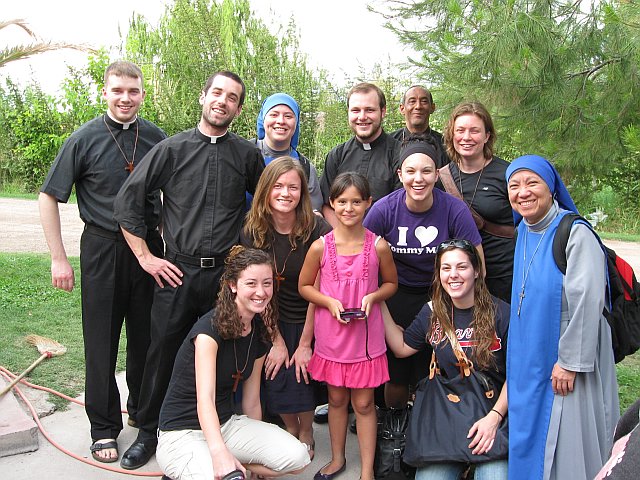
While in Argentina, I saw what spiritual motherhood and fatherhood looks like while spending time with the priests and nuns of the Religious Family of the Incarnate Word.

I was impressed by the strength, loving discipline, and leadership of the priests. To me, they exemplified masculinity and fatherhood. I was also struck by the joy, helpfulness, and affection of the nuns. To me, they exemplified femininity and motherhood.

This was most evident when the priests and nuns were with the children, young men, or young women. Seeing them interact, you might have thought that they were biological fathers and mothers because you wondered how they could love these children so much.

Spiritual motherhood and fatherhood isn’t just a quaint phrase; it’s a reality. Many of us aren’t used to seeing this kind of love between our religious and our children because of the fears caused by the scandals. But I was blessed to have seen what true, innocent spiritual fatherhood and motherhood looks like.

Seeing this also had another effect on me: it gave me a vision of what kind of mother I want to be and what kind of man I want as the father of my children.

From time to time we hear about the complimentarily of the married and celibate vocations; again, this is not just another quaint phrase. Both the married and celibate vocations are called to self-gift and to fruitfulness, and we can witness to each other and support each other in self-giving and in fruitful love.

Know any priests or nuns who are examples of spiritual motherhood or fatherhood? Take a moment to thank them and encourage them in living out their vocation.

What is my priority?

During our two-week young adult mission trip in Argentina, one thing that really struck me was the selflessness of the priests and sisters working in the City of Charity.

Every day they had only one priority: to serve God by serving others. Every moment of their day was dedicated to someone else: a child who needed a playmate, an elderly man who needed to be fed lunch, a teenaged girl who needed help getting her wheeled-chair unstuck, etc. When they weren’t directly serving others, they were doing things behind the scenes: sweeping a room, preparing the next meal, going over a list of errands with the Superior, etc. And of course their days were marked by Mass, Liturgy of the Hours, and silent prayer.

While in Argentina, we had he pleasure of taking daily siestas which offered me the opportunity to ask myself: What is my priority? And it’s a question I think we can all ask ourselves.

Take a spiritual siesta this afternoon and ask yourself what your priority is. What priority dictates your decisions, your time management, who you spend your time with, what you do in your free time, etc?

Then ask God to reveal any selfishness in your life. Believe me, He’ll tell you the honest truth!

A skeptic discovers that marriage ought to be taken seriously

I’ve had a lot of conversations about marriage over the last couple of months and in many of them, I am asked to defend what people call the outdated, antiquated teaching of the church. I am always looking for ways to show how in the two thousand plus years of experience the church has had with marriage it has learned some incontrovertible truths. I am always looking for help in making the connection between culture and faith. One of the gifts of truth is that it makes sense yesterday, today and tomorrow.

 Help from the most unlikely places

Much to my surprise, help has come in the recently published book by Elizabeth Gilbert. Imagine this—you are an acclaimed author, you write a hugely successful book in which you conclude, among other things, that you will never marry again. However, than man with whom you fall in love with at the end of the book and with whom you imagined being together, forever without the benefit of marriage, needs to get married in order to be able to live happily ever after–legally– with you in the U.S. What’s a woman to do?  If you are the author you write a book. Committed: A Skeptic Makes Peace with Marriage is the story of how it all works out happily ever after. But let’s go back to the beginning.

Elizabeth Gilbert’s book, Eat, Love Pray was an Oprah Book Club sensation. It hit a cord with millions of women as she explored with honesty and humor her difficult divorce, her awful rebound relationship, and her year-long journey of “spiritual seeking” through Italy, Indonesia and India. Why the tour through the three “I’s?” She chose Italy for pleasure, India for its spirituality and Indonesia as a place to explore the balance of the two. I believe a lot of the book’s appeal is that it speaks to so many people who have lived through the pain of a failed marriage and a divorce and it speaks to a common longing for a chance to escape it all in a grand way.

To Gilbert’s credit, when faced with the real question of marrying though having publicly stated her rejection of the institution, she chose to spend 10 months research and studying the history and meaning of marriage so as to be able to honestly enter into another marriage. Though I have not read Committed, I have been reading and watching a number of interviews with her and have gained some insight into her thinking.

 Marriage Fundamentals

Let me state clearly that Gilbert does not espouse a Christian understanding of marriage. Why I find her insight helpful is that she realizes that certain fundamental concepts are critical to marriage and make the institution of marriage beneficial to couples and society. She asks many of the right questions and her answers provide the makings of a very interesting conversation.

Before she began work on her book she thought of marriage as a “repressive tool, suffocating and irrelevant.” In a recent interview(wsj.com), when ask about what she thinks of marriage now, she writes of marriage “as having a capacity to evolve and adapt(over thousands of years) in a way she finds miraculous and kind of inspiring.” Furthermore, she believes that we carry into modern marriage the expectations and social memory of thousands of years of history…” In Christian language we talk about the concept of marriage existing from the very beginning of God’s plan for creation.  We talk about marriage as a private relationship with a public significance and indeed Gilbert writes “marriage is both a public and private concern, with real-world consequences.” She writes wisely of how easily people confuse marriage with weddings. Marriage requires a maturity that thinks about life beyond the wedding day. She writes however of how she has come to respect the public significance of marriage beginning with the importance of ritual and ceremony for people, families and societies. She believes that the vows publicly recognize that the status of the couple has changed and they are moving into a new phase in life. As Catholics we use the language of the grace of the sacrament and the commitment to be a sign of God’s love and fidelity to the world. We insist that marriages take place in a church building because the church building symbolizes the role the couple’s marriage will play in the life of the community.

Self-Giving

One area in which her interviews have engendered a lot of conversation is that she claims that marriage is not for the young! She suggests that one needs a certain maturity to endure the disappointments, and even contradictions, one discovers about marriage. It seems to me that it is not so much age as the ability of spouses to grow together that enable one to navigate the ups and downs of married life. More importantly, it is the model of Jesus’ self-giving love that teaches us the most about married love. While Gilbert, in no way embraces this nuance, she does admit that one thing she fears– and the one thing which every married person with whom she spoke talked about—is how critical the act of self-sacrifice is to marriage.  Marriage, she finds provides the space needed to learn how to live this self-giving love.

It is interesting to see that in a time when popular culture seems to reject the teaching of the church on marriage, one critic of marriage, especially Christian marriage, appears to have re/discovered some of the church’s age-old wisdom.  We can only hope that this discovery will eventually lead to a full understanding of sacramental marriage as the fullest expression of married love.

Priests who make a difference

The Catholic Standard, the official newspaper of the Archdiocese of Washington has opened up a space in their online edition to share stories of priests who have made a difference in our lives. What a great way to share the ordinary and extraordinary ways our priests serve God’s people.

As Mentors

Here’s my story. I don’t think I would be doing the work I am doing today if  I hadn’t met Fr. Dave Fitz-Patrick. Fr. Dave is a priest of the Archdiocese of Washington who is a military chaplain serving in the Air Force. I met Fr. Dave while he was serving the Diocese of Fairbanks as pastor at Sacred Heart Cathedral. I was a Jesuit Volunteer. My volunteer assignment was to serve as youth minister and coordinator of social concerns for the Cathedral parish. About three months into the job, I discovered that I loved everything about it!

The year was 1985 and at that time there were not many lay people involved in parish ministry and so while I entertained thoughts of doing this work full-time after finishing my volunteer year, I assumed that it really wasn’t possible for a lay person. I did not think I had a call to religious life and so I decided that I really shouldn’t think to much more about it.

About a month later, Fr. Dave asked me what I planned to do after my volunteer year. I said I wasn’t really sure. He asked me if I was enjoying my work and I said I loved it.  He then asked if I would think about serving the church in a full-time capacity.  I asked if it meant becoming a nun because I really diidnt’ think that was what the Lord was asking of me. He said that it did not necessarily mean that– as there were lay people who were beginning to work in parish ministry, but it would mean studying theology.

A deal of a life time

He then made me a deal, if I would agree to stay on in my job, I would be given time in the summer to study theology. It was a deal I couldn’t refuse and it began a mentoring relationship that saw me through two masters degrees and a doctorate! It was the prayer, advice and support that Fr. Dave gave me that helped me develop the spiritual life and practical skills I needed to serve the church in ecclesial ministry.

In big ways and small

I really knew he had my back, when I took a position as a pastoral associate in a parish and he called to check in on me and asked how it was going. I told him I made my first visit to a home-bound parishioner and when I asked her if she had a favorite prayer we could pray together, she responded with the Memorare.  I hesitated because I did not know the words by heart. She saw my hesitation and commented on her concern for the future of the church, if “people” couldn’t pray. I was pretty embarrassed.  Three days later in the mail I received a hand-made palm size copy of the Memorare with a note saying to hang in there and keep visiting the sick!

Click here and share your favorite story. http://www.cathstan.org/main.asp?SectionID=53&TM=46024.06

On Being a Fool for Christ

The Gospel from Saturday’s Mass is a stark and brief one: Jesus came with his disciples into the house. Again the crowd gathered, making it impossible for them even to eat. When his relatives heard of this they set out to seize him, for they said, “He is out of his mind.”  (Mark 3:20-21) Many different explanations exist about this obtuse little Gospel.

Of course one theory is just to take it at face value: some in Jesus own family thought he was crazy.  I celebrated Mass with the Sisters this morning and speaking with them after Mass most of us could think of at least one family member who thought we were crazy for entering religious life or the priesthood: “You’re throwing your life away! You’re crazy! What a fool!”

Ah, to be a fool for Christ! Now that is a wise thing indeed. But it is so daring and frightening that few even among priests and religious get there. To be a fool for Christ is to be mock, scorned and hated by this world, to be the butt of jokes, to be held in derision. Yet how many of any of us are willing to accept this? We have such a powerful instinct to fit in, be liked, be approved by men. The martyrs of the early Church accepted death for proclaiming and living Christ but we can barely endure a raised eyebrow! Maybe it is ambition that keeps us from the goal. Maybe it is an overly developed wish to live in peace with the world. Maybe it is fear or maybe it is just plain laziness. But few of us Christians can bear the notion of really being thought a fool by this world and so we desperately strive to fit in.

But St. Paul is clear:

Do not deceive yourselves. If any one of you thinks he is wise by the standards of this age, he should become a “fool” so that he may become wise. For the wisdom of this world is foolishness in God’s sight. As it is written: “He catches the wise in their craftiness”and again, “The Lord knows that the thoughts of the wise are futile.”So then, no more boasting about men! (1 Cor 3:18-21).

I am in a year-long process of preparing my parish for an Evangelization outreach. One of the things I tell them repeatedly is that if you evangelize, expect to get it with both barrels. Expect to be scorned, rebuffed and ignored. Expect your children and grandchildren to roll their eyes and say, “There you go again.!”  Expect a fallen away member of the family to ridicule you and recite your own past sins. Evangelizing is hard. Sometimes the fruits seem lacking despite repeated attempts. And it is often our own family members that grieve us most. But all of this is just fine. We have to remember that in spite of negative reactions we haven’t done anything wrong. We often think, probably from childhood, that when some one is angry at us we have done something wrong. Not necessarily. Sometimes it means we have done something right. A doctor often causes pain and discomfort in order to bring healing and so it is that the Word of God is sharper that any two edged sword. Sometimes people are angry and “hurt” because we have done something precisely right. The protest of pain often precedes the healing that follows.

But in the end, the biggest obstacle to evangelization is our fragile ego. We are often so afraid to incite a negative reaction, to incur another’s wrath or even worse, ridicule. Perhaps we will be asked a question we cannot answer or the other person will “out maneuver” us with Bible quotes and “win” the argument. Perhaps a fallen away family member will succeed in embarrassing us about our past sins. Perhaps it is just too painful to be told “no” again by a spouse or child who refuses to go to Church. Perhaps we will end up feeling like a fool.

And there it is, that word again: fool! Are you and I willing to be made a fool for Christ’s sake? Are we willing to risk ridicule and failure in order to announce Jesus Christ? The world has gone mad and the Gospel is “out of season.” More than ever the Lord needs a few fools to risk ridicule and hatred to proclaim his gospel to a hostile world that often thinks it is a foolish doctrine that is hopelessly out of touch.

It is said that among some of the Monks of the Orthodox Church it is common to place upon their tombstone the phrase: “Fool for Christ” Not bad. I pray that I will increasingly live a life worthy of the title. And if I do, kindly grant me the favor of inscribing on MY tombstone: “Fool for Christ.”

Here’s a little video showing forth Christ as “fool.”  After this discourse the cry went up, “How can anyone take him seriously!” (Jn 6:60)