A priest from Nepal once shared with me his amazing conversion story. Born and raised a Hindu, Fr. Silas Bogati became involved with the American “hippie” drug scene of Katmandu in the 1970’s. He was headed down the wrong path until he was introduced to Jesus Christ by a street preacher. Fr. Silas was ultimately was ordained the first native-born Nepalese priest. But his conversion came at a terrible cost. When he became a Christian, Fr. Silas was shunned by his Hindu family because, according to the caste system, he had become an “untouchable.”
Many of the earliest Christians, who were Jewish, experienced much the same thing, because when Jews became Christian, they were expelled from the local synagogue and effectively cast out of their families. Jesus’ words in today’s gospel about divided families spoke directly to their situation, and to their pain. However, these early believers must have been consoled by the fact that by following Jesus they received a new family: the Church, a family of brothers and sisters in Christ, united not by blood ties, but by the unbreakable bonds of the Holy Spirit.
The same is true today. We Christians, throughout the world, are one big family. And in a world full of broken families, families separated by great distances, and those who have no families, this reality should fill many people with inspiration and hope.
The task for us, however, is to act and live as if weThe task for us, however, is to act and live as if we are family. In our parish communities, we need to work at being welcoming, friendly, and inclusive. We need to serve one another, respond to one another’s needs, and challenge, support, and pray for each other. In short, we need to make our parishes feel like family to attract those who are looking for a new family to call their own.
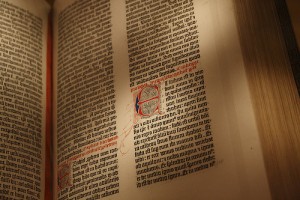
Have you ever picked up a book and thought: “Wow! This was written just for me! This is exactly what I needed to hear.” I have a suspicion that this is what St. Luke wanted each of us to think about the gospel he wrote.
In the very first line, he addressed his gospel to a person named “Theophilus.” In Greek, Theophilus means “Lover of God”- which is what we are! Luke, it would seem, wrote his gospel just for us. And as we read it, I’d bet he’d want us to think: “This is exactly what I needed to hear!”
Luke’s gospel is distinguished by themes of thankfulness, joy, and praise. It paints for us a portrait of Jesus who is prayerful, merciful, forgiving, concerned for the poor and outcast, and welcoming of all people- men and women, Jew and Gentile- into the kingdom of God. And Jesus is depicted as teaching at a series of meals as he journeys toward Jerusalem, where he celebrates a final meal- the Last Supper- at which he gives us a meal, the Holy Eucharist.
Like Jesus, we are on a journey to Jerusalem- the heavenly Jerusalem. And as we walk with Jesus, Luke would have us be nourished by the Eucharistic meal, so we can become more prayerful, joyful, thankful, compassionate, merciful, forgiving, and welcoming like Jesus- in other words, a true “Theophilus,” or lover of God.
Deep down, this is what we all want to become. That’s why Luke wrote his gospel, just for us. So we might say: “This is exactly what I needed to hear!”
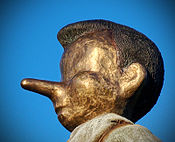
A cartoon I once saw featured a boss speaking to his staff. “Honesty may be the best policy,” he said, “but it’s not our company policy.” And while it may be funny, this cartoon reflects the sad truth that lying in our society has reached epidemic proportions. For instance, newspaper headlines speak of corporate scandals, fraudulent accounting practices, and insider trading. In schools today, surveys have shown that a majority of students cheat on tests or download research papers which they try to pass off as their own work. Job seekers pad their résumés with fake or exaggerated information. Car odometers are rolled back, expense accounts are padded, and spouses fib about how much they spent on that new dress or set of golf clubs. A recent university study revealed that a quarter of people’s “most serious lies” related to an affair. And considering that Jesus in today’s gospel spoke of the need to pay one’s taxes, it needs to be said that tax cheating is all too common.
Jesus gave this teaching after he had been approached by his opponents. They said to him, “Teacher, we know that you are a truthful man and that you teach the way of God in accordance with the truth.” The irony is, when they said that they believed Jesus to teach the truth, they were lying through their teeth. In a sense, all of us can relate to this experience of our Lord, because all of us have been lied to. And let’s face it: We’ve probably told a few lies ourselves.
People tell lies for all sorts of reasons. In our highly competitive society, , lies can help one gain an advantage over others and stand out from the crowd. And if everyone else is doing it, that makes it all the easier! Some people lie to get their “fifteen seconds” of fame- like the guy a few years ago who made up the story about witnessing one of the sniper attacks.
Other people, seeking revenge against someone they believe has hurt them, may start a vicious rumor. Some experience a thrill from lying because it gives them a feeling of having power over others. It’s not uncommon to lie in order to avoid punishment. You may remember Susan Smith, who in 1994 strapped her two boys into her car and then sent them into a lake to drown. If you recall, she tried to stay out of trouble by going on TV, saying her sons had been kidnapped, and pleading for their safe return. Finally, low self-esteem can lead some to exaggerate or even make up accomplishments or achievements, in order to feel better about themselves or impress others. For instance, phony war stories allow people with feelings of inferiority to be linked with the virtues of loyalty and courage.
Most of us believe that we do what we do for good reasons and with honest intentions. Therefore, when we lie, it’s easy to rationalize that what we’re doing is justified or even the right thing to do. We can think things like: “Nobody’s really getting hurt, so there’s really nothing wrong.” Or “I cheated on taxes or insurance- but only to get the money I rightly deserve.” Or “If everyone else lies on their resume, I better do it too so I won’t lose that job offer I want.” Or “If I told the truth about the way I feel, we’d just get in a fight and things would become even worse.”
As Christians, however, we are called to honesty and truth. This doesn’t mean that we have to be a bull in a china shop. We do need to be prudent and discrete in revealing the truth, because we don’t want to needlessly hurt or antagonize others. And this doesn’t mean that everyone has the right to hear the truth from us. To give an extreme example, no one would have to tell the Nazis where a Jewish family was hiding.
Nevertheless, God insists that we be honest people. As we all know, “You shall not bear false witness against your neighbor,” is one of the Ten Commandments. Indeed, God himself is truth, Jesus his Son reveals the truth, and they have sent the Holy Spirit of truth into our lives that we might walk in the truth and bear witness to it. Any lie, then, is really an offense against God himself.
Honesty and truthfulness are also requirements for justice and are essential for a civil society. “Men could not live with one another,” wrote St. Thomas Aquinas, “if there were not mutual confidence that they were being truthful to one another.” This is because lies always hurt those around us- even when we think they don’t.
In addition, Jesus has promised that the truth will set us free. It will free us from having to cover our tracks, live with shame and guilt, and the fear of our lies being discovered and exposed. The truth will liberate us to take off our masks and just be ourselves. It will also result in better relationships, less stress for ourselves, and less anger from others.
There is a cost to being honest! We may lose that job offer to the person who lied on their resume. We may have to “face the music” for something we’ve done or accept the reality of who we are, and not who we’ve been pretending to be. Our co-workers may resent us, because as one human resources expert has said, “employees who operate honestly and ethically often inspire anger, guilt, and resentment (from others).” Maybe we’ll end up with less money than we may have had if we’d fudged our tax returns. Nevertheless, we’ll be blessed with the assurance that God smiles upon our honesty, and we can unite our suffering with those of Jesus upon the cross.
As Mother Teresa once wrote, “If you are honest and frank, people may cheat you; be honest and frank anyway. You see, in the final analysis, it is between you and God. It was never between you and them anyway.”
Readings for today’s Mass: http://www.usccb.org/bible/readings/101611.cfm
The Gospel today contains lots of interesting juxtapositions: Hatred for Jesus, but grudging respect for him, real questions, versus rhetorical questions, politics and faith, duties to Caesar and duties to God. The word “juxtaposition” is from the Latin juxta (meaning “near”) and positio (meaning “place or position”). Hence a juxtaposition is the placing of two things near each other to see how they are similar and yet different. Usually, in English, a juxtaposition emphasizes differences more than similarities.
Let’s look at these one by one, spending the most time on the juxtaposition of our duties toward God and toward “Caesar.” The essential lesson in all these juxtapositions is that God will not be reduced to fit into our little categories. He is God, not man.
Juxtaposition 1 – The Enemy of my enemy is my friend. – The Gospel begins by describing an extremely unlikely set of “bedfellows.” The text says, The Pharisees went off and plotted how they might entrap Jesus in speech. They sent their disciples to him, with the Herodians. A very unlikely set of allies here. The Pharisees hated the Herodians. It was a combination of political and racial hatred; just about as poisonous as you could get in the ancient world. Yet they both agreed on this: This Jesus has to go.
Here is an important teaching, if you’re going to be a true Christian: the world will hate you. Too many Christians think some segment of the world will agree to live in peace with us, and so we strive to forge allegiances with it. In the modern American scene some think that the Republicans, or the Democrats are natural allies for us. As we will discuss later, we really don’t fit well into either party, or, frankly, any worldly club.
Catholicism is an “equal-opportunity offender” if it is proclaimed in an unabridged form. Issue by issue, we may appeal to one political party or another. But taken as a whole, we’re a nuisance: Pro-life, traditional family values, over here, Immigrants rights, contra capital punishment, affordable housing, etc., over there. But in the end we both please and annoy at the same time. Which is another way of saying we don’t fit into the world’s categories, and everyone has a reason to hate us.
Welcome to Jesus’ world where the Herodians and Pharisees, who agree on nothing, do agree to hate Jesus.
Juxtaposition 2 – Prophet and Lord or Political talking head? In their opening remarks to Jesus, his enemies give him grudging respect, but not to actually praise him, rather to provoke him. They say, Teacher, we know that you are a truthful man and that you teach the way of God in accordance with the truth. And you are not concerned with anyone’s opinion, for you do not regard a person’s status. Tell us, then, what is your opinion…
Now the juxtaposition here is to use praise as a pretext, to use praise to provoke. In effect, they think they can they can force a definition on Jesus: “You’re the Man, You’re the prophet….You’re the answer man….you’re the only one around here who tells the truth no matter what.” Now none of these things are false and they bespeak a grudging respect for Jesus.
But they are only using this to draw Jesus into a worldly debate well below his pay grade. They want Jesus to take sides in a stupid human debate over politics and worldly power. They want him to get arrested and killed over something not worth dying for.
Prophets die for the truth revealed by God, not for who the “big cheese” should be in human affairs, and who human beings think are the best. They want Jesus to opine as if he were some sort of talking head on T.V., rather than the prophet and Lord that he is. A question of this sort is not worthy of Jesus’ attention. Ask this of the local Senator or mayor, but leave God out of human political distinctions and camps do not expect him to take sides. He is beyond our distinctions and will not be confined by party lines, national boundaries, political philosophies and the like.
We may well debate that certain systems better reflect the Kingdom than others, but in the end, God cannot be reduced to being an Republican, a Democrat, or for that matter an American. He is God, and he transcends our endless debates and camps. He is not a talking head, he is God.
Juxtaposition 3- Real or Rhetorical? The odd coalition of Jesus haters asks him a question: Is it lawful to pay the census tax to Caesar or not? Though this is in the form of a question, it is not a sincere question, it is a rhetorical question.
Generally speaking rhetorical questions are statements or arguments in the form of a question. If I say to you, “Are you crazy?” I am not really looking for an answer. Though it is in the form of a question, I am really making a statement: “You ARE crazy.” This is what takes takes place here. The questioners already have their own opinion, and they are not about to change based on any answer Jesus would give. They don’t really want an answer per se. They just want something to use against Jesus.
If he says, “Yes, pay the taxes.” That is politically incorrect and will make him unpopular with the crowds. If he says “No, don’t pay the taxes” he gets arrested and will likely be executed.
In the end Jesus calls them what they are: hypocrites, a Greek word which means “actor.” And that is what they are, and are doing. This whole thing is an act. No real answer is sought, just a showdown. This is not about the truth, it is about a trap.
But Jesus will have none of it. He will not be reduced to human distinctions and categories. The truth he proclaims transcends the passing political order and struggles for human power. He will not be drawn in to declaring one side or the other better. Rather, He will apply the ruler of truth evenly to all.
He is Reality in the face of rhetoric, Perfection in the face of politics, Divinity in the face of division.
Juxtaposition 4 – God and Caesar – Jesus says, simply, and in a way that transcends worldly “all or nothing” scenarios: Then repay to Caesar what belongs to Caesar and to God what belongs to God.
This of course generates the wish for elaboration. But in our demands for more detail, we too often seek to conceal the fact that we really know the answer. And we also betray the need of the flesh to specify everything so as to control and limit its impact.
But if a list is demanded we might include some of the following things we ought to “pay” to Caesar (i.e. in our scenario, pay to our Country and locale):
To obey all just laws
Pay legally assessed taxes
Pray for our country and leaders.
Participate in the common defense based on our abilities and state in life.
Take an active and informed part in the political process
Engage in movements of necessary and on-going reform
Contribute to the common good through work, domestic and market based, and through the sharing of our abilities and talents.
Maintain strong family ties, and raise disciplined children well prepared to contribute to the common good and the good order of society.
Encourage patriotic love of this Country
Strive for unity and love rooted in Truth.
And we might include some of the following in what we owe to God:
Adoration, love and gratitude
Obedience to his Word and Law
Worship
Repentance
Support of his Church by attendance at sacred worship, financial support and sharing of our gifts and talents
Proclamation of his Word by witness and in verbal ways
Devoted reception of the Sacraments.
Raising our Children in His truth and in reverence of Him
Evangelization – making disciples
Preparing for death and judgement through a holy and reverent sojourn here
A glance at these lists reveals however that there is overlap, and one would expect this with God. For, He defies many of our human categories and distinctions. In effect we see a setting forth of the great commandment of Love: that we should love the Lord our God with all our soul, strength and mind, and our neighbor as our self (e.g. Matt 22:37). For, while God is not Caesar and Caesar is not God, yet love unites both categories.
Hence we see that to love our Country is to love our neighbor. To work for, support and be involved in the common good is to love our neighbor. And to love our neighbor whom we see is to begin to love God whom we do not see. Further, to seek to reform our land, secure justice, and ensure unity rooted in truth, is to help usher in the Kingdom of God. Yet again, to be rooted in God’s law, walk in his truth and raise our children as strong and disciplined disciples of the Lord is to bless this Country. To obey God and to walk in sobriety, love and self-discipline, is to render, not only to God, but to also have the ingredients of good citizenship.
However, it must be clear that God is, and must be our supreme love. And So Jesus is not setting forth a mere equivalence here. It remains a sad fact that this world is often at odds with God. And thus, we, who would be his disciples, must often accept the fact that we will be seen as aliens from another planet, according to this world. As we have already set forth, neither Jesus, nor we, should expect to fit precisely into any worldly category or club. We will be an equal-opportunity irritant to any large group. If you are going to be a faithful Catholic, expect to be an outsider, and outlier, and an outcast.
Let’s move from the abstract to the real. Is the Catholic Church Republican? Democrat? And what are you? As for me:
I’m against abortion, and they call me a Republican
I want greater justice for immigrants, and they call me a Democrat
I stand against “Gay” “Marriage,” and they call me a Republican
I work for affordable housing, and stand with unemployed in DC, and they call me a Democrat
I talk of subsidiarity and they say: “Republican, for sure.”
I mention the common good, and solidarity and they say, “Not only a Democrat, but a Socialist for sure.”
Embryonic Stem cell research should end, “See, he’s Republican!”
Not a supporter of the death penalty, standing with the Bishops and the Popes against it…”Ah, told you! He’s really a Democrat!…Dye in the wool and Yellow Dog to boot!”
Gee, and all this time I just thought I was trying to be a Catholic Christian. I just don’t seem to fit in. And, frankly, no Catholic should. We cannot be encompassed by any Party as currently defined.
Rendering to God comes first. But too many people today are more passionate about their politics than their faith. They tuck their faith under their politics and worldview. They more more inclined to agree with their party, than the Church, or even the Scriptures. And just try to tell them that, and they’ll say you’re violating Church/State barriers (a phrase not in the Constitution, by the way), or that since something is not infallibly defined (as they determine it), and thus they are free to entirely ignore the teaching of the Bishops, the Pope and/or the Catechism on any number of matters.
Hence the question goes up: Is God really first? Is his Word really the foundation of our thoughts and views? Or are we just playing games. Loving this world and working for the common good are not at odds with our love for God. But submitting to worldly categories and human divisions, and permitting them to drive our views IS most often opposed to God, who will not simply be conformed to human political movements.
God has set forth the Catholic Church to speak for him, but he has not anointed any political movement, or worldly organization to speak as such. No Catholic ought to surrender to artificial and passing distinctions, organizations, or permit worldly allegiances to them to trump what the Scriptures and the Church clearly proclaim. Sadly today, many do, and in such wise seem far more willing to render to some version of “Caesar” than to render first obedience and allegiance to God, and to the Church which speaks for Him. The Church is an object of faith, a political party is not. Render to God what is God’s.
This Song says, God and God alone is fit to take the Universe’s Throne:
“Everyone has a little dirty laundry.” Or so proclaimed an ad for a popular TV show about desperate housewives. Well, I don’t know if everyone has a little dirty laundry, but I do know that today’s gospel speaks to us when we do. Jesus reminded us that while we might keep secrets from other people, we can’t keep them from God. He sees and knows all that we do, and he holds us accountable for it.
Yet at the same time, God wants to forgive us of these things. We might say that while God sees all our dirty laundry, he wants to wash it for us too! Or as St. Augustine once said, “The one who made you is watching you, and the one who called you is helping you.”
It’s important that we me realize this, because sometimes our “dirty laundry” can fill us with so much shame that we become afraid to bring it to the Lord. We worry that we’ll be rejected or condemned. Then we avoid confession, we avoid Holy Communion, and sometimes we avoid church altogether.
But this is not what God wants us to do. He wants instead to release us from our shame and lift the burden of our guilt so he can fill us with his peace and joy. As the author of today’s psalm wrote, “I said, ‘I confess my faults to the Lord, and you took away the guilt of my sin.’”
In my experience of working with permanent deacons, many applicants to our formation program confess that they don’t think they’re worthy enough to answer such a high calling. They often say this as if such a belief is a bad thing. In reality, however, it’s a good thing. It means that a person is approaching ordained ministry with reverence and humility, and not with pride, indifference, or a sense of entitlement. To be a deacon is a wonderful privilege. But it is also a great responsibility. To him whom God has given much, much will be expected.
I think we see this reflected in today’s gospel. Jesus spoke very stern words of judgment to certain scribes and Pharisees. Here, as always, Jesus harshest words are for those in religious authority. Jesus could be very gentle with thieves, prostitutes, adulterers, even his own executioners. But he was very different when dealing with religious authorities- the bishops, priests, and permanent deacons of his day.
He held them to a higher standard, because they should have known better, and because their attitudes, practices, and beliefs harmed many other people’s relationship with God. Think about what we have seen and experienced in our own day: If ministers are arrogant or lazy, their parish suffers; if they teach false doctrine, the sheep are led astray, and divisions are created; if they cause a scandal, the church is wounded, and the world laughs.
Today’s gospel should challenge all ministers of the gospel to be always mindful of the great trust God has placed in them. Indeed, it should challenge all the baptized, because through that sacrament we become public witnesses to Christ. This shouldn’t fill us with fear, because God is merciful and all things are possible with him. But it should fill us with awe for what God expects of us, and commit us to do his will and seek his kingdom above all else, that we might be faithful servants of the one who came only to serve.
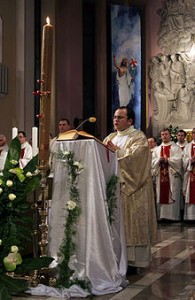
I’m going to let you in on a little secret. You’ve heard of “preaching to the choir?” Sometimes we preachers are guilty of that. More often than not, however, the words we preach are directedprimarily at ourselves- whether we’re conscious of it or not. One of the great preachers of the early church, St. John Chrysostom, said that if a preacher doesn’t practice what he preaches, he shouldn’t be stopped from preaching, because his own words might convince him to change.
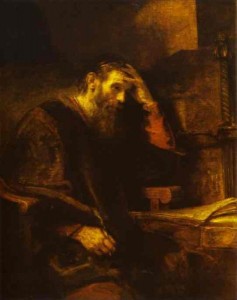
I have a suspicion that St. Paul’s words in today’s second reading were intended for himself as much as for the Philippians to whom he was writing. He encouraged his readers not to have anxiety, but instead to pray and think about positive and lovely and true things. Certainly this was advice that the Christians of Philippi needed to hear! But Paul himself had worries too. He admits as much in his first letter to the Corinthians, in which he speaks of his “anxiety for all the churches.” He worried that they would be torn apart by divisions or led astray by false teaching. It’s possible that he was concerned about his own acceptance as an apostle, as he wasn’t part of the original twelve selected by Jesus. And because his was in constant danger of being imprisoned and tortured, we can imagine his sometimes being worried about this too. On one trip, for instance, Paul admits that he and his companions “were utterly weighed down beyond our strength, so that we despaired even of life.”
How Paul dealt with his own anxiety is surely reflected in the advice he gave the Philippians; he was preaching to himself as much as he was preaching to them. Of course, he’s preaching to us too. And we would do well to pay attention, because many of us, in some way or another, struggle with anxiety, worry, and fear- particularly these days. People worry about the economy, their jobs, retirement, house values, terrorism, the conflicts in Iraq and Afghanistan, and the effects of global warming. And let’s not forget worries about health, kids, reputations, the effects of growing older, and the inevitability of death. Such worries can paralyze us, consume our thoughts and energies, ruin our mood, strain our human relationships, and effect our relationship with God too. We get angry with God, forget all the good things he’s done for us, lose sight of his presence in our lives, and worst of all, come to doubt his care and love for us. Yet this doesn’t need to be the case. St. Paul, in spite of everything he might have worried about, never lost his trust in God. He always remained grateful even in the most difficult circumstances, and he never failed to persevere in faith. The inspired advice he gave the Philippians certainly worked for him. Perhaps we should take it to heart too.
To begin with, Paul explains that when we begin to worry, we should lift up prayers and petitions to God. This may sound simple, even naïve. But have you ever been so consumed with worry that you forget to pray? We wring our hands, but forget to fold them. Not praying, however, only makes our worry worse. Yet when we pray, we put the whole matter in God’s hands, ask him to give us the help that only he can give, are reminded that he loves and cares for us, and we allow him to give us direction on how to deal with the things we’re worried about. Have you heard the slogan, “Give your worries to God each evening; he’s going to be up all night anyway?” It’s corny, but true. Whenever we find ourselves worrying, we should turn that into a prayer opportunity. Even if the only prayer we can muster is “Help!”
In addition to praying, St. Paul says, we also need to change the way we think. Instead of letting our hearts and minds be filled withanxious thoughts, we should think instead of those things which are true, honorable, just, pure, lovely, gracious, and excellent. Paul knew that we can lose sight of these things when we’re worried, and in so doing, it warps our view of the world. We see only the darkness, and are blinded to the light. Have you ever been so consumed with worry that you failed to notice the sights and smells of a beautiful morning when you stepped outside? However, when we make an intentional effort to think of those things Paul mentioned, we’re reminded of what’s good and beautiful in our world, all of which comes from God’s loving hand. And whenever we remember the good things of God, we remember the goodness of God himself.
It’s important to recall that Paul didn’t make any false promises or create unrealistic expectations. He didn’t say that praying and changing the way we think would take away our difficulties.He wrote his advice, in fact, while he was in prison and in great danger. He knew full well that sufferings and hardships are inevitable for anyone who chooses to follow a crucified Lord. We can’t avoid it. What we can do, however, is avoid losing sight that God can bring good out of evil, and that Jesus’ victory over evil offers us an eternal life without it. Praying and thinking won’t erase our problems. But they can replace anxiety and despair, with trust and hope.
Paul may very well have been preaching to himself as much as he is to us. But we can be grateful for that, because his advice is so timely and true, and we can see the good fruit that Paul’s practices bore in his life. He is, after all, a saint! However, there is one final thing Paul wrote today that’s intended exclusively for us: his request that we imitate him. For if we do, “the peace of God that surpasses all understanding will guard your hearts and minds in Christ Jesus.”
I cannot draw or paint. Yet I have always marveled at how some can take an empty canvas and bring it to life with color, form, depth, and shadow. And, little by little, from the painter’s brush and soul a picture emerges. So too with sculpting. A mere block of marble, with each blow of the sculptor’s tools, it comes to resemble the form of a human being or some other reality with nature.
Some years ago, there was a painter, on PBS (Bob Ross) who would, over the course of a half hour paint a picture and describe what he was doing as he went. I watched that show most every week for a number of years and, though I watched him, saw what he did, and even heard him describe the techniques, I never really ceased to be amazed by the mystery before me. How did he do it? Yes, he spoke of method and technique, but there was some deeper mystery at work; a power of the soul, a gift. He claimed we all have it. But I am more inclined to think some have it as a special gift.
Michelangelo famously said, Every block of stone has a statue inside it and it is the task of the sculptor to discover it. He also said, I saw the angel in the marble and carved until I set him free. Yes, but how does he see it? How does he set it free? Indeed, another great mystery and faculty of the human soul of some.
As with music, the art of painting and sculpting seems a unique capacity of the human soul. Animals do not draw, they do not sculpt, they do not even appreciate art. It is a special gift to the human person to be captivated by beauty, and for beauty, once seen and experienced, to emerge from his soul in expressive praise. There are special glories and a unique gifts given only to the human person, a mysterious gift to be sure. It is caught up in our desire for what is good, true and beautiful, caught up in our soul’s ultimate longing for God.
Perhaps Michelangelo should have the last word: Every beauty which is seen here by persons of perception resembles more than anything else that celestial source from which we all are come.
Picture: A Painter in his Studio by Francois Boucher
Here’s a painter a work on a speed painting with a surprise end:
–
Here’s a video of Bob Ross, the Joy of Painting show I mentioned above. In this brief passage he teaches us to paint a mountain and gives a little philosophy as well.
–
–
If you have time this video shows a remarkable transformation of a block of marble to a face.
–

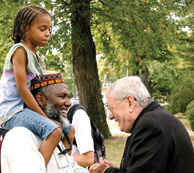 A priest from Nepal once shared with me his amazing conversion story. Born and raised a Hindu, Fr. Silas Bogati became involved with the American “hippie” drug scene of Katmandu in the 1970’s. He was headed down the wrong path until he was introduced to Jesus Christ by a street preacher. Fr. Silas was ultimately was ordained the first native-born Nepalese priest. But his conversion came at a terrible cost. When he became a Christian, Fr. Silas was shunned by his Hindu family because, according to the caste system, he had become an “untouchable.”